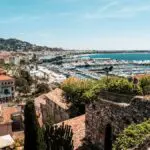
From Castle Hill, you can see two sides of Nice in a single walk. To the west, the rooftops of the old town meet the curve of the Baie des Anges. To the east, boats sit beneath the colourful façades of Port Lympia. Between them lies a city whose history stretches from prehistoric hunters to the opera audiences of today.
If you’re visiting Nice for the first time, spend a morning exploring Vieux Nice and Castle Hill, then follow the waterfront towards the port. Save Cimiez for a separate outing, when you have time to wander through the monastery gardens and see the Roman remains.
1. Castle Hill
The Colline du Château is a good place to get your bearings. Look west across the old town and the Promenade des Anglais, then cross the park for a view over Port Lympia. The fortress that once guarded the city survives in fragments. From the top, you can see why the site mattered, with views over both the bay and the harbour entrance.
Take the stairs if you fancy a climb, or check whether the lift near Rue des Ponchettes is operating. Leave time for the waterfall and the quieter paths through the park.
Visitor information for Castle Hill
2. Vieux Nice
Start at Cours Saleya and take whichever narrow street looks most inviting. Shuttered houses, small shops and Baroque churches sit close together in the old town. The lanes around Rue Droite and Place Rossetti are especially good for a slow wander.
For a local snack, order socca, a thin chickpea pancake served hot, with a crisp edge and a grind of black pepper. It’s an easy stop between the market and the cathedral.
Explore Cours Saleya in Vieux Nice
3. Sainte-Réparate Cathedral
The tiled dome of Sainte-Réparate Cathedral is easier to spot from Castle Hill than from the narrow streets around it. At ground level, you come upon the cathedral as the lanes open into Place Rossetti. Step inside to see its decorated side chapels and Baroque interior.
Address: 3 Place Rossetti, Vieux Nice.
Visitor information for Sainte-Réparate Cathedral
4. Palais Lascaris
A few streets away, Palais Lascaris gives you a sense of how a noble family lived in the heart of old Nice. The grand staircase and painted ceilings are worth seeing, as is the collection of historic musical instruments, which includes ornate harps and early keyboards. Pair it with the cathedral to see how Baroque taste carried from the church into the home.
Address: 15 Rue Droite, Vieux Nice.
Palais Lascaris visitor information
5. Cimiez Monastery and the Roman Remains
Begin at the Franciscan monastery, then walk through its gardens for views over the city. Nearby, the olive grove and the remains of the Roman settlement of Cemenelum make it easy to spend a few hours in the neighbourhood.
The Roman baths are worth seeing alongside the gardens. Within a short walk, you get a sense of how the same hillside served different communities over the centuries.
Starting point: Avenue du Monastère de Cimiez.
Visit Cimiez Monastery and the Franciscan Museum
6. Grotte du Lazaret
Beyond the port, at the foot of Mont Boron, the Grotte du Lazaret takes you back to a much earlier Nice. Animal bones, stone tools and human remains found in the cave help archaeologists understand the people who sheltered here and the animals they hunted.
It’s a natural extension of a walk around Port Lympia. Check the visiting arrangements before heading out if you want to go inside.
Address: 33 bis Boulevard Franck Pilatte.
Plan your visit to the Lazaret Cave
7. Monument aux Morts de Rauba-Capeù
Follow the coastal road around the base of Castle Hill and you’ll reach Nice’s Monument aux Morts, set directly into the rock. The memorial honours those from Nice who lost their lives in the First World War. Its scale is striking from across the road, while its sculpted reliefs reward a closer look.
Location: Near Place Guynemer, on the waterfront route to Port Lympia.
Discover the Monument aux Morts
8. Opéra de Nice
The Opéra de Nice stands just off Cours Saleya, close to the waterfront. The present building dates from the rebuilding that followed a fire in 1881. Its ornate auditorium offers a glimpse of the city’s cultural life in the late nineteenth century.
If you’re staying overnight, check what’s on before you go. An opera, ballet or concert is a chance to experience the building during a performance.
Address: 9 Rue Raoul Bosio.
Opéra de Nice tickets and visitor information
9. Notre-Dame du Port
At Place de l’Île de Beauté, the columned façade of Notre-Dame du Port faces the boats of Port Lympia. See it from across the harbour first, where you can take in the church and the surrounding façades together, then walk around the quay for a closer look.
Location: Place de l’Île de Beauté, Port Lympia.
Visitor information for Notre-Dame du Port
10. Muséum d’Histoire Naturelle de Nice
The Natural History Museum of Nice tells the story of the landscape around the city. Its collections introduce the plants, animals and geology of a region where the Mediterranean coast lies close to the foothills of the Alps. It makes a good companion to a visit to the Lazaret Cave, especially if you’re curious about the environment in which Nice’s earliest inhabitants lived.
Address: 60 Boulevard Risso.
Natural History Museum visitor information
Get to Know Nice Beyond the Landmarks
A morning in Vieux Nice gives you one impression of the city. An afternoon in residential Cimiez, on the western hills of Fabron or in Saint-Roch gives you another. If you’re getting to know Nice with a view to buying a home, visit the neighbourhoods at the times you’d actually use them. Walk to the shops, try the journey into town and see how the streets feel in the evening.
Explore our neighbourhood guides to Nice Cimiez, Nice Fabron and Nice Saint-Roch.
 //