
Securing a legacy through French Riviera real estate demands insight and timing. For those eyeing luxury properties in Cannes, understanding how prime locations shape long-term value is crucial. The transformation of major cities like Paris by projects such as the Grand Paris Express has already shown how infrastructure sparks new investment opportunities. This guide empowers you to identify prime locations and emerging investment hotspots so your acquisition in the South of France delivers enduring security, prestige, and sustainable growth.
Table of Contents
- Step 1: Identify Prime Locations And Investment Hotspots
- Step 2: Analyse Market Trends And Property Values
- Step 3: Secure Financing And Legal Representation
- Step 4: Conduct Professional Inspections And Due Diligence
- Step 5: Finalise Purchase And Verify Legal Compliance
Quick Summary
| Main Insight | Detailed Explanation |
|---|---|
| 1. Identify prime locations | Focus on Paris areas transforming through infrastructure projects for high appreciation and rental yield. |
| 2. Analyse market trends | Regularly track price movements and market cycles in Paris to make informed investment decisions. |
| 3. Secure essential financing | Initiate mortgage approval early and understand the notarial process to protect your investment. |
| 4. Conduct thorough due diligence | Hire professionals to inspect properties and verify legal compliance before finalising purchases. |
| 5. Ensure legal compliance at closing | Verify all legal documents and conditions before signing the deed to confirm ownership and protect interests. |
Step 1: Identify Prime Locations and Investment Hotspots
Finding the right location is where investment success truly begins. In Paris, location determines not only current value but future appreciation potential, rental yield, and long-term stability. This step guides you through identifying prime areas and emerging hotspots that align with your investment timeline and wealth preservation goals.
Start by understanding Paris’s transformation through major infrastructure projects. The Grand Paris Express and Olympic developments are reshaping the metropolitan region, creating new investment opportunities around enhanced metro connectivity and urban revitalisation zones. These infrastructure improvements increase accessibility, boost property values, and strengthen rental demand, particularly in secondary submarkets developing around these hubs. Areas adjacent to new metro lines and scientific clusters such as Paris-Saclay University and biotech campuses represent genuine growth corridors where values appreciate steadily alongside economic development.
Next, evaluate established luxury markets against emerging neighbourhoods based on your investment philosophy. Central Paris locations, particularly the 7th arrondissement and surrounding prestige addresses, command premium valuations due to limited supply and consistent international demand from high-net-worth buyers. These areas suit investors prioritising capital preservation and stability. However, neighbourhoods like Belleville and Ménilmontant offer compelling alternatives for those seeking growth potential. These areas combine affordability advantages with active urban regeneration, strong rental demand from younger professionals, and the kind of neighbourhood momentum that historically precedes significant appreciation cycles. The trade-off is clear: established prime locations offer stability and immediate prestige; emerging hotspots offer growth potential and stronger rental yields.
Walk these neighbourhoods yourself rather than relying solely on market reports. Notice foot traffic patterns, quality of local amenities, and the character of new developments underway. Talk with local property managers about rental activity and tenant profiles. Examine transport links not just to city centres but to employment hubs like the financial district and tech clusters. Investigate planning permissions and future development pipelines, which often signal where municipal investment is flowing. Check school districts if your investment thesis includes family-orientated rental markets. Understanding a neighbourhood’s trajectory requires time on the ground, conversation with local professionals, and your own instinct about where Paris is genuinely growing.
Consider your exit strategy when selecting locations. Prime central addresses attract international wealth transfers and provide liquid resale markets. Emerging neighbourhoods offer stronger appreciation but may require longer holding periods to realise full value. Secondary markets near transport improvements suit investors comfortable with longer timeframes but confident in urban development patterns.
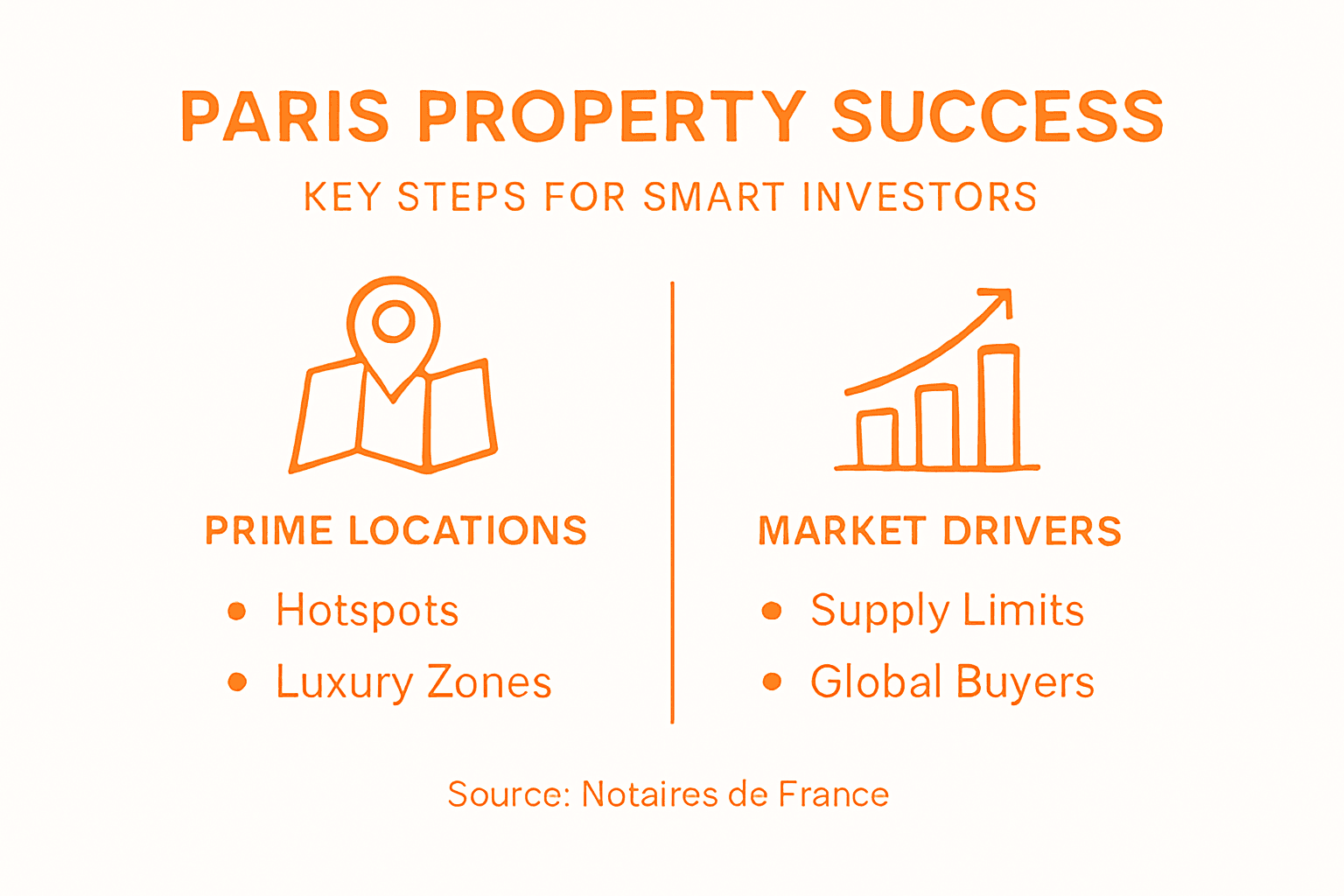
Here is a comparison of established prime locations and emerging hotspots for Paris property investment:
| Neighbourhood Type | Appeal | Risk Profile | Typical Investor Objective |
|---|---|---|---|
| Prime Central (e.g. 7th arrondissement) | Prestige, stability | Low risk, high liquidity | Wealth preservation, capital security |
| Emerging Hotspot (e.g. Belleville) | Growth potential, stronger yields | Moderate risk, longer holding | Capital growth, higher rental returns |
Professional tip Visit neighbourhoods at different times of day and seasons to assess genuine atmosphere and neighbourhood stability rather than relying on initial impressions or marketing photographs alone.
Step 2: Analyse Market Trends and Property Values
Understanding market dynamics separates shrewd investors from those who chase opportunities blindly. This step teaches you how to read Paris property market signals, interpret value trajectories, and position your investment at the optimal moment in the market cycle. You will learn to look beyond headlines and recognise the underlying patterns that drive returns.
Begin by establishing baseline data for your chosen arrondissement. The Paris market currently averages around €9,470 per square metre, though this figure masks enormous variation across the 20 arrondissements, each following its own trajectory influenced by local factors such as transport connectivity, cultural amenities, and neighbourhood reputation. Recent market analysis shows that after a correction phase in 2022 and 2023, the market is stabilising with moderating price declines and stabilising transaction volumes. This recovery pattern matters enormously because it signals where the market sits within its cycle. If you are entering an arrondissement during price stabilisation rather than peak appreciation, your downside risk diminishes significantly whilst upside potential remains intact.
Track price movements across multiple timeframes. Monthly fluctuations tell you about seasonal patterns and transaction velocity, but quarterly and annual trends reveal genuine market direction. Watch which arrondissements are recovering first from the 2022-2023 correction. These are typically areas with strong structural demand foundations such as proximity to employment centres, excellent schools, or cultural attractions. Look for transactions increasing alongside prices stabilising, which indicates genuine demand rather than speculative activity. Compare asking prices to actual sale prices, which often differ substantially. A gap between asking and sold prices indicates buyer caution; conversely, sales matching or exceeding asking prices signal strong underlying demand. Examine time on market metrics. Properties selling within weeks command premium values and suggest undersupply relative to demand. Properties lingering for months indicate either overpricing or genuine market resistance that your due diligence must investigate.

Consider what underpins price resilience in Paris specifically. Limited housing supply, strong international interest, and cultural desirability create a structural foundation for value preservation that transcends short-term corrections. This means Paris properties recover from downturns more reliably than secondary markets. Growth is expected to return by spring 2025 according to current projections, which suggests that acquisitions made during the current stabilisation phase position you advantageously before a recovery cycle. However, verify these projections against actual transaction data rather than accepting forecasts uncritically.
Analyse supply constraints in your target area. Fewer available properties typically means stronger pricing power and rental demand. Investigate planning permissions and new construction pipelines. An arrondissement with limited new supply competing for demand will appreciate faster than one facing substantial new inventory. Talk with local agents about their pipeline of available properties and months of supply. Markets with three months or fewer of supply generally favour sellers and property owners; markets with six months or more favour buyers.
Professional tip Track price trends across at least six to twelve months of data to distinguish genuine market direction from seasonal noise, and always compare multiple arrondissements to understand whether trends are local or market-wide.
Step 3: Secure Financing and Legal Representation
Financing and legal structures form the foundation of a protected investment. This step guides you through obtaining mortgage financing, understanding the notarial process, and assembling the professional team that safeguards your interests throughout the transaction. Getting these elements right prevents costly mistakes and ensures compliance with French property law.
Start your financing process early because mortgage approval typically takes one to two months and banks conduct thorough credit checks and property valuations before committing funds. Foreign buyers like yourself face no restrictions on property ownership in France, which represents a significant advantage for North American and British investors seeking European assets. However, mortgage conditions for foreign buyers tend to be stricter than for French citizens, with lenders often requiring higher down payments and more extensive documentation. Banks assess your creditworthiness carefully, so prepare comprehensive financial statements, tax returns from the previous three years, and proof of employment or income stability. The stronger your financial profile, the better interest rates and terms you will negotiate. Consider approaching multiple lenders because rates and conditions vary substantially. Alternative lenders operate actively in the French market alongside traditional banks, and some specialise in non-resident financing with more flexible requirements. Property valuation by the lender’s surveyor typically costs between €500 and €1,500 and is necessary before mortgage approval proceeds.
Understand the legal framework governing your purchase. French property purchase requires preliminary contracts, notary involvement, and registration fees totalling approximately six to eight per cent of the purchase price. Notaries are essential gatekeepers in French transactions; they oversee legal compliance, conduct title searches, register the deed with land registries, and ensure all documentation meets legal requirements. Their role differs significantly from notaries in North American jurisdictions, as French notaries function as impartial transaction facilitators with substantial legal authority. The notary’s fee is typically split between buyer and seller but is non-negotiable as it is set by law. Beyond the notary’s role, engage a lawyer specialising in real estate for additional protections. Your lawyer reviews contracts before signature, identifies potential issues the notary might not highlight, and advocates specifically for your interests. This dual representation appears redundant to some investors but proves invaluable when complications arise. A competent lawyer costs €2,000 to €5,000 depending on transaction complexity but provides insurance against costly errors.
Secure your mortgage documentation carefully. Mortgages require notarised deeds for enforceability and can be registered with land registries to protect the lender’s security interest. Your lawyer should review mortgage terms before you sign, ensuring that conditions align with your financial planning and that penalty clauses for early repayment are reasonable. Request written pre-approval from your lender before making an offer on a property, which strengthens your negotiating position by demonstrating financial capacity and removes contingency uncertainty from the seller’s perspective. Maintain communication with your lender throughout the process and notify them promptly of any contract changes or delays.
Assemble your professional team before you start seriously shopping for properties. Identify a notary by asking for recommendations from your bank or lawyer, as notaries typically have established working relationships with mortgage lenders. Select a lawyer experienced with foreign buyers and non-resident purchases, as this specialist knowledge prevents misunderstandings about tax implications or residency requirements. Brief your team on your investment timeline and objectives so they understand your priorities and can anticipate issues.
Below is a summary of essential professionals and their roles in a French property purchase:
| Professional | Main Role | When Involved | Typical Cost Range |
|---|---|---|---|
| Notary | Legal transactions, title checks | From contract to closing | 6–8% of purchase price |
| Real Estate Lawyer | Contract review, buyer advocacy | After offer accepted, pre-closing | €2,000–€5,000 |
| Surveyor | Property inspection, condition report | During due diligence phase | €800–€2,000 |
| Mortgage Broker or Banker | Financing arrangement | Before offer, approval & closing | Varies, bank arrangement |
Professional tip Obtain written mortgage pre-approval before making any property offers, as this demonstrates serious buying capacity and allows you to negotiate confidently knowing your financial commitment is secured.
Step 4: Conduct Professional Inspections and Due Diligence
Thorough inspections and due diligence separate prudent investors from those who discover problems after signing contracts. This step guides you through comprehensive property evaluation, title verification, and risk assessment before committing your capital. Conducting detailed due diligence prior to signature gives you leverage to negotiate terms and protects your investment from hidden liabilities.
Begin with a structural and technical inspection by a qualified surveyor experienced with Parisian properties. Request a detailed survey covering the building’s foundation, roof condition, plumbing and electrical systems, heating mechanisms, and any evidence of water damage or subsidence. Parisian properties vary enormously in age and construction quality, from seventeenth century stone townhouses requiring specialist expertise to post-war apartment blocks with different vulnerabilities. Your surveyor should identify deferred maintenance costs and estimate remediation expenses for significant issues. This inspection typically costs between €800 and €2,000 depending on property size and complexity but provides critical baseline data for your investment decision. Beyond structural matters, request testing for hazardous materials including asbestos, lead paint, and radon gas, as these trigger regulatory compliance obligations and remediation costs. Ask your surveyor to assess energy efficiency ratings and potential renovation costs to meet modern standards, which affects both property value and long-term operating expenses.
Comprehensive due diligence extends beyond physical inspection to include title reviews, zoning checks, and investigation of liens or encumbrances that could affect your ownership rights or property use. Your lawyer should obtain a full title report from the land registry confirming clear ownership history and identifying any mortgages, easements, or restrictions registered against the property. Verify that the seller has authority to sell and that no disputes are pending regarding ownership. Request documentation confirming all property taxes and charges are paid to date, as unpaid obligations transfer to the new owner. Investigate zoning regulations to confirm the property’s permitted uses align with your investment strategy. If you envision rental income, verify that residential rental is permitted and subject to any local restrictions. Some Parisian arrondissements impose strict regulations on short-term tourist rentals or limit the percentage of apartments that can be rented within a single building, which directly impacts your rental yield assumptions.
Investigate the property’s financial history. Request five years of utility bills to understand operating costs and energy consumption patterns. Obtain copies of any homeowners association documents if applicable, including bylaws, recent meeting minutes, and reserve fund status. Examine whether the building has planned major expenses such as roof replacement or facade restoration, which may trigger special assessments against all unit owners. Talk with current occupants if the property is tenanted, asking about maintenance responsiveness, water pressure reliability, noise levels, and neighbourhood stability. These conversations reveal operational realities that documentation misses. Review any environmental reports if the property sits near industrial areas or former commercial sites. Some Parisian locations have historical industrial use that created soil contamination requiring disclosure and remediation.
Assess your exit strategy implications during due diligence. Properties with clear title, no encumbrances, and good structural condition attract broader buyer interest and command premium resale values. Conversely, properties with significant defects, restrictive covenants, or title complexities appeal only to investors willing to accept lower purchase prices reflecting their complications. Understanding these factors during your due diligence phase allows you to negotiate purchase price reductions that offset anticipated repair or remediation costs.
Professional tip Commission your surveyor and lawyer’s due diligence during the initial contract period before making your final commitment, using their findings to renegotiate price or repair obligations rather than discovering problems after signature.
Step 5: Finalise Purchase and Verify Legal Compliance
The closing phase transforms all your preparation into confirmed ownership. This step guides you through the final verification process, understanding the notary’s critical role, and ensuring all legal compliance requirements are met before you sign the deed. Getting closure right means your ownership is bulletproof and your investment is fully protected.
Approximately two weeks before closing, your notary will conduct final verification of all transaction elements. The notary confirms ownership history by reviewing land registry records and verifying that the seller has clear authority to transfer the property. Identity verification occurs at this stage, confirming that both parties are who they claim to be and that no disputes exist regarding ownership rights. The notary safeguards legal compliance by verifying property status and confirming the absence of encumbrances such as undisclosed mortgages or liens that could compromise your ownership. This verification process is thorough because undisclosed encumbrances transfer to you automatically upon purchase, making careful checking essential. Your notary also confirms that any existing mortgages will be discharged from the seller’s proceeds and acquires all necessary administrative permissions before proposing the closing date. Some properties require municipal approval or notification to local authorities before ownership transfer, and your notary handles these procedural requirements.
Request a final walkthrough of the property within 48 hours before closing to confirm that the property condition matches your inspection reports and that all agreed items remain in place. Properties sometimes deteriorate between inspection and closing, and you have contractual rights to address significant changes. Confirm that utility meters have been read and that all services will transfer smoothly to your name. Request written confirmation that all property taxes and charges are paid to date, as the seller is responsible for these obligations up to closing. Review the closing statement provided by your notary, which itemises all costs including purchase price, mortgage discharge if applicable, registration fees, notary fees, and any adjustments for property taxes or utilities. Understanding these numbers before closing prevents surprises and gives you time to raise questions.
The final contract, known as the acte de vente, officially transfers ownership and must be signed in the presence of the notary to be legally valid. Bring identification documents and be prepared to answer the notary’s verification questions regarding your identity and your intentions for the property. Your mortgage lender will typically wire funds to the notary’s escrow account rather than directly to you, which ensures funds are available at closing. Once all parties have signed the deed and funds have been received, the notary registers the deed with the land registry, which creates your official legal ownership. This registration typically completes within five to ten working days, after which you receive an official extract from the land registry confirming your ownership. Only after registration is complete should you consider the transaction fully finalised.
Address any final compliance matters before closing. Confirm that all rental restrictions, use limitations, or residency requirements have been reviewed with your lawyer and that you understand their implications for your investment. If the property is subject to homeowners association rules, confirm that you have received and reviewed the complete set of bylaws and reserve fund documentation. Request a statement of any pending assessments or special levies that would become your obligation upon purchase. Arrange insurance coverage to commence on the closing date, as your lender requires proof of comprehensive building insurance. Notify your bank and accountant of the transaction so they can prepare appropriate documentation for tax reporting.
Professional tip Attend the notary closing meeting personally rather than authorising a representative, as the notary may raise questions only you can answer, and your physical presence demonstrates due diligence to future buyers when you eventually sell.
Elevate Your Property Investment Journey Beyond Paris to the Côte d’Azur
Navigating the complex Paris property market demands sharp insight into location dynamics, market cycles, and legal nuances. You want an investment that not only withstands market corrections but grows sustainably, providing a legacy for generations. While the article guides you through Paris’s prime and emerging neighbourhoods, financing strategies, and rigorous due diligence, the journey does not end there. For discerning investors seeking to secure heirloom-quality assets with iconic prestige and exceptional lifestyle appeal, the French Riviera stands as the ultimate next chapter.
Living on the Côte d’Azur specialises in connecting visionary buyers with luxury villas, legacy estates, and new constructions that combine heritage allure with cutting-edge sustainability. Imagine elevating your portfolio with properties commanding €2M and above, designed for lasting value appreciation and rental yield across hotspot locations like Cap d’Antibes or Saint-Tropez. Our approach embraces the same meticulous due diligence and legal rigour emphasised for Paris but we infuse it with the Riviera’s irresistible lifestyle rhythm—from Cannes’s film festival glamour to Èze’s timeless serenity. To explore how to seamlessly expand your investment horizon, enhance your legacy plays, or secure a seaside sanctuary tailored to your ambitions, reach out today.
Ready to take the next step towards owning your piece of French luxury? Discover how our expertise in navigating complex transactions and market trends can empower your 2025 Riviera acquisition. Contact the team at Living on the Côte d’Azur for bespoke guidance and start your journey towards timeless heritage. Learn more about our services and benefits when you connect with us today and begin transforming your vision into reality.
Frequently Asked Questions
How do I identify prime locations in the Paris property market?
To identify prime locations, start by researching areas undergoing infrastructure improvements like the Grand Paris Express. Visit various neighbourhoods to observe local amenities and foot traffic, and engage with local professionals to gain insight into rental demand and market trends.
What are the key market trends I should monitor in Paris property investment?
Focus on price movements over several timeframes, including monthly, quarterly, and annual trends. Track recovery patterns specifically in the arrondissements that have strong structural demands, as these will indicate genuine market direction rather than speculative activity.
What steps are involved in securing financing for a property purchase in Paris?
Begin the financing process by obtaining mortgage pre-approval from lenders, as this can take one to two months. Prepare your financial documents and approach various lenders to compare terms, ensuring you secure the best rates available for your investment.
What should I include in my due diligence before finalising a property purchase?
Conduct a thorough inspection of the property, including structural assessments and checking for hazardous materials. Verify the property’s title history with your lawyer, ensuring there are no liens or encumbrances that could affect your ownership rights.
How do I ensure legal compliance when finalising my property purchase?
Finalise your purchase by confirming that your notary conducts a complete verification of ownership and that any existing mortgages are discharged. Request a final walkthrough within 48 hours of closing to ensure the property’s condition matches your expectations and all agreed provisions are fulfilled.
What professionals should I hire to assist in my property investment in Paris?
Assemble a team including a notary, real estate lawyer, and surveyor. Engaging these professionals early in the process ensures you are well-informed and prepared to navigate the complexities of purchasing property in Paris.
Recommended
- Exploring Property for Sale in Paris: Your Dream Home Awaits – Living on the Côte d’Azur
- Paris luxury and high-end real estate market stays strong – Living on the Côte d’Azur
- Things to know before buying property in the South of France
- How to Invest in Paris Real Estate for Lasting Value – Living on the Côte d’Azur
 //
//