
Selecting a luxury property on the Côte d’Azur is never just about the price tag. True value lies in curated estates that balance financial potential with lifestyle authenticity, shaping legacies that stand the test of time. For high-net-worth investors, curation is a rigorous process—one that weighs sustainability, provenance, and future appreciation alike, not simply location. This guide unpacks how expert methodology transforms real estate into meaningful, generational assets on the French Riviera.
Table of Contents
- Defining High-Value Real Estate Curation
- Types Of Luxury Property Investments
- Legal Safeguards And Compliance Checks
- Legacy Strategies For Future Generations
- Financial Implications And Tax Efficiency
Key Takeaways
| Point | Details |
|---|---|
| High-Value Real Estate Curation | Curation focuses on identifying properties that balance financial potential with lifestyle authenticity, ensuring long-term value. |
| Key Characteristics of Curated Properties | Curated properties possess attributes such as strategic location, structural integrity, sustainability, transparent provenance, and revenue-generating potential. |
| Importance of Due Diligence | Legal clarity and thorough due diligence are essential to safeguarding investments and ensuring generational wealth transfer without disputes. |
| Diverse Investment Strategies | Diversifying property types in your portfolio can balance appreciation with income generation and personal use, aligning with your financial goals. |
Defining High-Value Real Estate Curation
High-value real estate curation is far more than selecting expensive properties. It’s about identifying assets that combine financial potential with lifestyle authenticity, creating legacies that outlive market cycles.
At its core, curation means applying rigorous methodology to assess what truly distinguishes a property. This goes beyond square metres or beachfront proximity. Valuation methodologies reveal how professional standards align physical qualities with market assumptions, ensuring your investment reflects both tangible assets and future appreciation potential.
What Sets Curated Properties Apart
Think of property curation as art restoration. You’re not simply preserving an asset; you’re enhancing its inherent value through strategic decisions.
Curated high-value properties share specific characteristics:
- Strategic location context with proven appreciation trends and lifestyle desirability
- Structural integrity and modernisation meeting contemporary standards without losing architectural character
- Sustainable features that appeal to heirs and future buyers alike
- Transparent provenance with clear title, documented maintenance history, and legal clarity
- Revenue-generating potential through seasonal lettings or exclusive access arrangements
Consider how a restored Provençal mas differs from any farmhouse renovation. The curated version preserves authentic stone walls and period features whilst incorporating invisible modern infrastructure—underfloor heating, smart climate control, solar arrays integrated discreetly into heritage-listed roofs.
The difference? One appreciates steadily; the other becomes a preservation burden.
The Curation Framework for Your Legacy
Curation requires asking three critical questions before acquisition:
- Does this property align with generational wealth transfer? Will your heirs treasure it, lease it profitably, or refine it further?
- What’s the appreciation trajectory? Properties in established luxury markets—Cap d’Antibes, Roquebrune-Cap-Martin, Saint-Jean-Cap-Ferrat—typically appreciate 5-8% annually when properly curated.
- Can this property weather market volatility? Diversification across microclimates and property types protects your portfolio.
High-value curation transforms real estate from commodities into heirlooms—assets that grow in worth whilst providing sanctuary for those who follow.
When you curate property, you’re thinking generationally. A beachfront villa near Cannes isn’t simply a holiday residence; it’s a tangible asset that generates revenue through elite lettings, appreciates steadily, and becomes the physical anchor of family memories across decades.
Sustainable and resilient properties increasingly define value in premium markets. Those integrating technology, thoughtful design, and infrastructure resilience command premiums from discerning buyers who recognise lasting worth.
Recognition Through Scarcity
True curation acknowledges scarcity. The Côte d’Azur offers finite seaside acreage. Properties with heritage designation, unobstructed views, and privacy cannot be manufactured—only discovered and protected.
High-net-worth investors recognise this. When curating your portfolio, you’re bidding against institutional money, international collectors, and families protecting generational wealth. That competition validates rarity. Properties curated strategically—restored sensitively, positioned for legacy income—command prices that reflect their genuine scarcity.
Pro tip: Before acquiring any property, commission both a technical survey assessing structural resilience and a market analysis documenting comparable sales across five-year trends; this dual investigation reveals whether you’re curating genuine value or acquiring overpriced exposure.
Types Of Luxury Property Investments
Not all luxury properties serve the same purpose. Your investment strategy depends entirely on what you’re building: immediate income, generational wealth, or a blend of both.
The Côte d’Azur presents distinct property categories, each with unique appreciation curves, rental potential, and lifestyle appeal. Understanding these segments lets you allocate capital strategically across your portfolio.
Waterfront Villas And Beachfront Residences
Waterfront properties command premiums for reasons beyond aesthetics. Salt-kissed air and direct Mediterranean access create scarcity that compounds annually.
These properties typically appreciate 6-8% yearly when positioned in established markets like Cap d’Antibes, Saint-Jean-Cap-Ferrat, or Théoule-sur-Mer. Seasonal lettings generate 12-18% annual yields through elite rental agencies catering to international clientele seeking private beach access.
However, waterfront comes with obligations. Coastal maintenance, seismic assessments, and heritage restrictions require deeper due diligence than inland properties. Storm resilience and erosion risk must factor into your thirty-year outlook.
Hilltop Estates And Mountain Properties
Elevated properties offer what waterfront cannot: privacy and panoramic views across multiple communes. Villages like Èze, Mougins, and Saint-Paul-de-Vence attract collectors seeking artistic heritage alongside investment returns.

These properties appreciate steadily—typically 4-6% annually—without the coastal maintenance burden. Their appeal transcends seasons; winter light across snow-dusted Alps draws wealthy Europeans year-round.
Rental income runs slightly lower than beachfront, but tenant quality improves markedly. Families and executives lease hilltop villas for entire seasons, generating consistent revenue with minimal turnover.
Penthouses And Urban Luxury Apartments
Urban cores like Nice, Cannes, and Monaco attract investors seeking liquidity alongside luxury living.
Luxury property acquisition strategies increasingly favour penthouses in renovated Belle Époque buildings or contemporary developments. These units offer:
- Lower capital requirements than sprawling villas
- Easier management and maintenance responsibility
- Strong rental demand from business travellers and couples
- Proximity to cultural attractions and fine dining
Appreciation runs 4-5% annually, compensated by rental yields reaching 8-12% in premium locations.
Restored Provençal Mas And Country Properties
Restored farmhouses represent legacy plays for families valuing authenticity alongside ROI. A carefully curated mas—preserving stone walls whilst incorporating modern utilities—appreciates 5-7% annually whilst serving as personal sanctuary.
These properties rarely generate significant rental income, but their emotional and cultural value creates generational appeal. Your heirs will treasure the property itself, not merely its resale price.
Different property types serve different wealth-building objectives; your portfolio should reflect both financial goals and lifestyle priorities across multiple investment horizons.
Diversification Across Property Forms
International investors increasingly diversify across luxury property categories to balance appreciation with income generation and personal use.
Consider structuring your Côte d’Azur portfolio as follows:
- Primary residence or personal retreat (40-50% of capital): Waterfront or hilltop villa reflecting your lifestyle values
- Income-generating properties (30-40% of capital): Urban penthouses or beachfront villas positioned for seasonal lettings
- Legacy properties (10-20% of capital): Restored Provençal properties with cultural significance and generational appeal
This approach balances personal enjoyment, cash flow, and wealth preservation across market cycles.
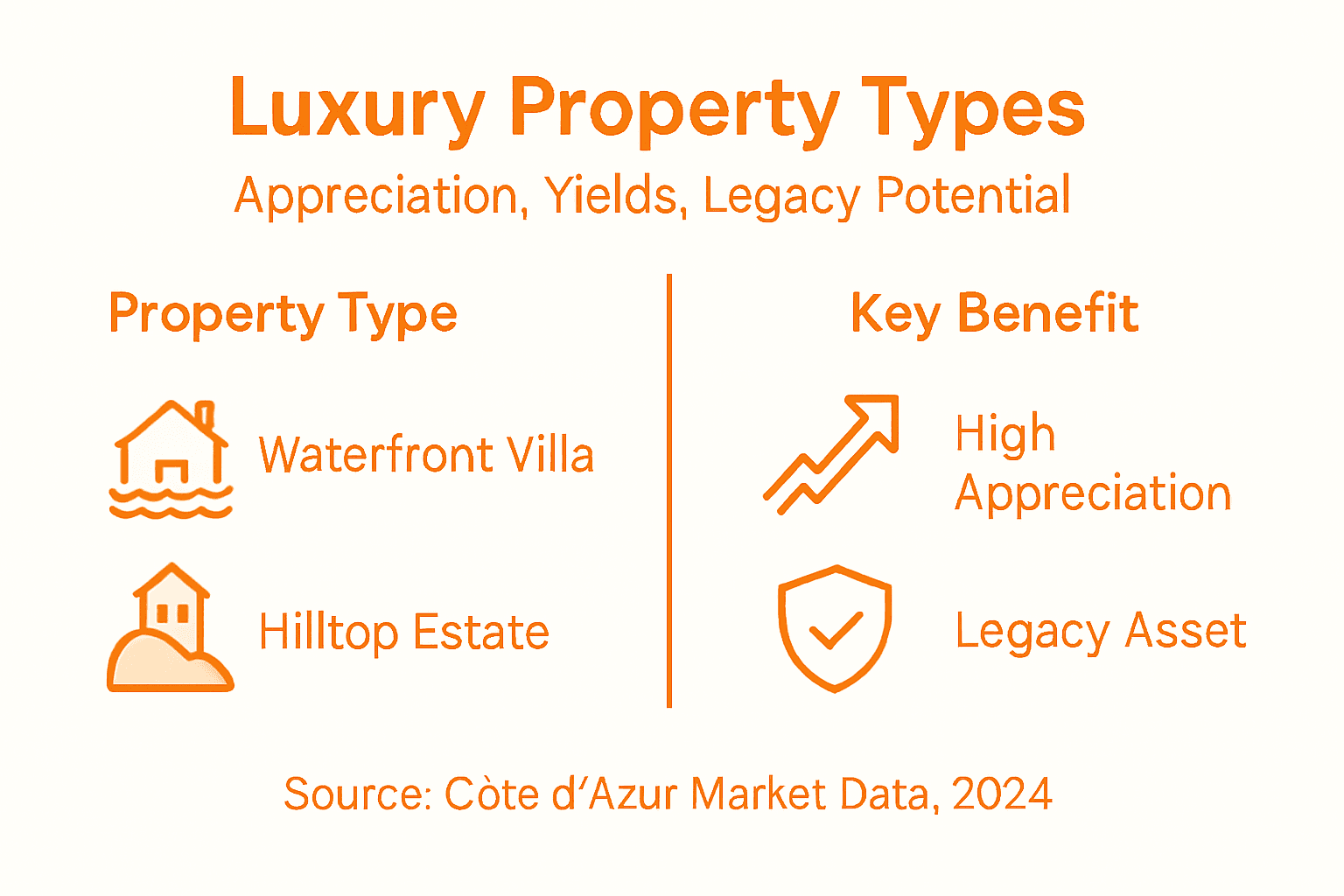
Here is a comparison of luxury property categories on the Côte d’Azur, highlighting their distinct investment profiles:
| Property Type | Annual Appreciation | Rental Yield | Key Investment Benefit |
|---|---|---|---|
| Waterfront Villa/Beachfront | 6-8% in prime locations | 12-18% seasonal | High yield and proven scarcity |
| Hilltop Estate/Mountain Property | 4-6% steady growth | 8-10% seasonal | Privacy, year-round appeal |
| Urban Penthouse/Luxury Apartment | 4-5% in best addresses | 8-12% annual | Liquidity and easy management |
| Restored Provençal Mas/Country | 5-7% with authenticity | Up to 5% occasional | Strong legacy and generational appeal |
Pro tip: Structure acquisitions across three consecutive years rather than concentrating purchases; this staggers capital deployment, reduces exposure to single-market timing errors, and allows learning from early purchases to refine later selections.
Legal Safeguards And Compliance Checks
A pristine villa means nothing if the title is clouded or ownership transfers stall for months. Legal clarity determines whether your investment becomes a family legacy or a costly dispute.
French real estate law protects buyers rigorously, but only if you navigate requirements systematically. The Côte d’Azur’s international buyer base creates additional compliance layers—currency regulations, beneficial ownership declarations, and anti-money laundering verifications that shield legitimate investors whilst filtering illicit actors.
Title Verification And Property History
Before signing anything, commission a notaire (French conveyancer) to conduct a complete title search through the Livre Foncier registry. This reveals ownership chains, liens, easements, and any outstanding claims against the property.
This step costs €800-1,500 but prevents catastrophic errors. You’ll uncover:
- Existing mortgages or legal charges
- Boundary disputes or servitude claims
- Inheritance complications from previous owners
- Heritage designation restrictions affecting modifications
Never rush this phase. Properties with clean, unencumbered titles command premium resale prices and facilitate generational transfers without legal friction.
Structural And Environmental Due Diligence
French law mandates technical surveys (diagnostic technique) for any property transaction. Commission a licensed surveyor to assess structural integrity, seismic resilience, and environmental contamination risk.
Coastal properties require additional scrutiny: erosion assessments, flooding risk evaluations, and asbestos surveys on pre-1997 constructions. These aren’t bureaucratic nuisances—they’re safeguards protecting your thirty-year investment thesis.
Beneficial Ownership And Anti-Money Laundering Compliance
Transparency in real estate transactions now extends across European Union markets. France enforces rigorous beneficial ownership declarations requiring buyers to identify all parties with 25%+ ownership stakes.
If purchasing through corporate structures, provide:
- Certified company registration documents
- Shareholder registers identifying beneficial owners
- Bank statements demonstrating funds origin
- Professional references from your accountants or wealth advisers
This transparency protects you. Properties with clean beneficial ownership records transfer smoothly to heirs and command stronger valuations in secondary markets.
Currency And Tax Compliance
Non-French residents purchasing Côte d’Azur property must declare currency transfers exceeding €10,000 to French authorities. Documentation requirements include:
- Bank transfer records showing fund origins
- Proof of lawful income (tax returns, employment letters, investment statements)
- Currency conversion receipts
Failure to comply invites serious penalties. Legitimate wealth deserves legitimate documentation. Your notaire coordinates these declarations automatically, but remain aware of obligations.
To assist with legal and compliance planning, here is a summary of key due diligence steps and their investment impact:
| Due Diligence Step | Description | Impact on Investment Security |
|---|---|---|
| Title Verification | Full ownership and lien search | Prevents legal disputes and transfer delays |
| Structural Survey | Engineer’s assessment of property soundness | Identifies costly repairs, ensures longevity |
| Environmental Survey | Checks for flooding, erosion, contamination | Reduces future liability and unforeseen losses |
| Beneficial Ownership | Disclosure of all controlling interests | Ensures compliance, smooth transfer to heirs |
| Currency/Tax Reporting | Declaring large transfers and income | Avoids penalties, facilitates international sale |
Structural Transaction Safeguards
Legal transaction frameworks protect buyers through staged payment schedules. French law typically structures purchases as follows:
- Initial offer (promesse de vente): Non-binding expression of intent
- Formal agreement (compromis de vente): Legally binding commitment with 10-day cooling-off period
- Final completion (acte authentique): Notaire executes transfer; funds released upon title passage
Never deviate from this sequence. Each stage provides exit opportunities if due diligence reveals problems.
Legal safeguards don’t slow transactions—they accelerate certainty, protecting your capital and your legacy across generational timescales.
Consider hiring an English-speaking real estate solicitor familiar with Côte d’Azur acquisitions. Their guidance through French procedure costs €2,000-4,000 but prevents far costlier mistakes.
Pro tip: Request your notaire’s completion timeline in writing before signing; French acquisitions typically close within 60-90 days, but clarifying expectations upfront prevents surprises and ensures your funds remain properly sequenced across legal stages.
Legacy Strategies For Future Generations
Your Côte d’Azur property isn’t merely a financial asset—it’s a foundation for generational prosperity. Strategic structuring transforms individual acquisitions into lasting family legacies that survive market volatility and personal circumstances.
The difference between inherited property and inherited chaos lies entirely in how you document ownership, structure transfers, and educate heirs about their responsibilities.
Trusts And Structured Ownership
French inheritance law complicates generational transfers without proper planning. Owning property outright as an individual creates forced succession complications: your property automatically divides among all heirs regardless of your wishes.
Establish a civil partnership (Société Civile Immobilière) or revocable trust to hold property instead. These structures allow you to:
- Designate specific heirs for specific properties
- Facilitate smooth transfers without probate delays
- Protect property from creditors’ claims
- Manage properties collectively whilst retaining personal control
Consult a French succession lawyer before purchasing. Restructuring ownership after acquisition costs significantly more than planning upfront.
Tax-Efficient Wealth Transfer
France levies substantial inheritance taxes: 60% on property transferred to non-spouse heirs outside structured arrangements. Generational wealth strategies emphasise tax deferral and legitimate reduction mechanisms.
Key approaches include:
- Lifetime gifting: Transfer property gradually whilst alive, spreading tax liability across multiple years
- Donation structures: Establish clear gift documentation reducing inheritance tax exposure
- Spousal transfers: Direct ownership to your spouse (zero inheritance tax) with succession planning for subsequent generations
- Foundation frameworks: Charitable giving structures preserving property whilst creating philanthropic legacy
Your notaire coordinates these strategies, but engage your personal accountant early to optimise your specific situation.
Revenue Structures And Passive Income Legacies
Multi-family and buy-and-hold strategies create ongoing cash flow benefiting heirs indefinitely. Rather than transferring static assets, structure properties to generate reliable rental income.
This approach provides:
- Annual cash distributions to heirs maintaining financial motivation
- Active property management teaching financial discipline
- Appreciation potential alongside consistent income
- Flexibility to adjust rental strategies as markets evolve
Heirs inherit not merely property but proven income streams. A villa generating €40,000 annually through seasonal lettings becomes genuinely valuable—not just aesthetically, but financially.
Family Governance And Stewardship Charters
Multi-generational wealth requires documented protocols preventing conflict. Establish a family governance charter specifying:
- Decision-making authority for property sales or refinancing
- Rental income distribution percentages among heirs
- Maintenance responsibilities and budget allocation
- Regular family meetings reviewing property performance
- Exit strategies if heirs wish to liquidate holdings
This documentation prevents misunderstandings that corrode family relationships and property values simultaneously.
Legacy isn’t inherited wealth; it’s inherited responsibility managed with intention, documentation, and generational dialogue.
Consider annual family property reviews where heirs understand market performance, maintenance costs, and strategic decisions. Financial literacy combined with emotional connection to place creates stewards rather than passive beneficiaries.
Pro tip: Before finalising your estate plan, establish a “family constitution” documenting your property legacy values—whether emphasising preservation of family sanctuary, income generation, or eventual charitable disposition; this clarity prevents heirs from guessing your intent when making costly decisions.
Financial Implications And Tax Efficiency
Taxes consume more wealth than market downturns. A property appreciating 6% annually becomes meaningless if 40% vanishes through inefficient structuring and poorly timed exits.
High-net-worth investors succeed by understanding tax consequences before acquiring property, not scrambling after sale. The Côte d’Azur’s international buyer base navigates multiple jurisdictions simultaneously—French succession law, your home country’s capital gains regimes, and wealth tax considerations all demand coordinated strategy.
Understanding French Acquisition Costs
French property purchases carry substantial transaction costs upfront. Budget approximately 7-8% beyond purchase price for:
- Notary fees (typically 3-4% of purchase price)
- Land registry and documentation charges
- Surveyor and legal assessment costs
- Currency conversion fees (for international buyers)
These aren’t optional expenses—French law mandates notarial involvement for all transfers. Understanding true acquisition cost prevents painful surprises when funds transfer.
Capital Gains Tax And Holding Periods
French capital gains tax depends entirely on holding duration. Properties held fewer than 5 years incur substantially higher taxation than those retained long-term.
Key brackets include:
- Under 5 years: 36% combined capital gains tax
- 5-15 years: Progressive reduction, reaching lower rates
- Over 15 years: Substantially reduced liability on appreciation
- Lifetime transfers to heirs: Zero capital gains tax (inheritance tax applies instead)
This structure incentivises generational thinking. A property held 20 years before transfer to heirs generates zero capital gains taxation—a profound advantage over short-term trading mentality. And if you make it your primary residence, you’ll never pay capital gains tax.
Rental Income Taxation And Deductions
Properties generating seasonal lettings income face distinct tax treatment. Tax benefits from real estate investments include allowable deductions substantially reducing taxable rental income.
Deductible expenses include:
- Maintenance and repair costs (but not capital improvements)
- Property management and agency fees
- Insurance and utilities paid by owner
- Mortgage interest (but not principal repayment)
- Marketing and promotional expenses
Careful documentation transforms gross rental income into modest taxable profit. A villa generating €50,000 annually might produce only €15,000-20,000 in taxable income after legitimate deductions.
Exit Strategy Tax Planning
Tax implications of real estate exits require advance structuring. Direct sales differ fundamentally from refinancing, trust distributions, or inheritance transfers—each triggering distinct tax consequences.
Consider timing strategically:
- Spreading sales across tax years: Avoid triggering higher marginal rates from concentrated gains
- Gifting during lifetime: Transfer appreciation tax-free whilst building heir relationships to property
- Refinancing instead of selling: Unlock equity whilst deferring capital gains taxation
- Charitable disposition: Donate appreciated property generating income tax deductions
Cross-Border Tax Coordination
International buyers face dual taxation without careful planning. Your home country taxes worldwide income; France taxes property within its borders. Coordination prevents paying both.
Essential steps include:
- Establish tax residency clearly (typically determines primary jurisdiction)
- File France tax returns reporting French real estate income
- Claim foreign tax credits in your home country for French taxes paid
- Document all acquisitions with acquisition cost basis for future capital gains calculations
Tax efficiency isn’t avoidance—it’s structuring legitimate transactions to minimise tax drag whilst maximising after-tax returns across generations.
Engage a cross-border accountant familiar with your home country’s tax code and French requirements. Annual coordination costs €2,000-5,000 but prevent catastrophic inefficiencies costing multiples more.
Pro tip: Structure acquisitions through French SARL (limited liability company) rather than personal ownership if your home country has favourable treaty treatment with France; this separation simplifies future transfers, enables tax-efficient distributions, and protects personal liability whilst optimising capital gains timing.
Elevate Your Legacy with Curated Côte d’Azur Real Estate
Navigating the complexities of high-value real estate curation requires more than just identifying prime properties. This article highlights crucial challenges such as securing title clarity, ensuring structural resilience, and crafting investment portfolios that balance generational wealth transfer with steady appreciation. At Living on the Côte d’Azur, we understand these goals intimately. We connect discerning global buyers with properties that are not mere homes but lasting legacies, combining lifestyle authenticity with smart Return on Investment, especially through seasonal lettings in coveted locations like Cap d’Antibes and Saint-Jean-Cap-Ferrat.
Our expertise embraces everything from legal due diligence to sustainable development and tax-efficient wealth planning. Whether you seek a restored Provençal mas for enduring family sanctuary or a sleek waterfront villa that commands premium yields, our portfolio and innovative services—including cryptocurrency payments—are tailored to your visionary ambitions. Embrace the Riviera lifestyle enriched with timeless appeal and smart investment insight.
Looking to transform your Riviera property dreams into tangible legacy assets? Discover how our deep market knowledge and curated selection serve as your savvy investor’s compass. Begin your journey today by reaching out through our Contact page. Let us guide you through every step from property acquisition to legacy structuring so your investment grows across generations with confidence.
Frequently Asked Questions
What is high-value real estate curation?
High-value real estate curation involves identifying properties that combine financial potential with lifestyle authenticity, focusing on long-term value and legacy rather than simply selecting expensive assets.
How can I assess the appreciation potential of a curated property?
To assess appreciation potential, consider proven market trends, the property’s location, structural integrity, and whether it includes sustainable features. Properties in established luxury markets tend to appreciate steadily when curated effectively.
What makes a property a good candidate for generational wealth transfer?
A good candidate for generational wealth transfer is one that aligns with family values, has revenue-generating potential, and offers a strong appreciation trajectory. It’s important that heirs find value in the property, whether for personal use or future investments.
What are the legal considerations when purchasing high-value real estate?
Legal considerations include ensuring clear title verification, conducting structural and environmental due diligence, and understanding the requirements for beneficial ownership and compliance with local regulations. Engaging a notaire for thorough title searches and legal assessments is crucial.
Recommended
- Luxury Property Acquisition: The Riviera Legacy
- What Defines High-End Real Estate: Complete Guide
- The concept of Ultra Luxury on the French Riviera – Living on the Côte d’Azur
- Expert Guide to Buying in Monaco for Legacy Investment
- Curated Event Portfolio: Elevating Luxury Experiences – Winelands Function – For Every Occasion, Your Celebration
 //
//