Luxury property markets move differently from mass real estate. While general housing cycles span 18 to 20 years, French Riviera estates follow shorter 7 to 15 year patterns with roughly 20% higher volatility. Understanding these rhythms helps you time acquisitions for optimal legacy returns and rental yields in Cannes, Antibes, or Monaco borders.
Table of Contents
- Luxury Market Cycle Fundamentals
- Market Cycle Impact On French Riviera Real Estate
- Common Misconceptions About Luxury Market Cycles
- Legacy Investment Strategies Aligned With Market Cycles
- Sustainability’s Role In Luxury Market Cycles
- New Construction And Market Cycle Risk Mitigation
- Summary And Practical Investor Takeaways
- Explore Exclusive Luxury Real Estate Opportunities On The French Riviera
Key takeaways
| Point | Details |
|---|---|
| Cycle duration and phases | Luxury markets complete expansion, peak, contraction, and trough phases in 7 to 15 years, driven by global wealth flows. |
| Appreciation potential | French Riviera properties historically appreciate 5 to 8% annually, with sea-view villas commanding €2M+ premiums. |
| Sustainability influence | Eco-certified luxury homes see 15% higher demand and stronger yields, aligning with 2026 investor priorities. |
| Legacy timing advantage | Buying during trough phases secures lower entry prices and 3 to 5% rental yields for wealth preservation. |
| New construction protection | VEFA contracts, ten-year warranties, and lower notary fees mitigate cyclical risks in off-plan Riviera builds. |
Luxury market cycle fundamentals
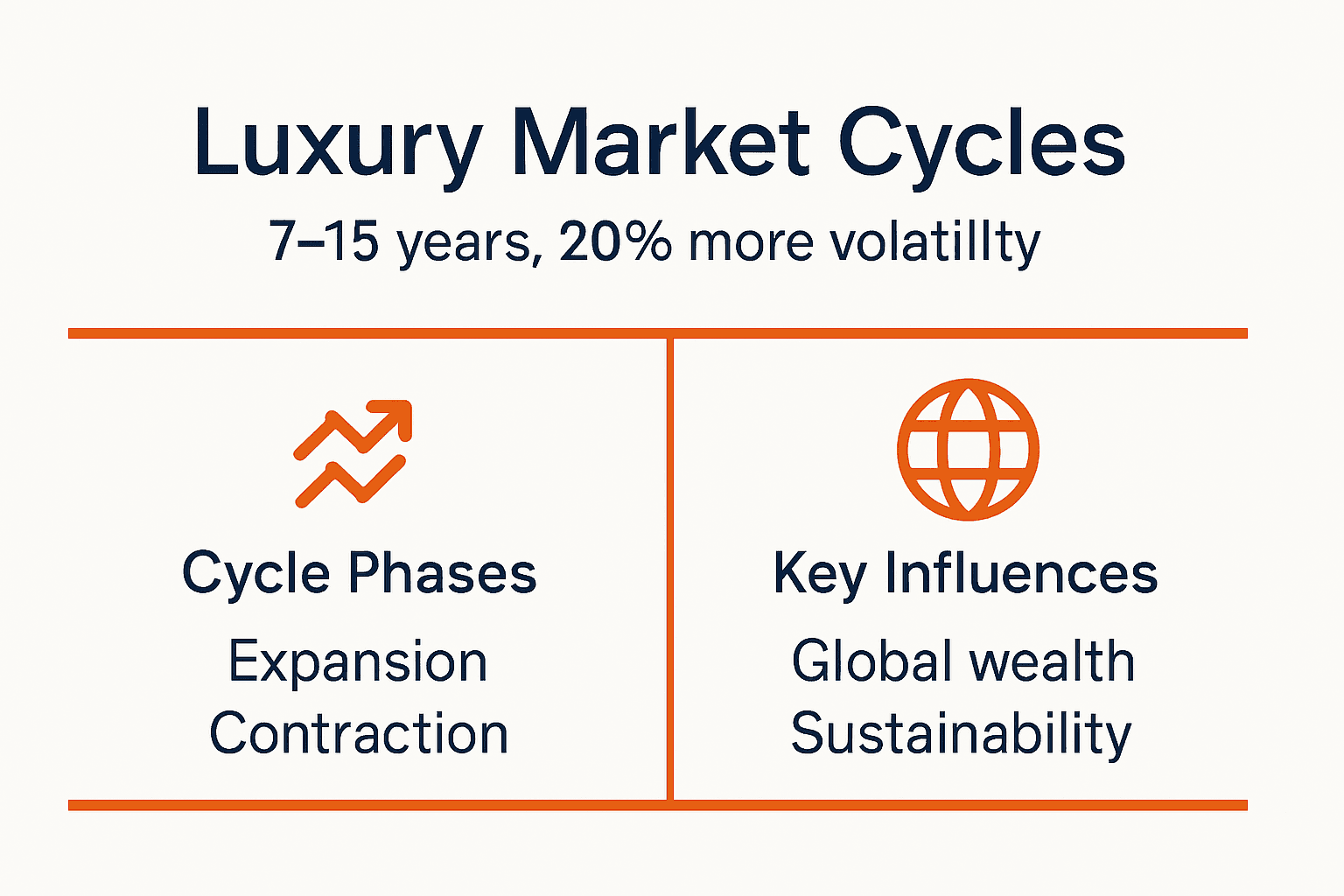
Luxury real estate operates on distinct timelines compared to broader housing markets. A full cycle typically lasts 7 to 15 years, progressing through four phases: expansion, peak, contraction, and trough. During expansion, global wealth creation fuels demand and prices rise steadily. Peaks arrive when credit tightens or geopolitical uncertainty reduces buyer liquidity. Contractions last 1 to 3 years, marked by falling transaction volumes and selective price corrections. Troughs offer strategic entry points where fundamentals remain strong but sentiment lags.
Three primary forces drive these cycles. Global wealth flows concentrate purchasing power among high-net-worth individuals who respond swiftly to currency shifts, tax policy changes, or equity market gains. Interest rate movements directly impact financing costs and opportunity costs for cash buyers. Broader economic growth influences business profits, bonus pools, and family office allocations. Unlike mass-market housing tied to population growth and mortgage availability, luxury cycles depend on discretionary decisions by a smaller, wealthier buyer pool.
This concentration creates volatility. When markets turn, luxury properties often experience sharper price swings than entry-level homes. However, recoveries can be equally rapid once confidence returns. The best seasons to buy property on the French Riviera often align with trough phases when motivated sellers meet patient legacy investors.
Pro Tip: Track global wealth indices and central bank policy calendars to anticipate cycle shifts. Cap d’Antibes prices often move three to six months after major monetary policy announcements in the US or Eurozone.
Key cycle characteristics:
- Expansion: 3 to 5 years of rising prices and increasing transaction volumes
- Peak: 6 to 12 months of record valuations and fierce bidding
- Contraction: 1 to 3 years of falling sales and selective price reductions
- Trough: 1 to 2 years of stabilised pricing and renewed buyer interest
Market cycle impact on French Riviera real estate
The Côte d’Azur luxury segment reflects global wealth dynamics while maintaining unique regional characteristics. Historical data shows annual appreciation averaging 5 to 8% for prime properties with Mediterranean views, eco-luxury features, or proximity to Monaco. Price peaks coincide with economic expansion phases when digital entrepreneurs, family offices, and emerging-market fortunes seek European havens. Favourable financing conditions amplify demand, particularly for estates priced above €5 million.
Contractions arrive swiftly. Liquidity compression among ultra-high-net-worth buyers triggers 1 to 3 year downturns where transaction volumes fall 30 to 40%. Prices typically correct 10 to 20% in less-prestigious zones whilst Cap d’Antibes or Èze hilltop villas hold value better. Recovery begins when wealth accumulation resumes and currency alignments favour euro-denominated assets.
Regional events influence micro-cycles. Cannes Film Festival weeks and summer regattas drive rental demand, sustaining 3 to 5% annual yields for well-positioned properties. Menton’s Lemon Festival and Nice Carnaval attract seasonal buyers who convert tourist experiences into acquisition decisions. Antibes’ yacht shows introduce international fortunes to Provençal lifestyle, creating demand spikes during expansion phases.
| Cycle phase | Average duration | Price movement | Rental yield |
|---|---|---|---|
| Expansion | 3 to 5 years | +5% to +8% annually | 3% to 4% |
| Peak | 6 to 12 months | +2% to +5% | 4% to 5% |
| Contraction | 1 to 3 years | -10% to -20% | 3% to 4% |
| Trough | 1 to 2 years | Flat to +2% | 4% to 5% |
Eco-certified villas outperform generic luxury during all phases. Solar arrays, rainwater systems, and green building certifications attract environmentally conscious buyers willing to pay premiums. These properties achieve 4 to 6% rental yields in peak seasons, particularly in Sainte-Maxime where Nartelle beach proximity meets sustainability standards.
Regional demand drivers:
- Monaco proximity: Properties within 10km command 20 to 30% premiums
- Sea views: Direct Mediterranean vistas add €2M+ to comparable inland estates
- Cultural access: Walking distance to galleries, festivals, or yacht clubs increases desirability
- Sustainability: LEED or HQE certification boosts resale value 8 to 12%
Common misconceptions about luxury market cycles
Many investors assume luxury real estate provides stable, predictable returns. Reality differs sharply. Volatility in luxury segments runs approximately 20% higher than mass-market housing due to concentrated buyer pools and discretionary purchase timing. A €10 million villa may lose €2 million in value during contractions whilst recovering that amount plus appreciation gains within 18 months of cycle reversal.
Another misconception treats luxury cycles as longer and more stable than general real estate patterns. Evidence shows the opposite: shorter durations and faster transitions between phases. Whilst UK housing cycles historically span 18 years, French Riviera luxury completes full rotations in 7 to 15 years. This acceleration stems from rapid wealth creation among tech entrepreneurs and emerging-market billionaires who enter and exit markets swiftly.
Downturns receive exaggerated pessimism. Contractions tend to be sharp, dropping prices 10 to 20% in 12 to 24 months, but recoveries arrive faster than in mass markets. Legacy investors who buy during troughs secure properties at optimal prices with immediate rental yield potential. Saint-Tropez waterfront estates purchased in 2020 delivered 12 to 18% total returns by 2023 as post-pandemic wealth surged into Mediterranean havens.
Sustainability increasingly reshapes cycle behaviour. Properties lacking eco-credentials face longer marketing periods and steeper discounts during contractions. Conversely, VEFA off-plan projects with solar installations and biophilic design attract buyers throughout all phases. This trend will intensify through 2026 as family offices prioritise environmental, social, and governance criteria in legacy portfolios.
Pro Tip: Avoid chasing peak-phase gains. Investors who buy during late expansion often experience immediate paper losses. Target trough acquisitions in prestigious zones like Cap d’Antibes where fundamental appeal outlasts temporary sentiment shifts.
Debunked assumptions:
- Luxury markets are stable: Volatility exceeds mass markets by 20%
- Cycles are predictable: Global wealth shocks create irregular patterns
- Hold forever strategy works: Active cycle timing improves total returns
- All luxury assets perform equally: Location, sustainability, and heritage create wide variance
Legacy investment strategies aligned with market cycles
Strategic legacy investors synchronise acquisitions with cycle phases to maximise wealth preservation and intergenerational transfer. Buying during trough phases delivers dual benefits: lower entry prices and immediate rental yields that fund property maintenance whilst appreciation builds. A €5 million Antibes villa purchased at trough with 4% rental yield generates €200,000 annually whilst potentially appreciating €250,000 to €400,000 as expansion resumes.
Cycle-aware acquisition steps:
- Identify trough signals: falling transaction volumes, rising inventory, motivated sellers
- Prioritise eco-certified properties with sustainability credentials that enhance resilience
- Conduct legal audits for title clarity and seismic surveys for structural integrity
- Structure acquisitions through family trusts or holding companies for tax-efficient wealth transfer
- Plan rental management to achieve 3 to 5% yields during ownership consolidation
Balanced returns combine appreciation with income. French Riviera estates historically deliver 5 to 8% annual price growth alongside 3 to 5% rental yields, producing 8 to 13% total returns over full cycles. This balance preserves capital during contractions whilst positioning heirs to benefit from long-term Mediterranean demand. Menton properties near Val Rahmeh botanical gardens or Èze village offer stable rental appeal through cultural tourism regardless of cycle phase.
Wealth transfer planning requires early integration. French inheritance law mandates forced heirship rules that complicate estate distribution. Establishing structures before acquisition allows seamless transfer whilst minimising French succession duties. Legacy investment strategies in France should address tax treaties, beneficial ownership transparency, and multi-generational governance.
Diversification across cycle phases and property types reduces concentration risk. Combining peak-phase sales of appreciated assets with trough-phase acquisitions of undervalued estates creates natural portfolio rebalancing. Mixing Nice Promenade penthouses with Sainte-Maxime beachside villas spreads geographic and stylistic exposure.
Legacy-optimised characteristics:
- Timeless locations: Cap d’Antibes, Monaco borders, Cannes Croisette command enduring premiums
- Architectural heritage: Belle Époque villas and Art Deco masterpieces appreciate above generic luxury
- Rental fundamentals: Proximity to beaches, yacht clubs, and cultural venues sustains yields
- Future-proof design: Eco-luxury features align with heir values and regulatory trends
Sustainability’s role in luxury market cycles
Environmental standards increasingly shape luxury market dynamics on the French Riviera. Demand for sustainable-built properties rose 15% from 2024 to 2026 as wealth creators prioritise climate-conscious investments. Green certifications like HQE or LEED act as value enhancers during expansion phases and risk hedges during contractions. Buyers pay 8 to 12% premiums for certified homes whilst these properties experience 5 to 8% smaller price drops when markets turn.
Long-term rental yields favour eco-luxury. Tenants willing to pay €15,000 to €30,000 monthly for Cannes or Antibes estates increasingly demand solar installations, energy-efficient climate control, and sustainable materials. Properties meeting these criteria achieve occupancy rates 10 to 15 percentage points higher than comparable non-certified homes, translating to 4 to 6% net yields versus 3 to 4% for standard luxury.
Investor priorities reflect generational wealth transfer. Digital entrepreneurs and family offices managing inherited capital view sustainability as essential to portfolio longevity. A €10 million investment in a Saint-Tropez eco-villa protects principal value whilst aligning with heir values around environmental stewardship. This dual mandate drives competitive bidding for certified properties even during late-cycle phases.
| Sustainability feature | Demand premium | Yield advantage | Cycle resilience |
|---|---|---|---|
| Solar energy systems | +8% to +10% | +0.5% to +1% | -3% to -5% contraction impact |
| Green building certification | +10% to +12% | +1% to +1.5% | -5% to -7% contraction impact |
| Water conservation tech | +5% to +7% | +0.3% to +0.5% | -2% to -4% contraction impact |
| Biophilic design elements | +6% to +9% | +0.5% to +0.8% | -4% to -6% contraction impact |
Sustainability integrates with heritage investment goals. Provençal mas restored with eco-materials and solar arrays preserve architectural character whilst meeting modern performance standards. These properties appeal to legacy buyers seeking timeless assets that honour tradition and embrace innovation. Nice’s Mont Boron developments blend Mediterranean views with cutting-edge sustainability, creating heirlooms for climate-aware generations.
Eco-luxury investment advantages:
- Premium pricing power throughout cycle phases
- Higher rental yields from quality-focused tenants
- Reduced operational costs through energy efficiency
- Enhanced resale appeal to values-driven buyers
New construction and market cycle risk mitigation
Off-plan luxury acquisitions on the Côte d’Azur offer structural protections against cycle volatility. Ten-year warranties cover construction defects, foundation issues, and major structural elements, shielding buyers from unexpected costs that can erode returns during market downturns. VEFA contracts (vente en l’état futur d’achèvement) further reduce risk by staging payments to construction milestones rather than requiring full capital at signing.
Eco-luxury design enhances market appeal regardless of cycle phase. Sainte-Maxime beachside apartments from €1.2 million incorporate solar arrays, rainwater harvesting, and biophilic elements that attract sustainability-focused buyers. These features command premiums during expansion whilst maintaining value during contractions. Nice’s emerging Mont Boron towers blend Baie des Anges panoramas with LEED certification, positioning properties for long-term appreciation.
Financial structures ease acquisition timing. Lower notary fees on new construction (2 to 3% versus 7 to 8% for resales) reduce upfront costs. Zero-interest payment plans spread capital deployment across 18 to 36 months, allowing investors to dollar-cost-average into markets regardless of cycle position. This flexibility proves valuable when acquiring during uncertain transition phases between trough and expansion.
New builds mitigate financial downturns through guaranteed completion dates and fixed pricing. Unlike resale transactions where sellers may withdraw if markets rise, VEFA contracts lock purchase terms. Buyers secure 2026 pricing for 2028 delivery, capturing appreciation during construction. If contraction arrives before completion, ten-year warranties and modern specifications support value retention better than ageing resale inventory.
New construction cycle advantages:
- Warranty protection reduces post-acquisition maintenance risks
- VEFA contracts spread payment obligations across construction timeline
- Eco-certifications attract premium buyers throughout cycles
- Lower fees improve total acquisition costs by 4 to 6%
- Fixed pricing captures expansion-phase appreciation before completion
Summary and practical investor takeaways
Luxury market cycles on the French Riviera follow distinct 7 to 15 year patterns with expansion, peak, contraction, and trough phases driven by global wealth flows, interest rates, and economic growth. Understanding these rhythms allows high-net-worth investors to time acquisitions strategically, targeting trough-phase purchases where entry prices optimise legacy returns and rental yields reach 4 to 5%. Historical appreciation of 5 to 8% annually combines with rental income to produce 8 to 13% total returns over complete cycles.
Sustainability emerged as a critical factor reshaping cycle behaviour. Eco-certified properties command 8 to 12% premiums, experience smaller price drops during contractions, and achieve higher rental yields through quality tenant demand. Family offices and digital entrepreneurs increasingly view green credentials as essential to portfolio resilience and intergenerational wealth transfer. French Riviera investing success requires integrating environmental standards into acquisition criteria alongside traditional location and architectural quality factors.
Legal due diligence protects capital throughout market cycles. Title audits, structural surveys, and VEFA contract reviews prevent costly surprises that compound during downturns. Ten-year warranties on new construction provide tangible risk mitigation whilst lower notary fees improve overall economics. Wealth transfer planning through trusts or holding companies enables tax-efficient legacy transitions aligned with French inheritance law.
Essential action points:
- Monitor cycle indicators: track transaction volumes, inventory levels, and wealth flow data
- Target trough acquisitions: prioritise periods of price stabilisation and motivated sellers
- Emphasise sustainability: demand eco-certifications that enhance yields and cycle resilience
- Verify legal foundations: conduct thorough title, structural, and contractual due diligence
- Plan succession early: structure ownership for efficient intergenerational wealth transfer
Explore exclusive luxury real estate opportunities on the French Riviera
Living on the Côte d’Azur connects global visionaries with off-market luxury properties unavailable through conventional channels. Our portfolio spans eco-certified villas in Cap d’Antibes, Monaco-adjacent estates, and Cannes Croisette penthouses designed for legacy wealth preservation. Expert market cycle guidance helps you identify optimal acquisition windows whilst legal and financial teams navigate French property law, VEFA contracts, and wealth transfer structures. Discover luxury villas and penthouses for sale that combine Mediterranean lifestyle with strategic investment fundamentals. Accept traditional currencies or cryptocurrency for seamless international transactions aligned with digital-age wealth management.
Frequently asked questions
What is the luxury market cycle and why does it matter?
The luxury market cycle is a 7 to 15 year pattern of expansion, peak, contraction, and trough phases affecting French Riviera property prices and demand. It matters because understanding these rhythms helps investors maximise returns by timing acquisitions to trough phases where entry prices and rental yields optimise legacy wealth preservation.
How do luxury market cycles on the French Riviera differ from general real estate cycles?
French Riviera luxury cycles are shorter, completing rotations in 7 to 15 years versus 18 to 20 years for mass markets, with approximately 20% higher volatility. They respond faster to global wealth flows, geopolitical shifts, and currency movements because buyer pools are smaller and more concentrated among high-net-worth individuals making discretionary purchase decisions.
What indicators signal a good time to buy in the luxury market cycle?
Trough phases marked by stabilised or slightly falling prices, rising inventory, and improved buyer liquidity represent optimal acquisition windows. Watch for macroeconomic signals like declining interest rates, strengthening euro-dollar exchange rates, and regional demand drivers such as Cannes Film Festival attendance or Monaco yacht show activity that predict cycle reversals.
How does sustainability impact luxury real estate investments?
Sustainability drives 15% higher demand for eco-certified properties and enhances long-term rental yields by 1 to 1.5 percentage points through quality tenant attraction. Green-certified homes experience 5 to 8% smaller price drops during contractions and command 8 to 12% premiums during expansion phases, making environmental credentials essential for cycle-resilient legacy portfolios.
Recommended
 //
//