Buying property in Paris is one of the most attractive long-term investments in Europe, but choosing the right arrondissement can make a major difference in both lifestyle and financial return. Prices, rental demand, schools, transport links, and neighborhood character vary widely across the city’s 20 districts. A luxury apartment near Luxembourg Gardens attracts a very different buyer than a rental studio near Canal Saint‑Martin.
For international buyers, expats, and investors, understanding these differences is the key to making a successful purchase. This guide explains the best arrondissements to buy property in Paris, including areas known for luxury real estate, districts with strong rental demand, and neighborhoods where prices still have room to grow. It also includes current price ranges, investment insights, and practical guidance for buyers looking to secure a property in one of Europe’s most stable real estate markets.
Paris Real Estate Market Explained
The Paris property market is unique because it combines strict historic preservation rules with constant global demand. Many residential buildings date back to the Haussmann era, which created the elegant boulevards and limestone apartment buildings that define the city today. Supply is limited because construction opportunities inside the city are rare, while demand continues to grow from local residents, international investors, students, and expats.
These conditions create a market where property values tend to rise steadily over time. Buyers interested in owning property in Paris must understand how location, infrastructure, and neighborhood reputation influence both property prices and long-term returns.
Why Property in Paris Remains a Stable Investment
Real estate in Paris has shown consistent appreciation for decades. Data from market research firms indicates that property prices have more than doubled over the past 20 years in many districts. Several factors contribute to this long-term stability.
First, demand remains strong due to the city’s global importance in culture, business, and tourism. Paris welcomes over 45 million visitors each year, and many international buyers eventually decide to purchase apartments for personal use or investment.
Second, strict preservation laws limit the construction of new buildings. Many properties are protected historic structures, particularly near landmarks such as the Louvre Museum, Notre‑Dame Cathedral, and Eiffel Tower. These restrictions protect the city’s architectural identity but also reduce supply, which supports property prices.
Finally, the city benefits from strong infrastructure and public transport. The Paris Metro network, operated by RATP, connects nearly every district, making it easy for residents to live anywhere in the city while still reaching central business areas quickly.
Key reasons investors continue to buy in Paris include:
- Limited housing supply
- Strong tourism and rental demand
- Stable long-term price growth
- Global reputation as a cultural capital
- High demand from international buyers
Average Property Prices by Arrondissement
Property prices vary widely across the 20 arrondissements. Central districts and historic neighborhoods command the highest prices, while eastern districts often provide more accessible entry points for investors. Below is an overview based on data from Meilleurs Agents, one of the most widely used property market research platforms in France.
| Arrondissement | Avg Purchase Price €/m² | Avg Rent €/m² |
| 1st | €11,816 | €35.6 |
| 4th | €12,806 | €36.0 |
| 6th | €14,276 | €37.1 |
| 7th | €14,704 | €37.1 |
| 9th | €10,502 | €33.6 |
| 11th | €9,843 | €32.1 |
| 13th | €8,689 | €29.7 |
| 19th | €7,839 | €28.0 |
| 20th | €8,125 | €28.7 |
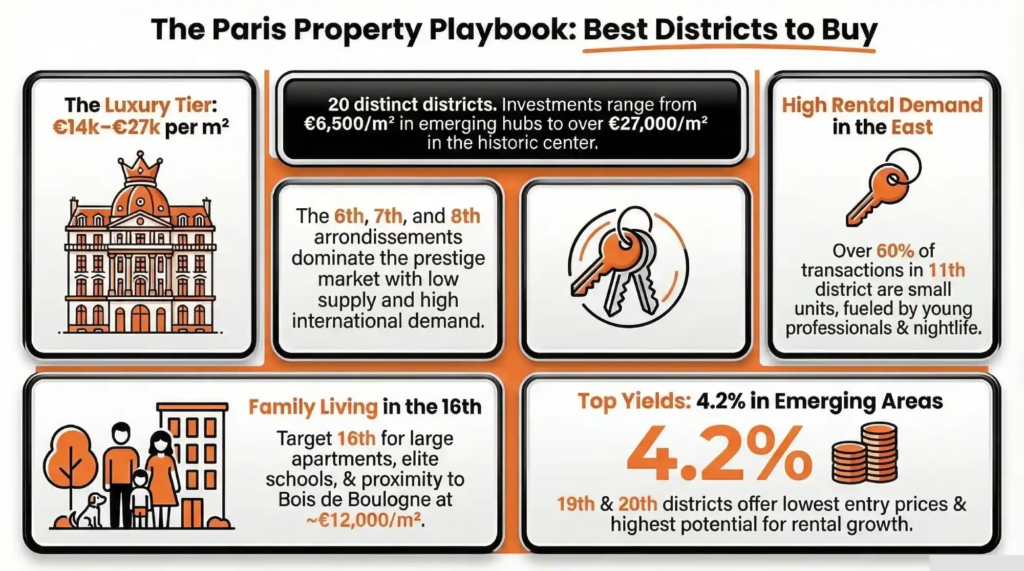
Across the city, prices generally range from €6,500 per m² in emerging districts to over €25,000 per m² in prime luxury neighborhoods. Premium apartments near Avenue Montaigne in the Golden Triangle have been known to exceed €40,000 per square meter.
What Drives Property Value in Paris
Location plays a major role in determining property value in Paris. Even within the same arrondissement, prices can vary depending on proximity to landmarks, transport, and local amenities. Several factors strongly influence property prices.
Proximity to Landmarks
Properties near famous landmarks attract both buyers and renters. Apartments close to the Luxembourg Gardens, Place Vendôme, or the Champs‑Élysées often command premium prices due to their prestige and accessibility.
Public Transport Connectivity
Easy access to Metro and RER lines increases demand. Districts such as the 11th arrondissement benefit from extensive connectivity with more than 25 Metro stations nearby, making them attractive to commuters.
Schools and International Communities
Families often choose neighborhoods close to international schools such as École Internationale Bilingue and ICS Paris – International School. Properties near respected schools can see price increases of 8–10% compared to similar homes in other areas.
Parks and Green Spaces
Access to parks adds significant lifestyle value. Important green spaces include:
- Parc des Buttes‑Chaumont
- Parc de Bercy
- Bois de Vincennes
These parks attract families and professionals who want outdoor space within the city.
Neighborhood Transformation
Some districts experience price growth due to redevelopment and cultural changes. Areas like Belleville and Canal Saint-Martin have gained popularity with young professionals and creative industries, which has increased property demand in the surrounding neighborhoods.
Which Arrondissements Are Best for Different Property Buyers
Each arrondissement appeals to a different type of buyer. Luxury investors, families, and landlords often prioritize different factors such as prestige, rental yield, or proximity to schools. Understanding these buyer profiles helps investors choose neighborhoods that match their financial goals.
Luxury & Wealth Investors
High-net-worth buyers often focus on prestigious districts on the Right Bank and the Left Bank. These areas combine historic architecture, elegant streets, and close proximity to cultural landmarks. The most popular districts for wealth investors include:
- 6th arrondissement – Saint-Germain-des-Prés
- 7th arrondissement – Eiffel Tower / Invalides
- 8th arrondissement – Golden Triangle / Champs-Élysées
- 16th arrondissement – Passy / Trocadéro
These districts feature classic Haussmann-style buildings, wide boulevards, and high-end boutiques such as Chanel, Louis Vuitton, and Dior. Many embassies and diplomatic residences are also located here, which further strengthens the reputation of these neighborhoods. Luxury buyers often purchase larger apartments with balconies or views of the Seine. These properties typically maintain their value well, even during slower market periods.
Balanced Investors (Rental + Appreciation)
Some buyers look for a combination of steady rental income and long-term capital growth. These investors often choose neighborhoods that are popular with young professionals, students, and expats. Popular districts for balanced investment include:
- 9th arrondissement: Opéra / South Pigalle
- 10th arrondissement: Canal Saint-Martin
- 11th arrondissement: Bastille / Oberkampf
- 14th arrondissement: Montparnasse
- 17th arrondissement: Batignolles
- 12th arrondissement: Bercy / Gare de Lyon
These areas have vibrant restaurants, cafés, and nightlife, making them attractive for renters. Apartments under 50 m² are especially popular, and in districts such as the 11th arrondissement they account for over 60% of transactions. Because of their central location and strong rental demand, these districts offer a balanced combination of appreciation and rental income.
Yield Investors (Higher Rental Returns)
Investors focused primarily on rental yield often look outside the most expensive districts. Eastern neighborhoods offer lower entry prices while still benefiting from strong demand from students and young professionals.
Districts frequently selected for higher rental returns include:
- 19th arrondissement: Buttes-Chaumont / Mouzaïa
- 20th arrondissement: Belleville / Ménilmontant
- 13th arrondissement: Butte-aux-Cailles / Chinatown
- 18th arrondissement: parts of Montmartre
Average gross yields in these areas can reach around 4.2%, compared with approximately 2.2% in luxury districts such as the 6th arrondissement. Many investors purchase small furnished apartments and rent them under the LMNP (furnished rental) status, which provides tax advantages in France.
Best Arrondissements to Buy Property in Paris
Paris contains 20 arrondissements, each with a distinct identity, property price range, and buyer profile. Some districts are famous for luxury real estate, while others attract investors looking for rental income or long-term appreciation. Most attractive areas for property buyers based on price trends, rental demand, lifestyle appeal, and accessibility.
6th Arrondissement – Saint-Germain-des-Prés
The 6th arrondissement is widely considered one of the most prestigious residential districts in Paris. Centered around Saint‑Germain‑des‑Prés, this area blends historic architecture, literary cafés, and elegant boulevards. Apartments here often overlook the Luxembourg Gardens, one of the most beautiful parks in the city. Properties in the 6th arrondissement attract wealthy buyers, international investors, and long-term residents who want a central location with timeless appeal. Many buildings date back to the 18th and 19th centuries and feature classic Parisian design elements such as high ceilings, balconies, and original stone façades.
Key characteristics of the 6th arrondissement include:
- Average price around €14,000–€27,000 per m²
- High demand from international buyers
- Strong long-term appreciation
- Limited availability of properties
Studios and small apartments sell quickly here. In some cases, properties receive offers within a few days due to extremely limited supply.
7th Arrondissement – Eiffel Tower & Invalides
The 7th arrondissement is one of the most recognizable districts in Paris thanks to landmarks such as the Eiffel Tower and Les Invalides. The neighborhood is known for its elegant residential streets, embassies, and historic mansions. Many families and diplomats choose this arrondissement because it combines central location with quiet residential streets. It is also close to major landmarks like Champ de Mars and several top schools, which increases demand among expatriate families.
Property features in this district often include:
- Classic Haussmann buildings
- Larger apartments suitable for families
- Views of the Seine or nearby monuments
Typical prices range between €11,000 and €24,000 per m², depending on location and property condition. Properties near the Eiffel Tower or riverside areas tend to command premium prices.
8th Arrondissement – Champs-Élysées & Golden Triangle
The 8th arrondissement is famous for luxury shopping streets and prestigious avenues. The district includes the iconic Champs‑Élysées and the famous Golden Triangle, formed by Avenue Montaigne, Avenue George V, and Avenue des Champs-Élysées. Luxury brands such as Chanel, Dior, and Louis Vuitton have flagship stores here, making the district one of the most prestigious retail locations in the world. The area is also close to the Arc de Triomphe, which adds to its international recognition.
Important characteristics of the 8th arrondissement include:
- Luxury apartments and penthouses
- Price ranges from €9,000 to €22,000 per m²
- Premium properties above €40,000 per m² in exclusive streets
- Strong demand from global investors
Because of its reputation and prime location, property in the Golden Triangle is often purchased as a long-term asset.
9th Arrondissement – Opéra & South Pigalle
The 9th arrondissement offers a lively urban environment filled with theaters, restaurants, and shopping districts. Landmarks such as Palais Garnier, the historic opera house, sit at the center of the neighborhood. South Pigalle, commonly called SoPi, has become popular with young professionals due to its cafés, nightlife, and proximity to major department stores such as Galeries Lafayette and Printemps.
Property characteristics in the 9th arrondissement include:
- Average prices around €8,000–€12,000 per m²
- Strong demand for small apartments
- Central location close to major transport hubs
Many investors purchase smaller apartments here because the district attracts professionals working in nearby business districts.
10th Arrondissement – Canal Saint-Martin
The 10th arrondissement is one of the trendiest districts in Paris. The neighborhood surrounding Canal Saint‑Martin has become a popular area for creative professionals, young residents, and start-up companies. The canal itself creates a relaxed atmosphere with cafés, restaurants, and walking paths along the water. The district also benefits from excellent transport connections through Gare du Nord and Gare de l’Est, two major railway stations.
Important factors influencing the property market here include:
- Growing demand from young professionals
- Rising prices due to neighborhood popularity
- Strong rental market
Apartments near the canal often reach around €10,000 per m², while properties further away may be slightly lower.
11th Arrondissement – Bastille & Oberkampf
The 11th arrondissement is one of the most dynamic districts in Paris. It includes the historic Place de la Bastille and lively areas such as Oberkampf, known for its restaurants and nightlife. This district attracts a large number of young residents and professionals working in central Paris. The high number of Metro stations makes it easy to travel across the city.
Important investment factors in the 11th arrondissement include:
- Average property prices between €8,000 and €14,000 per m²
- Strong rental demand
- High number of small apartments suitable for investors
More than 60% of property transactions in this district involve apartments under 50 square meters, making it popular with investors purchasing rental units.
13th Arrondissement – Butte-aux-Cailles & Chinatown
The 13th arrondissement is known for its diverse culture and modern architecture. It includes neighborhoods such as Butte-aux-Cailles and the large Asian community around Avenue de Choisy and Avenue d’Ivry. The district also includes the Bibliothèque François Mitterrand area, which has undergone significant redevelopment in recent years.
Property prices here are more accessible than in central districts. Key features include:
- Price ranges between €6,500 and €11,000 per m²
- Strong demand from students and professionals
- New developments in the Paris Rive Gauche area
Because of these factors, the 13th arrondissement attracts investors looking for long-term growth potential.
16th Arrondissement – Passy & Trocadéro
The 16th arrondissement is one of the most prestigious residential areas in Paris. Neighborhoods such as Passy and Trocadéro offer quiet streets, large apartments, and proximity to parks like the Bois de Boulogne. The district is also known for its high-quality schools and cultural institutions, making it a popular choice for families.
Important features of the 16th arrondissement include:
- Average property prices around €12,000 per m²
- Large family apartments
- Proximity to international schools
Properties near the Trocadéro Gardens often command premium prices due to views of the Eiffel Tower.
18th Arrondissement – Montmartre
The 18th arrondissement is famous for Sacré‑Cœur Basilica and the artistic district of Montmartre. The area has long attracted painters, musicians, and creative professionals. Montmartre sits on a hill overlooking the city, which gives many apartments impressive views of Paris. The district also contains small village-style streets, cafés, and art studios.
Property prices in this arrondissement vary widely:
- Around €9,500 per m² in Montmartre
- Lower prices in nearby neighborhoods
- Premium apartments with views reaching higher levels
The district attracts both lifestyle buyers and investors interested in tourism-driven rentals.
19th & 20th Arrondissements – Emerging Investment Areas
The 19th and 20th arrondissements are increasingly popular with investors looking for lower entry prices and higher rental yields. Neighborhoods such as Belleville, Gambetta, and Mouzaïa have seen steady price growth over the past decade. The districts also benefit from large green spaces such as Parc des Buttes‑Chaumont, which is one of the largest parks in the city.
Important investment factors include:
- Property prices between €6,500 and €11,000 per m²
- Gross rental yields up to 4.2%
- Strong demand from young renters
These areas are often considered the next phase of growth in the Paris property market.
Investment Performance by Arrondissement
For investors, choosing the best arrondissement involves more than selecting a popular neighborhood. Buyers often compare rental yields, appreciation potential, and entry prices before purchasing a property. In Paris, districts with the highest prestige tend to offer lower rental yields but strong long-term appreciation, while emerging areas provide higher yields with slightly more market risk.
Market research data shows that prime districts like the 6th and 7th arrondissements generate yields around 2–2.5%, while eastern districts such as the 19th and 20th arrondissements can reach 4% or more in gross rental yield. Investors therefore need to balance immediate rental income with long-term capital growth.
Below is a simplified comparison of investment performance across selected arrondissements.
| Arrondissement | Avg Price €/m² | Estimated Yield | Appreciation Potential | Typical Investor |
| 6th | €14,000+ | 2.2% | Very strong | Wealth investors |
| 7th | €14,700 | 2.3% | Strong | Long-term investors |
| 9th | €10,500 | 3.1% | Strong | Balanced investors |
| 11th | €9,800 | 3.3% | Strong | Rental investors |
| 13th | €8,600 | 3.7% | Growing | Value investors |
| 19th | €7,800 | 4.2% | Medium | Yield investors |
These numbers vary depending on property size, building condition, and proximity to Metro stations or parks.
Costs and Legal Considerations When Buying Property in Paris
Buying real estate in France involves several legal steps and additional costs that international buyers should understand before making an offer. The purchasing process is highly regulated; understanding the legal process of buying real estate in France is essential for international investors to avoid common pitfalls.
Notary Fees and Transaction Costs
When purchasing property in Paris, buyers must pay notary fees of around 7–8% of the purchase price for existing properties. These fees include:
- government taxes
- administrative costs
- notary services
- property registration
For example:
| Property Price | Estimated Notary Fees |
| €400,000 | €28,000 – €32,000 |
| €800,000 | €56,000 – €64,000 |
| €1,500,000 | €105,000 – €120,000 |
These costs are typically paid at the time of completion.
Rent Control Regulations
Paris introduced rent control rules to stabilize the rental market. These regulations limit how much landlords can charge based on location and apartment size.
Key points include:
- maximum rent levels set by the city
- adjustments based on property features and location
- rules apply mainly to long-term rentals
Understanding rent regulations is important for investors calculating expected rental income.
Ownership Structures for Investors
Foreign buyers often use specific ownership structures when purchasing property in France.
LMNP (Location Meublée Non Professionnelle)
This structure allows investors to rent furnished properties while benefiting from certain tax advantages.
SCI (Société Civile Immobilière)
An SCI is commonly used for family ownership or inheritance planning, allowing several owners to hold shares in a property. These structures can help optimize taxes and simplify property management over time. For many families, buying property via an SCI in France offers significant advantages for inheritance planning and shared ownership.
How to Choose the Right Paris Neighborhood
Selecting the right arrondissement depends on personal priorities, investment goals, and budget. A buyer looking for a luxury residence will focus on very different areas compared with someone purchasing a rental studio. Utilizing a search mandate service can significantly streamline your search by filtering properties based on your specific lifestyle and yield requirements. Several key factors help narrow down the search.
Budget and Price per Square Meter
Property prices vary significantly across the city. Central districts such as the 6th or 7th arrondissement command premium prices, while eastern districts offer more accessible entry points.
Buyers should calculate:
- purchase price
- renovation costs
- notary fees
- expected rental income
Understanding the total investment helps determine whether a property fits financial goals.
Lifestyle and Daily Convenience
Lifestyle plays a major role for buyers planning to live in their property. Factors such as restaurants, parks, and cultural institutions influence neighborhood choice.
Popular lifestyle districts include:
- Le Marais in the 3rd and 4th arrondissements
- Montmartre in the 18th arrondissement
- Saint-Germain-des-Prés in the 6th arrondissement
These areas combine historic charm with strong local amenities.
Transport and Accessibility
Public transport is another key consideration. Paris has one of the most extensive metro systems in Europe, with connections throughout the city.
Important transport hubs include:
- Châtelet–Les Halles
- Gare du Nord
- Gare de Lyon
Easy access to Metro and RER lines increases both property value and rental demand.
Proximity to Parks and Green Spaces
Although Paris is a dense city, it offers many parks that improve quality of life and property value.
Important green spaces include:
- Luxembourg Gardens
- Parc de Bercy
- Parc des Buttes-Chaumont
- Bois de Vincennes
Properties located near these parks often attract families and long-term residents.
Why Many International Buyers Work With Property Specialists
Purchasing property in Paris can be challenging for overseas buyers due to language barriers, local regulations, and limited access to listings. Many high-quality properties are sold privately before appearing on major property portals. Working with experienced property specialists can simplify the process. Professional buyer agents help clients by:
- identifying properties in the best arrondissements
- accessing off-market opportunities
- negotiating purchase terms
- coordinating with notaries and legal advisers
- assisting with renovation or property management
For international buyers exploring opportunities in France, the team at Living on the Côte d’Azur helps clients evaluate real estate investments across major French destinations. Their network of agents and local experts allows buyers to compare opportunities, secure the right property, and complete the purchase smoothly.
Future Outlook for the Paris Property Market
The Paris real estate market has shown consistent strength over the past two decades. According to industry reports, property prices have increased by more than 100% in many districts during the last 20 years.
Several factors continue to support long-term growth.
First, Paris remains one of the most visited cities in the world, welcoming millions of tourists every year. This steady stream of visitors supports both the hospitality sector and the demand for short-term accommodation.
Second, infrastructure improvements continue to strengthen the city’s accessibility. New transport projects and expansions to the Metro network improve connections between neighborhoods and surrounding suburbs.
Third, the city maintains strict building regulations that limit large-scale construction in historic districts. Because supply remains limited, well-located apartments often maintain strong value.
These factors suggest that Paris will remain a stable and attractive property market for investors and homeowners in the coming years.
Frequently Asked Questions
Which arrondissement in Paris is best for property investment?
Many investors consider the 9th, 10th, and 11th arrondissements ideal for balanced investments because they combine strong rental demand with reasonable entry prices. Luxury buyers often prefer the 6th or 7th arrondissement for long-term property value.
What is the cheapest arrondissement to buy property in Paris?
The 19th and 20th arrondissements generally offer the lowest average prices in Paris. These districts attract investors seeking higher rental yields and future appreciation.
Is Paris real estate a good investment for foreigners?
Yes. France allows foreign buyers to purchase property without major restrictions. International investors frequently purchase apartments in Paris for personal use, rental income, or long-term wealth preservation.
Which arrondissement has the highest rental yield?
Districts in eastern Paris such as the 19th and 20th arrondissements typically offer the highest rental yields, sometimes reaching around 4% gross return depending on property type and location.
Can foreigners buy property in France without residency?
Yes. Non-residents can legally buy property in France. However, buyers must complete the purchase through a French notary and follow local tax regulations.
Final Thought
Paris offers one of the most diverse real estate markets in Europe. Each arrondissement presents different opportunities depending on lifestyle preferences, budget, and investment strategy. Luxury buyers often choose districts such as Saint-Germain-des-Prés or the area near the Eiffel Tower, while investors seeking higher rental returns may focus on emerging neighborhoods in eastern Paris.
Understanding property prices, rental demand, and neighborhood characteristics helps buyers make informed decisions. For international investors, professional guidance can also simplify the purchasing process and provide access to better opportunities.
Through its network of property experts and market specialists, Living on the Côte d’Azur assists buyers looking for high-quality real estate across France. From identifying the right neighborhood to completing the legal process, experienced advisors can help investors secure the right property and make the most of the Paris real estate market.
 //
//