
TL;DR:
- The Côte d’Azur luxury market features distinct micro-markets like Nice, Cannes, Saint-Tropez, and Monaco areas.
- Successful estate ownership relies on active maintenance, strategic legal structuring, and ongoing family governance.
- Off-market channels and expert team assembly are crucial for securing and preserving a Riviera legacy property.
Picture this: a sun-drenched terrace above the Baie des Anges, salt-kissed air rising from the Mediterranean below, and beneath your feet, stone that has quietly appreciated for decades. A luxury villa on the Côte d’Azur is not simply a property purchase; it is a declaration of intent, a gift to the generations who will follow you. Yet without the right knowledge, even the most discerning buyers can stumble. This guide promises to walk you through every stage of securing your Riviera legacy, from reading the market with clarity to protecting your acquisition for the long term.
Table of Contents
- Understanding the luxury real estate landscape on the Côte d’Azur
- Pre-purchase essentials: Preparation and requirements
- Step-by-step guide to securing your luxury villa
- Safeguarding your legacy: Villa management and maintenance
- The overlooked truth about generational villa investing
- Your next step: Secure luxury and legacy on the Côte d’Azur
- Frequently asked questions
Key Takeaways
| Point | Details |
|---|---|
| Market knowledge first | Understanding villa categories and local trends is crucial before committing funds. |
| Legal and financial prep | Successful acquisitions rely on careful preparation and a trusted professional team. |
| Step-by-step execution | Following a proven process ensures you secure value and avoid costly mistakes. |
| Legacy safeguarding | Ongoing maintenance and professional management protect your investment for generations. |
| Expert guidance matters | Partnering with seasoned agents and advisers makes luxury villa investment stress-free and rewarding. |
Understanding the luxury real estate landscape on the Côte d’Azur
The Côte d’Azur remains, without question, one of the world’s most resilient and coveted luxury property markets. Understanding its contours is the essential first step before committing capital of this magnitude.
The prime locations at a glance
The Riviera is not a single market; it is a constellation of distinct micro-markets, each with its own character and investment profile.
- Nice offers extraordinary cultural density. Stroll the Cours Saleya flower market at dawn, then ascend Château Hill for panoramic views over the Baie des Anges. For buyers, Nice provides the broadest range of luxury properties at comparatively accessible price points.
- Cannes commands prestige rooted in its Festival de Cannes heritage. Croisette-facing villas and penthouse residences overlooking the yacht-lined bay attract film industry luminaries and global financiers alike.
- Saint-Tropez seduces with its mythological glamour. From Pampelonne’s paddleboard-dotted shores to the Vieux Port’s fisherman lore, the village retains an intimacy that extraordinary demand has only amplified.
- Monaco’s borders, including Cap-d’Ail and Beausoleil, offer investors proximity to the principality’s tax advantages without Monaco’s eye-watering entry prices, making them among the most strategically astute positions on the top Riviera cities for investors.
Villa categories and investment potential
Understanding the types of luxury properties available is vital to aligning your purchase with your legacy goals.
| Villa type | Typical price range | Annual appreciation | Rental yield potential |
|---|---|---|---|
| Classic Provençal mas | €2M to €5M | 5 to 6% | 3 to 4% |
| Ultra-modern sea-view villa | €5M to €20M+ | 6 to 8% | 4 to 5% |
| Heritage estate | €4M to €15M | 5 to 7% | 3 to 5% |
| Eco-luxury villa (certified) | €3M to €12M | 7 to 9% | 4 to 6% |
2026 market trends and demand dynamics
The current Côte d’Azur market trends reveal a market in confident motion. Demand for eco-luxury villas with solar arrays, green certifications, and biophilic design elements has surged by an estimated 15% year on year, driven by a new generation of wealth holders who regard environmental stewardship as inseparable from financial stewardship.
Prime sea-view properties are commanding premiums of €2M and above over comparable inland estates, a reflection of the extraordinary scarcity of Riviera coastline. The luxury home price factors most influencing values in 2026 include southern orientation, direct sea access, proximity to Monaco, and compliance with France’s latest energy efficiency standards. With interest rates easing across the eurozone, institutional and private capital is returning to the market with renewed confidence, compressing the window of opportunity for selective buyers.
Pre-purchase essentials: Preparation and requirements
With a clear view of the market, buyers must prepare the groundwork to ensure a smooth acquisition. A Riviera villa purchase is a sophisticated legal and financial undertaking, and thorough preparation separates confident acquirers from costly learners.
Legal requirements and documentation
France maintains a clear and structured property purchase process, but international buyers must be meticulous with their documentation. You will need valid identity documents, proof of address, a fiscal identification number if you are non-resident, and comprehensive proof of funds. French law requires all transactions to be finalised through a notary (notaire), a state-appointed officer who holds the legal responsibility for verifying title and registering the transfer.

Residency rules do not restrict foreign buyers from acquiring property in France, though the structure of ownership (personal, through an SCI property company, or a foreign holding entity) carries significant tax implications. Review the luxury buying legal steps early, as structuring decisions made before the purchase can save substantial sums over generations.
Financial groundwork
| Cost element | Approximate amount |
|---|---|
| Notary fees (new build) | 2 to 3% of purchase price |
| Notary fees (existing property) | 7 to 8% of purchase price |
| Agent commission | 3 to 6% (negotiable) |
| Annual property tax (taxe foncière) | Varies by commune |
| Wealth tax (IFI) | Applicable above €1.3M net property assets |
Currency management is a consideration many buyers overlook. If you are purchasing in euros from a non-euro base currency, even small exchange rate movements on a €5M transaction represent tens of thousands in real value. Engage a specialist foreign exchange adviser alongside your legal team. We also accept cryptocurrency payments, offering digital-native investors a seamless route to converting blockchain wealth into enduring stone. Staying informed through resources like the French Riviera newsletter ensures you track regulatory and market shifts before they affect your strategy.
Your acquisition team
A robust buying team is non-negotiable. At minimum, you require a notary, a bilingual property lawyer experienced in cross-border transactions, a specialist luxury estate agent with genuine off-market access, and a technical surveyor capable of assessing structural integrity, seismic resilience, and energy performance. Consult a comprehensive investment property guide to understand regional variances before assembling your advisers.
Pro Tip: Build in a minimum of eight weeks for thorough due diligence. Title searches, urban planning certificates, and heritage status verifications on older estates frequently surface complexities that require resolution before contracts can proceed. Patience here protects your legacy.
Step-by-step guide to securing your luxury villa
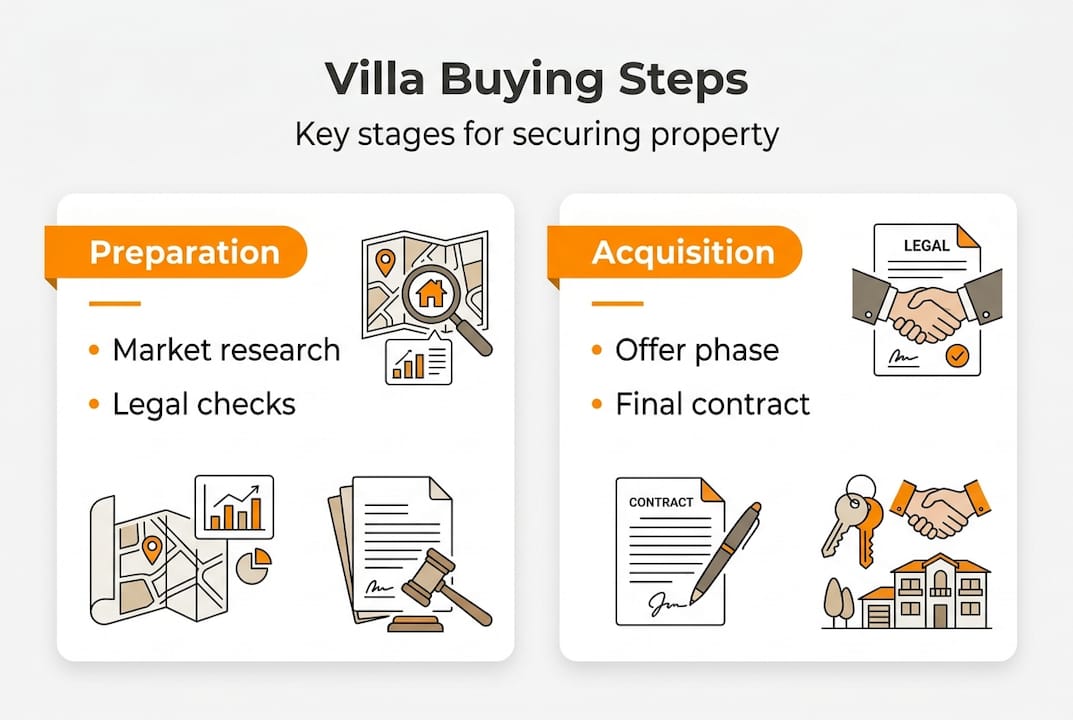
Once buyers are prepared, it is time to methodically follow the steps to secure the ideal villa. The acquisition journey, navigated with precision, transforms aspiration into a tangible heirloom.
Define your legacy brief. Before viewing a single property, articulate your purpose with clarity. Is this an owner-occupied sanctuary, a seasonal rental asset generating 4 to 6% yield, or a wealth transfer vehicle for the next generation? Your brief shapes every subsequent decision.
Engage specialist search channels. The most extraordinary Riviera properties rarely appear on public portals. Cultivate relationships with agents who maintain curated off-market networks. The finest villa and penthouse for sale opportunities reach discerning buyers through trust, not advertisement.
Evaluate the property rigorously. Assess not only aesthetics but investment fundamentals: southern aspect for maximum light and rental appeal, proximity to airports (Nice Côte d’Azur is 25 minutes from Cannes), planning restrictions affecting extensions, heritage classifications, and the condition of pools, terraces, and structural fabric.
Research comparable sales. Understand what similar properties have achieved in recent transactions. The top investment options on the Riviera are those where purchase price aligns with genuine scarcity, not merely aspirational vendor pricing.
Submit a formal offer (offre d’achat). Once satisfied, your agent submits a written offer. In France, an accepted offer initiates the preliminary contract (compromis de vente), at which point a deposit of typically 10% becomes payable.
Complete legal verification. Your notary and lawyer scrutinise the title deed, urban planning certificates (certificat d’urbanisme), diagnostics (asbestos, lead, energy performance), and any servitudes affecting the land.
Sign the acte de vente. The final deed is signed before the notary, funds transfer, and the keys to your Riviera legacy are formally yours.
| Stage | Typical duration |
|---|---|
| Property search | 1 to 6 months |
| Offer to compromis | 1 to 2 weeks |
| Compromis to acte de vente | 2 to 3 months |
| Registration and completion | 2 to 4 weeks post-signing |
Pro Tip: Always commission an independent survey of the property’s provenance, particularly for estates in Antibes, Èze, or Menton where centuries-old ownership histories can harbour undisclosed servitudes or boundary disputes that a standard notarial search may not surface immediately.
Safeguarding your legacy: Villa management and maintenance
After acquisition, maintaining and managing the villa is essential to safeguarding its value as a generational asset. A Riviera estate that is impeccably maintained commands a premium; one left to drift loses both capital value and the emotional resonance that makes it a true legacy.
Routine maintenance priorities
- Annual structural inspection of roofs, terraces, and external stonework, particularly after the intense Mistral winds that sweep the coast from late autumn through spring.
- Swimming pool servicing and seasonal preparation, including equipment checks, water treatment, and safety compliance in accordance with French regulations.
- Garden and grounds maintenance, because the sculpted olive groves, bougainvillea-laced pergolas, and maritime pine screens that define Riviera estates require professional, consistent care to retain their splendour.
- Full review of mechanical and electrical systems, air conditioning, smart home technology, security systems, and solar installations for eco-villas with certified green credentials.
Following villa maintenance tips from Riviera specialists ensures no seasonal detail is overlooked. For those seeking best-practice standards, villa cleaning best practices demonstrate how professional housekeeping protocols can reduce vacancy periods by up to 15% for seasonal rental properties.
Management options
For owners who are not in permanent residence, the choice of management model is critical.
- In-house staff: A resident housekeeper and property manager offer the highest level of personalised stewardship. Appropriate for estates above €5M where the complexity of maintenance warrants dedicated oversight.
- External management agency: Specialist villa management advice is available from agencies who handle everything from tenant liaison during elite lets to emergency repairs and regulatory compliance, providing peace of mind for internationally mobile owners.
- Concierge services: Premium concierge firms layer guest experiences atop operational management, particularly valuable for villas in Saint-Tropez or Cannes that command nightly rates of €5,000 and above during the peak summer season.
Legal structures for legacy preservation
Holding your villa within a Société Civile Immobilière (SCI) is a structure favoured by many families for its capacity to facilitate orderly inheritance. Shares in an SCI can be gifted progressively to heirs, reducing French inheritance tax exposure significantly over time. Annual review of your legal structure with a specialist adviser is a discipline that pays extraordinary dividends across generations.
A word of caution: Neglecting routine maintenance and management oversight, even for a single season, can erode both the market value and the irreplaceable character of a Riviera estate. Capital invested in stones deserves the same active stewardship as capital invested in markets.
The overlooked truth about generational villa investing
We have guided many extraordinary families through acquisitions on this coast, and the pattern we observe most consistently is this: the investors who succeed generationally are not those who buy the finest villa, but those who commit to the stewardship that follows.
The prevailing myth is that a prestige address on the legacy and ROI insights spectrum operates as a passive asset. It does not. A Riviera villa is a living entity, as responsive to care as the lavender-laced landscape surrounding it. Families who embed governance structures, from annual estate reviews to clearly documented inheritance intentions, outperform those who treat the property as a deposit made in stone.
Adaptability matters enormously. The eco-certified villa that appeals to your heir’s values in 2040 may require retrofitting today. The SCI structure that was optimal at purchase may need revision as family circumstances evolve. Community engagement, whether in Menton’s celebrated Lemon Festival or Cannes’ Film Festival social orbit, also sustains local relationships that protect property interests in quiet but meaningful ways.
Pro Tip: Convene an annual family governance review for your villa. Align ownership ambitions, maintenance budgets, and inheritance intentions in writing. This single discipline prevents the disputes that, more than any market downturn, erode generational legacies.
Your next step: Secure luxury and legacy on the Côte d’Azur
At Living on the Côte d’Azur, we connect discerning buyers with properties that transcend the transactional. Our curated portfolio spans iconic sea-view villas in Cannes and Saint-Tropez to architectural icons rising along Nice’s Mont Boron, all accessible through our bespoke off-market villa opportunities network. Browse our handpicked selection of French Riviera villas for sale, or allow our advisers to build a tailored acquisition strategy using our exclusive property investment guide. Contact us today and let us help you place your family’s future in the finest stone on the Mediterranean.
Frequently asked questions
What legal documents are required to purchase a luxury villa in France?
You need valid identity documents, proof of address, a French fiscal number if non-resident, and comprehensive proof of funds. A notary finalises all contracts and registers the transfer in accordance with French property law.
How can buyers access off-market luxury villas on the Côte d’Azur?
Off-market villas are accessed through trusted specialist agents and curated platforms with established high-net-worth networks, where the finest properties change hands quietly, long before public listings appear.
What is the typical return on investment for luxury villas in the French Riviera?
Prime Riviera villas have historically appreciated 5 to 8% annually, with elite seasonal lets generating rental yields of 3 to 6% depending on location, specification, and management quality.
How can buyers maintain a villa as a legacy asset for future generations?
Professional management and maintenance are the twin pillars of legacy preservation, ensuring the property retains both its market value and its character across ownership transitions.
Are there tax advantages or incentives for owning a luxury villa in France?
French property tax structures vary considerably by residency status, ownership vehicle, and investment type; a specialist adviser will identify the most tax-efficient structure for your family’s specific circumstances.
Recommended
 //
//