
TL;DR:
- Nearly 40% of luxury transactions on the Côte d’Azur occur off-market for privacy and exclusivity.
- Off-market deals are faster, often premium-priced, and protect buyer and seller identities.
- Building trusted networks and acting decisively are key to accessing these rare, high-value properties.
Nearly 40% of luxury transactions in markets like the Côte d’Azur are conducted entirely away from public listing portals, yet most investors cannot precisely define what “off-market” actually means. This distinction matters enormously. If you are seeking privacy, rarity, and the kind of generational asset that transforms a portfolio into a legacy, understanding off-market property is not optional — it is essential. We have prepared this guide to cut through the confusion, challenge a few myths, and give you the clarity and actionable strategies required to position yourself among the select few who access the Riviera’s finest hidden estates.
Table of Contents
- What defines off-market property?
- The advantages and risks of off-market deals
- How off-market deals actually happen: Strategies and networks
- The Côte d’Azur market: Off-market trends and investor outlook
- The real truth about off-market: Why rarity is the ultimate value
- Unlock your next legacy move with Côte d’Azur luxury experts
- Frequently asked questions
Key Takeaways
| Point | Details |
|---|---|
| Exclusive deals dominate | Up to 40% of luxury property sales on the Côte d’Azur are off-market, offering rare opportunities to discerning investors. |
| Privacy and speed advantages | Off-market transactions offer discretion and faster closing, ideal for high-net-worth individuals seeking legacy assets. |
| Risks require expertise | Limited price transparency and network dependence mean investors should use trusted advisers and rigorous due diligence. |
| Networks matter most | Building relationships with brokers and advisers unlocks the best off-market opportunities in the luxury segment. |
| Côte d’Azur trends | The local market follows global off-market patterns, but legacy value and rarity make these deals uniquely attractive. |
What defines off-market property?
An off-market property is any asset sold without being publicly listed on aggregator portals, national Multiple Listing Services (MLS), or mainstream estate agency websites. No Rightmove listing. No SeLoger advertisement. No public price revelation. The transaction moves between trusted parties, quietly and deliberately, before the wider world even senses the opportunity exists.
This is not a grey area or a workaround. It is a deliberate, legitimate, and increasingly preferred approach among the world’s most discerning buyers and sellers. On the Côte d’Azur, where a villa in Cap d’Antibes might command €8 million and a Monaco-adjacent penthouse can exceed €20 million, the motivations for keeping a sale private are as clear as the azure water below Èze’s clifftop ramparts.
Why do sellers choose off-market?
- Privacy: Ultra-high-net-worth individuals rarely wish to publicise their financial decisions. A sale announced on public portals can attract unwanted media attention, signal vulnerability, or simply feel undignified.
- Speed: Off-market deals, particularly in the Swiss and French luxury segments, close approximately 60% faster than comparable on-market transactions, largely because both parties are pre-qualified and motivated.
- Premium pricing: In the European luxury segment, sellers achieve a 3 to 8% price premium over comparable listed properties, given that buyers are competing for something genuinely rare rather than bidding against an open market.
- Discretion for sensitive estates: Family-owned Provençal mas, inherited estates near Menton’s lemon-scented citadel, or trophy villas used seasonally by high-profile owners all benefit from quiet transitions.
How off-market differs from public listings
| Feature | On-market listing | Off-market transaction |
|---|---|---|
| Public visibility | Full portal exposure | None |
| Buyer pool | Open to all | Pre-qualified, network-based |
| Transaction speed | Slower, broader negotiation | Typically faster |
| Price discovery | Transparent, competitive | Private, often premium |
| Privacy level | Low | High |
| Suited to | Standard residential | Luxury, legacy, prestige assets |
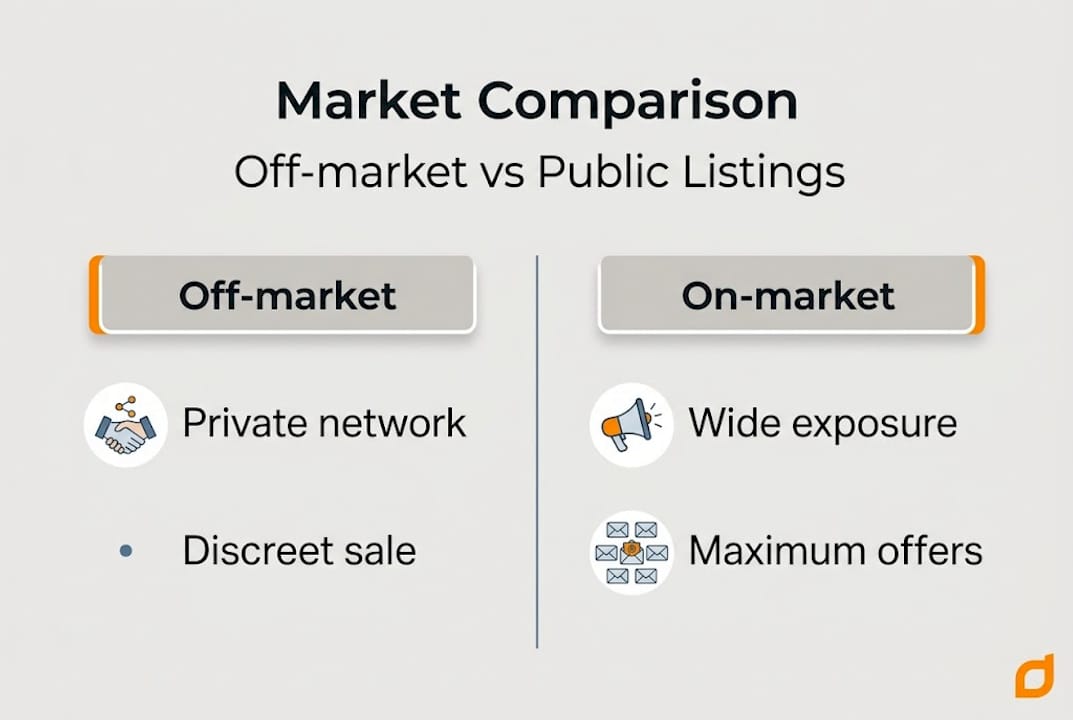
There is an important counterpoint here. Some agents argue that listing publicly maximises competition and therefore price, and the data does support this in standard residential markets. For a typical three-bedroom apartment in Nice’s Carré d’Or, full exposure makes perfect sense. However, for a singular estate with its own private beach between Cannes and Antibes, mass exposure can actually commoditise the asset, diluting its perceived rarity. Our guide to off-market properties explores this distinction in depth.
In 2026, it is estimated that roughly 40% of luxury transactions across premium markets occur off-market. On the Côte d’Azur, where exclusivity is the very foundation of the lifestyle, that figure is arguably higher. Rarity is the currency here.
The advantages and risks of off-market deals
With a firm definition in place, let us examine the practical upsides and dangers investors face in the off-market space.
The advantages are compelling, particularly for buyers seeking Riviera assets that appreciate 5 to 8% annually and offer 3 to 5% seasonal rental yields. Off-market transactions protect both buyer and seller identities, allow for nuanced negotiation without public pressure, and give access to properties that simply never reach portals. Imagine discovering a restored Provençal mas near the lavender-laced hills behind Grasse before any competing buyer has even heard it exists. That is the power of a trusted network.
In Switzerland and the south of France, the data is particularly striking. Swiss luxury properties sold off-market achieve price premiums of 3 to 8% and close 60% faster than public equivalents. In markets defined by genuine scarcity, this dynamic is amplified further.
Key advantages for Côte d’Azur investors
- Access to irreplaceable assets: The Riviera’s finest estates, particularly those with direct sea access or proximity to Monaco, rarely appear on public platforms. They move through curated networks.
- Reduced competition: Without open bidding, negotiations become a dialogue rather than an auction. This typically favours a buyer with the right advisors.
- Price stability and privacy: Off-market pricing reflects genuine value rather than speculative frenzy, which suits long-term legacy investment.
- Speed and certainty: Pre-qualified buyers and motivated sellers create cleaner, faster transactions, which is critical when securing a rare opportunity.
- Relationship-led due diligence: Trusted networks facilitate deeper access to property history, structural surveys, and title clarity before formal contracts begin.
“For exclusive Côte d’Azur gems, public listings commoditise rarity; the off-market route preserves the very quality that makes these assets exceptional.”
However, the risks deserve equal honesty. In the United States, sellers can leave nearly $5,000 on the table per transaction by avoiding public exposure, and in some US markets, off-market properties sell for approximately 17.5% less than their listed counterparts. The risks of limited price discovery and network dependency are real. If your broker is under-connected or, worse, has a conflict of interest, you may either overpay or lose a deal to a better-placed competitor.
The solution lies in understanding how to navigate these risks intelligently. Our analysis of off-market property advantages for Riviera investors provides a practical framework, while our elite off-market strategy guide covers the safeguards sophisticated buyers rely upon.
Pro Tip: Never rely on a single agent who represents both seller and buyer. Dual agency creates an inherent conflict of interest that can cost you transparency precisely when you need it most.
How off-market deals actually happen: Strategies and networks
Understanding the strengths and weaknesses, the next step is knowing how the most successful investors actually find and secure these exclusive opportunities.
The off-market world does not have a single front door. It operates through overlapping, relationship-driven networks where trust is the entry ticket. Advisors who specialise in the Côte d’Azur luxury segment spend years cultivating relationships with notaries, family offices, wealth managers, and private banking contacts. When an estate near Saint-Jean-Cap-Ferrat becomes available, these advisors are the first to know — often before the owner has formally decided to sell.
How successful investors access off-market properties
- Define your buy-box criteria precisely: Share exactly what you are seeking: the size, location, budget, lifestyle requirements, and investment objectives. An advisor who understands you are looking for a waterfront estate suitable for legacy transfer near the Monaco border will not waste your time with inland villas in Sainte-Maxime, no matter how charming the Nartelle beach sunsets.
- Act decisively: Off-market sellers often test appetite with a short window. Buyers who move slowly lose deals. Having legal, financial, and structural due diligence frameworks ready in advance is a significant competitive advantage.
- Commission truly independent due diligence: As noted in expert acquisition methodology, independent technical surveys and legal title checks should never be outsourced to the selling side of the transaction. Seismic resilience, coastal building restrictions, and historic title issues are all common on the Riviera.
- Avoid dual agency: We reinforce this point because it genuinely matters. An agent serving both buyer and seller cannot fully advocate for either. Appoint your own independent advisor from the outset.
- Leverage technology intelligently: Artificial intelligence platforms and curated off-market matching tools are emerging across European luxury markets. However, these tools augment rather than replace deep human networks. The Côte d’Azur’s most valuable estates will not appear in an algorithm. They move through conversations over dinner at Cannes’ Croisette or during Antibes’ Provençal market mornings.
Our off-market real estate guide outlines the precise due diligence steps we recommend, and our exclusive acquisition strategies page details how we navigate each stage with our clients.
Pro Tip: Prepare a concise one-page brief summarising your ideal property profile, acquisition timeline, and key decision criteria. Share this with your advisor in confidence. It accelerates the matching process considerably and signals that you are a serious, ready buyer rather than a casual enquirer.
The Côte d’Azur market: Off-market trends and investor outlook
Focusing specifically on the Côte d’Azur, here is how off-market trends are shaping the landscape for investors seeking enduring value and legacy.
The Riviera occupies a singular position in the global luxury property conversation. From Menton’s golden baroque facades and the botanical serenity of Val Rahmeh’s garden to Cannes’ yacht-studded bay during the Film Festival regattas, the region offers a lifestyle that simply cannot be replicated elsewhere. The financial case is equally compelling. Luxury properties in the region appreciate 5 to 8% annually, seasonal rental yields regularly reach 3 to 5%, and a growing cohort of digital-era investors are channelling wealth into tangible Riviera assets that offer both prestige and protection.
In this context, approximately 40% of luxury transactions in 2026 are occurring off-market, and the Côte d’Azur’s premium segment almost certainly exceeds this figure.
Key trends shaping the Riviera off-market landscape
- International buyers are driving demand: British, American, Middle Eastern, and Asian investors all recognise the Riviera’s enduring appeal. Many actively prefer off-market routes to protect their privacy and avoid currency-driven bidding wars.
- Legacy and generational wealth planning: Monaco-adjacent plots, Èze hillside estates, and restored farmhouses near Antibes are increasingly being acquired through family offices as multi-generational assets rather than short-term investments. The 2026 eco-villa trend, with solar arrays and green certifications, further supports this long-view strategy.
- Swiss and Mediterranean parallels: Switzerland’s luxury off-market data, showing faster sales and consistent price premiums, closely mirrors what we observe along the Riviera. Scarcity, privacy, and international buyer profiles create similar dynamics.
- Cryptocurrency and digital wealth are entering the market: Digital millionaires seeking to convert liquid crypto gains into appreciating stone assets are accelerating off-market enquiries. Discretion is paramount for this cohort.
- Seasonal catalysts amplify demand: The Cannes Film Festival, Monaco Grand Prix, Antibes’ yachting season, and Menton’s Lemon Festival create recurring windows when motivated sellers and well-connected buyers naturally converge, making these periods rich with quiet, off-market movement.
Investors seeking to track these movements and identify top luxury real estate locations will find context in our broader European market analysis. For a deeper exploration of Riviera legacy value and forward-looking market trends for 2026, we encourage you to explore our dedicated resources.
The real truth about off-market: Why rarity is the ultimate value
We will be direct: the mainstream real estate conversation consistently overvalues exposure and undervalues exclusivity.
The conventional wisdom that every seller should maximise public reach to secure the highest price is entirely rational in a standard residential market. It is largely irrelevant when applied to a singular estate overlooking the Baie des Anges, a Monaco-border villa with its own private garden, or a clifftop retreat above Èze’s Nietzsche trail. These properties are not commodities. They are statements of heritage, privacy, and vision.
When public listings commoditise rarity, they inadvertently strip these assets of the very quality that makes them exceptional. The moment a trophy estate appears on a public portal, it becomes an object of mass curiosity rather than a curated opportunity. The sellers we work with understand this. The buyers who succeed with us understand it too.
We believe that privacy in luxury real estate is not merely a preference. It is a strategic advantage. Discretion, wielded intelligently, becomes the asset itself. The buyers who create the most enduring legacies on the Côte d’Azur are those who treat their acquisition strategy with the same deliberate restraint they bring to every other aspect of their wealth.
Pro Tip: Treat your property search criteria as confidential strategic intelligence. Share them selectively, only with advisors who have demonstrated access to the calibre of assets you are seeking.
Unlock your next legacy move with Côte d’Azur luxury experts
Having revealed the true power of discretion and rarity, here is how you can put these principles into practice with trusted experts.
At Living on the Côte d’Azur, we are the discreet gateway between exceptional properties and exceptional buyers. Our access to invisible luxury real estate — estates that never appear on public portals — is built on years of relationship cultivation across notaries, family offices, and private networks. Whether you are a seasoned investor protecting intergenerational wealth or a digital entrepreneur seeking your first Riviera legacy asset, we understand the value of international property ownership and what it truly means to own a piece of this luminous coastline. Discover precisely why the Côte d’Azur is a must for investors in Europe and speak with our team today.
Frequently asked questions
How do off-market property deals work in the luxury Côte d’Azur market?
Properties are traded privately through trusted broker networks, offering faster transactions and enhanced discretion for high-net-worth buyers. In 2026, roughly 40% of luxury transactions occur through these channels, with European luxury deals frequently closing 60% faster than public equivalents.
Is it true that sellers get less when selling off-market?
This depends heavily on market and property type. While US sellers can lose nearly $5,000 per transaction and off-market homes sell around 17.5% below listed equivalents in some markets, European luxury sellers often achieve 3 to 8% price premiums due to exclusive buyer pools and genuine scarcity.
What are the biggest risks for international buyers in off-market deals?
The primary risks are limited price transparency and reliance on the quality of your network. However, for truly rare Riviera assets, these risks are offset by access to estates that public listings would commoditise rather than celebrate.
How do I access genuine off-market luxury opportunities?
Build relationships with specialist advisors who focus exclusively on the luxury segment and have verifiable access to private networks. As expert acquisition methodology consistently shows, sharing a precise buy-box brief, committing to fast decisions, and commissioning independent due diligence are the three behaviours that separate successful off-market buyers from those who perpetually miss the finest opportunities.
Recommended
 //
//