
TL;DR:
- True value on the Côte d’Azur depends on scarcity, infrastructure, and legacy potential, not just location.
- Rigorous due diligence, including legal, structural, and regulatory checks, is essential before purchasing.
- Sustainable features and structural adaptability ensure estates serve multiple generations and maintain long-term worth.
The Côte d’Azur is not simply a destination. It is a declaration. With luxury villas averaging USD 12,700 to 19,100 per m² in 2025, French Riviera estates consistently outpace global luxury property benchmarks by a considerable margin. Yet even within this gilded market, not every prestige address translates into lasting wealth. Some investors secure generational treasures; others acquire expensive maintenance burdens. The difference lies not in the postcode, but in the precision of your selection criteria. This guide walks you through the overlooked, often underestimated, factors that separate a fleeting luxury purchase from a true heirloom estate.
Table of Contents
- Understanding true value: Beyond location and aesthetics
- Conducting comprehensive due diligence
- Evaluating legacy and sustainability factors
- Applying decision frameworks for investment
- A fresh perspective: What legacy investors often overlook
- Explore unique luxury estate opportunities
- Frequently asked questions
Key Takeaways
| Point | Details |
|---|---|
| Scarcity and infrastructure | The most valuable estates derive lasting appreciation from limited supply and quality infrastructure, not mere location. |
| Comprehensive due diligence | Neglecting legal, financial, and maintenance checks may threaten legacy potential and investment security. |
| Legacy-driven criteria | Prioritising sustainability, regulatory compliance, and adaptability ensures generational wealth transfer. |
| Synthesis for selection | Combining all criteria into a practical decision framework is vital to secure enduring luxury estate investments. |
Understanding true value: Beyond location and aesthetics
There is a seductive simplicity to the notion that a property overlooking the Baie des Anges in Nice or perched above the lemon-scented ramparts of Menton will automatically appreciate. Location matters, of course. But on the Côte d’Azur, where every headland seems more breathtaking than the last, luxury home values are shaped by a far richer constellation of forces.
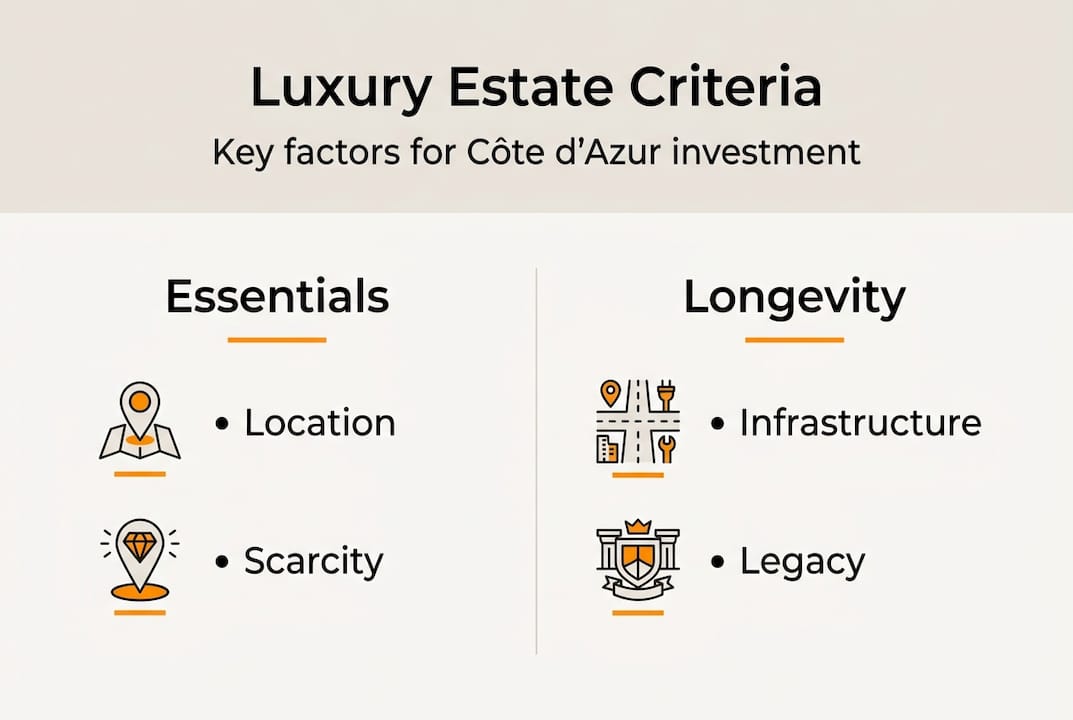
Scarcity is one of the most powerful. The coastline between the Italian border and Cannes is finite. Planning restrictions, protected natural zones, and the sheer geological drama of the terrain mean that truly exceptional plots are not being created. They are only changing hands. When you acquire a Cap d’Antibes estate with direct sea access or a Monaco-adjacent villa with uninterrupted panoramas, you are not buying a product that can be replicated. That irreplaceability is a cornerstone of sustained capital growth.
Infrastructure quality is the second pillar. Proximity to Nice Côte d’Azur International Airport, the TGV rail network, and the A8 motorway corridor matters enormously to a global buyer travelling between Paris, London, or Dubai. Estates within efficient reach of these arteries command measurable premiums, particularly among families who treat the Riviera as a primary residence rather than a seasonal retreat.

Legacy potential sits above both. This is the criterion that separates transactional buyers from visionary investors. An estate with adaptable floor plans, robust structural integrity, eco-retrofit potential, and established grounds speaks to successive generations, not just the present owner.
Consider how the Côte d’Azur stacks up against comparable global luxury markets:
| Value driver | Côte d’Azur | Global luxury average |
|---|---|---|
| Annual appreciation | 5 to 8% | 3 to 5% |
| Scarcity of supply | Extremely limited | Moderate to high |
| Rental yield (elite lets) | 3 to 5% | 2 to 4% |
| Infrastructure access | Exceptional | Variable |
| Legacy adaptability | High (Provençal stock) | Moderate |
| Regulatory environment | Stable, EU-backed | Variable |
The market trends for the Côte d’Azur in 2026 reinforce this picture. Industry research projects a 5.05% CAGR for Côte d’Azur villas through to 2031, underpinned by constrained supply and intensifying global demand. Scarcity and infrastructure remain the twin engines driving appreciation well above what comparable coastal markets in Southeast Asia or the Caribbean can reliably deliver.
When evaluating French Riviera estate options, we encourage our clients to resist the magnetism of aesthetics alone. A freshly renovated Èze hillside villa with a designer kitchen will seduce you instantly. The question worth asking is whether the bones of the building, the plot’s legal clarity, and the surrounding neighbourhood’s trajectory will continue to reward your heirs in thirty years.
Key value drivers to prioritise:
- Scarcity of the plot: Headland positions, domaine estates, and properties with agricultural or coastal protection designations
- Structural pedigree: Belle Époque or Provençal mas construction with proven structural resilience
- Sustainable infrastructure: Solar arrays, water recycling systems, and green certifications that future-proof the asset
- Community prestige: Proximity to Monaco, Cannes Film Festival circuits, or established sailing regattas that maintain international visibility
- Rental track record: Documented elite seasonal rental history that validates yield projections
Conducting comprehensive due diligence
Once you have identified an estate with genuine value credentials, the next imperative is rigorous verification. Beautiful properties can conceal complex legal histories, undeclared structural modifications, or regulatory encumbrances that erode their investment appeal entirely. We have seen discerning buyers fall in love with a Saint-Tropez mas and overlook a servitude (an easement, or a third party’s legal right of access) buried in the title deeds. That oversight cost one family months of legal dispute and a meaningful discount on a subsequent resale.
Here is the due diligence sequence we recommend for every luxury estate acquisition:
- Title audit: Commission a notaire (French public notary) to verify the chain of title, confirm there are no outstanding charges or mortgages, and ensure the property boundaries match cadastral records.
- Technical survey: Engage a qualified surveyor to assess structural integrity, seismic resilience, drainage systems, and any undeclared extensions or modifications.
- Regulatory compliance check: Confirm the property’s compliance with local PLU (Plan Local d’Urbanisme, or local planning regulations), particularly for any recent renovations or pool constructions.
- Tax liability assessment: Evaluate your exposure to the IFI (Impôt sur la Fortune Immobilière), France’s real estate wealth tax, which applies to net real estate assets above the €1.3M threshold.
- Financial forecasting: Model acquisition costs including notary fees (typically 7 to 8% for older properties and 2 to 3% for new builds under VEFA contracts), agency fees, and annual maintenance budgets.
- Off-market sourcing: Engage a chasseur d’appartement (a property hunter, a specialist advisor who sources estates not publicly listed) to access opportunities before they reach the open market.
Understanding luxury estate financing options is equally essential at this stage, particularly as easing interest rates in 2026 are opening more attractive leverage structures for high-net-worth buyers.
| Due diligence check | Who conducts it | Approximate cost |
|---|---|---|
| Title and deed audit | Notaire | Included in notary fees |
| Structural survey | Independent surveyor | €1,500 to €4,000 |
| Planning compliance | Architect or legal advisor | €1,000 to €2,500 |
| IFI tax assessment | Wealth tax specialist | €800 to €2,000 |
| Environmental survey | Specialist firm | €500 to €1,500 |
A dedicated luxury real estate tax guide will clarify how to structure ownership efficiently, whether through a Société Civile Immobilière (SCI), a French civil property company, or direct personal ownership. Consulting a French property tax specialist before signing any preliminary agreement is not optional for serious investors. It is foundational.
Pro Tip: Many of the most coveted estates on the Riviera never appear on public portals. A chasseur d’appartement with a curated network across Cap d’Antibes, the Cannes hinterland, and the Monaco borders will unlock off-market estate sourcing opportunities that are entirely invisible to buyers relying on standard listings. This access alone can justify the advisor’s fee many times over.
Maintaining an estate once acquired requires equally structured thinking. Research into estate maintenance practices confirms that disciplined upkeep directly reduces vacancy rates and protects seasonal rental premiums.
Evaluating legacy and sustainability factors
With due diligence complete, the truly long-horizon investor turns attention to a set of criteria that most buyers address only superficially: legacy suitability and sustainability resilience.
A legacy estate, as we define it at Living on the Côte d’Azur, is one that serves multiple generations without requiring fundamental reinvention. It possesses structural adaptability, meaning it can be reconfigured to accommodate extended family living, private staff quarters, or even a boutique hospitality operation. It carries a maintenance history that is transparent and professionally managed. And it reflects the environmental values that today’s heirs, and tomorrow’s buyers, will demand.
The French luxury estate market is registering a 15% demand increase for eco-certified and sustainability-enhanced builds heading into 2026. Buyers who acquire estates with solar arrays, rainwater harvesting, geothermal heating, and biophilic garden design are not simply making an ethical choice. They are securing a market advantage.
True luxury is not measured in marble or sea views alone. It is measured in the estate’s capacity to endure, adapt, and reward each generation that inherits it.
Key legacy and sustainability factors to assess:
- Green certifications: HQE (Haute Qualité Environnementale) or BBC Effinergie labels that signal energy performance
- Renewable energy systems: Solar arrays, heat pumps, and battery storage that reduce operating costs
- Structural adaptability: Floor plans that accommodate multi-generational living without costly reconfiguration
- Legal structure readiness: SCI ownership structures that facilitate tax-efficient intergenerational transfer
- Provenance and maintenance records: Documented renovation history, service contracts, and condition reports
- Regulatory compliance trajectory: Estates that already meet 2030 energy performance standards avoid future liability
Luxury estate amenities such as private pools, tennis courts, and home automation systems contribute to rental premiums but should be assessed against their maintenance cost profiles. A Sainte-Maxime domaine with a heated infinity pool overlooking the Golfe de Saint-Tropez is a seasonal rental treasure. It also demands a disciplined upkeep budget to maintain its commanding nightly rates.
Maintenance and regulatory compliance are not administrative formalities. They are active determinants of legacy estate value. An estate that has received consistent professional care for two decades will attract a measurably different buyer profile and price upon resale than one showing deferred maintenance, regardless of its location.
Pro Tip: When reviewing an estate’s legacy potential, request at least ten years of maintenance records, any planning permissions granted or refused, and the current energy performance certificate (DPE). These three documents alone will tell you more than any estate agent’s brochure about the property’s true condition and future liability profile.
Understanding what defines a legacy property for portfolio investors is a discipline in itself, one we have refined across hundreds of client acquisitions along the Riviera.
Applying decision frameworks for investment
The final step is synthesis: taking all the criteria above and distilling them into a structured, repeatable decision framework. Without this, even informed buyers can succumb to emotional decision-making, paying a premium for an estate that excites the imagination but underdelivers on measurable investment metrics.
Here is the framework we apply with our most discerning clients:
- Define your investment thesis: Clarify whether the estate serves primarily as a private sanctuary, a seasonal rental asset, an intergenerational legacy vehicle, or a combination of all three. Each objective weights the criteria differently.
- Score the value drivers: Rate each estate against scarcity, infrastructure, sustainability, structural pedigree, and rental track record on a weighted scale you establish before viewing properties.
- Complete the due diligence matrix: Use the checks outlined above as non-negotiable gates. No estate advances to offer stage without passing every item.
- Model the financial outcomes: Calculate the price per square metre relative to comparable transactions, project the rental yield across conservative and optimistic scenarios, and stress-test the IFI implications.
- Assess the regulatory landscape: Confirm the estate’s position within local planning frameworks, particularly any pending infrastructure projects or environmental protection designations that could affect future development rights.
- Review regulatory and market comparisons: These shape investment outcomes in ways that pure property fundamentals cannot predict alone.
| Decision criterion | Questions to ask | Red flags |
|---|---|---|
| Scarcity | Is this plot genuinely irreplaceable? | High local supply; replicated views |
| Due diligence | Are all checks complete and clear? | Unresolved title issues; undeclared works |
| Sustainability | Does it meet 2030 energy standards? | Poor DPE rating; no eco features |
| Legacy suitability | Can it serve multiple generations? | Inflexible layout; deferred maintenance |
| Financial viability | Does the yield justify the acquisition cost? | Inflated asking price; hidden charges |
| Regulatory clarity | Is planning status unambiguous? | Pending zoning changes; enforcement notices |
The most common pitfalls we observe among first-time Riviera investors include an over-reliance on trend-driven amenities, such as a wine cellar or a cinema room, without investigating the estate’s regulatory standing. Another frequent error is failing to account for the cumulative tax burden across IFI, capital gains on eventual sale, and annual taxe foncière. Exploring luxury investment options on the Côte d’Azur with an experienced advisor avoids these costly oversights.
A fresh perspective: What legacy investors often overlook
We have guided buyers from Monaco to Menton, from the yacht-lined quays of Antibes to the hilltop galleries of Èze, and one pattern repeats itself with striking regularity. The investors who achieve the greatest long-term returns are not those with the largest budgets or the most sophisticated financial models. They are those who treat regulatory clarity and structural adaptability as primary criteria rather than secondary considerations.
Too many buyers arrive on the Riviera captivated by the salt-kissed light of a Cannes penthouse or the lavender-laced terraces of a Provençal mas, and they anchor their decision entirely to aesthetics and perceived prestige. The IFI implications, the DPE energy rating, the planning history: these feel like administrative details. They are, in fact, the architecture of your investment’s future value.
The estates that endure across generations are not those that impressed their era most. They are those that were built and acquired with the greatest care for what lies beneath the surface.
We also observe that the most rewarding acquisitions on the Riviera tend to come through professional networks rather than public listings. A legacy and ROI-focused approach demands access to estates that have never been publicly marketed, where motivated sellers and informed buyers meet in curated, confidential settings.
The Riviera rewards patience, precision, and the courage to look beyond the view.
Explore unique luxury estate opportunities

At Living on the Côte d’Azur, we connect visionary buyers with estates that transcend the ordinary, from Monaco-adjacent villas dripping with prestige to serene Sainte-Maxime retreats steps from the Nartelle sands. Whether you are ready to act or still refining your investment thesis, our advisors bring intimate knowledge of every micromarket along the coast. Discover off-market properties that never reach public portals, or explore our curated portfolio of French Riviera villas for sale across every prestige address. For families focused on protecting future generations, our high-net-worth real estate guidance delivers the strategic clarity your legacy deserves.
Frequently asked questions
What is the typical price per square metre for luxury estates on the Côte d’Azur?
In 2025, Côte d’Azur villas average between USD 12,700 and 19,100 per m², making the French Riviera one of the most consistently valued luxury markets in the world.
What legal checks are essential when acquiring luxury real estate in France?
Buyers must verify clear property title, confirm compliance with local planning regulations, and assess obligations such as the IFI wealth tax for net real estate assets exceeding €1.3M.
How can buyers access exclusive or off-market luxury estates?
Engaging a chasseur d’appartement, a specialist property hunter with curated networks along the Riviera, is the most reliable route to estates that never reach public listings.
Why is legacy potential important in luxury estate investment?
Legacy properties deliver sustained capital appreciation, facilitate tax-efficient intergenerational wealth transfer, and retain their desirability across market cycles precisely because they were selected for resilience, not simply for trend appeal.
Recommended
 //
//