
TL;DR:
- New construction on the Côte d’Azur offers sustainability, customization, and structural protections for lasting legacy.
- Eco-certified new builds provide significant energy savings, future-proofing, and resale premiums.
- Modern new homes surpass older properties with warranties, lower fees, and advanced technological integration.
The Côte d’Azur has never been simply a destination. It is a declaration. For the global investor who thinks in decades rather than quarters, selecting new construction along this salt-kissed coastline requires far more than admiring a view from a sun-drenched terrace in Cap d’Antibes or counting superyachts from a Cannes Croisette penthouse. Sustainability credentials, customisation freedom, legal protections, and generational value all converge in ways that existing properties simply cannot replicate. We guide you through every advantage that matters most when the goal is not merely ownership, but a lasting heritage.
Table of Contents
- Evaluating new construction: essential criteria for legacy investors
- Sustainability and eco-certifications: future-proofing your investment
- Customisation and technological edge: shaping modern luxury
- Economic impact and community transformation: case studies on the Côte d’Azur
- How new construction compares to existing property for legacy investments
- Why new construction delivers more than luxury: an expert take
- Explore luxury new construction opportunities on the Côte d’Azur
- Frequently asked questions
Key Takeaways
| Point | Details |
|---|---|
| Sustainability advantages | New constructions achieve impressive eco-certifications and carbon savings, aligning with legacy-focused values. |
| Customisation potential | Buyers enjoy unmatched personalisation options and cutting-edge technology without extra renovation expenses. |
| Community and economic impact | Modern developments stimulate local economies, provide jobs, and transform regions, adding investor value. |
| Legacy investment edge | High-quality builds and future-proof features make new properties especially attractive for generational wealth planning. |
Evaluating new construction: essential criteria for legacy investors
Before any investor commits capital to a new build, they must ask: what separates a luxury asset from a true legacy asset? On the Côte d’Azur in 2026, the answer is layered and richly nuanced. Understanding the benefits of new homes in this specific context is not a matter of aesthetics alone. It is about choosing an asset that your children and grandchildren will cherish, and that the market will continue to reward.
Legacy-focused buyers consistently prioritise four decision drivers:
- Sustainability and energy performance, which dramatically reduce long-term costs and align with evolving regulatory standards
- Customisation opportunities, enabling spaces to reflect individual vision without expensive post-purchase renovation
- Technological integration, from smart climate controls to biometric security, which adds both daily comfort and measurable resale value
- Legal and structural protections, particularly France’s VEFA (Vente en l’État Futur d’Achèvement) off-plan contracts, which shield buyers from construction overruns and include a ten-year structural warranty
Asset longevity is equally critical. A property in Menton, within walking distance of the legendary Lemon Festival and Val Rahmeh’s botanical gardens, will endure as a cultural and geographical prize. But a new build in Menton provides something an 18th-century mas cannot: a structure designed for the climate challenges and lifestyle expectations of the next fifty years. For those exploring international real estate investment, the Riviera’s combination of stable demand, limited supply, and extraordinary lifestyle continues to make it one of the most compelling arguments for new construction anywhere in Europe.
Properties on the Côte d’Azur appreciate at 5 to 8% annually on average, and new builds tend to lead that curve rather than follow it, driven by modern amenity expectations and strengthening environmental standards.
Sustainability and eco-certifications: future-proofing your investment
Sustainability is not a marketing phrase in 2026. It is a financial imperative. For the investor thinking generationally, a property with strong environmental credentials is one that will remain desirable, lettable, and legally compliant across decades of evolving regulation. Our portfolio of sustainable luxury properties on the Côte d’Azur reflects precisely this forward-thinking philosophy.
The region is already producing extraordinary proof of concept. The Canebiers-Villette eco-district in Cagnes-sur-Mer stands as a landmark example, where low-carbon construction methods have saved 8,500 tonnes of CO2 compared to conventional building techniques. The development features 65% greened surfaces, a geothermal energy system, and is actively targeting premier eco-certifications. This is the architecture of tomorrow, being built today, and buyers who secure a position now are doing so from a position of rare foresight.
| Feature | Standard new build | Eco-certified new build |
|---|---|---|
| Energy rating | B | A or A+ |
| Annual energy costs | Moderate reduction | Up to 70% savings vs. older stock |
| CO2 footprint | Reduced | Near-zero or carbon-offset |
| Regulatory compliance | Current standards | Future-proof for 20+ years |
| Resale premium | Market average | 10 to 20% premium anticipated |
“An eco-certified property on the Riviera is not simply a greener home. It is a more resilient investment, one that protects capital against tightening legislation and attracts the most sophisticated buyers in successive generations.”
Pro Tip: When evaluating any new build, always request the project’s energy performance certificate at pre-completion stage and confirm which certification body is involved. HQE (Haute Qualité Environnementale) and BBC-Effinergie labels are the most prestigious in France, and they translate directly into lettability and resale advantage.
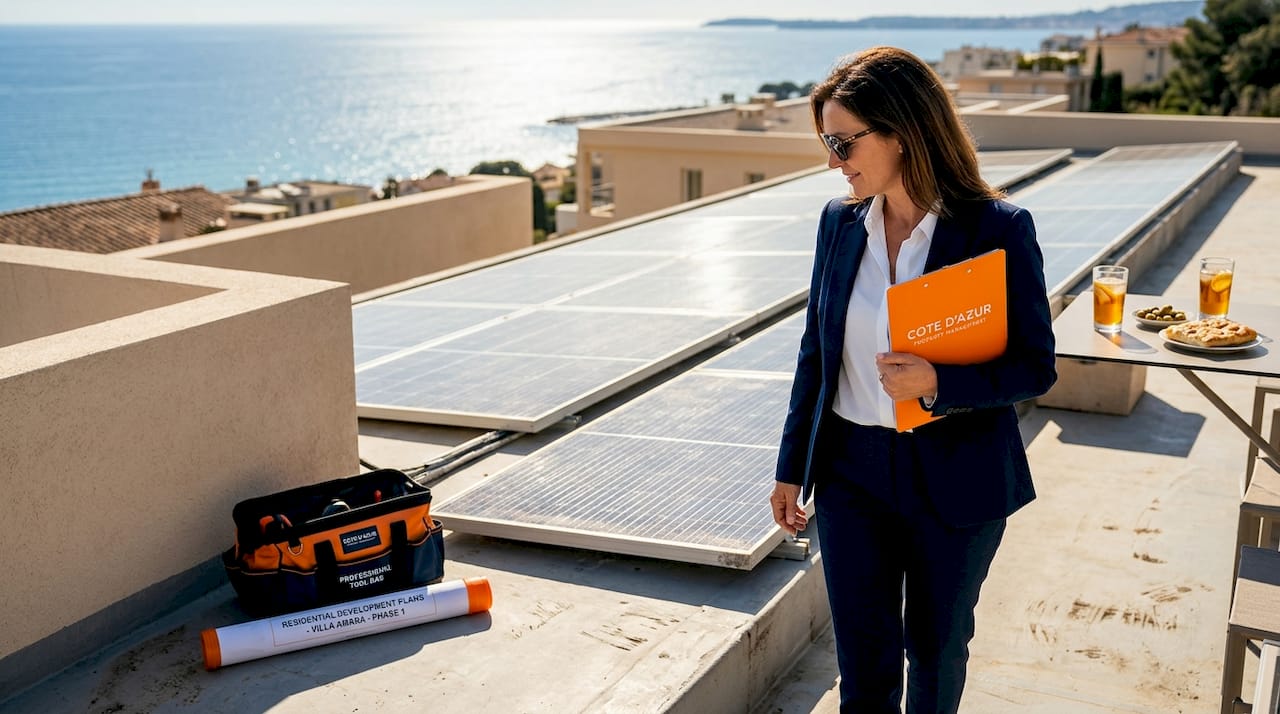
Renewable energy integration, particularly solar arrays designed to complement the Riviera’s 300 days of annual sunshine, further reduces operating costs in a meaningful way. For heirs who value the planet as much as their portfolio, such a property is a true inheritance: beautiful, responsible, and built to endure.
Customisation and technological edge: shaping modern luxury
One of the most profound advantages of purchasing new construction is the ability to shape the property before it is finalised. On the Côte d’Azur, where discerning buyers have deeply personal visions of how luxury should feel and function, this is not a trivial benefit. New homes enable personalisation without the disruption and often significant cost of post-purchase renovation.
Consider what becomes possible when you engage with a development at the right stage:
- Floor plan adjustments, converting a standard layout into an open-plan living and dining space that captures sea views from every angle
- Material and finish selections, from hand-cut Provençal stone floors to custom cabinetry sourced from regional artisans in the hills above Grasse
- Technology packages, specifying your preferred smart home platform, audio-visual infrastructure, and integrated climate control from the outset
- Outdoor living configurations, designing terraces, pool surrounds, and landscaping to complement the natural backdrop, whether that is the lavender-laced hillsides near Èze or the pine-shaded tranquillity of Cap d’Antibes
To ensure you select luxury amenities that will serve both immediate enjoyment and long-term value, we suggest the following approach:
- Define your primary lifestyle use, whether it is a family sanctuary, a seasonal rental flagship, or a full-time residence, since different uses favour different configurations
- Engage with a technology specialist before construction is finalised, particularly for smart home systems, as retrofitting these later is costly and disruptive
- Request a detailed specification sheet from the developer covering all standard finishes, and negotiate upgrades during the contract stage, when leverage is greatest
- Consider biophilic design elements, such as living walls, natural materials, and generous glazing, since these have demonstrated a measurable positive effect on both wellbeing and resale interest
Pro Tip: Smart home technology is now expected, not exceptional, at the luxury end of the Riviera market. Buyers who specify fully integrated systems at new build stage typically command rental premiums of 12 to 18% compared to equivalently located properties that lack these features.
The intersection of personalisation and technology is where new construction most visibly outperforms its established counterpart. A villa above Saint-Tropez’s Pampelonne beach, finished precisely to your specification and equipped with the latest home automation, is not merely a home. It is an extension of identity, and an asset that commands attention in an elite rental market.
Economic impact and community transformation: case studies on the Côte d’Azur
Sophisticated investors understand that an asset’s value is inseparable from the health of its surrounding community. The Côte d’Azur’s most ambitious new construction projects are not only reshaping skylines; they are transforming local economies in ways that compound long-term property value.
The Parc Méridia eco-district in Nice is perhaps the most compelling example of this transformative vision. Spanning 64 hectares, the Parc Méridia development incorporates 5,430 housing units, of which 35% are designated as social housing, alongside 6,000 new jobs and 23 hectares of renatured green space. The project is anchored in principles of urban agriculture and circular economy, creating a self-sustaining neighbourhood that will only grow in prestige and desirability over time.
When a development of this scale succeeds, the surrounding area benefits directly. Demand for new construction properties in adjacent districts increases, transport and retail infrastructure improves, and the cultural life of the neighbourhood becomes richer and more vibrant. For the legacy investor, buying within or adjacent to transformational projects is akin to acquiring a stake in the city’s future.
| Project | Location | Scale | Key benefits for investors |
|---|---|---|---|
| Parc Méridia | Nice | 64ha, 5,430 units | Jobs growth, green space, circular economy |
| Canebiers-Villette | Cagnes-sur-Mer | Eco-district, CO2 saving | Eco-certifications, geothermal, 65% green surfaces |
| Mont Boron towers | Nice | Sea-view residences | Biophilic design, panoramic Baie des Anges vistas |
| Sainte-Maxime waterfront | Sainte-Maxime | From €1.2M | Steps from Garonette sands, ferry to Saint-Tropez |
Demand for sustainable new builds across the region is forecast to spike by 15% in 2026, reflecting both growing buyer awareness and tightening French environmental regulations. The investors who position themselves now, during the early phases of these landmark developments, will benefit most from that momentum.
How new construction compares to existing property for legacy investments
The question every investor must eventually confront is a direct one: why choose new construction over a storied Provençal mas or a classic villa on the heights above Èze? The answer is not that existing properties lack charm. It is that new builds offer a constellation of structural advantages that existing stock simply cannot match.
New construction on the Côte d’Azur consistently delivers energy-efficient, modern amenities that are designed from the outset for the expectations of elite buyers. Consider the key distinctions:
- Ten-year structural warranty (garantie décennale): new builds carry this protection automatically; existing properties do not
- Lower notary fees: purchasing off-plan typically reduces notary costs to around 2 to 3% of the purchase price, versus 7 to 8% for existing properties
- Zero-interest payment plans: many VEFA developers offer staged payment programmes that align with construction milestones, easing capital deployment
- Energy performance: new builds meet current and anticipated standards, whereas many classic villas face costly upgrades under France’s evolving Diagnostic de Performance Énergétique requirements
- No hidden renovation costs: what you specify is what you receive, with no unpleasant discoveries behind 1970s tiling or ageing electrical systems
To explore the advantages of existing property is also worthwhile, since heritage properties carry an irreplaceable romance. However, for the investor whose primary goal is legacy building, rental yield optimisation, and cost predictability across generations, new construction presents the more dependable instrument.
| Criterion | New construction | Existing property |
|---|---|---|
| Structural warranty | Ten years | None (unless recent) |
| Notary fees | 2 to 3% | 7 to 8% |
| Energy efficiency | A to B rating | Often E or below |
| Customisation | Full at build stage | Post-purchase renovation required |
| Regulatory compliance | Future-proof | Potential upgrade costs ahead |
The decision, of course, is never purely financial. A restored farmhouse near Antibes, where Picasso once wandered the coastal sentiers, carries an emotional weight that a spreadsheet cannot capture. But emotion and legacy are not mutually exclusive with new construction. A perfectly realised new villa, finished to your specification, with your family’s values embedded in its materials and design, is equally an heirloom.
Why new construction delivers more than luxury: an expert take
There is a persistent assumption in the high-end property world that prestige is synonymous with age. That the most compelling asset on the Côte d’Azur must be a sun-bleached bastide or a belle époque jewel overlooking the sea from the corniche above Menton. We respectfully challenge that view.
The investors who have generated the most enduring wealth from Riviera property in recent years are not those who paid heritage premiums for properties requiring significant capital expenditure. They are those who recognised that a new build, designed with precision and acquired through an off-plan VEFA contract, compounds value in ways that old stone rarely replicates. The combination of energy performance, warranty protection, and customisation creates an asset that is simultaneously more comfortable, more lettable, and more compliant than its antique counterpart.
There is also a generational dimension that conventional advice frequently misses. When you pass a new build to your heirs, you pass them a property that will not require a six-figure renovation in the first decade of their ownership. You pass them an asset that already carries the values they care about, environmental responsibility, technological sophistication, and curated beauty. Reviewing the luxury market trends for 2026 makes this abundantly clear: the most ambitious buyers, from digital entrepreneurs investing in physical assets to established family offices diversifying portfolios, are gravitating towards new builds precisely because they understand the compounding logic.
The Riviera’s new construction renaissance is not a departure from tradition. It is tradition, reimagined for the world your heirs will actually inhabit.
Explore luxury new construction opportunities on the Côte d’Azur
We invite you to take the next step with confidence. Our curated portfolio of active new build listings spans the coastline from Menton’s lemon-scented promenades to Sainte-Maxime’s Nartelle beach sunsets, encompassing off-plan residences, beachside designer apartments, and sea-view towers designed for the most discerning global buyers. For those seeking something entirely bespoke, our off-market luxury properties service opens doors that rarely appear publicly. Browse our full range of luxury villas and penthouses and speak with our specialists to identify the new construction opportunity that will become your family’s most treasured inheritance.
Frequently asked questions
How do eco-certifications enhance the value of new construction investments?
Eco-certifications confirm that a property meets rigorous sustainability benchmarks, which drives resale premiums, reduces operating costs, and ensures the asset remains attractive to the most environmentally conscious buyers. Developments like the Canebiers-Villette eco-district demonstrate this through 8,500 tonnes of CO2 savings and geothermal energy integration.
Can new construction properties on the Côte d’Azur be customised extensively?
Yes, buyers engaging at the off-plan stage can shape layouts, finishes, and technology integrations without post-purchase renovation costs, since new builds allow personalisation as a structural part of the purchase process.
What community benefits do large new construction projects provide?
Landmark projects like Parc Méridia create 6,000 jobs and 23 hectares of renatured green space, strengthen local infrastructure, and generate the rising community desirability that elevates surrounding property values over the long term.
Is energy efficiency really a significant advantage for luxury buyers?
Absolutely. Energy-efficient new builds reduce annual running costs substantially, ensure compliance with increasingly stringent French environmental legislation, and command a clear premium from elite tenants and future purchasers alike.
How do new build homes on the Côte d’Azur compare to classic villas for legacy planning?
New builds provide ten-year structural warranties, lower notary fees, full customisation at build stage, and guaranteed energy performance ratings, whereas classic villas, however romantically appealing, frequently carry hidden renovation liabilities and energy compliance challenges that can erode a legacy portfolio’s efficiency over time.
Recommended
 //
//