
TL;DR:
- International diversification reduces risk exposure from domestic policy, currency fluctuations, and market cycles.
- Luxury real estate offers inflation hedging, income, and long-term appreciation with low correlation to equities.
- Genuine resilience comes from owning geographically and thematically uncorrelated assets aligned with specific family goals.
The most persistent myth in wealth management is that staying close to home means staying safe. Yet for high-net-worth families watching domestic policy shifts, currency pressures, and market cycles erode carefully built portfolios, that assumption is increasingly costly. Investing internationally in luxury real estate reduces exposure to single-market risks and introduces assets that perform along entirely different rhythms. This article maps the case for international diversification, the practical steps to build a resilient global portfolio, and the nuanced lessons that even seasoned investors often overlook.
Table of Contents
- Why diversification matters for the wealthy
- How global luxury property strengthens your portfolio
- Key challenges and how to overcome them
- Tailoring your global real estate strategy
- What most investors miss about international diversification
- Connect with premier global real estate expertise
- Frequently asked questions
Key Takeaways
| Point | Details |
|---|---|
| Mitigate single-market risks | International property spreads exposure, protecting wealth from home market shocks. |
| Unlock stable income and growth | Prime global real estate generates reliable rental yields and can offer capital appreciation. |
| Tailor strategy to family goals | Match markets and property types to legacy, lifestyle, or prestige objectives for optimal impact. |
| Factor in local risks | Address legal, tax, and geopolitical challenges with professional guidance and research. |
| Follow substance, not trends | Building true portfolio resilience means prioritising fundamentals over chasing market fads. |
Why diversification matters for the wealthy
Concentrated wealth is vulnerable wealth. A family whose holdings exist predominantly within a single jurisdiction faces the full force of that country’s inflation cycles, regulatory overhauls, and currency swings simultaneously. There is no buffer, no counterbalance. This is not theory; it is the lived experience of families caught by sudden capital controls in emerging economies, or by punishing stamp duty adjustments in mature markets.
The benefits of international property ownership are perhaps most visible when a domestic market softens and an internationally diversified estate holds its ground. Currency shifts that punish domestic assets can actually serve as an amplifier for foreign-denominated holdings. A villa purchased along the Côte d’Azur in euros, for instance, may appreciate in both asset value and currency conversion terms when sterling weakens.
What is equally compelling is how international diversification addresses different motivations depending on the investor’s background. Consider these distinct regional philosophies:
- Asian HNWIs prioritise legacy and generational wealth transfer, seeking estates that anchor family identity across decades
- European investors weigh tax efficiency and lifestyle alignment, often channelling capital into France, Portugal, or Italy for both quality of life and fiscal advantage
- Middle Eastern buyers pursue prestige and branded residences in recognised global capitals, treating property as a marker of international standing
“The most resilient portfolios we see are not simply large. They are geographically and thematically diverse, with international property serving as both an anchor and a growth engine in the same breath.”
This is the foundation upon which intelligent international strategy is built: not simply accumulating more assets, but ensuring each asset class and location behaves differently from the others. That uncorrelated behaviour is the true engine of resilience.
How global luxury property strengthens your portfolio
Once the rationale for diversification is clear, the next question is why luxury real estate specifically earns its place. The answer lies in a combination of qualities that no other asset class replicates precisely.
Prime international property in supply-constrained locations, think Cap d’Antibes, central Monaco, or the historic centre of Menton with its lemon-perfumed promenades, does not simply track economic cycles. It often moves against them. When equity markets experience sharp corrections, trophy properties in irreplaceable locations have historically held value or corrected modestly before recovering strongly. Luxury real estate provides inflation hedging, reliable cash flow from high-end rentals, and capital appreciation in prime locations where supply is fundamentally limited by geography and planning law.

Consider the following comparison for a clearer picture:
| Asset class | Inflation hedge | Income yield | Capital appreciation | Liquidity | Correlation to equities |
|---|---|---|---|---|---|
| International luxury real estate | Strong | 3 to 5% elite lets | 5 to 8% in prime zones | Low to medium | Low |
| Domestic property | Moderate | 2 to 4% | 2 to 5% | Low | Moderate |
| Global equities | Weak | 1.5 to 3% dividend | Variable | High | N/A |
| Government bonds | Weak | 2 to 4% | Low | High | Low to negative |
| Gold | Strong | None | Variable | High | Very low |
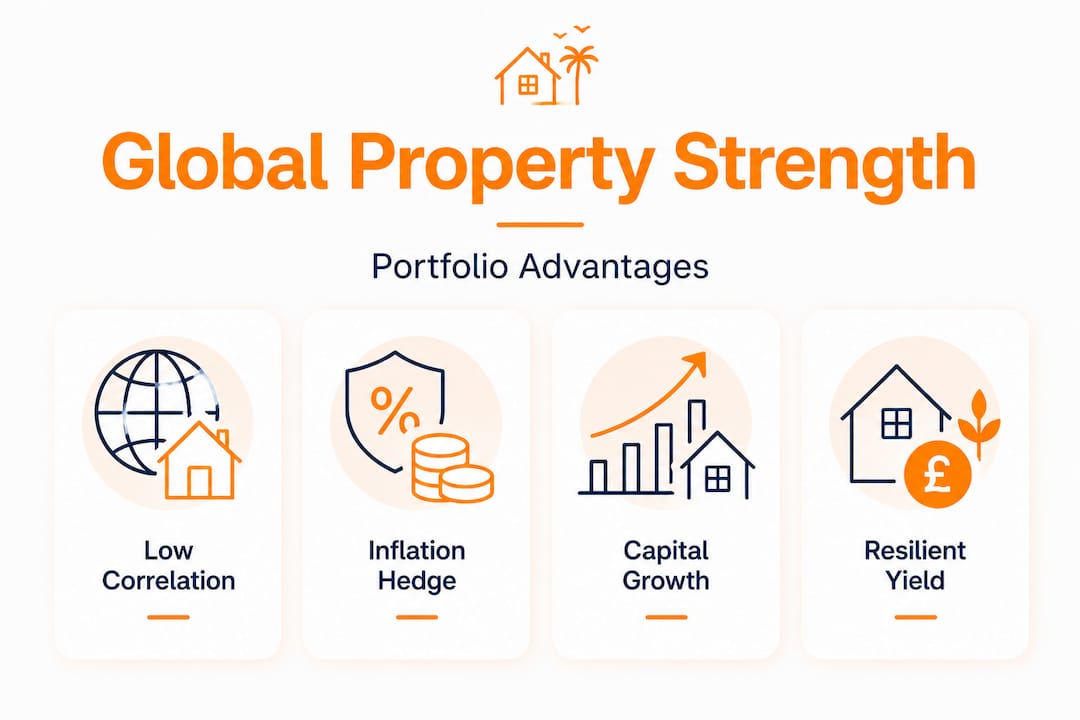
The table illustrates a compelling reality. International luxury real estate occupies a rare position: it offers genuine inflation protection, meaningful income through seasonal and long-term elite lets, and capital appreciation often running at 5 to 8% annually in locations like the French Riviera, all whilst maintaining a low correlation to equity markets.
Pro Tip: Look beyond the headline yield figure. Properties in Antibes or Sainte-Maxime that generate 4% net rental income during the summer Cannes Film Festival season or the Saint-Tropez regattas may command significantly higher occupancy premiums during peak cultural events. Seasonal demand from global elites attending these events creates rental pricing power that standard yield calculations rarely capture in full.
When you evaluate luxury real estate across markets, the due diligence process should account not only for current yield but for the structural supply constraints that protect future capital value. The limited buildable land along the Riviera coastline, for example, creates a scarcity dynamic that underpins long-term appreciation fundamentally.
Key challenges and how to overcome them
Understanding the rewards is only half the story. International property investing introduces a specific set of challenges that require both intellectual honesty and practical preparation to navigate confidently.
The principal risks, as identified by experienced international investors, include currency fluctuations, legal and tax complexities, geopolitical instability, higher management costs, and financing difficulties in unfamiliar markets. Each of these is real. None of them is insurmountable with the right expertise alongside you.
Here is how we approach each:
- Currency risk: Structure acquisitions in currencies that either align with income streams or offer natural hedging. Holding a euro-denominated Riviera property whilst drawing income from European sources creates natural balance. Currency forwards and options provide additional protection for larger positions.
- Legal and tax complexity: Each jurisdiction has its own conveyancing rules, ownership structures, and inheritance law. In France, the VEFA contract (Vente en l’État Futur d’Achèvement) protects buyers of new constructions from cost overruns and developer default, a critical protection for off-plan acquisitions in developments from Nice’s Mont Boron towers to Sainte-Maxime’s beachside residences. Always engage a local notaire and an independent legal adviser familiar with cross-border estate planning.
- Geopolitical exposure: Favour markets within stable, well-regulated jurisdictions. France, Portugal, and Italy offer EU-backed legal frameworks. Dubai provides a transparent freehold ownership model supported by robust government oversight. Emerging markets may offer superior yields but require elevated risk tolerance and careful due diligence.
- Management costs: Distance creates friction. Partner with specialist property management firms in each location, ideally those with an established client roster of similarly positioned international owners. This is particularly pertinent for seasonal let properties where presentation standards and occupancy optimisation are revenue-critical.
| Risk | Impact | Recommended countermeasure |
|---|---|---|
| Currency fluctuation | Portfolio value erosion | Matched currency structures, hedging instruments |
| Legal and tax complexity | Ownership disputes, tax penalties | Local notaire, cross-border tax adviser |
| Geopolitical instability | Asset accessibility, forced sales | Stable jurisdictions, political risk insurance |
| Management challenges | Rental income loss, property neglect | Specialist international property managers |
| Financing difficulties | Acquisition failure, poor terms | Local mortgage brokers, private banking relationships |
Pro Tip: Engage specialists early, before you identify a specific property. A thorough understanding of the luxury property tax landscape in your target market, combined with proper advance structuring, can reduce your effective acquisition cost substantially. We always advise clients to consult a cross-border tax adviser six to twelve months before their intended purchase, not the week contracts are exchanged.
Understanding the key steps in international luxury property buying at the earliest stage saves both time and capital. Preparation is the most underrated luxury in international acquisition.
Tailoring your global real estate strategy
Now that you are prepared for the risks, the essential task is building a strategy that honours your family’s specific aspirations, not simply following a template designed for someone else’s circumstances.
The most effective international real estate strategies we encounter share one quality: they begin with precise clarity about objectives. A family seeking to establish a legacy estate in Provence to anchor multigenerational gatherings has fundamentally different needs from a family office targeting maximum yield from a portfolio of seasonal lets in Ibiza and the Côte d’Azur. Both are legitimate and achievable. They simply require different property types, different market selections, and different ownership structures.
Different HNWI profiles pursue distinct international strategies based on their core motivations. Aligning your family’s priorities with the right market is the first and most consequential decision in the process. Here is the framework we recommend:
- Define your primary objective. Is this a legacy asset, a yield-generating investment, a lifestyle base, or a prestige marker? Clarity here shapes every subsequent decision.
- Identify the markets that serve that objective. Cap d’Antibes for ultra-private sea-view estates, Monaco borders for prestige and tax efficiency, Sainte-Maxime or Saint-Tropez for premium seasonal rental income, Menton for botanical serenity and emerging appreciation potential.
- Assess your risk appetite and liquidity requirements. Trophy assets in the most recognised locations offer the greatest capital resilience but the lowest liquidity. More diversified holdings across two or three locations balance prestige with flexibility.
- Choose the appropriate ownership structure. Direct ownership, SCI (Société Civile Immobilière) in France, or a cross-border trust all carry distinct tax and inheritance implications. Structure before you sign.
- Select the right property type. Provençal mas for generational legacy, new-construction eco-villas with solar arrays and green certifications for heirs who value sustainability alongside yield, or branded residences in managed developments for hands-off income generation.
- Build your advisory team. Local notaire, international tax adviser, specialist property manager, and a global real estate strategy partner who understands both the market and your portfolio context.
The process sounds deliberate because it must be. Reactive acquisitions driven by market excitement rather than strategic alignment tend to underperform. The families who benefit most from international diversification are those who invest time in frameworks before they invest capital in assets.
What most investors miss about international diversification
Having outlined the strategies and the risks, we feel compelled to share the insight that separates genuinely resilient portfolios from merely large ones. It is the insight that most experienced investors either resist or discover too late.
The majority of HNWIs, even those who consider themselves diversified, remain significantly overweight in their home market. Research consistently shows that approximately 70% of family office real estate holdings are domestic, with only the most internationally oriented portfolios, typically Swiss or Hong Kong-based family offices, achieving genuine geographic spread. This is not a rational allocation. It is home bias at work.
Home bias is the deeply human tendency to favour the familiar. It feels safer because you understand the system, you know the market, you speak the language. But familiarity is not the same as security. In fact, concentrating capital in a single jurisdiction magnifies the very tail risks that wealthy families are most exposed to: sudden regulatory change, currency debasement, political disruption.
The families who embraced international diversification in earnest a decade ago, placing assets along the Côte d’Azur, in Lisbon’s historic palaces, or in Dubai’s waterfront towers, did not merely outperform financially. They created structures that gave future generations genuine choices. A Riviera estate does not simply generate rental income during the Cannes Film Festival season or the Monaco Grand Prix weekend. It provides a physical base from which heirs can build European lives if domestic conditions change, a freedom that cannot be bought retrospectively.
Resilience does not come from owning more of the same. It comes from owning assets that are genuinely uncorrelated, that rise and fall under different influences, and that serve multiple functions across generations. Follow the evolving trends among luxury buyers closely, but do not simply follow the crowd. The most powerful diversification moves are often the ones made before consensus forms around them.
Connect with premier global real estate expertise
At Living on the Côte d’Azur, we exist precisely at this intersection of aspiration and intelligence. Our portfolio spans the salt-kissed terraces of Cap d’Antibes, the lemon-scented boulevards of Menton, and extends to Ibiza, Dubai, Bali, Portugal, and Mauritius, each market curated for its unique investment character. Whether you are drawn to invisible luxury real estate available exclusively off-market, or seeking to understand what luxury real estate truly represents as an asset class, we bring insider knowledge and a discreet, personalised approach. For families intent on building high-net-worth legacy and meaningful ROI, we invite you to begin a conversation with our team today.
Frequently asked questions
What makes international luxury real estate a unique investment?
It offers uncorrelated returns and portfolio resilience, combining inflation hedging, reliable rental cash flow, and capital appreciation in prime locations where supply is structurally constrained.
How do I manage legal and tax risks in global property?
Engage local legal experts and a cross-border tax adviser before identifying a specific property, as thorough due diligence across legal and tax regimes is the single most effective risk mitigation strategy available to international buyers.
Which international locations offer the best opportunities?
Emerging markets like Dubai excel for yield whilst traditional hubs such as the Côte d’Azur, Lisbon, and London offer a combination of prestige, capital stability, and lifestyle value that continues to attract the most discerning global buyers.
How do international holdings support family legacy goals?
They create multigenerational wealth anchors that combine geographic currency diversification with real-world utility, giving heirs both financial resilience and the freedom to establish lives across multiple jurisdictions should circumstances ever require it.
Recommended
- 7 Essential Steps for Buying Luxury Property in 2025
- High-net-worth real estate: Legacy, luxury, and ROI
- Emerging Luxury Market: Shaping 2026 Wealth Strategies
- Wealth Building Through Real Estate: Riviera Legacy Moves
- Luxury airport travel: real benefits, options, and expert insights
 //
//