
TL;DR:
- Legal expertise is crucial for French Riviera luxury property purchases due to complex inheritance laws, cross-border tax obligations, and title issues that require professional guidance. Engaging specialized legal counsel early ensures thorough due diligence, proper structuring, and protection of privacy, safeguarding long-term investments. Without such expertise, buyers risk costly legal disputes, inheritance complications, and compromised legacy planning.
Many high-net-worth buyers arrive on the French Riviera captivated by the salt-kissed air of Cap d’Antibes or the panoramic sweep of Baie des Anges from a Nice clifftop terrace, and assume that prestige alone simplifies the transaction. It does not. Luxury property acquisitions on the Côte d’Azur carry a web of legal obligations, cross-border inheritance rules, and title complexities that no handshake or swift bank transfer can resolve. What separates a triumphant legacy acquisition from a costly legal ordeal is almost always the quality of specialist legal counsel retained before a single document is signed.
Table of Contents
- Why legal expertise is critical for French Riviera property purchases
- Key legal services involved in property buying
- How legal services protect your interests and investments
- Navigating cross-border and succession law complexities
- Best practices for luxury property transactions on the Riviera
- Why robust legal process is the linchpin of lasting property legacies
- Connect with experts for your French Riviera legal needs
- Frequently asked questions
Key Takeaways
| Point | Details |
|---|---|
| Specialist legal advice essential | Every luxury buyer needs legal experts with French Riviera experience for true security and compliance. |
| Protect legacy and privacy | Proper legal structuring shields wealth, succession plans, and high-profile buyer confidentiality. |
| Mitigate cross-border risks | Expert legal guidance navigates complex tax, residency, and inheritance laws for global investors. |
| Follow a structured transaction process | Adhering to a clear, professional legal roadmap ensures a smooth, dispute-free property purchase. |
Why legal expertise is critical for French Riviera property purchases
The French Riviera occupies a singular position in the global luxury property market, and that singularity extends well beyond its cerulean coastline and the heady fragrance of lavender drifting from the hills above Èze. France operates an entirely distinct legal framework governing property ownership, and its regulations bear almost no resemblance to those in the United Kingdom, the United States, or the Gulf states from which so many buyers originate. For an international investor accustomed to Anglo-Saxon conveyancing, the French system can feel like an entirely foreign language, because in many respects it is.
The French Riviera acquisition guide makes clear that the market attracts international buyers with complex cross-border financial and inheritance issues that require specialist handling from the outset. These are not abstract risks. They manifest as real financial losses, family disputes, and even compulsory sales if buyers proceed without proper guidance.
Several distinct legal complexities define this market:
- Forced heirship laws under the French Civil Code restrict how you may distribute your estate, regardless of the instructions in your will.
- Non-resident tax obligations differ markedly from those applicable to French fiscal residents, affecting both acquisition costs and rental income.
- Boundary and planning disputes are more common than many buyers anticipate, particularly in older Riviera villages where cadastral maps may be outdated.
- Co-ownership regimes (copropriété) in apartment buildings impose legally binding obligations on owners that must be thoroughly reviewed.
- Mortmain and pre-emption rights held by local municipalities can derail a transaction at a late stage if not identified early.
Following the steps to successful property buying on the Côte d’Azur requires understanding that legal due diligence is not an administrative formality. It is the architecture of your investment’s security.
“The most expensive mistake a luxury buyer can make is treating legal counsel as an afterthought. On the Riviera, the legal landscape is as dramatic as the geography. Both demand respect.” — Living on the Côte d’Azur Advisory Team
The stakes for overlooking proper legal guidance are especially acute when estate planning and forced heirship rules intersect with multi-jurisdictional family structures. A villa in Cannes held in personal name, with heirs spread across three continents, is a succession challenge of considerable proportion.
Key legal services involved in property buying
Understanding the cast of legal professionals involved in a French Riviera transaction clarifies why the process demands both time and expertise. Legal professionals coordinate due diligence, contract drafting, compliance, and transfer of ownership across each stage of the acquisition journey.
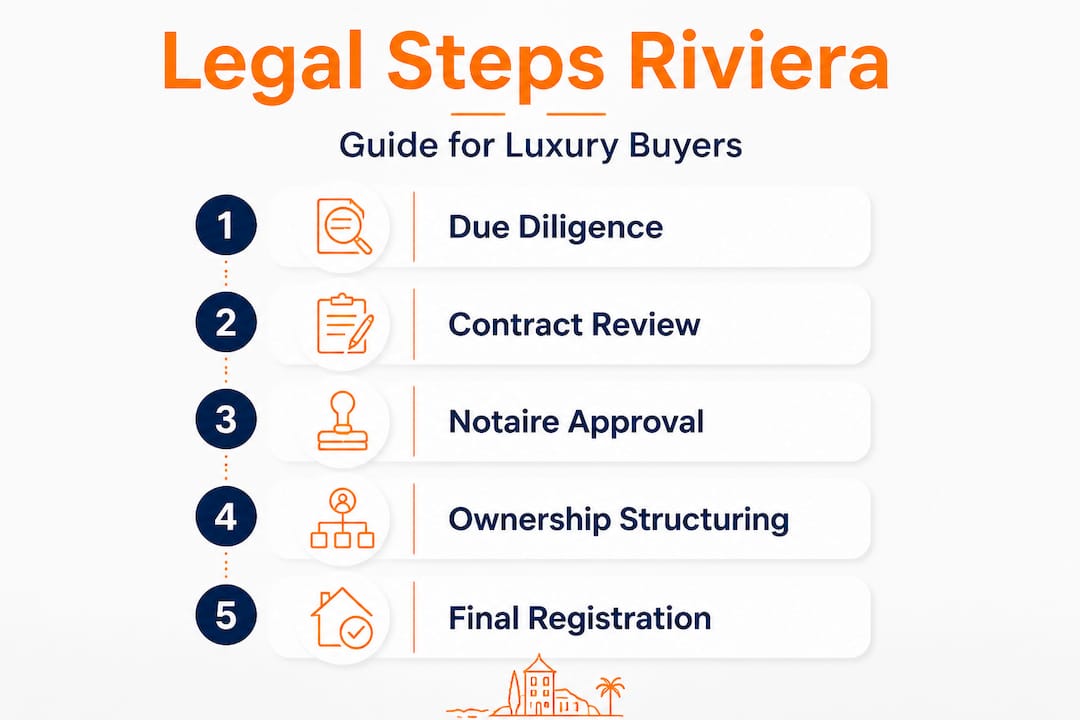
The acquisition unfolds in clearly defined stages, each with its own legal deliverables:
- Pre-acquisition due diligence — Title searches, urban planning verifications, and checks for outstanding charges or legal encumbrances are conducted before any offer is formalised.
- Offer and preliminary contract (compromis de vente) — A legally binding preliminary agreement is drafted, typically accompanied by a 10% deposit. Legal review at this stage is essential, as the compromis de vente defines your rights and obligations.
- Regulatory and compliance clearances — Asbestos surveys, energy performance diagnostics, lead tests, and flood zone assessments are all legally mandated and must be reviewed by your legal team.
- Financing and ownership structure confirmation — Whether you are purchasing as an individual, via a Société Civile Immobilière (SCI), or through an international entity, the ownership structure has profound tax and succession implications.
- Final deed of sale (acte authentique) — Signed before a notaire, this is the moment legal title transfers. The notaire collects all transfer taxes and registration fees on behalf of the French state.
- Post-completion — Inscription at the land registry (cadastre) confirms your ownership. Any outstanding legal obligations, such as neighbourhood covenants or easements, become your responsibility from this point.
The notaire is a state-appointed public official whose role is to authenticate the transaction and ensure it complies with French law. However, the notaire’s duty of impartiality means they serve the transaction, not exclusively the buyer. This is precisely why engaging your own independent legal adviser, alongside exploring the due diligence essentials in depth, is a non-negotiable best practice for high-value acquisitions.
| Legal stage | Key professional | Buyer benefit |
|---|---|---|
| Due diligence | Independent solicitor | Identifies hidden risks before commitment |
| Preliminary contract | Notaire and solicitor | Protects deposit and sets terms |
| Tax structuring | Tax lawyer or SCI specialist | Optimises acquisition and succession costs |
| Final deed | Notaire | Legal transfer of ownership confirmed |
| Post-completion | Land registry | Ownership secured in public record |
Pro Tip: Instruct your independent legal adviser and the notaire simultaneously, as early in the process as possible. Waiting until you have found your ideal property in Antibes or Sainte-Maxime to begin legal preparations costs valuable time and may expose your position unnecessarily.
You can explore the full purchase stages for luxury homes on the Côte d’Azur to align your timeline with each legal milestone.
How legal services protect your interests and investments
The practical value of specialist legal services becomes most vivid when you consider what can go wrong. Legal oversight detects title irregularities, compliance breaches, and ensures privacy protections for buyers in one of the world’s most scrutinised property markets.

Consider a scenario that we encounter more frequently than buyers imagine: a Cannes apartment presented as a private luxury residence is discovered, during due diligence, to carry an unregistered easement granting a neighbouring property access across the terrace. Without a meticulous title review, this would become the buyer’s burden. Or consider a Cap d’Antibes villa where building works completed five years prior lacked proper planning consent, creating retroactive liability that falls on the new owner.
| Risk scenario | Without legal services | With legal services |
|---|---|---|
| Hidden easement or servitude | Buyer inherits liability after completion | Identified pre-completion; renegotiation or withdrawal possible |
| Non-compliant building works | Buyer faces retrospective enforcement | Seller required to regularise or price adjusted |
| Inheritance dispute | Estate frozen pending litigation | Succession structured to match French law requirements |
| Privacy breach in documentation | Buyer’s identity exposed in public filings | Legal structure provides anonymity and discretion |
| Unpaid charges on copropriété | Buyer assumes outstanding debt | Outstanding charges revealed and cleared pre-sale |
Privacy is a dimension of legal protection that particularly resonates with our clients: those who have built substantial wealth and wish to acquire their Riviera property without their identity or financial details becoming public knowledge. A well-structured acquisition, guided by experienced real estate privacy issues specialists, can employ holding structures that keep beneficial ownership appropriately discreet within the parameters of French law.
Pro Tip: If privacy is a priority, discuss ownership via a Société Civile Immobilière (SCI) with your legal adviser before viewing properties. The SCI structure must be established prior to the compromis de vente to be effective for your acquisition.
French property transactions for luxury assets often attract a level of public and professional scrutiny that buyers from other markets find surprising. In 2026, with anti-money laundering (AML) regulations having significantly tightened across the EU, both notaires and legal advisers are obligated to conduct enhanced due diligence on the source of funds. This is not an obstacle. It is part of the framework that maintains the Riviera’s extraordinary market integrity and your investment’s long-term legitimacy.
Navigating cross-border and succession law complexities
For the international buyer, whether arriving from London, Dubai, Singapore, or São Paulo, the Riviera’s succession law landscape is perhaps the most counterintuitive dimension of ownership. French forced heirship laws mandate that a portion of an estate passes automatically to children, which can disrupt legacy plans that seemed airtight under a buyer’s home jurisdiction.
Understanding forced heirship is vital. Under French law, children are “réservataires,” meaning they hold a reserved portion of the estate. For one child, this reserve is 50% of the estate. For two children, it rises to two-thirds. For three or more, it reaches three-quarters. Crucially, the EU Succession Regulation (Brussels IV), which came into force in 2015 and remains operative, allows non-French nationals to elect for the law of their nationality to govern their succession, but this election must be made formally and recorded correctly to be enforceable.
Key solutions that specialist legal advisers regularly deploy for international clients include:
- Brussels IV nationality election — Formally electing for your home country’s succession law to govern your estate, recorded within your will or a specific declaration before a notaire.
- Société Civile Immobilière (SCI) — Holding the property through an SCI allows shares to be transferred across generations with greater flexibility and can ease succession considerably.
- Cross-border trusts — Where permissible and correctly structured, trusts established in common law jurisdictions can hold French property, though these must be carefully aligned with French fiscal law to avoid unintended tax consequences.
- Donation-partage — A French mechanism enabling the structured gifting of property interests to heirs during your lifetime, reducing future estate exposure.
“On the Riviera, we work with families who have built wealth across continents. The beauty of expert legal structuring is that your estate plan does not have to choose between French law and your global intentions. The two can be harmonised.” — Living on the Côte d’Azur Advisory Team
Exploring offshore investment structures in conjunction with your French legal team ensures that your acquisition strategy is coherent across every jurisdiction where your wealth resides. This is not a luxury; it is a necessity for anyone acquiring a Menton estate or a Monaco-border villa as a generational asset.
Best practices for luxury property transactions on the Riviera
Bringing precision and intention to every stage of your acquisition is what separates an assured legacy purchase from an anxious series of reactive decisions. Following a structured, expert-led process dramatically reduces transaction time and post-completion disputes, protecting both capital and composure.
A practical chronological approach for discerning buyers includes the following:
- Engage independent legal counsel before you begin viewing properties. Agree your ownership structure, succession strategy, and privacy priorities in advance. Arriving at a viewing in Saint-Tropez already legally prepared means you can move decisively.
- Commission a comprehensive title search on any property of interest. Do not rely solely on the seller’s documentation. Independent title verification is the cornerstone of clean conveyancing.
- Review all technical diagnostic reports with your legal team. Energy performance, asbestos, lead, electrical compliance, and natural risk assessments are legally mandated disclosures. Each carries implications that deserve careful interpretation.
- Confirm your financing and ownership structure before signing the compromis de vente. Changing your structure after this point is costly and may create tax complications.
- Conduct a pre-completion inspection supported by your legal adviser. Confirm the property’s condition, vacant possession, and that all agreed works have been completed.
- Plan for post-completion obligations. Registering ownership, arranging appropriate insurance, and filing any required tax declarations should be coordinated by your legal team before the keys are handed over.
Explore the full step-by-step buying process to align your timeline with each legal milestone, and consider financing luxury property options that complement your tax and structuring strategy from the outset.
Pro Tip: Always verify that your chosen legal firm holds active membership of the French Bar (Barreau) or is a qualified notaire, and can demonstrate a portfolio of transactions involving comparable luxury assets and international buyers. References from previous high-net-worth clients, provided confidentially, are a legitimate request.
Why robust legal process is the linchpin of lasting property legacies
We have observed, across years of working alongside the most discerning buyers on the Côte d’Azur, a persistent and somewhat costly misconception: that the sophistication of the buyer renders exhaustive legal process unnecessary. The logic runs, broadly, that someone who has built a business empire or accumulated generational wealth surely understands risk. And they do. What they sometimes underestimate is how specifically calibrated French legal risk can be.
The Riviera’s prestige is not incidental. It is encoded in layers of planning law, architectural heritage restrictions, coastal access regulations, and succession statutes that have accumulated over decades. A transaction that appears luminously straightforward, perhaps a stone bastide above Èze with unobstructed sea views and a willing seller, can harbour cadastral ambiguities, disputed servitudes, or inheritance encumbrances invisible to any buyer without Côte d’Azur due diligence expertise.
The “buy cheap on legal fees, pay dearly later” reality is not merely financial. Public legal disputes over French properties erode the privacy and reputation that wealth has taken lifetimes to build. Family strife over a poorly structured succession can fracture relationships that no estate, however magnificent, is worth damaging. We believe, with conviction earned through experience, that rigorous legal process is not the bureaucratic shadow of a beautiful acquisition. It is the very foundation on which lasting luxury legacies are built.
Connect with experts for your French Riviera legal needs
At Living on the Côte d’Azur, we curate access to off-market luxury property opportunities and connect you with the specialist legal professionals who protect every dimension of your acquisition. Whether your ambition is a legacy-driven property investment to anchor your family’s future or a prestige villa positioned for elite seasonal rental returns, we navigate the full legal and lifestyle landscape with you. Our network spans international tax counsel, notaires with decades of luxury experience, and succession specialists who understand both French law and the global family structures our clients bring to the table. We welcome cryptocurrency as a payment method, reflecting our commitment to innovative, modern acquisition pathways. Speak to our Riviera experts today and let us protect your legacy from the very first step.
Frequently asked questions
Do I need a French notaire if I already have a solicitor in my home country?
Yes, a French notaire is legally required to oversee property transactions in France, even if you have overseas representation. Your notaire and independent solicitor work in parallel, with the notaire authenticating the final deed and coordinating due diligence and transfer of ownership.
How do French forced heirship laws impact international buyers?
French forced heirship law means a portion of your estate must pass to your children automatically, regardless of your will, which can disrupt carefully constructed inheritance strategies prepared under a different jurisdiction’s law.
Can legal services help with privacy and confidentiality for high-profile buyers?
Yes, specialist legal counsel can structure purchases through holding entities and documentation arrangements to maximise buyer privacy, as legal oversight ensures both title integrity and discretion throughout the transaction.
What are the main documents a legal expert will check in a luxury property deal?
Legal experts review title deeds, urban planning compliance, mandatory technical diagnostics, tax liability status, pending charges, and ownership structures, as professionals coordinate all these compliance and conveyancing elements before completion.
Is due diligence different for off-market or luxury properties?
Due diligence for luxury and off-market assets is considerably more rigorous, with enhanced privacy, title, and compliance reviews required, because legal oversight detects the nuanced irregularities that standard residential transactions rarely encounter.
Recommended
- Privacy in Luxury Real Estate – Why It Matters on the Côte d’Azur
- Luxury Real Estate Buying Guide: Secure Your Riviera Legacy
- 7 Key Examples of Buyer Agent Services for Investors
- Role of Buyer Agents in Luxury Real Estate: Complete Guide
- Enjeux légaux de la location saisonnière en France 2026 | PerfectHost
 //
//