

TL;DR:
- Prime real estate on the French Riviera is characterized by irreplaceable location, scarcity, and proven appreciation that sustain legacy value across market cycles. Authentic prime properties possess cultural significance, unmatched scarcity, and consistent appreciation, making them true family fortresses rather than merely desirable addresses. Accessing these hidden opportunities requires trusted, well-connected agents and thorough due diligence to preserve long-term generational wealth.
Not every villa perched above a turquoise bay qualifies as prime real estate. This is a distinction that separates the truly visionary investor from the merely aspirational buyer. On the French Riviera, where salt-kissed air mingles with the scent of mimosa and the Côte d’Azur stretches in luminous glory between Menton’s lemon-festooned hillsides and Saint-Tropez’s storied Vieux Port, the difference between a beautiful property and a genuine legacy asset is profound. For high-net-worth families seeking to protect generational wealth, understanding that distinction is not just useful — it is essential.
Table of Contents
- Defining prime real estate for legacy investors
- Key characteristics of prime properties on the French Riviera
- Evaluating appreciation and legacy potential
- Accessing and securing invisible prime opportunities
- What most investors overlook about prime legacy real estate
- Explore luxury legacy opportunities on the Côte d’Azur
- Frequently asked questions
Key Takeaways
| Point | Details |
|---|---|
| Prime defined by legacy | True prime real estate on the Riviera is centred on legacy value, not just location or amenities. |
| Enduring characteristics | Scarcity, historical prestige, and resilience underpin properties that appreciate across generations. |
| Access through networks | Elite, off-market properties require connections and trusted advisers for successful acquisition. |
| Ongoing stewardship needed | Maintaining a property’s prime status demands care, vision, and sometimes reinvestment over the years. |
Defining prime real estate for legacy investors
To begin, let us clarify what “prime real estate” truly means for those seeking legacy properties. The word “prime” is used liberally in marketing materials, yet its true meaning, in the context of generational wealth, carries far greater weight than a sea view or a freshly renovated kitchen.
Prime real estate, properly defined, is property that exhibits irreplaceable location, enduring scarcity, and demonstrable appreciation over multiple market cycles. It is real estate that your grandchildren will thank you for acquiring. On the Riviera, this means an estate in Cap Ferrat, a Belle Époque villa above the Cannes Croisette, or a Monaco-adjacent plot where supply is constitutionally constrained. These are not merely desirable addresses; they are stone-and-mortar fortifications against the erosion of wealth.
The hallmarks of genuinely prime property include:
- Unmatched locational scarcity: The address cannot be replicated. Headlands, historic old towns, and protected coastlines are finite.
- Cultural or historical significance: A provenance that elevates the asset beyond bricks and mortar — a Picasso-era Antibes fortress, a Belle Époque façade in Nice, a Provençal mas with centuries of story.
- Consistent multi-cycle appreciation: Value that has risen through recessions, geopolitical shocks, and market corrections.
- Lifestyle incomparability: Access to yachting marinas, Michelin-starred dining, international schools, and world-class healthcare that the global elite will continue to seek.
The deeper essence of luxury real estate features is not opulence for its own sake, but resilience encoded in stone. True prime property carries an emotional resonance that transcends spreadsheets — it is a family sanctuary, a gathering place for future generations, a piece of paradise held in trust.
“The most enduring estates on the Côte d’Azur were not bought as investments. They were acquired as declarations of belonging — and the returns followed naturally.”
Pro Tip: When assessing whether a property is truly prime, ask whether its location could be built again today. If the answer is no, you are looking at genuine scarcity.
Key characteristics of prime properties on the French Riviera
With a working definition in mind, we can examine the defining traits of prime properties specific to the Riviera. The Côte d’Azur is not a uniform market. Its French Riviera key features vary dramatically between a hilltop village in Èze, where Nietzsche once walked the goat paths above cobblestoned lanes, and a beachfront penthouse in Sainte-Maxime, where Nartelle’s golden sands shimmer at dusk.
The table below clarifies the line between desirable and genuinely prime:
| Feature | Desirable property | Prime legacy property |
|---|---|---|
| Location | Pleasant neighbourhood, good access | Irreplaceable address, protected coastline or historic district |
| Views | Garden or partial sea glimpse | Unobstructed panoramic sea or château views |
| Scarcity | Many comparable listings | Fewer than 5 comparable assets in the market |
| Appreciation history | Variable, market-dependent | Consistent 5–8% annual growth across cycles |
| Cultural prestige | Modern build in sought-after area | Belle Époque heritage, noted provenance, or landmark status |
| Rental yield | 2–3% seasonal | 4–6% via elite seasonal or long-term lets |
| Buyer profile | Affluent local and European buyers | Global ultra-high-net-worth families and institutions |
What separates the finest villa and penthouse options from the merely attractive is this combination of scarcity, prestige, and provable performance. Consider the difference between a new-build apartment in a Cannes suburb and a Belle Époque villa above the Croisette with direct Lérins Islands views. Both sit on the Riviera. Only one is prime.

The top Riviera cities for prime legacy investment each carry their own signature. Nice rewards buyers with Baie des Anges panoramas and Cours Saleya’s vibrant cultural life. Menton, with its lemon festivals and the botanical serenity of Val Rahmeh, suits those drawn to quieter prestige. Cannes delivers Film Festival glamour and some of the most consistently priced prime inventory on the coast. Antibes, where Picasso spent formative years sketching within fortress walls, offers a rare marriage of cultural heritage and Cap d’Antibes coastal grandeur.
Prime Riviera properties in 2026 tend to share these characteristics:
- Direct or panoramic sea views from principal living spaces
- Private grounds of 2,000 square metres or more in sought-after communes
- Proximity to international airports (Nice Côte d’Azur within 45 minutes)
- Green certifications and solar infrastructure, reflecting evolving buyer preferences
- Historic architectural distinction or contemporary signature design by recognised architects
It is worth noting that prime appreciation rates on the upper Riviera have historically outpaced both French national averages and many comparable European coastal markets, a pattern that shows no signs of reversing given constrained supply and sustained global demand.
Evaluating appreciation and legacy potential
Having established what makes property prime, let us look at the factors underpinning long-term appreciation and legacy protection. Not all prime property performs equally. Smart legacy investors move beyond the seduction of a beautiful terrace and apply a rigorous, structured assessment before committing capital.
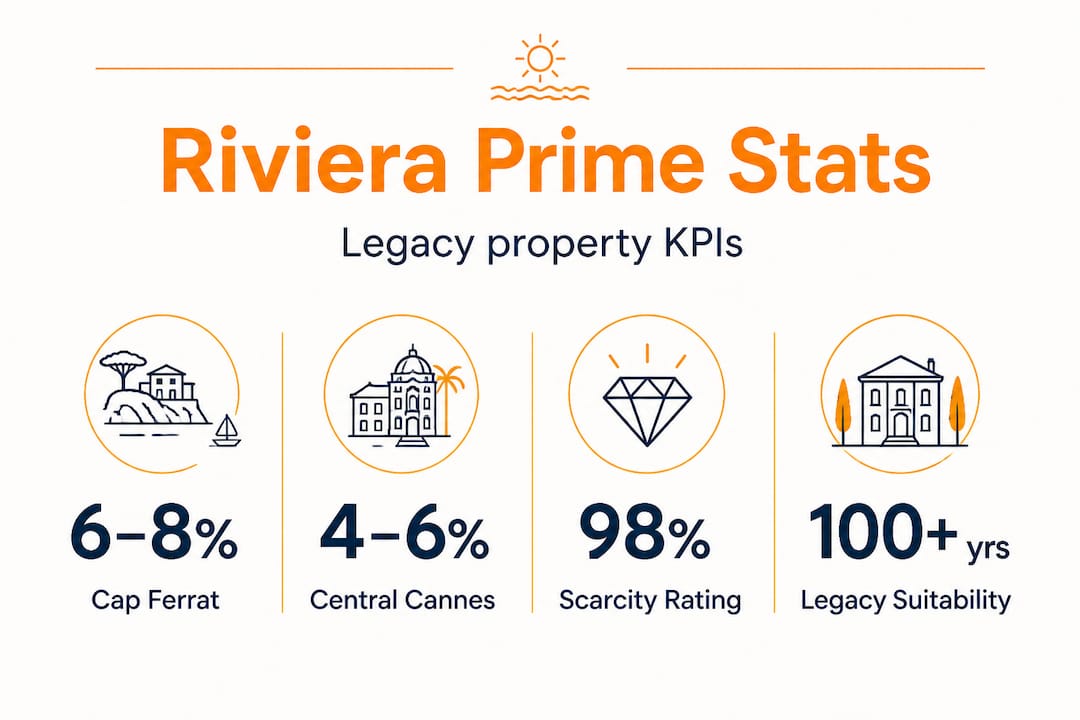
The following table illustrates indicative appreciation patterns across key Riviera locations, drawing on historical market data and current trajectory:
| Location | Average annual appreciation | Scarcity rating | Legacy suitability |
|---|---|---|---|
| Cap Ferrat | 6–8% | Extremely high | Outstanding |
| Monaco border communes | 5–8% | Very high | Outstanding |
| Cannes (Croisette & La Californie) | 5–7% | High | Excellent |
| Antibes (Cap d’Antibes) | 4–6% | High | Excellent |
| Nice (Mont Boron & Cimiez) | 4–6% | Moderate to high | Very good |
| Menton historic centre | 3–5% | Moderate | Good |
| Sainte-Maxime beachfront | 3–5% | Moderate | Good |
Consulting investment trends by region before finalising any acquisition decision is something we strongly advocate for our clients, because micro-market dynamics shift subtly with infrastructure changes, planning regulations, and evolving buyer nationality profiles.
A stepwise framework for evaluating legacy potential:
- Verify irreplaceability. Can this specific combination of location, view, and size be found elsewhere within 5 kilometres? If yes, it is desirable. If no, it is prime.
- Review a minimum of two market cycles. Prime assets hold or grow value through downturns. Request transaction history for comparable properties over at least 15 years.
- Assess planning and regulatory environment. Protected zones (such as Natura 2000 or classified historic areas) restrict future development, preserving both exclusivity and value.
- Model rental income conservatively. Elite seasonal letting on the Riviera can generate 3–5% annual yields. Factor in management, maintenance, and vacancy at realistic rates.
- Commission a technical survey. Structural soundness, seismic resilience, and the condition of heritage features are non-negotiable for a legacy asset.
- Engage a notaire early. Title clarity, existing charges, and inheritance implications must be reviewed before negotiation advances.
Two pitfalls deserve particular attention. First, market sentiment can inflate prices in trophy micro-markets, creating brief windows of overvaluation. Second, changing local regulations regarding short-term rentals (as seen across France’s coastal communes in recent years) can meaningfully affect yield projections. Legacy investors plan for a 20-year horizon at minimum, and regulatory landscapes shift considerably over such periods.
Pro Tip: Always instruct an independent technical surveyor alongside your legal team. On historic Riviera properties, hidden structural costs can erode projected returns in ways that no price negotiation will fully remedy.
Accessing and securing invisible prime opportunities
Understanding what to look for is only part of the equation — actually accessing such rare opportunities is another challenge altogether. The finest prime properties on the Côte d’Azur rarely appear on public portals. They move between families, between trusted networks, between introductions made at the Cannes Film Festival or over dinner at a Menton garden party during the Lemon Festival.
This is the world of off-market or “invisible” property. It is where the most compelling legacy acquisitions occur, away from competitive bidding wars and public scrutiny. For ultra-high-net-worth buyers, access to this hidden layer of the market is not a luxury — it is a necessity.
The role of the specialist agent cannot be overstated here. A well-connected local broker does not merely facilitate a transaction; they open doors that do not appear in any catalogue. Choosing an estate agent with genuine off-market reach is, in our experience, the single most impactful decision a buyer can make before initiating their search.
A readiness checklist for accessing invisible prime assets:
- Proof of financial capacity (typically a bank attestation or asset statement) prepared before approach
- Legal entity or personal ownership structure decided in advance with your tax adviser
- Clear brief prepared: preferred communes, minimum specification, budget envelope, and legacy intent
- Power of attorney or trusted representative in place if you cannot travel quickly
- Pre-agreed terms with a trusted notaire who can move efficiently when opportunity arises
- Cryptocurrency readiness, where applicable, as some sellers increasingly favour digital asset transactions
“The best properties on the Riviera are never for sale to the public. They are offered, quietly, to those who have already earned the trust of the people who matter.”
Staying connected to market intelligence is equally vital. Subscribing to our property market newsletter ensures you receive curated updates on emerging opportunities, regulatory shifts, and off-plan releases before they reach the wider market.
What most investors overlook about prime legacy real estate
Beyond metrics and lists, legacy investing in the Riviera carries deeper, often invisible, layers of complexity. We have watched many sophisticated investors approach the Côte d’Azur with impressive spreadsheets and flawless due diligence protocols, and still miss what truly makes a property a generational treasure.
The most common oversight is treating a prime property as a passive asset. True legacy real estate is a living relationship — with the community, with the landscape, and with the cultural fabric of the place it inhabits. An estate in Èze that participates in the village’s artistic life, or a Menton villa whose garden opens during botanical festivals, becomes woven into the social and cultural identity of its location. This is not sentimentality. It is how heritage is created, and heritage is precisely what protects and amplifies value over generations.
We also observe that emotional resonance and cultural continuity frequently deliver better multi-decade outcomes than purely financial selection criteria. The families who have held the great Riviera estates for 40, 50, or 60 years did not always choose the highest-yielding asset on the market in their acquisition year. They chose the property that called to them, that carried a story worth adding to, and that their children would fight to inherit rather than sell.
The caution we offer through our legacy and ROI insights is this: prime status is not permanent without stewardship. An estate neglected architecturally, or disconnected from the cultural life of its commune, slowly loses the intangible qualities that justify its premium. Legacy investing requires ongoing vision, thoughtful maintenance, and a genuine sense of belonging to the place you have chosen.
Explore luxury legacy opportunities on the Côte d’Azur
If you are ready to move from insight to action, we are here to guide you with the precision and discretion that this calibre of investment demands. At Living on the Côte d’Azur, we specialise in surfacing invisible Côte d’Azur luxury properties that never reach the open market, curating opportunities aligned with your vision for generational wealth. Our high-net-worth real estate strategies are built around your family’s long-term aspirations, not short-term market noise. We accept cryptocurrency and work with clients across five continents. When you are ready to begin your legacy conversation, connect with our team for bespoke, confidential guidance.
Frequently asked questions
What makes real estate “prime” versus simply desirable on the French Riviera?
Prime real estate possesses irreplaceable location, genuine scarcity, and a demonstrable legacy investment track record, often combined with cultural or historical prestige that desirable properties simply do not carry.
How can I access off-market prime properties on the Côte d’Azur?
Working with experienced local brokers who hold deep, trusted networks is the most reliable route, as the finest prime properties are typically offered privately before any public listing occurs.
Which areas of the Riviera are considered most enduring for legacy investment?
Cap Ferrat, Monaco-adjacent communes, and central Cannes have sustained multi-generational premium status through successive market cycles, consistently delivering strong appreciation and elite buyer demand.
Is prime property always the best long-term investment?
Prime assets offer exceptional stability and prestige, but rigorous due diligence remains essential, as regulatory shifts, maintenance obligations, and micro-market changes can all influence long-term performance.
Recommended
- Master the Property Investment Process France for Legacy Wealth
- Securing French Riviera real estate: 5% to 8% annual growth
- Côte d’Azur Property Lifestyle Value: 8% Legacy Wealth
- Luxury Real Estate Buying Guide: Secure Your Riviera Legacy
- Discover what makes French boutique wineries unique – Res Fortes
 //
//
