TL;DR:
- Inheritance tax in France depends on the relationship between the deceased and each beneficiary, as well as domicile and asset value. Surviving spouses and PACS partners are fully exempt, while other exemptions are limited and require formal declarations. Proper estate planning, including modeling gifts and assets, is essential to minimize tax liabilities and preserve family legacies.
Inheritance tax in France is one of those subjects that inspires quiet dread at dinner tables from Nice to Neuilly. Many assume the rules are punishing across the board, or conversely, that generous exemptions will shield most estates automatically. Neither assumption is reliably correct. What genuinely determines your liability is the relationship between the deceased and each beneficiary, the value of each heir’s share, and where both parties call home. Understanding inheritance tax France explained in plain terms means cutting through those misconceptions and getting to the mechanics that actually matter for your family’s future.
Table of Contents
- Key takeaways
- How inheritance tax in France is calculated
- France inheritance tax exemptions
- Filing deadlines and declaration requirements
- Cross-border inheritance and domicile rules
- Practical estate planning tips for French inheritance
- My perspective on French inheritance tax
- Discover your Côte d’Azur legacy with Livingonthecotedazur
- FAQ
Key takeaways
| Point | Details |
|---|---|
| Relationship drives liability | Tax rates and personal allowances depend entirely on the heir’s relationship to the deceased. |
| Spouses pay nothing | Surviving spouses and PACS civil partners are fully exempt from French inheritance tax. |
| Domicile determines scope | If the deceased or heir is French-domiciled, worldwide assets can fall within the French tax net. |
| Deadlines are strict | Heirs have six months to file if the death occurred in France, and twelve months if it occurred abroad. |
| Lifetime gifts reduce allowances | Prior donations are factored into the personal allowance at death, which can increase the taxable share. |
How inheritance tax in France is calculated
The French term is droits de succession, and understanding how it works starts with a simple but crucial principle: tax is assessed per beneficiary, not on the estate as a whole. Each heir pays tax based on their individual share after applying their personal allowance (abattement).
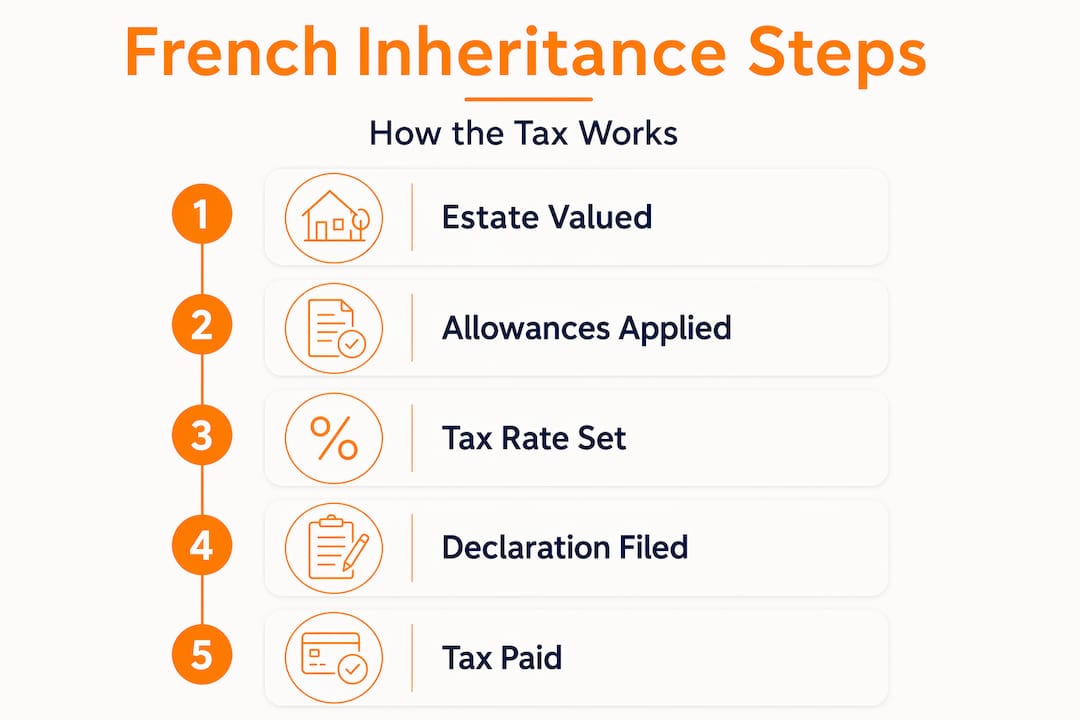
The stepwise process works as follows:
- Determine the gross estate value. This includes all assets: property, bank accounts, investments, and personal effects.
- Deduct outstanding debts. Mortgages, funeral costs, and other liabilities reduce the net taxable estate.
- Allocate shares to each heir. French succession law dictates minimum shares for children (réserve héréditaire), with any remaining portion freely allocated.
- Apply the personal allowance. Each beneficiary subtracts their allowance from their share. For direct-line heirs such as children, the allowance is €100,000 per child.
- Apply the progressive tax rates. The remaining taxable share is taxed using a barème (progressive rate table).
The 2026 rate table for direct-line heirs (children and parents) runs as follows:
| Taxable share (per heir) | Rate |
|---|---|
| Up to €8,072 | 5% |
| €8,072 to €12,109 | 10% |
| €12,109 to €15,932 | 15% |
| €15,932 to €552,324 | 20% |
| €552,324 to €902,838 | 30% |
| €902,838 to €1,805,677 | 40% |
| Above €1,805,677 | 45% |
To make this concrete: if a child inherits a net share of €115,000, they subtract the €100,000 allowance and are left with a taxable share of €15,000. Applying the tranches, a €15,000 taxable share produces roughly €1,240 in tax. That is a manageable figure. The burden escalates sharply at higher values, which is why planning matters.
One frequently overlooked detail: lifetime gifts factor into the allowance calculation at the point of death. If you made a gift of €60,000 to a child within the last fifteen years, only €40,000 of their €100,000 allowance remains at inheritance. This is not a penalty. It is the mechanism that prevents repeated use of the same allowance across different transfers.
Pro Tip: Model your estate beneficiary by beneficiary before making any gift decisions. The interaction between prior donations and the personal allowance at death can produce surprising tax outcomes.
France inheritance tax exemptions
Real exemptions under French law are narrower than many people expect. The most significant exemption applies to surviving spouses and partners in a registered civil partnership (PACS). They pay absolutely nothing, regardless of the estate’s value. This exemption is unconditional and requires no special application.
Beyond spouses and PACS partners, the list of full exemptions is selective:
- Siblings can be fully exempt if they meet all three conditions: unmarried or widowed or divorced at the time of death, aged over 50 or incapable of working, and having lived with the deceased for the five years immediately prior to death. All three criteria must be met simultaneously.
- War victims and terrorism victims. Heirs of individuals who died as a direct result of acts of war or terrorism benefit from a specific exemption on the inheritance received.
- Bequests to certain public bodies and cultural institutions. Donations to the French state, regional authorities, hospitals, and recognised charities can be exempt from inheritance tax, making structured philanthropic bequests a legitimate planning tool.
- Certain asset types carry partial exemptions or reduced valuations, including woodland and forests, certain agricultural property under long-term leases, and employer-funded death benefit contracts.
One point that catches people off guard: even when an heir is exempt from paying inheritance tax, a formal declaration may still be legally required. The obligation to file and the obligation to pay are separate matters. If the estate includes property or exceeds certain value thresholds, the declaration process proceeds regardless of whether a tax liability ultimately arises.
Pro Tip: Do not assume exemption means no paperwork. Confirm with a notary whether a declaration remains obligatory given the estate’s composition, even if you expect to pay nothing.
Filing deadlines and declaration requirements
Filing a déclaration de succession is a legal obligation for most heirs, and the deadlines are firm. Miss them and you face interest charges and potentially a flat penalty surcharge on top of the tax due.
The core rules:
- Six months from the date of death if the deceased died in France.
- Twelve months if the death occurred outside France.
- The primary form is the Cerfa n° 2705-SD, submitted to the tax authorities (Service des Impôts des Particuliers) relevant to the deceased’s last place of residence.
- If the estate includes real property anywhere in France, a notary must be involved. The notary prepares the declaration and coordinates the tax payment with the authorities.
- Thresholds do apply: if the net taxable share received by a non-exempt heir falls below €50,000 and no gifts were made during the deceased’s lifetime, the filing obligation may be waived. This applies per heir, not to the whole estate.
One distinction that matters: the declaration of succession and the formal sharing of assets are separate legal steps. You can delay the division of property among heirs, but you cannot delay the declaration itself. The clock runs from the date of death, not from the moment the family agrees on who gets what.
Cross-border inheritance and domicile rules
For international families, the French inheritance tax rules contain one clause that changes everything: the worldwide asset rule tied to domicile. If the deceased was domiciled in France at the time of death, the entire worldwide estate falls within the French tax net, regardless of where the assets are located.
The rule extends further. Even if the deceased was not French-domiciled, French inheritance tax on worldwide assets can still apply if the heir was domiciled in France for at least six years out of the ten years immediately preceding the death. This heir-level domicile trigger is consistently overlooked by international families and their advisers.
Key points for cross-border situations:
- If neither the deceased nor the heir meets the French domicile threshold, only French-situs assets (property and assets physically located in France) are taxable in France.
- International tax treaties can modify this outcome. France has a limited number of bilateral inheritance tax treaties, but where one exists, it may eliminate double taxation or reassign taxing rights between countries.
- The ten-year domicile look-back period for heirs means that moving abroad shortly before an anticipated death may not remove the French tax exposure if the heir has spent substantial time in France.
| Scenario | Assets subject to French tax |
|---|---|
| Deceased domiciled in France | All worldwide assets |
| Heir domiciled in France (6/10 years) | All worldwide assets |
| Neither condition met | French-situs assets only |
| Tax treaty in force | Determined by treaty provisions |
Pro Tip: Keep a record of your years of French tax residency, especially if you move between countries. Heir-level domicile is tracked per the French tax calendar, and six years can accumulate quietly across career or lifestyle moves.

Practical estate planning tips for French inheritance
Good planning is not about avoiding tax at all costs. It is about making informed choices that preserve family harmony and put assets where they are most useful. A few approaches stand out as genuinely effective.
- Model every heir individually. Tax outcome varies significantly by beneficiary because different heirs carry different allowances and face different rate brackets. Splitting an estate thoughtfully across multiple direct-line heirs can produce a materially lower aggregate tax bill than leaving everything to one person.
- Use gifts strategically. The €100,000 parental allowance renews every fifteen years. A structured gifting programme over time can transfer substantial wealth at low or zero tax cost. The key is to plan early enough for the renewal cycle to work in your favour.
- Consider life insurance contracts (assurance-vie). Properly structured, these fall outside the succession estate up to certain thresholds and are taxed under separate, often more favourable rules. They are not inheritance tax-free in all circumstances, but they remain one of the most effective planning vehicles available in France.
- Engage a notary for any estate involving French property. The notary’s role in France is not optional for real estate succession. They carry legal liability for the accuracy of the declaration and provide invaluable guidance on the legal steps for inherited property.
- Do not delay the declaration to wait for the family to agree on asset division. The tax deadline does not pause for family negotiations.
Pro Tip: If your estate includes Côte d’Azur property, obtain an independent valuation before the declaration. Property valuations affect the taxable base, and a well-supported figure protects against challenge from the tax authorities.
My perspective on French inheritance tax
I have seen the same pattern repeat itself with remarkable consistency. Families with Riviera property, often acquired over a generation of summers in Cap d’Antibes or Menton, arrive at the succession stage with one of two misconceptions. Either they believe the tax will be crippling, so they never plan at all. Or they assume a spouse exemption or a simple gift made years ago will cover everything, so they also never plan at all. The outcome, in both cases, is the same: decisions made under pressure, with incomplete information, and often with unnecessary tax cost.
What I have found actually moves the needle is the ten-year domicile question. More often than one might expect, a grown child who spent formative years in France, perhaps studying in Nice or working in Cannes, has unknowingly crossed the six-year threshold. Their inheritance from a non-French parent is then subject to French tax on worldwide assets. That is a genuinely startling outcome for a family that considered itself entirely non-French for tax purposes.
The other overlooked factor is the relationship between lifetime gifts and the personal allowance. Prior gifts made in good faith, often at a family accountant’s suggestion, silently erode the allowance available at death. The planning that felt generous and tax-efficient at the time of the gift can quietly increase the tax bill a decade later. The solution is not to avoid gifting. It is to model the full picture across time, with someone who understands both the succession code and the estate’s actual composition.
France rewards those who plan with clarity and penalises those who plan in fragments.
— ab
Discover your Côte d’Azur legacy with Livingonthecotedazur
Understanding French inheritance tax is not the end of the story. It is the beginning of a more purposeful conversation about legacy. At Livingonthecotedazur, we work with discerning families who view property not as a transaction but as an heirloom, a piece of the Riviera passed from one generation to the next with the salt-kissed air of Antibes or the lemon-scented streets of Menton woven into its walls. Our portfolio is curated for those who think in decades, not years.
If you are considering how a Côte d’Azur acquisition fits into a tax-efficient succession strategy, explore our off-market luxury properties or discover how real estate protects your legacy across generations. We also accept cryptocurrency payments, making acquisition as discreet and forward-thinking as the clients we serve.
FAQ
What is inheritance tax in France?
Inheritance tax in France (droits de succession) is a tax levied on the share of an estate received by each beneficiary, calculated after applying personal allowances based on the heir’s relationship to the deceased.
Are spouses exempt from French inheritance tax?
Yes. Surviving spouses and registered PACS civil partners are fully exempt from paying French inheritance tax, regardless of the size of the estate they inherit.
How does domicile affect French inheritance tax?
If the deceased was domiciled in France, all worldwide assets are taxable in France. If the heir was domiciled in France for at least six of the ten years before the death, the same worldwide scope applies even if the deceased was not French-resident.
What is the deadline for filing an inheritance declaration in France?
Heirs have six months to file if the death occurred in France and twelve months if it occurred abroad. Late filing incurs interest and penalty surcharges on any tax due.
Do lifetime gifts affect French inheritance tax?
Yes. Prior gifts reduce the personal allowance available at death if they were made within the last fifteen years, increasing the taxable portion of the inheritance received.
Recommended
 //
//