
TL;DR:
- Buying a luxury secondary residence involves complex legal, tax, and financing considerations that require thorough preparation.
- Affluent buyers must secure pre-approval, understand residency restrictions, and manage detailed documentation to avoid costly mistakes.
The secondary residence buying process looks deceptively straightforward from the outside. You find a magnificent villa above Cap d’Antibes, arrange financing, and sign. Reality is considerably more demanding, particularly for high-net-worth buyers whose portfolios, tax positions, and legacy intentions introduce layers of complexity that standard guides simply ignore. What follows is a curated roadmap covering every significant stage: financial prerequisites, legal and residency considerations, tax strategy, step-by-step acquisition mechanics, and post-purchase management. Whether you are acquiring a sun-drenched retreat on the Côte d’Azur or a prestige property elsewhere in Europe, preparation separates a trophy asset from a costly mistake.
Table of Contents
- Key takeaways
- Financial prerequisites for buying a luxury second home
- Legal steps and residency considerations abroad
- Tax implications and rental strategies
- Step-by-step guide to acquiring a luxury second home
- Post-purchase management and investment optimisation
- My perspective on what most buyers get wrong
- Discover curated luxury residences with Livingonthecotedazur
- FAQ
Key takeaways
| Point | Details |
|---|---|
| Financing thresholds matter | Second home mortgages typically require 10–25% down plus 2–6 months of cash reserves maintained post-closing. |
| Ownership does not equal residency | In most European jurisdictions, purchasing a property grants no automatic right to reside; separate visa processes apply. |
| Tax calendar discipline is critical | Exceeding 14 rental days per year under IRS Section 280A changes your tax treatment and can complicate your mortgage classification. |
| Due diligence protects legacy | Title audits, technical surveys, and legal counsel are non-negotiable for luxury acquisitions where values exceed €2M. |
| Post-purchase management demands structure | Meticulous occupancy logs, maintenance records, and periodic valuations protect both your deductions and your lender relationship. |
Financial prerequisites for buying a luxury second home
Most buyers arrive at the secondary residence buying process with a confident grasp of their wealth and a vague assumption that qualifying for a mortgage will be simple. Lenders think otherwise. Second home mortgages typically require a minimum down payment of 10% to 25%, and that figure only begins the conversation.
What surprises many affluent buyers is the reserve requirement. Liquid assets post-closing must cover two to six months of combined housing costs across both your primary and secondary residences, and those reserves must remain untouched after the transaction completes. A buyer who depletes savings to cover a large down payment can fail underwriting despite extraordinary net worth on paper.
Credit score expectations are equally precise. Most lenders require scores of 680 or above for second home financing, with the most competitive rates reserved for scores above 720. Documentation requirements go well beyond a primary residence application: two years of tax returns, proof of rental income from any existing properties, and detailed statements showing the source of funds for the down payment.
| Criteria | Primary residence | Secondary residence | Investment property |
|---|---|---|---|
| Minimum down payment | 3–5% | 10–25% | 15–30% |
| Cash reserves required | 0–2 months | 2–6 months | 6+ months |
| Credit score threshold | 620+ | 680–720+ | 680–740+ |
| Rental income counted | N/A | No | Yes (partial) |
| Lender scrutiny level | Standard | Elevated | High |
The property itself must qualify. Year-round suitability and part-time owner occupancy are non-negotiable for second home classification. Multi-unit properties and homes intended primarily as investment rentals do not qualify under secondary residence mortgage guidelines, regardless of how infrequently you plan to stay.
Pro Tip: Secure your mortgage pre-approval before shortlisting properties, not after. Lenders scrutinise occupancy claims in luxury markets aggressively, and misrepresenting your intended use can constitute fraud and trigger a loan call at any point during ownership.
Legal steps and residency considerations abroad
Purchasing a luxury secondary residence in a foreign jurisdiction introduces legal complexity that demands specialist counsel, not a generalised reading of property law. The conveyancing process in France, for example, involves a notaire who represents the state rather than either party, meaning your interests require separate legal representation.
A critical misconception, particularly among buyers acquiring properties in Italy and across southern Europe, is that ownership confers the right to live there. Property ownership in Italy does not grant residency. Stays exceeding 90 days within any 180-day period require a permesso di soggiorno applied for within eight business days of arrival, alongside formal local residency registration. Planning your immigration pathway must begin before the purchase completes, not after.
Key legal steps for an international luxury acquisition include:
- Title verification: Conduct a thorough cadastral and land registry search to confirm clean title, absence of encumbrances, and accurate boundary demarcation.
- Planning and zoning checks: Verify permitted use, any conservation restrictions, and future development designations affecting the property or its immediate surroundings.
- Contract review: Instruct a specialist lawyer to review the compromis de vente (France) or contratto preliminare (Italy) before any deposit is paid.
- Tax classification review: Confirm whether the property qualifies as a secondary residence under local tax law, as this affects taxe foncière, taxe d’habitation, and capital gains treatment on eventual sale.
- HOA and co-ownership rules: For apartments or gated developments, obtain and review all règlement de copropriété documents.
For buyers considering the Italian Riviera or Tuscany as an alternative to the Côte d’Azur, Italy’s purchase workflow carries distinct procedural requirements that reward preparation.
Pro Tip: Engage a bilingual notaire and an independent property lawyer simultaneously. The notaire handles the formalities; your lawyer protects your specific interests, negotiates protections into preliminary contracts, and guides immigration planning.
Tax implications and rental strategies
For internationally mobile buyers with US tax obligations, the IRS Section 280A 14-day rental rule is the single most consequential piece of legislation governing your secondary residence. Rent the property for more than 14 days per year and you must declare that rental income. Exceed 14 rental days and your personal use falls below the threshold required to claim full deductions. The property shifts, in IRS terms, from a personal-use asset to a rental property with profoundly different tax treatment.
The practical impact extends beyond income declaration. Rental calendar discipline determines whether your mortgage interest, property taxes, and maintenance expenses remain deductible, and in what proportion. Buyers who rent casually, without structure, frequently discover mid-year that they have lost beneficial treatment retroactively.
Consider the scenarios in the table below:
| Usage pattern | Personal days | Rental days | IRS classification | Deductibility |
|---|---|---|---|---|
| Predominantly personal | 60 | 10 | Personal use | Mortgage interest deductible; rental income tax-free |
| Mixed use | 40 | 20 | Mixed | Proportional deductions; rental income declared |
| Predominantly rental | 14 | 60 | Rental property | Full expense deductions; depreciation available |
Beyond US tax considerations, European jurisdictions impose their own frameworks. In France, non-resident owners of secondary residences pay prélèvements sociaux on rental income, and capital gains on sale are subject to taper relief over long holding periods. On deductible mortgage interest, US law caps combined primary and second home mortgage debt at $750,000 for interest deductibility purposes, a threshold easily breached on a luxury Riviera acquisition.

The ongoing cost of buying a vacation property extends well beyond your mortgage payment. Comprehensive budget planning must incorporate property tax, insurance, HOA fees, management fees if renting, routine maintenance, and travel costs. For a €3M villa above Cannes, annual running costs routinely reach 1.5% to 2.5% of property value before any mortgage servicing.
Pro Tip: Design your rental calendar in January of each ownership year. Allocate personal use dates first, then calculate your maximum permissible rental days without crossing the IRS threshold. Confirm the plan with your tax adviser before accepting any booking.
Step-by-step guide to acquiring a luxury second home
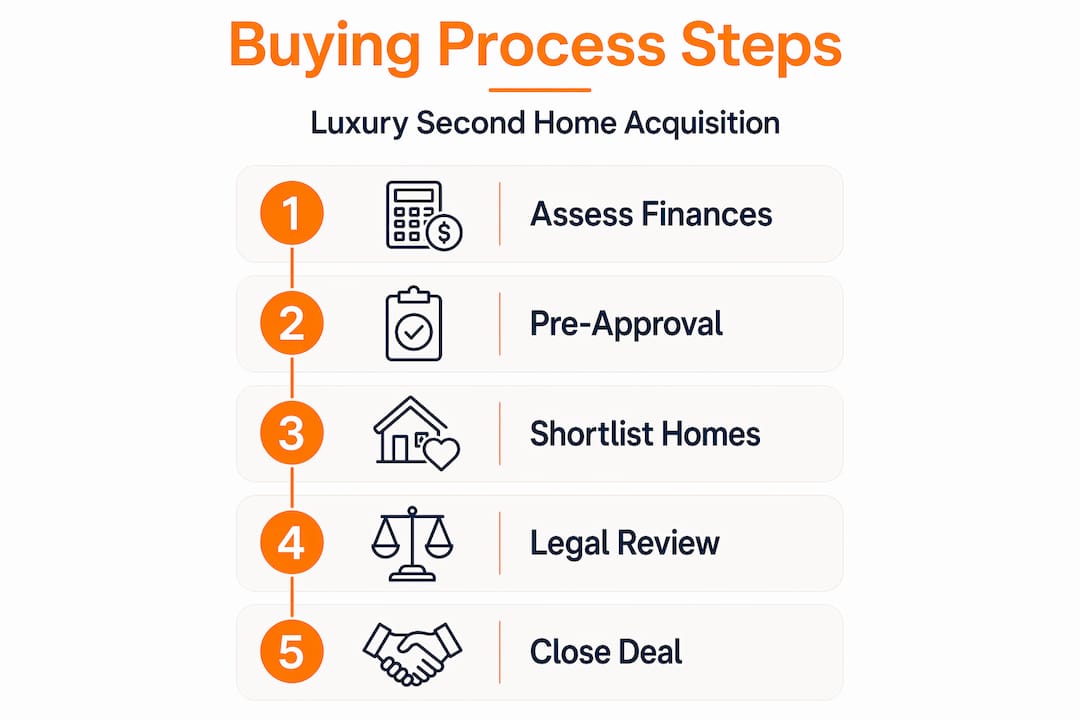
The procedural reality of the secondary residence buying process in luxury markets rewards those who treat it as an investment process, not merely a property purchase. Here is the sequence that experienced buyers follow:
- Define your total budget. Include purchase price, notary fees (typically 7–8% in France on existing property), legal costs, furnishing, and a 10% contingency. Many buyers underestimate closing costs by 30%.
- Obtain mortgage pre-approval. Lender underwriting for second homes is stricter than for primary residences. Pre-approval gives you credibility with sellers of prestigious properties and prevents last-minute financing failures.
- Engage a specialist buyer’s agent. A luxury buyer agent with deep knowledge of the specific market provides access to off-market inventory and negotiating leverage unavailable to general buyers.
- Shortlist and inspect properties. Commission independent technical surveys, including structural assessment and, for coastal properties, damp and sea-exposure analysis.
- Submit an offer and negotiate. In competitive Riviera markets, off-market relationships often determine access. Offers should be conditional on satisfactory due diligence and finance confirmation.
- Sign the preliminary contract. The compromis de vente locks in the property subject to conditions. Your deposit (typically 10%) is placed in escrow and protected by a cooling-off period.
- Conduct full due diligence. This encompasses title searches, planning history, outstanding charges, neighbourhood development plans, and investment yield projections if rental use is planned.
- Coordinate final financing. Submit complete mortgage documentation. Projected rental income cannot be used to qualify; lenders assess only your existing income and liabilities.
- Complete at the notaire. Final funds transfer, keys received, title registered. Retain certified copies of all completion documents in a secure location.
- Initiate post-purchase management. Insurance, utility transfers, property registration, and tax notifications must be completed within prescribed timeframes.
Pro Tip: The most underestimated step is number two. Liquid cash reserves must be a top priority pre-purchase. Late discoveries during underwriting, when lenders find insufficient post-closing reserves, kill deals that appeared financially sound.
Post-purchase management and investment optimisation
Acquiring the property is one achievement. Protecting its value, managing its operational life, and optimising it as a legacy asset is the continuing work that distinguishes sophisticated investors from occasional buyers.
Your post-purchase responsibilities should be structured around four disciplines:
- Occupancy logging: Maintain a detailed calendar recording every personal use day, rental day, and maintenance access separately. Meticulous documentation including booking confirmations, contracts, and receipts is critical for audit defence and preserving deductions.
- Operational budgeting: Review running costs annually. Service charges, insurance premiums, and maintenance on a luxury property fluctuate; an annual audit prevents cost creep.
- Rental compliance: If renting, verify compliance with local licensing requirements (France introduced tighter short-term rental regulation in 2024), HOA rules, and tax declaration obligations in both your country of residence and the property’s jurisdiction.
- Periodic valuation: Commission an independent valuation every two to three years. This informs repositioning decisions, supports remortgaging at improved rates, and provides estate planning clarity.
Lenders and tax authorities do periodically audit secondary residence classifications. Buyers who cannot demonstrate genuine personal use risk having their mortgage reclassified as an investment loan at a higher rate. The discipline required is modest but non-negotiable. For those managing multiple properties as part of a broader legacy investment strategy, specialist advisers who consolidate tax and management reporting across jurisdictions return their fee many times over.
My perspective on what most buyers get wrong
I have accompanied high-net-worth buyers through numerous luxury secondary residence acquisitions, and the pattern of errors is remarkably consistent. Almost universally, buyers underestimate the lender scrutiny they will face. They arrive expecting wealth alone to open doors. It does not. Lenders want documented income, documented reserves, and documented intended occupancy. The buyer with £20M in assets but complex corporate income structures frequently faces a more difficult underwriting experience than a straightforward employed professional.
The second consistent error is treating tax planning as a post-completion task. In my experience, the buyers who make the best long-term returns on luxury secondary residences are those who structure their rental calendar, tax declarations, and usage logs before they spend a single night in the property. That operational discipline is not glamorous. It is, however, what preserves both the tax efficiency and the lender relationship for decades of ownership.
My contrarian view: do not optimise too aggressively for rental yield in the early years. A secondary residence acquired purely for income quickly becomes a management burden that erodes the lifestyle value that made you want it in the first place. The Côte d’Azur’s most successful investor-owners tend to hold their properties generously, use them well personally, and let the long-term appreciation, which has historically run at 5% to 8% annually in premium locations, do the heavy lifting. Patience, in this market, is its own form of sophistication.
— ab
Discover curated luxury residences with Livingonthecotedazur
At Livingonthecotedazur, we work with a global community of discerning buyers who understand that a secondary residence is not merely an address. It is a statement of values, a sanctuary for families, and a store of generational wealth etched into stone and sea view. From the salt-kissed terraces above Antibes to the lemon-fragrant promenades of Menton, our curated portfolio spans the full spectrum of Côte d’Azur prestige.
We offer access to off-market Riviera properties unavailable through conventional channels, alongside bespoke acquisition support covering legal co-ordination, mortgage structuring, and tax positioning. For investors seeking to understand the full spectrum of luxury real estate investment options on the Côte d’Azur, we bring thirty years of Riviera expertise to every conversation. We also accept cryptocurrency payments. Contact our team to begin a conversation calibrated entirely to your ambitions.
FAQ
What down payment is required for a secondary residence mortgage?
Most lenders require between 10% and 25% as a down payment for a second home mortgage, with additional cash reserves of two to six months of combined housing costs required post-closing.
Does buying property in Europe grant residency rights?
No. In most European countries, including France and Italy, property ownership does not confer any right of residency. Stays exceeding 90 days within a 180-day period require a separate visa or residency permit application.
How does the IRS 14-day rental rule affect my second home?
Under IRS Section 280A, renting your secondary residence for more than 14 days per year requires you to declare that rental income and shifts the property’s tax classification, potentially restricting your ability to deduct personal-use expenses.
Can rental income help me qualify for a second home mortgage?
No. Lenders exclude projected rental income when assessing eligibility for a secondary residence mortgage. Qualification is based solely on your existing documented income and your current debt-to-income ratio.
What ongoing costs should I budget for after buying a vacation property?
Beyond mortgage servicing, expect to budget 1.5% to 2.5% of property value annually for property tax, insurance, HOA fees, maintenance, and management costs, with higher figures applicable to older or larger luxury properties.
Recommended
 //
//