
TL;DR:
- In 2025, the luxury real estate market experienced pricing adjustments driven by supply constraints and international demand, rather than a collapse.
- Selective resilience was evident in geographies like the French Riviera, where limited supply maintained premium values despite broader softening.
The luxury real estate market in 2025 confounded even seasoned investors. Headlines spoke of softening demand and price corrections, yet select coastal enclaves and resort-driven markets told an entirely different story. Understanding the real estate market trends 2025 produced requires looking beyond aggregate indices and national medians. The forces at work — shifting buyer demographics, constrained coastal supply, and the rising influence of out-of-market capital — created a market of profound contrasts. This guide cuts through the noise to offer the precise, regional, and data-grounded analysis that serious investors require.
Table of Contents
- Key takeaways
- Macroeconomic and demographic forces in 2025
- Luxury pricing dynamics and inventory conditions
- Regional and submarket variations in 2025
- Practical investment considerations for luxury buyers
- The outlook beyond 2025
- Our perspective
- Discover Côte d’Azur investment opportunities with Livingonthecotedazur
- FAQ
Key takeaways
| Point | Details |
|---|---|
| Pricing recalibration, not collapse | Luxury prices adjusted modestly in 2025, presenting selective buying opportunities rather than broad market distress. |
| Out-of-market buyers reshaped demand | Non-local buyers dominated major metro demand signals, making local comparable sales increasingly unreliable for valuation. |
| Supply scarcity preserves coastal premiums | Geographic constraints in markets like the Côte d’Azur sustained luxury pricing even as broader markets softened. |
| Track price percentiles, not medians | Investors who studied luxury price tiers by percentile gained sharper insight into submarket dynamics and exit timing. |
| Legacy assets outperform short-term plays | Properties in geographically irreplaceable locations continued to appreciate, rewarding patient, long-horizon investors. |
Macroeconomic and demographic forces in 2025
The year 2025 was defined as much by who was buying as by what they were paying. Several structural forces converged to shape a market that defied simplistic characterisation.
On the macroeconomic side, gradual monetary easing created renewed confidence among high-net-worth buyers who had sat on the sidelines during the rate spike years. U.S. house prices rose 1.8% from Q4 2024 to Q4 2025, a modest but meaningful appreciation that signalled resilience rather than stagnation. This was not a market in freefall. It was a market finding its footing.
The buyer profile itself underwent notable transformation:
- Down payments declined. Median down payments fell to a four-year low by early 2026, dropping to $23,400 and a 12.8% share, down 19% year-over-year. This reflected a broader easing of affordability pressure.
- Government-backed financing surged. FHA and VA loans accounted for over one third of purchase mortgages, with VA’s share reaching its highest level in a decade at 11.7%.
- Migration patterns accelerated. Second-home buyers and relocation-driven purchasers increasingly targeted markets far from their primary residences, reshaping demand geographies entirely.
The net effect was a buyer pool that was more heterogeneous than at any point in the prior decade. For luxury analysts, this heterogeneity is not a footnote. It is the central variable.
Pro Tip: When modelling demand for a specific luxury submarket, segment your buyer pool by financing type, origin market, and motivation. A resort-driven coastal market attracts predominantly cash buyers with legacy intent, a very different underwriting profile from a primary-residence metro.
Luxury pricing dynamics and inventory conditions
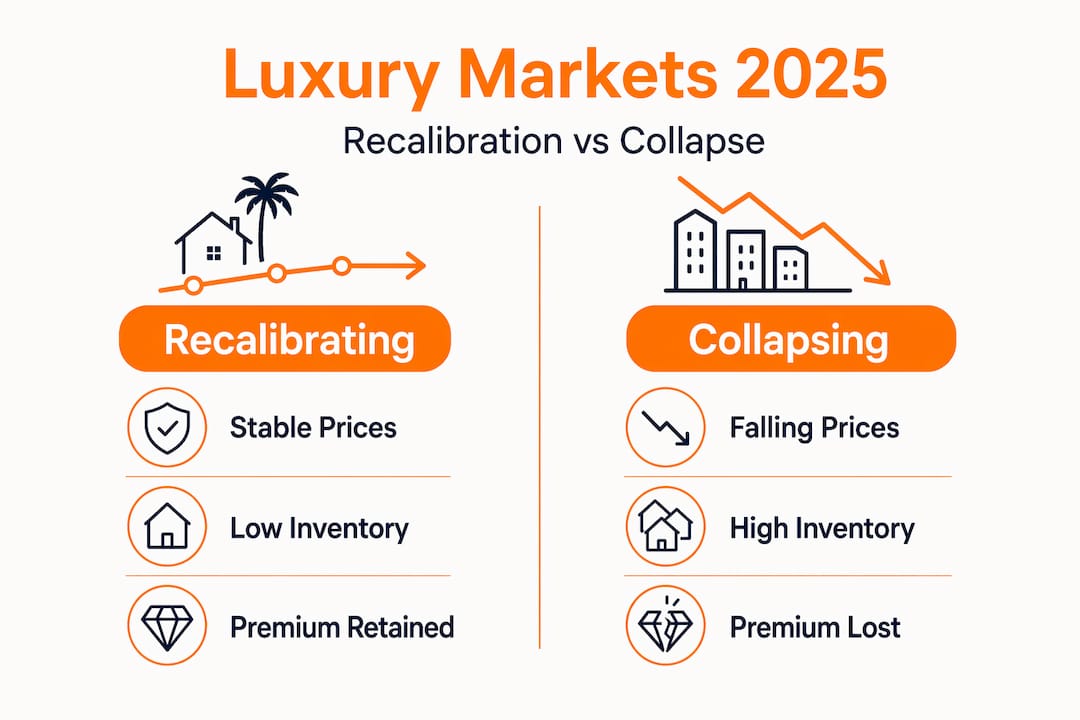
The phrase that best captures 2025 luxury pricing is recalibration, not collapse. Investors who treated the two as synonymous missed significant opportunity.
Here is how the two market types compared at the luxury tier:
| Market condition | Recalibrating market | Collapsing market |
|---|---|---|
| Price movement | Modest monthly gains with annual softening | Sustained double-digit annual declines |
| Time on market | Extended by 5 to 9 days versus prior year | Dramatically extended, often 60 to 90 days above norm |
| Inventory posture | Constrained by geography or low new supply | Elevated supply with rising cancellation rates |
| Seller behaviour | Selective negotiation, limited discounting | Significant price reductions to attract buyers |
The national luxury threshold dipped 3.1% year-over-year in February 2026, yet showed month-over-month stabilisation. Time on market lengthened by 5 to 9 days across luxury tiers compared with the prior year, which tells a precise story: sellers were not panicking, but buyers were negotiating with greater patience.
Inventory scarcity proved the most decisive pricing factor in premium coastal and resort markets. Where developable land is finite — Cap d’Antibes, Saint-Jean-Cap-Ferrat, Monaco’s immediate border villages — supply simply cannot respond to demand spikes. This structural constraint preserves pricing floors that broader market softening cannot erode.

Pro Tip: When assessing a luxury property’s pricing resilience, prioritise supply-side analysis over demand-side sentiment. A market with three years of constrained new supply will hold its value through cycles that devastate oversupplied inland markets.
Regional and submarket variations in 2025
Not all luxury markets moved in the same direction. The divergence between regional markets in 2025 was sharper than at any point since the post-pandemic re-pricing.
Sun Belt and selected Midwestern markets retained strong momentum, partly driven by corporate migration and the gravitational pull of AI and data-centre expansion, which drew clusters of high-earning relocators to specific metro areas. These markets saw out-of-market buyers account for nearly 62% of online property views in late 2025, a structural shift from the 48.6% recorded in 2019.
Coastal and resort-driven markets, including the French Riviera, operated by different rules entirely:
- Lifestyle desirability sustained year-round enquiry from buyers across Europe, the Middle East, and Asia Pacific, irrespective of broader economic sentiment.
- Supply limitations in markets with finite coastline created what researchers describe as micro-market effects, allowing sustained luxury premiums despite broader softening.
- Second-home and legacy buyers dominated transaction volumes in villages such as Èze, Mougins, and Roquebrune-Cap-Martin, where buyers are acquiring assets for generational tenure rather than speculative resale.
- International capital flows from digital entrepreneurs, family offices, and sovereign wealth-adjacent investors continued to regard Riviera property as a hard asset with currency-proof appeal.
On the Côte d’Azur specifically, the micro-market dynamic is vivid. A villa perched above Èze with views across the Bay of Angels is not competing with a Nice apartment. It is competing with a Capri estate, an Algarve quinta, a Bali compound. The buyer’s reference frame is global, and pricing must be read accordingly. Our French Riviera investment guide captures this regional complexity in precise detail.
Practical investment considerations for luxury buyers
Translating 2025’s market signals into sound portfolio decisions requires moving beyond headline statistics. Here is a structured approach for discerning investors.
- Track price percentiles, not medians. Monitoring luxury price thresholds by percentile provides superior insight into market stratification and exit timing. The median tells you what the average luxury buyer paid. The 90th percentile tells you where the most coveted properties are priced and how that tier is moving.
- Model buyer qualification pathways. Investors must account for the full spectrum of buyer financing, from all-cash legacy purchasers to those using conventional or government-backed loans. Liquidity and effective demand vary considerably across these profiles, which affects resale velocity and negotiation dynamics.
- Prioritise geographic irreplaceability. Supply constraints in coastal resorts and mountain-backed enclaves support luxury premiums that no amount of new construction can dilute. Saint-Jean-Cap-Ferrat has precisely as much coastline today as it did in 1960. That scarcity compounds in value over time.
- Evaluate seasonal rental yield potential. On the Côte d’Azur, the summer season commands extraordinary rental premiums. A well-positioned villa in Antibes or Sainte-Maxime can generate 3 to 5% annual yield purely from elite seasonal lets, with demand from the Cannes Film Festival through the Monaco Grand Prix creating near-guaranteed high-season occupancy.
- Incorporate sustainable premium positioning. Eco-certified properties with solar arrays, biophilic design, and green credentials are increasingly attracting a premium, particularly from buyers under 50 who regard environmental responsibility as integral to legacy value.
- Consider off-market property access as a strategic advantage. The most coveted Riviera properties rarely reach public listing portals. Cultivating relationships with specialists who hold off-market mandates is not a luxury. It is a prerequisite for serious acquisition strategy.
Pro Tip: Build a “luxury price ladder” for your target market, mapping each property tier by square metre value, view quality, and proximity to key amenities. This framework allows you to identify relative value dislocations that aggregate data will never surface.
The outlook beyond 2025
As we move through 2026 and look further ahead, several dynamics warrant close monitoring:
- Demand stabilisation at the luxury tier is likely as buyers who deferred in 2024 and early 2025 return with accumulated capital and greater financing confidence.
- Regulatory and tax shifts across European markets, including changes to non-dom taxation in the UK and evolving French property tax frameworks, could redirect capital flows between competing luxury destinations, potentially accelerating Riviera acquisition interest.
- Seasonal versus structural pricing signals must be distinguished carefully. A price softening in October on the Côte d’Azur is seasonal rhythm. A price softening in July is a structural signal. Investors who fail to make this distinction risk misreading both buying and selling windows.
- Liquidity planning deserves renewed attention. Luxury assets are inherently illiquid, and investors with short time horizons must be honest about the mismatch between their capital requirements and the patience that premium properties demand.
The 2025 housing market outlook that ultimately proved most accurate was not the bearish narrative of correction, but the more nuanced picture of selective resilience. The markets that held their value were precisely the ones that always do: irreplaceable, supply-constrained, and deeply desired by a global buyer pool with multigenerational intent.
Our perspective
I have spent years watching investors arrive at luxury market analysis with the wrong tools. They bring spreadsheets calibrated for equity markets and expect pricing to behave rationally against macro signals. It rarely does. What I have learned is that the most reliable predictor of luxury real estate performance is not the interest rate cycle or GDP growth. It is the relationship between irreplaceability and desire.
The data from 2025 confirmed something I have believed for a long time: aggregate pricing figures will consistently mislead you. The market that “fell 3%” in the headlines often contained a submarket that rose 7%. The investors who profited were not the ones with the best macroeconomic models. They were the ones with the deepest micro-market knowledge and the patience to hold.
On the Côte d’Azur specifically, I have seen properties in Mougins and Cap d’Antibes barely register the tremors that shook broader European markets. The reason is simple: the buyers for these properties are not responding to the same signals as mainstream buyers. They are responding to legacy, to lifestyle, to the irreplaceable pleasure of a lavender-laced evening above the Mediterranean. That is a demand floor that no interest rate can dissolve.
My counsel to any serious investor studying luxury real estate investment strategies for 2025 and beyond is this: go deeper than the data, find the supply constraint, and hold.
— ab
Discover Côte d’Azur investment opportunities with Livingonthecotedazur
At Livingonthecotedazur, we have spent years curating access to the most coveted properties along the French Riviera, properties that rarely appear in public listings and that reward the investors patient enough to seek them out properly. Our portfolio spans the salt-kissed corniches above Èze, the sun-washed terraces of Antibes, and the lemon-scented heights of Menton, extending further to Ibiza, Dubai, Bali, Portugal, and Mauritius for those whose vision of legacy spans continents.
We accept cryptocurrency payments and work with digital entrepreneurs, family offices, and global high-net-worth buyers who understand that the finest assets are acquired through trusted relationships, not open portals. Explore our curated off-market Côte d’Azur properties or discover the full spectrum of Côte d’Azur investment options we have assembled for discerning investors. Contact us for a personalised investment consultation tailored to your legacy ambitions.
FAQ
What defined luxury real estate market trends in 2025?
The defining features were pricing recalibration rather than collapse, rising out-of-market buyer dominance, and sustained premiums in supply-constrained coastal markets. Luxury price thresholds dipped modestly year-over-year but showed monthly stabilisation, indicating selective resilience rather than broad decline.
How did out-of-market buyers affect luxury property valuations in 2025?
Out-of-market buyers accounted for nearly 62% of online property views in major metros by late 2025, making local comparable sales less reliable as the sole valuation reference. Investors must incorporate multi-source demand signals to price accurately.
Why did coastal luxury markets like the Côte d’Azur outperform in 2025?
Geographic supply constraints meant that new inventory could not respond to demand, preserving pricing premiums. Micro-market scarcity effects in coastal resorts with limited developable land consistently supported values even as broader markets softened.
What is the most reliable investment strategy for luxury real estate in 2025?
Prioritising geographically irreplaceable assets with strong lifestyle appeal and constrained supply, held with a multigenerational horizon, produced the most resilient outcomes. Tracking luxury price tiers by percentile rather than medians helps identify entry and exit opportunities with greater precision.
How are financing trends affecting luxury property investment decisions?
The surge in government-backed loans and the decline in median down payments reflect a broader buyer risk profile entering the market. For pure luxury segments, cash and private financing remain dominant, but understanding buyer qualification pathways across tiers is critical for modelling effective demand and resale liquidity accurately.
Recommended
 //
//