TL;DR:
- Discretion in luxury buying safeguards privacy and enhances asset value by minimizing information exposure through single-source advisors and private transactions. It has become a key status symbol among ultra-high-net-worth individuals, replacing visible branding with understated confidence and independence. Implementing strict confidentiality and long-term estate integration ensures genuine discretion, which now defines the modern luxury experience.
Discretion in luxury buying is defined as the deliberate practice of maintaining privacy, subtlety, and controlled exposure to protect personal identity and preserve value in high-end transactions. What the industry increasingly terms inconspicuous consumption has moved from a preference to a governing philosophy among ultra-high-net-worth individuals. Since 2020, quiet luxury and stealth wealth have reshaped how affluent buyers approach everything from Hermès acquisitions to off-market Riviera estates. The role of discretion in luxury buying now operates on two levels simultaneously: as a practical mechanism for protecting privacy, and as the most sophisticated status signal available to those who no longer need to prove anything to anyone.
How does discretion protect privacy in luxury transactions?
Genuine discretion is not a personality trait. It is an operational architecture built on three structural commitments: information minimisation, access control, and itinerary compression. When a buyer engages five separate advisors for a single acquisition, each one holds a fragment of the full picture. Collectively, those fragments constitute a significant exposure risk. Single-source luxury models resolve this by limiting knowledge to operational necessity alone.
The practical mechanisms that protect affluent buyers in high-end transactions follow a clear hierarchy:
- Single-source procurement. Consolidating all advisory functions, from legal due diligence to interior specification, within one trusted partner reduces the number of individuals with access to sensitive financial and personal information.
- Private viewings and controlled access. Scheduling property visits outside standard agency hours, with no third-party presence, eliminates casual information leakage that occurs in conventional open-house formats.
- Itinerary compression. Grouping multiple acquisition activities, such as legal meetings, property tours, and financing discussions, into condensed, private sessions limits the public footprint of the transaction.
- Non-disclosure agreements at every tier. NDAs should extend beyond the primary advisor to cover all ancillary service providers, including surveyors, architects, and removal companies.
- Unbranded logistics. Services such as VIP Global’s executive mobility model, which uses unbranded vehicles and controlled interaction, demonstrate how operational discipline at the logistical level reinforces the privacy of the entire transaction.
Personal shopping and concierge services have become the infrastructure layer of discreet luxury acquisition. Discretionary protocols including private entrances and NDAs command fees three to five times higher than standard services. That premium is not for a better product. It is for the guarantee of anonymity.
Pro Tip: Avoid engaging fragmented advisors across different disciplines for a single acquisition. Each additional contact point is an additional exposure risk. A single, trusted partner who manages the full transaction lifecycle is the most effective privacy architecture available.
Is discretion now a luxury status symbol?
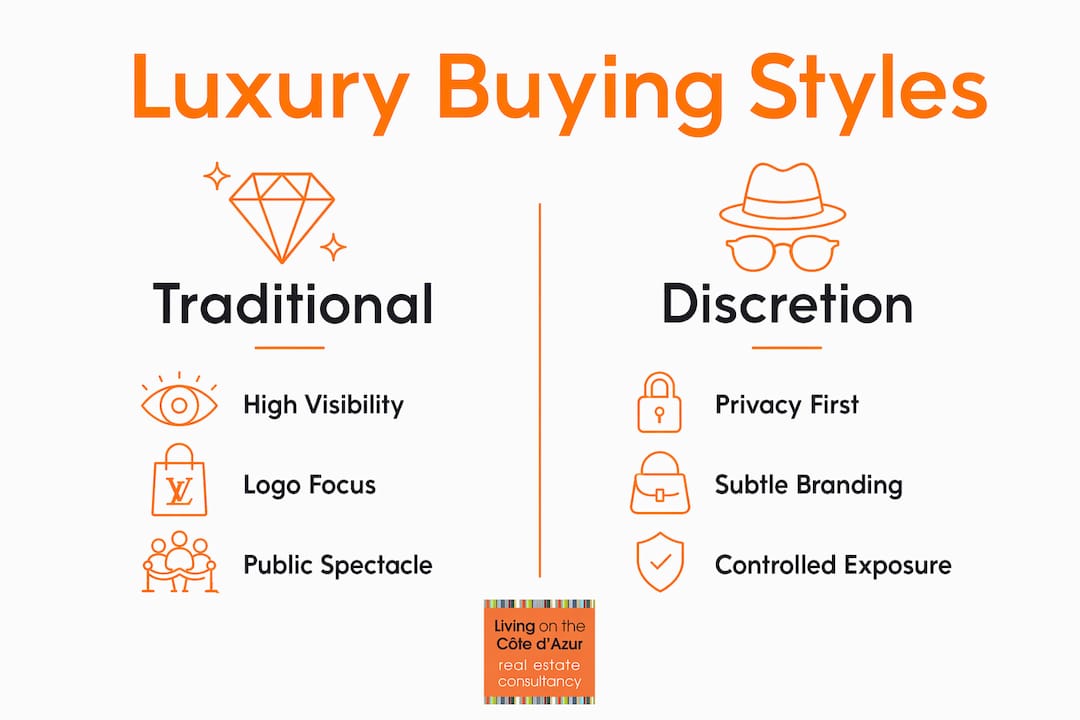
The cultural shift is unambiguous. Conspicuous consumption, defined by visible logos, public spectacle, and brand-forward signalling, served a particular social function for decades. It communicated arrival. The problem is that arrival is now assumed among peers at the highest wealth levels, which makes visible branding redundant as a signal.
Invisibility communicates confidence and independence in a hyper-visible world. Among ultra-high-net-worth individuals, the ability to move without public profile, to acquire without announcement, and to own without display has become the clearest possible signal of genuine, established wealth. This is the psychological appeal of quiet luxury: it excludes those who cannot read it.
Several forces have accelerated this shift:
- Social media scrutiny. Public acquisitions are now subject to immediate commentary, valuation, and criticism. Discretion removes the acquisition from that arena entirely.
- Security considerations. Visible wealth signals create tangible personal security risks, particularly for families with children. The Riviera villages of Saint-Jean-Cap-Ferrat and Cap d’Antibes attract buyers precisely because their private roads and gated estates allow low-profile living at the highest level.
- Peer signalling over public signalling. Among UHNW peers, recognition of quality requires no logo. A Provençal mas in Mougins or a sea-view villa above Èze communicates everything necessary to those who understand the market, without communicating anything to those who do not.
- Brand adaptation. Houses such as Hermès have long understood this dynamic, emphasising heritage and craftsmanship over visible branding. Their waiting lists are themselves a form of discretion, restricting access without advertising it.
“The highest form of luxury is invisible service: the elimination of the need for client explanation.” — VIP Global
Modern luxury brands that win buyer loyalty in 2026 do so through AI-enabled personalisation and practical convenience, not through priced image markups. Reassurance has replaced ostentation as the primary value proposition.
Traditional luxury buying vs. modern discretion-focused strategies
The contrast between old and new luxury buying behaviour is most visible when examined across five dimensions. The table below captures how consumer discretion in luxury goods has fundamentally restructured the acquisition experience.
| Dimension | Traditional luxury buying | Discretion-focused buying |
|---|---|---|
| Brand visibility | Prominent logos and public-facing branding | Unbranded or subtly marked; quality legible only to peers |
| Transaction structure | Multiple advisors, public showrooms, open viewings | Single-source partner, private viewings, compressed itineraries |
| Client relationship | Transactional, volume-driven | Long-term, lifestyle-integrated, NDA-governed |
| Marketing approach | Aspirational advertising to broad affluent audience | Invitation-only access, word-of-mouth, off-market listings |
| Technology role | CRM and loyalty programmes | AI-enabled personalisation, tailored property experiences, predictive curation |
The shift in decision-making in luxury buying is not merely aesthetic. Affluent buyers follow disciplined, long-term acquisition calendars, previewing collections and properties privately to integrate purchases strategically within their lifestyle and estate plans. Impulse acquisition is a marker of new wealth. Deliberate, calendar-driven acquisition is the signature of established wealth. This distinction matters because it changes the entire service model a luxury provider must offer.
High-income households earning above $200,000 annually saw a 20.5-point drop in purchasing consideration between December 2025 and February 2026. Luxury hotels maintained 67.8% consideration while physical goods declined sharply. This tells us that experience-based luxury, where discretion is embedded in the service itself, retains value even when confidence wavers.
Practical ways to apply discretion in your luxury purchases
Implementing discretion effectively requires deliberate structure, not instinct. The following framework applies across categories, from art acquisition to real estate on the Côte d’Azur.
- Appoint a single trusted partner. Whether acquiring a villa above Cannes or a collection of contemporary art, consolidate all advisory functions. Your partner should manage legal, financial, logistical, and lifestyle dimensions without subcontracting to parties outside the agreed confidentiality framework.
- Structure private viewings as standard practice. For real estate, this means requesting off-schedule access, ideally with no other buyers present and no public listing trail. Livingonthecotedazur’s off-market property access in locations such as Roquebrune-Cap-Martin and Saint-Paul-de-Vence operates precisely on this basis.
- Negotiate confidentiality agreements before disclosure. Any advisor, surveyor, or specialist who receives information about your acquisition should sign an NDA before that information is shared. This is not excessive caution. It is standard operational practice at the UHNW level.
- Integrate acquisitions into long-term estate planning. Disciplined acquisition calendars that align with inheritance structures, tax planning cycles, and family governance frameworks transform individual purchases into legacy assets. A restored Provençal mas in Valbonne or a Monaco-adjacent plot in Beausoleil is not simply a property. It is a generational instrument.
- Control the digital footprint of every transaction. Avoid searches, enquiries, and communications on unsecured channels. Use encrypted communication with advisors and request that no transaction details appear in publicly accessible records beyond legal requirements.
Pro Tip: Before any acquisition conversation begins, ask your advisor explicitly: who else in your organisation will have access to this information, and under what terms? If the answer is vague, the operational architecture is not yet adequate for a discreet transaction.
Key takeaways
Discretion in luxury buying functions simultaneously as an operational privacy framework and the defining status signal of established wealth in 2026.
| Point | Details |
|---|---|
| Discretion is structural, not personal | Build information minimisation, access control, and NDA governance into every acquisition from the outset. |
| Invisibility signals established wealth | Among UHNW peers, quiet luxury communicates confidence and independence more powerfully than visible branding. |
| Single-source models reduce exposure | Consolidating all advisory functions with one trusted partner limits information risk across complex transactions. |
| Experience-based luxury retains value | Hotels and private services maintain buyer consideration even as confidence in physical goods declines. |
| Acquisition must serve legacy | Integrating purchases into long-term estate and tax planning transforms individual buys into generational assets. |
Why discretion has become the defining luxury of our time
We have observed, across years of working with discerning buyers on the Côte d’Azur and beyond, that the clients who ask the fewest public questions tend to make the most considered decisions. There is a particular quality of attention that accompanies genuine discretion. It is unhurried, precise, and entirely unconcerned with external validation.
What strikes me most is how poorly the luxury industry, taken broadly, has adapted to this reality. Many providers still default to spectacle: grand unveilings, branded events, social media campaigns targeting aspirational audiences. These approaches are not wrong for every market segment. But they are entirely wrong for the buyer who values privacy as the primary luxury. The gap between what the market offers and what the most sophisticated buyers actually want remains wider than most providers acknowledge.
The Riviera itself embodies this tension beautifully. The Cannes Film Festival fills the Croisette with cameras and crowds each May, while three kilometres away, a buyer quietly completes the acquisition of a Cap d’Antibes villa that will never appear in any public record beyond the notaire’s register. Both realities coexist on the same coastline. The question is which one you are building your life around.
My honest view is that discretion will only deepen as a priority. As AI-enabled personalisation makes it possible to deliver genuinely invisible service at scale, and as privacy in luxury real estate becomes a standard expectation rather than a premium add-on, the buyers who have already structured their acquisitions around discretion will find themselves ahead of a market that is only beginning to catch up.
— ab
Discover discreet, off-market properties on the Côte d’Azur
At Livingonthecotedazur, we work exclusively with buyers who understand that the finest properties are never publicly listed. Our portfolio of invisible luxury real estate on the Côte d’Azur spans private villas in Saint-Jean-Cap-Ferrat, sea-view estates above Èze, and restored mas in the fragrant hills of Mougins and Grasse. Every enquiry is handled under strict confidentiality, with a single dedicated advisor managing the full acquisition process. We accept cryptocurrency payments and structure transactions to support long-term legacy and ROI planning. If you are ready to acquire with complete discretion, we are ready to listen.
FAQ
What is the role of discretion in luxury buying?
Discretion in luxury buying is the deliberate management of privacy, information exposure, and transaction visibility to protect personal identity and preserve asset value. It operates as both a practical security framework and a cultural status signal among ultra-high-net-worth individuals.
How does quiet luxury differ from traditional conspicuous consumption?
Quiet luxury prioritises unbranded or subtly marked goods and private transactions that signal quality only to informed peers, whereas conspicuous consumption relies on visible logos and public display. Since 2020, stealth wealth has become the dominant preference among established UHNW buyers.
Why do affluent buyers prefer single-source luxury advisors?
Single-source models limit the number of individuals with access to sensitive acquisition information, reducing exposure risk across complex transactions. Fragmented advisory structures, by contrast, distribute confidential details across multiple parties, each representing a potential breach point.
Do discretionary luxury services cost more?
Discretionary protocols including private access, NDA-governed service, and dedicated advisors command fees three to five times higher than standard luxury services. The premium reflects the guarantee of anonymity, not a superior product.
How does discretion apply to luxury real estate on the Côte d’Azur?
Discreet real estate acquisition on the Riviera involves off-market listings, private viewings outside standard agency schedules, and NDA-governed advisory relationships. Villages such as Saint-Jean-Cap-Ferrat, Mougins, and Roquebrune-Cap-Martin are particularly sought after for their ability to accommodate low-profile ownership at the highest level of quality.
Recommended
 //
//