
TL;DR:
- A long-term property value strategy involves deliberate, multi-decade planning focused on appreciation, rental income, and ROI through strategic acquisition and disciplined management. Prioritizing location, targeted renovations, operational efficiency, and financial reserves is essential for building generational wealth on the French Riviera. Active management and careful market assessment are crucial, as passive holding fails without reserves and ongoing reevaluation.
A long-term property value strategy is a deliberate, multi-decade plan to maximise property appreciation, rental income, and overall return on investment through strategic acquisition, targeted renovation, and disciplined operational management. In luxury real estate markets, this approach is not merely advisable. It is the defining difference between a property that holds its prestige and one that quietly erodes in relative value. The industry term for this discipline is long-term buy-and-hold investing, and it encompasses everything from market selection and value-add improvements to net operating income (NOI) management and tax structuring. For discerning investors on the Côte d’Azur, in Monaco, or across the broader French Riviera, mastering each component of this strategy is the foundation of generational wealth.
What are the proven methods to increase property value long-term?
The most reliable property value growth strategies combine a buy-and-hold horizon with targeted physical improvements and operational discipline. Each element compounds the others over time.
The buy-and-hold foundation
A buy-and-hold strategy targets a 10–20+ year hold period to benefit from steady appreciation averaging 3–5% annually, equity accumulation, and significant tax advantages. That compounding effect is the engine of generational wealth. In luxury markets, typical investment financing requires a down payment of 20–25%, and the financial goal is a minimum positive cash flow of £160 or more per unit per month, equivalent to the widely cited $200 benchmark.

The 1% rent-to-price rule serves as a quick acquisition filter. If a property’s monthly rental income equals at least 1% of its purchase price, the fundamentals are sound. In prime Riviera locations, this ratio is harder to achieve, which is precisely why operational efficiency and appreciation potential carry greater weight.
Value-add renovations with the highest ROI
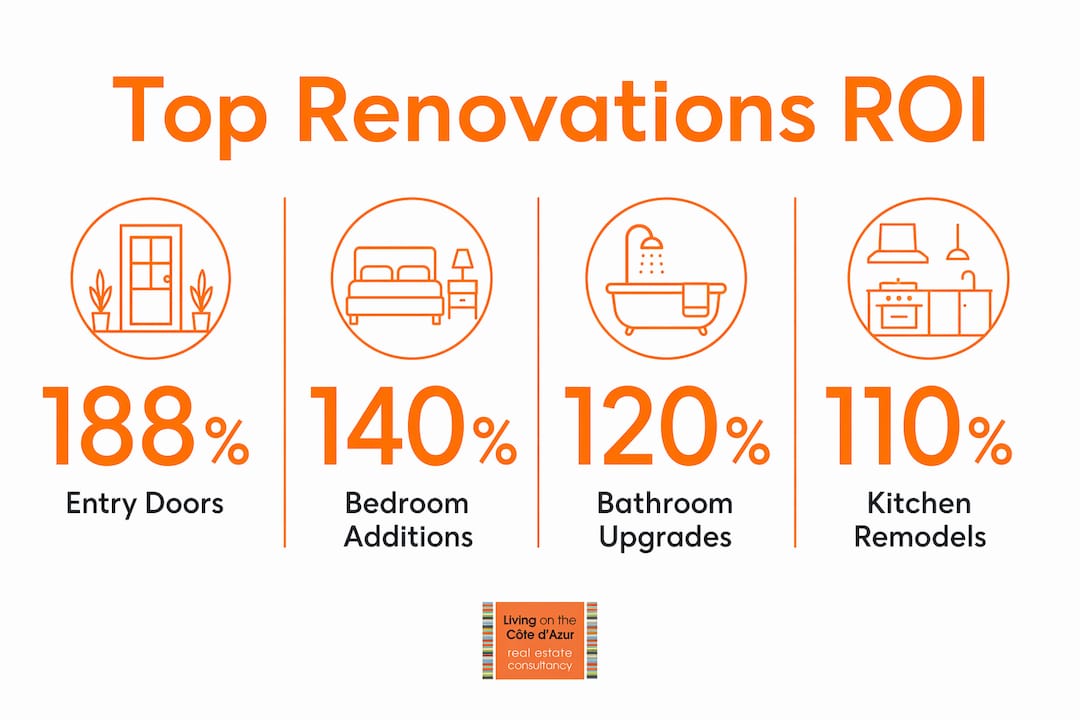
Not all renovations are created equal. The 2026 data on renovation ROI is unambiguous: entry door replacement yields up to 188% ROI, making it the single most cost-effective physical upgrade available. That figure reflects how powerfully first impressions shape perceived value in luxury markets.
Adding a bedroom costs between £20,000 and £44,000 but increases property value by £48,000 to £72,000, representing approximately 140% ROI. A bathroom addition delivers over 130% ROI in family-oriented luxury suburbs. Minor kitchen remodels recover roughly 96% of their costs. The pattern is clear: functional additions outperform cosmetic upgrades in appraisal-driven value creation.
Pro Tip: Address deferred maintenance and structural defects before any cosmetic upgrade. Buyers and appraisers discount properties with visible defects far more aggressively than the actual repair cost warrants.
| Renovation Type | Estimated ROI | Notes |
|---|---|---|
| Entry door replacement | Up to 188% | Highest ROI of any single upgrade |
| Bedroom addition | ~140% | Cost £20,000–£44,000; value gain £48,000–£72,000 |
| Bathroom addition | 130%+ | Particularly effective in family luxury suburbs |
| Minor kitchen remodel | ~96% | Strong recovery; avoid over-specification |
| Cosmetic upgrades | Variable | Lower priority until structural issues resolved |
For a deeper analysis of which luxury renovation projects deliver the strongest returns on the Côte d’Azur, the distinction between cosmetic and structural investment becomes even more pronounced at the top of the market.
How does location shape long-term property value growth?
Location is not a passive factor in a real estate investment strategy. It is the single most powerful determinant of long-term appreciation, and selecting it incorrectly cannot be corrected by any renovation or operational improvement.
What drives appreciation in prime locations?
Strategic location selection targets areas with strong infrastructure growth, positive migration patterns, and economic momentum. These three forces create a self-reinforcing cycle: infrastructure attracts residents, residents attract commerce, and commerce sustains demand. That sustained demand is what protects downside risk during market corrections.
The risks of overpaying for a fashionable but overheated market are real and often underestimated. Markets that attract speculative capital tend to correct sharply when sentiment shifts. Emerging luxury hubs, by contrast, often offer acquisition prices that reflect current rather than anticipated prestige, leaving room for genuine appreciation.
Key location factors that sustain luxury demand over decades include:
- International schools: Proximity to institutions such as the International School of Monaco or Mougins School directly supports demand from expatriate families and high-net-worth relocators.
- Transport connectivity: Access to Nice Côte d’Azur Airport and the TGV network underpins both rental demand and resale liquidity.
- Lifestyle infrastructure: Marinas, private clubs, Michelin-starred restaurants, and cultural institutions such as the Fondation Maeght in Saint-Paul de Vence sustain the aspirational character that defines luxury value.
- Regulatory stability: Markets with clear property rights, transparent transaction processes, and predictable tax frameworks attract and retain international capital.
- Demographic momentum: Areas receiving net inflows of high-net-worth individuals, such as Monaco and the wider Alpes-Maritimes département, demonstrate structural rather than cyclical demand.
Pro Tip: Use data-driven tools such as INSEE migration statistics and local notarial transaction records alongside on-the-ground knowledge from established local advisers. Neither alone is sufficient for confident acquisition decisions.
For investors considering the international acquisition process in 2026, understanding which Riviera micro-markets are entering a growth phase versus those approaching peak pricing is the most consequential decision in the entire investment cycle.
Which operational strategies add value without major renovations?
Operational improvements are the most underutilised lever in luxury property investment. They require no planning permission, no contractor management, and no disruption to tenants. Yet their impact on property valuation can be profound.
In commercial and multifamily property, value equals NOI divided by the market capitalisation rate. A small, consistent improvement in NOI therefore produces an outsized increase in asset value. This is the mathematical argument for prioritising operational efficiency before physical renovation.
Here is a structured approach to operational value creation:
Conduct an expense audit. Review every service contract, insurance policy, and utility arrangement. Redundant or overpriced contracts are common in properties that have not been actively managed. Eliminating them improves NOI immediately and without capital expenditure.
Implement a Ratio Utility Billing System (RUBS). Shifting utility costs to tenants through RUBS can raise monthly NOI by £24–£48 per unit (equivalent to the cited $30–$60 range). Across a portfolio of ten units, that represents an annual NOI improvement of up to £5,760.
Eliminate deferred maintenance. Deferred maintenance is the most critical issue reducing property value at appraisal. Leaking roofs, failing HVAC systems, and water damage invite price reductions that far exceed the cost of repair. Treating maintenance as objection removal rather than improvement reframes it correctly.
Introduce ancillary income streams. Storage fees, parking allocations, and concierge service charges add revenue without structural change. In luxury properties, these additions align with tenant expectations and carry minimal resistance.
Maintain 3–6 months of operational cash reserves. Financial reserves prevent forced sales during market volatility and protect tenancy quality during unexpected cost events. This is not a conservative measure. It is a prerequisite for executing a long-term hold with confidence.
Pro Tip: Light renovations costing between £2,800 and £4,400 per unit, such as new flooring, updated fixtures, and fresh neutral paintwork, can justify rent increases of £80–£160 per month. The payback period is typically under three years.
The luxury rental investment workflow on the Côte d’Azur rewards investors who treat operational discipline with the same rigour they apply to acquisition.
What frameworks support a 20-year hold for wealth preservation?
A 20-year hold is not simply a longer version of a short-term investment. It requires a distinct financial architecture, a clear scaling methodology, and the discipline to resist premature disposal when markets appear to peak.
The BRRRR method as a scaling framework
The BRRRR method (Buy, Rehab, Rent, Refinance, Repeat) enables investors to build portfolios from a single property to ten or more units within years by using rehab-driven appreciation to unlock refinancing capital. The method is particularly powerful in markets where value-add opportunities exist alongside strong rental demand. On the Côte d’Azur, off-market acquisitions in need of considered restoration represent precisely this profile.
Key financial metrics for long-term investment planning
Successful long-term investment planning rests on a small number of non-negotiable financial criteria. These are not aspirational targets. They are minimum thresholds for a strategy that will hold through multiple market cycles.
- Annual appreciation target: 3–5% per annum, compounding over the hold period
- Positive cash flow: Minimum £160 per unit per month after all expenses
- Rent-to-price ratio: 1% monthly rent as a proportion of acquisition price, used as an initial filter
- Operational reserves: 3–6 months of total property expenses held in liquid form
- Renovation ROI threshold: No physical improvement undertaken unless projected ROI exceeds 100%
- Tax structuring: Depreciation allowances and capital gains deferral mechanisms (such as the French plus-value immobilière regime or, for US-connected investors, 1031 exchanges) should be modelled before acquisition, not after
| Investment Criterion | Target KPI | Purpose |
|---|---|---|
| Hold period | 10–20+ years | Captures full appreciation cycle and tax benefits |
| Annual appreciation | 3–5% | Baseline for wealth compounding projections |
| Monthly cash flow | £160+ per unit | Confirms operational viability without reliance on appreciation |
| Operational reserves | 3–6 months expenses | Protects against forced sale during downturns |
| Renovation ROI minimum | 100%+ | Filters out value-destroying cosmetic expenditure |
For a comprehensive view of how to structure luxury property portfolios for both legacy and yield, the interplay between tax efficiency, financing structure, and asset selection is where the most significant value is created or destroyed. Investors who approach wealth preservation in real estate with this level of rigour consistently outperform those who rely on market conditions alone.
Key takeaways
A successful long-term property value strategy combines disciplined acquisition, targeted renovation, operational efficiency, and financial resilience to build compounding wealth across market cycles.
| Point | Details |
|---|---|
| Prioritise functional renovations | Entry door replacement, bedroom additions, and bathroom upgrades deliver 130–188% ROI. |
| Location drives appreciation | Target areas with infrastructure growth, migration momentum, and lifestyle infrastructure. |
| Operational gains compound quietly | Expense audits and RUBS improvements raise NOI without capital expenditure or planning risk. |
| Financial reserves are non-negotiable | Holding 3–6 months of operational reserves prevents forced sales during market corrections. |
| BRRRR enables portfolio scaling | Rehab-driven refinancing allows investors to grow from one property to ten or more within a decade. |
Where cosmetic thinking costs investors the most
I have spent years watching investors make the same expensive mistake: they fall in love with a property’s aesthetic potential and pour capital into surfaces, finishes, and fittings before addressing the fundamentals. A beautifully appointed villa with a failing drainage system or an outdated electrical installation will not hold its value. The appraisal will reflect what the surveyor finds beneath the surface, not what the interior designer created above it.
The second pattern I see consistently is location selection driven by current prestige rather than forward trajectory. Cannes and Monaco carry extraordinary cachet, and that cachet is priced in. The investors who have built the most durable wealth on the Riviera are those who identified Cap d’Ail, Roquebrune-Cap-Martin, or the hills above Antibes before those areas attracted mainstream attention. The demographic signals were there: international school enrolment rising, new marina berths being added, infrastructure investment visible. The price premium had not yet arrived.
The third misconception is that long-term holding is passive. It is not. A 20-year hold requires active operational management, periodic reassessment of the asset’s position in the market, and the financial discipline to resist selling during a strong cycle when the temptation is greatest. The investors who exit at the wrong moment typically do so because they lack the reserves to hold through a correction. That is a structural failure, not a market failure.
What I find genuinely exciting about the 2026 Riviera market is the growing recognition that efficiency upgrades, energy performance certificates, and resilience features such as solar integration and water management systems are now appraisal-relevant. These are no longer lifestyle choices. They are value-add investments with measurable returns, and they align perfectly with the long-term hold philosophy.
— Ab Kuijer
How Livingonthecotedazur supports your investment strategy
Livingonthecotedazur brings together access to over 100,000 properties across the Côte d’Azur, including off-market luxury properties that never appear on public portals. These invisible acquisitions are where the most compelling long-term value is created: acquired below market awareness, improved with precision, and held through appreciation cycles that reward patience. Our team provides legal audits, tax optimisation, and financing guidance as part of every transaction, so your investment architecture is as considered as the property itself. For investors seeking curated luxury real estate investment options on the Côte d’Azur, we offer the local knowledge and transactional rigour that long-term wealth building demands.
FAQ
What is a long-term property value strategy?
A long-term property value strategy is a structured plan to maximise property appreciation, rental income, and ROI over a 10–20+ year hold period through strategic acquisition, renovation, and operational management.
Which renovations increase property value the most?
Entry door replacement yields up to 188% ROI, bedroom additions deliver approximately 140% ROI, and bathroom additions exceed 130% ROI, making functional additions the most reliable value-add investments.
How does location affect long-term property appreciation?
Locations with strong infrastructure investment, positive migration trends, and lifestyle infrastructure such as international schools and transport links consistently outperform markets driven by short-term sentiment.
What is the BRRRR method in real estate investment?
BRRRR stands for Buy, Rehab, Rent, Refinance, Repeat. It allows investors to use rehab-driven equity to refinance and fund new acquisitions, scaling a portfolio from one property to ten or more within years.
How much cash reserve should a property investor hold?
Investors should maintain 3–6 months of total operational expenses in liquid reserves to protect against forced sales, unexpected costs, and market downturns without compromising tenancy quality.
Recommended
 //
//