
TL;DR:
- Estate curation involves organizing and documenting assets to preserve their value for future generations. It helps prevent financial loss, family conflicts, and legal disputes by ensuring accurate records and clear intentions. Early, multidisciplinary estate management is essential for protecting high-value and digital assets effectively.
Estate curation is defined as the deliberate process of organising, documenting, and managing a property and its associated assets to preserve their financial and sentimental value across generations. For high-net-worth individuals, collectors, and luxury property investors, it is the difference between a legacy that endures and one that fragments under administrative pressure. Families who organise records and assets before estate liquidation reduce administrative delays by 65%, while a lack of preparation can result in a 30% loss of potential estate value. That is a compelling case for acting early, and acting with precision.
What is estate curation explained: the core process
Estate curation, known in professional circles as estate management or legacy asset planning, is the structured practice of cataloguing every asset within an estate and preparing it for seamless transfer. It covers physical holdings such as property, art, jewellery, and wine collections, as well as the digital layer that most estates still ignore. The goal is to give heirs, executors, and advisors a clear, accurate picture of what exists, what it is worth, and what should happen to it.
The process follows a logical sequence that rewards thoroughness at every stage.
1. Comprehensive asset inventory
The foundation of any well-curated estate is a complete inventory. Every property, vehicle, artwork, collectible, financial account, and business interest must be listed with enough detail for a stranger to understand it. For luxury estates, this means recording not just the asset but its condition, location, and any associated documentation.

2. Provenance and authentication records
For collectors, provenance documentation is the single most important factor in preserving financial value. Certificates of authenticity, purchase receipts, exhibition histories, and installation instructions all contribute to an artwork’s market credibility. Conceptual art is particularly vulnerable here. Without installation instructions, a piece can lose both its meaning and its value entirely.
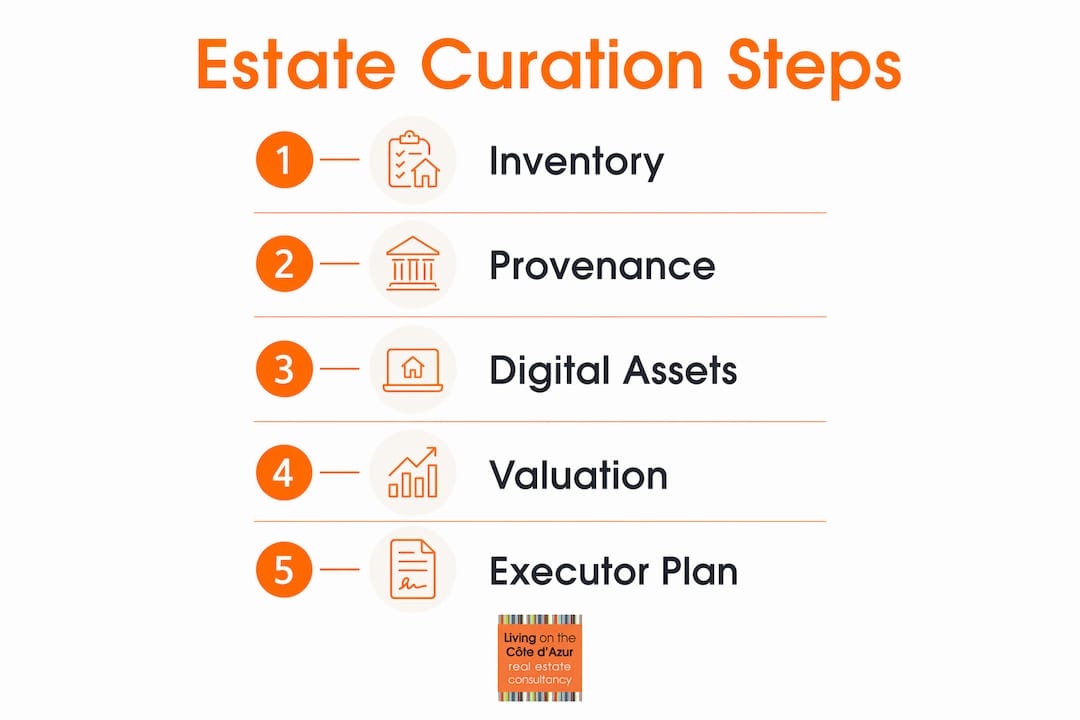
3. Digital asset integration
Digital assets must be included in every modern estate plan. Passwords, domain names, cryptocurrency wallets, and online brokerage accounts represent real financial value. Heirs locked out of these accounts face months of legal effort and, in many cases, permanent loss of access. A secure digital vault, updated annually, resolves this entirely.
4. Periodic valuation and appraisals
Collectors should maintain updated appraisals every 3–5 years to manage estate tax reporting, insurance coverage, and disposition planning. Markets shift, and an appraisal from a decade ago is not just inaccurate. It is a liability.
5. Executor simplification strategies
Pre-defining what happens to each asset category removes the burden of decision-making from grieving family members. Simplification strategies, such as designating specific items for donation, sale, or retention, give executors a clear framework rather than an open-ended problem.
Pro Tip: Begin your estate inventory at least five years before you anticipate needing it. Early preparation prevents value loss and eliminates the administrative delays that cost estates a significant portion of their worth.
How does effective estate curation prevent common pitfalls?
Poor estate curation does not simply create inconvenience. It creates conflict, financial loss, and lasting damage to family relationships. The most common source of dispute in estates with collections is the gap between what the collector intended and what the family understood. Communicating intentions clearly with family members is the single most effective way to prevent estate disputes. A conversation held today costs nothing. A legal dispute resolved in probate court costs considerably more.
The risks of inadequate preparation are well documented:
- Value erosion. Lack of preparation can result in a 30% loss of potential estate value, driven by rushed sales, undocumented assets, and missed tax planning opportunities.
- Emotional decision-making. Hasty decisions made in grief risk the permanent loss of legacy items that hold both sentimental and financial significance.
- Executor overwhelm. When no simplification strategy exists, executors face an open-ended catalogue of decisions under time pressure, which frequently leads to undervalued disposals.
- Liquidity shortfalls. Estates heavy in illiquid assets, such as art, property, and collectibles, can face cashflow crises if no plan exists for converting assets to meet tax obligations or heir distributions.
- Family disputes. Undocumented wishes and ambiguous ownership create fertile ground for disagreement, particularly across blended families or multi-generational estates.
“The most common source of conflict in estates with collections is the gap between collector intention and family understanding. Discussing wishes early is not just advisable. It is the most protective action a collector can take.”
Estate planning for collections: what executors need to know
Pre-defining simplification strategies for collections prevents executor overwhelm and the emotional gridlock that follows. This is not about reducing the estate’s value. It is about protecting it by removing ambiguity at the most vulnerable moment.
What special considerations apply to luxury and high-value estates?
Luxury estates present a category of complexity that standard estate planning guides rarely address with sufficient depth. Art, architecture, rare collectibles, and prestige property each carry their own valuation logic, conservation requirements, and tax implications. Managing them well requires a multidisciplinary team, not a single adviser.
Art curation as architectural strategy
Art curation is a core component of architectural design in luxury estates. The placement of works is not decorative. It is structural, balancing visual weight, lighting, and proportion to reinforce the character of the property itself. This integration means that art and architecture must be documented together. Removing a significant work without understanding its role in the space can diminish both the collection and the property’s perceived value.
Pro Tip: Commission a specialist art consultant to document the curatorial rationale behind each placement. This record becomes part of the estate’s provenance and supports both insurance valuation and future sale.
Provenance protection for financial value
Provenance documentation for artworks, including certificates of authenticity and installation instructions, is non-negotiable for preserving financial value. This is especially true for conceptual and installation art, where the work’s integrity depends entirely on how it is presented. Estates that lose this documentation lose a measurable portion of the collection’s market value.
Comparing approaches to luxury estate management
| Approach | Strengths | Weaknesses |
|---|---|---|
| Single legal adviser | Coordinated legal documentation | Limited expertise in art, tax, and property valuation |
| Multidisciplinary team | Covers legal, tax, conservation, and appraisal needs | Requires active coordination and higher fees |
| Digital vault only | Accessible and organised records | Does not address physical conservation or tax strategy |
| Integrated estate curation | Combines all disciplines into a cohesive plan | Requires early engagement and ongoing maintenance |
The integrated approach consistently produces the best outcomes for high-value estates. It aligns legal, tax, conservation, and investment considerations into a single, coherent plan. Charitable planning strategies, such as donating works to institutions in exchange for tax relief, also become viable only when the collection is properly documented and appraised.
How can estate curation enhance legacy value and investment returns?
Estate curation is not purely a defensive exercise. Used well, it is a tool for enhancing legacy value and ROI on luxury real estate portfolios. Collectors and advisors who treat curation as an investment discipline, rather than an administrative task, consistently achieve better outcomes at the point of transfer.
The connection between curation and investment performance is direct:
- Documented estates sell faster and at higher prices. Buyers and heirs alike pay a premium for clarity. A fully documented luxury property with a curated art collection and clean title history commands stronger offers than an equivalent property with gaps in its records.
- Tax planning becomes possible. Accurate, current appraisals allow advisors to structure disposals, gifts, and charitable donations in ways that reduce estate tax exposure. Without them, the default is the least tax-efficient outcome.
- Legacy real estate gains narrative value. A property on the Côte d’Azur with a documented history of distinguished ownership, curated interiors, and maintained provenance records carries a story. That story is part of its value. Buyers in the prestige market pay for authenticity and continuity.
- Succession becomes a transition, not a crisis. When heirs receive a curated estate, they inherit a clear picture of what they hold, what it is worth, and what their options are. That clarity transforms succession from a source of stress into an opportunity for informed decision-making.
- Portfolio structuring improves. Understanding the full scope of an estate, including its luxury property portfolio, allows advisors to identify concentration risks, liquidity gaps, and opportunities for yield improvement before they become problems.
The Côte d’Azur market illustrates this principle clearly. Properties in Saint-Tropez, Monaco, and Cap d’Antibes that carry complete ownership histories, curated interiors, and documented renovation records consistently attract the most discerning buyers. The curation itself becomes a selling point, signalling to the market that the estate has been held with care and intention.
Key takeaways
Estate curation is the most effective tool a high-net-worth individual has for protecting asset value, preventing family conflict, and ensuring a dignified legacy transfer.
| Point | Details |
|---|---|
| Start early | Begin the inventory and documentation process at least five years before it is needed. |
| Include digital assets | Passwords, cryptocurrency, and domain names must be recorded to prevent heirs losing access to real value. |
| Update appraisals regularly | Revalue art and collectibles every 3–5 years to keep tax, insurance, and disposition planning accurate. |
| Communicate intentions clearly | Discussing wishes with family is the single most effective way to prevent estate disputes. |
| Use a multidisciplinary team | Legal, tax, conservation, and appraisal expertise must work together for high-value estates. |
Why estate curation is the conversation most collectors avoid
I have spent years working alongside high-net-worth clients across the Côte d’Azur, and the pattern is consistent. The clients who have built the most extraordinary collections and estates are often the least prepared for what happens next. There is something deeply human about it. Building a legacy feels creative and alive. Documenting it feels like an admission that it will one day need to pass on.
What I have found, without exception, is that the clients who engage with estate curation early are the ones whose legacies actually survive intact. The ones who defer it are the ones whose families face the hardest conversations at the worst possible time.
The digital asset gap is the most overlooked issue I encounter. Clients with cryptocurrency holdings, private domain portfolios, and online investment accounts routinely have no record that a trusted person can access. That is not a minor administrative oversight. It is a significant and entirely preventable loss.
The second thing I would say is this: multidisciplinary collaboration is not a luxury. For estates that include art, prestige property, and financial instruments, a single adviser cannot hold all the expertise required. The estates that transfer most gracefully are the ones where a conservator, a tax specialist, a property adviser, and a legal professional have all contributed to the same plan.
Estate curation in 2026 is not what it was a decade ago. The complexity of digital assets, the sophistication of the art market, and the international nature of high-net-worth portfolios mean that the old approach of a will and a solicitor is no longer sufficient. The clients who recognise this early are the ones who protect what they have built.
— Ab Kuijer
How Livingonthecotedazur supports your estate legacy
At Livingonthecotedazur, we work with clients who hold some of the most distinguished properties on the French Riviera, from Saint-Tropez to Monaco. Our approach to luxury real estate legacy planning goes beyond the transaction. We connect buyers with over 100,000 properties, including off-market Côte d’Azur estates that never reach the open market. Our team coordinates legal audits, tax optimisation, and financing assistance, giving clients the multidisciplinary support that effective estate curation demands. If you are building a legacy worth preserving, we are the partner who understands what that means.
FAQ
What is estate curation?
Estate curation is the process of organising, documenting, and managing all assets within an estate to preserve their value and facilitate smooth transfer to heirs or beneficiaries. It covers physical assets, digital holdings, and associated legal and tax records.
How does estate curation differ from estate planning?
Estate planning focuses on the legal and financial structures for asset transfer, such as wills and trusts. Estate curation is the practical layer beneath it, ensuring every asset is inventoried, valued, and documented so that the legal plan can be executed without gaps or disputes.
Why do luxury estates require specialist curation?
Luxury estates include art, prestige property, and collectibles that carry their own valuation logic, conservation requirements, and tax implications. A standard estate plan does not address provenance documentation, architectural integration of art, or the liquidity challenges of illiquid high-value assets.
How often should estate appraisals be updated?
Collectors should update appraisals every 3–5 years to keep estate tax reporting, insurance coverage, and disposition planning accurate. Markets shift significantly over that period, and outdated valuations create both financial and legal risk.
What happens if digital assets are not included in an estate plan?
Heirs can be permanently locked out of cryptocurrency wallets, online accounts, and domain portfolios if no access records exist. Including digital assets in a secure, updated record is the only reliable way to prevent this loss.
Recommended
 //
//