
TL;DR:
- Buying an overseas property involves choosing between cash, local mortgages, international lenders, or equity borrowing, each with distinct costs and risks. Proper budgeting, currency risk management, and understanding off-plan payment schedules are essential for successful cross-border acquisitions. A coordinated approach with professional advice helps buyers avoid costly mistakes and optimize their investment.
Financing an overseas property purchase means choosing between four principal routes: cash, a local mortgage in the country of purchase, a home-country international lender, or equity-based borrowing against assets you already hold. Each route carries distinct eligibility rules, cost implications, and currency risks that can materially affect your total outlay. Understanding the main financing methods before you make an offer is the single most important step in any cross-border acquisition. Acquisition costs alone can add 12–13% to the headline price, and exchange rate movements between offer and completion can shift your budget further still. This guide covers every major financing option, the true cost of buying abroad, how to manage currency exposure, and the particular challenges of off-plan purchases.
What are the main options to finance overseas property?
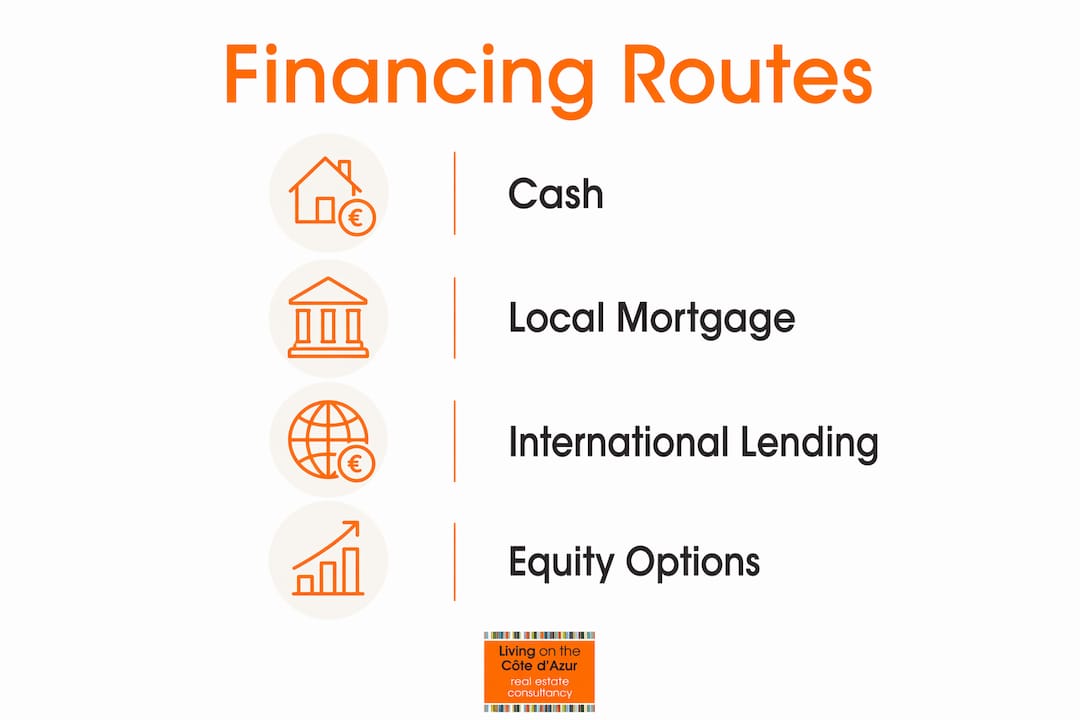
Four practical financing routes exist for buyers purchasing property abroad: cash, local mortgages, home-country international lending, and equity-based alternatives. Most buyers end up blending two or more of these depending on their residency status, liquidity, and the jurisdiction involved.

Cash purchase
Paying cash is the cleanest route. It removes lender approval timelines, eliminates currency-denominated debt, and often strengthens your negotiating position with a seller. The limitation is straightforward: it ties up capital that could otherwise remain invested or serve as a liquidity buffer. For high-value acquisitions in markets like Monaco or Saint-Tropez, even buyers with substantial wealth often prefer to retain liquidity rather than commit entirely to a single asset.
Local mortgages for non-residents
A local mortgage, obtained from a bank in the country where you are buying, is the most common route for buyers who want leverage. The challenge is that non-resident buyers face stricter conditions, including lower loan-to-value ratios and requirements to hold a local bank account. Eurozone regulators have tightened borrower-based measures controlling LTV and income multiples, which restricts credit access further for non-residents. French banks, for example, typically lend up to 70% of value to non-resident buyers, compared with 80–85% for residents.
Home-country international lending
Several private banks and specialist lenders offer cross-border mortgage facilities from your home country. Deutsche Bank Private Bank notes that cross-border lending solutions increasingly assess global income, assets, and tax position rather than local credit history alone. This approach suits buyers with complex income structures or multiple residencies. The facility is typically priced at a premium to a standard domestic mortgage, but the flexibility it offers is considerable.
Equity-based options
A Home Equity Line of Credit (HELOC) or a securities-backed lending facility allows buyers to borrow against existing assets rather than the overseas property itself. This sidesteps local lender restrictions entirely. The risk is that your existing assets serve as collateral, so a market downturn can trigger margin calls or reduce your available credit line at an inconvenient moment.
| Financing route | Best suited to | Key limitation |
|---|---|---|
| Cash | Buyers with high liquidity | Ties up capital |
| Local mortgage | Long-term residents or those with local ties | Lower LTV for non-residents |
| Home-country international lender | Complex income or multi-jurisdiction buyers | Premium pricing |
| HELOC or securities-backed | Buyers with significant existing assets | Collateral risk |
Pro Tip: Combine a home-country international facility for the bulk of the loan with a local bank account to satisfy residency requirements. This blended approach is common among buyers on the Côte d’Azur and gives you the best of both structures.
How to budget for acquisition costs beyond the property price
Acquisition costs are the most consistently underestimated element of buying property abroad. Redfin warns that many buyers underestimate acquisition overhead, which leads to financial shortfalls at the point of completion.
Extra costs typically add around 12–13% on top of the property price and must be budgeted before you approach a lender. That figure covers the following:
- Transfer taxes and stamp duty. In France, droits de mutation run to approximately 7–8% for existing properties. UK non-resident buyers face an additional 2% stamp duty surcharge on UK property purchases, with partial repayment possible only if residency status changes within 12 months.
- Notary fees. In France, the notaire charges approximately 1–1.5% of the purchase price for their professional fees, separate from the taxes they collect.
- Agent commissions. These vary by market and can reach 5–6% in some jurisdictions, though they are sometimes shared between buyer and seller.
- International transfer fees and FX costs. Wire transfer fees, correspondent bank charges, and the bid-offer spread on currency conversion add up quickly on large sums.
- Legal and due diligence fees. Independent legal advice, title searches, and structural surveys are non-negotiable for any serious buyer.
The practical implication is significant. On a €2,000,000 property, a 12% overhead adds €240,000 to your total outlay. That sum must be available in cash at or before completion, because mortgage lenders fund only the property price, not the associated costs. Budget for acquisition costs separately from your mortgage deposit, and hold those funds in a liquid, accessible account from the moment you make an offer.
Pro Tip: Ask your notaire or solicitor for a full cost breakdown before signing any preliminary contract. Surprises at this stage are avoidable with a single conversation.
Managing currency exchange and deposit handling
Foreign exchange risk is the silent variable in every international property purchase. The gap between the exchange rate at the time of your offer and the rate at completion can add or subtract tens of thousands of pounds from your effective purchase price.
Forward contracts allow you to lock in an exchange rate for a future payment date. Cambridge Currencies notes that forward contracts may require a margin deposit and can be structured around milestone payments over time. This is the most direct way to remove exchange rate uncertainty from your budget. Specialist FX providers such as Moneycorp and Currencies Direct offer forward contracts tailored to property transactions, typically with tighter spreads than high-street banks.
FX planning must align with your contract stages. The payment timetable for a typical overseas purchase looks like this:
- Reservation payment. A small initial deposit, often 1–2% of the price, paid within days of agreeing terms.
- Preliminary contract deposit. Typically 10% of the purchase price, due within 2–4 weeks of the reservation.
- Stage payments (for off-plan purchases). Multiple tranches over the construction period.
- Final completion balance. The remaining sum, due on the day of legal transfer.
Each stage requires a separate currency conversion or a pre-arranged forward contract tranche. Planning FX around these milestones, rather than converting everything at the last moment, is the approach recommended by specialist currency advisers.
Deposit handling carries equal weight. Deposits for overseas property must be paid into regulated escrow accounts, notary client accounts, or regulated trust accounts. Wiring funds directly to a seller’s personal account is both legally risky and, in many jurisdictions, non-compliant. In France, the notaire holds all deposits in a regulated client account until completion. In Spain, a bank guarantee or insurance policy must protect off-plan deposits by law.
Compliance with deposit handling rules is not optional. Funds wired to unregulated accounts can be frozen, lost to fraud, or rendered legally unenforceable. Always confirm the account type and regulatory status before transferring any sum.
Pro Tip: Use a dedicated FX provider rather than your high-street bank for all property-related transfers. The savings on a €1,000,000 transaction can be material, and the milestone-payment structure they offer fits the property purchase timetable precisely.
What special financing considerations exist for off-plan purchases?
Off-plan property, known in France as VEFA (Vente en l’État Futur d’Achèvement), presents a financing challenge that catches many buyers unprepared. The core issue is timing: mortgage funds are typically released only at completion, not during construction.
In Spain, for example, buyers must fund all pre-completion payments from their own equity. The payment schedule for a Spanish off-plan purchase typically follows this structure:
- Reservation fee. A fixed sum, often €6,000–€10,000, paid on signing the reservation agreement.
- Private purchase contract deposit. Typically 10% of the purchase price, paid within 30 days.
- Construction milestone payments. Multiple instalments of 10–20% each, triggered by build stages such as foundations, structure, and roof completion.
- Final completion payment. The remaining balance, paid at the escritura (notarial deed of sale), at which point the mortgage is drawn down.
The construction period for a new development typically runs 18–36 months. During that entire period, the buyer must fund stage payments from their own resources. This demands genuine liquidity planning, not just a mortgage approval in principle.
For buyers using a luxury off-plan investment strategy, bridge financing is one solution. A short-term bridging loan secured against existing assets can fund construction-stage payments until the mortgage draws down at completion. Securities-backed lending can serve the same purpose for buyers with investment portfolios. The key is to model the full cash flow from reservation to completion before committing, accounting for every stage payment date and the precise mortgage drawdown timing.
French VEFA purchases follow a similar staged payment structure, regulated by law, with the developer required to hold bank guarantees protecting buyer deposits. The new construction market on the Côte d’Azur has seen sustained demand, and understanding the VEFA payment schedule is a prerequisite for any buyer considering a prestige new-build in this market.
Key takeaways
Financing an overseas property purchase requires combining the right lending route with careful cost budgeting, FX planning, and liquidity management across the full acquisition timeline.
| Point | Details |
|---|---|
| Choose the right financing route | Cash, local mortgages, international lenders, and equity options each suit different buyer profiles. |
| Budget for acquisition costs | Extra costs of around 12–13% of the property price must be funded separately from the mortgage. |
| Manage currency risk early | Forward contracts aligned to payment milestones remove exchange rate uncertainty from your budget. |
| Use regulated deposit accounts | Always pay deposits into notary, escrow, or trust accounts to protect funds and ensure compliance. |
| Plan liquidity for off-plan purchases | Mortgage funds release only at completion; stage payments over 18–36 months must come from your own equity. |
What I have learned from financing property across borders
Ab Kuijer’s perspective
The most common mistake I see is treating the financing decision as separate from the tax and residency picture. Rightmove’s guidance is clear: financing and tax planning must be integrated, because the method you choose affects your tax position in both the country of purchase and your home jurisdiction. A buyer who takes a French mortgage may face different wealth tax implications than one who pays cash or borrows against a UK property. Getting that analysis wrong is expensive.
The second lesson is about liquidity. Buyers who arrive at the notaire’s office with a mortgage approval but insufficient cash for acquisition costs and stage payments face genuine legal and financial jeopardy. The 12–13% overhead figure is not a rough estimate. It is a floor. In prestige markets, legal complexity and specialist due diligence can push that figure higher.
Deutsche Bank’s framing resonates with me: view the loan as part of a global portfolio, not as a standalone transaction. High net worth buyers who treat their overseas property financing as one component of a broader asset structure consistently achieve better pricing, greater flexibility, and fewer surprises at completion. That posture requires early engagement with a private banker or specialist adviser, not a last-minute call to a local branch.
FX is the area where I see the most avoidable losses. Buyers who convert large sums at the spot rate on completion day are gambling with their budget. A forward contract costs very little relative to the protection it provides. Use one. Every time.
— Ab Kuijer
Financing expertise for prestige property on the Côte d’Azur
Livingonthecotedazur works with buyers navigating the full complexity of international property financing, from structuring the initial offer to coordinating with notaires, private banks, and FX specialists at every stage. Our network spans over 100,000 properties across the Côte d’Azur, including curated opportunities in Saint-Tropez, Cannes, and Monaco, many of which never reach the open market. For buyers seeking a clear path through luxury real estate financing, we provide personalised guidance on mortgage structuring, tax optimisation, and acquisition cost planning. Speak with our team to receive a financing overview tailored to your specific acquisition profile and investment objectives.
FAQ
What are the main ways to finance overseas property?
The four principal routes are cash payment, a local mortgage in the country of purchase, a home-country international lending facility, and equity-based borrowing such as a HELOC or securities-backed loan. Most buyers blend two of these routes to balance cost, flexibility, and liquidity.
How much extra should I budget beyond the property price?
Acquisition costs typically add around 12–13% on top of the purchase price, covering transfer taxes, notary fees, agent commissions, and legal costs. These sums must be available in cash and cannot be included in a mortgage.
How do forward contracts protect overseas property buyers?
A forward contract locks in an exchange rate for a future payment date, removing the risk that currency movements will increase your effective purchase cost between offer and completion. Specialist providers such as Moneycorp and Currencies Direct structure these around property payment milestones.
Can I get a mortgage as a non-resident buyer?
Yes, but non-resident buyers face stricter lending conditions, including lower loan-to-value ratios and requirements for local bank accounts in many jurisdictions. International private banks increasingly offer cross-border facilities that assess global income and assets rather than local credit history alone.
How does off-plan financing differ from a standard purchase?
With an off-plan purchase, mortgage funds are released only at completion, meaning all stage payments during the construction period of 18–36 months must be funded from the buyer’s own equity or a bridging facility. Planning this cash flow in advance is non-negotiable.
Recommended
 //
//