
New-build housing on the French Riviera is structurally scarce because national land-use policy and stringent coastal protections make greenfield development effectively impossible in many prime communes. The Zéro Artificialisation Nette framework, the Loi Littoral, and Architectes des Bâtiments de France oversight all push development toward renovation and dense infill rather than new construction. Buyers should expect a market where off-market deals, refurbishment projects, and small-scale redevelopment near transport hubs matter more than any new-build listing.
TL;DR:
- Strict environmental and coastal protection laws ensure most new construction occurs only in small, carefully planned redevelopment projects rather than on greenfield sites.
- The timeline and approval process for Riviera building permits are lengthy and complex, often involving multiple reviews from environmental, heritage, and planning authorities.
- Most real estate demand on the Riviera is met through renovation, refurbishment, or off-market deals, as new-build projects are limited and highly localized.
- Local planning policies are becoming increasingly restrictive, and the future of new coastal construction looks unlikely to improve given climate, biodiversity, and land-use commitments.
- Buyers should focus on off-market opportunities, detailed due diligence, and working with experienced agents familiar with local planning constraints.
Table of Contents
- Why new-build property on the French Riviera is structurally scarce
- Geography leaves almost nowhere left to build
- How long does a Riviera building permit actually take?
- Demand outpaces supply, so the market moves off-market
- Why developers avoid large coastal new-build projects
- What this means if you are house-hunting on the Riviera
- A buyer agent’s view from inside the planning system
- How new-build development on the Riviera has changed over decades
- Biodiversity and coastal erosion rules add another layer
- Do local councils encourage or block new construction?
- How does the Riviera compare with other Mediterranean coasts?
- What could change scarcity in the years ahead?
- Scarcity as strategy, not accident
- How Living On The Cote d’Azur finds scarce opportunities for buyers
- Sources
- FAQ
Why new-build property on the French Riviera is structurally scarce
The scarcity is not an accident of the market cycle. It is written into French planning law, and it has been building for years. The single biggest lever is the national Zéro Artificialisation Nette (ZAN) policy, which obliges municipalities to halve the pace at which natural, agricultural, and forest land is converted into buildings by 2031, working towards zero net land take by 2050. That target now has to be threaded through every commune’s local planning documents, the Plan Local d’Urbanisme (PLU) and the Schéma de Cohérence Territoriale (SCoT), with deadlines running between 2024 and 2028.
Layer the Loi Littoral on top and greenfield building along the coast becomes even harder. This 1986 law restricts construction within sight of the shoreline and effectively bans new development in a protected buffer zone along much of the coast. Add the Architectes des Bâtiments de France (ABF), whose sign-off is required near listed heritage sites and in protected townscapes common across Nice’s old town, Antibes, and Saint-Tropez, and you have three separate regulatory filters that a project must clear before a single foundation gets poured.
- ZAN pushes planners towards reusing existing built land rather than opening new plots.
- Loi Littoral removes large stretches of coastline from development consideration entirely.
- ABF review can add months, sometimes years, to a permit process, and often forces material or design changes.
Pro Tip: A refused or heavily modified permit rarely makes headlines, but ask any local architect and they will tell you it happens constantly along this coast — check ABF sensitivity on any plot before you fall in love with it.
The practical result is exactly what ZAN guidance recommends: reuse, densification, and renaturation instead of new artificialised land. A developer who might once have bought a hillside plot in Mougins now has to hunt for a brownfield site or an ageing apartment block to demolish and rebuild within the same footprint.
Geography leaves almost nowhere left to build
The Riviera’s coastline is narrow, and much of it climbs steeply within a kilometre or two of the water. That geography alone limits how much land could ever be built on, long before any planning law gets involved. Add the protected categories that remove land from the developable stock entirely, and the shortlist of viable parcels gets very short indeed.
- ENAF (Espaces Naturels, Agricoles et Forestiers) zones, protected under the ZAN framework.
- Natura 2000 biodiversity sites, which cover significant stretches of coastal and hillside terrain.
- Site classé designations, protecting specific landscapes and viewpoints from any alteration.
- PPRI flood-risk zones along river valleys and low-lying coastal strips, where insurers and municipalities alike restrict new building.
Where new construction does still happen, it clusters around a handful of redevelopment pockets and transport corridors: the Grand Arénas district near Nice’s airport, the Nice Méridia innovation quarter, and infill schemes around La Bocca in Cannes. These are the exceptions that prove the rule, urban renewal projects on already-built land, not new villas carved out of hillside.
How long does a Riviera building permit actually take?
A permis de construire on the Côte d’Azur rarely moves quickly, and buyers who assume otherwise tend to get an unpleasant surprise. The process usually runs through several layers of technical and administrative review before a shovel goes into the ground.
Pre-application consultation with the local mairie, often informal but essential for gauging ABF and PLU sensitivities early.
2. Environmental and hydrological studies, including flood-risk (PPRI) and ecological impact assessments where the site sits near a protected zone.
3. Servitudes research, checking easements, rights of way, and any third-party restrictions attached to the land.
4. ABF consultation where the site falls within a protected perimeter, frequently requiring design revisions.
5. Municipal planning commission review, which can loop back for clarifications before final approval.
One detail catches even experienced developers off guard: ZAN accounting treats the start of physical works, not the date of permit approval, as the moment land becomes artificialised. That timing rule means phased projects inside a Zone d’Aménagement Concerté (ZAC) can get tactically sequenced, but only with careful legal advice, since getting the phasing wrong can trigger compensation obligations that erode a project’s economics.
Pro Tip: Ask any seller claiming a plot is “shovel ready” for the actual permit file. A signed permis de construire with no pending ABF or environmental appeal is worth far more than a verbal assurance.
Demand outpaces supply, so the market moves off-market
International demand for Riviera property has not slowed the way new-build supply has. Buyers increasingly want turnkey homes with contemporary finishes, and market analysts at Barclays Private Bank describe a clear shift toward high-spec renovation and boutique new projects because volume simply cannot keep pace with what buyers are asking for.
That mismatch pushes the market in two directions at once.
- Well-located renovation projects command a real premium, since buyers pay for scarcity of position, not just square metres.
- A meaningful share of ultra-prime transactions never reach public portals at all, moving instead through private introductions and agent networks.
Market snapshots suggest new builds account for only a modest slice of listings in the most searched coastal areas, concentrated in specific pockets such as Nice-Ouest, Grand Arénas, and Cagnes-sur-Mer rather than spread evenly across the coast. A rare flagship launch, like an architect-led beachfront residence, adds prestige and a handful of units, not meaningful volume, to the overall stock.
Why developers avoid large coastal new-build projects
Land acquisition cost is the first constraint, and it is a steep one on a coastline where every square metre is contested. Layer in compensation and mitigation obligations tied to ZAN’s environmental accounting, plus the technical complexity of building on sloped, protected, or flood-sensitive terrain, and a developer’s margin narrows fast before construction even starts.
- Land cost per buildable square metre on prime coastal communes rivals anywhere in France.
- Ecological compensation requirements add real cost and timeline risk to any greenfield-adjacent site.
- ABF compliance frequently demands premium materials and bespoke design solutions, adding to build cost.
- Financing partners price in permit-refusal risk, which discourages speculative building on unproven plots.
Density bonuses and ZAC phasing exist as policy tools to soften these constraints, but they work best on larger urban-infill sites, not the small coastal plots that dominate the Riviera’s remaining developable land. For a boutique scheme of six or eight units in Villefranche-sur-Mer or Cap d’Antibes, the maths rarely stretches far enough to justify the risk, which is why so many developers pivot toward renovation and rebuild-in-place instead of new footprint.
What this means if you are house-hunting on the Riviera
Expect most genuine new-build opportunities to be small: boutique developments, urban infill, or redevelopment near transport nodes rather than sprawling estates. Renovation and off-market access will do more work for you than scrolling new-build listings ever will.
- Check the PLU and any servitudes attached to a plot before making an offer, not after.
- Get an ABF preliminary read where the property sits near a protected zone or heritage perimeter.
- Confirm PPRI flood-risk status, particularly for anything near a valley floor or low coastal strip.
- Ask how ZAN’s start-of-works accounting affects the specific project timeline you are buying into.
- Build realistic contingency budget and time allowances into any renovation or rebuild plan.
Pro Tip: Widen your geographic search before you widen your budget. A renovation project fifteen minutes further from the seafront often delivers better value than chasing a rare new-build listing in the most saturated postcode.
Architectural due diligence before the offer is the single habit that separates a smooth purchase from a stalled one. Working with a buyer agent who understands local planning constraints tends to open doors that a general property search never finds.
A buyer agent’s view from inside the planning system
Ab Kuijer at Living On The Cote d’Azur has watched enough Riviera transactions to know that scarcity is not a marketing line, it is a planning reality that shapes every search. Buyer representation matters most before an offer is signed: verifying PLU status, negotiating conditional demolition or rebuild clauses, and sourcing redevelopment leads that never reach public listings. Access to off-market opportunities and new developments through a wide agent and developer network changes what is realistically available to an international buyer.
How new-build development on the Riviera has changed over decades
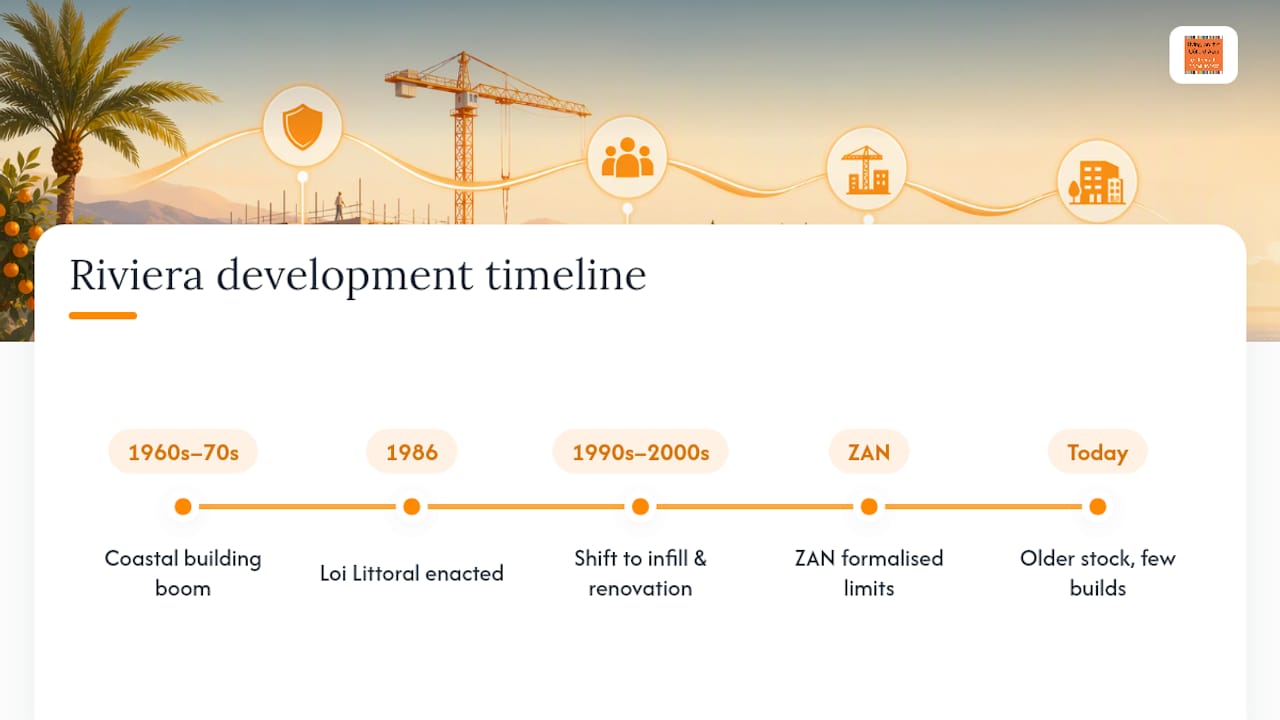
The Côte d’Azur was not always this constrained. Through the 1960s and 1970s, coastal building boomed, and stretches of the shoreline that would be untouchable under today’s rules were developed with relatively little friction. That era produced much of the mid-century apartment stock now sought after for renovation in Nice, Cannes, and Juan-les-Pins.
The Loi Littoral arrived in 1986 as a direct response to concerns that unchecked coastal building was eroding both landscape and public access to the shore. From that point, new greenfield permits along the water became progressively harder to secure, and municipalities began steering growth inland or into already urbanised zones. The 1990s and 2000s saw a shift toward higher-density infill and renovation of the existing housing stock rather than expansion of the built footprint.
ZAN, introduced through the Climate and Resilience Law, formalised what had already been happening piecemeal for two decades: a national commitment to stop net land conversion altogether by the middle of this century. What changed is not the direction of travel, but the pace and legal weight behind it. Communes now face binding 2031 targets rather than voluntary restraint, and every PLU revision has to show its working on land consumption.
For a buyer, this history explains a pattern that otherwise looks odd: the Riviera has plenty of older housing stock, much of it desirable, but comparatively little that was built in the last decade. That is not a gap in the market waiting to be filled. It is the deliberate outcome of forty years of tightening coastal policy.
Biodiversity and coastal erosion rules add another layer
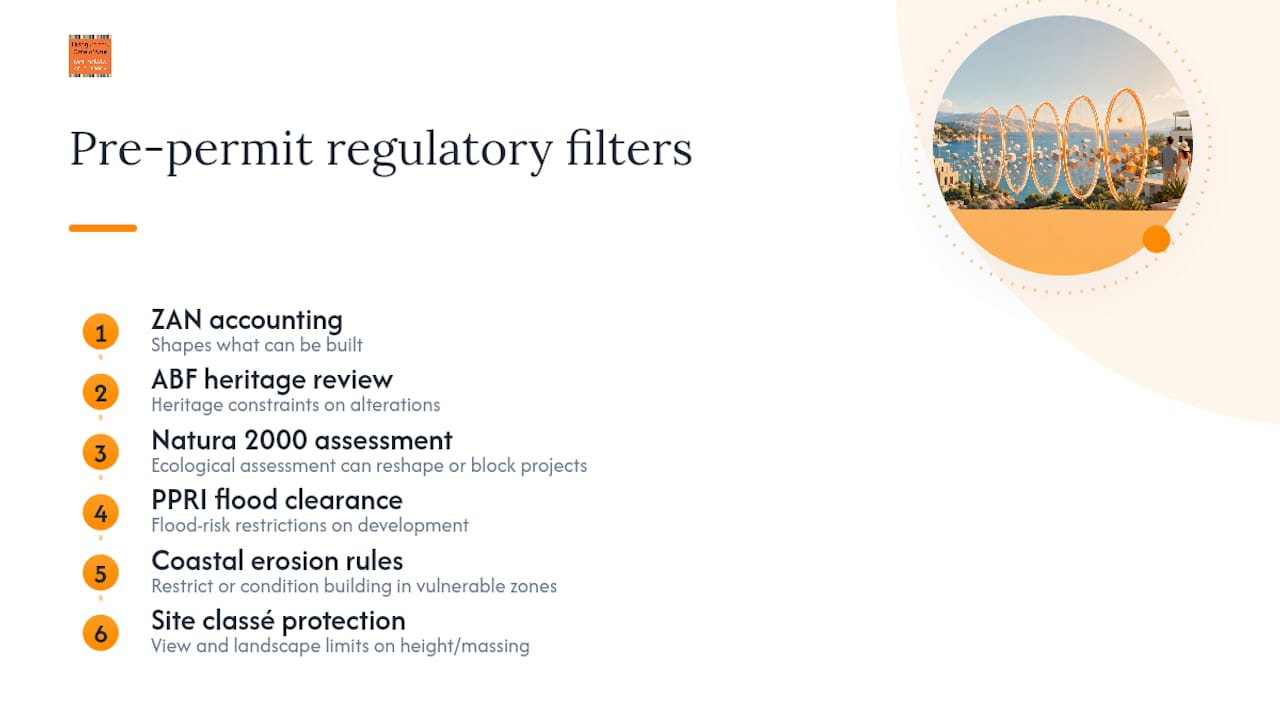
ZAN gets most of the attention, but it is far from the only environmental constraint shaping what can be built. Natura 2000 designations protect specific habitats along the coast and in the hinterland, and any project near one triggers an ecological impact assessment that can reshape or block a scheme regardless of ZAN status.
Coastal erosion is a growing concern in its own right. Municipalities along exposed stretches of shoreline increasingly factor erosion projections into their planning documents, restricting or conditioning new building in zones expected to be vulnerable within a few decades. This sits alongside, rather than replaces, flood-risk PPRI restrictions, and the two can overlap on the same parcel.
Site classé protections add a further filter, safeguarding specific landscapes and viewpoints considered part of the region’s heritage. A plot with a protected view corridor can face height or massing restrictions that have nothing to do with ZAN or flood risk, but that are just as binding.
The cumulative effect is a planning environment where a single project might need to clear ZAN accounting, ABF heritage review, Natura 2000 ecological assessment, PPRI flood clearance, and site classé landscape protection, all before the ordinary permis de construire process even begins. Each layer exists for a distinct policy reason—biodiversity, coastal resilience, heritage, safety—but together they compound into a planning environment that strongly favours working with existing buildings over creating new footprint.
Do local councils encourage or block new construction?
Municipal attitudes vary more than buyers often expect. Some communes, particularly those with ambitious economic development goals, actively court redevelopment through mechanisms like ZAC phasing, using density bonuses to make urban-infill schemes financially viable near transport hubs such as Nice’s Grand Arénas.
Other communes, especially smaller, heritage-conscious towns along the coast, take a far more restrictive posture. Saint-Tropez and Villefranche-sur-Mer, for instance, place a premium on preserving townscape character, and their PLUs reflect that priority through tight height limits, strict material rules, and heavy reliance on ABF sign-off for anything visible from public space.
This creates a genuinely uneven map. A project that sails through planning in a redevelopment-friendly zone near Nice might face years of iteration in a heritage-protective commune twenty minutes down the coast. Density bonuses and incentive schemes exist nationally, but their practical effect depends heavily on local political appetite for growth versus preservation, and that appetite differs commune by commune in ways a generic planning guide will never capture.
For a buyer, the lesson is not to assume any commune’s approach based on its neighbour. Checking a specific commune’s current PLU priorities, ideally through Service-public or the local mairie directly, tells you far more than general assumptions about Riviera-wide policy.
How does the Riviera compare with other Mediterranean coasts?
The French Riviera’s scarcity is more acute than many buyers assume when they compare it, even loosely, with other Mediterranean coastal markets. Spain’s Costa del Sol and parts of Italy’s Ligurian coast have their own planning restrictions, but neither operates under a national land-take target as binding as ZAN, and coastal protection regimes elsewhere tend to be regional rather than backed by a nationwide 2050 net-zero deadline.
Within France itself, the Riviera stands out even against other protected coastlines. Brittany and the Atlantic coast also fall under Loi Littoral, but they have considerably more available land inland from the shoreline, softening the practical bite of the restriction. The Riviera’s narrow coastal shelf, hemmed in by the Alpes-Maritimes foothills, leaves far less room for that kind of inland flexibility.
The result is a market where genuinely new coastal construction is rarer, proportionally, than in most comparable Mediterranean destinations, French or otherwise. That scarcity is precisely why renovation, redevelopment, and off-market access matter so much more here than in markets with looser land constraints. It is also a big part of why long-term value on this coast has proven resilient. There is simply no realistic mechanism for a wave of new supply to arrive and dilute it.
What could change scarcity in the years ahead?
ZAN’s intermediate targets tighten further as 2031 approaches, and most planning observers expect implementation to get stricter, not looser, as municipalities work to hit binding halving-of-consumption goals. That points toward continued pressure on greenfield permits rather than any relaxation.
Demographic trends add another layer. Continued international demand, alongside domestic relocation toward the South of France, keeps pressure on existing stock even as new supply stays constrained. Nothing in current policy suggests that demand pressure easing anytime soon.
Where change is more likely is at the margins: redevelopment pockets near transport corridors, Grand Arénas, Nice Méridia, and similar urban-renewal zones, could see incremental additions as ZAC-phased projects complete over the coming years. These will not resemble the greenfield villa developments of past decades. They will be denser, urban, and concentrated in specific nodes rather than spread along the coast.
The realistic planning horizon for most buyers is this: scarcity is not a temporary market condition waiting for a policy reversal. It is the settled direction of French coastal planning, reinforced by climate and biodiversity goals that enjoy broad political support. Buyers who plan around that reality, rather than waiting for a supply surge that is not coming, tend to make better decisions.
Scarcity as strategy, not accident
The Riviera’s scarcity is not a flaw in the market, it is the policy working as intended, and that is precisely what protects long-term value here. Buyers who respect these planning constraints, rather than fight them, and who access off-market stock through experienced representation tend to do far better than those chasing a new-build listing that may never exist in their target commune.
— Ab Kuijer
How Living On The Cote d’Azur finds scarce opportunities for buyers
Chasing new-build listings on your own means competing for a genuinely thin slice of the market, often the same handful of developments every other international buyer has already found. An independent buyer agent searches the entire market, including off-market stock and developer relationships that never reach public portals, rather than representing a fixed set of listings, often leveraging specialized Real Estate SEO Services to capture the best leads and opportunities.
That matters most exactly where this article has focused, because so much of the Riviera’s realistic new-build and redevelopment opportunity sits outside conventional search. Services often cover planning and architectural due diligence, negotiation, and transaction coordination through to the notaire, drawing on networks covering extensive property selections in the French Riviera region.
If scarcity is shaping your search, the practical next step is a conversation, not another afternoon scrolling listings. Start with a search mandate to define what you are actually looking for, or reach out directly through the contact page to discuss your situation.
Sources
For primary policy detail, see the Ministère de la Transition écologique’s ZAN framework. For buying guidance, see purchasing new construction on the Côte d’Azur and renovation and rebuilding support.
- Ministère de la Transition écologique — Zéro Artificialisation Nette (ZAN)
- Barclays Private Bank — French Riviera property: new shine, old allure (Sept 2025)
- PCD group — What families relocating to the French Riviera need to know (May 2026)
FAQ
Is it wise to buy property on the French Riviera now?
Property here has historically held value well because supply is structurally constrained rather than cyclical, which limits the risk of a sudden oversupply eroding prices. Timing still depends on your specific goals, budget, and whether you are prepared to consider renovation or off-market routes rather than waiting for new-build stock that may not appear in your target area.
Why does new-build housing on the Riviera often disappoint on quality?
Where new-build schemes do get approved, developers face such tight margins from land cost, compensation obligations, and ABF compliance that some cut corners on finishes or materials to protect profitability. This is one reason buyers increasingly favour high-spec renovation over unproven new developments, since a well-executed renovation can offer more reliable quality control.
Why do cheap châteaux sometimes appear for sale in France?
Large historic properties inland, particularly outside the Riviera’s core coastal zones, can carry high renovation and maintenance costs that suppress their sale price relative to size. This dynamic is largely separate from Riviera coastal scarcity, though it reflects a similar principle: French property values track land constraints, location desirability, and renovation burden far more than raw square footage.
Are French house prices falling on the Riviera?
Broad national price trends do not apply evenly to the Riviera’s prime coastal communes, where structural scarcity has historically supported values even during softer national cycles. Renovation-ready and well-located properties in particular tend to hold demand, though any specific commune’s pricing should be checked against current local market data rather than national averages.
Where should I actually look for new-build opportunities on the Riviera?
Realistic new-build supply concentrates in specific redevelopment pockets such as Grand Arénas, Nice Méridia, and infill zones around Cagnes-sur-Mer and La Bocca, rather than being spread along the coast. A buyer agent with local planning knowledge can also surface off-market redevelopment leads that never reach public listings.
Recommended
 //
//