
TL;DR:
- A private treaty sale involves direct negotiation between seller and buyer without a public auction. It allows for confidential, flexible, and bespoke transactions, especially suited for luxury and unique properties. Buyers should understand the process, negotiate with certainty, and avoid common misconceptions to secure the best deal.
A private treaty sale is a real estate transaction in which the seller sets an asking price and negotiates terms directly with prospective buyers, without a public auction. This method is the standard approach for most residential property sales across the United Kingdom, France, and much of Europe, and it carries particular weight in the luxury market. For buyers considering prestige properties on the Côte d’Azur, in Monaco, or across Saint-Tropez, understanding the private treaty sale definition is the first step towards negotiating with confidence. The process rewards preparation, discretion, and the right professional guidance.
What is a private treaty sale and how does it work?
A private treaty sale is defined as a method where the seller lists a property at a guide price and invites offers from buyers, who negotiate directly or through agents. Unlike an auction, there is no public bidding room, no hammer price, and no fixed deadline. The seller retains full control over which offer to accept, and the buyer retains the right to negotiate terms before any contract becomes legally binding.
The process typically follows six clear stages.
Listing at a guide price. The seller, usually with an estate agent, sets an asking price that signals where negotiations begin. This figure is not a ceiling. Sellers are not obligated to accept the first or highest bid, and buyers who understand this hold a genuine advantage.
Targeted marketing. In luxury markets, properties are often presented to a curated pool of qualified buyers rather than broadcast publicly. This protects the seller’s privacy and preserves the asset’s exclusivity.
Offer submission and negotiation. Buyers submit offers, often in writing, and a period of negotiation follows. At this stage, offers are not legally binding. Before contract exchange, sellers may engage with multiple buyers simultaneously unless a formal exclusivity agreement is in place.
Initial deposit. Once a price is agreed in principle, a holding deposit is typically paid. Standard practice includes an initial deposit of around 0.25% at the offer stage, with a further 10% paid at contract exchange. In some jurisdictions, earnest money deposits range from 1%–3% of the purchase price, held in escrow to signal commitment during due diligence.
Contract exchange. This is the moment the transaction becomes legally binding for both parties. Buyers should have completed their legal checks, financing arrangements, and any agreed inspections before this point.
Settlement. The period between exchange and completion is negotiable. Settlement periods are often around 42 days, though luxury transactions frequently require longer timelines to accommodate international financing or legal structures such as an SCI in France.
Pro Tip: Request a formal exclusivity agreement in writing before you commit to due diligence costs. Without one, the seller is free to accept another offer while you are still conducting surveys and legal checks.
What are the advantages of buying luxury properties through private treaty?
Private treaty sales offer high confidentiality and seller control, making them particularly well suited to unique and luxury assets where public auction exposure may undervalue the property or attract unwanted attention. For high-net-worth buyers, this method is not simply a preference. It is often the only appropriate vehicle for acquiring a truly exceptional home.
The core advantages for luxury buyers include:
Confidentiality. Private treaty sales protect high-value assets from speculative bidding and public exposure. A discreet transaction preserves both the seller’s privacy and the buyer’s anonymity, which matters greatly when the purchase price runs into tens of millions of euros.
Negotiation control. Buyers can table offers based on independent valuations, request price reductions after surveys, and negotiate terms that reflect the true condition of the property. This is not possible in an auction room.
Bespoke contract terms. The lack of a fixed deadline enables bespoke payment schedules and contingencies that auctions cannot accommodate. A buyer financing through a Swiss private bank, for instance, may need 90 days to complete. Private treaty allows for that.
Due diligence conditions. Buyers can include inspection clauses, financing conditions, and legal audit requirements within the offer. These contingencies protect the buyer’s position before exchange.
Avoidance of auction pressure. Competitive bidding creates emotional decisions. Private treaty removes the adrenaline of the auction room and replaces it with measured, informed negotiation.
Access to off-market stock. Many of the finest properties on the Côte d’Azur never appear on public portals. They circulate privately among trusted agents and their clients. Understanding private listings advantages is therefore central to accessing the best of what the market holds.
Pro Tip: Commission an independent valuation before submitting any offer. The asking price is a starting point, not a fixed value. A well-researched offer grounded in comparable sales carries far more weight than a speculative bid.
How does a private treaty sale differ from an auction?

The distinction between private treaty and auction is not merely procedural. It reflects a fundamentally different balance of power between buyer and seller, and a different philosophy about how value is determined.
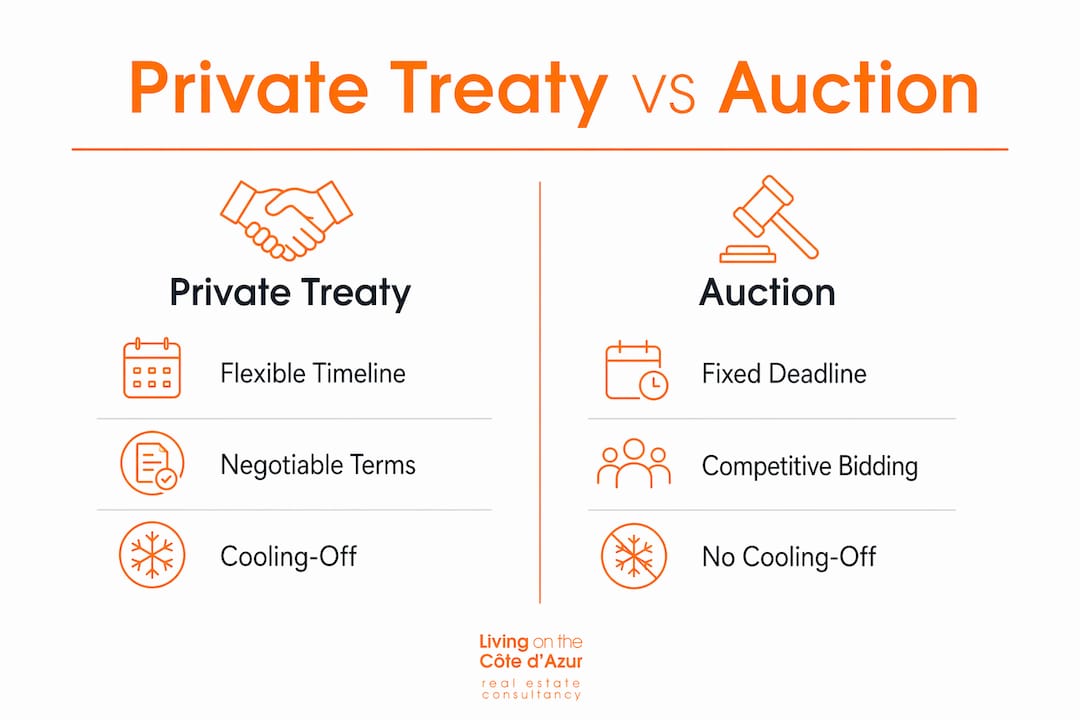
| Feature | Private treaty | Auction |
|---|---|---|
| Deadline | No fixed end date | Fixed date and time |
| Bidding | Private negotiation | Public competitive bidding |
| Legally binding moment | Contract exchange | Fall of the hammer |
| Cooling-off period | Often available for residential sales | Rarely available |
| Deposit at binding moment | Typically 10% at exchange | Typically 10% immediately |
| Contingencies | Negotiable before exchange | Not permitted after hammer falls |
| Privacy | High | Low |
| Suited to | Unique, luxury, or complex assets | High-demand, standardised properties |
The most consequential difference is the cooling-off period. Residential private treaty sales often include a cooling-off period allowing buyers to withdraw within three business days, subject to a penalty of £100 or 0.2% of the purchase price, whichever is higher. At auction, no such protection exists once the hammer falls. That asymmetry makes private treaty considerably safer for buyers who need time to finalise financing or legal structures.
Auctions suit standardised properties with broad buyer appeal, where competitive tension drives the price upward. Private treaty suits properties that are genuinely unique, where value is subjective and the right buyer may take time to identify. A Belle Époque villa above Cannes or a penthouse overlooking Monaco Harbour is not a commodity. It deserves a sale method that reflects its singular character.
The negotiation flexibility in private treaty also enables buyers and sellers to customise payment and contingency terms to fit complex requirements that auctions simply cannot accommodate. For buyers with international assets, trust structures, or multi-currency financing, this flexibility is not a luxury. It is a necessity.
What are common misconceptions buyers should avoid?
Private treaty sales carry several persistent misconceptions that cost buyers money, time, and occasionally the property itself. Knowing where others go wrong is as valuable as knowing the process.
The asking price is fixed. The advertised price is a starting point for negotiation. Buyers should undertake their own valuations to make competitive offers grounded in evidence. Accepting the asking price without question leaves money on the table. Equally, a low-ball offer without supporting data will simply be dismissed.
The highest offer always wins. In private treaty sales, the highest financial offer is not always the most attractive to sellers. Offers free of financing or inspection contingencies, with immediate deposits, often outweigh higher conditional bids. A seller who has lived in a property for decades may also place weight on the buyer’s intentions for the home.
Offers are binding before exchange. Before contract exchange, no offer is legally binding. This protects buyers, but it also means the seller can accept a better offer at any point. Buyers who assume they have secured a property before exchange are exposed. Negotiate a formal exclusivity agreement to close that gap.
Cooling-off periods are automatic. Cooling-off periods are not universal and may be waived. They are commonly excluded in competitive market transactions or commercial sales. Assuming automatic cooling-off rights can be a costly mistake if not verified contractually. Always confirm the applicable terms with your legal adviser before exchange.
The agent represents your interests. The listing agent acts for the seller. Their duty is to achieve the best outcome for their client, not for you. Engaging a specialist buyer agent who works exclusively on your behalf changes the dynamic entirely. In the luxury market, this distinction is not a detail. It is the difference between a well-negotiated acquisition and an overpaid one.
A further subtlety worth noting: sellers in the luxury segment often receive a free home valuation from independent advisers before listing. Buyers who arrive with their own valuation data are taken more seriously and negotiate from a position of genuine authority.
Key takeaways
Private treaty sales give luxury buyers the privacy, flexibility, and negotiation control that auctions cannot offer, making them the preferred method for acquiring exceptional properties in exclusive markets.
| Point | Details |
|---|---|
| Definition is clear | A private treaty sale is a negotiated transaction where the seller sets a guide price and buyers submit offers privately. |
| Offers are not binding early | No offer is legally binding until contract exchange; secure a formal exclusivity agreement to protect your position. |
| Asking price is a starting point | Independent valuation before submitting an offer gives buyers a factual basis for negotiation and greater credibility. |
| Cooling-off rights vary | Cooling-off periods may be waived or inapplicable; always verify the terms with a legal adviser before exchange. |
| Clean offers win | Sellers often prefer offers free of contingencies over higher conditional bids, favouring cash buyers or those pre-approved for financing. |
Why private treaty is the natural home for luxury real estate
Ab Kuijer’s perspective
Having worked with buyers across the Côte d’Azur for many years, I have seen the private treaty process at its finest and at its most frustrating. The finest moments come when a buyer arrives prepared: they know the comparable sales, they have their financing confirmed, and they understand that the asking price is an invitation to a conversation, not a take-it-or-leave-it proposition.
The frustrating moments almost always trace back to the same misunderstanding. A buyer falls in love with a property, assumes their offer is secure because the agent said “the seller is very interested,” and then discovers three weeks later that another buyer exchanged contracts while they were still arranging their survey. That scenario is entirely avoidable. A written exclusivity agreement, even for a short period, costs nothing to request and protects everything.
What I find most compelling about private treaty in the luxury segment is the space it creates for genuine dialogue. A seller of a historic mas in Provence or a waterfront villa in Antibes is not simply selling square metres. They are handing over something they have cared for, often for decades. Private treaty allows that conversation to happen with dignity and discretion, on both sides.
My practical advice: engage a buyer’s agent before you fall in love with a property, not after. The off-market property advantages available to buyers with the right connections are substantial. The finest properties rarely appear on public portals. They are presented quietly, to the right people, at the right moment. Being one of those people requires preparation, relationships, and a clear understanding of how private treaty actually works.
— Ab Kuijer
Exclusive properties, curated for discerning buyers
At Livingonthecotedazur, we work with buyers who understand that the most exceptional properties are rarely found through a public search. Our access to invisible luxury real estate on the Côte d’Azur means our clients see properties before they reach the open market, and often before they are formally listed at all. We handle the full process with discretion: from initial identification and independent legal audit through to negotiation, tax structuring, and settlement. If you are ready to acquire a property of genuine distinction, we would welcome a private conversation about what is currently available.
FAQ
What is the private treaty sale definition in simple terms?
A private treaty sale is a property transaction where the seller sets a guide price and negotiates directly with buyers, without a public auction. The sale is agreed privately between the two parties, usually through an agent.
How does private treaty work when making an offer?
A buyer submits a written offer, which the seller may accept, reject, or counter-negotiate. No offer is legally binding until both parties exchange signed contracts, at which point a deposit of typically 10% is paid.
What are the main advantages of private treaty sale for luxury buyers?
The main advantages include confidentiality, flexible contract terms, the ability to include due diligence conditions, and access to off-market properties that never appear on public portals.
How does private treaty vs auction differ for the buyer?
Private treaty gives buyers time to negotiate, conduct surveys, and arrange financing before any legally binding commitment. At auction, the contract is binding the moment the hammer falls, with no cooling-off period and no contingencies permitted.
When should a buyer use a private treaty sale rather than an auction?
Private treaty is the preferred method for unique, luxury, or complex assets where value is subjective and the buyer needs time to complete due diligence, arrange international financing, or negotiate bespoke contract terms.
Recommended
 //
//