
TL;DR:
- New construction on the French Riviera offers lower long-term costs, modern design, and structural warranties unavailable in resale properties. It provides affluent buyers with energy efficiency, smart-home features, and legal protections that reduce financial risks. Careful vetting of developers and understanding purchase procedures are vital for success in off-plan investments.
For UK buyers seeking a luxury second home or investment on the French Riviera, new construction is, in most cases, the stronger choice. A verified build baseline, guaranteed by the garantie décennale (France’s mandatory 10-year structural warranty), combined with RE2020 energy performance compliance and predictable running costs, gives discerning buyers a financial and lifestyle edge that a resale villa rarely matches.
The verdict at a glance:
- Financial case: 10-year total cost of ownership modelling shows new-build buyers save an average of $25,335 over a decade versus buyers of 20-year-old homes, through lower utilities and fewer major system replacements.
- Lifestyle case: Modern open-plan layouts, integrated smart-home systems, and seamless indoor–outdoor terraces are the design standard in new Riviera developments — and prohibitively expensive to retrofit into a historic Provençal villa.
- Risk caveat: Construction delays and developer solvency are real risks; the protections you negotiate before signing matter as much as the property itself.
Table of Contents
- Why wealthy buyers choose new construction on the Côte d’Azur
- New vs resale: what the total cost of ownership actually shows
- What UK buyers must know before purchasing a new build in France
- How to evaluate a developer and new development on the Riviera
- Disadvantages and real risks of buying new construction on the Riviera
- Timeline and additional costs from reservation to handover
- Living On The Cote d’Azur: your partner for new construction on the Riviera
- Key takeaways
- Why we recommend new construction to many of our clients
- Official sources and further reading
- FAQ
Why wealthy buyers choose new construction on the Côte d’Azur
The financial argument begins with total cost of ownership, not the asking price. New construction expands your effective budget because lower operating costs allow you to afford a higher-quality property than a resale budget would permit — a point made explicitly by Realtor.com senior economist Joel Berner. On the Riviera, where energy prices are elevated and older stone villas carry ageing HVAC, plumbing, and electrical infrastructure, that gap widens further.
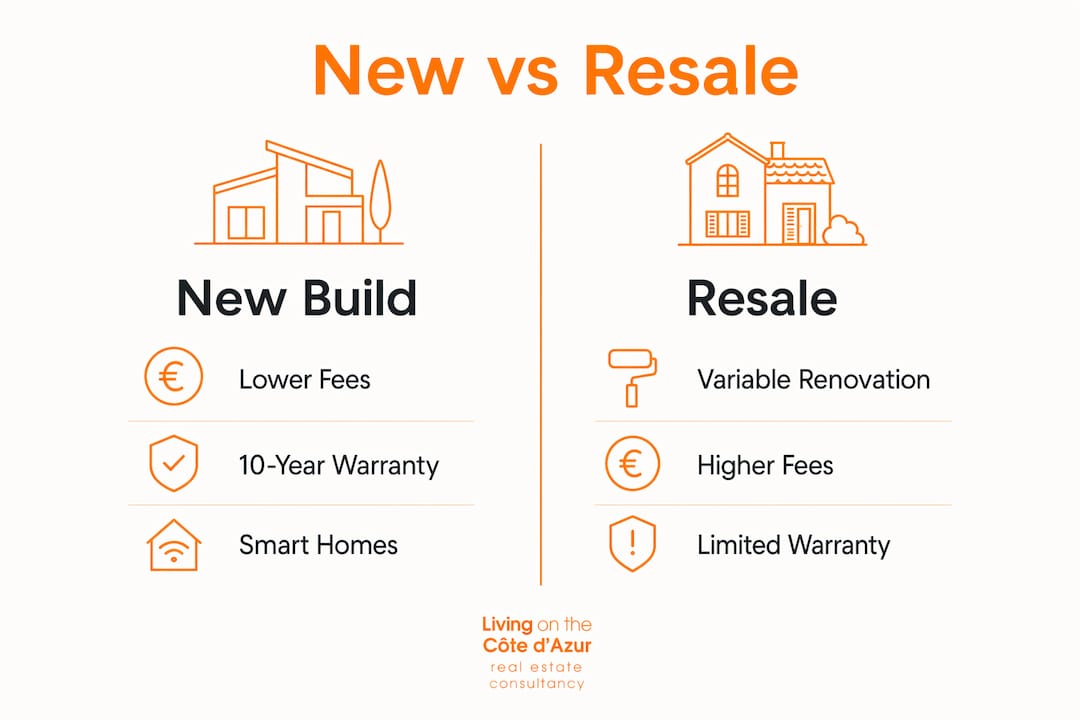
Beyond the numbers, new builds on the French Riviera are designed around the way affluent international buyers actually live: generous terraces that dissolve the boundary between salon and garden, floor-to-ceiling glazing that frames the Mediterranean light, and primary suites with dressing rooms and spa bathrooms that older properties simply were not built to accommodate. Retrofitting these features into a 1970s villa above Cannes typically costs more than the premium between resale and new-build pricing.
Integrated smart-home and security systems are another decisive advantage. Historic stone construction blocks wireless signals and complicates cable routing; a new build is wired for automation, security, and concierge connectivity from the ground up. Add lower insurance premiums — modern electrical and fire-safety standards reduce insurer risk materially — and the running-cost case becomes compelling.
The garantie décennale provides 10 years of structural coverage from the date of completion, and the garantie de parfait achèvement covers defects reported in the first year. These protections, absent in resale transactions, give buyers a financial safety net that no survey of an existing property can replicate.
Pro Tip: Ask the developer for the cahier des charges (technical specification) on day one. It defines materials, soundproofing grades, and energy performance in binding detail — far more revealing than any marketing brochure.
New vs resale: what the total cost of ownership actually shows
The sticker price of a new-build villa in Saint-Tropez or above Nice will almost always exceed that of a comparable resale property. The question is whether that premium disappears — or reverses — over a 10-year hold.
“A home with older HVAC systems, poor insulation, and outdated windows may look attractive on paper, but buyers often underestimate how quickly those inefficiencies add up through utility bills, maintenance, and replacement costs.” — Joel Berner, Senior Economist, Realtor.com
Total cost of ownership for a luxury Côte d’Azur property encompasses: mortgage or financing costs, utilities (electricity, heating, pool), scheduled maintenance, major system replacement (roof, HVAC, electrics), insurance, notaire fees, co-propriété charges, and applicable French taxes. On a resale villa, deferred maintenance and hidden defects are the principal financial risk — and a non-invasive survey cannot expose what lies behind finished walls.
When TCO favours new construction:
- The property meets RE2020 standards, keeping utility costs structurally lower.
- Energy prices rise faster than forecast — the savings on an efficient build compound.
- The resale alternative requires significant retrofitting (electrics, insulation, smart systems).
- Builder incentives or mortgage rate buydowns are available, reducing financing costs.
- The garantie décennale absorbs costs that a resale buyer would pay out of pocket.
When the calculation may not favour new construction: if the resale property has been recently renovated to a high specification, sits in an irreplaceable location (a Belle Époque villa on Cap d’Antibes, for instance), and carries no deferred maintenance, the premium for new construction may not be recovered within your intended hold period.
Pro Tip: Before exchanging contracts, request a developer-certified 10-year operating cost worksheet. Reputable developers on the Riviera will provide projected utility and maintenance figures; treat any refusal as a due diligence flag.
What UK buyers must know before purchasing a new build in France
The French off-plan purchase process differs substantially from the UK conveyancing model. Understanding the sequence protects your deposit and your timeline.
The reservation and exchange sequence:
- Sign a contrat de réservation and pay a reservation deposit (typically 2–5% of the purchase price, held in escrow).
- A 10-day statutory cooling-off period follows; you may withdraw without penalty within this window.
- The acte de vente (notarial deed of sale) is signed before a notaire, who conducts the legal audit, verifies the permis de construire, and registers the transaction.
- Staged payments are released as construction milestones are certified — typically 35% at foundations, 70% at roof completion, 95% at practical completion, and 100% at handover (livraison).
Key documents to verify before signing:
- Permis de construire (planning permission) — confirm it is valid and uncontested.
- Cahier des charges — the binding technical specification.
- Garantie financière d’achèvement — the bank guarantee that ensures completion even if the developer becomes insolvent.
- DPE (Diagnostic de Performance Énergétique) and RE2020 compliance evidence.
- Garantie décennale insurance certificate.
Tax and ownership considerations for UK buyers: As a non-EU buyer post-Brexit, you will pay notaire fees of approximately 2–3% on new builds (lower than the 7–8% applicable to resale). TVA at 20% is typically included in the developer’s advertised price for new construction. Co-propriété charges vary by development and should be confirmed in writing. An SCI (Société Civile Immobilière) structure may offer inheritance planning advantages; French succession law applies to French real estate regardless of your domicile, so independent legal advice is essential before choosing your ownership vehicle.
Pro Tip: Engage a UK-based French property solicitor alongside the notaire. The notaire acts for the transaction, not exclusively for you.
How to evaluate a developer and new development on the Riviera
Due diligence on the developer is as important as due diligence on the property. The Côte d’Azur attracts both established luxury developers with decades of delivery history and opportunistic entrants whose financial resilience is untested.

| Due diligence check | What to look for |
|---|---|
| Planning permission | Valid permis de construire, no active appeals |
| Developer track record | Completed projects in Nice, Saint-Tropez, or Monaco area; verifiable references |
| Financial health | Audited accounts; garantie financière d’achèvement from a recognised bank |
| Technical specification | Detailed cahier des charges; RE2020 / DPE predictions independently verified |
| Warranties | Garantie décennale, garantie de parfait achèvement, systems warranties in writing |
| Show flat vs specification | Confirm show-flat finishes match the cahier des charges exactly |
Living On The Cote d’Azur vets developers through local relationships built over years on the Riviera, cross-referencing prior delivery records in locations from Menton to Sainte-Maxime, and commissioning independent structural reviews where the project warrants it. Access to off-market luxury developments means clients often see curated opportunities before they reach the open market.
Pro Tip: Visit a completed project by the same developer before committing. The gap between a glossy brochure and a delivered product is where reputations are made — or lost.
Disadvantages and real risks of buying new construction on the Riviera
Transparency demands an honest account of the downsides.
- Construction delays are the most common frustration. Supply-chain disruptions, labour shortages, and planning complications can push handover dates by six to eighteen months, affecting rental windows and financing arrangements.
- Developer solvency risk is real, particularly for smaller operators. The garantie financière d’achèvement is your primary protection; never proceed without it.
- Finish allowances and upgrade costs can add materially to the budget. Standard specifications in luxury developments are high, but bespoke finishes — stone flooring, custom joinery, high-end kitchen appliances — attract premiums.
- Limited immediate rental yield if the development is owner-occupier focused and the surrounding rental market is thin.
- Energy performance mis-estimates: DPE projections are modelled, not measured. Actual performance can vary, particularly in properties with extensive glazing facing the Mistral.
Pro Tip: Insist on staged payments tied to certified construction milestones, not calendar dates. This is your most practical lever against delay risk.
Timeline and additional costs from reservation to handover
A typical off-plan purchase on the Côte d’Azur runs 18–36 months from reservation to livraison, depending on the stage of construction at which you buy.
Key milestones:
- Reservation and cooling-off period: weeks 1–2
- Notarial deed (acte de vente): months 1–3
- Construction milestone payments: months 3–30 (staged)
- Practical completion and snagging: months 28–36
- Livraison and final certification: month 30–36
| Cost category | Indicative range |
|---|---|
| Notaire fees (new build) | typically lower than those for resale properties, representing a smaller proportion of the purchase price |
| TVA | Typically included in developer price |
| Furnishing and styling | 5–10% of purchase price for a luxury finish |
| Co-propriété charges (annual) | Varies; confirm in writing |
| Landscaping and pool commissioning | 1–3% of purchase price |
| Contingency buffer | 10–15% of purchase price recommended |
Pro Tip: Budget a 10–15% contingency above the purchase price for a luxury new build on the Riviera. Upgrade selections, furnishing to a prestige standard, and the inevitable snagging process will consume it.
Living On The Cote d’Azur: your partner for new construction on the Riviera
Securing the right new-build property on the Côte d’Azur demands more than a property search. It requires developer vetting, legal coordination, tax structuring, and the kind of local relationships that open doors before a development reaches the public market.
Living On The Cote d’Azur connects UK buyers to exclusive property services across the Riviera, from Nice and Antibes to Saint-Tropez and Monaco, with access to more than 100,000 listings including off-market new developments. Our Dutch-style, transparency-first approach means you receive a candid assessment of every opportunity — not a sales pitch. Services span developer vetting and legal audit coordination, tax and SCI structuring, interior design and turnkey handover, and ongoing property management.
Contact us to brief our team on your requirements and receive a curated shortlist of vetted new-build opportunities.
Key takeaways
New construction on the Côte d’Azur is the stronger choice for UK high-net-worth buyers when the garantie décennale, RE2020 compliance, and a verified developer track record are all confirmed before exchange.
| Point | Details |
|---|---|
| Verify the garantie décennale | Confirm the 10-year structural warranty certificate is in place before signing. |
| Demand the cahier des charges | The technical specification is the binding document; marketing imagery is not. |
| Model 10-year running costs | New-build buyers save an average of $25,335 over a decade versus 20-year-old homes. |
| Budget a significant contingency percentage to cover upgrades, furnishing, and snagging on a luxury Riviera new build. | |
| Use Living On The Cote d’Azur | Access vetted off-market new developments and full legal and tax coordination from one adviser. |
Why we recommend new construction to many of our clients
The “people before property” principle that guides everything we do at Living On The Cote d’Azur means we listen carefully before we recommend. For many of our clients — UK buyers seeking a prestige second home in Villefranche-sur-Mer, a legacy investment above Monaco, or a rental asset in Saint-Raphaël — new construction consistently delivers what matters most: certainty. Certainty about running costs, about structural integrity, about the quality of the finish they will actually receive. We have seen clients fall in love with a Belle Époque villa only to discover, post-survey, that the cost of bringing it to the standard they expected would have exceeded the new-build premium twice over. That conversation is one we prefer to have before, not after, the offer is made. Our geographic expertise across the Riviera, from the hills above Nice to the harbours of Saint-Tropez, means we know which developers deliver and which do not — and that knowledge is what we place at your disposal.
Official sources and further reading
For independent verification of planning, energy standards, and purchase procedures:
- Mairie de Nice — local planning decisions, urban development zones, and municipal services for buyers settling in the Nice metropolitan area.
- Office de Tourisme de Saint-Tropez — destination information and local authority contacts for buyers considering the Gulf of Saint-Tropez.
- Monaco Government — official portal — residency, property ownership rules, and fiscal framework for buyers with Monaco in scope.
- Service Public — acheter un logement neuf — the French government’s official guide to purchasing new-build property, covering the contrat de réservation, staged payments, and buyer protections.
- Agence de la transition écologique (ADEME) — authoritative source on RE2020 energy standards, DPE methodology, and the environmental performance framework that governs all new French construction.
FAQ
What is the garantie décennale and why does it matter?
The garantie décennale is a mandatory French 10-year structural warranty covering defects that compromise the integrity or habitability of a new build. It is one of the most important protections a buyer of new construction in France holds, and the insurance certificate must be verified before exchange.
How much are notaire fees on a new build in France?
Notaire fees on new-build properties in France are typically 2–3% of the purchase price, significantly lower than the 7–8% applicable to resale transactions — a meaningful saving on a luxury Riviera acquisition.
Can UK buyers use an SCI to purchase a French property?
Yes. An SCI (Société Civile Immobilière) is a French property-holding company that can offer inheritance planning advantages for UK buyers, as French succession law applies to French real estate regardless of the owner’s domicile. Independent legal advice is essential before choosing this structure.
How long does an off-plan purchase take on the Côte d’Azur?
From reservation to livraison, a typical off-plan purchase runs 18–36 months, depending on the construction stage at which you buy. Delays of six to eighteen months beyond the projected handover date are not uncommon, so build flexibility into your financing and rental plans.
Is new construction worth the price premium on the French Riviera?
For most UK high-net-worth buyers, yes — provided the developer is vetted, the garantie décennale and garantie financière d’achèvement are confirmed, and the total cost of ownership over a 10-year hold is modelled rather than the sticker price alone.
Recommended
 //
//