
TL;DR:
- Always verify legal title, seller identity, and authority with solicitor-led searches before any property transfer.
- Continuous verification, including title updates and identity checks, reduces the risk of fraud and loss.
Always confirm legal title, seller identity and authority, and solicitor-led searches before you offer or transfer a single pound. Those three checks are non-negotiable, whether you are buying a family home in Surrey or a second property on the Côte d’Azur.
Start with these three actions the moment a seller contacts you:
- Pull the HM Land Registry title register and confirm the registered proprietor matches the person claiming to sell.
- Require government-issued photo ID and conduct a live video call on a link you control, not one the seller sends you.
- Instruct a solicitor or licensed conveyancer to run searches, verify the seller’s authority and handle all funds.
Pro Tip: Never transfer funds directly to a seller’s personal account at any stage. Insist that your solicitor holds all deposits in a client escrow account. If a seller resists this, treat it as an immediate red flag.
Table of Contents
- How to vet property sellers: a staged workflow from first contact to exchange
- How do you verify ownership and title using HM Land Registry?
- How do you confirm a seller’s identity and legal authority to sell?
- What documents prove renovations and extensions were done properly?
- How do you spot a motivated seller and negotiate wisely?
- What financial encumbrances and leasehold issues should you check?
- What are the top red flags when vetting a seller?
- What should you instruct your solicitor to do during conveyancing?
- Key takeaways
- The checks that matter most, in our experience
- Buying with confidence through Living On The Cote d’Azur
- FAQ
- Authoritative UK resources for seller verification
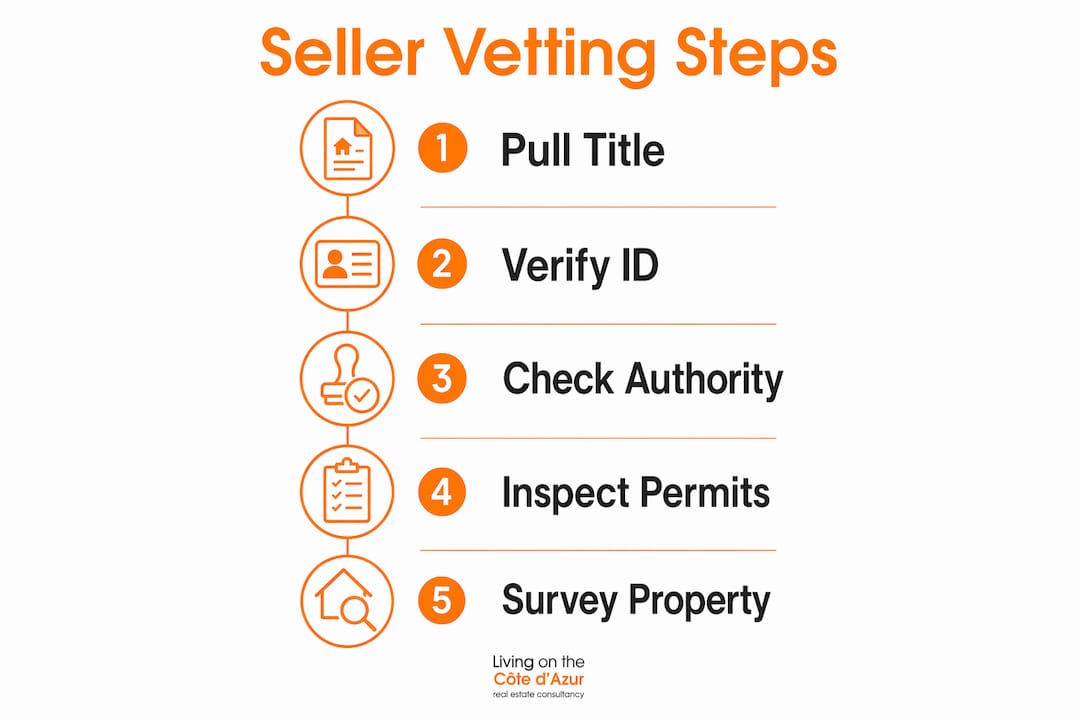
How to vet property sellers: a staged workflow from first contact to exchange
A disciplined sequence protects you far better than a single check. Here is the practical order of play, with realistic timescales.
- Initial contact qualification (Day 1–3): Confirm the seller’s name, contact address and stated ownership. Cross-reference with the Land Registry title register online.
- Pre-offer documentation (Day 3–7): Request photo ID, proof of address and any relevant authority documents (grant of probate, power of attorney). Ask open questions about motivation and timeline.
- Instruct solicitor (Day 7–14): Your solicitor verifies identity formally, runs anti-money-laundering checks and orders official searches.
- Pre-exchange searches and surveys (Week 2–8): Local authority searches, drainage, chancel, environmental and any specialist surveys complete here.
- Completion precautions (Day of exchange onward): Confirm all funds move through solicitor escrow; re-verify seller’s bank details by telephone on a number you sourced independently.
| Task | Buyer | Solicitor | Surveyor | Agent (if used) |
|---|---|---|---|---|
| Pull Land Registry title | ✓ | ✓ | ||
| Verify seller ID | ✓ | ✓ | ||
| Order official searches | ✓ | |||
| Structural/specialist survey | ✓ | |||
| Confirm signing authority | ✓ | |||
| Escrow/funds management | ✓ |
Pause the process if the seller cannot produce authority documents within seven days of request, or if the Land Registry record raises unexplained discrepancies.
How do you verify ownership and title using HM Land Registry?
The HM Land Registry title register is your first port of call. For a modest official fee you can download the title register and title plan for any registered property in England and Wales. Read these four fields carefully:
- Registered proprietor: The name here must match the seller’s ID exactly, including middle names where shown.
- Title number and class of title: Absolute freehold or leasehold title is the gold standard; qualified or possessory title warrants extra solicitor scrutiny.
- Charges register: Lists mortgages, legal charges and financial encumbrances. Any outstanding charge must be discharged at completion.
- Restrictive covenants and notices: These bind future owners. Your solicitor must advise on their practical effect before you proceed.
For a basic title-chain check, look at the proprietorship register’s history. Rapid resales within 12 months, especially at significantly different prices, can signal title fraud or undisclosed defects. Where the property is held in trust, by an estate or through a corporate structure, additional signing-authority documents are required beyond the title register alone.
Pro Tip: Save the title register and title plan as dated PDFs the moment you download them. If the register changes between your search and exchange, your solicitor needs that baseline to identify what moved and why.
How do you confirm a seller’s identity and legal authority to sell?
Acceptable primary ID documents include a current passport, UK driving licence or national identity card. Secondary verification should include a recent utility bill or bank statement showing the seller’s address. Critically, never rely on government ID alone: conduct a live video call on a link you generate yourself, and independently contact a neighbour or the property’s managing agent to confirm the seller’s connection to the address.
For non-individual sellers, the document requirements expand considerably:
- Probate sales: Require the grant of probate and letters of administration; confirm the executor’s name matches the Land Registry proprietor.
- Power of attorney: Request a certified copy of the registered lasting or enduring power of attorney and verify it with the Office of the Public Guardian.
- Corporate sellers: Obtain a Companies House company search, board minutes authorising the sale and confirmation of the signatory’s authority.
- Trust sellers: Require the trust deed and confirmation of all trustees’ identities.
Seller impersonation fraud is a growing threat in UK property transactions. Vacant land and second homes are disproportionately targeted because the true owner is often absent and less likely to notice a fraudulent listing until funds have already moved. Treat any remote transaction, or one where the seller is reluctant to appear on video, as unverified until independent proof of ownership is confirmed.
Mismatched names between the Land Registry record and the seller’s ID, requests to transfer funds to a personal account, or a seller who communicates exclusively by text are all signals that warrant an immediate pause and solicitor consultation.
What documents prove renovations and extensions were done properly?
Seller disclosures about works are hypotheses until documented. Rank the claimed works by potential cost and liability, then request proof in this order of priority:
- Planning permission from the local planning authority (LPA) for any extension, change of use or structural alteration.
- Building control completion certificate or a certificate of lawful development confirming the work met building regulations.
- Final inspection sign-off from the local authority building control or an approved inspector.
- Contractor invoices, warranties and any specialist certificates (gas safety, electrical installation condition report, FENSA window certificates).
You can search your local planning authority’s online portal using the property address to verify that permit numbers on documents match the council’s records. For older works where no certificate exists, your solicitor may recommend indemnity insurance as a pragmatic resolution, though this does not remedy the underlying defect.
Pro Tip: Instruct a structural engineer or specialist surveyor for any claimed works involving load-bearing walls, roof structures or basement conversions. A building control certificate confirms compliance at the time of inspection; it does not guarantee the work has held up over years of use.
How do you spot a motivated seller and negotiate wisely?
Identifying genuine urgency early shapes your entire approach. Within the first three minutes of any conversation, ask open-ended questions that reveal the seller’s circumstances without being intrusive:
- “What’s prompting the move at this point?”
- “How flexible are you on the timeline to completion?”
- “Has the property been on the market before, and if so, what happened?”
- “Are there any circumstances that would make a faster completion particularly helpful?”
Answers pointing to divorce, probate, relocation, financial pressure or a job transfer signal genuine motivation. A seller who needs to close within 30 days is a materially different negotiation from one who is simply testing the market.
When motivation is clear, you can negotiate on price, speed and contingencies simultaneously. Speed is often worth more to a motivated seller than the last few thousand pounds on the asking price. That said, urgency on their side must never translate into haste on yours: maintain all due diligence steps regardless of pressure.

Pro Tip: If a seller pushes you to waive survey or solicitor checks in exchange for a lower price, decline. The discount rarely covers the liability you are accepting. Document any such request in writing.
What financial encumbrances and leasehold issues should you check?
Beyond the mortgage shown on the charges register, look for:
- Judgment liens or county court judgments registered against the seller personally.
- Unpaid council tax or HMRC charges that could attach to the property.
- Outstanding service charges or management company arrears on leasehold properties.
- Easements and restrictive covenants that limit how you can use or develop the asset.
Leasehold properties require additional scrutiny. Check the remaining lease length (anything below 80 years triggers mortgage lender restrictions and enfranchisement complexity), the ground rent history, and the service charge accounts for the past three years. A property due diligence checklist covering title, encumbrances and permits is the professional standard across European markets, and the UK is no exception.
| Check | Typical cost | Typical timeframe |
|---|---|---|
| Land Registry title register | £3 per document | Immediate online |
| Local authority search | £100 | 1–6 weeks |
| Drainage and water search | £30 | 3–5 days |
| Structural survey (full) | £500 | 1–2 weeks post-instruction |
| Solicitor conveyancing fees | £1,000 | Throughout transaction |
When indemnity insurance is the proposed solution for a title defect or missing certificate, ask your solicitor to confirm the insurer, the scope of cover and whether the policy transfers to future buyers.
What are the top red flags when vetting a seller?
Treat any of the following as a reason to pause immediately:
- Land Registry proprietor name does not match the seller’s ID.
- Seller refuses to provide documents or repeatedly delays without explanation.
- Pressure to pay a deposit quickly, outside solicitor escrow.
- Communication exclusively by text or email, with no willingness to appear on video.
- Overseas-only contact with no independent local verification possible.
- Inconsistent information about ownership history or previous sales.
When you encounter multiple red flags, the escalation steps are clear:
- Pause all negotiations and do not transfer any funds.
- Instruct your solicitor to run a full official title search and verify the title chain.
- Contact neighbours or the managing agent independently to confirm the seller’s connection to the property.
- If fraud is suspected, report to Action Fraud (actionfraud.police.uk) and notify your solicitor immediately.
Pro Tip: Send a confirmatory letter to the property’s registered address as well as any alternative address the seller has given you. A genuine owner will receive it; an impersonator will not. This simple step has prevented fraud in numerous documented cases.
What should you instruct your solicitor to do during conveyancing?
Hand your solicitor this checklist at instruction:
- Run an official HM Land Registry search with priority (OS1 or OS2) to freeze the title against third-party registrations.
- Order local authority searches, drainage and water searches, and a chancel repair liability search where relevant.
- Conduct formal ID verification and anti-money-laundering checks on all parties.
- Analyse the full title deed chain and flag any gaps, rapid resales or unexplained transfers.
- Confirm the seller’s legal authority to sign: grant of probate, power of attorney, board resolution or Companies House extract as appropriate.
- Verify the energy performance certificate (EPC) is current (valid for ten years) and that its rating matches the seller’s representations.
Ask your solicitor directly: “Are you a member of a recognised redress scheme?” (they must be, by law), “How will you hold our deposit funds?” and “What indemnity insurance do you recommend if a title defect is found?” For transactions involving overseas sellers or complex ownership, also ask your solicitor to demand documentation process evidence from the seller’s representatives before exchange.
Key takeaways
Solicitor-verified title and confirmed seller identity are the two conditions that must be in place before you exchange contracts on any UK property.
| Point | Details |
|---|---|
| Check Land Registry first | Download the title register and confirm the registered proprietor matches the seller’s ID before any other step. |
| Verify identity with live video | Government ID alone is insufficient; conduct a video call on your own link and cross-check with neighbours or managing agents. |
| Never transfer direct to seller | All funds must move through your solicitor’s client escrow account at every stage of the transaction. |
| Prioritise title and permit issues | Missing building control certificates or unexplained charges must be resolved or insured before exchange, not after. |
| Living On The Cote d’Azur advisory | For luxury or cross-border acquisitions, the Living On The Cote d’Azur team provides full legal audit and title verification support as part of its acquisition service. |
The checks that matter most, in our experience
The most common mistake we see buyers make is treating seller vetting as a single event rather than a continuous process. You check the Land Registry on day one, then assume the picture is static. It is not. Title registers can be amended, charges can be registered, and fraudulent listings can be constructed with convincing paperwork. The buyers who protect themselves best are those who keep verifying at each stage, right up to the moment funds move.
We have seen transactions where a seller’s name matched the Land Registry record perfectly, yet the individual on the video call was not the registered owner. The discrepancy only surfaced when an independent letter was sent to the property address and returned unopened, because the property was vacant. That one step, costing nothing but a stamp, was the difference between a secure purchase and a significant financial loss.
For investors acquiring luxury real estate across borders, the verification stakes are higher still. The principles are identical to any UK purchase, but the jurisdictional complexity demands advisors who know both the local legal framework and the international fraud patterns that target high-value assets.
Buying with confidence through Living On The Cote d’Azur
For buyers and investors who want every layer of seller verification handled by specialists, Living On The Cote d’Azur offers something distinct: access to over 100,000 curated properties across the Côte d’Azur, Monaco and beyond, paired with full legal audit, title verification and financial advisory built into the acquisition process. You are not left to navigate Land Registry searches, authority checks and permit verification alone. Our network of trusted local solicitors, notaries and specialists handles each checkpoint, so you move from first contact to exchange with clarity rather than anxiety. If you are considering a prestige acquisition, explore our off-market property portfolio and speak with our advisory team about how we structure every purchase to protect your investment from the outset.
FAQ
What is the first step to vet a property seller in the UK?
Pull the HM Land Registry title register for the property and confirm the registered proprietor’s name matches the seller’s government-issued ID exactly before proceeding further.
How do you verify a seller’s authority when the property is in probate?
Request the grant of probate and letters of administration, confirm the executor’s name matches the Land Registry record, and have your solicitor verify the documents independently before exchange.
What documents prove renovation work was done with proper permission?
Ask for the local planning authority’s planning permission, the building control completion certificate, final inspection sign-offs and contractor invoices or warranties for all claimed works.
When should you walk away from a property transaction?
Walk away, or at minimum pause, when the seller refuses to provide identity documents, pressures you to transfer funds outside solicitor escrow, or when the Land Registry proprietor name does not match the seller’s ID.
Can Living On The Cote d’Azur help with seller verification on luxury properties?
Yes. Living On The Cote d’Azur includes legal audit and title verification as part of its full property acquisition service, with specialist advisors handling each verification checkpoint for buyers of prestige assets.
Authoritative UK resources for seller verification
Use these official sources at each stage of your checks:
- HM Land Registry: Search by address or title number to download the title register and title plan. Save both as dated PDFs. Check the proprietorship register, charges register and any restrictions or notices.
- Companies House: Search the corporate seller’s registered name to confirm directors, filing history and any charges registered against the company. Download the latest confirmation statement and any relevant board resolutions.
- Local planning authority portals: Search your local council’s planning portal by property address to verify planning permissions and building control completion certificates. Confirm that permit reference numbers on seller-supplied documents match the council’s records exactly.
| Resource | What to search | What to save |
|---|---|---|
| HM Land Registry | Property address or title number | Title register, title plan (dated PDFs) |
| Companies House | Corporate seller’s registered name | Confirmation statement, charges register |
| Local authority planning portal | Property address | Planning permissions, completion certificates |
For international acquisitions or cross-border seller verification, the step-by-step acquisition guide from Yigal Realty offers a useful parallel framework for understanding documentation workflows in other jurisdictions.
Recommended
 //
//