TL;DR:
- The most reliable way to identify prime Côte d’Azur addresses involves validating market fundamentals first. Professionals then filter sites through strict gates and rank survivors with a weighted scoring matrix confirmed by on-the-ground visits. This disciplined approach minimizes capital risk and ensures acquisitions are based on thorough, objective analysis.
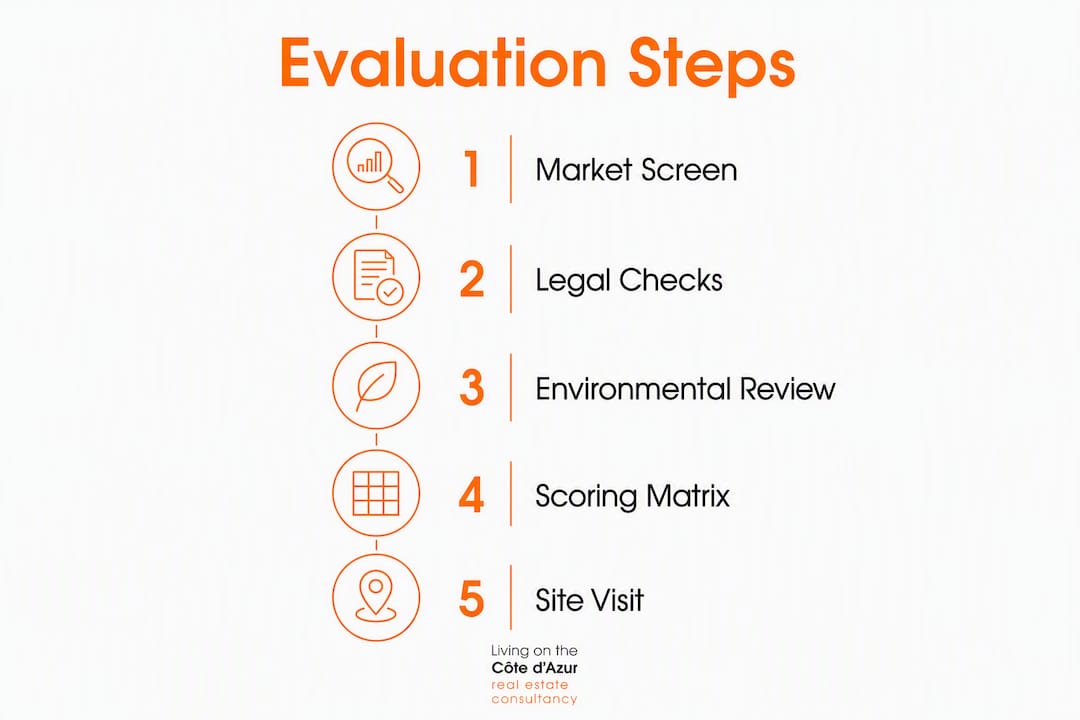
The most reliable way to identify a prime Côte d’Azur address is to validate market fundamentals first, then filter individual sites through hard gates, and finally rank surviving candidates with a weighted scoring matrix confirmed by on-the-ground reconnaissance. Skip any of those three stages and you risk committing capital to an address that looks exceptional in isolation but sits in a submarket that cannot sustain its value. Living On The Cote d’Azur applies this sequence on every mandate, drawing on the LESA framework (Land Evaluation and Site Assessment) alongside the UK government’s site assessment template (Appendix A) to structure each stage.
The three components to apply immediately:
- Market fundamentals: Demand, Supply, Cost, Risk across candidate communes (Nice, Cannes, Antibes, Saint-Tropez corridor).
- Hard gates: Zoning compliance, clean title, and absence of disqualifying environmental constraints — any failure ends the assessment.
- Weighted scoring matrix: A transparent 0–100 model that ranks surviving sites against criteria weighted to your investment thesis.
Table of Contents
- Why market selection matters more than any individual site
- How to assess a site: the structured checklist you need
- The weighted scoring matrix: ranking sites with rigour
- What only a site visit can tell you
- Infrastructure and lifestyle: what defines ‘prime’ on the Riviera
- Tax and legal considerations for UK buyers
- Realistic timelines and costs for prime transactions
- How specialist advisers protect and accelerate your acquisition
- Key takeaways
- Key takeaways
- The view from the ground
- Living On The Cote d’Azur: discreet sourcing and next steps
- Useful sources for verification and further reading
- FAQ
Why market selection matters more than any individual site
Market selection is the highest-leverage decision in real estate. A project’s failure is more often tied to the market it sits in than to execution at the address level — strong markets allow average projects to outperform, while weak markets can undermine even the most beautifully positioned villa.
The four-factor framework structures this analysis: Demand (population growth, tourism flows, rental absorption), Supply (new pipeline, permitted units, competing stock), Cost (land values, construction, holding costs), and Risk (regulatory exposure, climate hazards, political stability). On the Riviera, these factors interact in ways that differ sharply by commune. Cannes benefits from a globally recognised events calendar that compresses seasonal vacancy; Mougins and Valbonne attract a quieter, longer-term resident profile; Saint-Tropez commands extraordinary summer premiums but carries pronounced off-season liquidity risk.
Run a rapid market screen across candidate communes before commissioning any site-level work. Institutional capital flows into the Côte d’Azur reflect precisely this logic: buyers who validate geographic fundamentals first consistently outperform those who fall in love with an address before understanding its submarket.
Pro Tip: Score each candidate commune on all four factors before viewing a single property. A commune that scores poorly on Supply (oversupply of comparable stock) or Risk (coastal erosion exposure) should be deprioritised regardless of how attractive an individual listing appears.
How to assess a site: the structured checklist you need
Site assessment is a multi-disciplinary process distinct from market analysis. It verifies whether a specific address is eligible, suitable, and compatible with your intended use — and it begins with hard gates that can end the process immediately.
Hard gates: automatic disqualifiers
- Non-permitted zoning under the commune’s PLU (Plan local d’urbanisme).
- Title encumbrances that cannot be resolved: unregistered servitudes, disputed ownership, or outstanding legal charges.
- Floodplain designation or coastal protection restrictions under the Loi Littoral that prohibit the intended use.
- Protected area status (site classé, monument historique buffer zones) incompatible with renovation or development plans.
Legal and title checks
Request the acte de propriété, full cadastre extract, and a certificat d’urbanisme from the notaire before proceeding. Verify all servitudes (servitude de passage, utility rights) and confirm there are no pre-emption rights held by the commune. Luxury property due diligence at this level requires a French notaire and, for complex titles, an independent avocat.
Environmental and physical constraints
An early environmental constraint screen is non-negotiable. Map floodplains, wetlands, slope instability, and protected habitats before ordering engineering surveys. Known red-flag constraints can invalidate an otherwise attractive location entirely, saving weeks of costly due diligence.
Pro Tip: Request the commune’s PPRI (Plan de Prévention des Risques d’Inondation) and PPRN (natural risk prevention plan) at the mairie before instructing any survey. These documents are public and free; they reveal flood and landslide exposure that rarely appears in agent particulars.
The weighted scoring matrix: ranking sites with rigour
Practitioners recommend combining hard gates with weighted scores to create an objective, repeatable selection process. Hard gates filter; weighted scores rank. The table below shows suggested criteria, sample weights, and scores for two hypothetical Riviera addresses.
| Criterion | Weight | Address A (coastal, Cannes) | Address B (hillside, Mougins) |
|---|---|---|---|
| Accessibility | — | — | 10 |
| Amenity and lifestyle | — | — | 12 |
| Physical condition | 10 | 8 | — |
| Environmental risk | 10 | 6 | — |
| Price and valuation | 5 | 3 | 4 |
| Total (out of 100) | 100 | — | — |
To normalise inputs, score each criterion on a 0–10 scale, then multiply by the weight divided by 10. Many practitioners set a minimum threshold of 60/100 before advancing a site to full feasibility. Address A scores higher on accessibility and market fundamentals; Address B recovers ground on environmental risk and physical condition. The weighting makes those trade-offs visible and defensible for family office review.
A scoring model built this way also mitigates local-knowledge bias — the tendency to overweight a site’s aesthetic appeal at the expense of structural factors like zoning flexibility or resale liquidity.
What only a site visit can tell you
Desk analytics identify candidates; site visits confirm or contradict them. Data-driven screening is powerful, but field reconnaissance still uncovers occupancy patterns, neighbouring land use, and service-level cues that no dataset captures.
On a Riviera visit, observe:
- Micro-accessibility: Is the approach road passable for large vehicles? Is parking genuinely available, or theoretical?
- Neighbour occupancy: Are adjacent properties well-maintained and occupied year-round, or seasonal and shuttered?
- Noise and visual buffers: Road noise, proximity to service roads, and sightlines to neighbouring terraces all affect long-term desirability.
- Security and concierge cues: The presence of private security, gated access, and discreet service infrastructure signals a neighbourhood’s true positioning.
Visit at different times of day and, where possible, in both high and low season. Walk the immediate streets, photograph systematically, and speak briefly with local café owners or concierge staff.
Pro Tip: Prepare a short five-question interview script for local service providers: ask about year-round footfall, recent changes in the neighbourhood, and whether they have noticed new residents or renovations nearby. These conversations surface demand signals that satellite data cannot.

Infrastructure and lifestyle: what defines ‘prime’ on the Riviera
Prime locations on the Côte d’Azur combine transport accessibility with a curated constellation of elite amenities. Nice Côte d’Azur Airport is France’s second-busiest airport, with direct connections to London, and most prestige addresses sit within 45 minutes of it. Heliport access from Monaco and Cannes Mandelieu Airport extends that reach further.
Key metrics for HNW buyers:
- International schools: Mougins School (British curriculum, near Cannes), the International School of Nice, and the International School of Monaco serve the corridor. Proximity to a preferred school often anchors a family’s geographic shortlist.
- Beaches and beach clubs: Private beach clubs in Cannes, Antibes, and Saint-Tropez command premium positioning; access to a secluded calanque or private waterfront adds measurable value.
- Michelin dining and events: The Riviera hosts the Cannes Film Festival, Monaco Grand Prix, and a calendar of regattas that drive short-term rental premiums and sustain year-round international demand.
- Healthcare: The Centre Hospitalier Universitaire de Nice and several private clinics serve the region; proximity matters for legacy buyers and older residents.
For yield-focused investors, proximity to the airport and event venues is paramount. For legacy buyers, school catchment and year-round community character weigh more heavily.
Tax and legal considerations for UK buyers
Engage French counsel and a UK tax adviser before signing any preliminary agreement. Cross-border tax, inheritance, and ownership structure decisions materially change net returns, and the interaction between French and UK tax rules is genuinely complex post-Brexit.
- Ownership structures: Direct ownership is straightforward but exposes the estate to French succession rules. An SCI (Société Civile Immobilière) offers flexibility for legacy planning and can simplify inheritance, though it carries its own tax implications. Trust structures are not recognised under French law and require careful structuring.
- French property taxes: Taxe foncière applies annually to all owners. The taxe d’habitation has been phased out for primary residences but may still apply to secondary homes in certain communes.
- Capital gains: Non-resident disposals are subject to French capital gains tax. UK residents should also consider UK CGT obligations on overseas property. Obtain tailored counsel — rates and reliefs depend on residency status, holding period, and ownership structure.
- Inheritance: French forced heirship rules (réserve héréditaire) apply to French-situated property. EU Succession Regulation 650/2012 allows non-French nationals to elect their national law in some circumstances; take specialist advice early.
Pro Tip: Use a staged conditional offer (the French offre d’achat followed by a compromis de vente with suspensive conditions) to buy 8–12 weeks for legal audit and tax structuring without losing the asset to another buyer.
For a detailed overview of property acquisition documentation and cross-border process, the international acquisition guide covers the full sequence.
Realistic timelines and costs for prime transactions
A clean transaction from shortlist to completion typically takes 8–20 weeks. Complex due diligence, re-zoning requirements, or title issues extend that materially.
- Market screen: 1–2 weeks.
- Site assessment and hard-gate checks: 2–4 weeks.
- Offer, negotiation, and compromis de vente: 1–3 weeks.
- Conditional due diligence period: 4–8 weeks.
- Final notaire contract and transfer: 2–4 weeks.
Indicative transaction costs for prime Riviera purchases: notaire fees typically run at roughly 7–8% of the purchase price for existing properties (lower for new builds). Legal audit, environmental screening, and advisory fees for a prime transaction commonly represent an additional 1–2% of the purchase price, though this varies with complexity. Budget for currency conversion costs if purchasing in euros from sterling.
How specialist advisers protect and accelerate your acquisition
Specialists reduce transaction risk, expand access to off-market inventory, and accelerate closing through local relationships. The Riviera’s most desirable addresses rarely appear on public portals.
- Buyer agent: Sources and negotiates on your behalf, with access to off-market stock and established relationships with local notaires and private vendors.
- French notaire: Manages title verification, contract drafting, and registration. Instructing your own notaire (in addition to the seller’s) costs nothing extra and adds independent oversight.
- Tax counsel: Structures ownership and advises on cross-border implications before the compromis is signed.
- Environmental and engineering consultants: Commission Phase 1-equivalent checks and structural surveys during the conditional period.
Living On The Cote d’Azur provides bespoke off-market sourcing across more than 100,000 properties from Nice to Saint-Tropez, alongside legal audit introductions, tax optimisation referrals, and full lifestyle services. The firm’s Dutch approach prioritises transparency: every stage of the process is explained clearly, and clients receive honest assessments rather than curated enthusiasm.
Pro Tip: Engage a specialist on a defined discovery scope first: a market screen plus two site visits. This limits upfront commitment while giving you a genuine read on the opportunity set before you authorise deeper due diligence.
Key takeaways
- Run a four-factor market screen (Demand, Supply, Cost, Risk) across candidate communes before viewing any property.
- Apply hard gates first: non-compliant zoning, unresolvable title issues, and disqualifying environmental constraints end the assessment immediately.
- Use a weighted scoring matrix (minimum threshold 60/100) to rank surviving sites transparently.
- Conduct site visits at multiple times of day and season; field reconnaissance surfaces what desk research cannot.
- Engage French legal counsel and a UK tax adviser before signing any preliminary agreement.
- Non-negotiables for prime Riviera purchases: legal and title clarity, and a completed environmental constraint screen.
- Stage your specialist engagement: market screen first, then two site visits, then full due diligence.
Key takeaways
The most defensible Côte d’Azur acquisitions follow a single sequence: market-first validation, hard-gate filtering, weighted scoring, and on-the-ground reconnaissance.
| Point | Details |
|---|---|
| Market-first validation | Screen Demand, Supply, Cost, and Risk across communes before any address-level work. |
| Hard gates before scoring | Zoning, title, and environmental checks must pass before a site enters the scoring matrix. |
| Weighted scoring matrix | Use a 0–100 model with a 60/100 minimum threshold to rank and compare sites objectively. |
| On-the-ground reconnaissance | Site visits at different times reveal occupancy, noise, and security cues no dataset captures. |
| Living On The Cote d’Azur | Provides off-market sourcing, legal audit introductions, and tax referrals across the full Riviera corridor. |
The view from the ground
The conventional wisdom on Riviera property holds that location is everything — and that is true, but incomplete. What most buyers underestimate is how much the submarket matters relative to the individual address. We have seen clients arrive with a specific commune in mind, convinced by a single exceptional property, only to discover that the surrounding market cannot support the exit value or rental yield their thesis requires. The scoring matrix is not bureaucracy; it is the tool that makes those trade-offs visible before capital is committed.
There is also a subtler point about off-market access. The finest addresses on this coast rarely surface publicly. The families who hold them transact quietly, through relationships built over years. A client who approaches the Riviera with a rigorous evaluation framework and a trusted local network gains access to a different tier of opportunity entirely — one where the competition is not a public auction but a private conversation.
Living On The Cote d’Azur: discreet sourcing and next steps
For buyers who want the evaluation framework applied on their behalf, Living On The Cote d’Azur offers something the open market cannot: access to invisible luxury properties that never reach public portals, combined with a structured acquisition process that covers market screening, legal audit introductions, and tax optimisation referrals from the first conversation.
The practical first steps are straightforward: request a market screen for your target communes, commission a two-site visit package, and initiate the legal audit during the conditional period. Every engagement is handled with complete confidentiality, and the firm’s longstanding relationships across the Riviera mean that the most coveted addresses are often accessible before they are ever listed. To begin, speak with the team about your acquisition criteria.
Useful sources for verification and further reading
These official and authoritative sources underpin the legal, planning, and environmental points in this guide. Consult them directly for any shortlisted commune.
- UK government site assessment template (Appendix A) — practical checklists for suitability, availability, and viability including flood risk indicators.
- Nice Côte d’Azur Airport — official airport site for connectivity data and terminal information.
- Mougins School — British curriculum international school serving the Cannes corridor.
- Centre Hospitalier Universitaire de Nice — regional public hospital and specialist healthcare hub.
- Your target commune’s mairie website — for PLU documents, PPRI flood risk maps, and pre-emption right registers. Search “[commune name] mairie” for the official municipal portal.
Consult a French notaire and an independent avocat for any shortlisted property before signing a preliminary agreement. This guide is general information, not legal or tax advice; confirm current rules with qualified professionals for your specific situation.
FAQ
What is the first step when evaluating Côte d’Azur property locations?
Run a four-factor market screen (Demand, Supply, Cost, Risk) across candidate communes before viewing any individual property; this prevents capital being committed to an address in a structurally weak submarket.
What are the hard gates that disqualify a Riviera site immediately?
Non-compliant zoning under the PLU, unresolvable title encumbrances, disqualifying flood or coastal protection designations under the Loi Littoral, and protected area status incompatible with the intended use.
How do UK buyers structure ownership of French property?
The three common structures are direct ownership, an SCI, and (with careful planning) certain holding arrangements; each carries different implications for French succession law, capital gains, and UK tax obligations, so specialist cross-border advice is required before signing.
How long does a prime Côte d’Azur transaction typically take?
A clean transaction from shortlist to completion takes 8–20 weeks; complex title issues or environmental due diligence can extend this materially.
How does Living On The Cote d’Azur source off-market properties?
Living On The Cote d’Azur draws on longstanding relationships with private vendors, local notaires, and specialist agents across the Riviera corridor, providing access to properties that never appear on public portals.
Recommended
 //
//