
TL;DR:
- Chamonix offers luxury property buyers a year-round mountain lifestyle with diverse neighborhoods and premium real estate options. Investors should consider seasonal rental fluctuations and local planning rules before purchasing. Engaging experienced local agents and understanding tax implications are key to successful Alpine property ownership.
Chamonix is a compelling Alpine second home for luxury buyers already rooted on the French Riviera. The valley delivers year-round demand, a globally recognised lifestyle, and a property market that ranges from compact pied-à-terre apartments to multi-million euro chalets. If your priority is lifestyle and capital preservation, Chamonix warrants serious attention. If rental yield is the primary driver, set realistic expectations: seasonal peaks are strong, but occupancy gaps between winter and summer seasons affect net returns.
Quick price orientation: entry-level apartments in the valley start from moderate prices, while larger luxury apartments and premium chalets can reach significantly higher prices depending on location and specification.
The ten neighbourhoods every buyer must evaluate are:
- Chamonix centre — vibrant, walkable, the highest footfall and rental demand
- Les Praz-de-Chamonix — quieter, family-oriented, close to the Flégère lift
- Argentière — authentic village feel, strong ski-in/ski-out appeal
- Les Houches — lower altitude, greener, excellent for families and year-round living
- Les Bois — residential calm within easy reach of the centre
- Servoz — the most tranquil end of the valley, suited to buyers prioritising nature
- Les Tines — small, discreet, popular with those seeking privacy
- Les Moussoux — elevated position above Chamonix with panoramic Mont Blanc views
- Les Pècles — peaceful residential pocket, limited stock
- Les Gaillands — southern approach to Chamonix, close to the climbing crags
Immediate next steps: contact a buyer agent with Riviera expertise and Alpine connections, request an off-market property search covering exclusive mandates, and prepare your financing documents — French lenders typically require proof of income, tax returns, and a detailed asset statement before issuing a mortgage offer in principle.
Table of Contents
FAQ
What does the Chamonix property buying process look like?
Once an offer is accepted, a compromis de vente (preliminary contract) is signed and a deposit is typically paid. Completion at the notary typically follows within three to four months.
What are the total acquisition costs for a UK buyer?
Notary fees on resale properties are charged as a percentage of the purchase price, covering transfer taxes, registration, and the notary’s own fee. New-build purchases attract lower notary fees.
Can UK buyers get a French mortgage?
Yes. French banks and specialist international lenders will consider UK applicants, though post-Brexit documentation requirements are more detailed. Loan-to-value ratios for non-residents are often within a certain range, and lenders assess global income and liabilities carefully.
Which neighbourhood suits a luxury buyer best?
It depends on your priorities. Les Moussoux and Les Praz-de-Chamonix suit buyers seeking prestige and calm; Chamonix centre maximises rental potential; Argentière appeals to serious skiers wanting an authentic village. Local experts note the valley spans several distinct micro-markets, each with its own character and planning rules.
How do I access off-market listings in Chamonix?
A meaningful share of premium stock moves through exclusive mandates rather than public portals. Building a direct relationship with a trusted local agent and sharing precise criteria is the most reliable route to unlocking these opportunities.
What taxes apply to UK buyers owning property in France?
You will pay French taxe foncière (land tax) annually and taxe d’habitation if applicable. Rental income is taxed in France under the micro-BIC or régime réel regime. Capital gains on resale are taxed in France at 19% for EU/EEA residents; UK buyers post-Brexit fall under the non-resident rate of 19% plus social levies, currently totalling 26.5% — confirm the current rate with a French tax adviser before exchange. For inheritance planning, an SCI (société civile immobilière) structure is worth discussing with a notary, particularly for legacy and wealth preservation.
What are the advantages and disadvantages of buying in Chamonix?
Advantages: world-class mountain lifestyle, strong international buyer demand, year-round appeal (skiing in winter, hiking and trail running in summer), and a finite supply of quality stock that supports long-term values. Disadvantages: seasonal rental gaps, strict local planning rules (Plan Local d’Urbanisme) that vary by neighbourhood, and higher running costs than a comparable Riviera apartment due to winter maintenance, snow clearance, and heating.
How should I manage a Chamonix property remotely?
Good local agencies provide post-purchase support including utility account set-up, seasonal maintenance coordination, and winter snow clearance. For Riviera buyers accustomed to concierge-level service, appointing a dedicated property manager from day one avoids the operational friction that catches remote owners off-guard.
More questions buyers ask about Chamonix property
How do Chamonix property prices compare to the French Riviera?
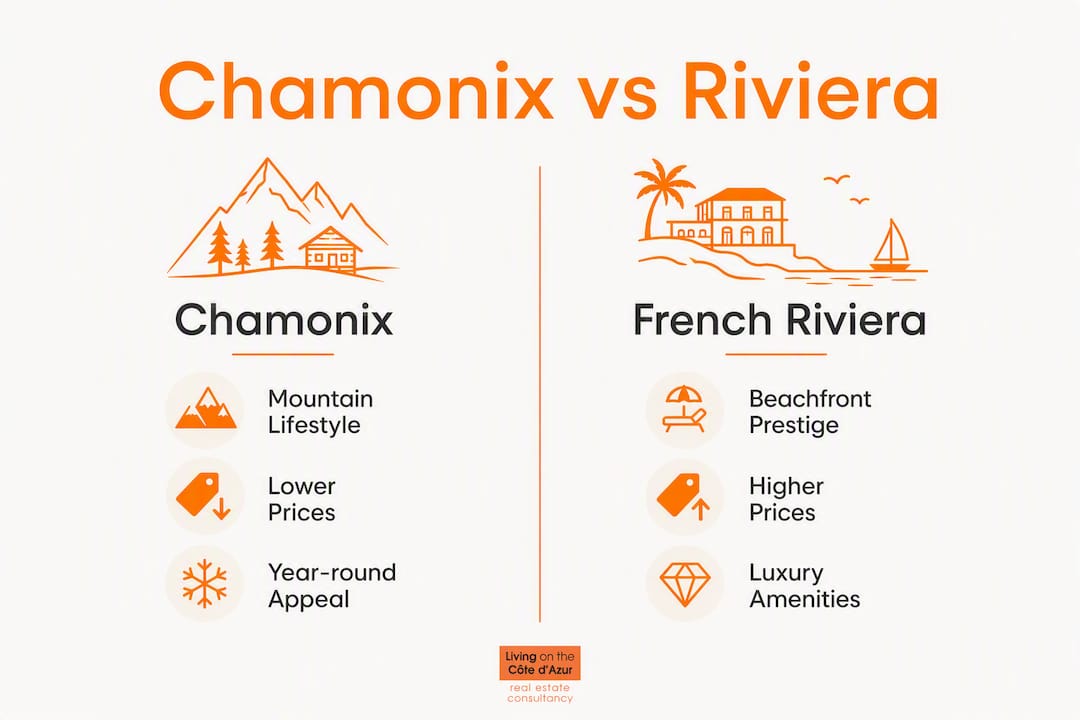
Entry-level apartments in the valley start from moderate prices, while larger luxury apartments and premium chalets can reach significantly higher prices depending on location and specification. Prime Riviera addresses in Saint-Tropez or Cap d’Antibes command significantly higher per-square-metre figures, making Chamonix an accessible complement to a Riviera portfolio.
What property types are available in Chamonix?
The market offers studios and apartments, luxury chalets, traditional mazots (small mountain structures), farmhouses, and development land — a broader typology than most Alpine resorts.
How do local planning rules affect renovation plans?
Chamonix’s Plan Local d’Urbanisme creates a mosaic of permissions across the valley. What is permitted in Les Praz may be restricted in Les Houches. Always verify permitted floor-area ratios and extension rights with a local notary before committing.
How long does it take to find the right property?
For buyers with precise criteria in a specific neighbourhood, a focused search with a well-connected local agent can yield results within weeks. Buyers open to the whole valley but seeking off-market chalets should allow three to six months.
Is Chamonix suitable for year-round rental income?
Chamonix attracts winter skiers and summer hikers, giving it stronger year-round demand than single-season resorts. That said, shoulder seasons (April to June and October to November) see lower occupancy, so gross rental yields are moderate rather than exceptional.
What financing options exist beyond a French mortgage?
Some buyers leverage equity release on existing Riviera or UK properties to fund an Alpine acquisition outright, avoiding French mortgage complexity. Others use a combination of a smaller French loan and personal capital. A step-by-step buying guide can help you map the right structure before approaching lenders.
How do I choose a local agent in Chamonix?
Prioritise agencies with 20–30 or more years of local presence; they navigate pricing nuances, micro-market planning rules, and off-market supply far more effectively than newer entrants. Ask for transparent fee disclosure in writing and a realistic local valuation before signing any mandate.
What lifestyle and logistics should I factor in?
Geneva Airport is approximately one hour from Chamonix by road, with direct connections to London. The valley has international schools within reach, a well-regarded local hospital, and a calendar of world-class events including the Ultra-Trail du Mont-Blanc. For buyers weighing Alpine against seafront living, the contrast with Monaco’s neighbourhoods is instructive: Chamonix trades year-round warmth for altitude, privacy, and a pace of life that many Riviera buyers find deeply restorative.
This article is general information only, not legal, tax, or financial advice. Confirm current rates and rules with a qualified French notary or tax adviser for your specific situation.
Recommended
 //
//