
An exclusive agency agreement — known in the UK as a sole agency arrangement — gives one agent the exclusive right to market and sell your property, while preserving your right to find a buyer yourself and pay no commission if you do. Barnes Walker’s legal glossary defines it precisely: one brokerage holds the mandate, but the owner retains the freedom to sell independently. That single carve-out is what separates sole agency from every other listing type.
Who this suits and the core trade-off:
- Sellers with an active personal network of potential buyers
- Owners of prestige or off-market properties where discreet, direct introductions are common
- Anyone who wants professional marketing but is unwilling to surrender the right to sell privately
The trade-off is real: you gain control, but your agent’s financial incentive is reduced. If you find the buyer, they earn nothing.
A quick example. You instruct an agent under a sole agency agreement. Three weeks later, a colleague expresses interest and you agree a price directly. No commission is owed. Had you signed an exclusive right-to-sell instead, the agent would have been entitled to their fee regardless of who found the buyer.
Key takeaways
Sole agency gives sellers professional marketing and the right to find their own buyer commission-free — but only if the contract is drafted with precision.
| Point | Details |
|---|---|
| Define procuring cause in writing | Vague contract language is the primary source of post-sale commission disputes under sole agency. |
| Attach the exclusion list before signing | Name every pre-existing contact in a signed schedule before marketing begins to protect your carve-out. |
| Shorten the term and require reporting | Negotiate an 8-week initial term with fortnightly written updates to maintain agent accountability. |
| Commission is always negotiable | UK contract law and industry guidance confirm that commission rates and trigger events are set by agreement, not statute. |
| Living On The Cote d’Azur | Offers contract review, legal audit, and off-market buyer introductions for sellers of prestige Côte d’Azur property. |
Table of Contents
- What does an exclusive agency agreement actually cover?
- What are the real advantages and disadvantages for sellers?
- How does exclusive agency compare with other listing types?
- How do you avoid procuring-cause disputes?
- When does sole agency make sense, and how should you negotiate it?
- The case for professional guidance over DIY negotiation
- Bespoke contract guidance from Living On The Cote d’Azur
- Sources
- FAQ
What does an exclusive agency agreement actually cover?
Realtor that exclusive agency sits between an open listing and an exclusive right-to-sell — and the contract clauses reflect that middle-ground position. Before you sign, expect to see the following:
- Term and duration: often between two and four months, but negotiable
- Commission rate and trigger: the percentage owed and the precise event that triggers it (agent-procured sale only)
- Procuring-cause definition: who is deemed to have “found” the buyer — the most disputed clause in any sole agency contract
- Marketing scope: portals, photography, floor plans, viewings, and whether the property appears on the MLS or major UK property portals
- Seller exclusion list: named individuals the seller has already contacted, who are explicitly excluded from the commission trigger
- Termination and notice: how either party exits the agreement and whether a buy-out fee applies
- Expense reimbursement: whether the agent can recover marketing costs if the seller finds the buyer independently
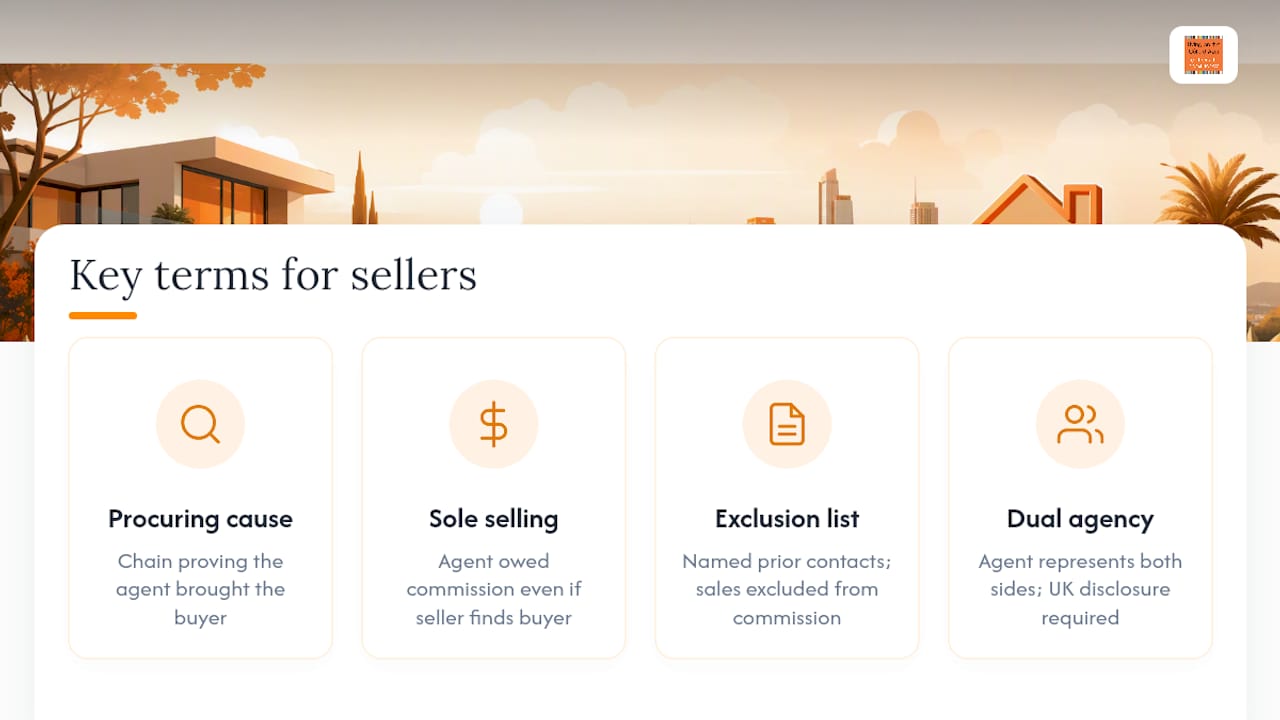
Key terms every seller should know
Procuring cause refers to the chain of events an agent must demonstrate to claim they were responsible for bringing the buyer to the transaction. In a sole agency context, this is where disputes concentrate.
Sole selling rights is a stricter UK variant: under this arrangement, the agent is owed commission even if you find the buyer yourself. It is not the same as sole agency, and conflating the two is a costly mistake.
Seller exclusion list is a written schedule, attached to the contract, naming people the seller has already approached. Any sale to a listed person is excluded from the commission obligation.
Dual agency / conflict language covers situations where the same agent represents both buyer and seller. In the UK, agents must disclose this under the Estate Agents Act 1979.
Every clause above is negotiable. The NAR’s consumer guide on listing agreements confirms that commission terms are set by contract, not statute — which means a well-prepared seller can shape them before signing.
What are the real advantages and disadvantages for sellers?
Seller advantages
- Commission saving: if you source the buyer through your own network, you owe nothing
- Professional marketing: you benefit from the agent’s portals, photography, and buyer database
- Control: you can pursue your own leads in parallel without breaching the agreement
- Flexibility: shorter terms and termination clauses are easier to negotiate than under sole selling rights
Seller disadvantages
- Reduced agent motivation: ListWithClever observes that exclusive agency listings are uncommon precisely because agents carry the risk of zero commission — which can translate into less aggressive marketing
- Procuring-cause disputes: if a buyer your agent showed around later contacts you directly, the question of who “found” them becomes legally contentious
- Longer time on market: an agent who is uncertain of their fee may allocate fewer resources to your listing
- Documentation burden: you must keep meticulous records of every independent contact to defend your exclusion list
The agent’s perspective
Agents generally prefer exclusive right-to-sell because it guarantees compensation regardless of who sources the buyer. Industry commentary consistently highlights that agents may de-prioritise sole agency listings when their pipeline is full. That is not cynicism — it is rational behaviour. Understanding this dynamic helps you negotiate a contract that keeps your agent genuinely motivated.

Pro Tip: Negotiate a written marketing commitment into the agreement: minimum portal exposure, a set number of viewings per month, and a fortnightly written report. This creates accountability without requiring you to surrender the seller carve-out.
How does exclusive agency compare with other listing types?
The RESO listing-agreement taxonomy treats exclusive agency as a standard, distinct listing category. The table below maps the key differences across the three main types.
| Feature | Open listing | Sole agency (exclusive agency) | Sole selling rights (exclusive right-to-sell) |
|---|---|---|---|
| Who pays commission | Agent who finds the buyer | Agent only if they find the buyer | Agent always, regardless of who finds the buyer |
| Seller’s right to find buyer | Yes, no commission owed | Yes, no commission owed | Yes, but commission still owed |
| Agent’s guaranteed compensation | None | None if seller finds buyer | Always guaranteed |
| Agent motivation | Low | Moderate | High |
| Typical use case | Seller with strong buyer network; rural or niche markets | Seller wants marketing support but retains private-sale option | Standard residential sale; agent invests heavily in marketing |
Colibri Real Estate’s comparison frames sole agency as the arrangement for sellers who want to stay actively involved in finding buyers. Open listings suit sellers with very specific, pre-identified buyers and no need for broad marketing. Sole selling rights suit sellers who want maximum agent effort and are comfortable paying commission regardless of outcome.
For sellers of prestige property, where off-market introductions and private networks carry real weight, sole agency often strikes the right balance. You can read more about how exclusive listings work in luxury real estate and the specific dynamics that apply at the higher end of the market.
How do you avoid procuring-cause disputes?
Procuring-cause disputes are the primary legal headache in sole agency arrangements, as LegalClarity’s detailed guide makes clear. The question is always the same: did the agent set in motion the sequence of events that led to the sale, or did the seller act independently?
Courts and arbitrators look at evidence: who made first contact, who arranged viewings, who conducted negotiations. A seller who cannot produce dated records is at a disadvantage.
Contract review checklist for sellers:
- Confirm the seller exclusion list is attached as a signed schedule before marketing begins
- Require written acknowledgement from the agent of every name on that list
- Define “procuring cause” explicitly in the contract — do not leave it to interpretation
- Specify the reporting cadence (fortnightly written updates, at minimum)
- Include a clear termination clause with a defined notice period and any applicable buy-out fee
- Clarify whether marketing costs are recoverable if you find the buyer yourself
Sample clause language sellers can propose
For the exclusion list: “The following individuals, having been contacted by the Seller prior to the commencement of this agreement, are excluded from any commission obligation: [names, dates of contact].”
For procuring cause: “Commission shall be payable only where the Agent is the proximate cause of the introduction of the Buyer, evidenced by written correspondence or documented viewing records.”
For mutual notification: “Each party shall notify the other in writing within 48 hours of any contact with a prospective buyer.”
Pro Tip: Date-stamp every email, text, and note relating to prospective buyers before you instruct an agent. A simple folder of timestamped correspondence is your strongest defence if a commission dispute arises after the sale.
When does sole agency make sense, and how should you negotiate it?
Colibri Real Estate identifies sole agency as the natural choice for sellers who want to stay involved. The scenarios where it genuinely makes sense include:
- You have a shortlist of private buyers you intend to approach directly
- The property is a prestige or off-market asset where discreet introductions are the norm
- You are selling in a small, relationship-driven market where your personal network is as powerful as any portal
- You want professional marketing as a safety net while pursuing your own leads in parallel
For sellers of high-net-worth real estate, the calculus is often different from a standard residential sale. The buyer pool is smaller, introductions matter more than portal impressions, and the commission saving on a high-value transaction is material.
Negotiation checklist:
- Shorten the initial term to 8 weeks with a renewal option, rather than accepting a standard 16-week lock-in
- Cap any recoverable marketing expenses at a fixed amount agreed in writing
- Require fortnightly written performance reports covering viewings, enquiries, and portal statistics
- Attach the seller exclusion list before signing, not after
- Include a termination clause with no more than 14 days’ written notice required
- Define the procuring-cause standard explicitly — do not rely on implied terms
On commission, remember that the NAR’s guidance and UK contract law both confirm these rates are negotiable. A listing agent’s service will typically present a standard rate, but the structure — particularly the trigger event — is always open to discussion.
The case for professional guidance over DIY negotiation
Sole agency agreements offer genuine advantages, but they reward sellers who read contracts carefully and document everything. The sellers who struggle are those who sign a standard form without negotiating the exclusion list, accept vague procuring-cause language, and then face a dispute at the point of sale.
The arrangement works best when both parties understand their obligations precisely. For sellers of prestige property, where the stakes are higher and buyer introductions often come through private channels, the quality of the contract matters as much as the quality of the marketing. Accessing exclusive listings in luxury European markets requires a different approach than a standard residential transaction, and the listing agreement should reflect that.
Bespoke contract guidance from Living On The Cote d’Azur
Sellers of prestige property on the Côte d’Azur often find that a sole agency agreement, properly negotiated, is the most elegant solution — preserving their private network while securing professional marketing. Living On The Cote d’Azur offers exactly that kind of tailored support: contract review, legal audit, curated marketing to a qualified buyer database, and discreet off-market introductions to buyers who never appear on public portals. If you are weighing a sole agency mandate or want a second opinion on a contract already in front of you, contact the team for a no-obligation consultation.
Sources
- Exclusive Agency Agreement: How It Works in Real Estate – LegalClarity
- Consumer Guide: Listing Agreements
- What Is An Exclusive Agency Listing?
- Exclusive Agency | Legal Glossary – Barnes Walker
- ListingAgreement — Exclusive Agency (RESO)
- Legislation
FAQ
What does an exclusive agency mean in UK property law?
Sole agency gives one agent the right to market your property while you retain the right to sell independently without paying commission. Under the Estate Agents Act 1979, agents must clearly explain the difference between sole agency and sole selling rights before you sign.
What is an example of an exclusive agency arrangement?
You instruct an agent under a sole agency agreement. You then sell directly to a neighbour you had already been in discussions with before instructing the agent. Because the neighbour was on your exclusion list and the agent played no role in that introduction, no commission is owed.
How do you exit an exclusive agency agreement?
Check the contract for a termination clause — most sole agency agreements require 14 days’ written notice. Realtor.com notes that buy-out fees may apply if the agent has incurred marketing costs, so negotiate a cap on those expenses before signing.
What is a disadvantage of an exclusive buyer agency for sellers?
The primary risk is reduced agent motivation. ListWithClever confirms that exclusive agency listings are uncommon because agents carry the risk of earning nothing if the seller finds the buyer, which can result in less intensive marketing compared with a sole selling rights mandate.
Recommended
 //
//