
Managing the steps to selling and buying a house simultaneously is one of the most logistically demanding things you will do as a homeowner. The good news: with the right sequence, it is entirely manageable. Here is the six-step plan to keep both transactions moving in lockstep.
Your six-step action plan:
- Gather all paperwork and instruct a conveyancing solicitor before you market your home.
- Confirm your finances: calculate net equity, secure a mortgage Agreement in Principle (AIP), and set a deposit contingency buffer.
- Appoint your estate agent, obtain a current EPC, and launch your marketing.
- Accept an offer and simultaneously make an offer on your purchase, sharing your AIP and proceedable status with both agents.
- Coordinate exchange of contracts across the chain on the same day, with completion set 1–2 weeks later.
- Confirm removal logistics, carry out final checks, and hand over vacant possession by the contractually agreed time.
Exchange of contracts is the legal turning point. Until exchange, either party can walk away. Everything in the process of selling and buying a house is designed to get you to that moment safely.
Pro Tip: Instruct your conveyancing solicitor before you accept any offer. Title checks, disclosure packs, and replies to enquiries take weeks; starting them on day one of marketing rather than day one of offer acceptance can shave four to six weeks off your timeline.
Key takeaways
Managing the steps to selling and buying a house simultaneously requires early professional instruction, realistic timeline planning, and a financial buffer that covers both transactions through to completion.
| Point | Details |
|---|---|
| Instruct solicitors early | Appoint a conveyancer before marketing; title checks and disclosure packs take weeks to prepare. |
| Chain position matters | Chain-free or short-chain transactions complete in 8–14 weeks; each extra link adds 2–4 weeks and raises fall-through risk. |
| Exchange is the legal milestone | Both parties are legally bound only at exchange; do not move out or commit removals before this point. |
| Budget beyond the deposit | Include SDLT, conveyancing, surveys, agent fees, and a contingency buffer before committing to a purchase price. |
| Living On The Cote d’Azur | For clients adding a Côte d’Azur or Ibiza second home to their move, Living On The Cote d’Azur provides full legal, financial, and acquisition advisory across both transactions. |
Table of Contents
- What documents and decisions do you need before you start?
- How long does the whole process take?
- How do you prepare your home for sale?
- How do you sort your finances before exchanging?
- Who should you appoint, and when?
- How do you market your home and handle offers?
- What do you do on the buyer side while your sale is live?
- What happens during conveyancing and at exchange?
- What are the key legal obligations you must not overlook?
- What happens on completion day?
- What do you do if the chain breaks?
- What does it cost to sell and buy at the same time?
- Considering a Côte d’Azur property alongside your UK move?
- Sources
- FAQ
What documents and decisions do you need before you start?
Delays in the home buying and selling process almost always trace back to missing paperwork. Solicitors and lenders cannot proceed without specific documents, and chasing them after an offer is accepted costs you weeks. Prepare the following before you market your home or begin viewing properties seriously.
Conveyancing and property documents
- Title deeds or Land Registry title number — your solicitor will need these to draft the contract pack.
- Mortgage statements — showing your current outstanding balance and lender details.
- Building regulations completion certificates and planning consents — for any extension, conversion, or structural work carried out since you purchased.
- Guarantees and warranties — NHBC, damp-proofing, timber treatment, double-glazing, roof work, and any other transferable guarantees.
- Energy Performance Certificate (EPC) — EPCs last ten years; check the official register before commissioning a new assessment.
- Gas safety and electrical installation condition reports — not legally required for a sale but buyers and their solicitors routinely request them.
- Leasehold information — if leasehold, gather the lease, service charge accounts, ground rent schedule, and management company contact details.
Financial documents
- Mortgage AIP from your chosen lender or broker.
- Up-to-date mortgage redemption figure (request this from your lender).
- Evidence of deposit source (bank statements, gift letter if applicable).
- Proof of identity and address for anti-money-laundering checks.
Decisions to make before marketing
- Your minimum acceptable sale price and your reserve (the price below which you will not proceed).
- Timeline preference: are you flexible on completion, or do you have a hard deadline such as a school year or lease expiry?
- Chain tolerance: will you accept a buyer who is in a long chain, or only chain-free and cash buyers?
- Contingency plan: if your sale falls through, can you rent temporarily, use bridging finance, or pause the purchase?
Pro Tip: Prepare a disclosure bundle for your solicitor at the outset: plans, warranties, certificates, and any correspondence about disputes or planning matters. Well-prepared disclosure packs shorten conveyancing timelines by reducing the volume of buyer enquiries that delay exchange.
How long does the whole process take?
Realistic timing is the single most underestimated element of the house buying process. Most people plan for the best case and are caught off guard by the average.
A property chain is a sequence of linked sales where each purchase depends on the next completing. Chain-free transactions are the fastest, typically completing in 8–14 weeks. Each additional link in the chain tends to add 2–4 weeks and raises the probability of a fall-through.
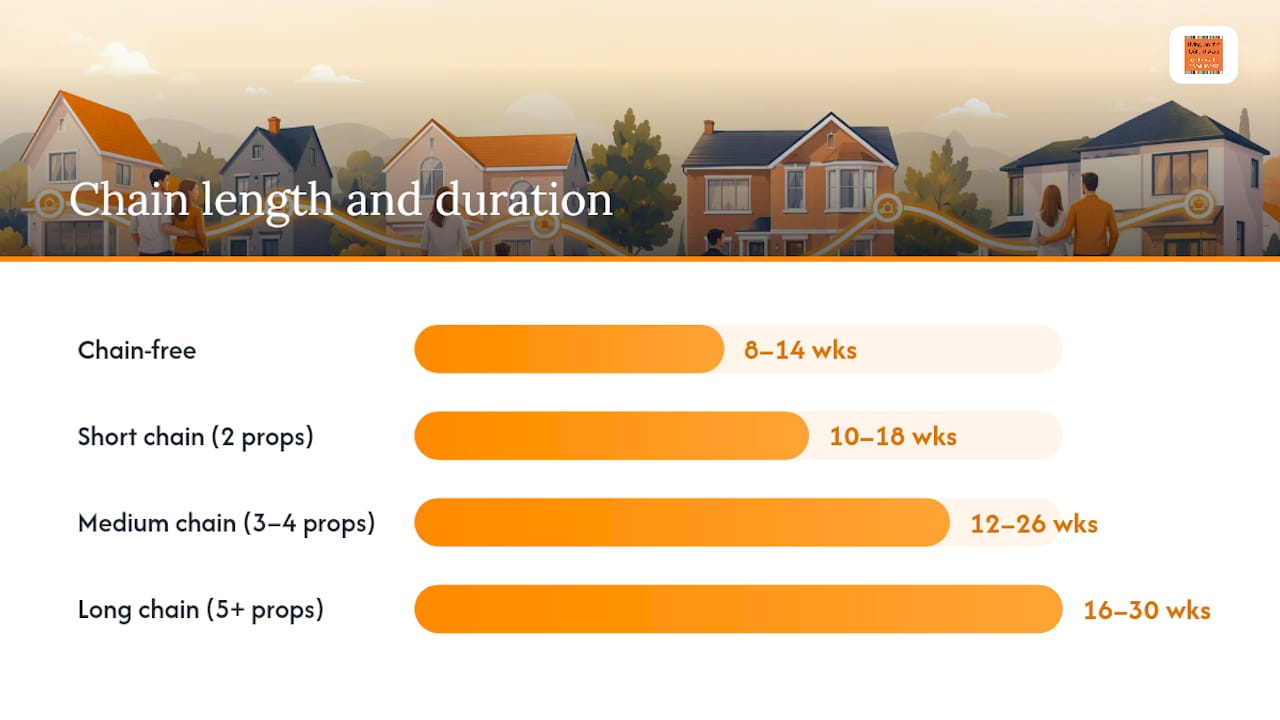
| Chain type | Typical total duration | Key risk |
|---|---|---|
| Chain-free (cash or no onward purchase) | typically faster | Minimal |
| Short chain (2 properties) | usually slower | One dependent sale |
| Medium chain (3–4 properties) | slower still | Coordinating multiple exchanges |
| Long chain (5+ properties) | slowest and most complex | High fall-through exposure |
A significant portion of agreed sales fall through, largely due to chain issues. Being near the bottom of a chain, or chain-free, materially improves your odds of completing on time. When you are both selling and buying, you sit in the middle of a chain by definition, so your choice of buyer and your choice of onward purchase both affect your risk profile.
Statistic to know: Each extra chain link typically adds 2–4 weeks of potential delay. A five-property chain can therefore run 8–16 weeks longer than a chain-free sale, purely from coordination friction.
Practically, this means targeting proceedable buyers for your own sale (chain-free, cash, or buyers with a mortgage AIP and a solicitor already instructed) and, on the purchase side, favouring properties where the seller has no onward purchase or is already under offer on their next home.
How do you prepare your home for sale?
Preparation is where sellers lose or gain weeks. A well-presented home with complete paperwork attracts reliable offers faster and survives the conveyancing process with fewer conditional issues.

Valuation
Get at least two in-person valuations from local estate agents, not just an online estimate. Online tools use comparable sales data but cannot account for your property’s specific condition, aspect, or recent improvements. The in-person figure should inform your reserve price and your choice of agent. An agent who values high to win your instruction but cannot achieve that price wastes your time.
EPC
Check the official EPC register before commissioning a new assessment. If a valid certificate exists (issued within the last ten years), you can use it. If none exists or it has expired, you must commission a new EPC before marketing in most cases. An assessor can usually attend within a few days.
Repairs and disclosures
Prioritise health and safety defects: faulty electrics, gas appliances, structural movement, and damp. Fix visible cosmetic issues that will appear in photographs or trigger survey queries. Gather all guarantees and warranties now so your solicitor can include them in the disclosure pack.
Critically, you have a legal duty to disclose material facts that would affect a buyer’s decision: neighbourhood disputes, planning enforcement notices, building regulation breaches, and boundary disputes. Failure to disclose can result in claims for compensation or contract rescission after completion.
Presentation and photography
- Declutter every room, including storage areas that buyers will open.
- Deep clean, paying particular attention to kitchens, bathrooms, and windows.
- Arrange professional photography on a bright day; most buyers form their first impression online.
- Consider a pre-sale survey to identify issues before buyers’ surveyors do.
Choosing an estate agent
Ask agents for their average time to sale, their fall-through rate, and how they qualify buyers before presenting offers. An agent who insists on AIP before viewings and who checks chain positions before recommending acceptance is worth more than one who simply promises the highest price.
Pro Tip: Ask your agent to confirm in writing that any buyer they recommend has a solicitor instructed and an AIP in place. This single step filters out a significant proportion of fall-throughs before they start.
How do you sort your finances before exchanging?
The financial architecture of a simultaneous sale and purchase is more intricate than either transaction alone. Getting it right before you exchange protects you from being caught short at the worst possible moment.
Calculating net proceeds
What remains is your available equity to put towards the deposit on your purchase.
Agreement in Principle
An AIP from a lender confirms how much they are willing to lend in principle, subject to full underwriting. Most AIPs are valid for 60–90 days. If your transaction takes longer, you will need to renew it. A mortgage offer (the full, underwritten approval) typically lasts six months from issue. If your completion slips beyond that, you may need to reapply, which can affect your rate.
Bridging finance
Bridging loans allow you to complete your purchase before your sale completes, but they carry significant costs: monthly interest rates and arrangement fees that accumulate quickly. They are appropriate only when you have a clear, near-term repayment plan (your sale completing within weeks, not months) and the financial capacity to carry the cost if the sale slips. Use them as a last resort, not a default strategy.
Financial note: Bridging finance is a common contingency to break chains, but it should be used only with a clear repayment plan. Monthly interest and arrangement fees can erode equity rapidly if a sale is delayed.
Deposit strategy and buffer
- Confirm with your solicitor how the buyer’s deposit on your sale will flow through to your purchase deposit on exchange day.
- Keep a contingency buffer of at least 1–2% of the purchase price in accessible savings to cover survey-driven price reductions, repair costs, or bridging interest.
- Never commit your entire equity to the deposit without retaining funds for Stamp Duty Land Tax (SDLT), legal fees, and moving costs.
Documents to give your mortgage broker:
- Last three months’ payslips or two years’ accounts if self-employed.
- Last three months’ bank statements.
- Proof of deposit source.
- Current mortgage statement and redemption figure.
- Details of any existing credit commitments.
Who should you appoint, and when?
The right professionals, instructed at the right moment, prevent the bottlenecks that collapse chains. Timing matters as much as selection.
Conveyancing solicitor
Instructing a conveyancing solicitor early is strongly recommended because they handle title checks, disclosure, and buyer enquiries that otherwise stall transactions. Instruct them before you accept any offer, ideally before you even go to market. Late instruction is one of the most common causes of chain delays.
When selecting a conveyancer, ask:
- Do you offer a fixed fee or an estimate? (Fixed fees avoid surprises.)
- Do you have an online progress-tracking system?
- What is your average time from instruction to exchange?
- Will the same person handle my file throughout, or will it be passed between team members?
Surveyor
Once your offer on a purchase is accepted, book a survey immediately. For most properties, a RICS Level 2 HomeBuyer Report is appropriate; for older, larger, or structurally complex properties, commission a Level 3 Building Survey. The lender’s mortgage valuation is not a survey. It protects the lender, not you, and will not identify defects that could cost you thousands after completion.
Mortgage broker
A whole-of-market broker accesses products from across the lending market and can advise on timing: when to lock a rate, whether a tracker or fixed product suits your timeline risk, and how to handle a mortgage offer that may expire before completion.
Removal company
Get at least three quotes as soon as you have an approximate completion window. Removal companies book up weeks in advance, particularly in spring and summer. Confirm your booking once exchange is imminent and ensure your insurance covers goods in transit and any overlap period between properties.
Pro Tip: Responsiveness is the single most important quality in a conveyancer. A solicitor who takes three days to return calls will cost you more in chain delays than any fee saving. Ask for references from recent clients before instructing.
How do you market your home and handle offers?
Marketing is not simply listing a property and waiting. The timing of your launch and the quality of buyers you attract will determine whether your purchase stays on track.
Timing your launch
Coordinate your market launch with your house hunting. Ideally, you should have identified two or three realistic purchase options before your property goes live, so that when offers arrive you can move quickly on a purchase without a gap. Launching before you have any purchase target in mind risks accepting an offer and then spending weeks searching, during which your buyer’s patience and AIP may expire.
Evaluating offers
Not all offers are equal. A proceedable buyer has:
- A mortgage AIP or cash funds confirmed.
- No property to sell, or a property already under offer with a solicitor instructed.
- A solicitor instructed and ready to receive the draft contract.
A higher offer from a buyer in a long chain is often worth less than a slightly lower offer from a chain-free buyer. The difference in fall-through risk and timeline can be substantial.
| Offer type | Advantage | Risk |
|---|---|---|
| Unconditional (cash, chain-free) | Fastest, lowest fall-through risk | May offer below asking price |
| Conditional (subject to mortgage) | Broader buyer pool | Mortgage may be declined or delayed |
| Long-chain buyer | Potentially higher price | Higher fall-through risk, longer timeline |
Provisional acceptance and gazumping
Accepting an offer in England and Wales is not legally binding until exchange of contracts. This means a seller can accept a higher offer after provisional acceptance (gazumping), and a buyer can withdraw without penalty. To protect your position as a buyer, move quickly to instruct solicitors and push for exchange. As a seller, resist the temptation to accept a higher late offer once your chain is assembled and exchange is imminent — the cost of rebuilding the chain rarely justifies the gain.
In sealed-bid situations, submit your best and final offer with evidence of your proceedable status: AIP, solicitor details, and your own sale position. This reassures the seller that you will not cause delays.
What do you do on the buyer side while your sale is live?
Running a purchase alongside a sale requires parallel action. The moment your sale offer is accepted, the buyer’s clock starts.
House hunting checklist
- Define your non-negotiables (location, size, school catchment) before viewing begins.
- Keep your financial position updated: if your sale price changes, recalculate your maximum purchase budget immediately.
- Note the seller’s chain position on every property you view. A seller with no onward purchase is a significant advantage.
- Align your viewing schedule with your sale timeline; viewing properties you cannot afford to buy yet wastes goodwill with agents.
Making a proceedable offer
When you make an offer, share your AIP, confirm your solicitor’s details, and state your sale position clearly. Sellers and their agents favour buyers who demonstrate they can proceed without delay. If you are in a chain, be transparent about its length and the stage each link has reached.
Surveys and inspections
Book your survey within days of offer acceptance, not weeks. Survey results can trigger renegotiation, and the sooner you have the report, the more time you have to negotiate before exchange pressure builds. For leasehold properties, also request the management pack immediately — it can take weeks to arrive and will be needed before exchange.
Pre-contract enquiries
Your solicitor will raise enquiries with the seller’s solicitor based on the contract pack and search results. Common enquiries cover boundaries, rights of way, planning history, and service connections. Respond promptly to any enquiries raised about your own sale; delays on your side stall the whole chain.
What happens during conveyancing and at exchange?
Conveyancing is the legal transfer of ownership. It runs in parallel on both your sale and your purchase, and the two processes must reach exchange readiness at the same time.
The conveyancing workflow
- Draft contract issued — your solicitor sends the draft contract, title documents, and disclosure pack to the buyer’s solicitor.
- Searches ordered — the buyer’s solicitor orders local authority, water, drainage, and environmental searches (typically 2–6 weeks depending on the local authority).
- Enquiries raised and answered — the buyer’s solicitor raises questions; your solicitor answers them, drawing on your disclosure bundle.
- Mortgage offer issued — the buyer’s lender issues a formal mortgage offer after valuation.
- Report on title — both solicitors report to their respective clients, confirming the terms of the transaction.
- Exchange readiness confirmed — both parties confirm they are ready; deposit funds are confirmed.
- Exchange of contracts — solicitors exchange contracts simultaneously; the deposit (typically 10% of the purchase price) is transferred; both parties are legally bound.
- Completion — funds transfer on the agreed completion date, typically 1–2 weeks after exchange.
Coordinating exchange across a chain
When coordinating exchanges across a chain, solicitors typically agree a single exchange date and then set completion 1–2 weeks later. All solicitors in the chain must be ready simultaneously. One solicitor who is not ready holds the entire chain. This is why instructing a responsive solicitor and maintaining pressure on all parties throughout the process is so important.
Pre-exchange checklist:
- Confirm your mortgage offer is in place and has not expired.
- Confirm your deposit funds are in your solicitor’s client account.
- Confirm buildings insurance on your purchase will be in place from exchange (you are at risk from exchange, not completion).
- Confirm removal company booking.
- Confirm completion date with all parties in the chain.
- Read and sign the contract.
What are the key legal obligations you must not overlook?
The legal dimension of selling and buying simultaneously carries risks that go beyond paperwork. These are the obligations that, if missed, can result in financial loss or legal action.
Disclosure of material facts
Legal obligation: Sellers must disclose material facts that would affect a buyer’s decision to purchase. This includes neighbourhood disputes, planning enforcement notices, building regulation breaches, and boundary disagreements. Failure to disclose can lead to claims for compensation or contract rescission after the sale. The duty extends beyond the visible condition of the property to anything a reasonable buyer would consider significant.
Vacant possession on completion day
On completion day, sellers are contractually expected to provide vacant possession by the agreed time, commonly 2:00pm. Failure to vacate can trigger a notice to complete, interest charges on the purchase price, and claims for the buyer’s losses — including storage and accommodation costs. If a seller remains in the property after the completion time, they may technically be a trespasser, and the buyer’s solicitor can seek a court eviction order.
Moving out before exchange
Moving out before exchange of contracts carries significant risk because exchange is the point at which both parties become legally bound. If the sale falls through after you have vacated, you face the cost of an empty property and the disruption of an incomplete transaction. Moving between exchange and completion is substantially lower risk. If you must vacate early, notify your insurer in writing: most buildings insurance policies restrict cover after 30–60 days of vacancy, and failure to notify is a common reason for a refused claim.
Pro Tip: Keep a dated file of all disclosures, photographs of the property’s condition before marketing, and written confirmation from your insurer when the property will stand empty. These records materially reduce post-completion disputes.
What happens on completion day?
Completion day is the culmination of months of preparation. A clear sequence prevents costly mistakes.
Pre-completion checklist
- Confirm with your solicitor that all funds (mortgage advance and deposit) are in their client account the day before completion.
- Confirm the removal company’s arrival time and ensure it allows you to vacate by the contractual deadline.
- Take meter readings for gas, electricity, and water at both your sale and purchase properties.
- Redirect your post and notify utilities, banks, and the DVLA of your new address.
- Carry out a final check of the property to confirm all agreed fixtures and fittings are present.
Completion day sequence
- Your solicitor receives the purchase funds from your lender and your deposit contribution.
- Your solicitor transfers the balance to the seller’s solicitor.
- The seller’s solicitor confirms receipt and authorises key release.
- You collect the keys, typically from the estate agent.
- Your solicitor registers the transfer at HM Land Registry, usually within a few days of completion.
If completion is delayed
Most completion-day delays resolve within hours. If a seller remains after the completion time, remedies include serving a notice to complete (10 working days) and claiming compensation for accommodation or storage costs. Keep your solicitor’s mobile number to hand and retain receipts for any emergency costs — these are recoverable.
What do you do if the chain breaks?
A broken chain is distressing, but it is rarely the end of the transaction. Speed and clarity of thinking in the first 48 hours determine how much damage is done.
Immediate steps
- Contact your solicitor immediately to understand which link has broken and whether it is recoverable.
- Ask your estate agent to identify whether a replacement buyer can be found quickly, or whether the seller above you in the chain can be persuaded to wait.
- Assess whether a short deferment of your purchase is possible while the chain is rebuilt.
Options for buyers stuck mid-chain
- Bridging loan — allows you to complete your purchase while your sale is still live, but carries monthly interest and fees. Use only with a clear repayment timeline.
- Savings or family loan — a lower-cost alternative to bridging if the gap is small and short-lived.
- Agree an extension — if both your buyer and your seller are willing, extending the completion date costs nothing and preserves the chain.
- Temporary rental — sell first, move into rented accommodation, and buy without chain pressure. This removes timing risk entirely but adds moving costs and disruption.
| Strategy | Advantage | Disadvantage |
|---|---|---|
| Sell first, rent temporarily | No chain pressure on purchase | Two moves, storage costs, rental expense |
| Bridging finance | Keeps purchase on track | Monthly interest, arrangement fees, financial risk |
| Part-exchange | Certainty of sale | Usually below market value |
| Target chain-free properties | Fastest purchase route | Smaller pool of available properties |
Pro Tip: Being near the bottom of the chain or chain-free materially improves your odds of completing on time. When rebuilding after a break, prioritise finding a chain-free buyer even if their offer is slightly lower — the reduction in risk is almost always worth more than the price difference.
What does it cost to sell and buy at the same time?
Budgeting accurately is as important as any legal or logistical step. Underestimating costs is one of the most common reasons transactions stall at exchange.
Typical costs
Ranges are illustrative; obtain quotes specific to your property and location.
Stamp Duty Land Tax
SDLT rates in England depend on the purchase price, whether you are a first-time buyer, and whether you own additional properties. The GOV.UK SDLT calculator gives an accurate figure for your specific transaction. If you are buying a second home or investment property, a surcharge applies.
Worked example (illustrative)
Suppose you sell for £400,000 with a £200,000 mortgage outstanding. If your purchase price is £450,000, your SDLT (for a standard residential purchase, not a second home) and conveyancing costs will reduce the deposit available. Retaining a buffer of at least £5,000–£10,000 beyond the deposit and fees is prudent for survey-driven renegotiations or bridging costs.
- Calculate your mortgage redemption figure first — this is the most significant deduction.
- Deduct all selling costs to arrive at net equity.
- Confirm SDLT liability on the purchase before committing to a price.
- Add all buying costs to the deposit requirement to get your total cash needed.
- Compare total cash needed against net equity plus savings to confirm you have sufficient funds before exchange.
A perspective on chains and simultaneous moves
The most consistent mistake we see is over-optimism about timing. Sellers accept an offer, assume exchange will happen in six weeks, and book removals before searches have even been returned. When the local authority search takes four weeks and the buyer’s surveyor raises three queries, the timeline slips — and the removal booking becomes a source of pressure rather than a plan.
The second most common error is late solicitor instruction. We have seen transactions where a seller did not instruct a conveyancer until after accepting an offer, then spent three weeks gathering title documents that could have been ready on day one. Those three weeks are rarely recovered.
For clients considering a second home in the Côte d’Azur or Ibiza alongside a UK move, the complexity multiplies. Cross-border transactions involve different legal systems, tax structures, and financing arrangements. Living On The Cote d’Azur’s property acquisition guide addresses the due diligence specific to French and Ibiza purchases, and the firm’s advisory team can coordinate the international dimension so it does not disrupt your UK chain.
The third lesson: chain position is a negotiating variable, not a fixed condition. Buyers who present themselves as proceedable — AIP confirmed, solicitor instructed, chain-free or near the bottom — consistently achieve better terms and faster completions than those who treat chain position as an afterthought.
Considering a Côte d’Azur property alongside your UK move?
For those whose ambitions extend beyond the UK market, Living On The Cote d’Azur offers something the standard conveyancing process cannot: access to over 100,000 properties across the French Riviera and Ibiza, including a curated portfolio of off-market luxury properties that never reach the open market. The firm’s Dutch approach prioritises transparency and precision — the same qualities that matter in a UK chain apply with even greater force when navigating French notarial law, SCI structures, and cross-border tax planning.
Where a UK transaction demands a solicitor, a surveyor, and a mortgage broker, a Riviera purchase demands a team fluent in French inheritance law, local planning nuance, and the particular rhythms of prestige markets from Saint-Tropez to Monaco. Living On The Cote d’Azur assembles that team for you, drawing on longstanding relationships with local agents, notaires, and financial specialists. Whether you are considering a second home as a legacy investment or a primary relocation, contact the team to discuss how your UK move and your Riviera ambitions can be coordinated without one compromising the other.
Sources
Use these official pages to verify requirements, check certificates, and confirm legal obligations throughout your transaction.
- Completion Day Delay UK: What to Do Fast
- What are the legal duties of a seller in conveyancing?
- Should I move out before my house sale completes? | ValuQ
- What Is a Property Chain? | UK Chain explained 2026
- Gov
For mortgage and insurance specifics, consult your lender’s and insurer’s own policy documents directly. Rates, terms, and eligibility criteria vary and change; no third-party guide substitutes for the primary source.
This article is general information, not a substitute for advice from a qualified financial advisor. Consult a qualified financial professional about your own circumstances before acting on anything here.
FAQ
What is the six-month rule for selling property?
The six-month rule refers to mortgage lender restrictions that prevent a buyer from using a mortgage to purchase a property that has been owned for fewer than six months. This primarily affects investors and developers who buy and resell quickly; it rarely affects standard residential sellers.
Who moves first on completion day?
The seller must vacate and provide vacant possession by the contractually agreed time, commonly 2:00pm. Keys are released to the buyer only once the seller’s solicitor confirms receipt of the completion funds, so in practice the seller moves out first and the buyer collects keys shortly after funds clear.
Do you need a solicitor before you sell your house?
There is no legal requirement to instruct a solicitor before marketing, but doing so is strongly recommended. Instructing a conveyancing solicitor early means title checks, disclosure packs, and draft contracts are ready the moment an offer is accepted, saving weeks of delay.
How long after selling a house are you responsible for it?
Your legal responsibility for the property ends at completion, when ownership transfers to the buyer. However, liability for misrepresentation or non-disclosure of material facts can extend beyond completion if a buyer later discovers information you were obliged to reveal before the sale.
Can you exchange contracts on a sale and purchase on the same day?
Yes, and this is the standard approach in a chain. Solicitors across the chain coordinate to exchange simultaneously, with completion set 1–2 weeks later. All parties must be ready at the same moment; a single solicitor who is not prepared can delay the entire chain.
Recommended
 //
//