
The fastest way to find a good buyer’s agent is to combine three things: mortgage preapproval, two or three trusted referrals, and a structured interview with your shortlisted candidates. Skip any one of these and you risk hiring someone based on charm rather than competence.
Start with a lender, not an agent search. A preapproval letter tells you what you can genuinely afford and signals to any agent that you’re a serious buyer, not a browser. Then gather referrals from people who’ve actually closed a purchase recently, cross-check them against a directory or matching tool, and interview at least two candidates before you commit. Research from HomeLight suggests buyers who compare two or three agents end up with a better fit on communication style and negotiating strategy than those who hire the first person they meet.
Here’s what to do in the next 48 to 72 hours:
- Contact a lender and request a preapproval letter, or at minimum a rate quote and estimated borrowing capacity.
- Ask three people you trust (a colleague, a family member, your mortgage broker) for the name of an agent they’d use again.
- Cross-reference those names, plus two or three from a directory or agent-matching tool, into a shortlist of four or five.
- Book calls or meetings with your top two or three shortlisted agents this week.
Before any of those interviews, prepare a short folder:
- Preapproval letter or lender contact details
- A one-page wish list (property type, must-haves, deal-breakers)
- Your realistic timeline (are you buying in three months or twelve?)
Pro Tip: Interview at least two agents even if the first one feels perfect. You won’t know whether their pricing strategy or communication style is actually strong until you’ve heard someone else’s approach for comparison.
Key Takeaways
Finding a good buyer’s agent means securing mortgage preapproval first, gathering referrals, verifying licences and recent sales, and interviewing two or three candidates before signing any agreement.
| Point | Details |
|---|---|
| Get preapproved first | A mortgage preapproval letter clarifies your budget and signals seriousness to any agent you approach. |
| Interview two or three agents | Comparing candidates on communication, negotiation examples, and availability reveals fit better than meeting just one. |
| Verify before you sign | Confirm active licensing, check for disciplinary history, and review recent buyer-side sales in your target area. |
| Read the contract closely | Check exclusivity terms, duration, fee structure, and termination clauses before agreeing to representation. |
| Choose specialist support for high-value purchases | Living On The Cote d’Azur pairs off-market access with legal audits, tax optimisation, and financing support for luxury and international buyers. |
Authoritative resources worth bookmarking
A handful of official sources are worth checking directly rather than taking any single agent’s word for it.
- Government licence lookup pages: most regions publish a free public search tool for confirming an agent’s licence status and any disciplinary record.
- NAR’s designation pages: explain exactly what credentials like ABR require, so you know what the letters after an agent’s name actually mean.
- Consumer Financial Protection Bureau guidance on preapproval: a clear, plain-language explainer on getting a mortgage preapproval letter before you start agent interviews.
- State or regional dual agency bulletins: regulator guidance, such as this one on dual agency risks, spells out exactly what conflicts can arise and what disclosure is legally required.
Table of Contents
- How to find a good buyer’s agent who actually works for you
- Is it worth using a buyer’s agent?
- Where to find buyer’s agents worth interviewing
- How to verify an agent’s licence, track record and credentials
- Interview questions and red flags that should make you walk away
- How buyer’s agents get paid and what to expect in the contract
- How to choose between your finalist candidates
- Why specialist buyer’s agents matter for luxury and international purchases
- Common pitfalls in the hiring process and how to avoid them
- How Living On The Cote d’Azur supports serious buyers
- Sources
- FAQ
How to find a good buyer’s agent who actually works for you
A buyer’s agent is a licensed real estate professional who owes a fiduciary duty exclusively to the purchaser in a transaction, not to the seller. That distinction sounds technical, but it changes everything about how negotiations, disclosures, and pricing advice unfold.
A listing (seller) agent, by contrast, is contractually obligated to get the best price and terms for the seller. If you approach the listing agent of a house you love and ask them to also represent you, you’ve entered dual agency territory, where one person is meant to serve two opposing interests at once. It’s legal in many places, but it dilutes the very representation you’re paying for. As one state regulator puts it in its consumer guidance, dual agency can create real conflicts of interest, and buyers should always ask an agent directly whether they ever act for both sides and how they’d manage that conflict if it arose mid-negotiation.
Here’s how the three roles compare:
| Role | Who they represent | Best suited for |
|---|---|---|
| Buyer’s agent (exclusive) | The buyer only | Buyers who want full negotiating loyalty and confidential advice |
| Listing/seller agent | The seller only | Sellers seeking maximum price and terms |
| Dual agent | Both parties in the same deal | Situations where both sides accept limited advocacy, generally best avoided if you want a strong negotiator on your side |
- An exclusive buyer’s agent cannot also list the property you’re bidding on.
- A dual agent must disclose the arrangement, but disclosure doesn’t remove the built-in tension.
- Some brokerages default to “designated agency,” where two agents from the same firm each represent one side, which reduces but doesn’t eliminate the conflict.
Is it worth using a buyer’s agent?
For most purchases, yes, and the reasoning holds up under scrutiny rather than just sounding reassuring. A competent buyer’s agent brings four things a solo buyer usually can’t replicate: granular market knowledge, negotiating leverage, contract oversight, and access to properties that never make it to public portals.
Consider what each of those looks like in practice:
- Market knowledge: An agent who’s closed a dozen deals in your target postcode this year knows which listings are overpriced and which have room to negotiate, long before you’d spot the pattern yourself.
- Negotiation: A skilled agent can secure repair credits, extended closing timelines, or a lower price by reading the seller’s motivation, something a first-time buyer rarely has the experience to judge.
- Contract oversight: Purchase agreements are dense with contingencies and deadlines. An agent who catches a missing inspection clause before you sign has just saved you from a costly gap.
- Off-market access: Agents with strong local networks often hear about properties before they’re publicly listed, particularly in tighter or higher-value markets.
- Vendor network: A good agent can point you toward vetted inspectors, conveyancers, and contractors, cutting weeks off your search for reliable help.
A buyer who walks into interviews with a preapproval letter in hand tends to get taken more seriously by agents too. NAR’s own research on buyer behaviour notes that prepared buyers with a clear list of must-haves and financing in place are treated as priority clients in competitive markets, which means faster callbacks and more attention to your file.
Where to find buyer’s agents worth interviewing
Not every channel produces the same quality of lead, so it pays to rank them.
- Personal referrals. Ask people who’ve bought recently, and be specific: “Would you use them again?” not just “Did they seem nice?” Data from HomeLight indicates more than half of first-time buyers find their agent through a personal referral, and this channel consistently produces the highest satisfaction because the recommendation comes with lived experience attached.
- Lender recommendations. Mortgage brokers work alongside agents constantly and know who closes deals smoothly versus who causes delays.
- Agent-matching services and directories. Platforms like Zillow and HomeLight let you filter by area and read transaction history, though you should treat their “top agent” badges as a starting point, not a guarantee, since some directories operate on a pay-to-play basis where placement is partly about advertising spend.
- The National Association of Realtors (NAR) offers a “Find a Realtor” directory and lists agents who hold additional certifications, useful for a first pass at credential-checking.
- Local brokerages. Walking into a well-regarded independent brokerage and asking who specialises in your target neighbourhood can surface agents who don’t advertise heavily online.
- Driving the neighbourhood and social media. Noting which agents’ signs appear repeatedly on streets you like, or checking their recent posts for tone and listing activity, gives you a soft read on local engagement and working style.
When you call a referral, ask specific questions: How responsive was the agent during the offer stage? Did they push back on a bad decision, or just agree with everything? Would they use this agent again for a different type of property?
One caution worth repeating: if you fall for a listing you found online, resist the urge to call the listing agent directly and ask them to represent you too. That’s the fastest route into a dual agency arrangement where your negotiating position weakens the moment you sign.
How to verify an agent’s licence, track record and credentials
Enthusiasm and a firm handshake tell you nothing about whether an agent is actually good at the job. Verification does.
- Confirm the agent’s licence is active through your region’s real estate regulator or licensing board. Most publish free public lookup tools.
- Search the same regulator’s site for disciplinary actions or complaints filed against that licence number.
- Ask for a list of the agent’s closed buyer-side transactions in your target neighbourhood and property type over the past 12 to 18 months.
- Cross-check those claimed sales against public sold-price records where available, to confirm dates, addresses, and roughly matching prices.
- Look for buyer-focused designations, particularly Accredited Buyer’s Representative (ABR), alongside Certified Residential Specialist (CRS) or Seniors Real Estate Specialist (SRES) if relevant to your situation.
Local specialism matters more than general experience. An agent who’s excellent with downtown condos may have thin knowledge of suburban single-family homes or rural estates, and the gap in local market knowledge between property types is often wider than buyers expect. When you review an agent’s recent sales, look for comparable square footage, price bracket, and neighbourhood, not just a long list of closed deals somewhere in the wider region.
- Government or state licence lookup pages (search “[your region] real estate license lookup”)
- NAR’s designation pages, explaining what ABR, CRS, and similar credentials actually require
- Municipal land registry or public records offices, useful for confirming sold prices
Pro Tip: Ask each shortlisted agent for the names of their three most recent buyer clients who had a brief similar to yours, then actually call those references. An agent who hesitates or stalls on this request is telling you something important.
Interview questions and red flags that should make you walk away
A structured interview turns a gut feeling into a comparable score. Ask the same core questions of every candidate so you’re judging like against like.
Useful questions to ask a buyer’s agent:
- How many buyer-side transactions have you closed in this specific neighbourhood in the past year?
- Can you walk me through a negotiation where you got a buyer a better deal than the asking price suggested?
- How do you search for new listings, and will I see off-market opportunities before they’re public?
- What’s your typical response time to calls or messages, and how do you prefer to communicate?
- Have you ever represented both sides of a transaction, and how would you handle that if it happened with me?
- What’s your availability like over the next few months, given your other clients?
Red flags worth taking seriously:
- Pressure to sign a buyer-agency agreement before you’ve had a proper conversation.
- Vague or evasive answers when asked about specific recent sales.
- Reluctance to provide client references, or references that turn out to be relatives or colleagues.
- Slow or inconsistent communication during the interview stage itself, which rarely improves once you’re under contract.
- Pushy suggestions to view or offer on properties that don’t match your stated brief.
Try a short role-play during the interview: describe a hypothetical property that’s slightly overpriced and ask how they’d advise you to approach it. A strong agent will talk through comparable sales and negotiating leverage; a weak one will just say “offer what feels right.” Score each candidate on the same five or six criteria immediately after each interview, while the details are fresh, rather than trying to compare from memory a week later.
How buyer’s agents get paid and what to expect in the contract
Buyer’s agents are typically compensated through a commission, commonly cited in the 2 to 3% range of the purchase price, which has traditionally been paid by the seller out of the total sale commission rather than billed directly to the buyer. That structure is shifting in some markets. Recent changes to commission transparency mean many buyers are now asked to sign a written buyer-representation agreement before an agent will show them properties, spelling out fees, services, and duration upfront rather than leaving them implicit.
Before signing anything, check the contract for:
- Exclusivity: does it lock you into working only with this agent, and for how long?
- Duration: 30, 60, or 90 days is common; avoid open-ended terms with no review point.
- Scope of services: what exactly does the agent commit to doing (showings, negotiation, paperwork review)?
- Termination clause: can you exit the agreement early if the relationship isn’t working, and under what notice?
- Fee arrangement: is the commission fixed, negotiable, or contingent on the final sale price?
- Conflict-of-interest disclosures: does the agreement address dual agency or designated agency scenarios?
A few negotiation tips: commission percentages are often more negotiable than agents initially suggest, particularly for higher-value purchases where the absolute commission amount is substantial. Push for a shorter initial term, perhaps 30 to 60 days, so you’re not stuck if communication or service quality disappoints. Watch for clauses that claim a commission even if you buy a property the agent never showed you; that’s a common sticking point worth striking or amending before you sign.
How to choose between your finalist candidates
Once you’ve interviewed two or three agents, score them consistently rather than relying on which one you simply liked best.
A simple scoresheet works well:
| Criteria | Weight for typical buyer |
|---|---|
| Local market experience | High |
| Specialism match (condo, suburban, luxury) | High |
| Communication style and availability | High |
| Negotiation track record | Medium to high |
| References and client satisfaction | Medium |
| Fees and contract terms | Medium |
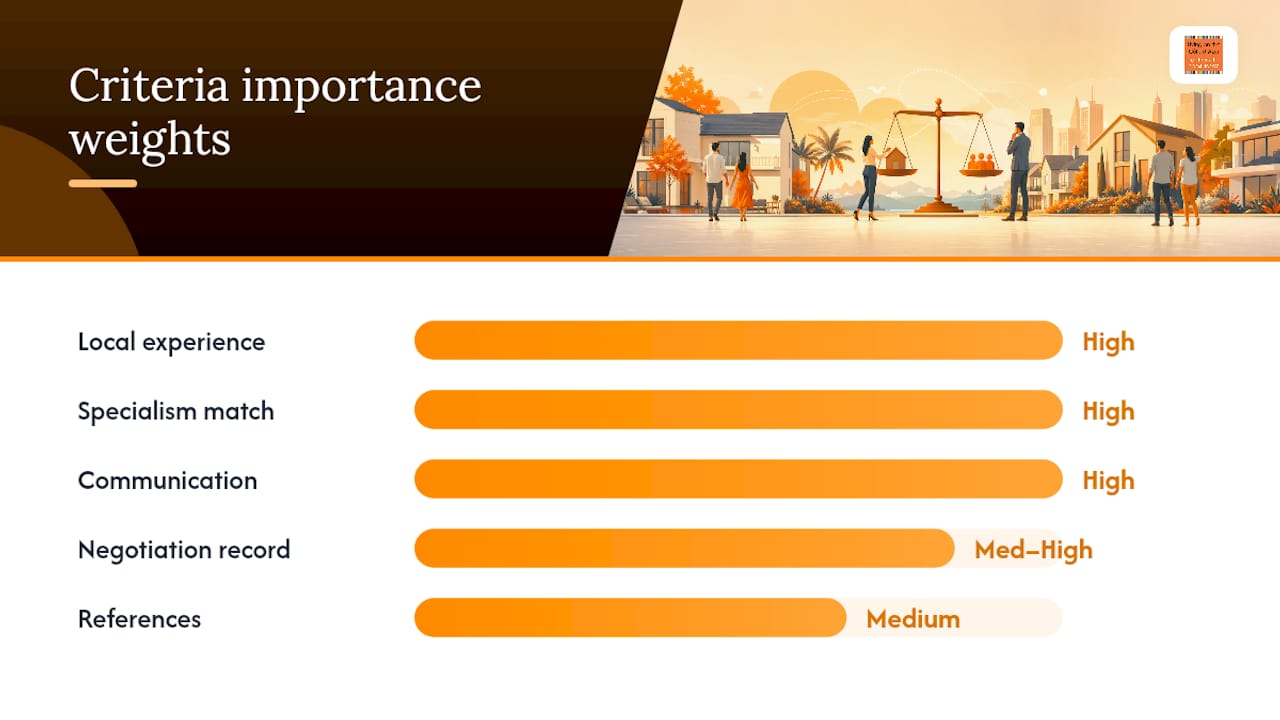
Rate each candidate from 1 to 5 on every row immediately after their interview, then total the scores. A first-time buyer should weight communication and hand-holding more heavily, since you’ll have more questions along the way. An investor is usually better served weighting negotiation record and speed of access to new listings. A luxury buyer should weight specialism and discretion above almost everything else, for reasons the next section covers.
Pro Tip: If you’re still torn between two strong candidates, ask about a short “touring agreement” limited to a single property viewing before committing to full exclusivity. It’s a low-risk way to see how an agent actually operates before signing anything longer-term.
Why specialist buyer’s agents matter for luxury and international purchases
High-value and cross-border purchases carry risks a standard vetting process doesn’t fully cover. A generalist agent might handle a suburban family home competently and still be out of their depth negotiating a discreet off-market villa sale or navigating cross-border tax exposure.
Specialist buyer’s agents in this segment typically bring:
- Off-market sourcing through long-standing relationships with local agents, developers, and notaries who never list certain properties publicly.
- Discreet negotiation practices suited to high-net-worth sellers who value privacy over public listing exposure.
- Coordination with legal and tax advisors so a purchase structure, financing arrangement, and long-term ownership plan align from the outset rather than being patched together after the fact.
Verifying this kind of experience takes an extra step beyond a standard licence check. Ask directly how many cross-border or high-value transactions the agent has closed, request references from clients with comparable budgets, and ask how they’ve handled currency, tax residency, or inheritance planning questions in past deals. Specialist knowledge of luxury property fundamentals matters here in a way general market familiarity simply doesn’t replicate.
This is precisely the gap Living On The Cote d’Azur was built to close for buyers purchasing across the Côte d’Azur, Monaco, Paris, Ibiza, Portugal, and Dubai: access to over 100,000 listings including off-market opportunities, paired with legal audits, tax optimisation guidance, and financing support woven into the buying process rather than bolted on afterwards.
Common pitfalls in the hiring process and how to avoid them
Even careful buyers make predictable mistakes when hiring an agent. Rushing the decision is the most common: signing with the first agent you meet because the search itself feels tiring skips the comparison that actually reveals fit. Interviewing only one candidate means you have nothing to measure them against.

Another frequent misstep is confusing charm with competence. An agent can be personable and still be weak on negotiation or slow to return calls once you’re under contract, which is exactly why checking references and recent sales data matters more than how the interview felt.
Buyers also commonly skip the preapproval step, assuming they’ll “sort financing out later.” That leaves you unable to move quickly on a strong property and makes agents less inclined to prioritise your file. Equally common: accepting vague answers about recent transactions rather than pressing for specifics, and signing a buyer-agency agreement without reading the termination and exclusivity clauses closely. Each of these is avoidable with the checklist covered above, but only if you actually follow it rather than treating it as optional once you find someone likeable.
A publisher’s note on choosing an agent for high-value purchases
For buyers moving significant capital into a second home or an investment property abroad, the calculus shifts. Transparency about fees, a genuinely deep local network, and real support on legal and tax structuring matter more than a polished sales pitch. The agents who serve high-net-worth and international clients well are the ones who treat the legal audit and the tax conversation as part of the search itself, not an afterthought once an offer is accepted.
Living On The Cote d’Azur was built around that principle, working with high-net-worth individuals, family offices, and international investors seeking properties that combine genuine lifestyle fit with solid long-term value.
How Living On The Cote d’Azur supports serious buyers
If you’re weighing a purchase on the Côte d’Azur, in Monaco, Paris, Ibiza, Portugal, or Dubai, the checklist above still applies, but the stakes and the paperwork both get heavier. Living On The Cote d’Azur exists precisely for that gap: a Dutch approach built on transparency, with access to over 100,000 properties including off-market opportunities that never reach public portals, paired with legal audits, tax optimisation, and financing assistance handled alongside the search rather than after you’ve already found a property and started worrying.
Before reaching out, it helps to have ready: your mortgage preapproval or proof of funds, a realistic budget range, your preferred neighbourhoods or regions, and a rough timeline for purchase. That preparation lets a first conversation focus on strategy rather than basics.
If a purchase in this category is genuinely on your horizon, the most useful next step is a direct conversation about your brief, your budget, and your timeline. You can start that conversation through Living On The Cote d’Azur’s home search service.
Sources
FAQ
Is it worth using a buyer’s agent?
For most purchases, yes. A buyer’s agent brings market knowledge, negotiation skill, and contract oversight that typically outweighs the commission cost, particularly for first-time buyers or anyone purchasing outside their usual local market.
What is the hardest month to sell a house?
This varies by region and local buyer demand cycles, so there’s no single universal answer. What matters more for your search is your own timeline and financing readiness, not trying to time a seller’s slow month.
Is it okay to offer 10% below the asking price?
It depends entirely on local market conditions, how long the property has sat listed, and recent comparable sales. A good buyer’s agent will tell you, based on actual sold-price data in that neighbourhood, whether a 10% offer is realistic or likely to be dismissed outright.
What not to say to a real estate agent?
Avoid revealing your absolute maximum budget or how emotionally attached you are to a specific property, since either can weaken your negotiating position. A trustworthy buyer’s agent should be asking for your priorities, not pressuring you to disclose more than necessary.
How many agents should I interview before choosing one?
Two or three is the generally recommended range, enough to compare communication style, negotiation examples, and local knowledge without dragging the process out for weeks.
Does Living On The Cote d’Azur act as a buyer’s agent?
Yes. Living On The Cote d’Azur works exclusively for buyers across the Côte d’Azur, Monaco, Paris, Ibiza, Portugal, and Dubai, combining access to over 100,000 listings with legal, tax, and financing support throughout the purchase.
Recommended
 //
//