
Luxury real estate is any property that sits in the top price tier of its local market (typically the 90th percentile or above) and delivers exceptional location, scarcity or features that most buyers simply cannot access. Neither factor alone is enough. Thresholds shift from Nice to New York to Ibiza Town, so the honest answer always starts with local percentiles, then checks the property against the amenities, provenance and scarcity that justify the price.
TL;DR:
- Luxury real estate is defined by local percentile rankings and unique amenities, not fixed prices, with thresholds shifting significantly between markets.
- Provenance, bespoke features, and scarcity, such as protection status or renowned architects, can elevate a property’s luxury status beyond raw price.
- Common luxury features include high-quality materials, architectural distinction, privacy, specialist rooms, outdoor infrastructure, and integrated home automation systems.
- Property formats like urban penthouses, coastal villas, and heritage estates each command premiums based on scarcity factors like view, land, or legal protections.
- Buyers should benchmark properties against local percentile thresholds, assess scarcity drivers, and verify provenance and legal restrictions before committing.
Table of Contents
- What is considered luxury real estate: how analysts actually decide
- Key features and amenities that mark a luxury property
- Types and formats where luxury actually appears
- Price thresholds and the seven levels of luxury
- Why people buy luxury property in the first place
- How to judge a candidate property in practice
- How buyer agents assess luxury on the Riviera and Ibiza
- Frequent buyer mistakes and what actually matters
- Working with an independent buyer agent on the Côte d’Azur and Ibiza
- Primary sources and recommended reading
- Sources
- FAQ
What is considered luxury real estate: how analysts actually decide
Appraisers and market analysts do not use a fixed dollar figure. They use percentiles, comparing a property against everything else that sold or listed in the same metro over a defined period.
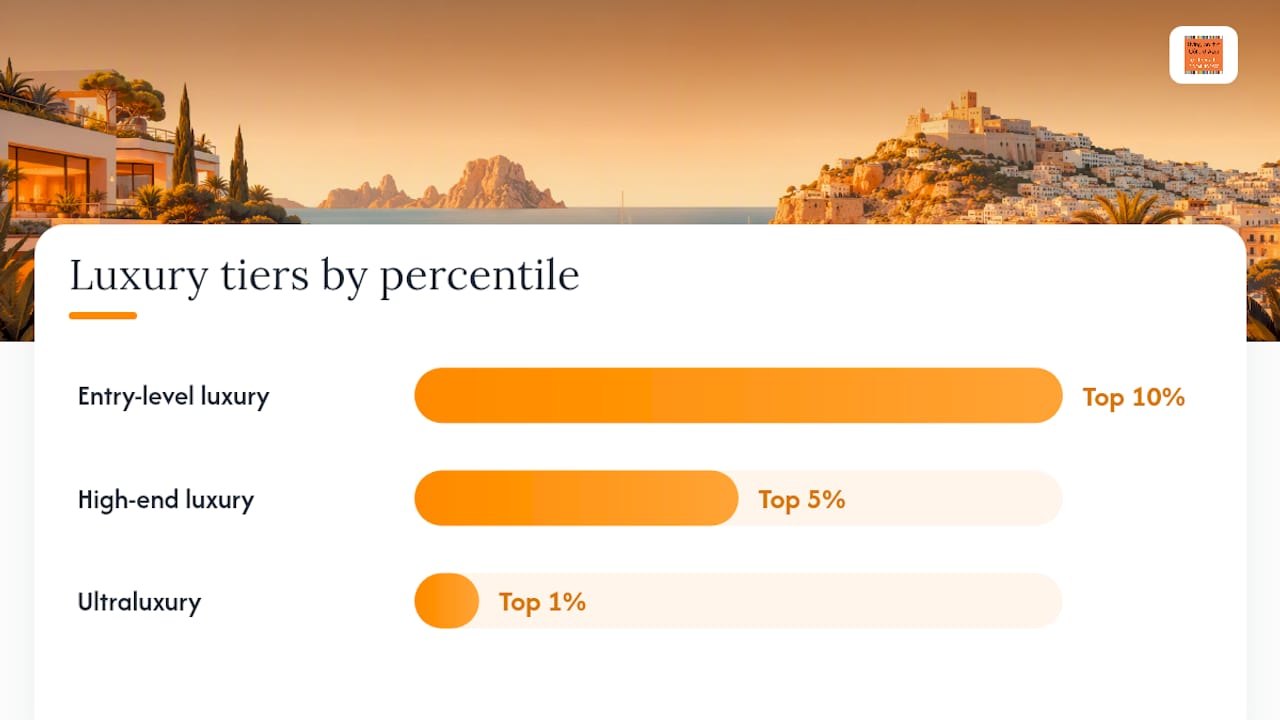
Realtor.com’s research treats the top 10% of listings in a given market as entry level luxury, the top 5% as high end, and the top 1% as ultraluxury. These are listing based benchmarks, not legal categories, and that distinction matters more than it sounds. A property can be reclassified from one quarter to the next simply because the local market shifted beneath it, not because anything changed about the house.
Statistic callout: A $1 million home might sit at the very top of the market in a modest regional town, yet barely clear entry level luxury in Miami or fail to register as luxury at all in Monaco’s immediate hinterland. Percentiles solve this because they are always relative to the neighbourhood, not the country.
Beyond price, appraisers weigh provenance. A villa designed by a recognised architect, a heritage building with protected status, or a sale conducted with genuine confidentiality all push a property up the luxury scale even when the raw numbers look ordinary. LegalClarity’s analysis of luxury classification notes that local comparables, bespoke construction and land scarcity materially affect both valuation and how tax authorities treat a property.
Key features and amenities that mark a luxury property
Price gets a property through the door. Features are what keep it there once local buyers start comparing it against the alternatives. Across markets, a consistent set of attributes recurs:
- Materials and construction: solid stone, reclaimed timber, hand finished stucco, or bespoke joinery rather than standardised fittings.
- Architectural distinction: a named architect, an unusual footprint, or a design that could not be replicated on the next plot.
- Privacy and security: gated access, discreet approach roads, and staff quarters separated from main living areas.
- Service layer: concierge access, on-site management, or a resident caretaker, particularly common in branded residences.
- Specialist rooms: a wine cellar, screening room, spa or gym that would never appear in a standard listing.
- Outdoor infrastructure: an infinity pool, mature landscaped gardens, or direct water access.
- Integrated technology: full home automation covering lighting, climate, security and audiovisual systems from a single interface.
Each category carries a practical consequence beyond kerb appeal. Bespoke construction usually means bespoke maintenance costs and a narrower pool of contractors qualified to service it. Specialist rooms and pools raise insurance premiums. Smart systems age faster than stone walls and need budgeting for replacement.
Pro Tip: Ask any agent showing you a “luxury” property for the service and maintenance contracts before you fall for the finishes. A wine cellar with no climate control contract is a liability dressed as an amenity.
Types and formats where luxury actually appears
Luxury real estate takes different physical forms depending on the market, and format shapes what buyers should expect to pay for.
- Urban penthouses and luxury apartments: value comes from vertical scarcity. There is only one top floor per building, and amenity stacking (concierge, pool, gym, parking) compounds the premium in dense cities.
- Coastal villas and compounds: land itself is the asset. Privacy, direct beach or sea access, and outdoor living space command a premium that no interior finish can replicate.
- Country estates and heritage properties: value sits in provenance, plot size, and often in legal protections that restrict future development nearby, preserving the setting.
- Branded residences and gated enclaves: a hotel brand or developer name attached to a building adds a service guarantee and a resale story that independent properties cannot match.
On the French Riviera, this plays out clearly: a penthouse in central Nice competes on views and building amenities, while a villa in Cap d’Antibes or Ramatuelle competes on land, privacy and proximity to the coastline.
Price thresholds and the seven levels of luxury
Local percentiles give you the entry point. Realtor.com’s seven levels of luxury framework then breaks the top of any market into finer bands, from properties that simply offer more space than the median, up to what it calls elite ultraluxury: the rarest, most expensive, most heavily scrutinised transactions in a given metro.
The old rule of thumb, that anything above $1 million counts as luxury, no longer holds up. Some national coverage still cites entry-level luxury thresholds around $1.2 to $1.3 million in US listing data, but that figure is only a starting point for discussion, not a rule you can apply to Nice, Ibiza or Dubai.
A working method:
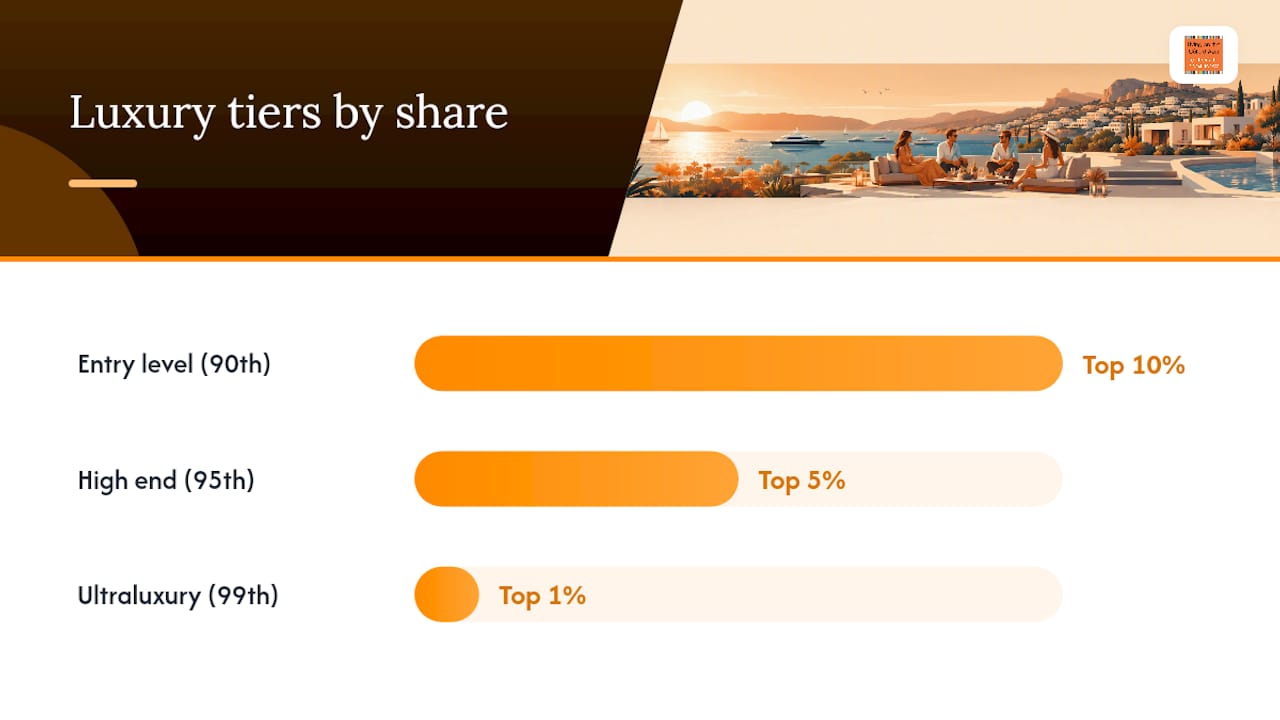
- Entry level (90th percentile): top 10% of local listings, often the first tier where premium finishes become standard rather than exceptional.
- High end (95th percentile): top 5%, where scarcity of location starts to outweigh square footage.
- Ultraluxury (99th percentile): top 1%, where confidentiality, provenance and bespoke everything define the transaction.
Why people buy luxury property in the first place
Motivation changes the entire equation. Most luxury buyers are not chasing rental yield. They are buying capital preservation, lifestyle, and often a legacy asset intended to outlast them.
Industry commentary on the luxury segment consistently points to cross-border capital flows and high-net-worth mobility as the real driver of demand, with owners commonly prioritising preservation and optionality over short-term returns. That reframes what “return” even means for this class of buyer.
The practical consequences follow directly from that motivation:
- Rental yields on luxury property are typically lower than on mainstream housing, because price appreciation and usability matter more than income.
- Insurance costs run higher, driven by bespoke construction, specialist rooms and higher rebuild valuations.
- Tax and legacy planning become central rather than an afterthought, particularly for buyers holding property across multiple jurisdictions.
How to judge a candidate property in practice
When you are standing in front of an actual listing, the theory needs to collapse into a short checklist you can run in fifteen minutes.
- Benchmark against local percentiles first. Ask your agent where this listing sits relative to the market’s 90th, 95th and 99th percentile prices, not the national average.
- Identify the scarcity driver. Is it the view, the plot size, the address, or the building’s amenity stack? If you cannot name it, be sceptical of the premium.
- Check service levels against the price. A high-end apartment without a functioning concierge or management contract is overpriced for its tier.
- Verify provenance and planning restrictions. Confirm architect credentials, heritage protections and any planned development nearby that could affect future value.
A penthouse in a global city, a villa in a regional resort hub, and a compound in a protected coastal enclave will each fail or pass this test on different lines. That is the point. The checklist travels; the answers do not.
How buyer agents assess luxury on the Riviera and Ibiza
On the ground, assessing a “luxury” listing means running past the marketing photos fast. We look at eye-test signals first: build quality, garden maturity, road noise, neighbours. Then we validate provenance directly with the notaire and check whether the listing is genuinely on-market or whether a better version of it exists off-market through our network, which is where most ultra-prime stock actually trades.
Beyond the eye test, we run practical due diligence: notaire searches, service and management contracts where shared amenities exist, and a clear picture of local tax exposure and renovation liabilities before a buyer commits. With access to over 100,000 listings across the Riviera, Monaco’s hinterland and Ibiza, including properties never publicly advertised, that verification work happens before a client ever makes an offer.
Frequent buyer mistakes and what actually matters
The most common blind spot among international buyers is falling for finish over provenance: a beautifully renovated kitchen distracts from a plot with no long-term protection or a neighbourhood on a downward trajectory. The second is underestimating running costs, particularly for properties with pools, extensive grounds or heritage status that restricts what you can change.
If there is one habit worth adopting, it is this: benchmark every candidate against local percentiles before you fall in love with it, and commission technical and tax checks early, not after you have already imagined yourself living there.
— Ab Kuijer
Working with an independent buyer agent on the Côte d’Azur and Ibiza
Living On The Cote d’Azur is the alternative to relying on a single local agency’s own listings when hunting for luxury property on the French Riviera or in Ibiza. Where a traditional agency can only show you its own inventory, Living On The Cote d’Azur searches the entire market on your behalf, through a network of local agents and developers, including off-market opportunities that never reach public portals.
That matters most at the top of the market, where confidentiality and scarcity define the best listings. We coordinate the full process for international buyers, from defining the search and comparing properties, through viewings and negotiation, to organising the purchase workflow with the notaire. If you are actively assessing whether a property on your shortlist genuinely qualifies as luxury for its market, get in touch to discuss your search and see what our network can surface that public listings cannot.
Primary sources and recommended reading
The percentile framework and price benchmarks in this article draw on Realtor.com’s seven levels of luxury research and its companion piece on defining luxury by local market. Feature and tax implications reference LegalClarity’s guide to luxury home classification, while buyer motivation and market cycle commentary comes from HousingWire’s analysis of luxury market resilience.
Sources
- Realtor
- What is considered a luxury home: price, features & taxes — LegalClarity
- Luxury housing’s resilience — HousingWire
FAQ
What are the five main types of real estate property?
Real estate is generally grouped into five categories: residential, commercial, industrial, land, and special purpose. Luxury properties can appear within residential, commercial (branded hotel residences) and land categories, but most buyers encounter them within the residential segment.
What is the most luxurious home?
There is no single “most luxurious” home; ultraluxury status depends entirely on local percentiles, scarcity and confidentiality rather than one global ranking. The 99th percentile of any given market, whether that is Monaco, Manhattan or Ibiza, defines that market’s own ultraluxury tier.
Is there a fixed price that makes a home “luxury”?
No single figure applies everywhere. Local percentile benchmarks, not a fixed dollar amount, determine luxury status in any given market.
Does a branded residence automatically count as luxury?
Not automatically, but branded residences typically add a service layer and resale story that push them into the higher percentile bands more consistently than unbranded equivalents.
How does Living On The Cote d’Azur judge whether a Riviera property is genuinely luxury?
We benchmark each listing against local price percentiles, then verify provenance, service contracts and off-market alternatives through our agent network before advising a buyer either way.
Recommended
 //
//