
Anantara Zanzibar Resort & Residences is a branded beachfront development in Nungwi, with units from roughly $350,000 and rental returns that are projected, not guaranteed. It suits investors who want a professionally managed, hotel-run asset and are comfortable with leasehold ownership, off-plan risk and a long hold. It suits them less if they want freehold, quick liquidity or a place to use all year round. Below we set it against the realistic alternatives, so you can judge it on its merits.
TL;DR
- Units run from hotel suites to three-bedroom villas, with entry from about $350,000, and completion is scheduled for 2027 (Anantara FAQ).
- The developer’s projected returns are 15% to 23% depending on unit type. They are projections and depend on market performance, so test them with your own downside case.
- Ownership is a 99-year leasehold in three 33-year terms, with income shared in a managed rental pool and 15 personal days a year.
- Zanzibar demand is strong, but the market is young. Compare it with a Dubai branded unit, an independent Nungwi villa or a Riviera purchase before you commit.
Table of Contents
- What you are actually buying at Anantara Zanzibar
- Why Zanzibar, and why now
- How ownership and the rental pool work
- Reading the 15% to 23% projection
- Zanzibar branded residence versus the alternatives
- Contract structure is where outcomes are decided
- Risks to weigh before you reserve
- Our perspective
- How we can help you decide
- FAQ
- Sources
What you are actually buying at Anantara Zanzibar
The project is a five-star beachfront resort with branded residences, developed by Infinity Developments and described by Business Insider Africa as offering hotel suites, lagoon suites and one- and two-bedroom villas from $350,000. According to the project FAQ, the range runs up to three-bedroom villas, and Minor Hotels manages the resort under the Anantara brand.
When the signing was reported in 2024, Hotels magazine noted a new-build beachside retreat with 37 luxury suites, a presidential villa and 73 one- and two-bedroom sea-view villas with private pools. Unit counts can change as a project evolves, so treat any early figure as a snapshot and ask the developer for the current schedule.
There are three broad ways to hold a unit:
- Hotel or lagoon suite. The lowest entry point and the most hotel-like. You are buying a room within a managed resort, and the income depends heavily on how the operator fills the whole property.
- One- or two-bedroom villa. A private pool and more space, which suits owners who plan to use their 15 days and would like the unit to feel like a home.
- Three-bedroom villa. The top of the range, which appeals to families and to buyers who think of it as a second home first and an income asset second.
We always tell clients the same thing: pick the unit you would be happy to own if the projected income came in lower. If the investment only makes sense at the top of the projection, it is not yet a good investment.
Why Zanzibar, and why now
The demand story is real, and it is documented. Zanzibar recorded 917,167 international arrivals in 2025, up from 736,755 in 2024, and bed occupancy in December 2025 reached about 89%, with an average stay of eight nights.
That success creates its own tension. Tourism Update reports that demand is starting to outstrip the range of experiences available beyond hotels and beaches. In practice this means that reliable, well-run capacity is scarce, which is the gap the developer is aiming at. Infinity Group’s chairman, Samuel Saba, has described the project as an answer to the lack of branded, five-star accommodation that meets international standards, in a market of many small boutique hotels.
There is also public investment behind the island’s access. The Zanzibar government plans to put over $400 million into port infrastructure, which includes the $300 million Mangapwani project. Ports mainly serve cargo and passenger logistics, so they help the construction and supply side of resort life more than they guarantee guests. Read them as a supportive signal, not a return driver.
A fair note of caution: one strong year and one strong month do not make a cycle. Peak-season occupancy is not the same as annual occupancy, and a newly opened branded resort may take time to build its own booking base.
How ownership and the rental pool work
These mechanics matter more than the headline yield, so read them closely.
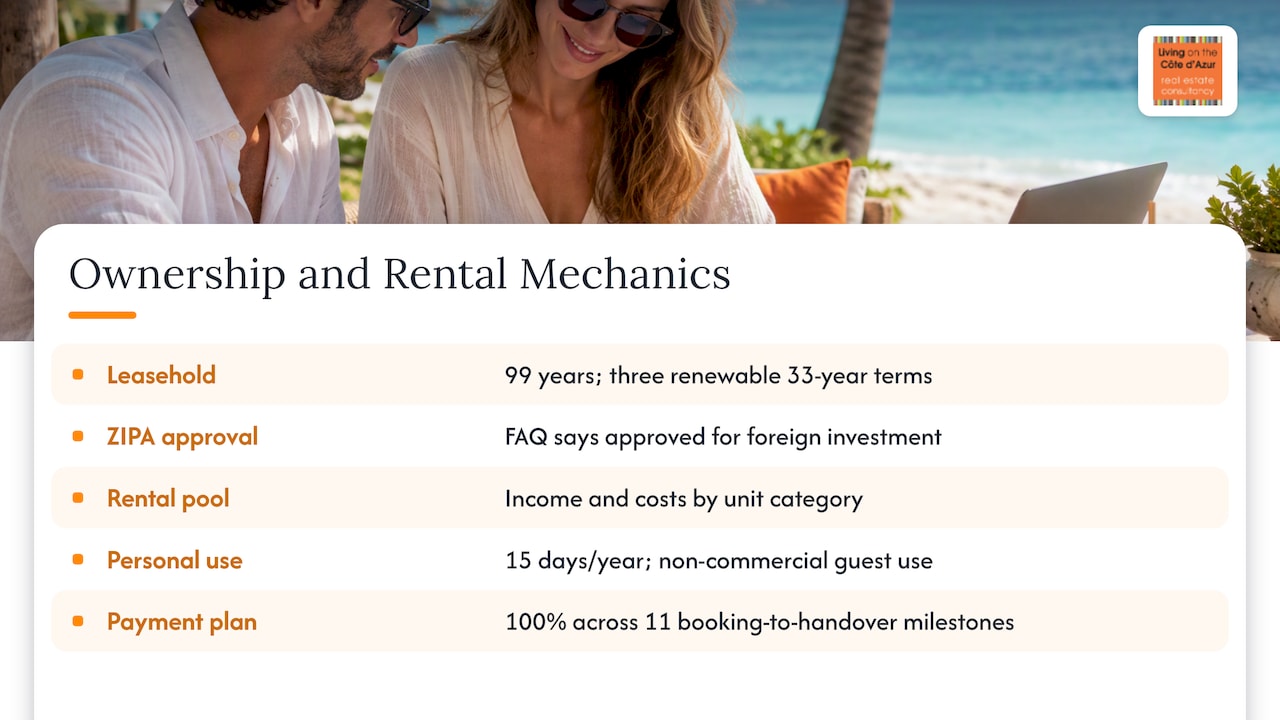
Leasehold, not freehold. Per the developer’s FAQ, the structure is a 99-year leasehold split into three renewable 33-year terms. Buyers receive a formal title deed and leasehold title, which is transferable on resale. The project needs approval from the Zanzibar Investment Promotion Authority (ZIPA) to be open to foreign investment, and the FAQ states that it has it.
A shared rental pool. Income and operating costs are aggregated by unit category, so every Lagoon Suite, for example, shares one pool. The aim is to smooth out the occupancy of any single unit. The flip side is that you do not control which weeks your unit is let, and you do not earn rental income while it is out of the pool for your own stay.
Fifteen personal days. Owners have 15 days of personal use per year, and these can be passed to friends or family for non-commercial use. Fifteen days is generous for a hotel residence, but if you imagine spending whole winters there, this is the wrong product.
Payment. The project brochure describes a standard plan covering 100% of the price across 11 milestones from booking to handover, with alternative financing possible depending on the unit and investor. Marketing pages elsewhere quote different deposit structures, so rely only on the contract you are actually offered.
Residency and tax. The brochure says the investment is structured to support residency applications for foreign buyers and their families in Tanzania, and mentions possible exemptions for foreign investors under the Zanzibar Investment Act 2023. Both should be checked with a local lawyer and tax adviser early, since eligibility can depend on your own circumstances and rules can change.
Reading the 15% to 23% projection
The developer’s FAQ gives projected, non-guaranteed returns of 15% to 23%, depending on unit type and market performance. Treat this the way you would treat any forward-looking figure in a sales document.
Here are the questions we would ask before accepting it:
- Gross or net? Is the figure before or after management fees, operating costs, furniture replacement, service charges and local taxes?
- Return on what? Is it measured on the purchase price, or on the amount you have actually paid in so far during construction?
- Which assumptions? What occupancy and average daily rate sit behind each scenario, and what does the low case look like?
- When does it start? Income only begins after the resort opens and your unit enters the pool. During the build you are paying out, not earning.
- What happens at resale? Leasehold units are transferable, but a resale market for new branded residences on the island is still to be proven.
A quick sensitivity check helps. Applying the lowest projected figure of 15% to the $350,000 entry price would give $52,500 a year. That is arithmetic on a sales projection, not a forecast, and the entry unit may sit at a different point in the range. Then halve the occupancy assumption and see whether you would still want to own it. If yes, the unit is robust. If no, you are buying the brochure.
Zanzibar branded residence versus the alternatives
A keyword like this usually means someone is comparing. Here is the honest comparison of the realistic routes for an investor with a similar budget and appetite. We have kept it to structure and risk, since prices and yields change and are rarely comparable like for like.
| Criterion | Anantara Zanzibar (branded, pooled) | Independent villa in Nungwi | Dubai branded residence | French Riviera property |
|---|---|---|---|---|
| Ownership | 99-year leasehold in 33-year terms | Leasehold via a project or lease | Depends on the freehold zone and the developer | Ownership structures vary, with a notaire involved |
| Management | Hotel operator, shared rental pool | You or a local manager | Often operator-run | Agent or concierge, owner-controlled |
| Rental control | Low: pooled, 15 personal days | High, but you carry the risk | Varies by scheme | High, subject to local rental rules |
| Delivery risk | Off-plan, scheduled for 2027 | Varies by project | Often off-plan | Mostly completed stock, with some new-build |
| Best for | Hands-off yield seekers | Owners wanting flexibility | Investors wanting liquidity and a mature market | Lifestyle owners and long-term wealth preservation |
A few observations.
An independent Nungwi villa from a developer such as Sandbank Villas gives you more control over who rents the property and when you use it. You also take on more management and brand risk, because there is no international operator behind the guest experience. For owners who like to be hands-on, that trade is worth making. For most investors who live elsewhere, a hotel operator is the reason to buy.
A Dubai branded unit is a more mature, more liquid market with a long track record of resales. If you are considering it, our piece on the future of Dubai luxury real estate sets out how we look at that market.
The French Riviera is where we are based, and it plays a different role. It rarely competes with Zanzibar on projected income. Instead it usually serves buyers who want to use the home themselves, hold it for decades and pass it on. Many clients hold both: a diversifying, income-oriented position in a young market, and a Riviera home as the anchor.
Contract structure is where outcomes are decided
With an off-plan, pooled, leasehold unit, the contract carries more weight than the view. You are effectively agreeing to how income is calculated, how costs are allocated, who can change the rental programme, and what happens if the schedule slips.
That is why we encourage buyers to read about how contract structure determines investment outcomes before signing anything, and to have an independent lawyer review the sales agreement and the rental pool terms. Pay particular attention to these clauses:
- the completion date and what remedies you have for delay;
- the milestone payment schedule and what is secured against each stage;
- how pool income is calculated and how often it is paid;
- cost items charged to owners, and any cap on them;
- the rules on resale, transfer and lease renewal at each 33-year point.
Risks to weigh before you reserve
- Construction and timing. The project is scheduled for 2027, and off-plan schedules in any country can move.
- Concentration. A single resort, a single operator and a single island is a concentrated bet.
- Pool dependency. Returns rely on the operator’s performance across your category, not on your unit alone.
- Currency and access. Returns are quoted in US dollars. If you earn and spend in sterling or euros, exchange rates affect the real outcome, and so do the costs of moving money across borders.
- Exit. Leasehold with a transferable title is a good structure, but buyers are fewer in a young market than in Dubai or on the Riviera. Our guide to real estate liquidity explains how we think about exit before entry.
- Tax at home. Your own tax residence decides how rental income and gains are treated. Speak to a tax adviser in your country before you pay a deposit.
Our perspective
We are a buyer agent, based on the French Riviera and working internationally, so we do not represent a developer or sell units from a stock list. We work for the buyer, and that changes the questions we ask. With Zanzibar, we start with what you want the money to do. If the aim is hands-off income and you can accept a long hold, a branded pooled unit is a coherent choice and Anantara is among the most credible names on the island. If the aim is control, use or legacy, we will often point you elsewhere, and that may be a villa on the Riviera or in Ibiza.
What we like about this project is the combination of an established hospitality operator, a regulator-approved structure and a pooled model that removes the daily management burden. What we want every buyer to do is slow down at the numbers: ask for the assumptions, ask for the low case, and read the pool terms as carefully as the price list. A projection is a starting point for a conversation, not a result.
We have also written a shorter overview of Anantara Zanzibar as a new luxury resort and investment opportunity if you want a second look at the project itself.
— Ab Kuijer
How we can help you decide
If you are weighing Zanzibar against other markets, we can help you set the criteria, compare options across regions, introduce lawyers and tax advisers for your situation, and keep the process orderly. Our Buyer Agent service is built around independent representation and access to a wide market network, including off-market opportunities, and we will explain openly how we are paid before you commit to anything. If you already know your budget and goals, a search mandate is the quickest way to start. Send us an enquiry with your budget, timeline and the role you want the property to play, and we will come back with an honest view.
FAQ
Can foreigners buy property in Zanzibar?
Yes, through leasehold rather than freehold. At Anantara Zanzibar, the developer’s FAQ describes a 99-year leasehold in three 33-year terms, with a formal title deed that can be transferred on resale. Projects need ZIPA approval to be open to foreign investors, so always ask to see it.
What are the minimum investment and expected returns?
Units start at around $350,000, according to Business Insider Africa. The developer projects returns of 15% to 23% depending on unit type, and these are not guaranteed. Ask for the assumptions behind the figures and whether they are gross or net.
Who manages Anantara Zanzibar?
The resort is managed by Minor Hotels under the Anantara brand, as set out in the project FAQ. Owners join a managed rental pool, so day-to-day operation and guest handling are not your responsibility.
Can I use the property myself?
Yes, for 15 days per year, and you can pass those days to friends or family for non-commercial use. Rental income is earned only while the unit is in the pool, so personal stays reduce the income you receive.
When will it open?
The project is scheduled for completion in 2027. As with any off-plan development, confirm the current timetable and your remedies for delay in the contract before paying a deposit.
Sources
- Anantara Zanzibar Resort & Residences FAQ
- Anantara Zanzibar project brochure (PDF)
- Business Insider Africa: Anantara Zanzibar offers investors a slice of paradise
- Hotels magazine: Anantara signs in Zanzibar
- The Citizen: Zanzibar tourism hits nearly one million arrivals in 2025
- The Citizen: Ports projects position Zanzibar as EAC’s major trade gateway
- Southern & East African Tourism Update: Zanzibar growth puts pressure on capacity
- CEO Middle East: Developing the future
Recommended
 //