
You can buy a second home in the South of France whatever your nationality or residence, and the purchase follows a clear, notaire-led sequence. The real work lies before the offer: deciding where, what budget is honest once taxes and fees are added, and seeing the whole market rather than the handful of properties one agency happens to list. We are an independent buyer agent on the Côte d’Azur. We work for the buyer, not for a seller’s portfolio, and search the market through local agents, developers and off-market contacts. This guide gives you the route we would walk with a friend.
TL;DR
- Foreign buyers can purchase French property freely, and the notaire handles the legal transfer under French law.
- Start with how you will use the home (weeks, months, rental, family), then choose the town. The place decides almost everything else.
- Budget for purchase taxes and notaire costs on top of the price, then yearly taxes, insurance and upkeep.
- Pay purchase funds to the notaire’s client account, never straight to the seller, and keep proof of where the money came from.
- A buyer agent searches the whole market, including off-market homes, and negotiates and coordinates for you. See our buyer broker service.
Table of Contents
- Why buyers choose the South of France, and how to choose where
- Can a foreigner buy a second home in France?
- The buying process, step by step
- Checks to make before you commit
- What it costs: budgeting beyond the price
- Financing and moving the money
- Owning it: ongoing costs and practical life
- Our perspective
- How we help you buy
- FAQ
- Sources
Why buyers choose the South of France, and how to choose where
People tell us the same things again and again: the light, the weather, the village markets, the sea within reach and an airport not far away. The Local makes a point we agree with: the benefits depend on the precise place, not on the region as a whole. A flat in Nice and a stone house in the hinterland are different lives.
Before you open a single listing, answer five questions.
- How often will you really come? Four long summer stays suit a different home from twenty weekends a year.
- How will you travel? Think about flight frequency, the airport you will use and the drive at the end of it. A beautiful house that costs three hours each way will be used less.
- Do you want a village, a town or the coast? Coastal living means walks to the sea, restaurants and an active season. Inland means space, quiet and often more garden for the money.
- Who will look after it when you are away? Maintenance, pool, garden and keyholding need planning from day one. We cover this in maintaining a villa on the French Riviera.
- Is there a healthcare and community angle? If this may become a long-term base, look at hospital access and year-round life in the town, not just summer.
The places we are asked about most are Nice and Cannes for apartments, Cap d’Antibes, Mougins, Villefranche-sur-Mer and the Saint-Tropez peninsula for villas, and the areas close to Monaco. If you are weighing Nice, our guide to the best neighbourhoods in Nice for international buyers is a good next read. For a wider orientation, see our page on a second home in the South of France.
Set the budget before the search
Decide a fixed all-in figure, including taxes and fees, and then keep an open mind about the type of property. We explain why this works in finding your property with a static budget and an open mind. On the Riviera, a flexible brief (a newer apartment a little further from the water, say, or a village instead of the seafront) often reveals better homes than a rigid one.
Can a foreigner buy a second home in France?
Yes. In 2025 the French Senate confirmed in an official answer that no general law forbids a foreign national from acquiring French real estate, and that the buyer’s lawful stay in France has no bearing on the right to own. You do not need to be resident, and you do not need a visa to buy.
What does matter is your own situation. Notaires de France explains that a non-resident buyer’s nationality, residence and marital regime should be reviewed, because French law governs the transaction and affects ownership, tax and resale. In plain terms: how you hold the property (personally, jointly, through a company such as an SCI) shapes tax, succession and flexibility later. Decide that with the right advisers before you sign, not after. We connect buyers with trusted tax advisers and notaires when required, and our page on French inheritance tax on property shows why ownership structure is worth an early conversation.
The buying process, step by step
The French process is formal but predictable. Here is how it runs, where it tends to go wrong, and what we do at each stage.
1. Define the search
Write down location, property type, outdoor space, parking, sea or mountain views, rental intent and your all-in budget. Vague briefs waste viewing trips. At this stage we turn your wishes into a search mandate, described on our search mandate page.
2. Search the whole market
The common mistake is to browse portals and call one agency per listing. The same property often appears at different prices with different agencies, and some of the best homes never reach a portal. Our network gives us access to more than 100,000 properties, including off-market homes and new developments. Our guide to off-market property on the Côte d’Azur explains how those sales happen.
3. Shortlist, compare and view
We source and compare properties and arrange the viewings, so a trip of three days can cover what would otherwise take three visits. Take notes on what each property is like in the evening and in the off-season too, not only in sunshine. Our overview of the buying process shows what a typical search looks like.
4. Negotiate and make an offer
An offer is normally put in writing and, once accepted, leads to the preliminary contract. Negotiation is where an agent who knows local prices earns their place: comparing recent comparable sales, reading how long a property has been on the market and understanding what the seller really needs. We negotiate on your behalf; see our negotiation workflow.
5. Sign the preliminary contract
This is the stage where the notaire starts the legal checks and you commit under agreed conditions. Read every condition (financing, planning, works) and be sure you understand which ones let you withdraw. Do not sign anything you have only read in a language you do not fully follow without having it explained by your notaire or adviser.
6. The notaire’s checks and the final deed
The period between the preliminary contract and the final deed (the acte de vente) is when title, mortgages, planning and pre-emption rights are verified. The next section sets out what is checked. Overseas buyers do not have to be present: French Notaires notes that you can sign in person, through a representative under power of attorney or remotely where the notarial arrangements allow it.
7. Completion and handover
Funds reach the notaire, the deed is signed, and the keys are yours. Then come the practical steps: utilities, insurance, local tax registration and a plan for the home when you are away. We coordinate the purchase through to the notaire and can help with post-purchase needs.
The Local gives the same practical advice we give: use professionals who know the French notarial system and your background, because the legal system and purchase process can differ materially from those in your home country.
Checks to make before you commit
The notaire does much of the legal verification, and you should know what it covers. According to Justice.fr, before the acte de vente the notaire verifies the seller’s legal situation, the property’s mortgage status, the urban-planning rules, the cadastral position, pre-emption rights (such as those of SAFER, local authorities and co-owners) and the origin of the seller’s title.
The notaire’s pre-contractual analysis can reach further. The Congrès des Notaires report of 2022 lists servitudes, planning authorisations, works carried out, insurance, environmental situation and use regulations. The same report notes that a notaire’s duty of advice can extend to suggesting extra diagnostics when a property presents particular risks.
Diagnostics
In France the seller provides a set of diagnostic reports. FrenchEntrée lists coverage including thermal performance, electrical and drainage compliance, flood and subsidence risk, lead, asbestos, insects and gas installations where relevant. It also points out that a full building survey, usual for many international buyers at home, is relatively underused in France. For a villa with a pool, an older roof or a sloping plot, we would think carefully about whether to add one. Connexion France adds that notaires should make sure termite inspections are up to date in affected areas, electrical and gas inspections are done for properties over 15 years old, and flood-risk documents are in place.
If you are buying an apartment
Service-Public.fr advises checking the measured surface area, the building’s maintenance log, co-ownership charges, the minutes of recent general assemblies and the co-ownership regulations. Ask the mairie about neighbourhood changes and public servitudes too. The assembly minutes tell you about planned works and who will pay for them, and they are often the most revealing document in the file.
Planning and the neighbourhood
FrenchEntrée stresses that it is the buyer’s responsibility to confirm that planning zoning allows their development plans, and to find out about proposed developments nearby by visiting the local mairie. If you plan an extension, a pool or a renovation, settle this before the preliminary contract, not after. We bring in architects and renovation specialists when a project is part of the plan.
What it costs: budgeting beyond the price
French purchase costs are higher than many buyers expect, and the sale price is only part of the cheque.
| Cost | What to know |
|---|---|
| Transfer taxes | Generally about 5% of the price, according to the American Bar Association |
| Notaire fees | Approximately 0.8% (ABA), plus regulated remuneration and disbursements shown in the notaire’s statement |
| Agency commission | Check whether the advertised price already includes it, or whether it is charged on top |
| Yearly taxes | Taxe foncière and, for second homes, taxe d’habitation |
| Wealth tax on property | IFI may apply once net real-estate assets reach €1.3 million |
The total depends on the department and on whether the home is old or new. French Finance states that for deeds signed between 1 April 2025 and 31 March 2028, 88 of 100 departments charge a 5.00% departmental rate on older property, bringing the total purchase tax to 6.3185% of the price. It also notes that the first-time-buyer exemption does not help a second-home buyer from the UK or elsewhere abroad. Ask the notaire for a written estimate of all costs before you make an offer, so that your budget includes everything.
Property tax and IFI
The ABA explains that IFI applies to individuals or households with net real-estate assets of at least €1.3 million, assessed after an €800,000 deduction, at progressive rates from 0.5% up to 1.5% above €10 million. For a Riviera buyer with several properties or a higher-value home, this deserves attention at the structuring stage. It is a conversation for a French tax adviser, and we will introduce you to one.
Financing and moving the money
Many Riviera second homes are bought with cash or financed in the buyer’s home country. The Local reports that non-residents can buy French property, but a French mortgage is likely to be harder to obtain, and cash buyers or those financing at home have a wider choice. If you do want French finance, we connect you with trusted mortgage brokers and can do so early, because the lender’s terms decide the budget.
Whatever route you choose, the money trail matters:
- Send funds to the notaire. French Notaires advises paying purchase funds into the notaire’s regulated client account, not directly to the seller.
- Document the source of funds. Notaires de France says notaries verify transfers and the source of funds, and can report to TRACFIN where there are serious doubts about where money came from. Prepare bank statements, sale contracts or other evidence early.
- Plan the currency. If your money is in sterling, dollars or another currency, plan the exchange so that the euro amount you need on completion day is not at the mercy of one week’s rate.
Owning it: ongoing costs and practical life
A second home is a recurring commitment. The holding costs guide from French Notaires explains that taxe foncière is payable by the owner even when the property is empty or rented, and that co-ownership charges can cover cleaning, lifts, heating, syndic services, building insurance and reserve funds. Add insurance, utilities, repairs, and garden or pool care.
On taxe d’habitation, FrenchEntrée explains that it was removed for main residences but generally remains for second homes since 2023, and that local authorities in designated housing-shortage zones may add a surcharge. Many Riviera communes sit in those zones, so check the commune’s rate before you buy. The same holding costs guide notes that renting the property out brings management, cleaning and vacancy costs, and French rental-income tax; on resale, capital-gains tax may apply. Notaires de France adds that tax treatment depends on whether the home is a main residence, a second home or a rental, and should be considered for purchase, ownership and resale.
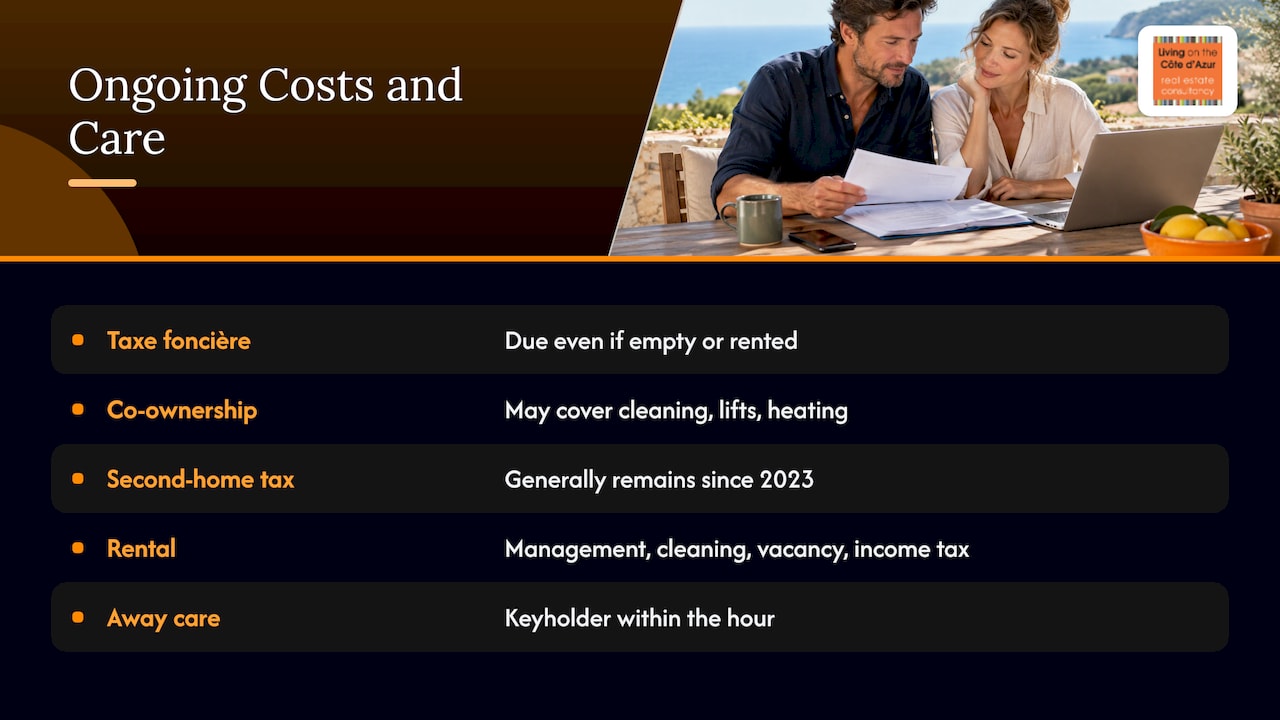
To keep the home running when you are away, plan these four things early: a keyholder who can be at the property within the hour, a maintenance schedule for pool, garden and roof, a way to receive and pay French bills, and someone who understands French and home-country tax filings. Our guide to maintenance of your villa on the French Riviera goes into detail.
Our perspective
Most buyers who come to us first fall in love with a view, and then discover that the market is far bigger and far less visible than a portal suggests. On the Riviera, the same villa can reach you through three different channels at three different asking prices, and some homes never get advertised at all.
That is why we work only for the buyer. We are an independent international buyer agent: we do not have our own listings to push, so we search the entire market through local agents, developers and off-market contacts, and we compare honestly. Our Dutch way of working is personal, transparent and efficient. You know what is happening at each stage, and who is doing what.
A second home should add ease to your life, not a second job. That is why we also stay with you beyond the viewing: negotiating, coordinating with the notaire, and connecting you with mortgage brokers, tax advisers, architects and renovation specialists when you need them. Choose the person who will guide you as carefully as you would choose the house.
Ab Kuijer
How we help you buy
We guide international clients throughout the journey: defining the search, sourcing and comparing properties, arranging viewings, negotiating and coordinating the purchase through to the notaire. Our buyer broker service is 2%, and you can read the details on our full-service page. If you want to see how an agent changes the search, our guide to using a buyer’s agent is a good place to start. When you are ready to talk about your own second home, send us an enquiry through our website with your area, budget and how you want to use the home.
FAQ
Can I buy a second home in the South of France if I do not live in France?
Yes. The French Senate confirmed in 2025 that no general law bars foreign nationals from buying French real estate, and your residence status does not affect ownership. The notaire will review your personal circumstances, such as nationality and marital regime, because French law governs the purchase.
Do I have to travel to France to sign?
Not necessarily. Overseas buyers can sign in person, give a power of attorney to a representative, or sign remotely where the notarial arrangements permit. Your notaire will confirm which option applies to your case.
How much should I budget on top of the purchase price?
Allow for transfer taxes (generally about 5% of the price at the departmental rate, more once other charges are added), notaire remuneration and disbursements, and possibly agency commission. Ask the notaire for a written estimate before you make an offer, and keep a reserve for furniture, works and the first year’s running costs.
Is it hard to get a French mortgage as a non-resident?
It is usually harder than for residents, and many second-home buyers use cash or finance in their home country. If you want French finance, speak to a mortgage broker early so the lender’s terms are set before you search. We can introduce trusted brokers.
Which taxes will I pay each year?
Taxe foncière is paid by the owner every year, and taxe d’habitation generally applies to second homes, sometimes with a local surcharge. Higher-value holdings may be subject to IFI, and renting out the home brings French rental-income tax. A tax adviser familiar with both France and your home country can set this out for your situation.
Sources
- Achat immobilier en France par un étranger, French Senate
- Purchase in France by a non-resident, Notaires de France
- What to know about buying a second home in the Riviera and Provence, The Local
- What you can and cannot do as a non-resident in France, The Local
- Buy French Property from Abroad, French Notaires
- Acte de vente d’un logement existant, Justice.fr
- J’achète un logement, Service-Public.fr
- Ingénierie notariale et analyse précontractuelle, Congrès des Notaires
- Essential checks before buying property in France, Connexion France
- How to Buy Well in France: Due Diligence, Surveys and Planning Checks, FrenchEntrée
- Buying a Secondary Residence in France, American Bar Association
- French Second Home Mortgages for UK and International Buyers, French Finance
- French Property Holding Costs Guide, French Notaires
- French Property Taxes: Taxe d’Habitation and Taxe Foncière, FrenchEntrée
Recommended
 //