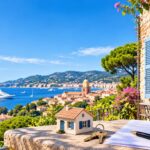
A century ago, artists, writers, and affluent families came here to enjoy the French Riviera. Today, tucked behind the verdant hills of Grimaud, lie some of the most exclusive villas in the Gulf of Saint-Tropez. Yet, the story of Beauvallon-Bartole runs much deeper than mere real estate.
Driving along the coast from Sainte-Maxime toward Port Grimaud, one might easily overlook Beauvallon. Hidden behind pine trees, umbrella pines, and meticulously landscaped gardens lie impressive villas—some offering panoramic views over the Bay of Saint-Tropez, others tucked discreetly away on expansive private estates.
There is no bustling promenade here, lined with the storefronts of international luxury brands; no throngs of tourists hunting for glimpses of celebrities. In Beauvallon-Bartole, luxury manifests itself precisely through what remains unseen.
And that is exactly what has made this unique enclave so alluring for more than a century.
When the Côte d’Azur Was Still a Secret
The story begins in the early twentieth century, as the French Riviera gradually transformed from a collection of fishing villages and winter retreats into an international destination for the wealthy elite.
Around 1912, an ambitious plan took shape in Beauvallon: the creation of an exclusive resort featuring a golf course, a luxury hotel, and elegant villas. The historic hotel opened its doors in 1914.
During the 1920s, Beauvallon acquired its distinctive character. Beginning in 1925, entrepreneurs Émile and Edmond Bernheim further developed the area into a prestigious residential enclave of villas. Their vision was remarkably modern. Beauvallon was not intended to be merely a collection of holiday homes, but rather an environment where nature, architecture, sport, and culture converged.
The golf course served as a key social hub. The hotel attracted an international clientele, while the villas offered exactly what affluent families were looking for: space, tranquility, sunshine, and a certain degree of seclusion from the outside world.
Writers, artists, and the beau monde
Beauvallon cultivated a cultural reputation that extended well beyond the Gulf of Saint-Tropez.
Among its historical visitors were the French writer Colette and the American novelist F. Scott Fitzgerald.
Fitzgerald, best known for The Great Gatsby, was one of the writers who imbued the sophisticated lifestyle of the 1920s with an almost mythical status. His name evokes images of champagne, jazz, elegant parties, and a generation that celebrated the freedoms of the interwar period.
His association with Beauvallon is entirely in keeping with the cultural climate of that era—though it should be noted that he did not own a villa there, nor did he reside there permanently.
Artists and architects also found their way to the estate. The Bernheim family, with their keen interest in progressive art and architecture, gave designers the creative freedom to realize exceptional residences.
In this way, Beauvallon became not only a meeting place for the affluent, but also a small-scale laboratory for modern architecture.
A hidden museum of modern architecture
To view Beauvallon solely as an upscale residential area of luxury villas is to overlook perhaps its most compelling feature.
In 1928, the architect Pierre Chareau designed the Villa Vent d’Aval here—a modernist residence that was later granted status as a protected historical monument. Chareau is internationally renowned for the Maison de Verre in Paris, one of the most famous private residences of the twentieth century.
The golf course’s historic clubhouse was also designed by Chareau, in collaboration with the Dutch architect Bernard Bijvoet.
Decades later, another architectural highlight emerged: the 1961 Villa La Seynave, designed by Jean Prouvé. With its industrial materials, innovative construction, and expansive glass surfaces, the villa represents a vision of living that stands in stark contrast to the traditional Provençal bastides.
And as if that were not remarkable enough, Beauvallon later became home to an international architectural pavilion by Toyo Ito and Cecil Balmond—a structure originally designed for the Serpentine Gallery in London in 2002.
It is a striking concentration of architectural history in a location that remains relatively unknown to the general public.
From historic villas to multi-million-euro residences
A century after its initial development, Beauvallon-Bartole continues to exert a unique appeal.
The hills above the coast offer, in several locations, spectacular views across the Gulf of Saint-Tropez. From certain terraces, the bay unfolds like a painting, with the port of Saint-Tropez visible on the opposite side.
In 2026, properties in the new development Les Villas de Beauvallon were offered with asking prices ranging from approximately 5.6 to 7.8 million euros. These are spacious, modern villas featuring private swimming pools and generous outdoor areas.
Existing villas are also listed for millions of euros. Their final value depends heavily on factors such as location, views, privacy, plot size, and the quality of the property itself.
However, Beauvallon-Bartole is not merely a collection of ultra-modern, multi-million-euro homes. The area also encompasses older villas, Mediterranean-style residences, and architecturally distinctive houses from various eras.
It is precisely this diversity that makes it so attractive.
The luxury of invisibility
Saint-Tropez is known for its famous port, designer boutiques, and beach clubs. Beauvallon offers a different kind of affluence.
Here, luxury is less about being seen and more about the ability to live undisturbed.
Expansive gardens, long driveways, natural vegetation, and the sheltered positioning of many of the homes create a profound sense of seclusion. Moreover, some residential areas have private access and management arrangements.
This makes Beauvallon attractive to those who appreciate being close to Saint-Tropez, yet prefer not to be constantly in the midst of the hustle and bustle.
The area is situated on the northern side of the Gulf of Saint-Tropez, within the municipality of Grimaud and close to Sainte-Maxime. It thus combines a tranquil residential setting with access to beaches, golf, restaurants, and water sports.
Looking across the bay toward Saint-Tropez, one sees the glamour; living in Beauvallon allows one to enjoy that glamour without necessarily being a part of it.
A historic luxury hotel finds new life
One of the most significant developments is the revival of the historic Beauvallon hotel.
Following a long period of closure, the hotel reopened in 2026 under the name COMO Le Beauvallon.
This restores an international luxury destination to a key component of the original development plan.
It is almost as if history has come full circle: what began over a century ago as an exclusive retreat for the international elite has taken on a new purpose in the twenty-first century.
While the architecture, the setting, and the landscape have evolved, the area’s inherent appeal remains unmistakable.
The other side of Saint-Tropez¬
Perhaps this is the greatest secret of Beauvallon-Bartole.
While Saint-Tropez has become a global symbol of overt glamour, Beauvallon represents a quieter tradition of luxury.
It is a tradition that began with visionary entrepreneurs, writers, artists, and architects. And which lives on today in distinctive residences, expansive gardens, and one of the most beautiful panoramas overlooking the Gulf of Saint-Tropez.
Beauvallon-Bartole is not a place you happen upon by chance.
It is a place you have to know about.
Beauvallon: A Name That Can Cause Confusion
One of the most confusing aspects of buying property in Beauvallon is that several distinct residential estates share the Beauvallon name, although they differ considerably in location, facilities, ownership structure and annual maintenance fees.
The historic Domaine de Beauvallon, developed around the golf course in the 1920s, should not be confused with Domaine Beauvallon-Bartole, a predominantly residential hillside area known for its spacious villas, privacy and panoramic sea views.
Meanwhile, Les Parcs de Beauvallon offers a more resort-style lifestyle, with advertised facilities including private beach access, tennis courts, a communal swimming pool and security. Annual service charges here can reach approximately €14,400–€15,600, compared with around €1,000 for certain properties in Beauvallon-Bartole.
Adding to the confusion, Les Rives de Beauvallon, Les Domaines de Beauvallon and Les Résidences du Golf form part of a separate, interconnected condominium structure, with different management arrangements and potentially overlapping service charges.
Other names, such as Les Hauts de Beauvallon and Les Coteaux de Bartole, refer to additional residential areas or developments.
For international property buyers, understanding these distinctions is essential. Two villas advertised simply as being located in “Beauvallon, Grimaud” may offer completely different lifestyles, facilities and ongoing ownership costs.
As an independent buyer’s agent we can help identify the exact estate, verify its legal structure and clarify which amenities and financial obligations are actually included in the purchase. You can browse our first selection of properties for sale in Grimaud. Or ask for a personal selection, including off-market villas.
 //