
The best neighbourhood in Nice depends on how you will use the home. Mont Boron suits buyers who want sea views and quiet. Cimiez suits families who want green space and space indoors. The Carré d’Or and the Old Town suit those who want to walk everywhere. The Port suits buyers who like a working harbour and a good price-to-lifestyle ratio. Below, we compare them the way we do with our own clients, with current price context, the trade-offs, and the checks that matter before you sign.
We are an independent buyer agent on the French Riviera. We work for the buyer, not for a seller’s portfolio, so we can tell you where a neighbourhood disappoints as well as where it shines. If you want to browse while you read, our page of villas and apartments for sale in Nice shows what is on the market.
TL;DR
- Mont Boron is the prestige address: villas, sea views and the highest price per square metre in the city. Cimiez offers elegant, leafy hills and more space for the money.
- Carré d’Or, Promenade des Anglais and the Old Town are the walkable, apartment-led choices, strong for lock-up-and-leave second homes.
- Prices vary widely: PAP’s October 2026 data puts Mont Boron around 9,946 €/m² and Carras around 4,311 €/m².
- Before you fall for a street, check flood mapping, the building’s condition and the conditions suspensives in your compromis.
- A buyer agent in France is paid through commission shared by the selling agency, so for you the service costs nothing extra to retain.
Table of Contents
- How to read Nice before you pick a neighbourhood
- Nice neighbourhoods at a glance
- Mont Boron: the prestige hill
- Cimiez: green, spacious and family-minded
- Carré d’Or and the Promenade des Anglais
- The Old Town and the Port: character first
- Musiciens, Thiers and Fabron: practical choices
- Carras and the west: where the budget stretches
- Climate and flood risk: a check every buyer should make
- Our perspective: choose the street, not just the name
- How we help you buy in Nice
- Before you sign: the French purchase process in short
- Matching your profile to a neighbourhood
- FAQ
- Sources
How to read Nice before you pick a neighbourhood
Nice is France’s fifth-largest city by reputation and the Riviera’s real urban centre, but it behaves like a collection of villages. The seafront, the hills and the river valley of the Paillon each have a different pace, noise level and price. Two apartments with identical floor areas can differ by tens of per cent depending on which side of a hill they sit.
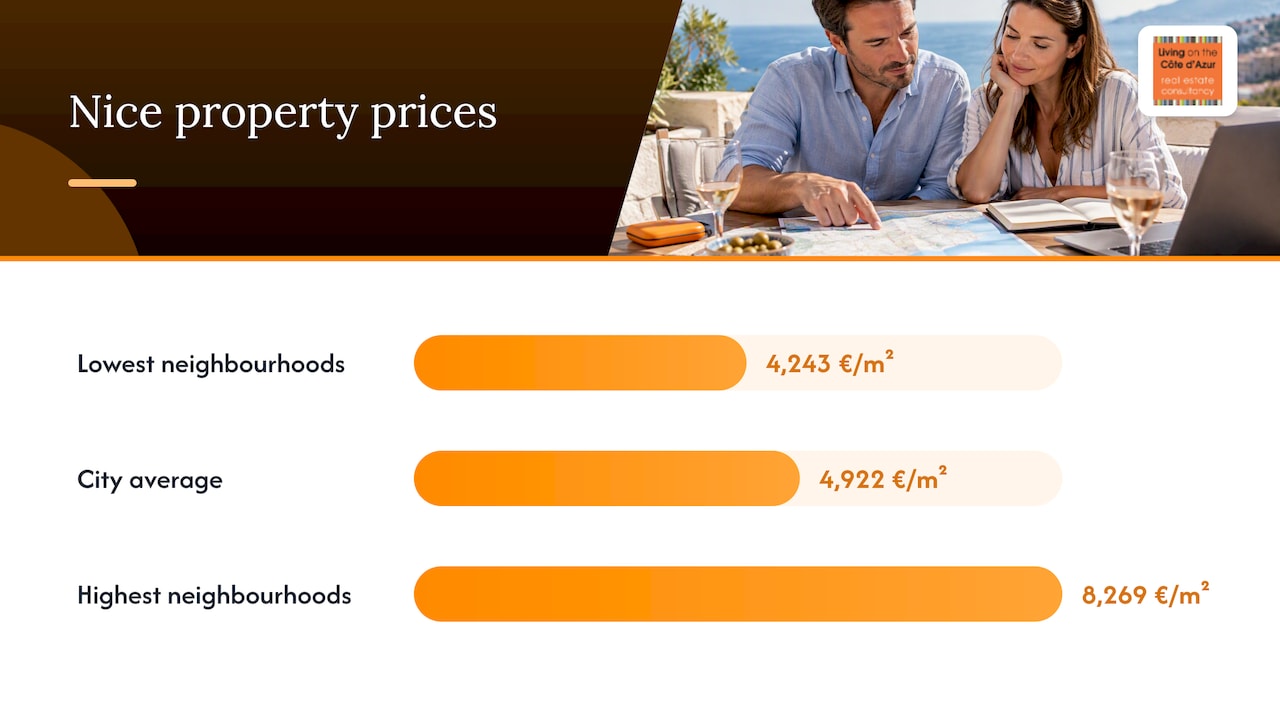
The city-wide average gives you a baseline. According to PAP, using DVF transaction data and PAP listings as of 1 October 2026, the average price in Nice is 4,922 €/m², with the lowest neighbourhoods around 4,243 €/m² and the highest around 8,269 €/m² on that page’s city-level range. Treat any such figure as a starting point. A sea-view top-floor flat in a good building can sit far above an average, and a ground-floor flat facing a courtyard far below it.
When we first walk a new client through Nice, we ask four questions before we mention a single street:
- Will you live here all year, or lock up and leave for months?
- Do you need a car, or do you want to manage on foot, tram and bus?
- Is a terrace or garden essential, or is a view enough?
- Is this purely for enjoyment, or must it also work as a rental or a store of value?
The answers usually narrow the field to two or three areas within minutes.
Nice neighbourhoods at a glance
| Neighbourhood | Character | Typical property | Best for |
|---|---|---|---|
| Mont Boron | Wooded hill, sea views, villas | Villas, large apartments in residences | Prestige buyers, privacy, views |
| Cimiez | Leafy, residential, belle époque and modern | Period apartments, villas, residences with gardens | Families, long-term living |
| Carré d’Or | Central, shopping streets, near the sea | Haussmann-style and period apartments | Walkable second homes |
| Promenade des Anglais | Seafront, open horizon | Apartments, many with sea views | Sea-view lovers, lock-up-and-leave |
| Old Town (Vieux-Nice) | Markets, narrow streets, nightlife | Small apartments, often characterful | Atmosphere seekers, small budgets |
| Port and Riquier | Harbour, cafés, local life | Apartments, some renovation projects | Value-minded buyers wanting character |
| Musiciens and Thiers | Urban, close to the station | Apartments, good transport | Practical city living, investors |
| Fabron and western hills | Quiet, villa-style, space | Villas, apartments with gardens | Families, calm |
| Carras and the west | More affordable, newer stock | Apartments in modern buildings | Budget-focused buyers |
This table is our editorial summary of the areas, not a ranking from a data source. Use it to shortlist, then test each area on foot.
Mont Boron: the prestige hill
Mont Boron is where many international buyers begin, and for good reason. The hill rises east of the Old Town and the Port, wooded with pines, with villas and residences that look over the Baie des Anges and, in places, Villefranche-sur-Mer. It is quiet, green and close enough to the centre that you can reach the Port by bike or a short drive.
The price reflects it. PAP’s October 2026 figures show Mont Boron among the most expensive districts in the city, with a median around 9,946 €/m². That is more than double the figure for Carras.
Advantages
- Sea views and a sense of space rare inside a major city.
- Villas and residences with gardens, pools or terraces.
- Quiet streets, with the Port and beaches close by.
Disadvantages
- The highest entry price in Nice.
- Steep roads: you will want a car, or accept some climbing.
- Fewer shops and restaurants on your doorstep than in the centre.
Who we see buying here: buyers with a large budget who want a villa feel without leaving Nice, and those thinking of the home as a long-term family asset. Because the best houses here often change hands quietly, a search that covers off-market contacts matters more than in the centre.
Cimiez: green, spacious and family-minded
Cimiez sits on the hill north of the centre. It is the area we suggest when a family says they want a calmer Nice with room for children, a garden or a proper guest bedroom. You find grand period residences, modern buildings with pools and communal gardens, and a good amount of open green space.
The trade-off is distance from the sea. You will not stroll to the beach after breakfast. You will, however, usually get more interior space and outdoor space per euro than on the seafront, and a different, more residential rhythm.
What to check in Cimiez
- The age and condition of larger residences: charges (copropriété fees) can be significant for buildings with pools, lifts and gardens.
- Orientation and views, which vary enormously from one building to the next.
- Your daily route: Nice’s bus network has been improving, and the city says a high-level-service bus line has operated since October 2024, but test your own commute at rush hour.
For buyers relocating from abroad and enrolling children in school, Cimiez and the hills around it are often where our searches start, though you should always verify catchment and school availability directly with the school or the town hall before committing to an address.
Carré d’Or and the Promenade des Anglais
The Carré d’Or is the heart of old-money Nice commerce: boutiques, cafés, and a short walk to the sea. Apartments tend to be period buildings with high ceilings and balconies, and the appeal is simple. You can live without a car.
The Promenade des Anglais is the postcard: the long seafront with the bay in front of you. Apartments here are among the most coveted in the city when they have an open sea view, and noise from traffic and summer crowds is the price you pay.
Why buyers choose this zone
- Walkable life: market, restaurants, tram, beach.
- Strong demand from both owner-occupiers and renters.
- A genuine urban Mediterranean lifestyle rather than a resort bubble.
What to weigh
- Noise, especially on lower floors and street-facing balconies.
- Lifts, façade works and shared charges in older buildings.
- If you plan to rent short-term, check the building rules and the city’s current regulations first. Rules in French cities can change, so confirm them at the town hall before you buy with rental income in mind. Our guide on tax on rental income in France covers the tax side.
The Old Town and the Port: character first
Vieux-Nice is the Nice most visitors fall in love with: ochre façades, the flower and produce market on Cours Saleya, tiny squares and long lunches. Many apartments are small, with beams, vaulted ceilings and little light. If you love it, you love it deeply, and a pied-à-terre here can be a joy.
The practicalities deserve an honest look. Streets can be loud late at night, lifts are rare, and older buildings may need serious work. Our advice is to see an apartment on a Friday evening and again on a Sunday morning before deciding.
The Port and Riquier, just to the east, offer a more local feel. Fishermen and boats, cafés on Place Île de Beauté, and a mix of residents who actually live here year-round. Some buildings are in need of renovation, which can mean value for a buyer prepared to manage a project. If that appeals, our team can connect you with renovation specialists and architects as part of the purchase.
Musiciens, Thiers and Fabron: practical choices
The Musiciens quarter and Thiers, near the main railway station, are urban and practical. You get tram and train access, a regular local population and, generally, more modest prices than the seafront. They suit buyers who prioritise transport links or want an investment flat for long-term letting, rather than a showpiece.
Fabron and the western hills offer a calmer, villa-style living, with more space and a quieter backdrop while still being within Nice. They tend to appeal to families who want a garden without moving out to Mougins or Saint-Paul-de-Vence. If you are weighing Nice against its neighbours, remember that the airport is on the western side of the city, which is useful for frequent flyers but worth checking for aircraft noise on a given street.
Carras and the west: where the budget stretches
Carras, in the west, shows how far prices can differ. PAP’s data puts it around 4,311 €/m², about 57% below Mont Boron’s median on the same page. You often find newer buildings, lifts, parking and balconies, but less of the old-town charm. It is a sensible choice if you want a Nice address, a solid layout and a lower entry price, and if you do not need to walk to the Promenade each morning.
Climate and flood risk: a check every buyer should make
Nice is dramatic geography: hills dropping to a bay, and river valleys running through the city. That is beautiful, and it also means that heavy rain can cause problems. The city’s own page on flood risk explains that city-centre streets and valleys can flood from runoff, and that several parts of the commune can be affected.
Practical steps:
- Ask your agent or the notaire for the flood-risk information for the specific address.
- Cross-check against the municipality’s flood mapping before an offer, particularly for ground-floor flats, garages and basements.
- Look at the building: drainage, car park access, and how water runs on the street.
The city is also preparing a climate plan for 2026 to 2032, which is worth reading if you are an eco-conscious buyer thinking about the next 20 years.
Our perspective: choose the street, not just the name
After years of walking buyers through Nice, we keep seeing the same pattern. Clients arrive with a neighbourhood name in mind, often because a friend or a magazine mentioned it. Then they walk three streets and change their mind.
Here is what we believe. A neighbourhood label tells you very little about a specific apartment. Floor, orientation, building condition, charges and the noise on the street matter at least as much as the district. A well-chosen flat in a quieter district often beats an average flat in a famous one, and that is true at every budget.
The second thing is that the market is not only what you see on the portals. Because we are independent and search the whole market through local agents, developers and off-market contacts, we can show you a Mont Boron villa and a Cimiez apartment side by side, and tell you honestly which one is better value for your plans. We do not have a shop window to fill.
The third thing: be clear about the purpose. A second home you will use six weeks a year is a different brief to a family relocation. The first can tolerate a fourth-floor walk-up in the Old Town because it is a joy. The second cannot.
— Ab Kuijer
How we help you buy in Nice
We are an independent international buyer agent. We define the search with you, source and compare properties across the whole market, arrange viewings, negotiate, and coordinate the purchase through to the notaire. When you need them, we connect you with mortgage brokers, tax advisers, notaries, architects and renovation specialists.
Our site lists a 2% fee for both the buyer broker service and for higher segment searches. Our model is commission-sharing with the selling agent, so retaining us does not add a fee to your side. If you already know your neighbourhoods and want us to do the legwork, our search mandate is the simplest way to start. To discuss a Nice shortlist, send us an enquiry through the Living on the Côte d’Azur site and tell us your budget, timing and how you plan to use the home.
For more on the apartment side, read our tips for buying an apartment in Nice.
Before you sign: the French purchase process in short
The order of events in France surprises many international buyers.
- Offer and compromis de vente. After your offer is accepted, you sign a preliminary contract. ANIL, the national housing information agency, says non-professional buyers have a 10-day cooling-off period after the first notification of the signed contract, and advises treating the compromis as a firm commitment.
- Conditions suspensives. These protect you if, for example, your financing falls through. ANIL recommends having a professional draft the contract and making sure these conditions are stated clearly. See our guide to conditions suspensives.
- Acte authentique. Ownership transfers only when you sign the final deed at the notary’s office. Do not take possession or start renovations before then.
Our legal process guide walks through each stage, and our overview of buying a property in France is a good place to begin if you are new to it.
Tax points for non-residents
If you do not live in France, the tax rules are different. The French tax authority states that capital gains on French property sold by non-residents are taxed at 19%, plus social levies of 17.2% in the cases it describes, and that the social levy rate differs for some residents of the EU, EEA and Switzerland and for furnished rental profits. Rates and reliefs change, so confirm your own position with a tax adviser before you buy. Our French property tax guide and capital gain tax page give more background.
Matching your profile to a neighbourhood
- Second-home buyer, lock-up-and-leave: Carré d’Or, Promenade des Anglais, or the Port. Lifts, a concierge and low-maintenance interiors matter more than square metres.
- Family relocating: Cimiez, Fabron and the western hills. Look at space, schools and the commute.
- Prestige and privacy: Mont Boron. Expect to pay for it, and expect to use a car.
- Investor: Musiciens, Thiers and central areas with steady rental demand, subject to your own tax and regulatory checks.
- Value hunter: Carras and the west, or a Port apartment that needs work.
- Buying from abroad: work with someone who can view for you and coordinate the notaire. We explain this in our guide to purchasing property on the Côte d’Azur from abroad.
FAQ
What is the most expensive neighbourhood in Nice?
Mont Boron is generally the most expensive, with a median of about 9,946 €/m² in PAP’s October 2026 data. Individual properties vary a great deal with view, floor and condition, so use this as a guide only.
Which Nice neighbourhood is best for a family?
Cimiez, Fabron and the western hills are the usual starting points because they offer more space and a calmer setting. Check school catchments directly with the school or town hall, and test the daily commute before you commit.
Is it better to buy in the Old Town or near the Promenade des Anglais?
It depends on your tolerance for noise and your need for light. The Old Town gives atmosphere and often smaller, older apartments. The Promenade area gives views and more conventional buildings. We recommend viewing both at different times of day.
Do I have to pay a buyer agent in France?
Our model is commission-sharing with the selling agent, so our buyer agent services are free to the buyer. Fees and arrangements differ between agents, so always get the terms in writing before you start.
Should I worry about flooding in Nice?
It is a check, not a reason to avoid the city. The municipality publishes information on flood risk, and you should cross-reference the specific address, especially for ground-floor and basement spaces.
Sources
- PAP: Prix m² Nice (06) par quartiers
- ANIL: Acheter un logement ancien
- Ville de Nice: Le risque d’inondation
- Ville de Nice: Le Plan Climat
- Ville de Nice: Mobilités
- impots.gouv.fr: Selling property, tax arrangements and rate
Recommended
 //