
There is no single best type of investment property. The right choice depends on your capital, your appetite for risk and how much time you want to spend managing the asset, and the honest answer changes depending on which of those three variables matters most to you. A hands-off investor with modest capital tends to do better with REITs or managed funds, while someone with a moderate capital amount and a Saturday to spare might build steady income through a single buy-to-let. An active investor comfortable with renovation risk can do very well with a fix-and-flip project, and those seeking scale eventually gravitate toward multi-family blocks or industrial units. At the top of the market, families protecting generational wealth often look beyond their home postcode entirely, toward properties on the Côte d’Azur or in Ibiza, where lifestyle and long-term value preservation matter as much as yield.
Here is the shortlist, matched to investor type:
- Hands-off, lower capital: REITs, property funds or crowdfunding platforms
- Moderate capital, steady income seeker: Single buy-to-let or a small multi-family property
- Active investor, comfortable with risk: BRR (buy, refurbish, refinance) or fix-and-flip
- Scale-focused or institutional-minded: Multi-family blocks, industrial units or mixed-use assets
- Wealth preservation, lifestyle-led: Luxury overseas property in established markets such as the Côte d’Azur
| Investor goal | Best-suited property type |
|---|---|
| Passive income with minimal effort | REITs or property funds |
| Reliable monthly cash flow | Buy-to-let or small multi-family |
| Fast capital growth via active work | BRR or flipping |
| Long-term wealth preservation | Luxury overseas real estate |
| Portfolio scale and diversification | Multi-family, industrial or mixed-use |
Pro Tip: Match the property type to your available hours, not just your available capital. An HMO can outperform a REIT allocation on paper, but only if you actually have the time to manage tenants and licensing, but only if you actually have the time to manage tenants and licensing.
Official guidance from Gov and rent data from the Office for National Statistics both confirm what experienced buyers already know: location and structure change the maths more than the property type itself.
Key Takeaways
The best type of investment property depends on matching your capital, risk tolerance and available time to the return engine and management burden each strategy demands.
| Point | Details |
|---|---|
| No universal answer | Investor profile, not property type alone, determines the right fit for capital and risk tolerance. |
| Match strategy to engine | Rental income, capital growth and trading profit carry different timing and risk. |
| Location drives returns | Regional wage and rent growth, tracked by the ONS, shape long-term outcomes more than property type. |
| Passive routes trade control for ease | REITs and funds offer liquidity but less say over individual assets. |
| Overseas luxury suits legacy goals | Living On The Cote d’Azur helps buyers structure cross-border purchases for wealth preservation, not just yield. |
Table of Contents
- How do property investments actually make money?
- Which residential strategy suits your capital and time?
- Are commercial or specialist properties worth the extra complexity?
- Should you invest directly or through REITs and funds?
- How do you choose the right property type for your goals?
- What market and tax factors change the outcome?
- What does a luxury overseas investment actually look like?
- Where should you actually start?
- How Living On The Cote d’Azur supports overseas property investors
- Sources
- FAQ
How do property investments actually make money?
Every property investment earns money through one of three engines: rental income, capital growth, or trading profit. Understanding which engine a strategy leans on tells you almost everything about its risk profile and time horizon.
Rental income is money collected from tenants, month after month, whether that tenant is a family in a semi-detached house or a retailer paying a commercial lease. Capital growth is the increase in the property’s resale value over time, driven by local demand, infrastructure and scarcity. Trading profit is the margin made from buying, improving and selling within a short window, the model behind flipping and much of the BRR strategy.
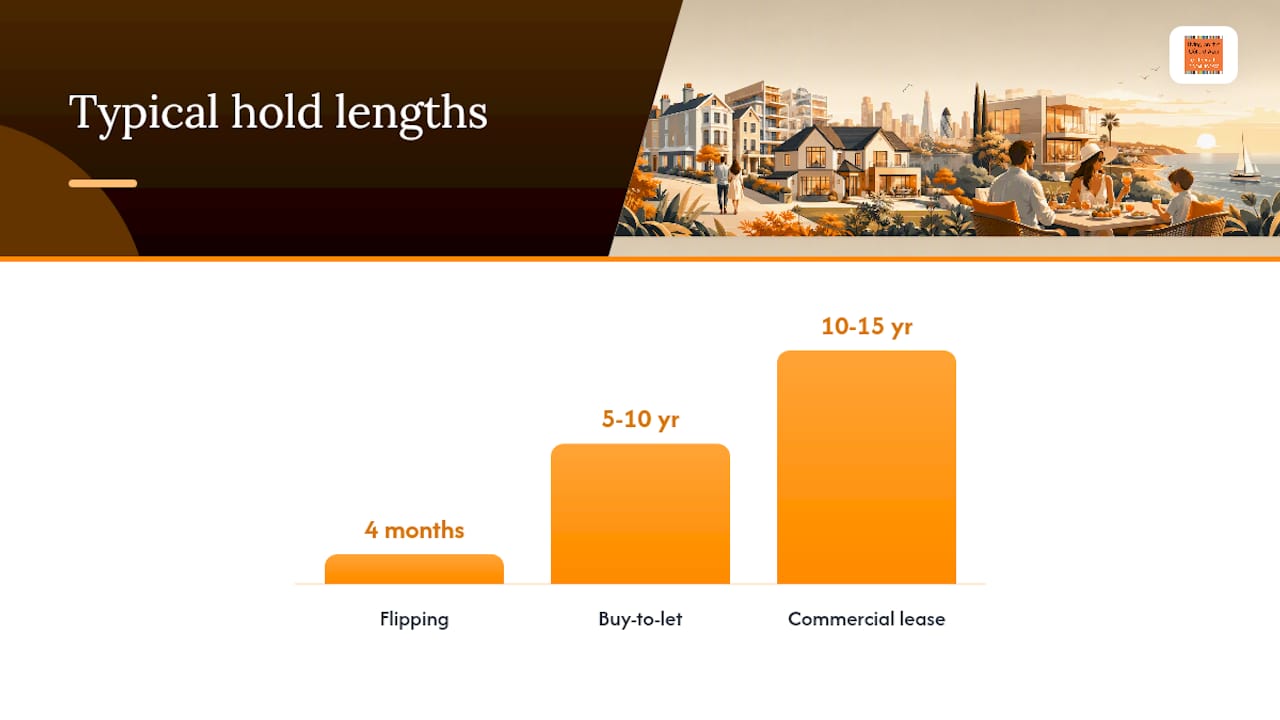
Residential property typically blends the first two: a landlord collects rent while hoping the asset appreciates over a five to ten year hold. Commercial property leans harder on the lease itself, since a 10 or 15 year lease to a corporate tenant behaves more like a bond than a speculative asset. Flipping ignores both rental income and long-term growth entirely and bets purely on execution speed and renovation margin.
- A landlord who buys a two-bedroom flat for rental income accepts lower monthly returns in exchange for lower volatility and a mortgage that a tenant effectively services.
- A flipper who buys a run-down terrace, refurbishes it in four months and sells accepts higher risk and higher potential reward, with no rental income cushion if the market turns before the sale completes.
Leverage complicates all three engines. Borrowing to buy amplifies capital growth when prices rise, but it also amplifies losses when they fall, and refinancing risk becomes real the moment interest rates move against you mid-project.
Which residential strategy suits your capital and time?
Residential property remains the entry point for most UK investors, but “residential” covers wildly different risk and effort levels. Here is how the main subtypes compare.
Single buy-to-let
Buying one flat or house and letting it to a single tenant or family is the simplest residential strategy, and it makes money almost entirely through rental income plus modest long-term appreciation. It typically requires the smallest deposit of any direct-ownership strategy, usually 25% or more under standard buy-to-let mortgage terms, and management intensity is low if you use a letting agent.
- Pros: Straightforward to finance, easy to sell, minimal specialist knowledge required.
- Cons: Yields are often squeezed by mortgage costs, and a single void period hits your cash flow hard because there is no other tenant to absorb it.
Multi-family property
A small block of flats or a purpose-built multi-unit property spreads risk across several tenants under one roof. If one unit sits empty, the others keep paying the mortgage.
- Pros: More resilient cash flow, economies of scale on maintenance and management.
- Cons: Requires more capital upfront, commercial-style mortgage terms in many cases, and a steeper learning curve on compliance.
HMO (house in multiple occupation)
Renting individual rooms within a single property to unrelated tenants can produce noticeably higher gross rental income than a standard single-family let, because you’re charging per room rather than per unit. But HMOs in the UK carry specific licensing obligations that vary by local authority, and non-compliance can mean fines or an inability to evict.
- Pros: Higher rental yield potential, resilient to individual tenant turnover.
- Cons: Licensing and safety compliance burden, higher tenant management intensity, more wear and tear on shared spaces.
Red flag callout: Any HMO deal where the seller hasn’t disclosed the licence status, or where the local authority operates an Article 4 direction restricting HMO conversions, deserves extra scrutiny before you exchange contracts.
BRR (buy, refurbish, refinance) and fix-and-flip
Both strategies use trading profit or forced appreciation as the primary return engine, rather than patient rental income. BRR investors buy under market value, add value through renovation, then refinance to pull capital back out while keeping the property as a long-term rental. Flippers do the same renovation work but sell immediately rather than refinancing.
- Pros: Fastest route to capital growth if you have renovation expertise or trusted contractors; BRR in particular can let you recycle deposit capital into a second deal.
- Cons: Highly sensitive to build cost overruns, planning delays and refinancing valuations coming in lower than projected. When interest rates rise mid-project, the exit maths can fall apart even if the renovation itself goes to plan.
If the deal still works at that lower number, you have genuine margin for error.*
New build and off-plan
Buying directly from a developer, sometimes before construction finishes, can secure a discount to eventual market value and newer, lower-maintenance stock. It works differently to the strategies above because the return depends heavily on the developer completing on time and the local market absorbing new supply without oversupply dragging down prices.
- Pros: Lower maintenance costs early on, potential price appreciation between reservation and completion.
- Cons: Construction delays, snagging issues, and a real risk that comparable new stock nearby depresses your resale value.
Across all of these, ONS data on private rents and house prices shows how sharply returns vary by region. A property in a market with strong wage growth and constrained supply tends to outperform an identical property in a stagnant regional market, regardless of which residential strategy you pick.
Are commercial or specialist properties worth the extra complexity?
Commercial and specialist assets play by different rules to residential property, and they generally suit investors with larger capital bases and a higher tolerance for lease-driven income structures.

Office space earns income through longer commercial leases, often five to fifteen years, frequently structured as NNN (triple net) agreements where the tenant covers insurance, maintenance and property tax on top of rent. That structure appeals to investors who want bond-like predictability, but office assets have faced real headwinds since hybrid working reduced demand for floor space in many cities.
Retail units depend heavily on footfall and tenant covenant strength. A unit let to a national chain on a long lease is a very different risk to a unit let to an independent trader on a rolling agreement, even if the rent looks identical on paper.
Industrial and logistics property, including warehouses and last-mile distribution units, has become one of the more resilient specialist categories as online retail has grown. Leases tend to run long, tenants are often well-capitalised, and vacancy cycles can be shorter than in retail.
Student housing offers near-guaranteed demand in university towns, with income often secured through parental guarantees, but it comes with seasonal void risk over summer and higher turnover-related management costs each year.
Senior housing and care-adjacent property benefits from demographic tailwinds but usually demands specialist operational knowledge or a management contract with an experienced operator, since the tenant base has different needs to a standard residential let.
Serviced accommodation and holiday lets monetise through nightly or weekly rates rather than a fixed lease, which can produce strong gross income in tourist hotspots but brings genuine regulatory exposure. London’s municipal guidance on short-term and holiday lets sets out registration and planning requirements that catch out investors who assume a flat can simply be listed on a booking platform without checks. ONS figures on short-term lets through online platforms show how concentrated and seasonal this market can be, which matters when you’re relying on peak-season income to cover a full year of mortgage payments.
- Pros across specialist categories: Longer income certainty (offices, industrial, student), demographic tailwinds (senior housing), or high gross yield potential (holiday lets).
- Cons across specialist categories: Higher capital thresholds, specialist management requirements, and in the case of holiday lets, meaningful regulatory and licensing risk that varies significantly by local authority.
Pro Tip: Before buying anywhere with ambitions of running a holiday let, check whether the local authority operates an Article 4 direction or a separate short-let registration scheme, since planning rules on changing property use can quietly block your entire business model.
Should you invest directly or through REITs and funds?
Not everyone wants to manage tenants, chase contractors or field 11pm calls about a burst pipe. Passive routes exist precisely for that reason, and they trade some upside for meaningfully less effort.
- REITs (property investment trusts): Highly liquid, tradeable daily like shares, low minimum investment, but returns move with stock market sentiment as much as with underlying property fundamentals.
- Property funds: Slightly less liquid than REITs, often with quarterly or monthly dealing windows, offering exposure to a diversified pool of assets without direct ownership headaches.
- Crowdfunding platforms: Lower minimum capital than buying a whole property, access to specific deals including commercial or development projects, but typically far less liquid, with your capital locked in until the project or platform allows an exit.
- Fractional ownership: Similar principle to crowdfunding, letting you own a slice of a specific asset, often illiquid until a sale event is triggered.
The trade-off is consistent across all four: greater liquidity and lower effort generally comes with less control over the specific asset and, often, thinner net returns after platform or fund fees. Direct ownership of a single property gives you control over refurbishment, tenant selection and timing of sale, but locks up substantially more capital in one illiquid asset.
Funds and crowdfunding tend to make more sense when you want diversification across many properties without saving a full deposit for each one, or when you want exposure to an asset class, such as large-scale logistics or student housing portfolios, that would otherwise be out of reach for an individual buyer.
How do you choose the right property type for your goals?
Turning this comparison into an actual decision comes down to running through a short, disciplined checklist before you commit capital.
- Define your primary goal. Are you chasing monthly income, long-term capital growth, or a hybrid of both, and over what time horizon?
- Quantify your real capital and financing options. Know your deposit, your borrowing capacity, and whether you’re using a standard mortgage, a commercial facility, or cash.
- Estimate your realistic management bandwidth. Be honest about how many hours a month you can give to tenant queries, licensing paperwork or renovation oversight.
- Choose a target holding period. A five-year hold suits different property types to a fifteen-year hold, particularly around refinancing and exit costs.
- Run a simple cash flow test on any specific deal, including a vacancy allowance and a stress-tested interest rate.
Before committing, stress-test the numbers with a few direct questions: What happens to cash flow if the property sits empty for three months? What happens if mortgage rates rise by two percentage points at renewal? What is the realistic contingency budget if a major repair, such as a roof or a boiler, comes up in year two? Seasoned investors also treat any seller-provided income projection with real caution, checking it against trailing twelve-month accounts rather than a forward-looking best-case scenario, and assuming running costs will creep up faster than rents over time.
Watch for these red flags: a seller’s pro-forma that assumes zero vacancy, a licensing or planning issue that hasn’t been fully disclosed, or a local area with stagnant wage growth that can’t realistically support future rent increases. If you want a structured walk-through of the search process itself, our guide to finding a property with a static budget and an open mind covers the practical negotiation side of this checklist.
What market and tax factors change the outcome?
Interest rates shape returns more than almost any other single variable. When rates rise, the same property with the same rent produces less net cash flow, and refinancing a BRR project at a higher rate than you modelled can erase the margin you were counting on. Rather than waiting for rates to fall, many experienced investors simply adjust their offer price so the deal still works at today’s cost of borrowing.
Tax treatment varies by structure and jurisdiction, and it changes the real return on paper yield significantly. UK landlords should read the official gov.uk guidance on tax relief changes for residential landlords before assuming mortgage interest is fully deductible, since relief rules have shifted in recent years. HMO investors need to confirm local licensing requirements before exchange, not after. And anyone eyeing holiday lets should check municipal short-let guidance for registration and planning obligations that differ sharply between local authorities.
Before purchase, obtain: proof of any existing licences, trailing twelve-month rent and expense accounts, planning history including any Article 4 directions, and confirmation of leasehold or freehold status where relevant.
What does a luxury overseas investment actually look like?
A family office client approached Living On The Cote d’Azur seeking wealth preservation rather than headline yield: a legacy property in a market with durable long-term demand, low political risk, and genuine lifestyle value the family would actually use. They chose a villa near Cap d’Ail, prioritising long-term value stability over rental income, with the property serving both as an occasional family residence and a slow-appreciating asset held for the next generation.
Overseas luxury purchases carry their own checklist, distinct from a domestic buy-to-let:
- Local property and wealth taxes, which differ significantly by country and sometimes by region
- Inheritance rules, where a holding structure such as an SCI can materially change succession outcomes for French property
- Financing options for non-resident buyers, which are often more limited than domestic mortgages
- Local schools and lifestyle infrastructure, relevant for families considering partial relocation
Pro Tip: Never assume your home country’s inheritance rules apply abroad. French succession law, for example, treats property very differently depending on whether it’s held personally or through an SCI, so get this structured before you buy, not after.
Living On The Cote d’Azur supports buyers through this exact process, combining buyer-agent sourcing with legal audits, tax structuring guidance and renovation coordination, drawing on relationships built across Nice, Cannes, Antibes and Saint-Tropez over many years of local dealmaking.
Where should you actually start?
Most readers overthink the property type and underthink their own bandwidth. My recommendation is simple: run the checklist above against your actual capital and available hours before you fall in love with a specific strategy or postcode. Shortlist one or two property types, then model a conservative, stress-tested case for each rather than the seller’s best-case numbers.
From there, take three concrete steps: confirm your financing capacity with a lender, research licensing or planning rules for your chosen local authority, and speak to someone with genuine on-the-ground experience in your target market before committing capital. Living On The Cote d’Azur’s experience with cross-border luxury buyers illustrates why local knowledge, not just spreadsheet returns, often decides whether a purchase actually performs.
How Living On The Cote d’Azur supports overseas property investors
If you’ve read this far and landed on luxury overseas property as your best fit, the practical challenge shifts from “which type” to “how do I actually execute this from another country.” That’s where a dedicated buyer-agent service earns its place. Living On The Cote d’Azur gives investors direct access to over 100,000 listings across the Côte d’Azur, Monaco, Ibiza, Portugal and Dubai, including off-market opportunities that never reach public portals.
Beyond sourcing, the team coordinates legal audits, tax structuring, financing introductions and renovation management, so a cross-border purchase doesn’t stall on unfamiliar paperwork or local red tape. If wealth preservation or a legacy purchase is your goal, explore our range of luxury investment options on the Côte d’Azur or get in touch for a tailored feasibility review of a specific property or region. Other routes exist, from domestic funds to solo overseas searches, but few match the combination of local network and structured support Living On The Cote d’Azur brings to a first cross-border purchase.
Sources
- Real estate investments with the most profit potential (SmartAsset)
- Gov
- Private rents and house prices, UK: September 2024 (ONS)
- London
FAQ
What type of property is best to invest in?
There is no single best type; a hands-off investor with modest capital often suits REITs, while active investors with more capital and time tend to do better with buy-to-let, multi-family or BRR projects, and wealth-focused buyers often look at overseas luxury property.
What creates most millionaires through property?
Long-term ownership of appreciating assets, often residential rental property held over many years, tends to build wealth more reliably than short-term trading, since patient capital growth combined with rental income compounds steadily.
What is the 2% rule for property?
The 2% rule is a rough screening guide suggesting monthly rental income should equal roughly 2% of the purchase price for a deal to be worth deeper analysis, though it’s a starting filter rather than a guarantee of profitability.
What are the top investments to consider alongside property?
Alongside direct property, REITs and diversified property funds are widely used to spread risk and add liquidity, while equities and pensions remain the other common pillars of a balanced long-term portfolio.
Is buy-to-let still worth it for UK investors?
Buy-to-let remains viable where local rent growth and tenant demand are strong, though tax relief changes mean returns should always be modelled after mortgage interest and other allowable deductions, not on gross rent alone.
How much capital do I need to start investing in property?
Direct ownership typically requires a deposit of 25% or more for buy-to-let mortgages, while REITs, funds or crowdfunding platforms allow far smaller starting amounts for investors wanting exposure without a full deposit.
Is overseas luxury property a good investment for wealth preservation?
For buyers prioritising legacy and long-term value stability over rental yield, established overseas markets can suit that goal well, provided local tax, inheritance and financing rules are properly structured in advance, which is where firms like Living On The Cote d’Azur add genuine value.
What’s the biggest risk across most property investment types?
Overestimating rental income or resale value while underestimating vacancy, interest rate rises and maintenance costs is the most common cause of underperformance, regardless of which property type you choose.
Recommended
 //
//