
Foreigners can buy new-build property in North Cyprus, but only after the authorities grant permission to purchase, and the real risk sits in two places: the status of the land beneath the building and the way a developer’s payment plan is written. Get those two right and the rest is paperwork. Get them wrong and a sunny Kyrenia apartment can become an expensive lesson.
We are an independent buyer agent, so we work for the buyer and not for the developer. Most of our work is on the French Riviera, but our clients regularly ask us to look at other Mediterranean markets, North Cyprus among them. This guide is how we would walk a friend through it: what is different from buying in France or the Republic of Cyprus, what to check, and where to slow down.
TL;DR
- Foreign buyers need prior permission from the TRNC authorities before a purchase can be completed, applied for through the Interior Ministry’s immovable property unit.
- Title is the central question. The Republic of Cyprus government warns against buying property that belonged to displaced Greek Cypriots, and other countries’ courts may enforce judgments against assets held outside Cyprus.
- Rules changed in 2025 and 2026, including deadlines, project limits and residence-permit conditions. Have a lawyer confirm the current text on the day you sign.
- Off-plan means paying in stages. Protect yourself with a lawyer, a clean land history and a contract that matches what is actually being built.
Table of Contents
- Why buyers look at North Cyprus new builds
- Can foreigners buy property in North Cyprus?
- The question that matters most: title and the “Cyprus problem”
- The buying process, step by step
- What changed in 2025 and 2026
- Taxes and costs to budget for
- Off-plan payment plans: where the risk sits
- Residency, living there and the long game
- Financing, resale and exit
- How it compares with the French Riviera
- Our perspective
- Working with us
- A short checklist before you pay a deposit
- FAQ
- Sources
Why buyers look at North Cyprus new builds
The appeal is easy to understand. Sea, mountains and a Mediterranean pace of life, with Kyrenia and the north coast the favourite for foreign buyers. Developers offer modern apartments and villas with pools, often sold off-plan with instalments during construction, and the price per square metre has traditionally sat well below the French Riviera.

We will not quote prices here. Asking prices vary widely by location, build quality and developer, and any figure we printed would be out of date quickly. What we would say is that a low headline price tells you nothing until you know the land status, the build specification, the taxes on top and who carries the risk if the project stalls.
The reasons people give us for looking are familiar to anyone who has considered a second home in France:
- A winter-sun base, closer to home than they expected.
- A lower entry ticket than the Riviera for a sea-view apartment.
- A holiday-let or long-term rental idea, which deserves more scepticism than brochures give it.
- A retirement plan, which makes residency rules matter more than the price.
The last two deserve a hard look. Resale liquidity, financing and legal recognition all work differently here than in France, and we cover them below.
Can foreigners buy property in North Cyprus?
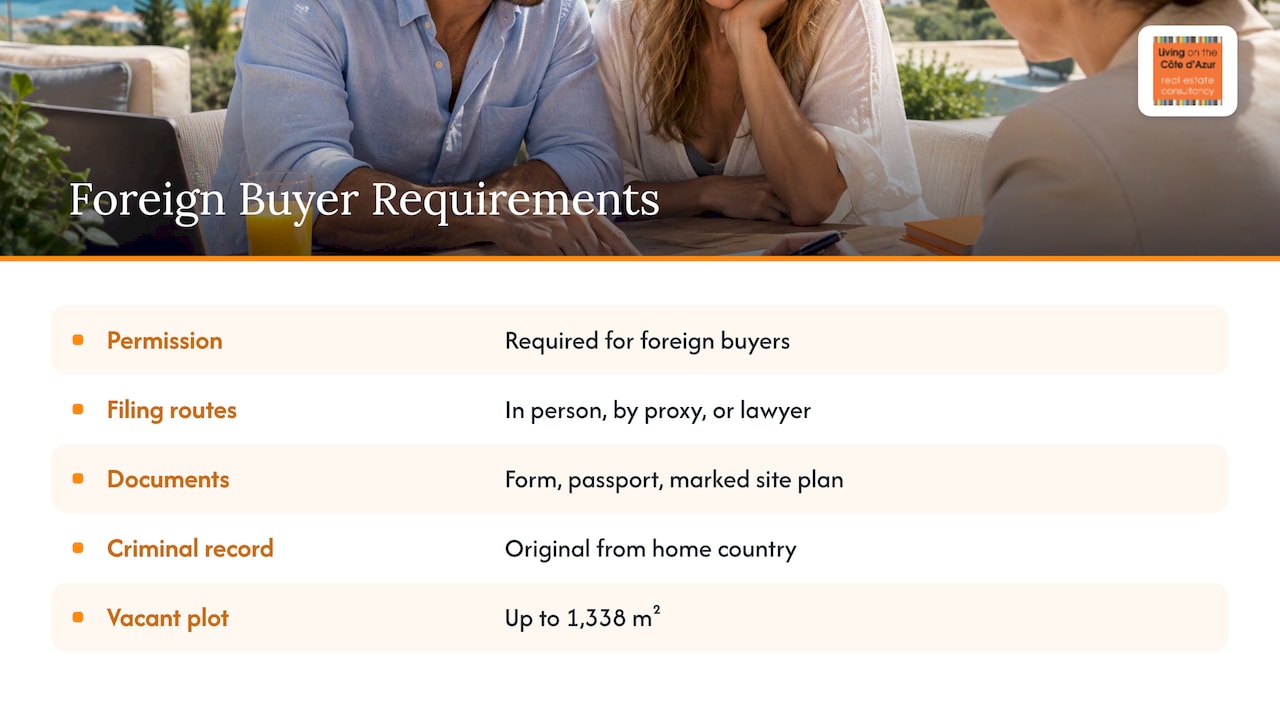
Yes, with permission. The Interior Ministry explains that foreign nationals buying immovable property must apply for approval, and the application can be filed in person, by proxy or through a lawyer, according to the TRNC e-government page on acquiring property as a foreigner. The ministry’s list of required documents includes a completed information form, a copy of your passport, a site plan with the plot marked, a copy of the contract if one exists, and an original criminal record certificate from your home country.
That last item catches people out. Start requesting the certificate early, because it has to be an original from your own country, and check with your lawyer whether it needs legalising or translating.
There are also limits on how much a foreign buyer may own. A law firm’s published guide to property transactions in North Cyprus states that non-TRNC citizens may buy one of several alternatives, including a single vacant plot of up to 1,338 m². Rules for flats, villas and multiple units differ, and they have been amended more than once, so ask your lawyer for the figure that applies to your nationality and property type today.
The question that matters most: title and the “Cyprus problem”
This is the part brochures skip, and the part we would want explained to us before any deposit.
Since 1974 the island has been divided. A great deal of land in the north was owned by Greek Cypriots who were displaced. The Republic of Cyprus Ministry of Foreign Affairs warns foreign citizens against buying Greek Cypriot owned property in the north, pointing to possible civil and criminal consequences. Its separate page on property in the occupied area describes a 2006 criminal code amendment covering buying, selling or promoting such property without the owner’s permission.
The practical consequence for a buyer is that judgments from Republic of Cyprus courts may be enforced against assets you hold in EU member states. The Apostolides v. Orams case is the one lawyers cite. If you own a home in France, Spain or elsewhere in the EU, that is not an abstract point.
So a new-build is not automatically “safe” because it is new. A modern building can stand on land with a contested history. Before you pay anything, your independent lawyer should:
- Trace the ownership history of the plot back as far as the records allow, not just the developer’s own paperwork.
- Confirm whether the land was ever registered to a Greek Cypriot owner.
- Check the status of the title deed, and whether it is in the developer’s name or a landowner’s.
- Confirm planning and construction permits for the specific building.
- Tell you in writing what remains unresolved.
If a seller waves this away, treat that as information about the seller.
The buying process, step by step
The sequence below is the general shape. Details vary by developer and lawyer, and the rules have been moving, so treat it as a map and not as legal advice.
- Define the brief. Location, budget, whether you want to live there, rent it or both, and how long you plan to hold.
- Shortlist projects and developers. Look at completed projects, not renderings. Visit, speak to existing owners and ask whether their title deeds have actually been issued.
- Appoint your own lawyer. Not the developer’s recommended one. Your lawyer works for you alone.
- Reserve, then review the contract. A small reservation deposit should buy you time to do due diligence, with clear terms on refund.
- Sign the sales contract. It should name the exact unit, specification, completion date, payment schedule and penalties for delay.
- Apply for permission to purchase. Your lawyer files the application and documents with the Interior Ministry’s property unit.
- Pay taxes and fees within the deadlines. More on this below.
- Receive keys and title. On completion, the title deed is transferred to you, or, where it is not yet possible, you receive whatever interim document the law provides.
A caution on contracts. Market commentary on the 2025 to 2026 changes says contracts now have to be registered within short timeframes. Whatever the exact figure, the point is that you cannot sign, put it in a drawer and think about it later.
What changed in 2025 and 2026
North Cyprus has been tightening its rules on foreign purchases. We would not rely on any one commentator for the details, and neither should you, but the direction of travel is consistent across the sources we reviewed:
- An official gazette dated 14 November 2025 introduced updated regulations for foreign acquisitions, as reported by local agents.
- A 2026 decree-law has been reported to add several new concepts, among them a certificate allowing a buyer to sell or transfer before full title registration, a definition of what counts as an “investment”, and a cap on the share of units in a new project that can be sold to foreigners. Reports put that cap at 80%.
- Reports also say that build-and-sell housing projects may not count as “investment” under the new definitions, which matters if a developer markets a unit as qualifying for special treatment.
We cannot verify the final legal text here, and some of what we saw comes from sellers with a stake in the market. That is exactly why you ask your lawyer to quote the current provision, with the date, in writing. If a developer says “the new rules do not affect this project”, ask for the reason on paper.
One point from the reports is worth acting on regardless: administrative deadlines are being enforced. Agents describe a window of roughly 75 working days after publication of the permit for paying taxes and fees, with automatic cancellation of the permission if missed. Confirm the exact window with your lawyer and diarise it. Missing it is the kind of error that is hard to fix afterwards.
Taxes and costs to budget for
Several taxes and fees sit on top of the contract price. Commonly quoted figures for non-TRNC buyers include a land registry transfer fee of around 9% and VAT on new builds at reduced rates that depend on the size of the property, with legal, stamp duty and utility connection costs on top. These are figures repeated by agents and have changed before, so please treat them as a prompt for questions and not as a quote.
Ask the developer and your lawyer for a written cost schedule covering:
- Who pays VAT, and whether the quoted price includes it.
- The transfer fee and when it falls due.
- Stamp duty on the contract.
- Legal fees, and whether they are fixed or a percentage.
- Water, electricity and any developer-imposed fees for connections and common areas.
- Annual property and service charges after completion.
Also ask what currency the contract is in and how payments are converted. Many projects are priced in sterling or euros, and an exchange-rate movement during a two-year build can shift your real cost.
Off-plan payment plans: where the risk sits
Most new builds in the north are sold before or during construction, with a deposit, instalments and a final payment on completion. That is normal in many markets. In this one it puts extra weight on the developer.
Before committing, we would check:
- Track record. How many projects has the developer actually finished, and can you visit them and speak to owners?
- Land and permits. Is the plot in the developer’s name, and are building permits in place for the project you are being sold?
- The contract. Does it fix a completion date, specification and remedy for delay, or does it leave these vague?
- Payment protection. What happens to your stage payments if the project stalls? Ask your lawyer exactly where your money sits and what claim you would have.
- Title deed timing. Some buyers wait a long time for the deed after moving in. Ask what the developer commits to and what it costs you if the deed is delayed.
And a plain rule: never pay a large sum on the strength of a showroom visit and a sales presentation, and never accept the seller’s lawyer as your own.
Residency, living there and the long game
Owning in North Cyprus can lead to a residence permit, but it is not automatic and not a one-time event. The Immigration Department’s page on residence permits linked to property ownership (in Turkish) says foreign owners may be granted one-year permits for the first three years, and then two-year permits if they hold the title deed in their own name. It also expects suitable housing for residence.
Market reports add that proof of income relative to the minimum wage is now part of the picture. Again, ask your lawyer or the Immigration Department for the current requirement before you plan a move around it.
If you plan to live there, also think about:
- Healthcare and how you would be covered, which is a separate decision from the property.
- Travel. Most international flights to the north route through Turkey, so check your own journey times rather than relying on a brochure.
- Schools, if you have children, and whether the options suit your family.
- The practical side of a home that is empty for part of the year: management, utilities and insurance.
Financing, resale and exit
Treat this as a cash-purchase market unless a lawyer tells you otherwise. Lending by international banks against North Cyprus property is limited, and developer instalment plans are the usual form of financing. That affects everything from your negotiating position to your exit.
On exit, think before you buy about who your future buyer is. A foreign buyer will also need permission, and the same title questions will be asked of you. A clean paper trail, a title deed in your name and a documented purchase are what make a resale smooth. The reported certificate allowing sale before full title registration may help in some cases, but it is only as good as the paperwork behind it.
For the same reason, we would be cautious with rental yield projections. Seasonal demand, management fees and licensing all eat into the headline figure. Ask for actual occupancy and income statements from owners in the same building.
How it compares with the French Riviera
This is the comparison we are asked for most, so here it is plainly.
| North Cyprus new-build | French Riviera new-build | |
|---|---|---|
| Legal recognition of title | Disputed internationally, central due-diligence question | Fully recognised, notarised transfer |
| Foreign buyer permission | Required, with deadlines | Not required for most foreign buyers |
| Buyer protection on off-plan | Depends heavily on the contract and developer | A regulated off-plan sale framework with staged payments |
| Financing | Limited, often cash or developer plan | French and international mortgages available |
| Resale market | Narrower, more specialised | Deep, international |
| Price per square metre | Generally lower | Among the highest in Europe |
The French off-plan framework is described on our own pages about buying new construction on the French Riviera from abroad and purchasing property in the Côte d’Azur from outside France. We are not saying one is right and the other wrong. The two markets answer different questions, and an honest comparison starts with what you need the property to do.
Our perspective
We are a buyer agent, which means we are paid to be sceptical on your behalf. When a client asks us about North Cyprus, our first conversation is rarely about the apartment. It is about what they want the property for, how much legal uncertainty they can live with, and whether they hold other assets in the EU that a title dispute could touch.
For some buyers, the answer is that the price advantage is worth it, as long as the land history is documented and the developer has finished comparable projects. For others, especially families with property in France or elsewhere in Europe and a plan to leave an inheritance, a fully recognised title is worth paying more for, and we say so. We would rather lose an enquiry than have you discover a title problem after the final instalment.
Our approach is the same wherever we search: define the brief, look at the whole market and not one developer’s stock, bring in independent lawyers and tax advisers, and negotiate on your side. You can read how we think about the North Cyprus market in our own foreign buyers’ guide to buying property in North Cyprus and see properties in the area through our Kyrenia listings archive.
— Ab Kuijer
Working with us
If you are weighing a North Cyprus new-build against a Riviera apartment, or want a second opinion on a project you have been offered, we can help you set the brief and test the options. We represent you, not the seller, and we coordinate with independent lawyers, tax advisers and other specialists as your purchase needs them. See how our buyer agent and full-service approach works, or send us your enquiry with your budget, timeline and what you want the property to do for you.
A short checklist before you pay a deposit
- You have your own lawyer, with no ties to the developer.
- The land history is traced and documented, with the Greek Cypriot ownership question answered in writing.
- The developer has finished comparable projects and you have visited them.
- The contract names the unit, specification, completion date and remedies for delay.
- You have a written schedule of every tax and fee, with deadlines.
- You have your criminal record certificate request under way.
- You know how you would sell, and to whom.
- You have checked the current rules, dated, with your lawyer.
FAQ
Is it safe to buy a house in North Cyprus?
Many people buy and enjoy homes there, but “safe” depends on the land and the contract. The Republic of Cyprus government warns about property formerly owned by Greek Cypriots, so independent title checks are essential. Use your own lawyer and keep the paperwork complete.
Can a foreigner buy property without permission?
No. Foreign nationals must apply to the TRNC authorities for permission before the purchase can be completed, and the application needs documents including an original criminal record certificate from your home country. Deadlines for paying taxes and fees apply afterwards, so ask your lawyer to confirm the dates.
Does buying a new-build give me a residence permit?
Not automatically. Property ownership can support a residence application, with one-year permits in the first three years according to the Immigration Department, but income and housing conditions apply and the rules have been changing. Check the current requirements before you plan a move.
Is a new-build safer than a resale in North Cyprus?
Not by itself. A new building can still stand on land with a disputed history, and off-plan adds developer risk. What makes either safer is a documented land history, a sound contract and a lawyer acting only for you.
Sources
- TRNC e-government: acquiring property as a foreigner
- Interior Ministry: documents for permission to buy property
- Republic of Cyprus Ministry of Foreign Affairs: legal consequences for foreign buyers
- Republic of Cyprus Ministry of Foreign Affairs: property in the occupied area
- TRNC Immigration Department: residence permit linked to property
Recommended
 //