
Ibiza remains a desirable market for international buyers, but only if you confirm licences and planning status before you commit. The island’s charm is real, and so are its legal complications: a property without a valid tourist rental licence or with unresolved rural planning issues can turn a dream purchase into a costly headache. Our first piece of advice is simple: instruct a Pitiüses based lawyer and gather your NIE and proof of funds before you fall in love with a particular villa.
TL;DR:
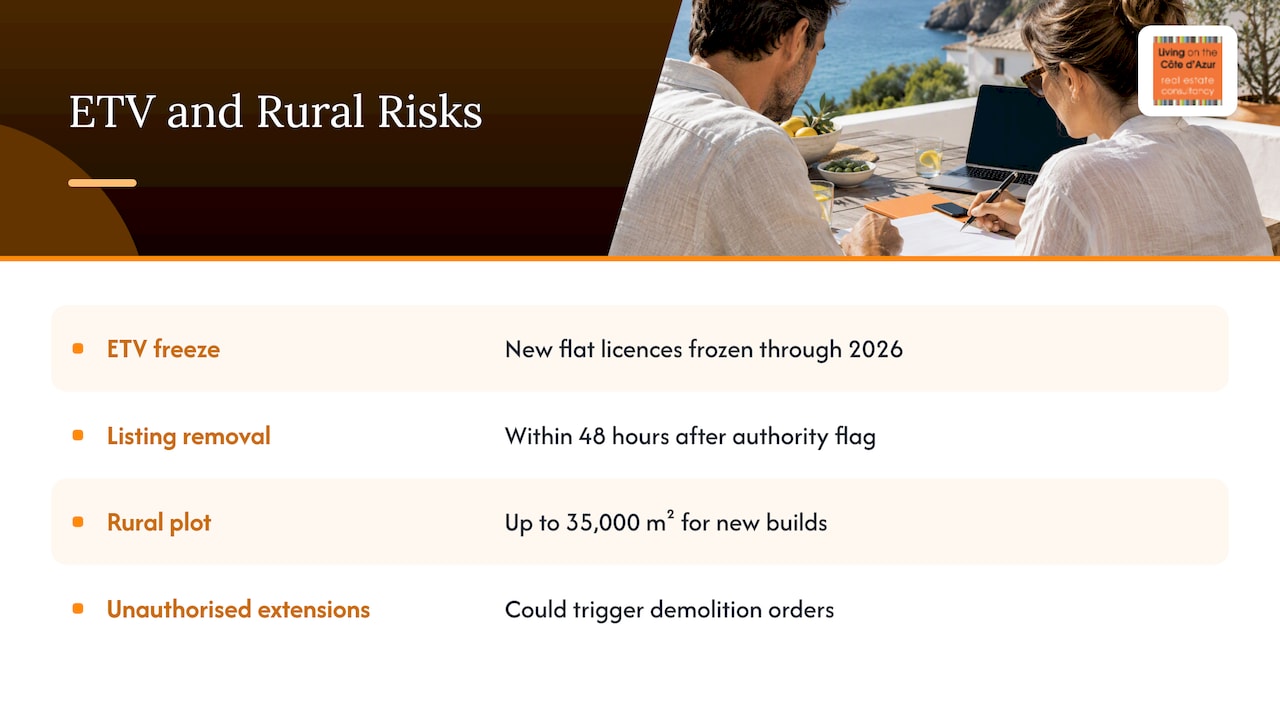
- New licences for flats remain frozen through 2026, while transferable ETV licences command a 20% to 40% premium; verify status with Consell d’Eivissa.
- Nonresident buyers typically receive 60% to 70% loan to value, while island appraisals may fall 8% to 15% below the agreed price.
- Some municipalities require plots of up to 35,000 square meters before new construction, and older country homes may contain unauthorized additions or lack occupancy certificates.
- Before paying a reservation deposit, have a local lawyer review title, planning, habitability, and claimed rental licences, verifying each against official records.
Table of Contents
- Snapshot of the 2026 Ibiza market and who is buying now
- Which parts of Ibiza suit which buyer
- Step by step: how international buyers actually purchase in Ibiza
- Taxes and costs to budget for
- ETV licences, the moratorium and the rural build trap
- What non-resident buyers should expect from Spanish banks
- A due diligence checklist before you pay arras
- How an independent buyer agent helps you navigate Ibiza’s market
- When to buy now, and when to wait
- Let us handle the search and the risk checks for you
- FAQ
- Sources
Snapshot of the 2026 Ibiza market and who is buying now
Foreign buyers continue to drive the upper end of the Ibiza market, drawn by the island’s mix of cosmopolitan nightlife, quiet countryside and Mediterranean coastline. Supply, however, is tight, and not simply because Ibiza is small. Licence moratoria on tourist rentals and strict rural planning limits mean the pipeline of new, fully compliant stock barely grows year on year.
Prices have risen over recent years, and properties with a valid, transferable tourist rental licence (ETV) now command a clear premium over otherwise comparable homes without one. According to Buvivo’s 2026 buyer guide, properties with an active transferable ETV licence trade at a 20 to 40% premium over similar unlicensed properties, a gap that reflects just how scarce legal rental rights have become.
A few patterns stand out for anyone weighing up where the real opportunities sit:
- Finished, licence-ready homes near Ibiza Town and the south coast attract the fiercest competition.
- Renovation projects, particularly fincas with potential but no current licence, often represent better value than chasing a fashionable postcode.
- Buyers who understand the licence and planning landscape tend to negotiate from a position of strength, since many sellers cannot fully explain their own property’s status.
Which parts of Ibiza suit which buyer
Ibiza is not one market. Each area has its own rhythm, and matching your lifestyle priorities to the right spot matters as much as the property itself.
- Ibiza Town (Eivissa): marinas, restaurants and walkable charm, ideal for buyers who want urban convenience alongside sea views and short runs to the airport.
- South coast (Vista Alegre, Es Cubells, Cala Jondal): privacy, dramatic cliffside plots and direct seafront access, a favourite with buyers seeking discretion over proximity to nightlife.
- West coast (San Antonio and surrounds): the island’s liveliest strip, better suited to buyers who want energy on their doorstep rather than seclusion.
- North and centre (San Juan, Santa Gertrudis, Morna Valley): quieter, greener and dotted with traditional fincas, popular with families and those drawn to a slower pace.
Formentera deserves a separate mention. Supply there is even more limited than on Ibiza, and purchase dynamics differ enough that treating it as a simple extension of the Ibiza market tends to mislead buyers rather than help them.
Coastal protection rules also shape what you can and cannot do with seafront land. Spain’s servidumbre de protección de costas restricts building and renovation within a protected strip along the shoreline, and several south coast and west coast plots fall within or close to this zone. Checking this early, through the certificado de costas, avoids discovering a planning restriction after you have already committed funds.
Step by step: how international buyers actually purchase in Ibiza
The process rewards preparation, and engaging a NYC real estate attorney for international buyers can help navigate cross-border ownership complexities. Buyers who arrive with paperwork in order move faster and negotiate from a stronger position.
- Secure your NIE and a Spanish bank account well before you start viewing, since nearly every later step depends on both.
- Arrange proof of funds or mortgage pre-approval, particularly important given how tight non-resident lending criteria can be on the island.
- Make an offer and sign a reservation or arras contract, which typically involves a deposit and should include clauses protecting you if due diligence later reveals a problem.
- Complete due diligence before signing anything binding, covering legal title, planning status and technical condition rather than relying on the seller’s summary.
- Sign before a notary, pay the applicable transfer taxes, and register the property at the Land Registry to finalise ownership.
Our guide to the property buying process in Ibiza walks through each of these stages in more depth, including the documents your lawyer will request at each point.
Pro Tip: Never pay a reservation deposit until your lawyer has reviewed the nota simple and confirmed the property’s licence and planning status in writing.
Taxes and costs to budget for
Purchase taxes in Ibiza depend on whether you are buying a resale or a new build, and the bands matter more here than on the mainland. The Balearic tax authority set island-specific thresholds in 2026 that raise the value limit used for certain reduced ITP and AJD rates on Ibiza and Formentera to just under €380,000, according to ATIB’s 2026 order. Resale properties are subject to Impuesto de Transmisiones Patrimoniales (ITP) on a progressive scale, while new builds carry IVA plus Actos Jurídicos Documentados (AJD) instead.
Beyond the headline tax, budget for several recurring transactional costs:
- Notary and Land Registry fees, which scale with the declared property value.
- Lawyer’s fees, typically charged as a percentage of the purchase price for full due diligence and completion support.
- Agency commission, usually paid by the seller rather than the buyer under standard market practice.
Once you own the property, ongoing costs include Impuesto sobre Bienes Inmuebles (IBI, the local property tax), non-resident income tax if the home is used for part of the year, and, depending on your overall Spanish asset position, wealth tax considerations. Ownership structure (personal name, company or trust) affects several of these, so it is worth settling that question with a tax adviser before completion rather than after.
ETV licences, the moratorium and the rural build trap
The tourist rental licence question sits at the heart of nearly every Ibiza purchase involving a holiday let. New ETV licences for flats in multi-unit buildings have been frozen since 2022, and that freeze has been extended and renewed through 2026, which is exactly why existing transferable licences carry such a premium, as Buvivo’s guide sets out. Verifying a licence means checking the ETV resolution itself and confirming its status directly with the Consell d’Eivissa, not simply taking a seller’s word for it.
Enforcement is active rather than theoretical. Platforms remove listings without a valid licence number within 48 hours once authorities flag them, which can wipe out projected rental income overnight for a buyer who underwrote the purchase on the assumption of a licence that never materialises.
Rural properties bring a different set of risks. Minimum plot size rules (unidad mínima de cultivo) can require up to 35,000 square metres before new construction is permitted in some municipalities, and older fincas sometimes carry unauthorised extensions that could trigger demolition orders.
Pro Tip: Treat any rural property without a confirmed cédula de habitabilidad as a renovation project, not a ready home, until an independent architect’s report says otherwise.
What non-resident buyers should expect from Spanish banks
Financing in Ibiza follows the general Spanish non-resident pattern, with a few local quirks worth planning around.
- Expect loan-to-value ratios of roughly 60 to 70% for non-residents, meaning a substantial cash contribution is standard rather than exceptional.
- Bank appraisals on Ibiza properties can come in 8 to 15% below the agreed purchase price, a gap that has caught out buyers who assumed their mortgage would simply track the sale price.
- Build a cash cushion into your budget from the outset, and treat pre-approval as a starting point rather than a guarantee once a formal valuation is carried out.
Our separate piece on securing financing across the Riviera and Ibiza covers how to plan around this 60 to 70% LTV range in more practical detail.
A due diligence checklist before you pay arras
Before any deposit changes hands, your lawyer should have gathered and reviewed the following:
- The nota simple confirming registered ownership and any charges against the property.
- The certificado urbanístico setting out the property’s planning classification and permitted uses.
- The cédula de habitabilidad, confirming the home meets habitability standards.
- ETV documentation, where a rental licence is claimed, verified independently with the Consell.
- The certificado de costas, where the property sits near the coastline, to rule out protection zone restrictions.
- IBI receipts, confirming local taxes are paid and up to date.
For rural properties, commission an independent architect’s report to reconcile the cadastral footprint against the certificado urbanístico, a step specialist legal guides recommend precisely because unauthorised structures are common on older fincas. A winter visit, away from the summer gloss, often reveals far more about a property and its neighbourhood than a viewing in August ever will.
How an independent buyer agent helps you navigate Ibiza’s market
Buyer-only representation changes the dynamic of a purchase like this. Rather than relying on a seller’s agent to flag licence gaps or planning risks, we work exclusively for you, searching across the whole market, including off-market stock that never reaches a portal.
- We coordinate the local specialists you need: lawyer, mortgage broker and architect, so nothing falls between the cracks.
- We carry support through from the first search brief to notary completion, rather than handing you off once an offer is accepted.
- Our founder, Ab Kuijer, built this approach around the same transparent, buyer-first working style we apply across the French Riviera, Monaco and now Ibiza.
As one insider guide to buying in Ibiza puts it, the agents who hand you the highest valuation are rarely the ones acting in your interest. The best value, that same guide notes, usually comes from a well-chosen renovation project rather than a search for an undervalued postcode, which is exactly the kind of opportunity buyer-side representation is built to find. You can read more about why working with a buyer agent changes the outcome of a purchase like this.
When to buy now, and when to wait
Buy when the licence status and planning position are verified and due diligence is clean. If either is still unclear, pause rather than push forward on optimism. A pause is not wasted time: use it to instruct a local lawyer and keep an eye on how the ETV pipeline develops over the coming months. Either way, the next move is the same: get the paperwork moving before you get attached to a particular address.
— Ab Kuijer
Let us handle the search and the risk checks for you
We represent buyers, which means our focus on an Ibiza purchase is protecting your interests, from licence verification through to the notary table. We search broadly through a network of local agents and developers, including some properties that do not reach public listings.
An initial engagement starts with a short call to understand what you are looking for, followed by a written brief and a shortlist drawn from across our network rather than one agency’s own stock. From there we assist with coordinating viewings and negotiation, and with connecting you with local specialists your purchase may require. If Ibiza’s licence and planning rules feel complex, a buyer agent service can help guide you through the process. Get in touch through our search mandate page to start the conversation.
FAQ
What is the 2% rule for property?
The 2% rule is a rough investment guideline suggesting monthly rental income should equal roughly 2% of a property’s purchase price for it to perform well as a rental investment. It is a general rule of thumb used across many markets rather than an Ibiza-specific standard, and licence restrictions on the island make it far less reliable here than elsewhere.
Can Brits buy property in Ibiza?
Yes, British nationals can buy property in Ibiza in the same way as any other non-EU buyer, by obtaining a NIE number and following the standard Spanish purchase process. Brexit has not changed the right to purchase, though it does affect visa-free stay duration for those not relocating permanently.
Where should you avoid staying in Ibiza?
Areas directly around San Antonio’s main strip can be very loud through peak summer nights, which suits some buyers and puts off others entirely. For a purchase intended as a quiet family home or long-term retreat, it is worth visiting any shortlisted area at night during high season before committing.
Where is the nicest part of Ibiza to stay?
This depends entirely on what you want: Ibiza Town suits buyers who want restaurants and marina life within walking distance, while the north and centre of the island suit those seeking a quieter, greener setting. The south coast tends to appeal to buyers prioritising privacy and direct sea access over proximity to town.
Sources
Before relying on any licence, tax or planning claim in this guide, confirm it against a primary source, since rules on Ibiza change more often than general property guides suggest.
- Agència Tributària de les Illes Balears – A.T.I.B. 516
- Buying property in Ibiza and Formentera in 2026: the foreign buyer’s guide · Buvivo
- Buying Property in Ibiza: What Nobody Tells You Until It’s Too Late – The Ibiza Magazine
Recommended
 //
//