The best districts in Nice for international buyers, expats, and retirees: Mont Boron, Cimiez, Carré d’Or, Le Port, Libération, and Promenade des Anglais.
 //
//



The best districts in Nice for international buyers, expats, and retirees: Mont Boron, Cimiez, Carré d’Or, Le Port, Libération, and Promenade des Anglais.
//North Cyprus is one of the Mediterranean’s best-kept investment secrets. Property prices remain significantly lower than in Spain, Portugal, Southern Cyprus, France, and Italy, while rental yields often exceed 8% to 12% annually. The region offers over 300 sunny days per year, beautiful beaches, modern developments, favorable tax policies, and a lifestyle reminiscent of the Mediterranean of 30 years ago. Easily accessible from London, Amsterdam, and major German airports via Turkey, North Cyprus has become increasingly attractive to international investors, retirees, digital nomads, and second-home buyers seeking affordable opportunities with strong growth potential.
For years, Living on the Côte d’Azur has focused on helping international buyers find their dream property on the French Riviera.
However, many clients began asking the same question:
“Where can I still find a beautiful Mediterranean property at a realistic price?”
The reality is that property prices along the French Riviera, Monaco, Ibiza, Mallorca, and many parts of Southern Europe have increased dramatically.
Today:
Not every investor wants or can spend these amounts.
That is why we started exploring alternative Mediterranean destinations that offer:
✅ Strong rental demand
✅ Lower acquisition costs
✅ Modern developments
✅ Attractive payment plans
✅ Long-term growth potential
✅ A sunny lifestyle
North Cyprus consistently stood out.
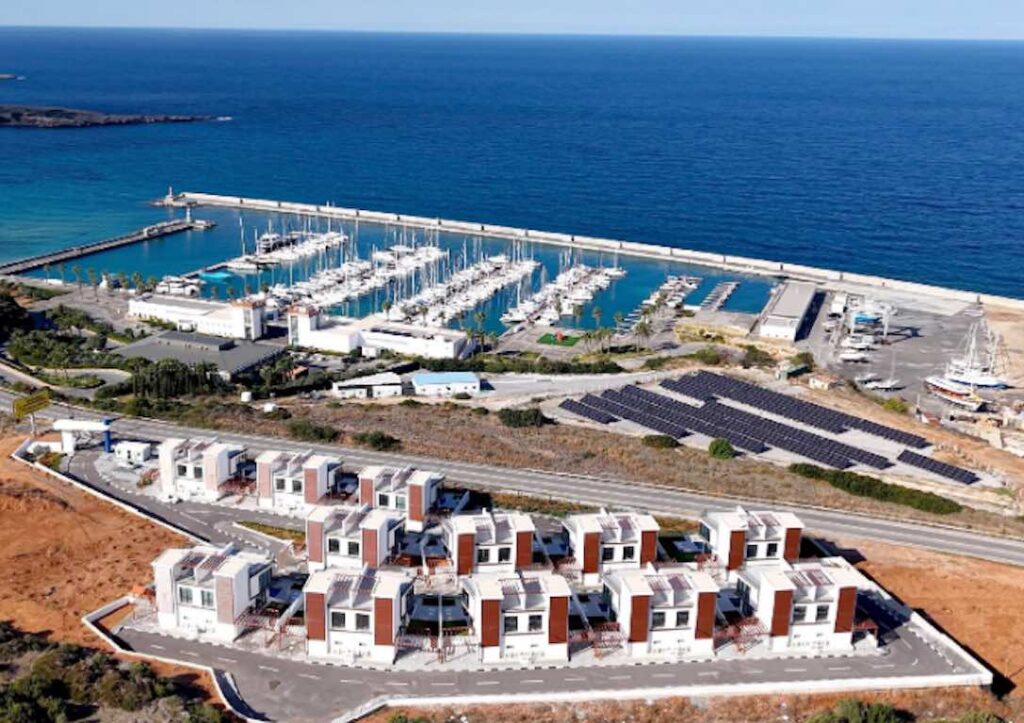
North Cyprus occupies the northern part of the island of Cyprus.
While geographically close to Europe, it operates independently from the European Union and has developed its own unique property market.
For investors, this creates opportunities that are becoming increasingly rare elsewhere in the Mediterranean.
Many buyers compare North Cyprus today with:
The market remains relatively undiscovered internationally, which means entry prices are still accessible.
One of the biggest reasons buyers fall in love with North Cyprus is simple:
The lifestyle.
Imagine:
The pace of life is relaxed and welcoming.
Unlike many overcrowded European destinations, North Cyprus still feels authentic.
You can enjoy:
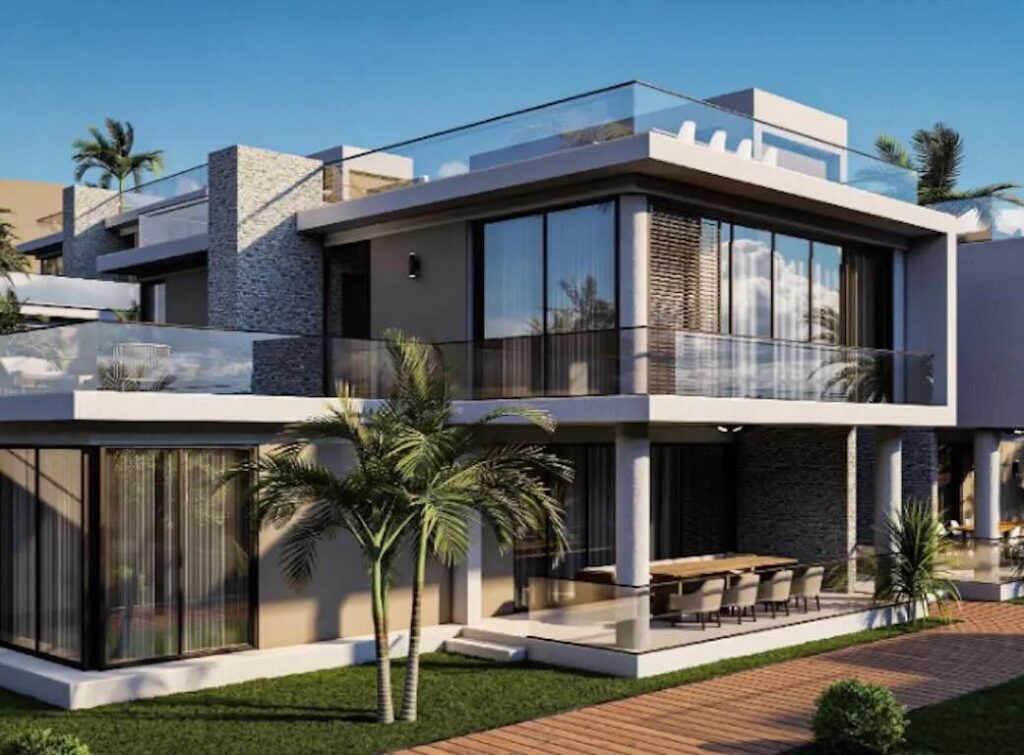
One of the strongest investment arguments is affordability.
As of 2026:
This lower entry point allows investors to diversify more easily and often purchase larger properties.
Many buyers first discover North Cyprus for its rental yields.
Depending on location and property type, gross rental yields often range between:
The combination of:
creates multiple rental markets throughout the year.
Unlike highly seasonal destinations, some areas generate income almost year-round.
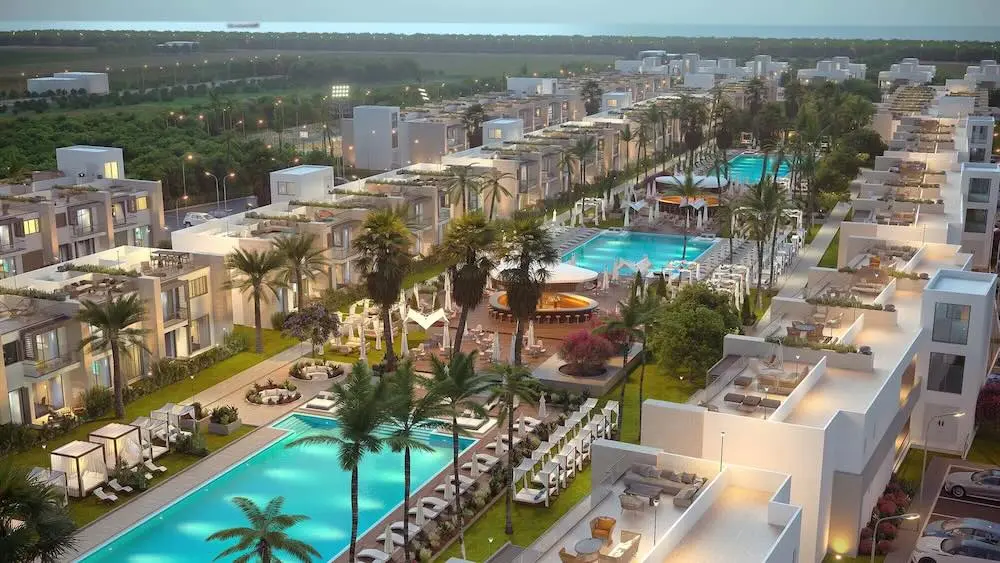
Many investors appreciate the relatively favorable tax environment.
Potential advantages may include:
Tax regulations can change and depend on personal circumstances, so professional tax advice is always recommended.
However, compared to many Western European countries, the fiscal environment is often considered investor-friendly.
Another major advantage is that many developers offer payment plans rarely seen in Western Europe.
Buyers may benefit from:
This makes investing accessible without immediately committing large amounts of capital.
A common question is:
“Can I easily travel there from Europe?”
The answer is yes.
Most international visitors fly via Turkey.
Daily departures from:
Flights typically connect through:
Average travel time:
4.5 to 6.5 hours
Daily flights connect through:
Average travel time:
5 to 7 hours
Excellent connections from:
Most routes connect through Istanbul or Antalya.
Average travel time:
5 to 7 hours
The strongest gains in property investment usually occur before a destination becomes mainstream.
Many investors believe North Cyprus is currently at that stage.
The market benefits from:
As awareness grows, demand continues to rise.
We see growing interest from:
Seeking retirement homes and rental income.
Looking for affordable second homes with sunshine.
Interested in rental yields and diversification.
Attracted by climate and lifestyle.
Looking for lower living costs and excellent weather.
Seeking a relaxed Mediterranean lifestyle.
At Living on the Côte d’Azur, we do not add destinations lightly.
North Cyprus impressed us because it offers something increasingly difficult to find:
A genuine Mediterranean lifestyle combined with realistic property prices and strong investment potential.
While the French Riviera remains one of the world’s most desirable locations, North Cyprus provides an attractive alternative for buyers seeking:
For many investors, it represents an opportunity to enter a market that may look very different in ten years’ time.
North Cyprus is generally considered one of the safest destinations in the Mediterranean, with low crime rates and welcoming local communities.
Yes. Foreign buyers can purchase property, subject to local regulations and approval procedures.
Yes. English is commonly used in business, tourism, and real estate transactions.
Yes. Both long-term and short-term rental opportunities are available, depending on the project and local regulations.
Absolutely. Many retirees choose North Cyprus for its climate, affordability, healthcare options, and relaxed lifestyle.
North Cyprus is no longer just an emerging destination—it is rapidly becoming one of the Mediterranean’s most talked-about property markets.
Affordable entry prices, attractive rental yields, beautiful beaches, favorable taxation, modern developments, and year-round sunshine create a compelling investment story.
That is why we have carefully selected a portfolio of quality developments and properties in North Cyprus for our international clients.
If you are looking for a Mediterranean investment with strong potential and a lifestyle to match, North Cyprus deserves a place on your shortlist.
//Offering breathtaking panoramic sea views, this sumptuous 118 m² 4-room apartment is located just 500 m from the beach, on the top floor of a modern, secure residence. Designed with every detail in mind, it combines elegance, generous volumes and natural light at every turn: – A bright, open-plan living room of over 60 m², with a contemporary kitchen ideal for sharing. –
Three spacious bedrooms with built-in storage, including a master suite with private shower room. – A refined bathroom and two separate WCs offer comfort and practicality for everyday life. – Two magnificent terraces of 46 m² and 33 m², accessible from every room, offering true continuity inside-outside and a unique feeling of space. The amenities are in keeping with the location: – Reversible air conditioning for optimum comfort in all seasons. –
Double-glazed aluminum joinery for impeccable thermal and acoustic insulation. – Electric roller shutters for added comfort and modernity. – Home automation, connected thermostat, fiber optics… An exceptional property on the Côte d’Azur, combining a rare location, top-of-the-range amenities and a sea view.
Whether you’re looking for a primary residence, a prestigious pied-à-terre or a high-standard investment, this apartment represents a rare opportunity. Contact us now for more information. Price : €1,559,000 ECD : A Contact us for a visit and a personal selection of alternative properties. We offer a full service in real estate, from selection, visits and negotiations to financing, renovations and the most effective fiscal structure. Use our extensive expert network!
//The French Riviera has always attracted the world’s wealthiest families, entrepreneurs, investors and celebrities. From the hills of Cannes and the waterfront villas of Saint-Jean-Cap-Ferrat to the estates of Saint-Tropez and Cap d’Antibes, owning property on the Côte d’Azur is more than a purchase. It is a statement, a lifestyle and, above all, a legacy investment.
But there is one important reality many buyers discover too late: when you contact a traditional luxury real estate agency on the French Riviera, you only see a tiny part of the market.
Most agencies have perhaps 5 to 10 truly high-end properties in their own portfolio. They naturally try to sell those first. That means you are not seeing the full market, the best opportunities, or the off-market properties that may fit your wishes better.
At Living on the Côte d’Azur, we work differently.
Because we act as an international buyer’s agent, we do not represent just one agency or one portfolio. Through our network of local agencies, developers and inter-agency partnerships, we give you access to virtually all luxury properties for sale on the French Riviera: more than 100,000 listings, including exclusive and off-market opportunities.
Whether you are looking for a seafront villa in Saint-Tropez, a Belle Époque mansion in Cap d’Antibes, a penthouse in Cannes, or a private estate in Mougins, we help you compare the entire market instead of limiting you to one agency’s selection.
A traditional luxury agency will usually present only the properties it has under mandate. Even very large agencies often have only a handful of ultra-luxury listings at any given time.
That means:
Living on the Côte d’Azur works exclusively in the interest of the buyer.
We compare all relevant properties from our network and help you find the best match based on your budget, lifestyle and investment goals.
For example, instead of seeing only eight villas from one agency in Cannes, you can compare dozens of luxury villas in Cannes, Super Cannes, Californie, Mougins and Cap d’Antibes at the same time. This gives you more negotiating power and a much better chance of finding the perfect property.
The Côte d’Azur is one of the most resilient and prestigious real estate markets in the world. Even during periods of economic uncertainty, prime real estate on the French Riviera continues to perform strongly.
There are several reasons for this:
Many investors view French Riviera property as a long-term store of value, similar to fine art, gold or a family business.
The most desirable villas and apartments rarely lose value because there is simply not enough land available in the best locations. A unique sea-view villa in Cap Ferrat or a waterfront estate in Saint-Tropez can never truly be replaced.
At Living on the Côte d’Azur, we combine the listings of hundreds of local agencies and developers into one international platform.
You gain access to:
Because we work with almost every serious agency on the Côte d’Azur, you do not need to contact ten different agencies yourself. One conversation with us gives you access to the entire market.
That saves time, avoids frustration and often leads to better opportunities.
Owning a property on the French Riviera remains one of the ultimate symbols of success. The region is home to celebrities, royals, entrepreneurs and family offices from around the world.
A villa in Saint-Tropez or Cap d’Antibes is not simply real estate. It is a prestigious asset that reflects taste, success and long-term vision.
Luxury property on the French Riviera has historically shown remarkable resilience. Prime properties in Cannes, Saint-Tropez and Cap Ferrat continue to appreciate because demand is stronger than supply.
With very little land left for development, especially close to the sea, rare properties become increasingly valuable over time.
The Côte d’Azur offers a lifestyle that is almost impossible to replicate elsewhere:
For many buyers, investing here is about both financial return and quality of life.
Many of the best luxury properties on the French Riviera are sold quietly and discreetly.
At Living on the Côte d’Azur, we specialise in confidential transactions and off-market properties. We understand that high-net-worth buyers value privacy above everything else.
Our role is to protect your interests, negotiate discreetly and give you access to properties that are often never advertised online.
The best French Riviera properties are timeless. They become part of a family’s story and can be passed from generation to generation.
A waterfront villa in Saint-Tropez, a historic estate in Mougins or a penthouse in Cannes is not just an investment for today. It is a legacy asset that can preserve wealth and create memories for decades to come.
Unlike a traditional agency that shows only its own portfolio, Living on the Côte d’Azur searches the entire market on your behalf.
We help international buyers by:
Our Dutch approach is different: transparent, efficient and focused on finding the best property for you, not on selling one particular listing.
If you are looking for a luxury villa, apartment or investment property on the Côte d’Azur, do not limit yourself to the small portfolio of one agency.
Choose the agency that gives you access to everything.
Contact Living on the Côte d’Azur today for a personalised selection of the finest properties on the French Riviera, both online and off-market. Or have a look at these high-value luxury properties for sale on the Côte d’Azur.
//The French Riviera continues to attract international buyers seeking a second home, an investment property, or a luxury lifestyle residence. Yet genuinely sea-front new-build opportunities have become increasingly rare.
That is why the final sea-front apartment available within the prestigious sea front development in Juan-les-Pins deserves special attention.
Situated between Cannes and Nice, Juan-les-Pins remains one of the Côte d’Azur’s most desirable seaside destinations. Famous for its sandy beaches, elegant promenade, beach clubs, restaurants, and relaxed Mediterranean atmosphere, it offers everything buyers love about the Riviera—without the intensity and pricing of Monaco or Saint-Tropez.
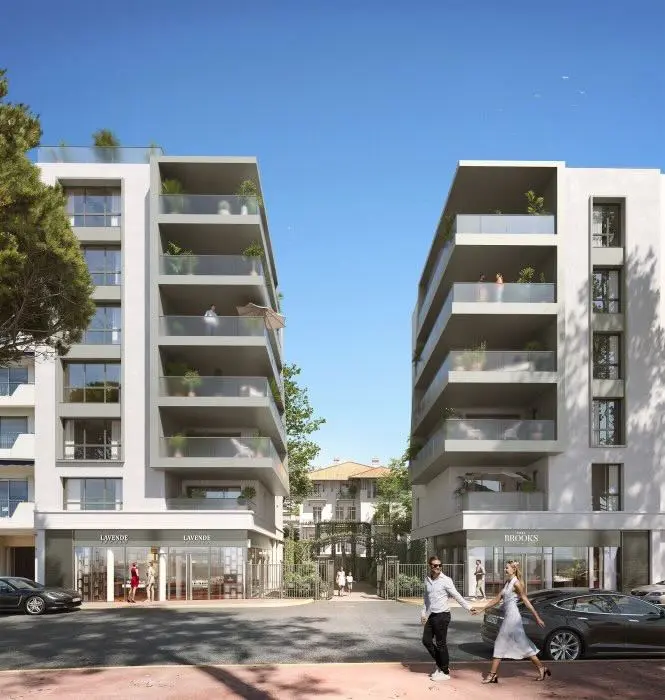
This is not simply another residential development.
The project carefully restores two historic hotels that helped shape the identity of Juan-les-Pins while integrating elegant contemporary residences designed for modern living. The result is a unique blend of Riviera heritage and contemporary luxury.
Large glass openings, generous terraces, premium finishes, landscaped gardens inspired by the Belle Époque era, and sustainable construction standards create an exceptional residential environment.
Residents will enjoy:
On the French Riviera, the coastline is almost fully developed. New sea-front construction opportunities are extremely limited due to strict planning regulations and environmental protections.
As a result, genuine sea-front apartments in premium developments often sell quickly, particularly when they combine:
Beau Rivage delivers all of these advantages while occupying one of the most iconic locations in Juan-les-Pins.
For international buyers, this luxury new construction represents more than just a property purchase.
Imagine starting your morning with coffee overlooking the Mediterranean, walking to the beach within minutes, enjoying lunch in Antibes Old Town, and ending the day watching the sunset from your private terrace.
The location also benefits from strong rental demand thanks to:
This combination of lifestyle and long-term desirability makes premium sea-front properties among the most resilient real estate assets on the French Riviera.
C building (sea front) 2nd floor. Living area 81 m2, terrace 21 m2. South-facing. Full sea view. Price 1,480,000 €
C building (sea front) 3rd floor. Living area 81 m2, terrace 20 m2. South-facing. Full sea view. Price 1,530,000 €
C building (sea front) 5th floor. Living area 81 m2, terrace 17 m2. South-facing. Full sea view. Price 1,730,000 €
D building (sea front) 2nd floor. Living area 99 m2, terrace 21 m2. South-facing. Full sea view. Price 1,880,000 €
D building (sea front) 3rd floor. Living area 99 m2, terrace 20 m2. South-facing. Full sea view. Price 1,980,000 €
At Living on the Côte d’Azur, we help international buyers navigate the entire purchasing process in France.
We provide:
Our clients benefit from local expertise combined with international service standards.
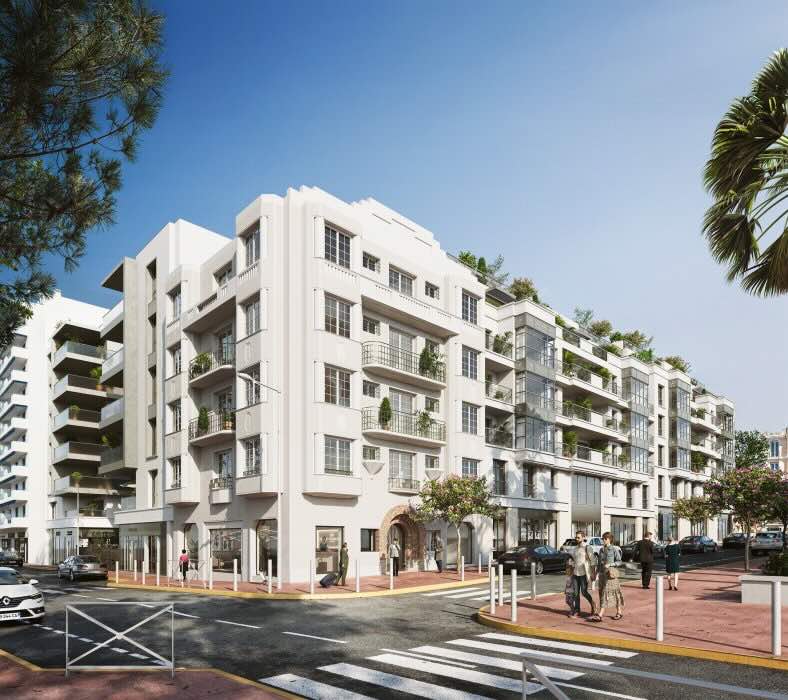
Opportunities to acquire a seafront apartment in a landmark development are becoming increasingly scarce.
If you would like floor plans, pricing, availability, or a private presentation of the remaining sea-front apartment, contact Living on the Côte d’Azur today.
The Mediterranean is not making any more coastline. This may be your last opportunity to secure a front-row position in one of Juan-les-Pins’ most exciting new developments.
Juan les Pins combines the glamour of the French Riviera with a relaxed beach-town atmosphere. Located within the municipality of Antibes, it offers beautiful sandy beaches, a lively restaurant scene, a famous jazz heritage, and excellent connections to Cannes, Nice, and Monaco.
//A private beach day on the French Riviera in 2026 costs roughly €20 to €80 per sunbed in more relaxed locations such as Menton, Mandelieu or parts of Nice, while premium beaches in Cannes, Monaco and Saint-Tropez can easily reach €70 to €150+ per person before lunch, drinks and parking. The most expensive part of the experience is usually not the sunbed itself, but the full day: lunch, rosé, cocktails, towels, valet parking, and service.
And this is where the dream often begins. Many visitors arrive for one beach day and leave wondering: What would it cost to live here? Below you will find updated beach club price indications and local real estate notes for each destination.
| Location | Typical 2026 Sunbed Price | Luxury Level | Real Estate Appeal |
|---|---|---|---|
| Menton | €20–€80 | Relaxed | Retirement, value, Italian border lifestyle |
| Monaco / Larvotto | €40–€100+ | Ultra-prime | Tax, prestige, global wealth |
| Nice | €30–€70 | Urban Riviera | Year-round living, airport access |
| Villefranche / Beaulieu / Cap Ferrat | €40–€90+ | Elegant | Sea views, scarcity, Monaco proximity |
| Antibes / Juan-les-Pins | €35–€60+ | Family chic | Schools, beaches, investment growth |
| Cannes | €60–€130+ | Glamour | Croisette, Palm Beach, rental demand |
| Saint-Tropez / Pampelonne | €80–€150+ | Iconic luxury | Villas, scarcity, international buyers |
Menton remains one of the best-value seaside towns on the French Riviera. Private beach prices in 2026 generally range from around €20 to €80 per day, depending on the beach, season and level of service.
Useful external source: Private beaches in Menton.
Menton has a softer, more local rhythm than Cannes or Saint-Tropez. The old town, Italian influence, lemon festival, gardens and seafront make it ideal for retirees, long-stay visitors and buyers who want sunshine without excessive glamour.
Many people discover Menton as a second home during a quiet beach holiday and later compare it with Nice or Monaco. Menton is particularly attractive for buyers looking for:
Larvotto is Monaco’s main beach area, combining public beach access with private beach restaurants and luxury service. Published prices vary, and several venues prefer direct reservation requests. As a practical 2026 guide, expect around €40 to €100+ per sunbed depending on the venue, season and setup.
Useful external sources: Private beaches in Monaco and Larvotto Beach guide.
Larvotto is not only a beach. It is part of the Monaco lifestyle: morning swim, lunch by the sea, luxury shopping, yachts, supercars and fine dining within walking distance.
For buyers, Monaco is in a category of its own. The appeal is not just the beach, but the full package: security, tax environment, prestige, international schools, private banking and limited property supply.
Prime districts near the beach include:
Nice offers some of the most accessible private beach experiences on the Côte d’Azur. In 2026, sunbeds are commonly found from around €30 to €70, depending on the beach and season.
Ruhl Plage, one of the classic Nice beach institutions, is listed from around €35 via MySunbed. Castel Plage, Beau Rivage, Blue Beach and Opéra Plage remain among the better-known private beach options along the Promenade des Anglais.
Useful external sources: Ruhl Plage Nice, Private beaches in Nice and Castel Plage Nice.
Nice is not only a summer destination. It is a real city with an international airport, tram network, universities, restaurants, museums, hospitals and year-round life. That makes it one of the most practical places to buy property on the French Riviera.
Visitors who enjoy Nice beach clubs often start looking to buy a home in Nice in nearby areas such as:
This part of the Riviera is one of the most beautiful stretches between Nice and Monaco. Prices vary widely, but for private beach comfort in 2026, visitors should expect roughly €40 to €90+ per sunbed depending on the venue.
Paloma Beach in Saint-Jean-Cap-Ferrat was one of the most famous beach clubs on the French Riviera. It is now officially marked as permanently closed. The official Paloma Beach website redirects visitors toward Baia Bella in Beaulieu-sur-Mer.
Useful external sources: Official Paloma Beach announcement and Riviera Edition report on Paloma Beach closure.
Even without Paloma Beach as it once was, the coastline around Villefranche-sur-Mer, Beaulieu-sur-Mer and Saint-Jean-Cap-Ferrat remains one of the most desirable locations in Europe. The bay of Villefranche, the villas of Cap Ferrat and the Belle Époque elegance of Beaulieu continue to attract international buyers.
This area is all about scarcity. Sea-view apartments, waterfront homes and villas for sale in Villefranche sur Mer with privacy are limited and highly sought after.
Antibes and Juan-les-Pins offer a more family-friendly beach scene than Cannes or Saint-Tropez, while still feeling stylish and international. In 2026, typical private beach pricing is around €35 to €60+ per sunbed, depending on location.
Plage Keller on Cap d’Antibes has been reported to cost around €42 for a beach sunbed, €46 for the first row, and €48 for the pontoon. Juan-les-Pins also has municipal beach options with sun loungers and parasols during the summer season.
Useful external sources: Best beach clubs in Antibes, Juan-les-Pins municipal beach loungers and Private beaches in Antibes Juan-les-Pins.
Antibes combines beaches, a real old town, international schools, the Port Vauban marina, Cap d’Antibes luxury villas and easy access to Sophia Antipolis. It is one of the best choices for families who want to live on the French Riviera full-time.
Antibes is attracting strong international interest because it is both practical and beautiful. Popular areas to buy a home in Antibes include:
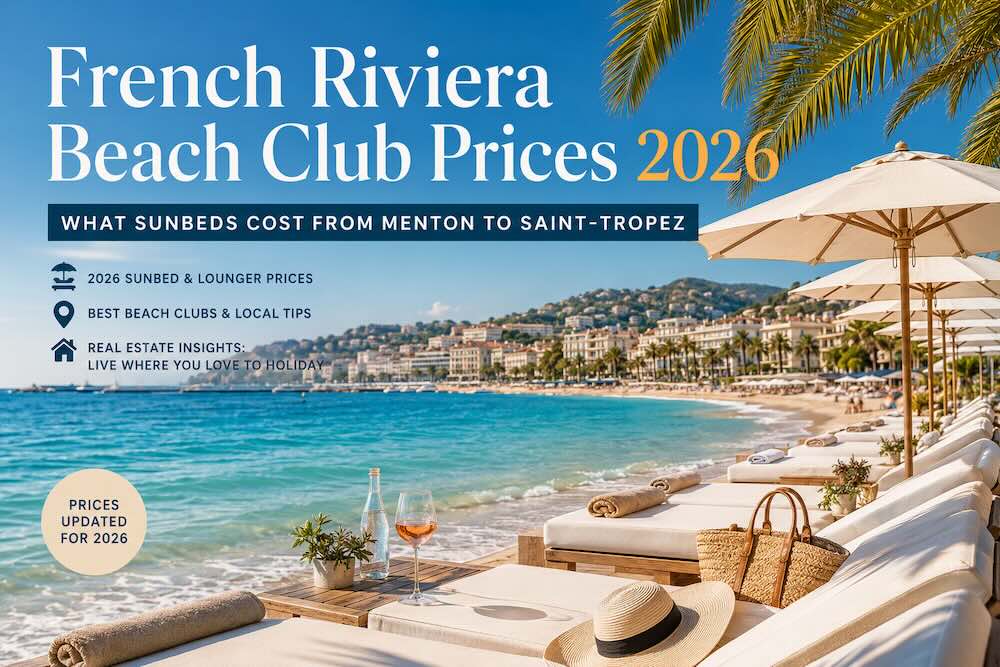
Cannes remains one of the most expensive beach club destinations on the French Riviera. On the Croisette, 2026 pricing for premium venues often sits around €60 to €130+ per sunbed, depending on the row, season and event calendar.
At Carlton Beach Club, published 2026 sunbed fees for May, June and September show:
Prices may be higher during major events such as the Cannes Film Festival, MIPIM, Cannes Lions and peak summer.
Useful external sources: Carlton Beach Club sunbed fees, Official Carlton Beach Club, Cannes beach clubs on MySunbed and Cannes Croisette beach guide.
Cannes has a unique mix of beach life, luxury hotels, international congresses, film festival glamour, shopping, restaurants and investment demand. A beach day here can easily turn into a property search.
Visitors who enjoy the Croisette often ask what it costs to live nearby. The most popular areas to buy a home in Cannes include:
For visitors seeking a beach club day near Cannes without the Croisette pricing, Mandelieu-la-Napoule can offer better value. In 2026, private beach prices are often indicated between €20 and €50 for a deckchair, depending on season and location.
Useful external source: Private beaches in Mandelieu-la-Napoule.
This area appeals to buyers who want sea access, marinas, golf, nature and larger properties without being in the centre of Cannes.
Saint-Tropez and Pampelonne remain the legendary beach club destination of the French Riviera. Exact sunbed prices are not always published publicly, but in 2026, visitors should realistically budget from around €80 to €150+ per person for a premium beach setup, with the total day often rising much higher once lunch, drinks and service are included.
Well-known names include Le Club 55, Nikki Beach, Bagatelle, Loulou, Gigi, Shellona and Casa Amor. Pampelonne is less about a simple sunbed and more about the full Saint-Tropez experience.
Useful external sources: Nikki Beach Saint-Tropez, Pampelonne beach clubs on MySunbed and Best Saint-Tropez beach clubs 2026.
Pampelonne Beach is where beach life becomes theatre. It attracts yacht owners, celebrities, entrepreneurs, families, fashion brands and international investors. Many visitors come for one lunch and return later looking for a villa.
The Saint-Tropez property market is driven by scarcity, prestige and global demand. Popular areas include:
Always check before booking. A beach club price may or may not include:
In premium clubs, the sunbed can look reasonable compared with the final bill. Lunch, wine, cocktails, water, desserts and service can easily double or triple the cost of the day.
Most private beach sunbeds cost between €30 and €80 per day, but premium locations in Cannes, Monaco, and Saint-Tropez can exceed €100 per person.
A full beach day in Saint-Tropez can easily cost several hundred euros per couple once sunbeds, lunch, drinks, parking and service are included.
Menton, Mandelieu-la-Napoule and some parts of Nice usually offer better value than Cannes or Saint-Tropez.
No. Paloma Beach in Saint-Jean-Cap-Ferrat is officially marked as permanently closed.
Yes. Cannes, especially the Croisette, is generally more expensive than Nice for private beach clubs.
Yes. Foreign buyers can purchase property in France and Monaco, although Monaco has its own specific residency and financial requirements.
For year-round living, Nice and Antibes are practical choices. For glamour, Cannes and Saint-Tropez are stronger. For prestige and scarcity, Monaco, Cap Ferrat, and Villefranche-sur-Mer are exceptional.
The French Riviera has a funny way of changing people’s plans. You arrive for a beach lunch, order a glass of rosé, look at the sea, and suddenly start wondering what life would be like if this were not just a holiday.
That is where Living on the Côte d’Azur can help.
We give international buyers access to thousands of properties across the French Riviera, from Menton and Monaco to Nice, Cannes, Antibes and Saint-Tropez. Whether you are looking for a sea-view apartment, a family home, a lock-up-and-leave pied-à-terre, or an off-market villa, our buyer representation service helps you search with confidence.
Contact the team at Living on the Côte d’Azur and discover the best properties for sale from Menton to Saint-Tropez. If you’re looking for the best deal, check out our special Best Property Deals on the French Riviera website with real deals in real time, powered by real market data.
Last updated: June 2026. Prices can change by season, row, event period, and availability. Always check directly with the beach club before booking.
//Le Canon Français is a fast-growing French movement that brings together thousands of people around long communal tables, regional cuisine, wine, music, and local traditions. Its mission is to celebrate the French way of life, regional heritage, and the bonds between generations. In early 2026, Le Canon Français hosted a major Provençal banquet in Grasse on the French Riviera, attracting around 1,600 participants. While no new dates have yet been announced for Nice, Cannes, or Antibes, the success of the event suggests a return to the Côte d’Azur is only a matter of time.
Anyone who has ever sat on a village square in Southern France with a glass of rosé, a platter of local charcuterie, and a group of friends spontaneously breaking into song already understands the spirit of Le Canon Français.
The initiative was launched in 2021 with a simple idea: France possesses one of the richest culinary and cultural heritages in the world, yet many French people feel that these traditions are increasingly threatened by globalization and our ever more digital lifestyles.
The founders wanted to bring people back together around something timeless: a shared table.
No screens.
No algorithms.
Just real conversations, local food, good wine, and genuine human connection.
The result has been extraordinary. Across France, Le Canon Français organizes giant banquets where hundreds or even thousands of people gather to eat, drink, sing, dance, and celebrate what makes France unique.
In French slang, a canon can refer to a good glass of wine or a drink shared among friends.
The name therefore has nothing to do with military cannons. Instead, it symbolizes one of France’s oldest traditions: raising a glass together.
It represents:
In many ways, Le Canon Français has become a modern expression of the famous French art de vivre.
One of the reasons the movement resonates with so many people is that it expresses patriotism through culture rather than politics.
The focus is not on debates or ideologies.
Instead, it celebrates:
At every event, you will find young professionals sitting beside retirees, farmers beside entrepreneurs, families beside visitors from distant regions.
Everyone shares the same table.
The message is simple:
France is more than a country. It is a culture that is meant to be lived together.
In January 2026, Le Canon Français arrived in Grasse, the historic perfume capital of the French Riviera, for a grand Provençal banquet.
Around 1,600 guests gathered to celebrate the gastronomy, traditions, and heritage of Provence.
The choice of Grasse was no coincidence.
Few places embody the spirit of Le Canon Français better than the Alpes-Maritimes:
The French Riviera may be known worldwide for luxury yachts and glamorous events, but beneath that international image lies a deeply rooted Provençal culture that remains very much alive.
At the time of writing, no new events have been officially announced for Nice, Cannes, Antibes, or other Riviera destinations.
However, given the remarkable Canon Français success of the Grasse gathering, many observers believe it is only a matter of time before Le Canon Français returns to the region.
The Côte d’Azur offers everything the movement stands for: authenticity, gastronomy, heritage, and an exceptional quality of life.
Perhaps because many people feel that something essential is disappearing from modern life.
We live in a world of endless notifications, video calls, social media feeds, and fast-moving digital interactions.
Le Canon Français offers the opposite.
A long table.
A slow meal.
A meaningful conversation.
A connection to the land, the people, and the traditions that came before us.
It reminds us that culture is not something preserved in museums.
Culture lives when people gather to share it.
And nowhere is that more evident than in France.
Especially here on the French Riviera.
Whether you live in Menton, Nice, Antibes, Cannes, Saint-Raphaël, or Saint-Tropez, life ultimately revolves around the same timeless pleasures:
Good food.
Good wine.
Good friends.
And taking the time to enjoy them.
As the French like to say:
“À table, la France se raconte.”
At the table, France tells its story. 🇫🇷🍷🥖
Living on the Côte d’Azur is about more than beautiful properties and stunning sea views. It is about discovering the traditions, culture, and lifestyle that make Southern France one of the most cherished places in the world to live, invest, and create lasting family memories.
//TL;DR:
- International property agents serve as expert intermediaries, providing local market intelligence and managing complex cross-border transactions. They offer access to off-market listings, expert negotiation, legal coordination, and remote viewing options, reducing risk and improving investment outcomes. Their role is increasingly vital as technology amplifies their ability to deliver personalized, efficient, and strategic service worldwide.
International property agents are licensed real estate professionals who act as expert intermediaries between global buyers and the local markets they wish to invest in. The role of international property agents extends far beyond simply matching buyers to listings. They translate regulatory complexity, cultural nuance, and market intelligence into confident, informed decisions. For investors eyeing the French Riviera, where a villa in Mougins or a sea-view apartment above Saint-Jean-Cap-Ferrat can appreciate 5 to 8% annually, the right agent is not a convenience. They are the difference between a legacy asset and a costly mistake.
International property agents, also known as buying agents or buyer’s representatives, perform a defined set of functions that compress months of complexity into a structured, manageable process. Market research and deal management sit at the core of their work, encompassing property search, comparative analysis, negotiation, and contract oversight. This means a buyer in Singapore considering a property in Cannes, where the Croisette gleams with yacht-dotted prestige and the Lérins islands beckon just offshore, receives the same depth of local intelligence as a buyer already living on the Côte d’Azur.
Their core functions include:
Pro Tip: Ask your agent directly what percentage of their completed transactions involved off-market properties. A figure above 30% signals genuine network depth, not just portal access.
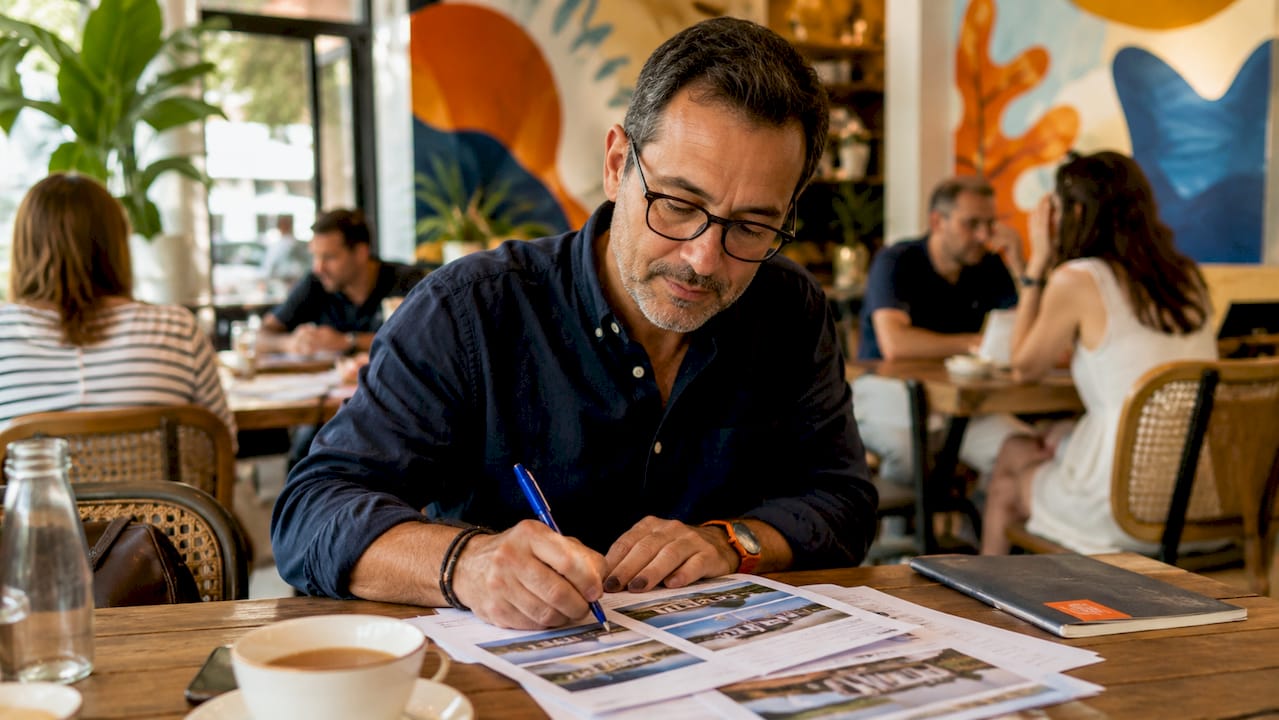
The comparison between using an international buying agent and purchasing directly is not simply a question of cost. It is a question of risk, access, and outcome quality. Direct buyers face a market where language barriers, unfamiliar legal frameworks, and opaque pricing can erode both confidence and capital.
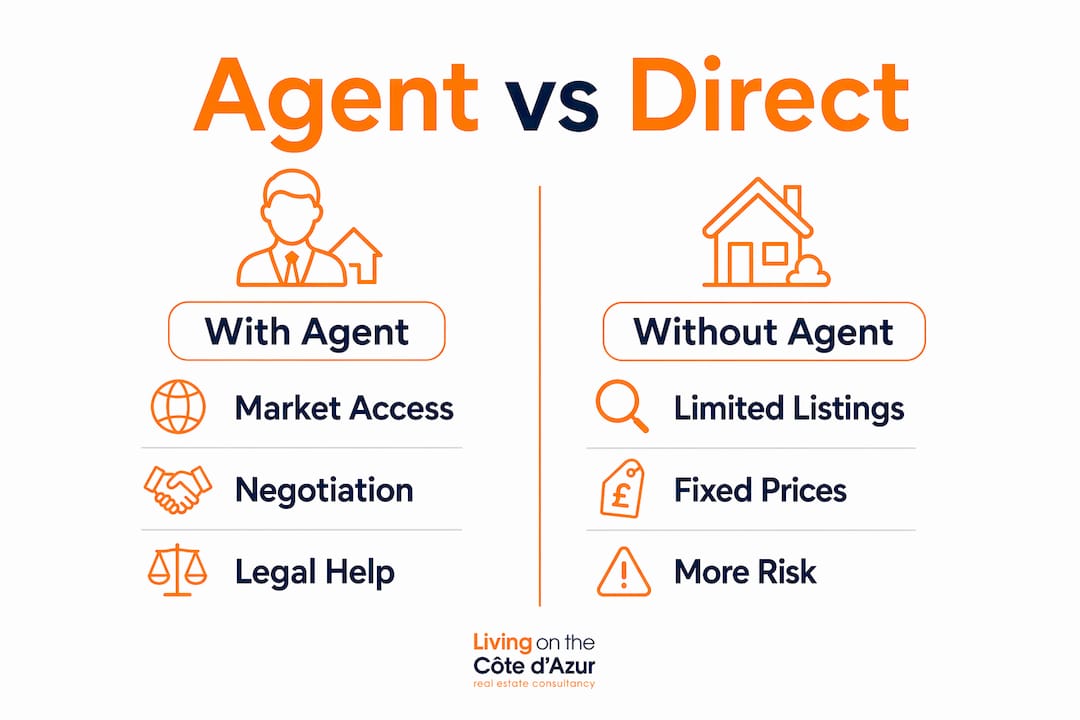
| Factor | With an agent | Without an agent |
|---|---|---|
| Market access | Off-market and exclusive listings included | Limited to publicly listed properties |
| Negotiation | Professional positioning based on market data | Buyer negotiates without comparable intelligence |
| Legal oversight | Coordinated with notaires and solicitors | Buyer must source and manage specialists independently |
| Transaction speed | Weeks rather than months with structured management | Extended timelines due to unfamiliar processes |
| Financial planning | Trusted specialists including currency brokers and mortgage advisers introduced | Buyer arranges financial support independently |
The financial case for using an agent is particularly strong in markets like Valbonne, Mouans-Sartoux, and Théoule-sur-Mer, where pricing is not always transparent and seller agents represent the vendor’s interests exclusively. An independent buying agent works solely for you. That distinction matters enormously when the asset in question carries a price tag of €2 million or above.
The benefits extend to tax planning as well. The French Riviera carries specific fiscal considerations, from notaire fees to wealth tax thresholds, and a well-connected agent will introduce you to specialists who understand real estate tax obligations before you commit to a purchase.
Technology has not replaced the role of international property agents. It has amplified it. The most effective agents in 2026 blend AI tools, online listings, and client communication platforms with the kind of personalised relationship-building that no algorithm can replicate. This combination is what allows a buyer in Dubai or Mauritius to make a confident offer on a property in Grasse or Mandelieu-la-Napoule without ever having stood in the garden.
The technology stack a modern agent deploys typically works as follows:
Pro Tip: Request a live virtual tour rather than a pre-recorded video. A live walkthrough allows you to direct the agent’s attention to specific details, such as the quality of finishes or the angle of sea views, in real time.
Working effectively with an international buying agent requires preparation on your part as much as expertise on theirs. The buyers who achieve the best outcomes are those who arrive with clarity about what they want and the willingness to trust their agent’s local knowledge.
Consider the following steps when beginning your search:
Livingonthecotedazur connects buyers with exclusive property services that cover this full spectrum, from first enquiry through to completion and beyond.
International property agents are the single most effective tool for reducing risk and improving outcomes in cross-border real estate transactions, particularly in prestige markets like the French Riviera.
| Point | Details |
|---|---|
| Core agent functions | Agents handle search, negotiation, legal coordination, and off-market access in a single managed process. |
| Agent versus direct buying | Buyers with agents gain faster transactions, better prices, and access to properties never publicly listed. |
| Technology as amplifier | Virtual tours, data analytics, and digital document tools extend agent reach across time zones without losing precision. |
| Choosing the right agent | Prioritise regional specialisation, off-market track record, and transparent fee structures before engaging. |
| Long-term partnership value | Treating your agent as a portfolio partner, not a transaction facilitator, compounds returns over time. |
Having worked alongside international buyers acquiring properties from Menton’s lemon-scented hillsides to the yacht-lined quays of Antibes, my view is clear. The complexity of cross-border real estate is not decreasing. It is increasing. Regulatory changes, currency volatility, and the growing sophistication of prime markets mean that the gap between an informed acquisition and an expensive error is wider than it has ever been.
What strikes me most is how often buyers underestimate the value of an agent’s network compared to their transactional skills. Negotiation matters, of course. But the ability to surface a property in Beausoleil or Beaulieu-sur-Mer before it reaches any portal, and to introduce a buyer to the right notaire, currency specialist, and tax adviser in a single conversation, is where the real value lives. That kind of access is built over years, not assembled from a website.
I have also observed a meaningful shift in how buyers engage with technology. Virtual tours and augmented reality walkthroughs have moved from novelty to expectation. Buyers now arrive at first conversations having already conducted detailed remote assessments. The agent’s role has shifted accordingly, from gatekeeper of information to interpreter of nuance. Knowing that a property in La Gaude sits in a microclimate that delivers 300 days of sunshine annually, or that a particular plot in Opio carries development potential not visible in the listing, is the kind of intelligence that no portal delivers. That is what a great agent brings.
The off-market property market on the Côte d’Azur operates on trust and relationships. Buyers who invest in those relationships, through the right agent, consistently outperform those who treat property acquisition as a purely transactional exercise.
— ab
Livingonthecotedazur specialises in connecting discerning international buyers with the finest properties across the Côte d’Azur, from sun-drenched villas in Mougins to prestige residences in Saint-Paul-de-Vence and Cannes. Our team provides comprehensive support from first enquiry through to completion, including introductions to trusted legal, financial, and tax specialists. We accept cryptocurrency payments and offer access to a curated portfolio of off-market luxury properties that never appear on public portals. Whether you are acquiring a legacy estate or a high-yield seasonal rental, we are your trusted partner on the Riviera. Explore our luxury investment options and begin your search today.
An international property agent acts as a buyer’s representative in a foreign market, handling property search, negotiation, legal coordination, and financial specialist introductions. Their role is to simplify cross-border transactions and protect the buyer’s interests throughout the process.
Agents leverage established local networks to access properties that are never publicly listed. In prime markets like the French Riviera, exclusive off-market deals are common and accessible only through trusted agent connections.
Hiring an agent reduces transaction timelines, mitigates legal and language barriers, and typically secures better pricing through professional negotiation. For international buyers unfamiliar with French property law or local market pricing, the agent’s fee is consistently outweighed by the value they deliver.
Modern agents use virtual tours, augmented reality walkthroughs, data analytics platforms, and digital document management tools to support buyers across time zones. This allows detailed property assessments and contract execution without requiring the buyer to travel.
Prioritise agents with demonstrable regional specialisation, a strong off-market track record, and transparent fee structures. Our guide on choosing a Riviera agent outlines the specific criteria that distinguish a genuine market specialist from a generalist portal agent.
//TL;DR:
- Interior design establishes a home’s structural framework, while styling refines it through colour, texture, and accents. Proper sequencing—design first, then styling—ensures a balanced, harmonious, and functional living space. Restraint and editing in styling elevate a room’s sophistication and protect property value over time.
Interior design and styling together define how a home looks, feels, and functions at every level. Interior design sets the framework by addressing layout, architecture, cabinetry, and structural elements, while interior styling refines that framework through colour, texture, lighting, and curated accents. The two disciplines are distinct but inseparable. Whether you are refreshing a sun-drenched villa above Cannes or transforming a pied-à-terre in Nice’s Vieux Quartier, understanding both roles is the clearest path to a home that is as beautiful as it is liveable. This guide covers the principles, sequences, and practical tools that make the difference between a space that merely looks finished and one that genuinely feels complete.
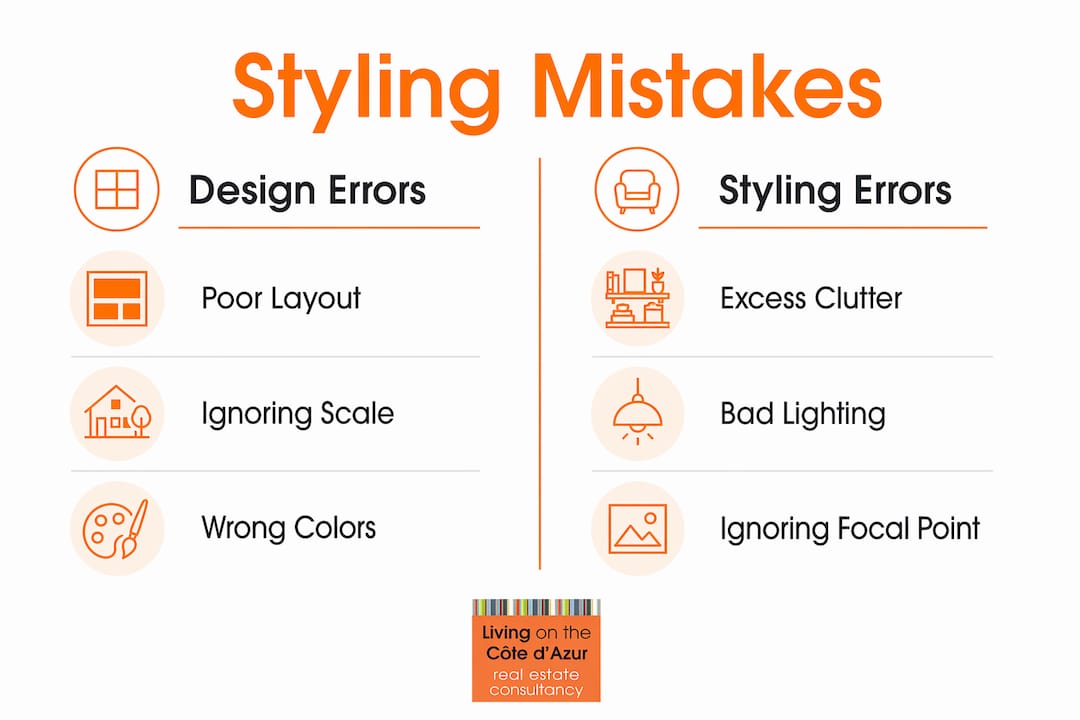
Interior design addresses the physical framework of a home: the floor plan, traffic flow, built-in cabinetry, lighting circuits, and the relationship between architectural features and furniture scale. Styling follows once that framework is resolved. Attempting to style a poorly planned space produces beautiful objects in an awkward room. The sequence matters enormously.
Before purchasing a single piece of furniture, map the room’s traffic paths. Professional designers maintain clear corridors of 60 to 90 centimetres between pieces so movement feels natural rather than obstructed. Zoning, the practice of dividing an open-plan space into defined areas for dining, lounging, and working, relies on layout decisions made before any decor is chosen.
Built-in elements carry particular weight in luxury properties. Bespoke cabinetry in a Mougins farmhouse or a Cap d’Antibes villa does not merely provide storage; it defines the room’s proportions and anchors the entire colour palette that follows. When a renovation is genuinely required, address it before styling. When only a refresh is needed, work with what exists and let the styling layer do the heavy lifting.
Pro Tip: Photograph each room at different times of day before making any design decisions. Natural light shifts dramatically between morning and late afternoon, and those shifts will influence every colour and material choice you make.
The 60-30-10 colour rule is the single most reliable framework for building a balanced interior palette. Sixty per cent goes to the dominant colour, typically walls and large surfaces. Thirty per cent covers supporting tones, usually upholstery and major furniture pieces. Ten per cent is reserved for accent colours expressed through cushions, art, and small accessories. The result is visual harmony without monotony.
Texture operates alongside colour to give a room depth. A living room in Saint-Paul-de-Vence might combine linen curtains, a stone-effect wall, a velvet sofa, and a jute rug. Each material reads differently under light, creating layered interest that a single-material room cannot achieve. The key is contrast without competition: pair smooth with rough, matte with gloss, warm with cool.
Styling works best as an essential layer that clarifies and resolves a space, focusing on material relationship and restraint rather than mere decoration.
Restraint is the most underrated principle in modern interior styling. The instinct to fill every surface produces rooms that feel busy rather than considered. Select functional objects with genuine presence, a sculptural lamp, a single oversized artwork, a ceramic bowl with weight and patina, rather than accumulating smaller pieces that dilute each other’s impact. Editing is not deprivation; it is precision.
Common pitfalls to avoid when building a colour palette and styling layer:
Layered lighting involves three distinct types: ambient, task, and accent. Ambient light provides general visibility across the room. Task lighting serves specific activities such as reading, cooking, or working at a desk. Accent lighting highlights architectural features, artwork, or focal points to create depth and drama. Most rooms benefit from all three layers working together.
Spaces with layered lighting feel up to 40% larger and more welcoming than rooms relying on a single overhead source. That figure reflects a real perceptual shift: multiple light sources at varying heights create dimension, whereas a single ceiling fixture flattens a room and makes it feel institutional rather than intimate.
Here is a practical sequence for layering lighting in any room:
Fixture scale depends on room volume and furniture dimensions, not personal preference alone. A pendant that looks elegant in a showroom can appear incidental in a double-height salon or oppressive in a low-ceilinged bedroom. Measure ceiling height and the diameter of the dining table or seating group before selecting any hanging fixture.
Pro Tip: In a living room, position floor lamps and table lamps so their shades sit at eye level when you are seated. This creates the warm, horizontal band of light that makes a room feel genuinely cosy rather than merely lit.
Layout optimisation is the primary driver of perceived size in compact rooms. Furniture placement, not paint colour, determines whether a small space feels generous or cramped. Resolve the layout before buying anything, and you will spend less and achieve more.
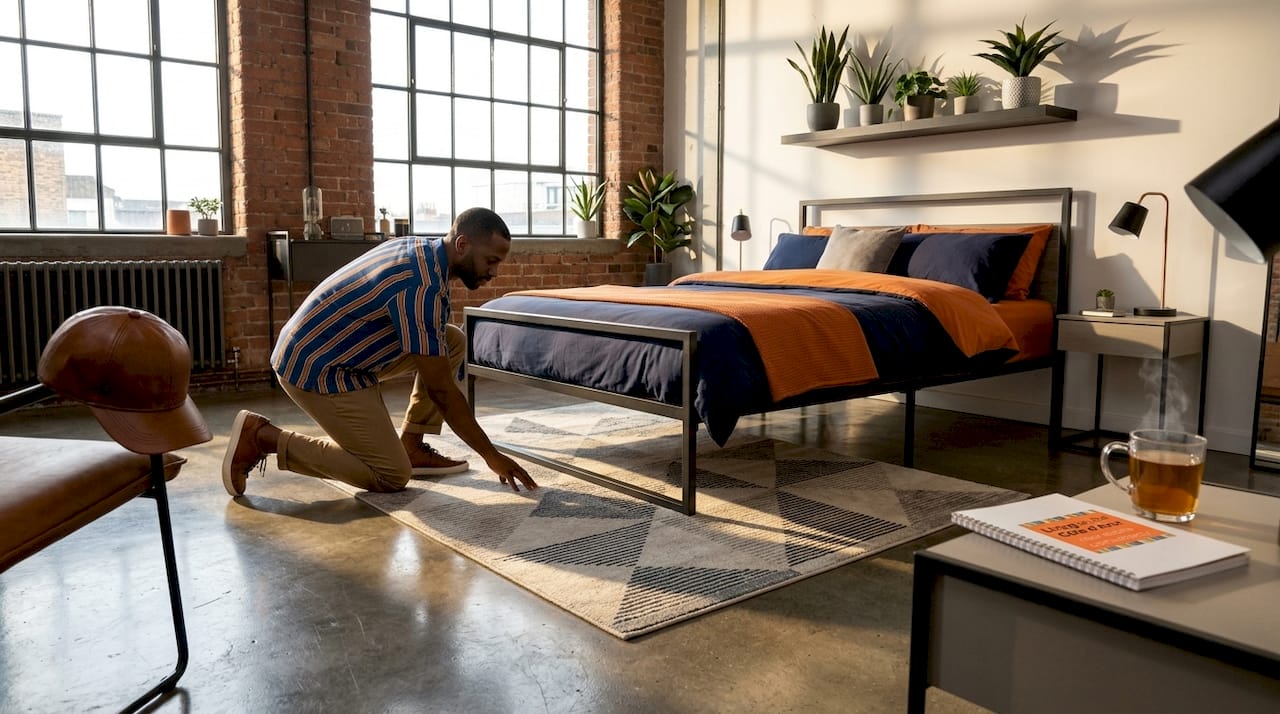
Floating furniture away from walls is one of the most counter-intuitive yet effective techniques available. Pulling a sofa 30 to 40 centimetres from the wall and placing a console or low bookcase behind it creates a defined zone that reads as intentional and spacious. Pushing everything against the perimeter, the instinctive response to a small room, actually makes the central space feel exposed and unresolved.
One focal point per room is a rule worth following without exception. In a compact bedroom in Valbonne or a studio apartment in Nice’s Mont Boron, a single strong element, an upholstered headboard, a framed artwork, a statement light fixture, organises the eye and gives the room a sense of purpose. Multiple competing focal points produce visual noise that makes a small room feel smaller still.
| Technique | Effect |
|---|---|
| Float furniture from walls | Creates defined zones and adds perceived depth |
| One focal point per room | Organises the eye and reduces visual clutter |
| Use a single large rug | Anchors the seating group and unifies the space |
| Limit wood finishes to two | Maintains cohesion across furniture and flooring |
| Layer lighting at multiple heights | Adds dimension and makes the room feel larger |
Rugs deserve particular attention in small spaces. A rug that is too small fragments the room into disconnected pieces. The front legs of all seating pieces should sit on the rug, anchoring the group as a single composition. For a bespoke villa interior, the same principle applies at a grander scale: proportion governs every decision.
The most common styling failure is accumulation without intention. Rooms fill gradually, one object at a time, until the space reads as a collection of unrelated things rather than a considered whole. Styling as a disciplined editing process means selecting anchor pieces first, adding only items that serve a clear purpose, and removing anything that competes or clutters.
Scale errors rank alongside accumulation as the most damaging mistakes. A coffee table that is too small for the sofa group, a pendant that is too delicate for a double-height ceiling, artwork hung too high above a sofa: each of these breaks the proportional logic that makes a room feel resolved. Measure before you buy, every time.
The professional sequence is worth memorising: lock the structure and layout first, build the colour palette using the 60-30-10 framework, then add accents last and sparingly. Reversing this sequence, buying decorative objects before the palette is established, produces the mismatched, trend-heavy rooms that date quickly and satisfy no one. Luxury upgrades that hold their value follow this same logic: structure first, refinement second.
Pro Tip: Before finalising any styled surface, photograph it in black and white. Colour is removed from the equation, and you can assess proportion, balance, and visual weight with complete clarity.
Effective interior design and styling require a clear sequence: resolve structure and layout first, establish a proportional colour palette, then add accents with restraint and purpose.
| Point | Details |
|---|---|
| Design before styling | Fix layout, scale, and built-in elements before choosing any decorative pieces. |
| Apply the 60-30-10 rule | Allocate 60% dominant, 30% supporting, and 10% accent colour for a balanced palette. |
| Layer all three lighting types | Combine ambient, task, and accent lighting with dimmers for flexibility and mood. |
| Float furniture from walls | Create defined zones in small spaces by pulling pieces away from the perimeter. |
| Edit with discipline | Style one surface at a time, remove one item after finishing, and resist accumulation. |
Having worked closely with homeowners and property investors across the Côte d’Azur, from light-filled apartments above Nice’s Promenade des Anglais to stone-walled mas in the hills above Grasse, I have observed the same pattern repeatedly. The rooms that feel genuinely luxurious are almost always the ones where something has been taken away, not added.
The instinct to fill space is understandable. We associate fullness with generosity and emptiness with neglect. But the most compelling interiors I have encountered, whether in a Cap d’Antibes villa where the Mediterranean light does half the work, or in a Mougins farmhouse where the architecture speaks for itself, succeed because the styling supports the space rather than competing with it. One extraordinary piece of furniture, one considered artwork, one beautifully scaled light fixture: these choices carry more weight than a room full of carefully sourced objects that cancel each other out.
The practical implication is this: invest in fewer, better things. A single bespoke sofa in a considered fabric will outlast and outperform six trend-driven cushions purchased in a moment of enthusiasm. Proper interior design and styling, done in the right sequence, saves money over time because it eliminates the cycle of buying, regretting, and replacing. It also protects the value of the property itself, which matters considerably when that property sits on the French Riviera and represents a legacy investment rather than a temporary arrangement.
— ab
At Livingonthecotedazur, we believe that a home’s interior is as much a part of its value as its location or architecture. Our interior design adviser Jolanda Kuijer listens to your vision, offers considered guidance, and coordinates every detail of your interior transformation, from structural decisions to the final styling layer. Whether you are preparing a newly acquired villa in Saint-Jean-Cap-Ferrat for seasonal letting or personalising a residence in Roquebrune-Cap-Martin for long-term living, Jolanda brings clarity, restraint, and genuine expertise to the process. For those seeking off-market Riviera properties where interior design and styling form part of the acquisition conversation from day one, we are the partner you want beside you. Speak with us and let us help you create a home that is worth inheriting.
Interior design addresses layout, architecture, and structural elements, while interior styling refines a completed space through colour, texture, lighting, and curated accents. Design comes first; styling follows once the framework is resolved.
The 60-30-10 rule allocates 60% of a room’s colour to dominant surfaces such as walls, 30% to supporting elements like upholstery, and 10% to accent pieces. This proportion prevents both visual chaos and a flat, one-dimensional palette.
The three lighting layers are ambient for general visibility, task for specific activities, and accent for highlighting features and creating mood. Using dimmers on ambient and accent circuits allows a room to shift atmosphere without changing the physical setup.
Optimise the layout first, float furniture away from walls, establish one clear focal point, and layer lighting at multiple heights. A single large rug that anchors all seating pieces also unifies the space and adds perceived depth.
Staging for sale and decorating for living serve different objectives. Staging is temporary and designed to appeal to the broadest possible market, while personal decoration reflects individual taste and long-term comfort. If selling, prioritise neutral palettes and edited surfaces over personal collections.
 //
//Looking for a unique holiday experience on the French Riviera? This summer, step away from the beaches for two inspiring days and immerse yourself in the world of sculpture with renowned Vallauris artist Karine Garzi.
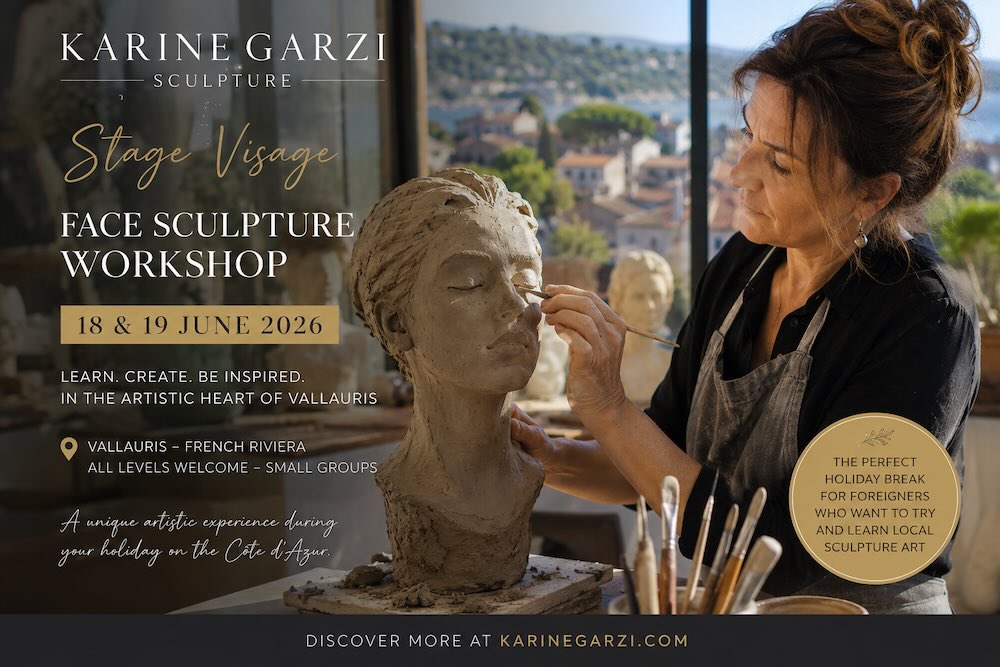
On 18 and 19 June 2026, Karine will host her popular “Stage Visage” (Face Sculpture Workshop) at her studio in Vallauris, the historic heart of ceramics and sculpture on the Côte d’Azur. Whether you are a complete beginner or already have artistic experience, this workshop offers a rare opportunity to learn directly from a professional sculptor in an intimate and creative setting.
Most visitors come to the French Riviera for its sunshine, beaches and picturesque villages. But few discover the region’s rich artistic heritage. Vallauris has long been a centre for ceramics and sculpture and is famous for attracting artists from around the world, including Pablo Picasso.
Karine Garzi continues this artistic tradition from her studio nestled in the hills above Vallauris. A former clinical project manager who followed her passion for sculpture, she has become known for her expressive figurative works, often inspired by human emotions, faces and the stories reflected in the eyes of her subjects.
During this two-day workshop, participants will discover the fascinating process of creating a human face from clay. Karine teaches the essential techniques used by professional sculptors, including:
The workshop takes place in small groups of just four to six participants, ensuring personal guidance and plenty of individual attention. All materials and tools are provided, making it easy for visitors and holidaymakers to participate.
One of the most enjoyable aspects of Karine’s workshops is their accessibility. You do not need any previous sculpting experience. Beginners are warmly welcomed, while more advanced artists can deepen their skills and techniques.
For foreign visitors staying in Cannes, Antibes, Nice or Mougins, the workshop offers an authentic local experience far removed from traditional tourist activities. It is an opportunity to meet local artists, discover French craftsmanship and return home with a unique artwork created by your own hands.
Imagine spending your morning sculpting clay in a peaceful Provençal studio and your evening enjoying dinner overlooking the Mediterranean Sea. It is a holiday memory unlike any other.
Karine’s sculptures are exhibited throughout the region and are admired for their emotional depth and lifelike expressions. Her artistic philosophy centres on capturing humanity, kindness and emotion through clay and bronze. Alongside creating her own works, she is passionate about sharing her knowledge and helping others discover the joy of sculpture.
The Face Sculpture Workshop will take place on 18 & 19 June 2026 at Karine Garzi’s studio in Vallauris. Places are limited due to the small-group format. Costs for two days are 240 euro clay and tools included, firing €25 in supplement.
For more information about Karine Garzi, her sculptures, workshops and exhibitions, visit:
If you are searching for a creative holiday activity on the French Riviera, this workshop could be the highlight of your stay. Learn a new skill, experience authentic local culture and discover the timeless art of sculpture in one of the most artistic villages of Southern France.
//