Looking for a suitable (second) home to buy in France, Ibiza or Portugal is not easy. Thousands of homes are offered for sale online, and you often have no idea where exactly that home is located. That is why using a purchasing agent, such as Living on the Côte d’Azur, is nice.
With our local knowledge and experience, we can quickly make a selection for you and assess the advertisements you have encountered yourself. Our purchasing guidance service is free of charge* because the broker shares the commission with us.
You will then receive the support of an excellent English-speaking notary on the Côte d’Azur. And our network with professionals in the field of loans, tax structures, and renovations.
Selection process
A house in the South of France can be different for everyone; it might be a studio near Rue d’Antibes in Cannes, a family villa in Sainte Maxime, a one-bedroom apartment in Nice, or a seasonal rental investment close to Monaco.
We are always happy to listen to your motivation and expectations. We will then let you know the best way to find the home that’s right for you. Does the ideal home exist? Not really. There is always something you have to give up to gain something else. Near the sea, in peace and serenity? Then you still get a train. Within walking distance of the bakery? There is a good chance that the main road is nearby. Or a tram.
Search, View and Buy Houses in France, Ibiza or Portugal
Once the collaboration and our working process are clear, the selection process begins. From long list to shortlist, from 25 possible contenders to a Top 5 of homes that you would almost want to buy ‘blind’. Unfortunately, photos are not always accurate, and you cannot experience smells or sounds. That is why a visit is so important. You won’t know until you walk through the house and admire the view. This will be your new home in the South of France.
Where is the house located on the French Riviera?
Unlike the rest of the world, the addresses of the homes in France are kept carefully secret. The proverb ‘as the innkeeper trusts his guests’ seems to apply here. The fear is that you will ring the residents’ doorbells and try to reach an agreement without an estate agent. Funnily enough, only the French are trying to do this because French people generally hate real estate agents: ‘They do nothing and make way too much money’. The fact that a real estate agent sends information all day long and, in 9 out of 10 cases, organizes a visit for nothing is forgotten.
Anyway, it would be nice if you knew the address of the house that you might want to view. Thanks to our network and the proven reliability of our foreign customers, we can provide you with the address. In some cases, you sign a ‘bon de visite’ that lets the owner and the selling agent know who you are and that you have visited the house at street level. Even if only via Google Earth.
Scheduling visits
Now, making visits is not always easy. Anyone hoping for a fun weekend of house hunting often comes home disappointed. Many real estate agents do not consider Saturdays important and make excuses for not having a key. Or that the owner is gone.
In many cases, the French seller would also prefer not to have visitors on weekends. And certainly not on Sunday because that day is still holy in France. Family visits and extensive dinners take priority over a tour of a potential buyer’s home. “If they are interested, they will return,” they think.
That is why planning your visits during the week is more effective. Then everyone is available, and you don’t have to worry about everything having to be planned on one Saturday morning. The selection of homes to visit usually contains as many different real estate agents as there are homes. It is our logistical task to book all agents on the same day and ensure that the visits run smoothly from one open door to the next.
Found a house, what now?
If you have the right feeling about the home, we will enter into negotiations for you. Sometimes, a house is so popular that there is little room for negotiation. Outbidding is an unknown phenomenon in France. You can bid on the price; This trumps all lower bids. The seller is obliged to accept your offer, provided no document, such as a Promesse de Vente, has been signed.
Are you ready?
Please get in touch with us at [email protected] for an initial conversation by telephone or Zoom. We would love to hear your plans and will do everything we can to help you as best as possible with your purchase of a house in the South of France!
*If you are looking for something ‘small but nice’ under 300,000, we charge a 2% commission for our guidance from A to Z.
by Ab Kuijer//in Blog
https://www.livingonthecotedazur.com/wp-content/uploads/2024/03/couple-working-with-laptops.jpeg8011200Ab Kuijerhttps://www.livingonthecotedazur.com/wp-content/uploads/2024/02/sitelogo150.pngAb Kuijer2026-04-20 08:08:002026-04-20 09:29:49Search, View and Buy Houses with your buyer agent
Finding a peaceful spot on the French Riviera often feels like an impossible task, especially during the busy summer months when the coastal roads are backed up with traffic. Most travelers get stuck in the crowded centers of Nice or Cannes, missing out on the quiet, high-elevation villages that offer a more authentic Provencal life. Opio solves this problem perfectly by acting as a garden village that sits just twenty minutes from the Mediterranean but feels miles away from the noise. This guide will show you how to enjoy the luxury of the hills, from world-class golf courses to historic olive mills, helping you plan a trip that balances relaxation with genuine local culture.
Opio is a rare find on the Côte d’Azur because it has managed to keep its rural, agricultural soul while becoming a hub for high-end leisure. Located in the hills between Grasse and Cannes, the village is surrounded by vast forests and rolling olive groves that have been cultivated for hundreds of years. It is a place where people come to breathe fresh air and enjoy a slower pace, but without giving up the modern comforts of a luxury resort. For those looking to escape the coastal heat, Opio offers a cooler climate and a community that values privacy and nature above all else.
World-Class Leisure: The Golfing Capital of the Hills
For sports enthusiasts, Opio is famous as one of the best golfing destinations in Southern France. The Golf Opio Valbonne is an 18-hole course that dates back to 1966 and was designed by the well-known English architect Donald Harradine. The course is unique because it sits on a 220-hectare estate that feels like a private park, featuring ancient trees and historic stone walls. If you are looking for more variety, the nearby Golf de la Grande Bastide offers wide, forgiving fairways and views of the surrounding hills, making it accessible for players of all levels. After a round, many golfers head to the Château de la Bégude, a 17th-century manor house that now serves as a hotel and restaurant overlooking the greens.
The Heritage of Liquid Gold: Moulin d’Opio
One of the most authentic things to do in the village is visit the Moulin d’Opio, an olive oil mill that has been in the same family for seven generations. Founded in 1848, the mill still uses traditional methods to produce some of the finest AOC Provence olive oils in the region. You can take a free guided tour to see the stone wheels and old presses, learning how the small Cailletier olives are turned into liquid gold. The on-site boutique is a favorite for locals, stocked with tapenades, olive-wood crafts, and soaps. If you visit between November and January, you can even watch the active harvest and see the fresh oil being produced in real-time.
Site
Primary Attraction
Best Time to Visit
Golf Opio Valbonne
18-Hole Historic Course
Year-round (Spring/Fall for best weather)
Moulin d’Opio
Historic Olive Oil Mill
November – March (Harvest season)
Château de la Bégude
17th-Century Dining
Sunset for terrace views
Grande Bastide Golf
Open Fairway Play
Mornings for quiet rounds
Professional Guidance for Your Home in Opio
The Golf Triangle formed by Opio, Valbonne, and Mougins is one of the most sought-after residential areas for international families and retirees. Properties here are often large estates with private pools and olive groves, providing a level of space that is hard to find closer to the water. Living on the Côte d’Azur acts as a local partner to help you find these exclusive homes. We understand the specific rules for building in these protected green zones and can help you find a property that offers both a sound investment and a peaceful Mediterranean lifestyle. The muted greens and earthy tones of these groves often inspire local home design; many residents use specific palettes like Farrow & Ball’s French Gray to mirror the silvery-green leaves of the Opio landscape. Having an expert who knows the local land is the best way to ensure your move to Opio is as smooth as the olive oil the town produces.
Active Family Fun: The Club Med Opio Experience
Beyond the golf greens, Opio is home to a world-unique sports and creative destination: Club Med Opio en Provence. Even if you are not staying at the resort, it is well worth knowing about for the CREACTIVE by Cirque du Soleil experience. This is a massive circus-themed playground where children and adults can train in acrobatic and artistic disciplines under the guidance of professional Gentils Circassiens. You can try your hand at the flying trapeze, high bungee, or tightrope walking, or opt for more relaxed artistic activities like mask painting and juggling. It is a one-of-a-kind way to burn off energy while learning a new skill in a safe, professional environment.
The Zen Pool and Sports Infrastructure
While the circus school takes center stage, the resort also offers a rare retreat known as the Zen Pool. Tucked away in the quietest corner of the 50-hectare estate, this adults-only area is surrounded by century-old olive trees and offers a peaceful atmosphere for swimming and sunbathing. For those who prefer traditional sports, the infrastructure is vast, including professional-grade tennis courts, archery ranges, and fitness centers. The resort’s recent multi-million euro refit has ensured that the equipment is state-of-the-art, making it a primary hub for active tourism in the Alpes-Maritimes.
Historical Exploration: The Old Village and Roman Roots
A short walk up the hill leads you to the Old Village (Le Village), which feels like a different world compared to the modern resorts below. The center of town is anchored by the Town Hall (Mairie), which was formerly the 17th-century residence of the Bishops of Grasse. One of the most fascinating local secrets is a marble funerary stone dating back to the 2nd or 3rd century, which is sealed into a corner of the Town Hall. It bears the inscription A Albucius Caius Oppius, a tangible link to the town’s Roman past when it served as an oppidum (fortified site). Nearby, you can explore the Église Saint-Trophyme, a 12th-century Romanesque church that has been beautifully preserved and offers a cool, quiet space for reflection.
Nature and Panoramic Trails: The Brague Valley
For hikers, Opio serves as a primary gateway to the Parc Naturel Départemental de la Brague. One of the most popular local routes is the Brague Trail, which follows the river through a lush Mediterranean forest filled with alder, hazel, and ash trees. The path is mostly flat and well-shaded, making it perfect for a three-hour hike that eventually leads you to the neighboring village of Valbonne. Along the way, you’ll pass small waterfalls and stone bridges that feel like scenes from a storybook. If you prefer higher elevations, the trails heading toward the Cimes du Mercantour viewpoints provide dramatic perspectives where you can see the white peaks of the Alps on one side and the deep blue of the Mediterranean on the other.
Comparison of Recreational Activities in Opio
Activity
Target Audience
Location
High-Value Feature
CREACTIVE Circus
Families & Kids
Club Med
Flying trapeze and bungee training.
Brague Trail Hike
Nature Lovers
Brague Valley
Shaded river path with waterfalls.
Old Village Walk
History Buffs
Le Village
Roman funerary stone and Bishop’s Palace.
Zen Pool
Adults & Couples
Resort Area
Quiet relaxation among olive groves.
Finding Your Perfect Retreat in the Hills
The balance between modern sports facilities and ancient history is exactly what makes Opio such a strong choice for those looking to settle in the South of France. Unlike many villages that feel like museums, Opio is a living community where you can hike a thousand-year-old trail in the morning and take a circus class in the afternoon. Living on the Côte d’Azur means understanding that moving here is about more than just buying a luxury house in Opio; it’s about finding a base for an active and varied lifestyle. Because Opio is a protected green zone, many of the finest bastides never reach the open market. Ourguide to off-market real estate explains how we secure these ‘silent’ listings for our clients. Our team can help you identify properties that are within walking distance of these trails or have the perfect orientation to catch those snow-to-sea views, ensuring your new home in Opio is a true sanctuary.
Culinary Excellence: The Flavors of Opio
The dining experience in Opio is defined by a slow food philosophy that makes the most of the village’s agricultural roots. One of the most unique spots is Restaurant La Bégude, located within a beautifully restored 17th-century manor at the golf club. It serves Mediterranean dishes that emphasize seasonal vegetables and, of course, the local olive oil. For a more casual yet equally authentic vibe, Au Bidochon has become a local favorite; this vintage Citroën food truck serves high-quality charcuterie and homemade fries in a cozy outdoor setting. If you’re willing to drive just five minutes into the neighboring hills, you can find L’École des Filles, a restaurant in a converted schoolhouse that offers a creative menu in a nostalgic, historic atmosphere.
Strategic Day Trips: The 15-Minute Rule
Opio’s location is its greatest asset, allowing you to reach the most famous sites of the Riviera in minutes while avoiding the coastal gridlock. The perfume capital of Grasse is just 10 minutes away, where you can visit the International Perfume Museum or take a nose workshop at Fragonard to create your own signature scent. To the east, the village of Valbonne is famous for its Place des Arcades, a stunning 16th-century square lined with cafes and boutiques. If you visit on a Friday morning, the Valbonne market is one of the best in the region for finding high-end linens and regional delicacies. For a dramatic change of scenery, a 15-minute drive up the mountain leads to Gourdon, an Eagle’s Nest village with views that stretch across the entire coastline.
Practical Planning and Logistics
While Opio feels like a remote garden, it is very well-connected if you have the right transportation. While there are local buses, a rental car is highly recommended to fully explore the surrounding hills and nearby villages. If you are flying in, the village is a quick 30-minute drive from the Nice Côte d’Azur Airport. The best time to visit depends on your interests: June to August is perfect for poolside living and the lively village festivals, but November is the most interesting month for foodies who want to witness the olive harvest and participate in mill tastings. For those staying longer, the village offers a quiet base that remains active even in the winter, unlike many of the coastal resorts that can feel empty in the off-season.
Destination
Time from Opio
Best For
Grasse
10 Minutes
Perfume tours and historic museums.
Valbonne
5 Minutes
Weekly markets and arcade dining.
Gourdon
15 Minutes
Panoramic views and artisan glassblowing.
Cannes
25 Minutes
Sandy beaches and luxury shopping.
Frequently Asked Questions
1. Is Opio a good base for exploring the French Riviera?
Yes, Opio is an excellent strategic base. It sits just 30 minutes from Nice Airport and 20 minutes from the beaches of Cannes. By staying here, you enjoy the quiet of the countryside and easier parking while remaining a short drive away from the coast’s most famous attractions and the perfume factories of Grasse.
2. What is the best way to get around the village and surrounding areas?
A car is highly recommended for anyone staying in Opio. While the village center is walkable, the attractions like the golf courses, olive mills, and neighboring hilltop villages are spread out. Public buses do exist, but they are infrequent compared to the coastal train lines, making a vehicle essential for a flexible schedule.
3. Can I visit the Moulin d’Opio olive mill year-round?
The mill’s boutique is open to visitors throughout the year for tastings and shopping. However, if you want to see the traditional machinery in full action, you should visit during the harvest season between November and January. This is the only time you can watch the actual pressing process as local growers bring in their crops.
4. Are there hiking trails suitable for beginners in Opio?
The Brague Valley trail is perfect for beginners and families. It is a mostly flat, shaded path that follows the river towards Valbonne. Unlike the steeper Baou climbs found in nearby Vence, this trail offers a relaxing walk through the woods without requiring professional hiking gear or intense physical climbing.
5. Is Opio suitable for families with children?
Absolutely. Between the unique circus school at Club Med, the expansive playgrounds at the Brague nature park, and the flat walking trails, there is plenty to keep children active. Many of the local restaurants are also very family-oriented, offering large outdoor terraces where kids can move around safely while parents dine.
Building a Life in the Garden of the Riviera
For many, a weekend in Opio is enough to spark a lifelong interest in the area. The combination of open space, historic architecture, and proximity to major international hubs like Sophia Antipolis makes it a top choice for those looking to relocate to France. However, navigating the local real estate market, where many Mas (traditional farmhouses) are sold privately, requires an insider’s perspective. Living on the Côte d’Azur specializes in this Golden Triangle of the back country. We use our local network to find properties that offer the peace of the olive groves with the convenience of being near the Riviera’s best schools and services.
by Feline Kuijer//in Blog
https://www.livingonthecotedazur.com/wp-content/uploads/2026/01/Attractions-and-Things-to-Do-in-Opio.avif10241536Feline Kuijerhttps://www.livingonthecotedazur.com/wp-content/uploads/2024/02/sitelogo150.pngFeline Kuijer2026-04-18 11:57:272026-02-23 17:37:47Top 10 Attractions and Things to Do in Opio
There are luxury properties, and then there are properties so rare that they feel more like a private kingdom than a home.
Cove Crest, on the northeast coast of Corfu, belongs firmly in that second category.
This extraordinary seafront estate will be sold through an international auction taking place in May 2026. As an official partner of Concierge Auctions, we can guide our clients through every step of the process, from the first confidential viewing to registering for the auction, arranging due diligence and ultimately securing the property.
A Private World on the Greek Island of Corfu
The Cove Crest estate is located in Barbati, one of Corfu’s most sought-after areas. The estate enjoys a commanding position above the Ionian Sea, with panoramic views across the water and complete privacy.
What makes this property unique is that it consists of two architecturally distinct villas, set within beautifully terraced gardens that lead directly to a private beach, a cave and even a private jetty.
In the Mediterranean, properties with their own direct sea access are already rare. A private beach, cave and jetty together make this estate almost impossible to replicate.
The estate has been listed for €13.5 million, but the auction is expected to open between approximately €4 million and €9 million. That creates an exceptional opportunity for buyers who understand that some of the world’s most unique homes can occasionally be acquired below their traditional asking price.
Two Villas, Endless Possibilities
The first villa is contemporary and minimalist, spread across two levels. It offers elegant living spaces, smart-home technology and a private infinity pool overlooking the sea.
The second villa is larger and more dramatic, spread across three floors plus a lower level. It includes a spectacular principal suite, luxurious spa-style bathrooms and flexible space that could become a cinema room, gym, wellness area, art studio or guest accommodation.
Together, the two villas make Cove Crest ideal for:
A family estate with separate guest accommodation
A multigenerational residence
Entertaining friends and business guests in total privacy
A luxury retreat or second-home investment
Buyers looking for a property that can never truly be duplicated
Some properties are valued by square metres alone. Others are valued because they are unique.
Just as Leonardo da Vinci’s Salvator Mundi or a Rolls-Royce Boat Tail commands a premium because there is nothing else quite like it, Cove Crest has that same level of rarity. You are not simply buying a villa in Greece. You are buying one of the Mediterranean’s most singular waterfront estates.
Why Buy Through Auction?
Luxury property auctions are becoming increasingly popular among international buyers because they create transparency, momentum and often a genuine opportunity.
Instead of years of negotiation, uncertain sellers and endless back-and-forth, the process is clear:
The property is presented with full due diligence documents
Interested buyers can inspect the property and ask questions
Buyers register in advance for the auction
Bidding takes place during a defined period
The winning bidder secures the property
For Cove Crest, bidding opens on 13 May 2026 and closes on 28 May 2026.
Because this property is being sold through Concierge Auctions, one of the world’s leading luxury auction houses, the process is highly professional and internationally recognised.
Our Role: Guiding You Through the Entire Process
Buying a property through an international auction can feel unfamiliar, especially when the property is in another country.
That is why our role as partner of Concierge Auctions is so important.
We guide our clients throughout the entire process, including:
Introducing you confidentially to the property
Arranging additional information, plans and documents
Organising a viewing trip to Corfu
Helping you understand the auction rules and bidding process
Assisting with registration and required paperwork
Recommending lawyers, tax advisers and local specialists in Greece
Advising on bidding strategy
Supporting you after a successful purchase
In other words: you do not need to navigate the auction process alone.
We stay by your side from the first conversation until the keys are handed over.
Corfu has quietly become one of the Mediterranean’s most desirable islands for international buyers.
Compared with destinations such as Saint-Tropez, Ibiza or Capri, Corfu still offers more space, more privacy and often significantly better value.
The island combines:
Crystal-clear waters and spectacular coastline
Excellent accessibility through Corfu International Airport
Strong demand from international buyers
Beautiful scenery and a relaxed lifestyle
Attractive long-term appeal as a second-home destination
For buyers looking beyond the French Riviera and searching for something equally exclusive but more discreet, Corfu is increasingly becoming one of Europe’s best-kept secrets.
Interested in Cove Crest?
If you would like to know more about this extraordinary estate or would like assistance registering for the auction, we would be pleased to help.
As official partner of Concierge Auctions, we can make sure you are fully prepared, well informed and represented throughout the entire process.
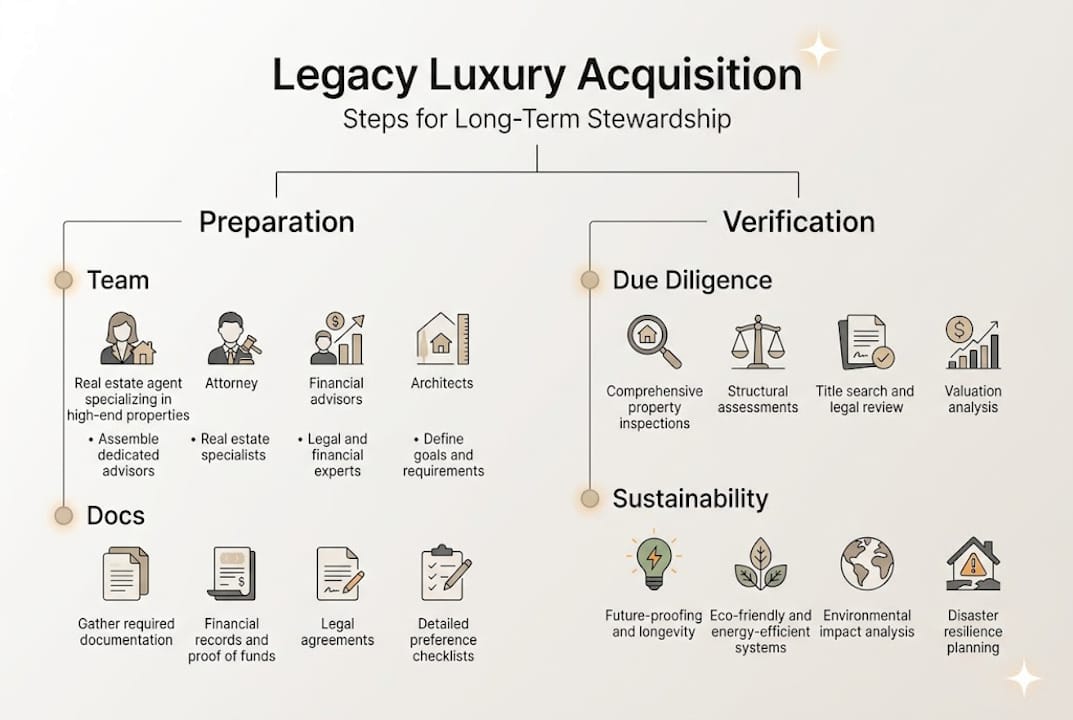
Acquiring a luxury home on the Côte d’Azur is one of the most rewarding decisions a discerning investor can make. It is also one of the most intricate. Between cross-border tax structures, off-market sourcing, sustainability certifications, and succession planning, even seasoned buyers can find the process overwhelming. The stakes are simply too high for ambiguity. Whether you are drawn to a stone-clad villa above Èze’s flower-festooned lanes or a sea-view residence overlooking Cannes’ Croisette, this guide distils the entire acquisition workflow into clear, purposeful stages, built specifically for those whose vision extends far beyond ownership and into the realm of generational legacy.
Successful luxury acquisitions prioritise long-term family wealth and sustainability credentials.
Preparation secures advantage
Meticulous organisation of finance and paperwork unlocks access to superior, often off-market, options.
Stepwise execution matters
Following a structured workflow mitigates errors and preserves property value.
Verification protects legacy
Continuous due diligence and legacy planning defend your estate for generations.
Understanding legacy-focused luxury home acquisition
Now that we’ve outlined the big picture, let’s clarify the unique focus of legacy-driven luxury home acquisition.
In luxury real estate, the word legacy carries genuine weight. It describes a philosophy of acquisition rooted not in quick capital gains, but in the creation of enduring family wealth, cultural heritage, and environmental stewardship. A legacy property is one that appreciates reliably, transfers cleanly across generations, and stands as a physical expression of its owner’s values. As key features of luxury real estate reveal, legacy property investment seeks wealth preservation across generations and emphasises sustainability, setting it apart from purely transactional purchases.
The distinction matters enormously. A speculative buyer may pursue a Sainte-Maxime apartment for short-term rental yields in Pampelonne, then exit within five years. A legacy buyer seeks a Cap d’Antibes estate that will anchor family summers for decades, carry eco-credentials that satisfy future heirs, and transfer through succession with minimal fiscal erosion. The mindset, and therefore the workflow, is fundamentally different.
Priority
Legacy acquisition
Transactional acquisition
Time horizon
Generational
3 to 7 years
Primary goal
Wealth preservation and heritage
Capital appreciation or yield
Sustainability
Central criterion
Secondary consideration
Legal structure
Succession-optimised
Standard ownership
Location focus
Prestige and privacy
Yield and liquidity
For a property to qualify as a genuine legacy asset within our luxury portfolio essentials, it must satisfy a precise set of criteria:
Prime, irreplaceable location such as Monaco-border plots or Cap d’Antibes coastal sentiers
Robust construction quality with seismic resilience surveys and verified building history
Unambiguous legal title with clean ownership records and no encumbrances
Eco-credentials, including HQE (Haute Qualité Environnementale) or equivalent green certifications
Succession-ready ownership structure, such as an SCI (Société Civile Immobilière) holding company
Pro Tip: Prioritise requesting environmental impact certifications, particularly BBC Effinergie or HQE labels, before any offer is considered. These credentials not only protect your sustainability values but are increasingly required by the most discerning heirs.
Preparation: Prerequisites for a seamless acquisition
With the legacy principles established, the next step is to ensure you have everything in place to act confidently.
The Côte d’Azur luxury market moves swiftly, and the most coveted properties rarely linger. Preparation is not a formality. It is a competitive advantage. Effective financing and preparation often unlock superior off-market opportunities, placing prepared buyers in a privileged position before a property is ever publicly listed.
Begin by assembling your core documentation and professional team. No serious negotiation proceeds without both.
Document or resource
Purpose
Notes
Passport and proof of address
Identity verification
Notarised copies required
Proof of funds or mortgage pre-approval
Credibility with vendors
Essential for off-market access
Tax residency certificate
French fiscal compliance
Consult your tax advisor
Source of funds declaration
Anti-money laundering compliance
Mandatory for transactions above €500,000
Sustainability checklist
Eco-due diligence
Tailored to your legacy criteria
Your advisory team should include at minimum:
A French notaire specializing in luxury and cross-border transactions
An independent avocat (property lawyer) to review contracts and protect your interests
A wealth tax consultant familiar with French IFI (Impôt sur la Fortune Immobilière) obligations
A technical surveyor experienced in Riviera construction and seismic assessments
A trusted acquisition agent with verified off-market access
The figures here are striking. An estimated 60 to 70 percent of prime Côte d’Azur luxury homes change hands off-market, meaning they are never advertised publicly. Without the right relationships and preparation, a substantial portion of the finest legacy properties is simply invisible to unprepared buyers. Understanding how to finance luxury property before your search begins is not optional. It is the price of entry.
Sustainability due diligence deserves equal emphasis. Request energy performance diagnostics (DPE ratings), check for any environmental protection orders on the land, and verify that planned renovations comply with the local Plan Local d’Urbanisme (PLU). These checks protect your investment against future regulatory shifts.
Step-by-step luxury home acquisition workflow
Once your foundation is solid, it’s time to walk through the complete acquisition process.
The acquisition process requires a strict sequence for optimal legal and financial outcomes. Skipping steps, even with the best intentions, creates vulnerabilities that can surface years later and undermine the very legacy you are building.
Define your legacy brief — Articulate your location priorities, sustainability requirements, succession structure, and budget ceiling before any viewing.
Engage your acquisition team — Appoint your notaire, avocat, and agent. Brief them fully on your legacy objectives.
Access off-market inventory — Your agent opens doors to discreet listings. Explore the full scope of off-market property advantages before committing to any publicly listed property.
Conduct structured viewings — Visit shortlisted properties at different times of day. Assess orientation, natural light, sea views, and neighborhood character.
Commission technical surveys — Engage your surveyor for structural, seismic, and environmental assessments. Never negotiate price before this stage.
Submit a Letter of Intent or Offre d’Achat — A written offer signals seriousness and locks in your position.
Sign the Compromis de Vente — This preliminary contract binds both parties. Your avocat reviews every clause before signature.
Complete due diligence — Title searches, urban planning certificates, and environmental compliance checks occur during this 60 to 90-day window.
Finalize financing — Confirm your mortgage facility or cryptocurrency payment arrangement with your financial institution.
Sign the Acte Authentique — The final notarised deed transfers ownership. You receive the keys.
Pro Tip: Secure mortgage pre-approval or formal proof of crypto holdings before beginning your property search. Vendors and their agents take pre-approved buyers far more seriously, particularly for off-market introductions.
Legal caution: International buyers must verify cross-border compliance at every stage. French property law, inheritance law, and IFI tax obligations interact in ways that differ significantly from UK, Swiss, or UAE frameworks. Never sign a preliminary contract without independent legal counsel reviewing the terms.
Verification and legacy proofing your investment
With your new property secured, it’s crucial to validate every detail and prepare for generational continuity.
Legacy-proofing includes succession planning and environmental risk mitigation, two disciplines that most buyers address far too late, if at all. The moment of acquisition is precisely when this work must begin.
Conduct the following verification checks before considering the process complete:
Ownership structure review — Confirm your SCI or personal ownership is correctly structured for your nationality, residency, and succession wishes
Environmental compliance audit — Verify the property meets current French environmental standards and has no outstanding compliance orders
Legacy documentation assembly — Compile building permits, historic title deeds, and renovation records into a single dossier for heirs
Succession planning integration — Work with your avocat and notaire to inscribe the property within your broader estate plan
Insurance and ongoing management — Appoint a luxury property manager to maintain standards and protect value between family visits
Risk
Verification step
Benefit
Title disputes
Independent title search
Clean transfer to heirs
Environmental liability
DPE and ecological audit
Regulatory compliance
Succession complexity
SCI structure review
Tax-efficient generational transfer
Structural deterioration
Annual technical survey
Preserved capital value
Rental compliance
Local PLU and rental licence check
Optimised seasonal yield
Ongoing management is not a luxury add-on. It is central to the legacy proposition. A Menton villa that hosts lemon festival guests each February, or a Cannes pied-à-terre occupied during the Film Festival, must be maintained to the highest standard year-round. Partnering with a specialist manager protects both the asset and its reputation. Explore how to invest in French Riviera real estate for enduring, lasting value across every season.
An insider’s perspective on legacy property acquisition
Having reviewed verification best practices, let’s reveal what the brochures rarely mention: the legacy aspect few address.
Most luxury buyers invest enormous energy in the acquisition itself. The search, the negotiation, the thrill of the Acte Authentique. Then they stop. And that is precisely where legacy value quietly erodes.
We have seen it consistently across our years of curating high-value real estate on the Riviera. A stunning Cap d’Antibes villa, acquired with impeccable taste, held in personal ownership without an SCI, passed to multiple heirs under French forced heirship rules, and suddenly fractured into a legal dispute that diminishes both its value and its emotional significance for the family.
“The greatest threat to a legacy property is not market volatility. It is the absence of a plan for the generation that inherits it.”
Sustainability oversight follows the same pattern. A buyer who secures an eco-villa in 2026 but fails to maintain its green certifications across the following decade risks both regulatory penalties and a dramatic reduction in its premium when the next generation eventually sells. The Riviera’s most enduring estates are those whose owners treat post-acquisition stewardship as seriously as the purchase itself. Our genuine counsel: invest as much time in your succession and sustainability plan as you invest in your initial search.
Secure your Côte d’Azur legacy with expert guidance
For hands-on assistance and exclusive high-value listings, here’s your next step.
The workflow outlined here is your compass, but navigating the Côte d’Azur’s most coveted properties requires intimate local knowledge and privileged access. We connect discerning buyers with an exceptional selection of French Riviera villas, from Monaco-border estates to Sainte-Maxime’s sun-drenched beachside residences. Our acquisition specialists guide you through every stage, combining legal precision with a lyrical understanding of what makes a property truly generational. For those seeking the rarest opportunities, our curated off-market property collection brings the finest estates to your attention before they ever reach the open market. Speak with us today.
Frequently asked questions
What makes a property ‘legacy-worthy’ on the Côte d’Azur?
A legacy-worthy property combines prime location, proven longevity, eco-certification, and robust legal documentation. As legacy portfolio essentials confirm, the focus is firmly on generational wealth and sustainability rather than short-term yield.
How long does the luxury home acquisition process typically take?
With proper preparation, acquiring a luxury home on the Côte d’Azur usually takes 3 to 6 months from search to signature. Expert guidance and prerequisites streamline the timeline significantly for prepared buyers.
What is the biggest pitfall for international buyers?
The most common mistake is neglecting local legal and tax requirements, which leads to unexpected costs and complications. Cross-border compliance must be addressed before signing any preliminary contract.
Are off-market properties genuinely better for legacy buyers?
Off-market properties often offer greater privacy, exclusivity, and legacy potential than publicly listed homes. Off-market buying advantages are especially significant for buyers seeking irreplaceable, discreetly held Riviera estates.
https://www.livingonthecotedazur.com/wp-content/uploads/2026/04/1776391317579_image-1.jpeg7201260Websols Servicedeskhttps://www.livingonthecotedazur.com/wp-content/uploads/2024/02/sitelogo150.pngWebsols Servicedesk2026-04-17 07:03:042026-04-17 12:32:28Luxury home acquisition workflow for legacy living 2026
For years, Cannes has been one of the most desirable property markets on the French Riviera. But in 2026, the city is proving once again that the best addresses in Cannes are not only beautiful places to live—they are among the most valuable in all of France.
According to the latest figures, one street in Cannes now exceeds €11,800 per square meter, placing it firmly among the most expensive streets in the country. Yet for buyers looking beyond Paris, Cannes continues to offer something unique: sea views, lifestyle, security and international prestige combined in one location. (cannes-actus.com)
The Most Expensive Address in Cannes
The standout in 2026 is Gray Street, located between the famous Croisette and the Rue d’Antibes. Property prices there now average nearly €12,000 per m². Just behind it comes the iconic Boulevard de la Croisette, where the average price is approximately €11,458 per m².
These prices place Cannes in fourth position among the most expensive locations on the French Riviera, behind only the ultra-exclusive areas of Antibes and Nice. In the prestigious Cap d’Antibes area, the Chemin de la Garoupe now averages more than €12,300 per m², while Mont Boron in Nice exceeds €12,000 per m².
Yet Cannes remains different. Here, buyers are not simply paying for square metres. They are paying for the experience of living near the sea, within walking distance of designer boutiques, private beaches, Michelin-starred restaurants and world-famous events such as the Cannes Film Festival.
Why Buyers Continue to Choose Cannes
What makes Cannes so resilient is that it appeals to several types of buyers at the same time:
International investors seeking a secure luxury property market
Families who want a second home near the sea
Buyers who intend to spend part of the year in France and rent out the property the rest of the time
Retirees looking for a combination of climate, healthcare, and quality of life
Entrepreneurs and business owners who value the easy access to Monaco, Nice airport, and the rest of Europe
Even though the average property price across Cannes is closer to €6,000 per m², there is an enormous difference between neighborhoods. Prime seafront addresses, luxury villas and apartments with panoramic views can easily climb above €20,000 or even €30,000 per m².
That is why it is essential to know where to buy.
A buyer who only looks at the headline price for “Cannes” may miss the difference between:
The glamour and rental potential of the Croisette
The authentic charm of Le Suquet
The convenience of Rue d’Antibes
The tranquillity and sea views of Californie and Super Cannes
The more value-oriented opportunities in Le Cannet and lower Croix-des-Gardes
Cannes Is Not Just for Billionaires
Many buyers believe Cannes has become unattainable. In reality, there are still attractive opportunities for buyers who know the market well.
For example, while the Croisette commands some of the highest prices in France, many nearby areas still offer excellent apartments, terraces, sea views, or rental potential at significantly lower prices. The key is understanding where future demand is likely to increase.
Neighborhoods just a few minutes from the center often benefit from the same lifestyle and rental appeal, but at much more accessible prices. For investors, these can represent the strongest combination of capital growth and rental return.
Why Work With Living on the Côte d’Azur
When a market becomes more expensive and more competitive, buyers need more than a standard real estate portal. They need someone who understands where the true opportunities are.
That is where Living on the Côte d’Azur comes in.
Unlike many agencies that only show their own portfolio, Living on the Côte d’Azur searches across the entire Riviera market. Whether you are looking for an apartment near the Croisette, a villa in Californie, an investment property in Le Cannet, or an off-market home with sea view, we help you compare the best opportunities available. Have a look at our daily updated properties for sale in Cannes.
As a Dutch-founded buyer’s agent active across the French Riviera, we combine local knowledge with an international perspective. We guide buyers through the full process: selecting the right neighborhood, comparing prices, arranging viewings, understanding French buying costs, and helping with negotiations.
For buyers who read that “Cannes is too expensive”, our answer is simple: the best streets may be among the most expensive in France, but there are still excellent opportunities if you know where to look.
Of course, average prices per square meter do not tell the whole story. In Cannes, some properties reach far higher values because they are truly unique. A penthouse with a 180° sea view over the Bay of Cannes, a Belle Époque villa in Californie with original architecture, or an apartment on the Croisette with an exceptional terrace can command a price far above the local average.
Luxury real estate follows the same logic as a Bugatti Chiron or a work by Keith Haring: uniqueness has its price. When there is only one property like it, with a rare location, extraordinary view, or architectural pedigree, buyers are no longer comparing square meters. They are competing for something that cannot be replicated.
That is why some exceptional Cannes properties sell for €20,000, €30,000 or even more per m². In the world of ultra-prime real estate, rarity is often more important than size. Contact us for all properties, online and off-market
by Ab Kuijer//in Blog
https://www.livingonthecotedazur.com/wp-content/uploads/2026/04/benches-cannes-france.jpeg6581000Ab Kuijerhttps://www.livingonthecotedazur.com/wp-content/uploads/2024/02/sitelogo150.pngAb Kuijer2026-04-16 09:54:122026-04-16 09:54:17Cannes in 2026: Why the Most Expensive Streets Keep Rising in Value
If you are looking at a sun-drenched villa in Cannes or a classic apartment in Nice, the three letters DPE now carry more weight than the view from the balcony. For years, energy ratings were a minor detail at the back of a sales brochure, but today they act as a primary price setter. A poor rating can lead to a steep price drop or a total ban on renting your property, while a top-tier rating can add tens of thousands of euros to your final sale price. Whether you are buying or selling, you need to understand how these energy scores change the math of French real estate in 2026. This guide solves the confusion by breaking down the laws, the costs, and the specific market shifts that dictate what your property is actually worth.
What Is the Impact of DPE on French Property Prices?
The Diagnostic de Performance Énergétique (DPE) is no longer just a technical report; it is a financial instrument that dictates the Green Value of a home. Data from the Notaires de France shows that A and B-rated houses often sell for a 17% premium compared to D-rated properties. Conversely, G-rated thermal sieves (passoires thermiques) suffer a Brown Discount, often selling for 25% less because buyers factor in the high cost of mandatory renovations. In a market where energy bills and climate laws are top of mind, the DPE score determines how many buyers will visit your home and how much they are willing to bid.
The 2026 Electricity Reform: A Valuation Windfall
A major shift occurred on January 1, 2026, regarding how electricity is calculated in the DPE methodology. Previously, electric heating was penalized because of a high primary energy conversion factor (2.3), which pushed many small apartments into the F or G categories. This factor has been lowered to 1.9, reflecting France’s low-carbon nuclear and renewable energy mix. For property owners, this means roughly 850,000 homes, particularly studios and one-bedroom flats in cities like Nice and Paris, have seen their ratings improve automatically. If you own an electric-heated property, your asset value may have increased overnight without you spending a single euro on insulation.
Understanding the DPE / Diagnostic de Performance Énergétique
The DPE is a mandatory document within the Dossier de Diagnostic Technique (DDT) that every seller must provide. It measures two main things: annual energy consumption and greenhouse gas emissions. Regulated by the Loi Climat et Résilience, the report gives the property a grade from A (highly efficient) to G (very inefficient). In 2026, the DPE is opposable, meaning if a surveyor makes a mistake, they can be held legally liable for the loss in value. Because this document is valid for 10 years, it serves as the long-term energy passport for the building.
Who Produces the DPE?
You cannot perform your own energy assessment; it must be done by a certified diagnostic professional who is independent of the sale. These surveyors must be accredited by COFRAC (the French Accreditation Committee) and use state-approved software to generate the report. When hiring a surveyor, it is vital to check their insurance and certification status. A DPE produced by an uncertified individual is legally void, which could stall your sale at the notaire’s office or leave you open to lawsuits from a buyer who later finds the energy bills are much higher than promised.
Understanding the A–G Energy Rating Scale
The A–G scale provides a quick visual reference for a property’s energy health. Ratings A and B are usually reserved for new-builds or homes that have undergone a total thermal renovation. C and D are considered the market standard for well-maintained older homes. Once you hit E, F, or G, the property enters a high-risk zone. These lower grades signify that the building loses heat quickly through the roof, walls, or windows. In 2026, a G rating is not just an indicator of high bills; it is a legal red flag that limits how you can use or rent the property.
Rating
Meaning
Typical Market Impact
A – B
High Efficiency
10% to 17% price premium
C – D
Standard
Baseline market value
E
Below Average
Minor price negotiation (approx. 5%)
F – G
Thermal Sieve
15% to 25% price discount
Why DPE Ratings Now Directly Affect French Property Values
Buyer awareness across France has reached a tipping point where energy costs are a major factor in home affordability. Under the influence of EU law and the Loi Climat et Résilience, energy performance has shifted from a background statistic to a core pricing driver. Buyers calculate the long-term ownership costs and the potential for future legal bans before making an offer. This means that properties with high energy efficiency are no longer just a nice to have feature; they are protected assets that maintain their liquidity in a shifting market.
How Much Do DPE Ratings Affect Property Prices?
The gap between high and low-performing homes is widening as the market increasingly favors efficiency. Statistics from the Notaires de France confirm that A-rated homes often sell for significantly more than D-rated counterparts, sometimes reaching a 17% premium. Conversely, G-rated properties can see a 25% discount below the market average. While the variation is slightly less dramatic for flats in city centers like Nice or Marseille, the Green Value impact remains a consistent trend across the country, especially for older housing stock that has not yet been retrofitted.
Buyer Behavior Shift
There is a clear movement in demand toward C-rated properties as the new minimum standard for safety and comfort. Interest in F and G-rated homes has dropped unless the property is priced to reflect the necessary renovation work. Interestingly, renovation-ready homes that are priced correctly are gaining attention from investors who see the value in upgrading an E or F rating to a B or C. This shift in buyer preference means that sellers of poorly rated homes must be prepared for more aggressive price negotiations.
F and G Energy Ratings: The Most Important Market Risk
Properties in the lowest categories face severe legal pressures that directly impact their investment potential. These homes are increasingly viewed as liabilities rather than assets if they are not modernized.
Rental Restrictions Timeline
The French government has established a strict schedule to phase out energy-inefficient rentals.
G-rated properties: A rental ban is already in force as of 2025; these homes cannot be listed for new leases unless they are upgraded.
F-rated properties: Restrictions will tighten further starting in 2028.
E-rated properties: These are expected to face similar rental bans by 2034.
Impact on Sellers and Landlords
For landlords, these bans mean a total loss of rental income if they fail to act. For sellers, it results in a smaller pool of potential buyers, as investors will avoid properties that cannot generate immediate revenue. This pressure often leads to a forced price reduction, as the market currently prices in the future risk of these looming deadlines.
DPE and French Mortgage Lending (Bank Risk Assessment)
French banks and mortgage lenders have integrated DPE scores into their risk assessment models. When a bank reviews a loan application, they look at the energy rating to determine the property’s future resale value and the borrower’s residual income.
How French Banks Use DPE
Lenders now factor projected energy bills into the debt-to-income ratio. If a home is rated G, the bank assumes the monthly utility costs will be significantly higher, which could push a borrower over the 35% debt limit allowed by the Haut Conseil de Stabilité Financière (HCSF). This makes the DPE a deciding factor in whether a loan is approved or rejected.
Mortgage Implications
A–C rated homes: Buyers often find easier approvals and sometimes access to Green Loan incentives.
F–G rated homes: These face much higher scrutiny. Banks may require a detailed renovation plan and proof of funds to carry out the work before they agree to release the mortgage capital. This reduces the total borrowing capacity for many prospective buyers.
Green Mortgages and Energy-Based Financing Options
To support the national transition to greener housing, some French banks now offer Green Mortgages. these specialized loans provide incentives such as lower interest rates or longer repayment terms for properties that meet high efficiency standards. To qualify, you typically need to show a DPE rating of A or B, or provide a certified renovation plan that guarantees the property will reach a C rating within a specific timeframe. These products often require a formal energy audit and a set of cost estimates from certified contractors.
Mandatory Energy Audit for Poor Ratings (Audit Énergétique Réglementaire)
Since 2023, selling a standalone house or a building owned by a single entity with an F or G rating requires an Audit Énergétique Réglementaire. This is a more exhaustive document than the standard DPE, providing a technical roadmap for thermal improvement. It is conducted by a certified surveyor and must be presented to the purchaser during the first viewing or, at the latest, when signing the compromis de vente. The audit serves as a high-stakes negotiation tool because it attaches a specific price tag to the work required to reach a B rating.
What the Audit Includes
Step-by-Step Scenarios: Detailed paths to move from G to B in one or several stages.
Cost Estimates: Approximate budgets for insulation, ventilation, and heating upgrades.
Expected Savings: Calculations of how much lower the energy bills will be post-renovation.
Role of Notaires de France and Legal Documentation
The French Notaire ensures that the DPE is valid and included in the Dossier de Diagnostic Technique (DDT). During the legal due diligence phase, they verify that the seller has met all disclosure obligations. If a seller provides an outdated or fraudulent DPE, the buyer may have grounds to seek a price reduction or even cancel the sale after completion.
Seller Obligations
Pre-Listing Requirement: You must have a valid DPE before an advertisement is even published.
Truthful Disclosure: Misrepresenting the energy class can lead to significant legal liability under the French Civil Code.
Validity Check: Any DPE issued before July 2021 is now legally void and must be replaced before a sale can proceed.
At Living on the Côte d’Azur, we help our clients identify properties with ‘hidden’ green value and connect them with RGE-certified professionals to protect their investment.
Renovation Costs vs. Property Value Gains
Investing in energy efficiency is increasingly seen as a high-return strategy rather than just a cost. Improving a property from a G to a C rating can fundamentally change its market position and exit price.
Insulation Upgrades: Focusing on the roof and walls is the most effective way to jump rating categories.
Heating Systems: Replacing oil or old gas boilers with a pompe à chaleur (heat pump) is a primary driver of DPE improvement in 2026.
ROI Impact: While the work may cost €30,000, the Green Value added to the property often exceeds this investment by ensuring the home qualifies for a standard mortgage and higher rental rates.
Renovation Grants and Financial Support in France
The French state provides significant support through schemes like MaPrimeRénov’. In 2026, the focus has shifted toward Global Renovations, where the government covers a larger percentage of costs if the project raises the DPE by at least two grades. Both buyers and landlords can access these grants, provided the work is carried out by RGE-certified (Recognized Guarantor of the Environment) professionals.
Impact on Buyers, Sellers, and Landlords
The DPE creates a different set of priorities for each party in a real estate transaction.
Buyers: Use the DPE to assess true affordability, factoring in both the mortgage and future utility costs.
Sellers: Must decide whether to renovate before selling to capture the Green Value premium or accept a lower price.
Landlords: Are under the most pressure to comply with rental bans to avoid stranded assets that produce no yield.
Regional Impact: Where DPE Matters Most in France
In high-demand markets like Paris, Nice, and Marseille, the DPE impact is magnified by the age of the housing stock. In the Côte d’Azur, cooling costs (air conditioning efficiency) are becoming as important as heating efficiency. In Paris, the historic nature of Haussmannian buildings often limits the type of external insulation allowed, making internal upgrades and high-performance windows the primary tools for value protection.
Common Misconceptions About DPE Ratings
It’s just a formality: In 2026, this is false. It is a legally binding document that affects loan approvals.
Renovation is always too expensive: With government grants and the resulting price premium, the net cost is often lower than the value gained.
Only sellers need to care: Buyers who ignore a poor DPE may find themselves unable to sell or rent the property in five years.
Frequently Asked Questions
What does DPE mean in French property sales?
It is the Energy Performance Certificate that ranks a home from A to G based on its efficiency and carbon footprint.
Can a poor DPE reduce property value?
Yes, G-rated properties often sell for up to 25% less than the market average for efficient homes.
Are F and G homes illegal to rent?
G-rated homes are currently banned for new leases as of 2025; F-rated homes follow in 2028.
How long is a DPE valid in France?
Generally 10 years, but any report issued before July 2021 is no longer valid for a sale or rental.
Final Summary: Why DPE Is Now a Value Driver in France
The Diagnostic de Performance Énergétique has moved from the margins to the center of the French real estate market. It dictates the price you pay, the mortgage you receive, and your right to generate rental income. Whether you are holding a portfolio of apartments in Lyon or looking for a holiday home on the Riviera, the DPE rating is the most accurate predictor of a property’s future financial performance. Navigating these rules requires a strategic approach, ensuring that your investment remains a high-value asset in a green-focused economy.
by Feline Kuijer//in Blog
https://www.livingonthecotedazur.com/wp-content/uploads/2026/04/DPE-Energy-Ratings.webp7201200Feline Kuijerhttps://www.livingonthecotedazur.com/wp-content/uploads/2024/02/sitelogo150.pngFeline Kuijer2026-04-14 06:02:032026-04-13 12:24:28DPE Energy Ratings: How They Affect French Property Values
For many years, we have loved giving our clients something personal after they purchase a home on the French Riviera. Not a traditional bottle of wine or a standard bouquet, but a beautiful coffee table book filled with photographs of the Côte d’Azur and, whenever possible, the village or region where they had just found their new apartment or villa.
It was our way of giving them something lasting. A reminder of the moment they chose a new life in the South of France.
But for 2026, we wanted to create something even more personal. Something elegant, timeless, and impossible to find in any shop.
That is why we are proud to announce a special collaboration between Living on the Côte d’Azur and Atelier Tino Aiello in Vallauris.
Tino Aiello has created an exclusive series of coffee mugs especially for our clients. At first glance, they immediately carry the unmistakable style for which his ceramics are known: refined shapes, natural texture,s and a subtle Mediterranean character that feels perfectly at home on the French Riviera.
A Unique Collaboration with Atelier Tino Aiello in Vallauris
Yet these mugs are unlike anything else in his collection.
Inside each mug is a warm orange glaze, inspired by the color of our logo and a subtle reference to our heritage in the Netherlands. It is a small detail, but one that gives the piece a surprising and distinctive identity. On the bottom inside, discreetly engraved into the clay, are the words “Living on the Côte d’Azur”.
The result is a piece that feels both artisanal and personal: a souvenir of a new beginning on the Côte d’Azur, created especially for the people who have entrusted us with finding their dream home.
Of course, receiving two exclusive Aiello x Living on the Côte d’Azur mugs is not the reason to buy an apartment in Cannes, a villa in Mougins or a sea-view property near Saint-Tropez.
But they do add something special to the experience.
Imagine an early morning on your terrace. The Mediterranean is sparkling in the distance. The shutters are open, the sun is already warm, and you are holding a freshly made coffee, tea, or hot chocolate in one of these handmade mugs. In that moment, it becomes more than a simple cup. It becomes a memory of why you chose this place and this lifestyle.
That is exactly what we want Living on the Côte d’Azur to be about: not only helping people buy property, but helping them embrace the lifestyle that comes with it.
About Atelier Tino Aiello
Tino Aiello has built a reputation far beyond Vallauris as a true alchemist of clay. His creations can be found in some of the most stylish restaurants, hotels, and homes on the French Riviera, as well as in Paris and Ibiza. His atelier in Vallauris remains a destination for lovers of authentic craftsmanship, timeless design, and ceramics with soul.
https://www.livingonthecotedazur.com/wp-content/uploads/2026/04/Drinking-man-and-woman-cote-azur.jpg6671000Ab Kuijerhttps://www.livingonthecotedazur.com/wp-content/uploads/2024/02/sitelogo150.pngAb Kuijer2026-04-13 11:59:312026-04-16 09:22:51A Unique Collaboration with Atelier Tino Aiello in Vallauris
Finding the right property in the South of France often feels like a full-time job, especially when you realize that the friendly person showing you the villa might not actually be on your side. Most buyers walk into an agency assuming the agent is a neutral middleman helping both parties reach a fair deal. However, the French property system is built on specific legal contracts that define exactly where an agent’s loyalty must lie. If you don’t know who is legally bound to protect your money and who is hired to get the highest price for the seller, you could end up overpaying or missing serious red flags. This guide solves that problem by explaining the different roles so you can pick the right partner for your purchase.
Who Represents the Buyer in French Property Deals?
In a standard French real estate transaction, the Agent Immobilier (estate agent) represents the seller. Their legal duty is to find a buyer and secure the best possible terms for the person selling the home. On the other hand, a Buyer’s Broker (known in France as a chasseur immobilier) represents the buyer exclusively. While estate agents work under a mandat de vente (seller’s agreement), a buyer’s broker works under a mandat de recherche (search agreement). This distinction is vital because it determines who is responsible for negotiating the price down and who is trying to push the price up.
What Is an Agent Immobilier?
An agent immobilier is a licensed real estate professional in France who operates under strict legal regulation. They must hold a carte professionnelle (carte T) issued under French law, which confirms they are authorized to handle property transactions. Their role is centered on marketing and selling property. Most agents build relationships with property owners, not buyers. This means their primary responsibility is tied to the seller’s success.
Key points:
Works under mandat de vente
Paid through commission on the sale price
Responsible for marketing and negotiations for the seller
Acts as intermediary between seller and buyer, but represents seller interests
On the Côte d’Azur, agent immobilier networks are often strong, with access to both local listings and shared agency networks. However, this still does not mean buyer representation is included.
Core Responsibilities of an Agent Immobilier
The daily work of an estate agent includes several structured tasks:
Listing and valuing properties
Creating marketing campaigns and listing ads
Conducting property viewings
Screening potential buyers
Negotiating offers on behalf of the seller
Coordinating with the notaire during the sale process
Their success is measured by how quickly and at what price a property is sold, not by how well the buyer negotiates.
What Is a Buyer’s Broker in France?
A buyer’s broker, often called a chasseur immobilier, works only for the buyer. Their role is formalized through a mandat de recherche, which defines the search criteria and establishes legal representation. Unlike estate agents, they are not focused on selling available listings. Instead, they search the market based on the buyer’s needs and act as a dedicated representative during negotiations.
They are commonly used by:
International buyers unfamiliar with French systems
Investors looking for off-market deals
Buyers targeting high-demand regions like the Côte d’Azur
Core Responsibilities of a Buyer’s Broker
A buyer’s broker provides end-to-end support focused on acquisition:
Searching both listed and off-market properties
Filtering unsuitable properties before viewings
Assessing property value and condition
Negotiating purchase price and conditions
Coordinating with estate agents and notaires
Supporting legal and administrative steps
A major advantage is access. Some properties are never publicly listed and circulate within private networks. Buyer’s brokers often access these early.
Key Difference – Who Does the Agent Really Work For?
The main difference between these two roles comes down to fiduciary duty, which is the legal obligation to act in the best interest of a client. When you work directly with a listing agent, you are essentially talking to the seller’s representative. A buyer’s broker flips this dynamic, providing a shield for the purchaser.
Factor
Agent Immobilier
Buyer’s Broker
Primary Client
The Seller
The Buyer
Legal Goal
Highest sale price
Lowest purchase price
Inventory
Only their agency’s listings
The entire market + Off-market
Loyalty
Toward the Seller
Toward the Buyer
Primary Document
Mandat de Vente
Mandat de Recherche
Commission Structure in French Property Transactions
One of the most common points of confusion is who actually pays the professional fees in a French deal. In a standard listing, the price you see on the portal is the Frais d’Agence Inclus (FAI), which means the commission is already baked into the asking price. Because the seller pays the listing agent out of the final sale proceeds, that agent is naturally motivated to keep the price as high as possible. If the price drops by €50,000, the agent’s commission also drops.
A buyer’s broker, however, operates differently. They are paid based on a success fee agreed upon in the search mandate. In many cases, if a broker finds a property listed with another agency, they perform a commission split (inter-cabinet). This allows the buyer to have full representation without necessarily increasing the total cost of the transaction.
Mandates Explained: Mandat de Vente vs. Mandat de Recherche
In the French legal framework, no real estate activity can happen without a signed mandat. A Mandat de Vente is the contract between the seller and the agent that grants the authority to market the property and defines the commission. A Mandat de Recherche is the legal contract between the buyer and the broker. This document is a powerful tool for the purchaser because it establishes a clear legal loyalty. It outlines your specific search criteria, the budget, and the fee structure. Without this document, no one is legally representing your interests in the search process. It also ensures that the broker is a regulated professional, providing you with consumer protections that a simple finder or uncertified contact cannot offer.
Conflict of Interest: The Hidden Reality in Property Deals
When you work with a listing agent, you must understand that their primary duty is to the person paying their bill: the seller. This creates a natural conflict of interest if you are looking for an objective opinion on a property. For example, a listing agent may not proactively tell you about a planned construction project next door that will block your sea view, or they might downplay a low energy rating. Their goal is to overcome your objections to close the sale. A buyer’s broker exists to avoid this trap. Because they do not own the listing, they have no problem telling you to walk away from a bad house. They would rather find you a better one than see you buy a property that will be hard to sell in the future.
Off-Market Access: Who Gets Better Property Deals?
The best homes on the Côte d’Azur often never make it to public websites. High-profile sellers often prefer discreet sales to protect their privacy. An Agent Immobilier only has access to their own listings and perhaps a small network of partner agencies. A Buyer’s Broker, however, spends their day building relationships with notaires, lawyers, and other agents specifically to find these off-market gems. They act as a filter, gaining access to properties before the general public even knows they are for sale. This gives you a massive advantage in competitive markets where the best villas are often sold within 48 hours of being whispered about in the professional community.
Negotiation Power: Who Gets the Better Price?
Negotiation in France is a delicate process that requires a deep understanding of local market comps and the psychological motivations of the seller. A listing agent negotiates for the seller; their job is to handle your offer in a way that protects the seller’s profit. A buyer’s broker, conversely, is an expert in price reduction. They look at how long the property has been on the market, the results of the technical diagnostics, and the urgency of the seller. Because they are not emotionally attached to the house, they can negotiate firmly and rationally. They often save buyers much more than the cost of their fee simply by knowing exactly where the floor is for a specific neighborhood or property type.
Legal Framework in France: Carte Professionnelle and Regulation
In the French real estate market, every professional handling a transaction must be authorized by the state. This is verified by the Carte Professionnelle, or Carte T (for transactions), which is issued by the local Chamber of Commerce. This regulation ensures that the individual has a clean criminal record, professional indemnity insurance, and a financial guarantee to protect client funds. While a listing agent and a buyer’s broker both hold this card, the way they operate under the law is different. The listing agent is bound by the Mandat de Vente to act as the seller’s representative, while the broker is bound by the Mandat de Recherche to be the buyer’s advocate. Working with an unregulated finder who does not have this card is a significant risk, as you lose all legal protection and the right to use a professional escrow account.
Role of the Notaire in Balancing the Transaction
While the agents and brokers handle the commercial side, the Notaire is a neutral public official who handles the legal transfer of the property. Their role is to ensure that the sale complies with all national laws, that all taxes are collected, and that the title is clear of any liens. It is a common misconception that you must use the same notaire as the seller. In fact, it is standard practice for a buyer to appoint their own notaire. The two officials then share the fixed legal fees, so it costs the buyer nothing extra. Having your own notaire provides a second layer of legal review, which is especially helpful when your buyer’s broker identifies potential zoning issues or complex co-ownership rules.
First-Time Buyers in France: If you are unfamiliar with the Compromis de Vente or the local diagnostics, a buyer’s broker is highly recommended to prevent expensive mistakes.
Foreign and International Buyers: For those living outside of France, a broker acts as your eyes and ears. They filter out homes that look good in pictures but have structural issues, saving you the time and cost of unnecessary travel.
Investors: Professional investors use brokers to target specific yields and to gain access to off-market deals before they reach the general public.
Sellers: If you are selling, a high-quality Agent Immobilier is essential to ensure your property reaches the widest possible audience and is marketed professionally.
Cost Comparison: Which Option Is More Expensive?
At first glance, it might seem that hiring a buyer’s broker adds an extra layer of cost, but the reality is often the opposite. Because the broker is a professional negotiator, they often reduce the purchase price by more than the amount of their fee. Furthermore, in many transactions, the broker and the listing agent share the existing commission already included in the price. This means you get a dedicated advocate for the same price you would have paid to go alone.
Factor
Going to a Listing Agent Direct
Using a Buyer’s Broker
Purchase Price
Usually closer to the asking price
Negotiated down based on data
Time Investment
High (visiting bad properties)
Low (only visiting vetted shortlists)
Risk of Issues
Higher (seller bias in disclosure)
Lower (broker performs due diligence)
Professional Fee
Paid by seller (baked into price)
Often split with the listing agent
Risks of Not Having Buyer Representation
Buying property in France without a buyer’s broker can work in simple cases, but in competitive regions like the Côte d’Azur, it often creates blind spots that affect both price and long-term value. Many buyers assume the estate agent will guide them fairly, but the agent immobilier is legally aligned with the seller. This gap in representation is where most risks appear.
One of the most common issues is overpaying. Without independent valuation support, buyers often rely on listing prices or agent guidance, which is naturally shaped by seller expectations. In high-demand coastal markets, small differences in negotiation can lead to significant financial gaps.
Another risk is missing hidden issues. While France has strong disclosure rules through the dossier de diagnostic technique (DDT), technical reports still require interpretation. Structural concerns, renovation costs, or energy inefficiencies linked to DPE ratings may not be fully understood without independent advice.
Negotiation weakness is also a major factor. Buyers dealing directly with seller-focused agents may lack leverage, especially when multiple offers are involved. Finally, access to off-market properties is often limited without a dedicated buyer network, which reduces the overall quality of available options. At Living on the Côte d’Azur, we act as your dedicated Buyer’s Broker, ensuring total loyalty and access to the region’s best off-market villas.
Frequently Asked Questions
Does a French estate agent work for the buyer or seller?
A French estate agent works for the seller under a mandat de vente. Their legal duty is to secure the best possible price and terms for the seller, not the buyer. Even though they assist buyers during the process, their financial and contractual obligation remains on the seller’s side.
What is a buyer’s broker in France called?
A buyer’s broker is commonly called a chasseur immobilier. They operate under a mandat de recherche and focus exclusively on representing the buyer. Their role includes property search, valuation support, and negotiation on behalf of the buyer.
Is a buyer’s agent worth it in French property purchases?
A buyer’s agent is often valuable in competitive or unfamiliar markets. They help reduce overpayment risk, improve negotiation outcomes, and provide access to properties that are not publicly listed. This is especially relevant for international buyers or investors targeting regions like the French Riviera.
Who pays the estate agent in France?
In most cases, the seller pays the estate agent through a commission included in the property price. However, the fee is effectively embedded in the total price paid by the buyer at completion.
Can you negotiate property prices in France?
Yes, property prices in France are negotiable. The level of flexibility depends on market demand, property condition, and seller motivation. In high-demand coastal areas, negotiation margins are often smaller, but buyer representation can improve outcomes.
Do buyer’s brokers have access to off-market properties?
Yes, buyer’s brokers often access off-market or pre-listed properties through private networks, investor contacts, and discreet seller arrangements. This access can be a key advantage in competitive regions where public listings move quickly.
Future Trends in French Real Estate Representation
The French property market is shifting, especially in high-demand regions such as the Côte d’Azur and Paris. One major trend is the growing demand for buyer-side representation. More international buyers now prefer working with chasseurs immobiliers to avoid pricing errors and gain early access to properties.
At the same time, transparency expectations are increasing. Buyers expect clearer data on pricing, energy performance, and legal status, especially with regulations linked to DPE / diagnostic de performance énergétique and rental restrictions on F and G rated properties. This is pushing the market toward more structured and documented transactions.
Off-market transactions are also becoming more common. Sellers who want privacy are choosing discreet sales channels instead of public listings, which increases the value of buyer networks and private brokers.
Finally, there is a rise in international advisory firms that combine legal guidance, property sourcing, and negotiation support. These firms cater especially to foreign buyers who need full-service representation in a system that is different from their home countries.
Final Verdict: Who Really Works for You?
The choice between an agent immobilier and a buyer’s broker depends entirely on what side of the transaction you want support from. The estate agent is structured to serve the seller, while the buyer’s broker is built to protect the buyer’s financial and strategic interests.
In simple terms:
Agent Immobilier = seller-focused representation by default
Buyer’s Broker = dedicated buyer protection and negotiation support
There is no universal answer that fits every buyer. The best outcome depends on experience, property type, and market pressure. First-time buyers or international clients often benefit more from buyer representation, especially in competitive regions where prices move quickly and off-market deals exist. Experienced investors may choose selectively depending on deal complexity.
by Feline Kuijer//in Blog
https://www.livingonthecotedazur.com/wp-content/uploads/2026/04/Agent-Immobilier-vs-Buyer-Broker.webp7201200Feline Kuijerhttps://www.livingonthecotedazur.com/wp-content/uploads/2024/02/sitelogo150.pngFeline Kuijer2026-04-12 08:17:052026-04-10 21:04:19Agent Immobilier vs Buyer Broker: Who Really Works for You?
Luxury real estate in Nice continues to reach new heights. While official figures often suggest prices around €12,000 per square metre in the city’s most prestigious streets, local agents say the reality is often much higher.
“Truthfully, we are closer to €20,000 per square metre,” says Benjamin Mondou, president of Century 21 Lafage Transactions in Nice.
The French Riviera remains one of the few places in Europe where demand for prime property continues to grow despite rising prices, international uncertainty and limited supply.
Avenue Jean-Lorrain: Nice’s Most Expensive Street
At the top of the market is Avenue Jean-Lorrain, located on Cap de Nice between Mont Boron and the sea. According to SeLoger, the average price on this avenue is around €12,052 per square metre. Yet the most desirable villas and apartments sell for significantly more.
The reason is simple: there are very few properties available and buyers are willing to pay a premium for a unique combination of sea views, tranquillity and proximity to the centre of Nice.
Over the past few years:
A waterfront villa on Avenue Jean-Lorrain sold for more than €7 million.
A 110-square-metre apartment sold for approximately €2 million.
Newly renovated or brand-new properties regularly exceed €20,000 per square metre.
For many international buyers, Avenue Jean-Lorrain offers exactly what they want from the French Riviera: privacy, elegance, panoramic Mediterranean views and easy access to the airport, the marina and the centre of Nice.
Who Is Buying Luxury Property in Nice?
The profile of luxury buyers in Nice has changed over the past decade. The market is no longer driven only by local or French buyers. Today, the strongest demand comes from three international groups:
Parisian Buyers
Many wealthy buyers from Paris are leaving the capital in search of a better lifestyle. They want sunshine, more space, sea views and a second home that can also be used as a primary residence.
For these buyers, Nice offers an attractive combination of luxury, direct flights to Paris, excellent restaurants, cultural life and lower prices than Paris for comparable high-end properties.
Scandinavian Buyers
Buyers from Sweden, Norway and Denmark continue to be extremely active in Nice and the wider French Riviera market. They are particularly attracted by:
The mild climate all year round
The healthy outdoor lifestyle
Secure and well-maintained properties
Sea views and modern architecture
Scandinavian buyers often prefer renovated apartments in Mont Boron, Cap de Nice, the Carré d’Or or near the Port of Nice.
American Buyers
American demand has increased strongly in recent years. For many Americans, the French Riviera offers a unique combination of European lifestyle, long-term value and prestige.
Favourable exchange rates in recent years have also encouraged more US buyers to invest in Nice. Many are looking for either:
A luxury second home
A retirement property on the Riviera
A long-term family investment
A pied-à-terre that can also generate rental income
American buyers are often especially interested in sea-view apartments, Belle Époque villas and properties close to the waterfront.
The Most Expensive Areas in Nice
Although Avenue Jean-Lorrain is currently one of the most expensive addresses in Nice, it is far from the only prime location.
The most prestigious districts in Nice include:
Mont Boron
Cap de Nice
Boulevard Franck Pilatte
Port Lympia
Carré d’Or
Quai des États-Unis
The beginning of the Promenade des Anglais
These neighbourhoods combine everything luxury buyers are looking for:
Sea views
Quiet surroundings
Walking distance to restaurants and the city centre
Historic architecture or newly renovated residences
Limited supply of available properties
Properties in these districts have increased strongly in value. Between 2020 and 2026, property prices in Nice rose by more than 21%.
Where Could Prices Rise Next?
While the most exclusive districts continue to dominate the market, there are also areas in Nice that may see significant future growth.
According to local experts, the districts around Riquier and the train station still offer relatively affordable prices, generally between €4,000 and €4,500 per square metre.
These areas may benefit from:
The extension of Nice’s Coulée Verte
Their proximity to the port
Beautiful traditional buildings
Ongoing urban redevelopment
For investors willing to be patient, these districts could offer some of the best future opportunities in Nice.
Saint-Jean-Cap-Ferrat: The Billionaires’ Peninsula
Just a few kilometres from Nice lies the most expensive town in France: Saint-Jean-Cap-Ferrat.
Average prices there reach around €18,100 per square metre, while exceptional waterfront villas regularly sell for more than €20 million.
Often called “the billionaires’ peninsula”, Saint-Jean-Cap-Ferrat remains one of the most exclusive locations in the world.
The reasons are obvious:
Exceptional sea views
Green and protected surroundings
Very limited construction
Complete privacy
Proximity to Monaco, Nice and the international airport
For ultra-high-net-worth buyers, owning a property in Saint-Jean-Cap-Ferrat is not simply about real estate. It is about owning one of the rarest and most desirable assets in the world.
Why Buyers Continue to Choose Nice
Luxury buyers continue to choose Nice because it offers something that few destinations can match: a unique balance between lifestyle and long-term value.
Unlike many international luxury markets, Nice still offers a wide range of properties, from elegant Belle Époque apartments to waterfront villas and modern penthouses.
For Parisian, Scandinavian and American buyers, Nice is more than a destination. It is a place to invest, live, retire and create a legacy for future generations.
As supply remains limited and international demand continues to grow, the most prestigious addresses in Nice are likely to become even more valuable in the years ahead.
by Ab Kuijer//in Blog
https://www.livingonthecotedazur.com/wp-content/uploads/2026/04/pexels-raouf-meftah-544066862-17200691.jpeg7501000Ab Kuijerhttps://www.livingonthecotedazur.com/wp-content/uploads/2024/02/sitelogo150.pngAb Kuijer2026-04-11 13:17:372026-04-11 13:33:45Nice Luxury Real Estate Buyers And Most Expensive Addresses
Buying a home in France often starts with a single, pressing question: how much cash do you actually need to hand over to secure the deal? Unlike some countries where a handshake or a small holding fee suffices, the French system requires a formal financial commitment early in the process. If you are looking at a villa in Saint-Tropez or an apartment in Nice, the deposit acts as your “skin in the game.” It proves to the seller that you are a serious buyer and not just browsing. Understanding the specific rules around these funds prevents you from losing money or missing out on a prime property because your capital wasn’t ready in time.
Quick Answer: What Deposit Do You Need in France?
In the French secondary (resale) market, the customary deposit is 5% to 10% of the purchase price. While the French Civil Code does not set a mandatory minimum for existing homes, a 10% deposit is the standard expectation to secure a compromis de vente. For new-build properties (Vente en l’État Futur d’Achèvement or VEFA), the deposit is strictly regulated by Article R261-28 of the Code de la Construction et de l’Habitation, capped at 5% if the deed is signed within a year, or 2% if signed within two years.
What Is the Deposit Called in France?
In the French legal system, the deposit goes by two primary names depending on the type of contract you sign. If you sign a compromis de vente, the payment is usually called a dépôt de garantie. If you sign a promesse de vente, which is a unilateral promise to sell, it is referred to as an indemnité d’immobilisation. This second term literally translates to a “fee for immobilization,” meaning you are paying the seller to take the property off the market while you finalize your checks and financing. Both terms represent the same thing: a sum of money that serves as a guarantee of your intent to complete the purchase.
When Do You Pay the Deposit in the French Buying Process?
The timing of your payment is a critical milestone in the French property timeline. You do not pay anything during the initial negotiations or when your offer is first accepted.
Offer Stage (Offre d’Achat)
At this initial point, no money changes hands. An offre d’achat is a written proposal to the seller. Under French law, it is actually illegal for an agent or seller to demand a deposit at this stage. Your only task here is to reach an agreement on the price and any specific conditions you want to include in the contract.
Preliminary Contract (Compromis de Vente / Promesse de Vente)
The deposit is due immediately after you sign the preliminary contract. Once both parties have signed, you will receive instructions on how to transfer the funds. Usually, you have a few days to send the bank transfer to the notaire. This is the moment your legal commitment officially begins, though it is still subject to a cooling-off period.
Completion (Acte de Vente)
On the day of completion, the deposit you paid months earlier is simply deducted from the total purchase price. The notaire calculates the remaining balance you owe, including their fees and taxes, and you transfer that final amount before signing the acte de vente. The deposit essentially becomes the first installment of your home’s price.
Who Holds the Deposit and How Is It Protected?
Security is a major part of the French system. Your deposit is never sent directly to the seller’s personal bank account. It must be held by a professional who has a dedicated “client account” for this purpose.
The Notaire: In the vast majority of cases, the notaire holds the funds in an escrow account (séquestre).
The Estate Agent: Some agencies can hold the deposit, but only if they hold a Carte Professionnelle and a Garantie Financière. This is a financial bond that protects your money if the agency were to go bust.
Why Escrow Matters
Using an escrow account ensures that the money is “frozen” and cannot be touched by the seller for their own use. This protection is vital because it ensures the funds are available to be returned to you if a legal problem arises or if you use your right to withdraw during the cooling-off period. It removes the risk of a seller spending your deposit and being unable to pay you back if the deal fails.
Why the Deposit Amount Varies (5%, 10%, or Less)
While 10% is the goal for most sellers, the actual figure is often up for negotiation. In a “seller’s market,” like the high-demand areas of the French Riviera, a 10% deposit makes your offer much more attractive than a 5% offer. However, for very expensive luxury properties, a seller might accept 5% because the raw euro amount is already substantial. Your buyer’s agent at Living on the Côte d’Azur can help you decide which percentage to offer based on the current competition for the specific villa or apartment you want.
Can You Buy French Property with a Lower Deposit (or No Deposit)?
It is possible to negotiate a deposit lower than 10%, particularly if you have a very strong financial profile or are making a cash purchase with a fast completion date. In very rare instances, a 0% deposit might be accepted if the buyer and seller have a high level of trust or if the buyer is a well-known entity. However, most notaires advise against a 0% deposit because it gives the seller no protection if the buyer simply disappears. A lower deposit usually requires the seller’s explicit permission, as they are the ones taking the risk of keeping the property off the market for several months.
The 10-Day Cooling-Off Period
Under Article L271-1 of the Code de la Construction, individual (non-professional) buyers have a mandatory 10-day cooling-off period. This period starts the day after you receive the fully signed contract via registered mail or electronic notification. During these ten days, you have the absolute right to change your mind for any reason, or no reason at all. If you choose to withdraw, you must notify the seller or notaire by registered letter within this window. If you retract in time, your entire deposit must be refunded to you in full, typically within 21 days. This protection is a pillar of the French system, ensuring that international buyers have a final moment to reflect before their funds become legally bound to the transaction.
Mortgage Clause (Condition Suspensive) and Deposit Protection
If you require financing, Article L313-41 of the Consumer Code ensures your deposit is protected if your loan is refused. However, you must prove you applied for a loan matching the criteria (amount, duration, and max interest rate) stated in the contract.
The maximum interest rate you are willing to accept.
The total loan amount required.
The duration of the mortgage (e.g., 20 years).
The deadline for obtaining a formal “offer of loan” from a bank (usually 45 to 60 days).
If your mortgage application is refused by at least two or three lenders (depending on the contract terms) and you provide the written rejection letters before the deadline, the contract is cancelled. In this scenario, your deposit is protected and returned to you without penalty.
When You Can Lose Your Deposit
Outside of the cooling-off period and the failed conditions suspensive, the deposit becomes a penalty for non-performance. You risk losing your entire deposit if:
You decide to pull out of the deal after the 10-day cooling-off period has ended without a valid legal excuse.
You fail to apply for a mortgage or provide proof of refusal by the agreed-upon deadline.
You fail to transfer the remaining balance by the completion date specified in the acte de vente.
In these cases, the notaire may release the funds to the seller as compensation for their lost time and market opportunity. Furthermore, some contracts include a clause pénale (penalty clause) which might allow the seller to seek additional damages through court proceedings if the deposit does not cover their actual losses.
When You Get Your Deposit Back
There are three main scenarios where your money is safely returned to your bank account:
Voluntary Retraction: Withdrawing during the initial 10-day window.
Failed Conditions: If a legal condition is not met (e.g., the bank refuses your loan, or a pre-sale structural survey reveals a catastrophic fault allowed in the contract).
Seller Default: If the seller decides not to sell after the cooling-off period has passed, they are legally required to return your deposit. In many cases, they must also pay you an additional sum equal to the deposit as a penalty for their breach of contract.
Refund Timeline and Process
If a refund is triggered, the process is handled entirely by the notaire. Under French law, the professional holding the funds is expected to return them within 21 days of the contract being formally voided. The money is sent back via bank transfer to the account from which it originated. It is important to note that if you have already incurred certain administrative costs (such as basic file opening fees at the notaire’s office), these may be deducted, though the main deposit amount remains protected.
Scenario
Refund Status
Legal Basis
Withdrawal within 10 days
Full Refund
Art. L271-1 Code de la Construction
Mortgage Refusal (with proof)
Full Refund
Art. L313-41 Consumer Code
Seller Defaults/Withdraws
Full Refund + Penalty
Art. 1590 Civil Code (Double Deposit)
Buyer Defaults (Late Stage)
Forfeited to Seller
Breach of Contract
Contested Structural Fault
Mediation Required
Outcome depends on contract drafting
How the Deposit Is Used at Completion
Once all legal checks are finished and your mortgage is approved, the notaire prepares the final settlement. The deposit you paid at the compromis de vente stage is not an extra fee; it is the first portion of your purchase price. For example, if you are buying a villa for €1,000,000 and paid a €100,000 deposit, you only need to transfer the remaining €900,000 (plus taxes and fees) for the final signing. The notaire acts as the central clearing house, ensuring all funds, including your bank’s mortgage contribution, are present in the escrow account before the acte de vente is signed.
Deposit vs. Total Buying Costs in France
It is a common mistake for buyers to assume the deposit covers all upfront costs. In reality, the deposit only addresses the property price. You must budget separately for the frais de notaire (notary fees), which are significantly higher in France than in many other countries. For an existing home, these fees are usually 7% to 8%, while new-build properties enjoy a reduced rate of 2% to 3%. These fees are paid in full at the moment of completion, not at the preliminary contract stage.
What the Deposit Does NOT Cover:
Notaire Fees: Registration duties, land registry fees, and the notary’s actual pay.
Agency Fees: Usually included in the advertised price (Frais d’Agence Inclus – FAI), but occasionally paid separately by the buyer.
Property Taxes: Pro-rated amounts for taxe foncière and taxe d’habitation (if applicable) for the remainder of the year.
Running Costs: Building insurance and utility connection fees.
Worked Example: A €1,200,000 Villa Purchase
To avoid “budget shock,” buyers should look at the total cash requirement at the start and end of the process.
Cost Item
Percentage
Amount
Due Date
Purchase Deposit
10%
€120,000
Post-signing (Escrow)
Notaire Fees (approx)
7.5%
€90,000
Completion Date
Provision sur Frais
Fixed
~€500–€1,000
Contract Opening
Remaining Balance
90%
€1,080,000
Completion Date
Total Property Cost
—
€1,290,000
(Excluding furniture/bank fees)
Common Strategic Errors
Ignoring the “Provision sur Frais”:Notaires often ask for a small upfront payment (€500–€2,000) for administrative searches before the main completion date.
Single Notaire Representation: Many buyers don’t realize they can appoint their own notaire to work alongside the seller’s notaire for the same fee. This provides an extra layer of independent legal review.
Currency Volatility: For non-Euro buyers, a 10% deposit sent via a retail bank can result in significant losses due to poor exchange rates. Regulated currency specialists can often mitigate this via “forward contracts.”
Deposit Requirements for Foreign Buyers and Non-Residents
If you are buying from outside the Eurozone, the deposit stage requires extra planning. French notaires are subject to strict TRACFIN regulations, which are anti-money laundering checks. You must be able to prove the source of your funds. Additionally, fluctuations in exchange rates can affect your buying power between the time you pay the deposit and the final completion. Many international clients choose to use a specialist currency broker instead of a traditional bank to lock in exchange rates and avoid high transfer fees.
Common Mistakes Buyers Make with Deposits
Even experienced investors can stumble during the French purchase process. One of the biggest risks is paying the deposit directly to a seller’s private account, never do this. Without the protection of a notaire’s escrow account, your money has no legal shield. Another mistake is failing to respect the “mortgage notification” dates. If your contract says you must provide a loan offer by a certain date and you miss it without requesting an extension, you could technically be in breach of contract, putting your deposit at risk even if the bank eventually says yes.
Practical Tips to Secure Your Deposit Safely
To ensure your funds are handled correctly, always verify the credentials of the person holding the money. If an agency is holding the deposit, ask to see their carte professionnelle. At Living on the Côte d’Azur, we recommend that our clients always transfer funds directly to the notaire for maximum security. Ensure your compromis de vente includes every specific protection you need, from planning permissions to specialized inspections. Having a clear, written record of every condition is the best way to ensure your deposit remains refundable until the deal is truly “ready to go.”
Frequently Asked Questions
Is a 10% deposit mandatory in France?
No, it is not a legal requirement, but it is the market standard. Sellers in competitive areas like the French Riviera may reject offers with lower deposits.
Can you negotiate a lower deposit?
Yes. For high-value properties or new-builds, 5% is common. Your agent can negotiate this on your behalf during the offer stage.
Who holds the deposit in France?
Usually the notaire in a dedicated escrow account. In some cases, a licensed estate agency with financial guarantees may hold it.
Can foreigners pay the deposit from abroad?
Yes, but you must pass anti-money laundering checks and ensure the funds arrive in the notaire’s account by the deadline specified in the contract.
Final Thoughts: What Your Deposit Really Means
The deposit is more than just a payment; it is the legal bridge between a “handshake” and owning a piece of the French Riviera. It provides the seller with the security to take their home off the market and gives you the exclusive right to proceed with your purchase. By understanding the 10-day cooling-off period, the importance of escrow, and the role of the notaire, you can move forward with confidence. If you are ready to start your search for a luxury home, the team at Living on the Côte d’Azur is here to guide you through every financial and legal step of the journey.
by Feline Kuijer//in Blog
https://www.livingonthecotedazur.com/wp-content/uploads/2026/04/How-Much-Deposit-Do-You-Need-for-a-French-Property_.webp7201200Feline Kuijerhttps://www.livingonthecotedazur.com/wp-content/uploads/2024/02/sitelogo150.pngFeline Kuijer2026-04-10 07:36:332026-04-11 12:48:39How Much Deposit Do You Need for a French Property?
We may request cookies to be set on your device. We use cookies to let us know when you visit our websites, how you interact with us, to enrich your user experience, and to customize your relationship with our website.
Click on the different category headings to find out more. You can also change some of your preferences. Note that blocking some types of cookies may impact your experience on our websites and the services we are able to offer.
Essential Website Cookies
These cookies are strictly necessary to provide you with services available through our website and to use some of its features.
Because these cookies are strictly necessary to deliver the website, refusing them will have impact how our site functions. You always can block or delete cookies by changing your browser settings and force blocking all cookies on this website. But this will always prompt you to accept/refuse cookies when revisiting our site.
We fully respect if you want to refuse cookies but to avoid asking you again and again kindly allow us to store a cookie for that. You are free to opt out any time or opt in for other cookies to get a better experience. If you refuse cookies we will remove all set cookies in our domain.
We provide you with a list of stored cookies on your computer in our domain so you can check what we stored. Due to security reasons we are not able to show or modify cookies from other domains. You can check these in your browser security settings.
Other external services
We also use different external services like Google Webfonts, Google Maps, and external Video providers. Since these providers may collect personal data like your IP address we allow you to block them here. Please be aware that this might heavily reduce the functionality and appearance of our site. Changes will take effect once you reload the page.
Google Webfont Settings:
Google Map Settings:
Google reCaptcha Settings:
Vimeo and Youtube video embeds:
Privacy Policy
You can read about our cookies and privacy settings in detail on our Privacy Policy Page.



 //
//