• English
  • German
  • Dutch
  • Italian
  • French
  • Arabic
  • Hebrew
  • Chinese
  • Polish
  • Home
  • News
  • Real estate market
  • Our services
  • FAQ
  • About us
Living on the Côte d’Azur
  • Existing properties
    • High-Value Properties
    • The Search Mandate
    • Greater Monaco area
    • Greater Nice area
    • Greater Cannes area
    • Greater Saint Raphael area
    • Greater Saint Tropez area
    • Greater Paris area
    • Use our Buyer Agent Service
    • Off market properties
    • Dubai
    • Interior design and styling
  • New constructions
    • Building a new villa
    • Monaco region
    • Nice region
    • Cannes region
    • Saint Raphael region
    • Saint Tropez region
    • Paris New Condos
    • New mountain ski chalets
    • Dubai
    • Interior design and styling
    • Capsule Tiny House
  • Budget search
    • € 0 – 300,000
    • € 300,000 – 750,000
    • € 750,000 – 1,500,000
    • € 1,500,000 – 3,000,000
    • € 3,000,000 – 6,000,000
    • € 6,000,000 – 10,000,000
    • € 10,000,000 and more
  • International
    • Ibiza real estate
    • Portugal real estate
    • United Arab Emirates
    • Mauritius Real Estate
    • Bali Real Estate
    • North Cyprus new construction
    • Crypto
  • Art
    • Tino Aiello – Ceramic Art
    • Karina Garzi – Bronze Art
  • Contact
    • Newsletter
    • Top 100 new on the market
    • Join the team!
    • Selling
    • Temporary Accommodation
    • Rent a villa for year
    • Download presentation
    • Your favorites
    • Your email alerts
  • Menu Menu

This weekend, April 10–12 2026, the quiet hilltop village of Biot on the Côte d’Azur will undergo a spectacular metamorphosis. For three days the medieval cité will once again become “Biot et les Templiers,” its tenth edition drawing more than 500 costumed participants from 30 European countries, 150 hours of free spectacles, a living medieval market of 70 stalls, and nightly sound-and-light mapping projected across 27,000 square metres of ancient stone façades. Knights will clash swords in the Grand Combat “La Défense des Pèlerins,” ladies in flowing gowns will reenact a medieval wedding, flag-throwers from Italy will swirl their banners, and fire-eaters will illuminate the night sky. Children will train as young knights, artisans will demonstrate 13th-century crafts, and a vast encampment at La Fontanette will recreate the daily life of pilgrims, soldiers and camp followers. All of it free, all of it faithful to the history that still pulses beneath Biot’s cobbled streets.

Count Alphonse II of Provence

The event is far more than a tourist spectacle. It commemorates a precise moment in local memory: in March 1209, Count Alphonse II of Provence granted the Knights Templar lands around the castrum de Biot. By 1233 the Order had established a commandery in the old château, turning the village into a strategic staging post on the road to the Holy Land. The 2026 theme, “La Femme et le Temple,” spotlights the often-overlooked role of women in the Order’s network—patronesses, managers of estates, and protectors of pilgrims. In an age when many French villages chase modernity with shopping centres and glass architecture, Biot deliberately chooses to travel backwards. And in doing so, it reveals something deeper about the French soul.

France’s embrace of history is not nostalgia; it is identity. From the school curriculum that devotes more hours to the Ancien Régime and the Revolution than to digital entrepreneurship, to the formidable “exception culturelle française” that protects heritage with strict laws, the French have long preferred the layered patina of the past to the blank slate of the future. While Silicon Valley worships disruption, French public opinion often greets radical change with strikes, petitions and a stubborn attachment to “les acquis”—hard-won social and cultural rights rooted in collective memory. Innovation exists—France leads Europe in nuclear energy, high-speed rail and luxury tech—but it is rarely allowed to erase what came before. Historic buildings cannot be demolished without battles; village fêtes must respect centuries-old rituals; even new museums like the Louvre Abu Dhabi or the Centre Pompidou’s satellite in Metz are framed as continuations of a 500-year conversation with art and beauty.

French Riviera still feels like yesterday

This reverence explains why the French Riviera, despite its superyachts and billion-euro villas, still feels like “yesterday.” Between the futuristic architecture of Monaco and the celebrity beaches of Saint-Tropez lie dozens of perched villages—Èze, Gourdon, Tourrettes-sur-Loup, Biot—whose medieval ramparts, Romanesque churches and narrow stone lanes have barely changed since the Templars rode through. Urban planning in the 1960s and 70s pushed concrete high-rises onto the coast, yet the arrière-pays was spared. Strict heritage protections, combined with a Mediterranean temperament that values the apéro under plane trees over 24/7 productivity, have kept the interior timeless. The same families still run the pottery workshops in Biot’s old quarter; the same olive groves that supplied Templar commanderies still scent the air. When the mistral blows, you can almost hear the clank of armour on the Route de la Mer.

Festivals like Biot et les Templiers are the living proof of this philosophy. Every April the village does not merely stage the Middle Ages; it reclaims it. Over 100,000 visitors came in previous years not for roller-coasters or influencers, but for the chance to watch a real farrier shoe a horse, taste hypocras spiced the medieval way, and witness a torchlit parade that ends with the great mapping show “La Femme et le Temple.” In a world of algorithm-driven entertainment, the French still crave embodied, collective memory. They queue for hours to see a knight receive the Order’s mantle because the gesture connects them to a continuous national story—from the Crusades through the Sun King to the Resistance and beyond.

A sense of belonging

Critics sometimes call this attitude conservative or even backward. Yet it delivers something the hyper-modern world increasingly lacks: a sense of belonging. In Biot, history is not a museum behind glass; it is a street performance, a shared meal, a child learning to swing a wooden sword under the approving gaze of 13th-century banners. The Riviera’s timelessness is not accidental. It is the deliberate choice of a culture that understands progress is meaningless without roots.

As Friday evening’s opening procession winds through Place des Arcades and the first mapping bathes the church in golden light, Biot will once again prove that the French do not fear the past. They inhabit it, celebrate it, and—crucially—invite the world to join them. In an era of relentless change, that invitation feels like the most radical act of all.

by Ab Kuijer/9 April 2026/in Blog
https://www.livingonthecotedazur.com/wp-content/uploads/2026/04/Biot-Templars.jpg 667 1000 Ab Kuijer https://www.livingonthecotedazur.com/wp-content/uploads/2024/02/sitelogo150.png Ab Kuijer2026-04-09 05:47:002026-04-08 11:48:03Biot Templars: French Riviera Travels Back to the 13th Century


TL;DR:

  • France’s layered property taxes vary significantly across Riviera towns, impacting high-value owners.
  • Strategic ownership structures and contesting cadastral values can optimize tax liabilities.
  • Location and commune rates crucially influence long-term property costs and investment decisions.

The French Riviera is one of Europe’s most coveted addresses, yet the tax landscape here is anything but serene. Average national bills across France sit around €1,000 to €1,200 annually, but Riviera communes regularly exceed this by a considerable margin. For high-net-worth buyers acquiring a villa above Cap d’Antibes or a penthouse overlooking the Baie des Anges, understanding exactly what you owe, why, and how to structure ownership intelligently is not optional. It is essential. This guide cuts through the complexity, offering the clarity and strategic insight that discerning investors and legacy planners genuinely need before signing anything.

Table of Contents

  • What is real estate tax in France?
  • How is real estate tax calculated on the French Riviera?
  • Comparing property tax by Riviera location
  • Tax impacts for high-value property and legacy strategies
  • Beyond the numbers: Our take on French Riviera property tax
  • Next steps for luxury investors on the Riviera
  • Frequently asked questions

Key Takeaways

PointDetails
Local rates vary enormouslyEven within the French Riviera, property tax rates and bills differ substantially by commune.
Luxury and second homes face surchargesHigh-value properties and secondary residences are exposed to extra taxes, sometimes exceeding 60%.
Tax bills keep risingRecent years saw sharp increases in many Riviera cities, affecting investor strategies and legacy plans.
Tax structuring is criticalProactive planning can reduce exposure and preserve long-term property value for high-net-worth owners.

What is real estate tax in France?

France operates a layered system of local property taxation, and the term “real estate tax” most commonly refers to the taxe foncière. This is an annual local property tax levied on the owners of built properties and land. It is not a tax on income generated by the property, nor is it a transaction tax. It is simply the cost of ownership, billed each autumn and payable by whoever holds title on 1 January of that year.

Understanding the distinction between France’s two principal property taxes is critical for any investor consulting our luxury real estate tax guide:

  • Taxe foncière: Paid by the owner, regardless of whether the property is occupied, rented, or vacant. Applies to all built properties and land plots.
  • Taxe d’habitation: Historically paid by the occupant. Since 2023, it has been abolished for primary residences but remains firmly in place for second homes and investment properties.
  • Vacancy tax (taxe sur les logements vacants): Applies to properties left unoccupied for more than one year in designated housing pressure zones, which includes much of the Riviera coastline.
  • Capital gains tax: Separate entirely from annual ownership taxes; relevant when you sell. Our capital gain tax info page covers this in detail.

Taxe foncière is the anchor cost of property ownership in France. Every owner pays it. The question is never whether you will pay, but how much, and whether your ownership structure minimises unnecessary exposure.

The tax base is calculated using the valeur locative cadastrale (VLC), which is the theoretical annual rental value assigned to your property by the French tax authority. This figure is then halved, and the resulting amount is multiplied by the rates set by the local commune, the intercommunal body, and the département. Each authority sets its own rate independently, which is precisely why bills can vary so dramatically between neighbouring towns.

Pro Tip: The cadastral rental value on older properties is often outdated and may not reflect current market realities. Challenging an inflated VLC through a formal contestation can meaningfully reduce your annual bill, particularly on large Provençal estates.

For luxury buyers, secondary residences, and investment portfolios, all three tax categories above can apply simultaneously. This makes strategic planning from the outset far more valuable than any reactive adjustment later.

How is real estate tax calculated on the French Riviera?

Knowing what the tax is, it is critical to see how bills are determined, especially in high-demand Riviera communes where cadastral values and local authority rates diverge sharply from national norms.

The calculation follows a clear sequence:

  1. Establish the VLC: The French cadastre assigns a theoretical rental value to your property based on size, location, and condition.
  2. Apply the 50% abatement: French law automatically reduces the VLC by 50% before any rates are applied. This figure becomes the base imposable.
  3. Multiply by local rates: The commune, intercommunal authority, and département each apply their own percentage to the base imposable. These are added together.
  4. Add any surcharges: Second homes in pressure zones attract additional levies on top of the base calculation.
  5. Deduct eligible exemptions: New builds, for example, often benefit from a two-year temporary exemption from taxe foncière.

Nice’s property tax rate currently sits at approximately 35.3%, with some Riviera towns reaching as high as 47%. The calculation uses 50% of the VLC multiplied by the applicable local commune rates.

Agent checking tax rates for Nice property

TownApproximate 2025/2026 rateAverage annual bill (3-room property)
Nice~35.3%€1,600 to €2,200
Cannes~28% (reduced)€1,100 to €1,600
Antibes~32%€1,375 to €1,800
Saint-Tropez~30% + surcharge€1,500 to €2,500+
Menton~38%€1,400 to €2,000

When assessing market value for acquisition purposes, these annual holding costs must factor into your financial modelling from day one. A villa with a VLC that has not been revised in a decade may carry a deceptively low bill today, only for a reassessment to trigger a sharp upward correction.

Pro Tip: Always request the most recent avis de taxe foncière (tax notice) before exchanging contracts. Our property valuation team can help you interpret what the figures reveal about the asset’s true holding cost profile.

Subscribing to our market trends newsletter ensures you receive updates each time communes revise their rates, which has happened with increasing frequency since 2022.

Comparing property tax by Riviera location

Once you know how the tax is calculated, the next important factor is where, as location is decisive.

Rates vary considerably even across neighbouring Riviera towns. In 2025, a three-room Antibes flat faced an annual bill of approximately €1,375, while Nice averaged higher percentages overall, and Cannes notably reduced its communal rate.

Location2025 communal rateSecond home surchargeHousing pressure zone
Nice~35.3%Up to 60%Yes
Cannes~28% (reduced 2025)Up to 60%Yes
Antibes~32%Up to 60%Yes
Saint-Tropez~30%Up to 60%Yes
Menton~38%Up to 60%Yes

Some observations worth noting for acquisition strategy:

  • Cannes made headlines in 2025 by reducing its communal rate, a rare move on the Riviera and one that rewards investors holding properties in the city during the Film Festival season and the Lérins abbey regattas.
  • Nice has consistently applied and enforced surcharges on second homes, reflecting the city’s acute housing pressure. Promenade-facing apartments and Mont Boron residences carry some of the highest effective rates.
  • Saint-Tropez combines a moderate base rate with aggressive surcharge enforcement. The allure of Pampelonne paddleboards and the Vieux Port’s timeless fisherman lore comes at a measurable fiscal premium for non-primary owners.
  • Menton, with its lemon festival charm and Val Rahmeh botanical gardens, carries one of the higher base rates on the eastern Riviera, though its relative affordability compared to Monaco-adjacent communes still makes it compelling for legacy buyers.

For precise local price calculations that incorporate tax holding costs into your per-square-metre analysis, our tools offer a far more accurate picture than headline asking prices alone.

Most tax-intensive towns: Nice, Menton, Antibes.
Relatively lower base rates: Cannes (post-2025 reduction), Saint-Tropez (base only, before surcharges).

The strategic implication is clear. Two comparable villas, one in Cannes and one in Nice, can carry meaningfully different annual tax burdens. Over a ten or twenty-year legacy holding period, this difference compounds into a significant sum.

Tax impacts for high-value property and legacy strategies

Having compared rates by town, investors must also consider broader strategies, especially those looking to preserve and grow legacy wealth across generations.

For high-net-worth buyers, the annual taxe foncière bill is only one dimension of the tax picture. The structure through which you hold the asset shapes your total exposure considerably:

  1. Personal ownership: Straightforward but exposes the full estate to French inheritance tax rules, which can be punishing for non-EU heirs.
  2. Société Civile Immobilière (SCI): A French civil property company that allows multiple shareholders, facilitating gradual wealth transfer to heirs while retaining management control. Widely used for Provençal mas and coastal estates.
  3. Corporate holding structures: Relevant for investors treating the property as a commercial rental asset. Requires careful accounting but can offer deductible expenses against rental income.
  4. LMNP status (non-professional furnished rental): Allows depreciation deductions that can significantly reduce taxable rental income for furnished luxury properties.

The right structure is not a one-size solution. A Cap d’Antibes villa held for seasonal elite rentals demands different thinking from a Menton estate intended as a multi-generational family sanctuary.

Surtaxes on second homes reach up to 60% in cities such as Nice, meaning overall tax strategy now matters more than ever as bills and penalties rise. A Saint-Tropez holiday home held personally and left vacant for extended periods could attract both the second home surcharge and the vacancy tax simultaneously.

Key steps for efficient legacy ownership:

  1. Obtain a formal tax audit of the VLC before purchase to identify contestation opportunities.
  2. Confirm whether the commune is designated a housing pressure zone, which triggers surcharge eligibility.
  3. Assess whether an SCI structure serves your inheritance and income objectives before notarisation.
  4. Review your structure every three to five years as commune rates and national legislation evolve.
  5. Consult a notaire and a specialist tax adviser jointly, not sequentially.

For those considering buying new homes, new builds offer a two-year taxe foncière exemption, lower notary fees, and ten-year structural warranties. These advantages compound beautifully within a legacy investment framework. Our property acquisition guide walks through every stage of this process in detail.

Pro Tip: Revisit your legacy structure whenever a commune announces a rate change, when French inheritance law is amended, or when your family circumstances shift. Proactive reviews cost far less than reactive corrections.

Beyond the numbers: Our take on French Riviera property tax

We observe something consistently among the most sophisticated investors we work with. They do not fear tax increases. They use them.

When Nice or Saint-Tropez raises surcharges, a segment of less-informed buyers retreats. This creates acquisition windows in prestige locations that rarely open otherwise. The investor who understands the full tax picture, who has structured ownership correctly and modelled holding costs accurately, can move with confidence precisely when others hesitate.

Tax complexity on the Riviera is not a barrier. It is a filter. Those who engage qualified advisers and consult our in-depth tax guide early in the process consistently find that the effective cost of ownership, when properly structured, remains entirely proportionate to the extraordinary asset appreciation this coastline delivers. Properties here grow 5 to 8% annually on average. A well-managed tax position does not diminish that return. It protects it.

Next steps for luxury investors on the Riviera

Armed with a clear understanding of how taxe foncière works, how rates differ across the Riviera’s most coveted communes, and how legacy structures can protect generational wealth, the natural next step is to act with precision. We work exclusively with high-net-worth buyers who recognise that the finest properties are rarely found on public portals. Discover off-market luxury opportunities curated for discerning investors, or browse our Riviera villa listings to see what is currently available. For bespoke guidance on structuring your acquisition, our property acquisition expertise team is ready to support you at every stage.

Frequently asked questions

How much is the average real estate tax bill on the French Riviera?

Property tax on the Riviera varies but typically ranges from €1,200 to €2,000 for apartments, with villas considerably higher. Nice and Antibes rank among the most expensive locations, with Nice’s effective rate reaching up to 47% in some scenarios.

Who pays real estate tax in France?

The owner of the property on 1 January each year is responsible for paying taxe foncière annually, regardless of whether the property is occupied, rented out, or vacant at the time of billing.

Are there any surtaxes for second homes in the region?

Yes. Second homes in housing pressure towns such as Nice and Saint-Tropez face surcharges reaching 60% on top of the standard taxe d’habitation for second home owners in designated pressure zones.

How can I reduce my Riviera property tax liability?

Engage a qualified notaire and tax adviser to review your VLC, identify applicable exemptions, and assess whether an SCI or alternative ownership structure better aligns with your legacy and income objectives.

Recommended

  • Newsletter French riviera real Estate February 2023 – Living on the Côte d’Azur
  • How to Invest in French Riviera Real Estate for 2025 Gains – Living on the Côte d’Azur
  • Luxury Real Estate Tax Explained: Strategies and Risks – Living on the Côte d’Azur
  • Benefits of property investment on French Riviera 2026
  • Steuervorteile Mallorca-Immobilien 2026: Top 5 Tipps
by Websols Servicedesk/9 April 2026/in Blog
https://www.livingonthecotedazur.com/wp-content/uploads/2026/04/1775694104591_Investor-reviewing-French-property-tax-documents.jpeg 714 1280 Websols Servicedesk https://www.livingonthecotedazur.com/wp-content/uploads/2024/02/sitelogo150.png Websols Servicedesk2026-04-09 02:26:592026-05-07 12:49:07French Riviera real estate tax: investor guide 2026

An interview with Emil Folke, founder of Monsieur Folke, one of Nice’s leading short-term rental management companies.

If you are considering buying an apartment in Nice with the idea of renting it out, you are not alone. The French Riviera remains one of the most attractive markets in Europe for lifestyle buyers and international investors. While demand for rental properties in Nice remains strong, the rules have become significantly more complex.

To understand what is really happening on the ground, we spoke with Emil Folke of Monsieur Folke, a short-term rental specialist based in Nice.

Through Monsieur Folke, Emil and his team manage more than 50 properties across Nice and the surrounding area. In the past year alone, they welcomed more than 1,600 guests and generated over €1 million in bookings.

Here is what Emil believes every buyer should know before purchasing a property in Nice.


“The first question buyers ask is: can I still rent my apartment on Airbnb in Nice?”

Emil Folke:

Yes, you can, but it depends entirely on whether the property will be your primary residence or your second home.

That distinction is the key to everything.

If the apartment will be your primary residence, meaning you live there for more than eight months of the year, the process is relatively simple.

You are allowed to rent out your primary residence for up to 90 nights per year without requiring a specific change-of-use permit from the city.

However, there is one important thing buyers often forget.

Before purchasing, you must check the règlement de copropriété — the building bylaws. Some apartment buildings in Nice explicitly prohibit short-term rentals.

If the bylaws allow it, then you are generally free to rent the property up to the 90-night limit.


“What paperwork is required if it is your primary residence?”

Emil Folke:

For a primary residence, the main administrative obligation is tourist tax.

Every guest staying in the apartment must pay tourist tax, which then needs to be declared and paid to the City of Nice.

Most professional management companies can handle this for you. At Monsieur Folke, for example, we register the property, collect the tourist tax from guests, and make the declarations on behalf of the owner.

So for a buyer who wants to spend most of the year in Nice and occasionally rent the apartment when they travel, the process is still relatively straightforward.


“And what if the property is a second home?”

Emil Folke:

That is where the real challenge begins.

If the apartment is a second home, Nice treats short-term rentals as a commercial activity. That means you need permission from the city before you can legally rent the property to tourists.

Again, the first step is always to check the building bylaws.

If the building permits short-term rentals, you can then apply for what is called a temporary change-of-use permit.

In Nice, this permit is valid for one year and can be renewed twice.

In practice, that means you can legally rent your second home short-term for a maximum of three years under the temporary system.

The good news is that during those three years there is no limit on the number of nights you can rent the property.


“Nice is introducing new quotas in 2026. What does that mean for buyers?”

Emil Folke:

This is probably the biggest change buyers need to understand.

Nice plans to introduce quotas in four of the city’s most in-demand areas. If your apartment is located in one of those zones, the city will only issue a limited number of temporary permits each year.

So even if your building allows short-term rentals, there is no guarantee you will receive permission.

The four areas expected to be affected include:

  • Vieux Nice
  • Port / Riquier / Mont-Boron
  • Central Nice
  • Nice West

Originally, these quotas were supposed to come into force on 1 February 2026.

However, the system was partially suspended after a legal challenge. For now, the city has delayed the launch of the quota application process while the rules are being reviewed.

That means buyers need to be extremely careful in 2026. If you are purchasing specifically for short-term rental income, you should verify whether the property is inside one of the future quota zones before signing anything.


“What happens after the three-year temporary permit expires?”

Emil Folke:

After those three years, you have only one option if you want to continue renting the property short-term: you need a permanent change-of-use permit.

This is much more difficult and more expensive.

When you receive a permanent permit, the apartment becomes permanently classified as commercial property rather than residential property.

To compensate for that loss of housing stock, the City of Nice requires the owner to convert an equivalent amount of commercial space somewhere else in the city into residential space.

Most private owners obviously do not own offices or shops that they can convert.

So in practice, most buyers purchase what are known as “compensation rights.”

The price depends on the district and on the size of the apartment, but it can become a substantial additional investment.

That is why I always advise buyers to think carefully before purchasing solely for Airbnb income.

The best opportunities are often properties that work both as a personal home and as a rental property.


“What if you cannot get permission for short-term rentals?”

Emil Folke:

Many buyers think that if they cannot rent short-term, the property has no rental potential.

That is not true.

Even if short-term rentals are prohibited, French law does not allow building bylaws to forbid normal residential leases.

You can always rent the property to someone who will use it as their main residence.

The classic option is a long-term lease of 12 months or more.

But for international owners who still want to use the apartment themselves during the year, there is another solution that works very well: the mobility lease, or bail mobilité.

A mobility lease lasts between one and ten months and is intended for people coming to Nice for work, studies, internships or professional training.

For example, we often see demand from:

  • International students
  • People relocating temporarily to the Côte d’Azur
  • Executives working in Monaco or Sophia Antipolis
  • Professionals on seasonal assignments

This type of lease gives owners flexibility because they can still use the apartment themselves outside the rental period.

For many second-home owners, it is the ideal compromise.


“What is your advice to someone buying in Nice today?”

Emil Folke:

My advice is simple: do your homework before you buy.

Too many buyers fall in love with an apartment, assume they can rent it on Airbnb, and only later discover that the building rules or city regulations make that impossible.

Before signing a purchase agreement, you should always:

  1. Check the building bylaws
  2. Confirm whether the property is inside a future quota zone
  3. Understand whether the apartment will be a primary or secondary residence
  4. Estimate the rental income under different scenarios
  5. Explore alternative strategies such as mobility leases

The good news is that Nice remains one of the strongest rental markets on the French Riviera.

With the right property and the right strategy, it is still possible to generate excellent returns.

But in 2026, buyers need more guidance than ever.


Final Word from Emil Folke

“Nice is still an exceptional market,” Emil says. “But today, buying the right property is not only about location and price. It is also about understanding the regulations before you invest.”

For buyers who want to know whether a specific apartment can legally be rented out — and how much income it could generate — Monsieur Folke offers property-specific advice and realistic revenue estimates based on current market data.

You can learn more at www.monsieurfolke.com.

by Ab Kuijer/8 April 2026/in Blog
https://www.livingonthecotedazur.com/wp-content/uploads/2026/04/cropped-emil-folke-for-rentals-in-Nice.jpg 969 995 Ab Kuijer https://www.livingonthecotedazur.com/wp-content/uploads/2024/02/sitelogo150.png Ab Kuijer2026-04-08 06:06:002026-04-07 13:18:32Buying to Rent in Nice? What Every Investor Needs to Know in 2026

The Côte d’Azur solidifies its position as France’s premier luxury magnet in 2026, with new construction properties commanding extraordinary premiums for sea views and eco-luxury finishes. Off-plan builds now outpace historic estates in demand, driven by a 15% surge in sustainable luxury preferences among high-net-worth buyers. These modern villas and apartments blend cutting-edge design with legal safeguards, offering both immediate lifestyle integration and multigenerational legacy value that historic properties struggle to match.

Table of Contents

  • Legal Protections And Buyer Safeguards In New Construction
  • Sustainability In New Construction: Eco-Luxury And Market Impact
  • Market Trends And Financial Forecasts For 2026
  • Prime Locations And Lifestyle Integration On The Côte D’Azur
  • Legacy Investments And Tax Efficiency Through New Builds
  • Common Misconceptions About New Houses Construction On The Côte D’Azur
  • Conclusion: Making Smart Luxury New Construction Investments On The Côte D’Azur
  • Explore Our Luxury Côte D’Azur Real Estate Solutions
  • Frequently Asked Questions About New Houses Construction On The Côte D’Azur

Key Takeaways

PointDetails
Legal ProtectionNew builds include 10-year structural warranties and VEFA contracts that shield buyers from construction overruns and defects.
Sustainability PremiumEco-luxury features drive a 15% demand increase and enhance rental yields by 3-5% through elite seasonal lettings.
Prime Location AdvantageCap d’Antibes and Monaco-border properties combine privacy, prestige, and cultural lifestyle access for maximum appreciation.
Legacy EfficiencyNew construction enables tax-efficient wealth transfer with lower notary fees and structured inheritance planning.
Market ConfidenceUnderstanding 2026 trends ensures savvy investors capitalize on 5-8% annual appreciation and rising sustainable demand.

Introduction: The Allure of New Construction on the Côte d’Azur

The luxury real estate on the Côte d’Azur market has entered a transformative phase in 2026. Seasoned investors increasingly favor off-plan properties over historic estates, recognizing superior legal protections and modern amenities that command premium returns. This shift reflects a sophisticated understanding that new construction delivers both immediate lifestyle rewards and long-term wealth preservation.

Sustainable luxury now defines buyer preferences across the Riviera. Solar arrays, green certifications, and biophilic design elements have moved from optional upgrades to essential features that directly impact property valuations. Digital millionaires and established family offices alike seek homes that align environmental responsibility with financial performance, creating a perfect storm of demand for eco-conscious new builds.

The Côte d’Azur’s cultural richness amplifies investment appeal beyond mere financial metrics. From Menton’s lemon festivals to Antibes’ yacht-dotted marinas, these properties serve as gateways to Mediterranean living at its finest. New construction projects in Sainte-Maxime, Nice’s Mont Boron, and other prime locations offer turnkey access to this lifestyle, eliminating the renovation uncertainties that plague historic purchases.

Key drivers positioning new builds as superior investments include:

  • VEFA contract protections that eliminate construction risk
  • Zero-interest payment plans spreading acquisition costs
  • Lower notary fees compared to resale transactions
  • Immediate energy efficiency reducing operational expenses
  • Customization opportunities unavailable in existing properties

These advantages create a compelling case for buyers seeking both security and appreciation potential. Côte d’Azur as premier global luxury hotspot in 2026 with rising sustainable demand reflects market fundamentals that favor forward-thinking construction over backward-looking restoration.

Legal Protections and Buyer Safeguards in New Construction

VEFA (Vente en l’État Futur d’Achèvement) contracts represent the cornerstone of buyer protection in French off-plan purchases. These legally binding agreements transfer ownership progressively as construction milestones are achieved, ensuring developers cannot simply vanish with your deposit. Unlike traditional resale transactions, VEFA contract benefits include 10-year warranty and zero-interest payment plans that fundamentally shift risk away from buyers.

The 10-year structural warranty (garantie décennale) covers major defects affecting habitability or structural integrity. This protection far exceeds anything available with historic properties, where hidden issues often surface years after purchase. Buyers gain peace of mind knowing that foundation problems, water intrusion, or structural failures remain the builder’s responsibility for a full decade.

Payment structuring under VEFA contracts and buyer safeguards typically follows this schedule:

  • 5% deposit upon contract signing
  • 10% at foundation completion
  • 35% at roof completion
  • 35% at full enclosure
  • 15% upon final delivery and keys

This staged approach protects capital while allowing developers necessary cash flow. Many premium projects now offer zero-interest installments during construction, effectively providing an inflation hedge as your euros today lock in tomorrow’s delivery price.

Seismic and technical surveys remain essential despite VEFA protections. Engage independent engineers to review soil studies, foundation plans, and structural calculations before committing. These audits cost €2,000-€5,000 but can reveal dealbreakers that contract language alone won’t catch.

Pro Tip: Most buyers overlook the completion guarantee (garantie de livraison) embedded in quality VEFA contracts. This insurance policy ensures project completion even if the developer encounters financial distress, protecting you from half-built disasters that plague some markets.

Specialized legal counsel becomes invaluable when navigating cross-border acquisitions. French property law contains nuances around usufruct rights, servitudes, and co-ownership structures that common law jurisdictions handle differently. Budget €3,000-€7,000 for thorough title audits and contract review by attorneys experienced in Riviera transactions.

Sustainability in New Construction: Eco-Luxury and Market Impact

Biophilic design principles now dominate premium new builds across the Côte d’Azur. Floor-to-ceiling windows frame Mediterranean vistas while maximizing natural light, reducing artificial lighting needs by 40%. Living walls and integrated gardens blur indoor-outdoor boundaries, creating spaces that promote wellness alongside environmental responsibility.

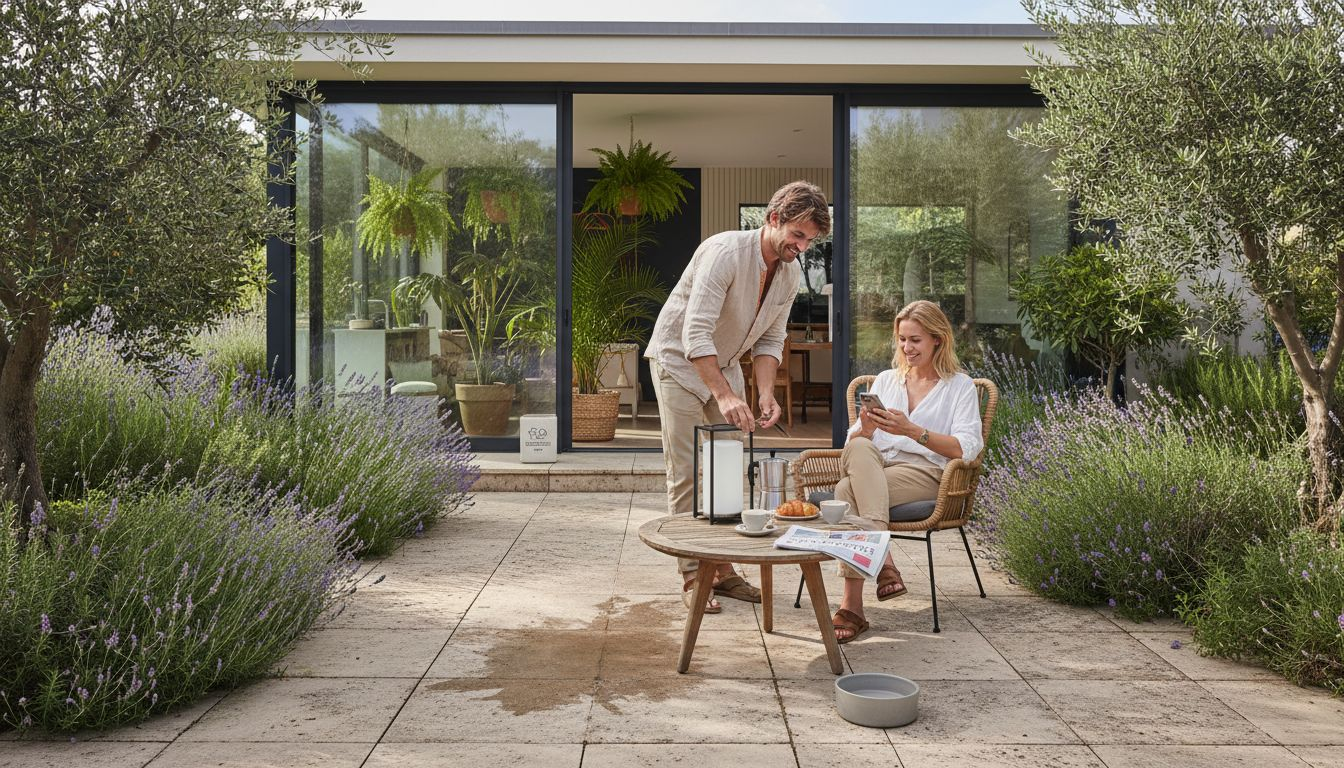
Couple relaxing outside eco luxury home

Solar installations have evolved from rooftop afterthoughts to architectural statements. Modern photovoltaic systems generate 60-80% of typical household electricity needs, slashing operational costs while appealing to eco-conscious tenants willing to pay premium rents. Battery storage systems increasingly accompany these arrays, providing energy independence that resonates with buyers seeking resilience.

Eco-luxury features on the Côte d’Azur directly correlate with market performance:

  • Green-certified buildings command 8-12% price premiums over conventional builds
  • Energy-efficient homes attract longer tenant commitments, reducing vacancy
  • Sustainability features appeal to younger heirs in legacy planning
  • Regulatory trends favor low-carbon buildings, future-proofing investments

Green building certifications like HQE (Haute Qualité Environnementale) and BREEAM provide third-party validation of environmental claims. These labels aren’t mere marketing; they represent measurable performance in energy consumption, water efficiency, and material sustainability. Properties bearing these certifications consistently outperform non-certified peers in both sales velocity and rental yields.

The 15% increase in demand for eco-friendly luxury homes reflects a fundamental shift in buyer values. Digital entrepreneurs and family offices increasingly view sustainability as essential to long-term value preservation. They recognize that environmental regulations will only tighten, making today’s green features tomorrow’s minimum standards.

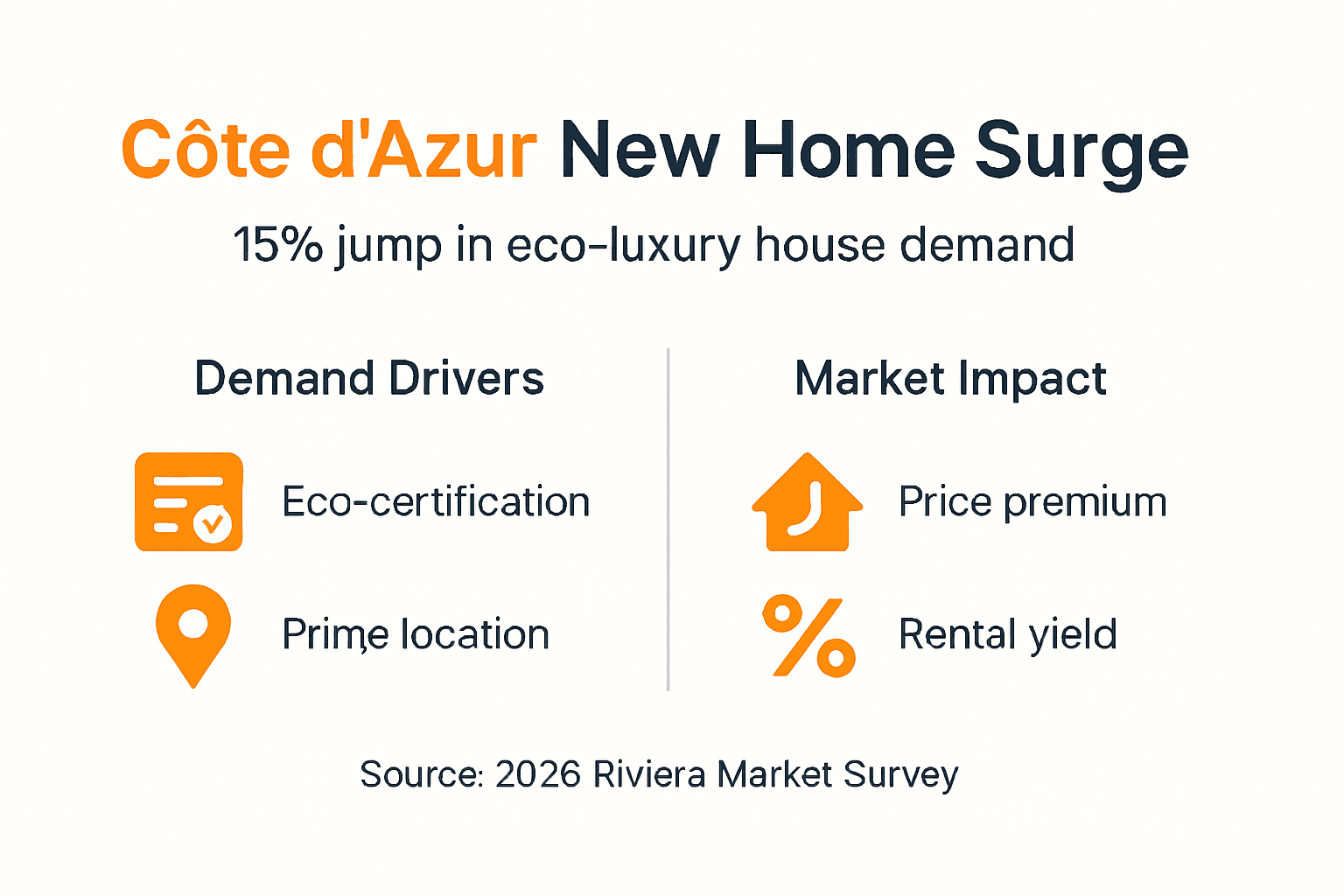
Demand Surge: Sustainable luxury new builds on the Côte d’Azur experienced a 15% demand increase in 2026, with eco-certified properties achieving 3-5% higher rental yields than conventional alternatives through premium seasonal lettings.

Infographic highlighting new home demand surge

Geothermal heating and cooling systems represent another leap forward. These installations use stable underground temperatures to dramatically reduce HVAC energy consumption, often paying for themselves within 7-10 years through operational savings. The technology particularly suits the Riviera’s moderate climate, where extreme temperature swings are rare.

Market Trends and Financial Forecasts for 2026

Property appreciation on the Côte d’Azur follows a distinctly different trajectory than France’s broader market. While national averages hover around 2-3% annually, 5-8% annual property appreciation; 3-5% rental yields characterize prime Riviera locations. New construction in sought-after zones frequently exceeds even these elevated benchmarks during the first five years post-delivery.

Rental income provides immediate returns while appreciation builds wealth over time. Elite seasonal lettings during summer months and festival periods generate substantial cash flow, with luxury villas commanding €10,000-€50,000 per week depending on location and amenities. Annual yields of 3-5% remain achievable even after accounting for management fees and maintenance reserves.

MetricNew ConstructionHistoric Estate
Annual Appreciation6-8%4-6%
Rental Yield3.5-5%2.5-4%
Maintenance Costs0.5-1% of value2-3% of value
Energy EfficiencyA or B ratingD or E rating
Warranty Coverage10 years structuralNone standard

Several factors drive superior financial performance in luxury property demand trends:

  1. Limited coastal land availability constrains new supply
  2. International buyer competition intensifies for turnkey properties
  3. Sustainability mandates reduce appeal of older, inefficient buildings
  4. Modern amenities command premium rents from discerning tenants
  5. VEFA protections attract risk-averse institutional investors

Interest rate environments significantly impact acquisition strategies. As European rates stabilize in 2026, financing costs for luxury purchases have moderated from recent peaks. This creates opportunities for leveraged buyers to amplify returns, though all-cash purchases remain common among ultra-high-net-worth individuals seeking simplicity.

Property appreciation rates vary considerably by micro-location. Monaco-adjacent properties in Roquebrune-Cap-Martin or Beausoleil command the steepest premiums, while emerging zones like Sainte-Maxime offer better value with strong growth potential. Understanding these nuances separates sophisticated investors from those chasing headlines.

Pro Tip: Time your off-plan purchase to coincide with construction commencement rather than initial sales launch. Developers often offer better terms once ground breaks, as they’ve secured financing and need to maintain sales momentum. You’ll sacrifice some appreciation upside but gain negotiating leverage on upgrades and payment schedules.

Currency fluctuations add another layer of complexity for international buyers. Those earning in dollars, pounds, or Swiss francs must factor exchange rate volatility into return calculations. Some investors hedge currency risk through forward contracts, while others view euro exposure as portfolio diversification.

Prime Locations and Lifestyle Integration on the Côte d’Azur

Cap d’Antibes represents the pinnacle of Riviera exclusivity, where prime Côte d’Azur locations command premiums justified by unmatched privacy and prestige. New construction here remains rare due to strict building regulations, making each approved project instantly coveted. Proximity to Antibes’ Provençal markets and the peninsula’s legendary coastal paths creates lifestyle value that financial metrics alone cannot capture.

Monaco-border properties in Beausoleil and Cap d’Ail offer a compelling alternative for buyers seeking principality prestige without Monaco’s stratospheric price tags. Cap d’Antibes offers privacy with premium pricing; Monaco borders provide elevated prestige through proximity to banking services, cultural events, and tax advantages for qualifying residents. New builds in these zones typically feature Monaco-facing terraces that frame the iconic harbor vista.

LocationPrimary AppealAverage New Build PriceLifestyle Highlights
Cap d’AntibesUltimate privacy€15,000-€25,000/m²Coastal sentiers, Provençal markets
Monaco BordersPrestige proximity€12,000-€18,000/m²Banking access, Grand Prix views
Sainte-MaximeBeach lifestyle value€8,000-€12,000/m²Nartelle sunsets, golf courses
Nice Mont BoronCity meets nature€9,000-€14,000/m²Baie des Anges vistas, urban culture

Lifestyle integration extends beyond location to encompass the daily rhythms that make Riviera living extraordinary:

  • Mediterranean climate enabling year-round outdoor activities
  • World-class gastronomy from Michelin-starred dining to fishing village bistros
  • Cultural calendar spanning Cannes Film Festival to Menton’s Lemon Festival
  • Wellness infrastructure including thalassotherapy centers and yoga retreats
  • International schools and healthcare facilities serving global families

Sainte-Maxime exemplifies the emerging luxury tier, where real estate investment tips Côte d’Azur focus on value appreciation potential. New beachside developments starting at €1.2 million offer direct Garonette beach access and ferry connections to Saint-Tropez. The town’s golf courses and family-friendly atmosphere attract a different buyer profile than glitzy Cannes, yet appreciation potential remains robust.

Nice’s Mont Boron district combines urban sophistication with natural beauty. New construction here targets buyers who want Promenade des Anglais proximity without sacrificing green space and panoramic views. These properties appeal to full-time residents rather than pure investment plays, creating stable long-term demand that weathers seasonal fluctuations.

Cannes and Antibes maintain their status as perennial favorites, though for different reasons. Cannes draws entertainment industry connections and Croisette glamour, while Antibes offers Picasso Museum culture and authentic Provençal character. New builds in both towns sell quickly to buyers prioritizing established infrastructure and international recognition.

Legacy Investments and Tax Efficiency Through New Builds

Multigenerational wealth transfer represents a primary motivation for many Côte d’Azur acquisitions. New builds offer tax-efficient wealth transfer and advantages over historic estates for inheritance through several mechanisms that savvy families exploit. French inheritance law’s complex forced heirship rules require careful navigation, but new construction provides flexibility unavailable with older properties.

Sustainability features resonate powerfully with younger heirs who will eventually inherit these properties. Today’s 35-year-old digital entrepreneur cares deeply about environmental impact, making eco-certified villas more appealing legacy assets than energy-guzzling Belle Époque mansions. This generational shift in values directly impacts which properties maintain desirability decades into the future.

Legacy investment strategies leveraging new construction include:

  • Establishing SCI (Société Civile Immobilière) structures to hold property and facilitate gradual ownership transfer
  • Utilizing démembrement to separate usufruct (usage rights) from bare ownership, reducing taxable estate value
  • Gifting property shares to children while retaining lifetime occupancy rights
  • Structuring purchases through family trusts domiciled in favorable jurisdictions

Notary fees on new construction run approximately 2-3% of purchase price, compared to 7-8% for resale properties. This difference saves €50,000-€100,000 on a €2 million acquisition, capital that can fund additional investments or reduce financing needs. The savings stem from reduced land registry taxes on first-time property transfers.

Tax efficiency extends beyond acquisition to ongoing ownership. Modern construction’s superior energy ratings translate to lower taxe foncière (property tax) in many communes that incentivize green building. While the savings appear modest annually, they compound meaningfully over 20-30 year holding periods typical of legacy investments.

Pro Tip: Engage estate planners with specific French property expertise at least 18 months before purchase. Optimal structures often require advance setup, and retrofitting tax efficiency after closing proves difficult. Budget €5,000-€15,000 for comprehensive planning that can save multiples of that fee in reduced taxes and smoother generational transitions.

Wealth preservation through real estate gains particular appeal amid stock market volatility and low bond yields. Tangible assets providing both utility and appreciation offer psychological comfort alongside financial returns. New construction on the Côte d’Azur checks these boxes while adding lifestyle enjoyment that pure financial instruments cannot match.

Common Misconceptions About New Houses Construction on the Côte d’Azur

Many buyers mistakenly assume historic Belle Époque villas carry more prestige than modern construction. While certain landmark properties deserve their reputation, the reality is that VEFA contracts provide more buyer security than assumed; sustainability positively impacts returns. Prestige now stems from design quality, location, and amenities rather than construction date alone.

Off-plan purchase risks loom large in buyer imagination, yet legal protections make these investments safer than many realize. Horror stories from unregulated markets don’t apply to French VEFA contracts, which include completion guarantees and staged payments tied to verified construction milestones. The real risk lies in choosing disreputable developers, not the off-plan concept itself.

Sustainability skeptics argue that green features represent expensive greenwashing without financial merit. Market data proves otherwise: eco-certified properties consistently achieve faster sales, higher prices, and better rental yields than conventional alternatives. The premium buyers pay for sustainability returns through lower operating costs and stronger tenant demand.

Key misconceptions corrected:

  • Myth: Historic properties appreciate faster than new builds. Reality: New construction in prime locations often outpaces older properties through first decade ownership due to modern amenities and energy efficiency.
  • Myth: VEFA contracts expose buyers to construction delays without recourse. Reality: Contracts include penalty clauses for late delivery and completion guarantees ensuring project finishing regardless of developer issues.
  • Myth: Sustainable features cost more than they’re worth. Reality: Green certifications increase property values 8-12% while reducing operational expenses 30-40% through energy savings.

Understanding VEFA contract misconceptions separates informed investors from those leaving money on the table. The contracts’ complexity intimidates some buyers into avoiding excellent opportunities, while those who invest time in understanding protections gain confidence to act decisively.

Another persistent myth suggests that luxury buyers don’t care about energy costs, making efficiency irrelevant. While utilities represent small percentages of wealthy household budgets, the environmental consciousness behind efficiency matters tremendously to modern affluent buyers. Properties perceived as wasteful or outdated face increasing difficulty attracting premium tenants.

Conclusion: Making Smart Luxury New Construction Investments on the Côte d’Azur

Successful luxury acquisitions blend legal knowledge, market awareness, and lifestyle vision into coherent strategies aligned with your financial goals and family values. New construction on the Côte d’Azur offers unique advantages through VEFA protections, sustainability features, and turnkey delivery that historic properties cannot match. The 15% demand surge for eco-luxury builds reflects fundamental shifts in buyer preferences that will only intensify.

Prime locations continue commanding premium pricing justified by privacy, prestige, and cultural richness that transforms houses into homes. Whether you’re drawn to Cap d’Antibes’ exclusive peninsula or Sainte-Maxime’s beach lifestyle value, location remains the single most important driver of long-term appreciation. Choose based on how you’ll actually use the property, not abstract investment theories.

Legacy planning elevates real estate from mere asset allocation to multigenerational wealth preservation. New builds’ tax efficiency, coupled with sustainability features appealing to younger heirs, position these properties as superior legacy vehicles. Engage specialized advisors early to structure ownership optimally for your family’s unique circumstances.

Due diligence remains non-negotiable regardless of VEFA protections. Verify developer track records, review technical surveys independently, and ensure financing aligns with your broader wealth strategy. The Côte d’Azur’s luxury market rewards prepared buyers while punishing those who skip essential research steps.

Explore Our Luxury Côte d’Azur Real Estate Solutions

Living on the Côte d’Azur curates exceptional new construction opportunities matched to your investment criteria and lifestyle aspirations. Our portfolio spans emerging value plays in Sainte-Maxime to ultra-premium Cap d’Antibes estates, each vetted for developer credibility and location excellence. We guide clients through every acquisition phase, from initial luxury real estate key features evaluation to final key handover.

Our luxury property acquisition services include legal coordination, technical inspections, and financing facilitation tailored to international buyers. We accept cryptocurrency payments for clients seeking blockchain transaction efficiency. Whether you’re building legacy wealth or diversifying into tangible assets, our team provides insights that transform complex markets into confident decisions. Explore real estate investment strategies designed specifically for discerning Riviera investors.

Frequently Asked Questions About New Houses Construction on the Côte d’Azur

What key benefits do VEFA contracts provide to luxury buyers?

VEFA contracts offer 10-year structural warranties covering major defects, staged payments tied to construction milestones protecting your capital, and completion guarantees ensuring project finishing even if developers face financial difficulties. These legal protections far exceed anything available with resale properties.

How do eco-luxury features impact long-term property value?

Green-certified buildings command 8-12% price premiums over conventional construction while achieving 3-5% higher rental yields through premium seasonal lettings. Energy efficiency reduces operational costs 30-40%, and sustainability appeals strongly to younger generations who will inherit these properties, ensuring long-term desirability.

Which Côte d’Azur locations offer the best legacy investment potential?

Cap d’Antibes provides ultimate privacy and scarcity driving consistent appreciation, while Monaco-border properties in Beausoleil combine prestige with banking access. Emerging zones like Sainte-Maxime offer stronger value appreciation potential starting from €1.2 million, appealing to families seeking beach lifestyle with solid returns.

What are common pitfalls to avoid when purchasing off-plan properties?

Skipping independent technical surveys of soil studies and structural plans risks discovering issues too late. Failing to verify developer track records through completed project visits can lead to quality disappointments. Not engaging French property law specialists early prevents optimal tax structuring that’s difficult to retrofit after closing.

How can new construction support tax-efficient estate planning?

New builds incur 2-3% notary fees versus 7-8% for resales, saving €50,000-€100,000 on typical purchases. SCI structures facilitate gradual ownership transfer to heirs, while démembrement separates usage rights from ownership to reduce taxable estate values. Superior energy ratings often qualify for reduced property taxes in eco-conscious communes.

Why is demand for sustainable luxury builds increasing so rapidly?

The 15% demand surge reflects generational wealth transfer to environmentally conscious heirs, tightening energy regulations making efficiency essential, and proven financial outperformance of green-certified properties in both sales pricing and rental yields. Sustainability has shifted from optional amenity to fundamental value driver in luxury markets.

Recommended

  • Why Demand Luxury Apartments on the Côte d’Azur
  • Luxury Home Prices: What Drives Côte d’Azur Value
  • Second Home Trends 2025: Shaping Riviera Legacies
  • Invest in New Construction in French Alps for Dual-Season ROI
by Feline Kuijer/7 April 2026/in Blog
https://www.livingonthecotedazur.com/wp-content/uploads/2026/02/1772256163804_image.jpg 768 1344 Feline Kuijer https://www.livingonthecotedazur.com/wp-content/uploads/2024/02/sitelogo150.png Feline Kuijer2026-04-07 05:23:002026-04-07 12:44:26New Houses Construction Côte d’Azur: 15% Demand Surge

TL;DR:

  • Successful Riviera property investments require precise, bespoke financing structures for legacy preservation.
  • Advanced tools like Lombard loans and staged off-plan financing maximize liquidity and minimize risks.
  • Regular review and expert guidance ensure long-term value and compliance in France’s elite real estate market.

The assumption that high-net-worth property acquisitions on the French Riviera are simply a matter of writing a large cheque is, frankly, one of the most costly misconceptions in elite real estate. The truth is considerably more nuanced, more layered, and far more rewarding when approached with precision. France’s luxury real estate market is valued at approximately EUR 30 billion, with the Côte d’Azur standing as its most coveted theatre of investment. From the lemon-scented promenades of Menton to the yacht-dotted marinas of Antibes, every acquisition here carries the weight of legacy. Knowing how to finance that legacy intelligently is where vision becomes reality.

Table of Contents

  • Understanding the luxury property finance landscape
  • Choosing the right financing structure for luxury assets
  • Advanced strategies: Leveraging financial assets and off-plan opportunities
  • Mitigating risks and optimising legacy outcomes
  • Our insight: The realities behind luxury property financing success
  • Unlock your Riviera legacy with expert support
  • Frequently asked questions

Key Takeaways

PointDetails
Market is thrivingFrench Riviera luxury property attracts global investors with a EUR 30 billion market size.
Bespoke finance is essentialStandard mortgages rarely suit legacy investments—seek tailored solutions from expert lenders.
Leverage financial assetsLombard loans and asset-backed lending allow you to acquire property without sacrificing portfolio gains.
Structure for legacyOptimise deals for intergenerational transfer and volatility by combining legal, tax, and lending expertise.
Expert guidance mattersWorking with specialist advisors ensures access to the best opportunities and deal structures.

Understanding the luxury property finance landscape

Having set the scene, let us examine the fundamental market dynamics and the principal players who enable high-value transactions on the Riviera. This is not a market for the uninitiated, and understanding its architecture is the first step towards securing your position within it.

The France luxury real estate market, valued at roughly EUR 30 billion, is powered by a concentrated pool of high-net-worth individuals (HNWIs) and ultra-high-net-worth individuals (UHNWIs) drawn from across the globe. The French Riviera sits at the apex of this market, rivalled only by Paris in terms of prestige and price resilience. Demand is driven by scarcity of prime coastal land, the enduring allure of the Mediterranean lifestyle, and the region’s reputation as a safe harbour for generational wealth.

The buyers active in this space are a sophisticated cohort. They include:

  • European family offices seeking tax-efficient wealth preservation
  • Digital entrepreneurs and crypto investors reallocating liquid assets into tangible, appreciating property
  • International executives drawn to Monaco’s borders and Cap d’Antibes’ privacy
  • Legacy-focused families structuring acquisitions for intergenerational transfer

Financing at this level rarely involves a standard retail bank. Instead, the ecosystem is shaped by private banks, boutique lenders, and cross-border advisory firms who understand the unique legal and fiscal landscape of French property law.

Financing playerTypical client profileKey advantage
Private bank (e.g., UBS, CMB Monaco)UHNWI, family officesBespoke terms, relationship-driven
Boutique mortgage brokerInternational HNWIsCross-border expertise, flexibility
Cross-border legal advisorNon-resident investorsTax structuring, compliance

Exploring the full range of French Riviera property features reveals why this market commands such premium valuations, and why understanding current market trends is essential before committing capital. Properties here appreciate at 5 to 8% annually in prime locations, making the financing structure you choose as important as the asset itself.

Choosing the right financing structure for luxury assets

With a grasp of the market’s scale, it is essential to understand which financing structures best align with your goals and risk profile. Not every structure suits every investor, and the difference between a well-matched and poorly matched approach can be measured in millions.

There are four principal structures worth understanding:

  1. Traditional private bank mortgage: Offered by institutions with deep Riviera expertise, these loans are tailored to the borrower’s full financial picture rather than income alone. Loan-to-value ratios typically range from 50% to 70% for prime assets.
  2. Bespoke cross-border lending: Designed for non-resident investors, these solutions account for currency risk, foreign income streams, and the specific legal requirements of French property acquisition.
  3. Lombard loans: Secured against an existing investment portfolio, these allow you to preserve your asset base whilst releasing liquidity for property purchase. Ideal for investors who prefer not to liquidate positions.
  4. Blended approaches: Combining a Lombard loan with a partial mortgage, for instance, can optimise both tax efficiency and cash flow, particularly for legacy-focused acquisitions.

Institutions such as CMB Monaco offer bespoke mortgage solutions for French Riviera and Monaco properties, including staged funding commitments for off-plan VEFA developments. This level of customisation is precisely what distinguishes elite financing from conventional lending.

Client and advisor review mortgage options

StructureBest forLiquidity impactComplexity
Private bank mortgageLong-term hold, legacyModerateMedium
Lombard loanPortfolio-rich investorsLowMedium
Cross-border bespokeNon-residentsVariableHigh
Blended approachLegacy and yield focusLowHigh

For a thorough overview of detailed financing options specific to the Riviera, we recommend reviewing the full spectrum before committing to a single path. Exploring structuring loan options can also provide useful comparative context.

Pro Tip: Always engage your private banker and your notaire simultaneously from the outset. Delays caused by misalignment between legal and financial advisors are among the most common and expensive mistakes we witness in high-value Riviera transactions.

Advanced strategies: Leveraging financial assets and off-plan opportunities

Once the fundamentals are clear, it is time to consider the advanced tools that elite investors use to optimise their legacy and leverage. These are the strategies that separate a well-structured acquisition from a truly exceptional one.

Lombard loans secured against financial portfolios are a cornerstone tool for UHNWIs, enabling liquidity without the need to liquidate carefully constructed investment positions. The mechanics are elegant: your portfolio acts as collateral, releasing capital at favourable rates whilst your assets continue to generate returns. The key considerations include:

  • Loan-to-value ratios on portfolios typically range from 50% to 80%, depending on asset quality and diversification
  • Interest rates are generally lower than standard mortgages, reflecting the security of liquid collateral
  • Margin call risk must be managed carefully, particularly in volatile market conditions
  • Currency alignment between the portfolio and the property purchase should be reviewed with your advisor

Off-plan financing, known in France as VEFA (Vente en l’État Futur d’Achèvement), presents a distinct and compelling opportunity. Financing off-plan developments like Mareterra requires tailor-made bank commitments with progressive funding released in stages as construction milestones are met. This suits ultra-UHNWIs who are diversifying portfolios and wish to acquire tomorrow’s icons at today’s prices.

“The finest acquisitions we have facilitated on the Riviera were not reactive purchases. They were the result of financing structures conceived twelve to eighteen months before a single offer was made.”

Consider Sainte-Maxime’s emerging beachside residences, where designer apartments from EUR 1.2M offer both lifestyle and yield. Structuring a VEFA acquisition here with staged funding protects you from construction overruns and benefits from lower notary fees. For guidance on structuring high-value deals and understanding Monaco legacy strategies, our curated resources offer an invaluable starting point.

Pro Tip: When financing off-plan, insist on a bank guarantee (garantie financière d’achèvement) written into your VEFA contract. This protects your staged payments should the developer encounter financial difficulties during construction.

Mitigating risks and optimising legacy outcomes

Taking advantage of sophisticated strategies demands careful risk management. Let us cover how to protect your legacy and avoid the pitfalls that even experienced investors sometimes overlook.

The Riviera market is resilient, but no market is immune to external shocks. A well-structured acquisition anticipates volatility rather than reacting to it. Here are the five most important risk mitigation steps we recommend:

  1. Conduct a full legal audit before any offer is made. Title clarity, planning permissions, and any encumbrances must be verified by a qualified notaire and, ideally, an independent legal advisor.
  2. Stress-test your financing structure against a 20% currency shift and a 15% property value correction. If your structure cannot withstand either scenario, it requires revision.
  3. Structure for intergenerational transfer from day one. French inheritance law (the réserve héréditaire) affects non-resident buyers significantly. A Société Civile Immobilière (SCI) structure can offer both tax efficiency and seamless legacy transfer.
  4. Review compliance annually. French tax law evolves, and what is optimal today may require adjustment in two years. Retain a cross-border tax advisor with specific French expertise.
  5. Choose advisors with genuine Riviera relationships. Bespoke mortgage solutions from institutions like CMB Monaco are not available to those who approach the market without the right introductions.

Riviera properties in prime locations appreciate at 5 to 8% annually, making long-term hold strategies particularly powerful when combined with elite seasonal rental yields of 3 to 5%. The numbers are compelling; the structure must be equally so.

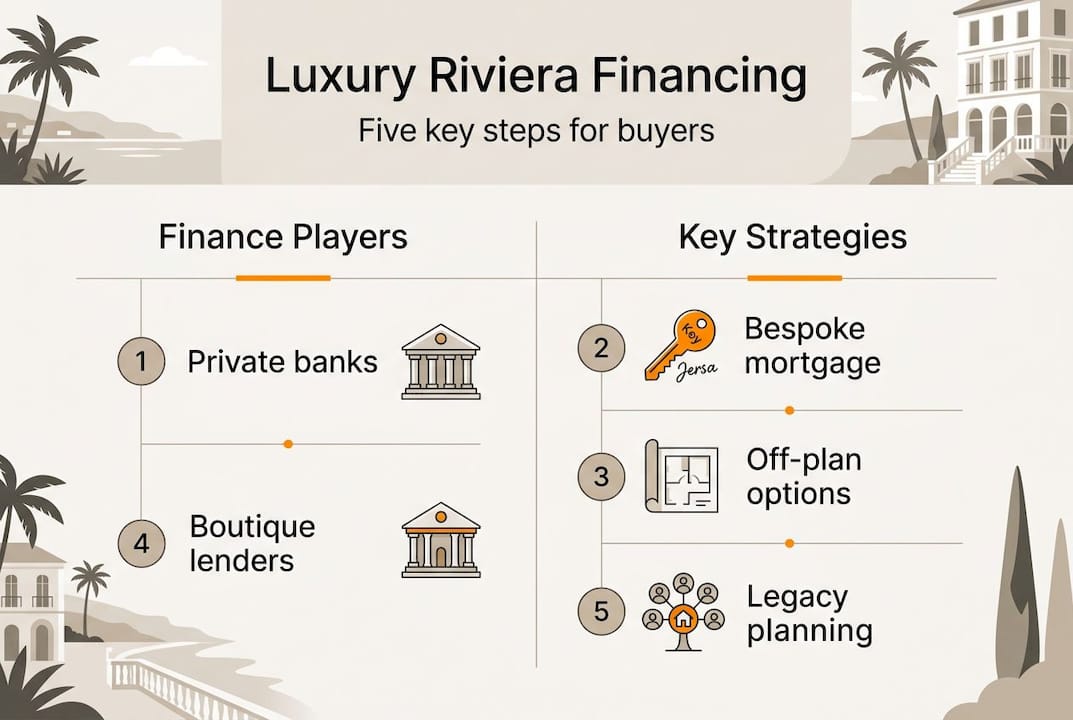
Infographic showing luxury property finance steps

For a broader view of investment strategies for legacy on the Côte d’Azur, our resources cover the full spectrum from Provençal mas to Monaco-adjacent plots.

Pro Tip: An SCI (Société Civile Immobilière) is not merely a tax vehicle. When structured correctly, it becomes the architectural backbone of a multi-generational legacy, allowing shares to be gifted progressively to heirs whilst retaining management control.

Our insight: The realities behind luxury property financing success

After examining structured approaches, our experience in the market reveals a dimension often absent from standard guides. The most successful financing outcomes we have witnessed on the Riviera were never purely about securing the lowest headline rate. They were about strategic alignment maintained over years, not just at the point of purchase.

The investors who build the most enduring legacies here treat their Riviera acquisition as a living financial instrument. They revisit their structure annually, adjusting for shifts in French tax law, currency movements, and family circumstances. They cultivate relationships with their private bankers the way one cultivates a fine vineyard: with patience, attention, and long-term intent.

We have seen clients lose significant value not through poor property selection, but through financing structures that were never revisited after completion. A one-size-fits-all approach, applied to a market as nuanced as the Côte d’Azur, is a quiet but costly error. The investment benefits in 2026 are real and substantial. Capturing them fully requires bespoke planning that begins long before the search for a property does.

Unlock your Riviera legacy with expert support

Understanding the principles of luxury property financing is a powerful foundation. Translating that understanding into a precisely structured, legally sound, and legacy-ready acquisition is where our expertise becomes your advantage. We specialise in acquiring Riviera legacy properties that transcend the transactional, connecting discerning investors with assets that appreciate in both value and meaning. Our access to exclusive off-market opportunities ensures that your search extends well beyond what is publicly listed. Whether you are structuring your first Riviera acquisition or expanding a curated portfolio, we invite you to speak to our Riviera experts for a private, personalised consultation.

Frequently asked questions

How do Lombard loans support luxury property purchases?

Lombard loans allow you to borrow against your investment portfolio, releasing liquidity for a property purchase whilst your assets remain fully invested and continue generating returns.

What is off-plan (VEFA) property financing and why is it used?

VEFA financing provides staged funding commitments released progressively as construction milestones are met, making it ideal for UHNWIs seeking to diversify into premium developments before completion.

Is luxury property finance in France available to non-resident investors?

Yes. International buyers can access bespoke mortgage solutions through private banks and cross-border advisors who specialise in French Riviera and Monaco acquisitions for non-resident clients.

What are the main risks when financing luxury property on the Riviera?

The principal risks include currency volatility, evolving French tax law, legal compliance, and inadequate legacy structuring. Engaging specialist advisors early and revisiting your structure annually are the most effective safeguards.

Recommended

  • Finding the perfect French Riviera luxury investment property
  • How to Finance Luxury Real Estate on the Côte d’Azur
  • Luxury Real Estate Buying Guide: Secure Your Riviera Legacy
  • How to Invest in French Riviera Real Estate for 2025 Gains – Living on the Côte d’Azur
  • Top questions to ask mortgage brokers for smart homebuying
  • Comprendre les types de rendement immobilier pour investir
by Ab Kuijer/3 April 2026/in Blog
https://www.livingonthecotedazur.com/wp-content/uploads/2026/04/1775175712557_Private-banker-reviews-luxury-property-documents.jpeg 714 1280 Ab Kuijer https://www.livingonthecotedazur.com/wp-content/uploads/2024/02/sitelogo150.png Ab Kuijer2026-04-03 02:22:202026-04-04 16:09:45Luxury property financing on the French Riviera: 5 key tips

Dreaming of a retirement filled with sunshine, beautiful scenery, excellent food and a relaxed lifestyle? Then the South of France should be at the top of your list.

From the glamorous coastline of the French Riviera to the lavender fields of Provence, southern France offers one of the best lifestyles in Europe for retirees. Whether you want a sea-view apartment in Nice, a villa in Provence or a peaceful village near the Côte d’Azur, retiring in the South of France is more achievable than many people think.

Here are the 10 best reasons why more retirees are choosing southern France in 2026.

1. Enjoy More Than 300 Days of Sunshine a Year

One of the biggest reasons people retire to the South of France is the weather.

The Mediterranean climate offers warm summers, mild winters and more than 300 sunny days per year in many parts of the region. Cities such as Nice, Antibes, Cannes and Montpellier enjoy far more sunshine than northern Europe, the UK, the Netherlands or much of North America.

A warmer climate is not just pleasant; it can improve your quality of life. Many retirees find that sunshine and milder winters help with joint pain, arthritis, mood and energy levels.

Imagine starting each day with breakfast on your terrace, followed by a walk by the sea or through a Provençal village square.

2. A Better Quality of Life

France consistently ranks among the best countries in Europe for quality of life, and the South of France takes that even further.

Life here moves at a slower, more enjoyable pace. People take time to enjoy lunch, shop at local markets and meet friends at cafés. Stress levels are lower and there is a greater focus on enjoying life rather than rushing through it.

Retirees often say that one of the greatest benefits of living in southern France is simply having more time to enjoy every day.

The region combines excellent healthcare, beautiful surroundings, good infrastructure and a safe environment. Whether you enjoy reading in a village square, gardening, walking or dining outdoors, the South of France makes daily life feel like a holiday.

3. Excellent and Affordable Healthcare

Healthcare is one of the most important factors when choosing where to retire.

France has one of the best healthcare systems in the world. Once you become a resident, you can join the French healthcare system and many costs are reimbursed through the Sécurité Sociale. Many retirees also choose an affordable “mutuelle” insurance policy to cover the remaining costs.

The South of France has excellent hospitals and clinics in cities such as:

  • Nice
  • Marseille
  • Montpellier
  • Toulon

Many doctors and specialists also speak English, especially in popular retirement areas with an international population.

Compared with the United States and several other countries, healthcare in France is often significantly cheaper while maintaining an extremely high standard.

4. Beautiful and Diverse Places to Live

The South of France offers an incredible variety of locations, depending on the lifestyle you want.

If you love the sea and a lively atmosphere, you may prefer:

  • Nice
  • Antibes
  • Cannes
  • Saint-Tropez

If you prefer a quieter lifestyle with vineyards, markets and charming streets, villages such as:

  • Lorgues
  • Fayence
  • Vence

offer excellent value and a slower pace of life.

You can choose between a modern apartment by the sea, a traditional Provençal house, a village home or a villa with a pool. For many retirees, that variety is one of the biggest attractions.

5. The Food and Wine Are Part of Everyday Life

Retiring in southern France means living in one of the world’s greatest food regions.

Fresh vegetables, seafood, local cheeses, olive oil, rosé wine and fresh bread are not special treats here — they are part of everyday life.

The Mediterranean diet is also known to be one of the healthiest in the world. Local markets take place several times each week in almost every town and village, where you can buy produce directly from farmers and artisan producers.

The region is also home to world-famous wine areas such as:

  • Provence
  • Châteauneuf-du-Pape
  • Bandol

Whether you prefer simple bistros or Michelin-starred restaurants, southern France is a paradise for food lovers.

6. You Can Stay Active All Year Round

Retirement in the South of France does not mean slowing down unless you want to.

The region offers countless opportunities for an active lifestyle:

  • Walking and hiking in the hills of Provence
  • Cycling along the coast
  • Golf, tennis and pétanque
  • Sailing and swimming in the Mediterranean
  • Visiting markets and cultural events
  • Skiing in the Alps during winter

One of the great advantages of the South of France is that you can often swim in the sea and ski in the mountains on the same day.

Popular outdoor destinations include:

  • Gorges du Verdon
  • Calanques National Park
  • Mercantour National Park

This combination of sea, countryside and mountains makes the region ideal for active retirees.

7. A Strong International Community

Moving abroad can feel daunting, especially if you worry about feeling isolated.

Fortunately, the South of France already has a large international community. In many towns on the Côte d’Azur and in Provence, you will find English-speaking doctors, clubs, social groups and other expats.

Popular areas with international communities include:

  • Nice
  • Cannes
  • Aix-en-Provence
  • Montpellier

At the same time, the region has kept its authentic French atmosphere. You can enjoy the comfort of an international community without losing the charm of living in France.

8. Excellent Travel Connections

Another major advantage is how easy it is to travel.

The South of France is extremely well connected, with international airports in:

  • Nice Côte d’Azur Airport
  • Marseille Provence Airport
  • Montpellier-Méditerranée Airport

There are also excellent train connections. The French TGV can take you from the South of France to Paris in a few hours, and you can easily travel to Italy, Spain and Switzerland.

For retirees who want to see family regularly or continue travelling around Europe, this is a huge advantage.

9. Property Still Offers Good Value

Many people think the South of France is only for the ultra-rich. While places like Monaco and Saint-Tropez are expensive, there are still many affordable and attractive areas.

If you move slightly inland, you can often find beautiful homes at much lower prices than directly on the coast. Villages in Provence or inland areas near the French Riviera often offer better value, more space and a quieter lifestyle.

For retirees who are also thinking about long-term investment, the South of France remains one of the most desirable property markets in Europe.

Because you are already active on the Côte d’Azur and work with buyers through your international network, you know better than most that there are still many hidden opportunities beyond the obvious hotspots.

10. The South of France Makes Retirement Feel Special

Finally, there is something difficult to measure but impossible to ignore.

The South of France simply has a unique atmosphere.

It is the scent of lavender in Provence, the sound of the sea in the morning, the village market on a sunny square, the pétanque players in the afternoon and a glass of rosé as the sun sets.

Retirement here is not only about where you live. It is about how you live.

The South of France offers beauty, culture, relaxation and a true “art de vivre” that many people spend their whole lives searching for. (Barefoot Blogger)

If you are considering retiring abroad, the South of France deserves to be high on your list. Whether you want a lock-up-and-leave apartment near the beach or a peaceful villa in Provence, there has rarely been a better time to make the move.

by Ab Kuijer/2 April 2026/in Blog
https://www.livingonthecotedazur.com/wp-content/uploads/2026/04/retiring-french-riviera.jpg 667 1000 Ab Kuijer https://www.livingonthecotedazur.com/wp-content/uploads/2024/02/sitelogo150.png Ab Kuijer2026-04-02 08:53:162026-04-02 19:36:4710 Powerful Reasons to Retire in the South of France

For years, Nice was often seen as the elegant gateway to the French Riviera: a city with a beautiful seafront, a famous old town and an airport convenient for reaching Cannes, Monaco or Saint-Tropez. Today, however, Nice is no longer simply the arrival point. It has become the destination itself.

In 2026, Nice is more popular than ever. Tourism is booming, international flights are increasing, luxury real estate in Nice remains in demand and the city has managed to position itself as one of the few places in Europe where people can combine lifestyle, business, climate and culture in one location.

The clearest sign of this growing popularity can be seen at Nice Côte d’Azur Airport. This summer, the airport announced the biggest schedule in its history: 130 destinations in 47 countries, including 18 new routes and 10 entirely new destinations. (Riviera Radio)

That is not the sign of a city losing momentum. It is the sign of a city that is becoming one of Europe’s most connected and desirable places to visit, live and invest in.

A City That Is Easier Than Ever to Reach

One of the biggest reasons behind Nice’s popularity is accessibility. While many Mediterranean destinations still rely heavily on seasonal tourism and a limited number of flights, Nice now has direct connections to almost every major European market.

This summer alone, new routes have been added to cities such as Boston, Newcastle, Seville, Cork, Hanover and Bratislava. There are also more flights to Paris, Birmingham and Bucharest. For international visitors, that means Nice is easier to reach than ever before. (Nice Airport)

The new Boston route is especially significant. It shows that Nice is increasingly attracting not only European visitors but also Americans. The French Riviera has always been popular with American tourists and second-home buyers, but direct long-haul flights make the region far more attractive for regular visits, remote working and property investment.

The airport will offer 15 long-haul routes this summer, including seven routes to the United States, two to Canada and six to the Middle East. With 112 international destinations out of 130, Nice has become one of the most internationally connected cities in Europe outside the major capitals. (Nice Airport)

The Climate and Lifestyle People Dream About

Of course, flights alone do not explain why Nice has become so popular. The real reason is that the city offers a lifestyle that millions of people are searching for.

Nice enjoys around 300 days of sunshine per year. Winters are mild, summers are warm without being extreme and the sea is never far away. Residents can have breakfast on the famous Promenade des Anglais, spend the afternoon in the mountains and still return in time for dinner by the sea.

Unlike many resort towns, Nice remains alive all year round. There are universities, hospitals, shopping streets, museums, restaurants and a large local population. This gives the city a real energy and makes it attractive not only for tourists, but also for people who want to relocate permanently or spend several months a year there.

The old town, known as Vieux Nice, offers narrow streets, markets and historic buildings. The modern city centre has luxury shops, business districts and excellent transport. In recent years, the city has also invested heavily in public spaces, green areas and tram connections.

The result is a city that feels elegant and Mediterranean, but also practical and easy to live in.

A Growing International Community

Another reason for Nice’s success is that it has become increasingly international. English is widely spoken, there are international schools, international businesses and a large community of people from northern Europe, the United States and the Middle East.

Many buyers from countries such as the Netherlands, Belgium, Germany, Scandinavia and Britain are choosing Nice not only as a holiday destination but as a place to own a second home or even move permanently.

For Dutch and international buyers looking at the French Riviera, Nice is often seen as the ideal compromise. It offers the glamour of the Riviera without the extreme prices of Monaco or the seasonal nature of smaller coastal towns.

The city also benefits from its strategic location. Within less than an hour, residents can reach Cannes, Antibes, Monaco or even ski resorts in the Alps. For people who want variety, Nice is the perfect base.

Property Demand Continues to Rise

The growing popularity of Nice is also reflected in the real estate market. Demand remains strong because the city attracts several different types of buyers at the same time:

  • Holiday-home buyers
  • Investors looking for rental income
  • Retirees relocating to the sun
  • Families seeking an international lifestyle
  • Entrepreneurs and remote workers

This broad demand makes Nice one of the strongest property markets on the French Riviera. While luxury villas in places such as Saint-Jean-Cap-Ferrat or Cannes can reach very high prices, Nice still offers a wide range of apartments and houses at more accessible levels.

Neighbourhoods such as Cimiez, Mont Boron and Carré d’Or remain especially popular because they combine prestige, views and proximity to the city centre.

Investors are also encouraged by the fact that Nice has a strong rental market throughout the year. Because the city attracts tourists, business travellers, students and international residents, there is demand in every season.

A City With Confidence in the Future

Perhaps the strongest proof of Nice’s popularity is not what the city has today, but what is being built for tomorrow.

The extension of Terminal 2 at the airport is opening this spring to cope with increasing numbers of passengers. Airport management says the record schedule reflects “the growing appeal of our region” and the confidence that airlines have in the future of Nice and the French Riviera. (Nice Airport)

Passenger numbers continue to rise. Nice airport welcomed more than 15 million passengers in 2025, making it one of the busiest airports in France and the main gateway to the Riviera. (Riviera Edition)

That growth is unlikely to slow down. The combination of sunshine, international access, quality of life and strong property demand means Nice is no longer simply a summer destination. It has become one of Europe’s most desirable places to live, visit and invest.

For many people, Nice represents exactly what they are looking for in 2026: a city by the sea, easy to reach, full of life and with a future that looks brighter than ever.

by Ab Kuijer/1 April 2026/in Blog
https://www.livingonthecotedazur.com/wp-content/uploads/2026/04/nice-cote-azur.jpg 628 1000 Ab Kuijer https://www.livingonthecotedazur.com/wp-content/uploads/2024/02/sitelogo150.png Ab Kuijer2026-04-01 09:57:542026-04-02 15:21:54Why Nice Has Become One of Europe’s Most Popular Destinations

For years, getting around Ibiza without a car has often felt like a challenge. Visitors and residents alike know the routine: buses that arrive late, routes that seem designed for another decade, and little information when things go wrong.

Now, that may finally be changing.

From 1 April 2026, ALSA launches a completely redesigned public transport system across the island. It is not a small update or a few timetable adjustments. Ibiza is replacing its existing network with a new structure of 62 lines, a modern fleet of around 100 buses, digital ticketing, and live tracking.

If it works as promised, this could become one of the biggest improvements to everyday life on the island in years.

The change comes at exactly the right time. Ibiza has become increasingly difficult to navigate in recent summers. Roads between Ibiza Town, Sant Antoni de Portmany, and Santa Eulària des Riu are often heavily congested. Parking near beaches is a nightmare in July and August. And with the island also introducing new restrictions on the number of vehicles allowed onto Ibiza, many people will increasingly need an alternative.

Ibiza’s New Bus Network Could Completely Change the Island

This new bus network is clearly designed to become that alternative.

The most visible change will be the buses themselves. Over the coming months, the fleet will grow to around 100 vehicles. More than half of them — 64 buses in total — will be fully electric, with another three hybrid buses joining the network. That immediately makes Ibiza one of the most advanced tourist destinations in Europe for sustainable public transport.

The new buses are not just greener. They are also much more modern. The vehicles will offer free Wi-Fi, USB charging points, accessibility ramps and contactless payment. In other words, taking the bus in Ibiza may finally start to feel more like using transport in a major city rather than relying on an outdated seasonal service.

But the biggest difference is not the buses. It is the way the entire island is being reorganised.

Until now, Ibiza’s bus system has often felt fragmented. Some routes overlap, others make little sense, and certain villages or beaches have been difficult to reach unless you drive.

The new network is designed around a clearer structure.

At the centre are the new “T routes”, which will act as the main transport corridors across the island:

  • T1: Sant Antoni – Sant Rafel – Ibiza Town
  • T2: Sant Antoni – Sant Josep – Ibiza Town
  • T3: Santa Eulària – Ibiza Town
  • T4: Santa Eulària – Sant Joan
  • T5: Santa Eulària – Sant Antoni
  • T6: Sant Joan – Sant Llorenç – Santa Eulària
  • T7: Sant Joan – Sant Antoni

These lines are intended to create faster and more logical connections between the main population centres. Instead of a confusing mix of seasonal and local services, the new system should make it easier to understand how to travel between the two sides of the island.

For example, someone staying in Santa Eulària des Riu can reach Sant Antoni de Portmany directly via the T5 route, while visitors staying in Sant Joan de Labritja can travel more easily to either Santa Eulària or Sant Antoni.

Beyond the T routes, the system introduces several additional categories:

  • A routes: local connections to smaller villages and accessibility links
  • P routes: links between towns and beaches, especially important during the summer
  • U routes: urban transport within towns
  • UE routes: urban transport specifically within Ibiza Town

That may sound complicated at first, but it is actually a much more logical system than before. Once people understand the meaning of the letters, it should become easier to identify whether a line is long-distance, local, beach-focused, or urban.

The beach connections could be especially important.

Every summer, some of Ibiza’s most beautiful beaches become almost inaccessible due to traffic and a lack of parking. Popular spots such as Cala Comte, Cala Bassa, and Benirràs Beach often experience severe congestion.

If the new P routes work well, tourists may begin leaving their rental cars behind and taking buses instead. That would reduce traffic, parking pressure, and emissions while also making the beaches more enjoyable.

There is also a strong possibility that the new network will change how people explore Ibiza.

At the moment, many visitors rarely leave the area where they are staying. Someone in Sant Antoni may spend their entire holiday in the west of the island simply because travelling elsewhere feels inconvenient. Better transport could encourage people to discover more of Ibiza — from the restaurants of Santa Eulària to the villages in the north and the beaches around Sant Josep.

That could spread tourism more evenly across the island and benefit local businesses outside the traditional hotspots.

Technology major part of the upgrade

Passengers will be able to use the Alsa Mobi4U app to see exactly where their bus is and when it will arrive. Real-time information, QR codes at bus stops, and digital payments should finally eliminate one of Ibiza’s oldest transport frustrations: standing at a bus stop with no idea whether the bus is five minutes away or has already disappeared. (ALSA.ES)

That said, there is one important warning.

Large transport changes almost always create confusion at first.

From April, many existing lines disappear completely. Route numbers, timetables and destinations will change. Even people who have used the buses for years are likely to make mistakes during the first weeks. Authorities are already advising residents and tourists to check the new routes in advance before travelling. (Cadena SER)

There is another question mark too: will the improvements continue outside the summer season?

Ibiza has often been criticised for offering good transport in July and August but weak services during the rest of the year. Winter buses can be infrequent, routes are sometimes reduced, and some villages feel isolated without a car.

The new system promises to improve year-round consistency. But until people have experienced it through autumn and winter, nobody really knows whether that promise will be kept.

Impressive ambition

This is not just a transport update. It is an attempt to rethink how people move around the island.

If the new system succeeds, Ibiza could become easier, cleaner, and less stressful to explore. Traffic could fall, parking problems could improve, and many people may discover that they no longer need a car for every journey.

And for an island that has long been famous for its beaches, nightlife, and luxury villas, perhaps it is finally time for Ibiza to become known for something less glamorous — a bus system that actually works.

by Ab Kuijer/30 March 2026/in Blog
https://www.livingonthecotedazur.com/wp-content/uploads/2026/03/ibiza-new-buslines-for-2026-1.jpg 667 1000 Ab Kuijer https://www.livingonthecotedazur.com/wp-content/uploads/2024/02/sitelogo150.png Ab Kuijer2026-03-30 18:30:072026-03-30 18:30:32Ibiza’s New Bus Network Could Completely Change the Island

Not every jewel on the Côte d’Azur catches the light of a public listing. Some of the most coveted villas above Èze, the most storied estates along Cap d’Antibes, and the most quietly magnificent Belle Époque residences in Menton change hands in a world entirely invisible to the open market. High-net-worth individuals gain access to private exclusive assets unavailable to the general market, and on the French Riviera, this is not the exception. It is the rule for the most extraordinary properties. This guide reveals what off-market acquisition truly means, why it matters to discerning investors, and precisely how you can position yourself to participate in this rarefied world.

Table of Contents

  • Defining off-market acquisition in luxury real estate
  • Why off-market matters for discerning investors
  • How off-market compares with traditional real estate
  • When and why sellers choose off-market
  • The off-market process: How buyers gain access
  • Key considerations and potential pitfalls
  • Discover your off-market opportunity with Living on the Côte d’Azur
  • Frequently asked questions

Key Takeaways

PointDetails
Exclusive accessOff-market acquisition offers unique properties before they reach the general market.
Privacy and discretionTransactions remain private, protecting both buyer and seller interests.
Potential price advantageOff-market deals can result in purchases below typical market values.
Network is essentialAccess often hinges on relationships with trusted agents and local experts.
Risks and due diligenceBuyers should assess value, ethics, and transparency before committing.

Defining off-market acquisition in luxury real estate

Off-market acquisition refers to the purchase of property without any public advertising, open-day events, or placement on major listing portals. These transactions move through curated networks, trusted introductions, and discreet agent relationships. Off-market deals are kept outside major listing services for privacy and exclusivity, and on the Riviera, this practice is deeply embedded in the culture of high-value asset transfer.

You may encounter several terms in this space. A silent listing is a property whose sale is known only within a closed circle. A pocket listing sits with a single agent who shares it selectively. A private placement often involves direct negotiation between principals, sometimes facilitated by a family office or wealth manager. Each term describes a slightly different arrangement, but all share one defining quality: controlled access.

  • Properties sold without public advertising or portal listings
  • Transactions facilitated through trusted agent networks or personal introductions
  • Buyers are typically pre-qualified and vetted before receiving details
  • Sellers retain full control over who views the asset and when
  • Discretion is maintained throughout, protecting both parties’ reputations

When you explore private real estate sales on the Riviera, you enter a world where relationships carry more weight than search filters.

Pro Tip: Discretion is a currency in off-market transactions. Buyers who demonstrate seriousness, financial credibility, and respect for confidentiality are far more likely to receive introductions to the finest silent listings.

Why off-market matters for discerning investors

Elite investors consistently seek off-market opportunities for reasons that go well beyond simple asset acquisition. Buyers benefit from reduced competition, privacy, and access to unique assets that never surface in the public domain. On the Côte d’Azur, where a sea-view villa in Antibes or a hillside retreat above Saint-Tropez can attract global bidding wars, avoiding that frenzy is itself a form of strategic advantage.

The off-market advantages extend to negotiation dynamics. Without competing offers visible to all parties, conversations tend to be more measured, more personal, and more conducive to creative deal structures. A buyer might negotiate a phased payment, a leaseback arrangement, or the inclusion of furnishings and art that would never appear in a standard contract.

“The finest properties on the Côte d’Azur are rarely sold. They are passed between people who understand their value.”

Privacy is equally significant for buyers protecting a family name, a business reputation, or simply a preference for quiet. Acquiring a legacy estate near Monaco without triggering press speculation or alerting competitors is a genuine priority for many of our clients. The guide to unlocking off-market value on the Riviera begins with understanding that access is earned, not purchased.

  • Reduced competition means calmer, more strategic negotiations
  • Privacy protects family reputation and personal security
  • Access to properties with unique provenance or lifestyle attributes
  • Opportunity to structure bespoke deal terms not possible in open bidding
  • First-mover advantage on assets before they ever reach the wider market

Pro Tip: Appoint an agent with deep local roots and a reputation for discretion. The best off-market introductions come from agents who are trusted by sellers, not merely known to buyers. Our elite off-market guide outlines exactly what to look for.

How off-market compares with traditional real estate

It is essential to see precisely how these off-market deals stack up against traditional sales. The differences are significant, and understanding them helps you decide which route serves your investment objectives.

Infographic comparing off-market and traditional sales

FactorOn-marketOff-market
ExposureGlobal, open to all buyersControlled, invitation only
CompetitionHigh, often multiple biddersLow, curated buyer pool
Price dynamicsCan drive prices above valuationMay close below market value
NegotiationFormal, agent-mediatedFlexible, relationship-driven
TimelineStructured, publicly visibleDiscreet, often faster
Due diligence windowStandard, well-definedShorter, requires preparation

Some off-market sales close for up to 22% below public market value, reflecting reduced competition and lower exposure. For a buyer, this represents a compelling entry point. For a seller, it represents a deliberate trade: price for privacy. Neither outcome is inherently superior. The right choice depends entirely on the asset, the parties, and the circumstances.

When assessing market value on the French Riviera, it is worth noting that Riviera properties appreciate at 5 to 8% annually in prime locations. Securing an asset at even a modest discount to market value, then holding it through a Cannes Film Festival season or a Monaco Grand Prix summer of elite lettings, compounds that advantage considerably. A detailed off-market vs on-market comparison reveals that the optimal strategy often depends on your timeline and risk appetite.

The off-market properties guide we have curated for the Riviera reflects these nuances in full.

When and why sellers choose off-market

Given the trade-offs, why would a seller ever opt out of the market fanfare and exposure? The motivations are as varied as the properties themselves, but several themes recur consistently among Riviera vendors.

Off-market is chosen for privacy, discretion, specific buyer targeting, or avoiding media scrutiny. A family selling a generational estate near Menton during the Lemon Festival season may have no desire to see their home photographed by property portals or discussed in wealth publications. A Monaco-adjacent landowner transferring assets across borders may require a buyer with specific financial and legal credentials.

  • Privacy mandate: Sellers with public profiles, family legacies, or sensitive circumstances prioritise confidentiality above all
  • Targeted buyer search: Some assets suit only a narrow profile of buyer, making broad advertising counterproductive
  • Complex negotiations: Heritage properties, multi-party ownership, or cross-border transfers require bespoke handling
  • Speed and certainty: A pre-qualified buyer from a trusted network often moves faster than an open-market process
  • Avoiding speculation: Public listings can attract speculators who inflate interest without genuine intent to purchase

The risk for sellers is real. A smaller buyer pool may mean a lower final price. Yet for many vendors of ultra-prime assets, the private sales for legacy approach is not a compromise. It is a deliberate choice that honours the asset’s history and the family’s future.

The off-market process: How buyers gain access

Understanding seller motivations, what must a buyer do to participate in this world? The process is less transactional and more relational than most investors expect.

Networks and trusted agents are the gateways to off-market opportunities. Gaining access begins long before any specific property is identified. It begins with reputation.

  1. Build your presence in the right circles. Attend Riviera events, from the Cannes Yacht Show to private gallery openings in Antibes, where relationships with agents and vendors form naturally.
  2. Appoint a specialist buyer’s agent. The advantages of using a buyer agent on the Côte d’Azur are considerable. A well-connected agent acts as your advocate and your introduction to sellers who would never accept a cold approach.
  3. Communicate your requirements with precision. Sellers and their agents need to know you are serious. Define your budget, your preferred locations, your lifestyle requirements, and your timeline clearly.
  4. Prepare your due diligence in advance. Have your legal and financial advisors briefed. Off-market timelines can be swift, and hesitation signals doubt.
  5. Demonstrate discretion at every stage. Do not share details of properties you are shown. Confidentiality is the foundation of trust in this world.

The property buyer agent benefits for discerning investors extend well beyond access. A skilled agent negotiates on your behalf, manages due diligence, and ensures the transaction reflects the asset’s true value. Our guide to finding off-market homes on the Riviera walks you through each stage in detail.

Agent negotiating property deal by window

Pro Tip: Credibility opens more doors than capital alone. Sellers of exceptional properties want to know their home is passing to someone who will honour its legacy, not merely its price tag.

Key considerations and potential pitfalls

Even as the allure is strong, prudent investors must navigate several genuine risks in the off-market world.

Critics argue off-market deals may restrict diversity, limit fair market access, or pose ethical dilemmas around transparency. These are legitimate considerations, and any serious investor should weigh them honestly.

“Exclusivity, when unchecked, can become opacity. The most sophisticated buyers insist on rigorous due diligence precisely because the market cannot do it for them.”

  • Valuation risk: Without competing bids, it is harder to confirm you are paying a fair price. Commission an independent valuation before proceeding.
  • Limited data: Off-market transactions rarely appear in comparable sales data, making price benchmarking more complex.
  • Compressed timelines: Sellers who value discretion often expect swift decisions. Prepare your advisors in advance.
  • Reduced transparency: The absence of public scrutiny means buyers must conduct more thorough independent checks on title, planning, and condition.
  • Ethical considerations: The discriminatory practice debate around off-market listings is real. Responsible participation means working with agents who operate with integrity and inclusivity.

Our comprehensive off-market guide addresses each of these risks with practical frameworks drawn from years of Riviera transactions. The salt-kissed air of the Côte d’Azur carries both opportunity and obligation. The most enduring investments are those made with both eyes open.

Discover your off-market opportunity with Living on the Côte d’Azur

At Living on the Côte d’Azur, we have spent years cultivating the relationships and the reputation that grant access to the Riviera’s most extraordinary off-market assets. From a sun-drenched villa above the Nartelle beach in Sainte-Maxime to a discreet Belle Époque residence in Menton’s lemon-scented old town, our curated portfolio reaches far beyond what any public portal can offer. We work with digital pioneers, family offices, and legacy investors who understand that the finest properties are never advertised. They are introduced. Whether you prefer to transact in traditional currency or cryptocurrency, we are equipped to guide you with the discretion and expertise your ambitions deserve. Explore our private listings and let us open the doors that others cannot.

Frequently asked questions

What exactly is off-market acquisition?

It is the purchase of property privately, without public advertising or listings, available only to trusted and pre-qualified buyers. Off-market deals avoid public listing services and marketplace exposure entirely.

Why do sellers choose off-market rather than a public sale?

For privacy, speed, and the ability to target a specific buyer profile without attracting media scrutiny or unwanted speculation. Sellers opt for off-market to shield privacy or block unwanted attention.

Can off-market acquisition help buyers secure below-market prices?

Yes. Some deals close up to 22% below public market value due to reduced competition and limited exposure, offering a meaningful entry advantage for prepared buyers.

Are there any drawbacks to off-market property buying?

Potential drawbacks include limited choice, reduced transparency, and the need for more rigorous independent due diligence. Concerns over reduced access and transparency are acknowledged within the industry and should be factored into any acquisition strategy.

Recommended

  • Property acquisition guide – Living on the Côte d’Azur
  • 7 Top Off-Market Property Advantages for Riviera Investors
  • The invisible luxury real estate properties on the Cote d’Azur – Living on the Côte d’Azur
  • Steps to successful property buying on Côte d’Azur 2026
by Jolanda Kuijer/28 March 2026/in Blog
https://www.livingonthecotedazur.com/wp-content/uploads/2026/03/1774657132564_Consultant-meeting-with-clients-in-Riviera-home.jpeg 714 1280 Jolanda Kuijer https://www.livingonthecotedazur.com/wp-content/uploads/2024/02/sitelogo150.png Jolanda Kuijer2026-03-28 01:20:122026-05-07 12:46:41Off-market acquisition: secure exclusive Côte d’Azur property

The French Riviera has long been synonymous with glamour, sunshine, and extraordinary cuisine. In 2026, the region added yet another culinary milestone: eight restaurants across the Riviera and Monaco were awarded their first Michelin star, further cementing the Côte d’Azur’s reputation as one of Europe’s most exciting gastronomic destinations. (IYC)

The announcement was made during the Michelin Guide France & Monaco ceremony held at the Grimaldi Forum in Monaco, a historic first for the principality and a symbolic moment that highlighted the region’s global culinary influence. (Michelin)

For residents and visitors alike, this means one simple thing: the French Riviera is one of the best places in the world to eat. Going out to eat is a treat, but going to a Michelin restaurant every night eventually gets boring. A local Pan Bagnat on the beach with fresh tuna and anchovies can taste very good too, especially with your feet in the sand. Or a menu du jour at a local restaurant is often surprisingly tasty. But a night out at a Michelin restaurant remains the ultimate indulgence for the taste buds.


A New Generation of Michelin-Star Restaurants

Each year, Michelin inspectors travel anonymously across France to evaluate restaurants based on strict criteria: ingredient quality, technique, the chef’s personality, value, and consistency.

In the 2026 Michelin Guide, France welcomed 54 new one-star restaurants nationwide, with several of them located in Provence-Alpes-Côte d’Azur. (Michelin Guide)

The Riviera’s newest stars demonstrate a growing trend:

  • Chefs combining Mediterranean ingredients with modern techniques
  • Restaurants focusing on local seafood, Provençal herbs, and seasonal produce
  • Dining experiences that mix luxury with authenticity

This wave of recognition confirms what locals have known for years: the Riviera’s culinary scene is evolving fast.


Why the Côte d’Azur Is a Culinary Powerhouse

The French Riviera benefits from a unique combination of ingredients and influences:

1. Exceptional local produce
The Mediterranean provides fresh fish, shellfish, and sea salt, while the nearby hills deliver olive oil, herbs, citrus, and vegetables.

2. Italian and Provençal heritage
Bordering Italy, the Riviera blends culinary traditions — think handmade pasta, seafood, olive oil, and delicate sauces.

3. A global clientele
International visitors push restaurants to innovate. Chefs constantly reinvent classic Mediterranean cuisine for a cosmopolitan audience.

4. Luxury hospitality culture
Five-star hotels and beach clubs have created a competitive environment where gastronomy is a key part of the experience.

From elegant seaside hotels to intimate gastronomic kitchens, these new stars represent a new generation of chefs redefining Mediterranean cuisine.

New Michelin Stars in the Var

Les Oliviers — Chef Martin Feragus

👉 https://www.thalazur.fr/bandol/hotel/restaurant/

Located in Bandol overlooking the beautiful Baie de Renécros, this elegant restaurant combines refined gastronomy with spectacular sea views. Chef Martin Feragus creates modern Mediterranean dishes inspired by Provence and the sea. (Bandol Tourisme)


L’Oursin — Hôtel Les Roches — Chef Antoine Gras

👉 https://lesroches-rouges.com/restaurants-bars/loursin

Situated inside the iconic Hôtel Les Roches Rouges near Saint-Raphaël, L’Oursin focuses on delicate seafood cuisine and seasonal Mediterranean ingredients.


Shanael — Chef Anthony Denon

👉 https://restaurant-shanael.fr

A creative gastronomic address in the Var where chef Anthony Denon delivers contemporary cuisine with bold flavour combinations and artistic presentation.


New Michelin Stars in the Alpes-Maritimes & Monaco

La Table du Cap Estel — Chef Kevin Garcia

👉 https://www.capestel.com/fr/restaurant-gastronomique-cote-dazur.html

Located in the spectacular Cap Estel hotel in Èze, this refined restaurant offers a gastronomic experience overlooking the Mediterranean. Chef Kevin Garcia’s cuisine blends precision technique with Mediterranean ingredients and herbs from the estate’s garden. (capestel.com)


La Table de Pierre — Chef Rodolphe Loury

👉 https://www.lemasdepierre.com/fr/restaurants-bars/la-table-de-pierre

Situated in the luxurious Domaine du Mas de Pierre in Saint-Paul-de-Vence, this restaurant elevates Provençal cuisine with modern creativity and seasonal produce.


Épicentre — Chef Selim M’Nasri

👉 https://restaurant-epicentre.fr

A contemporary gastronomic restaurant focusing on refined textures and intense flavours, showcasing chef Selim M’Nasri’s innovative approach to French cuisine.


Auberge de la Roche — Chef Louis-Philippe Riel

👉 https://aubergedelaroche.com

A charming gourmet restaurant where traditional French cuisine meets modern refinement in an intimate setting.


Robuchon Monaco — Chef Jonathan Larrieu

👉 https://www.montecarlosbm.com/en/restaurant-monaco/robuchon-monaco

Part of the legendary Joël Robuchon culinary legacy, this Monaco restaurant continues the tradition of elegant haute cuisine with modern precision.


With eight new Michelin stars and a growing generation of talented chefs, the Riviera continues to attract global attention. From the markets of Nice to the luxury terraces of Monaco and Saint-Tropez, the region offers some of the most exciting dining experiences in Europe.

For food lovers, there may be no better place to explore — because on the French Riviera, gastronomy is part of everyday life.

by Ab Kuijer/25 March 2026/in Blog
https://www.livingonthecotedazur.com/wp-content/uploads/2026/03/Dining-Michelin-Cote-Azur-French-Riviera.jpg 667 1000 Ab Kuijer https://www.livingonthecotedazur.com/wp-content/uploads/2024/02/sitelogo150.png Ab Kuijer2026-03-25 16:25:412026-05-07 12:46:06Eight New Michelin Stars Light Up the French Riviera
Page 6 of 79«‹45678›»

Find The Best Property Deals

find best property deals french riviera

Information for buyers

  • The Buying Process
  • Legal Process 
  • Top Towns to Buy
  • Visa and residency

Popular Beaches

  • Beaches Cap Ferrat to Monaco
  • Beaches Nice
  • Beaches Antibes Juan les Pins
  • Beaches Cannes
  • Beaches Theoule sur Mer

Family Future Real Estate 3mln+

Our Full service network

  • How to use our services
  • Subscribe to our newsletter
  • Search, visit and buy
  • Full-service real estate
  • Buyer Agent service
  • Long-term rental service
  • AI Alarm and security system
  • New home, new kitchen
  • International relocation
  • Interior design and decoration
  • Landscaping and construction
  • Renovation and maintenance
  • Spa, jacuzzi, wellness
  • French mortgage loans
  • Foreign Exchange Money Saver
  • Emergency Telephone Numbers in France
  • City shirts, caps and more
  • For agencies

Online French Classes For Expats

Online French Classes For Expats in the French Riviera

A Word from our customers

More Sunny Destinations

Top 100 new on the market

Find your property by budget

  • € 0 – 300,000
  • € 300,000 – 750,000
  • € 750,000 – 1,500,000
  • € 1,500,000 – 3,000,000
  • € 3,000,000 – 6,000,000
  • € 6,000,000 – 10,000,000
  • € 10,000,000 and more

Most wanted areas

  • Nice
  • Antibes
  • Cannes
  • Mandelieu
  • Villefranche sur mer
  • Eze
  • Mougins
  • Ramatuelle
  • Saint Tropez
  • Sainte Maxime
  • Gassin
  • Grimaud
  • Paris

Dutch reviews

Discover more of us

  • French Riviera Music playlist 1
  • French Riviera Music playlist 2
  • French Riviera Music playlist 3
  • Youtube
  • Instagram
  • Instagram Interior Styling
  • Facebook Group
  • TikTok
  • Pinterest
  • City shirts, caps and more

AI powered Alarm and Security system

Take your existing alarm system to the next level. AI ​​reads all camera feeds and analyses the situation at lightning speed. In case of a serious alarm, camera recordings of the incident are shared with a local 24-hour manned alarm centre.


Accredited member of the Association of International Property Professionals (AIPP) — your guarantee of professional and ethical service for international real estate purchases.

The only real estate portal with a personal service.

The best properties from the best real estate agents.

Contact

Mail: [email protected]
WhatsApp: +33783579579

Property updates, alerts, news and events

Member of Funda Netherlands and founder of the Real Estate Legacy Network.
All information shown comes from third parties. No rights regarding price or location can be derived from this website.

© Copyright – Living on the Côte d’Azur | Home | Terms of use | Sitemap | Trusted partner of Apimo, Funda, La Boite Immo, Orisha, Twimmo

Scroll to top Scroll to top Scroll to top

This site uses cookies. By continuing to browse the site, you are agreeing to our use of cookies.

OKRead more

Cookie and Privacy Settings


How we use cookies

We may request cookies to be set on your device. We use cookies to let us know when you visit our websites, how you interact with us, to enrich your user experience, and to customize your relationship with our website.

Click on the different category headings to find out more. You can also change some of your preferences. Note that blocking some types of cookies may impact your experience on our websites and the services we are able to offer.

Essential Website Cookies

These cookies are strictly necessary to provide you with services available through our website and to use some of its features.

Because these cookies are strictly necessary to deliver the website, refusing them will have impact how our site functions. You always can block or delete cookies by changing your browser settings and force blocking all cookies on this website. But this will always prompt you to accept/refuse cookies when revisiting our site.

We fully respect if you want to refuse cookies but to avoid asking you again and again kindly allow us to store a cookie for that. You are free to opt out any time or opt in for other cookies to get a better experience. If you refuse cookies we will remove all set cookies in our domain.

We provide you with a list of stored cookies on your computer in our domain so you can check what we stored. Due to security reasons we are not able to show or modify cookies from other domains. You can check these in your browser security settings.

Other external services

We also use different external services like Google Webfonts, Google Maps, and external Video providers. Since these providers may collect personal data like your IP address we allow you to block them here. Please be aware that this might heavily reduce the functionality and appearance of our site. Changes will take effect once you reload the page.

Google Webfont Settings:

Google Map Settings:

Google reCaptcha Settings:

Vimeo and Youtube video embeds:

Privacy Policy

You can read about our cookies and privacy settings in detail on our Privacy Policy Page.

Terms of use
Accept settingsHide notification only