• English
  • German
  • Dutch
  • Italian
  • French
  • Arabic
  • Hebrew
  • Chinese
  • Polish
  • Home
  • News
  • Real estate market
  • Our services
  • FAQ
  • About us
Living on the Côte d’Azur
  • Existing properties
    • High-Value Properties
    • The Search Mandate
    • Greater Monaco area
    • Greater Nice area
    • Greater Cannes area
    • Greater Saint Raphael area
    • Greater Saint Tropez area
    • Greater Paris area
    • Use our Buyer Agent Service
    • Off market properties
    • Dubai
    • Interior design and styling
  • New constructions
    • Building a new villa
    • Monaco region
    • Nice region
    • Cannes region
    • Saint Raphael region
    • Saint Tropez region
    • Paris New Condos
    • New mountain ski chalets
    • Dubai
    • Interior design and styling
    • Capsule Tiny House
  • Budget search
    • € 0 – 300,000
    • € 300,000 – 750,000
    • € 750,000 – 1,500,000
    • € 1,500,000 – 3,000,000
    • € 3,000,000 – 6,000,000
    • € 6,000,000 – 10,000,000
    • € 10,000,000 and more
  • International
    • Ibiza real estate
    • Portugal real estate
    • United Arab Emirates
    • Mauritius Real Estate
    • Bali Real Estate
    • North Cyprus new construction
    • Crypto
  • Art
    • Tino Aiello – Ceramic Art
    • Karina Garzi – Bronze Art
  • Contact
    • Newsletter
    • Top 100 new on the market
    • Join the team!
    • Selling
    • Temporary Accommodation
    • Rent a villa for year
    • Download presentation
    • Your favorites
    • Your email alerts
  • Menu Menu

Real estate jargon explained for Côte d’Azur investors 2026

French inheritance law dictates that at least half of your Riviera estate must pass to direct heirs, regardless of your wishes. This forced heirship rule, one of many Côte d’Azur jargon terms, transforms investment decisions. Understanding local real estate terminology shields high net worth investors from costly errors, clarifies legal obligations, and unlocks confident legacy planning in France’s most prestigious market.

Table of Contents

  • Legal And Inheritance Jargon Explained
  • Luxury Real Estate Terminology Explained
  • Financial And Tax Jargon Explained
  • Due Diligence And Risk Mitigation Jargon Explained
  • Common Misconceptions About Côte D’Azur Real Estate Jargon
  • Practical Application: Using Real Estate Jargon To Enhance Investment Decisions
  • Conclusion: Empowered Investing With Real Estate Jargon Mastery
  • Explore Expert Support For Your Côte D’Azur Luxury Investments

Key takeaways

PointDetails
Forced heirship limits estate planningFrench law reserves minimum inheritance shares for direct heirs, impacting will flexibility.
VEFA contracts protect new build buyersStage payments and 10 year warranties shield investors from construction risks.
Luxury finishes boost value and yieldPremium materials increase resale by up to 25% and enhance rental returns.
Tax terminology drives net returnsUnderstanding cadastral value and yield metrics clarifies true profitability.
Due diligence reduces investment riskLegal audits and technical surveys safeguard against structural and title defects.

Legal and inheritance jargon explained

Côte d’Azur property ownership carries unique legal complexities that shape investment outcomes. Mastering legal jargon transforms opaque contracts into strategic tools.

Forced heirship mandates minimum inheritance shares to direct heirs, restricting testamentary freedom. With one child, half your estate passes automatically. Two children claim two thirds, three or more secure three quarters. This immovable rule affects real estate inheritance planning on the Côte d’Azur, requiring careful structuring to balance legacy intentions with legal constraints. You cannot disinherit direct descendants, so understanding forced heirship prevents family disputes and aligns wealth transfer with French law.

VEFA contracts, or Vente en l’État Futur d’Achèvement agreements, govern off plan luxury purchases. These instruments require staggered payment tied to construction milestones and provide 10 year warranties, shielding buyers from builder insolvency and structural defects. VEFA terms include completion guarantees, insurance backed warranties, and payment schedules that align with project progress. Investors benefit from zero interest payment plans and reduced notary fees, typically 2% to 3% versus 7% to 8% for resale properties. This legal framework for Côte d’Azur luxury real estate ensures transparency and financial security in new builds.

Local zoning regulations and environmental codes influence renovation scope and timelines. Coastal zones near Nice, Antibes, and Cannes impose strict building codes to preserve architectural heritage and ecological balance. Protected sites require special permits, extending approval periods but maintaining property appeal. Terms like PLU (Plan Local d’Urbanisme) and ABF (Architecte des Bâtiments de France) appear frequently in contracts, defining permissible modifications to historic villas and seafront estates.

Pro Tip: Engage bilingual notaires and legal advisors who specialise in cross border transactions. Their fluency in both Côte d’Azur jargon and international wealth structures streamlines acquisitions and mitigates misunderstandings.

Key legal terms every luxury investor should know:

  • Acte de vente: Final deed of sale transferring ownership officially
  • Compromis de vente: Preliminary sales agreement binding both parties
  • Servitudes: Easements or restrictions affecting property use
  • Cadastre: Official land registry documenting property boundaries and fiscal values

Luxury real estate terminology explained

Luxury finishes and legacy investment concepts shape valuation and long term wealth creation on the Riviera. Fluency in these terms refines acquisition strategies.

Luxury finishes encompass bespoke materials and craftsmanship that distinguish elite properties. Marble from Carrara, handcrafted cabinetry, smart home integration, infinity pools with Baie des Anges views, and sustainable energy systems define contemporary Riviera elegance. Data shows luxury finishes increase resale value by up to 25% and boost rental yields by 3%, translating aesthetic appeal into measurable returns. Investors prioritise finishes that resonate with international buyers: minimalist design, biophilic elements, and Mediterranean authenticity.

Legacy investment terminology centres on intergenerational wealth transfer. Properties function as tangible assets appreciating steadily while offering lifestyle enjoyment and rental income. Terms like “capital preservation,” “generational wealth,” and “heirloom estates” reflect this philosophy. Côte d’Azur real estate appreciates annually between 5% and 8%, driven by limited coastal inventory, global demand, and lifestyle prestige. Families channel inherited funds into Provençal mas or Monaco adjacent plots, securing tax efficient wealth transfer and 3% to 5% annual yields via elite seasonal lets.

Family discussing legacy real estate investments

Understanding factors driving luxury home prices on the Riviera empowers strategic positioning. Sea views command €2 million premiums. Proximity to marinas, golf courses, and cultural hubs amplifies desirability. Sustainability certifications and eco villas with solar arrays attract environmentally conscious heirs, future proofing investments.

Pro Tip: Prioritise properties combining legacy appeal with rental potential. Villas in Cap d’Antibes or Sainte Maxime balance family use with lucrative summer lets, maximising both lifestyle and financial returns.

Luxury FinishTypical Value ContributionRental Yield Impact
Sea view terraces+15% to 25% resale+2% to 3% yield
Smart home systems+8% to 12% resale+1% to 2% yield
Eco certifications+10% to 15% resale+1% to 2% yield
Bespoke interiors+12% to 20% resale+2% to 3% yield
Infinity pools+10% to 18% resale+1% to 2% yield

Market appreciation rates vary by micro location. Saint Tropez penthouses and Cannes Croisette apartments outpace regional averages, while Menton and Èze offer value growth balanced with lifestyle charm. Demand for luxury apartments remains robust across all Riviera hotspots, sustained by global elite appetite for Mediterranean sanctuaries.

Financial and tax jargon explained

Taxation and financial metrics directly affect net returns and carrying costs. Mastering these terms clarifies true profitability in Côte d’Azur investments.

Cadastral value, or valeur locative cadastrale, forms the basis for property taxes. This administrative assessment reflects rental income potential and location desirability. Annual property taxes range from 0.5% to 1.5% of cadastral value, varying by commune. Antibes and Cannes levy higher rates due to premium services and infrastructure, while Menton offers comparative savings. Understanding cadastral value helps investors forecast annual carrying costs accurately.

Net yield measures rental income after deducting taxes, maintenance, and management fees. Côte d’Azur luxury properties typically deliver 3% to 5% net yields, with prime sea view villas commanding higher returns during peak summer months. Capital appreciation, the increase in property value over time, complements yield, creating total return profiles averaging 8% to 13% annually. Investors assess both metrics to gauge wealth accumulation potential.

Wealth tax, or Impôt sur la Fortune Immobilière (IFI), applies to French real estate holdings exceeding €1.3 million. Rates progress from 0.5% to 1.5% on net taxable value, impacting high net worth portfolios. Strategic structuring through SCIs (Sociétés Civiles Immobilières) or trusts mitigates exposure, highlighting the importance of understanding luxury real estate tax obligations.

Notary fees, or frais de notaire, represent transaction costs including transfer taxes, registration fees, and notary charges. Resale properties incur 7% to 8% fees, while new builds via VEFA contracts benefit from reduced 2% to 3% rates. This differential influences acquisition strategies, favouring off plan investments for cost efficiency.

Key financial terms for luxury investors:

  • Taxe foncière: Annual property tax based on cadastral value
  • Taxe d’habitation: Residence tax (recently abolished for primary homes, still applies to secondary properties)
  • Plus value immobilière: Capital gains tax on property sales
  • Charges de copropriété: Shared building maintenance costs in apartments
LocationAvg Annual Property TaxCadastral Value RangeNet Yield Potential
Cannes1.2% to 1.5%€800k to €3M3% to 4.5%
Antibes1.0% to 1.3%€600k to €2.5M3.5% to 5%
Nice0.8% to 1.2%€500k to €2M3% to 4%
Menton0.5% to 0.9%€400k to €1.5M3.5% to 5%
Saint Tropez1.3% to 1.5%€1M to €5M4% to 5.5%

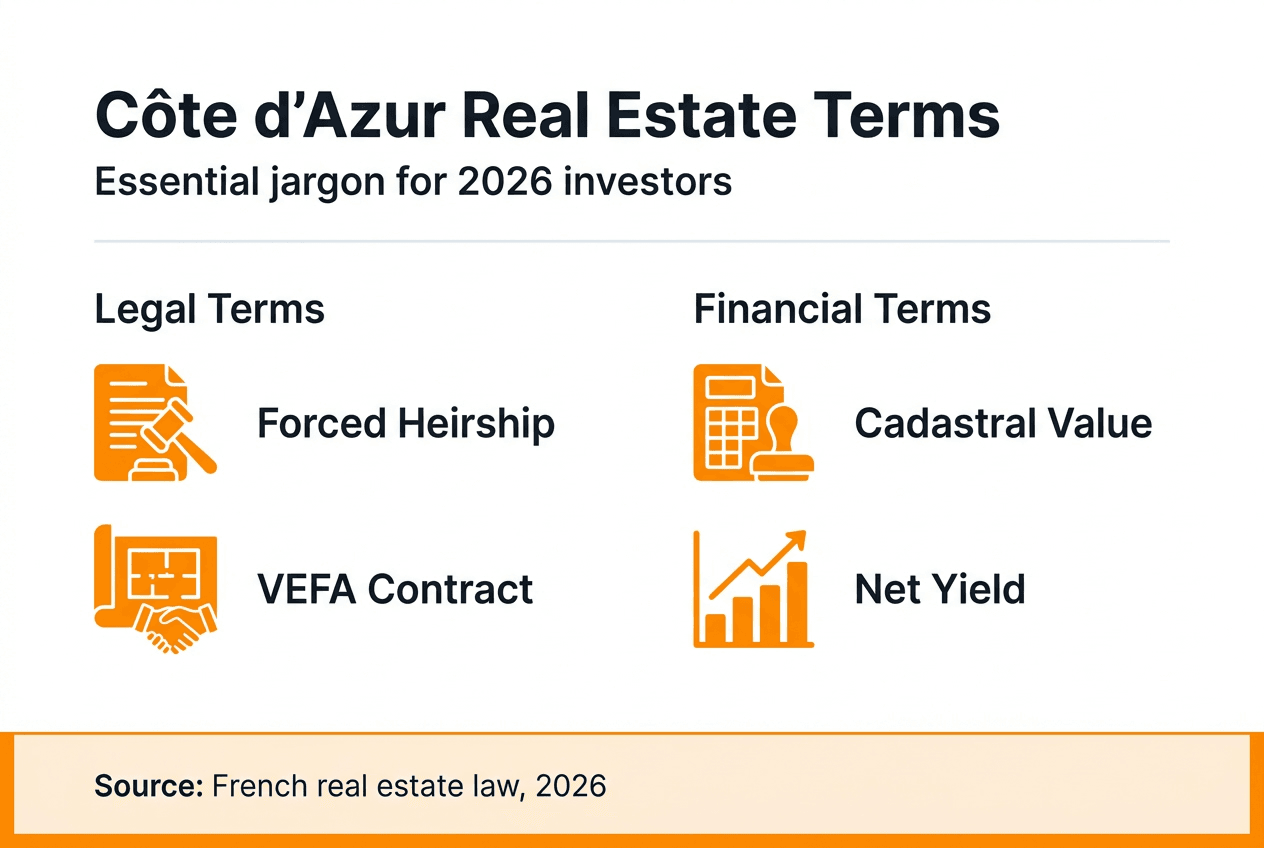
Infographic of key Côte d'Azur real estate terms

Understanding property terminology specific to Cannes and other Riviera communes refines tax planning. Each location presents distinct fiscal profiles, influencing portfolio diversification and regional real estate trends that savvy investors monitor continuously.

Due diligence and risk mitigation jargon explained

Thorough due diligence protects luxury investments from hidden defects and legal complications. Familiarity with inspection terminology ensures rigorous vetting.

Due diligence encompasses comprehensive investigations into property condition, title clarity, and regulatory compliance. Legal audits verify ownership chains, identify servitudes or liens, and confirm zoning permissions. Technical surveys, or diagnostics immobiliers, assess structural integrity, energy efficiency, asbestos presence, and termite risks. Due diligence procedures including legal audits and technical surveys reduce unforeseen risks in high value Côte d’Azur transactions, safeguarding capital and reputation.

Seismic resilience evaluations matter in coastal zones prone to geological activity. Engineers assess foundation stability, structural reinforcement, and compliance with seismic building codes. Properties meeting current standards command premiums and lower insurance costs. Structural integrity checks extend to roofing, plumbing, electrical systems, and facades, identifying repair needs before purchase.

Title insurance, rare in France but increasingly available, protects against undisclosed claims or ownership disputes. Investors accustomed to Anglo Saxon markets appreciate this layer of security. Pre acquisition site visits, architect consultations, and notaire reviews complete rigorous vetting processes.

Pro Tip: Retain independent surveyors with Côte d’Azur expertise rather than relying solely on seller provided reports. Local specialists identify region specific issues like coastal erosion or heritage restrictions that generic assessments might overlook.

Essential due diligence steps for Riviera luxury investments:

  • Verify ownership history and title clarity through notaire searches
  • Commission full diagnostics immobiliers covering energy, asbestos, lead, termites
  • Assess structural integrity and seismic resilience with certified engineers
  • Review local zoning regulations and renovation permissions
  • Confirm property boundaries match cadastral records
  • Evaluate environmental restrictions in coastal or protected zones

Risk mitigation extends beyond inspections to contractual safeguards. Suspensive clauses, or conditions suspensives, allow buyers to withdraw if financing falls through or inspections reveal defects. These clauses protect deposits and provide negotiation leverage. Understanding terms like “garantie décennale” (10 year builder warranty) and “garantie biennale” (2 year equipment warranty) clarifies post purchase protections, especially critical for new construction investments on the Côte d’Azur.

Common misconceptions about Côte d’Azur real estate jargon

Misunderstanding key terms leads to misinformed decisions. Clarifying these misconceptions sharpens investor acumen.

Many assume luxury finishes are purely aesthetic indulgences with negligible return impact. Data contradicts this belief. Premium materials and smart integrations demonstrably boost resale values by 15% to 25% and enhance rental yields by 2% to 3%. Finishes signal quality to discerning buyers, shortening sales cycles and commanding higher offers. They are strategic investments, not frivolous expenditures.

Forced heirship often appears as an impenetrable barrier to estate planning. While direct heirs receive mandatory shares, investors retain flexibility over the disposable portion, typically one quarter to one half of the estate. Strategic use of lifetime gifts, trusts, and asset structuring preserves significant testamentary freedom. The key lies in early planning with advisors fluent in both French succession law and international wealth structures.

VEFA contract protections are frequently underestimated. Buyers mistakenly view off plan purchases as riskier than resale acquisitions. In reality, VEFA agreements offer substantial buyer safeguards including staged payments tied to construction milestones, builder insolvency insurance, and decade long structural warranties. These protections often exceed those available in resale transactions, making new builds attractive for risk averse investors.

Some investors believe all Côte d’Azur locations share identical tax burdens. Tax rates and cadastral values vary significantly by commune. Menton offers lower property taxes than Cannes or Saint Tropez, while Nice balances moderate rates with robust infrastructure. Understanding municipal differences enables tax efficient portfolio construction.

Common jargon misunderstandings corrected:

  • Misconception: Forced heirship eliminates estate planning flexibility
  • Reality: Disposable portions and lifetime gifts preserve testamentary control
  • Misconception: VEFA contracts expose buyers to construction risks
  • Reality: Staged payments and 10 year warranties provide superior protection
  • Misconception: Luxury finishes offer only aesthetic value
  • Reality: Premium materials increase resale by 15% to 25% measurably
  • Misconception: All Riviera locations have similar tax profiles
  • Reality: Rates vary from 0.5% to 1.5%, significantly affecting returns

Practical application: using real estate jargon to enhance investment decisions

Translating jargon knowledge into actionable investment strategies maximises returns and mitigates risks. Follow these steps to apply terminology effectively.

  1. Audit contracts using jargon fluency: Review compromis de vente and acte de vente clauses for suspensive conditions, completion timelines, and warranty terms. Identify forced heirship implications and structure ownership to align with succession goals.
  2. Calculate net yields accurately: Factor cadastral value based property taxes, copropriété charges, and wealth tax exposure into return projections. Compare gross versus net yields to assess true profitability across locations.
  3. Prioritise VEFA protections in new builds: Verify builder guarantees, payment schedules tied to construction stages, and 10 year structural warranties. Negotiate lower notary fees and zero interest payment plans standard in off plan transactions.
  4. Commission comprehensive diagnostics: Insist on full technical surveys covering energy efficiency, structural integrity, seismic resilience, and environmental compliance. Use findings to negotiate price reductions or seller funded repairs.
  5. Engage bilingual specialists: Retain notaires, legal advisors, and surveyors fluent in both French real estate jargon and international investment terminology. Clear communication prevents costly misunderstandings.
  6. Assess luxury finishes strategically: Evaluate whether existing finishes justify asking prices or require upgrades. Budget for enhancements that deliver 15% to 25% resale premiums and 2% to 3% yield boosts.
  7. Structure ownership tax efficiently: Explore SCIs, trusts, or corporate vehicles to mitigate wealth tax and optimise succession planning within forced heirship constraints. Professional guidance ensures compliance and maximises benefits.

Pro Tip: Maintain a personal glossary of Côte d’Azur real estate terms encountered during your investment journey. Markets evolve, regulations shift, and new jargon emerges. Continuous learning sustains competitive advantage and investment confidence.

Applying jargon fluency transforms abstract concepts into concrete decision criteria. When evaluating a Cap d’Antibes villa, understanding forced heirship guides ownership structuring. Recognising VEFA protections clarifies new build advantages over resale alternatives. Calculating net yield using precise tax terminology reveals whether a Menton apartment outperforms a Cannes counterpart despite lower gross rent. Each jargon term becomes a lens through which due diligence processes and inheritance planning strategies gain clarity and precision.

Conclusion: empowered investing with real estate jargon mastery

Mastering Côte d’Azur real estate jargon equips high net worth investors with clarity and confidence. Understanding forced heirship, VEFA protections, luxury finish valuations, tax terminology, and due diligence processes reduces risk and enhances legacy wealth strategies. Fluency in local terminology transforms opaque contracts into strategic tools, enabling informed negotiations and optimised returns. As you navigate Riviera investments, let jargon knowledge illuminate pathways to heirloom estates that appreciate 5% to 8% annually while safeguarding family legacies across generations.

Explore expert support for your Côte d’Azur luxury investments

Living on the Côte d’Azur specialises in connecting discerning investors with exclusive off market properties across the French Riviera. Our bilingual team applies jargon fluency to every transaction, ensuring clear communication and strategic positioning. From tailored acquisition services to legacy focused portfolio construction, we transform real estate terminology into investment advantage. Explore our curated listings and discover investment strategies designed for generational wealth. Contact our experts today to secure your Riviera heirloom with confidence and precision.

FAQ

What is forced heirship and how does it affect my Côte d’Azur property investment?

Forced heirship reserves a fixed estate share for direct heirs, limiting testamentary freedom. With one child, half your property passes automatically; three or more children secure three quarters. This rule requires careful inheritance planning on the Côte d’Azur to balance legacy intentions with legal mandates, ensuring family harmony and wealth transfer efficiency.

What protections do VEFA contracts provide for new build luxury homes?

VEFA contracts mandate stage payments tied to construction milestones and include 10 year structural warranties, protecting buyers from builder insolvency and defects. They also offer zero interest payment plans and reduced notary fees of 2% to 3%, compared to 7% to 8% for resale properties. These safeguards make off plan investments particularly secure under Côte d’Azur luxury real estate regulations.

How can understanding luxury real estate jargon improve my investment returns?

Jargon fluency enables precise risk assessment, clearer contract negotiations, and strategic financial planning. Knowing terms like net yield, cadastral value, and forced heirship allows you to forecast costs accurately, structure ownership tax efficiently, and identify properties with superior appreciation potential. This knowledge cumulatively enhances portfolio returns and legacy wealth strategies across generations.

What key financial terms should I know when investing in Côte d’Azur properties?

Essential terms include cadastral value, which determines property tax liabilities ranging from 0.5% to 1.5% annually, and net yield, measuring rental income after expenses. Capital appreciation, typically 5% to 8% annually on the Riviera, complements yield for total return assessment. Understanding wealth tax (IFI) and notary fees clarifies carrying costs and transaction expenses. Mastering these concepts through resources like the luxury real estate tax guide sharpens investment decision making.

Recommended

  • Guide to International Real Estate Investment in Côte d’Azur
  • Côte d’Azur 2026 Real Estate Rules: 50% Forced Heirship Explained
  • Property acquisition guide – Living on the Côte d’Azur
  • 7 Essential Real Estate Investment Tips for Côte d’Azur
  • Safari Lodge Terminology: Decoding The Luxury Experience – Namibia Luxury Safaris | Book Your 2025/2026 Adventure Today
by Jolanda Kuijer/9 March 2026/in Blog
https://www.livingonthecotedazur.com/wp-content/uploads/2026/03/1773085054536_Agent-meeting-investors-on-Cote-d-Azur-terrace.jpg 768 1376 Jolanda Kuijer https://www.livingonthecotedazur.com/wp-content/uploads/2024/02/sitelogo150.png Jolanda Kuijer2026-03-09 20:39:332026-03-10 09:49:11Real estate jargon explained for Côte d’Azur investors 2026

For many international residents of Dubai, the idea of leaving the desert for the Mediterranean has become increasingly appealing. While Dubai offers modern luxury, world-class infrastructure, and a global lifestyle, the French Riviera offers something equally powerful but different: timeless elegance, culinary excellence, and a century-long tradition of luxury living.

From glamorous seaside cities to ultra-private peninsulas, the Riviera has long attracted royalty, artists, and international entrepreneurs seeking beauty, privacy, and prestige. Today, a growing number of residents from Dubai are discovering that the French Riviera offers a perfect second home—or even a permanent relocation—combining lifestyle, heritage, and investment potential.

A Century of Riviera Luxury

Long before the skyscrapers of Dubai rose from the desert, the French Riviera was already synonymous with luxury. Since the late 19th century, European aristocracy and international elites have flocked to this Mediterranean coastline for its mild climate, spectacular sea views, and refined culture.

Cities such as Nice, Cannes, and Antibes became winter destinations for British royalty, Russian nobility, and later Hollywood celebrities. Over time, the region developed a reputation for fine gastronomy, luxury hotels, and elegant seaside living.

Today, the Riviera remains one of the world’s densest regions of Michelin-starred restaurants, exclusive beach clubs, and prestigious marinas. Dining on fresh Mediterranean seafood while overlooking the sea is not a trend here—it is a way of life that has existed for generations.

For someone accustomed to the luxury lifestyle of Dubai, the Riviera offers something rare: luxury with history and character. Have a look at our legacy luxury real estate on the French Riviera.

Monaco: The Riviera’s Global Luxury Hub

For those seeking an environment closest to the urban energy of Dubai, Monaco is the most obvious destination.

This tiny principality is famous for its skyline of luxury residences, superyachts anchored in Port Hercules, and glamorous events such as the Monaco Grand Prix. Monaco attracts international entrepreneurs, investors, and celebrities who appreciate its cosmopolitan lifestyle, high security, and world-class services.

Much like Dubai, Monaco offers luxury apartment living with concierge services, private parking, spas, and direct access to marinas and fine dining. Property prices are among the highest in the world, but demand remains strong due to the principality’s prestige and international appeal.

For Dubai residents accustomed to penthouses overlooking marinas and skyline views, Monaco often feels like the most familiar transition on the Riviera.

Cap d’Antibes: Privacy and Seaside Villas

Those looking for space, privacy, and spectacular Mediterranean views often prefer Cap d’Antibes.

This peninsula is one of the most exclusive residential areas on the French Riviera. Hidden behind pine trees and gated estates, many of the Riviera’s most luxurious villas can be found here. The coastline is dotted with small coves, private beaches, and legendary hotels such as the Hôtel du Cap‑Eden‑Roc.

For families moving from Dubai’s villa communities, Cap d’Antibes offers a similar sense of privacy and exclusivity, but with the added charm of the Mediterranean landscape. Large properties with gardens, swimming pools, and panoramic sea views make it one of the most desirable addresses on the Riviera.

Property here is often purchased as a long-term lifestyle investment, as demand from international buyers has remained strong for decades.

Saint Jean Cap Ferrat: Old-Money Elegance

Another legendary Riviera location is Saint-Jean-Cap-Ferrat. This peninsula has long been associated with discreet wealth and refined luxury.

Unlike the more dynamic atmosphere of Monaco or Cannes, Cap-Ferrat offers tranquility, exceptional sea views, and grand historic villas surrounded by lush gardens. Land here is extremely limited, which has helped preserve its exclusivity.

Many properties are located near iconic landmarks, such as the Villa Ephrussi de Rothschild, one of the Riviera’s architectural jewels.

For buyers from Dubai seeking peace, prestige, and privacy, Saint-Jean-Cap-Ferrat represents one of the most elegant addresses in Europe.

Cannes and the Croisette Lifestyle

If Monaco feels like the Riviera’s financial hub, then La Croisette in Cannes represents its glamorous beachfront heart.

This palm-lined boulevard is home to luxury hotels, designer boutiques, beach clubs, and prestigious apartment buildings facing the Mediterranean. During events like the Cannes Film Festival, the city becomes one of the world’s most glamorous destinations.

For Dubai residents who enjoy beachfront living, shopping, and vibrant nightlife, Cannes offers a lifestyle that blends Mediterranean relaxation with international glamour.

Luxury apartments on the Croisette are often used as both holiday residences and rental investments, thanks to the city’s year-round tourism and global events.

Investing in Riviera Real Estate

Beyond lifestyle, many buyers from Dubai are also attracted to the French Riviera for its stable real estate market and long-term investment potential.

While property prices are high in prime areas, the region has historically shown strong resilience. Limited coastal land, strict building regulations, and global demand continue to support long-term value.

Many international buyers choose to structure their purchase through a French real estate holding structure known as a Société Civile Immobilière (SCI).

Why an SCI Can Be Attractive

An SCI is commonly used by families and investors purchasing property in France. It allows the property to be owned through shares in a company rather than directly by individuals.

Some advantages include:

• Easier ownership between multiple family members or partners
• Simplified inheritance planning, as shares can be transferred gradually
• Potential flexibility in property management and long-term planning

Many international investors use an SCI when purchasing second homes, rental investments, or family estates on the Riviera.

However, the structure must be carefully set up with legal and tax advice, especially for non-EU residents.

Other Investment Strategies

Besides an SCI, investors may also consider:

• Direct personal ownership, which is simple and common for second homes
• Family holding structures, especially for multi-property portfolios
• Seasonal rental investments, particularly in cities like Cannes and Antibes

Short-term rental demand remains strong due to tourism, conferences, and events, making certain locations attractive for hybrid lifestyle and income investments.

A Lifestyle Worth Staying For

The biggest surprise for many Dubai residents arriving on the French Riviera is that the region offers more than just beautiful scenery.

It offers a slower, more refined way of living.

Mornings may start with coffee overlooking the Mediterranean. Lunch might be enjoyed at a seaside restaurant serving freshly caught fish and Provençal wines. Evenings often end with sunset walks along the coast or dinner in one of the Riviera’s many Michelin-starred establishments.

Luxury here is not defined by height or scale—but by quality, heritage, and atmosphere.

In other words, once you arrive on the French Riviera, you may realize that leaving Dubai was not the end of luxury living.

It was simply a new chapter of it.

After Dubai, Habibi… you may just want to stay. 🌊🍷

by Ab Kuijer/6 March 2026/in Blog
https://www.livingonthecotedazur.com/wp-content/uploads/2026/03/dubai-or-french-riviera.jpg 794 1016 Ab Kuijer https://www.livingonthecotedazur.com/wp-content/uploads/2024/02/sitelogo150.png Ab Kuijer2026-03-06 15:36:172026-03-06 15:36:22After Dubai, Habibi… You May Want to Stay on the French Riviera

If you are looking to buy a new villa in Mougins, you are not just purchasing a property — you are securing a lifestyle asset in one of the most prestigious addresses on the French Riviera. Located just minutes from Cannes yet surrounded by greenery and privacy, Mougins offers a rare combination of elegance, tranquility, and long-term investment stability.

Why Mougins Is One of the Riviera’s Most Desirable Locations

Mougins sits in the hills above Cannes, offering privacy and panoramic views while remaining only 15 minutes from the Croisette and Mediterranean beaches. Unlike the more tourist-driven coastal towns, Mougins is primarily residential, attracting international entrepreneurs, family offices, and high-net-worth individuals who value discretion.

The historic old village, with its cobbled streets and art galleries, has long been associated with culture and gastronomy. It was also home to Pablo Picasso in his later years, reinforcing Mougins’ artistic prestige. Today, the commune blends Provençal charm with contemporary luxury estates.

For buyers seeking both lifestyle and capital appreciation, Mougins consistently ranks among the safest real estate markets on the Côte d’Azur.


Strong Investment Fundamentals

When you buy a new villa in Mougins, you are investing in:

1. Limited Land Supply

Mougins is highly regulated in terms of construction and urban planning. Strict zoning laws preserve green areas and prevent overdevelopment. This limited supply protects long-term property values.

2. International Demand

The area attracts buyers from Northern Europe, the Middle East, the US, and increasingly tech entrepreneurs relocating to the Sophia Antipolis technology hub nearby. Demand for modern, energy-efficient villas remains strong year-round.

3. Capital Stability

Luxury real estate in Mougins historically shows resilience even during market fluctuations. Prime properties with sea views, gated domains, or proximity to golf courses maintain liquidity and value.


The Advantages of Buying a New Villa in Mougins

Choosing to buy a new villa in Mougins rather than an older property offers distinct advantages:

Modern Architecture & Energy Efficiency

New villas are built to the latest French building standards (RT 2012 / RE 2020), ensuring superior insulation, lower energy costs, and smart home integration.

Turnkey Living

Unlike renovation projects, new builds offer immediate comfort — contemporary kitchens, spa-style bathrooms, home automation, underfloor heating, and infinity pools are standard features.

Customisation Opportunities

Off-plan purchases often allow you to personalise finishes, materials, and layouts.

Lower Maintenance Costs

New systems and warranties reduce unexpected expenses, making your investment more predictable.


A Lifestyle Investment Beyond Financial Returns

Mougins is not only about property value — it is about quality of life.

Privacy and Security

Many new villas are located within secure gated domains with surveillance systems and private access roads.

Golf and Leisure

Mougins is home to prestigious golf courses such as Royal Mougins Golf Club, attracting international members. The surrounding countryside offers cycling routes, hiking trails, and equestrian facilities.

International Schools

Families appreciate proximity to top-tier schools like Mougins School, making the area particularly attractive for relocation.

Strategic Location

  • 20 minutes to Nice Côte d’Azur Airport
  • 10–15 minutes to Cannes beaches
  • 5 minutes to Sophia Antipolis tech hub

This connectivity enhances both lifestyle convenience and rental potential.


Rental and Resale Potential

If you buy a new villa in Mougins, you benefit from strong seasonal and long-term rental demand. Cannes Film Festival visitors, corporate executives, and affluent holidaymakers seek luxury villas with pools and privacy.

Premium new villas can generate attractive weekly rental income during peak summer months, while still maintaining exclusivity.

On resale, new contemporary villas often command higher price-per-square-meter values compared to older Provençal homes, especially when featuring:

  • Sea views
  • South-facing orientation
  • Smart home technology
  • Energy-efficient certification
  • Gated community access

Market Trends in 2026

The luxury property market on the Côte d’Azur continues to favour:

  • Contemporary architecture
  • Eco-conscious construction
  • Secure domains
  • Properties offering indoor-outdoor living

Mougins ticks all these boxes. With limited land and increasing international mobility, high-quality new villas remain a prime asset class.


Who Should Buy a New Villa in Mougins?

Mougins is ideal for:

  • Family offices seeking legacy assets
  • Entrepreneurs relocating to the French Riviera
  • Investors diversifying into tangible lifestyle real estate
  • Retirees seeking privacy without isolation
  • International buyers looking for stability within the EU

Whether as a primary residence, secondary home, or strategic portfolio asset, buying new in Mougins combines emotional and financial return.


Conclusion: Why Now Is the Right Time to Buy a New Villa in Mougins

To buy a new villa in Mougins is to invest in scarcity, prestige, and long-term value. With its secure environment, international appeal, strong infrastructure, and limited development capacity, Mougins remains one of the safest luxury real estate markets in Southern France.

Modern villas offer energy efficiency, turnkey comfort, and architectural excellence — all in a setting that balances Riviera glamour with Provençal authenticity.

For discerning investors seeking both capital preservation and lifestyle enhancement, Mougins represents a compelling opportunity that continues to outperform expectations.

If your objective is to combine secure investment fundamentals with Mediterranean living at its finest, buying a new villa in Mougins may be one of the smartest real estate decisions you can make.

Les Costes – Domaine Privé: An Exclusive New Villa Development in Mougins


Image


In the peaceful hills above Cannes, in one of the Riviera’s most sought-after residential addresses, Les Costes – Domaine Privé introduces a rare opportunity to buy a new villa in Mougins. This boutique development of just ten architect-designed villas combines privacy, contemporary elegance, and Mediterranean authenticity in a fully enclosed and secure estate.
Developed by Art Immobilier Construction (AIC), a respected regional promoter with more than 20 years of experience, Les Costes reflects a commitment to architectural quality, environmental responsibility, and long-term value.

A Confidential Private Estate at the Foot of the Old Village


Located on a gently sloping terraced plot (restanques) typical of Provence, Les Costes enjoys a privileged position just minutes from Mougins’ medieval village. The estate is entirely enclosed and secured under video surveillance, offering residents peace of mind and discretion.
Only ten villas have been created, carefully positioned to follow the natural curves of the land. Each property is surrounded by lush Mediterranean vegetation — olive trees, mulberry trees, hackberry trees, and laurels — preserving both biodiversity and privacy.This low-density concept ensures that every villa benefits from:
A vast private landscaped garden
A private swimming pool with wooden deck
Enclosed, electrically equipped garages
Secure access control managed via smartphone or badge
The result is an intimate, residential environment where architecture blends seamlessly with nature.

Contemporary Architecture Rooted in Provençal Character


Les Costes is not a standard development. The architectural vision was guided by a desire for soft integration into the landscape. Each villa features interlocking volumes and clean contemporary lines, while incorporating subtle references to local architectural codes. Facades combine sand-toned render, grey or beige stone, and aluminium pergolas, creating a harmonious palette of textures.
Large floor-to-ceiling bay windows open onto generous terraces, blurring the line between indoor and outdoor living — a fundamental element of the Mediterranean lifestyle.
Glass balustrades preserve open views over the landscaped gardens, reinforcing the fluidity and lightness of the design.

Spacious Interiors Designed for Modern Living


Inside, the villas prioritise volume, light, and functionality.

  • Ground floors typically include:
  • A large open-plan living and dining area
  • A fully fitted contemporary kitchen
  • Direct access to the terrace and pool
  • A ground-floor master suite for single-level living
  • Upstairs, additional bedrooms offer:
  • En-suite bathrooms
  • Dressing rooms
  • Flexible spaces such as a family room, gym, or library


Buyers also benefit from personalised interior design support, allowing each villa to reflect the owner’s individual lifestyle and preferences.

High-End Specifications with Eco-Responsible Standards


Les Costes – Domaine Privé has been developed according to the latest environmental standards, ensuring energy efficiency and long-term sustainability.


Key features include:


Comfort & Refinement
100×100 cm glazed porcelain stoneware tiles
Smooth wall finishes throughout
Individual reversible heat pump for heating and cooling
Home automation (domotics) for climate and shutters
Double-glazed aluminium joinery
Electric roller shutters with centralised control
Fully equipped bathrooms with backlit mirrors
Suspended toilets and ultra-flat shower trays


Outdoor Living
Private landscaped gardens with automatic irrigation
Private swimming pool with wooden deck
Preserved wooded areas within the estate


Security
Estate fully enclosed by wrought-iron fencing
Video surveillance at each entrance
Secure connected access control system
Reinforced insulated entrance doors with A2P 5-point locks
These eco-conscious villas offer both reduced energy consumption and enhanced living comfort — a critical factor for modern luxury buyers.

A Prime Location Close to Everything


Les Costes enjoys exceptional connectivity while maintaining a peaceful atmosphere.
4 minutes to Mougins’ medieval village
5 minutes to the Cours des Arts shopping and cultural centre
9 minutes to Mougins School
15 minutes to the beaches of Cannes
20 minutes to Cannes Mandelieu Airport
30 minutes to Nice Côte d’Azur Airport
Golf enthusiasts will appreciate proximity to prestigious courses such as Royal Mougins Golf Club, while nature lovers benefit from immediate access to wooded trails and green spaces.
Mougins itself is renowned for its art galleries, Michelin-starred restaurants, and refined atmosphere — a rare balance between Riviera vibrancy and residential serenity.

A Rare Investment Opportunity on the Côte d’Azur


The scarcity of new-build villas in secure private estates makes Les Costes particularly attractive from an investment perspective. Limited supply, strong international demand, and Mougins’ enduring prestige support long-term capital appreciation.


Key investment strengths:
Boutique development of only 10 villas
Prime hillside location near Cannes
High energy performance standards
Strong resale appeal due to security and privacy
Lifestyle-driven rental potential during peak Riviera seasons
Whether as a primary residence, a secondary home, or a strategic real estate investment, Les Costes – Domaine Privé represents a rare opportunity to acquire a new luxury villa in one of the French Riviera’s most stable and desirable markets.

by Ab Kuijer/5 March 2026/in Blog
https://www.livingonthecotedazur.com/wp-content/uploads/2026/03/villa-10-bd-68c977e2d7fd6.jpg 630 1440 Ab Kuijer https://www.livingonthecotedazur.com/wp-content/uploads/2024/02/sitelogo150.png Ab Kuijer2026-03-05 08:31:002026-03-04 15:53:02A New Villa in Mougins: The Ultimate Investment in French Riviera Luxury

Many travelers arriving on the French Riviera feel overwhelmed by the sheer number of options and end up stuck in the most crowded tourist spots, missing the true soul of the city. The main problem is that Nice is a large, multi-layered city where the best experiences are often tucked away in quiet squares or on hilltop parks. If you are wondering what to do in Nice, you need a plan that moves beyond the basic beach walk and helps you find the authentic flavors and views that make this UNESCO World Heritage city so special. This guide provides a clear path through the city’s historic landmarks, art scenes, and culinary secrets to ensure your time on the Côte d’Azur is spent like a local rather than a lost visitor.

Table of contents

  • Iconic Landmarks and Sightseeing Fundamentals
  • The Heart of the City: Place Masséna and Port Lympia
    • Immersive Culture in Vieux Nice (Old Town)
    • The Benefit of Local Expertise
  • Artistic Heritage: Nice’s World-Class Museums
  • Culinary Experiences: A Taste of Nissart Culture
  • Nature, Beaches, and Outdoor Activities
    • The Benefit of Local Property Expertise
  • Luxury Shopping and Glamorous Evenings
  • Strategic Planning: Logistics for a Seamless Trip
  • Frequently Asked Questions
    • Is 3 days enough for Nice?
    • Are the beaches in Nice sandy or rocky?
    • Is Nice, France safe for solo travelers?
    • Can you drink tap water in Nice?
  • The Luxury of a Permanent Base in Nice

Iconic Landmarks and Sightseeing Fundamentals

The best way to start your journey is with a walk along the Promenade des Anglais. This world-famous seafront walkway stretches for seven kilometers along the Baie des Anges and is the perfect place to get your bearings. You will see the famous blue chairs (Chaises Bleues) where people sit to watch the waves, and you can admire the grand architecture of the Hotel Negresco. For the best view in the city, head to Colline du Château (Castle Hill). While the castle itself is long gone, the park offers a massive waterfall and several lookout points where you can see the red-tiled roofs of the Old Town on one side and the Port Lympia on the other. You can reach the top by climbing the winding stairs or by taking the free elevator located near the Bellanda Tower.

The Heart of the City: Place Masséna and Port Lympia

Place Masséna serves as the central hub of Nice, easily recognized by its red buildings, checkerboard floor, and the Sun Fountain featuring a massive statue of Apollo. It is a great spot for people-watching and serves as the gateway between the historic district and the modern shopping areas. From here, a short walk leads you to Port Lympia, the historic harbor. This area is a fantastic mix of old and new; you can see traditional wooden fishing boats called Pointus docked right next to multimillion-dollar yachts. The harbor is surrounded by Venetian-style buildings and offers a more relaxed atmosphere for a morning coffee or an evening stroll away from the main beach crowds.

Immersive Culture in Vieux Nice (Old Town)

Entering Vieux Nice is like stepping back in time to the era when Nice was part of the House of Savoy. The streets are narrow and cool, filled with the scent of spices and fresh bread. A primary highlight here is the Cours Saleya Flower Market, which is open every morning except Monday (when it becomes an antiques market). You can buy everything from local lavender and soaps to fresh produce and honey. While in the Old Town, make sure to visit the Cathédrale Sainte-Réparate, a masterpiece of Italian Baroque style with a stunning tiled dome. Exploring the smaller side streets is where you will find artisan workshops making handmade jewelry, leather goods, and local crafts that represent the true spirit of the city. While the city itself is a UNESCO masterpiece, Nice serves as the perfect gateway to explore the most beautiful villages on the French Riviera, such as the hilltop eagle’s nest of Eze or the artistic ramparts of Saint-Paul-de-Vence.

LandmarkBest Time to VisitWhy Visit?
Castle HillSunsetThe best panoramic views and cool waterfall.
Cours Saleya9:00 AMFresh flowers, local food, and lively energy.
Promenade des AnglaisEarly MorningPerfect for a quiet walk or bike ride by the sea.
Place MassénaEveningBright lights, street performers, and central hub.

The Benefit of Local Expertise

Nice is a city that many people visit once and immediately decide they want to live in forever. If you find yourself looking at the balconies of the Old Town or the luxury apartments in the Carré d’Or and wondering about the possibility of owning a home here, professional help is essential. The real estate market in a city this popular moves very fast, and many high-value properties are sold before they ever hit a public listing. Using a buyer’s agent likeLiving on the Côte d’Azur gives you a massive advantage. They act as your representative on the ground, scanning the entire market to find a property in Nice that fits your lifestyle and budget, and handling all the difficult negotiations so you can focus on enjoying the Nissart way of life.

Artistic Heritage: Nice’s World-Class Museums

Taste of Nice Travel

Nice has long been a sanctuary for creators, and its museums offer a deep look into the colors and history of the region. Exploring these spaces provides a perfect break from the midday sun while allowing you to see the city through the eyes of its most famous residents.

  • Musée Matisse: Located in a beautiful 17th-century villa in the Cimiez district, this museum explores the lifelong connection between Henri Matisse and the city. You can see his personal objects and works that show how the light of the Riviera transformed his style.
  • Musée Marc Chagall: This museum was built during the artist’s lifetime to house his Biblical Message series. The highlight for many is the concert hall, where stunning stained-glass windows create a play of blue light that feels truly spiritual.
  • MAMAC (Modern and Contemporary Art Museum): For those who prefer 20th-century movements, this museum is the place to discover the School of Nice. It features bold works by Niki de Saint Phalle and the famous International Klein Blue of Yves Klein.
  • Villa Masséna: Situated right on the Promenade, this Belle Époque mansion offers a look into the Napoleonic history of the Riviera. It houses rare artifacts, including Napoleon’s death mask, and tells the story of how Nice became a winter playground for royalty.

Culinary Experiences: A Taste of Nissart Culture

The food in Nice is a point of local pride, and the city even has a Cuisine Nissarde label to protect traditional cooking methods. To eat like a local, you must move beyond the standard tourist menus and find the spots where fresh, Mediterranean ingredients are the star of the show.

  • Street Food Crawl: You cannot visit the Old Town without stopping for Socca, a savory chickpea pancake cooked in large copper tins. Other local staples include Pissaladière, a thick onion tart, and the Le Pan Bagnat, a hearty sandwich that is essentially a salad in a loaf of bread.
  • The Niçoise Salad Debate: There is a strict tradition regarding what goes into an authentic Salade Niçoise. Locals will tell you that real versions never include cooked vegetables (like green beans or potatoes). Places like Lou Balico are famous for serving it exactly as tradition dictates.
  • Michelin Dining vs. Local Bistros: Nice offers a perfect balance between high-end gastronomy and humble family-run spots. While the city has several Michelin-starred venues for a grand evening, the certified Cuisine Nissarde bistros offer the most authentic and affordable way to experience the local flavors.

Nature, Beaches, and Outdoor Activities

While the city is bustling, it is very easy to find green spaces and blue water. The outdoor lifestyle is a major part of why people choose to live here. For those considering a long-term move, Guide to Living on the French Riviera provides essential advice on everything from administrative paperwork to local community life.

  • Nice’s Pebble Beaches: The main beach along the Promenade is famous for its smooth grey pebbles. You can choose between free public areas or private beach clubs like Castel Plage or Blue Beach, where you get a padded lounge, an umbrella, and seaside dining.
  • Sentier du Littoral: If you want to see the rugged side of the coast, this coastal hike is the best choice. Starting at the end of the Nice Port, the trail winds along the rocks and cliffs all the way to Villefranche-sur-Mer, offering plenty of spots for a quiet swim in turquoise water.
  • Parc Phoenix: Located at the western end of the city, this park is a must-visit for families. It features one of the largest greenhouses in Europe, divided into different climates, and is home to a variety of birds, lemurs, and turtles, making it a great spot for biodiversity lovers.
CategoryRecommended SpotKey Feature
ArtMusée Marc ChagallFamous Biblical Message canvases.
Local FoodChez Pipo (Old Town)The best traditional Socca in the city.
OutdoorsSentier du LittoralScenic cliffside walking trail.
HistoryVilla MassénaNapoleonic artifacts and garden views.

The Benefit of Local Property Expertise

Understanding the different vibes of these neighborhoods is the first step toward making Nice your home. Whether you want to live near the artistic hills of Cimiez or the vibrant Port area, the local market can be fast-moving and difficult to track. Living on the Côte d’Azur specializes in helping buyers find homes that match their lifestyle needs. The real estate market in a city this popular moves very fast. Our specialized services for buying property in France ensure you have access to the most desirable listings before they reach the general public. Because they act as a buyer’s agent, they have access to listings from all over the city, ensuring you find the right property without the stress of managing multiple agencies. Their local knowledge helps you find value in the most desirable districts, making your transition to French Riviera life a success.

Luxury Shopping and Glamorous Evenings

Nice is a premier destination for fashion lovers, offering a mix of high-street brands and exclusive designer houses. The city’s shopping districts are clearly defined, making it easy to find exactly what you are looking for, whether it is a souvenir from a local boutique or a high-end investment piece.

  • Avenue Jean Médecin: This is the main shopping artery of the city, stretching from Place Masséna toward the train station. It is home to major retailers, the massive Galeries Lafayette department store, and the Nicetoile shopping center.
  • The Golden Square (Carré d’Or): For those seeking luxury, this district contains the most prestigious labels. Streets like Rue Paradis and Avenue de Suède are lined with names like Chanel, Louis Vuitton, and Hermès, reflecting the glamorous side of Riviera life.
  • Nightlife: Evenings in Nice can be as relaxed or as high-energy as you wish. You can enjoy a sophisticated cocktail at the Le Relais bar inside the Hotel Negresco, or head to the Old Town for vibrant jazz clubs and wine bars that stay busy well into the night.

Strategic Planning: Logistics for a Seamless Trip

Getting around Nice is efficient and affordable, thanks to a modern public transport system that connects the airport to the city center and beyond. Understanding the local layout will help you avoid the stress of traffic and parking.

  • Getting Around: The Lignes 2 Tram is the most convenient way to travel from the Nice Airport to the Port, stopping at major points like Jean Médecin. For regional travel, the TER train connects Nice to nearby towns in minutes. Consider the French Riviera Pass for unlimited transport and entry to major museums.
  • When to Visit: The city has something to offer year-round. The Nice Carnival in February is one of the world’s major winter events, featuring floral parades. However, if you want to avoid the peak summer heat and crowds, the Golden October shoulder season provides warm water and perfect walking weather.
  • Day Trip Logic: Nice is the ultimate base for exploring the region. Within 30 minutes, you can be in the hilltop village of Eze, the glamorous streets of Monaco, or the artistic village of Saint-Paul-de-Vence. The train station (Nice-Ville) makes these trips incredibly easy to manage without a car.

Frequently Asked Questions

Is 3 days enough for Nice?

Three days is a perfect amount of time to see the main landmarks, explore the Old Town, and visit one or two museums. However, if you plan to use Nice as a base for day trips to Monaco or Cannes, a 5-to-7-day stay is better.

Are the beaches in Nice sandy or rocky?

The beaches in Nice are made of large, smooth grey stones called galets. While they are beautiful to look at, they can be hard to walk on, so wearing water shoes is a good idea. For sandy beaches, you would need to take a short train ride to Villefranche-sur-Mer or Antibes.

Is Nice, France safe for solo travelers?

Yes, Nice is generally very safe for solo travelers. Like any major city, you should stay aware of your surroundings in crowded areas like the flower market or the train station, but the city is well-lit and active late into the evening.

Can you drink tap water in Nice?

Yes, the tap water in Nice is perfectly safe to drink and is of very high quality. You will even find historic fountains throughout the city where you can refill your water bottle for free.

DestinationTravel Time (Train)Best For
Monaco20 MinutesLuxury, Casinos, and the Oceanographic Museum.
Eze Village15 Minutes (Bus)Medieval architecture and exotic gardens.
Cannes35 MinutesSandy beaches and the Film Festival palace.
Antibes25 MinutesThe Picasso Museum and the billionaire’s quay.

The Luxury of a Permanent Base in Nice

It is one thing to visit the Promenade des Anglais, but it is another thing entirely to wake up to a view of the Mediterranean every morning. Nice offers a quality of life that is hard to find elsewhere, combining a major international airport with a relaxed seaside atmosphere. If you are considering buying a property in the Carré d’Or or a villa in the hills of Cimiez, the process can be complex for international buyers. Living on the Côte d’Azur specializes in simplifying this journey. As a dedicated buyer’s agent, they represent your interests alone, helping you find the best homes and negotiating the best prices. Their network of local experts ensures that your move to Nice is handled with honesty, transparency, and the speed that the local market demands.

by Feline Kuijer/4 March 2026/in Blog
https://www.livingonthecotedazur.com/wp-content/uploads/2026/01/What-to-Do-in-Nice-France-1.avif 1024 1536 Feline Kuijer https://www.livingonthecotedazur.com/wp-content/uploads/2024/02/sitelogo150.png Feline Kuijer2026-03-04 11:38:072026-02-01 17:35:34What to Do in Nice, France

Prime Côte d’Azur estates can appreciate annually by up to 8%, yet many affluent buyers still view luxury property through outdated lenses of mere location and aesthetics. True property lifestyle value on the French Riviera integrates financial return, sustainable living, and legacy wealth preservation into a single holistic investment. This guide reveals how to evaluate and acquire estates that serve as both family sanctuaries and appreciating assets, aligning with your wealth transfer goals and sustainability values while delivering the Riviera lifestyle you seek.

Table of Contents

  • Defining Property Lifestyle Value on the Côte d’Azur
  • Legacy Investments and Value Appreciation
  • Sustainability and New Construction Trends
  • Due Diligence and Financial Safeguards
  • Comparative Analysis of Riviera Locales
  • Financial and Legal Considerations in Legacy Investments
  • Discover Your Legacy Luxury Real Estate Opportunity

Key Takeaways

PointDetails
Integrated ValueProperty lifestyle value combines financial returns, sustainability credentials, and legacy preservation in one estate.
Legacy ReturnsPrime estates deliver 5-8% annual appreciation with 3-5% rental yields through tax-efficient structures.
Eco DemandSustainable builds see 15% forecast demand growth in 2026, driven by certifications and solar arrays.
Due DiligenceLegal audits, technical surveys, and financial forecasts protect value and ensure compliant acquisitions.
Location LiquidityCore Côte d’Azur cities sell faster (45-75 days) versus peripheral properties (120+ days), impacting investment strategy.

Defining Property Lifestyle Value on the Côte d’Azur

Property lifestyle value represents a fundamental shift in how global elites approach Côte d’Azur acquisitions. It moves beyond square footage and postal codes to encompass three interwoven pillars: financial performance, authentic lifestyle immersion, and environmental stewardship. You’re not simply purchasing walls and views; you’re securing a multigenerational asset that appreciates while delivering daily joy and planetary responsibility.

Curated luxury estates blend timeless Provençal architecture with cutting-edge eco-engineering. Think restored stone mas with solar arrays hidden beneath terracotta tiles, or contemporary villas featuring biophilic design that blurs indoor and outdoor living. Premium locations command €2M+ premiums around sea views and eco finishes; structural integrity and sustainability certifications amplify this value. A panoramic Baie des Anges vista from Nice’s Mont Boron or Cap d’Antibes’ coastal sentiers becomes exponentially more valuable when paired with green building credentials and seismic resilience.

Lifestyle authenticity distinguishes true Riviera estates from generic luxury boxes. Privacy gates open onto gardens scented with lavender and lemon blossoms, steps from Antibes’ Provençal markets or Menton’s citadel rambles. Architectural distinction matters: whether a Belle Époque villa echoing Cannes’ Croisette elegance or a minimalist marvel framing Saint-Tropez’s Pampelonne sunsets. Cultural connection runs deeper still. Your estate becomes the launchpad for yacht-gazing at Lérins abbey, gallery-hopping through Èze’s floral lanes, or ascending Nice’s Château Hill for sunrise panoramas over the Mediterranean.

Key lifestyle value components include:

  • Certified eco-luxury features (solar systems, green materials, energy ratings)
  • Prime location offering cultural immersion and natural beauty access
  • Architectural integrity respecting Riviera heritage while embracing innovation
  • Privacy and security infrastructure suitable for high-net-worth families
  • Proximity to elite amenities (marinas, golf, Michelin dining, international schools)

Pro Tip: Prioritise estates where sustainability and lifestyle authenticity reinforce rather than compromise each other, such as restored farmhouses with modern eco-systems or new builds using local stone and renewable energy.

Legacy Investments and Value Appreciation

Côte d’Azur luxury property transcends typical real estate transactions to become legacy plays: wealth preservation vehicles passing through generations. Historical appreciation of 5-8% annually on prime estates outpaces most traditional investments, while 3-5% rental yields via elite seasonal letting add immediate income streams. This dual return profile positions Riviera property as both capital growth engine and cash-flow generator.

Tax-efficient ownership structures unlock the true legacy potential. French and international legal frameworks allow strategic wealth transfer minimising inheritance taxation while preserving asset control. Inherited funds channelled into Monaco-adjacent plots or restored Provençal estates benefit from appreciation that compounds across decades, building family wealth resistant to market volatility. Your children inherit not just property, but an appreciating Riviera sanctuary that generates income and serves as their own legacy launchpad.

Strategic legacy investment steps:

  1. Engage specialised French Riviera legal and tax advisors before acquisition to design optimal ownership structures
  2. Model long-term appreciation scenarios using conservative 5% annual growth assumptions for financial planning
  3. Establish elite rental management early to capture seasonal demand from global travellers seeking authentic Côte d’Azur experiences
  4. Document property heritage and architectural significance to enhance future valuation and family storytelling
  5. Build relationships with local artisans and service providers ensuring estate maintenance preserves legacy value

The sustainability dimension strengthens legacy credentials. Eco-villas with verified green certifications and renewable energy systems appeal to next-generation heirs who weigh environmental impact alongside financial return. Solar arrays and rainwater harvesting aren’t merely operational features; they’re value signals to future buyers and family members inheriting the estate. A 2026 Cap d’Antibes villa with net-zero energy consumption holds exponentially greater appeal to your grandchildren than a comparable property burning fossil fuels.

Pro Tip: Balance appreciation and yield by selecting properties in core locales with proven rental demand, then structure ownership to optimise both immediate income and long-term capital transfer to heirs.

Sustainability and New Construction Trends

The Côte d’Azur witnesses a sustainable luxury renaissance in 2026. Demand for eco-certified builds is forecast to grow 15% this year, driven by affluent buyers who refuse to compromise planetary health for personal comfort. Biophilic architecture dominates new developments: floor-to-ceiling glass dissolving boundaries between interior and Mediterranean landscape, living walls purifying air, natural ventilation reducing energy loads. These aren’t aesthetic flourishes; they’re engineering solutions delivering healthier living while trimming operational costs.

Solar energy systems have evolved from rooftop afterthoughts to integrated design elements. Sainte-Maxime’s beachside apartments feature solar arrays powering entire complexes, steps from Garonette’s golden sands and ferry connections to Saint-Tropez. Nice’s Mont Boron towers blend photovoltaic facades with sea-view terraces, generating clean energy without sacrificing Riviera glamour. Green building certifications (HQE, BREEAM, LEED) are no longer optional; elite buyers demand verified sustainability credentials backed by independent auditors.

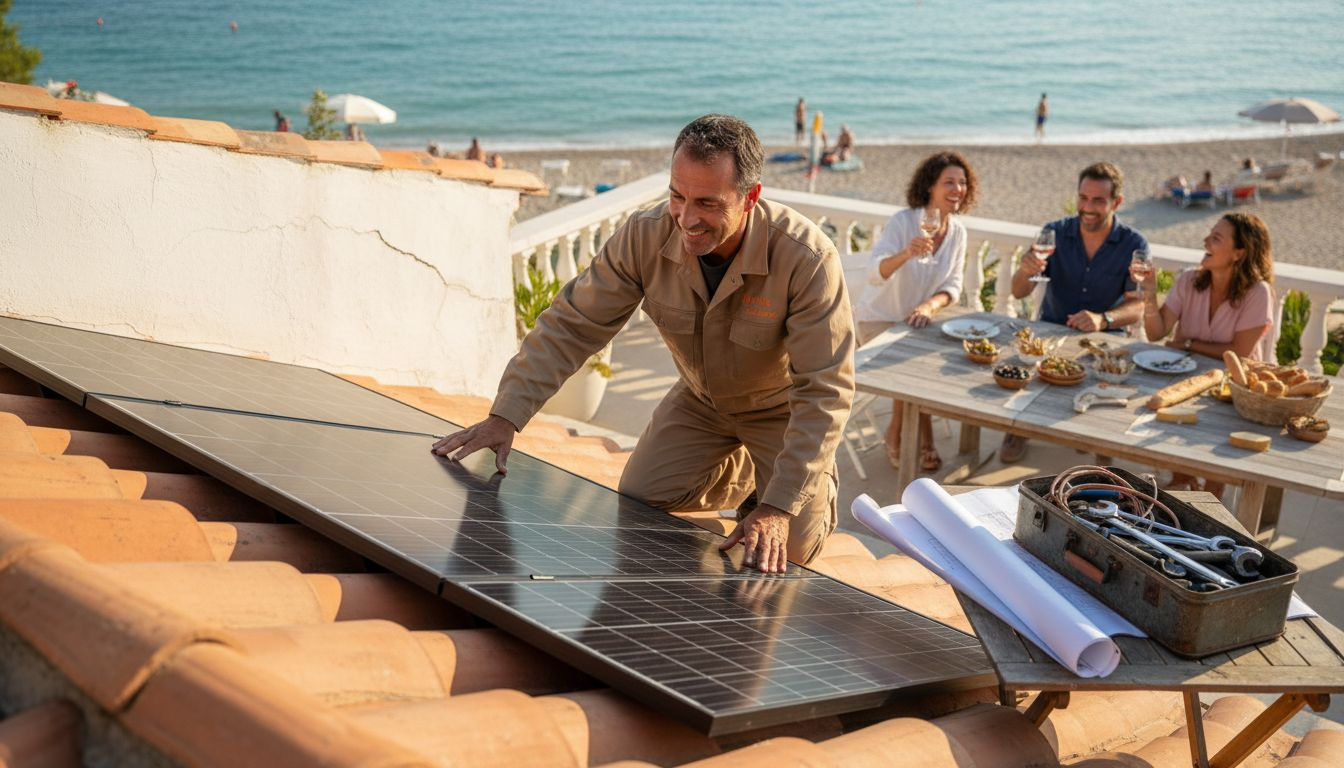
Contractor inspecting solar panels on villa roof

New constructions offer 10-year warranties protecting structural integrity and systems performance, a critical safeguard for legacy investments spanning generations. Financial incentives sweeten the proposition: zero-interest payment plans spread acquisition costs while preserving investment capital, and lower notary fees on new builds (2-3% versus 7-8% on resales) deliver immediate savings. VEFA contracts (vente en l’état futur d’achèvement) shield buyers from construction cost overruns, locking purchase prices regardless of material or labour fluctuations.

Sustainability features driving 2026 value:

  • Solar photovoltaic systems integrated into architectural design
  • Rainwater harvesting and greywater recycling infrastructure
  • High-performance insulation and triple-glazed windows reducing energy demand
  • Locally sourced stone and timber minimising construction carbon footprint
  • Smart home systems optimising energy use and security
  • Native landscaping requiring minimal irrigation and chemical inputs

These eco-innovations aren’t sacrifices; they’re enhancements elevating daily living. Imagine mornings on your Menton terrace, lemon-scented breeze drifting from Val Rahmeh’s botanical gardens, knowing your solar array powers breakfast while your rainwater system nourishes native plantings. Afternoons might find you hiking Saint-Agnès’ eagle-eye trails or kayaking to Lérins abbey, returning to a villa that’s cooled itself naturally through cross-ventilation and thermal mass.

Pro Tip: Verify green certifications through independent audits rather than developer claims alone, ensuring your eco-luxury investment delivers genuine sustainability and long-term value to future generations.

Due Diligence and Financial Safeguards

Securing property lifestyle value demands rigorous due diligence across legal, technical, and financial dimensions. Legal title audits confirm provenance and ownership clarity, preventing disputes that could cloud your legacy. French property law contains complexities unfamiliar to international buyers: servitudes (easements), copropriété governance for shared facilities, and historical monument restrictions on renovations. Specialist Riviera legal advisors navigate these intricacies, ensuring your acquisition proceeds cleanly.

Technical surveys assess structural and seismic resilience, critical for estates meant to shelter generations. The Côte d’Azur sits in moderate seismic zones; professional engineers evaluate foundation integrity, load-bearing capacity, and earthquake reinforcement. They inspect for hidden defects: moisture intrusion behind Belle Époque facades, outdated electrical systems in charming villas, or inadequate drainage threatening hillside properties. These surveys cost thousands but prevent hundred-thousand-euro surprises post-acquisition.

Financial forecasting models the complete investment picture. You need projections spanning acquisition costs (purchase price, notary fees, registration taxes), ongoing expenses (property taxes, insurance, maintenance, utilities), rental income potential, and appreciation scenarios. Recent tax and interest rate shifts make expert modelling essential. French mortgage rates have eased slightly in 2026, improving financing costs, but rental income taxation has climbed significantly, reshaping yield calculations.

Critical due diligence components:

  • Title searches confirming clean ownership history and absence of liens or claims
  • Structural engineering reports evaluating seismic resilience and building systems
  • Energy performance diagnostics (DPE) assessing efficiency and renovation needs
  • Environmental surveys checking soil contamination or protected species presence
  • Financial projections incorporating 2026 tax rates and market conditions
  • Copropriété financial health reviews for apartment or complex purchases

The due diligence investment pays exponential dividends. A €5,000 comprehensive survey might reveal €200,000 in deferred maintenance, empowering price renegotiation or prompting you to walk away. Legal audits costing €3,000 prevent ownership disputes that could freeze your asset for years. Financial modelling illuminates whether a property truly aligns with your legacy wealth goals or merely looks attractive on paper.

Pro Tip: Engage French Riviera specialists (notaires, geometres, architects) rather than generalist advisors, as local expertise navigates regional regulations and market nuances far more effectively.

Comparative Analysis of Riviera Locales

Location selection fundamentally shapes both lifestyle experience and investment performance. Core Côte d’Azur cities (Nice, Cannes, Antibes) deliver faster sales cycles of 45-75 days compared with peripheral villas or renovation properties requiring 120+ days to attract buyers. This liquidity matters profoundly for legacy planning: your heirs might need to sell or refinance, and illiquid assets complicate wealth transfer.

Buyer profiles diverge by locale. Central Nice attracts international investors valuing airport proximity, cultural institutions, and Promenade des Anglais’ vibrant energy. Cours Saleya’s flower markets and Baie des Anges views anchor daily life. Cannes draws film industry insiders and yacht owners who prioritise Croisette glamour and Lérins island access. Antibes appeals to families seeking Provençal authenticity, with Picasso’s fortress, coastal walking paths, and thriving markets balancing sophistication with small-town charm.

Peripheral locales offer different value propositions. Èze delivers hilltop tranquility, Nietzsche trails, and pebbled coves for buyers prioritising privacy over nightlife. Menton’s lemon festivals and Italian border proximity attract retirees and second-home owners seeking quieter rhythms. Saint-Tropez and Sainte-Maxime command premium prices for Pampelonne beach access and yachting culture, but seasonal crowds and tourism infrastructure may not suit year-round family living.

LocaleDays on MarketPrimary Buyer ProfileInvestment FocusLifestyle Trade-off
Nice/Cannes/Antibes45-75International investors, familiesLiquidity, appreciationHigher density, tourism
Cap d’Antibes/Monaco Borders60-90Ultra-high-net-worth, privacy seekersPrestige, scarcityPremium pricing, exclusivity
Èze/Menton90-120Retirees, lifestyle buyersTranquility, authenticityLower liquidity, slower sales
Saint-Tropez/Sainte-Maxime60-100Seasonal residents, yachting enthusiastsRental yield, beach accessSeasonal crowds, variable occupancy
Renovation/Peripheral120+Renovation specialists, long-term holdersValue-add potentialIlliquidity, project risk

The table illuminates strategic choices. If legacy liquidity matters (enabling heirs to sell or borrow against the asset), core locales offer superior positioning. If privacy and authentic Provençal living outweigh quick-sale potential, peripheral properties deliver richer lifestyle value. Regional market trends show core cities maintain stronger appreciation during market corrections, while peripheral areas can outperform during booms when buyers seek undiscovered gems.

Your locale selection should balance:

  • Liquidity needs for potential future sale or financing flexibility
  • Lifestyle priorities (cultural vibrancy versus tranquil privacy)
  • Rental income potential if seasonal letting factors into financial planning
  • Appreciation trajectory based on infrastructure development and demand trends
  • Family usage patterns (year-round residence versus seasonal retreat)

Don’t underestimate lifestyle authenticity. A slower-selling Èze villa offering daily gallery walks through floral lanes and panoramic Mediterranean vistas may deliver far greater family satisfaction than a liquid Nice apartment lacking soul. Your legacy encompasses memories and experiences, not just balance sheets.

Financial and Legal Considerations in Legacy Investments

French tax policy shifts in 2026 reshape luxury property investment calculations. Rental income tax rates jumped from 17% to 40% for furnished rentals exceeding €23,000 annually, dramatically impacting yield projections for high-value estates. This change targets speculative investors and short-term vacation rental operators, aiming to preserve housing stock for residents while discouraging rapid property flipping that inflates prices.

The regulatory environment increasingly discourages short-term vacation rentals in prime Côte d’Azur locales. Municipalities impose registration requirements, occupancy limits, and tax surcharges to combat overtourism and housing shortages. For legacy investors, this means traditional long-term leasing or selective seasonal letting to vetted tenants becomes more viable than Airbnb-style operations. Your rental strategy must align with evolving regulations while preserving after-tax returns.

Tax planning now demands sophisticated investment and tax strategies tailored to your specific wealth structure. International buyers benefit from exploring French property holding companies (SCI), which offer flexibility in ownership transfer and potential tax optimisation. Inheritance taxation, which can reach 60% for non-family transfers in France, requires careful structuring to preserve legacy wealth. Many affluent buyers combine French property ownership with international trust structures or offshore entities, though recent transparency regulations demand full compliance.

Critical financial and legal factors for 2026:

  • Rental income taxation at 40% for high earners reshapes yield calculations and cash-flow projections
  • Short-term rental restrictions limit Airbnb strategies in favour of traditional seasonal letting
  • Inheritance tax planning through SCI structures or international entities protects wealth transfer
  • Capital gains taxation on property sales requires minimum holding periods for exemptions
  • Wealth tax (IFI) applies to French real estate exceeding €1.3M, impacting annual holding costs

These regulations aren’t obstacles but parameters defining intelligent legacy investment. A well-structured acquisition in 2026 accounts for rental taxation in yield models, plans ownership transfer to minimise inheritance taxes, and ensures full regulatory compliance preventing future penalties. The complexity demands expert guidance, but the rewards persist: Côte d’Azur property remains one of Europe’s premier legacy wealth vehicles when properly structured.

Proactive financial planning preserves enduring property lifestyle value. You’re not merely buying an estate; you’re architecting a multigenerational wealth strategy leveraging real estate appreciation, rental income, tax efficiency, and lifestyle richness. The Riviera’s timeless appeal endures regardless of tax rates, provided your structure optimises for current regulations.

Discover Your Legacy Luxury Real Estate Opportunity

Navigating Côte d’Azur luxury property acquisition demands expertise spanning investment analysis, sustainability credentials, legal compliance, and legacy planning. Our specialised services guide high-net-worth buyers through every dimension of securing estates that balance financial performance with authentic Riviera living and environmental stewardship. We connect you with verified eco-luxury properties, coordinate comprehensive due diligence, and structure acquisitions aligning with your legacy-focused investment strategies. Whether you seek a restored Provençal mas for multigenerational gatherings or a cutting-edge sustainable villa commanding Mediterranean panoramas, our expertise transforms complexity into clarity. Explore our portfolio to understand key luxury real estate features defining true property lifestyle value, and discover how Riviera estates become family heirlooms appreciating across generations.

Frequently Asked Questions

Which Côte d’Azur locations yield fastest sales and best legacy potential?

Core cities like Nice, Cannes, and Antibes deliver the strongest combination, with sales cycles of 45-75 days providing liquidity while maintaining 5-8% annual appreciation. Cap d’Antibes and Monaco borders offer even greater prestige and scarcity value, though at premium pricing and slightly longer sales timelines of 60-90 days. For pure legacy wealth preservation where liquidity matters less, these ultra-prime locales deliver superior long-term appreciation and family prestige.

How do sustainability features affect luxury property value and rental income?

Verified eco-certifications and renewable energy systems command measurable premiums, with sustainable builds seeing 15% demand growth in 2026. Solar arrays and green materials reduce operational costs by 30-50%, improving rental yields while appealing to environmentally conscious tenants willing to pay premium rates. Long-term value appreciation accelerates as regulatory pressure and buyer preferences increasingly favour certified sustainable properties over conventional luxury estates.

What recent tax changes must investors consider for legacy wealth preservation?

Rental income taxation jumped to 40% for furnished lettings exceeding €23,000 annually, significantly impacting yield projections for high-value estates. Short-term vacation rental restrictions in prime locales further reshape income strategies, favouring traditional seasonal letting over Airbnb models. Inheritance taxation reaching 60% for non-family transfers demands sophisticated ownership structures (SCI, international trusts) to preserve wealth transfer to heirs, making expert tax planning essential for legacy investments.

How critical is due diligence in securing long-term property lifestyle value?

Comprehensive due diligence represents the foundation of successful legacy investments, preventing costly surprises that could undermine appreciation and family enjoyment. Legal audits confirm clean title and ownership rights, technical surveys assess structural resilience critical for multigenerational use, and financial modelling ensures investments align with your wealth preservation goals. The modest upfront cost (typically €10,000-€20,000) protects against risks that could destroy hundreds of thousands in value or create legal complications for heirs.

Can rental yields reliably support legacy income goals in the current market?

Elite seasonal rentals on the Côte d’Azur deliver 3-5% annual yields even with 2026’s increased taxation, provided properties occupy prime locales with strong tourism demand and feature luxury amenities. Strategic letting during peak summer months and shoulder seasons maximises occupancy while preserving personal usage periods. Combined with 5-8% appreciation, total returns of 8-13% annually position Riviera property as a robust legacy income vehicle, though professional rental management and tax optimisation prove essential for achieving these targets.

Recommended

  • Guide to International Real Estate Investment in Côte d’Azur
  • Real Estate Inheritance: Safeguarding Your Côte d’Azur Legacy
  • Master the Property Investment Process France for Legacy Wealth
  • Luxury Home Prices: What Drives Côte d’Azur Value
by Ab Kuijer/2 March 2026/in Blog
https://www.livingonthecotedazur.com/wp-content/uploads/2026/03/1772423822169_image.jpg 768 1344 Ab Kuijer https://www.livingonthecotedazur.com/wp-content/uploads/2024/02/sitelogo150.png Ab Kuijer2026-03-02 04:57:322026-03-02 11:10:17Côte d’Azur Property Lifestyle Value: 8% Legacy Wealth

Many travelers visiting the French Riviera make the mistake of spending all their time in the busy streets of Nice or the expensive shops of Monaco, missing out on the quiet beauty of the Italian border. The biggest problem with a trip to the Côte d’Azur is the “tourist fatigue” that comes from crowded landmarks and high prices. Menton offers a direct solution by providing a slower, more authentic lifestyle with a climate that stays warm even when the rest of the coast chills. This guide highlights the best places to visit in Menton, France, ensuring you see the side of the town that most people overlook while making the most of your time on this sunny stretch of coast.

Table of contents

  • The Heart of History: Exploring Menton’s Old Town 
    • The City of Gardens: Menton’s Botanical Treasures
    • Artistic Legacy: The Jean Cocteau Museum
    • The Benefit of Local Guidance
  • Coastal Charm: Beaches and the Promenade du Soleil
    • The Sentier du Corbusier: A World-Class Coastal Walk
  • Hidden Gems: Beyond the Tourist Path
  • Culinary Tourism: A Taste of the Franco-Italian Border
    • Making Menton Your Home Base
  • Planning Your Trip and Expert Travel Tips
    • The Best Time to Visit Menton
    • Getting There: Transport Logistics
    • Pro Tips for a Seamless Visit
  • Frequently Asked Questions 
    • Is Menton worth a day trip from Nice?
    • Can you walk from Menton to Italy?
    • Why are the buildings in Menton so colorful?
    • What is the best beach for families?
  • Experience the Magic of Menton Long-Term

The Heart of History: Exploring Menton’s Old Town 

Walking through the Old Town of Menton feels like stepping back into a world where time has slowed down. The narrow streets are lined with pastel-colored buildings in shades of terracotta, ochre, and lemon yellow, reflecting the town’s famous citrus heritage. As you wander up the steep alleys, you will find the Basilique Saint-Michel Archange, a stunning example of Baroque architecture that sits proudly on a paved square overlooking the sea. Just above the church lies the Cimetière du Vieux Château, which is widely considered one of the most beautiful cemeteries in Europe. It rests on the site of an ancient castle and offers a vantage point where you can see the entire coastline stretching toward Italy. This area is the soul of the town and is a must for anyone who appreciates history and photography.

The City of Gardens: Menton’s Botanical Treasures

Menton is often called the “City of Gardens” because its unique microclimate allows tropical plants to grow here that cannot survive anywhere else in France. The Jardin Botanique Val Rahmeh is a top choice for nature lovers, featuring over 1,500 species of exotic plants, including the rare Sophora toromiro from Easter Island. For those interested in landscape design, the Serre de la Madone offers a more structured experience with tiered pools and rare species collected by world travelers. These green spaces provide a quiet escape from the heat of the beach and show why Menton has been a favorite retreat for botanists and aristocrats for over a century.

Artistic Legacy: The Jean Cocteau Museum

The influence of the artist Jean Cocteau is visible throughout the town, but the primary place to experience his work is at the Musée Jean Cocteau (Le Bastion). Housed in a 17th-century harbor fort that Cocteau himself restored, the museum contains a rotating collection of his drawings, tapestries, and ceramics. The architecture of the bastion is just as impressive as the art inside, with thick stone walls that have stood the test of time against the Mediterranean waves. Even if you aren’t a dedicated art fan, the museum offers a deep look into the creative spirit that defines the French Riviera and is one of the most culturally significant places to visit in Menton.

Top LandmarkBest ForLocation
Old Town AlleysPhotography & HistoryCentral Hillside
Val Rahmeh GardenExotic Plants & PeaceGaravan District
Le Bastion (Cocteau)Modern Art & ViewsOld Port
Les Halles MarketLocal Food & CultureNear the Port

The Benefit of Local Guidance

If you find yourself falling in love with these landmarks and want to make Menton a permanent part of your life, working with a local expert is the best way to move forward. The real estate market here is competitive, and many of the best villas near the historic gardens never make it to public websites. Using a buyer’s agent like Living on the Côte d’Azur allows you to find hidden properties that match the aesthetic of the Old Town while having someone handle the legal hurdles of the French buying process. Their service ensures that your transition from a visitor to a homeowner is as smooth as a walk along the promenade. Whether you are drawn to the colorful facades of the Old Town or the grand villas of Garavan, understanding the market value when buying a villa on the French Riviera is crucial. A local expert can help you identify which neighborhoods offer the best long-term investment while maintaining that authentic Mediterranean charm.

Coastal Charm: Beaches and the Promenade du Soleil

French Riviera's Hidden Gem

No trip to the French Riviera is complete without time by the water, and Menton offers some of the most scenic stretches of coastline in the region. The Promenade du Soleil is the town’s main seafront walkway, running along the pebble Menton beaches and offering endless views of the Mediterranean. If you prefer a softer surface, head to Plage des Sablettes. This beach is famous for its calm, shallow waters and its location directly beneath the colorful skyline of the Old Town. It is the perfect spot for families or those who want to transition from a morning of sightseeing to an afternoon of swimming. For those who want to avoid the crowds, Plage du Fossan is a non-smoking beach that offers a wide wooden boardwalk, making it a favorite for locals who want to enjoy a quiet picnic by the sea.

The Sentier du Corbusier: A World-Class Coastal Walk

For travelers who want to see the rugged beauty of the coast, the Sentier du Corbusier (also known as the Cap Martin coastal path) is a top-tier experience. This trail connects Menton to the neighboring Roquebrune-Cap-Martin and eventually leads toward Monaco. As you walk along the limestone cliffs, you will pass hidden coves, luxury villas tucked behind pine trees, and the famous “Cabanon” designed by the architect Le Corbusier. The path is well-maintained and provides a perspective of the Riviera that you simply cannot get from a car or train. It is a fantastic way to spend a morning, especially if you end your hike with a refreshing dip at Le Buse Beach before taking a short train ride back to Menton.

Hidden Gems: Beyond the Tourist Path

While the main sights are beautiful, Menton has several “secret” spots that offer a more intimate look at local life. The Monastère de l’Annonciade is a secluded 17th-century monastery perched high above the town. While most tourists go to the Old Town cemetery for views, the hike or short drive up to the monastery provides an even more panoramic and peaceful vantage point. Another local favorite is the Maison Herbin Confiturerie, a traditional jam factory where you can watch artisans turn Menton lemons into world-class marmalade. If you happen to be in town on a Friday, walking across the border to the Ventimiglia Market in Italy is a classic local tradition, offering a chance to find Italian leathers and cheeses at a fraction of the price found in France.

Culinary Tourism: A Taste of the Franco-Italian Border

Eating in Menton is a unique experience because it blends the best of French and Italian cuisines. The Marché des Halles, built in 1898, is the heart of the local food scene. Here, you can try Barbajuan, a savory pastry stuffed with Swiss chard and ricotta that is a staple of the region. You should also look for Socca, a chickpea pancake that is crispy on the outside and soft on the inside. For a more formal meal, Menton is home to Mirazur, which has been ranked as one of the best restaurants in the world. However, the true charm of Menton lies in the small bistros along the port where you can enjoy fresh seafood and pasta while watching the sun set over the Italian Alps.

ActivityRecommended SpotWhy Visit?
Best Beach ViewPlage des SablettesPostcard-perfect view of the Old Town.
Best HikeSentier du CorbusierScenic cliffside walk to Roquebrune.
Best Local FoodMarché des HallesAuthentic Barbajuan and local lemons.
Best Secret ViewMonastère de l’AnnonciadeQuiet, high-altitude lookout.

Making Menton Your Home Base

Whether you are visiting for a few days or planning a longer stay, Menton’s central location makes it the perfect base for exploring the entire Côte d’Azur. Because it is less “touristy” than Nice, you can find a level of peace here that is rare on the coast. If you are considering buying a property in Menton to use as a vacation home or a rental investment, Living on the Côte d’Azur can help you identify neighborhoods that offer the best return on investment while ensuring you are near the best beaches and gardens. Their expertise in the local market means you can secure a piece of this Mediterranean paradise with total confidence. Beyond the primary landmarks, Menton is the city’s microclimate, its unique history, and why it remains the most tranquil home base for exploring the coast.

Planning Your Trip and Expert Travel Tips

The Best Time to Visit Menton

Timing your trip can change your experience from a quiet retreat to a vibrant festival adventure. While Menton is known for having 316 days of sunshine, the spring months of May and June are widely considered the best for weather, as the flowers are in full bloom and the heat is not yet intense. If you want to witness the town’s most famous event, you must visit in February for the Fête du Citron (Lemon Festival). During this time, the Jardins Biovès are filled with massive sculptures made entirely of citrus fruits. For those who prefer swimming and sunbathing, the late summer and early autumn (September) offer warm water temperatures and fewer crowds than the peak of August.

Getting There: Transport Logistics

Reaching Menton from the Nice Côte d’Azur Airport (NCE) is straightforward and offers several scenic options. The most efficient method is the SNCF TER train, which runs roughly every 30 minutes. You can take a short tram from the airport terminals to the Nice Saint-Augustin station, and from there, the train journey to Menton takes about 40 minutes. If you are on a budget, the Bus 605 (formerly the 100 line) provides a incredibly scenic route along the coast for just a few euros, though it takes significantly longer due to local stops. For a direct and comfortable arrival, airport shuttles or private car services can be booked in advance, taking approximately 45 minutes via the A8 highway.

Pro Tips for a Seamless Visit

To make the most of your time, keep these practical tips in mind. First, be aware that Menton has two train stations: Menton Station (best for the city center and main hotels) and Menton-Garavan (best for the botanical gardens and the Italian border). Wear comfortable walking shoes, as the best views in the Old Town require climbing several flights of stone steps. If you plan on visiting multiple gardens or museums, look for a “Pass Tourisme” to save on entry fees. Finally, take advantage of the free electric shuttle (La Navette) that circles the town center; it is a great way to save your energy for the hills while staying environmentally friendly.

Frequently Asked Questions 

Is Menton worth a day trip from Nice?

Absolutely. It is only 40 minutes away by train and offers a much more relaxed, Italian-influenced vibe compared to the larger cities. You can easily see the main landmarks, enjoy a beachfront lunch, and visit a garden in a single afternoon.

Can you walk from Menton to Italy?

Yes, it is one of the few places where you can walk across an international border on foot. Starting from the Garavan district, it is a flat, 15-minute walk to the border crossing. Many locals walk over to visit the Italian town of Ventimiglia.

Why are the buildings in Menton so colorful?

The pastel pinks, yellows, and oranges are a tradition that dates back centuries. These colors were originally used to help sailors identify the town from the sea and to reflect the bright, sunny personality of the Mediterranean coast.

What is the best beach for families?

Plage des Sablettes is the top choice for families. The water is very shallow and protected by breakwaters, meaning there are rarely large waves, making it safe for young children to swim.

Experience the Magic of Menton Long-Term

If a short visit to these places isn’t enough, you might be considering a more permanent stay. The lifestyle in Menton is one of the most sought-after in Europe, blending French services with an Italian pace of life. Even if you are looking for a Belle Époque villa with a sea view or a modern apartment near the casino, Living on the Côte d’Azur provides the local expertise needed to navigate the market. We help you find the perfect home so you can spend your days exploring these gardens and beaches at your own pace.

by Feline Kuijer/27 February 2026/in Blog
https://www.livingonthecotedazur.com/wp-content/uploads/2026/01/Top-Rated-Places-to-Visit-in-Menton.avif 1024 1536 Feline Kuijer https://www.livingonthecotedazur.com/wp-content/uploads/2024/02/sitelogo150.png Feline Kuijer2026-02-27 11:35:102026-02-01 17:34:53Top Rated Places to Visit in Menton, France: A Local’s Guide

The process of purchasing luxury property on the French Riviera with Bitcoin brings unique advantages but also vital responsibilities. For investors who value legacy and seek flexibility through cryptocurrency, confirming ownership and compliance is more than a formality. This guide outlines each step in the journey—highlighting how to prove your Bitcoin holdings, partner with crypto-compliant agencies, and protect your interests through anti-money laundering (AML) compliance and regulated conversion services—ensuring your Riviera investment stands on lawful, solid ground.

Table of Contents

  • Step 1: Verify Your Bitcoin Holdings for Property Purchase
  • Step 2: Select the Right Crypto-Compliant Estate Agency
  • Step 3: Engage a Trusted Crypto-to-Fiat Service for Transaction
  • Step 4: Complete Legal Due Diligence on Your Chosen Estate
  • Step 5: Confirm Settlement and Secure Ownership Transfer

Quick Summary

Key MessageExplanation
1. Verify Bitcoin OwnershipProve control of your Bitcoin with documented proof including private keys and transaction history.
2. Choose a Crypto-Compliant AgencySelect an estate agency experienced in cryptocurrency transactions and familiar with local laws to facilitate the purchase.
3. Use a Licensed Crypto-to-Fiat ServiceOpt for a reputable service to convert Bitcoin to euros, ensuring compliance with financial regulations during the transaction.
4. Conduct Thorough Legal Due DiligenceInvestigate property legality, ownership history, and tax obligations, using specialised lawyers to protect your investment.
5. Confirm Payment SettlementCoordinate with your notary to verify payment and ensure proper registration of ownership following the purchase.

Step 1: Verify Your Bitcoin Holdings for Property Purchase

Before you commit to purchasing luxury real estate on the Côte d’Azur with Bitcoin, you need to prove you actually own the Bitcoin you claim to hold. This verification step protects both you and the seller, ensuring the transaction proceeds without legal complications.

Start by understanding what Bitcoin ownership truly means. You own Bitcoin when you control the private cryptographic keys to your wallet address. Without those keys, you don’t control the funds, regardless of what any platform tells you. Your keys are your proof.

Gather your ownership evidence. You’ll need to demonstrate control over your Bitcoin holdings through several documents:

  • Your wallet address and its complete transaction history
  • Proof that you control the private keys to that address
  • Bank statements showing transfers to regulated cryptocurrency exchanges
  • Records from your crypto exchange account confirming your Bitcoin balance
  • Screenshots or documentation of your wallet holdings dated within the last 30 days

Next, verify the source of your funds through anti-money laundering (AML) compliance. This means proving the origin of your Bitcoin investments by showing legitimate acquisition. Have bank statements ready that trace your initial deposits to regulated exchanges. This documentation establishes that your wealth came from lawful sources, not illicit activities.

Confirm your cryptocurrency exchange is regulated. Many jurisdictions require exchanges to hold proper licences and comply with financial regulations. Verify this through the exchange’s official website or regulatory databases in your country. A regulated exchange provides stronger legal footing for your transaction.

Use blockchain explorers to verify your actual Bitcoin balance. Tools like Blockchain.com or Etherscan allow you to enter your public wallet address and see exactly what Bitcoin sits in that account on the immutable ledger. This provides undisputable proof of ownership that anyone can independently verify.

The blockchain never lies. Your wallet address and transaction history are permanently recorded, creating an audit trail that satisfies even the most rigorous legal requirements.

When working with our team at Living on the Côte d’Azur, we’ll request these verification documents as part of our due diligence process. This isn’t bureaucracy—it’s protection for everyone involved. Once verified, your Bitcoin can move forward toward your dream Riviera property purchase.

Pro tip: Gather all verification documents at least two weeks before your property viewing, so there’s no delay when you’re ready to make an offer on your ideal Riviera residence.

Step 2: Select the Right Crypto-Compliant Estate Agency

Not all estate agencies understand cryptocurrency transactions. Finding one that specialises in crypto-compliant property purchases is crucial to your success on the Côte d’Azur. The right agency bridges the gap between digital assets and luxury real estate seamlessly.

Start by identifying agencies with proven experience in cryptocurrency transactions. Look for firms that have successfully completed Bitcoin or stablecoin property deals. Ask prospective agents about their previous crypto transactions and request references from past clients. A track record speaks volumes.

Verify that the agency works with licensed intermediaries and developers who accept cryptocurrency payments. Many boutique agencies partner with crypto payment processors or specialised financial partners to handle the technical aspects. These partnerships ensure compliance with anti-money laundering regulations whilst keeping transactions moving.

Seek out agencies knowledgeable about local regulations. Your agency should understand both French real estate law and cryptocurrency legal requirements. They’ll guide you through regulatory frameworks that protect your investment and ensure legitimacy throughout the purchase process.

Evaluate their expertise in wallet verification and blockchain documentation. Your chosen agency must be comfortable reviewing blockchain records, understanding private key security, and verifying fund sources. They should ask the right questions about your Bitcoin holdings without making you feel scrutinised.

Check for AML and KYC compliance capabilities. Any reputable crypto-compliant agency will conduct Know Your Customer checks and anti-money laundering verification. This protects everyone involved and prevents legal complications down the road. Don’t avoid agencies that insist on these checks; embrace them.

The best crypto-compliant agencies treat compliance as a feature, not a burden. They streamline verification whilst maintaining the security and discretion you expect from luxury real estate professionals.

During your initial consultations, ask about their experience with verifying cryptocurrency asset transactions. Their answers will reveal whether they truly understand crypto or are simply experimenting with it.

At Living on the Côte d’Azur, we’ve built our entire platform around crypto-compliant transactions. Our team understands the nuances of Bitcoin payments, blockchain verification, and international compliance requirements. We work with established payment partners to ensure your transaction flows smoothly from wallet to deed.

Pro tip: Request a consultation with multiple agencies and compare their specific experience with crypto transactions—ask for timelines and their exact process for handling Bitcoin payments before committing.

Step 3: Engage a Trusted Crypto-to-Fiat Service for Transaction

Your Bitcoin must eventually convert to euros to complete the property purchase. Selecting a trusted crypto-to-fiat service is the bridge between your digital wealth and the traditional banking system required by French law. This step demands careful attention to legitimacy and compliance.

Advisor reviewing Bitcoin real estate paperwork

Understand why conversion is necessary. Most sellers, notaries, and developers require payment in euros rather than Bitcoin. Regulatory frameworks across France mandate fiat currency for official property transfers. A reliable conversion service handles this technically while maintaining full compliance with financial regulations.

Identify services with proper licensing and regulatory approval. Search for crypto-to-fiat providers registered with financial authorities in your jurisdiction. Legitimate services display their licencing information prominently. Never use unlicenced converters, regardless of how competitive their rates appear.

Verify KYC and AML compliance requirements. Any trustworthy service will ask detailed questions about your identity, fund sources, and transaction purpose. This isn’t intrusive bureaucracy—it’s legal protection for everyone involved. Services that skip these checks are operating illegally.

Evaluate their track record and reputation. Research reviews from other property buyers who’ve used their services. Ask your estate agency for recommendations based on their experience. Word-of-mouth referrals from trusted professionals matter more than marketing claims.

Compare conversion fees and exchange rates across multiple providers. Rates vary considerably, and smaller differences compound on large transactions. Request quotes for your specific amount and timeline before committing. Transparency about all fees is non-negotiable.

Check their integration with traditional banking. The service should facilitate smooth transfers directly into the notary’s escrow account or your designated French bank. Understand their settlement timeline—typically two to five business days.

Trust is earned through transparency. A crypto-to-fiat service that explains every step and answers your questions thoroughly deserves your business more than one offering slightly better rates.

When selecting your provider, prioritise services experienced with converting cryptocurrency for real estate transactions. Their expertise in this specific use case means fewer complications and faster processing.

Our partnerships at Living on the Côte d’Azur include established crypto-to-fiat providers who understand Riviera property transactions. We coordinate directly with these services to ensure seamless conversion and timely fund arrival at closing.

Pro tip: Begin your crypto-to-fiat conversion process at least three weeks before your scheduled closing date to account for verification delays and banking transfer times.

For a quick comparison, see how crypto-to-fiat converters differ from exchanges:

FactorCrypto-to-Fiat ConverterStandard Crypto Exchange
RegulationAlways strictly regulatedVaries, some unregulated
AML/KYC ProcessDetailed due diligenceSometimes lighter verification
PurposeProperty purchases, large sumsGeneral trading, personal use
Euro SettlementDirect to notary or bankMay require extra bank transfer

Step 4: Complete Legal Due Diligence on Your Chosen Estate

Before you commit your Bitcoin to purchase, you must thoroughly investigate the property legally. Due diligence protects you from inheriting hidden liabilities, ownership disputes, or regulatory violations. This step separates savvy investors from those who learn expensive lessons too late.

Infographic showing Riviera Bitcoin buying process

Start with a comprehensive title search. Your lawyer should verify the seller genuinely owns the property with clear, unencumbered rights. Check for liens, mortgages, or claims against the estate that could complicate your ownership. French property registries provide official documentation of ownership history.

Verify compliance with local property laws and regulations. Properties must meet building codes, planning permissions, and environmental standards. Some Côte d’Azur estates have historical designations requiring special approval for modifications. Your lawyer identifies these restrictions before you purchase.

Engage lawyers specialised in both cryptocurrency and real estate law. They understand the unique complexities of Bitcoin transactions whilst protecting your legal interests. Their expertise proves invaluable when drafting contracts that address cryptocurrency risks like price volatility and timing.

Undertake a thorough anti-money laundering compliance review. Your legal team verifies that the property sale doesn’t breach AML regulations and that fund sources align with the transaction legitimately. This protects you from inadvertently participating in financial crime.

Understand tax implications of your purchase. Property acquisition in France carries specific tax obligations, including transfer duties and ongoing property taxes. Inheritance considerations matter too, particularly for legacy-focused buyers. Your lawyer explains these costs clearly before closing.

Review property condition and technical surveys. Engage independent surveyors to assess structural integrity, seismic resilience, and systems functionality. Riviera properties face specific environmental concerns including coastal erosion and Mediterranean weather patterns.

Legal diligence isn’t bureaucratic burden—it’s your investment insurance. A thorough review today prevents costly problems years from now.

Request a notarisation timeline from your lawyer. The French notary coordinates final title verification, contract execution, and registration. Understanding this process ensures closing happens smoothly without surprises.

Our team at Living on the Côte d’Azur works alongside your chosen legal professionals to streamline due diligence. We facilitate communication between your lawyer, the estate agency, and all parties involved to keep momentum moving toward closing.

Pro tip: Budget approximately 6-8 weeks for complete legal due diligence before signing final contracts, allowing time for thorough investigation and negotiation adjustments.

Step 5: Confirm Settlement and Secure Ownership Transfer

You’ve verified your Bitcoin, selected your agency, converted your funds, and completed due diligence. Now comes the final critical step: confirming payment settlement and transferring legal ownership into your name. This is where your dream Riviera estate becomes legally yours.

Review the final purchase contract with your lawyer before signing. The contract should include special clauses addressing Bitcoin volatility if you’re settling in cryptocurrency, or confirmation of fiat conversion amounts and timing if converting to euros. Every detail matters at this stage.

Coordinate payment settlement with your crypto-to-fiat service and the notary. Confirm that funds will arrive in the notary’s escrow account on the agreed date. The notary holds these funds in trust until all conditions are satisfied and ownership transfers complete.

Understand the notarisation process. The French notary acts as an impartial official who verifies all parties’ identities, confirms fund availability, and registers the ownership transfer with local authorities. This process typically takes one to two weeks after contract signing.

Ensure proper documentation of the transaction for compliance with property law and anti-money laundering regulations. Your legal team must verify lawful fund sourcing and complete final due diligence before the notary releases funds.

Register your ownership title in French land registries. This registration proves your legal ownership and protects your rights against any future claims. The notary handles this registration automatically as part of the conveyancing process.

Receive your official deed of ownership. Once the notary completes registration, you’ll receive the acte de vente, the official French property deed. Keep this document safely—it proves you own your Côte d’Azur estate.

Settlement day is when digital wealth becomes tangible legacy. Your Bitcoin’s journey from wallet to deed is complete, and your Riviera investment is now legally protected.

Arrange final property inspections and utilities transfers. Before taking possession, confirm that all systems function properly and arrange for utilities to transfer to your name. This ensures seamless transition to ownership.

Our team at Living on the Côte d’Azur coordinates closely with your notary and legal representatives to ensure every detail aligns perfectly. We guide you through each milestone until you hold the keys to your new home.

Here’s how key players contribute during a Bitcoin property purchase:

RoleResponsibilityWhen Involved
BuyerProvides verified Bitcoin funds and identityThroughout
Estate AgencyEnsures crypto compliance and transaction supportProperty search to offer
Crypto-to-Fiat ServiceConverts Bitcoin to euros securelyAfter offer, before payment
LawyerHandles legal checks and contract draftingDue diligence to settlement
NotaryRegisters ownership and holds escrow fundsFinal settlement and closing

Pro tip: Schedule your notary appointment for settlement at least two weeks in advance to secure your preferred date, and plan your move logistics once the registration is complete.

Secure Your Luxury Riviera Real Estate Purchase with Trusted Crypto Expertise

Buying high-end property on the Côte d’Azur with Bitcoin involves navigating unique challenges such as verifying your crypto ownership, ensuring legal compliance, and converting digital assets into euros for settlement. You need a partner who understands the intricacies of blockchain verification, crypto-to-fiat services, and French real estate law. Living on the Côte d’Azur offers a seamless gateway to this process through our dedicated expertise in crypto-compliant luxury real estate transactions.

Our platform connects visionary investors with exclusive properties while providing critical support for legacy investment strategies and due diligence essentials from title audits to contract negotiations. With us, your Bitcoin holdings transform into tangible heritage in prestigious locations like Cap d’Antibes and Monaco borders, where value appreciates steadily and lifestyle meets legacy.

Discover how to turn your digital wealth into an enduring Riviera estate through personalised guidance and trusted partners. Start your journey with a personal consultation at Living on the Côte d’Azur, explore our expertise in crypto-compliant property purchases, and benefit from a tailored approach that protects your investment every step of the way.

Don’t let complex cryptocurrency rules or legal hurdles delay your dream home acquisition. Contact us today to unlock Riviera real estate potential designed exclusively for digital millionaires seeking a legacy beyond the blockchain.

Frequently Asked Questions

How can I verify my Bitcoin ownership before buying luxury real estate?

To verify your Bitcoin ownership, gather evidence such as your wallet address, transaction history, and proof of control over your private keys. Begin this process at least two weeks before your property viewing to ensure all documentation is ready for your agent.

What are the legal requirements for purchasing property with Bitcoin?

The legal requirements include compliance with anti-money laundering regulations and proper verification of your funds’ origins. Consult with a lawyer experienced in cryptocurrency transactions to ensure all necessary checks are conducted prior to making an offer.

Why is it necessary to convert Bitcoin to euros for a property purchase?

Most sellers, notaries, and developers require payment in euros due to regulatory frameworks that mandate fiat currency for official property transfers. Choose a reputable crypto-to-fiat service to facilitate this conversion before finalising your purchase.

What steps should I take to ensure my property purchase due diligence is complete?

Conduct a thorough title search, verify compliance with local property laws, and engage specialised legal professionals to review the property. Aim to finish your due diligence approximately 6–8 weeks before signing any contracts to allow for comprehensive checks and adjustments.

How does the final ownership transfer process work when buying property with Bitcoin?

The final ownership transfer involves reviewing the purchase contract, coordinating payment settlement with your crypto-to-fiat service, and working with a notary to ensure all legal requirements are met. Schedule your notary appointment at least two weeks in advance to facilitate a smooth settlement process.

Recommended

  • Luxury Real Estate Buying Guide: Secure Your Riviera Legacy
  • How to Find Off-Market Homes for Riviera Investment Success
  • Luxury Property Acquisition: The Riviera Legacy
  • How to Buy in Cannes: Secure Your Riviera Legacy Estate
by Ab Kuijer/27 February 2026/in Blog
https://www.livingonthecotedazur.com/wp-content/uploads/2026/02/1772174485180_image.jpg 768 1344 Ab Kuijer https://www.livingonthecotedazur.com/wp-content/uploads/2024/02/sitelogo150.png Ab Kuijer2026-02-27 07:42:192026-05-07 12:43:39Buy Luxury Riviera Real Estate with Bitcoin Legally

The Côte d’Azur—stretching roughly from Nice to Cannes and the technology hub of Sophia Antipolis—has become one of Europe’s most international regions. Thousands of expatriate professionals, entrepreneurs, and second-home owners live here, which has led to a strong ecosystem of international schools offering British, American, and International Baccalaureate curricula.

Below is a detailed overview of the main international schools on the French Riviera, starting with the newest addition.


1. Mouratoglou International School (Sophia Antipolis)

Location:
Biot / Sophia Antipolis (between Antibes and Valbonne)

The Mouratoglou International School (MIS) is one of the newest international education projects on the Côte d’Azur. Located within the famous Mouratoglou Tennis Academy campus, the school was developed to combine high-level academics with elite sports training. The academy itself is globally known for training professional tennis players.

The school has gradually expanded and recently opened its international program to a broader public rather than only academy athletes. It offers a flexible system allowing students to combine academic education with sport or artistic projects. The campus hosts students from more than 45 nationalities, emphasizing a multicultural environment. (Mouratoglou School)

Curriculum

  • International program with US High School Diploma
  • French curriculum option
  • Adapted schedules for sports or arts

Tuition fees

Estimated:
€15,000 – €30,000 per year depending on program and sport training (typical for premium international schools in France). (World Schools)

Access

  • 20 minutes from Nice Airport
  • 15 minutes from Antibes and Cannes
  • Located inside the Sophia Antipolis tech park, making it convenient for families working in technology companies or startups.

Key strengths

  • Integration with one of Europe’s best sports academies
  • Flexible schedules for talented athletes
  • Modern campus facilities

2. Mougins British International School (Mougins)

Location:
Mougins, near Cannes and Sophia Antipolis

Founded in 1964, Mougins School is one of the most established international schools in the region. It follows the British curriculum and prepares students for IGCSE and A-Levels, which provide access to universities worldwide.

The school hosts approximately 550 students from more than 50 nationalities, creating a highly international environment. (International School Search)

Curriculum

  • British National Curriculum
  • GCSE / IGCSE
  • A-Levels (for university preparation)

Tuition fees

  • €15,960 – €25,600 per year, depending on age group. (International Schools Database)

Access

  • 20 minutes from Nice Airport
  • 10 minutes from Cannes
  • Located near Sophia Antipolis, making it popular with expatriate tech professionals.

Key strengths

  • Strong academic reputation
  • British educational pathway
  • Large international student community

3. International School of Nice (Nice)

Location:
West Nice, close to Nice Côte d’Azur Airport

The International School of Nice (ISN) is a long-established American-style international school serving the Riviera’s expatriate community. It offers education from Pre-K to Grade 12 and prepares students for the International Baccalaureate Diploma (IB).

With about 370 students from nearly 40 nationalities, it provides a close-knit environment and small class sizes. (International School Guide)

Curriculum

  • American curriculum
  • IGCSE
  • International Baccalaureate (IB)

Tuition fees

Approximately:
€10,000 – €14,000 per year depending on grade level. (International School Guide)

Access

  • 5 minutes from Nice Airport
  • 20 minutes from Monaco
  • 30 minutes from Cannes

Key strengths

  • Full IB pathway
  • Strong American educational structure
  • Ideal for families relocating internationally

4. ICS Côte d’Azur (Valbonne / Sophia Antipolis)

Location:
Valbonne, within the Sophia Antipolis technology park

ICS Côte d’Azur is a bilingual international primary school focusing on early childhood and primary education. It is part of the Globeducate international school network and offers the International Baccalaureate Primary Years Programme (PYP).

The school emphasizes 50/50 bilingual learning in English and French, making it attractive for both international and French families who want a global education environment. (World Schools)

Curriculum

  • IB Primary Years Programme
  • Bilingual French–English education

Age range

2–11 years old

Tuition fees

  • €12,780 – €16,995 per year depending on grade. (IB World Schools Yearbook)

Access

  • 25 minutes from Nice Airport
  • 15 minutes from Cannes
  • Located in the center of the Sophia Antipolis technology cluster.

Key strengths

  • Strong bilingual immersion
  • IB Primary programme
  • Ideal stepping stone to international secondary schools

5. Centre International de Valbonne (Valbonne)

Location:
Valbonne, Sophia Antipolis

The Centre International de Valbonne (CIV) is unique among Riviera schools because it is a public French school with international sections. It hosts more than 2,300 students from around 65 nationalities on a large 12-hectare campus in the pine forests of Sophia Antipolis. (Civfrance)

Students follow the French national curriculum while also studying advanced language tracks such as English, German, Spanish, or Italian.

Curriculum

  • French national curriculum
  • International language sections
  • French Baccalauréat

Tuition fees

  • Essentially free (public education), though some international sections may have minor fees.

Access

  • 30 minutes from Nice Airport
  • 20 minutes from Antibes
  • Accessible by school buses throughout the Riviera.

Key strengths

  • Highly respected French academic program
  • Much lower cost than private international schools
  • Strong multilingual environment

Conclusion

The Côte d’Azur offers a diverse selection of international schools, reflecting the region’s global population. Families can choose between:

  • Elite private schools such as Mouratoglou or Mougins
  • American or IB systems like the International School of Nice
  • Bilingual primary education at ICS Côte d’Azur
  • Public international education at the Centre International de Valbonne

Annual tuition typically ranges from €12,000 to €25,000 per year, although public international schools like CIV are far more affordable.

The majority of these schools are concentrated around Sophia Antipolis, making them easily accessible from Nice, Antibes, Cannes, and Valbonne. This proximity to Europe’s largest technology park has made the area particularly attractive for expatriate families seeking both career opportunities and international education for their children.

by Ab Kuijer/26 February 2026/in Blog
https://www.livingonthecotedazur.com/wp-content/uploads/2026/02/header-education-schools-cote-azur-french-riviera.jpg 327 986 Ab Kuijer https://www.livingonthecotedazur.com/wp-content/uploads/2024/02/sitelogo150.png Ab Kuijer2026-02-26 14:03:592026-05-07 12:43:20International Schools on the Côte d’Azur: A Complete Guide

There are unsuspecting places that still hold hidden and preserved treasures. Such is the case of the Gairaut hill, one of Nice’s most sought-after neighborhoods. Perched above the city, it embodies discretion, prestige, and an extraordinary lifestyle.

As you pass through the elegant surroundings of Boulevard de Cimiez, with its stately homes and Belle Époque residences, you are gently prepared for the refined tranquility that reigns on this emblematic hill. During the Belle Époque, sovereigns and aristocrats from across Europe chose this address to build their villas — a legacy of prestige that continues today.

Welcome to an exceptional 5-room villa-apartment in the highly exclusive Domaine de Gairaut, one of the most prestigious private estates in Nice.


A Landscape Overlooking the Bay of Angels

Set high above the shimmering coastline, the estate offers breathtaking views over the legendary Baie des Anges — a panorama of endless azure where sea and sky merge in perfect harmony.

The design of Domaine de Gairaut is organized around an ancient Roman road, now transformed into a peaceful pedestrian walkway that runs north to south across the property — a subtle reminder of the timeless character of this land.

Within a nearly 5-hectare private park, olive trees, pines, and ancient oaks create a majestic Mediterranean landscape. Terraces supported by traditional dry-stone walls host flourishing Mediterranean species, reinforcing the authentic Provençal spirit of the estate.

Here, nature is not simply decoration — it is an integral part of daily life.


Architecture in Harmony with Nature

In the heart of this site of rare natural beauty, the architecture cultivates elegance through discretion. Nothing dominates the landscape; instead, the residences blend seamlessly into it.

Facing the sea and arranged around a central square adorned with a fountain, five spacious independent residences house villa-style apartments. Their refined design subtly harmonizes contemporary comfort with a timeless Provençal setting.

Each residence has been carefully positioned to guarantee remarkable Mediterranean views. Rendered façades are gracefully enveloped by pergolas — a signature feature of this elegant architectural style — creating shaded outdoor spaces that invite relaxation and contemplation.

This is Riviera living at its most authentic.


A Private Estate with Resort-Level Amenities

Living in Domaine de Gairaut means enjoying the privileges of a private resort, every single day:

  • 🛡️ On-site caretaker, ensuring security, maintenance, and complete peace of mind
  • 🎾 Private tennis court
  • ⛳ Golf practice area
  • 🏋️ Fully equipped gym
  • 🏊‍♂️ Olympic-size swimming pool with panoramic sea views
  • 🌿 Hundreds of olive trees enhancing the serenity and exclusivity of the estate

Few addresses in Nice combine such extensive facilities within a secure and intimate domain.


Why Visit — And Why Invest

1. An Address with Historical Prestige

Gairaut is not simply a neighborhood — it is a legacy location. The Belle Époque heritage, combined with modern exclusivity, ensures enduring desirability.

2. Absolute Privacy with Immediate Access

While offering tranquility and panoramic views, the estate remains just minutes from the vibrant heart of Nice, international schools, fine dining, beaches, and Nice International Airport.

3. Architectural Rarity

Low-density development, villa-style apartments, protected green spaces, and carefully integrated design make properties here exceptionally rare on the Côte d’Azur.

4. Long-Term Value & Security

Prime real estate in secure, landscaped private estates with sea views continues to be one of the most resilient and sought-after investment categories on the French Riviera. Scarcity, prestige, and lifestyle ensure lasting value.


More Than a Property — A Way of Life

Imagine beginning your day with a swim overlooking the Mediterranean. Practicing tennis under the Riviera sun. Enjoying sunset aperitifs on your terrace as the Bay of Angels glows gold and pink.

This villa-apartment in Domaine de Gairaut is not simply high-end because of its price — it is high-end because of its rarity, its setting, its history, and the lifestyle it offers.

In this idyllic and highly desirable environment, you savor the authentic luxury of an exceptional address.

Schedule your private visit and discover why Domaine de Gairaut remains one of Nice’s most treasured and exclusive residential estates.

by Ab Kuijer/23 February 2026/in Blog
https://www.livingonthecotedazur.com/wp-content/uploads/2026/02/domaine-de-gairaut.jpg 656 1000 Ab Kuijer https://www.livingonthecotedazur.com/wp-content/uploads/2024/02/sitelogo150.png Ab Kuijer2026-02-23 16:31:202026-02-23 16:44:59Live the Côte d’Azur Dream — Timeless Elegance in Domaine de Gairaut, Nice

Selecting a luxury property on the Côte d’Azur is never just about the price tag. True value lies in curated estates that balance financial potential with lifestyle authenticity, shaping legacies that stand the test of time. For high-net-worth investors, curation is a rigorous process—one that weighs sustainability, provenance, and future appreciation alike, not simply location. This guide unpacks how expert methodology transforms real estate into meaningful, generational assets on the French Riviera.

Table of Contents

  • Defining High-Value Real Estate Curation
  • Types Of Luxury Property Investments
  • Legal Safeguards And Compliance Checks
  • Legacy Strategies For Future Generations
  • Financial Implications And Tax Efficiency

Key Takeaways

PointDetails
High-Value Real Estate CurationCuration focuses on identifying properties that balance financial potential with lifestyle authenticity, ensuring long-term value.
Key Characteristics of Curated PropertiesCurated properties possess attributes such as strategic location, structural integrity, sustainability, transparent provenance, and revenue-generating potential.
Importance of Due DiligenceLegal clarity and thorough due diligence are essential to safeguarding investments and ensuring generational wealth transfer without disputes.
Diverse Investment StrategiesDiversifying property types in your portfolio can balance appreciation with income generation and personal use, aligning with your financial goals.

Defining High-Value Real Estate Curation

High-value real estate curation is far more than selecting expensive properties. It’s about identifying assets that combine financial potential with lifestyle authenticity, creating legacies that outlive market cycles.

At its core, curation means applying rigorous methodology to assess what truly distinguishes a property. This goes beyond square metres or beachfront proximity. Valuation methodologies reveal how professional standards align physical qualities with market assumptions, ensuring your investment reflects both tangible assets and future appreciation potential.

What Sets Curated Properties Apart

Think of property curation as art restoration. You’re not simply preserving an asset; you’re enhancing its inherent value through strategic decisions.

Curated high-value properties share specific characteristics:

  • Strategic location context with proven appreciation trends and lifestyle desirability
  • Structural integrity and modernisation meeting contemporary standards without losing architectural character
  • Sustainable features that appeal to heirs and future buyers alike
  • Transparent provenance with clear title, documented maintenance history, and legal clarity
  • Revenue-generating potential through seasonal lettings or exclusive access arrangements

Consider how a restored Provençal mas differs from any farmhouse renovation. The curated version preserves authentic stone walls and period features whilst incorporating invisible modern infrastructure—underfloor heating, smart climate control, solar arrays integrated discreetly into heritage-listed roofs.

The difference? One appreciates steadily; the other becomes a preservation burden.

The Curation Framework for Your Legacy

Curation requires asking three critical questions before acquisition:

  1. Does this property align with generational wealth transfer? Will your heirs treasure it, lease it profitably, or refine it further?
  2. What’s the appreciation trajectory? Properties in established luxury markets—Cap d’Antibes, Roquebrune-Cap-Martin, Saint-Jean-Cap-Ferrat—typically appreciate 5-8% annually when properly curated.
  3. Can this property weather market volatility? Diversification across microclimates and property types protects your portfolio.

High-value curation transforms real estate from commodities into heirlooms—assets that grow in worth whilst providing sanctuary for those who follow.

When you curate property, you’re thinking generationally. A beachfront villa near Cannes isn’t simply a holiday residence; it’s a tangible asset that generates revenue through elite lettings, appreciates steadily, and becomes the physical anchor of family memories across decades.

Sustainable and resilient properties increasingly define value in premium markets. Those integrating technology, thoughtful design, and infrastructure resilience command premiums from discerning buyers who recognise lasting worth.

Recognition Through Scarcity

True curation acknowledges scarcity. The Côte d’Azur offers finite seaside acreage. Properties with heritage designation, unobstructed views, and privacy cannot be manufactured—only discovered and protected.

High-net-worth investors recognise this. When curating your portfolio, you’re bidding against institutional money, international collectors, and families protecting generational wealth. That competition validates rarity. Properties curated strategically—restored sensitively, positioned for legacy income—command prices that reflect their genuine scarcity.

Pro tip: Before acquiring any property, commission both a technical survey assessing structural resilience and a market analysis documenting comparable sales across five-year trends; this dual investigation reveals whether you’re curating genuine value or acquiring overpriced exposure.

Types Of Luxury Property Investments

Not all luxury properties serve the same purpose. Your investment strategy depends entirely on what you’re building: immediate income, generational wealth, or a blend of both.

The Côte d’Azur presents distinct property categories, each with unique appreciation curves, rental potential, and lifestyle appeal. Understanding these segments lets you allocate capital strategically across your portfolio.

Waterfront Villas And Beachfront Residences

Waterfront properties command premiums for reasons beyond aesthetics. Salt-kissed air and direct Mediterranean access create scarcity that compounds annually.

These properties typically appreciate 6-8% yearly when positioned in established markets like Cap d’Antibes, Saint-Jean-Cap-Ferrat, or Théoule-sur-Mer. Seasonal lettings generate 12-18% annual yields through elite rental agencies catering to international clientele seeking private beach access.

However, waterfront comes with obligations. Coastal maintenance, seismic assessments, and heritage restrictions require deeper due diligence than inland properties. Storm resilience and erosion risk must factor into your thirty-year outlook.

Hilltop Estates And Mountain Properties

Elevated properties offer what waterfront cannot: privacy and panoramic views across multiple communes. Villages like Èze, Mougins, and Saint-Paul-de-Vence attract collectors seeking artistic heritage alongside investment returns.

Man overlooking panoramic hilltop estate view

These properties appreciate steadily—typically 4-6% annually—without the coastal maintenance burden. Their appeal transcends seasons; winter light across snow-dusted Alps draws wealthy Europeans year-round.

Rental income runs slightly lower than beachfront, but tenant quality improves markedly. Families and executives lease hilltop villas for entire seasons, generating consistent revenue with minimal turnover.

Penthouses And Urban Luxury Apartments

Urban cores like Nice, Cannes, and Monaco attract investors seeking liquidity alongside luxury living.

Luxury property acquisition strategies increasingly favour penthouses in renovated Belle Époque buildings or contemporary developments. These units offer:

  • Lower capital requirements than sprawling villas
  • Easier management and maintenance responsibility
  • Strong rental demand from business travellers and couples
  • Proximity to cultural attractions and fine dining

Appreciation runs 4-5% annually, compensated by rental yields reaching 8-12% in premium locations.

Restored Provençal Mas And Country Properties

Restored farmhouses represent legacy plays for families valuing authenticity alongside ROI. A carefully curated mas—preserving stone walls whilst incorporating modern utilities—appreciates 5-7% annually whilst serving as personal sanctuary.

These properties rarely generate significant rental income, but their emotional and cultural value creates generational appeal. Your heirs will treasure the property itself, not merely its resale price.

Different property types serve different wealth-building objectives; your portfolio should reflect both financial goals and lifestyle priorities across multiple investment horizons.

Diversification Across Property Forms

International investors increasingly diversify across luxury property categories to balance appreciation with income generation and personal use.

Consider structuring your Côte d’Azur portfolio as follows:

  1. Primary residence or personal retreat (40-50% of capital): Waterfront or hilltop villa reflecting your lifestyle values
  2. Income-generating properties (30-40% of capital): Urban penthouses or beachfront villas positioned for seasonal lettings
  3. Legacy properties (10-20% of capital): Restored Provençal properties with cultural significance and generational appeal

This approach balances personal enjoyment, cash flow, and wealth preservation across market cycles.

Here is a comparison of luxury property categories on the Côte d’Azur, highlighting their distinct investment profiles:

Property TypeAnnual AppreciationRental YieldKey Investment Benefit
Waterfront Villa/Beachfront6-8% in prime locations12-18% seasonalHigh yield and proven scarcity
Hilltop Estate/Mountain Property4-6% steady growth8-10% seasonalPrivacy, year-round appeal
Urban Penthouse/Luxury Apartment4-5% in best addresses8-12% annualLiquidity and easy management
Restored Provençal Mas/Country5-7% with authenticityUp to 5% occasionalStrong legacy and generational appeal

Infographic comparing luxury property investment types

Pro tip: Structure acquisitions across three consecutive years rather than concentrating purchases; this staggers capital deployment, reduces exposure to single-market timing errors, and allows learning from early purchases to refine later selections.

Legal Safeguards And Compliance Checks

A pristine villa means nothing if the title is clouded or ownership transfers stall for months. Legal clarity determines whether your investment becomes a family legacy or a costly dispute.

French real estate law protects buyers rigorously, but only if you navigate requirements systematically. The Côte d’Azur’s international buyer base creates additional compliance layers—currency regulations, beneficial ownership declarations, and anti-money laundering verifications that shield legitimate investors whilst filtering illicit actors.

Title Verification And Property History

Before signing anything, commission a notaire (French conveyancer) to conduct a complete title search through the Livre Foncier registry. This reveals ownership chains, liens, easements, and any outstanding claims against the property.

This step costs €800-1,500 but prevents catastrophic errors. You’ll uncover:

  • Existing mortgages or legal charges
  • Boundary disputes or servitude claims
  • Inheritance complications from previous owners
  • Heritage designation restrictions affecting modifications

Never rush this phase. Properties with clean, unencumbered titles command premium resale prices and facilitate generational transfers without legal friction.

Structural And Environmental Due Diligence

French law mandates technical surveys (diagnostic technique) for any property transaction. Commission a licensed surveyor to assess structural integrity, seismic resilience, and environmental contamination risk.

Coastal properties require additional scrutiny: erosion assessments, flooding risk evaluations, and asbestos surveys on pre-1997 constructions. These aren’t bureaucratic nuisances—they’re safeguards protecting your thirty-year investment thesis.

Beneficial Ownership And Anti-Money Laundering Compliance

Transparency in real estate transactions now extends across European Union markets. France enforces rigorous beneficial ownership declarations requiring buyers to identify all parties with 25%+ ownership stakes.

If purchasing through corporate structures, provide:

  • Certified company registration documents
  • Shareholder registers identifying beneficial owners
  • Bank statements demonstrating funds origin
  • Professional references from your accountants or wealth advisers

This transparency protects you. Properties with clean beneficial ownership records transfer smoothly to heirs and command stronger valuations in secondary markets.

Currency And Tax Compliance

Non-French residents purchasing Côte d’Azur property must declare currency transfers exceeding €10,000 to French authorities. Documentation requirements include:

  • Bank transfer records showing fund origins
  • Proof of lawful income (tax returns, employment letters, investment statements)
  • Currency conversion receipts

Failure to comply invites serious penalties. Legitimate wealth deserves legitimate documentation. Your notaire coordinates these declarations automatically, but remain aware of obligations.

To assist with legal and compliance planning, here is a summary of key due diligence steps and their investment impact:

Due Diligence StepDescriptionImpact on Investment Security
Title VerificationFull ownership and lien searchPrevents legal disputes and transfer delays
Structural SurveyEngineer’s assessment of property soundnessIdentifies costly repairs, ensures longevity
Environmental SurveyChecks for flooding, erosion, contaminationReduces future liability and unforeseen losses
Beneficial OwnershipDisclosure of all controlling interestsEnsures compliance, smooth transfer to heirs
Currency/Tax ReportingDeclaring large transfers and incomeAvoids penalties, facilitates international sale

Structural Transaction Safeguards

Legal transaction frameworks protect buyers through staged payment schedules. French law typically structures purchases as follows:

  1. Initial offer (promesse de vente): Non-binding expression of intent
  2. Formal agreement (compromis de vente): Legally binding commitment with 10-day cooling-off period
  3. Final completion (acte authentique): Notaire executes transfer; funds released upon title passage

Never deviate from this sequence. Each stage provides exit opportunities if due diligence reveals problems.

Legal safeguards don’t slow transactions—they accelerate certainty, protecting your capital and your legacy across generational timescales.

Consider hiring an English-speaking real estate solicitor familiar with Côte d’Azur acquisitions. Their guidance through French procedure costs €2,000-4,000 but prevents far costlier mistakes.

Pro tip: Request your notaire’s completion timeline in writing before signing; French acquisitions typically close within 60-90 days, but clarifying expectations upfront prevents surprises and ensures your funds remain properly sequenced across legal stages.

Legacy Strategies For Future Generations

Your Côte d’Azur property isn’t merely a financial asset—it’s a foundation for generational prosperity. Strategic structuring transforms individual acquisitions into lasting family legacies that survive market volatility and personal circumstances.

The difference between inherited property and inherited chaos lies entirely in how you document ownership, structure transfers, and educate heirs about their responsibilities.

Trusts And Structured Ownership

French inheritance law complicates generational transfers without proper planning. Owning property outright as an individual creates forced succession complications: your property automatically divides among all heirs regardless of your wishes.

Establish a civil partnership (Société Civile Immobilière) or revocable trust to hold property instead. These structures allow you to:

  • Designate specific heirs for specific properties
  • Facilitate smooth transfers without probate delays
  • Protect property from creditors’ claims
  • Manage properties collectively whilst retaining personal control

Consult a French succession lawyer before purchasing. Restructuring ownership after acquisition costs significantly more than planning upfront.

Tax-Efficient Wealth Transfer

France levies substantial inheritance taxes: 60% on property transferred to non-spouse heirs outside structured arrangements. Generational wealth strategies emphasise tax deferral and legitimate reduction mechanisms.

Key approaches include:

  • Lifetime gifting: Transfer property gradually whilst alive, spreading tax liability across multiple years
  • Donation structures: Establish clear gift documentation reducing inheritance tax exposure
  • Spousal transfers: Direct ownership to your spouse (zero inheritance tax) with succession planning for subsequent generations
  • Foundation frameworks: Charitable giving structures preserving property whilst creating philanthropic legacy

Your notaire coordinates these strategies, but engage your personal accountant early to optimise your specific situation.

Revenue Structures And Passive Income Legacies

Multi-family and buy-and-hold strategies create ongoing cash flow benefiting heirs indefinitely. Rather than transferring static assets, structure properties to generate reliable rental income.

This approach provides:

  • Annual cash distributions to heirs maintaining financial motivation
  • Active property management teaching financial discipline
  • Appreciation potential alongside consistent income
  • Flexibility to adjust rental strategies as markets evolve

Heirs inherit not merely property but proven income streams. A villa generating €40,000 annually through seasonal lettings becomes genuinely valuable—not just aesthetically, but financially.

Family Governance And Stewardship Charters

Multi-generational wealth requires documented protocols preventing conflict. Establish a family governance charter specifying:

  • Decision-making authority for property sales or refinancing
  • Rental income distribution percentages among heirs
  • Maintenance responsibilities and budget allocation
  • Regular family meetings reviewing property performance
  • Exit strategies if heirs wish to liquidate holdings

This documentation prevents misunderstandings that corrode family relationships and property values simultaneously.

Legacy isn’t inherited wealth; it’s inherited responsibility managed with intention, documentation, and generational dialogue.

Consider annual family property reviews where heirs understand market performance, maintenance costs, and strategic decisions. Financial literacy combined with emotional connection to place creates stewards rather than passive beneficiaries.

Pro tip: Before finalising your estate plan, establish a “family constitution” documenting your property legacy values—whether emphasising preservation of family sanctuary, income generation, or eventual charitable disposition; this clarity prevents heirs from guessing your intent when making costly decisions.

Financial Implications And Tax Efficiency

Taxes consume more wealth than market downturns. A property appreciating 6% annually becomes meaningless if 40% vanishes through inefficient structuring and poorly timed exits.

High-net-worth investors succeed by understanding tax consequences before acquiring property, not scrambling after sale. The Côte d’Azur’s international buyer base navigates multiple jurisdictions simultaneously—French succession law, your home country’s capital gains regimes, and wealth tax considerations all demand coordinated strategy.

Understanding French Acquisition Costs

French property purchases carry substantial transaction costs upfront. Budget approximately 7-8% beyond purchase price for:

  • Notary fees (typically 3-4% of purchase price)
  • Land registry and documentation charges
  • Surveyor and legal assessment costs
  • Currency conversion fees (for international buyers)

These aren’t optional expenses—French law mandates notarial involvement for all transfers. Understanding true acquisition cost prevents painful surprises when funds transfer.

Capital Gains Tax And Holding Periods

French capital gains tax depends entirely on holding duration. Properties held fewer than 5 years incur substantially higher taxation than those retained long-term.

Key brackets include:

  • Under 5 years: 36% combined capital gains tax
  • 5-15 years: Progressive reduction, reaching lower rates
  • Over 15 years: Substantially reduced liability on appreciation
  • Lifetime transfers to heirs: Zero capital gains tax (inheritance tax applies instead)

This structure incentivises generational thinking. A property held 20 years before transfer to heirs generates zero capital gains taxation—a profound advantage over short-term trading mentality. And if you make it your primary residence, you’ll never pay capital gains tax.

Rental Income Taxation And Deductions

Properties generating seasonal lettings income face distinct tax treatment. Tax benefits from real estate investments include allowable deductions substantially reducing taxable rental income.

Deductible expenses include:

  • Maintenance and repair costs (but not capital improvements)
  • Property management and agency fees
  • Insurance and utilities paid by owner
  • Mortgage interest (but not principal repayment)
  • Marketing and promotional expenses

Careful documentation transforms gross rental income into modest taxable profit. A villa generating €50,000 annually might produce only €15,000-20,000 in taxable income after legitimate deductions.

Exit Strategy Tax Planning

Tax implications of real estate exits require advance structuring. Direct sales differ fundamentally from refinancing, trust distributions, or inheritance transfers—each triggering distinct tax consequences.

Consider timing strategically:

  • Spreading sales across tax years: Avoid triggering higher marginal rates from concentrated gains
  • Gifting during lifetime: Transfer appreciation tax-free whilst building heir relationships to property
  • Refinancing instead of selling: Unlock equity whilst deferring capital gains taxation
  • Charitable disposition: Donate appreciated property generating income tax deductions

Cross-Border Tax Coordination

International buyers face dual taxation without careful planning. Your home country taxes worldwide income; France taxes property within its borders. Coordination prevents paying both.

Essential steps include:

  1. Establish tax residency clearly (typically determines primary jurisdiction)
  2. File France tax returns reporting French real estate income
  3. Claim foreign tax credits in your home country for French taxes paid
  4. Document all acquisitions with acquisition cost basis for future capital gains calculations

Tax efficiency isn’t avoidance—it’s structuring legitimate transactions to minimise tax drag whilst maximising after-tax returns across generations.

Engage a cross-border accountant familiar with your home country’s tax code and French requirements. Annual coordination costs €2,000-5,000 but prevent catastrophic inefficiencies costing multiples more.

Pro tip: Structure acquisitions through French SARL (limited liability company) rather than personal ownership if your home country has favourable treaty treatment with France; this separation simplifies future transfers, enables tax-efficient distributions, and protects personal liability whilst optimising capital gains timing.

Elevate Your Legacy with Curated Côte d’Azur Real Estate

Navigating the complexities of high-value real estate curation requires more than just identifying prime properties. This article highlights crucial challenges such as securing title clarity, ensuring structural resilience, and crafting investment portfolios that balance generational wealth transfer with steady appreciation. At Living on the Côte d’Azur, we understand these goals intimately. We connect discerning global buyers with properties that are not mere homes but lasting legacies, combining lifestyle authenticity with smart Return on Investment, especially through seasonal lettings in coveted locations like Cap d’Antibes and Saint-Jean-Cap-Ferrat.

Our expertise embraces everything from legal due diligence to sustainable development and tax-efficient wealth planning. Whether you seek a restored Provençal mas for enduring family sanctuary or a sleek waterfront villa that commands premium yields, our portfolio and innovative services—including cryptocurrency payments—are tailored to your visionary ambitions. Embrace the Riviera lifestyle enriched with timeless appeal and smart investment insight.

Looking to transform your Riviera property dreams into tangible legacy assets? Discover how our deep market knowledge and curated selection serve as your savvy investor’s compass. Begin your journey today by reaching out through our Contact page. Let us guide you through every step from property acquisition to legacy structuring so your investment grows across generations with confidence.

Frequently Asked Questions

What is high-value real estate curation?

High-value real estate curation involves identifying properties that combine financial potential with lifestyle authenticity, focusing on long-term value and legacy rather than simply selecting expensive assets.

How can I assess the appreciation potential of a curated property?

To assess appreciation potential, consider proven market trends, the property’s location, structural integrity, and whether it includes sustainable features. Properties in established luxury markets tend to appreciate steadily when curated effectively.

What makes a property a good candidate for generational wealth transfer?

A good candidate for generational wealth transfer is one that aligns with family values, has revenue-generating potential, and offers a strong appreciation trajectory. It’s important that heirs find value in the property, whether for personal use or future investments.

What are the legal considerations when purchasing high-value real estate?

Legal considerations include ensuring clear title verification, conducting structural and environmental due diligence, and understanding the requirements for beneficial ownership and compliance with local regulations. Engaging a notaire for thorough title searches and legal assessments is crucial.

Recommended

  • Luxury Property Acquisition: The Riviera Legacy
  • What Defines High-End Real Estate: Complete Guide
  • The concept of Ultra Luxury on the French Riviera – Living on the Côte d’Azur
  • Expert Guide to Buying in Monaco for Legacy Investment
  • Curated Event Portfolio: Elevating Luxury Experiences – Winelands Function – For Every Occasion, Your Celebration
by Ab Kuijer/21 February 2026/in Blog
https://www.livingonthecotedazur.com/wp-content/uploads/2026/02/1771655828276_image.jpg 768 1344 Ab Kuijer https://www.livingonthecotedazur.com/wp-content/uploads/2024/02/sitelogo150.png Ab Kuijer2026-02-21 07:37:342026-05-07 12:41:54Curating High-Value Real Estate: Legacy and ROI
Page 8 of 79«‹678910›»

Find The Best Property Deals

find best property deals french riviera

Information for buyers

  • The Buying Process
  • Legal Process 
  • Top Towns to Buy
  • Visa and residency

Popular Beaches

  • Beaches Cap Ferrat to Monaco
  • Beaches Nice
  • Beaches Antibes Juan les Pins
  • Beaches Cannes
  • Beaches Theoule sur Mer

Family Future Real Estate 3mln+

Our Full service network

  • How to use our services
  • Subscribe to our newsletter
  • Search, visit and buy
  • Full-service real estate
  • Buyer Agent service
  • Long-term rental service
  • AI Alarm and security system
  • New home, new kitchen
  • International relocation
  • Interior design and decoration
  • Landscaping and construction
  • Renovation and maintenance
  • Spa, jacuzzi, wellness
  • French mortgage loans
  • Foreign Exchange Money Saver
  • Emergency Telephone Numbers in France
  • City shirts, caps and more
  • For agencies

Online French Classes For Expats

Online French Classes For Expats in the French Riviera

A Word from our customers

More Sunny Destinations

Top 100 new on the market

Find your property by budget

  • € 0 – 300,000
  • € 300,000 – 750,000
  • € 750,000 – 1,500,000
  • € 1,500,000 – 3,000,000
  • € 3,000,000 – 6,000,000
  • € 6,000,000 – 10,000,000
  • € 10,000,000 and more

Most wanted areas

  • Nice
  • Antibes
  • Cannes
  • Mandelieu
  • Villefranche sur mer
  • Eze
  • Mougins
  • Ramatuelle
  • Saint Tropez
  • Sainte Maxime
  • Gassin
  • Grimaud
  • Paris

Dutch reviews

Discover more of us

  • French Riviera Music playlist 1
  • French Riviera Music playlist 2
  • French Riviera Music playlist 3
  • Youtube
  • Instagram
  • Instagram Interior Styling
  • Facebook Group
  • TikTok
  • Pinterest
  • City shirts, caps and more

AI powered Alarm and Security system

Take your existing alarm system to the next level. AI ​​reads all camera feeds and analyses the situation at lightning speed. In case of a serious alarm, camera recordings of the incident are shared with a local 24-hour manned alarm centre.


Accredited member of the Association of International Property Professionals (AIPP) — your guarantee of professional and ethical service for international real estate purchases.

The only real estate portal with a personal service.

The best properties from the best real estate agents.

Contact

Mail: [email protected]
WhatsApp: +33783579579

Property updates, alerts, news and events

Member of Funda Netherlands and founder of the Real Estate Legacy Network.
All information shown comes from third parties. No rights regarding price or location can be derived from this website.

© Copyright – Living on the Côte d’Azur | Home | Terms of use | Sitemap | Trusted partner of Apimo, Funda, La Boite Immo, Orisha, Twimmo

Scroll to top Scroll to top Scroll to top

This site uses cookies. By continuing to browse the site, you are agreeing to our use of cookies.

OKRead more

Cookie and Privacy Settings


How we use cookies

We may request cookies to be set on your device. We use cookies to let us know when you visit our websites, how you interact with us, to enrich your user experience, and to customize your relationship with our website.

Click on the different category headings to find out more. You can also change some of your preferences. Note that blocking some types of cookies may impact your experience on our websites and the services we are able to offer.

Essential Website Cookies

These cookies are strictly necessary to provide you with services available through our website and to use some of its features.

Because these cookies are strictly necessary to deliver the website, refusing them will have impact how our site functions. You always can block or delete cookies by changing your browser settings and force blocking all cookies on this website. But this will always prompt you to accept/refuse cookies when revisiting our site.

We fully respect if you want to refuse cookies but to avoid asking you again and again kindly allow us to store a cookie for that. You are free to opt out any time or opt in for other cookies to get a better experience. If you refuse cookies we will remove all set cookies in our domain.

We provide you with a list of stored cookies on your computer in our domain so you can check what we stored. Due to security reasons we are not able to show or modify cookies from other domains. You can check these in your browser security settings.

Other external services

We also use different external services like Google Webfonts, Google Maps, and external Video providers. Since these providers may collect personal data like your IP address we allow you to block them here. Please be aware that this might heavily reduce the functionality and appearance of our site. Changes will take effect once you reload the page.

Google Webfont Settings:

Google Map Settings:

Google reCaptcha Settings:

Vimeo and Youtube video embeds:

Privacy Policy

You can read about our cookies and privacy settings in detail on our Privacy Policy Page.

Terms of use
Accept settingsHide notification only