• English
  • German
  • Dutch
  • Italian
  • French
  • Arabic
  • Chinese
  • Polish
  • Home
  • News
  • Real estate market
  • Our services
  • FAQ
  • About us
Living on the Côte d’Azur
  • Existing properties
    • High-Value Properties
    • The Search Mandate
    • Greater Monaco area
    • Greater Nice area
    • Greater Cannes area
    • Greater Saint Raphael area
    • Greater Saint Tropez area
    • Greater Paris area
    • Use our Buyer Agent Service
    • Off market properties
    • Dubai
    • Interior design and styling
  • New constructions
    • Building a new villa
    • Monaco region
    • Nice region
    • Cannes region
    • Saint Raphael region
    • Saint Tropez region
    • Paris New Condos
    • New mountain ski chalets
    • Dubai
    • Interior design and styling
    • Capsule Tiny House
  • Budget search
    • € 0 – 300,000
    • € 300,000 – 750,000
    • € 750,000 – 1,500,000
    • € 1,500,000 – 3,000,000
    • € 3,000,000 – 6,000,000
    • € 6,000,000 – 10,000,000
    • € 10,000,000 and more
  • International
    • Ibiza real estate
    • Portugal real estate
    • United Arab Emirates
    • Mauritius Real Estate
    • Bali Real Estate
    • North Cyprus new construction
    • Crypto
  • Art
    • Tino Aiello – Ceramic Art
    • Karina Garzi – Bronze Art
  • Contact
    • Newsletter
    • Top 100 new on the market
    • Join the team!
    • Selling
    • Temporary Accommodation
    • Rent a villa for year
    • Download presentation
    • Your favorites
    • Your email alerts
  • Menu Menu


TL;DR:

  • Sustainable luxury properties on the Côte d’Azur command higher demand and appreciation due to eco-features.
  • Green-certified estates offer lower resale risk, better value retention, and are future-proofed legally.
  • Incorporating sustainability enhances long-term wealth transfer, reputation, and resilience for family legacies.

The notion that luxury and sustainability are somehow at odds is one of the most persistent misconceptions in high-end real estate. On the Côte d’Azur, the opposite is emphatically true. Sustainable luxury properties command higher demand and price appreciation, driven by scarcity, international appeal, and eco-friendly features that resonate with today’s most discerning buyers. From Cap d’Antibes’ salt-kissed coastal sentiers to Menton’s lemon-scented ramparts, the Riviera’s finest estates are being reimagined as green sanctuaries. For high-net-worth investors seeking resilience, legacy value, and genuine ROI, sustainable luxury is not a trend. It is the new standard.

Table of Contents

  • Why sustainable luxury properties are in demand on the Côte d’Azur
  • Top benefits for legacy and wealth growth
  • How sustainability boosts property value and ROI
  • Key considerations for choosing the right sustainable luxury property
  • The overlooked truth: sustainability as a legacy multiplier
  • Unlock your Côte d’Azur legacy with expert guidance
  • Frequently asked questions

Key Takeaways

PointDetails
Strong demand drives valueEco-friendly luxury homes on the Côte d’Azur see higher appreciation due to market scarcity and international interest.
Legacy investment edgeSustainable properties retain value and simplify intergenerational wealth transfer for high-net-worth families.
Superior ROI and resilienceGreen features lower costs and boost financial performance, while adapting easily to changing regulations and buyer trends.
Choose with green credentialsProperties with verified sustainability certifications stand out for resale, regulatory compliance, and long-term prestige.

Why sustainable luxury properties are in demand on the Côte d’Azur

The Côte d’Azur has always been a place where scarcity and desire meet. Clifftop villas above Èze, belle époque mansions near Monaco, and biophilic new-builds overlooking Sainte-Maxime’s Nartelle beach are not merely homes. They are curated expressions of a life well lived. Yet in 2026, a new layer of value has emerged: sustainability credentials are becoming as prized as sea views.

The eco-luxury market trends on the French Riviera reveal a clear pattern. Buyers from London, Geneva, Dubai, and Singapore are actively seeking properties rated A or B on the DPE (Diagnostic de Performance Énergétique), France’s energy performance scale. Solar panels, water recovery systems, and smart energy management are no longer optional extras. They are baseline expectations for a buyer who understands both comfort and capital.

Scarcity amplifies this dynamic. The Riviera’s buildable land is finite, and eco-certified properties represent a small fraction of the total stock. That combination of limited supply and surging international demand creates a compelling investment thesis. According to luxury market trends 2026, sustainable properties are appreciating faster than their conventional counterparts across the region.

Key features that appeal to legacy investors:

  • High DPE energy ratings (A or B classification)
  • Photovoltaic solar panel arrays with battery storage
  • Rainwater harvesting and greywater recycling systems
  • LEED or BREEAM green building certifications
  • Smart home energy management platforms
  • Thermally efficient construction and natural insulation materials
  • EV charging infrastructure integrated into the property

Year-on-year appreciation: sustainable vs standard luxury properties

Property type2023 appreciation2024 appreciation2025 appreciation
Sustainable luxury (A/B DPE)7.2%8.1%8.6%
Standard luxury4.8%5.1%5.3%
Riviera average3.9%4.2%4.5%

Statistic to note: Properties with A or B energy ratings command premiums of up to 20% over equivalent standard luxury homes on the Côte d’Azur, reflecting both regulatory alignment and buyer preference.

This is not speculative. It is a structural shift, driven by European energy directives, evolving buyer values, and the simple fact that a property which costs less to run and meets future regulations is inherently more transferable across generations.

Top benefits for legacy and wealth growth

With strong demand established, it is time to examine how these properties support both legacy ambitions and the growth of your family’s wealth. Sustainable luxury on the Riviera is not merely about lower energy bills. It is about building an asset that retains prestige, transfers efficiently, and grows in relevance as the world changes.

Architect reviewing sustainable property plans

Sustainable properties demonstrate higher long-term value retention and are increasingly preferred for wealth transfer strategies among ultra-high-net-worth families. This is a critical distinction. Standard luxury properties face growing resale risk as regulatory thresholds tighten across France and the EU. Sustainable assets, by contrast, are already ahead of the curve.

Comparing sustainable luxury versus traditional luxury for legacy investors:

FactorSustainable luxuryTraditional luxury
Resale riskLow (regulatory compliant)Medium to high (retrofit costs)
Value retentionStrong, 5 to 8% annuallyModerate, 3 to 5% annually
Regulatory complianceFuture-proofedRequires ongoing investment
Legacy transferabilityHighVariable
Tenant appeal for seasonal letsPremium, eco-conscious marketBroader but less premium

The legacy benefits of sustainable investments extend well beyond the balance sheet. Consider three core advantages:

  1. Enhanced intergenerational transfer. Eco-certified estates carry lower retrofit liability for heirs, making them cleaner assets to inherit and simpler to manage across generations.
  2. Price premium resilience. The value stability in green assets is well documented. Sustainable properties hold their premium even during broader market corrections, offering a buffer that standard luxury cannot reliably provide.
  3. Long-term buyer appeal. As younger ultra-high-net-worth individuals inherit and accumulate wealth, their preference for sustainability intensifies. Owning an eco-luxury estate today means owning tomorrow’s most desirable asset.

Pro Tip: Focus on properties with reputable green certifications such as LEED or BREEAM. These internationally recognised standards provide the highest returns and the greatest security when it comes to resale and legacy transfer.

The regional investment trends across the Riviera confirm that Monaco-adjacent plots and Cap d’Antibes estates with strong eco-credentials are among the most sought-after legacy plays available to global investors today.

How sustainability boosts property value and ROI

Beyond legacy and status, the practical financial advantages of sustainable features are compelling and measurable. The mechanisms are straightforward once you understand them.

How sustainability drives ROI in luxury real estate:

  • Reduced energy costs lower annual running expenses, increasing net rental yield for seasonal lets
  • Material efficiency during construction reduces build overruns and maintenance cycles
  • Waste reduction systems lower ongoing property management costs
  • Regulatory future-proofing eliminates costly retrofit expenditure that erodes returns on standard properties
  • Increased buyer trust among international purchasers who conduct rigorous due diligence
  • Higher occupancy rates for seasonal rentals, as eco-conscious tenants pay premium rates for certified properties

Sustainability drives ROI through cost reduction and improved resilience, making green assets structurally superior performers over a ten-year investment horizon.

“Green retrofits in luxury properties boost values by 11.9%, with certified sustainable homes commanding premiums of up to 20% in prime French coastal markets.”

The regional differences in sustainability ROI are worth noting. Coastal markets like the Côte d’Azur outperform inland equivalents because the combination of climate desirability and regulatory pressure creates a uniquely favourable environment for green asset appreciation.
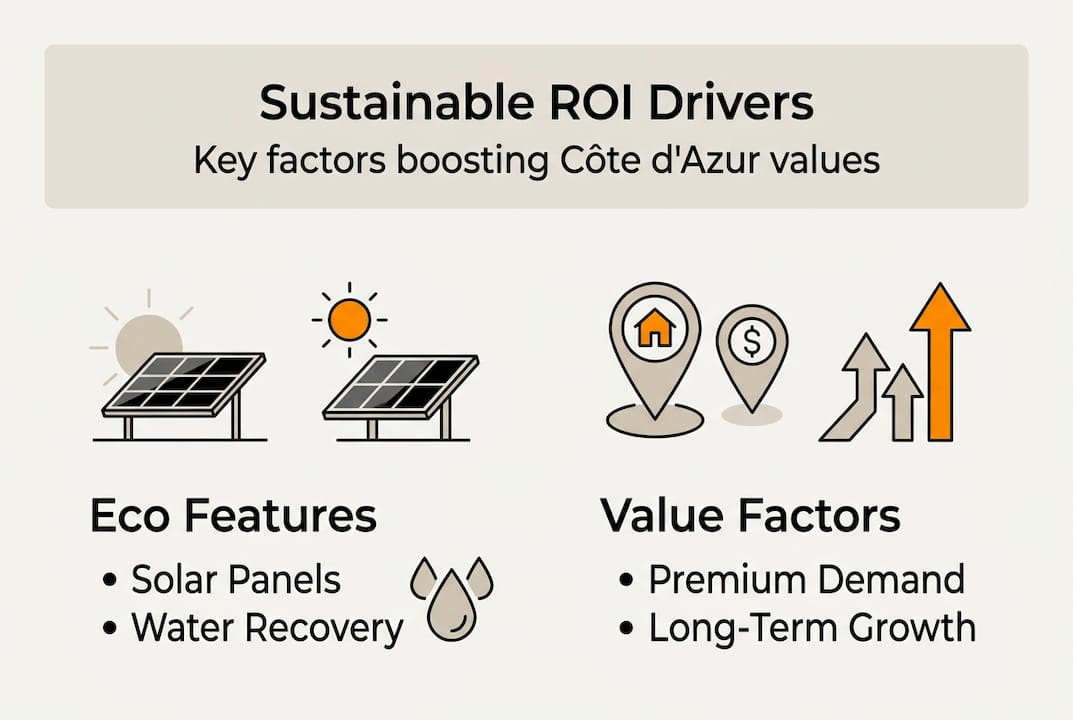
Infographic on Côte d'Azur property value drivers

Pro Tip: When evaluating a property, prioritise those with up-to-date energy systems already installed rather than properties that promise future upgrades. Existing, verified systems enhance liquidity immediately and reduce acquisition risk.

Our international investment guide outlines how to structure due diligence for sustainable acquisitions, including the technical surveys and energy audits that protect your capital from the outset. Note that financial impact always varies by location, property specification, and market conditions, so thorough due diligence remains essential regardless of headline figures.

Key considerations for choosing the right sustainable luxury property

Understanding the financial mechanisms is vital. Here is how you can put this knowledge into practice when evaluating potential properties along the Riviera.

Step-by-step guide to evaluating eco-credentials:

  1. Assess location and microclimate. Solar orientation, coastal exposure, and proximity to infrastructure all affect the performance of sustainable systems. A south-facing villa above Antibes’ Cap will generate significantly more solar energy than a north-facing plot.
  2. Verify build quality and materials. Request full construction documentation. Biophilic design elements, natural insulation, and thermally efficient glazing should be specified, not assumed.
  3. Confirm certifications. LEED, BREEAM, or the French HQE (Haute Qualité Environnementale) label are the gold standards. Sustainability and eco-certifications align directly with market appreciation and reduce resale risk.
  4. Evaluate maintenance requirements. Solar arrays, water recovery systems, and smart platforms require specialist servicing. Confirm that local providers are available and that maintenance costs are factored into your yield projections.
  5. Profile the tenant market. For seasonal rental income, understand who your likely tenants are. Eco-conscious ultra-high-net-worth renters during Cannes Film Festival season or the Saint-Tropez summer regattas will pay a significant premium for certified sustainable properties.

Key questions to ask during on-site visits:

  • What is the property’s current DPE rating, and is it independently verified?
  • Which direction does the main living space face, and how many peak solar hours does the site receive?
  • Are water recovery and greywater recycling systems already operational?
  • What is the projected regulatory outlook for this property under current EU energy directives?
  • Has the property undergone a full technical survey, including seismic resilience assessment?
  • Are there green certification nuances specific to this build type that affect its classification?

Balancing scarcity, compliance, and verified green features is the art of acquiring a truly exceptional legacy asset. We always encourage investors to explore the full spectrum of types of luxury assets available across the region before committing, ensuring the property matches both your financial goals and your family’s vision.

The overlooked truth: sustainability as a legacy multiplier

Most guides stop at yield figures and certification checklists. We believe that misses the deeper story entirely. Sustainable luxury on the Côte d’Azur does something that standard assets simply cannot: it multiplies legacy impact across dimensions that no spreadsheet fully captures.

When your heirs inherit a certified eco-villa above Èze or a solar-powered estate near Monaco, they inherit more than bricks and a sea view. They inherit a reputation. They inherit alignment with the values of the next generation of ultra-high-net-worth buyers. They inherit a property that will not require expensive retrofitting as EU energy directives tighten through 2030 and beyond.

Conventional wisdom focuses on today’s premium. We focus on tomorrow’s baseline. Regulatory trends are moving in one direction only, and properties that already meet or exceed those standards will become the new prestige benchmark. Our legacy wealth strategies are built on this conviction. The families who acquire sustainable estates today are not simply buying property. They are shaping the values and reputation of their lineage for generations.

Unlock your Côte d’Azur legacy with expert guidance

If you are considering your next legacy investment on the French Riviera, we are here to guide you with the precision and discretion that your ambitions deserve. Our curated portfolio of Côte d’Azur luxury villas includes estates with verified sustainability credentials, from solar-powered Cap d’Antibes retreats to biophilic new-builds overlooking Sainte-Maxime’s golden sands. We accept cryptocurrency payments and offer bespoke acquisition support for investors who demand more than a transaction. Explore our property acquisition guide for a step-by-step framework tailored to legacy-focused buyers. Your heirloom awaits.

Frequently asked questions

How do sustainable luxury properties compare in value to standard luxury homes?

Sustainable luxury properties on the Côte d’Azur can command premiums up to 20% over equivalent standard homes and demonstrate superior long-term value retention, making them structurally stronger legacy assets.

Are green certifications essential for resale and legacy value?

Yes. Properties with certifications such as LEED or BREEAM benefit from higher buyer appeal, smoother resale processes, and greater legacy transferability. Prioritising green certifications is one of the most effective strategies for protecting long-term wealth growth.

What sustainability features add the most value?

Solar energy systems, water recovery infrastructure, and high DPE ratings are the most impactful features. Solar panels and water recovery systems consistently drive demand and command the strongest premiums among international buyers.

Do sustainable luxury properties cost more to maintain?

Generally, they offer lower running costs. Sustainability reduces running costs by up to 30% in materials and 25% in waste, meaning the net cost of ownership is typically lower than for a comparable standard luxury property.

Recommended

  • Luxury market trends on the Côte d’Azur: insights for 2026
  • Côte d’Azur Luxury Property Management 2026: 15% Value Gain
  • Why Luxury Properties Appreciate on the Côte d’Azur
  • High-end property explained: Côte d’Azur luxury guide 2026
  • Luxury spa trends 2026: 7 innovations for elite wellness
by Websols Servicedesk/5 April 2026/in Landingpage
https://www.livingonthecotedazur.com/wp-content/uploads/2026/04/1775348245678_Eco-villa-terrace-with-sea-view-and-solar-panels.jpeg 714 1280 Websols Servicedesk https://www.livingonthecotedazur.com/wp-content/uploads/2024/02/sitelogo150.png Websols Servicedesk2026-04-05 02:19:042026-05-07 12:48:34Sustainable luxury properties on the Côte d’Azur: 20% gains


TL;DR:

  • Europe’s luxury property market is rapidly expanding, rewarding decisive investors with high appreciation potential.
  • Top locations are chosen based on stability, accessibility, legacy, amenities, and legal clarity.
  • Coastal hotspots like the French Riviera and emerging cities like Lisbon and Budapest offer diverse investment opportunities.

Europe’s luxury property market is expanding at a pace that rewards the decisive and punishes the hesitant. Valued at USD 549B in 2025 and projected to reach USD 571B in 2026, this is not a market for passive observers. For high-net-worth investors, the central challenge is not whether to invest, but precisely where. The right location secures legacy, delivers yield, and provides the kind of lifestyle that transforms a property into a family heirloom. In this guide, we examine the criteria, the coastal jewels, the urban powerhouses, and the rising stars that define Europe’s most compelling luxury property landscape today.

Table of Contents

  • Key criteria for selecting luxury property locations in Europe
  • Best coastal luxury locations: Prestige, value, and exclusivity
  • Europe’s urban luxury property hotspots: Culture, connectivity, and capital gains
  • Emerging luxury destinations worth your attention
  • Quick comparison: Which luxury locations suit your investment goals?
  • A seasoned investor’s perspective: What truly makes a location ‘luxury’?
  • Choose your European luxury property with confidence
  • Frequently asked questions

Key Takeaways

PointDetails
Legacy drives valueChoosing locations with heritage prestige secures long-term property returns.
Evaluate beyond hypeTrue luxury value lies in regulation, amenities, and stable growth rather than trends.
Consider emerging gemsRising markets such as Portugal and Croatia offer strong growth potential and lifestyle value.
Matching goals mattersAligning your investment priorities with a location’s features yields better outcomes.

Key criteria for selecting luxury property locations in Europe

With the European luxury property market expanding rapidly, it is critical to identify the pillars that define a top-tier location. Not every destination with a glamorous reputation translates into a sound investment. The most discerning buyers we work with consistently evaluate locations against a clear, multi-layered framework before committing capital.

Here are the core criteria worth examining:

  • Market stability and growth trajectory: Look for destinations with consistent price appreciation records and resilient demand, even during broader economic shifts.
  • Accessibility and global connectivity: Proximity to international airports, private aviation terminals, and major transport corridors matters enormously for both personal use and rental appeal.
  • Legacy value and appreciation history: Properties that have appreciated steadily over decades signal enduring desirability. This is the foundation of true legacy investment.
  • Lifestyle amenities: Branded residences, Michelin-starred dining, private marinas, and world-class healthcare elevate a location’s premium appeal.
  • Legal transparency and regulatory clarity: Jurisdictions with clear title systems, transparent transaction processes, and investor-friendly regulations reduce risk significantly.

Spain and Portugal lead the branded residences segment in Europe, demonstrating how regulatory environments and lifestyle infrastructure can combine to attract sustained global capital. Knowing how to evaluate luxury real estate with rigour separates the astute from the merely affluent.

Pro Tip: Before visiting any property, request a full legal audit and a five-year price appreciation report for the micro-market. Understanding luxury buyer trends in your target region will sharpen your negotiating position considerably.

Best coastal luxury locations: Prestige, value, and exclusivity

Applying these criteria, coastal regions continue to dominate investor interest for both value and lifestyle. Salt-kissed air, azure horizons, and the timeless glamour of a seafront address remain irresistible to the world’s wealthiest buyers. Yet each coastline tells a different story.

The Côte d’Azur, French Riviera remains Europe’s most storied luxury address. From the lemon-scented promenades of Menton to the yacht-dotted marinas of Antibes and the Croisette’s effortless opulence in Cannes, the Riviera offers a depth of heritage that no emerging market can replicate. Properties here appreciate 5 to 8% annually in prime micro-markets, and off-market villas in Cap d’Antibes or along the Monaco border command premiums that reflect genuine scarcity. Explore the finest French Riviera cities to understand where legacy value concentrates most powerfully.

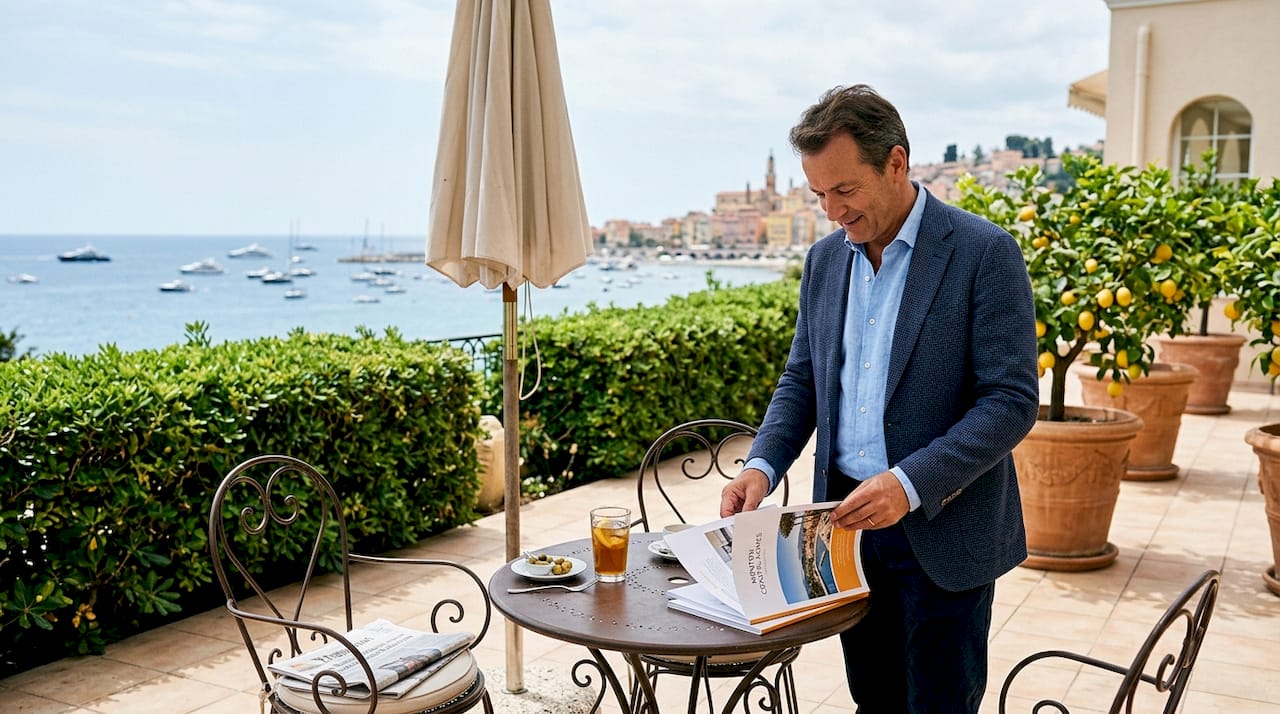
Agent arranging brochures on Riviera villa terrace

Costa del Sol, Spain has evolved from a holiday favourite into a serious luxury investment corridor, with branded residences and world-class golf resorts attracting a new generation of international buyers.

The Algarve, Portugal offers regulatory stability, a welcoming investment climate, and renowned resort communities that continue to draw buyers from across the globe. Discover curated Portugal luxury markets that combine lifestyle with compelling returns.

“The Côte d’Azur is not simply a destination; it is a declaration of intent. Those who invest here are not buying property, they are securing a legacy written in stone and sea.”

Coastal locationAvg. annual appreciationRental yieldExclusivity rating
Côte d’Azur5 to 8%3 to 5%★★★★★
Costa del Sol4 to 6%4 to 6%★★★★☆
Algarve3 to 5%3 to 5%★★★★☆

Europe’s urban luxury property hotspots: Culture, connectivity, and capital gains

Yet, not all luxury investments anchor on the beach; Europe’s iconic cities offer their own blend of opportunity and resilience. Urban luxury property combines cultural cachet with structural demand, making it a cornerstone of any diversified portfolio.

  • London remains a global benchmark for legal transparency, institutional-grade property rights, and consistent long-term returns. Prime central London continues to attract sovereign wealth and private family offices alike.
  • Paris carries an almost mythological appeal. The prime arrondissements, particularly the 7th and 8th, deliver steady yields underpinned by relentless global demand and a cultural legacy that transcends market cycles.
  • Monaco is in a category entirely its own. With zero income tax, ultra-high-net-worth residents, and a supply of land so constrained it borders on the finite, Monaco properties rarely depreciate. They simply wait for the next discerning buyer.
  • Barcelona and Lisbon represent the most compelling value propositions in European urban luxury today, combining lifestyle quality with growth trajectories that more established cities can no longer offer.

The luxury residential market is projected to surpass USD 571B in 2026, and urban centres are absorbing a significant share of that capital. Savvy investors are already mapping top city markets and tracking emerging markets before the broader crowd arrives.

The key insight here is resilience. Urban luxury properties in established capitals tend to hold value through downturns in ways that newer or more speculative destinations cannot guarantee.

Emerging luxury destinations worth your attention

Some aspirational buyers and investors look beyond the established hotspots to capitalise on Europe’s next wave of premium locations. These destinations offer a compelling blend of cultural richness, relative value, and accelerating demand.

  • Dubrovnik, Croatia: The Adriatic’s crown jewel is experiencing a genuine luxury boom. UNESCO World Heritage status, crystalline waters, and a rapidly maturing hospitality sector are drawing buyers who recognise value before it becomes consensus.
  • Santorini and Mykonos, Greece: Scarcity is the defining characteristic here. Limited developable land, extraordinary natural beauty, and insatiable tourism demand create conditions where premium properties rarely linger on the open market.
  • Budapest, Hungary: A cultural renaissance, EU integration, and rising international interest are combining to produce returns that surprise even seasoned investors.
  • Porto, Portugal: The city’s creative regeneration districts and surging luxury segment make it one of Europe’s most exciting urban property stories. Investing in Portugal now, before the next wave of international recognition, is a position many of our clients are actively taking.

Market value growth is projected through 2026, with Spain and Portugal at the forefront, but the ripple effects are reaching these emerging destinations with increasing force. Explore our curated emerging luxury markets guide for deeper analysis.

DestinationPrice growth (2023 to 2026)Entry price (prime)Legal clarity
Dubrovnik12 to 18%From €800KModerate
Mykonos10 to 15%From €1.2MModerate
Budapest8 to 12%From €600KGood
Porto10 to 16%From €700KVery good

Pro Tip: In emerging markets, engage a bilingual legal adviser with specific experience in the local property registration system. Title clarity issues are the most common and costly mistake international buyers make in newer luxury destinations.

Quick comparison: Which luxury locations suit your investment goals?

To make your decision process even more effective, compare the options and clarify which fit your profile best. Every investor arrives with a distinct set of priorities, whether that is maximum yield, generational legacy, lifestyle quality, or capital preservation.

LocationStabilityROI potentialExclusivityLifestyle quality
Côte d’Azur★★★★★★★★★☆★★★★★★★★★★
Monaco★★★★★★★★☆☆★★★★★★★★★★
London★★★★★★★★☆☆★★★★☆★★★★☆
Costa del Sol★★★★☆★★★★☆★★★★☆★★★★☆
Porto★★★★☆★★★★★★★★☆☆★★★★☆
Dubrovnik★★★☆☆★★★★★★★★☆☆★★★★☆

With Europe’s luxury real estate market surpassing USD 570B in 2026, the window for securing the finest assets at today’s values is narrowing. Use this investor decision framework to guide your next steps:

  1. Set your priorities clearly. Decide whether legacy, yield, lifestyle, or capital growth is your primary driver. Each destination serves a different hierarchy of needs.
  2. Assess the regulatory landscape. Understand ownership structures, tax implications, and transaction costs in your shortlisted markets before you fall in love with a property.
  3. Engage market experts with genuine local intelligence. The most valuable opportunities in luxury real estate rarely appear on public portals. Relationships and insider knowledge are what separate exceptional acquisitions from ordinary ones.

For a deeper exploration of the process, our guide to international luxury buying in 2026 covers every stage with precision.

A seasoned investor’s perspective: What truly makes a location ‘luxury’?

Looking across tables and trends, what separates the successful from the merely lucky is deeper than simple returns. We have observed, across years of working with discerning buyers on the Riviera and beyond, that the investors who build genuine wealth in luxury real estate are not chasing the loudest headlines. They are acquiring quietly in places where legacy is already embedded in the stone, the culture, and the community.

The uncomfortable truth is that many buyers confuse prestige marketing with enduring value. A location with a glossy launch campaign and celebrity endorsements may deliver short-term excitement, but it rarely delivers the kind of appreciation that protects family wealth across generations. True luxury value is built on scarcity, heritage, and the irreplaceable quality of place.

Off-market opportunities are where the real rewards concentrate. The finest villas on the Côte d’Azur, the most coveted Monaco-adjacent plots, the restored Provençal estates that never reach a public listing — these are secured through relationships, patience, and expertise. Our Riviera investment insights reflect exactly this philosophy. Invest in legacy, not in hype.

Choose your European luxury property with confidence

Finding the right adviser and support team can transform your discovery phase into a successful acquisition. At Living on the Côte d’Azur, we connect discerning investors with off-market Riviera properties that never reach the open market, offering access that simply cannot be found elsewhere. Our curated portfolio of French Riviera villas and penthouses spans the full arc of the Riviera, from Menton’s lemon-festival charm to Saint-Tropez’s Pampelonne sunsets. We accept cryptocurrency payments and offer personalised guidance tailored to your legacy goals. Let us help you secure not just a property, but a piece of your family’s future.

Frequently asked questions

What is considered the most exclusive luxury location in Europe?

The French Riviera, particularly the Côte d’Azur legacy region, is widely recognised for its unmatched exclusivity, heritage depth, and enduring value appreciation.

Which factors have the biggest impact on luxury property ROI in Europe?

Market stability, location reputation, branded amenities, and legal transparency are the primary drivers of ROI, as market value and regulations consistently confirm across European luxury segments.

Are emerging luxury property markets in Europe a safe bet for legacy investments?

Emerging markets such as Portugal and Croatia offer compelling growth potential, but Spain, Portugal, and emerging destinations all require thorough due diligence and expert local guidance before committing capital.

Is coastal or urban property better for high-net-worth international investors?

Both can excel within a well-structured portfolio; coastal locations deliver lifestyle exclusivity and strong seasonal yields, whilst urban properties in established capitals offer structural resilience and consistent long-term capital growth.

Recommended

  • 7 Top Luxury Real Estate Markets to Invest In – Living on the Côte d’Azur
  • Emerging Luxury Market: Shaping 2026 Wealth Strategies
  • Luxury Real Estate Explained: Key Features and Value – Living on the Côte d’Azur
  • 7 Essential Luxury Real Estate Checklists for Elite Buyers
  • Best Top Real Estate Comparison Sites – Expert Comparison 2025 – ULI & LISA Mallorca Property Blog
by Websols Servicedesk/4 April 2026/in Landingpage
https://www.livingonthecotedazur.com/wp-content/uploads/2026/04/1775261900298_Couple-on-penthouse-balcony-with-city-skyline.jpeg 714 1280 Websols Servicedesk https://www.livingonthecotedazur.com/wp-content/uploads/2024/02/sitelogo150.png Websols Servicedesk2026-04-04 02:19:102026-04-04 02:19:14Europe’s top luxury real estate locations: $571B market

Many affluent buyers assume that owning a slice of the Côte d’Azur, a Cap d’Antibes villa with salt-kissed terraces or a Cannes penthouse above the Croisette, requires full acquisition and the full price tag to match. That assumption leaves extraordinary opportunities on the table. Luxury fractional real estate has quietly reshaped how the world’s most discerning families access premier properties, combining genuine deeded ownership with curated services, flexible use, and shared costs. In this guide, we clarify exactly what the model means, how it works in practice, and why it is becoming the preferred route for high-net-worth individuals seeking both lifestyle and legacy in the world’s most coveted addresses.

Table of Contents

  • Defining luxury fractional real estate
  • How luxury fractional ownership works
  • Luxury fractional versus timeshare: Key differences
  • Who should consider luxury fractional real estate
  • The real value: More than a cost-saving measure
  • Explore luxury opportunities on the Côte d’Azur
  • Frequently asked questions

Key Takeaways

PointDetails
True co-ownershipLuxury fractional real estate offers genuine property co-ownership with legal rights, not just periodic use.
Premium experiencesOwners access multi-bedroom luxury homes and services far beyond typical holiday accommodation.
Flexible investmentFractional models deliver lifestyle flexibility, lower upfront cost, and easier cross-border ownership.
High-income thresholdQualifying for luxury fractional ownership generally requires a minimum annual income of US $150,000.
Distinct from timeshareFractional properties offer more time, control, and resale options than classic timeshare models.

Defining luxury fractional real estate

Luxury fractional real estate is, at its core, a form of co-ownership. A single high-end property is divided among a small group of buyers, typically between six and twelve, each of whom holds a legally deeded share. That share entitles you to exclusive use of the property for a defined number of weeks each year, along with proportional ownership rights and a stake in any future appreciation.

Understanding what defines luxury real estate is the natural starting point, because not every co-owned property qualifies as fractional in the true sense. The properties in question are genuinely premium: three to five bedroom residences with architectural distinction, panoramic sea views, private pools, and hotel-level services. Think of a sun-drenched villa above Èze’s medieval ramparts, or a contemporary residence steps from Sainte-Maxime’s Nartelle beach. These are not holiday apartments; they are curated estates.

The contrast with the timeshare model is significant and worth stating clearly. Timeshares typically offer a right-to-use arrangement rather than actual ownership, involve far larger groups of buyers, and are associated with resort-style developments rather than bespoke private residences. Fractional ownership is a fundamentally different proposition, both legally and experientially.

Key features that distinguish luxury fractional real estate include:

  • Ownership structure: Each buyer holds a deeded legal share, not merely a usage right
  • Group size: 6 to 12 owners per property, keeping the experience exclusive
  • Annual use: Typically 5 or more weeks per year, compared to just 1 to 2 weeks in a timeshare
  • Property standard: Three to five bedroom luxury homes with concierge, housekeeping, and maintenance included
  • Qualifying profile: Buyers typically have an annual income of US $150,000 or above, versus $75,000 for timeshare buyers
  • Exit options: Shares can be sold, gifted, or bequeathed as with any real estate asset

“Fractional ownership is not a compromise on luxury. It is a precision instrument for those who want the finest properties, on their terms, without the weight of sole ownership.”

Pro Tip: Always verify that the fractional structure involves a deeded title registered with the relevant land authority. This is the clearest legal distinction between genuine fractional ownership and a right-to-use arrangement.

How luxury fractional ownership works

Now that we have defined what luxury fractional real estate is, let us look in detail at how fractional ownership functions for you as an investor.

The process is more straightforward than many expect. A specialist developer or management company identifies a premium property, structures the co-ownership legally, and invites a curated group of buyers to acquire shares. Each owner’s steps for buying luxury property follow a clear sequence:

  1. Selection: You review available fractional properties and choose a share size aligned with your desired usage and budget
  2. Legal acquisition: You purchase your deeded share through a notarised transaction, with full title registration
  3. Usage scheduling: The management company coordinates an annual calendar, allocating your weeks fairly and flexibly, including peak season slots
  4. Enjoying the property: You arrive to a fully serviced residence, with concierge, housekeeping, and any bespoke arrangements prepared in advance
  5. Ongoing management: All maintenance, insurance, and operational costs are handled professionally and shared proportionally among owners
  6. Resale or transfer: When you choose to exit, you sell, gift, or bequeath your share independently

Professional management is the cornerstone of the fractional model’s appeal. A reputable management company ensures the property is maintained to the highest standard year-round, that scheduling disputes are resolved gracefully, and that every owner’s arrival feels like a five-star welcome. This is not a self-managed arrangement; it is a fully staffed, hotel-grade experience in a private home.

Manager inspects luxury condo for owners

FeatureFractional ownershipFull ownershipTimeshare
Annual use5+ weeksUnlimited1 to 2 weeks
Capital requiredFraction of full priceFull purchase priceLow upfront cost
Legal titleDeeded shareFull titleRight-to-use
ManagementProfessional, sharedOwner’s responsibilityResort-managed
Exit flexibilitySell or bequeath shareFull saleLimited, often restricted

Pro Tip: Review the checklists for elite buyers before committing to any fractional purchase. Confirming the management company’s track record and the legal structure of the co-ownership agreement are the two most critical due diligence steps.

Luxury fractional versus timeshare: Key differences

A natural question arises: how is luxury fractional ownership different from the familiar timeshare model?

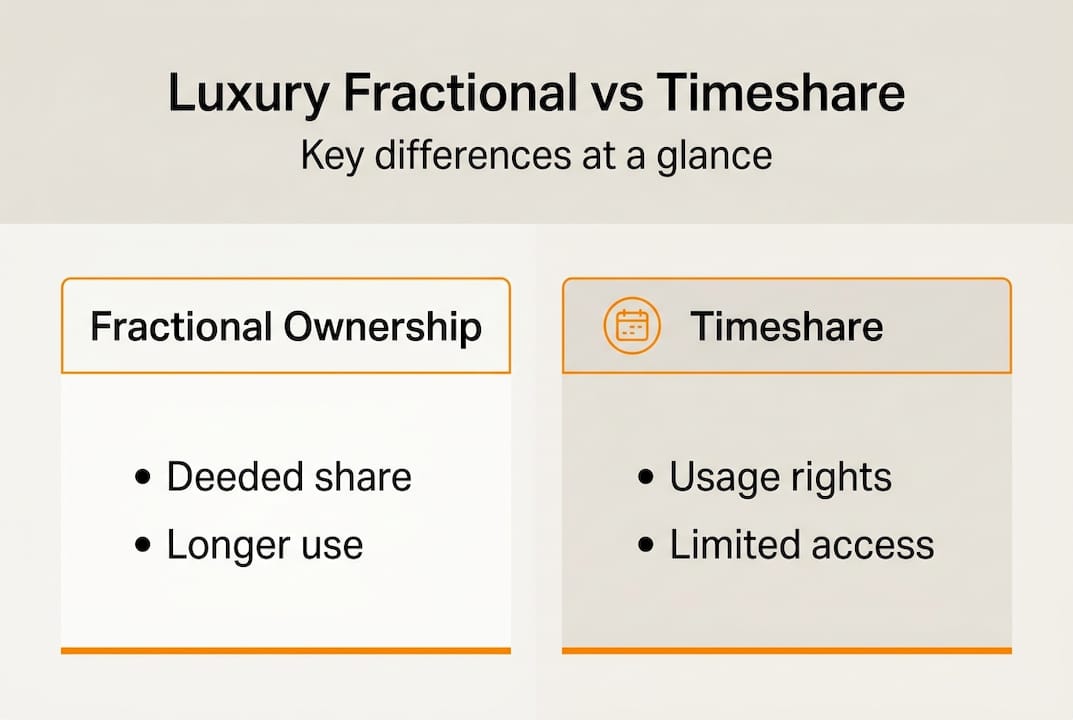
The answer lies in three areas: legal standing, property quality, and the profile of the buyers involved. Fractional ownership confers a genuine deeded interest in a specific, named property. You own a share of that villa above Nice’s Baie des Anges or that Antibes residence near Picasso’s fortress. Timeshares, by contrast, grant a contractual right to use a property or a pool of properties during a fixed period, without any ownership stake.

Infographic comparing fractional and timeshare key features

Fractional buyers tend to have higher incomes, longer usage rights, and access to significantly larger and more exclusive properties than timeshare buyers. This reflects a fundamentally different investment mindset.

AttributeFractional ownershipTimeshare
Ownership typeDeeded real estate shareRight-to-use contract
Typical buyersIncome $150k+Income $75k+
Property size3 to 5 bedroomsStudio to 2 bedrooms
Annual use5+ weeks1 to 2 weeks
Concierge servicesIncludedRarely included
Resale optionsOpen marketHighly restricted

Scenarios where fractional ownership is the stronger choice:

  • You want genuine legal ownership and the ability to pass the asset to your children
  • You seek 5 or more weeks annually in a specific, curated property
  • You value bespoke concierge services and a private residence atmosphere
  • You are building a multi-destination portfolio without locking up full capital in each location

Scenarios where a timeshare might suit:

  • You want a very low entry cost and flexibility across resort networks
  • You require only one or two weeks per year in a holiday setting

For families who want to how to buy luxury property with long-term legacy in mind, fractional ownership is the clear choice. It offers control, prestige, and a transferable asset rather than a depreciating contract.

Who should consider luxury fractional real estate

With the models compared, it is time to explore who benefits most from luxury fractional real estate.

The ideal fractional buyer is not defined solely by wealth. They are defined by lifestyle ambition. International families who spend extended time across multiple destinations, serial entrepreneurs who travel between financial capitals, and executives seeking a guaranteed sanctuary during Cannes Film Festival or Menton’s Lemon Festival are all natural candidates. So too are digital millionaires who want their wealth anchored in appreciating stone rather than volatile markets.

Qualifying income for luxury fractional real estate is typically US $150,000 or above annually, and the model is designed for those who want 5 or more weeks per year in a prime property without committing the full capital a sole purchase demands.

Key benefits for this profile include:

  • Capital efficiency: Access a €3M villa on the Cap d’Antibes coastal sentiers for a fraction of the full acquisition cost
  • Prime location access: Secure a foothold in markets where full ownership is increasingly competitive
  • Legacy building: Pass a deeded share to your heirs, creating a family anchor in a world-class destination
  • Hassle-free management: Arrive to a property that is perfectly prepared, without the operational burden of sole ownership
  • Flexible scheduling: Align your stays with the Antibes yacht regattas, Nice’s Carnaval, or quiet autumn weeks when the Riviera exhales
  • Portfolio diversification: Hold fractional interests across multiple destinations, from the Côte d’Azur to Ibiza or Mauritius

The steps for luxury property purchase are well-defined, and fractional buyers follow the same rigorous due diligence as sole purchasers. Legal audits, title verification, and management company assessments are all essential.

Pro Tip: Before committing, map your actual travel patterns over the past three years. If you consistently spend 4 to 8 weeks in a single destination, fractional ownership will likely deliver better value and a richer experience than either renting or full ownership.

The real value: More than a cost-saving measure

We observe, time and again, that fractional ownership is misread as simply a way to split a bill. That framing misses the point entirely.

The families and investors we work with are not choosing fractional models because they cannot afford full ownership. Many could. They choose it because it gives them something sole ownership rarely does: genuine freedom. The freedom to hold a curated position in Sainte-Maxime, another in Ibiza, and perhaps one in Mauritius, without the weight of managing three full estates. The freedom to arrive and simply live, with every detail handled.

We have seen emerging luxury market trends shift decisively toward experience over accumulation. The most sophisticated buyers are no longer measuring success by how many properties they own outright. They measure it by the quality and breadth of the life those properties enable. Fractional ownership is the architecture of that life. It is a legacy instrument, a lifestyle passport, and a remarkably intelligent investment vehicle, all at once.

Explore luxury opportunities on the Côte d’Azur

If you are considering how to put this knowledge to work for your family or investment portfolio, the next step is straightforward. We invite you to explore our curated selection of French Riviera luxury villas, spanning the sun-gilded coastline from Menton to Saint-Tropez. For those seeking something truly singular, our exclusive off-market listings offer access to properties that never reach the open market. We also accept cryptocurrency payments, reflecting our commitment to serving a new generation of global wealth. When you are ready to speak with someone who understands both the Riviera and your ambitions, speak to an expert from our team.

Frequently asked questions

Is luxury fractional real estate the same as a timeshare?

No. Luxury fractional ownership gives you a deeded share in a specific prime property and 5+ weeks of use annually, whereas timeshares typically offer a right-to-use contract with far less exclusivity and shorter annual access.

How much time do I really get each year in a fractional property?

Typically, you will enjoy 5 or more weeks of exclusive use each year, allocated flexibly across seasons depending on the ownership structure and scheduling agreement.

What is the minimum income for luxury fractional ownership?

Most programmes require a qualifying annual income of at least US $150,000, reflecting the premium nature of the properties and services involved.

Can I sell my fractional property share in future?

Yes. Because fractional shares are deeded real estate interests, you can sell, gift, or bequeath your share on the open market just as you would any other property asset.

What services are included with luxury fractional ownership?

Expect hotel-level services as standard, including concierge, daily housekeeping, property maintenance, and often bespoke local experiences tailored to each owner’s preferences.

Recommended

  • Emerging Luxury Market: Shaping 2026 Wealth Strategies
  • 7 Essential Steps for Buying Luxury Property in 2025
  • Key steps in international luxury property buying 2026
  • Luxury market trends on the Côte d’Azur: insights for 2026
  • Investissement immobilier patrimonial : Sécuriser et transmettre en 2026 – Balmont Conseil
by Websols Servicedesk/2 April 2026/in Landingpage
https://www.livingonthecotedazur.com/wp-content/uploads/2026/04/1775089405241_Family-reviewing-luxury-fractional-real-estate-documents-1.jpeg 714 1280 Websols Servicedesk https://www.livingonthecotedazur.com/wp-content/uploads/2024/02/sitelogo150.png Websols Servicedesk2026-04-02 02:23:412026-04-02 07:01:20Luxury fractional real estate: invest, enjoy, profit in 2026

The French Riviera luxury property market is, by design, opaque. Salt-kissed villas perched above Èze’s medieval lanes, Cap d’Antibes estates shielded by ancient pines, Monaco-adjacent penthouses with Baie des Anges panoramas — the most coveted of these rarely surface on any public portal. For high-net-worth buyers accustomed to commanding the best, this hidden architecture of the market can be both surprising and frustrating. Off-market luxury properties are not publicly listed, and accessing them demands more than capital. It demands relationships. This guide reveals precisely how experienced buyer agents deliver critical access, strategic negotiation, and bespoke protection at every stage of a Riviera acquisition.

Table of Contents

  • The hidden property network: why access beats advertisements
  • Negotiation edge: saving more than the agent’s fee
  • Unbiased advocacy and strategic risk reduction
  • Discretion, privacy and bespoke service: the HNWI advantage
  • The real value of experience: what most buyers never see
  • Connect with Riviera buyer agents for your legacy investment
  • Frequently asked questions

Key Takeaways

PointDetails
Unlock off-market accessExperienced buyer agents open doors to the Riviera’s most exclusive, undiscoverable luxury properties.
Benefit from negotiation expertiseYou save more than the agent’s fee through skilled negotiation and insider market knowledge.
Gain full risk protectionIndependent representation ensures your interests are prioritised, legal risks are managed, and opaque practices avoided.
Enjoy tailored, confidential serviceAgents deliver complete discretion and personal support before, during, and long after your purchase.

The hidden property network: why access beats advertisements

Imagine searching for the finest table at a Cannes Film Festival dinner — not through a booking app, but through a quiet word with the maître d’ who has worked the Croisette for twenty years. That is precisely how the upper tier of the French Riviera property market operates. The most prestigious estates, the Belle Époque villas above Nice’s Promenade des Anglais, the discreet bastides near Antibes’ Provençal markets, are exchanged through private networks long before any listing is drafted.

Seasoned buyer agents leverage networks of 400 to 500 real estate contacts across the Côte d’Azur, granting clients first-refusal access to properties that never reach the open market. This is not a marginal advantage. It is the difference between competing with dozens of buyers and arriving at a negotiation as the sole, pre-qualified party.

“The finest properties on the Riviera are rarely advertised. They are offered, quietly, to those with the right relationships.”

Consider the practical contrast between a standard online search and an agent-led off-market property acquisition:

ApproachProperty accessCompetitionPrivacySpeed
Online portalsPublic listings onlyHighLowSlow
Buyer agent networkOff-market and exclusiveMinimalHighFast

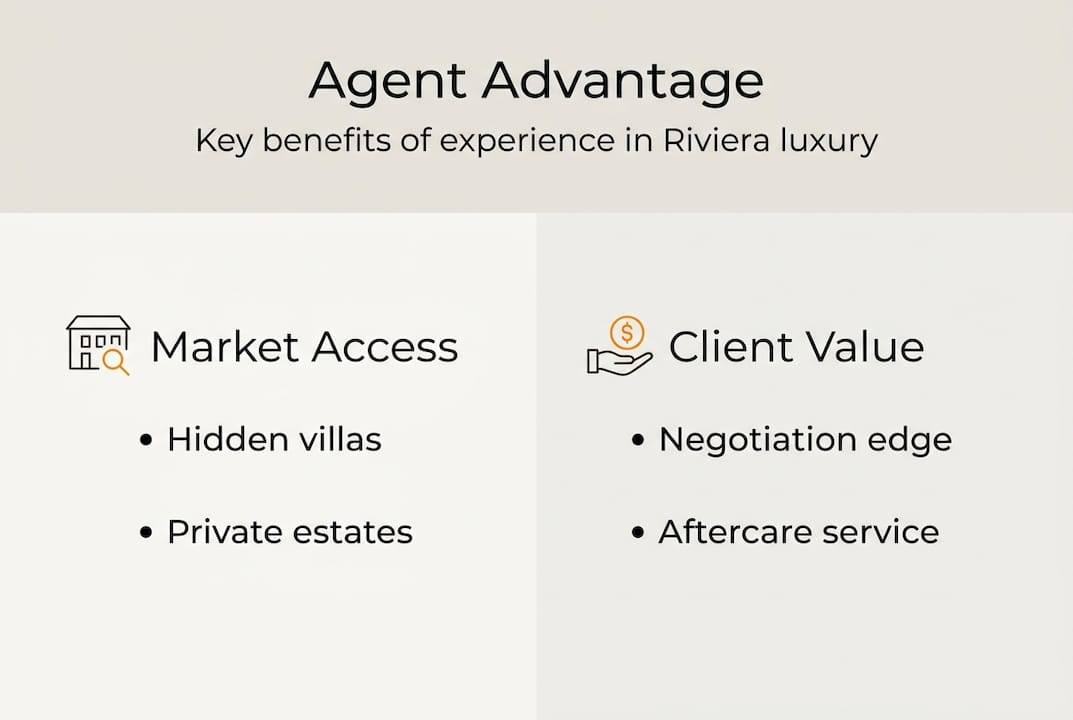
Infographic on Riviera agent advantages

The off-market advantages extend well beyond exclusivity. Sellers of trophy assets often prefer discretion, meaning the buyer who arrives through trusted channels is received with far greater goodwill. These invisible luxury listings represent the true apex of the Riviera market, and they are simply not visible to those searching alone.

Key benefits of agent network access:

  • First-refusal opportunities before public release
  • Reduced bidding competition on trophy assets
  • Enhanced seller goodwill and smoother negotiations
  • Full confidentiality for both parties throughout

Negotiation edge: saving more than the agent’s fee

After opening the door to exclusive properties, seasoned agents deliver even greater value at the negotiation table. The numbers here are compelling and worth examining closely.

Expert negotiation skills consistently deliver average savings of 4 to 8% off the asking price in comparable luxury markets. Against a typical buyer agent fee of 2 to 3% of the purchase price, the arithmetic is straightforward. On a €5M villa in Cap d’Antibes, a 6% negotiated reduction yields €300,000 in savings. The agent’s fee at 2.5% amounts to €125,000. The net gain to the buyer: €175,000, before accounting for any other value delivered.

Illustrative value comparison on a €5M acquisition:

ItemAmount
Asking price€5,000,000
Negotiated saving (6%)€300,000
Buyer agent fee (2.5%)€125,000
Net financial advantage€175,000

Beyond price, the compounding advantages are significant. Time savings are substantial, with agent-led acquisitions completing in approximately 45 days compared to six months or more for unassisted buyers. That speed protects against rate movements and competing interest.

  1. Price reduction: Skilled agents know when a seller is motivated and how to structure offers that are taken seriously.
  2. Due diligence speed: Technical surveys, legal audits, and diagnostics are coordinated simultaneously, not sequentially.
  3. Risk avoidance: Identifying structural, legal, or title issues before the compromis de vente (preliminary contract) prevents costly withdrawals.
  4. Terms optimisation: Conditions suspensives (conditional clauses) are crafted to protect the buyer, not merely to close the deal.

Pro Tip: Ask your agent about their specific negotiation history on comparable properties. A track record of Riviera transactions reveals cultural fluency that generic negotiators simply cannot replicate.

Unbiased advocacy and strategic risk reduction

Beyond price, the right agent protects your investment at every stage. This is where the distinction between a buyer’s agent and a traditional French estate agent becomes critical.

In France, many agents represent both seller and buyer simultaneously, a practice known as dual agency. Independent buyer representation eliminates this conflict entirely, ensuring that every recommendation, every piece of advice, and every negotiated clause serves your interests alone. The seller has their own counsel. You deserve yours.

Thorough due diligence in the French market encompasses far more than a structural survey. It includes title searches, urban planning checks (PLU certificates), mandatory diagnostics for asbestos and lead, and an assessment of any syndic (residents’ association) obligations for co-owned properties. For overseas buyers, these layers of complexity are precisely where costly mistakes are made.

“Cultural negotiation in France requires structured offers and discretion. Inexperienced buyers frequently overpay simply because they misread the opacity of the market.”

Common pitfalls for overseas and high-net-worth buyers:

  • Misunderstanding the legal weight of the compromis de vente
  • Overlooking PLU restrictions that limit renovation or extension
  • Underestimating notary fees and transfer taxes in the total acquisition cost
  • Failing to account for co-ownership charges in prestige residences
  • Neglecting to verify that the property’s title is free of servitudes (easements)

When selecting your agent, prioritise those with demonstrable experience in the specific micro-market you are targeting. The buyer agent benefits in a market as nuanced as the Riviera are inseparable from local expertise.

Pro Tip: Never attempt to bypass your contracted agent and approach a seller directly after an introduction has been made. French courts have imposed penalties of up to 10% of the transaction value in such cases, a costly lesson that experienced buyers never need to learn.

Discretion, privacy and bespoke service: the HNWI advantage

Once the groundwork is secure, the final advantage is service tailored beyond the deal itself. For ultra-high-net-worth individuals, the acquisition of a Riviera estate is rarely a single transaction. It is the opening chapter of a long relationship with a property, a region, and a trusted advisory team.

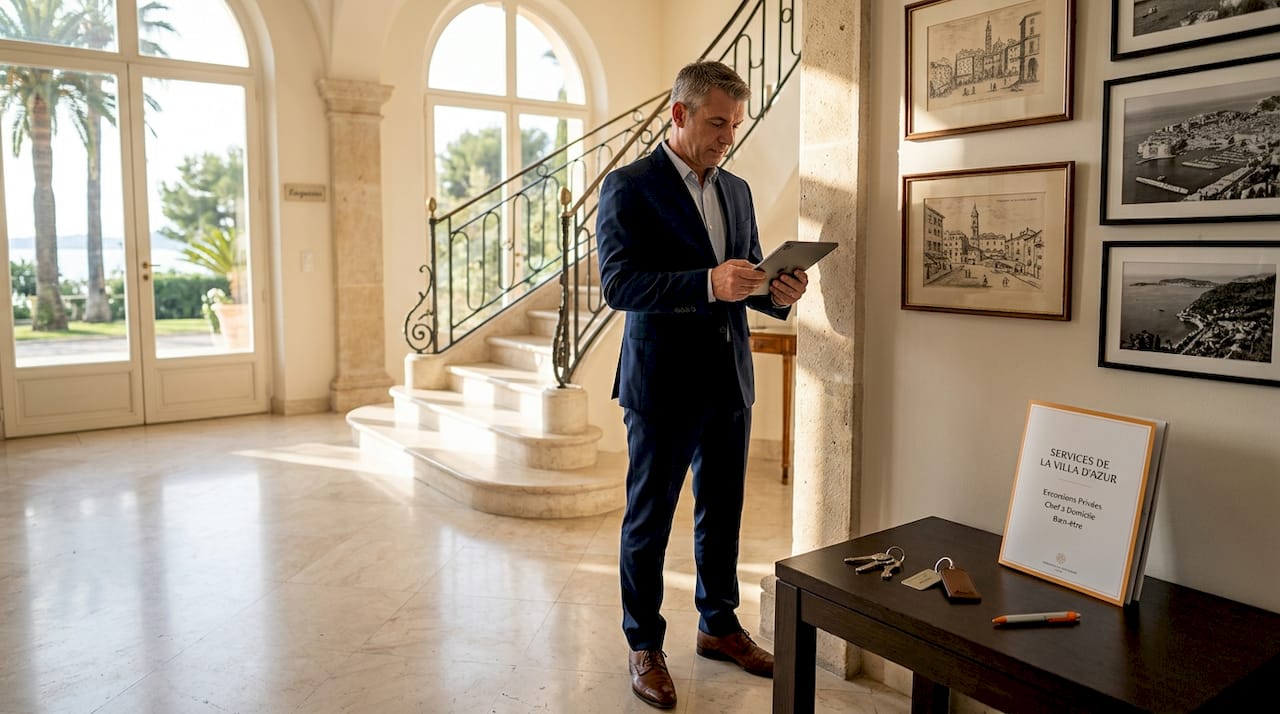
Concierge manages luxury villa aftercare task

Agents ensure discretion, privacy, and post-purchase support that integrates seamlessly with broader wealth management strategies, including property management, tax planning, and seasonal rental optimisation. A well-positioned Riviera villa, managed with precision, can yield 3 to 5% annually through elite seasonal lets, particularly during the Cannes Film Festival, Monaco Grand Prix, and the summer regattas that animate the coastline from Saint-Tropez’s Vieux Port to Antibes’ yacht-dotted marina.

For international clients who cannot be present throughout the acquisition process, agents coordinate pre-viewings, virtual tours, and all logistics remotely, ensuring that no opportunity is missed and no detail is overlooked.

“A seasoned Riviera agent does not simply find you a property. They curate an experience, protect a legacy, and remain your trusted partner long after the notaire has signed.”

Practical concierge and after-purchase services typically offered:

  1. Property management and seasonal rental oversight
  2. Introduction to trusted architects, interior designers, and restoration specialists
  3. Integration with tax advisers for wealth transfer and inheritance planning
  4. Security and household staff recruitment
  5. Coordination of cryptocurrency payment logistics for digital-asset investors

For those exploring international agent solutions, the breadth of aftercare available through an experienced Riviera team is genuinely transformative. Our luxury property guide for 2026 outlines the full spectrum of services available to discerning buyers at every stage.

The real value of experience: what most buyers never see

Conventional wisdom focuses almost entirely on price savings when evaluating a buyer agent’s worth. We believe this misses the deeper story. The most significant value delivered by a truly experienced Riviera agent is not measured in percentage points. It is measured in judgement.

A seasoned agent who has navigated twenty years of Côte d’Azur transactions carries something no fee schedule can quantify: the ability to sense, within moments of visiting a property, whether it is a legacy asset or a liability dressed in limestone. They recognise the seller who is genuinely motivated from the one who is merely testing the market. They know which notaires move swiftly, which communes have pending planning changes, and which micro-locations will appreciate as the next generation of buyers discovers Menton’s lemon-scented ramparts or Sainte-Maxime’s Nartelle sunsets.

We have seen high-net-worth buyers, operating without experienced counsel, acquire properties that appeared flawless on paper yet carried hidden servitudes, unresolved syndic disputes, or planning restrictions that neutered their renovation vision entirely. The buyer agent case studies that resonate most are not stories of dramatic price reductions. They are stories of disasters quietly averted. Experience, on the French Riviera, is not a credential. It is a shield.

Connect with Riviera buyer agents for your legacy investment

If you are ready to move beyond public listings and into the curated world of Riviera prestige, we are here to guide every step. At Living on the Côte d’Azur, we connect discerning buyers with experienced, independent buyer agents who offer confidential, full-service support from first search to final signature. Explore our French Riviera luxury listings, gain access to off-market opportunities that never reach public portals, and begin a conversation about your legacy property journey. We welcome cryptocurrency payments and serve a global clientele with the discretion and expertise that truly exceptional acquisitions demand. Connect with our buyer agent team today.

Frequently asked questions

What types of off-market properties can a buyer agent access in the French Riviera?

Experienced buyer agents provide access to private villas, penthouses, and estates that are withheld from public advertising out of respect for seller confidentiality and market discretion.

How much can I expect to save with an experienced buyer agent?

Buyers typically achieve savings of 4 to 8% off the asking price, which routinely exceeds the agent’s standard fee of 2 to 3%, delivering a clear net financial advantage on high-value acquisitions.

Is it a legal risk to bypass an agent in France after an introduction?

Yes. Circumventing a contracted agent after they have facilitated an introduction can result in court-imposed fines of up to 10% of the transaction value, a risk no prudent buyer should accept.

What post-purchase support do buyer agents offer for luxury clients?

For high-net-worth clients, post-purchase services typically include property management, seasonal rental oversight, and integration with wealth and tax strategy to maximise both lifestyle enjoyment and long-term returns.

Recommended

  • International Buyer Agents: Shaping Riviera Luxury Deals
  • Role of Buyer Agents in Luxury Real Estate: Complete Guide
  • 7 Key Examples of Buyer Agent Services for Investors
  • 7 Key Property Buyer Agent Benefits for Luxury Investors
  • Premium Marble for Luxury Home Design– SurfacesGalore
by Websols Servicedesk/1 April 2026/in Landingpage
https://www.livingonthecotedazur.com/wp-content/uploads/2026/04/1775003025566_Agent-reviewing-Riviera-property-documents.jpeg 714 1280 Websols Servicedesk https://www.livingonthecotedazur.com/wp-content/uploads/2024/02/sitelogo150.png Websols Servicedesk2026-04-01 02:23:582026-04-01 02:24:06French Riviera luxury: why experienced buyer agents matter

When fine wine prices rose 146% over the past decade, outpacing many traditional asset classes, it became clear that luxury assets are not mere indulgences but strategic investments. Luxury asset advisory transforms these holdings into robust, multigenerational wealth vehicles. This article explores what luxury asset advisory entails, its core services, the advisory process, and how it safeguards your legacy on the Côte d’Azur and beyond.

Table of Contents

  • Defining luxury asset advisory: The foundation
  • How luxury asset advisory benefits investors
  • The process: From acquisition to legacy
  • Key elements and services within luxury asset advisory
  • When and why do you need luxury asset advisory?
  • Secure your Côte d’Azur legacy with expert advisory
  • Frequently asked questions

Key Takeaways

PointDetails
Holistic asset supportLuxury asset advisory delivers complete management from acquisition to multigenerational legacy planning.
Outperformance potentialLuxury assets, when expertly managed, can surpass traditional investments in growth and resilience.
Expert-led risk reductionProfessional advisory minimises compliance risks, inefficiencies, and costly errors in significant acquisitions.
Legacy-focused structuringEfficient ownership structures and succession planning are essential for preserving wealth and family legacy.

Defining luxury asset advisory: The foundation

Luxury asset advisory is a specialised discipline that extends far beyond the initial purchase of high-value assets. It encompasses strategic guidance on acquisition, ownership structuring, tax optimisation, succession planning, and ongoing administration. Unlike traditional asset management, which often focuses on liquid securities, luxury asset advisory provides end-to-end support for tangible assets such as real estate, yachts, fine art, and collectables.

Advisors act as legacy architects, orchestrating every facet of your investment journey. They coordinate with insurers, lenders, legal experts, and tax specialists to ensure your assets appreciate whilst remaining compliant across jurisdictions. This holistic approach is particularly vital for cross-border holdings, where regulatory landscapes shift and tax implications multiply.

Core services include:

  • Acquisition strategy and due diligence
  • Ownership structure design using trusts or corporate entities
  • Tax efficiency planning and compliance
  • Succession and inheritance frameworks
  • Ongoing administration and reporting

Consider the difference between purchasing a Riviera villa independently and engaging an advisor. The former may secure a property, but the latter ensures it becomes a tax-efficient, legally sound, and appreciating cornerstone of your family’s wealth. As one industry expert notes:

“Luxury asset advisory transforms acquisitions into legacy plays, where every decision is calibrated for long-term preservation and growth.”

For those seeking personalised luxury real estate benefits, advisory services provide the strategic depth required to navigate complex markets. Understanding legal frameworks for luxury assets further underscores the necessity of expert guidance, particularly when assets span multiple jurisdictions.

How luxury asset advisory benefits investors

The value proposition of luxury asset advisory lies in its ability to mitigate risk, preserve wealth, and enhance returns through expert asset selection and holistic planning. High-net-worth individuals face unique challenges: regulatory scrutiny, tax complexity, and the need to protect assets for future generations. Advisory services address these challenges with precision.

Estate planning in home office setting

Risk mitigation and compliance support form the bedrock of advisory value. Advisors conduct rigorous due diligence, verifying provenance, assessing legal title, and ensuring regulatory compliance. This is especially critical for cross-border acquisitions, where missteps can trigger penalties or jeopardise ownership.

Wealth preservation and legacy protection are central to advisory mandates. By structuring ownership through trusts or holding companies, advisors shield assets from creditors, divorce settlements, and estate taxes. Succession planning ensures seamless transfer to heirs, avoiding probate delays and family disputes.

Tax efficiency and regulatory guidance deliver tangible financial benefits. Advisors identify opportunities to minimise capital gains, inheritance taxes, and ongoing holding costs. For Riviera properties, this might involve leveraging French tax treaties or structuring ownership to optimise VAT recovery.

Improved returns result from expert asset selection and strategic timing. Luxury assets have shown resilience and strong appreciation, often outperforming traditional classes. Advisors curate portfolios that balance capital growth with income generation, such as seasonal lettings on the Côte d’Azur.

BenefitImpactExample
Risk mitigationAvoids legal pitfallsTitle verification for Antibes villa
Wealth preservationProtects from creditorsTrust structure for Monaco property
Tax efficiencyReduces liabilitiesVAT optimisation on yacht purchase
Enhanced returnsMaximises appreciationSeasonal letting in Cannes

Pro Tip: Engage advisors early in the acquisition process. Pre-purchase structuring can unlock tax benefits that are impossible to retrofit once ownership is established.

For investors exploring investment strategies for legacy yield, advisory services provide the frameworks to achieve both capital preservation and income generation. Learning to evaluate luxury real estate becomes more effective when paired with advisory insights. Discover high value asset support to understand the breadth of services available.

The process: From acquisition to legacy

Effective luxury asset advisory unfolds through a structured journey, beginning with asset identification and culminating in multigenerational transfer. Each phase demands specialised expertise and meticulous coordination.

1. Discovery and strategy: Advisors assess your wealth objectives, risk tolerance, and legacy goals. This phase establishes the investment thesis, whether acquiring a Cap d’Antibes estate for family use or a Saint-Tropez villa for rental income.

2. Acquisition and due diligence: Advisors source opportunities, conduct legal and technical audits, and negotiate terms. For Riviera properties, this includes verifying planning permissions, assessing seismic resilience, and reviewing title history.

3. Ownership structuring: Mechanics of luxury asset management involve coordination with insurers, lenders, and legal advisors to establish optimal ownership structures. Trusts offer asset protection, whilst corporate entities provide tax efficiency and operational flexibility.

4. Administration and compliance: Ongoing management includes insurance renewals, regulatory filings, financial reporting, and liaison with service providers. Advisors ensure assets remain compliant and well-maintained.

5. Succession and transfer: Estate planning integrates assets into inheritance frameworks, minimising taxes and ensuring smooth transfer to heirs. This phase often involves family governance structures to manage shared assets across generations.

ApproachAdvantagesDisadvantages
DIY acquisitionLower upfront costsHigher risk of legal errors
Advisory-ledExpert guidance, tax efficiencyAdvisory fees
DIY acquisitionDirect controlTime-intensive due diligence
Advisory-ledHolistic legacy planningRequires trust in advisors

The contrast between DIY purchases and advisory-led acquisitions is stark. Independent buyers may secure assets but often overlook structuring opportunities, tax optimisation, and succession planning. Advisors transform acquisitions into legacy cornerstones.

For those focused on safeguarding estate legacy, the advisory process ensures every decision aligns with long-term wealth preservation. Understanding curating real estate for legacy reveals how strategic selection and structuring compound over time. Explore luxury asset performance to appreciate the financial upside of expert guidance.

Key elements and services within luxury asset advisory

Luxury asset advisory encompasses a suite of specialised services designed to maximise value and protect wealth. Each element addresses a critical aspect of ownership, from initial valuation to ongoing administration.

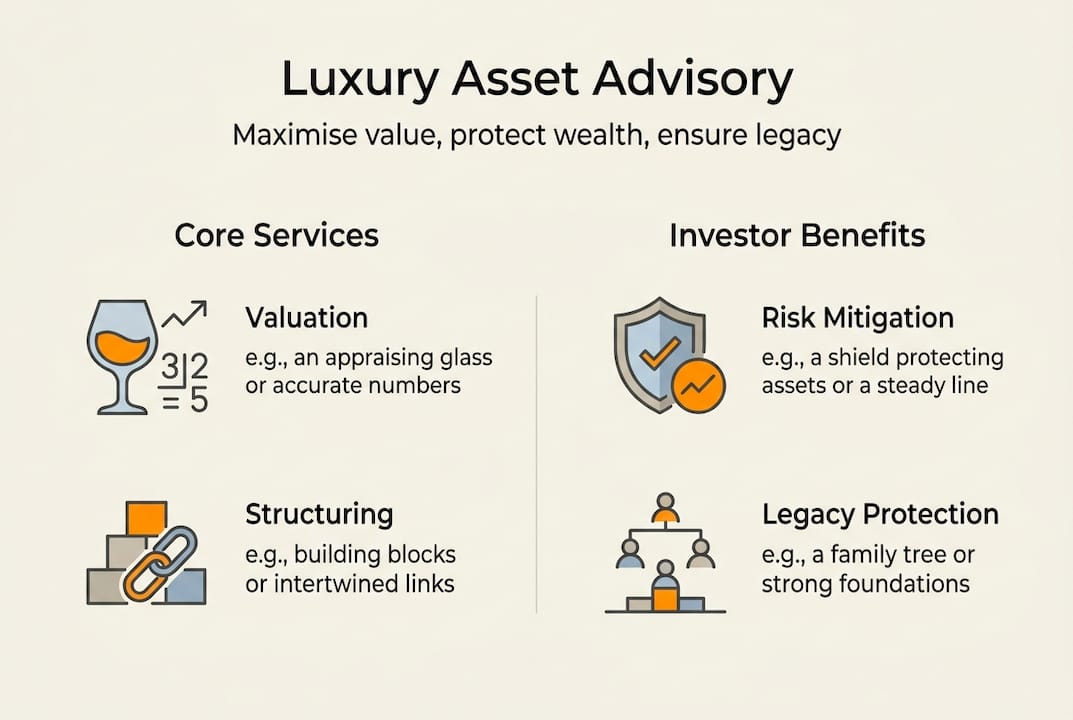
Infographic showing luxury asset advisory services

Valuation and provenance checks ensure authenticity and fair pricing. For art and collectables, advisors verify provenance to avoid forgeries. For real estate, they commission independent appraisals to confirm market value and identify renovation opportunities.

Ownership structuring using companies or trusts provides asset protection and tax efficiency. Trusts shield assets from creditors and simplify succession, whilst corporate entities offer operational flexibility and VAT recovery on business use.

Insurance and risk management solutions protect against loss, damage, and liability. Advisors negotiate comprehensive coverage, often securing better terms through industry relationships. For yachts and villas, this includes specialist policies covering high-value contents and seasonal risks.

Lender and insurer coordination streamlines financing and coverage. Luxury advisory frequently handles valuation, provenance verification, insurance, financing, and ongoing administration, ensuring seamless integration across service providers.

Regular administration, reporting, and compliance maintain asset value and regulatory standing. Advisors manage renewals, filings, and audits, providing consolidated reporting that simplifies portfolio oversight.

Pro Tip: Establish substance and economic presence in jurisdictions where you hold assets. This can unlock tax benefits and simplify compliance, particularly for Riviera properties used for business or rental purposes.

Did you know? Riviera villas with eco-luxury finishes command €2M+ premiums, reflecting growing demand for sustainable, future-proof assets. Advisors identify these opportunities early, positioning clients ahead of market trends.

For investors seeking estate insurance solutions, advisory services ensure comprehensive coverage tailored to high-value holdings. Mastering luxury real estate tax strategies becomes simpler with expert guidance. Review comprehensive luxury asset services to understand the full scope of advisory support.

When and why do you need luxury asset advisory?

Recognising when to engage luxury asset advisors can mean the difference between a sound investment and a costly misstep. Several scenarios demand expert guidance, particularly when assets cross borders, involve significant value, or require succession planning.

1. Cross-border acquisitions: Purchasing property or assets in foreign jurisdictions introduces legal, tax, and regulatory complexities. Advisors navigate these challenges, ensuring compliance and optimising structures for international holdings.

2. Succession and estate planning: Transferring wealth to heirs requires careful planning to minimise taxes and avoid family disputes. Advisory ensures compliance, maximises returns, and supports efficient succession for luxury assets.

3. Significant asset value: High-value purchases justify advisory fees through tax savings, risk mitigation, and enhanced returns. For Riviera estates exceeding €5M, advisory services often pay for themselves through structuring efficiencies alone.

4. Regulatory changes: Shifting tax laws and compliance requirements demand ongoing vigilance. Advisors monitor regulatory landscapes, proactively adjusting structures to maintain efficiency and compliance.

5. Family governance: Managing shared assets across generations requires governance frameworks that balance individual interests with collective wealth preservation. Advisors facilitate family councils and establish decision-making protocols.

Warning signs you should not DIY:

  1. Unfamiliarity with local legal and tax systems
  2. Assets spanning multiple jurisdictions
  3. Complex ownership structures involving trusts or entities
  4. Succession planning for multigenerational wealth
  5. High-value acquisitions where errors carry significant financial risk

Best practice: Engage advisors early, ideally before making purchase commitments. Pre-acquisition structuring unlocks opportunities that are difficult or impossible to implement post-purchase.

As one wealth manager observes:

“The cost of advisory services pales beside the financial and emotional toll of poorly structured acquisitions. Early engagement transforms potential pitfalls into strategic advantages.”

For those evaluating smart estate evaluation, advisory insights enhance decision-making at every stage. Implementing tax strategies for estates becomes more effective with expert guidance. Explore historical asset performance to appreciate the long-term value of strategic advisory.

Secure your Côte d’Azur legacy with expert advisory

The Riviera’s timeless allure, combined with robust appreciation and global prestige, makes it an ideal canvas for legacy investments. Our advisory services transform acquisitions into multigenerational wealth anchors, blending local expertise with international sophistication. From Cap d’Antibes privacy to Monaco-adjacent prestige, we curate opportunities that align with your vision and values. Whether you seek a Provençal mas for family gatherings or a sustainable villa with solar arrays, our team orchestrates every detail, from legal audits to succession frameworks. Discover how property acquisition on the Riviera becomes seamless with dedicated advisory support. Explore our luxury real estate overview to understand the breadth of opportunities awaiting discerning investors. Begin your journey with our property acquisition guide, designed to simplify complex decisions and unlock lasting value.

Frequently asked questions

What assets are covered by luxury asset advisory?

Luxury asset advisory typically covers real estate, yachts, fine art, classic cars, collectables, and other high-value assets. End-to-end luxury asset support spans a range of asset classes, ensuring comprehensive management and strategic oversight.

How can luxury asset advisory maximise my legacy investment?

By structuring ownership efficiently, providing tax strategies, and planning for succession, advisory enhances and protects your legacy. Advisory provides ownership structures, succession planning, and ongoing administration, ensuring assets appreciate whilst remaining compliant and accessible to future generations.

Is luxury asset advisory only for the ultra-wealthy?

While often catering to high-net-worth individuals, advisory services are valuable to anyone with significant assets requiring tailored management and cross-border support. Advisory serves high-value clients but is relevant for a range of substantial investments, particularly those involving complex legal or tax considerations.

What makes luxury real estate on the Côte d’Azur distinct for investors?

The region offers resilience, appreciation, and global cultural cachet, all enhancing legacy and wealth preservation for discerning investors. Fine wine and luxury asset appreciation outpacing traditional classes highlights regional investment strength, with Riviera properties commanding premiums for sea views, eco-luxury finishes, and proximity to cultural landmarks.

Recommended

  • Real Estate Inheritance: Safeguarding Your Côte d’Azur Legacy
  • How to Buy in Cannes: Secure Your Riviera Legacy Estate
  • Luxury market trends on the Côte d’Azur: insights for 2026
  • Luxury Real Estate Buying Guide: Secure Your Riviera Legacy
by Websols Servicedesk/31 March 2026/in Landingpage
https://www.livingonthecotedazur.com/wp-content/uploads/2026/03/1774916891883_Advisor-reviewing-luxury-property-documents.jpeg 714 1280 Websols Servicedesk https://www.livingonthecotedazur.com/wp-content/uploads/2024/02/sitelogo150.png Websols Servicedesk2026-03-31 02:28:342026-03-31 02:28:39Luxury asset advisory: Secure your Côte d’Azur legacy

Selecting a luxury second home on the French Riviera is one of the most consequential decisions a discerning investor will ever make. The stakes extend far beyond square metres and sea views. You are choosing a vessel for generational wealth, a sanctuary etched in Provençal stone, and an asset that must perform across decades of shifting markets. The luxury segment has shown 3–5% annual growth over the past five years, yet not every property qualifies as a true legacy investment. What separates the strategic buyer from the rest is clarity of purpose, rigorous due diligence, and an unwavering commitment to sustainability as a core investment criterion.

Table of Contents

  • Establishing your investment goals and criteria
  • Navigating French Riviera market dynamics
  • Selecting the right location and property type
  • Understanding taxes, fees and legal structures
  • Sustainability and future-proofing your second home
  • Explore luxury property solutions on the Côte d’Azur
  • Frequently asked questions

Key Takeaways

PointDetails
Legacy focused buyingStrategic buyers prioritise heritage value, capital preservation, and succession planning in their second home choices.
Tax efficiency mattersUnderstanding property taxes, inheritance, and legal structures is essential for minimising costs and building a legacy.
Sustainability adds valueEco-luxury features enhance future market resilience and ensure your second home stands out in the Riviera market.
Market resilienceThe French Riviera luxury segment has delivered steady 3–5% annual growth, buoyed by international demand.
Location is keyChoosing the right city and property type directly influences your returns and legacy potential.

Establishing your investment goals and criteria

Before you fall in love with a clifftop villa above Èze or a Belle Époque apartment overlooking Nice’s Baie des Anges, you must define precisely what you want this property to achieve. Is it a private retreat for family summers, a rental asset generating seasonal income, or a cornerstone of your estate to be passed to the next generation? Each purpose demands a different acquisition strategy.

For legacy buyers, real estate on the Riviera is viewed as strategic heritage rather than a transactional asset. Rental yields tend to sit between 1.5% and 2.5%, but capital preservation and long-term appreciation are the true rewards. French inheritance tax is progressive, reaching up to 45% for non-direct heirs, though direct-line descendants benefit from significant exemptions. Structuring ownership through an SCI (Société Civile Immobilière), a French civil property company, can dramatically improve succession efficiency and reduce tax exposure across generations. Our investment tips for the Côte d’Azur offer further guidance on structuring your acquisition intelligently.

Key criteria to define before you begin your search:

  • Purpose: Holiday use, rental yield, legacy transfer, or a blend of all three
  • Time horizon: Short-term capital gain versus multi-generational stewardship
  • Sustainability requirements: Energy performance certificates, solar integration, green certifications
  • Legal structure: Personal ownership, SCI, or offshore holding for non-EU buyers
  • Budget envelope: Purchase price plus acquisition costs, annual taxes, and maintenance reserves

Pro Tip: Always request documented sustainability credentials, such as DPE (Diagnostic de Performance Énergétique) ratings, before shortlisting any property. Eco-certified homes command measurably stronger resale premiums and attract a higher calibre of seasonal tenant.

Navigating French Riviera market dynamics

With goals clarified, understanding how the market actually behaves gives you a decisive tactical edge. The Côte d’Azur is not a uniform market. It is a constellation of micro-markets, each with its own demand drivers, price floors, and buyer profiles.

“International buyers continue to drive demand for €50M-plus trophy assets, while sustainability has emerged as the defining differentiator for future value across all price points.” — Barclays Private Bank, 2025

The 2026 luxury market trends reveal a market shaped by scarcity, prestige, and an increasingly sustainability-conscious buyer pool. American, Middle Eastern, and Northern European buyers dominate the upper tier, drawn by the Riviera’s unmatched combination of climate, culture, and connectivity.

Agent reviewing growth trends for Riviera properties

MetricFigure
Annual luxury price growth (5-year average)3–5%
Typical rental yield1.5–2.5%
Trophy asset threshold€50M+
International buyer share (upper tier)Majority
Sustainability premium on resaleMeasurably higher

What drives property appreciation on the Côte d’Azur is a combination of constrained supply, irreplaceable geography, and the enduring allure of the Riviera lifestyle. During the Cannes Film Festival, when the Croisette shimmers with global celebrity, or during Menton’s legendary Fête du Citron, demand for premium properties spikes visibly. Seasonality amplifies desirability, and desirability protects value.

Selecting the right location and property type

To apply these market dynamics, buyers must next select the optimal locale and property format. The Riviera stretches from the Italian border at Menton to the golden headlands of Saint-Tropez, and each enclave offers a distinct investment proposition.

LocationProperty typeYield profilePrestige factor
Monaco borderTrophy villa or penthouse1.5–2.5% yieldExceptional
Cap FerratGrand villa2–3%Very high
Cannes / CroisettePenthouse or apartment2.5–3.5%High
Nice Mont BoronSea-view apartment3–4%High
Antibes / Cap d’AntibesVilla or mas2.5–3.5%High
Sainte-MaximeBeachside apartment3–4.5%Moderate to high
Saint-TropezTrophy villa2–3%Exceptional

Pro Tip: Proximity to a private marina, an international school, or a Michelin-starred dining corridor adds measurable liquidity to your asset. Cap d’Antibes, where Picasso once sketched the coastline, and the coastal sentiers wind through fragrant pines, consistently outperforms broader market averages precisely because of this amenity density.

A structured approach to narrowing your location shortlist:

  1. Define your primary use case and match it to the locale’s seasonal rhythm
  2. Assess travel connectivity: proximity to Nice Côte d’Azur Airport or Monaco Heliport
  3. Evaluate the micro-market’s historical price resilience during downturns
  4. Review planning restrictions and heritage protections that limit new supply
  5. Inspect the property’s orientation, sea-view permanence, and neighbour density

Our guide to evaluating luxury real estate and our curated overview of the top Riviera cities will help you refine this shortlist with precision.

Understanding taxes, fees and legal structures

Once property format is chosen, buyers must evaluate the full tax, legal, and closing cost picture. This is where many international buyers are caught off guard, and where expert structuring pays for itself many times over.

Non-resident buyers face a layered tax environment. Annual property taxes include the taxe foncière plus second home surcharges, typically ranging from €1,500 to €8,000 per year depending on location and property value. Rental income is taxed at a minimum rate of 20% for non-residents. If your total French real estate holdings exceed €1.3 million in net value, the IFI (Impôt sur la Fortune Immobilière), France’s wealth tax on property, applies annually. Capital gains are taxed on sale, with rates reducing progressively over a 22-year ownership period.

Cost or taxEstimate
Notary fees (resale)7–8% of purchase price
Notary fees (new build)2–3% of purchase price
Annual taxe foncière + surcharges€1,500–€8,000
Rental income tax (non-resident)Minimum 20%
IFI thresholdNet French RE above €1.3M
Capital gains taxReducing over 22 years

“For non-direct heirs, French inheritance tax can reach 45%, making legal structuring not a luxury but a necessity for any serious legacy buyer.”

Our capital gains tax guide and second home buying guide walk you through each stage of the acquisition process. For broader estate planning context, this estate planning guide offers useful comparative frameworks.

Top strategies for minimising tax exposure and protecting your asset:

  • Establish an SCI to hold the property, enabling smoother succession and potential IFI optimisation
  • Opt for new build where possible: notary fees drop to 2–3% and a ten-year structural warranty is included
  • Hold for the long term: capital gains tax reduces significantly after 22 years of ownership
  • Engage a French notaire and a tax adviser specialising in cross-border estate planning before signing any preliminary agreement
  • Consider cryptocurrency settlement where accepted, as we facilitate at Living on the Côte d’Azur, for streamlined international transactions

Sustainability and future-proofing your second home

With financial structure and legal details in place, the final layer of a truly resilient acquisition is sustainability. Eco-luxury is no longer a niche preference. It is a market imperative, and sustainability now differentiates assets for future value across every price bracket on the Riviera.

Eco-luxury, in practical terms, means properties that combine exceptional aesthetic quality with measurable environmental performance. Think solar arrays integrated into terracotta rooflines above Sainte-Maxime, geothermal heating beneath the marble floors of a Cap Ferrat villa, or rainwater harvesting systems concealed within the landscaped gardens of a Menton estate overlooking the Val Rahmeh botanical gardens. These features are not cosmetic. They reduce operating costs, attract premium tenants, and future-proof the asset against tightening European energy regulations.

Sustainable features that add the most measurable value to a legacy home:

  • High EPC rating (A or B): Increasingly required for rental compliance and commanding 10–15% resale premiums
  • Solar photovoltaic panels: Reduce energy costs and qualify for green certification
  • Smart home automation: Climate, security, and energy management systems that appeal to discerning tenants
  • Biophilic design elements: Living walls, natural materials, and maximised natural light, as seen in Nice’s newest Mont Boron developments
  • Electric vehicle charging infrastructure: Now a baseline expectation for ultra-high-net-worth buyers
  • Green building certifications: HQE (Haute Qualité Environnementale) or BREEAM accreditation for new builds

Pro Tip: Target properties with an EPC rating of A or B and integrated smart systems. These assets consistently outperform the broader market during periods of economic uncertainty, precisely because their operating costs are lower and their tenant appeal is broader. Explore our curated selection of eco-luxury Riviera properties to see what genuine sustainable luxury looks like in practice.

Explore luxury property solutions on the Côte d’Azur

Having navigated the full spectrum of criteria, market dynamics, location strategy, tax structures, and sustainability imperatives, the next step is finding the property that brings all of these elements together. At Living on the Côte d’Azur, we curate an exclusive portfolio of luxury villas and penthouses across the Riviera’s most coveted addresses, from Monaco’s gilded borders to the sun-drenched shores of Saint-Tropez. Our eco-luxury property opportunities are selected specifically for buyers who understand that sustainability and prestige are not competing values but complementary ones. For those ready to begin a structured legacy property acquisition, our advisory team brings decades of Riviera expertise, cross-border legal knowledge, and the rare ability to accept cryptocurrency payments for seamless international transactions. Your heirloom awaits.

Frequently asked questions

What taxes apply for non-resident second home buyers on the French Riviera?

Non-residents pay taxe foncière plus surcharges of €1,500–8,000 per year, rental income tax at a minimum of 20%, IFI when net French real estate exceeds €1.3 million, and capital gains tax on sale.

How do inheritance taxes affect legacy buyers and can they be mitigated?

French inheritance tax reaches 45% for non-direct heirs, though direct descendants benefit from meaningful exemptions, and holding property through an SCI structure is the most widely used tool for efficient legacy planning.

What are the most future-proof features in luxury second homes?

High EPC ratings, smart home automation, solar integration, and green building certifications such as HQE are the features that most reliably differentiate for future value and protect resale premiums over the long term.

What annual growth rates do luxury properties typically achieve on the French Riviera?

The luxury segment has delivered 3–5% annual growth over the past five years, with sustainable and trophy assets consistently outperforming the broader market average.

Recommended

  • Second Home Trends 2025: Shaping Riviera Legacies
  • Real Estate Investment Strategies Shaping Legacy and Yield
  • Expert Guide to Buying in Monaco for Legacy Investment
  • Côte d’Azur Property Lifestyle Value: 8% Legacy Wealth
  • Architectural Trends in 2025: What Shifts Shape Legacy –
by Websols Servicedesk/30 March 2026/in Landingpage
https://www.livingonthecotedazur.com/wp-content/uploads/2026/03/1774830197765_Buyer-researching-Riviera-property-in-living-room.jpeg 714 1280 Websols Servicedesk https://www.livingonthecotedazur.com/wp-content/uploads/2024/02/sitelogo150.png Websols Servicedesk2026-03-30 02:23:312026-05-07 12:47:36Second home buyer tips: 3–5% growth legacy investments

Most people assume ‘bespoke’ is simply a grander word for luxury. In the world of high-end property, that assumption costs discerning investors dearly. Bespoke real estate refers to highly personalised luxury properties custom-built entirely to an individual’s vision, from the orientation of the plot to the grain of the marble underfoot. For legacy buyers seeking an estate on the Côte d’Azur, understanding this distinction is not merely academic. It is the difference between acquiring a home and commissioning a heirloom.

Table of Contents

  • What does bespoke real estate really mean?
  • Dissecting bespoke: What sets it apart from standard luxury homes
  • The mechanics of the bespoke real estate process
  • Common misconceptions about ‘bespoke’ in property markets
  • Bespoke real estate on the Côte d’Azur: Opportunities and impact
  • Start your bespoke property journey on the Côte d’Azur
  • Frequently asked questions

Key Takeaways

PointDetails
True bespoke definitionBespoke real estate is entirely designed, built, and finished to the owner’s vision from a blank slate.
Misuse of ‘bespoke’The term is often applied to semi-custom or luxury homes, but authentic bespoke means full customisation at every level.
Distinctive process stagesBespoke home creation moves from vision mapping to site analysis, custom design, and hands-on construction management.
Côte d’Azur advantagesCommissioning a bespoke property in the region provides unique legacy, privacy, and investment returns.

What does bespoke real estate really mean?

The word ‘bespoke’ originates from Savile Row tailoring, where a suit was ‘spoken for’ before a single thread was cut. Authentic bespoke real estate carries the same philosophy. Every decision, from the architectural language to the placement of a wine cellar, originates with the client. Nothing is pre-designed. Nothing is assumed.

This stands in sharp contrast to what the market frequently labels as luxury. A penthouse in Cannes overlooking the Croisette, finished with Italian marble and a rooftop pool, is undeniably opulent. But if its floor plan was drawn before you were ever consulted, it is not bespoke. It is a premium product. The distinction matters enormously when you are building a legacy.

Bespoke real estate is defined by blank-slate design, extreme personalisation, and expert team coordination across every discipline. Meanwhile, the term ‘bespoke’ is often misused across luxury sectors, with true bespoke requiring deep client knowledge and unique visioning from the very first conversation.

When exploring the Côte d’Azur luxury property guide, you will notice that only a fraction of listings genuinely qualify as bespoke. The rest, however beautiful, are curated selections from a pre-existing catalogue.

What separates authentic bespoke from the rest:

  • Blank-slate architecture: No predefined plans; the design begins with your vision
  • Client-led material selection: Every fixture, finish, and fabric is chosen by you
  • Site-specific orientation: The estate is designed around its land, views, and microclimate
  • Bespoke team assembly: Architects, interior designers, and landscape artists are appointed for your project alone
  • Provenance and craftsmanship: Materials and artisans are sourced for their heritage and quality, not convenience

“True bespoke real estate is not a product you select from a brochure. It is a process you lead, supported by a team of world-class specialists who translate your vision into stone, glass, and light.”

For those considering French Riviera villa and penthouse options, understanding where each property sits on this spectrum is the first act of intelligent due diligence. The best places to buy real estate globally share one trait: the finest assets are always those built with intention.

Dissecting bespoke: What sets it apart from standard luxury homes

With the core definition established, it is worth examining the precise features that separate genuine bespoke estates from traditional luxury listings. The differences are structural, not cosmetic.

Every detail in a bespoke home is tailored, from site orientation to the specification of individual fixtures. This level of granularity is simply absent in standard luxury developments, however prestigious their address.

Craftsman fitting bespoke fixture in luxury home

FeatureBespoke estateStandard luxury property
Design originClient-initiated, blank slateDeveloper-led, pre-designed
Architectural uniquenessOne of a kindRepeated typology
Material sourcingProvenance-driven, bespokePremium but standardised
Client involvementEvery stageFinish selections only
Legacy potentialExceptionalModerate
AftercareBespoke maintenance programmeStandard building warranty
Timeframe2 to 5 yearsImmediate or off-plan

The ‘blank slate’ principle is worth dwelling on. When we say blank slate, we mean no predefined floor plans, no standard room configurations, and no inherited design decisions. You are not choosing between Option A and Option B. You are authoring the brief. This is why bespoke club homes and private estates consistently command premiums that standard luxury properties cannot match.

From a financial perspective, architectural uniqueness is a powerful value driver. Properties that cannot be replicated hold their value through market cycles in ways that even the finest developer apartments cannot guarantee. On the Côte d’Azur, where ultimate luxury amenities for estates are increasingly expected as standard, it is the irreplaceable quality of a bespoke commission that elevates an asset into a true generational holding.

Infographic comparing bespoke and luxury properties

Pro Tip: Genuine bespoke projects typically require between two and five years from initial consultation to handover. If a developer promises a ‘bespoke’ estate within twelve months, ask precisely which decisions were made before you arrived at the table.

For a deeper understanding of what distinguishes elite properties in this market, our high-end property guide offers an authoritative framework for evaluation.

The mechanics of the bespoke real estate process

Understanding how bespoke differs is one thing. The practical journey from vision to reality is another dimension altogether, and it rewards those who approach it with patience and precision.

Key stages of the bespoke process include consultation, site analysis, concept design, architectural planning, regulatory approvals, construction, and final customisation. Each stage is sequential and interdependent. Rushing any one of them introduces risk into the entire commission.

  1. Initial consultation: Mapping your lifestyle, aesthetic vision, family needs, and legacy objectives
  2. Site analysis: Evaluating land, topography, views, microclimate, and planning constraints
  3. Concept design: Translating your brief into spatial concepts and architectural language
  4. Architectural planning: Producing detailed drawings, structural specifications, and engineering plans
  5. Regulatory approvals: Securing planning permissions and building consents, particularly nuanced in French coastal zones
  6. Construction: Phased building with regular client reviews and quality checkpoints
  7. Final customisation: Interior fit-out, landscaping, technology integration, and snagging
StageKey roleTypical durationPrimary deliverable
ConsultationClient and advisor1 to 3 monthsVision document
Site analysisArchitect and surveyor1 to 2 monthsSite feasibility report
Concept designArchitect2 to 4 monthsConcept drawings
ApprovalsLegal and planning team3 to 12 monthsPlanning consent
ConstructionProject manager and contractors12 to 36 monthsCompleted structure
Final customisationInterior designer3 to 6 monthsFinished estate

Client engagement throughout this process is not optional. It is the engine of the entire commission. You will be called upon to make hundreds of decisions, from the angle of a staircase to the species of timber on a terrace. This is precisely what makes the result irreplaceable.

Pro Tip: Appointing a trusted local project manager is essential when commissioning a bespoke estate abroad. On the Côte d’Azur, navigating French planning law, coastal building restrictions, and artisan supply chains requires someone with deep regional expertise and established relationships. Explore invisible luxury real estate opportunities and the stages of luxury property purchase to understand the full acquisition landscape.

Common misconceptions about ‘bespoke’ in property markets

Even seasoned investors can be caught off guard by the creative use of ‘bespoke’ in property marketing. The term has been stretched, diluted, and repurposed to the point where it risks losing its meaning entirely.

True ‘bespoke’ must be client-initiated and architected from scratch, not a pre-designed luxury model home with finish upgrades. Yet the following tactics appear regularly across prime property markets:

  • ‘Bespoke interiors’ on a standard shell: The structure is fixed; only the furnishings are personalised
  • ‘Customisable’ new builds: Buyers choose from a limited palette of finishes within a developer’s predefined scheme
  • ‘Bespoke service’ rather than bespoke design: Concierge and lifestyle management are excellent, but they do not constitute a bespoke property
  • Architect-designed but not client-led: A celebrated architect’s signature does not make a property bespoke if the brief was the developer’s, not yours

“When a developer uses the word ‘bespoke’, your first question should always be: at what point in the process did the client’s vision begin? If the answer is after the plans were drawn, it is not bespoke.”

The dilution of this term damages buyer expectations and, ultimately, value perception. When you pay a bespoke premium for a semi-custom product, you are not simply overpaying. You are acquiring an asset that will not hold the same legacy value as a genuinely commissioned estate. Understanding the true drivers of luxury property appreciation is essential before committing capital at this level. For those exploring unique real estate investments globally, the same scrutiny applies across every market.

Always ask the developer or agent these questions: Who initiated the design brief? At what stage were you, the buyer, first consulted? Can the floor plan be altered? Who selected the architect? The answers will reveal everything.

Bespoke real estate on the Côte d’Azur: Opportunities and impact

Equipped with a discerning eye for authentic bespoke offerings, it is time to focus on the Côte d’Azur, where legacy investment meets world-class custom living. From the lemon-scented ramparts of Menton to the pebbled coves below Èze, this coastline offers a canvas unlike any other on earth.

World-class bespoke estates on the Côte d’Azur generate generational value and consistently outperform generic luxury listings over the long term. The reasons are structural and deeply rooted in the region’s enduring prestige.

The lifestyle and financial advantages of owning a bespoke estate here are compelling:

  • Absolute privacy: Bespoke estates are typically set within private grounds, away from the density of resort developments, offering the seclusion that true HNWIs require
  • Design control and legacy: Every architectural decision reflects your family’s identity, creating an estate that carries meaning across generations
  • Superior appreciation: Unique, irreplaceable properties on the Riviera appreciate at rates that outpace standard luxury stock, with prime assets historically returning 5 to 8% annually
  • Elite rental yield: Bespoke estates command the highest seasonal rental premiums, attracting discerning guests who pay for exclusivity and authenticity
  • Sustainability integration: In 2026, bespoke commissions on the Côte d’Azur increasingly incorporate solar arrays, biophilic design, and green certifications, future-proofing the asset for environmentally conscious heirs
  • Off-market access: The finest bespoke opportunities rarely appear on public portals; they circulate within trusted networks

The Côte d’Azur luxury market trends for 2026 confirm a 15% demand spike for sustainable, architecturally distinctive builds. Cap d’Antibes remains the address of choice for those who prize privacy above all, while the Monaco border commands unrivalled prestige. Sainte-Maxime, with its Nartelle beach sunsets and easy ferry access to Saint-Tropez, is emerging as a compelling location for bespoke commissions at a slightly more accessible entry point.

For those ready to explore investing for lasting value on the Riviera, our French Riviera investment guide maps the region’s most promising territories with the precision that legacy investors deserve. Internationally, prestigious bespoke estates confirm that the appetite for genuinely custom, irreplaceable properties is a global phenomenon, and the Côte d’Azur sits at its very pinnacle.

Start your bespoke property journey on the Côte d’Azur

At Living on the Côte d’Azur, we specialise in guiding visionary investors through every stage of the bespoke property journey, from identifying the right plot to assembling the finest local team of architects, planners, and artisans. Our access to off-market luxury estates means you will never be limited to what is publicly listed. We work discreetly, precisely, and with an intimate understanding of what it means to curate high-value real estate for clients who are building not just homes, but heirlooms. We welcome cryptocurrency payments and work with clients across Ibiza, Dubai, Italy, Bali, Portugal, and Mauritius. Contact us today for a discreet, obligation-free consultation.

Frequently asked questions

How is bespoke real estate different from luxury property?

Every element in bespoke real estate, from architecture to finishes, is tailored entirely to the client’s vision, whereas luxury property, however opulent, typically follows a developer’s predefined design. Bespoke is a commission; luxury is a purchase.

What is the first step to begin a bespoke property project?

The initial consultation is the essential first step, where your lifestyle, legacy objectives, and aesthetic vision are mapped in detail before any design work begins. Everything that follows is built upon the clarity established in that first conversation.

Why is the term ‘bespoke’ sometimes misused in real estate?

‘Bespoke’ is frequently diluted and misused across luxury sectors, applied to semi-custom homes or upgraded specification properties where the client’s involvement began only at the finish-selection stage. True bespoke demands complete client control from the very inception of the brief.

Are bespoke homes more valuable than ordinary luxury properties?

Bespoke homes deliver exceptional value for discerning investors because their architectural uniqueness and irreplaceable character command significant premiums and sustain stronger long-term appreciation than comparable luxury stock. On the Côte d’Azur, this distinction is particularly pronounced.

Recommended

  • Personalised Real Estate Service: Luxury Benefits
  • The Exclusive Real Estate Buying Guide – Living on the Côte d’Azur
  • What Is a Boutique Real Estate Agency and Why It Matters
  • Understanding the Definition of Boutique Real Estate – Living on the Côte d’Azur
  • A Guide to the Boca Raton MLS for Home Buyers – Luxury Apartments for Rent in Boca Raton | Premium Boca Raton Apartments | Aapartments Boca Raton
by Websols Servicedesk/29 March 2026/in Landingpage
https://www.livingonthecotedazur.com/wp-content/uploads/2026/03/1774743480331_image.jpeg 720 1260 Websols Servicedesk https://www.livingonthecotedazur.com/wp-content/uploads/2024/02/sitelogo150.png Websols Servicedesk2026-03-29 01:18:112026-05-07 12:47:07What is bespoke real estate? A guide for discerning buyers

Monaco is one square mile of concentrated ambition, where every address carries weight and every purchase is a statement of intent. Yet within this gilded principality, the differences between neighbourhoods are profound. Larvotto commands seafront scarcity. Carré d’Or pulses with Grand Prix energy. Fontvieille offers calm marina living for families building multigenerational wealth. Choosing the wrong enclave for your legacy goals is a costly misstep in a market where prestigious Monaco real estate routinely exceeds €50,000 per square metre. This guide cuts through the complexity with evidence, data, and clear recommendations.

Table of Contents

  • How to evaluate Monaco’s prime neighbourhoods
  • Larvotto: Seafront prestige for legacy investors
  • Carré d’Or (Monte-Carlo): The golden address for lifestyle and capital growth
  • Fontvieille: Family-friendly luxury and marina living
  • La Condamine: Portside action and rental opportunity
  • Jardin Exotique and Moneghetti: Value, views, and yield plays
  • Monaco’s luxury neighbourhoods compared: Price, yield and lifestyle
  • Which Monaco neighbourhood is right for your goals?
  • Explore exclusive Monaco and Riviera opportunities
  • Frequently asked questions

Key Takeaways

PointDetails
Legacy investment focusLarvotto and Carré d’Or are ideal for capital preservation, prestige, and long-term value.
Family-friendly livingFontvieille balances modern amenities, space, and a peaceful environment.
Maximising rental incomeLa Condamine offers attractive rental yields and major event access.
Best valueJardin Exotique and Moneghetti provide strong yields and panoramic views at lower entry costs.
Customised strategyMatch your investment or lifestyle goals with the right Monaco neighbourhood using a data-driven framework.

How to evaluate Monaco’s prime neighbourhoods

Before comparing addresses, you need a framework. Monaco’s micro-market is unlike any other: a single floor, a sea-facing orientation, or proximity to a new development can shift value by tens of thousands of euros per square metre. The right criteria depend entirely on what you are building.

Key evaluation factors for legacy-focused buyers:

  • Investment goal: capital preservation and legacy transfer versus maximum rental yield
  • Lifestyle priority: privacy and calm, or proximity to Monaco’s world-class events and amenities
  • Property type: new build versus heritage stock, noting that new builds carry a 30-50% price premium and that views, floor level, and amenities significantly affect value
  • Scarcity: limited supply in any Monaco district is a structural advantage for long-term holders
  • Liquidity: trophy assets in prime zones attract global buyers, shortening exit timelines

Understanding these investment drivers is essential before committing capital. Keep an eye on Monaco market trends as easing interest rates in 2026 are drawing fresh international demand.

Pro Tip: The most compelling Monaco opportunities rarely appear on public portals. Use expert partners with local intelligence to surface off-market or newly launched stock before it reaches the open market.

With selection criteria established, let’s explore Monaco’s most sought-after enclaves.

Larvotto: Seafront prestige for legacy investors

Larvotto is Monaco’s ultimate seafront address. It is the only neighbourhood with direct beach access, and that scarcity alone makes it irreplaceable for legacy-minded buyers. The Larvotto average price reached €71,167 per sqm in 2025, rising to €120,000 per sqm within the Mareterra eco-district, Monaco’s ambitious land reclamation project that has redefined the eastern waterfront.

What defines Larvotto for investors:

  • Absolute scarcity: no new beachfront land can be created beyond Mareterra
  • Eco-prestige: Mareterra’s green credentials attract a new generation of sustainability-conscious buyers
  • Capital preservation: ultra-prime sea-facing units have historically held value through every market cycle
  • Legacy appeal: large-format apartments suitable for multigenerational family use

‘Larvotto’s appeal is driven by ultra-prime sea views and the Mareterra eco-district, cementing its status among legacy-minded buyers.’

Securing prime Larvotto properties requires speed and insider access. The process of buying legacy property in Larvotto demands rigorous legal due diligence given the premium valuations involved.

Pro Tip: A sea-facing unit on an upper floor in a newly completed Larvotto project is not simply a home. It is a generational asset that appreciates with each passing decade of coastal scarcity.

Having covered Larvotto’s seafront prestige, let’s examine Monaco’s glittering golden core.

Carré d’Or (Monte-Carlo): The golden address for lifestyle and capital growth

Carré d’Or, the gilded heart of Monte-Carlo, is where Monaco’s legend lives. The Casino de Monte-Carlo, the Hôtel de Paris, the Formula 1 circuit threading through its streets during Grand Prix weekend: this is the neighbourhood that the world pictures when it imagines Monaco. For investors, the numbers are equally compelling.

Monte-Carlo commands €60,000 to €100,000 per sqm, with a 5-year ROI of 33.8%, the strongest sustained capital growth of any Monaco district. Rental demand is fierce year-round, peaking dramatically during the Grand Prix, the Monaco Yacht Show, and the Monte-Carlo Rolex Masters tennis tournament.

Carré d’Or at a glance:

  • Prestige address: the most internationally recognised postcode in Monaco
  • Rental engine: Monte-Carlo record prices reflect demand that never truly softens
  • Amenity density: luxury boutiques, Michelin-starred restaurants, and private members’ clubs within walking distance
  • Event premium: short-term rental income during Grand Prix week alone can be extraordinary

‘Central Monte-Carlo remains the heartbeat of Monaco’s luxury scene and an engine for capital appreciation.’

The trade-off is noise and reduced privacy during event seasons. For buyers who value tranquillity above all, this is worth weighing carefully. For those who see Monaco’s social calendar as an asset, Carré d’Or is unmatched. Explore top luxury markets globally to understand how Monte-Carlo compares.

From the bustling centre, we move west towards Monaco’s most modern, family-oriented community.

Fontvieille: Family-friendly luxury and marina living

Fontvieille was built on reclaimed land and carries none of the historical density of Monaco’s older quarters. Wide streets, a working marina, manicured parks, and a heliport make it Monaco’s most practical neighbourhood for families who want space alongside prestige. The atmosphere is calm, almost village-like by Monaco standards.

Family walking in Fontvieille marina district

Fontvieille’s average price sits at €52,518 to €53,908 per sqm, representing genuine relative value within Monaco’s market. For families seeking larger floor plates and quieter surroundings, this differential matters.

Key Fontvieille advantages:

  • Modern apartment stock with generous layouts
  • Direct marina access and waterfront promenades
  • Proximity to Monaco’s international school and family services
  • Stable pricing with growing appeal among international families relocating permanently

Fontvieille suits buyers whose legacy priority is a functional, beautiful family home rather than a trophy rental asset. For a deeper look at investment value in Fontvieille, the relative pricing stability is a compelling argument for long-term holders.

If you value vibrant local culture and events, La Condamine offers an energetic alternative.

La Condamine: Portside action and rental opportunity

La Condamine wraps around Monaco’s working port, the Port Hercule, where superyachts jostle for berths during the Grand Prix and the Monaco Yacht Show. It is the most authentically Monégasque neighbourhood, home to the open-air market, local brasseries, and the kind of street-level energy that the principality’s more rarefied districts deliberately avoid.

La Condamine averages €53,801 per sqm, making it one of Monaco’s more accessible entry points. Rental yields here are strong, driven by proximity to events and the port’s magnetic appeal to visiting superyacht owners and their guests.

Why La Condamine works for yield-focused investors:

  • Event proximity: Grand Prix circuit views from certain buildings command extraordinary short-term premiums
  • Port energy: year-round footfall and demand from Monaco’s working wealthy
  • Relative value: lower entry price than Larvotto or Carré d’Or with competitive rental yields in Monaco
  • Authentic character: the market, the port, the daily rhythm of Monégasque life

Pro Tip: Properties with direct port views in La Condamine generate superior short-term rental income during event seasons. A Grand Prix-facing apartment can recoup months of carrying costs in a single week.

For investors prioritising entry value or panoramic views rather than trophy addresses, Monaco’s elevated districts offer intriguing alternatives.

Jardin Exotique and Moneghetti: Value, views, and yield plays

Perched above the principality, Jardin Exotique and Moneghetti offer something rare in Monaco: perspective. Literally. The panoramic views across the Mediterranean from these elevated neighbourhoods are breathtaking, and the relative quiet attracts buyers who want Monaco’s tax advantages and prestige without the density of the seafront or centre.

Jardin Exotique has surged 36.4% in recent years, outperforming many coastal districts. Moneghetti offers entry at approximately €43,797 per sqm, the most accessible price point in Monaco’s prime market. Both neighbourhoods attract buyers who understand that price drivers in Monaco extend well beyond postcode alone.

What makes these elevated districts compelling:

  • Panoramic vistas: uninterrupted Mediterranean views without seafront price tags
  • Tranquillity: removed from the noise and crowds of event seasons
  • Yield performance: Jardin Exotique’s 36.4% surge signals strong investor confidence
  • Relative value: Moneghetti’s pricing offers the lowest entry into Monaco’s prime market

Next, let’s clarify the strengths and trade-offs of each Monaco neighbourhood with a direct side-by-side comparison.

Monaco’s luxury neighbourhoods compared: Price, yield and lifestyle

The table below draws on 2025 average prices and 5-year ROI data to give you a clear, at-a-glance reference for each neighbourhood.

NeighbourhoodAvg price/sqm (2025)5-year ROI / trendCore lifestyleBest for
Larvotto€71,167 (to €120,000)Capital preservationBeachfront, eco-prestigeLegacy, scarcity play
Carré d’Or€60,000 to €100,000+33.8% ROIEvents, luxury amenitiesCapital growth, rental
Fontvieille€52,518 to €53,908Stable growthMarina, parks, familyFamily legacy
La Condamine€53,801Strong yieldPort, markets, eventsRental income
Jardin ExotiqueSurged 36.4%OutperformingPanoramic views, calmYield, value growth
Moneghetti€43,797Solid yieldElevated, tranquilEntry value, privacy

With the numbers and highlights side by side, let’s distil those insights into clear recommendations for different legacy and lifestyle goals.

Which Monaco neighbourhood is right for your goals?

Every buyer arrives in Monaco with a different ambition. The neighbourhood that serves a digital entrepreneur seeking maximum rental income differs sharply from the one that suits a family building a multigenerational sanctuary. Here is a clear, persona-based guide to investor strategies for Monaco.

  1. My priority is legacy preservation and capital appreciation: Choose Larvotto or Carré d’Or. Both offer prestige and capital preservation at the highest level, with scarcity and global demand ensuring long-term value.
  2. My priority is family lifestyle and permanent residence: Choose Fontvieille. Spacious layouts, parks, calm streets, and proximity to international schooling make it Monaco’s most liveable neighbourhood for families.
  3. My priority is rental yield and event-driven income: Choose La Condamine or Jardin Exotique. Port views and event proximity in La Condamine, combined with Jardin Exotique’s surging yield performance, offer the strongest income potential.
  4. My priority is privacy, views, and relative value: Choose Jardin Exotique or Moneghetti. Elevated, tranquil, and priced below the seafront, these districts reward patient investors who understand that Monaco’s tax advantages apply equally across every postcode.
  5. My priority is a balance of lifestyle and investment: Choose Carré d’Or. The 33.8% five-year ROI, combined with world-class amenities and the most recognised address in Monaco, makes it the most versatile choice for buyers who want everything.

Explore exclusive Monaco and Riviera opportunities

Having matched neighbourhoods to your ambitions, the natural next step is discreet, bespoke access to Monaco’s finest assets. At Living on the Côte d’Azur, we connect discerning buyers with off-market investments that never reach public portals, from Larvotto seafront residences to Carré d’Or trophy apartments. Our portfolio extends across the French Riviera, with French Riviera penthouse options in Nice, Cannes, and Cap d’Antibes for buyers building a broader Mediterranean legacy. We accept cryptocurrency payments and work with clients across time zones. Reach out for personalised property guidance and let us open doors that remain firmly closed to the general market.

Frequently asked questions

What is the priciest Monaco neighbourhood in 2026?

Larvotto is Monaco’s most expensive district, with prices reaching €120,000/sqm in the Mareterra eco-development and an average of €71,167 per sqm across the neighbourhood.

Which Monaco neighbourhood offers the highest ROI for investors?

Carré d’Or leads on return on investment, delivering a 5-year ROI of 33.8% alongside unmatched luxury amenities and rental demand.

Where should families look for property in Monaco?

Fontvieille is the natural choice for families, offering spacious modern layouts, marina access, parks, and a quieter residential atmosphere than central Monaco.

Which area in Monaco has the best rental yields?

La Condamine stands out for rental income, with strong event-driven yields and port-view properties commanding exceptional short-term premiums during Grand Prix and yacht show seasons.

Recommended

  • The Monaco Real Estate breaking new historical record – Living on the Côte d’Azur
  • How to select prime Côte d’Azur real estate in 2026
  • Expert Guide to Buying in Monaco for Legacy Investment
  • 7 Prime Investment Property Examples for Savvy Riviera Buyers
  • Trendi investiranja v 2026: kriptovalute in nepremičnine | Onnasis
by Websols Servicedesk/27 March 2026/in Landingpage
https://www.livingonthecotedazur.com/wp-content/uploads/2026/03/1774571116007_Advisor-overlooking-Monaco-Larvotto-terrace.jpeg 714 1280 Websols Servicedesk https://www.livingonthecotedazur.com/wp-content/uploads/2024/02/sitelogo150.png Websols Servicedesk2026-03-27 01:25:312026-03-27 01:25:34Best Monaco neighbourhoods for luxury investment 2026

Navigating Portugal’s luxury real estate market presents unique challenges for international buyers seeking legacy and investment opportunities. From understanding intricate legal frameworks to managing cross-border financial arrangements, the process demands careful planning and expert guidance. This guide breaks down the essential steps to simplify your purchase journey, equipping you with the knowledge to secure premium Portuguese properties that serve as both family sanctuaries and wealth-building assets for generations to come.

Table of Contents

  • Key takeaways
  • Preparing to buy luxury real estate in Portugal
  • Step-by-step guide to executing your property purchase
  • Common pitfalls and how to avoid them
  • Maximising your investment and legacy with property ownership in Portugal
  • Explore tailored luxury real estate solutions with us
  • Frequently asked questions

Key Takeaways

PointDetails
Market preparationThorough prior research of Portugal’s luxury property landscape and legal requirements is essential before viewing properties.
Expert advisory teamAssemble a Portuguese property lawyer, a luxury market real estate agent, and a cross border financial consultant to protect your interests.
Documentation and financeGather essential documents early including tax identification number, proof of funds, valid identification, and residency documentation, and open a Portuguese bank account to streamline payments.
Costs and residencyBudget for acquisition costs including property transfer tax of six to eight percent for properties above one million euros, notary, legal and registration fees, plus annual taxes and maintenance, and consider the Golden Visa pathway for residency.

Preparing to buy luxury real estate in Portugal

Successful property acquisition begins well before you view your first villa. Portugal offers attractive advantages for luxury property investment including tax benefits and stable market growth, making it a compelling destination for high-net-worth individuals. Understanding these market fundamentals sets the foundation for informed decision-making.

Your first priority is researching Portugal’s luxury property landscape. The market has shown consistent appreciation, particularly in premium coastal areas and historic city centres. Properties in Lisbon’s Chiado district and the Algarve’s Golden Triangle command premium prices, whilst offering strong rental yields for investors seeking seasonal income. Study recent transaction data to understand pricing trends and identify emerging opportunities before they reach peak valuation.

Assembling your professional advisory team is non-negotiable. You’ll need a Portuguese lawyer specialising in property law to navigate local regulations, a licenced real estate agent with luxury market expertise, and a financial consultant familiar with cross-border transactions. These specialists protect your interests and ensure compliance with Portuguese legal requirements. Their combined expertise saves you time and shields you from costly errors that plague uninformed buyers.

Gathering essential documentation early accelerates your purchase timeline. International buyers must obtain a Portuguese tax identification number (Número de Identificação Fiscal), which your lawyer can arrange within days. You’ll also need proof of funds, valid identification, and potentially residency documentation depending on your citizenship. Opening a Portuguese bank account streamlines payments and demonstrates financial credibility to sellers.

Budget planning extends beyond the property price. Factor in acquisition costs including property transfer tax (typically 6-8% for properties above €1 million), notary fees, legal fees, and registration charges. Annual property taxes and maintenance expenses also require consideration. Sophisticated investors allocate an additional 10-15% of the purchase price for these combined costs to avoid financial surprises.

Infographic outlines key steps to buy luxury property

The Golden Visa programme offers residency benefits for qualifying property investments, creating a pathway to European mobility for you and your heirs. This scheme provides visa-free travel across the Schengen area and eligibility for permanent residence after five years. For families prioritising legacy planning, this residency option transforms a property purchase into a multi-generational asset that secures your descendants’ future opportunities.

Pro Tip: Engage professionals who speak your native language fluently and have proven experience with international luxury transactions. Communication clarity prevents misunderstandings that could derail your purchase or create legal complications down the line.

Step-by-step guide to executing your property purchase

Once your preparation is complete, the formal acquisition process follows a structured legal framework. The purchase process includes formal steps: negotiation, promissory contract, due diligence, final deed, and registration. Understanding each phase’s requirements and timelines ensures smooth progression from offer to ownership.

1. Make your offer and negotiate terms

Begin by submitting a written offer through your real estate agent. Luxury property negotiations in Portugal typically involve multiple rounds of discussion covering price, included furnishings, completion timeline, and any contingencies. Sellers expect serious buyers to demonstrate financial capability upfront. Your offer should specify the proposed purchase price, deposit amount, and preferred completion date.

2. Sign the promissory contract (Contrato de Promessa de Compra e Venda)

Once terms are agreed, both parties sign a promissory contract that legally binds the transaction. This document outlines all agreed conditions, payment schedules, and completion deadlines. You’ll typically pay a deposit of 10-30% of the purchase price at this stage. The contract protects both parties: if the seller withdraws, they must return double your deposit; if you withdraw without valid cause, you forfeit the deposit entirely.

3. Conduct comprehensive due diligence

Your lawyer performs critical legal checks during this phase. They verify the property’s legal title at the land registry, confirm there are no outstanding debts or liens, check planning permissions and building licences, and ensure boundaries match official records. A technical survey assesses the property’s structural condition, identifying any defects or required repairs. This investigation period typically spans two to four weeks.

Lawyer verifying property ownership documents

4. Arrange final financing and payments

Confirm your funding arrangements well before the completion date. If using mortgage financing, Portuguese banks require extensive documentation and typically take four to six weeks to approve loans for international buyers. Transfer funds to your Portuguese bank account several days early to account for international banking delays. Your lawyer will hold funds in escrow until completion.

5. Complete the final deed of sale (Escritura)

The final deed signing occurs at a notary’s office with both parties present (or represented by power of attorney). The notary reads the deed aloud, confirms all parties understand the terms, and witnesses signatures. You’ll pay the remaining purchase price, and the property officially transfers to your ownership. The notary registers the deed with the land registry, though this administrative step may take several additional weeks.

6. Register your ownership

Final registration at the land registry (Conservatória do Registo Predial) creates the official public record of your ownership. Your lawyer manages this process, ensuring all documentation is correctly filed. Once registered, you receive official confirmation and can proceed with property management arrangements.

Purchase PhaseTypical DurationKey Milestone
Offer to Promissory Contract1-2 weeksDeposit paid, terms locked
Due Diligence Period2-4 weeksLegal and technical verification
Contract to Completion4-8 weeksFinal financing arranged
Deed Signing to Registration2-4 weeksOfficial ownership recorded

Pro Tip: Schedule your deed signing for mid-month when notaries have lighter workloads, ensuring more personalised attention and reducing the risk of administrative delays that could postpone your completion date.

Common pitfalls and how to avoid them

Even experienced investors encounter obstacles when purchasing Portuguese luxury property. Many international buyers overlook due diligence and tax planning, leading to complications that diminish their investment returns or create legal headaches. Learning from others’ mistakes protects your capital and preserves your peace of mind.

Neglecting proper legal checks ranks as the most expensive error. Some buyers rush through due diligence to secure desirable properties quickly, only to discover undisclosed debts, planning violations, or boundary disputes after completion. Portuguese property law places responsibility on buyers to verify all aspects of a property’s legal status. Comprehensive legal investigation by a qualified lawyer is your primary defence against inheriting previous owners’ problems.

Underestimating total acquisition costs catches many buyers unprepared. Beyond the obvious property transfer tax and legal fees, budget for ongoing expenses including annual property tax (IMI), wealth tax if applicable, utilities, insurance, and maintenance. Luxury properties with pools, gardens, and advanced systems require substantial upkeep. Factor these recurring costs into your investment calculations to ensure the property remains financially viable long-term.

Failing to verify residency and visa implications creates complications for buyers planning extended stays. Non-EU citizens require proper documentation to spend more than 90 days per 180-day period in Portugal. The Golden Visa programme addresses this need for qualifying investors, but you must structure your purchase correctly from the outset to maintain eligibility. Retroactively adjusting your ownership structure proves difficult and expensive.

Rushing decisions without consulting specialists leads to suboptimal outcomes. The allure of a stunning ocean-view villa can cloud judgement, prompting hasty commitments before proper evaluation. Take time to review all documentation thoroughly, seek second opinions on property valuations, and verify comparable sales data. Your advisory team exists to provide objective analysis that balances emotional appeal with financial prudence.

Currency exchange timing significantly impacts your effective purchase price. Exchange rate fluctuations between your home currency and euros can shift your total cost by thousands. Consider using forward contracts or currency specialists to lock in favourable rates once you’ve signed the promissory contract. This strategy eliminates exchange rate risk during the completion period.

“The difference between a successful luxury property investment and a costly mistake often comes down to patience and professional guidance. Buyers who invest time in proper preparation and expert consultation consistently achieve better outcomes than those who rush the process.”

Pro Tip: Request English translations of all legal documents, but also have your lawyer explain key clauses verbally. Written translations sometimes miss nuanced legal meanings that could affect your rights or obligations under Portuguese law.

Maximising your investment and legacy with property ownership in Portugal

Securing ownership marks the beginning of your property’s value creation journey, not its conclusion. Strategic post-purchase management transforms luxury real estate from a static asset into a dynamic wealth generator. Leveraging Portugal’s residency options and property management enhances long-term legacy and return on investment.

Property management options range from personal oversight to full-service professional administration. If you plan seasonal use, professional management companies handle maintenance, security, and rental marketing during your absence. Premium services include guest relations, housekeeping coordination, and emergency response. These providers typically charge 15-25% of rental income but deliver occupancy rates and rental premiums that offset their fees through superior property presentation and guest experiences.

The Golden Visa programme’s residency benefits extend beyond the initial investor. Your spouse and dependent children also qualify for residence permits, creating opportunities for European education, business ventures, and lifestyle flexibility. After five years of maintaining your investment and meeting minimal stay requirements, you become eligible for permanent residence or citizenship. This progression transforms property ownership into a family legacy that opens doors across Europe for generations.

Tax optimisation through proper legal structures preserves wealth for your heirs. Portugal offers various holding structures, each with distinct tax implications. Some investors hold properties personally to access the Non-Habitual Resident tax regime’s benefits, whilst others prefer corporate structures for estate planning flexibility. Your tax advisor should model different scenarios based on your specific circumstances, inheritance goals, and anticipated holding period.

Comparing personal versus corporate ownership reveals trade-offs worth careful consideration:

Ownership StructureTax AdvantagesEstate PlanningFlexibility
Personal OwnershipNHR regime access, simpler complianceDirect inheritance, potential tax exposureEasy to sell, limited asset protection
Portuguese CompanyControlled distributions, business deductionsStructured succession, share transfersComplex to establish, ongoing admin costs
Offshore StructureTax efficiency in some casesMulti-jurisdictional planningRegulatory scrutiny, higher setup costs

Legacy planning extends beyond tax efficiency to encompass your family’s long-term relationship with the property. Establish clear succession plans that address ownership transitions, usage rights, and maintenance funding. Some families create formal agreements governing property access, expense sharing, and decision-making processes to prevent future conflicts. These arrangements preserve both the asset’s value and family harmony across generations.

Maximising returns requires active portfolio management. Monitor local market trends, track comparable rental rates, and assess opportunities for value-adding improvements. Strategic renovations, sustainability upgrades, or amenity additions can significantly boost both rental income and resale value. The Portuguese luxury market increasingly rewards properties with eco-certifications, smart home technology, and wellness facilities.

Seasonal rental income provides substantial returns in Portugal’s prime locations. The Algarve’s peak summer season and Lisbon’s year-round appeal create opportunities for 8-15% annual yields on well-managed luxury properties. Position your property competitively through professional photography, strategic pricing, and targeted marketing to affluent travellers seeking authentic Portuguese experiences. Consider partnering with luxury real estate specialists who understand high-net-worth client expectations and can connect your property with qualified renters.

Pro Tip: Schedule annual property reviews with your advisory team to reassess your ownership structure, evaluate market positioning, and identify emerging opportunities. Markets evolve, and strategies that optimised returns three years ago may no longer serve your current objectives or family circumstances.

Explore tailored luxury real estate solutions with us

Your journey to securing legacy properties deserves expert partnership. We specialise in curating luxury real estate opportunities aligned with your investment goals and family vision, connecting discerning buyers with premium properties across Portugal and the French Riviera. Our experience navigating complex international transactions ensures you benefit from insider market knowledge and exclusive off-market opportunities unavailable through conventional channels.

Whether you’re seeking a coastal villa for multi-generational gatherings or a strategic investment property with strong rental potential, our personalised approach matches properties to your specific requirements. We understand that luxury real estate represents more than square metres and sea views; it embodies your family’s future and your legacy’s foundation. Our proven investment strategies maximise your portfolio’s value whilst minimising the complexity and stress of international property acquisition.

Contact our team for a confidential consultation about your Portuguese property ambitions. We’ll discuss your objectives, explore suitable opportunities, and create a tailored acquisition strategy that transforms your vision into reality.

Frequently asked questions

What are the main legal documents required for buying property in Portugal?

Key documents include the promissory contract (Contrato de Promessa), final deed of sale (Escritura), land registry certificate (Certidão Predial), and your Portuguese tax identification number (NIF). Legal representation is highly recommended to ensure all paperwork’s accuracy and completeness. Your lawyer will also obtain property registry extracts, verify planning permissions, and confirm the absence of debts or encumbrances.

How long does the property purchase process usually take in Portugal?

The process typically takes between two to four months from initial offer to final registration. Delays can occur depending on due diligence complexity, financing arrangements, and notary availability. Properties with clear legal title and motivated sellers often complete faster, whilst those requiring planning clarifications or involving multiple heirs may extend beyond four months. Building buffer time into your timeline prevents scheduling conflicts.

Can international investors benefit from Portugal’s Golden Visa programme?

Yes, international buyers can obtain residency through qualifying property investments under the Golden Visa scheme. This programme ensures visa-free travel across the Schengen area and eligibility for permanent residence after five years. Your immediate family members also receive residence permits, creating educational and business opportunities throughout Europe. Minimum investment thresholds and property location requirements apply, so verify current criteria with your legal advisor.

What are the common costs besides the property price?

Additional costs include property transfer tax (IMT) ranging from 6-8% for luxury properties, stamp duty at 0.8%, notary fees of approximately €500-1,500, legal fees typically 1-2% of purchase price, and registration charges around €250-500. Annual property taxes (IMI) average 0.3-0.8% of fiscal value, whilst wealth tax (AIMI) may apply to high-value properties. Budget for ongoing maintenance, insurance, and utilities to accurately assess total ownership costs.

Recommended

  • How to Invest in Portugal Real Estate: A Step-by-Step Guide – Living on the Côte d’Azur
  • Why Choose Portugal for Luxury Homes: Complete Guide – Living on the Côte d’Azur
  • Reasons to invest in Portugal for secure luxury growth
  • Why Invest in Portugal Real Estate: Complete Guide
by Websols Servicedesk/26 March 2026/in Landingpage
https://www.livingonthecotedazur.com/wp-content/uploads/2026/03/1774484765569_Woman-reviewing-Lisbon-luxury-home-listings.jpeg 714 1280 Websols Servicedesk https://www.livingonthecotedazur.com/wp-content/uploads/2024/02/sitelogo150.png Websols Servicedesk2026-03-26 01:27:272026-03-26 01:27:32Essential steps to buying luxury real estate in Portugal

While Monaco and Dubai dominate headlines, Portugal quietly commands a 12% year-on-year surge in luxury property transactions, outpacing traditional havens. For high-net-worth investors seeking legacy assets that blend appreciation with seasonal rental yields, this Atlantic gem offers political stability, residency pathways, and a lifestyle that transforms stone into heirloom. You’ll discover how Portugal’s legal framework, tax incentives, and coastal allure create a fortress for generational wealth while delivering tangible returns in an era of market volatility.

Table of Contents

  • Key takeaways
  • Portugal’s stable luxury real estate market and growth potential
  • Residency benefits and financial incentives for investors in Portugal
  • Seasonal rental income potential and lifestyle appeal
  • Mitigating risks and ensuring a secure legacy investment in Portugal
  • Discover premium real estate opportunities tailored for you
  • Frequently asked questions

Key Takeaways

PointDetails
Market resilience and growthPortugal’s luxury property market has shown strong growth and resilience, underpinned by a diversified economy and coastal demand that sustains value.
Residency and tax incentivesThe Golden Visa and Non-Habitual Resident regimes offer pathways to residence and favourable tax treatment, enhancing after tax returns for long term investors.
Rental income and appreciationCoastal areas deliver seasonal rental income alongside steady capital appreciation, with occupancy staying high in premium belts like the Algarve.
Strategic location and infrastructureStrategic location near international airports and planned transport upgrades are expected to boost coastal suburb values.

Portugal’s stable luxury real estate market and growth potential

Portugal’s luxury property market has shown strong growth and resilience, attracting global investors who recognise its divergence from speculative bubbles. Unlike markets tethered to single industries, Portugal’s economy blends tourism, technology hubs, and renewable energy, insulating real estate from sector-specific shocks. Lisbon’s Avenida da Liberdade penthouses now command €8,000 per square metre, whilst Porto’s Foz do Douro villas appreciate 9% annually, driven by remote-working executives and retirees seeking Atlantic sunsets over Alpine chill.

Historical data reveals Portugal weathered the 2008 crisis with a 15% dip, recovering within four years compared to Spain’s decade-long stagnation. The Algarve’s golden triangle, Quinta do Lago to Vale do Lobo, maintained occupancy rates above 75% even during pandemic lockdowns, proving its appeal to European elites seeking private estates over crowded Riviera marinas. This resilience stems from supply constraints: strict coastal zoning limits new builds, ensuring scarcity premiums for existing properties.

Top appreciation regions through 2030:

Region2026 avg price/sqmProjected 5-year growthKey drivers
Lisbon (Chiado, Príncipe Real)€7,20038%Tech sector expansion, cruise tourism
Porto (Foz, Boavista)€4,80042%UNESCO heritage, wine tourism
Algarve (Vilamoura, Quinta do Lago)€5,50035%Golf resorts, year-round climate
Comporta coast€6,00050%Underdeveloped luxury, eco-tourism

Risks exist: Portugal’s ageing infrastructure in rural areas and bureaucratic delays can test patience. Yet the government’s €6 billion Recovery and Resilience Plan prioritises transport upgrades and digital connectivity, directly enhancing property values in secondary cities like Braga and Évora. For legacy investors, these are tomorrow’s Portos, offering entry points at €3,000 per square metre before gentrification premiums take hold.

Infographic overview of Portugal luxury investment

Pro Tip: Target properties within 15 minutes of international airports or high-speed rail links. Lisbon’s pending metro extension to Cascais will compress travel times, likely triggering 20% appreciation in coastal suburbs by 2028.

Portugal’s property investment landscape also benefits from EU membership, ensuring legal harmonisation and dispute resolution mechanisms absent in non-bloc jurisdictions. Portuguese real estate opportunities extend beyond residential: agricultural estates in Alentejo with organic certification yield 5% annually through olive oil and wine exports, diversifying portfolios whilst retaining land value.

Residency benefits and financial incentives for investors in Portugal

Portugal’s Golden Visa programme transforms property purchases into residency permits, a rarity among EU nations tightening immigration. A €500,000 investment in urban real estate or €400,000 in low-density regions grants you and your family Schengen access, renewable every two years with minimal physical presence requirements. After five years, permanent residency or citizenship becomes available, offering a Plan B for geopolitical uncertainty whilst maintaining your primary residence elsewhere.

The non-habitual resident (NHR) tax regime slashes income tax to 10% for qualifying professions, including architects, investors, and consultants, for a decade. Foreign pension income often escapes Portuguese tax entirely under double-taxation treaties, making Cascais and Tavira magnets for British and Scandinavian retirees. Capital gains on property held over two years face just 28% tax, reduced to 14% if reinvested in Portuguese real estate within three years, a mechanism purpose-built for portfolio expansion.

Golden Visa qualifying investments beyond property:

  • €500,000 in Portuguese investment funds focusing on startups or renewables
  • €350,000 in scientific research or cultural heritage restoration projects
  • €250,000 in arts production or national heritage rehabilitation in low-density areas
  • Creation of 10 full-time jobs, appealing to entrepreneurs establishing Iberian operations

These alternatives suit investors seeking liquidity over bricks, though property remains the preferred route for tangible legacy assets. The programme’s 2026 reforms excluded Lisbon and Porto’s urban cores to redirect capital towards interior regions, yet coastal Algarve and Silver Coast properties still qualify, preserving access to prime lifestyle zones.

Pro Tip: Combine Golden Visa residency with NHR status by timing your tax residency declaration. Spend 183 days in Portugal during year one to trigger NHR benefits, then revert to minimal stays whilst maintaining visa validity, optimising tax efficiency without lifestyle disruption.

Succession planning gains elegance under Portuguese law: forced heirship rules reserve two-thirds of estates for direct descendants, but foreign nationals can elect their home country’s inheritance laws, enabling bespoke wealth transfer. Trusts, though uncommon in Portugal, are recognised for non-residents, allowing British or Swiss structures to hold Portuguese property whilst sidestepping local probate complexities.

Seasonal rental income potential and lifestyle appeal

Portugal’s prime locations deliver growing demand for seasonal rentals, offsetting ownership costs whilst preserving capital appreciation. Algarve villas command €8,000 weekly during July and August, with shoulder seasons (April to June, September to October) fetching €4,500 as golfers and hikers replace beach crowds. Lisbon apartments near Belém or Alfama generate €3,000 monthly through corporate lets and festival visitors, achieving 70% annual occupancy with professional management.

Woman browsing rentals on Algarve balcony

Luxury rental platforms report 40% booking increases for Portuguese properties since 2024, driven by travellers seeking alternatives to overtouristed Mediterranean islands. Your five-bedroom Comporta estate, purchased at €2.5 million, can yield €120,000 gross annually, netting 4.8% after management fees and maintenance. This income stream funds property taxes, insurance, and periodic renovations, transforming the asset into a self-sustaining legacy vehicle.

Rental yield comparison by property type:

Property typePurchase price rangeGross annual yieldNet yield (post-costs)Peak season
Algarve beachfront villa€1.8M-€4M5.5%4.2%June-September
Lisbon city apartment€600K-€1.2M6.2%4.8%Year-round
Porto historic townhouse€500K-€900K5.8%4.5%May-October
Comporta eco-retreat€2M-€5M4.8%3.6%July-August, December

Lifestyle factors amplify investment logic. Portugal ranks third globally for quality of life, balancing 300 days of sunshine with affordable private healthcare and English fluency in urban centres. Your family’s August retreats to a Tavira villa become traditions, weaving memories into the asset’s narrative whilst European guests fund the privilege during your absence. The country’s safety, Portugal holds the sixth-lowest crime rate in the EU, ensures peace of mind for absentee owners.

Cultural and recreational draws sustaining rental demand:

  • Algarve’s 42 golf courses attract 1.2 million players annually, peak season March to November
  • Lisbon’s Web Summit and tech conferences drive corporate bookings, €300+ nightly rates
  • Douro Valley wine estates offer harvest experiences, filling September and October calendars
  • Madeira’s levada trails and Porto Santo’s beaches diversify coastal appeal beyond mainland

Portugal’s time zone alignment with UK and proximity to European capitals (Lisbon to London: 2.5 hours) make it accessible for long weekends, sustaining off-peak bookings. Your property isn’t merely an investment; it’s a launchpad for Sintra’s Moorish palaces, Óbidos’ medieval ramparts, and Peniche’s surf breaks, experiences that justify premium rates and repeat bookings.

Mitigating risks and ensuring a secure legacy investment in Portugal

Portugal provides transparent legal frameworks and political stability, reducing risks common in international real estate investments. The nation’s democracy, uninterrupted since 1974, contrasts with neighbours experiencing populist upheavals. Property rights are constitutionally protected, with foreign ownership restrictions limited to border zones and military areas, irrelevant for coastal luxury markets. Title insurance, whilst optional, costs 0.5% of purchase price and eliminates concerns over historical claims or boundary disputes.

Market transparency ranks high: Portugal’s land registry (Conservatória do Registo Predial) is digitised and publicly accessible, allowing due diligence on ownership history, mortgages, and liens within 48 hours. Notaries, state-appointed and impartial, verify all transactions, preventing the fraud endemic in less-regulated jurisdictions. Agent licensing through APEMIP ensures professional standards, though savvy investors still engage independent legal counsel fluent in cross-border tax implications.

Common pitfalls and mitigation strategies:

  • Underestimating renovation costs in historic properties: Commission structural surveys (€1,500-€3,000) revealing hidden issues before purchase
  • Currency fluctuations eroding returns: Lock exchange rates via forward contracts when transferring funds from sterling or dollars
  • Tax residency triggers: Consult specialists in dual-taxation treaties to avoid unintended liabilities in your home country
  • Rental income misreporting: Use licensed property managers issuing compliant invoices, avoiding penalties from Autoridade Tributária audits

Political risk remains negligible. Portugal’s coalition governments favour foreign investment, with no serious movement to replicate Spain’s tourist restrictions or Italy’s luxury property taxes. The European Central Bank’s monetary policy directly influences Portuguese mortgage rates, currently 3.8% for non-residents, offering leverage to amplify returns if you’re comfortable with debt.

Pro Tip: Structure ownership through a Portuguese company (Sociedade Unipessoal por Quotas) if purchasing multiple properties. This simplifies accounting, enables VAT reclaims on renovations, and streamlines inheritance by transferring shares rather than individual titles, saving 0.8% stamp duty per subsequent generation.

Environmental considerations grow critical. Coastal erosion affects 15% of Algarve’s shoreline; prioritise properties 200 metres inland or atop cliffs with erosion monitoring data. Wildfire risk in interior regions demands defensible space clearance and insurance riders, though coastal zones face minimal threat. Climate projections favour Portugal: rising temperatures enhance year-round appeal whilst Southern Spain and Italy confront water scarcity, potentially redirecting future demand northward.

Legal protections extend to tenants, which can delay evictions if rental income strategies falter. Short-term rental licences (Alojamento Local) require compliance with safety codes and neighbour notifications, with Lisbon and Porto capping new licences in saturated neighbourhoods. Engage local attorneys early to navigate these evolving regulations, ensuring your legacy asset remains revenue-generating across decades.

Discover premium real estate opportunities tailored for you

Navigating Portugal’s luxury market demands insight beyond listings. Our team specialises in legacy investments, connecting discerning families with off-market estates that blend appreciation security and lifestyle resonance. We’ve guided clients to Sintra quintas with centuries-old gardens and Comporta plots where architects craft bespoke eco-villas, properties absent from public portals yet ideal for generational wealth.

Our real estate investment strategies integrate tax optimisation, residency planning, and rental yield forecasting, ensuring your Portuguese acquisition aligns with broader wealth preservation goals. Whether you’re curating high-value real estate across Iberia or seeking a single Algarve sanctuary, we provide the due diligence and local expertise that transform transactions into legacies. Contact us to explore opportunities tailored to your family’s vision, where Atlantic horizons meet strategic foresight.

Frequently asked questions

What is the minimum investment to qualify for Portugal’s Golden Visa?

The current minimum property investment is €500,000 in most regions, reduced to €400,000 in designated low-density areas like interior Alentejo or Beiras. Urban Lisbon and Porto no longer qualify under 2026 rules, redirecting capital towards coastal Algarve, Silver Coast, and rural zones. Alternative pathways include €350,000 in heritage restoration or €500,000 in investment funds, though property remains the tangible choice for legacy-focused buyers.

Which Portuguese regions offer the best luxury real estate appreciation?

Lisbon, Porto, and the Algarve lead in luxury market growth, combining infrastructure, international demand, and lifestyle appeal. Lisbon’s tech sector expansion drives 8% annual appreciation in Chiado and Santos, whilst Porto’s UNESCO status sustains 9% growth in Foz do Douro. Algarve’s golden triangle, Quinta do Lago to Vale do Lobo, benefits from golf tourism and limited coastal supply, projecting 7% gains through 2030. Emerging Comporta offers 10%+ potential as luxury developers establish eco-resorts.

How can luxury property investors generate seasonal rental income in Portugal?

Seasonal luxury rentals in coastal and urban centres enjoy strong demand from international tourists, supporting attractive rental yields. List Algarve villas on platforms specialising in high-end properties, targeting July to September peak season at €6,000 to €10,000 weekly. Lisbon apartments achieve year-round occupancy through corporate lets and festival visitors, netting 4-6% annually. Engage licensed property managers handling guest services, maintenance, and tax compliance, preserving your time whilst maximising returns.

What are the main risks of investing in Portuguese luxury real estate and how to mitigate them?

Risks include market fluctuations and legal complexities; thorough due diligence and reputable local advisors are essential for risk mitigation. Currency volatility between euros and your home currency can erode returns, mitigated via forward contracts locking exchange rates. Regulatory changes, such as rental licence caps in Lisbon, require monitoring; diversify across regions or property types. Engage independent legal counsel reviewing title history, tax implications, and inheritance laws, ensuring your legacy asset withstands bureaucratic shifts and family transitions across generations.

Recommended

  • Portugal new properties for sale – Living on the Côte d’Azur
  • Five reasons to choose Mauritius for your property investment
  • Why Portugal is great as Property Investment – Living on the Côte d’Azur
  • Why Invest in Portugal Real Estate: Complete Guide
by Websols Servicedesk/25 March 2026/in Landingpage
https://www.livingonthecotedazur.com/wp-content/uploads/2026/03/1774398166395_Advisor-overlooking-Lisbon-skyline-in-penthouse.jpeg 714 1280 Websols Servicedesk https://www.livingonthecotedazur.com/wp-content/uploads/2024/02/sitelogo150.png Websols Servicedesk2026-03-25 01:23:342026-03-25 01:23:38Reasons to invest in Portugal for secure luxury growth
Page 10 of 23«‹89101112›»

Find The Best Property Deals

find best property deals french riviera

Information for buyers

  • The Buying Process
  • Legal Process 
  • Top Towns to Buy
  • Visa and residency

Popular Beaches

  • Beaches Cap Ferrat to Monaco
  • Beaches Nice
  • Beaches Antibes Juan les Pins
  • Beaches Cannes
  • Beaches Theoule sur Mer

Family Future Real Estate 3mln+

Our Full service network

  • How to use our services
  • Subscribe to our newsletter
  • Search, visit and buy
  • Full-service real estate
  • Buyer Agent service
  • Long-term rental service
  • AI Alarm and security system
  • New home, new kitchen
  • International relocation
  • Interior design and decoration
  • Landscaping and construction
  • Renovation and maintenance
  • Spa, jacuzzi, wellness
  • French mortgage loans
  • Foreign Exchange Money Saver
  • Emergency Telephone Numbers in France
  • City shirts, caps and more
  • For agencies

Online French Classes For Expats

Online French Classes For Expats in the French Riviera

A Word from our customers

More Sunny Destinations

Top 100 new on the market

Find your property by budget

  • € 0 – 300,000
  • € 300,000 – 750,000
  • € 750,000 – 1,500,000
  • € 1,500,000 – 3,000,000
  • € 3,000,000 – 6,000,000
  • € 6,000,000 – 10,000,000
  • € 10,000,000 and more

Most wanted areas

  • Nice
  • Antibes
  • Cannes
  • Mandelieu
  • Villefranche sur mer
  • Eze
  • Mougins
  • Ramatuelle
  • Saint Tropez
  • Sainte Maxime
  • Gassin
  • Grimaud
  • Paris

Dutch reviews

Discover more of us

  • French Riviera Music playlist 1
  • French Riviera Music playlist 2
  • French Riviera Music playlist 3
  • Youtube
  • Instagram
  • Instagram Interior Styling
  • Facebook Group
  • TikTok
  • Pinterest
  • City shirts, caps and more

AI powered Alarm and Security system

Take your existing alarm system to the next level. AI ​​reads all camera feeds and analyses the situation at lightning speed. In case of a serious alarm, camera recordings of the incident are shared with a local 24-hour manned alarm centre.


Accredited member of the Association of International Property Professionals (AIPP) — your guarantee of professional and ethical service for international real estate purchases.

The only real estate portal with a personal service.

The best properties from the best real estate agents.

Contact

Mail: [email protected]
WhatsApp: +33783579579

Property updates, alerts, news and events

Member of Funda Netherlands and founder of the Real Estate Legacy Network.
All information shown comes from third parties. No rights regarding price or location can be derived from this website.

© Copyright – Living on the Côte d’Azur | Home | Terms of use | Sitemap | Trusted partner of Apimo, Funda, La Boite Immo, Orisha, Twimmo

Scroll to top Scroll to top Scroll to top

This site uses cookies. By continuing to browse the site, you are agreeing to our use of cookies.

OKRead more

Cookie and Privacy Settings


How we use cookies

We may request cookies to be set on your device. We use cookies to let us know when you visit our websites, how you interact with us, to enrich your user experience, and to customize your relationship with our website.

Click on the different category headings to find out more. You can also change some of your preferences. Note that blocking some types of cookies may impact your experience on our websites and the services we are able to offer.

Essential Website Cookies

These cookies are strictly necessary to provide you with services available through our website and to use some of its features.

Because these cookies are strictly necessary to deliver the website, refusing them will have impact how our site functions. You always can block or delete cookies by changing your browser settings and force blocking all cookies on this website. But this will always prompt you to accept/refuse cookies when revisiting our site.

We fully respect if you want to refuse cookies but to avoid asking you again and again kindly allow us to store a cookie for that. You are free to opt out any time or opt in for other cookies to get a better experience. If you refuse cookies we will remove all set cookies in our domain.

We provide you with a list of stored cookies on your computer in our domain so you can check what we stored. Due to security reasons we are not able to show or modify cookies from other domains. You can check these in your browser security settings.

Other external services

We also use different external services like Google Webfonts, Google Maps, and external Video providers. Since these providers may collect personal data like your IP address we allow you to block them here. Please be aware that this might heavily reduce the functionality and appearance of our site. Changes will take effect once you reload the page.

Google Webfont Settings:

Google Map Settings:

Google reCaptcha Settings:

Vimeo and Youtube video embeds:

Privacy Policy

You can read about our cookies and privacy settings in detail on our Privacy Policy Page.

Terms of use
Accept settingsHide notification only