• English
  • German
  • Dutch
  • Italian
  • French
  • Arabic
  • Chinese
  • Polish
  • Home
  • News
  • Real estate market
  • Our services
  • FAQ
  • About us
Living on the Côte d’Azur
  • Existing properties
    • High-Value Properties
    • The Search Mandate
    • Greater Monaco area
    • Greater Nice area
    • Greater Cannes area
    • Greater Saint Raphael area
    • Greater Saint Tropez area
    • Greater Paris area
    • Use our Buyer Agent Service
    • Off market properties
    • Dubai
    • Interior design and styling
  • New constructions
    • Building a new villa
    • Monaco region
    • Nice region
    • Cannes region
    • Saint Raphael region
    • Saint Tropez region
    • Paris New Condos
    • New mountain ski chalets
    • Dubai
    • Interior design and styling
    • Capsule Tiny House
  • Budget search
    • € 0 – 300,000
    • € 300,000 – 750,000
    • € 750,000 – 1,500,000
    • € 1,500,000 – 3,000,000
    • € 3,000,000 – 6,000,000
    • € 6,000,000 – 10,000,000
    • € 10,000,000 and more
  • International
    • Ibiza real estate
    • Portugal real estate
    • United Arab Emirates
    • Mauritius Real Estate
    • Bali Real Estate
    • North Cyprus new construction
    • Crypto
  • Art
    • Tino Aiello – Ceramic Art
    • Karina Garzi – Bronze Art
  • Contact
    • Newsletter
    • Top 100 new on the market
    • Join the team!
    • Selling
    • Temporary Accommodation
    • Rent a villa for year
    • Download presentation
    • Your favorites
    • Your email alerts
  • Menu Menu

Selecting the right property along the Côte d’Azur often means sorting through layers that go beyond price or aesthetics. For discerning European and North American buyers, the line between luxury and ultra-luxury is sharply drawn by core values like heritage, exclusivity, and transformational lifestyle experiences. As the meaning of luxury evolves, understanding the multifaceted nature of ultra-luxury becomes essential for those aiming to preserve legacy wealth while enjoying privileged access to the Mediterranean’s most coveted addresses.

Table of Contents

  • Defining Ultra-Luxury: Core Concepts
  • Key Categories and Distinctive Features
  • Ultra-Luxury Versus Conventional Luxury
  • Market Dynamics and Buyer Profiles
  • Risks, Costs, and Investment Implications

Key Takeaways

PointDetails
Understanding Ultra-LuxuryUltra-luxury transcends mere price and quality by embodying exclusivity, heritage, and access to unique lifestyle experiences. Buyers should assess properties for architectural provenance and cultural significance rather than just market value.
Distinct Property CategoriesUltra-luxury properties are divided into Heritage Properties, Bespoke Contemporary Residences, and Experiential Compounds, each serving unique buyer needs and wealth preservation strategies.
Buyer Profiles and MotivationsUltra-luxury purchasers typically include generational wealth families, tech entrepreneurs, and institutional investors, each prioritising specific values like cultural capital and privacy.
Investment RisksInvestors should be aware of risks including liquidity concerns, currency exposure, and regulatory changes that may impact the valuation and ownership of ultra-luxury assets.

Defining Ultra-Luxury: Core Concepts

Ultra-luxury exists at the apex of a spectrum that extends far beyond conventional definitions of wealth and exclusivity. Where standard luxury focuses on premium quality and elevated price points, ultra-luxury transcends these metrics entirely. It encompasses a multidimensional consumption experience that blends tangible assets with intangible value: heritage, legacy, exclusivity, and transformational lifestyle access. For high-net-worth individuals and family offices evaluating properties along the Côte d’Azur, understanding this distinction becomes paramount. A €3M villa isn’t ultra-luxury by virtue of its price alone; it becomes ultra-luxury when paired with irreplaceable location, architectural provenance, and the privilege of membership in an exclusive global community.

The evolution of luxury theory reveals that luxury encompasses shifting definitions rooted in economic positioning, social status, and experiential richness rather than mere acquisition. Contemporary ultra-luxury properties on the French Riviera exemplify this shift. A seafront estate commands premium valuation not simply because of its square footage or marble finishes, but because it represents freedom, independence, and access to curated experiences unavailable to the broader market. The property becomes a portal to Mediterranean culture, international social networks, and generational wealth preservation. This philosophical framework matters profoundly when assessing whether a real estate acquisition truly qualifies as ultra-luxury or merely occupies the luxury tier below it.

From multiple perspectives, luxury has evolved as a multifaceted concept shaped equally by providers, consumers, and co-creation dynamics. An ultra-luxury property represents collaboration between visionary architects, master craftspeople, landscape designers, and the discerning owner who curates the final expression. When you acquire a beachfront villa in Antibes or a hillside estate in Èze, you’re not purchasing a finished product but rather inheriting a legacy of creative excellence and stepping into a narrative that continues with your stewardship. The property’s value appreciation stems partly from structural quality and partly from its increasing cultural significance as a repository of refined taste and timeless design principles.

Pro tip: When evaluating an ultra-luxury property, assess whether it transcends commodity pricing by examining its historical significance, architectural authorship, and the exclusivity of its location within established prestige zones like Cap d’Antibes or the medieval villages surrounding Nice.

Key Categories and Distinctive Features

Ultra-luxury properties along the Côte d’Azur fall into distinct categories, each defined by characteristics that separate them from conventional luxury offerings. The primary distinctions centre on location prestige, architectural significance, bespoke customisation, and experiential ecosystems. A beachfront villa in Saint-Tropez differs fundamentally from a hilltop estate in Èze not merely in square metres or construction cost, but in the lifestyle narrative it commands. Location prestige anchors ultra-luxury properties within zones recognised globally for their exclusivity: Cap d’Antibes for coastal seclusion, Monaco borders for international finance proximity, or medieval villages inland for cultural richness. These aren’t interchangeable; each category attracts distinct buyer demographics and commands different yield potentials for legacy wealth positioning.

Core features distinguishing ultra-luxury encompass uniqueness, quality, exclusivity, and craftsmanship that transcend standard luxury parameters. Beyond construction excellence, ultra-luxury properties embed emotional and social value that appreciates as cultural significance deepens. Consider a recently restored 18th-century Provençal manor: its value multiplies not from updated plumbing alone, but from architectural authenticity, provenance documentation, and the social distinction ownership conveys. The property becomes a conversation piece within global networks of collectors and visionaries. Additionally, personalised services and cultural engagement represent defining features increasingly expected within ultra-luxury real estate. Discerning owners anticipate concierge-level property management, seamless access to Michelin-starred dining and gallery openings, and curated experiences that transform a residence into a lifestyle headquarters.

Three distinct ultra-luxury categories emerge on the Riviera:

  • Heritage Properties: Restored estates with documented architectural provenance, often dating to Belle Époque or earlier periods, commanding premium valuations for historical significance
  • Bespoke Contemporary Residences: Purpose-built estates designed by renowned architects, featuring cutting-edge sustainability systems and technological integration alongside artistic vision
  • Experiential Compounds: Multi-property estates encompassing main residences, guest pavilions, wellness facilities, and private beach or marina access, enabling complete lifestyle autonomy

Each category serves distinct purposes within wealth preservation strategies. Heritage properties function as cultural repositories and social anchors. Contemporary residences appeal to tech-forward collectors prioritising innovation alongside exclusivity. Experiential compounds attract family offices requiring multi-generational accommodation and comprehensive privacy infrastructure.

To clarify the distinct categories of ultra-luxury properties on the Riviera, see the summary below:

CategoryUnique AttributesTypical Buyer Profile
Heritage PropertiesHistorical architecture, cultural legacyGenerational wealth families
Bespoke Contemporary ResidencesInnovative design, sustainability technologyEntrepreneur collectors
Experiential CompoundsMultiple buildings, private amenitiesFamily offices, privacy-seekers

Pro tip: When categorising a property candidate, assess whether it commands premium valuation through intrinsic uniqueness (historical significance, bespoke design, irreplaceable location) rather than merely current market conditions, ensuring your investment maintains prestige across market cycles.

Ultra-Luxury Versus Conventional Luxury

The distinction between ultra-luxury and conventional luxury extends far beyond price differentials, though cost represents a visible marker of separation. Conventional luxury properties emphasise accessibility within premium segments, prioritising desirable locations, quality construction, and refined aesthetics that appeal to affluent buyers seeking status recognition. An ultra-luxury property, by contrast, pursues exclusivity as its primary objective. Where conventional luxury asks “What can I obtain at this price point?”, ultra-luxury instead asks “What cannot be replicated or purchased elsewhere?” A €5M villa in Cannes with sea views and contemporary finishes occupies the luxury segment. A €5M estate in Cap d’Antibes with documented Belle Époque provenance, private beach access, and architectural significance approaches ultra-luxury positioning. The difference lies not in amenity count but in irreplaceability and cultural significance that appreciates over generations.

Woman relaxing on luxury terrace with seaview

Market dynamics reveal critical distinctions. Ultra-luxury properties command significantly higher value premiums reflecting their exclusivity, bespoke service infrastructure, and unique location advantages within globally recognised prestige zones. Conventional luxury markets pursue volume and broader accessibility, targeting wider buyer demographics. Ultra-luxury markets attract clientele with distinct perceptions about extreme personalisation and unique experiences unavailable elsewhere. Occupancy rates differ fundamentally as well. Conventional luxury properties generate consistent rental income through frequent turnover and broader appeal. Ultra-luxury residences often maintain lower utilisation rates because owners value privacy and exclusivity over yield maximisation. This philosophical difference shapes investment expectations entirely. A conventional luxury villa might yield 4-5% annually through seasonal lettings. An ultra-luxury compound prioritises legacy preservation and lifestyle autonomy, accepting lower financial yields for cultural capital accumulation.

The luxury market demonstrates clear polarisation. Ultra-luxury brands emphasise extreme personalisation and unique value propositions as competitive advantages, contrasting sharply with conventional luxury strategies targeting broader consumer bases. Ultra-luxury properties along the Côte d’Azur increasingly distinguish themselves through experiential ecosystems rather than material specifications. A contemporary luxury estate features smart home integration and wellness centres. An ultra-luxury compound integrates these elements whilst offering private museum galleries, wine cellars with provenance documentation, and curated access to cultural institutions. This experiential dimension transforms the property from residence into lifestyle headquarters.

Key differences organise across several dimensions:

The following comparison highlights the fundamental differences between ultra-luxury and conventional luxury real estate:

DimensionUltra-Luxury ApproachConventional Luxury Approach
Investment FocusAsset irreplaceability, legacy growthRental yield, market demand
Buyer MotivationCultural capital and exclusivitySocial status and aesthetics
Property FeaturesProvenance, bespoke experiencesLocation, standard amenities
Market LiquiditySlow sales, few eligible buyersFaster turnover, broad appeal
  1. Accessibility: Conventional luxury targets affluent professionals and entrepreneurs; ultra-luxury appeals to generational wealth, sovereign funds, and family offices
  2. Market Strategy: Conventional luxury emphasises product features and amenities; ultra-luxury emphasises rarity and provenance
  3. Financial Performance: Conventional luxury optimises rental yield and turnover; ultra-luxury prioritises appreciation and legacy preservation
  4. Buyer Motivation: Conventional luxury seeks status confirmation; ultra-luxury seeks irreplaceable asset positioning

Pro tip: When evaluating whether a property qualifies as ultra-luxury or conventional luxury, examine whether its premium valuation stems from replicable features (location demand, construction quality) or irreplaceable characteristics (architectural provenance, cultural significance, absolute exclusivity), as this determines appropriate investment timeline and wealth preservation strategy.

Market Dynamics and Buyer Profiles

The ultra-luxury real estate market operates within a substantially larger global luxury ecosystem that demonstrates remarkable resilience and growth. Global luxury spending reached €1.5 trillion in 2023, driven by sustained demand across experiential and tangible asset categories. Within this landscape, ultra-luxury property acquisitions represent a distinct market segment characterised by concentrated purchasing power, longer decision cycles, and heightened due diligence requirements. The Côte d’Azur captures disproportionate market share within European ultra-luxury transactions because it combines irreplaceable geographic position, established prestige networks, and proven wealth preservation characteristics. This isn’t coincidental; global high-net-worth individuals strategically position Riviera properties as portfolio anchors within comprehensive wealth diversification strategies.

Buyer profiles within the ultra-luxury segment reveal critical distinctions from conventional luxury markets. The ultra-luxury purchaser typically represents one of three categories: generational wealth families managing multi-billion-pound portfolios; technology entrepreneurs and finance sector leaders with newly accumulated capital seeking cultural legitimacy; or international sovereign wealth funds deploying capital for institutional asset diversification. These buyers rarely operate in isolation. Family offices, wealth advisors, and legal teams orchestrate acquisitions across multiple jurisdictions simultaneously. A Canadian pension fund might acquire a Saint-Tropez waterfront property whilst simultaneously purchasing agricultural land in Provence and contemporary art collections in Nice. This portfolio integration approach fundamentally shapes negotiation dynamics and valuation expectations. Ultra-luxury buyers evaluate properties not solely on individual merit but within comprehensive wealth preservation frameworks spanning tax efficiency, currency diversification, and legacy planning across generations.

Geographic preference patterns further illuminate buyer sophistication. North American and Northern European buyers favour established prestige zones with documented historical significance, such as Cap d’Antibes and medieval Provençal villages. Middle Eastern and Asian investors increasingly target contemporary developments with technological innovation and sustainability credentials. Russian and Eastern European purchasers prioritise absolute privacy infrastructure and defensive architecture. These distinctions matter profoundly because they shape property customisation requirements and expected service ecosystems. A European family office might demand heritage restoration expertise and provenance documentation. An Asian investment vehicle might prioritise smart building systems, cryptocurrency transaction capability, and wellness centre infrastructure. Understanding buyer origin and motivation reveals what ultra-luxury properties must provide beyond architectural excellence.

Key buyer segments organise as follows:

  • Generational Wealth Families: Prioritise cultural capital accumulation, tax-efficient structures, and multi-generational usage; typical investment horizon spans 20+ years
  • Entrepreneur Collectors: Seek distinctive properties as status symbols and cultural repositories; often pursue renovation projects transforming historic structures
  • Institutional Investors: Require yield potential, heritage value appreciation, and portfolio diversification benefits; evaluate properties through structured financial frameworks
  • International Privacy-Seekers: Emphasise security infrastructure, complete discretion, and jurisdictional advantages; typically acquire through corporate entities

Pro tip: When positioning an ultra-luxury property to potential buyers, research their geographic origin and wealth source to anticipate which value drivers resonate most powerfully: generational wealth families respond to provenance and cultural significance, whilst institutional investors prioritise appreciation trajectories and diversification benefits.

Risks, Costs, and Investment Implications

Ultra-luxury property investment demands unflinching assessment of financial, operational, and market risks that extend substantially beyond conventional real estate considerations. The sector confronts macroeconomic uncertainties and inflationary pressures that constrain profitability and challenge traditional valuation models. A €8M Riviera estate represents not merely a residential acquisition but a complex asset requiring sophisticated risk management across multiple dimensions. Acquisition costs alone extend far beyond purchase price: legal fees for French property acquisition average 7 percent of transaction value, structural surveys for seismic compliance cost €15,000 to €40,000, and title audits ensuring clear ownership can require months of documentation review. Beyond acquisition, annual operating expenses consume 3 to 5 percent of property valuation for maintenance, property taxes, insurance, and discretionary staffing. These baseline costs exist regardless of occupancy or rental activity, creating minimum financial obligations that persist across market cycles.
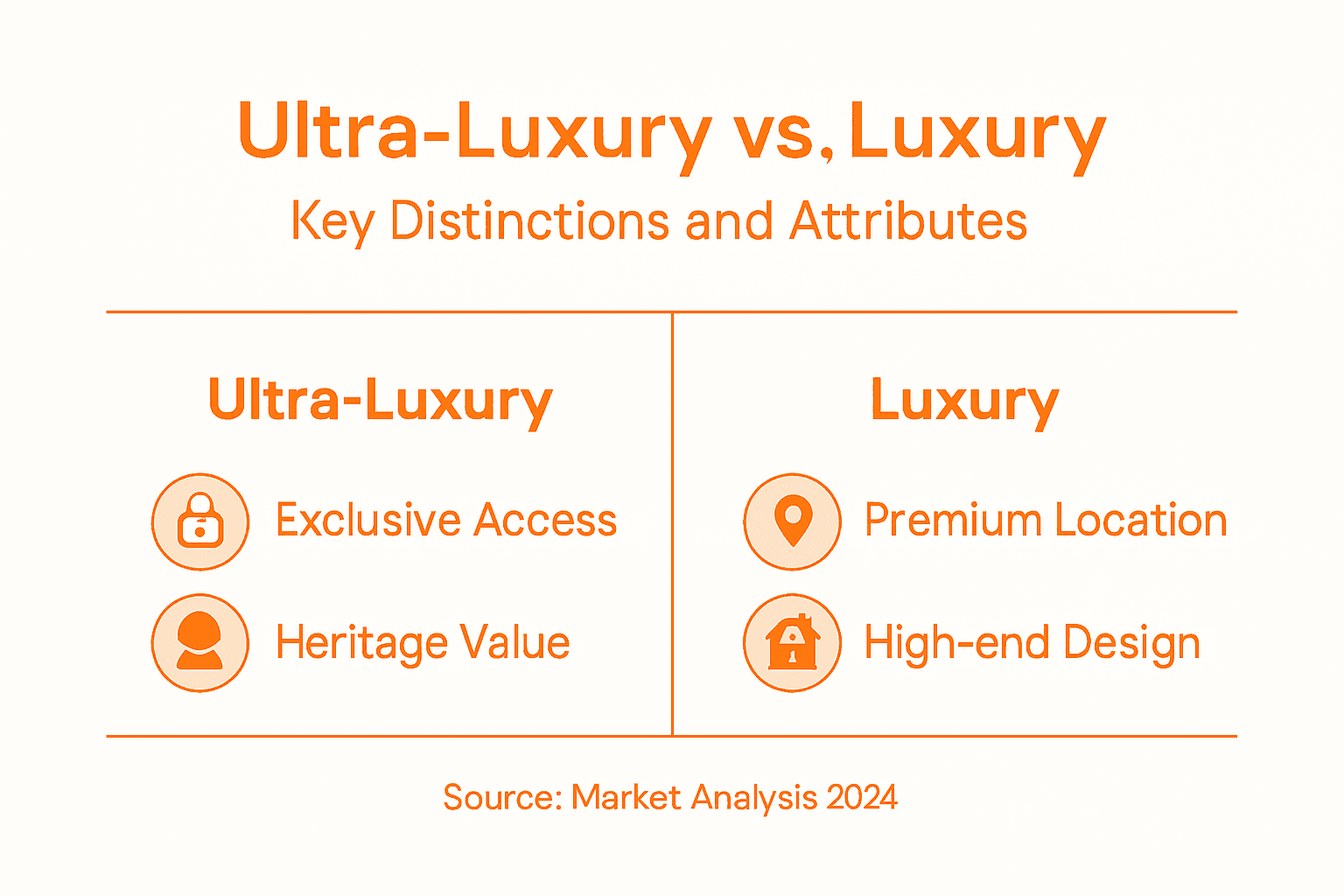
Infographic comparing ultra-luxury and luxury features

Currency and geopolitical risks merit particular attention for international buyers. A North American investor acquiring a €5M property faces inherent currency exposure as Euro strength appreciation reduces home-currency valuation. French wealth taxes, whilst reformed in recent years, continue imposing obligations on non-resident foreign nationals holding French real estate through personal ownership structures. Geopolitical instability, economic sanctions, and shifting regulatory environments create unpredictable cost escalations. Additionally, risks include price sensitivity and evolving consumer values around sustainability, meaning properties lacking modern sustainability certifications face increasing valuation pressure and restricted buyer pools. A beautifully preserved Belle Époque villa without renewable energy systems or contemporary waste management infrastructure becomes increasingly problematic within ultra-luxury markets prioritising environmental responsibility.

Market concentration risk presents another critical consideration. Ultra-luxury properties exhibit lower liquidity than conventional luxury segments. A €3M apartment in central Paris attracts multiple qualified buyers within weeks. A €15M bespoke compound with highly customised architecture might require 18 to 24 months to sell, assuming a qualified buyer materialises. This extended timeframe creates opportunity cost and market-timing risk. Properties appealing to narrow buyer demographics (those requiring specific security infrastructure, for instance) face even more constrained buyer pools. Investment implications demand strategic diversification: ultra-luxury property should represent no more than 15 to 20 percent of a comprehensive wealth portfolio, with remaining capital deployed across liquid assets enabling tactical repositioning as markets shift.

Key risk categories require structured mitigation:

  • Liquidity Risk: Ultra-luxury properties sell slowly; extended holding periods lock capital within illiquid assets
  • Currency Risk: International buyers face exchange rate exposure and foreign tax complications
  • Regulatory Risk: Changing tax structures, wealth restrictions, and foreign ownership limitations reshape valuation frameworks
  • Maintenance Risk: Aging structures require escalating specialist expertise and costly restoration interventions
  • Market Risk: Shifting preferences toward sustainability and contemporary design diminish appeal of unrenovated heritage properties

Pro tip: Before committing capital to ultra-luxury property acquisition, engage specialised tax advisors understanding French foreign ownership regulations and structure your purchase through appropriate legal entities (often Luxembourg or Irish holding companies) to optimise tax efficiency and minimise wealth tax exposure across your home jurisdiction and France simultaneously.

Discover Your Ultra-Luxury Legacy on the Côte d’Azur

Navigating the world of ultra-luxury real estate requires more than a transaction mindset. This article highlights the deep distinction between conventional luxury and ultra-luxury properties, centred on irreplaceability, architectural provenance, and lifelong cultural value. If you seek a property that is truly a legacy—whether it is a heritage estate in Cap d’Antibes, a bespoke residence with cutting-edge design, or a private compound offering complete lifestyle autonomy—understanding these nuances is essential. The challenge lies in securing an asset that appreciates not just in price but in prestige and exclusivity in a competitive and complex market.

At Living on the Côte d’Azur, we specialise in guiding discerning buyers through the intricacies of acquiring ultra-luxury properties that transcend mere lifestyle to become heirlooms. Tap into expert insights on legacy investments and bespoke new constructions that reflect your vision of sustainable wealth. To explore how your next acquisition can become a cultural capital cornerstone, connect with our team today at Contact Nice to Meet You. Act now to secure your place within the Riviera’s exclusive lineage of property owners and build a heritage that will flourish across generations.

Frequently Asked Questions

What defines ultra-luxury properties compared to conventional luxury properties?

Ultra-luxury properties are characterised by their exclusivity, historical significance, and unique cultural value, going beyond mere pricing to embrace irreplaceability and bespoke experiences. In contrast, conventional luxury properties focus more on accessibility and desirable location.

How can I identify if a property is truly ultra-luxury?

To identify ultra-luxury properties, evaluate their historical significance, architectural provenance, and the exclusivity of their location. The property’s narrative and the unique lifestyle it offers should also play a critical role in the assessment.

What are the key categories of ultra-luxury properties?

The main categories of ultra-luxury properties include heritage properties, bespoke contemporary residences, and experiential compounds, each distinguished by their unique attributes and buyer profiles. Heritage properties often have documented architectural provenance, while bespoke residences focus on innovative design.

What risks should I be aware of when investing in ultra-luxury real estate?

Investing in ultra-luxury real estate involves risks such as liquidity risk, currency risk, regulatory changes, maintenance costs, and market sensitivity to evolving consumer preferences. Strategic diversification and thorough due diligence are essential for mitigating these risks.

Recommended

  • The concept of Ultra Luxury on the French Riviera – Living on the Côte d’Azur
  • 法国里维埃拉的极致奢华理念 – Living on the Côte d’Azur
  • Top Locations High-Value Luxury Real Estate on the French Riviera
  • What Defines High-End Real Estate: Complete Guide
  • Understanding Hair Keratin Price: A Comprehensive Guide to Treatment Costs | MyHair
  • Used guitar or vintage guitar before a new instrument from a luthier
by /24 January 2026/in Landingpage
https://www.livingonthecotedazur.com/wp-content/uploads/2026/01/1769231491448_image.jpg 768 1344 https://www.livingonthecotedazur.com/wp-content/uploads/2024/02/sitelogo150.png 2026-01-24 06:12:112026-05-07 12:33:40Ultra-Luxury Explained: Beyond Prestige and Investment

Securing a legacy through French Riviera real estate demands insight and timing. For those eyeing luxury properties in Cannes, understanding how prime locations shape long-term value is crucial. The transformation of major cities like Paris by projects such as the Grand Paris Express has already shown how infrastructure sparks new investment opportunities. This guide empowers you to identify prime locations and emerging investment hotspots so your acquisition in the South of France delivers enduring security, prestige, and sustainable growth.

Table of Contents

  • Step 1: Identify Prime Locations And Investment Hotspots
  • Step 2: Analyse Market Trends And Property Values
  • Step 3: Secure Financing And Legal Representation
  • Step 4: Conduct Professional Inspections And Due Diligence
  • Step 5: Finalise Purchase And Verify Legal Compliance

Quick Summary

Main InsightDetailed Explanation
1. Identify prime locationsFocus on Paris areas transforming through infrastructure projects for high appreciation and rental yield.
2. Analyse market trendsRegularly track price movements and market cycles in Paris to make informed investment decisions.
3. Secure essential financingInitiate mortgage approval early and understand the notarial process to protect your investment.
4. Conduct thorough due diligenceHire professionals to inspect properties and verify legal compliance before finalising purchases.
5. Ensure legal compliance at closingVerify all legal documents and conditions before signing the deed to confirm ownership and protect interests.

Step 1: Identify Prime Locations and Investment Hotspots

Finding the right location is where investment success truly begins. In Paris, location determines not only current value but future appreciation potential, rental yield, and long-term stability. This step guides you through identifying prime areas and emerging hotspots that align with your investment timeline and wealth preservation goals.

Start by understanding Paris’s transformation through major infrastructure projects. The Grand Paris Express and Olympic developments are reshaping the metropolitan region, creating new investment opportunities around enhanced metro connectivity and urban revitalisation zones. These infrastructure improvements increase accessibility, boost property values, and strengthen rental demand, particularly in secondary submarkets developing around these hubs. Areas adjacent to new metro lines and scientific clusters such as Paris-Saclay University and biotech campuses represent genuine growth corridors where values appreciate steadily alongside economic development.

Next, evaluate established luxury markets against emerging neighbourhoods based on your investment philosophy. Central Paris locations, particularly the 7th arrondissement and surrounding prestige addresses, command premium valuations due to limited supply and consistent international demand from high-net-worth buyers. These areas suit investors prioritising capital preservation and stability. However, neighbourhoods like Belleville and Ménilmontant offer compelling alternatives for those seeking growth potential. These areas combine affordability advantages with active urban regeneration, strong rental demand from younger professionals, and the kind of neighbourhood momentum that historically precedes significant appreciation cycles. The trade-off is clear: established prime locations offer stability and immediate prestige; emerging hotspots offer growth potential and stronger rental yields.

Walk these neighbourhoods yourself rather than relying solely on market reports. Notice foot traffic patterns, quality of local amenities, and the character of new developments underway. Talk with local property managers about rental activity and tenant profiles. Examine transport links not just to city centres but to employment hubs like the financial district and tech clusters. Investigate planning permissions and future development pipelines, which often signal where municipal investment is flowing. Check school districts if your investment thesis includes family-orientated rental markets. Understanding a neighbourhood’s trajectory requires time on the ground, conversation with local professionals, and your own instinct about where Paris is genuinely growing.

Consider your exit strategy when selecting locations. Prime central addresses attract international wealth transfers and provide liquid resale markets. Emerging neighbourhoods offer stronger appreciation but may require longer holding periods to realise full value. Secondary markets near transport improvements suit investors comfortable with longer timeframes but confident in urban development patterns.

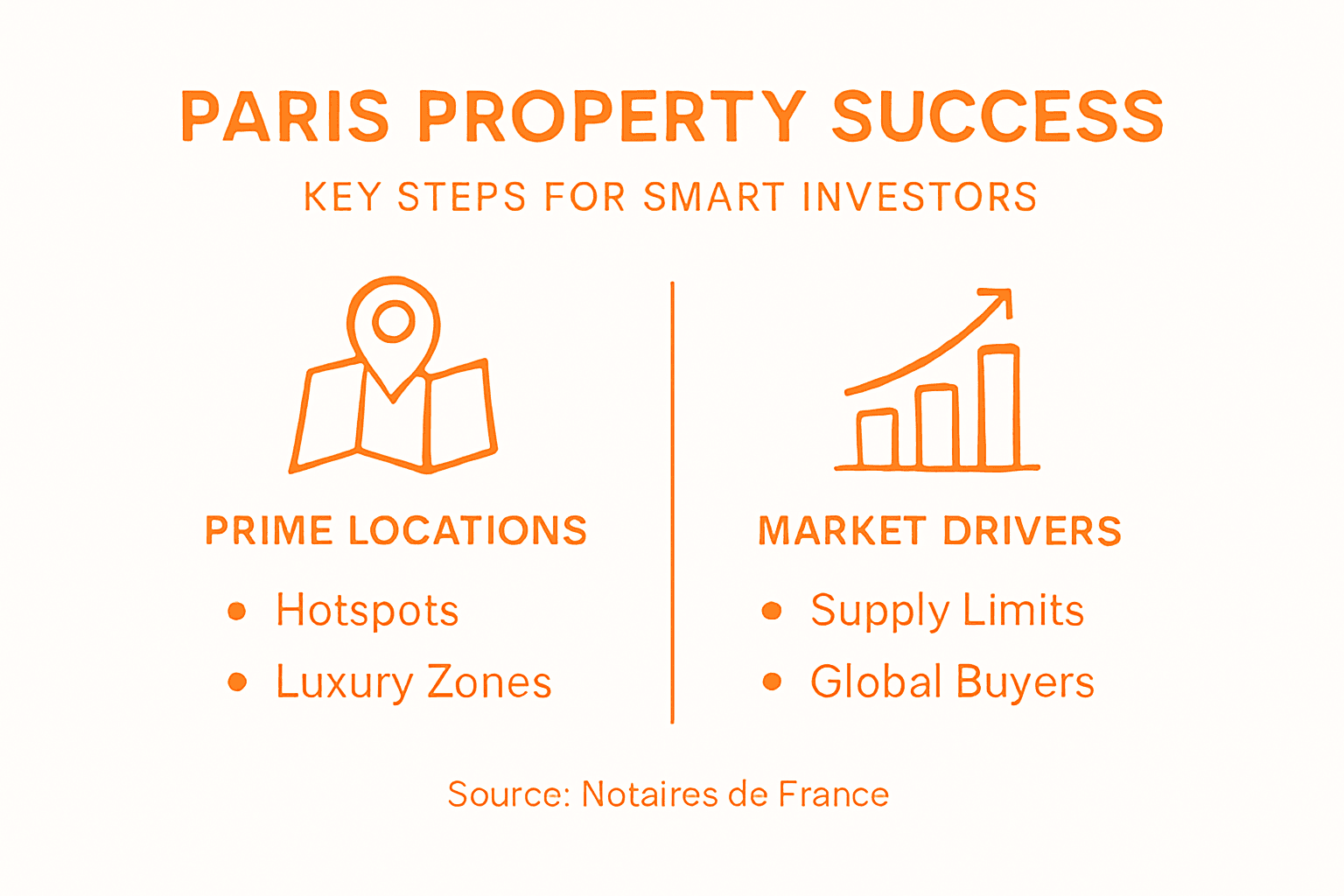
Infographic showing Paris property market essentials

Here is a comparison of established prime locations and emerging hotspots for Paris property investment:

Neighbourhood TypeAppealRisk ProfileTypical Investor Objective
Prime Central (e.g. 7th arrondissement)Prestige, stabilityLow risk, high liquidityWealth preservation, capital security
Emerging Hotspot (e.g. Belleville)Growth potential, stronger yieldsModerate risk, longer holdingCapital growth, higher rental returns

Professional tip Visit neighbourhoods at different times of day and seasons to assess genuine atmosphere and neighbourhood stability rather than relying on initial impressions or marketing photographs alone.

Step 2: Analyse Market Trends and Property Values

Understanding market dynamics separates shrewd investors from those who chase opportunities blindly. This step teaches you how to read Paris property market signals, interpret value trajectories, and position your investment at the optimal moment in the market cycle. You will learn to look beyond headlines and recognise the underlying patterns that drive returns.

Begin by establishing baseline data for your chosen arrondissement. The Paris market currently averages around €9,470 per square metre, though this figure masks enormous variation across the 20 arrondissements, each following its own trajectory influenced by local factors such as transport connectivity, cultural amenities, and neighbourhood reputation. Recent market analysis shows that after a correction phase in 2022 and 2023, the market is stabilising with moderating price declines and stabilising transaction volumes. This recovery pattern matters enormously because it signals where the market sits within its cycle. If you are entering an arrondissement during price stabilisation rather than peak appreciation, your downside risk diminishes significantly whilst upside potential remains intact.

Track price movements across multiple timeframes. Monthly fluctuations tell you about seasonal patterns and transaction velocity, but quarterly and annual trends reveal genuine market direction. Watch which arrondissements are recovering first from the 2022-2023 correction. These are typically areas with strong structural demand foundations such as proximity to employment centres, excellent schools, or cultural attractions. Look for transactions increasing alongside prices stabilising, which indicates genuine demand rather than speculative activity. Compare asking prices to actual sale prices, which often differ substantially. A gap between asking and sold prices indicates buyer caution; conversely, sales matching or exceeding asking prices signal strong underlying demand. Examine time on market metrics. Properties selling within weeks command premium values and suggest undersupply relative to demand. Properties lingering for months indicate either overpricing or genuine market resistance that your due diligence must investigate.

Investor analyzing Paris property price data

Consider what underpins price resilience in Paris specifically. Limited housing supply, strong international interest, and cultural desirability create a structural foundation for value preservation that transcends short-term corrections. This means Paris properties recover from downturns more reliably than secondary markets. Growth is expected to return by spring 2025 according to current projections, which suggests that acquisitions made during the current stabilisation phase position you advantageously before a recovery cycle. However, verify these projections against actual transaction data rather than accepting forecasts uncritically.

Analyse supply constraints in your target area. Fewer available properties typically means stronger pricing power and rental demand. Investigate planning permissions and new construction pipelines. An arrondissement with limited new supply competing for demand will appreciate faster than one facing substantial new inventory. Talk with local agents about their pipeline of available properties and months of supply. Markets with three months or fewer of supply generally favour sellers and property owners; markets with six months or more favour buyers.

Professional tip Track price trends across at least six to twelve months of data to distinguish genuine market direction from seasonal noise, and always compare multiple arrondissements to understand whether trends are local or market-wide.

Step 3: Secure Financing and Legal Representation

Financing and legal structures form the foundation of a protected investment. This step guides you through obtaining mortgage financing, understanding the notarial process, and assembling the professional team that safeguards your interests throughout the transaction. Getting these elements right prevents costly mistakes and ensures compliance with French property law.

Start your financing process early because mortgage approval typically takes one to two months and banks conduct thorough credit checks and property valuations before committing funds. Foreign buyers like yourself face no restrictions on property ownership in France, which represents a significant advantage for North American and British investors seeking European assets. However, mortgage conditions for foreign buyers tend to be stricter than for French citizens, with lenders often requiring higher down payments and more extensive documentation. Banks assess your creditworthiness carefully, so prepare comprehensive financial statements, tax returns from the previous three years, and proof of employment or income stability. The stronger your financial profile, the better interest rates and terms you will negotiate. Consider approaching multiple lenders because rates and conditions vary substantially. Alternative lenders operate actively in the French market alongside traditional banks, and some specialise in non-resident financing with more flexible requirements. Property valuation by the lender’s surveyor typically costs between €500 and €1,500 and is necessary before mortgage approval proceeds.

Understand the legal framework governing your purchase. French property purchase requires preliminary contracts, notary involvement, and registration fees totalling approximately six to eight per cent of the purchase price. Notaries are essential gatekeepers in French transactions; they oversee legal compliance, conduct title searches, register the deed with land registries, and ensure all documentation meets legal requirements. Their role differs significantly from notaries in North American jurisdictions, as French notaries function as impartial transaction facilitators with substantial legal authority. The notary’s fee is typically split between buyer and seller but is non-negotiable as it is set by law. Beyond the notary’s role, engage a lawyer specialising in real estate for additional protections. Your lawyer reviews contracts before signature, identifies potential issues the notary might not highlight, and advocates specifically for your interests. This dual representation appears redundant to some investors but proves invaluable when complications arise. A competent lawyer costs €2,000 to €5,000 depending on transaction complexity but provides insurance against costly errors.

Secure your mortgage documentation carefully. Mortgages require notarised deeds for enforceability and can be registered with land registries to protect the lender’s security interest. Your lawyer should review mortgage terms before you sign, ensuring that conditions align with your financial planning and that penalty clauses for early repayment are reasonable. Request written pre-approval from your lender before making an offer on a property, which strengthens your negotiating position by demonstrating financial capacity and removes contingency uncertainty from the seller’s perspective. Maintain communication with your lender throughout the process and notify them promptly of any contract changes or delays.

Assemble your professional team before you start seriously shopping for properties. Identify a notary by asking for recommendations from your bank or lawyer, as notaries typically have established working relationships with mortgage lenders. Select a lawyer experienced with foreign buyers and non-resident purchases, as this specialist knowledge prevents misunderstandings about tax implications or residency requirements. Brief your team on your investment timeline and objectives so they understand your priorities and can anticipate issues.

Below is a summary of essential professionals and their roles in a French property purchase:

ProfessionalMain RoleWhen InvolvedTypical Cost Range
NotaryLegal transactions, title checksFrom contract to closing6–8% of purchase price
Real Estate LawyerContract review, buyer advocacyAfter offer accepted, pre-closing€2,000–€5,000
SurveyorProperty inspection, condition reportDuring due diligence phase€800–€2,000
Mortgage Broker or BankerFinancing arrangementBefore offer, approval & closingVaries, bank arrangement

Professional tip Obtain written mortgage pre-approval before making any property offers, as this demonstrates serious buying capacity and allows you to negotiate confidently knowing your financial commitment is secured.

Step 4: Conduct Professional Inspections and Due Diligence

Thorough inspections and due diligence separate prudent investors from those who discover problems after signing contracts. This step guides you through comprehensive property evaluation, title verification, and risk assessment before committing your capital. Conducting detailed due diligence prior to signature gives you leverage to negotiate terms and protects your investment from hidden liabilities.

Begin with a structural and technical inspection by a qualified surveyor experienced with Parisian properties. Request a detailed survey covering the building’s foundation, roof condition, plumbing and electrical systems, heating mechanisms, and any evidence of water damage or subsidence. Parisian properties vary enormously in age and construction quality, from seventeenth century stone townhouses requiring specialist expertise to post-war apartment blocks with different vulnerabilities. Your surveyor should identify deferred maintenance costs and estimate remediation expenses for significant issues. This inspection typically costs between €800 and €2,000 depending on property size and complexity but provides critical baseline data for your investment decision. Beyond structural matters, request testing for hazardous materials including asbestos, lead paint, and radon gas, as these trigger regulatory compliance obligations and remediation costs. Ask your surveyor to assess energy efficiency ratings and potential renovation costs to meet modern standards, which affects both property value and long-term operating expenses.

Comprehensive due diligence extends beyond physical inspection to include title reviews, zoning checks, and investigation of liens or encumbrances that could affect your ownership rights or property use. Your lawyer should obtain a full title report from the land registry confirming clear ownership history and identifying any mortgages, easements, or restrictions registered against the property. Verify that the seller has authority to sell and that no disputes are pending regarding ownership. Request documentation confirming all property taxes and charges are paid to date, as unpaid obligations transfer to the new owner. Investigate zoning regulations to confirm the property’s permitted uses align with your investment strategy. If you envision rental income, verify that residential rental is permitted and subject to any local restrictions. Some Parisian arrondissements impose strict regulations on short-term tourist rentals or limit the percentage of apartments that can be rented within a single building, which directly impacts your rental yield assumptions.

Investigate the property’s financial history. Request five years of utility bills to understand operating costs and energy consumption patterns. Obtain copies of any homeowners association documents if applicable, including bylaws, recent meeting minutes, and reserve fund status. Examine whether the building has planned major expenses such as roof replacement or facade restoration, which may trigger special assessments against all unit owners. Talk with current occupants if the property is tenanted, asking about maintenance responsiveness, water pressure reliability, noise levels, and neighbourhood stability. These conversations reveal operational realities that documentation misses. Review any environmental reports if the property sits near industrial areas or former commercial sites. Some Parisian locations have historical industrial use that created soil contamination requiring disclosure and remediation.

Assess your exit strategy implications during due diligence. Properties with clear title, no encumbrances, and good structural condition attract broader buyer interest and command premium resale values. Conversely, properties with significant defects, restrictive covenants, or title complexities appeal only to investors willing to accept lower purchase prices reflecting their complications. Understanding these factors during your due diligence phase allows you to negotiate purchase price reductions that offset anticipated repair or remediation costs.

Professional tip Commission your surveyor and lawyer’s due diligence during the initial contract period before making your final commitment, using their findings to renegotiate price or repair obligations rather than discovering problems after signature.

Step 5: Finalise Purchase and Verify Legal Compliance

The closing phase transforms all your preparation into confirmed ownership. This step guides you through the final verification process, understanding the notary’s critical role, and ensuring all legal compliance requirements are met before you sign the deed. Getting closure right means your ownership is bulletproof and your investment is fully protected.

Approximately two weeks before closing, your notary will conduct final verification of all transaction elements. The notary confirms ownership history by reviewing land registry records and verifying that the seller has clear authority to transfer the property. Identity verification occurs at this stage, confirming that both parties are who they claim to be and that no disputes exist regarding ownership rights. The notary safeguards legal compliance by verifying property status and confirming the absence of encumbrances such as undisclosed mortgages or liens that could compromise your ownership. This verification process is thorough because undisclosed encumbrances transfer to you automatically upon purchase, making careful checking essential. Your notary also confirms that any existing mortgages will be discharged from the seller’s proceeds and acquires all necessary administrative permissions before proposing the closing date. Some properties require municipal approval or notification to local authorities before ownership transfer, and your notary handles these procedural requirements.

Request a final walkthrough of the property within 48 hours before closing to confirm that the property condition matches your inspection reports and that all agreed items remain in place. Properties sometimes deteriorate between inspection and closing, and you have contractual rights to address significant changes. Confirm that utility meters have been read and that all services will transfer smoothly to your name. Request written confirmation that all property taxes and charges are paid to date, as the seller is responsible for these obligations up to closing. Review the closing statement provided by your notary, which itemises all costs including purchase price, mortgage discharge if applicable, registration fees, notary fees, and any adjustments for property taxes or utilities. Understanding these numbers before closing prevents surprises and gives you time to raise questions.

The final contract, known as the acte de vente, officially transfers ownership and must be signed in the presence of the notary to be legally valid. Bring identification documents and be prepared to answer the notary’s verification questions regarding your identity and your intentions for the property. Your mortgage lender will typically wire funds to the notary’s escrow account rather than directly to you, which ensures funds are available at closing. Once all parties have signed the deed and funds have been received, the notary registers the deed with the land registry, which creates your official legal ownership. This registration typically completes within five to ten working days, after which you receive an official extract from the land registry confirming your ownership. Only after registration is complete should you consider the transaction fully finalised.

Address any final compliance matters before closing. Confirm that all rental restrictions, use limitations, or residency requirements have been reviewed with your lawyer and that you understand their implications for your investment. If the property is subject to homeowners association rules, confirm that you have received and reviewed the complete set of bylaws and reserve fund documentation. Request a statement of any pending assessments or special levies that would become your obligation upon purchase. Arrange insurance coverage to commence on the closing date, as your lender requires proof of comprehensive building insurance. Notify your bank and accountant of the transaction so they can prepare appropriate documentation for tax reporting.

Professional tip Attend the notary closing meeting personally rather than authorising a representative, as the notary may raise questions only you can answer, and your physical presence demonstrates due diligence to future buyers when you eventually sell.

Elevate Your Property Investment Journey Beyond Paris to the Côte d’Azur

Navigating the complex Paris property market demands sharp insight into location dynamics, market cycles, and legal nuances. You want an investment that not only withstands market corrections but grows sustainably, providing a legacy for generations. While the article guides you through Paris’s prime and emerging neighbourhoods, financing strategies, and rigorous due diligence, the journey does not end there. For discerning investors seeking to secure heirloom-quality assets with iconic prestige and exceptional lifestyle appeal, the French Riviera stands as the ultimate next chapter.

Living on the Côte d’Azur specialises in connecting visionary buyers with luxury villas, legacy estates, and new constructions that combine heritage allure with cutting-edge sustainability. Imagine elevating your portfolio with properties commanding €2M and above, designed for lasting value appreciation and rental yield across hotspot locations like Cap d’Antibes or Saint-Tropez. Our approach embraces the same meticulous due diligence and legal rigour emphasised for Paris but we infuse it with the Riviera’s irresistible lifestyle rhythm—from Cannes’s film festival glamour to Èze’s timeless serenity. To explore how to seamlessly expand your investment horizon, enhance your legacy plays, or secure a seaside sanctuary tailored to your ambitions, reach out today.

Ready to take the next step towards owning your piece of French luxury? Discover how our expertise in navigating complex transactions and market trends can empower your 2025 Riviera acquisition. Contact the team at Living on the Côte d’Azur for bespoke guidance and start your journey towards timeless heritage. Learn more about our services and benefits when you connect with us today and begin transforming your vision into reality.

Frequently Asked Questions

How do I identify prime locations in the Paris property market?

To identify prime locations, start by researching areas undergoing infrastructure improvements like the Grand Paris Express. Visit various neighbourhoods to observe local amenities and foot traffic, and engage with local professionals to gain insight into rental demand and market trends.

What are the key market trends I should monitor in Paris property investment?

Focus on price movements over several timeframes, including monthly, quarterly, and annual trends. Track recovery patterns specifically in the arrondissements that have strong structural demands, as these will indicate genuine market direction rather than speculative activity.

What steps are involved in securing financing for a property purchase in Paris?

Begin the financing process by obtaining mortgage pre-approval from lenders, as this can take one to two months. Prepare your financial documents and approach various lenders to compare terms, ensuring you secure the best rates available for your investment.

What should I include in my due diligence before finalising a property purchase?

Conduct a thorough inspection of the property, including structural assessments and checking for hazardous materials. Verify the property’s title history with your lawyer, ensuring there are no liens or encumbrances that could affect your ownership rights.

How do I ensure legal compliance when finalising my property purchase?

Finalise your purchase by confirming that your notary conducts a complete verification of ownership and that any existing mortgages are discharged. Request a final walkthrough within 48 hours of closing to ensure the property’s condition matches your expectations and all agreed provisions are fulfilled.

What professionals should I hire to assist in my property investment in Paris?

Assemble a team including a notary, real estate lawyer, and surveyor. Engaging these professionals early in the process ensures you are well-informed and prepared to navigate the complexities of purchasing property in Paris.

Recommended

  • Exploring Property for Sale in Paris: Your Dream Home Awaits – Living on the Côte d’Azur
  • Paris luxury and high-end real estate market stays strong – Living on the Côte d’Azur
  • Things to know before buying property in the South of France
  • How to Invest in Paris Real Estate for Lasting Value – Living on the Côte d’Azur
by /23 January 2026/in Landingpage
https://www.livingonthecotedazur.com/wp-content/uploads/2026/01/1769128953387_image.jpg 768 1344 https://www.livingonthecotedazur.com/wp-content/uploads/2024/02/sitelogo150.png 2026-01-23 01:43:172026-05-07 12:33:02Ultimate Guide to Paris Property Market Success

Securing a place on the Côte d’Azur through luxury real estate is more than a status symbol for discerning investors seeking long-term security and flexibility. The evolving appeal of the renewable golden visa lies in its promise of multi-year residency, allowing you and your family to establish meaningful roots without the hassles of annual visa renewals or reliance on local sponsors. This article reveals how the right investment strategy can transform your property aspirations into lasting residency and global mobility.

Table of Contents

  • Defining The Renewable Golden Visa Programme
  • Eligibility Criteria For High-Value Investors
  • Application Process And Renewal Steps In France
  • Investment Requirements For Côte d’Azur Properties
  • Financial, Legal, And Tax Implications
  • Comparing Permanent Residency And Golden Visas

Key Takeaways

PointDetails
Renewable Golden Visa AdvantagesProvides long-term residency with renewable terms, allowing for self-sponsorship and family inclusion without annual visa renewals.
Investment CriteriaEligibility largely hinges on substantial capital investments, notably in property, with minimum thresholds typically ranging from EUR 500,000 to EUR 3 million.
Application ProcessRequires meticulous preparation, including documentation of investments and residency intent, with a typical application timeline of 3 to 6 months.
Strategic StructuringInvestors should align their property acquisition with active economic contributions to strengthen visa approval prospects and ensure compliance.

Defining The Renewable Golden Visa Programme

A renewable golden visa represents a modern pathway for high-net-worth individuals and qualified professionals to secure long-term residency in premium destinations whilst maintaining the flexibility their sophisticated lifestyles demand. Unlike traditional visitor visas that require annual renewal or extension applications, a renewable golden visa grants extended residency validity spanning multiple years—typically 5 to 10 years at a time—with automatic renewal provisions. This structure eliminates the uncertainty of annual visa processing and provides the stability that discerning international investors require when establishing lasting ties to a chosen location.

The fundamental distinction of a renewable golden visa lies in its dual advantages: permanent residency security combined with periodic renewal cycles. When you obtain renewable long-term residency visas valid for 5 to 10 years, you gain immediate access to live, work, and conduct business without requiring a local sponsor or intermediary. The “renewable” element means that once your initial visa term concludes, you can extend it again for another multi-year period, provided you maintain eligibility criteria. This differs fundamentally from standard residency permits that demand annual compliance checks and sponsor approvals. For property investors on the Côte d’Azur seeking the stability to build meaningful ties whilst protecting their business interests globally, this structure offers unprecedented peace of mind.

Key characteristics that define the renewable golden visa programme include:

  • Multi-year validity periods allowing you to settle without constant administrative intervention
  • Self-sponsorship capability enabling independent visa management without reliance on employers or property owners
  • Family inclusion provisions permitting spouses and dependents to gain residency concurrently
  • Extended absence allowances granting flexibility for business travel without jeopardising visa status
  • Professional recognition for entrepreneurs, investors, and specialists who contribute meaningfully to their chosen jurisdiction
  • Automatic renewal mechanisms eliminating the urgency of annual reapplication cycles

The golden visa system specifically targets individuals with substantial capital or expertise, including real estate investors, business founders, scientists, and healthcare professionals. For Riviera property purchasers, the real estate investment category often aligns most directly with their circumstances. The visa acknowledges that your financial contribution—whether through property acquisition or business establishment—merits extended security and preferential treatment. This positioning transforms residency from a temporary arrangement into a genuine long-term commitment, enabling you to build family legacy, establish cultural roots, and develop the professional networks that transcend typical holiday residence models.

Pro tip: Before pursuing any golden visa pathway, verify that your chosen programme explicitly supports property investment as a qualifying category and confirm minimum investment thresholds align with your Riviera acquisition plans—this ensures seamless alignment between your real estate strategy and residency objectives.

Eligibility Criteria For High-Value Investors

Becoming eligible for a renewable golden visa as a high-value investor hinges on demonstrating substantial financial capacity and a genuine commitment to establishing residency in your chosen destination. The criteria vary by jurisdiction, but they typically centre on your ability to invest meaningful capital—whether through property acquisition, business establishment, or direct financial contributions. For those seeking Riviera access through property investment, your eligibility fundamentally rests on your investment threshold and your capacity to sustain residency obligations over the multi-year visa term. This isn’t merely about possessing wealth; it’s about proving that your financial position enables genuine, long-term settlement rather than temporary speculative activity.

The most straightforward eligibility pathway for Côte d’Azur investors involves real estate investment capital. Most golden visa programmes recognise property ownership as a qualifying investment category, with specific minimum thresholds typically ranging from EUR 1.5 million to EUR 3 million depending on the jurisdiction and property characteristics. When you purchase a luxury villa in Cannes, Antibes, or Saint-Tropez meeting this threshold, you immediately satisfy the primary eligibility requirement. Beyond the purchase price itself, programmes often consider factors such as property location, condition, and whether it represents a genuine residential acquisition versus speculative holdings. Your investment must demonstrate authenticity—owning a fully furnished, move-in-ready estate carries more weight than holding an empty plot awaiting development.

Additional eligibility dimensions extend beyond capital requirements:

  • Income verification demonstrating stable financial capacity to support residency without requiring employment income from the destination country
  • Proof of funds documentation showing the origin of your investment capital meets anti-money laundering standards
  • Business credentials if you’re establishing a professional enterprise alongside property investment
  • Health and character clearance confirming your background poses no security concerns
  • Family composition details if you’re including dependents in your visa application
  • Prior residency history showing successful integration in other countries when applicable

When you secure renewable long-term residency through investment categories, your ongoing eligibility depends on maintaining your investment position throughout the visa validity period. This means your Riviera property must remain in your ownership—you cannot sell the villa immediately after obtaining the visa without jeopardising your renewal prospects. Programmes specifically designed for investors expect you to maintain your asset as evidence of genuine commitment. Additionally, many jurisdictions require periodic compliance verification, ensuring your financial position remains sound and your residency intent continues. This creates a natural alignment between your investment strategy and your residency security, preventing opportunistic visa abuse whilst rewarding committed investors.

Age considerations rarely present barriers for high-value investors, unlike many employment-based residency programmes. Whether you’re 45 or 75, investment capacity typically supersedes age restrictions. Professional credentials matter less than capital availability—you need not be an entrepreneur or scientist to qualify through property investment channels. This accessibility makes the investor pathway particularly attractive for established wealth holders seeking Riviera stability without reinventing their professional identity. Your financial portfolio speaks louder than your career history.

Pro tip: Request pre-application eligibility assessments from residency advisers specialising in your target destination before finalising your Riviera property purchase, ensuring your specific investment structure and capital source align perfectly with current programme requirements and avoiding costly post-purchase complications.

Application Process And Renewal Steps In France

Securing your renewable golden visa in France demands meticulous attention to procedural detail and timing precision. The application journey begins well before you submit your formal documentation—preparation is where success is genuinely won or lost. Your first critical step involves establishing your eligibility profile through the official French administration channels, gathering comprehensive supporting documentation that validates your investment capacity, property ownership, and financial soundness. This isn’t a rushed process; successful applicants typically allocate three to six months for the complete application cycle from initial documentation assembly through final approval.

The formal application process unfolds in distinct phases that require sequential completion. You’ll need to gather necessary information through the official France-Visas platform, where you’ll determine your specific visa requirements, applicable fees, and the precise supporting documents your application demands. The online wizard guides you through jurisdiction-specific requirements—these vary considerably depending on whether you’re applying as a Côte d’Azur property investor versus other investment categories. After determining your exact requirements, you complete the comprehensive online application form, providing detailed information about your investment, financial background, family composition, and proposed residency plans. You’ll upload recent passport photographs meeting specific technical standards, along with scanned copies of your original travel documents valid for your intended residency period.

Once your digital application is finalised and payment processed, you must book an in-person appointment at your designated visa application centre. This timing is critical—appointment slots fill rapidly, particularly during peak seasons. Here’s where patience intersects with strategy:

  1. Submit your digital application and payment through the official portal with all required documentation attached
  2. Book your appointment immediately after payment confirmation to secure your preferred date and time
  3. Prepare your supporting materials including original property deeds, investment verification documents, and proof of funds
  4. Attend your appointment in person for biometric collection and document verification—this cannot be delegated
  5. Undergo security screening and background verification following standard French administrative procedures
  6. Receive your initial visa once all documentation is verified and approved

The in-person appointment requirement means you must physically present yourself at the visa application centre in France or your designated regional office. During this visit, your fingerprints and facial biometrics are collected, and immigration officers verify the authenticity of your submitted documents. This verification step is non-negotiable and forms the foundation of your entire residency authorisation. Bring original documents alongside your digital submissions—officers will cross-reference submitted materials against originals to confirm accuracy and legitimacy. Inconsistencies between digital and physical documentation can trigger application delays or rejection.

Renewal Process For Ongoing Residency Security

Renewal procedures commence approximately 90 days before your current visa expires. You’ll submit renewal documentation demonstrating continued compliance with programme requirements—your Riviera property remains in your ownership, your financial position remains sound, and you’ve maintained genuine residency intent throughout your initial visa term. The renewal application typically requires less extensive documentation than your original submission, as your background check and basic eligibility have already been established. However, you must provide updated property valuations, current financial statements, and evidence of your continued residency presence in France.

The renewal timeline operates more smoothly than initial applications because your established profile reduces administrative complexity. Most renewals process within 60 to 90 days, compared to four to six months for first-time applications. You’ll follow similar procedural steps—completing the online form, scheduling your appointment, attending in person, and undergoing biometric re-verification. This cyclical process ensures that your ongoing eligibility remains verified and that your commitment to Riviera residency is regularly documented and validated.

Conseil pro: Begin your visa application preparation at least six months before your intended residency start date, ensuring sufficient time for property documentation, financial verification, and appointment scheduling whilst avoiding last-minute complications that could delay your arrival at your Côte d’Azur property.

Investment Requirements For Côte d’Azur Properties

Understanding the precise investment thresholds for Côte d’Azur properties is essential for discerning investors pursuing renewable golden visa pathways. France’s approach differs markedly from traditional golden visa models—the country emphasises genuine economic contribution rather than passive property acquisition alone. This distinction fundamentally shapes your investment strategy when acquiring a luxury villa in Cannes, Antibes, or Saint-Tropez. The minimum investment requirements are not arbitrary figures; they represent France’s commitment to attracting investors who demonstrate serious long-term commitment to the French economy and society.

The foundational investment threshold for residency-linked property acquisition in France centres on a minimum purchase price of EUR 500,000 for eligible real estate investments. This baseline establishes France’s entry point for property investors seeking renewable residency status. However, this figure represents merely the financial floor—properties in prestige locations like the Côte d’Azur typically far exceed this minimum, with desirable villas commanding EUR 2 million to EUR 10 million depending on location, condition, and amenities. Your actual investment will likely substantially exceed the minimum threshold, particularly if you’re acquiring waterfront estates, period properties with historical significance, or newly constructed luxury developments. The EUR 500,000 baseline exists primarily to filter out speculative or marginal investments, ensuring that approved investors demonstrate material financial capacity and genuine settlement intentions.

What distinguishes France’s investment model is its emphasis on active economic contribution rather than passive ownership. Property investment alone—simply purchasing a villa and leaving it unoccupied—does not guarantee renewable golden visa eligibility or renewal approval. French authorities examine whether your investment generates measurable economic benefits to the region. Consider these qualifying dimensions:

  • Commercial property development creating jobs and generating business activity
  • Restoration of heritage properties contributing to cultural preservation and local employment
  • Investment in rental operations providing tourism revenue and local service employment
  • Business establishment alongside property ownership, demonstrating entrepreneurial engagement
  • Agricultural or wine-producing assets contributing to Provence-Côte d’Azur’s signature industries

Whilst residential villas represent legitimate investments, authorities scrutinise whether your property purchase genuinely reflects settlement intent or speculation. A fully furnished, move-in-ready estate where you maintain active residency throughout the visa validity period demonstrates authentic commitment. Conversely, purchasing a villa solely for capital appreciation, leaving it vacant except during holiday periods, or immediately attempting to lease it to tourists may trigger renewal complications. Your investment narrative must align with France’s vision—you’re not merely acquiring real estate; you’re participating in the Riviera’s economic and social fabric.

Beyond the property purchase itself, you’ll typically require demonstrating additional liquid capital reserves. The business investment route requires a minimum EUR 300,000 investment in tangible or intangible assets in France, and authorities generally expect renewable visa applicants to maintain financial reserves proving capacity to sustain residency without employment income. This might involve maintaining EUR 50,000 to EUR 150,000 in accessible liquid funds, depending on your property’s maintenance costs, local property taxes, and living expenses. These reserves demonstrate that your investment wasn’t financially exhausting—you maintain genuine economic stability and can meet ongoing obligations.

Below is a summary of the investment requirements for securing a renewable golden visa via Côte d’Azur property:

Requirement TypeMinimum ThresholdTypical Range in Côte d’AzurAdditional Considerations
Property PurchaseEUR 500,000EUR 2m to EUR 10mLocation, villa amenities
Business InvestmentEUR 300,000EUR 300,000+Must be in tangible assets
Liquid Capital ReservesEUR 50,000Up to EUR 150,000For ongoing expenses
Economic ContributionActive involvement requiredJob creation or restorationNot just passive holding

Strategic Investment Structuring For Visa Success

Successful Côte d’Azur property investors structure their acquisitions strategically from the outset. Rather than treating property purchase and visa applications as separate transactions, integrating these activities amplifies your eligibility prospects. Consider acquiring properties requiring renovation, simultaneously demonstrating capital investment and employment generation for local contractors and specialists. Alternatively, combine residential villa ownership with professional activity—establishing a creative business, consulting firm, or boutique enterprise alongside your primary residence transforms your investment profile from passive ownership to active entrepreneurship.

Couple signing villa papers by the sea

Timing matters significantly. Your property acquisition ideally precedes your formal visa application by sufficient months to demonstrate settlement commencement and genuine residency establishment. Purchasing a property weeks before submitting your visa application may raise administrative questions about your intentions; conversely, acquiring property six to twelve months before application demonstrates deliberate, well-considered commitment. Luxury real estate investments on the French Riviera require this longitudinal perspective—authorities examine whether your entire investment trajectory reflects authentic, sustainable engagement rather than rushed financial manoeuvres.

Conseil pro: Structure your investment to encompass both residential acquisition and some form of economic contribution activity—whether through property development, professional operations, or business establishment—as this dual approach significantly strengthens your visa renewal prospects and demonstrates France’s desired model of active investor commitment.

Financial, Legal, And Tax Implications

Securing a renewable golden visa for Côte d’Azur property ownership involves far more than financial investment—it demands rigorous attention to legal structures, tax obligations, and financial planning across multiple jurisdictions. Your decision to establish residency in France creates cascading implications for your global wealth management, tax position, and legal standing. These considerations require sophisticated professional guidance from specialists who understand both French regulations and your home country’s tax requirements. Overlooking these dimensions can transform what appears to be a sound investment into a complex compliance nightmare.

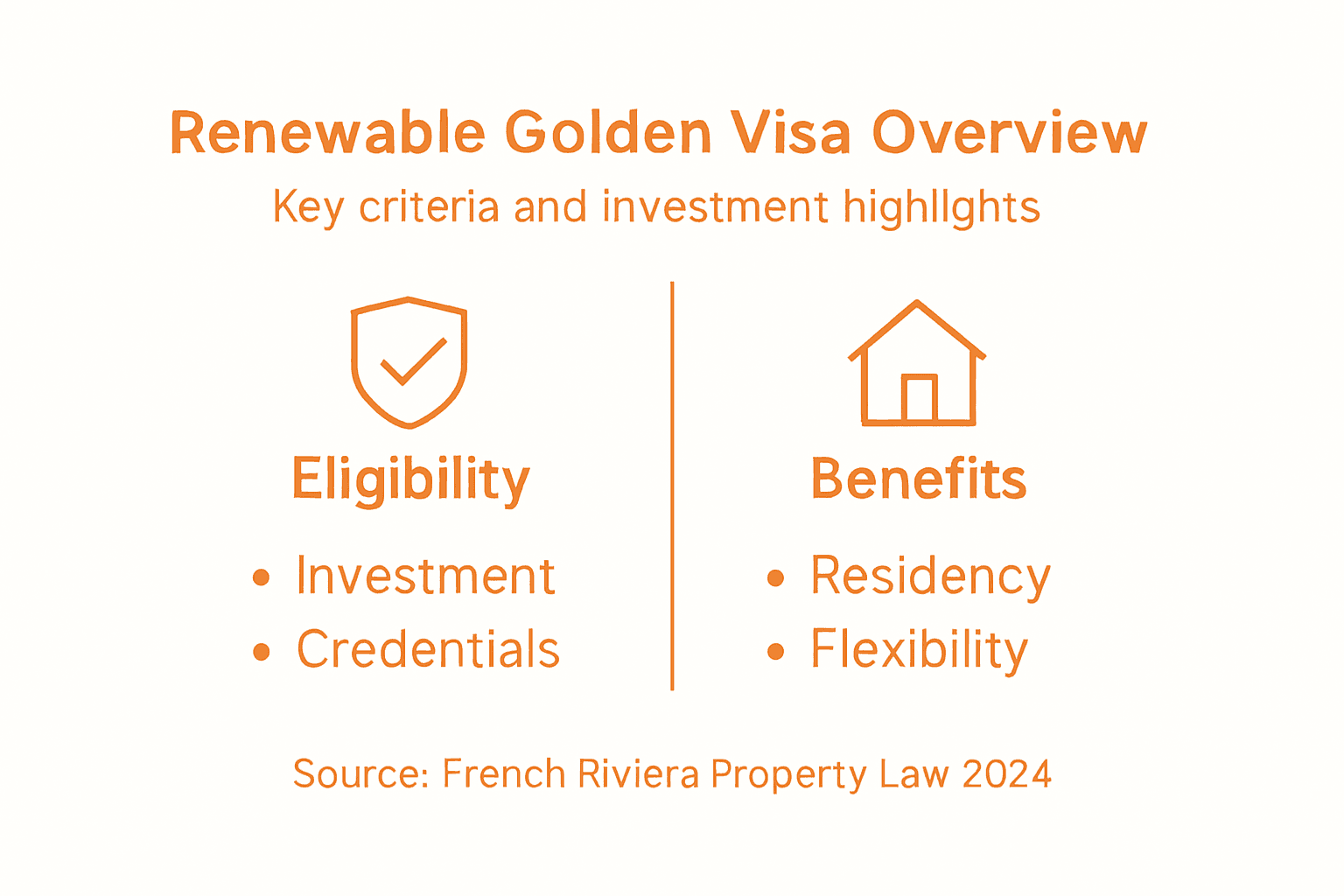
Infographic about renewable golden visa benefits

French law provides robust protection for your property investment through established contract enforcement and property rights protection under French civil law. When you purchase a Riviera villa, you’re acquiring an asset protected by centuries of refined legal precedent and a stable judiciary. France’s legal system ranks amongst Europe’s most reliable, meaning your ownership rights are secure against arbitrary seizure or political instability. However, this legal stability comes with corresponding obligations. The French administrative apparatus requires meticulous compliance with reporting requirements, tax declarations, and residency documentation. France maintains comprehensive systems tracking foreign ownership, investment origins, and financial flows—your investment transparency is non-negotiable.

The critical distinction between legal residency and tax residency fundamentally shapes your financial obligations. Holding a renewable golden visa grants legal residency status, but this does not automatically confer tax residency. Tax residency is determined separately, based on factors including the number of days you physically reside in France, your economic interests in France, and where your permanent home is located. Many international investors maintain legal residency in France whilst preserving tax residency elsewhere, but this requires meticulous documentation. If you spend more than 183 days annually in your Côte d’Azur villa or establish France as your centre of economic interest, you risk becoming a French tax resident. This distinction matters enormously because tax residency determines your obligations to report worldwide income and assets to French authorities, including property holdings, investment portfolios, and business interests globally.

Tax implications extend across multiple dimensions requiring strategic planning. France maintains wealth tax considerations for high-net-worth individuals, with potential obligations depending on your specific residency classification and income sources. Property ownership itself incurs annual property taxes, maintenance expenses, and potential capital gains taxation when you eventually sell. If you generate rental income from your villa—leasing it during summer months or as a holiday rental—that income becomes taxable in France. Additionally, you must navigate your home country’s tax requirements, as most nations tax their citizens on worldwide income regardless of residency location. A British national establishing French residency, for example, remains liable for UK tax on certain income sources whilst simultaneously managing French tax obligations. This dual taxation exposure requires sophisticated tax planning to optimise your position without creating legal vulnerabilities.

Strategic Legal And Financial Structuring

Successful high-net-worth investors structure their Côte d’Azur acquisitions through appropriate legal vehicles designed to balance asset protection, tax efficiency, and compliance. Rather than purchasing property directly in your personal name, consider acquiring through a French limited liability company (SARL) or similar structure. This approach provides liability protection, simplifies property management, and may offer tax advantages depending on your specific circumstances. However, such structuring requires careful design—poorly structured entities can create additional reporting obligations or trigger unexpected tax consequences.

You must obtain specialised legal and tax advice to navigate corporate structures, personal tax residency, and compliance with French tax regulations. This isn’t optional—it’s foundational. Engage French tax specialists and property attorneys before purchasing your villa, not after. These professionals can structure your acquisition optimally, advise on inheritance planning if you’re purchasing as a legacy asset, and establish compliance systems ensuring smooth renewals. The investment in professional advice typically costs EUR 5,000 to EUR 15,000 but prevents far costlier mistakes. Additionally, establish relationships with international tax advisers in your home country who understand cross-border compliance requirements. They’ll ensure your French property acquisition and residency don’t trigger unexpected liabilities in your jurisdiction of origin.

Annual compliance obligations demand rigorous attention. Every year you must file French property tax declarations, potentially complete worldwide asset disclosure forms, and ensure all documentation demonstrates legitimate residency. Your visa renewals depend partly on showing compliance—authorities examine tax records and financial documentation as evidence of genuine settlement and economic contribution. Missed deadlines or incomplete filings can jeopardise renewal prospects. Establish systems ensuring timely completion of all obligations; consider engaging a French accountant to manage annual compliance requirements, translating documents and submitting filings on schedule.

Conseil pro: Engage French tax and legal specialists at least three months before your property acquisition to structure your investment optimally, confirm tax residency implications, and establish compliance systems that prevent expensive complications during visa renewals.

Comparing Permanent Residency And Golden Visas

When pursuing lasting Riviera access, discerning investors frequently face a fundamental choice between renewable golden visas and traditional permanent residency pathways. Understanding the distinctions between these statuses is crucial, as they offer markedly different benefits, obligations, and long-term implications. A golden visa represents an investment-linked residency permit with predetermined renewal cycles, whilst permanent residency grants indefinite settlement rights with fundamentally different legal standing. Your choice hinges on your specific objectives, mobility requirements, and whether you envision eventual French citizenship or prefer maintaining flexibility across multiple jurisdictions.

The core distinction between these residency forms centres on duration, flexibility, and pathway to citizenship. A renewable golden visa typically grants residency validity for 5 to 10 years, after which you must reapply, demonstrating continued compliance with programme requirements. This cyclical renewal structure maintains an explicit link between your investment and your residency status—if you divest your Côte d’Azur property or your financial circumstances change substantially, renewal may be jeopardised. Conversely, permanent residency grants more stable, long-term settlement rights including welfare and civic benefits, often requiring longer residency periods, but once acquired, your status becomes independent of ongoing investment requirements. Permanent residency typically requires demonstrating sustained residence over five to ten years before becoming available, whereas a golden visa can be acquired immediately upon qualifying investment.

Golden visas attract international investors through explicit advantages that permanent residency cannot match. These programmes offer flexibility with less stringent physical presence requirements—you can secure renewable residency without maintaining continuous residence in France. A golden visa holder might spend only three months annually at their Riviera villa whilst maintaining residency status, enabling simultaneous property ownership across multiple countries. Permanent residency, by contrast, often requires demonstrating primary residence and substantial physical presence—many jurisdictions mandate 180+ days annually to maintain status. The application processes differ markedly as well. Golden visa pathways typically conclude within 4 to 6 months once you submit qualifying documentation, whereas permanent residency applications often span 12 to 24 months with substantially more rigorous vetting. For high-net-worth individuals seeking expedited access whilst preserving global mobility, golden visas offer compelling advantages.

However, permanent residency provides strategic benefits that golden visas cannot replicate. Permanent residency allows foreign nationals to live indefinitely in a country with most rights of citizens except voting and holding certain public offices, creating genuine long-term settlement security. Once granted, permanent residency status cannot be withdrawn due to investment fluctuations or market changes. Additionally, permanent residency typically establishes a clearer pathway to citizenship after meeting additional residency requirements—generally 5 to 10 years of continuous residence. If your ultimate objective is French citizenship and full political participation, permanent residency represents a more direct route. Conversely, renewable golden visas do not guarantee citizenship eligibility; France maintains discretion regarding whether visa holders eventually qualify for citizenship, and the renewable cycle can extend indefinitely without leading to permanent settlement rights.

For investors considering residency routes, here is a structured comparison of renewable golden visas and permanent residency in France:

AspectRenewable Golden VisaPermanent Residency
Validity Period5-10 years, renewableIndefinite, once granted
Link to InvestmentMust maintain qualifying assetsUnrelated after initial application
Physical Presence RequiredFlexible, often less than 6 months/yearTypically 183+ days/year
Pathway to CitizenshipIndirect, may need further eligibilityDirect after several years
Application Timeline4-6 months on average1-2 years on average

Strategic Considerations For Your Riviera Investment

Your choice between these pathways depends on several interconnected factors requiring honest assessment. First, clarify your long-term intentions. Are you seeking French citizenship eventually, or do you prefer maintaining international flexibility across multiple residences and nationalities? If citizenship is your goal, investigate whether France’s specific programmes offer clear citizenship pathways after golden visa tenure, or whether pursuing permanent residency from the outset accelerates your citizenship timeline. Second, evaluate your mobility requirements. If you anticipate spending significant periods outside France managing international business interests or maintaining multiple residences, a golden visa’s flexible residency requirements outweigh permanent residency’s stricter physical presence obligations. Third, consider investment permanence. If you’re acquiring your Côte d’Azur villa as a permanent family asset intended to remain in your ownership indefinitely, a golden visa aligns well with your intentions. Conversely, if your investment strategy anticipates eventually divesting the property, permanent residency might offer superior long-term stability independent of your property holdings.

The financial implications also merit consideration. Golden visa programmes typically command higher upfront investment requirements—EUR 500,000 to EUR 3 million in property acquisition—but deliver rapid residency access. Permanent residency often requires lower initial investment but demands extended residency periods before approval. For time-constrained investors seeking immediate Riviera access, the golden visa investment premium justifies accelerated processing. Additionally, examine renewal burden and costs. Golden visa renewals demand periodic reapplication and documentation review, generating administrative complexity and professional fees across multiple cycles. Permanent residency, once granted, eliminates such renewal requirements, though maintaining qualifying residency conditions remains necessary.

Conseil pro: Before committing to either pathway, consult with French immigration specialists to map your specific residency timeline and citizenship objectives, as the optimal choice depends entirely on whether you prioritise immediate flexible access via golden visa or long-term settlement security with eventual citizenship eligibility through permanent residency.

Secure Your Renewable Golden Visa with Trusted Côte d’Azur Expertise

Navigating the complexities of France’s renewable golden visa programme demands more than just financial commitment. From meeting stringent investment thresholds to managing detailed application procedures and understanding tax implications, high-net-worth investors face significant challenges in securing lasting residency on the French Riviera. This journey involves proving genuine economic contribution, maintaining property ownership, and meticulously planning your long-term residency strategy without jeopardising visa renewal prospects.

At Living on the Côte d’Azur, we understand that your investment is not only about acquiring a luxury villa but about securing a lifestyle and a legacy that transcends market cycles. Our expert guidance connects you with the finest properties in Cannes, Saint-Tropez, and Antibes while helping you structure your acquisition to align seamlessly with visa eligibility criteria. Whether you are focused on legacy investments or new eco-luxury constructions, our insights ensure your residency ambitions are supported by strategic legal, financial, and administrative planning.

Explore how to transform your property purchase into a secure gateway to the Riviera by consulting with our dedicated advisors. Discover more about purchasing luxury real estate on the French Riviera and legacy investment opportunities through our tailored services. Don’t leave your golden visa success to chance; take the decisive step today by contacting our team at Living on the Côte d’Azur.

Begin your journey now and secure your lasting access to the Mediterranean dream with confidence.

Frequently Asked Questions

What is a renewable golden visa?

A renewable golden visa is a long-term residency permit for high-net-worth individuals, allowing them to live, work, and conduct business in a given location, typically with validity periods of 5 to 10 years and automatic renewal provisions.

What are the eligibility criteria for obtaining a renewable golden visa?

Eligibility generally includes demonstrating substantial financial capacity through a significant investment, such as property acquisition, and meeting requirements like income verification and proof of funds.

How does the application process for a renewable golden visa work?

The application process involves gathering the necessary documentation, completing an online application, booking an in-person appointment for biometric verification, and then awaiting approval, which may take several months.

What are the investment requirements to qualify for a renewable golden visa?

Investment requirements vary but usually involve a minimum property purchase price of around EUR 500,000, with the actual amounts typically being higher in premium locations. Active economic contribution is also a factor in qualifying.

Recommended

  • Golden Visa Programmes: Powering Global Luxury Lifestyles
  • The World’s Largest Visa Application Center Opens in Dubai – Living on the Côte d’Azur
  • Why Invest in Portugal Real Estate: Complete Guide
  • Luxury Real Estate Buying Guide: Secure Your Riviera Legacy
by /22 January 2026/in Landingpage
https://www.livingonthecotedazur.com/wp-content/uploads/2026/01/1769042582276_image.jpg 768 1344 https://www.livingonthecotedazur.com/wp-content/uploads/2024/02/sitelogo150.png 2026-01-22 01:43:592026-05-07 12:32:32Renewable Golden Visa: Securing Lasting Riviera Access

Securing the future of luxury property on the Côte d’Azur is about more than just passing on stunning villas and seaside estates. Wealth preservation and seamless inheritance take centre stage amid France’s distinctive legal system, where family protections and progressive tax rules shape every transfer. For those with multinational lives and assets, understanding forced heirship and the intricate web of French tax obligations is key to crafting a legacy that truly endures.

Table of Contents

  • French Riviera Inheritance: Essential Concepts
  • Types Of Luxury Property Succession
  • Key Features Of Forced Heirship Laws
  • Tax Obligations And Exemptions For Heirs
  • Common Pitfalls In Cross-Border Inheritance
  • Legal Structuring And Succession Planning

Key Takeaways

PointDetails
Understanding Forced HeirshipFrench law mandates a portion of the estate be reserved for direct descendants, ensuring they cannot be disinherited entirely.
Complex Tax ObligationsInheritance tax rates vary significantly based on familial relationships, making strategic tax planning essential for heirs.
Cross-Border ConsiderationsInternational property owners must navigate diverse legal frameworks to avoid the pitfalls of conflicting inheritance laws.
Sophisticated Succession StrategiesEmploying mechanisms like a Société Civile Immobilière (SCI) can optimise asset management and streamline inheritance processes.

French Riviera inheritance: essential concepts

Navigating real estate inheritance in the Côte d’Azur requires understanding France’s unique legal framework for property succession. The French inheritance system differs significantly from other European models, with specific regulations that protect familial rights and manage wealth transfer. Inheritance taxation mechanisms are particularly complex, involving nuanced rules about familial relationships and asset distribution.

Under French law, forced heirship represents a fundamental principle protecting direct descendants. Children automatically receive a guaranteed portion of their parents’ estate, ensuring they cannot be disinherited completely. This legal protection means that parents cannot allocate their entire estate to third parties, with reserved percentages mandated by law depending on the number of children. For international property owners in the French Riviera, understanding these inheritance protocols becomes crucial when planning long-term estate strategies.

The taxation structure for inherited property in the Côte d’Azur follows progressive rates based on familial proximity. Close relatives like children and spouses typically benefit from lower tax rates and higher exemption thresholds compared to distant relatives or non-family inheritors. Cross-border inheritance regulations further complicate the landscape, requiring careful navigation of European Union tax treaties and bilateral agreements to prevent double taxation.

Professional Tip: Consult a specialised French inheritance lawyer who understands international property succession to develop a comprehensive estate planning strategy tailored to your specific family circumstances and cross-border considerations.

Types of luxury property succession

Luxury property succession in the Côte d’Azur involves sophisticated strategies that go far beyond simple inheritance transfers. Historical inheritance systems reveal multiple approaches to managing valuable real estate assets, each with unique implications for high-net-worth families. Traditional methods range from primogeniture, where the eldest child inherits the entire property, to more complex arrangements that distribute assets strategically among multiple heirs.

Modern luxury property succession typically involves three primary approaches. First, direct inheritance remains common, where properties are transferred completely to designated heirs. Second, trust-based succession allows more nuanced control, enabling property owners to establish specific conditions for inheritance, protect assets from potential future legal challenges, and manage tax liabilities. Third, corporate succession strategies have emerged as sophisticated alternatives, particularly for families with extensive property portfolios in the French Riviera.

International property owners must carefully consider succession planning strategies that balance legal requirements, tax efficiency, and family dynamics. The Côte d’Azur’s complex property landscape demands sophisticated approaches that preserve both the financial and emotional value of luxury real estate. Factors such as international residency, potential future property developments, and long-term family wealth preservation become critical considerations in designing an effective succession strategy.

To clarify the main approaches, here is a summary comparison of luxury property succession methods:

Succession MethodMain AdvantageTypical Complexity
Direct InheritanceSimplicity and legal clarityModerate, depends on heirship
Trust-Based SuccessionCustom control and asset protectionHigh, requires expert setup
Corporate (SCI etc.)Flexible share allocationHigh, ongoing administration

Professional Tip: Engage a multidisciplinary team of international tax advisers, French property lawyers, and wealth management experts to design a comprehensive succession plan that addresses legal, financial, and familial complexities.

Key features of forced heirship laws

Forced heirship regulations represent a fundamental legal mechanism in French civil law that profoundly impacts property succession in the Côte d’Azur. These laws establish a structured approach to inheritance that prioritises family protection by mandating a portion of an estate be reserved for direct descendants. Unlike common law systems that allow complete testamentary freedom, French forced heirship ensures children receive a guaranteed inheritance share, effectively preventing total disinheritance.

Notary and client discuss inheritance contract

The legal framework divides an estate into two distinct components: the reserved portion and the disposable portion. For families with one child, the reserved portion guarantees 50% of the estate must be inherited directly. Families with two children see 66% reserved, while three or more children are entitled to 75% of the total estate value. This structured allocation means property owners can only freely dispose of the remaining percentage, creating a complex landscape for international investors seeking to manage luxury real estate transfers.

Cross-border inheritance scenarios introduce additional complexity, as international succession planning must navigate intricate legal frameworks. Wealthy international property owners in the Côte d’Azur must carefully consider how forced heirship laws interact with their home country’s inheritance regulations. These laws can override foreign wills, potentially requiring compensation mechanisms or establishing co-ownership arrangements that balance legal requirements across multiple jurisdictions.

Professional Tip: Consult a specialised international estate planning lawyer who understands both French forced heirship laws and your home country’s inheritance regulations to develop a comprehensive succession strategy.

Tax obligations and exemptions for heirs

Inheritance tax regulations in the Côte d’Azur represent a complex landscape of progressive taxation and strategic exemptions. The French tax system distinguishes between different categories of heirs, applying nuanced rates that significantly impact luxury property transfers. Direct descendants enjoy the most favourable tax treatment, with substantial allowances designed to facilitate intergenerational wealth preservation while maintaining revenue collection mechanisms.

The tax framework establishes distinct thresholds and rates based on familial relationships. Immediate descendants benefit from a generous €100,000 personal allowance per parent, with progressive tax rates ranging from 5% to 45% depending on the inheritance value. Siblings face higher taxation, typically encountering rates between 35% and 60%, while non-direct relatives or unrelated heirs can experience tax rates approaching 60%. Specific exemptions exist for family businesses and primary residences, creating opportunities for strategic inheritance planning that minimises tax liabilities.

Infographic of French inheritance tax rates and exemptions

European inheritance tax structures introduce additional complexity for international property owners in the Côte d’Azur. Cross-border inheritance scenarios require careful navigation of bilateral tax treaties, potential double taxation risks, and variations in reporting requirements. Wealthy families must consider sophisticated strategies such as establishing trusts, leveraging international tax credits, and timing asset transfers to optimise their overall tax position while maintaining compliance with French and international regulations.

Professional Tip: Engage a multidisciplinary team of international tax specialists and French legal experts to develop a comprehensive inheritance strategy that balances tax efficiency with legal compliance.

Common pitfalls in cross-border inheritance

Cross-border inheritance challenges create a labyrinthine landscape for luxury property owners in the Côte d’Azur. The fundamental complexity stems from profound differences between legal systems, particularly the stark contrast between common law jurisdictions and France’s civil law framework. International property owners must navigate intricate legal terrain where wills drafted in one country may be rendered partially or completely invalid under French inheritance regulations.

The primary legal intersections present multiple potential complications. Forced heirship laws can supersede foreign wills, effectively rewriting estate distribution intentions. For instance, a testamentary document prepared in an Anglo-Saxon jurisdiction might be fundamentally undermined by French legal requirements that mandate specific inheritance shares for direct descendants. This can result in unexpected asset allocations, potentially fragmenting family wealth and creating unintended financial consequences for international heirs.

Inheritance dispute resolution becomes exponentially more complex when multiple jurisdictions are involved. Challenges arise from language barriers, divergent legal interpretations, and conflicting tax regulations. International property owners must anticipate potential scenarios involving multiple tax authorities, differing legal standards for estate administration, and the potential for prolonged legal disputes. Sophisticated cross-border inheritance strategies require comprehensive documentation, expert legal counsel, and a proactive approach to potential jurisdictional conflicts.

The following table highlights common cross-border inheritance pitfalls for Côte d’Azur property owners:

PitfallConsequenceMitigation
Foreign will invalid under French lawHeirs may not receive intended shareObtain dual-jurisdiction advice
Forced heirship supersedes testamentary wishesUnexpected asset divisionStructure estate to comply
Double taxation risksExcess tax liabilitiesUse bilateral tax treaties

Professional Tip: Engage bilingual legal specialists with expertise in both your home country’s inheritance laws and French civil law to develop a robust, internationally compliant estate planning strategy.

Legal structuring and succession planning

Succession planning strategies for luxury property owners in the Côte d’Azur demand sophisticated legal architectures that transcend traditional inheritance approaches. The complexity arises from intersecting legal frameworks, particularly for international property holders seeking to preserve generational wealth while navigating French civil law requirements. Effective structuring necessitates a comprehensive understanding of both local regulations and potential cross-border implications.

One prominent mechanism for managing luxury real estate succession is the Société Civile Immobilière (SCI), a legal entity specifically designed to hold and manage property assets. This structure offers significant advantages, including simplified inheritance transfer, potential tax optimisation, and increased flexibility in asset management. SCIs enable property owners to define precise inheritance rules, distribute ownership shares strategically, and provide enhanced protection for family wealth against potential legal challenges.

EU Succession Regulation mechanisms introduce additional layers of complexity and opportunity for international property owners. The regulation allows individuals to elect the applicable law for their succession, potentially mitigating forced heirship constraints. Sophisticated investors can strategically choose their national law for inheritance purposes, creating nuanced legal pathways that balance French regulatory requirements with international estate planning objectives. This approach requires meticulous documentation, expert legal counsel, and a proactive understanding of potential jurisdictional interactions.

Professional Tip: Engage a multidisciplinary team of international legal specialists who can craft a comprehensive succession strategy that integrates French legal requirements with your specific family wealth preservation objectives.

Secure Your Côte d’Azur Legacy with Expert Inheritance Planning

Navigating the intricate French Riviera inheritance laws, from forced heirship to cross-border taxation, can be overwhelming for international property owners. The challenge lies in safeguarding your luxury estates on the Côte d’Azur while ensuring seamless succession that honours your family’s wishes and complies with French civil law. Whether managing trust-based succession, structuring Société Civile Immobilière entities, or optimising tax obligations, meticulous planning is essential to preserve your Côte d’Azur legacy for generations.

At Living on the Côte d’Azur, we understand that your real estate is more than an asset — it is a family heirloom. Our expert team bridges the gap between complex inheritance laws and streamlined estate solutions. Benefit from tailored guidance that integrates international succession strategies with local expertise, ensuring your legacy is protected amidst the evolving French Riviera market. Discover how our knowledge can transform challenges into opportunities for lasting wealth preservation.

Ready to secure your Riviera inheritance with confidence today Visit contact page to connect with our specialists. Explore how our comprehensive approach to legacy investments and luxury real estate acquisition can help you craft an estate plan that honours both legal obligations and your family’s dreams. Start planning your Côte d’Azur future now and protect your legacy before the next chapter unfolds.

Frequently Asked Questions

What is forced heirship in French inheritance law?

Forced heirship is a legal principle that mandates a portion of an estate be reserved for direct descendants, ensuring they cannot be completely disinherited. This means parents must allocate specific shares of their estate to their children, preventing total control over asset distribution.

How does the inheritance tax system work for heirs in France?

France operates a progressive inheritance tax system with varying rates based on the relationship to the deceased. Direct descendants enjoy a personal allowance and lower tax rates, while distant relatives and non-family members face higher rates, reflecting the complexity of inheritance tax regulations in the country.

What are the common pitfalls in cross-border inheritance scenarios?

Common pitfalls include the potential invalidation of foreign wills under French law, forced heirship laws overriding testamentary wishes, and risks of double taxation. These complexities necessitate careful planning and legal counsel to navigate successfully.

How can I structure my estate to optimise inheritance outcomes?

Securing favourable inheritance outcomes can involve establishing a Société Civile Immobilière (SCI) for property management, ensuring tax optimisation, and defining clear inheritance rules. Engaging a multidisciplinary legal team can help tailor a strategy that meets both local and international estate planning objectives.

Recommended

  • Luxury Property Acquisition: The Riviera Legacy
  • Luxury Real Estate Buying Guide: Secure Your Riviera Legacy
  • 7 Essential Luxury Real Estate Checklists for Elite Buyers
  • What Defines High-End Real Estate: Complete Guide
  • Free Louisiana Affidavit of Heirship Form – forms.legal
by /21 January 2026/in Landingpage
https://www.livingonthecotedazur.com/wp-content/uploads/2026/01/1768957139942_image_1768957139685.jpg 768 1344 https://www.livingonthecotedazur.com/wp-content/uploads/2024/02/sitelogo150.png 2026-01-21 02:00:052026-05-07 12:32:20Real Estate Inheritance: Safeguarding Your Côte d’Azur Legacy

Every decision to acquire luxury real estate in the Côte d’Azur carries more than financial weight—it reflects your values, legacy, and global perspective. For high-net-worth investors prioritising sustainable and eco-luxury assets, the expertise of an international buyer agent becomes indispensable. Their role bridges complex international markets, protecting your interests while guiding you through legal, cultural, and strategic considerations unique to prime French property. Discover how these professionals transform cross-border real estate into enduring legacy investments.

Table of Contents

  • Defining The Role Of International Buyer Agent
  • Types Of Buyer Agents And Key Differences
  • How Agents Navigate The French Riviera Market
  • Legal Duties, Transparency And Fee Structures
  • Risks, Safeguards And Common Pitfalls To Avoid

Key Takeaways

PointDetails
Role of International Buyer AgentsThese agents facilitate cross-border real estate transactions, offering strategic insights and market analyses tailored to high-net-worth clients.
Types of Buyer AgentsUnderstanding the distinctions between Independent, Agency-Affiliated, and Corporate Procurement Agents aids in selecting the most suitable professional for specific investment needs.
Legal and Fee ConsiderationsClarity in fee structures and adherence to legal obligations are essential for ensuring transparent and ethical practices during property acquisitions.
Risk Management StrategiesEngaging local expertise and conducting thorough due diligence can mitigate risks associated with legal complexities and environmental factors in international investments.

Defining The Role Of International Buyer Agent

An international buyer agent represents a sophisticated professional bridging global real estate markets, specialising in helping high-net-worth clients acquire premium properties beyond their home borders. These specialists navigate complex international transactions with remarkable expertise, transforming property acquisition from a transactional process into a strategic investment journey.

The core responsibilities of an international buyer agent encompass several critical dimensions. They serve as strategic intermediaries who understand nuanced market dynamics, legal frameworks, and cultural considerations across different geographical regions. Their skill set includes:

  • Comprehensive market research and analysis
  • Identifying investment opportunities aligned with client objectives
  • Negotiating property acquisitions across international boundaries
  • Managing complex legal and regulatory compliance processes
  • Providing cultural and logistical guidance during property transactions

Beyond mere transaction facilitation, these professionals leverage global supplier networks to secure optimal property investments. They bring specialised knowledge about local market conditions, property valuation trends, potential growth areas, and strategic investment considerations that extend far beyond standard real estate brokerage services.

Pro tip: Always verify an international buyer agent’s credentials, track record of successful cross-border transactions, and depth of regional market knowledge before engaging their services.

Types Of Buyer Agents And Key Differences

The real estate investment landscape features diverse buyer agent categories with specialised roles and unique capabilities. International trade intermediaries represent a nuanced ecosystem of professionals designed to facilitate complex property transactions across global markets.

Three primary categories of buyer agents emerge in the international real estate context:

  1. Independent Agents
  • Operate as autonomous professionals
  • Offer personalised, flexible service
  • Work with multiple clients and property types
  • Often specialise in specific geographic regions
  1. Agency-Affiliated Agents
  • Employed by established real estate organisations
  • Access broader institutional resources
  • Benefit from structured training and support systems
  • Typically handle more standardised transaction processes
  1. Corporate Procurement Agents
  • Provide comprehensive procurement solutions
  • Focus on end-to-end investment strategies
  • Manage complex, high-value international property acquisitions
  • Offer strategic market analysis and risk management

Each agent type brings distinctive advantages, with compensation structures ranging from commission-based models to fixed-fee arrangements. The selection depends on specific client requirements, investment scale, and desired level of personalised service.

The following table contrasts the main types of international buyer agents to aid in understanding which may best suit different client needs:

Agent TypeTypical Client ProfileService FlexibilityAccess to Resources
IndependentEntrepreneurial investorsHighly personalisedLimited to personal network
Agency-AffiliatedMainstream international buyersModerately structuredStrong institutional tools
Corporate ProcurementCorporations, high-net-worth groupsStrategic and comprehensiveExtensive global networks

Pro tip: Evaluate an agent’s specialisation, network, and track record more critically than their organisational classification when selecting a buyer agent for international property investments.

How Agents Navigate The French Riviera Market

Navigating the French Riviera’s luxury real estate market requires exceptional expertise and deep local knowledge. Successful agents must comprehend the region’s unique micromarkets, from Saint-Tropez’s exclusive enclaves to Nice’s historic districts, understanding that each coastal stretch represents a distinct investment ecosystem. Finding your dream home demands more than transactional skills—it requires cultural intelligence and strategic market insight.

Professional buyer agents employ sophisticated strategies when exploring the Côte d’Azur’s property landscape:

  • Comprehensive local network intelligence
  • Intimate understanding of municipal zoning regulations
  • Precise valuation methodologies specific to coastal properties
  • Advanced negotiation techniques tailored to French legal frameworks
  • Multilingual communication capabilities

The most effective agents develop nuanced relationships with local stakeholders, including municipal officials, heritage preservation committees, and exclusive property owners. They understand that the Riviera’s luxury market transcends simple real estate transactions—it represents an intricate dance of cultural capital, historical significance, and investment potential.

Buyer agent meeting with Riviera officials

Geographic expertise proves particularly critical, with agents mapping micro-regions that offer different investment profiles. Coastal towns like Antibes, Cannes, and Saint-Raphael each present unique opportunities, requiring agents to possess granular knowledge about architectural styles, maritime proximity, and potential appreciation trajectories.

Pro tip: Prioritise working with buyer agents who demonstrate deep, documented understanding of specific Riviera submarkets rather than generalist real estate professionals.

Legal Duties, Transparency And Fee Structures

International buyer agents operate within a complex legal framework that demands exceptional professional integrity and transparent practices. Buyer agents in luxury real estate must navigate intricate regulatory landscapes while maintaining strict ethical standards that protect their clients’ interests across multiple jurisdictions.

The fundamental legal responsibilities of buyer agents encompass several critical dimensions:

  • Fiduciary duty to represent client interests exclusively
  • Complete disclosure of potential conflicts of interest
  • Comprehensive documentation of all transaction-related communications
  • Adherence to local and international property transaction regulations
  • Maintenance of professional indemnity insurance

Fee structures in the French Riviera’s luxury real estate market demonstrate significant variation, typically falling into three primary categories. Commission-based models remain most prevalent, with agents receiving a percentage of the property’s final sale price, usually ranging between 2.5% and 5%. Some agents alternatively implement fixed-fee arrangements or hybrid models that combine base fees with performance-related incentives.

Infographic of agent fees and transparency basics

Transparency represents the cornerstone of ethical buyer agent practice. Clients should expect detailed, written agreements that comprehensively outline all potential costs, including commission structures, additional service fees, and explicit explanations of the agent’s obligations. Sophisticated international buyers increasingly demand comprehensive documentation that provides complete visibility into the financial and legal aspects of their property acquisition journey.

Pro tip: Request a comprehensive written agreement that explicitly details all fee structures, potential additional costs, and the precise scope of services before engaging any international buyer agent.

Risks, Safeguards And Common Pitfalls To Avoid

International property investments in the French Riviera demand rigorous risk management strategies, particularly for high-net-worth investors navigating complex cross-border transactions. International real estate investment risks extend far beyond simple financial considerations, encompassing intricate legal, cultural, and regulatory challenges that require sophisticated understanding.

Key risk categories for international buyers include:

  • Legal jurisdiction complexities
  • Currency exchange volatility
  • Property title verification challenges
  • Taxation implications across multiple jurisdictions
  • Potential hidden structural or environmental property limitations

The French Riviera’s luxury real estate market presents unique safeguarding requirements. Investors must implement comprehensive due diligence processes that transcend standard property assessments. This involves engaging multilingual legal experts, conducting exhaustive property history investigations, verifying heritage protection statutes, and understanding potential zoning restrictions that might impact future property modifications or investments.

Below is a summary table outlining key risks and the corresponding safeguards crucial for international buyers in the French Riviera property market:

Risk CategoryPotential ImpactEssential Safeguard
Legal Jurisdiction ConflictsDispute resolution difficultiesEmploy cross-border legal specialists
Currency FluctuationsUnexpected rises in acquisition costsUse forward contracts for exchange rates
Undiscovered Title IssuesAcquisition delays or legal challengesConduct enhanced due diligence searches
Complex TaxationUnplanned tax liabilitiesConsult international tax advisors
Heritage/Environmental LimitsRestrictions on renovation or resaleVerify local statutes before acquisition

Language barriers and cultural misunderstandings represent significant potential pitfalls that can derail sophisticated property acquisitions. Successful international buyers leverage buyer agents with deep local expertise, ensuring nuanced communication and interpretation of complex contractual frameworks. Professional agents must demonstrate not just linguistic capabilities, but profound understanding of regional legal subtleties, property valuation methodologies, and unwritten cultural negotiation protocols specific to the Côte d’Azur.

Pro tip: Engage independent legal counsel specialising in French property law to conduct a comprehensive review of all transaction documents before finalising any international real estate investment.

Unlock Your Riviera Legacy with Expert International Buyer Agents

Navigating the intricate world of luxury real estate on the French Riviera, especially through international buyer agents, reveals challenges like legal complexities, cultural nuances and securing the ideal property that truly resonates with your legacy goals. This article highlights the vital role these agents play in managing cross-border transactions and protecting your investment with transparency and diligence. If you seek more than a home — an enduring heirloom on the Côte d’Azur — understanding these nuances is essential.

At Living on the Côte d’Azur we are dedicated to guiding high-net-worth visionaries through these sophisticated processes. With deep local knowledge and an expansive network, we help you access premium Riviera estates that promise exceptional value and timeless appeal. Whether you want insights on securing luxury villas in 2025, mitigating cross-border risks or leveraging strategic negotiation within the French Riviera market, our bespoke service is tailored for discerning investors. Discover more about our approach by visiting our contact page to start your bespoke journey.

Ready to transform your Riviera property aspirations into lasting legacies Act now to partner with experts who specialise in international buyer representation and unlock exclusive opportunities. Explore our guide to finding your dream home on the French Riviera and connect with a team committed to transparent, strategic investments that withstand market uncertainties. Your vision for a legacy estate deserves the confidence and expertise that only Living on the Côte d’Azur can provide.

Frequently Asked Questions

What is the role of an international buyer agent?

An international buyer agent acts as a professional intermediary, helping clients purchase properties across borders by navigating complex market dynamics, legal frameworks, and cultural considerations. They transform property acquisition into a strategic investment journey.

How do I choose the right type of buyer agent for my investment needs?

Selecting the right buyer agent depends on your specific requirements, investment scale, and desired level of personalised service. Independent agents offer flexibility, agency-affiliated agents provide institutional resources, and corporate procurement agents manage high-value acquisitions comprehensively.

What are the common risks associated with international property investments?

Common risks include legal jurisdiction complexities, currency exchange volatility, property title verification challenges, and taxation implications. Engaging legal experts and conducting thorough due diligence are essential to mitigate these risks.

What should I look for in an international buyer agent’s fee structure?

Look for transparency in fee structures, which may include commission-based models or fixed fees. Ensure that the written agreement details all potential costs and the scope of services to avoid unexpected expenses.

Recommended

  • Role of Buyer Agents in Luxury Real Estate: Complete Guide
  • The concept of Ultra Luxury on the French Riviera – Living on the Côte d’Azur
  • 法国里维埃拉的极致奢华理念 – Living on the Côte d’Azur
  • 精品房地产的力量 – Living on the Côte d’Azur
by /20 January 2026/in Landingpage
https://www.livingonthecotedazur.com/wp-content/uploads/2026/01/1768870123306_image_1768870122969.jpg 768 1344 https://www.livingonthecotedazur.com/wp-content/uploads/2024/02/sitelogo150.png 2026-01-20 01:49:382026-01-20 01:49:43International Buyer Agents: Shaping Riviera Luxury Deals

Wealth now means more than lavish finishes or panoramic views in the Côte d’Azur. For discerning international investors, true prestige lies in acquiring a sustainable legacy asset that redefines luxury through environmental excellence. Eco-luxury estates blend architectural sophistication with AI-managed energy systems and renewables, offering more than elegant homes. This new era of opulence promises both lasting value and genuine ecological leadership amidst intense competition for the region’s most sought-after properties.

Table of Contents

  • Eco-luxury Property Defined And Debunked
  • Key Features Of Eco-luxury Estates
  • Types Of Eco-luxury Villas And Homes
  • Sustainability Standards And Certifications
  • Costs, Investment Benefits, And Risks
  • Comparisons With Traditional Luxury Property

Key Takeaways

PointDetails
Eco-luxury DefinitionEco-luxury properties combine elegance with sustainability, featuring advanced technologies and responsible design.
Sustainability CertificationsKey certifications like BREEAM and LEED assess properties on various environmental performance criteria, ensuring genuine sustainability.
Investment BenefitsEco-luxury investments often lead to substantial energy savings, enhanced property values, and lower operational costs despite initial premiums.
Comparative CharacteristicsUnlike traditional luxury properties, eco-luxury homes integrate resource efficiency, renewable energy infrastructure, and a reduced environmental footprint.

Eco-luxury property defined and debunked

Eco-luxury represents a revolutionary paradigm in high-end real estate, where architectural elegance meets environmental consciousness. Sustainable luxury integrates corporate social responsibility with cutting-edge technological innovations, transforming traditional notions of opulent living.

At its core, an eco-luxury property transcends mere aesthetic appeal, embodying a holistic approach to sustainability. These extraordinary estates combine architectural mastery with radical self-sufficiency, featuring intelligent systems that optimise energy consumption and minimise environmental footprint. Advanced green technology enables carbon-neutral living through renewable energy platforms, AI-managed infrastructure, and predictive maintenance technologies.

Key characteristics of eco-luxury properties include:

  • Intelligent home automation systems
  • Renewable energy integration
  • Minimal carbon emissions
  • Resource-efficient design
  • Advanced waste management solutions
  • Locally sourced, sustainable building materials

Expert Tip: When evaluating an eco-luxury property, request comprehensive sustainability certification documentation and independent energy performance assessments to validate genuine environmental credentials.

Key features of eco-luxury estates

Eco-luxury estates represent a sophisticated fusion of opulent living and environmental stewardship, meticulously designed to minimise ecological impact while maximising comfort and aesthetic appeal. Sustainable residential developments prioritise green architecture through innovative design strategies that seamlessly integrate ecological consciousness with luxurious living standards.

These exceptional properties distinguish themselves through comprehensive sustainability features that extend far beyond conventional green building practices. Sustainable luxury estates employ advanced resource conservation techniques encompassing multiple dimensions of environmental responsibility. Key architectural and technological elements include:

  • Renewable energy infrastructure
  • Advanced thermal insulation systems
  • Intelligent water management technologies
  • Solar panel integration
  • Passive cooling and heating designs
  • Locally sourced sustainable construction materials
  • Biodiversity-supporting landscaping
  • Smart home energy monitoring systems

Designing these estates requires a holistic approach that balances technological sophistication with ecological sensitivity. Each element is carefully calibrated to reduce environmental footprint while maintaining an exceptional standard of living, proving that luxury and sustainability can coexist harmoniously.

Pro Tip: When evaluating an eco-luxury estate, examine the property’s comprehensive sustainability certification and request detailed performance metrics demonstrating its actual environmental impact reduction.

Types of eco-luxury villas and homes

The landscape of eco-luxury villas has transformed dramatically, evolving from mere architectural statements to sophisticated sustainability showcases that harmonise cutting-edge design with environmental consciousness. Luxury villas now embrace Passivhaus standards that reimagine residential living through advanced ecological engineering.

Agent presenting interior of eco luxury home

These innovative residences manifest in several distinctive architectural typologies, each representing a unique approach to sustainable luxury. The primary categories include:

Biophilic Villas

  • Integrated natural landscape design
  • Living walls and rooftop gardens
  • Extensive glazing for natural light
  • Seamless indoor-outdoor spatial transitions

High-Performance Ecological Residences

  • Advanced thermal insulation systems
  • Triple-glazed energy-efficient windows
  • Mechanical ventilation with heat recovery
  • Renewable energy infrastructure

Regenerative Design Estates

  • Carbon-neutral construction materials
  • Solar and geothermal energy systems
  • Water recycling and conservation technologies
  • Biodiversity-supporting landscape design

The French Riviera presents an ideal canvas for these extraordinary eco-luxury homes, where architectural innovation meets environmental stewardship. Each villa represents not just a dwelling, but a comprehensive ecosystem thoughtfully designed to minimise environmental impact while delivering unparalleled living experiences.

Pro Tip: Request comprehensive environmental performance documentation and third-party sustainability certifications when evaluating potential eco-luxury property investments.

Sustainability standards and certifications

In the rapidly evolving landscape of eco-luxury real estate, sustainability certifications have become pivotal markers of genuine environmental commitment. Green building certifications provide comprehensive assessment frameworks that evaluate properties across multiple critical environmental performance dimensions, transforming abstract sustainability concepts into measurable, verifiable standards.

The most prominent international sustainability certifications for luxury properties include:

Global Certification Systems

  • BREEAM (Building Research Establishment Environmental Assessment Method)
  • LEED (Leadership in Energy and Environmental Design)
  • Green Globes
  • WELL Building Standard
  • Passive House Certification

Key Assessment Criteria

  • Energy efficiency performance
  • Water conservation strategies
  • Sustainable material selection
  • Indoor environmental quality
  • Site development impact
  • Carbon emissions reduction
  • Waste management protocols

These rigorous certification processes go beyond superficial green marketing, demanding comprehensive evidence of sustainable design, construction, and operational practices. Investors and homeowners can rely on these standards as credible indicators of a property’s genuine environmental credentials, ensuring that eco-luxury estates deliver substantive sustainability rather than mere greenwashing.

Below is a summary of how leading sustainability certification systems differ in emphasis and scope:

Certification SystemAssessment FocusGeographic Reach
BREEAMLifecycle impact & materialsPrimarily Europe
LEEDEnergy, water & innovationGlobal
Green GlobesProject management & waterNorth America
WELL StandardOccupant health & wellnessIncreasingly global
Passive HouseUltra-low energy designEurope & expanding

Pro Tip: Request comprehensive certification documentation and verify the specific performance metrics associated with each sustainability standard before making an investment decision.

Costs, investment benefits, and risks

Eco-luxury property investments represent a sophisticated financial strategy that transcends traditional real estate approaches. Sustainability factors increasingly influence property valuations, creating a nuanced landscape where environmental credentials directly impact financial performance and long-term asset value.

Infographic comparing eco-luxury and traditional property

The investment profile of eco-luxury properties encompasses several critical financial dimensions:

Financial Considerations

  • Initial construction cost premium: 10-25% higher than conventional builds
  • Potential energy savings: 30-50% reduced operational expenses
  • Enhanced property market value
  • Lower maintenance and replacement costs
  • Reduced carbon taxation risks
  • Improved tenant/buyer attraction

Risk Assessment Parameters

  • Regulatory compliance potential
  • Climate adaptation resilience
  • Technological obsolescence
  • Insurance and financing accessibility
  • Future market adaptability

Climate transition risks challenge real estate investments, demanding strategic foresight and proactive investment approaches. Sophisticated investors recognise that sustainable properties are not merely an environmental statement but a robust financial strategy positioning assets against emerging market uncertainties.

Pro Tip: Conduct comprehensive financial modelling that integrates sustainability performance metrics, projected energy savings, and potential regulatory incentives before finalising your eco-luxury property investment.

The chart below contrasts the financial profile of eco-luxury and traditional luxury properties:

FactorEco-Luxury PropertyTraditional Luxury Property
Initial CostHigher, 10–25% premiumStandard for luxury market
Long-Term SavingsSignificant energy savingsHigh operating expenditure
Maintenance NeedsLower due to efficienciesFrequent costly upkeep
Resale Value PotentialStrong sustainability demandPrestige-only driven
Regulatory RiskLower, future-readyHigher, sustainability lag

Comparisons with traditional luxury property

The landscape of luxury real estate is undergoing a profound transformation, challenging long-established paradigms of opulence and exclusivity. Sustainability is reshaping definitions of luxury property, introducing a nuanced approach that goes beyond mere aesthetic grandeur to encompass environmental responsibility and intelligent design.

Key distinctions between traditional and eco-luxury properties emerge across multiple dimensions:

Traditional Luxury Property Characteristics

  • Emphasis on square footage
  • Ornate architectural features
  • Energy-intensive design
  • High maintenance requirements
  • Limited environmental considerations
  • Status-driven aesthetic choices

Eco-Luxury Property Characteristics

  • Holistic sustainability integration
  • Resource-efficient systems
  • Renewable energy infrastructure
  • Low operational costs
  • Minimal environmental footprint
  • Intelligent technological integration
  • Health and wellness-oriented design

While traditional luxury properties prioritised visual spectacle and size, eco-luxury estates represent a sophisticated evolution that harmonises aesthetic excellence with environmental stewardship. These properties demonstrate that luxury can be both visually stunning and ecologically responsible, appealing to a new generation of discerning, environmentally conscious investors.

Pro Tip: Evaluate potential luxury property investments through a comprehensive lens that balances aesthetic appeal, technological sophistication, and environmental performance.

Discover Eco-Luxury Living on the French Riviera with Living on the Côte d’Azur

The shift towards eco-luxury properties redefines the meaning of prestige on the Côte d’Azur. As the article highlights, today’s discerning investors no longer seek just grand villas but sustainable estates with advanced green technologies and certifications offering not only architectural brilliance but future-proof financial benefits. Navigating this complex market requires expert guidance to ensure your acquisition embodies resource efficiency, carbon neutrality, and seamless integration with the Riviera lifestyle.

At Living on the Côte d’Azur, we understand that establishing a legacy amid this evolving landscape demands comprehensive knowledge of local sustainability standards and an insider’s view of Riviera hotspots. Our team supports you through every step to ensure your eco-luxury investment stands as an heirloom with verified environmental credentials and lasting value. Should you wish to explore how to align your vision with authentic green estates, consult our contact page to connect with our specialists.

Are you ready to blend opulence with sustainability and secure a future-ready legacy in the French Riviera’s most coveted locations? Let us guide you through Buying Luxury Real Estate on the French Riviera while embracing the innovative features that eco-luxury offers. Act now to access insider expertise, tailored listings, and invaluable insights. Reach out today via Living on the Côte d’Azur contact, and turn your vision into a timeless Riviera treasure.

Frequently Asked Questions

What defines an eco-luxury property?

Eco-luxury properties combine architectural elegance with environmental consciousness, integrating sustainability into high-end living through intelligent systems and advanced green technologies.

What are the key features of eco-luxury estates?

Key features include renewable energy infrastructure, intelligent home automation systems, advanced waste management solutions, and resource-efficient design, all aimed at minimising the ecological impact while maximising comfort.

How do eco-luxury properties differ from traditional luxury properties?

Eco-luxury properties prioritise holistic sustainability, resource efficiency, and renewable energy, whereas traditional luxury properties typically focus on size, ornate design, and limited environmental considerations.

What sustainability certifications should I look for in eco-luxury properties?

Prominent sustainability certifications include BREEAM, LEED, Green Globes, and WELL Building Standard, each assessing different environmental performance criteria, ensuring properties meet rigorous sustainability standards.

Recommended

  • Luxury Property Acquisition: The Riviera Legacy
  • Luxury Property Terms: Meaning in Cannes and Beyond
  • The concept of Ultra Luxury on the French Riviera – Living on the Côte d’Azur
  • Luxury Real Estate Buying Guide: Secure Your Riviera Legacy
by /19 January 2026/in Landingpage
https://www.livingonthecotedazur.com/wp-content/uploads/2026/01/1768783533623_image_1768783533373.jpg 768 1344 https://www.livingonthecotedazur.com/wp-content/uploads/2024/02/sitelogo150.png 2026-01-19 01:46:252026-05-07 12:31:55Eco-Luxury Property: Shaping Riviera Investments

Selecting a luxury villa on the Côte d’Azur is never just about acquiring a beautiful property—it is a strategic investment in lasting wealth. For discerning North American and European investors, aligning financial ambitions with market realities can help turn aspiration into a meaningful legacy. This guide highlights the importance of defining clear investment goals and using focused criteria to create tailored strategies for generational growth in the dynamic 2025 French Riviera real estate market.

Table of Contents

  • Step 1: Define Investment Goals And Set Criteria
  • Step 2: Research Market Trends And Location Value
  • Step 3: Assess Legal And Technical Due Diligence
  • Step 4: Evaluate Property Features And Lifestyle Appeal
  • Step 5: Verify Financial Performance And Legacy Potential

Quick Summary

Key InsightExplanation
1. Define Clear Investment GoalsUnderstanding your motivations shapes property selection, strategy, and financing for luxury real estate on the French Riviera.
2. Research Local Market TrendsConduct in-depth research on property dynamics, appreciation rates, and rental yields to guide informed investments.
3. Perform Thorough Due DiligenceAssess the property’s physical conditions and verify legal compliance to safeguard your investment interests.
4. Evaluate Lifestyle and Wellness FeaturesPrioritise wellness-oriented design and lifestyle appeal, enhancing not just investment value but quality of life.
5. Verify Financial Performance MetricsExamine potential rental yields and legacy value, ensuring that the property supports both immediate and long-term wealth goals.

Step 1: Define Investment Goals and Set Criteria

Defining clear investment goals is your strategic foundation when considering luxury real estate on the French Riviera. This critical step transforms your property search from a vague aspiration into a targeted, purposeful journey towards building generational wealth.

Start by understanding your specific motivations for investing. Are you seeking long-term wealth generation through rental income, aiming for a personal holiday retreat, or planning a strategic asset for inheritance? Your objectives will dramatically shape property selection, financing approach, and overall investment strategy. Consider factors like potential appreciation, rental yield, lifestyle benefits, and tax implications specific to properties along the Côte d’Azur.

Carefully assess your financial comfort zone and risk tolerance. This means examining your current investment portfolio, liquid assets, and how a luxury property fits into your broader financial landscape. Understanding your personal financial roadmap helps prevent emotional decisions and ensures the investment aligns with your long-term economic goals. Research local market trends, understand potential tax benefits for international investors, and consult financial advisors who specialise in French property investments.

Expert Advice: Always create a detailed investment profile that includes specific financial targets, risk parameters, and a clear timeline for your luxury real estate acquisition.

Here is a comparison of key investment motivations and their impact on property selection and strategy:

Investment MotivationKey Property CriteriaImpact on Strategy
Long-term wealth generationHigh rental potential, locationFocus on yield, capital growth
Personal holiday retreatLifestyle features, amenitiesPrioritise comfort, privacy
Asset for inheritanceStable value, legal clarityEmphasise legacy, minimised risk

Step 2: Research Market Trends and Location Value

Researching market trends and location value is your strategic roadmap for making intelligent investment decisions in the luxury French Riviera real estate market. This crucial step transforms raw market data into actionable insights that guide your property acquisition strategy.

Begin by diving deep into comprehensive market research reports that offer nuanced perspectives on regional property dynamics. These authoritative sources provide invaluable insights into economic indicators, demographic shifts, and emerging investment trends specific to the Côte d’Azur. Focus on understanding local market fundamentals such as property appreciation rates, rental yields, tourism patterns, and infrastructure development plans that could impact future property values.

Look beyond surface level statistics and analyse the broader contextual factors influencing luxury real estate investments. Emerging market trends reveal critical considerations like climate resilience, technological infrastructure, and evolving lifestyle preferences among international buyers. Pay special attention to microeconomic factors unique to specific coastal towns along the Riviera such as Nice, Cannes, Saint Tropez, and Antibes. Each location offers distinct investment characteristics that can significantly influence long-term property performance.

Expert Tip: Develop a systematic approach to market research by creating a comparative spreadsheet that tracks key performance metrics across different Riviera locations, enabling data driven investment decisions.

This table summarises key differentiators among top Côte d’Azur locations:

LocationDistinctive AppealTypical Investor Profile
NiceUrban lifestyle, rich cultureYoung professionals, families
CannesEvents, film festival, nightlifeShort-term let, event investors
Saint TropezExclusive, celebrity destinationUltra-high-net-worth individuals
AntibesYacht haven, historic ambianceBoating enthusiasts, retirees

Step 3: Assess Legal and Technical Due Diligence

Assessing legal and technical due diligence is a critical step in safeguarding your luxury real estate investment along the French Riviera. This comprehensive evaluation protects your financial interests by uncovering potential risks and ensuring the property meets all regulatory and structural standards.

Begin with a thorough technical investigation of property conditions. This process involves a systematic review of the property’s physical infrastructure including structural integrity, building systems, potential environmental issues, and compliance with local building regulations. Engage specialised professionals such as chartered surveyors who understand the unique architectural nuances of Riviera properties including historical buildings and coastal constructions that may have specific maintenance and preservation requirements.

Expand your due diligence to include a comprehensive legal and ownership verification process. This involves examining property titles, checking for any existing liens or encumbrances, verifying zoning compliance, and understanding local property ownership laws that might impact international buyers. Pay particular attention to French property regulations which can differ significantly from other European jurisdictions. Scrutinise documents such as the ‘diagnostique technique’ which provides critical information about the property’s condition and potential required renovations.

Expert Tip: Hire a bilingual legal professional specialising in French property law to conduct a meticulous review of all documentation and ensure complete transparency in your investment process.

Step 4: Evaluate Property Features and Lifestyle Appeal

Evaluating property features and lifestyle appeal transforms a simple real estate transaction into a holistic investment strategy that considers far more than physical infrastructure. This critical step requires a nuanced approach that balances tangible property characteristics with the intangible elements that create true value on the French Riviera.

Couple evaluating villa features and lifestyle

Begin by examining wellness real estate principles that go beyond traditional property assessments. Look for features that enhance overall quality of life including proximity to green spaces, sustainable design elements, natural light exposure, and integrated smart home technologies. Consider how the property supports physical and mental wellbeing through architectural design, outdoor spaces, and connection to the surrounding coastal environment. The Côte d’Azur offers unique opportunities to blend luxurious living with wellness oriented design that speaks to discerning international investors.

Delve deeper into the property’s lifestyle potential by analysing its broader experiential value. Luxury hospitality research reveals that premium properties are distinguished by their ability to offer exclusive, personalised experiences. Evaluate factors such as privacy, views, architectural heritage, potential for entertainment, and proximity to cultural amenities. A true luxury property on the French Riviera is not just a residence but a gateway to a sophisticated lifestyle that includes easy access to world class dining, cultural events, maritime activities, and the region’s renowned social scene.

Expert Tip: Create a comprehensive scoring matrix that rates potential properties across multiple lifestyle dimensions beyond traditional real estate metrics to ensure a truly holistic investment approach.

Step 5: Verify Financial Performance and Legacy Potential

Verifying financial performance and legacy potential transforms your luxury real estate investment from a mere property acquisition into a strategic generational asset. This critical step requires a meticulous approach that evaluates both immediate financial returns and long-term wealth preservation strategies specific to the French Riviera market.

Infographic on five luxury investment evaluation pillars

Begin by examining real estate investment structures that provide deeper insights into potential revenue streams. Analyse multiple financial dimensions including potential rental yields, capital appreciation projections, operational costs, and tax efficiency. Consider how the property might generate income through short-term luxury lets during peak seasons like the Cannes Film Festival or through long-term residential leasing to discerning international tenants. Understanding these financial nuances will help you assess the property’s true economic potential beyond its aesthetic appeal.

Delve deeper into the investment’s legacy potential by scrutinising private real estate fund strategies that reveal sophisticated investment approaches. Evaluate the property against core investment criteria such as location resilience, potential for value added improvements, and alignment with broader portfolio diversification goals. Look beyond immediate financial metrics to understand how the property might serve as a generational asset that can be preserved, enhanced, and potentially transferred to future family members with minimal tax implications.

Expert Tip: Develop a comprehensive financial model that projects potential returns across multiple scenarios, accounting for both optimistic and conservative market conditions.

Elevate Your Luxury Real Estate Investment Journey on the Côte d’Azur

Navigating the complex art of evaluating luxury real estate for smarter investments demands precision, due diligence and a deep understanding of market nuances. This article highlights essential steps such as defining clear investment goals, researching market trends, performing legal and technical due diligence, and verifying financial performance to transform your property search into a legacy-building venture. Whether you seek high-yield Riviera villas or a peaceful retreat with lifestyle appeal, identifying the right property that aligns with your vision is paramount.

At Living on the Côte d’Azur, we offer tailored expertise that bridges these critical insights with your unique aspirations. Our team specialises in guiding discerning buyers through every phase—from scrutinising legal frameworks and architecturally significant estates to uncovering legacy investments and eco-luxury new builds. Embrace the confidence of investing in a market where properties appreciate between 5 to 8 per cent annually with our bespoke advisory services. To explore curated listings or begin your personalised investment strategy, connect with the experts today through Contact Nice to Meet You. Your journey towards a French Riviera heirloom starts here.

Ready to transform your luxury property ambitions into enduring wealth and lifestyle? Discover how our comprehensive solutions can make your Riviera investment not only smarter but truly exceptional. Reach out now to schedule your consultation and step into the world where investment meets indulgence.

Frequently Asked Questions

How do I define my investment goals for luxury real estate?

To define your investment goals for luxury real estate, start by identifying your specific motivations, such as long-term wealth generation or a personal holiday retreat. Write down your objectives and create a detailed investment profile that includes your financial targets, risk parameters, and acquisition timeline.

What market trends should I research for luxury real estate investments?

Research important market trends by analysing comprehensive market reports that cover property appreciation rates, rental yields, and tourism patterns. Focus on tracking these trends over a period of six months to understand their impact on your potential investment decisions.

How can I assess the legal aspects of a luxury property?

To assess the legal aspects of a luxury property, conduct a thorough review of property titles and check for any existing liens or encumbrances. Engage a legal professional familiar with property laws to ensure all documentation is accurate and compliant with local regulations.

What property features should I prioritise for a smart investment?

Prioritise property features that enhance quality of life, such as proximity to green spaces and sustainable design elements. When evaluating potential properties, create a scoring matrix to rate these features alongside traditional real estate metrics to ensure they meet your lifestyle needs and investment goals.

How can I verify the financial performance of a luxury property?

To verify the financial performance of a luxury property, analyse various factors like potential rental yields, operational costs, and tax efficiency. Develop a financial model that projects returns across multiple scenarios, accounting for different market conditions to assess the overall investment potential.

What is the importance of legacy potential in luxury real estate investments?

Assessing legacy potential is vital as it helps you understand how a property can serve as a generational asset. Evaluate its long-term value and implications for inheritance to ensure it aligns with your family’s financial strategies for the future.

Recommended

  • Top Locations High-Value Luxury Real Estate on the French Riviera
  • What Defines High-End Real Estate: Complete Guide
  • Luxury Property Acquisition: The Riviera Legacy
  • 法国里维埃拉的极致奢华理念 – Living on the Côte d’Azur
by /18 January 2026/in Landingpage
https://www.livingonthecotedazur.com/wp-content/uploads/2026/01/1768699118970_image_1768699118665.jpg 768 1344 https://www.livingonthecotedazur.com/wp-content/uploads/2024/02/sitelogo150.png 2026-01-18 02:19:492026-05-07 12:31:27How to Evaluate Luxury Real Estate for Smarter Investments

Choosing the right property in the French Riviera can feel overwhelming, especially when you want lasting value and rental appeal. With luxury markets from Nice to Saint-Tropez attracting buyers worldwide, every decision matters—location, legal protections, financing, and more. If you want your Côte d’Azur investment to stand the test of time and avoid costly missteps, you need a clear action plan.

This list breaks down the most effective strategies for smart Riviera property buying. You’ll discover how to identify areas with genuine long-term potential, shield your investment with careful due diligence, and create a setup for wealth preservation. Each insight is designed to help you invest confidently and get the most out of your experience on the iconic Mediterranean coast.

Table of Contents

  • 1. Identify Prime Riviera Locations for Long-Term Growth
  • 2. Assess Legal and Technical Due Diligence Needs
  • 3. Structure Cross-Border Financing and Tax Plans
  • 4. Choose Properties with High Lifestyle and Rental Appeal
  • 5. Focus on Legacy Value and Wealth Transfer Strategies
  • 6. Invest in New Build and Eco-Friendly Opportunities
  • 7. Partner with Local Experts for Curated Investment Success

Quick Summary

Key MessageExplanation
1. Choose prime Riviera locations for investmentFocus on Nice, Cannes, Antibes, and Saint-Tropez for sustained appreciation and vibrant lifestyle potential. Each location offers unique advantages.
2. Conduct thorough legal and technical due diligenceVerify ownership history and conduct structural assessments before purchase to uncover potential risks and ensure compliance with local regulations.
3. Understand cross-border financing requirementsNon-resident investors must be aware of stricter mortgage conditions and specific tax obligations when acquiring property in France.
4. Prioritise properties with lifestyle and rental appealLook for properties with Mediterranean views, contemporary design, and sustainable features to attract high-net-worth renters and buyers.
5. Partner with local experts for successBuild relationships with local real estate professionals for insights on micromarket trends, regulatory nuances, and to identify strong investment opportunities.

1. Identify Prime Riviera Locations for Long-Term Growth

Investing in the Côte d’Azur demands strategic location selection that promises sustained appreciation and vibrant lifestyle potential. The French Riviera boasts several exceptional regions where real estate represents not just property ownership, but a gateway to generational wealth.

Key locations like Nice, Cannes, Antibes, and Saint-Tropez have consistently demonstrated remarkable investment potential, with prime coastal markets showing robust growth. These destinations offer more than picturesque landscapes they represent strategic investment zones with international appeal and limited property supply.

Understanding micromarket dynamics is crucial. Nice presents comprehensive urban infrastructure with excellent transportation links. Cannes attracts high-net-worth individuals during its famous film festival. Antibes offers a perfect blend of historical charm and modern amenities. Saint-Tropez remains synonymous with luxury and exclusivity.

Investors should evaluate locations based on multiple criteria: proximity to amenities, accessibility, potential rental yields, and historical price appreciation trends. Each Riviera location offers unique investment characteristics that demand careful analysis.

Research indicates that properties near cultural landmarks, seaside proximity, and areas with strong tourism infrastructure tend to demonstrate superior long-term value appreciation. The scarcity of available land in these premium locations further reinforces potential investment returns.

Top Investment Tip: Focus on understanding local neighbourhood microtrends and emerging development zones before committing to any property purchase.

2. Assess Legal and Technical Due Diligence Needs

Successful real estate investment on the Côte d’Azur requires meticulous legal and technical assessment beyond standard property evaluation. Your investment protection depends on comprehensive due diligence processes that uncover potential risks and ensure regulatory compliance.

Legal verification involves multiple critical steps. First, confirm the property’s complete ownership history. Verify that all previous transactions are legitimate and free from encumbrances. Check for any outstanding legal disputes, potential boundary issues, or unresolved inheritance claims that might complicate future ownership.

Technical inspections represent another crucial dimension of due diligence. Professional surveyors should conduct detailed structural assessments examining foundation integrity, potential renovation requirements, and compliance with local building regulations. Environmental assessments become particularly important in coastal regions like the French Riviera where geological and climate factors can significantly impact property value.

Investors must engage local experts who understand the nuanced regulatory landscape of the Côte d’Azur. These professionals can navigate complex French property laws, interpret regional building codes, and identify potential hidden risks that might not be apparent to international buyers.

Key areas to investigate include zoning regulations, potential archaeological restrictions, coastal development limitations, and environmental protection zones. Understanding these elements prevents future legal complications and ensures your investment remains secure and compliant.

Top Investment Tip: Retain a bilingual legal professional specialising in French coastal property transactions to conduct a comprehensive risk assessment before finalising any purchase.

3. Structure Cross-Border Financing and Tax Plans

Navigating the complex landscape of cross-border real estate investment demands sophisticated financial and tax planning strategies. Foreign investors in the Côte d’Azur must understand the intricate financing requirements for non-residents.

French property acquisition involves unique financial considerations. Non-resident investors typically face stricter mortgage conditions compared to local buyers. Banks often require substantial deposits typically ranging from 30% to 50% of the property value. This means you need significant upfront capital and must demonstrate robust financial standing.

Tax planning represents another critical dimension of cross-border investment. France imposes specific transaction taxes and annual property levies that can significantly impact your investment returns. Transfer duties hover around 5.8% for established properties, with different VAT rates applying to new construction projects.

One strategic approach involves establishing a Société Civile Immobilière (SCI), a legal structure that can optimise tax liabilities and facilitate estate planning. This approach allows for more flexible wealth transfer mechanisms and potential tax efficiencies. International tax treaties can help mitigate double taxation risks, but professional guidance becomes essential in navigating these complex regulations.

Key considerations include understanding French property tax obligations, exploring potential tax treaty benefits, and structuring your investment to maximise financial efficiency. Consulting with bilingual tax specialists who understand both your home country’s regulations and French property law is crucial.

Top Investment Tip: Engage a cross-border tax specialist with specific expertise in French real estate before finalising any international property investment strategy.

4. Choose Properties with High Lifestyle and Rental Appeal

Successful luxury real estate investment on the Côte d’Azur transcends mere property acquisition it represents a strategic selection of lifestyle assets with exceptional rental potential. Luxury properties with distinct appeal can generate significant financial returns while offering extraordinary living experiences.

Key characteristics that elevate a property’s lifestyle and rental desirability include unobstructed Mediterranean sea views, architectural excellence, and proximity to world renowned cultural amenities. Affluent renters and buyers seek properties that offer more than square metres they desire immersive experiences that reflect the glamorous Riviera lifestyle.

Architectural design plays a pivotal role in property attractiveness. Properties featuring contemporary design elements balanced with classic Mediterranean aesthetics command premium rental rates. Consider features like open plan living spaces, expansive glass walls capturing panoramic views, sustainable technologies and private outdoor entertainment areas that create seamless indoor outdoor living experiences.

Location remains paramount in determining rental appeal. Properties situated near renowned destinations like Saint Tropez, Cannes, or Nice offer inherent advantages. Proximity to marina facilities, prestigious golf clubs, world class restaurants and cultural venues significantly enhances a property’s attractiveness to high net worth international clientele.

Consider sustainability as an increasingly critical factor. Modern renters prioritise properties with eco friendly technologies energy efficient systems and green design elements. Solar panels intelligent home management systems and environmentally conscious construction materials can distinguish your property in a competitive market.

Top Investment Tip: Prioritise properties with unique architectural features versatile living spaces and demonstrable sustainability credentials to maximise both lifestyle appeal and rental potential.

5. Focus on Legacy Value and Wealth Transfer Strategies

Transforming a Côte d’Azur property investment into a generational legacy requires sophisticated financial and legal planning. Understanding the nuanced estate planning frameworks in France becomes crucial for sophisticated international investors seeking to preserve and transfer wealth.

French estate regulations offer sophisticated mechanisms for strategic wealth transfer. Investors can leverage lifetime gifting strategies allowing partial property transfers to heirs while maintaining personal usage rights. This approach minimises tax exposure and facilitates smoother intergenerational asset transitions.

Contemporary wealth management strategies increasingly emphasise creating structured legal vehicles like spousal trusts and family holding companies. These sophisticated instruments provide flexible ownership structures that protect assets reduce tax liabilities and maintain family control over premium Riviera real estate investments.

Consider establishing a Société Civile Immobilière (SCI) which enables more complex ownership arrangements. This legal structure allows multiple family members to share property ownership while providing significant tax optimisation benefits. Strategic implementation can help mitigate potential inheritance tax challenges and create more resilient long term wealth preservation strategies.

Careful documentation and forward thinking legal frameworks are essential. Working with bilingual legal professionals who understand both international and French property laws can help create robust wealth transfer strategies that protect your family’s financial interests across generations.

Top Investment Tip: Engage specialised cross border estate planning experts at least 36 months before anticipated wealth transfer to design comprehensive and tax efficient inheritance strategies.

6. Invest in New Build and Eco-Friendly Opportunities

The Côte d’Azur real estate market is experiencing a transformative shift towards sustainable luxury developments that offer both environmental consciousness and exceptional investment potential. Modern investors recognise that new build properties represent more than architectural statements they are strategic assets with significant long term value.

Eco friendly properties in premier Riviera locations are attracting discerning buyers seeking advanced technological integration and reduced environmental footprints. Contemporary developments now incorporate intelligent home management systems solar energy technologies and sustainable construction materials that dramatically enhance property desirability and future market value.

New construction projects in areas like Nice Antibes and Saint Tropez are pioneering design approaches that blend Mediterranean architectural traditions with cutting edge green technologies. These developments offer investors opportunities to acquire properties with superior energy efficiency lower maintenance costs and enhanced marketability to environmentally conscious global clientele.

Key considerations for eco friendly property investments include evaluating renewable energy capabilities thermal insulation standards smart home technologies and locally sourced sustainable construction materials. Properties featuring comprehensive environmental certifications demonstrate superior long term investment potential and appeal to increasingly sophisticated international buyers.

Additionally modern developments often come with extended warranties comprehensive technical specifications and more streamlined legal transfer processes compared to older properties. This reduces potential renovation costs and provides greater financial predictability for international investors seeking premium Riviera real estate opportunities.

Top Investment Tip: Prioritise new build developments that provide comprehensive environmental certification documentation and demonstrate measurable sustainability credentials.

7. Partner with Local Experts for Curated Investment Success

Successful real estate investment in the Côte d’Azur demands more than financial resources it requires deep local knowledge and strategic partnerships. International investment ecosystems provide sophisticated investors with nuanced insights that transform property acquisition into a comprehensive wealth strategy.

Navigating the intricate French property landscape requires expertise that extends far beyond traditional real estate transactions. Local specialists offer invaluable perspectives on micromarket trends, regulatory nuances, and potential investment opportunities that remain invisible to external observers.

Comprehensive local partnerships should encompass multiple professional domains. This includes bilingual real estate agents with intimate knowledge of premium locations, legal experts specialising in French property regulations, tax advisors understanding cross border financial frameworks, and technical professionals who can assess property integrity and potential renovation requirements.

Investors benefit from collaborative networks that provide end to end support. These experts can help identify properties with superior long term appreciation potential, negotiate favourable transaction terms, streamline administrative processes, and provide ongoing strategic guidance that adapts to evolving market conditions.

The most successful international investors recognise that local expertise represents a critical investment asset. By building relationships with trusted professional networks you gain access to insider knowledge market intelligence and strategic opportunities that significantly enhance your investment potential.

Top Investment Tip: Prioritise building long term relationships with local professionals who demonstrate deep understanding of the Côte d’Azur real estate ecosystem.

Below is a comprehensive table summarising the key strategies and insights for successful real estate investment on the Côte d’Azur presented throughout the article.

TopicDetailsKey Considerations
Prime Locations for InvestmentCôte d’Azur locations such as Nice, Cannes, Antibes, and Saint-Tropez offer great urban infrastructure, vibrant lifestyle, and high-net-worth appeal.Evaluate factors like proximity to cultural landmarks, rental yield potential, and landscape scarcity.
Legal and Technical Due DiligenceComplete ownership checks, legal history verification, and structural assessments are essential.Employ local expertise for navigating French legal and zoning regulations specific to Riviera properties.
Cross-Border Financial PlanningNon-residents often face higher deposit requirements and specific tax liabilities.Use strategies like SCIs to optimise tax efficiency and consult international tax professionals.
High Lifestyle and Rental AppealProperties with Mediterranean views, modern design, and eco-friendly aspects attract affluent clientele.Focus on location proximity to cultural and leisure landmarks and next-generation green technologies.
Legacy Wealth Transfer StrategiesStructured legal entities and gifting strategies facilitate asset inheritance and tax optimisation.Engage with bilingual estate planning experts early to create tax-efficient frameworks and secure intergenerational wealth.
Eco-Friendly DevelopmentsSustainability credentials and modern technological features enhance long-term value.Prioritise properties with environmental certifications and sustainable construction innovations.
Collaborate with Local ExpertsProfessionals with marketplace knowledge provide invaluable strategic insights and support.Build long-term relationships with local legal, real estate, and tax professionals who understand Côte d’Azur dynamics.

Unlock the Full Potential of Côte d’Azur Real Estate Investments

Navigating the exhilarating yet intricate world of Côte d’Azur property investment demands more than ambition. The article highlights key challenges such as identifying prime locations like Nice and Saint-Tropez, conducting thorough legal and technical due diligence, managing complex cross-border financing, and structuring legacy wealth transfers. These pain points reflect the true demands of building a lasting Riviera legacy through luxury real estate.

At Living on the Côte d’Azur, we understand that your investment is not just about acquisition but about securing an enduring lifestyle asset with high rental appeal and sustainable value appreciation. Our expert team collaborates closely with you to decipher local microtrends, guide you through bilingual legal reviews, and optimise your financial structures according to French property laws. With access to exclusive insights on eco-friendly new builds and legacy properties, we help you transform challenges into opportunities.

Ready to embark on your journey to claim a prime Côte d’Azur estate that blends lifestyle and investment foresight? Visit our contact page to connect with seasoned local specialists. Discover how our tailored advisory services can safeguard your purchase with expert due diligence and legacy planning. Secure your place in the Riviera’s timeless narrative today by partnering with Living on the Côte d’Azur for trusted guidance every step of the way.

Frequently Asked Questions

What criteria should I evaluate when choosing a property in Côte d’Azur for investment?

To choose the right property, evaluate factors like proximity to amenities, potential rental yields, and historical price appreciation trends. Start by analysing local neighbourhoods for unique features and emerging development zones.

How can I ensure my legal and technical due diligence is comprehensive when investing in Côte d’Azur real estate?

Ensure thorough legal and technical assessments by verifying ownership history and conducting structural inspections. Engage local experts who can navigate French property laws and help uncover any potential risks.

What financing requirements should I be aware of as a non-resident buying property in Côte d’Azur?

Non-residents typically need larger deposits, ranging from 30% to 50% of the property’s value, and may face stricter mortgage conditions. Prepare your finances accordingly to meet these demands before proceeding with your investment.

How can I identify eco-friendly and sustainable property options in Côte d’Azur?

Look for new build properties that incorporate sustainable technologies and energy-efficient systems, ensuring they meet environmental certification standards. Assess features like solar panels and smart home technologies to find properties that appeal to environmentally-conscious buyers.

What strategies can I implement to ensure my property investment becomes a multi-generational legacy?

Utilise estate planning frameworks such as lifetime gifting strategies and establish a Société Civile Immobilière (SCI) to facilitate wealth transfer and optimise tax liabilities. Begin planning early to create robust mechanisms for protecting your family’s financial interests in the future.

Why is partnering with local experts essential for success in Côte d’Azur real estate investment?

Local experts provide invaluable insights into market trends, regulatory nuances, and potential investment opportunities. Build long-term relationships with professionals who have deep knowledge of the area to enhance your investment strategies and outcomes.

Recommended

  • Luxury Property Acquisition: The Riviera Legacy
  • Why Invest in Portugal Real Estate: Complete Guide
  • 7 Essential Luxury Real Estate Checklists for Elite Buyers
  • Luxury Real Estate Buying Guide: Secure Your Riviera Legacy
  • Step by Step Real Estate Investing for Beginners | Bold Street AI
by /17 January 2026/in Landingpage
https://www.livingonthecotedazur.com/wp-content/uploads/2026/01/1768610803409_image_1768610803117.jpg 768 1344 https://www.livingonthecotedazur.com/wp-content/uploads/2024/02/sitelogo150.png 2026-01-17 01:46:562026-01-17 01:47:027 Essential Real Estate Investment Tips for Côte d’Azur

Relocating to the French Riviera is more than a transaction, it is a transformative step for those seeking lasting impact and intergenerational security. Wealthy families from North America, Asia, and british backgrounds are increasingly drawn to the region’s luxury property market, where over 60 percent of legacy investors now prioritize sustainable ownership structures. Setting up the right legal and financial foundations in France ensures your investments remain resilient, future-focused, and perfectly aligned with family planning goals.

Table of Contents

  • Step 1: Assess Your Needs And Legal Requirements
  • Step 2: Secure Financials And Property Acquisition
  • Step 3: Arrange Residency And Tax Optimisation
  • Step 4: Plan International Move And Settle In
  • Step 5: Cultivate Your Riviera Lifestyle

Quick Summary

Key PointExplanation
1. Assess Tax Residency StatusEnsure you understand the criteria for tax residency to comply with French regulations. Stay over 183 days or establish economic links in France.
2. Prepare for Property AcquisitionFactor in notary and registration fees when budgeting for a property purchase on the French Riviera, as these can significantly impact costs.
3. Establish Relationships with BanksCreate ties with French banks to facilitate financial transactions and secure necessary services for international investors.
4. Understand Income Declaration RulesClearly declare all worldwide income upon moving to avoid double taxation and ensure compliance with French fiscal laws.
5. Engage with Local CultureImmerse yourself in the Riviera lifestyle by learning French and participating in local events to build genuine connections in your new community.

Step 1: Assess Your Needs and Legal Requirements

Relocating to the French Riviera requires strategic planning and understanding of complex legal frameworks. Your initial focus will be comprehensively assessing personal and professional requirements that determine your eligibility and tax status in France.

Beginning with residency, you will need to carefully evaluate your tax residence criteria. This involves examining multiple factors including the duration of your stay, professional activities, and economic interests within France. The French government considers you a tax resident if you meet specific conditions such as spending more than 183 days per year in the country, having your primary professional base in France, or maintaining your primary economic interests here.

Next, you will want to understand income declaration procedures. The official tax guidelines outline precise requirements for declaring income earned before and after your arrival. This includes detailing worldwide income sources, understanding potential double taxation agreements, and ensuring complete compliance with French fiscal regulations. Professional consultation with a tax advisor specialising in international relocations can provide personalised guidance tailored to your specific circumstances.

Expert Advice: Consider engaging a bilingual legal professional who specialises in international relocations to navigate the nuanced French administrative landscape and ensure comprehensive compliance with residency and tax regulations.

Step 2: Secure Financials and Property Acquisition

Securing your financial strategy and navigating property acquisition in the French Riviera requires meticulous planning and understanding of unique regional investment mechanisms. Your primary goal is establishing a robust financial framework that supports your luxury property ambitions while complying with French investment regulations.

Advisor and client review Riviera property documents

Begin by exploring state property acquisition channels which offer secure and transparent opportunities for high-end real estate investments. These platforms provide direct access to government-owned properties, potentially presenting unique acquisition prospects in prestigious locations along the Côte d’Azur. Understanding the financial landscape is crucial your property investment strategy. The comprehensive fee structure for property purchases in France includes notary fees, registration taxes, and additional administrative costs that can significantly impact your overall investment budget.

Navigating international banking and financing requires strategic preparation. Consider establishing relationships with French banking institutions specialising in international client services, as they can provide tailored mortgage products and investment advice specific to non resident property investors. This approach helps streamline your financial transactions and ensures compliance with both French and international banking regulations.

Expert Advice: Engage a specialised French financial advisor who understands international property investment to help structure your finances and navigate complex cross border transaction requirements.

Here is a summary of key financial and legal considerations for relocating to the French Riviera:

AspectCore RequirementBusiness Impact
Tax Residency StatusStay over 183 days or main income in FranceGlobal income subject to French tax
Property AcquisitionNotary and registration fees applyInvestment budget affected by fees
Banking RequirementsEstablish French bank accountsFaster transactions, compliance
Income DeclarationDeclare worldwide income, avoid double taxationLegal compliance, optimised tax

Step 3: Arrange Residency and Tax Optimisation

Successfully relocating to the French Riviera demands a strategic approach to residency and tax planning. Your objective is to establish a comprehensive framework that optimises your legal status while ensuring full compliance with French administrative requirements.

Understanding the expatriate tax regime becomes crucial in this process. France offers specific taxation frameworks for international professionals and investors, which can provide significant financial advantages when navigated correctly. This involves carefully evaluating your income sources, professional activities, and potential tax treaty benefits that might reduce your overall fiscal obligations. You will need to determine your tax residency status, which depends on factors such as the duration of your stay, professional connections, and economic interests within France.

Consider working with a specialised international tax consultant who understands the nuanced French administrative landscape. They can help you structure your income, identify potential tax optimisation strategies, and ensure you meet all reporting requirements. This might include exploring options like specific expatriate tax regimes, understanding worldwide income declaration protocols, and managing potential double taxation scenarios. The key is to approach your tax strategy proactively, creating a transparent and compliant financial structure that protects your interests while meeting French regulatory standards.

Expert Advice: Maintain meticulous documentation of all financial transactions and seek professional guidance to ensure seamless integration into the French tax system.

Step 4: Plan International Move and Settle In

Preparing for your international relocation to the French Riviera requires comprehensive planning and strategic coordination across multiple administrative and personal dimensions. Your primary objective is to create a seamless transition that minimises potential disruptions and establishes a strong foundation for your new life in France.

Begin by thoroughly understanding the entry requirements for France. This involves gathering all necessary documentation, including valid passport, appropriate visa, proof of accommodation, financial stability evidence, and comprehensive health insurance. Pay special attention to the specific requirements for third-country nationals, as documentation can vary significantly depending on your country of origin and intended length of stay. Strategically organise your documents well in advance, ensuring each piece of paperwork is translated into French and authenticated if required.

Utilise the digital administration portal to streamline your residency permit and immigration procedures. This online platform allows you to complete many essential administrative tasks remotely, reducing bureaucratic complexity. Consider engaging a relocation specialist who understands the intricacies of French administrative systems and can guide you through potential challenges. They can help you navigate healthcare registration, local municipal requirements, and social security enrolment, ensuring a smooth integration into your new community.

Expert Advice: Create a comprehensive digital and physical folder containing all important documents, and maintain multiple certified copies to expedite administrative processes.

Step 5: Cultivate Your Riviera Lifestyle

Transitioning to the French Riviera demands more than acquiring property. You are stepping into a distinctive cultural landscape where lifestyle becomes an art form, blending sophisticated social traditions with individual personal expression. Your journey involves understanding and seamlessly integrating into the unique social rhythms of this extraordinary region.

Luxury relocation infographic for French Riviera

Delve into the cultural nuances by exploring regional lifestyle magazines that offer deep insights into local social dynamics. These publications provide invaluable perspectives on social etiquette, seasonal events, art scenes, and exclusive gatherings that define Riviera living. Understanding these subtleties helps you transition from being an outsider to becoming an authentic part of the community. Learn the unwritten social codes such as appropriate dinner conversation topics, the art of apéritif, and the delicate balance between professional networking and genuine social connections.

Cultivate relationships through strategic social engagement. Attend local art exhibitions, participate in wine tastings, join yacht club events, and explore cultural festivals. These interactions are not merely social opportunities but gateways to understanding the intricate social fabric of the French Riviera. Your goal is to build a network that reflects the region’s sophisticated yet welcoming spirit, connecting with locals and international residents who share your appreciation for refined living.

Below is a comparison of social integration strategies for a successful Riviera transition:

Social StrategyMain BenefitTypical Example
Language LearningAccelerates community integrationEnrolling in French lessons
Cultural EngagementBuilds genuine local relationshipsJoining art or wine events
NetworkingEnhances professional opportunitiesAttending yacht club gatherings

Expert Advice: Invest time in learning conversational French and understanding local customs to accelerate your social integration and enhance your Riviera experience.

Elevate Your Relocation to the French Riviera with Expert Guidance

Relocating to the French Riviera for luxury living involves navigating complex residency rules, tax optimisation, and high-value property acquisitions. The challenges of understanding tax residency criteria, securing financial frameworks for luxury villas, and integrating into this unique cultural landscape can feel overwhelming. Your goal to establish a compliant, seamless transition combined with making a legacy investment in this coveted region requires expert support that aligns perfectly with the detailed steps outlined in “How to Relocate to French Riviera for Luxury Living”.

At Living on the Côte d’Azur, we specialise in turning these intricate processes into confident, rewarding experiences. Whether you are looking to acquire a luxury villa with smart financial structuring or seeking strategic advice on tax residency and lifestyle integration, our tailored services provide you with the insights and local knowledge essential for success. Discover how to unlock the Riviera’s timeless appeal while protecting your fortune through our expert guidance on property purchases, legal audits, and tax optimisation. Begin your journey towards a legacy estate while embracing the rhythms of Riviera life with personalised coaching and exclusive access to prime opportunities.

Ready to transform your relocation ambitions into reality? Connect with our dedicated team to navigate luxury property investments and residency requirements smoothly. Act now and explore how your dream of Côte d’Azur living aligns with the 2025 vibrant market by reaching out via Contact Nice to Meet You. Find all the support you need to ensure your French Riviera move is as elegant and effortless as the lifestyle that awaits you.

Frequently Asked Questions

What are the key legal requirements for relocating to the French Riviera?

To relocate to the French Riviera, you must assess your residency status and tax obligations in France. Begin by reviewing the criteria for tax residency, which includes spending more than 183 days in the country or having your primary professional base there.

How can I ensure compliance with French tax regulations when moving?

To ensure compliance with French tax regulations, you should declare all worldwide income and consult a tax advisor. Take action by preparing your financial documents and engaging with a professional shortly after your arrival.

What steps should I take to secure property in the French Riviera?

To secure property in the French Riviera, you should explore available property acquisition channels and understand the fee structure. Start by researching government-owned properties and preparing for associated costs like notary fees within the next few months.

How do I navigate the residency permit application process in France?

Navigating the residency permit application process involves gathering necessary documents and organising them in advance. Collect your passport, visa, proof of accommodation, and financial stability evidence, and submit your application as soon as possible to avoid delays.

What strategies can I use to integrate socially into the French Riviera?

To integrate socially into the French Riviera, engage in local events and explore cultural opportunities. Commit to attending art exhibitions or wine tastings regularly, which will enhance your understanding of the community and help you build connections.

How can I optimise my tax strategy as an expatriate in the French Riviera?

To optimise your tax strategy as an expatriate, evaluate your income sources and seek guidance from a specialised tax consultant. Take steps to maintain meticulous documentation of all financial transactions to simplify compliance with the French tax system.

Recommended

  • Planning on retiring on the French Riviera? – Living on the Côte d’Azur
  • Why Is the French Riviera Lifestyle So Famous and Loved?
  • Luxury Property Acquisition: The Riviera Legacy
  • Finding your Dream home on the French Riviera – Living on the Côte d’Azur
  • Turn Your Space Into a Summer Oasis
by /14 January 2026/in Landingpage
https://www.livingonthecotedazur.com/wp-content/uploads/2026/01/1768390679005_image_1768390678409.jpg 768 1344 https://www.livingonthecotedazur.com/wp-content/uploads/2024/02/sitelogo150.png 2026-01-14 12:39:012026-05-07 12:30:14How to Relocate to French Riviera for Luxury Living

Most british and European buyers are drawn to the French Riviera, where luxury property prices can surge by over 20 percent in just a few years. For high-net-worth individuals from North America and Europe, understanding the region’s intricate market dynamics is essential to securing a legacy asset that endures. This guide offers clear insights into pricing trends, investment strategies, and key considerations tailored to help you build generational wealth through prime Riviera real estate.

Table of Contents

  • Step 1: Assess The Riviera Market Dynamics
  • Step 2: Define Your Investment Legacy Strategy
  • Step 3: Navigate Legal And Financial Requirements
  • Step 4: Select And Evaluate Prime Properties
  • Step 5: Verify Asset Quality And Investment Potential
  • Step 6: Secure Expert Guidance For Closing

Quick Summary

Key InsightExplanation
1. Understand local property factorsAssess geographical location, amenities, and architectural heritage to gauge property value in the French Riviera.
2. Prioritise legacy propertiesChoose investments that hold sentimental value and align with family heritage, focusing on rarity and exclusiveness in design.
3. Assemble a local expert teamEngage professionals such as lawyers and tax advisors familiar with the Riviera’s property laws to navigate complex regulations effectively.
4. Conduct thorough due diligenceEvaluate properties based on market trends, condition inspections, and potential for value appreciation before making a purchase.
5. Plan for transaction costsInclude a financial buffer of 10-15% to cover unexpected legal fees and administrative expenses during the property acquisition process.

Step 1: Assess the Riviera Market Dynamics

Understanding the French Riviera’s real estate market requires a strategic approach that goes beyond surface-level observations. You will want to develop a comprehensive understanding of the local economic factors, pricing trends, and investment potential before committing significant capital.

To navigate this complex landscape effectively, start by examining luxury home pricing dynamics that drive property values in this prestigious region. Key considerations include geographical location, proximity to amenities, architectural heritage, and the unique microeconomic conditions specific to each coastal municipality. Pay close attention to municipalities like Antibes, Cannes, and Saint Tropez, where property valuations can vary dramatically within short distances.

The Riviera market rewards nuanced research and patient analysis. Investors who take time to understand local regulations, seasonal demand fluctuations, and emerging neighbourhood developments position themselves for substantial long term returns. Focus on gathering data from multiple sources, including local real estate registries, tourism boards, and specialist property consultants who understand the intricate dynamics of this world renowned investment destination.

Here is a summary of the primary factors influencing property prices along the French Riviera:

FactorImpact on ValueTypical Locations Affected
Geographical locationCoastal proximity boostsCannes, Antibes, Saint Tropez
Architectural heritageHistoric sites increaseOld town districts
Amenities accessNear luxury services upsExclusive peninsulas
Microeconomic trendsLocal economy shapesVaries by municipality

Infographic showing Riviera property value factors

Insider Tip: Develop relationships with local property experts who can provide granular insights into micro market trends that are not immediately visible through standard research channels.

Step 2: Define Your Investment Legacy Strategy

Defining a robust investment legacy strategy on the French Riviera requires careful consideration of long-term wealth preservation and familial aspirations. Your goal is to select properties that transcend mere financial assets and become enduring symbols of your family’s vision and heritage.

Understanding the nuanced concept of legacy investments on the French Riviera is critical to making strategic decisions. These investments are not simply about acquiring property but about selecting iconic locations that offer cultural prestige, environmental sustainability, and potential for generational wealth transfer. Focus on rare properties in exclusive areas like Cap d’Antibes where scarcity and location become your primary value drivers.

Successful legacy investment demands a multifaceted approach that balances financial metrics with emotional and historical significance. Consider properties that offer architectural uniqueness, historical provenance, and potential for long-term appreciation. Engage with local property experts who understand the subtle dynamics of the Riviera market and can help you identify properties that represent more than just real estate but serve as tangible narratives of your family’s journey.

Insider Tip: Prioritise properties with unique characteristics that tell a story beyond their monetary value and can be appreciated by future generations.

Step 3: Navigate Legal and Financial Requirements

Successful investment in the French Riviera demands a comprehensive understanding of the legal and financial landscape that governs property ownership for international buyers. Your journey requires meticulous preparation and expert guidance to ensure a smooth and compliant transaction.

Understanding legal complexities for foreign buyers is crucial to your investment strategy. Non-resident investors will encounter specific requirements including substantial down payments, higher interest rates, and mandatory involvement of a notaire in property transactions. These financial nuances extend beyond simple purchase considerations to include intricate details about transfer taxes, rental regulations, and local compliance protocols.

To navigate this complex terrain effectively, assemble a team of specialised professionals including a bilingual lawyer, a chartered accountant familiar with French property laws, and a registered notaire who can guide you through the intricate legal framework. Your team will help you understand critical elements such as inheritance regulations, tax implications, and potential restrictions on property usage. Comprehensive due diligence will protect your investment and ensure you can confidently move forward with your Riviera property acquisition.

Insider Tip: Allocate additional financial buffer of 10-15% beyond your purchase price to cover unexpected legal fees and administrative costs associated with international property investment.

Step 4: Select and Evaluate Prime Properties

Selecting the perfect property on the French Riviera requires a strategic approach that balances financial potential with lifestyle aspirations. Your goal is to identify properties that offer exceptional value, historical significance, and long-term investment potential.

Buyer touring Riviera villa with agent

Explore the prime residential markets of the Riviera with a discerning eye towards international demand and location excellence. Key evaluation criteria should include proximity to renowned amenities, transport accessibility, architectural distinction, and historical price stability. Pay special attention to exclusive peninsulas and districts that attract global high-net-worth investors, focusing on properties that offer both privacy and scenic views.

Develop a comprehensive evaluation framework that goes beyond surface aesthetics. Conduct thorough due diligence by engaging local real estate experts, reviewing historical property performance, and assessing potential for appreciation. Consider factors such as architectural heritage, potential for renovation, proximity to cultural landmarks, and the unique microclimate that makes each Riviera location distinctive. Your selection should represent not just a property purchase, but a strategic investment in a lifestyle and a potential generational asset.

Insider Tip: Arrange multiple site visits during different seasons to truly understand the property’s character, light conditions, and local environment before making a final investment decision.

Step 5: Verify Asset Quality and Investment Potential

Verifying the investment potential of a French Riviera property demands a nuanced approach that goes beyond surface level assessments. Your objective is to conduct a comprehensive evaluation that reveals the true economic and lifestyle value of your potential investment.

Carefully analyse the French Riviera property market to understand its dynamic potential. Investors should focus on key metrics including rental yields typically ranging from 4-6% in prime areas, proximity to amenities, and properties with exceptional sea views. Scrutinise transaction costs, taxes, and potential economic factors that could impact your net returns, ensuring a holistic understanding of the property’s long term investment proposition.

Develop a robust due diligence framework that encompasses multiple evaluation dimensions. This includes professional property inspections, comprehensive market trend analysis, assessment of potential renovation opportunities, and consultation with local real estate experts who understand the subtle nuances of the Riviera market. Your goal is to transform a potential property purchase into a strategic asset that offers both financial returns and lifestyle enrichment, carefully balancing aesthetic appeal with economic sustainability.

Insider Tip: Request a detailed property condition report and engage a local tax specialist to understand the full financial implications before finalising your investment decision.

Step 6: Secure Expert Guidance for Closing

Successfully closing a luxury property acquisition on the French Riviera requires a strategic approach that combines meticulous planning with specialised professional expertise. Your goal is to navigate the complex transaction landscape with precision and confidence.

Embark on a comprehensive luxury property due diligence journey by assembling a team of local experts who understand the intricacies of Côte d’Azur real estate transactions. This team should include a bilingual notaire, a specialised legal counsel familiar with international property law, a local tax advisor, and a property management expert who can provide insights into regional regulations and potential investment nuances.

Your closing strategy must encompass multiple layers of verification including legal title checks, structural assessments, permit validations, and comprehensive financial planning. Engage each specialist to conduct thorough examinations that protect your investment and ensure a seamless transfer of ownership. Pay particular attention to regional specific regulations, potential inheritance implications, and tax considerations that could impact your long term investment strategy.

Below is a comparison of key roles involved in closing a Riviera property investment:

Specialist RolePrimary ResponsibilityAdded Benefit
Bilingual notaireLegal document verificationEnsures transaction compliance
Specialised legal counselOversees contracts and international lawsMitigates legal risks
Local tax advisorAssesses tax implicationsOptimises investment returns
Property managerAdvises on regulations and upkeepManages ongoing asset quality

Insider Tip: Request a comprehensive dossier from your notaire detailing every aspect of the property transaction to ensure absolute transparency and legal compliance.

Elevate Your French Riviera Investment Journey with Expert Support

Navigating the complexities of French Riviera property investment demands more than enthusiasm it requires deep market insight and trusted expertise. This comprehensive guide highlights challenges like understanding local microeconomic trends, mastering legal frameworks for foreign buyers, and selecting legacy-worthy estates. If your goal is to secure a luxury property that not only appreciates but also becomes a family heirloom you need a partner who can smoothly translate Riviera dreams into reality.

At Living on the Côte d’Azur, we specialise in guiding discerning investors through every step from market assessment and legacy planning to legal due diligence and asset verification. With our extensive knowledge of prime locations like Cap d’Antibes and Cannes, combined with access to exclusive listings, we help you transform complex Riviera dynamics into confident investment decisions. Discover how our personalised approach and local expertise elevate your journey by contacting the team today. Learn more and start your legacy investment by visiting Contact Nice To Meet You.

Are you ready to secure your place in the timeless allure of the Côte d’Azur Let us connect you with Riviera’s most coveted properties and expert insights now. Take the first step by reaching out at Living on the Côte d’Azur and experience investment guidance tailored to your visionary ambitions.

Frequently Asked Questions

What are the key factors influencing property values on the French Riviera?

Understanding the key factors influencing property values includes considering geographical location, architectural heritage, and access to amenities. Conduct thorough research on each municipality, paying close attention to areas like Cannes and Antibes, before making an investment decision.

How can I develop a strong investment legacy strategy?

To develop a strong investment legacy strategy, focus on selecting properties that hold both financial potential and emotional significance for your family. Identify unique properties in exclusive locations that can provide long-term appreciation and represent your family’s narrative.

What legal and financial requirements should I be aware of as a foreign buyer?

As a foreign buyer, be aware that you may face specific requirements such as substantial down payments and higher interest rates, alongside mandatory involvement of a notaire. Assemble a specialised team to help you navigate these complexities effectively and ensure compliance with local regulations.

How do I evaluate prime properties on the French Riviera?

To evaluate prime properties, assess key metrics such as rental yields and proximity to amenities while engaging local real estate experts for insights. Conduct thorough due diligence to ensure your selection aligns with your investment goals and lifestyle preferences.

What steps should I take to verify the quality and investment potential of a property?

Begin by conducting professional property inspections and a detailed market trend analysis. Consult local experts to gain insights into potential renovation opportunities and evaluate the overall long-term investment proposition of the property.

How can I secure expert guidance for closing my property transaction?

To secure expert guidance, assemble a knowledgeable team that includes a bilingual notaire and specialised legal counsel. Engage with each specialist regarding legal title checks and tax implications to ensure a transparent and compliant closing process.

Recommended

  • A Legacy of Luxury: High-End investment in the French Riviera – Living on the Côte d’Azur
  • Finding your Dream home on the French Riviera – Living on the Côte d’Azur
  • Things to know before buying property in the South of France
  • Buying high-end luxury real estate on the French Riviera – Living on the Côte d’Azur
by /12 January 2026/in Landingpage
https://www.livingonthecotedazur.com/wp-content/uploads/2026/01/1768200622096_image_1768200621834.jpg 768 1344 https://www.livingonthecotedazur.com/wp-content/uploads/2024/02/sitelogo150.png 2026-01-12 07:51:292026-01-12 07:51:34Comprehensive Guide to French Riviera Investing Success
Page 15 of 23«‹1314151617›»

Find The Best Property Deals

find best property deals french riviera

Information for buyers

  • The Buying Process
  • Legal Process 
  • Top Towns to Buy
  • Visa and residency

Popular Beaches

  • Beaches Cap Ferrat to Monaco
  • Beaches Nice
  • Beaches Antibes Juan les Pins
  • Beaches Cannes
  • Beaches Theoule sur Mer

Family Future Real Estate 3mln+

Our Full service network

  • How to use our services
  • Subscribe to our newsletter
  • Search, visit and buy
  • Full-service real estate
  • Buyer Agent service
  • Long-term rental service
  • AI Alarm and security system
  • New home, new kitchen
  • International relocation
  • Interior design and decoration
  • Landscaping and construction
  • Renovation and maintenance
  • Spa, jacuzzi, wellness
  • French mortgage loans
  • Foreign Exchange Money Saver
  • Emergency Telephone Numbers in France
  • City shirts, caps and more
  • For agencies

Online French Classes For Expats

Online French Classes For Expats in the French Riviera

A Word from our customers

More Sunny Destinations

Top 100 new on the market

Find your property by budget

  • € 0 – 300,000
  • € 300,000 – 750,000
  • € 750,000 – 1,500,000
  • € 1,500,000 – 3,000,000
  • € 3,000,000 – 6,000,000
  • € 6,000,000 – 10,000,000
  • € 10,000,000 and more

Most wanted areas

  • Nice
  • Antibes
  • Cannes
  • Mandelieu
  • Villefranche sur mer
  • Eze
  • Mougins
  • Ramatuelle
  • Saint Tropez
  • Sainte Maxime
  • Gassin
  • Grimaud
  • Paris

Dutch reviews

Discover more of us

  • French Riviera Music playlist 1
  • French Riviera Music playlist 2
  • French Riviera Music playlist 3
  • Youtube
  • Instagram
  • Instagram Interior Styling
  • Facebook Group
  • TikTok
  • Pinterest
  • City shirts, caps and more

AI powered Alarm and Security system

Take your existing alarm system to the next level. AI ​​reads all camera feeds and analyses the situation at lightning speed. In case of a serious alarm, camera recordings of the incident are shared with a local 24-hour manned alarm centre.


Accredited member of the Association of International Property Professionals (AIPP) — your guarantee of professional and ethical service for international real estate purchases.

The only real estate portal with a personal service.

The best properties from the best real estate agents.

Contact

Mail: [email protected]
WhatsApp: +33783579579

Property updates, alerts, news and events

Member of Funda Netherlands and founder of the Real Estate Legacy Network.
All information shown comes from third parties. No rights regarding price or location can be derived from this website.

© Copyright – Living on the Côte d’Azur | Home | Terms of use | Sitemap | Trusted partner of Apimo, Funda, La Boite Immo, Orisha, Twimmo

Scroll to top Scroll to top Scroll to top

This site uses cookies. By continuing to browse the site, you are agreeing to our use of cookies.

OKRead more

Cookie and Privacy Settings


How we use cookies

We may request cookies to be set on your device. We use cookies to let us know when you visit our websites, how you interact with us, to enrich your user experience, and to customize your relationship with our website.

Click on the different category headings to find out more. You can also change some of your preferences. Note that blocking some types of cookies may impact your experience on our websites and the services we are able to offer.

Essential Website Cookies

These cookies are strictly necessary to provide you with services available through our website and to use some of its features.

Because these cookies are strictly necessary to deliver the website, refusing them will have impact how our site functions. You always can block or delete cookies by changing your browser settings and force blocking all cookies on this website. But this will always prompt you to accept/refuse cookies when revisiting our site.

We fully respect if you want to refuse cookies but to avoid asking you again and again kindly allow us to store a cookie for that. You are free to opt out any time or opt in for other cookies to get a better experience. If you refuse cookies we will remove all set cookies in our domain.

We provide you with a list of stored cookies on your computer in our domain so you can check what we stored. Due to security reasons we are not able to show or modify cookies from other domains. You can check these in your browser security settings.

Other external services

We also use different external services like Google Webfonts, Google Maps, and external Video providers. Since these providers may collect personal data like your IP address we allow you to block them here. Please be aware that this might heavily reduce the functionality and appearance of our site. Changes will take effect once you reload the page.

Google Webfont Settings:

Google Map Settings:

Google reCaptcha Settings:

Vimeo and Youtube video embeds:

Privacy Policy

You can read about our cookies and privacy settings in detail on our Privacy Policy Page.

Terms of use
Accept settingsHide notification only