• English
  • German
  • Dutch
  • Italian
  • French
  • Arabic
  • Chinese
  • Polish
  • Home
  • News
  • Real estate market
  • Our services
  • FAQ
  • About us
Living on the Côte d’Azur
  • Existing properties
    • High-Value Properties
    • The Search Mandate
    • Greater Monaco area
    • Greater Nice area
    • Greater Cannes area
    • Greater Saint Raphael area
    • Greater Saint Tropez area
    • Greater Paris area
    • Use our Buyer Agent Service
    • Off market properties
    • Dubai
    • Interior design and styling
  • New constructions
    • Building a new villa
    • Monaco region
    • Nice region
    • Cannes region
    • Saint Raphael region
    • Saint Tropez region
    • Paris New Condos
    • New mountain ski chalets
    • Dubai
    • Interior design and styling
    • Capsule Tiny House
  • Budget search
    • € 0 – 300,000
    • € 300,000 – 750,000
    • € 750,000 – 1,500,000
    • € 1,500,000 – 3,000,000
    • € 3,000,000 – 6,000,000
    • € 6,000,000 – 10,000,000
    • € 10,000,000 and more
  • International
    • Ibiza real estate
    • Portugal real estate
    • United Arab Emirates
    • Mauritius Real Estate
    • Bali Real Estate
    • North Cyprus new construction
    • Crypto
  • Art
    • Tino Aiello – Ceramic Art
    • Karina Garzi – Bronze Art
  • Contact
    • Newsletter
    • Top 100 new on the market
    • Join the team!
    • Selling
    • Temporary Accommodation
    • Rent a villa for year
    • Download presentation
    • Your favorites
    • Your email alerts
  • Menu Menu


TL;DR:

  • An exclusive listing grants one brokerage sole authority to market and sell a property, typically for three to six months. While it offers privacy and dedicated marketing, it may reduce buyer reach, delay sales, and create conflicts from dual agency, often leading to eventual public listing and lower competition. Sellers should carefully evaluate their motivation, network strength, and contractual terms before choosing exclusivity to ensure it aligns with their strategic goals.

When discerning investors and high-net-worth sellers ask what is an exclusive listing, they often receive a polished but incomplete answer. The reality is more layered than “privacy and prestige.” An exclusive listing grants one brokerage sole authority to market and sell your property, and while that arrangement can suit certain sellers perfectly, it carries trade-offs that the brochure rarely mentions. Understanding those trade-offs, with clarity and without sentiment, is the difference between a well-structured sale and a quietly costly one.

Table of Contents

  • Key takeaways
  • What an exclusive listing actually means
  • The genuine advantages for luxury sellers
  • The drawbacks data rarely discussed openly
  • Exclusive vs open listings: a clear comparison
  • Strategic guidance for high-net-worth sellers and investors
  • Our perspective on exclusive listings
  • Discover exclusive listings on the Côte d’Azur with Livingonthecotedazur
  • FAQ

Key takeaways

PointDetails
Exclusive listing definitionA legally binding contract granting one brokerage sole selling rights, typically for three to six months.
Two contract types existExclusive right to sell and exclusive agency differ significantly in commission obligations and seller flexibility.
Privacy has a priceReduced market exposure can limit buyer competition and suppress the final sale price.
Brokerage incentives matterDual agency within exclusive arrangements can create conflicts between agent and seller interests.
Exclusivity is conditionalTreat exclusivity as a strategic choice to be evaluated, not an inherent mark of prestige.

What an exclusive listing actually means

At its core, an exclusive listing agreement is a legally binding contract granting sole marketing and selling rights to one brokerage, typically for a period of three to six months. During that window, no other agent may list or market your property, and in most cases, you remain liable for the agreed commission even if you find the buyer independently.

Two principal contract types define the exclusive listing landscape:

  • Exclusive right to sell. The most widely used form. The appointed brokerage earns its commission regardless of who ultimately sources the buyer, whether that is the agent, a referral network, or the seller themselves. This is the standard industry practice and the version most agencies will present as default.
  • Exclusive agency. A less common arrangement in which the seller retains the right to find their own buyer without incurring a commission. Brokerages are generally less enthusiastic about this structure, as it reduces their financial certainty, and it can soften the level of marketing investment they provide.

Beyond these two forms, several related concepts are worth understanding clearly:

  • Pocket listings (also called off-market listings): Properties shared only within a brokerage’s internal network or by direct invitation, never publicly advertised. They are the most discreet form of exclusive real estate listing.
  • Office exclusives: Properties listed within a single brokerage but not exposed on public MLS, meaning only that agency’s agents and clients will see them.
  • Coming soon listings: Properties announced publicly before formally entering the MLS, designed to build anticipation and generate early enquiries.

Pro Tip: Before signing any exclusive listing agreement, ask your solicitor to clarify the commission trigger clause. Knowing precisely when and how commission becomes payable protects you regardless of how the sale proceeds.

The genuine advantages for luxury sellers

For a certain profile of seller, the benefits of exclusive listings are real and worth pursuing. The question is whether your situation genuinely fits that profile.

Privacy is the most frequently cited reason high-net-worth individuals choose an exclusive arrangement. When a Cap d’Antibes villa or a Monaco-adjacent penthouse appears on public platforms, it attracts not only qualified buyers but also unwelcome attention. Brokers, journalists, and the merely curious begin circulating. For a seller whose identity, security, or business reputation warrants discretion, private listing advantages can justify the reduced exposure.

There are other genuine advantages beyond privacy:

  • Dedicated marketing investment. When one brokerage controls the listing exclusively, they have both the incentive and the obligation to invest in bespoke photography, private viewings, curated buyer introductions, and targeted outreach to their high-net-worth network.
  • Reduced disruption. Public listings on the Côte d’Azur often trigger a wave of viewings, some from buyers who are curious rather than committed. An exclusive arrangement filters access, preserving the seller’s time and the property’s atmosphere.
  • Stronger agent relationship. A single point of contact means clearer communication, consistent messaging about your property, and a marketing strategy that does not get diluted across competing agents.

“Exclusivity, when chosen deliberately, is not about hiding a property from the market. It is about presenting it to precisely the right audience, at precisely the right moment, with the full weight of a single agency’s attention and network behind it.”

For sellers with genuinely time-sensitive situations, such as estate planning around the Côte d’Azur’s spring season or ahead of the Cannes Film Festival when ultra-wealthy visitors converge on the region, a focused exclusive approach can accelerate the right connection.

The drawbacks data rarely discussed openly

Seller reviews exclusive real estate contract

Here is where the conversation about exclusive listings deserves more honesty. The data is instructive and not always flattering.

Research shows that 90% of exclusive listings eventually enter the public MLS, which raises an obvious question: if public listing becomes necessary in the majority of cases, what was gained by the exclusive period? The answer, for many sellers, is very little beyond delay.

FactorExclusive listingPublic MLS listing
Buyer reachLimited to brokerage networkBroad market exposure
Time to sellTypically longerGenerally faster
Price premiumNo consistent advantageCompetitive bidding possible
PrivacyHighLow to moderate
Brokerage conflict riskElevated (dual agency likely)Lower
Seller controlContractually limitedMore flexibility

A further concern is the structure of brokerage incentives. When a brokerage holds an exclusive listing, they are highly motivated to control both buyer and seller sides of the transaction, a situation known as dual agency. This arrangement allows them to capture the full commission from both parties. The problem is that an agent representing both buyer and seller cannot fully advocate for either. As a seller, your interest is in achieving the highest possible price. The brokerage’s interest, when dual agency applies, is in closing the deal efficiently.

Sellers also lose the launch moment that public listings create. When a well-priced property enters the MLS fresh, it attracts simultaneous interest from multiple buyers, which is precisely the condition that generates competitive offers and price escalation. An exclusive listing forfeits that competitive energy by design.

Pro Tip: Ask your agent to show you comparable sales data for properties that sold via exclusive arrangement versus public listing in your specific area and price band. Anecdote is not evidence. Data is.

Exclusive vs open listings: a clear comparison

Understanding how exclusive listings compare to alternative approaches helps you make a genuinely informed decision rather than one shaped by marketing language.

An open listing allows multiple brokerages to market your property simultaneously, with commission payable only to the agent who secures the buyer. It maximises exposure but typically reduces each individual agent’s motivation to invest heavily in your property’s marketing, since their effort may benefit a competitor.

Listing typeExposureAgent commitmentPrivacyBest suited to
Exclusive right to sellLow to moderateHighHighDiscretion-driven sellers with a patient timeline
Exclusive agencyLow to moderateModerateHighSellers who may source their own buyer
Office exclusiveVery lowHigh within brokerageVery highUltra-high-net-worth sellers in sensitive situations
Coming soonBuilding publiclyModerateLowProperties benefiting from pre-launch anticipation
Public MLS listingVery highVariableLowSellers prioritising speed and competitive pricing

The distinction between office exclusives and coming soon listings matters more than most sellers realise. An office exclusive means zero public exposure, full stop. A coming soon listing is a public announcement that builds anticipation before the formal MLS entry date. Conflating the two is a common source of misunderstanding, and sellers should have their agent clarify which approach applies and why.

For properties on the French Riviera, where a Saint-Jean-Cap-Ferrat estate or a Mougins mas may attract a very specific international buyer profile, off-market Riviera opportunities can be the most elegant route to the right transaction. The key word is “can.” It depends entirely on the depth of the brokerage’s genuine buyer network.
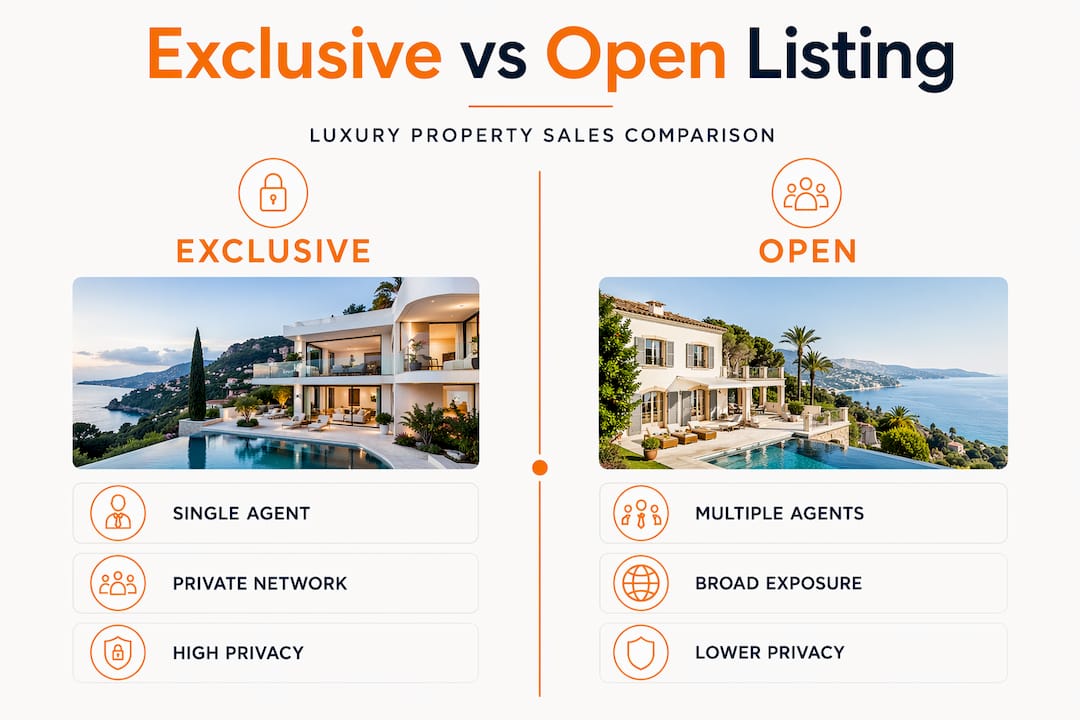
Infographic comparing exclusive and open listings

Strategic guidance for high-net-worth sellers and investors

Treating exclusivity as a strategy rather than a status symbol changes how you evaluate the decision. Here is a practical framework:

  1. Test your privacy assumption. Ask yourself whether your situation genuinely requires off-market handling, or whether the preference for privacy is aesthetic rather than necessary. True privacy needs, such as those of public figures or families managing estate transfers, justify the trade-offs. Preference alone may not.
  2. Interrogate the brokerage’s buyer network. An exclusive listing is only as valuable as the qualified buyers your agent can actually reach. Ask for specific, verifiable examples of comparable properties sold through their private network within the past twelve months.
  3. Clarify every term in writing. The difference between listing types must be documented precisely. What does “exclusive” mean in your contract? Who can show the property? What triggers commission?
  4. Evaluate the dual agency risk. If your brokerage is also representing prospective buyers for your property, ask directly how they manage that conflict. The answer will tell you a great deal about their priorities.
  5. Set a market feedback mechanism. Agree in advance on how many weeks without a qualified offer will trigger a conversation about adjusting the strategy. Market fragmentation in private networks makes it harder to interpret silence. Do not let ambiguity erode your timeline.

Pro Tip: Luxury sellers on the Côte d’Azur should treat exclusivity as a conditional strategic choice rather than an inherent premium. The finest properties attract the right buyers through excellent presentation and a genuine network, not simply by withholding access from the broader market.

Our perspective on exclusive listings

I have worked alongside high-net-worth sellers and investors across the French Riviera long enough to observe a pattern that rarely makes it into the conversation between agent and client. Exclusivity is frequently framed as an act of refinement, a choice that elevates a property above the noise of the open market. In practice, it is a contractual arrangement with real financial consequences, and those consequences deserve the same scrutiny you would apply to any other significant decision.

What I have seen is this: the sellers who benefit most from exclusive arrangements are those who have a genuine, specific reason for limiting exposure, not a vague sense that privacy signals prestige. A family transferring generational wealth through a Provençal estate. A public figure selling a Cap d’Antibes property without wishing to alert the press. Those are legitimate exclusive listing scenarios, and in those contexts, a skilled brokerage with a genuine network delivers real value.

Where I have seen sellers lose is when they confuse exclusivity with quality. The brokerage held the listing. The private network was thinner than promised. Months passed. The property eventually entered the public market, sometimes at a reduced price to compensate for the perception of stagnation.

My advice is simple. Choose your agent before you choose your listing type. If the agent has a demonstrable, active network of qualified buyers for your property’s profile, exclusivity may serve you well. If the network is largely theoretical, a well-executed public launch will almost always serve your financial interests better. The salt-kissed prestige of the Riviera does not require secrecy to command its true value.

— ab

Discover exclusive listings on the Côte d’Azur with Livingonthecotedazur

At Livingonthecotedazur, we work with a curated portfolio of properties that never appear on public platforms, from Monaco-adjacent villas with panoramic sea views to restored Provençal mas surrounded by lavender-scented hills. Our private inventory is built on relationships forged over years with genuine buyers across Europe, the Middle East, Asia, and the Americas. We understand that for many of our clients, the finest transaction is the one that never becomes public knowledge.

We offer bespoke exclusive property services tailored to high-net-worth sellers and investors who demand both discretion and results. Our team guides you through every dimension of the process, from legal due diligence to legacy-conscious acquisition strategies. Whether you are considering a discreet sale or seeking access to our off-market Côte d’Azur properties, we welcome the conversation.

Contact our team to discuss your requirements in complete confidence.

FAQ

What is an exclusive listing in real estate?

An exclusive listing is a contract granting a single brokerage sole rights to market and sell a property, typically for three to six months. The seller is generally obligated to pay commission to that brokerage regardless of who finds the buyer.

What does exclusive listing mean for a luxury seller?

For a luxury seller, an exclusive listing means heightened privacy and dedicated marketing attention from one agency, but potentially reduced buyer competition and a longer time to sell compared to a public listing.

What is the difference between exclusive and open listings?

An exclusive listing ties marketing rights to one brokerage, while an open listing allows multiple agents to market the property simultaneously with commission payable only to whoever secures the buyer.

Are exclusive listings better for achieving a higher sale price?

Research indicates that exclusive listings offer no consistent price premium over public listings and may reduce competitive bidding. They are better suited to privacy-driven sellers than to those prioritising maximum sale price.

What is a pocket listing and how does it differ from an office exclusive?

A pocket listing is shared privately within a brokerage’s network or by invitation only. An office exclusive is formally listed within one brokerage but not advertised publicly on the MLS. Both limit market exposure, but office exclusives carry a more defined internal structure.

Recommended

  • The Exclusive Real Estate Buying Guide – Living on the Côte d’Azur
  • How exclusivity shapes luxury real estate value
  • Exclusive property services on the French Riviera
  • Private listings: 5 key advantages for Côte d’Azur buyers
by Websols Servicedesk/26 May 2026/in Landingpage
https://www.livingonthecotedazur.com/wp-content/uploads/2026/05/1779556545114_Agent-meeting-clients-in-luxury-apartment.jpeg 714 1280 Websols Servicedesk https://www.livingonthecotedazur.com/wp-content/uploads/2024/02/sitelogo150.png Websols Servicedesk2026-05-26 02:00:382026-05-26 02:00:41What is an exclusive listing in luxury real estate?

TL;DR:

  • In 2025, the luxury real estate market experienced pricing adjustments driven by supply constraints and international demand, rather than a collapse.
  • Selective resilience was evident in geographies like the French Riviera, where limited supply maintained premium values despite broader softening.

The luxury real estate market in 2025 confounded even seasoned investors. Headlines spoke of softening demand and price corrections, yet select coastal enclaves and resort-driven markets told an entirely different story. Understanding the real estate market trends 2025 produced requires looking beyond aggregate indices and national medians. The forces at work — shifting buyer demographics, constrained coastal supply, and the rising influence of out-of-market capital — created a market of profound contrasts. This guide cuts through the noise to offer the precise, regional, and data-grounded analysis that serious investors require.

Table of Contents

  • Key takeaways
  • Macroeconomic and demographic forces in 2025
  • Luxury pricing dynamics and inventory conditions
  • Regional and submarket variations in 2025
  • Practical investment considerations for luxury buyers
  • The outlook beyond 2025
  • Our perspective
  • Discover Côte d’Azur investment opportunities with Livingonthecotedazur
  • FAQ

Key takeaways

PointDetails
Pricing recalibration, not collapseLuxury prices adjusted modestly in 2025, presenting selective buying opportunities rather than broad market distress.
Out-of-market buyers reshaped demandNon-local buyers dominated major metro demand signals, making local comparable sales increasingly unreliable for valuation.
Supply scarcity preserves coastal premiumsGeographic constraints in markets like the Côte d’Azur sustained luxury pricing even as broader markets softened.
Track price percentiles, not mediansInvestors who studied luxury price tiers by percentile gained sharper insight into submarket dynamics and exit timing.
Legacy assets outperform short-term playsProperties in geographically irreplaceable locations continued to appreciate, rewarding patient, long-horizon investors.

Macroeconomic and demographic forces in 2025

The year 2025 was defined as much by who was buying as by what they were paying. Several structural forces converged to shape a market that defied simplistic characterisation.

On the macroeconomic side, gradual monetary easing created renewed confidence among high-net-worth buyers who had sat on the sidelines during the rate spike years. U.S. house prices rose 1.8% from Q4 2024 to Q4 2025, a modest but meaningful appreciation that signalled resilience rather than stagnation. This was not a market in freefall. It was a market finding its footing.

The buyer profile itself underwent notable transformation:

  • Down payments declined. Median down payments fell to a four-year low by early 2026, dropping to $23,400 and a 12.8% share, down 19% year-over-year. This reflected a broader easing of affordability pressure.
  • Government-backed financing surged. FHA and VA loans accounted for over one third of purchase mortgages, with VA’s share reaching its highest level in a decade at 11.7%.
  • Migration patterns accelerated. Second-home buyers and relocation-driven purchasers increasingly targeted markets far from their primary residences, reshaping demand geographies entirely.

The net effect was a buyer pool that was more heterogeneous than at any point in the prior decade. For luxury analysts, this heterogeneity is not a footnote. It is the central variable.

Pro Tip: When modelling demand for a specific luxury submarket, segment your buyer pool by financing type, origin market, and motivation. A resort-driven coastal market attracts predominantly cash buyers with legacy intent, a very different underwriting profile from a primary-residence metro.

Luxury pricing dynamics and inventory conditions

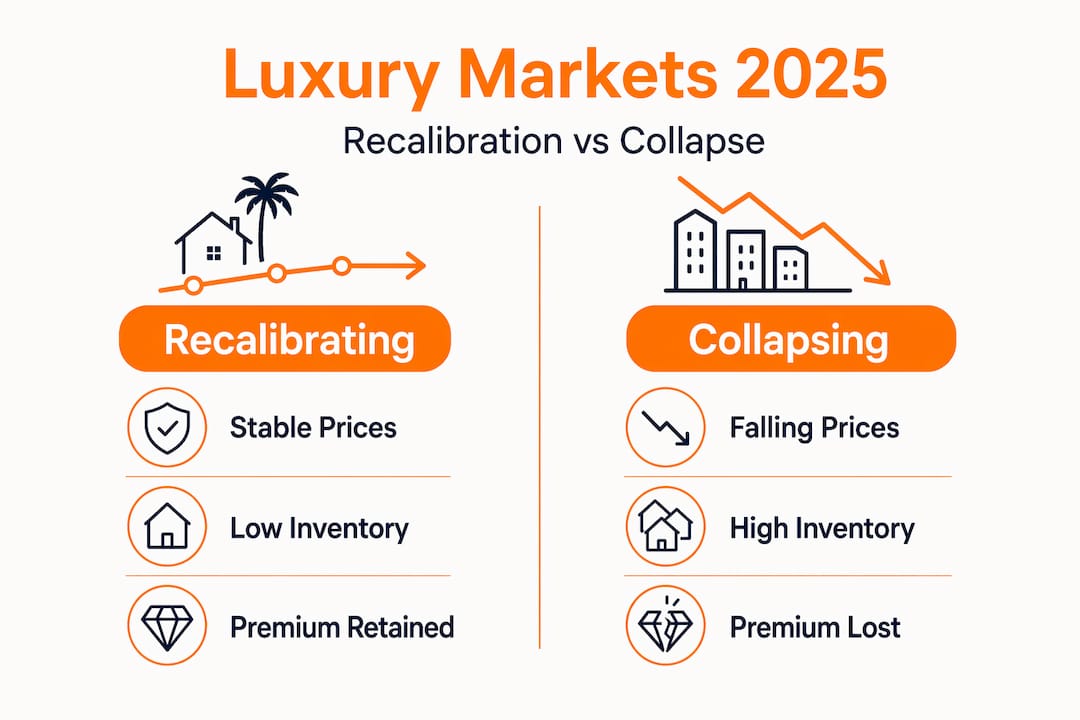
The phrase that best captures 2025 luxury pricing is recalibration, not collapse. Investors who treated the two as synonymous missed significant opportunity.

Here is how the two market types compared at the luxury tier:

Market conditionRecalibrating marketCollapsing market
Price movementModest monthly gains with annual softeningSustained double-digit annual declines
Time on marketExtended by 5 to 9 days versus prior yearDramatically extended, often 60 to 90 days above norm
Inventory postureConstrained by geography or low new supplyElevated supply with rising cancellation rates
Seller behaviourSelective negotiation, limited discountingSignificant price reductions to attract buyers

The national luxury threshold dipped 3.1% year-over-year in February 2026, yet showed month-over-month stabilisation. Time on market lengthened by 5 to 9 days across luxury tiers compared with the prior year, which tells a precise story: sellers were not panicking, but buyers were negotiating with greater patience.

Infographic comparing recalibrating and collapsing markets

Inventory scarcity proved the most decisive pricing factor in premium coastal and resort markets. Where developable land is finite — Cap d’Antibes, Saint-Jean-Cap-Ferrat, Monaco’s immediate border villages — supply simply cannot respond to demand spikes. This structural constraint preserves pricing floors that broader market softening cannot erode.

Luxury living room with sea view and owner reading

Pro Tip: When assessing a luxury property’s pricing resilience, prioritise supply-side analysis over demand-side sentiment. A market with three years of constrained new supply will hold its value through cycles that devastate oversupplied inland markets.

Regional and submarket variations in 2025

Not all luxury markets moved in the same direction. The divergence between regional markets in 2025 was sharper than at any point since the post-pandemic re-pricing.

Sun Belt and selected Midwestern markets retained strong momentum, partly driven by corporate migration and the gravitational pull of AI and data-centre expansion, which drew clusters of high-earning relocators to specific metro areas. These markets saw out-of-market buyers account for nearly 62% of online property views in late 2025, a structural shift from the 48.6% recorded in 2019.

Coastal and resort-driven markets, including the French Riviera, operated by different rules entirely:

  • Lifestyle desirability sustained year-round enquiry from buyers across Europe, the Middle East, and Asia Pacific, irrespective of broader economic sentiment.
  • Supply limitations in markets with finite coastline created what researchers describe as micro-market effects, allowing sustained luxury premiums despite broader softening.
  • Second-home and legacy buyers dominated transaction volumes in villages such as Èze, Mougins, and Roquebrune-Cap-Martin, where buyers are acquiring assets for generational tenure rather than speculative resale.
  • International capital flows from digital entrepreneurs, family offices, and sovereign wealth-adjacent investors continued to regard Riviera property as a hard asset with currency-proof appeal.

On the Côte d’Azur specifically, the micro-market dynamic is vivid. A villa perched above Èze with views across the Bay of Angels is not competing with a Nice apartment. It is competing with a Capri estate, an Algarve quinta, a Bali compound. The buyer’s reference frame is global, and pricing must be read accordingly. Our French Riviera investment guide captures this regional complexity in precise detail.

Practical investment considerations for luxury buyers

Translating 2025’s market signals into sound portfolio decisions requires moving beyond headline statistics. Here is a structured approach for discerning investors.

  1. Track price percentiles, not medians. Monitoring luxury price thresholds by percentile provides superior insight into market stratification and exit timing. The median tells you what the average luxury buyer paid. The 90th percentile tells you where the most coveted properties are priced and how that tier is moving.
  2. Model buyer qualification pathways. Investors must account for the full spectrum of buyer financing, from all-cash legacy purchasers to those using conventional or government-backed loans. Liquidity and effective demand vary considerably across these profiles, which affects resale velocity and negotiation dynamics.
  3. Prioritise geographic irreplaceability. Supply constraints in coastal resorts and mountain-backed enclaves support luxury premiums that no amount of new construction can dilute. Saint-Jean-Cap-Ferrat has precisely as much coastline today as it did in 1960. That scarcity compounds in value over time.
  4. Evaluate seasonal rental yield potential. On the Côte d’Azur, the summer season commands extraordinary rental premiums. A well-positioned villa in Antibes or Sainte-Maxime can generate 3 to 5% annual yield purely from elite seasonal lets, with demand from the Cannes Film Festival through the Monaco Grand Prix creating near-guaranteed high-season occupancy.
  5. Incorporate sustainable premium positioning. Eco-certified properties with solar arrays, biophilic design, and green credentials are increasingly attracting a premium, particularly from buyers under 50 who regard environmental responsibility as integral to legacy value.
  6. Consider off-market property access as a strategic advantage. The most coveted Riviera properties rarely reach public listing portals. Cultivating relationships with specialists who hold off-market mandates is not a luxury. It is a prerequisite for serious acquisition strategy.

Pro Tip: Build a “luxury price ladder” for your target market, mapping each property tier by square metre value, view quality, and proximity to key amenities. This framework allows you to identify relative value dislocations that aggregate data will never surface.

The outlook beyond 2025

As we move through 2026 and look further ahead, several dynamics warrant close monitoring:

  • Demand stabilisation at the luxury tier is likely as buyers who deferred in 2024 and early 2025 return with accumulated capital and greater financing confidence.
  • Regulatory and tax shifts across European markets, including changes to non-dom taxation in the UK and evolving French property tax frameworks, could redirect capital flows between competing luxury destinations, potentially accelerating Riviera acquisition interest.
  • Seasonal versus structural pricing signals must be distinguished carefully. A price softening in October on the Côte d’Azur is seasonal rhythm. A price softening in July is a structural signal. Investors who fail to make this distinction risk misreading both buying and selling windows.
  • Liquidity planning deserves renewed attention. Luxury assets are inherently illiquid, and investors with short time horizons must be honest about the mismatch between their capital requirements and the patience that premium properties demand.

The 2025 housing market outlook that ultimately proved most accurate was not the bearish narrative of correction, but the more nuanced picture of selective resilience. The markets that held their value were precisely the ones that always do: irreplaceable, supply-constrained, and deeply desired by a global buyer pool with multigenerational intent.

Our perspective

I have spent years watching investors arrive at luxury market analysis with the wrong tools. They bring spreadsheets calibrated for equity markets and expect pricing to behave rationally against macro signals. It rarely does. What I have learned is that the most reliable predictor of luxury real estate performance is not the interest rate cycle or GDP growth. It is the relationship between irreplaceability and desire.

The data from 2025 confirmed something I have believed for a long time: aggregate pricing figures will consistently mislead you. The market that “fell 3%” in the headlines often contained a submarket that rose 7%. The investors who profited were not the ones with the best macroeconomic models. They were the ones with the deepest micro-market knowledge and the patience to hold.

On the Côte d’Azur specifically, I have seen properties in Mougins and Cap d’Antibes barely register the tremors that shook broader European markets. The reason is simple: the buyers for these properties are not responding to the same signals as mainstream buyers. They are responding to legacy, to lifestyle, to the irreplaceable pleasure of a lavender-laced evening above the Mediterranean. That is a demand floor that no interest rate can dissolve.

My counsel to any serious investor studying luxury real estate investment strategies for 2025 and beyond is this: go deeper than the data, find the supply constraint, and hold.

— ab

Discover Côte d’Azur investment opportunities with Livingonthecotedazur

At Livingonthecotedazur, we have spent years curating access to the most coveted properties along the French Riviera, properties that rarely appear in public listings and that reward the investors patient enough to seek them out properly. Our portfolio spans the salt-kissed corniches above Èze, the sun-washed terraces of Antibes, and the lemon-scented heights of Menton, extending further to Ibiza, Dubai, Bali, Portugal, and Mauritius for those whose vision of legacy spans continents.

We accept cryptocurrency payments and work with digital entrepreneurs, family offices, and global high-net-worth buyers who understand that the finest assets are acquired through trusted relationships, not open portals. Explore our curated off-market Côte d’Azur properties or discover the full spectrum of Côte d’Azur investment options we have assembled for discerning investors. Contact us for a personalised investment consultation tailored to your legacy ambitions.

FAQ

What defined luxury real estate market trends in 2025?

The defining features were pricing recalibration rather than collapse, rising out-of-market buyer dominance, and sustained premiums in supply-constrained coastal markets. Luxury price thresholds dipped modestly year-over-year but showed monthly stabilisation, indicating selective resilience rather than broad decline.

How did out-of-market buyers affect luxury property valuations in 2025?

Out-of-market buyers accounted for nearly 62% of online property views in major metros by late 2025, making local comparable sales less reliable as the sole valuation reference. Investors must incorporate multi-source demand signals to price accurately.

Why did coastal luxury markets like the Côte d’Azur outperform in 2025?

Geographic supply constraints meant that new inventory could not respond to demand, preserving pricing premiums. Micro-market scarcity effects in coastal resorts with limited developable land consistently supported values even as broader markets softened.

What is the most reliable investment strategy for luxury real estate in 2025?

Prioritising geographically irreplaceable assets with strong lifestyle appeal and constrained supply, held with a multigenerational horizon, produced the most resilient outcomes. Tracking luxury price tiers by percentile rather than medians helps identify entry and exit opportunities with greater precision.

How are financing trends affecting luxury property investment decisions?

The surge in government-backed loans and the decline in median down payments reflect a broader buyer risk profile entering the market. For pure luxury segments, cash and private financing remain dominant, but understanding buyer qualification pathways across tiers is critical for modelling effective demand and resale liquidity accurately.

Recommended

  • Dubai Luxury Homes: Complete Guide for 2025 Buyers – Living on the Côte d’Azur
  • Luxury market trends on the Côte d’Azur: insights for 2026
  • Second Home Trends 2025: Shaping Riviera Legacies
  • French Riviera real estate market insights for 2026
by Websols Servicedesk/25 May 2026/in Landingpage
https://www.livingonthecotedazur.com/wp-content/uploads/2026/05/1779480305501_Real-estate-investor-working-at-kitchen-table.jpeg 714 1280 Websols Servicedesk https://www.livingonthecotedazur.com/wp-content/uploads/2024/02/sitelogo150.png Websols Servicedesk2026-05-25 02:30:312026-05-25 11:36:06Real estate market trends 2026: the investor’s guide


TL;DR:

  • Inheritance tax in France depends on the relationship between the deceased and each beneficiary, as well as domicile and asset value. Surviving spouses and PACS partners are fully exempt, while other exemptions are limited and require formal declarations. Proper estate planning, including modeling gifts and assets, is essential to minimize tax liabilities and preserve family legacies.

Inheritance tax in France is one of those subjects that inspires quiet dread at dinner tables from Nice to Neuilly. Many assume the rules are punishing across the board, or conversely, that generous exemptions will shield most estates automatically. Neither assumption is reliably correct. What genuinely determines your liability is the relationship between the deceased and each beneficiary, the value of each heir’s share, and where both parties call home. Understanding inheritance tax France explained in plain terms means cutting through those misconceptions and getting to the mechanics that actually matter for your family’s future.

Table of Contents

  • Key takeaways
  • How inheritance tax in France is calculated
  • France inheritance tax exemptions
  • Filing deadlines and declaration requirements
  • Cross-border inheritance and domicile rules
  • Practical estate planning tips for French inheritance
  • My perspective on French inheritance tax
  • Discover your Côte d’Azur legacy with Livingonthecotedazur
  • FAQ

Key takeaways

PointDetails
Relationship drives liabilityTax rates and personal allowances depend entirely on the heir’s relationship to the deceased.
Spouses pay nothingSurviving spouses and PACS civil partners are fully exempt from French inheritance tax.
Domicile determines scopeIf the deceased or heir is French-domiciled, worldwide assets can fall within the French tax net.
Deadlines are strictHeirs have six months to file if the death occurred in France, and twelve months if it occurred abroad.
Lifetime gifts reduce allowancesPrior donations are factored into the personal allowance at death, which can increase the taxable share.

How inheritance tax in France is calculated

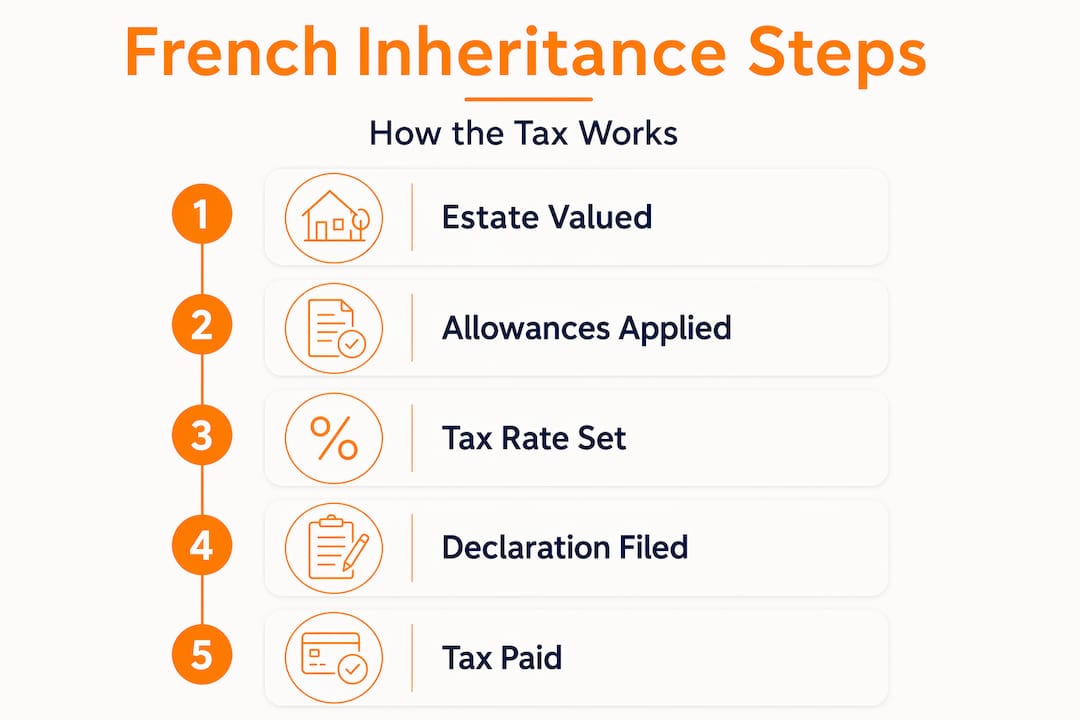
The French term is droits de succession, and understanding how it works starts with a simple but crucial principle: tax is assessed per beneficiary, not on the estate as a whole. Each heir pays tax based on their individual share after applying their personal allowance (abattement).

The stepwise process works as follows:

  1. Determine the gross estate value. This includes all assets: property, bank accounts, investments, and personal effects.
  2. Deduct outstanding debts. Mortgages, funeral costs, and other liabilities reduce the net taxable estate.
  3. Allocate shares to each heir. French succession law dictates minimum shares for children (réserve héréditaire), with any remaining portion freely allocated.
  4. Apply the personal allowance. Each beneficiary subtracts their allowance from their share. For direct-line heirs such as children, the allowance is €100,000 per child.
  5. Apply the progressive tax rates. The remaining taxable share is taxed using a barème (progressive rate table).

The 2026 rate table for direct-line heirs (children and parents) runs as follows:

Taxable share (per heir)Rate
Up to €8,0725%
€8,072 to €12,10910%
€12,109 to €15,93215%
€15,932 to €552,32420%
€552,324 to €902,83830%
€902,838 to €1,805,67740%
Above €1,805,67745%

To make this concrete: if a child inherits a net share of €115,000, they subtract the €100,000 allowance and are left with a taxable share of €15,000. Applying the tranches, a €15,000 taxable share produces roughly €1,240 in tax. That is a manageable figure. The burden escalates sharply at higher values, which is why planning matters.

One frequently overlooked detail: lifetime gifts factor into the allowance calculation at the point of death. If you made a gift of €60,000 to a child within the last fifteen years, only €40,000 of their €100,000 allowance remains at inheritance. This is not a penalty. It is the mechanism that prevents repeated use of the same allowance across different transfers.

Pro Tip: Model your estate beneficiary by beneficiary before making any gift decisions. The interaction between prior donations and the personal allowance at death can produce surprising tax outcomes.

France inheritance tax exemptions

Real exemptions under French law are narrower than many people expect. The most significant exemption applies to surviving spouses and partners in a registered civil partnership (PACS). They pay absolutely nothing, regardless of the estate’s value. This exemption is unconditional and requires no special application.

Beyond spouses and PACS partners, the list of full exemptions is selective:

  • Siblings can be fully exempt if they meet all three conditions: unmarried or widowed or divorced at the time of death, aged over 50 or incapable of working, and having lived with the deceased for the five years immediately prior to death. All three criteria must be met simultaneously.
  • War victims and terrorism victims. Heirs of individuals who died as a direct result of acts of war or terrorism benefit from a specific exemption on the inheritance received.
  • Bequests to certain public bodies and cultural institutions. Donations to the French state, regional authorities, hospitals, and recognised charities can be exempt from inheritance tax, making structured philanthropic bequests a legitimate planning tool.
  • Certain asset types carry partial exemptions or reduced valuations, including woodland and forests, certain agricultural property under long-term leases, and employer-funded death benefit contracts.

One point that catches people off guard: even when an heir is exempt from paying inheritance tax, a formal declaration may still be legally required. The obligation to file and the obligation to pay are separate matters. If the estate includes property or exceeds certain value thresholds, the declaration process proceeds regardless of whether a tax liability ultimately arises.

Pro Tip: Do not assume exemption means no paperwork. Confirm with a notary whether a declaration remains obligatory given the estate’s composition, even if you expect to pay nothing.

Filing deadlines and declaration requirements

Filing a déclaration de succession is a legal obligation for most heirs, and the deadlines are firm. Miss them and you face interest charges and potentially a flat penalty surcharge on top of the tax due.

The core rules:

  1. Six months from the date of death if the deceased died in France.
  2. Twelve months if the death occurred outside France.
  3. The primary form is the Cerfa n° 2705-SD, submitted to the tax authorities (Service des Impôts des Particuliers) relevant to the deceased’s last place of residence.
  4. If the estate includes real property anywhere in France, a notary must be involved. The notary prepares the declaration and coordinates the tax payment with the authorities.
  5. Thresholds do apply: if the net taxable share received by a non-exempt heir falls below €50,000 and no gifts were made during the deceased’s lifetime, the filing obligation may be waived. This applies per heir, not to the whole estate.

One distinction that matters: the declaration of succession and the formal sharing of assets are separate legal steps. You can delay the division of property among heirs, but you cannot delay the declaration itself. The clock runs from the date of death, not from the moment the family agrees on who gets what.

Cross-border inheritance and domicile rules

For international families, the French inheritance tax rules contain one clause that changes everything: the worldwide asset rule tied to domicile. If the deceased was domiciled in France at the time of death, the entire worldwide estate falls within the French tax net, regardless of where the assets are located.

The rule extends further. Even if the deceased was not French-domiciled, French inheritance tax on worldwide assets can still apply if the heir was domiciled in France for at least six years out of the ten years immediately preceding the death. This heir-level domicile trigger is consistently overlooked by international families and their advisers.

Key points for cross-border situations:

  • If neither the deceased nor the heir meets the French domicile threshold, only French-situs assets (property and assets physically located in France) are taxable in France.
  • International tax treaties can modify this outcome. France has a limited number of bilateral inheritance tax treaties, but where one exists, it may eliminate double taxation or reassign taxing rights between countries.
  • The ten-year domicile look-back period for heirs means that moving abroad shortly before an anticipated death may not remove the French tax exposure if the heir has spent substantial time in France.
ScenarioAssets subject to French tax
Deceased domiciled in FranceAll worldwide assets
Heir domiciled in France (6/10 years)All worldwide assets
Neither condition metFrench-situs assets only
Tax treaty in forceDetermined by treaty provisions

Pro Tip: Keep a record of your years of French tax residency, especially if you move between countries. Heir-level domicile is tracked per the French tax calendar, and six years can accumulate quietly across career or lifestyle moves.

Woman organizes domicile record documents at home

Practical estate planning tips for French inheritance

Good planning is not about avoiding tax at all costs. It is about making informed choices that preserve family harmony and put assets where they are most useful. A few approaches stand out as genuinely effective.

  • Model every heir individually. Tax outcome varies significantly by beneficiary because different heirs carry different allowances and face different rate brackets. Splitting an estate thoughtfully across multiple direct-line heirs can produce a materially lower aggregate tax bill than leaving everything to one person.
  • Use gifts strategically. The €100,000 parental allowance renews every fifteen years. A structured gifting programme over time can transfer substantial wealth at low or zero tax cost. The key is to plan early enough for the renewal cycle to work in your favour.
  • Consider life insurance contracts (assurance-vie). Properly structured, these fall outside the succession estate up to certain thresholds and are taxed under separate, often more favourable rules. They are not inheritance tax-free in all circumstances, but they remain one of the most effective planning vehicles available in France.
  • Engage a notary for any estate involving French property. The notary’s role in France is not optional for real estate succession. They carry legal liability for the accuracy of the declaration and provide invaluable guidance on the legal steps for inherited property.
  • Do not delay the declaration to wait for the family to agree on asset division. The tax deadline does not pause for family negotiations.

Pro Tip: If your estate includes Côte d’Azur property, obtain an independent valuation before the declaration. Property valuations affect the taxable base, and a well-supported figure protects against challenge from the tax authorities.

My perspective on French inheritance tax

Infographic showing French inheritance tax steps

I have seen the same pattern repeat itself with remarkable consistency. Families with Riviera property, often acquired over a generation of summers in Cap d’Antibes or Menton, arrive at the succession stage with one of two misconceptions. Either they believe the tax will be crippling, so they never plan at all. Or they assume a spouse exemption or a simple gift made years ago will cover everything, so they also never plan at all. The outcome, in both cases, is the same: decisions made under pressure, with incomplete information, and often with unnecessary tax cost.

What I have found actually moves the needle is the ten-year domicile question. More often than one might expect, a grown child who spent formative years in France, perhaps studying in Nice or working in Cannes, has unknowingly crossed the six-year threshold. Their inheritance from a non-French parent is then subject to French tax on worldwide assets. That is a genuinely startling outcome for a family that considered itself entirely non-French for tax purposes.

The other overlooked factor is the relationship between lifetime gifts and the personal allowance. Prior gifts made in good faith, often at a family accountant’s suggestion, silently erode the allowance available at death. The planning that felt generous and tax-efficient at the time of the gift can quietly increase the tax bill a decade later. The solution is not to avoid gifting. It is to model the full picture across time, with someone who understands both the succession code and the estate’s actual composition.

France rewards those who plan with clarity and penalises those who plan in fragments.

— ab

Discover your Côte d’Azur legacy with Livingonthecotedazur

Understanding French inheritance tax is not the end of the story. It is the beginning of a more purposeful conversation about legacy. At Livingonthecotedazur, we work with discerning families who view property not as a transaction but as an heirloom, a piece of the Riviera passed from one generation to the next with the salt-kissed air of Antibes or the lemon-scented streets of Menton woven into its walls. Our portfolio is curated for those who think in decades, not years.

If you are considering how a Côte d’Azur acquisition fits into a tax-efficient succession strategy, explore our off-market luxury properties or discover how real estate protects your legacy across generations. We also accept cryptocurrency payments, making acquisition as discreet and forward-thinking as the clients we serve.

FAQ

What is inheritance tax in France?

Inheritance tax in France (droits de succession) is a tax levied on the share of an estate received by each beneficiary, calculated after applying personal allowances based on the heir’s relationship to the deceased.

Are spouses exempt from French inheritance tax?

Yes. Surviving spouses and registered PACS civil partners are fully exempt from paying French inheritance tax, regardless of the size of the estate they inherit.

How does domicile affect French inheritance tax?

If the deceased was domiciled in France, all worldwide assets are taxable in France. If the heir was domiciled in France for at least six of the ten years before the death, the same worldwide scope applies even if the deceased was not French-resident.

What is the deadline for filing an inheritance declaration in France?

Heirs have six months to file if the death occurred in France and twelve months if it occurred abroad. Late filing incurs interest and penalty surcharges on any tax due.

Do lifetime gifts affect French inheritance tax?

Yes. Prior gifts reduce the personal allowance available at death if they were made within the last fifteen years, increasing the taxable portion of the inheritance received.

Recommended

  • Real Estate Inheritance: Safeguarding Your Côte d’Azur Legacy
  • Property Transfer Explained: Wealth, Legacy and Law
  • Net capital gain tax info – Living on the Côte d’Azur
by Websols Servicedesk/23 May 2026/in Landingpage
https://www.livingonthecotedazur.com/wp-content/uploads/2026/05/1779302227115_Couple-sorting-French-inheritance-papers-at-home.jpeg 714 1280 Websols Servicedesk https://www.livingonthecotedazur.com/wp-content/uploads/2024/02/sitelogo150.png Websols Servicedesk2026-05-23 04:31:212026-05-23 04:31:27Inheritance tax in France explained for families


TL;DR:

  • A villa is a statement of lifestyle, combining scale, light, and materiality to create a unique living space. Effective design emphasizes spatial zoning, indoor-outdoor flow, authentic materials, layered lighting, and restrained furnishing choices. Incorporating art, provenance, and durability ensures the interior remains timeless, meaningful, and suitable for seasonal rentals.

A villa is not simply a large house. It is a statement of how you choose to live, a space where scale, light, and materiality converge to create something truly singular. Whether you are refining a sun-warmed retreat on the Côte d’Azur or approaching a blank canvas in Bali or Ibiza, the interior design tips for villas that actually work go far beyond choosing a sofa or a paint colour. They demand a deeper understanding of spatial flow, material truth, and the quiet art of luxury. This guide gives you that understanding, point by point.

Table of Contents

  • Key takeaways
  • 1. Interior design tips for villas: start with spatial zoning
  • 2. Mastering indoor-outdoor flow
  • 3. Lighting design strategies to lift mood and luxury
  • 4. Choosing materials and finishes for timeless elegance
  • 5. Furnishing and decorating with restraint
  • 6. Integrating art, culture, and provenance
  • 7. Designing for seasonal living and rental yield
  • My perspective on villa interiors that truly endure
  • Discover villas designed to become heirlooms
  • FAQ

Key takeaways

PointDetails
Zone your spaces deliberatelySeparate public, semi-public, private, and service areas to protect privacy and enhance daily function.
Prioritise indoor-outdoor continuityUse continuous large-format flooring and tonal consistency to dissolve the boundary between interior and garden.
Layer your lightingCombine ambient, task, and accent lighting with dimmers to control mood at every hour of the day.
Choose authentic materialsNatural stone, quality timber, and textured fabrics create a longevity that synthetic alternatives never match.
Furnish with restraintFewer, finely chosen pieces with defined zones read as more luxurious than rooms filled with too many options.

1. Interior design tips for villas: start with spatial zoning

Before a single tile is chosen or a fabric swatch pinned to a board, the architecture of daily life must be mapped. Villa space planning follows a multi-zone model that separates public zones (reception rooms, dining, terraces), semi-public zones (home offices, guest suites), private zones (principal bedroom wing, family rooms), and service zones (kitchens, utility rooms, staff quarters). Each zone serves a distinct purpose and should have its own circulation logic.

Service zones, in particular, must have independent circulation paths from both public and private areas. Nothing disrupts the atmosphere of a formal dinner faster than a service corridor cutting through the main salon. In well-designed villas, staff can move invisibly from kitchen to terrace without crossing the principal living spaces.

  • Map every zone on your floor plan before committing to any layout
  • Identify where the morning light falls and align the breakfast and kitchen areas accordingly
  • Position the principal bedroom suite at the furthest remove from the entrance and entertaining spaces
  • Reserve semi-public zones as buffers between the social heart of the villa and the most private retreats

Pro Tip: Trace your most common daily paths directly onto a printed floor plan. Walk from bed to coffee machine, from front door to study, from pool to bathroom. If those paths cross awkwardly or create bottlenecks, the layout needs revision before anything else is decided.

Dead zones such as oversized entrance halls or circuitous corridors waste both space and the energy required to condition them. Every square metre of a villa should earn its place.

2. Mastering indoor-outdoor flow

The greatest gift of villa living is the effortless passage between interior and exterior. On the French Riviera, where salt-kissed air drifts through stone-pine gardens and a terrace in Antibes or Èze can rival any interior room for sheer beauty, this transition is not decorative. It is the heart of the design.

Villa glass door indoor outdoor movement

Seamless indoor-outdoor flow depends on continuous large-format tiles that run uninterrupted from inside to outside. Tile sizes of 600x1200mm or larger, including slab formats at 3.6m x 1.2m, minimise grout joints and create an unbroken visual plane. When the floor reads as one surface, the room appears to extend indefinitely into the garden.

Flooring materialBest useKey benefit
TravertineCovered terraces, salon floorsWarm tone, ages beautifully
Porcelain slabPool surrounds, open-plan livingFrost-resistant, minimal joints
Brushed limestoneIndoor-outdoor transitionsTonal versatility, natural texture
Teak or Iroko timberShaded loggias, dining terracesWarmth, tactile contrast

Patios treated as natural interior extensions, with matching tonal and textural elements, enhance both lifestyle and the spatial experience of the entire property.

Pro Tip: Align grout lines at the threshold between inside and outside, and avoid any level change at the transition point. Even a 10mm step reads as a visual and physical interruption that breaks the continuity you are working hard to create.

3. Lighting design strategies to lift mood and luxury

Lighting is the most underestimated element in villa interiors. Get it right, and every material glows with depth. Get it wrong, and even the finest stone looks flat and institutional. The three-layer approach used by professional villa designers covers ambient, task, and accent lighting, each serving a distinct purpose and working together through a dimmer-controlled system.

  1. Ambient lighting at 2700K with a CRI of 90 or above creates a warm, enveloping baseline. This is the layer that sets the room’s fundamental mood.
  2. Task lighting at 3500 to 4000K serves functional areas: kitchen worktops, reading chairs, vanity mirrors, and home offices where clarity matters more than romance.
  3. Accent lighting sculpts the architecture. It picks out a stone wall’s texture, bathes a painting in focused warmth, or traces the line of a coffered ceiling.

“Lighting is the silent element dictating room success, giving materials depth and defining atmosphere with shadow and light balance.” The psychology of light

Smart lighting systems programmed with pre-set scenes, such as a “Sunset Scene” that dims overhead lights while accent lighting rises to create evening ambience, allow you to shift the villa’s atmosphere with a single gesture. This kind of intentional control is what separates a well-designed home from a truly luxurious one.

The intentional absence of light matters as much as its presence. Corners left in shadow, walls that fade at their edges, and ceiling perimeters that recede into darkness all add depth and mystery. Uniform brightness is the enemy of atmosphere.

Pro Tip: Commission a lighting design consultant at the architectural stage, not after the ceilings are plastered. Conduit placement, ceiling void depth, and structural decisions all affect what is possible later. Retrofitting great lighting into a finished villa is expensive and rarely as good as designing it in from the start.

4. Choosing materials and finishes for timeless elegance

Quiet luxury in villa interiors is defined by proportion, material authenticity, and spatial flow rather than by the accumulation of expensive objects. This is one of the most important principles in modern villa interior design, and one of the most frequently misunderstood.

Natural stone carries a weight and warmth that no manufactured alternative replicates. Travertine, marble, limestone, and slate each bring their own geological biography into a space. Paired with quality timber, whether as wide-plank flooring, bespoke joinery, or structural ceiling beams, these materials create an interior that speaks of permanence and care.

  • Colour palette: Neutral tones of warm beige, taupe, ivory, and soft grey create interiors that feel calm and endure across decades. Use deeper hues, such as slate blue, forest green, or charcoal, as deliberate contrasting accents rather than dominant forces.
  • Texture layering: Combine polished stone with rough-hewn timber, linen with velvet, and matte wall finishes with glossy architectural elements. Texture is what makes a room feel rich at close quarters.
  • Investment priorities: Spend on architectural finishes first. Stone flooring, bespoke cabinetry, and plaster wall finishes outlast sofas and soft furnishings by decades. You can always replace a cushion; re-tiling a villa is a major undertaking.
  • Material authenticity: Buyers and guests perceive the difference between genuine marble and high-quality porcelain. In a luxury villa, where the entire experience depends on the quality of every surface, authenticity matters.

For design ideas for luxury villas that will appreciate in value, consult the French Riviera interior design philosophy, where heritage and modernity are balanced with particular elegance.

5. Furnishing and decorating with restraint

Furniture in a luxury villa should complement the architecture rather than compete with it. Fewer, finely considered pieces arranged with spatial intelligence create rooms that feel curated and alive. A salon with five exceptional pieces, perfectly placed, outperforms one with twenty mediocre ones every time.

Large villa rooms present a particular challenge: their scale can make even generous furniture appear small and disconnected. The solution is not to fill the space but to define it.

  • Use oversized rugs to anchor seating groups and give each zone a sense of enclosure within the larger room
  • Introduce wall panelling or boiserie to bring the ceiling plane down visually and add architectural warmth
  • Consider custom millwork, from built-in bookshelves to integrated media walls, to give rooms a tailored, finished quality that freestanding furniture alone cannot provide
  • Select one or two statement art pieces per room to add personality and provide a natural focal point for the eye
ApproachEffect in large villa rooms
Oversized rug per seating groupCreates intimate zones within a grand space
Statement artwork at key sightlinesDraws the eye and anchors the room’s character
Custom millwork and joineryDelivers architectural cohesion and reduces visual clutter
Layered textiles (throws, cushions)Adds tactile richness and human scale

Understanding what defines an ultra-luxury villa at the highest level of the market can sharpen your instincts for which furnishing decisions genuinely add value and which merely add cost.

6. Integrating art, culture, and provenance

A villa on the Côte d’Azur carries the whisper of Picasso’s Antibes fortress, of Matisse’s light-flooded studios in Nice, of the lemon-yellow walls of Menton’s old town. The interior design of a villa in such a place should not exist in a cultural vacuum. Art and provenance give a home its soul.

Commission works from regional artists or source pieces through the galleries of Saint-Paul-de-Vence, where the tradition of artists and collectors living in extraordinary communion has continued for over a century. Sculptural ceramics, hand-woven textiles from Provençal ateliers, and antique stone fountains placed in garden courtyards all speak of a life lived with intention and taste.

The best approach to villas interior decorating at this level is to treat acquisition as a long-term process. Buy what moves you rather than what matches the sofa. Over time, a collection assembled with genuine personal conviction will always produce a more compelling interior than one curated by a decorator following a trend board.

7. Designing for seasonal living and rental yield

If your villa will serve as both a family retreat and a high-yield seasonal rental, the design must accommodate both masters gracefully. On the Côte d’Azur, elite seasonal lets during the Cannes Film Festival, the Monaco Grand Prix, and the summer season along the Pampelonne coast command extraordinary nightly rates. The design must be photograph-ready and experientially flawless.

Durability and luxury are not mutually exclusive. Choose performance fabrics that resist salt air, UV exposure, and heavy use while reading as soft and expensive. Stone flooring is both beautiful and almost indestructible. Bespoke cabinetry with soft-close mechanisms and solid timber drawers outlasts flat-pack furniture by a generation.

Invest in a home automation system that allows guests to control lighting, climate, blinds, and audio with a single panel or smartphone. In 2026, this is not a luxury feature. It is an expectation among high-net-worth villa renters from London, Dubai, and New York, who will factor the quality of the technology experience into their review.

My perspective on villa interiors that truly endure

I have walked through extraordinary villas on the Côte d’Azur that cost tens of millions of euros and felt oddly cold. And I have spent evenings in relatively modest properties that felt like the most beautiful places on earth. The difference is almost never about money. It is about whether the person who designed the space was thinking about how it would be lived in, or only about how it would be photographed.

What I have come to believe, working with discerning buyers and owners across the Riviera, is that the most enduring villa interiors share three qualities. They are honest about their materials. They are planned for the rhythms of real daily life. And they use light not as an afterthought but as the primary architectural tool.

The mistake I see most often is the pursuit of extravagance over authenticity. A room lined with marble that has been chosen for its prestige rather than its beauty will always feel slightly wrong. A room where the stone was chosen because the owner fell in love with its particular vein and warmth will feel right for a lifetime.

My advice, always, is to slow down at the beginning and spend the design budget on the things that cannot be changed cheaply later: the floors, the ceilings, the light, and the spatial logic. Everything else is furniture.

— ab

Discover villas designed to become heirlooms

At Livingonthecotedazur, we work with homeowners and visionary buyers who understand that a villa is not simply a property. It is a living asset, a family legacy, and in the right hands, one of the most satisfying spaces a person can inhabit. Whether you are sourcing a property to design from scratch or refining an existing estate, our portfolio of off-market Côte d’Azur villas gives you access to residences that rarely appear publicly. For those beginning the ownership journey, our step-by-step transaction guide covers every stage of the process with clarity and precision. We accept cryptocurrency payments and offer a truly personalised service for discerning clients worldwide.

FAQ

What makes villa interiors different from standard home design?

Villa interiors require multi-zone spatial planning, greater attention to indoor-outdoor continuity, and a higher investment in architectural finishes due to the scale and prestige of the property.

What are the best interior styles for luxury villas?

Quiet luxury, characterised by proportion and authentic materials, consistently outperforms trend-led styles because it creates spaces that feel refined and relevant across decades rather than seasons.

Which colour schemes work best for villa interiors?

Warm neutrals including beige, taupe, ivory, and soft grey form the most enduring base palette, with deeper contrasting hues introduced through soft furnishings, joinery, and artwork.

How should I approach lighting when designing a villa?

Use a three-layer system of ambient, task, and accent lighting with fully dimmable controls, and commission a lighting consultant before the ceiling structure is completed to allow proper conduit and void planning.

Can a luxury villa interior also perform well as a seasonal rental?

Yes, provided the design balances visual impact with durable materials, intuitive home automation, and photography-ready styling that appeals to high-net-worth guests from global markets.

Recommended

  • Interior Design on the French Riviera: Crafting Legacy Homes
  • Why Italian villas are unique: legacy, luxury, and value
  • Villa Management: Safeguarding Legacy and Value
  • Luxury renovation tips for Côte d’Azur homes
by Websols Servicedesk/22 May 2026/in Landingpage
https://www.livingonthecotedazur.com/wp-content/uploads/2026/05/1779208273256_Designer-planning-zoning-in-villa-interior.jpeg 714 1280 Websols Servicedesk https://www.livingonthecotedazur.com/wp-content/uploads/2024/02/sitelogo150.png Websols Servicedesk2026-05-22 05:30:452026-05-22 05:30:48Interior design tips for villas: your expert guide


TL;DR:

  • Acquiring international property requires detailed preparation, legal verification, and understanding local regulations.
  • Buyers should assemble documentation early, hire independent legal counsel, and model all costs before proceeding.

Acquiring property across borders is one of the most rewarding moves a discerning investor can make. It is also one of the most technically demanding. The international property acquisition process confronts buyers with a layered matrix of local law, currency risk, tax obligations, and procedural timelines that vary sharply from one jurisdiction to the next. Whether you are eyeing a sun-drenched villa above the Baie des Anges in Nice, a sleek apartment steps from Sainte-Maxime’s Garonette sands, or a prestige plot near the Monaco border, the principles underpinning overseas property buying remain consistent. This guide gives you the clarity, structure, and confidence to move forward decisively.

Table of Contents

  • Key takeaways
  • What every buyer needs before starting
  • Executing the acquisition process step by step
  • Financing and managing the transaction
  • Post-purchase verification and ownership formalities
  • Common pitfalls and how to avoid them
  • My perspective: what the process really demands
  • Discover your next prestige acquisition with Livingonthecotedazur
  • FAQ

Key takeaways

PointDetails
Prepare documentation earlyGather identification numbers, funds-origin proof, and legal advisors before searching for property.
Hire independent legal counselNotaries in civil law countries act neutrally and will not protect your interests during due diligence.
Model all costs upfrontBudget between 2% and 20% of purchase price for closing costs and taxes, depending on jurisdiction.
Register the deed promptlyPost-completion registration typically takes 2 to 4 weeks and is critical to enforceable ownership.
Plan financing globallyModern global underwriting models assess worldwide income, making mortgages accessible without local residency.

What every buyer needs before starting

The international property acquisition process does not begin the moment you find a property you love. It begins weeks, sometimes months, earlier, with a sequence of administrative and strategic steps that determine whether your acquisition moves smoothly or stalls at the worst possible moment.

Start by defining your purpose with precision. Are you acquiring a legacy asset to hold across generations, a seasonal rental generating 3 to 5% annual yields, or a primary residence offering lifestyle rewards alongside capital appreciation? Your answer shapes everything from the legal structure you use to the financing product you pursue. A detailed total-cost model covering taxes, fees, currency exposure, and operational costs should be built before you ever view a property.

Next, understand ownership restrictions in your target market. Some countries limit foreign freehold ownership entirely. Others impose additional transfer taxes on non-residents. British Columbia, for example, applies an extra 20% transfer tax on non-resident buyers. France, by contrast, welcomes foreign buyers with few restrictions, though the tax and notary fee structure still requires careful modelling, particularly for Riviera properties above the €2 million threshold.

The essential prerequisites list for overseas property buying looks like this:

  • Obtain any locally required identification numbers (the NIE in Spain, the NIF in Portugal, a tax identification number in Italy)
  • Compile certified copies of passports and proof of address, typically covering the previous three months
  • Prepare documented evidence of funds origin, a mandatory requirement under anti-money laundering regulations
  • Appoint a qualified local property lawyer who acts exclusively for you, not for the vendor or the notary
  • Engage a currency specialist early, since exchange rate movements on large transfers can materially affect your acquisition cost

Pro Tip: Appoint your lawyer and currency specialist simultaneously. The two disciplines interact constantly during an international real estate purchase, and misaligned timelines between them cause preventable delays.

Explore the key steps in luxury buying for a jurisdiction-specific overview of where each prerequisite applies most critically.

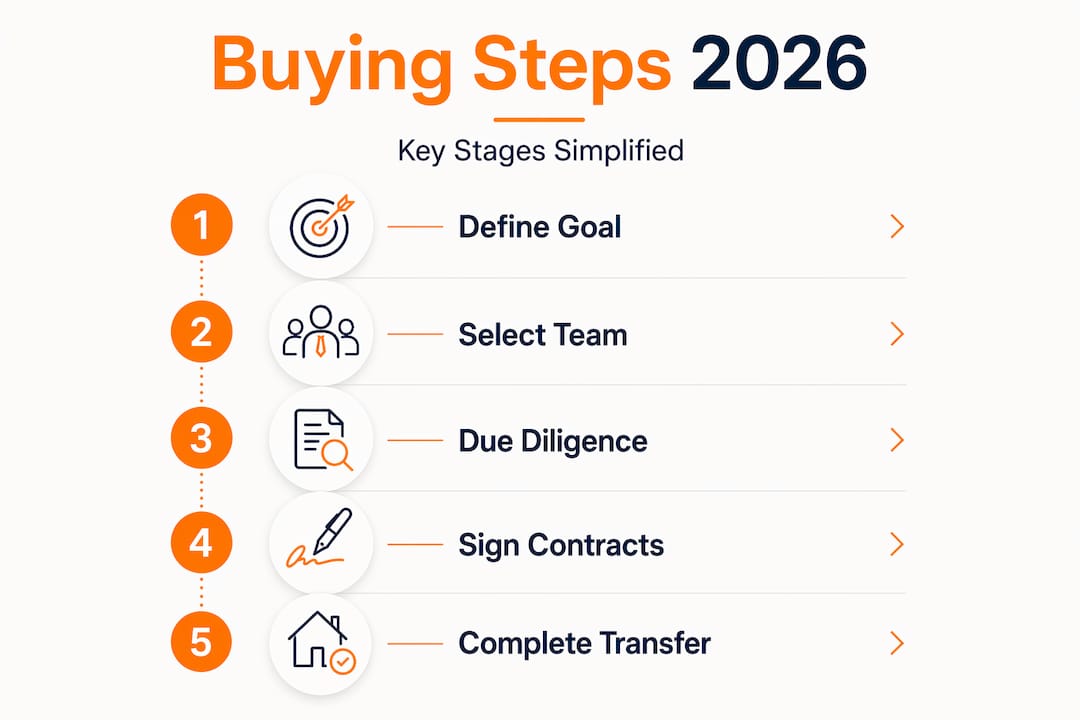
Infographic showing 2026 international property buying steps

Executing the acquisition process step by step

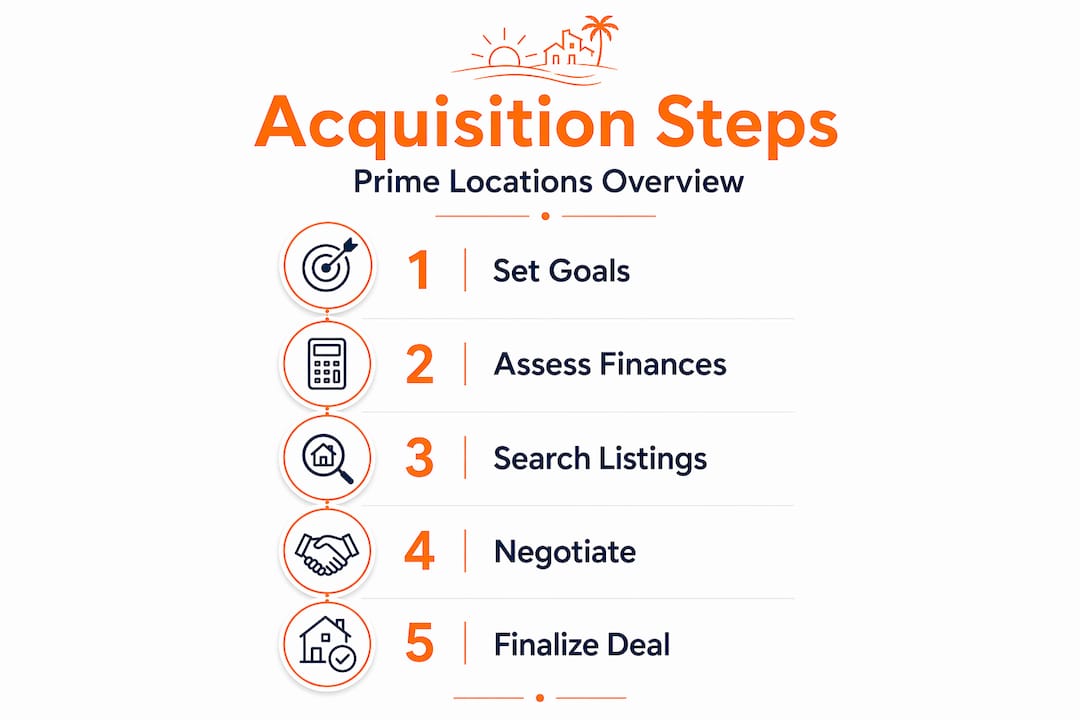
Once preparation is complete, the foreign real estate process itself unfolds in a structured sequence. Understanding each stage removes the anxiety that often accompanies cross-border transactions and gives you the leverage to negotiate from a position of genuine knowledge.

  1. Property search and market positioning. Work with a specialist portal or local advisor who has access to off-market inventory. The most prestigious Riviera acquisitions, from Cap d’Antibes privacy estates to Èze clifftop retreats, rarely reach public listings.
  2. Reservation and deposit. Once a property is identified, a reservation agreement secures it while due diligence proceeds. Deposits typically range from 1% to 10% of the purchase price. Confirm the conditions under which your deposit is fully refundable before signing.
  3. Due diligence. This is the stage most buyers underestimate. Your lawyer must verify clear title, check for mortgages or encumbrances registered against the property, confirm compliance with planning permissions, and review community charges. Notaries in civil law countries act as neutral public officials. They do not conduct property due diligence or protect your interests. Independent legal counsel is not optional.
  4. Preliminary contract. A formal purchase agreement or compromis de vente locks in price, conditions, and timelines. Penalties for withdrawal by either party become enforceable from this point.
  5. Financing confirmation. Mortgage approval, if applicable, must be secured before the final deed. Build adequate time into your timeline for lender processing.
  6. Deed signing and completion. The final act takes place before a notary. If you cannot attend in person, a Power of Attorney grants your lawyer full authority to sign on your behalf, a practical necessity for remote international buyers.
StageTypical durationKey risk if rushed
Reservation to due diligence complete2 to 6 weeksEncumbrances discovered post-deposit
Preliminary contract to deed4 to 12 weeksFinancing delays or ID number expiry
Deed signing to registration2 to 4 weeksTitle not enforceable against third parties

Pro Tip: Never sign a preliminary contract until your lawyer has completed at least a preliminary title search. The enthusiasm of the moment is not worth the legal exposure.

Financing and managing the transaction

For many global investors, the financing dimension of an international real estate purchase carries the greatest complexity and the greatest risk of delay. The good news is that the landscape has shifted decisively in buyers’ favour.

Investor and advisor reviewing property spreadsheets

Modern global underwriting evaluates your complete financial picture, worldwide income, assets, and liabilities, rather than demanding local residency or domestic tax returns. This approach is now available across more than 20 major markets, making non-resident mortgage access far more achievable than it was a decade ago. For Riviera buyers, the financing options for non-residents have expanded considerably alongside France’s easing interest rate environment in 2026.

When it comes to transferring funds internationally, discipline and early action are everything. Consider these principles:

  • Verify all wiring instructions by telephone before any transfer, using contact details sourced independently from the email thread, since wire fraud targeting property transactions is a real and growing risk
  • Send funds at least one week before closing, given that AML and KYC checks by receiving banks can delay credit by several business days
  • Use a regulated currency specialist rather than your retail bank for large transfers; the difference in exchange rates on a €2 million purchase can exceed €20,000
  • Confirm receipt with your notary or lawyer the moment funds arrive, and again 24 hours before the scheduled deed signing

Closing cost modelling deserves equal rigour. Buyers consistently underestimate the full acquisition cost when comparing property prices across borders. In France, notary fees and registration taxes together typically add 7 to 8% to the purchase price for resale properties, though new-build acquisitions under VEFA contracts benefit from lower notary fees, one of the most compelling financial arguments for Sainte-Maxime’s off-plan beachside developments or Nice’s Mont Boron sea-view towers. Building a tax and cost model before committing is not caution. It is professional discipline.

Post-purchase verification and ownership formalities

Signing the deed is not the end of the process. It is the beginning of a critical final chapter that too many buyers neglect, sometimes with serious consequences for the enforceability of their ownership.

ObligationTimeframeConsequence of delay
Deed registration at Land Registry2 to 4 weeks post-completionTitle may not be enforceable against third parties
Local property tax registrationWithin 30 to 90 daysPenalties and backdated assessments
Community fee notificationsImmediateLiability for unpaid charges from prior owner
Rental licence applicationBefore first letIllegal letting and potential fines

Once registration is confirmed, your ongoing obligations as an international property owner take effect. In France, these include the taxe foncière, levied annually on all property owners, and, depending on occupancy, the taxe d’habitation for secondary residences. For rental activity, quarterly or annual declarations to the French tax authority are required, alongside compliance with local short-let regulations that have tightened considerably across the Côte d’Azur in recent years.

Additional post-purchase steps that are frequently overlooked include:

  • Updating your home country tax declaration to reflect foreign property ownership, required in most jurisdictions
  • Reviewing your will and succession planning in light of the new asset, particularly given EU Succession Regulation 650/2012 which may affect how French property is inherited
  • Confirming that your property insurance covers the full replacement value, not simply the purchase price, for high-value Riviera villas

Common pitfalls and how to avoid them

Even experienced investors encounter friction in the international property acquisition process. Knowing where the pressure points lie allows you to pre-empt them rather than resolve them under time pressure.

The most recurring issues centre on the following:

  • Identification number delays. In Spain, NIE certificate validity is only three months, meaning that if a purchase is delayed, the certificate expires and the entire application must be resubmitted. Build a minimum four-week buffer into any Spanish transaction timeline.
  • Misplaced trust in the notary. Across civil law jurisdictions including France, Spain, and Italy, the notary authenticates and registers the transaction. The notary does not investigate the property’s legal history on your behalf.
  • Wire transfer fraud and delays. A single miscommunication about account details can freeze a transaction at the worst possible moment. Always verify.
  • Ignoring FIRPTA obligations in US purchases. Foreign owners of American real estate face a 15% withholding at sale under the Foreign Investment in Real Property Tax Act, with the buyer acting as the withholding agent. Unawareness of this rule has derailed otherwise smooth closings.
  • Incomplete Power of Attorney documentation. For remote buyers, a poorly drafted or insufficiently apostilled power of attorney can prevent your lawyer from completing critical steps at the notary’s office.

“The buyers who navigate international acquisitions with the least stress are those who treat the legal and financial preparation as the main event, not the paperwork before the main event.”

Seek expert negotiation strategies as early as the offer stage to protect your position through every subsequent phase.

My perspective: what the process really demands

I have worked alongside global buyers acquiring properties from the sun-bleached ramparts of Èze to the yacht-lined quays of Antibes, and the pattern I see most consistently is this: the buyers who struggle are not the ones who lack funds or ambition. They are the ones who treat the acquisition process as a sequence of bureaucratic inconveniences rather than a design challenge that requires genuine architecture.

Every international property purchase is, at its core, an operating system. It has legal dependencies, financial sequencing, tax consequences, and ongoing obligations that interact with each other in ways that are not always visible at the start. The buyers I have seen lose deposits, miss completions, or face unexpected tax bills upon sale almost always share one characteristic. They outsourced the process to advisors they barely vetted and assumed the transaction would simply move forward on its own momentum.

My honest advice: spend as much time selecting your lawyer, your currency specialist, and your tax adviser as you spend selecting the property itself. A spectacular villa in Roquebrune Cap Martin or a sea-view estate above Menton’s lemon-scented promenade is a generational asset. The advisers who protect that asset deserve the same scrutiny you apply to the stone and mortar itself.

The investors who build lasting, multi-generational portfolios through the international real estate purchase process share one characteristic above all others. They plan for complexity, not despite it.

— ab

Discover your next prestige acquisition with Livingonthecotedazur

At Livingonthecotedazur, we have spent years curating a constellation of the world’s most sought-after properties, from Monaco-border prestige estates to biophilic new-builds steps from Sainte-Maxime’s Nartelle sands. Our team combines deep local expertise with a global reach spanning Dubai, Ibiza, Bali, Portugal, and Mauritius, offering you the rare combination of local intimacy and international perspective. We also accept cryptocurrency payments, reflecting the reality of today’s discerning investor. Explore our off-market Côte d’Azur listings for properties that never reach public portals, and discover why the Riviera’s finest estates are acquired, not simply purchased. Contact us for a personalised consultation tailored to your investment goals and legacy vision.

FAQ

What is the international property acquisition process?

The international property acquisition process is the complete sequence of legal, financial, and administrative steps required to purchase real estate in a foreign jurisdiction. It covers everything from initial preparation and due diligence through to deed registration and post-purchase compliance.

Do I need a local lawyer for overseas property buying?

Yes, independent legal counsel is non-negotiable. Notaries in civil law countries act neutrally and do not protect the buyer’s interests, meaning only a lawyer appointed exclusively by you can verify title and check for encumbrances.

How much should I budget for closing costs abroad?

Closing costs for international buyers typically range from 2% to 20% of the purchase price depending on the country, with France’s resale market sitting at approximately 7 to 8% when notary fees and transfer taxes are combined.

Can non-residents get a mortgage for a foreign property purchase?

Yes. Global underwriting models now assess a buyer’s worldwide income and assets across more than 20 major markets, removing the requirement for local residency or domestic tax returns to qualify for financing.

How long does property registration take after completion?

Post-completion deed registration at the local Land Registry generally takes between 2 and 4 weeks. Until registration is finalised, your title may not be fully enforceable against third parties.

Recommended

  • Luxury real estate transactions: step-by-step guide 2026
  • How to buy luxury property in Portugal: your 2026 guide
  • 7 Essential Steps for Buying Luxury Property in 2025
  • Key steps in international luxury property buying 2026
by Websols Servicedesk/21 May 2026/in Landingpage
https://www.livingonthecotedazur.com/wp-content/uploads/2026/05/1779116671176_Man-reviews-international-property-documents-at-table.jpeg 714 1280 Websols Servicedesk https://www.livingonthecotedazur.com/wp-content/uploads/2024/02/sitelogo150.png Websols Servicedesk2026-05-21 02:00:562026-05-21 02:01:00International property acquisition process: 2026 guide


TL;DR:

  • Waterfront property offers unmatched scarcity, reputation, and lifestyle benefits, making it a resilient investment.
  • Thorough due diligence, including specialist marine inspections and environmental assessments, is essential before purchasing to mitigate risks.

There is a particular kind of clarity that comes from standing at the water’s edge, watching dawn light fracture across a still sea, and knowing that view is yours. That feeling is precisely why buy waterfront property remains one of the most searched questions among discerning investors and homebuyers every year. At Livingonthecotedazur, we work with clients who understand that a waterfront home is rarely just a home. It is a position. A legacy. And, when chosen with precision, one of the most resilient assets a portfolio can hold.

Table of Contents

  • Key takeaways
  • 1. Why buy waterfront property: the core case
  • 2. Evaluating a waterfront property before you commit
  • 3. Lifestyle benefits of owning waterfront property
  • 4. Investment advantages of waterfront real estate
  • 5. Comparing waterfront investment options across Côte d’Azur villages
  • 6. Risks and considerations specific to 2026
  • My perspective on waterfront property as a long-term commitment
  • Discover your waterfront property on the Côte d’Azur
  • FAQ

Key takeaways

PointDetails
Scarcity drives valueWaterfront homes command a 36% price premium per square foot compared to inland properties.
Lifestyle and health benefitsCoastal residents tend to live longer and report higher wellbeing due to outdoor access and cleaner air.
Due diligence is non-negotiableSpecialist marine inspections, flood zone assessments, and legal audits protect your investment before purchase.
Côte d’Azur leads in prestigeVillages such as Beaulieu-sur-Mer, Cannes, and Cap-d’Ail offer exceptional waterfront appeal with strong appreciation trends.
Risk awareness sharpens returnsRising flood insurance costs and environmental regulations in 2026 must be factored into every waterfront acquisition.

1. Why buy waterfront property: the core case

Waterfront property occupies a category of its own, and that distinction is not merely sentimental. Shoreline is finite. You cannot manufacture more of it, and the world’s population of high-net-worth buyers grows larger every year. That structural imbalance between supply and demand underpins strong price appreciation over decades, particularly in markets like the Côte d’Azur where international demand is persistent and inventory is tightly held.

Beyond economics, there is a quality of life argument that is genuinely difficult to replicate elsewhere. The proximity to water shapes daily routines, social habits, and even health outcomes in measurable ways. For buyers seeking both lifestyle fulfilment and financial returns, this convergence of emotional and monetary value is the defining reason to act.

2. Evaluating a waterfront property before you commit

Not all waterfront is created equal. The view from a clifftop terrace in Èze and the private jetty access of a Cap-d’Ail villa represent entirely different asset profiles, and each demands its own evaluation framework.

Before you commit, consider the following:

  • Water access rights. Confirm whether the property includes deeded beach rights, a private dock, or shared coastal access. Deeded dock rights can accelerate resale by 18 to 28% compared to similar waterfront homes without them.
  • Flood zone classification. Request the official flood zone designation from local authorities. Properties in high-risk zones can carry price discounts of 10 to 15%, but this discount is often offset by significantly elevated insurance premiums.
  • Structural and marine integrity. Standard home inspections miss what matters most at the water’s edge. Seawall failures, dock deterioration, and foundation erosion are costly hidden problems that only a specialist marine contractor will identify. Seawall repairs alone can run from €140,000 to over €450,000.
  • Environmental and coastal regulations. Many waterfront jurisdictions impose strict controls on shoreline modifications, construction proximity to water, and vegetation removal. Understanding local regulatory constraints early prevents costly surprises after acquisition.
  • Legal title clarity. On the Côte d’Azur, boundary lines at the water’s edge require careful legal audit. We always recommend a French notaire with coastal property experience before any offer is formalised.

Pro Tip: Buying in winter gives you a clearer picture of a waterfront property’s true condition. Shoreline drainage, erosion patterns, and flood susceptibility are far more visible when foliage is absent and rainfall is higher. Competition is also lower, which creates better negotiating conditions.

3. Lifestyle benefits of owning waterfront property

The benefits of waterfront living are not abstract. They are woven into the texture of each day, from the sound of water at dawn to the social rituals that form naturally around shared access to the sea.

“Waterfront living can improve quality of life by encouraging outdoor activities and social interactions unique to water access.” Health and lifestyle research consistently supports what waterfront homeowners already know.

Here is what changes when you live at the water:

  • Physical activity becomes habitual. Paddleboarding off Pampelonne, kayaking around the Lérins islands near Cannes, or simply swimming from your private cove on a September morning. Access shapes behaviour, and that behaviour compounds into real health outcomes.
  • Coastal residents live measurably longer. Studies show that coastal living adds approximately one year to life expectancy, attributed to milder climates, superior air quality, and higher rates of outdoor recreation.
  • Privacy is a genuine luxury. Waterfront plots, particularly in villages like Beaulieu-sur-Mer or along Cap-d’Ail’s coastal sentiers, offer a natural boundary that inland properties simply cannot replicate. The sea itself becomes your most elegant screen.
  • Seasonal richness. The Côte d’Azur waterfront is not a summer-only proposition. Menton’s Lemon Festival in February, the Cannes Film Festival regatta season in May, and the golden light of autumn across the Baie des Anges all offer distinct reasons to be present year-round.
  • Wellbeing and connection to nature. Salt-kissed air, the rhythm of tides, the particular blue of Mediterranean water in late afternoon. These are not decorative details. They constitute a daily restorative experience that urban properties, however grand, cannot offer.

4. Investment advantages of waterfront real estate

Waterfront property advantages extend well beyond lifestyle. For investors who understand the Côte d’Azur market, these assets represent one of the most dependable wealth preservation strategies available.

Agent tours buyers at waterfront property

Investment metricWaterfront property performance
Price premium per sq ftApproximately 36% above inland equivalents
Sales velocity (with dock rights)18 to 28% faster than comparable waterfront homes
Côte d’Azur annual appreciation5 to 8% per annum in prime coastal locations
Rental yield (elite seasonal lets)3 to 5% net yield for prestige waterfront properties
Market resilienceStronger than inland equivalents during downturns

The Côte d’Azur waterfront demand from international buyers and retirees creates a persistent supply constraint that insulates prime properties from market volatility better than almost any other asset class. When London, New York, or Singapore markets correct, the Riviera’s scarcest addresses hold their value with remarkable composure.

For families, the legacy dimension is equally compelling. An estate on the coast at Roquebrune-Cap-Martin or Saint-Jean-Cap-Ferrat does not depreciate in meaning across generations. It appreciates in both monetary and emotional terms. Explore the key features of French Riviera real estate to understand why this market is structured differently from almost anywhere else in the world.

Pro Tip: Waterfront properties with private deep-water access on the Côte d’Azur are genuinely rare. When one becomes available, the decision window is short. We advise clients to have financing or crypto-payment structures confirmed in advance so that offers can be made without delay.

5. Comparing waterfront investment options across Côte d’Azur villages

Different villages along the Riviera offer genuinely distinct waterfront profiles. Understanding those differences is the difference between a good acquisition and a great one.

VillageWaterfront characterInvestment appealLifestyle draw
CannesCroisette sea frontage, yacht marinaHigh demand, festival-driven prestigeFilm Festival energy, Lérins island kayaking
Beaulieu-sur-MerProtected bay, sheltered cove accessConsistent appreciation, discreet luxuryBelle Époque architecture, calm sea conditions
Cap-d’AilRocky coastal paths, Monaco proximityMonaco-adjacent premium, privacyCoastal sentiers, proximity to principality
Saint-Jean-Cap-FerratPeninsula exclusivity, private beachesAmong the world’s most prestigious addressesVilla culture, crystal-clear coves
Roquebrune-Cap-MartinDramatic clifftop sea viewsHeritage prestige, limited supplyLe Corbusier legacy, coastal hiking
Théoule-sur-MerCalanques, wild shorelineGrowing demand, natural settingUnspoilt coves, Estérel backdrop

International buyers consistently rank Saint-Jean-Cap-Ferrat and Cannes among their top choices, but villages such as Théoule-sur-Mer and Beaulieu-sur-Mer are increasingly attractive for buyers who want prestige without the headline price tags. The spectrum of waterfront real estate benefits here is broader than many buyers initially appreciate.

For a comparable perspective on what Mediterranean waterfront values look like in a different regional context, sea-view properties in Mallorca illustrate how the same scarcity principle operates across European coastal markets.

6. Risks and considerations specific to 2026

Investing in waterfront homes demands an honest accounting of costs and risks that are unique to this property type. In 2026, several developments make that accounting more pressing than in previous years.

  • Flood insurance costs are rising sharply. Premiums increased 15 to 18% in 2025, with comparable hikes projected through 2026 as regulators recalibrate risk models for coastal properties. Budget for this as a fixed annual cost, not an occasional expense.
  • Flood zone maps are being updated. Many properties previously classified as low-risk have been reclassified under revised FEMA-equivalent frameworks across European jurisdictions. A property’s designation can change between listing and completion, so verify the current zone status independently.
  • Structural maintenance is expensive and ongoing. Seawalls require periodic inspection and repair. Foundation systems exposed to tidal movement or erosive shorelines need monitoring every few years. Dock and pontoon maintenance adds further to annual costs.
  • Specialist inspections are not optional. A marine contractor inspection is the only way to assess dock integrity, erosion risk, and submerged structural elements. Standard property surveys do not cover these areas, and the consequences of missing them can be severe.
  • Environmental protections restrict modifications. Coastal regulations on the Côte d’Azur limit what you can build, extend, or alter near the shoreline. For buyers planning renovations or new constructions, understanding these protections before purchase prevents expensive redesigns or, worse, legal challenges after works begin.

The risks are real. But for buyers who conduct thorough due diligence, they are manageable, and they do not diminish the exceptional long-term case for waterfront real estate benefits in markets with genuine scarcity and prestige.

My perspective on waterfront property as a long-term commitment

I have worked alongside buyers who arrived with spreadsheets and left with something closer to a love affair. That is not a weakness in their decision-making. It is actually a reliable signal that the property has substance. The best waterfront acquisitions I have seen share a common characteristic: the buyer understood both the emotional pull and the financial fundamentals, and neither cancelled out the other.

What I have learned from years of watching these transactions is that the buyers who regret their waterfront purchase almost always cut corners on due diligence. They skipped the marine inspection. They did not verify the flood zone reclassification. They moved quickly because they were afraid of losing the property to another buyer, and they paid for that speed later in maintenance bills and insurance shocks.

The buyers who look back with satisfaction are the ones who took the time to understand what they were actually buying. Not just the view, magnificent as it is. But the seawall condition, the coastal access rights, the regulatory envelope around what can be modified, and the true all-in annual cost of ownership.

My honest view is this: is waterfront property worth it? Unequivocally yes, in the right location and with the right preparation. The Côte d’Azur offers a concentration of prestige, scarcity, and second-home lifestyle value that very few coastal markets in the world can match. But it rewards patience and precision, not impulse.

— ab

Discover your waterfront property on the Côte d’Azur

At Livingonthecotedazur, we curate access to some of the most exclusive waterfront addresses on the French Riviera, including properties that never appear on the open market. Our portfolio spans private villas with direct sea access in Beaulieu-sur-Mer, cliff-edge estates above Roquebrune-Cap-Martin, and discreet Cap-d’Ail retreats within minutes of Monaco. We guide clients through every stage of the acquisition process, from legal audits and marine inspections to legacy structuring and cryptocurrency-enabled transactions. If you are ready to explore off-market waterfront opportunities or want a tailored conversation about luxury investment options on the Riviera, we are here to guide you with the discretion and depth that this decision deserves.

FAQ

Why buy waterfront property over inland alternatives?

Waterfront homes command a 36% premium per square foot driven by finite shoreline supply, and they offer lifestyle advantages in health, privacy, and outdoor access that inland properties cannot replicate.

Is waterfront property worth it as a long-term investment?

Yes, particularly in prestige markets like the Côte d’Azur, where international buyer demand restricts supply and supports annual appreciation of 5 to 8% in prime coastal locations.

What are the biggest risks of buying waterfront property in 2026?

Rising flood insurance premiums, updated flood zone classifications, and structural maintenance costs such as seawall repairs are the primary financial risks buyers must account for before purchasing.

Do I need a specialist inspection for a waterfront home?

Yes. A marine contractor inspection is necessary to assess dock integrity, erosion risk, and submerged structural elements that standard property surveys will not cover.

Which Côte d’Azur villages offer the best waterfront investment potential?

Saint-Jean-Cap-Ferrat, Cannes, and Beaulieu-sur-Mer consistently attract international buyers and deliver strong prestige value, while Théoule-sur-Mer and Cap-d’Ail offer growing appeal at comparatively accessible price points.

Recommended

  • 7 Essential Steps for Buying Luxury Property in 2025
  • How to select prime Côte d’Azur real estate in 2026
  • How to buy luxury property in Portugal: your 2026 guide
  • High-end property explained: Côte d’Azur luxury guide 2026
by Websols Servicedesk/20 May 2026/in Landingpage
https://www.livingonthecotedazur.com/wp-content/uploads/2026/05/1779039225395_Coastal-homeowner-enjoying-waterfront-view-indoors.jpeg 714 1280 Websols Servicedesk https://www.livingonthecotedazur.com/wp-content/uploads/2024/02/sitelogo150.png Websols Servicedesk2026-05-20 04:00:412026-05-20 04:00:46Why buy waterfront property: a 2026 guide


TL;DR:

  • Acquiring a luxury apartment on the Côte d’Azur requires thorough preparation, off-market access, and detailed due diligence to secure a long-term asset.
  • Understanding your financial capacity, objectives, and micro-market nuances ensures a strategic purchase aligned with your lifestyle, legacy, or investment goals.

Acquiring a luxury apartment in a prime location is one of the most rewarding decisions a high-net-worth individual can make. It is also one of the most unforgiving if approached without a clear framework. From the lavender-laced hillsides above Èze to the salt-kissed promenades of Cannes and the yacht-dotted harbour of Antibes, the Côte d’Azur concentrates extraordinary opportunity within a remarkably competitive market. Understanding the luxury apartment acquisition steps before you move is not merely prudent. It is the difference between securing a generational asset and losing the finest property to a more prepared buyer.

Table of Contents

  • Key takeaways
  • Prerequisites and preparation before acquisition
  • The step-by-step acquisition process
  • Legal, financial, and tax considerations
  • Post-purchase management and long-term value
  • Our perspective on acquiring luxury apartments with intention
  • Discover exclusive off-market properties with Livingonthecotedazur
  • FAQ

Key takeaways

PointDetails
Preparation precedes everythingDefine your financial capacity, investment horizon, and lifestyle objectives before viewing a single property.
Off-market access is decisiveThe most coveted luxury apartments are never publicly listed; specialist broker relationships open these doors.
Due diligence goes beyond the wallsHOA reserve funds, building financials, and vendor contracts matter as much as the apartment itself.
Legal structure protects your wealthOwnership entities and experienced international legal counsel are non-negotiable for cross-border acquisitions.
Post-purchase management sustains valueProfessional property management and rental yield monitoring protect both lifestyle and long-term ROI.

Prerequisites and preparation before acquisition

Before you begin the process of buying high-end apartments, you must first know precisely what you are buying and why. This clarity is not always as obvious as it sounds, even for seasoned investors.

Start with a frank assessment of your financial position. Liquidity matters far more in luxury transactions than headline net worth. You need capital that is genuinely accessible, not locked in other investments or awaiting divestment. Consider not just the purchase price but also acquisition costs, which in France typically range from 7 to 10% for resale properties in notary fees and transfer taxes, plus ongoing maintenance reserves.

Infographic showing luxury apartment acquisition steps

Beyond liquidity, define what we call your lifestyle utilisation score: how often will you actually occupy the property, and what proportion of the year would it realistically generate rental income? A sea-view apartment on Mont Boron in Nice commands strong seasonal returns, but only if your personal use calendar does not crowd out the peak summer weeks that drive yield.

Equally, you must clarify your primary objective before you begin:

  • Personal sanctuary: A retreat for family, perhaps during the Cannes Film Festival or Menton’s famous Fête du Citron, where lifestyle takes precedence over yield.
  • Legacy asset: A property held for generational wealth transfer, prioritising capital appreciation and estate planning compatibility.
  • Investment vehicle: A property selected primarily for rental income and capital growth, where location, specification, and management infrastructure are paramount.

Each objective dictates an entirely different acquisition strategy, preferred location, and even ideal property type. Confusing them midway through a search wastes months and, occasionally, millions.

Pro Tip: Set your non-negotiables in writing before you engage any broker. Committing your criteria to paper before the search begins protects you from the very seductive temptation of a beautiful apartment that simply does not fit your objectives.

Market knowledge specific to your target villages is genuinely irreplaceable. The character of Cap d’Antibes differs enormously from Roquebrune-Cap-Martin. Beausoleil sits a few hundred metres from Monaco but offers a different fiscal and legal environment entirely. Understand the micro-market before you commit to the macro decision.

The step-by-step acquisition process

This is the heart of any serious luxury real estate purchase guide, and it must be followed with rigour rather than enthusiasm.

  1. Access off-market opportunities. The finest luxury apartments rarely appear on public portals. Most desirable properties are never publicly advertised, and relationships with specialist luxury brokers are the only reliable gateway. In our experience at Livingonthecotedazur, the most extraordinary acquisitions happen quietly, between trusted parties, often months before any formal listing.

  2. Engage a specialised luxury property adviser. A generalist agent will not know the reserve fund status of a prestige co-propriété in Mougins, nor will they have the relationships to secure a private viewing of an off-plan residence in Sainte-Maxime before public launch. Your adviser must live and breathe this segment.

  3. Evaluate properties with precision. Go beyond the aesthetic. Assess ceiling heights, orientation relative to the sun, terrace quality, acoustics, lift access, and the calibre of the co-owners in the building. In a luxury context, the building’s reputation and management are as important as the apartment itself.

  4. Conduct thorough due diligence. This is where most buyers underestimate the complexity. Building financial health deserves the same scrutiny as the apartment itself. Request the last three years of co-propriété accounts, the maintenance forecast, HOA reserve fund levels, and any outstanding works assessments. An unexpected capital call on a luxury building can run to tens of thousands of euros per unit. For a deeper framework, our due diligence guide covers these specifics for the Côte d’Azur market.

  5. Arrange financing early. If you are not purchasing in cash, begin conversations with your private bank or specialist lender before you identify a target property. Jumbo loans require 20 to 30% down payments and credit scores around 700 or above, with terms that vary considerably between portfolio lenders and private institutions. At Livingonthecotedazur, we also work with buyers who prefer cryptocurrency as part of their acquisition structure.

  6. Negotiate with strategy, not urgency. In a competitive prime market, rushing signals desperation. Understand the seller’s motivation: are they relocating, liquidating for an estate, or simply testing the market? Each scenario creates different leverage points. Price is rarely the only negotiable term. Completion timelines, included furnishings, and service charges in transition can all form part of a compelling offer.

  7. Close with professional oversight. Luxury transactions typically take between 3 and 6 months from offer to completion. The notarial process in France is thorough and protective, but it requires coordination between your notaire, your legal counsel, and your financial adviser. Never treat closing as a formality.

Pro Tip: Patience is not passive. The buyers who secure the most coveted apartments are those who remain calm, informed, and ready to move decisively when the right property appears. Preparation is what makes decisiveness possible.

StageKey actionCommon mistake
SearchAccess off-market listings via specialist brokerRelying solely on public property portals
EvaluationAssess building financials and HOA healthFocusing only on interior aesthetics
FinancingArrange private bank approval in advanceAssuming cash-equivalent speed with loans
NegotiationExplore all terms, not just priceOffering urgently in a competitive situation
ClosingCoordinate notaire, legal counsel, and lenderTreating the process as a formality

Legal, financial, and tax considerations

Buying luxury apartments across international borders introduces a layer of complexity that no amount of enthusiasm can substitute for professional expertise. This applies whether you are a European buyer acquiring on the Riviera or a global investor purchasing from Dubai, Bali, or Mauritius.

The ownership structure you choose at the outset shapes every financial outcome thereafter. International investors often establish LLCs or equivalent legal entities to limit personal liability, facilitate inheritance, and sometimes mitigate estate tax exposure. In France, the Société Civile Immobilière (SCI) is the most widely used vehicle for this purpose, offering flexibility in ownership transfer and estate planning.

Tax implications deserve specific attention:

  • Wealth tax (IFI): France levies an annual tax on real property assets above €1.3 million, which applies to non-residents holding French property directly.
  • Capital gains tax: Non-resident sellers are subject to French capital gains tax, though allowances increase with the duration of ownership.
  • Rental income taxation: Income generated from French property is taxable in France, regardless of where you are tax resident.
  • Inheritance and legacy planning: Without proper structuring, French succession law applies to French-situated assets, which may conflict with your home country’s testamentary intentions.

Experienced legal advisers who understand both local property law and cross-border complexity are not a luxury add-on. They are the foundation of a sound acquisition. We consistently recommend engaging specialist estate planning counsel in conjunction with your French notaire to create a structure that serves your legacy ambitions as well as your immediate acquisition.

“A well-structured acquisition is not just a purchase. It is the first chapter of a legacy, written in stone on one of the world’s most coveted coastlines.”

The international buyer’s guide from Livingonthecotedazur provides an updated framework for 2026 specifically addressing these cross-border intricacies, including the evolving regulatory environment for non-EU purchasers.

Post-purchase management and long-term value

The day you receive the keys is not the end of the acquisition process. It is, in many respects, the beginning of a more sustained commitment.

Luxury apartment owner hands keys to manager

Professional property management is indispensable for any owner who is not permanently resident on the Côte d’Azur. Luxury apartments require a standard of upkeep commensurate with their specification, and remote ownership without trusted local management invariably leads to deferred maintenance and diminished value.

Key responsibilities to plan for from day one include:

  • Routine maintenance: Climate control servicing, pool and terrace care, concierge coordination, and seasonal preparation all require consistent professional oversight.
  • Building governance: Attend or be represented at annual co-propriété general meetings. Vote on major works. Monitor the syndic’s management of reserve funds.
  • Rental performance: If you are generating seasonal income, review occupancy rates, average nightly rates, and guest feedback quarterly. The Riviera’s rental market is sophisticated and rewards well-managed, well-presented properties.
  • Resale readiness: Even if you intend to hold for a decade or more, maintain the property as if you could sell tomorrow. The buyers of the finest apartments on the Côte d’Azur are exacting, and presentation at the moment of sale commands a significant premium.

Pro Tip: Invest time in building a genuine relationship with your local property manager, not merely a transactional one. The managers who go beyond their brief during a crisis or a difficult tenant situation are the ones who protect your investment and your reputation as a landlord.

Our perspective on acquiring luxury apartments with intention

I have spent years observing how the most successful acquisitions on the Côte d’Azur unfold, and the pattern is consistent. The buyers who build genuine wealth through luxury property are not the fastest or the most aggressive. They are the most prepared, the most patient, and the most honest with themselves about what they actually want.

I have watched buyers rush into a Cannes apartment because the Croisette views were intoxicating, only to discover six months later that the co-propriété’s reserve fund was essentially depleted and a major façade restoration was pending. I have also watched buyers spend eighteen months building relationships and refining their criteria before securing an off-market penthouse in Saint-Jean-Cap-Ferrat at a genuinely remarkable price, because they were known, trusted, and ready.

The misconception I encounter most often is that luxury property is inherently liquid. It is not. Resale timelines of three to six months are common even in prime locations, and that assumes you have priced correctly and the market is receptive. Luxury apartments are exceptional long-term wealth vehicles. They are not short-term trading instruments.

My honest advice: approach every acquisition as though you intend to hold it for twenty years. That mindset forces you to scrutinise the building, the location’s trajectory, the legal structure, and the management infrastructure with the rigour these decisions deserve. The lifestyle dividend, whether that is waking above Baie des Anges or cycling the coastal sentiers of Cap d’Antibes, is the pleasure. The wealth preservation is the purpose.

— ab

Discover exclusive off-market properties with Livingonthecotedazur

At Livingonthecotedazur, we curate access to the acquisitions that never appear on public portals. Our portfolio of invisible luxury properties on the Côte d’Azur represents the finest collection of off-market opportunities available to discerning buyers in 2026. From biophilic-design new builds in Sainte-Maxime to Monaco-adjacent residences in Beausoleil, we provide bespoke guidance at every stage of your acquisition. We welcome buyers from across the globe, and we accept cryptocurrency alongside traditional payment structures. If you are ready to invest in stones that grow in value and carry meaning across generations, we invite you to begin the conversation with our team today.

FAQ

What are the key luxury apartment acquisition steps?

The core steps are: define your objectives and financial capacity, access off-market listings via a specialist broker, evaluate properties with thorough due diligence including building financials, arrange appropriate financing or legal ownership structures, negotiate strategically, and close with coordinated professional oversight. Each step demands more rigour than in standard residential transactions.

How long does it take to acquire a luxury apartment in France?

Luxury transactions typically take between 3 and 6 months from accepted offer to completion, accounting for notarial procedures, due diligence, and financing. Off-plan purchases under a VEFA contract follow a different timeline aligned with construction progress.

Do international buyers need a special legal structure to purchase in France?

It is strongly advisable. Many international buyers use an SCI (Société Civile Immobilière) to manage inheritance, reduce estate tax exposure, and facilitate ownership transfer. Experienced legal counsel who understands both French property law and your home country’s legal framework is essential before you commit to any structure.

How do I find off-market luxury apartments on the Côte d’Azur?

Off-market access comes exclusively through trusted broker relationships built over time. Specialist portals like Livingonthecotedazur maintain curated networks of sellers who prefer to transact quietly, away from public exposure, which is where the most compelling acquisitions consistently occur.

What is the typical rental yield for a luxury apartment on the French Riviera?

Prime Côte d’Azur luxury apartments can generate 3 to 5% annual rental yields through elite seasonal lets, particularly in high-demand locations near Cannes, Antibes, and Saint-Jean-Cap-Ferrat during the summer and festival seasons. Yield varies considerably by location, specification, and quality of management.

Recommended

  • Luxury real estate transactions: step-by-step guide 2026
  • 7 Essential Steps for Buying Luxury Property in 2025
  • Luxury home acquisition workflow for legacy living 2026
  • Essential steps to buying luxury property in Dubai
by Websols Servicedesk/19 May 2026/in Landingpage
https://www.livingonthecotedazur.com/wp-content/uploads/2026/05/1778973933379_Woman-reviews-luxury-apartment-buying-documents-in-kitchen-1.jpeg 715 1280 Websols Servicedesk https://www.livingonthecotedazur.com/wp-content/uploads/2024/02/sitelogo150.png Websols Servicedesk2026-05-19 02:00:522026-05-19 13:11:55Luxury apartment acquisition steps in prime locations


TL;DR:

  • More listings do not lead to better outcomes in luxury real estate; curated selection simplifies decision-making.
  • A personalized, concierge-driven approach filters properties to match specific criteria, reducing risks and saving time while aligning with long-term legacy goals.

The assumption that more listings mean better outcomes is one of the most expensive misconceptions in luxury property. When you are searching for an estate on the French Riviera, wading through hundreds of irrelevant listings does not sharpen your decision. It clouds it. Understanding what is real estate curation, and why it represents a fundamentally different way of approaching the market, is the first step towards acquiring a property that serves your legacy, your family, and your future. This guide explains what curation means in practice, how it works in the luxury segment, and why it matters profoundly on the Côte d’Azur.

Table of Contents

  • Understanding real estate curation and its benefits
  • The luxury concierge model: end-to-end curation and estate handling
  • Curated listings versus traditional listings: quality and relevance
  • Applying real estate curation in luxury Riviera investments
  • Why curated real estate is the future of luxury investing on the Riviera
  • Discover curated luxury properties and tailored investment services on the Côte d’Azur
  • Frequently asked questions

Understanding real estate curation and its benefits

At its simplest, the real estate curation definition is the practice of filtering an entire market down to a precise selection of properties that match a buyer’s specific criteria. Rather than presenting you with forty listings a week and leaving you to sift through them, a curated service presents you with three to five properties, each chosen because it genuinely aligns with what you are seeking. As curated home searches demonstrate, curation means filtering a small set of properties that match specific criteria, offering fewer false positives and faster decision-making. Fewer choices, made well, is the entire philosophy.

The benefits of real estate curation are tangible for high-net-worth investors who value their time as much as their capital. Consider what it means to be searching along the coast between Cap d’Antibes and Monaco. The market includes hundreds of villas, penthouse residences, and off-plan opportunities. Many will fail your criteria on the first or second criterion alone, whether that is sea view orientation, green certification, or structural integrity. Curation eliminates those properties before they ever reach you.

Key advantages of a curated approach include:

  • Time preservation. You review only properties that have already passed rigorous screening.
  • Reduced decision fatigue. Fewer, better options lead to clearer, faster choices.
  • Alignment with legacy goals. Properties are selected against long-term investment criteria, not just listing availability.
  • Lower risk of costly errors. Careful pre-selection filters out properties with legal ambiguities or hidden structural concerns.
  • Lifestyle coherence. A curated shortlist reflects how you intend to live, not merely what is available.

For investors focused on curating high-value real estate that will appreciate over generations, this approach is not a convenience. It is a necessity.

The luxury concierge model: end-to-end curation and estate handling

In the luxury segment, the real estate curation process extends well beyond selecting which properties to show you. The most sophisticated interpretation of curation is the concierge model, in which a dedicated team manages every stage of the estate journey on your behalf. From initial valuation through legal due diligence, technical surveys, negotiation, and closing, the concierge service removes every burden you would otherwise carry alone. Luxury concierge services provide comprehensive estate handling from valuation through closing, removing client burdens and coordinating legacy asset management.

Estate concierge handling luxury service tasks

For a family acquiring a Provençal mas near Menton or a sea-view residence above Èze, this coordination is not a luxury add-on. It is protection. The Riviera market in 2026 rewards buyers who move with both speed and precision, and a concierge model delivers both.

A typical concierge-curated acquisition follows this sequence:

  1. Initial briefing. Your adviser defines criteria across budget, lifestyle preferences, sustainability requirements, and legacy priorities.
  2. Market research. The team analyses on-market and off-market inventory, targeting properties with proven appreciation records.
  3. Property shortlisting. A refined selection is presented, typically three to five estates that meet your full criteria.
  4. Due diligence coordination. Legal audits for title clarity, technical surveys for seismic resilience, and financial modelling are arranged and managed.
  5. Negotiation and closing. Your adviser leads price negotiation and coordinates notary processes, often securing terms unavailable to unrepresented buyers.
  6. Post-acquisition support. Introductions to property managers, rental specialists, and sustainability consultants are provided for ongoing estate management.

Pro Tip: When engaging a personalised real estate service on the Riviera, ask explicitly whether their concierge fee is embedded in commission or charged separately. Most reputable services include project management within their commission structure, though third-party costs such as renovations are billed independently.

Curated listings versus traditional listings: quality and relevance

The contrast between curated and traditional listings becomes most apparent when you consider what each model actually delivers. A traditional high-volume property portal provides access. A curated service provides judgement. That distinction defines the entire experience.

FactorCurated listingsTraditional listings
Volume per search3 to 5 properties40 to 200+ properties
Relevance to buyerHandpicked against personal criteriaFiltered by broad parameters only
Lifestyle matchingIntegrated into selectionRarely considered
Legacy and sustainability criteriaCore to curationUsually absent
Off-market accessFrequently includedRarely available
Due diligence supportBuilt into the serviceBuyer’s responsibility
Time to shortlistDaysWeeks to months

Handpicked property searches offer small sets of homes tailored to transactional and lifestyle criteria, unlike large-volume feeds. For an investor weighing a Monaco-adjacent villa against a restored farmhouse near Antibes, the difference in experience is the difference between clarity and noise.

Infographic comparing curated and traditional listings

The properties most worth having on the Côte d’Azur rarely appear on conventional portals at all. The most sought-after estates in Cannes, Saint-Tropez, and along the Cap d’Antibes coastal paths change hands quietly, through networks built on trust and long-standing relationships. Curation, at its best, gives you access to that world.

Consider what a curated Riviera search account for in practice:

  • Sea-view orientation and unobstructed sightlines confirmed before presentation
  • Green certifications and solar integration verified for sustainability-focused buyers
  • Rental yield potential assessed against seasonal Riviera demand
  • Proximity to lifestyle anchors such as Pampelonne’s beaches, the Lérins islands, or Antibes’ Provençal markets
  • Legal title clarity reviewed before a property appears on your shortlist

Explore buyer agent services for investors to understand how this level of care translates into tangible investment protection.

Applying real estate curation in luxury Riviera investments

Knowing how to curate real estate for your specific Riviera ambitions requires more than a list of preferences. It requires a clear articulation of what legacy means to you, what sustainability standards you hold, and what kind of lifestyle you are building for your family across generations. The Côte d’Azur in 2026 offers a rare combination of prestige, natural beauty, and measurable annual appreciation of 5 to 8% for the finest properties. But accessing the best of that market demands a curated approach.

Curated platforms integrate buyer education, local market insights, and sustainable property trends to empower faster, better decisions. That is precisely the intelligence you need when considering a biophilic-designed new build on Mont Boron with Baie des Anges panoramas, or an off-plan apartment at Sainte-Maxime where evenings unfold over Nartelle beach sunsets.

Practical steps for applying real estate curation to your Riviera investment include:

  • Define your legacy criteria first. Will this property be an income-generating asset for seasonal letting, a family sanctuary, or both? Your answer shapes every subsequent filter.
  • Specify your sustainability requirements. Eco-villas with solar arrays and green certifications are commanding premiums and attracting the heirs who value the planet alongside their portfolio.
  • Prioritise locations with proven capital growth. Cap d’Antibes for privacy, Monaco borders for prestige, Menton for Italianate charm and the annual Lemon Festival’s cultural richness.
  • Request off-market inventory. The most compelling legacy properties are rarely advertised. A curated service with strong local relationships surfaces them.
  • Engage a service that combines data and expertise. Market analytics alone cannot capture the lemon-scented particular of a Menton terrasse at dusk, or the framing of the sea from an Èze hillside residence. Expertise does.

Pro Tip: When reviewing properties shortlisted for sustainable investment, cross-reference local planning regulations with guidance from the French Riviera tourist office to understand long-term environmental restrictions that could affect rental potential or future development rights.

Explore the full range of luxury real estate on the French Riviera and review real estate investment strategies tailored to discerning buyers seeking both yield and legacy on the Côte d’Azur.

Why curated real estate is the future of luxury investing on the Riviera

We hold a considered view on this, grounded in years of working with buyers whose ambitions extend well beyond the transactional. Conventional listings do not simply overwhelm. They actively obscure what matters. In a high-volume environment, the property with a misrepresented title, the villa with an unmapped right of way, or the apartment with unresolved planning disputes sits alongside genuinely exceptional opportunities without distinction. The buyer who proceeds without curation is navigating that landscape without a guide.

The key difference in curated searches is how exclusion rules shape quality, meaning curated services save buyers from costly mistakes often hidden in high-volume property searches. That is not a subtle benefit. On the French Riviera, where individual properties represent generational wealth and the stakes of a misjudged acquisition are measured in millions, exclusion is as valuable as inclusion.

We also believe the importance of curation in real estate extends beyond efficiency. It is an act of respect for the buyer’s vision. When a family comes to us with the ambition of creating an heirloom estate above Cannes, or a digital entrepreneur seeks a sea-facing residence near Antibes to anchor their wealth in stone, what they need is not access to more listings. They need someone to understand the difference between a property that looks right and a property that is right. Curation is that understanding, made actionable.

The Riviera’s finest properties appreciate because they are rare, positioned well, and maintained to a standard that preserves their character across decades. A curated service does not simply find those properties. It protects you from the ones that merely resemble them. Explore tailored real estate services to see how this philosophy translates into every search we conduct.

Discover curated luxury properties and tailored investment services on the Côte d’Azur

At Living on the Côte d’Azur, we apply a rigorous curation process to every property we present, drawing on deep local knowledge and an extensive network of private connections across the Riviera. Whether you are seeking invisible luxury real estate on the Côte d’Azur that never reaches the open market, or building a portfolio with a focus on legacy luxury and long-term ROI, our team works exclusively at the intersection of prestige and purpose. We accept cryptocurrency, move with discretion, and understand that for our clients, a property is never simply a transaction. Begin your curated real estate journey with us today.

Frequently asked questions

What exactly does real estate curation involve?

Real estate curation involves carefully selecting a small number of properties that precisely match a buyer’s specific preferences, rather than providing large volumes of unsuitable listings. In practice, curation means filtering a small set of properties that match specific criteria, offering fewer false positives and faster decision-making.

How does a real estate concierge differ from a standard agent?

A real estate concierge offers full-service, personalised handling of all estate matters from valuation to closing, relieving clients of logistical burdens and coordinating expert services throughout. Luxury concierge services provide comprehensive estate handling from valuation through closing, removing client burdens and coordinating legacy asset management in ways a standard agent does not.

Why is curated real estate particularly valuable for luxury Riviera investors?

Curated real estate filters for properties meeting strict legacy, lifestyle, and sustainability criteria, saving time and reducing risk in a complex, competitive luxury market like the French Riviera. Curated platforms integrate buyer education, local insights, and sustainable property trends to empower faster, better decisions.

How many properties do curated services typically present at once?

Curated services generally offer three to five handpicked properties at a time, focusing on quality and relevance over quantity to match buyer preferences closely. Rather than sending forty listings a week, clients receive hand-selected homes tailored to lifestyle and investment goals.

Are there additional costs for using concierge real estate services?

Typically, concierge real estate services include their expertise and project management within the commission, though third-party expenses such as renovations are billed separately. Clients do not pay a separate fee for concierge expertise or project management, though third-party costs may apply.

Recommended

  • Curating High-Value Real Estate: Legacy and ROI
  • High-net-worth real estate: Legacy, luxury, and ROI
  • How to Evaluate Luxury Real Estate for Smarter Investments
  • The Exclusive Real Estate Buying Guide – Living on the Côte d’Azur
by Websols Servicedesk/18 May 2026/in Landingpage
https://www.livingonthecotedazur.com/wp-content/uploads/2026/05/1778890661530_Advisor-reviewing-Riviera-luxury-property-dossiers.jpeg 715 1280 Websols Servicedesk https://www.livingonthecotedazur.com/wp-content/uploads/2024/02/sitelogo150.png Websols Servicedesk2026-05-18 02:00:452026-05-18 02:00:49What is real estate curation for luxury investors


TL;DR:

  • Touring a luxury property on the French Riviera without detailed preparation risks costly surprises from hidden defects and regulatory restrictions.
  • Thorough verification of diagnostics, planning permissions, heritage status, and independent inspections is essential before making an investment.

Touring a luxury property on the French Riviera without a clear, step by step luxury property tour plan is one of the most expensive mistakes a high-net-worth investor can make. Hidden structural defects, heritage restrictions that freeze renovation ambitions, and legal pitfalls invisible to the untrained eye can transform a dream estate into a costly ordeal before the ink dries on any contract. Whether you are drawn to a sun-washed villa above Èze, a Belle Époque townhouse in Menton steps from the Lemon Festival, or an off-plan residence overlooking Sainte-Maxime’s Garonette sands, the difference between a legacy asset and a liability lies entirely in how methodically you approach the viewing process.


Table of Contents

  • Preparing for your luxury property tour on the French Riviera
  • Conducting the step by step luxury property tour
  • Legal and financial verification after your tour
  • Common pitfalls and expert tips for luxury property tours
  • The critical role of thorough property tours in securing legacy investments
  • How Living on the Côte d’Azur supports your luxury property journey
  • Frequently asked questions

Key Takeaways

PointDetails
Comprehensive preparationGather all mandatory diagnostics and legal documents before touring a luxury property to avoid surprises.
Structured touring methodUse a step-by-step inspection focusing on structure, systems, and heritage compliance during property visits.
Legal and financial diligenceUnderstand the compromis de vente, cooling-off period, and notary fees to protect your investment legally and financially.
Avoid common pitfallsCheck environmental risks and heritage restrictions early, and commission expert surveys promptly after signing contracts.
Engage expert guidanceWork with trusted local specialists and buyer agents to access exclusive properties and navigate complex regulations.

Preparing for your luxury property tour on the French Riviera

Before you set foot inside any property, the groundwork you lay will determine everything that follows. A guided luxury home tour conducted without prior documentation review is not a tour at all; it is a gamble. We recommend treating preparation as a non-negotiable phase, equal in importance to the viewing itself.

Infographic showing luxury property tour steps

The first order of business is requesting the full diagnostics dossier from the seller. French law requires vendors to provide a package of technical reports, and a thorough European luxury listing evaluation confirms you should demand every report before stepping inside: the Diagnostic de Performance Énergétique (DPE, the energy rating), asbestos survey (amiante), lead paint report (plomb), termite certificate, electrical risk assessment, gas installation report, and the État des Risques et Pollutions (ERP) covering flood and seismic exposure. Missing even one of these can leave you blindsided.

Key documents and checks to request before any viewing:

  • Full diagnostics dossier including energy ratings, asbestos, termites and electrical risks
  • Planning permission history (permis de construire) for all structures and extensions
  • Heritage protection status: is the property listed, partially listed, or situated within a protected perimeter?
  • Urban planning certificate (certificat d’urbanisme) showing permitted uses and future development constraints
  • Condominium (copropriété) accounts and minutes if applicable, covering the last three years
  • Proof of compliance for any pool, terrace, or outbuilding additions
DocumentWhat it revealsRisk if missing
DPE energy reportRunning costs, insulation qualityUnexpected energy bills, future legal non-compliance
Amiante/plomb surveyAsbestos and lead presenceHealth hazard, costly remediation
Termite certificateActive infestation or historical damageStructural integrity loss
ERP risk reportFlood, seismic and tech risk zonesUninsurable property or restricted use
Certificat d’urbanismeBuilding rights and planning constraintsRenovation blocked or fined

Our essential checklists distil years of Riviera acquisition experience into a format you can carry into every viewing. Do not tour without them.

Also verify local urban planning rules, particularly in communes such as Antibes or Cap d’Antibes where coastal protection laws (Loi Littoral) restrict extensions and new builds. Heritage perimeters around Menton’s old town or Cannes’ Boulevard de la Croisette add further layers of restriction that can prevent you from altering even a window frame.

Pro Tip: Bring a laser distance measurer, a notebook for recording room dimensions, and a smartphone with a compass app to verify which rooms actually face the sea. Sellers’ brochures are aspirational documents; your measurements are facts.

With thorough preparation in place, let’s move on to how to conduct the property tour itself effectively.

Man taking measurements during property viewing


Conducting the step by step luxury property tour

The luxury property walkthrough is where preparation meets reality. A stepwise luxury real estate tour is not a leisurely stroll through beautiful rooms; it is a structured inspection that separates emotional appeal from investment substance. We advise clients to approach each room with the detachment of a surveyor and the instincts of someone who has seen a hundred Riviera properties before.

Stepwise touring method:

  1. Begin outside. Walk the full perimeter before entering. Inspect the roof line from a distance for sagging, missing tiles, or staining that suggests water ingress. Examine retaining walls, terraces, and any poolside structures for cracking or subsidence.
  2. Assess the foundations and basement. Look for efflorescence (white salt deposits on walls), damp patches, and cracking at junctions. These are early indicators of water table issues, common in seafront properties from Nice to Saint-Tropez.
  3. Inspect timber structures in the roof space. Ask to access the loft. Darkening, bore holes, or powdery residue around beams indicates woodworm or, worse, active termite damage, a documented risk in coastal Provence.
  4. Test all MEP systems. MEP stands for Mechanical, Electrical, and Plumbing. Run every tap, flush every toilet, switch every circuit, and feel every radiator. Outdated electrical panels are one of the most common compliance failures in older Riviera villas.
  5. Evaluate heritage and planning compliance on site. Ask the agent directly: has any work been carried out without planning permission? Unauthorised additions are the seller’s liability until they are not, and once ownership transfers, they become yours.
  6. Document everything photographically. Every crack, every damp stain, every piece of outdated wiring. These photographs become your negotiation toolkit.

Independent structural surveys are strongly recommended, as 20 to 30% of Riviera properties require renovations exceeding €50,000 to achieve full legal compliance. That figure rarely appears in the listing.

Areas most frequently overlooked during a luxury property walkthrough:

  • Condition of the under-tile waterproof membrane on pool surrounds
  • Drainage and storm water management on steeply sloped plots, common in Èze and the arrière-pays above Cannes
  • Adequacy of electrical supply for contemporary home automation and EV charging infrastructure
  • Age and condition of the septic system (fosse septique) on non-mains-drainage properties
Inspection areaLuxury feature priorityCompliance/renovation priority
Sea-view terracesViews, materials, proportionsStructural fixing, waterproofing, planning authorisation
Kitchen and bathroomsFinishes, brands, layoutElectrical compliance, plumbing condition
Pool and wellnessSize, heating, automationWater treatment certification, fencing safety law
Roof and loftAesthetic characterInsulation rating, timber health, waterproofing
Heating systemSmart controls, radiant floorsAge, efficiency rating, fuel type compliance

Our luxury property tour tips go deeper on every inspection category listed above, with region-specific guidance from Cap d’Antibes to Monaco’s borders.

Pro Tip: Never tour a Riviera property for the first time at sunset. The golden light is intoxicating and deliberately so. Visit once in the morning to assess natural light objectively, and once in the afternoon to evaluate privacy from neighbouring properties.

Now that you know how to perform a detailed property tour, you need to understand the key legal and financial verification steps to secure your purchase.


Legal and financial verification after your tour

The period between a successful viewing and signed ownership is where fortunes are protected or quietly eroded. France’s property acquisition process is orderly but unforgiving of those who misread its stages.

The compromis de vente is the preliminary sale agreement, and it is far more binding than many international buyers realise. Once signed by both parties, it legally commits the seller to sell. Crucially, after signing the compromis de vente, buyers benefit from a mandatory 10-day cooling-off period during which they may withdraw completely without financial penalty. This window is precious; use it deliberately.

Post-tour legal and financial checklist:

  • Commission an independent structural and termite expert within the first 48 hours of the cooling-off period
  • Verify that the seller’s title (titre de propriété) is clear of any mortgages, charges, or rights of way not previously disclosed
  • Confirm local preemption rights: communes and the SAFER (agricultural land authority in rural zones) hold rights to purchase ahead of you in certain cases
  • Review mortgage conditions carefully; French lenders require property valuations and may impose conditions on older buildings
  • Clarify the timeline to acte authentique (the final deed signed before a notary), which typically falls 2 to 3 months after the compromis

Notary fees for resale luxury properties on the French Riviera average 7 to 8% of the purchase price, payable at the acte authentique signing. On a €3M villa near Monaco, that represents €210,000 to €240,000 in additional costs that must be budgeted from the outset.

Cost componentApproximate percentageNotes
Transfer taxes (droits de mutation)5.80%Applies to resale properties
Notary professional fees0.814 to 3.945% (sliding scale)Lower percentage on higher values
Administrative and registration fees~0.10%Fixed administrative costs
Total notary fees (resale)7 to 8%New builds attract lower fees (~2 to 3%)

Pro Tip: For new-build purchases under VEFA contracts, notary fees drop to approximately 2 to 3% of the purchase price, a saving of tens of thousands of euros on prestige developments. This is one reason our off-plan portfolio in Sainte-Maxime and Nice commands such strong interest from legacy-focused investors. Explore our successful property buying steps to navigate the full timeline with confidence.

Review our luxury real estate checklists for a stage-by-stage legal verification guide mapped to the French conveyancing process.

With legal and financial prerequisites clarified, let’s consider some advanced tips and common mistakes that can ensure your investment is sound.


Common pitfalls and expert tips for luxury property tours

Even seasoned investors make predictable errors on the French Riviera. The most costly rarely involve the obvious; they involve what is missed during the touring phase and the days immediately following.

Frequent oversights among international buyers:

  • Failing to review PPR (Plan de Prévention des Risques) maps for flood and seismic exposure before making an offer
  • Underestimating the time and cost of heritage-restricted renovations: a reclassification of works as travaux soumis à autorisation (works requiring authorisation) can add 12 to 18 months to a renovation timeline
  • Overlooking co-ownership (copropriété) debt or deferred maintenance charges that transfer with the property
  • Accepting the agent’s assurances on planning compliance without independently verifying at the local mairie (town hall)
  • Not factoring in seasonal rental licensing requirements if the investment strategy involves elite short-term lets

International buyers often miss checking PPR flood and seismic maps, and local heritage restrictions limiting renovations affect around 30% of Riviera villas. That proportion rises sharply in Belle Époque neighbourhoods of Nice and the medieval perimeters of Antibes’ Vieil Antibes.

“The most expensive square metre on the French Riviera is not the marble in the entrance hall; it is the undisclosed planning restriction that prevents you from ever changing it.” — A principle we share with every client we accompany on their first Riviera acquisition.

During the 10-day cooling-off period, commission an independent termite and structural expert immediately. Do not wait until day eight. Booking specialists on the Riviera during peak season (May through September, coinciding with Cannes Film Festival energy and summer regattas) can mean delays of several days.

Pro Tip: If diagnostics reveal issues such as active termite activity or an electrical installation requiring full rewiring, use these findings to negotiate seller credits or a price reduction before signing the acte authentique. The cooling-off period and the weeks following it are your leverage. Our luxury real estate checklists include a negotiation framework built specifically around diagnostics findings.

Having covered common pitfalls, we’ll now share our perspective on why rigorous property tours are essential for legacy investors on the French Riviera.


The critical role of thorough property tours in securing legacy investments

We have accompanied enough international buyers through the acquisition process to say something that the industry rarely articulates clearly: the tour itself is the investment decision. Everything signed afterwards merely formalises what the tour revealed, or concealed.

Many investors arrive on the Riviera with the conviction that prestige addresses, salt-kissed sea views, and trophy architecture speak for themselves. They do, but only up to a point. A villa above Èze with a Nietzsche Trail view and a crumbling fosse septique is not a legacy asset; it is a beautiful problem with a price tag attached. The emotional power of exploring high-end properties can, and frequently does, override the analytical rigour that wealth preservation demands.

What we observe consistently is that investors who treat the luxury home viewing guide process as a formality, rather than a cornerstone of due diligence, are precisely those who discover costly surprises six months into ownership. Local heritage regulations in communes from Menton to Antibes can restrict alterations to facades, shutters, and even the colour palette of exterior paintwork. Seismic zone designations affect structural reinforcement requirements that cascade directly into renovation budgets. None of this is visible at first glance, and none of it appears in a brochure photograph.

The investors who build genuine generational wealth on the Riviera are those who understand that a methodical tour, supported by independent experts and a clear verification framework, transforms risk into opportunity. A property with disclosed, negotiated defects and a clear remediation plan is frequently a stronger investment than an apparently pristine estate where nothing has been questioned. Involving local heritage architects and structural engineers before signing the compromis is not caution; it is competitive advantage.

We believe in this philosophy deeply. It is why our property investment process for legacy wealth places the tour and due diligence phase at the absolute centre of every client journey we lead.


How Living on the Côte d’Azur supports your luxury property journey

At Living on the Côte d’Azur, we do not simply list properties; we curate pathways to generational wealth along one of the world’s most coveted coastlines. Our expertise spans off-market acquisitions in Cap d’Antibes, new-build residences with sea views above Nice’s Mont Boron, and restored Provençal estates that become true family sanctuaries. Discover our invisible luxury real estate guide to access properties that never reach the open market. Our high-net-worth real estate legacy guide maps the full ROI picture for investors focused on multi-generational value. We also accept cryptocurrency payments, because the buyers reshaping the Riviera deserve a transaction process as forward-thinking as their portfolios. Contact our team to begin your curated journey today.

Pro Tip: Engage a trusted buyer’s agent before you visit a single property. Off-market opportunities on the French Riviera, the ones that appreciate 5 to 8% annually and never appear on public portals, are secured through relationships, not searches.


Frequently asked questions

What is the cooling-off period after signing the compromis de vente?

Buyers have a mandatory 10-day cooling-off period after signing the compromis de vente, during which they can withdraw from the purchase completely without incurring any financial penalty.

How much are notary fees for luxury property purchases on the French Riviera?

Notary fees for resale properties typically range from 7% to 8% of the purchase price, covering transfer taxes and professional fees, payable in full at the acte authentique signing. New-build purchases attract significantly lower fees of approximately 2 to 3%.

What essential documents should I request before touring a luxury property in the French Riviera?

Request the full diagnostics dossier including the energy rating, asbestos, termite and electrical risk reports, alongside heritage status confirmation, planning permissions for all structures, and the urban risk (ERP) certificate.

Why is it important to conduct independent inspections during a luxury property tour?

Independent structural surveys uncover hidden defects and compliance requirements that directly affect renovation budgets and future resale value, particularly on the Riviera where 20 to 30% of properties require works exceeding €50,000 for full legal compliance.

Recommended

  • Luxury Real Estate Buying Guide: Secure Your Riviera Legacy
  • How to Find Off-Market Homes for Riviera Investment Success
  • Step-by-step guide to luxury real estate investment in the French Riviera
  • Comprehensive Guide to French Riviera Investing Success
by Websols Servicedesk/17 May 2026/in Landingpage
https://www.livingonthecotedazur.com/wp-content/uploads/2026/05/1778796509064_Buyers-touring-French-Riviera-luxury-apartment.jpeg 714 1280 Websols Servicedesk https://www.livingonthecotedazur.com/wp-content/uploads/2024/02/sitelogo150.png Websols Servicedesk2026-05-17 02:00:422026-05-17 02:00:45Step by step luxury property tour for Riviera investors


TL;DR:

  • Ultra-prime French Riviera real estate offers valuable negotiation opportunities influenced by seller psychology, seasonality, and fee structures. Skilled, systematic negotiators can significantly reduce purchase costs by addressing agency fees, timing, and relationship-building strategies. Understanding emotional and legacy interests enhances success in this exclusive market where discretion and reputation are critical.

The assumption that ultra-prime real estate on the French Riviera is a take-it-or-leave-it affair is, frankly, one of the most expensive myths in high-net-worth property acquisition. From the bougainvillea-draped bastides above Èze to the palatial sea-view residences along Cap d’Antibes’ coastal sentiers, prices appear immovable at first glance. Yet beneath the polished surface of every asking price lies a negotiating landscape shaped by seller psychology, seasonal rhythms, tax architecture, and the subtle art of relationship-building. Elite buyers who understand this landscape consistently secure better terms, more favourable tax positions, and stronger long-term returns.


Table of Contents

  • Why negotiation matters for luxury real estate on the French Riviera
  • Core negotiation frameworks: What elite buyers do differently
  • Practical strategies for negotiating French Riviera property deals
  • Common pitfalls in luxury property negotiation and how to avoid them
  • What most real estate negotiation guides miss about ultra-prime markets
  • Connect with off-market French Riviera opportunities
  • Frequently asked questions

Key Takeaways

PointDetails
Negotiation saves costsEven in luxury markets, strategic negotiation cuts fees, taxes, and boosts investment value.
Elite frameworks outperformStructured approaches like stakeholder mapping and concession planning deliver better results than ad hoc tactics.
Timing mattersNegotiating in off-peak seasons or with motivated sellers increases your leverage and potential discount.
Avoid costly mistakesLowball offers and neglecting fee optimisation can ruin deals or add unnecessary costs.
Legacy and emotion countUnderstanding identity and emotional drivers unlocks unique opportunities in ultra-prime deals.

Why negotiation matters for luxury real estate on the French Riviera

The French Riviera remains one of Europe’s most coveted property markets, a constellation of prestige addresses where demand persistently outpaces supply. This reality leads many buyers, even sophisticated family offices, to assume that negotiation is futile. It is not.

Even in the tightest markets, skilled negotiation can reshape the economics of a transaction in meaningful ways. One of the most overlooked levers is how agency fees are structured. As noted in detailed market updates French Riviera analysis, negotiating agency fees separately from the purchase price can reduce the notary fee calculation base, which typically runs at 7 to 8 percent of the declared price. On a €1 million acquisition where agency fees amount to €60,000, structuring the fees outside the sale price can yield approximately €5,000 in immediate savings, before factoring in the compounding effect on annual property taxes.

The question of margin is equally nuanced. Supply constraints create slim margins of 5 to 10 percent in competitive conditions, but off-peak periods such as winter months or situations where a property has been overpriced by 10 percent or more open considerably more room. The key principle: never lowball to the point of breaking the dialogue.

Purchase priceTypical negotiation range (5-10%)Notary fee saving via agency fee separationCombined potential saving
€1,000,000€50,000 to €100,000~€4,800~€54,800 to €104,800
€3,000,000€150,000 to €300,000~€14,400~€164,400 to €314,400
€7,500,000€375,000 to €750,000~€36,000~€411,000 to €786,000

The figures above illustrate why even a modest improvement in negotiating skill translates to material wealth preservation. For family offices securing luxury property growth as a multi-generational asset, this is not a peripheral concern. It is central to the investment thesis.

“In high-demand Riviera markets, the question is never whether to negotiate, but how to negotiate with enough intelligence that you preserve the relationship while securing real value. Every percentage point retained is compounded across decades of appreciation.”


Core negotiation frameworks: What elite buyers do differently

Most buyers approach property negotiation instinctively, guided by gut feeling and whatever leverage seems obvious at the time. Elite buyers approach it as a structured process, and the results reflect that discipline.

Woman mapping negotiation steps at desk

Research into elite negotiation methodology confirms that pre-briefs, stakeholder mapping, and formal concession planning reduce negotiation cycles by 33 percent, from an average of nine rounds to six, while boosting close rates by 11 percent. These are not marginal gains. They are the difference between securing a prized Cap d’Antibes villa and watching it transfer to a better-prepared buyer.

Equally revealing is the Harvard framework for negotiation, which prioritises rational, emotional, and identity interests simultaneously. Analyses of failed transactions, including data suggesting that 70 percent of high-value M&A deals collapse due to oversight of these layered interests, apply directly to ultra-prime real estate. A seller who has lived in a Provençal mas for thirty years is not merely transacting on price. They are also transacting on legacy, on who will inherit the light that fills those stone-walled rooms each morning.

Ad hoc negotiation vs. systematised approach

FactorAd hoc approachSystematised approach
PreparationReactive, price-focusedStructured pre-brief with stakeholder map
Concession planningImprovised in the momentPredefined boundaries and approval matrix
Relationship managementVariable, often neglectedConsistent rapport-building at each stage
Number of roundsAverage 9Average 6 (33% reduction)
Close rateBaseline11% higher
Tax and fee optimisationRarely addressedBuilt into the structure from outset

The five steps that top negotiators follow when pursuing private real estate sales tips in ultra-prime markets are as follows:

  1. Pre-brief: Establish your walk-away position, ideal outcome, and emotional priorities before any contact with the seller’s agent.
  2. Stakeholder mapping: Identify all decision-makers, including trustees, family members, or co-owners, since Riviera estates often involve complex ownership structures.
  3. Concession planning: Determine in advance which concessions you are willing to make (timing, deposit structure, furniture, crypto payment terms) and their relative value.
  4. Opening position: Place an offer that is credible and respectful, typically within 10 percent of asking unless there is a well-documented basis for a larger adjustment.
  5. Close with clarity: Confirm all agreed terms in writing immediately after any verbal agreement, ensuring no ambiguity enters the process.

Pro Tip: Always document your concession boundaries and approval matrix before your first offer. Knowing exactly what you will and will not trade prevents costly in-the-moment decisions that sellers and agents are trained to exploit. This preparation is especially critical when you are investing for lasting value as part of a broader family portfolio strategy.


Practical strategies for negotiating French Riviera property deals

The Côte d’Azur is not a monolithic market. The dynamics in Cannes, where Croisette-facing penthouses attract film-festival buyers each spring, differ meaningfully from those in Sainte-Maxime, where buyers arrive via summer ferry from Saint-Tropez and can be swayed by the romance of Nartelle beach sunsets. Timing, seller motivation, and local nuance all create leverage that a well-prepared buyer can use.

Here are the key strategies we have seen deliver consistent results:

  • Separate agency fees from the purchase price. As confirmed by French Riviera transaction specialists, structuring fees separately removes them from the notary fee calculation and from the taxable base for property taxes. On larger acquisitions this alone justifies the effort.
  • Analyse seller motivation before making any offer. A seller relocating for professional reasons, managing an estate, or facing liquidity pressures is structurally more flexible than one who is merely testing the market.
  • Time your approach deliberately. Negotiation room widens in off-peak periods, particularly between November and February when fewer competing buyers are active and sellers who listed optimistically in summer begin to recalibrate expectations.
  • Engage bilingual negotiators with verified local networks. The Riviera’s most compelling opportunities frequently never appear on public portals. A trusted local advisor with roots in the market provides access to motivated sellers before competing buyers arrive.
  • Avoid lowball offers without supporting evidence. A low offer unsupported by comparable sales data, technical survey findings, or documented remediation costs is read as disrespect and can permanently close a seller’s willingness to engage.

Pro Tip: Notary fees on the French Riviera are calculated on the declared purchase price, typically at 7 to 8 percent. If the agency commission is declared separately and paid directly by the buyer outside the deed, the notary fees apply only to the net property price. On a €3 million purchase with €150,000 in agency fees, this structure can save approximately €10,500 to €12,000 in notary costs alone. Always confirm this structure with a French notaire before signing any mandate.

We recommend choosing a local agent with a specific track record in your target area and reviewing a market value guide before forming your opening position. Understanding existing property advantages, particularly the absence of construction risk and the immediate income potential from elite seasonal letting, also strengthens your negotiating rationale.


Common pitfalls in luxury property negotiation and how to avoid them

Even buyers with genuine wealth and good intentions make errors in Riviera negotiations that cost them significant value or, worse, the property entirely. The five most consequential mistakes, and the disciplines that neutralise them, are outlined below.

  1. Lowballing without evidence. Offering 25 to 30 percent below asking on a well-priced Antibes villa, without documented justification, signals naivety or bad faith. The remedy is to ground every offer in comparable transaction data and independent valuation.

  2. Neglecting tax optimisation from the outset. Many buyers focus exclusively on price and discover the full tax cost only at the notary’s office. The remedy is to engage a French tax adviser before making any offer, mapping the complete acquisition cost including notary fees, wealth tax implications (IFI), and the impact of agency fee structuring on luxury property tax strategies.

  3. Failing to clarify agency fee arrangements early. Whether the agent represents the seller, the buyer, or both (dual mandate) has profound implications for loyalty and information flow. Clarify this before any substantive negotiation begins.

  4. Poor timing, specifically listing-season urgency. Buyers who allow themselves to be pressured during peak summer season, when Cannes is alive with yacht regattas and Menton glows through its celebrated Lemon Festival, often overpay. The remedy is to operate on a calendar that prioritises your investment logic over seasonal excitement.

  5. Neglecting the emotional dimension of the seller’s decision. Sellers of prestige Riviera properties frequently have a profound personal connection to the estate. Treating the negotiation as purely transactional, without acknowledging the history and identity embedded in the property, can destroy goodwill at a critical moment.

“In ultra-prime markets, the dialogue itself is an asset. Lose it through a reckless first offer and you may never recover access to the property, or the seller’s network of equally exceptional off-market opportunities.”

The limited supply environment on the Riviera means that sellers rarely need to entertain a buyer who has shown poor judgement. Your reputation as a credible, respectful counterpart travels through agent networks faster than any marketing campaign.


What most real estate negotiation guides miss about ultra-prime markets

Most guides on property negotiation treat it as a financial puzzle. Find the data, calculate the margin, submit the offer. In our experience advising family offices and private clients across Cap d’Antibes, Nice, and Monaco borders, the financial calculation is the easy part. The harder, more decisive work happens in the emotional and identity layers that the Harvard negotiation framework identifies as the root cause of 70 percent of high-value deal failures.

When a Niçois family has held a Belle Époque residence overlooking Baie des Anges for three generations, the seller’s core interest is not simply the highest number on the page. It is confidence that the home will be honoured, that its history will be respected, and that the new owners carry a sense of legacy into what those stone walls represent. We have witnessed negotiations where a better-funded buyer lost to a slightly lower offer from someone who communicated their vision for the estate with genuine warmth and specificity.

This is why we approach lasting legacy sales not merely as transactions but as introductions between one custodian and the next. Discretion matters enormously. The ability to conduct a negotiation entirely without public footprint, without press, without the performance of wealth, is a signal that resonates deeply with Riviera sellers who have seen every variety of high-profile buyer come and go. Rapport built quietly and consistently, over multiple conversations, across the lavender-laced months of an unhurried courtship, outperforms any aggressive financial tactic we have ever witnessed.

Infographic outlining steps for Riviera property negotiation

The practical implication: invest in the relationship as deliberately as you invest in the due diligence. Know the property’s story. Understand the family’s priorities. Arrive at the table with intelligence that goes beyond the price per square metre.


Connect with off-market French Riviera opportunities

https://www.livingonthecotedazur.com/contact-nice-to-meet-you/

If you are ready to move from strategy to acquisition, we invite you to explore the curated world of off-market luxury properties that never appear on public portals. At Living on the Côte d’Azur, our advisory team combines intimate market knowledge with a global network spanning Ibiza, Dubai, Italy, Bali, Portugal, and Mauritius, and we welcome cryptocurrency-enabled transactions for buyers who move at the pace of digital wealth. Browse our full portfolio of French Riviera villas and penthouses or deepen your understanding of what defines luxury real estate in today’s market. Your next heirloom awaits.


Frequently asked questions

How much can you typically negotiate on French Riviera luxury property?

Typical negotiation margins run 5 to 10 percent, with greater flexibility available on overpriced listings or during off-peak winter months when fewer competing buyers are active.

Why should agency fees be negotiated separately in French Riviera deals?

Separating agency fees from the purchase price reduces the declared sale price used to calculate notary fees at 7 to 8 percent, generating thousands in immediate savings on large transactions.

What is the best time of year to negotiate luxury property?

Winter and off-peak months create the most favourable conditions, as seasonal supply pressure eases and sellers who listed ambitiously during summer become more receptive to credible offers.

How do professional negotiators structure real estate deals?

They use systematic pre-briefs, full stakeholder mapping, and pre-planned concession boundaries, an approach that reduces negotiation rounds by 33 percent and raises close rates by 11 percent compared to improvised tactics.

What negotiation mistake do most luxury buyers make?

Submitting an aggressive lowball offer without documented justification risks closing the dialogue entirely, cutting off access to a coveted listing and, often, to the seller’s broader network of exceptional off-market properties.

Recommended

  • Newsletter French riviera real Estate February 2023 – Living on the Côte d’Azur
  • How legal services protect luxury property buyers on the French Riviera
  • Luxury property financing on the French Riviera: 5 key tips
  • Finding the perfect French Riviera luxury investment property
by Websols Servicedesk/15 May 2026/in Landingpage
https://www.livingonthecotedazur.com/wp-content/uploads/2026/05/1778630496023_Executive-reviewing-Riviera-property-listing-with-sea-view.jpeg 714 1280 Websols Servicedesk https://www.livingonthecotedazur.com/wp-content/uploads/2024/02/sitelogo150.png Websols Servicedesk2026-05-15 02:00:492026-05-15 02:00:53Master negotiation for French Riviera luxury property
Page 2 of 22‹1234›»

Find The Best Property Deals

find best property deals french riviera

Information for buyers

  • The Buying Process
  • Legal Process 
  • Top Towns to Buy
  • Visa and residency

Popular Beaches

  • Beaches Cap Ferrat to Monaco
  • Beaches Nice
  • Beaches Antibes Juan les Pins
  • Beaches Cannes
  • Beaches Theoule sur Mer

Family Future Real Estate 3mln+

Our Full service network

  • How to use our services
  • Subscribe to our newsletter
  • Search, visit and buy
  • Full-service real estate
  • Buyer Agent service
  • Long-term rental service
  • AI Alarm and security system
  • New home, new kitchen
  • International relocation
  • Interior design and decoration
  • Landscaping and construction
  • Renovation and maintenance
  • Spa, jacuzzi, wellness
  • French mortgage loans
  • Foreign Exchange Money Saver
  • Emergency Telephone Numbers in France
  • City shirts, caps and more
  • For agencies

Online French Classes For Expats

Online French Classes For Expats in the French Riviera

A Word from our customers

More Sunny Destinations

Top 100 new on the market

Find your property by budget

  • € 0 – 300,000
  • € 300,000 – 750,000
  • € 750,000 – 1,500,000
  • € 1,500,000 – 3,000,000
  • € 3,000,000 – 6,000,000
  • € 6,000,000 – 10,000,000
  • € 10,000,000 and more

Most wanted areas

  • Nice
  • Antibes
  • Cannes
  • Mandelieu
  • Villefranche sur mer
  • Eze
  • Mougins
  • Ramatuelle
  • Saint Tropez
  • Sainte Maxime
  • Gassin
  • Grimaud
  • Paris

Dutch reviews

Discover more of us

  • French Riviera Music playlist 1
  • French Riviera Music playlist 2
  • French Riviera Music playlist 3
  • Youtube
  • Instagram
  • Instagram Interior Styling
  • Facebook Group
  • TikTok
  • Pinterest
  • City shirts, caps and more

AI powered Alarm and Security system

Take your existing alarm system to the next level. AI ​​reads all camera feeds and analyses the situation at lightning speed. In case of a serious alarm, camera recordings of the incident are shared with a local 24-hour manned alarm centre.


Accredited member of the Association of International Property Professionals (AIPP) — your guarantee of professional and ethical service for international real estate purchases.

The only real estate portal with a personal service.

The best properties from the best real estate agents.

Contact

Mail: [email protected]
WhatsApp: +33783579579

Property updates, alerts, news and events

Member of Funda Netherlands and founder of the Real Estate Legacy Network.
All information shown comes from third parties. No rights regarding price or location can be derived from this website.

© Copyright – Living on the Côte d’Azur | Home | Terms of use | Sitemap | Trusted partner of Apimo, Funda, La Boite Immo, Orisha, Twimmo

Scroll to top Scroll to top Scroll to top

This site uses cookies. By continuing to browse the site, you are agreeing to our use of cookies.

OKRead more

Cookie and Privacy Settings


How we use cookies

We may request cookies to be set on your device. We use cookies to let us know when you visit our websites, how you interact with us, to enrich your user experience, and to customize your relationship with our website.

Click on the different category headings to find out more. You can also change some of your preferences. Note that blocking some types of cookies may impact your experience on our websites and the services we are able to offer.

Essential Website Cookies

These cookies are strictly necessary to provide you with services available through our website and to use some of its features.

Because these cookies are strictly necessary to deliver the website, refusing them will have impact how our site functions. You always can block or delete cookies by changing your browser settings and force blocking all cookies on this website. But this will always prompt you to accept/refuse cookies when revisiting our site.

We fully respect if you want to refuse cookies but to avoid asking you again and again kindly allow us to store a cookie for that. You are free to opt out any time or opt in for other cookies to get a better experience. If you refuse cookies we will remove all set cookies in our domain.

We provide you with a list of stored cookies on your computer in our domain so you can check what we stored. Due to security reasons we are not able to show or modify cookies from other domains. You can check these in your browser security settings.

Other external services

We also use different external services like Google Webfonts, Google Maps, and external Video providers. Since these providers may collect personal data like your IP address we allow you to block them here. Please be aware that this might heavily reduce the functionality and appearance of our site. Changes will take effect once you reload the page.

Google Webfont Settings:

Google Map Settings:

Google reCaptcha Settings:

Vimeo and Youtube video embeds:

Privacy Policy

You can read about our cookies and privacy settings in detail on our Privacy Policy Page.

Terms of use
Accept settingsHide notification only