• English
  • German
  • Dutch
  • Italian
  • French
  • Arabic
  • Chinese
  • Polish
  • Home
  • News
  • Real estate market
  • Our services
  • FAQ
  • About us
Living on the Côte d’Azur
  • Existing properties
    • High-Value Properties
    • The Search Mandate
    • Greater Monaco area
    • Greater Nice area
    • Greater Cannes area
    • Greater Saint Raphael area
    • Greater Saint Tropez area
    • Greater Paris area
    • Use our Buyer Agent Service
    • Off market properties
    • Dubai
    • Interior design and styling
  • New constructions
    • Building a new villa
    • Monaco region
    • Nice region
    • Cannes region
    • Saint Raphael region
    • Saint Tropez region
    • Paris New Condos
    • New mountain ski chalets
    • Dubai
    • Interior design and styling
    • Capsule Tiny House
  • Budget search
    • € 0 – 300,000
    • € 300,000 – 750,000
    • € 750,000 – 1,500,000
    • € 1,500,000 – 3,000,000
    • € 3,000,000 – 6,000,000
    • € 6,000,000 – 10,000,000
    • € 10,000,000 and more
  • International
    • Ibiza real estate
    • Portugal real estate
    • United Arab Emirates
    • Mauritius Real Estate
    • Bali Real Estate
    • North Cyprus new construction
    • Crypto
  • Art
    • Tino Aiello – Ceramic Art
    • Karina Garzi – Bronze Art
  • Contact
    • Newsletter
    • Top 100 new on the market
    • Join the team!
    • Selling
    • Temporary Accommodation
    • Rent a villa for year
    • Download presentation
    • Your favorites
    • Your email alerts
  • Menu Menu

 How To Buy a Luxury Property in Spain as an Overseas Buyer (Complete Guide)

Many international buyers look to Spain for luxury homes because the country blends lifestyle benefits with a strong second-home market, long rental seasons, and coastal regions known for high resale appeal. Buyers often compare Spain to France, Portugal, and Italy, yet Spain offers a wider range of modern beachfront villas, new developments, and investor-friendly tourism policies that attract foreign wealth. The challenge for overseas buyers is understanding legal steps, taxes, regional regulations, and how prices differ between areas like Marbella, Ibiza, and Barcelona. This guide helps buyers prepare for the full purchase process, understand market conditions, and evaluate where to buy based on lifestyle goals and investment plans.

Why Spain Is a Top Market for International Luxury Buyers

Spain remains a major draw for foreign buyers due to its coastal climate, international airports, and established expatriate communities in areas like Costa del Sol and the Balearic Islands. Luxury buyers often consider Spain because property prices remain competitive compared to Monaco, southern France, or major US coastal cities. Cities such as Marbella, Ibiza, and Mallorca offer modern villas with sea views, private pools, and high privacy levels while still providing access to fine dining, marinas, and golf resorts. Investors also value Spain’s tourism demand, as regions draw visitors throughout the year rather than only peak months, which helps maintain occupancy and rental income. This combination makes Spain attractive for buyers seeking long-term ownership and lifestyle benefits.

Reasons wealthy buyers choose Spain:

  • Strong tourism economy supporting rentals
  • Wide price range across coastal and island regions
  • Good infrastructure and international airports
  • Large selection of modern luxury villas
  • High number of English-speaking service providers
  • Warm climate suitable for year-round use

What Are the Best Regions in Spain for Luxury Property?

Luxury homes in Spain are concentrated across key coastal zones, islands, and major cities. Buyers choose based on whether they want nightlife, privacy, marina access, or city living. The Costa del Sol is popular for modern villas, private communities, and golf estates, while the Balearic Islands attract buyers who want waterfront villas and quiet coves with limited construction. Barcelona offers a mix of beachfront apartments and cultural living, while Madrid provides high-end penthouses and large residences in secure neighborhoods. Valencia and Alicante appeal to retirees and expats who want lower prices with a warm climate and easy travel access.

Costa del Sol (Marbella, Estepona, Benahavís)

The Costa del Sol attracts buyers who want modern architecture, sea-view villas, and access to resort-style communities with private security. Marbella is known for high-end dining, marina access, and large villas in gated neighborhoods, while Estepona offers newer developments near beaches and golf courses. Benahavís appeals to buyers interested in hillside estates with large plots and panoramic views. This region suits investors seeking a blend of lifestyle and rental potential due to long tourist seasons and strong international demand.

Balearic Islands (Mallorca, Ibiza, Menorca)

Mallorca and Ibiza offer upscale homes near beaches, marinas, and private coves. Buyers often choose the islands for natural scenery, peaceful surroundings, and nightlife options. Properties near Palma in Mallorca appeal to those who want proximity to urban life, while Ibiza draws buyers seeking privacy with direct sea views and high-end estates. Menorca offers a calmer setting with protected coastlines and limited overdevelopment, which appeals to nature-focused buyers. Island properties often come with higher purchase costs due to strict land-use rules and limited supply.

Barcelona + Catalonia

Barcelona offers luxury apartments near beaches, cultural districts, and business centers. Buyers here often want a city lifestyle rather than resort-style living. Properties in the Eixample or beachfront areas offer modern living with access to restaurants, tech hubs, and transport. Surrounding coastal towns in Catalonia offer lower prices while remaining close to Barcelona, making them suitable for buyers who want value and proximity to city services.

Madrid (Prime Urban Luxury)

Madrid suits buyers who prefer city life, exclusive neighborhoods, and access to international schools, embassies, and cultural institutions. Luxury properties include large penthouses, renovated historic buildings, and villas in private zones on the outskirts of the city. While it does not offer a coastal lifestyle, Madrid provides stable demand from locals and professionals, which appeals to buyers who want less seasonal fluctuation than tourist cities.

Valencia + Alicante (Value + Expats)

Valencia and Alicante attract international owners who want beach access without premium prices found in the islands or Marbella. These cities offer a mix of modern apartments, coastal homes, and quiet neighborhoods suited for long-term living. They appeal to investors seeking lower acquisition costs with steady rental demand during summer seasons. These areas are popular with retirees, remote workers, and long-stay European visitors.

How Much Does Luxury Property Cost in Spain? (Price Bands Explained)

Pricing varies widely between regions based on demand, sea views, plot size, and development type. Villas near beaches in Marbella or Ibiza can command high prices due to limited supply and international demand. Meanwhile, coastal homes in Valencia may cost significantly less while still offering waterfront access. Penthouses with terraces and sea views typically cost more per square meter than standard apartments due to outdoor space and height advantages. Buyers should compare regions based on both price and long-term usage rather than assuming the highest price delivers the best return.

RegionAvg € / m²Property TypeBuyer Profile
Marbella / Costa del SolHighModern villasInvestors + lifestyle buyers
Ibiza / MallorcaVery HighWaterfront estatesHigh-net-worth second homes
BarcelonaMid–HighCity apartmentsProfessionals + expats
MadridMid–HighPenthouses + villasUrban buyers + executives
Valencia / AlicanteMidCoastal apartmentsRetirees + value buyers

What Is the Step-By-Step Process of Buying Property in Spain as a Foreigner?

Foreign buyers follow a structured purchase process that begins with obtaining the required identification number and confirming financial arrangements before selecting a property. After choosing a home, both parties sign a reservation contract and then proceed to a private agreement where due diligence and deposit transfers take place. The final signing occurs in front of a notary, followed by registration of the new ownership. International buyers benefit from documenting income, confirming property legality, and reviewing zoning limitations before committing to a deposit. This structured approach helps protect the buyer’s interests and ensures ownership is legally transferred.

Step 1: Get an NIE Number (compulsory for foreigners)

An NIE number is required for any financial activity in Spain, including property purchases, opening bank accounts, and paying taxes. Foreign buyers must apply before signing final documents. You can request the NIE through a Spanish consulate abroad, a police station in Spain, or through a legal representative with a power of attorney. This step is often handled early so the remaining purchase stages can proceed without delay. The NIE is a personal identification code, not a residency permit, but it is required even for part-time or seasonal homeowners.

Step 2: Open a Spanish Bank Account

Opening a bank account helps transfer funds, pay local taxes, and set up ongoing property expenses such as utilities, insurance, and annual fees. While some buyers transfer payments through international banks, having a Spanish account simplifies currency exchange and recurring charges. Banks may request proof of income, identification, and tax documents before approval. Some banks offer remote account setup for non-residents, while others require an in-person visit. Buyers who finance their purchase through a Spanish lender must open a local account to manage mortgage payments and legal documentation.

Step 3: Search, evaluate & conduct legal checks

Before making an offer, buyers should confirm the property’s condition, legal standing, and land classification through independent legal checks. This includes reviewing registry documents, verifying boundaries, checking for outstanding debts, and confirming that previous renovations were authorised. Homes near the coast or historic areas may require additional documentation to confirm compliance with building and coastal regulations. Working with independent legal professionals is important to ensure documentation is accurate and not solely based on seller-provided information. Living on the Côte d’Azur helps clients review listings from multiple sources and compare opportunities before beginning formal due diligence.

Step 4: Make an offer & sign the reservation contract

Once a buyer chooses a property, they typically submit a written offer. If the seller agrees, both parties sign a reservation contract to remove the property from the market for a set period. A small reservation fee is usually paid at this stage, confirming the buyer’s intent. This period allows the buyer time to complete legal checks, confirm financing, and prepare documents before signing the next phase of the contract. The reservation stage does not transfer ownership but provides security so the property is not shown to other buyers while paperwork progresses.

Step 5: Private contract, deposit & due diligence

The private contract is often the most important binding step. It outlines the price, timelines, conditions, and responsibilities of each party. Buyers usually pay a deposit at this stage, often around 10% of the purchase price. Legal reviews, technical surveys, and mortgage approval occur before completing the final signing. Buyers must ensure the property has no outstanding debts, legal disputes, or unapproved construction before final payment. If issues arise, the contract may include exit conditions that allow withdrawal without losing the deposit. This stage protects both parties and prepares for the final transfer.

Step 6: Final deed signing with Notary + registry

The last step involves signing the official deed (escritura) in front of a Spanish notary. At this point, payment is completed, and the notary confirms all legal documents, identities, and compliance with regulations. Ownership transfers once the deed is signed and registered with the local land registry. Buyers receive keys after signing, and the property is officially recorded under the new owner. After the purchase, ongoing costs and taxes begin, along with updates to utilities, insurance, and annual property charges.

Can Overseas Buyers Get a Mortgage in Spain?

Foreign buyers can secure mortgages from Spanish lenders, though requirements vary depending on residency status and bank policies. Non-resident buyers generally receive lower loan-to-value ratios, meaning they must contribute a higher cash down payment. Banks often request proof of income, identification documents, and financial history from the buyer’s home country. Interest rates may vary depending on nationality, income type, and currency. Buyers should compare banks that specialise in international clients and consider the impact of currency conversion if their income is not in euros.

Requirements for non-residents

Non-residents need documents such as tax returns, bank statements, passport copies, and proof of employment or business income. Some banks require translated documents or certified copies. Income must demonstrate the capacity to cover mortgage payments while meeting other financial commitments. Buyers purchasing through companies may face additional corporate requirements.

Loan-to-value ratios by nationality & banks

Most banks offer 50–70% loan-to-value for non-residents, while residents may receive higher limits. Buyers from EU countries may have easier approval due to shared financial frameworks, while non-EU buyers may require additional documentation. High-value loans for luxury homes may involve private banking divisions rather than standard retail products.

Documentation + currency considerations

Foreign buyers should prepare for exchange-rate variations if their income is outside the eurozone. Some banks allow multi-currency accounts to reduce transfer costs. Documentation must often be translated into Spanish if issued abroad. Buyers should secure financing approval early to avoid delays during contract stages.

Taxes, Fees & Ongoing Costs for Buying Property in Spain

Buying a property in Spain includes taxes, legal fees, bank charges, insurance, and annual running costs. New homes are typically subject to VAT, while resale properties incur transfer tax. Buyers pay notary fees, registry fees, and legal review charges. Annual costs include wealth tax for certain price bands, municipal taxes, maintenance, and insurance. Costs vary by region and property type, so buyers should evaluate total ownership expenses rather than only purchase price.

Cost TypeNew PropertyResale PropertyNotes
Main TaxVATTransfer TaxDepends on the region
Notary + RegistryAppliesAppliesRequired for ownership
Wealth TaxHigh-value assetsHigh-value assetsThreshold varies
MaintenanceVariesVariesHigher for villas

How Do Residency & Visa Options Work for Property Investors?

Spain offers visas that support both residency and long-term stays, depending on investment size, citizenship, and intended use of the property. Buyers purchasing luxury homes often look at the Golden Visa route because it allows non-EU citizens to obtain residency through a qualifying investment, while EU citizens can live and buy without visa restrictions. Seasonal buyers may choose to maintain non-resident status and visit periodically, while full-time residents benefit from additional rights such as longer stays and local tax registration. The right approach depends on personal goals: rental income, relocation, retirement, or business activity in Spain.

Golden Visa Program (minimum investment threshold)

The Golden Visa program grants residency to non-EU citizens who invest a qualifying amount in real estate. The minimum investment generally starts from €500,000 in fully paid property, although higher levels may apply depending on the region or portfolio investment. The visa allows travel across the Schengen Zone and includes renewal options as long as the investment is maintained. Many buyers use this program for second homes that allow extended stays without applying for separate tourist visas. Properties must be purchased in the buyer’s name or through acceptable legal structures that comply with program rules.

Non-EU purchase rules

Non-EU buyers can purchase property in Spain without restrictions, but documentation, tax filing, and banking procedures may involve additional steps. Buyers may need to show proof of funds, identity documents, and official translations. Some countries may require additional background checks depending on bilateral agreements. Non-EU purchasers planning to rent their property must comply with regional rental laws, which differ significantly across Spain. While ownership does not automatically provide residency, combining property ownership with visa pathways such as the Golden Visa or long-stay permits can support extended stays.

Living full-time vs seasonal occupancy

Full-time residents may gain access to local healthcare, tax registration, and long-term visas. Seasonal owners usually remain non-resident and pay taxes as foreign property holders, which may include rental income declarations depending on use. Seasonal occupancy suits investors who want flexibility, while full-time residency suits retirees or professionals relocating to Spain. Financial planning may differ based on income sources, tax residency, and how long the buyer spends in Spain each year. Owners should evaluate travel plans, lifestyle needs, and long-term goals before selecting a visa path.

What Are the Legal Checks Required Before Purchasing?

Foreign buyers must complete legal verification before signing contracts to avoid disputes, boundary issues, or zoning complications. Property documentation should confirm legal ownership, absence of debts, and full registration in the Spanish land registry. Buyers acquiring homes in historic or coastal areas should expect extra paperwork due to environmental protections and construction limits. Energy performance records are required for all property transactions, especially if buyers plan to rent the home. Legal professionals help review compliance and ensure that renovation plans do not violate local zoning rules.

Urban planning compliance & land classification

Spain classifies land based on development categories, which may restrict where new homes can be built. Properties in protected zones require special permits or may prohibit construction entirely. Buyers should review land-use records before purchasing plots or undeveloped land to confirm whether future expansion is allowed. Historical towns may enforce building rules that require specific materials or architectural styles, especially on older streets. Legal checks ensure that all structures on the property match approved plans.

Title, debt & registry checks

Before signing, buyers must review the land registry to confirm ownership and ensure there are no debts, mortgages, or claims tied to the property. In some cases, properties may be sold with outstanding liabilities that transfer to the buyer. Reviewing registry documents verifies boundaries, building permissions, and shared infrastructure obligations such as community association fees. Independent verification helps avoid disputes and prevents unexpected financial issues after the purchase.

Coastal law limitations (especially beachfront villas)

Spain enforces coastal protection regulations that restrict construction near the shoreline. Some homes built decades ago may face limitations on expansion, fencing, or structural changes if they fall within regulated zones. Buyers should confirm compliance before planning renovations, pool installations, or landscaping. These rules help protect natural coastlines and impact the long-term value of beachfront homes. Understanding permitted usage helps buyers plan upgrades without legal issues.

Home energy certificates + renovation legality

Energy certificates are required for selling or renting property and provide transparency on energy use and potential upgrade needs. Older homes may require improvements to meet minimum standards, especially when used as furnished rentals. Renovations completed by previous owners must appear in official records to avoid penalties or legal disputes. Buyers should confirm paperwork for pools, extensions, terraces, and structural work before finalising the purchase.

Is Buying Property in Spain a Good Investment for Overseas Buyers?

Spain attracts investors because tourism supports strong rental demand, and coastal areas maintain long-term desirability. Cities like Marbella, Ibiza, and Mallorca offer high-value luxury homes that retain premium pricing, especially those with sea views or modern architecture. Investors seeking steady returns may choose long-term rentals in Madrid or Barcelona due to consistent demand from professionals. While short-term rentals offer higher seasonal returns, regulations vary by region and affect licensing. Buyers should balance lifestyle goals with rental strategy, tax planning, and long-term appreciation rather than selecting a property based purely on initial price.

Short-Term Rentals (Airbnb Laws by Region)

Short-term rental regulations differ between municipalities, and buyers should confirm whether permits are required before listing a property. Popular tourist cities may limit new licenses or require registration to manage tourism density. Coastal regions may have seasonal restrictions based on environmental impact. Buyers who plan to use the home as a vacation property and rent it occasionally must confirm local rules to avoid penalties. Areas such as Marbella and Ibiza receive strong summer demand, while city rentals in Barcelona may require specific permits or be limited to certain districts.

Long-Term Rentals + tenant protections

Long-term rentals follow different rules and may offer more stability depending on tenant rights and contract terms. Families and professionals seeking year-round homes support this market, especially in Madrid and Valencia. Long-term rentals may produce lower monthly income than short-term stays but reduce vacancy rates and regulatory risk. Buyers should compare both models before deciding on a management strategy.

Expected ROI by area

Returns vary depending on location, property type, and market conditions. Luxury villas in Ibiza may offer high seasonal income but involve higher maintenance costs, while urban apartments in Madrid may deliver stable returns with lower volatility. Investors should analyse purchase cost, expected occupancy, ongoing expenses, and market demand before projecting returns.

RegionTypical ROI RangeRental StyleNotes
MarbellaMid–HighSeasonal luxuryHigh demand in summer
IbizaHighSeasonal premiumLimited supply
MadridModerateYear-roundSteady demand
ValenciaModerate–HighMixedLower entry cost

Risks to Consider Before Buying in Spain

Luxury buyers should account for financial, legal, and structural risks when choosing a property. Unlicensed holiday rentals may lead to fines in cities with strict controls, while high-demand regions such as Marbella may have inflated pricing due to branding and limited inventory. Historic areas may restrict renovation methods, leading to higher costs and longer approval times. Rural land may present classification issues if the property is built on unapproved land, especially in lesser-regulated municipalities. Buyers should seek documented proof of legality before signing.

Common risk areas:

  • Properties without rental licenses
  • Overpriced beachfront segments
  • Historic homes needing upgrades
  • Rural land with unclear permissions

How Living on the Côte d’Azur Supports Cross-Border Luxury Buyers

Living on the Côte d’Azur supports international buyers seeking luxury homes across major coastal regions, including Spain and France. Our platform provides access to private networks, international agents, and off-market opportunities that are not shown on public portals. We help clients compare regions across the Riviera, Spain, and Monaco to decide where to invest based on lifestyle and long-term value. Our service includes coordination with legal advisers, currency transfer specialists, surveyors, and financial partners to streamline the purchase process. We assist throughout the purchase cycle and help connect clients to trusted partners for rental setup, renovations, and ongoing ownership services.

How we support cross-border buyers:

  • Sourcing exclusive listings and private offers
  • Comparing pricing across multiple regions
  • Providing bilingual legal and tax support partners
  • Organising viewing trips and remote tours
  • Assisting with post-purchase needs

FAQs: Buying Luxury Property in Spain as a Foreign Buyer

Can Americans buy property in Spain?
Yes, Americans can buy property without restrictions, though visas are required for long-term stays.

Do I need residency to buy a home?
No, residency is not required to purchase, but stays may be limited without a visa.

Are mortgages available for non-EU buyers?
Yes, but loan limits are typically lower for non-residents, and documentation requirements are higher.

Is Spain better than Portugal for investment?
Spain offers wider regional diversity and stronger tourism hubs, while Portugal may offer different tax incentives depending on policy changes.

Minimum investment for Golden Visa?
The standard property threshold is €500,000 in fully paid real estate, though rules may vary by investment type.

by Ab Kuijer/18 November 2025/in Landingpage
https://www.livingonthecotedazur.com/wp-content/uploads/2024/05/beautiful-panoramic-view-cala-hort-mountain-es-vedra.jpeg 800 1200 Ab Kuijer https://www.livingonthecotedazur.com/wp-content/uploads/2024/02/sitelogo150.png Ab Kuijer2025-11-18 12:20:582025-12-02 15:36:02 How To Buy a Luxury Property in Spain as an Overseas Buyer

Owning luxury property in France comes with far more than sweeping views and elegant interiors. High-value properties face specialized taxes that can dramatically alter investment returns and long-term wealth strategies. For international buyers and seasoned investors alike, navigating complex French tax laws and local regulations is critical. Understanding how luxury real estate tax works, what it aims to accomplish, and the hidden risks involved is the first step to making wise, compliant choices in the French Riviera’s prestigious property market.

Table of Contents

  • Defining Luxury Real Estate Tax and Its Purpose
  • Types of Luxury Real Estate Taxes in France
  • Governing Laws for French Riviera Properties
  • Tax Obligations for International Buyers
  • Cost Implications and Tax Planning Strategies
  • Common Pitfalls and Compliance Risks

Key Takeaways

PointDetails
Luxury Real Estate Tax PurposeThis tax not only generates revenue but also aims to redistribute wealth, discourage speculation, and influence housing market dynamics.
French Tax System for Luxury PropertiesKey taxes like the Impôt sur la Fortune Immobilière (IFI) and taxe foncière impose fiscal responsibilities on high-value property owners, necessitating strategic planning.
Legal Framework in the French RivieraComplex local regulations require thorough understanding and compliance to mitigate risks associated with property transactions and ownership.
Pitfalls in Investment ComplianceInvestors must avoid common mistakes such as underestimating costs and failing to document accurately to prevent severe financial penalties.

Defining Luxury Real Estate Tax and Its Purpose

Luxury real estate tax represents a sophisticated fiscal mechanism targeting high-value property transactions and ownership. As defined by Wikipedia, this specialized tax is designed to generate revenue from non-essential, premium real estate assets primarily purchased by wealthy individuals.

The fundamental purpose of luxury real estate tax extends beyond simple revenue generation. It serves multiple strategic economic objectives:

  • Redistribute wealth through targeted taxation
  • Generate additional government revenue streams
  • Create economic disincentives for excessive property speculation
  • Manage housing market dynamics by introducing financial barriers

Unlike standard property taxes, luxury real estate taxes specifically target properties exceeding predetermined value thresholds. Wikipedia notes that such taxes can be structured as annual assessments or transaction-based levies, with implementation varying significantly across different jurisdictions.

For high-net-worth property investors, understanding luxury real estate tax becomes crucial. These taxes can materially impact investment strategies, potentially affecting overall returns and long-term portfolio planning. Sophisticated investors must carefully analyze local tax regulations, assessment methodologies, and potential exemptions to optimize their real estate investment approaches.

luxury real estate tax

Types of Luxury Real Estate Taxes in France

France has developed a sophisticated system of luxury real estate taxation that targets high-value properties through multiple strategic mechanisms. According to Lodgis, these taxes include transfer duties upon acquisition, which typically range from 7-8% of the property’s total price.

The primary luxury real estate tax in France is the Impôt sur la Fortune Immobilière (IFI), a targeted wealth tax with specific characteristics:

  • Applies to net taxable real estate assets exceeding €1.3 million
  • Calculated based on the property’s net value
  • Levied annually on high-net-worth property owners
  • Progressive tax rate structure based on total asset value

RSM Global highlights that beyond the IFI, luxury property owners must also navigate additional tax obligations. These include the taxe foncière, a property tax calculated using the property’s cadastral value, which can vary significantly depending on location and property characteristics.

For international investors and high-net-worth individuals, understanding these nuanced tax regulations becomes critical. The French tax system is designed to not just generate revenue, but to manage real estate market dynamics, redistribute wealth, and ensure that luxury property ownership comes with proportional fiscal responsibilities. Sophisticated investors must carefully analyze these tax structures, considering potential exemptions, legal strategies, and long-term financial implications before making significant real estate investments in France.

Governing Laws for French Riviera Properties

The French Riviera’s property landscape is governed by a complex and nuanced legal framework that demands sophisticated understanding from international investors. Property regulations in this region blend national legislation with specific regional mandates, creating a unique legal environment for real estate transactions and ownership.

Recently, Qualifisc highlighted significant changes through the French Finance Act 2023, which introduced targeted regional taxation in the Provence-Alpes-Côte d’Azur (PACA) region. This legislation specifically impacts various property types, including:

  • Commercial spaces
  • Office properties
  • Storage facilities
  • Parking infrastructure

Key legal considerations for property ownership in the French Riviera encompass multiple dimensions beyond taxation. Investors must navigate intricate regulations surrounding property acquisition, foreign ownership rights, inheritance laws, and zone-specific building restrictions. The civil law system, fundamentally different from common law jurisdictions, requires careful interpretation of property rights, contractual obligations, and potential limitations on property use.

Furthermore, luxury property investors must remain vigilant about evolving legal frameworks. Local municipalities in the French Riviera often implement additional regulations concerning architectural preservation, environmental sustainability, and historical site protection. This multilayered regulatory environment demands expert legal counsel to ensure full compliance and mitigate potential risks associated with high-value real estate investments in this prestigious region.

Tax Obligations for International Buyers

International luxury real estate investors in France face a sophisticated and multifaceted tax landscape that requires meticulous planning and expert guidance. Non-resident property ownership comes with specific fiscal responsibilities that extend far beyond simple property acquisition costs.

RSM Global highlights critical tax obligations for international buyers, emphasizing that non-resident individuals are subject to several key taxation mechanisms:

  • Real Estate Wealth Tax (IFI) on net assets exceeding €1.3 million
  • Annual taxe foncière property taxes, regardless of residency status
  • Capital gains tax on property sales
  • Potential inheritance and gift tax implications

The complexity of French tax regulations demands a strategic approach. International buyers must carefully structure their property investments, considering factors such as potential tax treaty provisions, investment vehicle selections, and long-term financial planning. This might involve establishing a Société Civile Immobilière (SCI), a legal structure that can offer more flexible tax management and inheritance planning for foreign investors.

Beyond direct taxation, international buyers must also navigate intricate reporting requirements, potential withholding taxes, and the nuanced interactions between their home country’s tax system and French fiscal regulations. Sophisticated investors typically engage specialized tax advisors who understand both the French tax code and international tax law, ensuring comprehensive compliance and optimizing their financial strategy for luxury real estate investments in the French Riviera.

Cost Implications and Tax Planning Strategies

Luxury real estate investment in France demands sophisticated financial planning that goes beyond simple property acquisition. Tax optimization requires a comprehensive approach that anticipates potential fiscal challenges and leverages strategic financial structures.

Estatefy emphasizes the critical importance of strategic tax planning, highlighting several key considerations for luxury property investors:

  • Careful analysis of acquisition taxes
  • Strategic management of annual property taxes
  • Comprehensive capital gains tax planning
  • Leveraging specific exemptions and deductions
  • Evaluating optimal holding structures

Sophisticated investors typically employ multiple strategies to minimize tax liabilities. These may include establishing Société Civile Immobilière (SCI) structures, which can provide significant tax advantages by allowing more flexible ownership and inheritance planning. The goal is to create a legal framework that not only complies with French tax regulations but also optimizes overall financial efficiency.

Beyond immediate tax considerations, successful tax planning requires a holistic approach that integrates long-term investment goals, potential rental income, future capital appreciation, and inheritance strategies. This multifaceted approach demands expert guidance from professionals who understand the nuanced intersection of French tax law, international investment strategies, and personal wealth management.

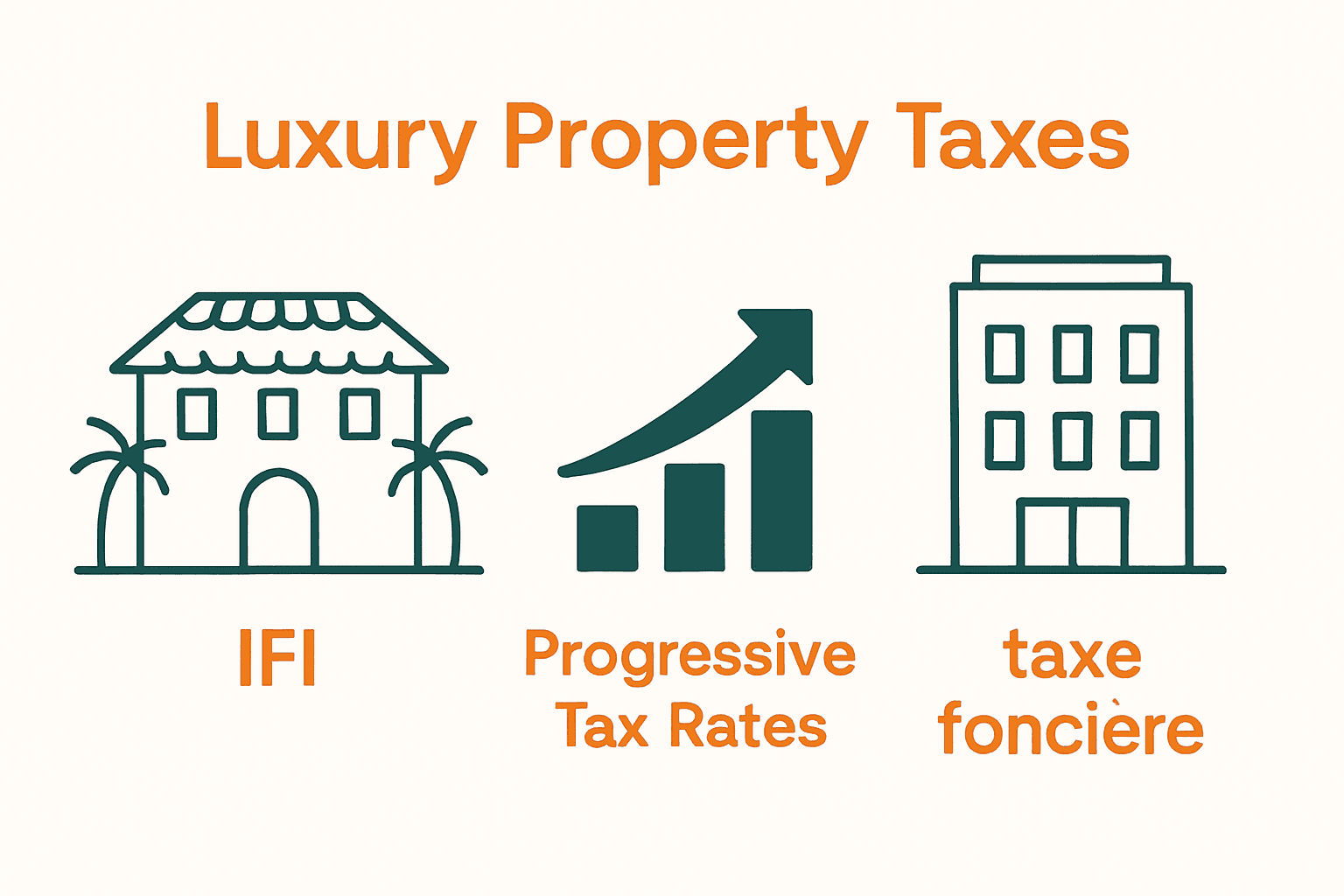
Comparison of French luxury real estate taxes IFI and taxe foncière Ultimately, the most effective tax strategy transforms potential fiscal challenges into opportunities for strategic wealth preservation and growth.

Common Pitfalls and Compliance Risks

Luxury real estate investments in the French Riviera demand exceptional diligence to navigate the intricate landscape of legal and financial compliance. Regulatory complexity can transform seemingly straightforward transactions into potential legal minefields for unsuspecting international investors.

Estatefy highlights several critical pitfalls that can derail luxury property investments:

  • Underestimating comprehensive acquisition costs
  • Overlooking recurring annual tax obligations
  • Mismanaging potential capital gains tax scenarios
  • Failing to accurately assess property valuation
  • Neglecting detailed financial documentation

RSM Global emphasizes the severe consequences of non-compliance, which can include substantial financial penalties. Investors must be particularly cautious about accurate asset declaration, especially concerning the Impôt sur la Fortune Immobilière (IFI), where misreporting property values can trigger comprehensive tax audits and significant legal repercussions.

Navigating these compliance risks requires a proactive, multilayered approach. Sophisticated investors typically engage specialized legal and tax professionals who understand the nuanced French regulatory environment. This strategic partnership helps mitigate risks by ensuring meticulous documentation, timely reporting, and comprehensive understanding of evolving tax regulations. The potential costs of non-compliance far outweigh the investment in expert guidance, making professional consultation an essential component of successful luxury real estate investment in France.

Navigate Luxury Real Estate Tax with Confidence on the French Riviera

Understanding the complexities of luxury real estate tax is essential for visionary investors looking to secure legacy assets on the Côte d’Azur. The challenges of managing progressive wealth taxes like Impôt sur la Fortune Immobilière, navigating acquisition duties, and anticipating ongoing fiscal obligations can be overwhelming. If you aim to protect your investment from compliance risks and plan your portfolio with precision, this knowledge is your first step to success.

At Living on the Côte d’Azur, we specialize in guiding high-net-worth buyers through these intricate tax landscapes and legal frameworks. Our expertise offers you tailored strategies that balance tax optimization with your long-term estate goals while uncovering exclusive opportunities in luxury villas French Riviera 2025. Explore how to transform potential tax challenges into strategic advantages by partnering with professionals who understand every nuance.

Ready to turn your Riviera real estate vision into a secure legacy without costly surprises? Connect with our dedicated team today. Discover how to invest smartly with insights on Buying Luxury Real Estate on the French Riviera, secure your family’s future through Legacy Investments, or explore New Constructions on the Côte d’Azur. Your journey to a tax-optimized estate begins now at Living on the Côte d’Azur.

Frequently Asked Questions

What is luxury real estate tax?

Luxury real estate tax is a specialized tax mechanism targeting high-value property transactions and ownership, designed to generate revenue primarily from wealthy individuals owning premium real estate assets.

How does the luxury real estate tax impact investors?

The luxury real estate tax can significantly impact investment strategies for high-net-worth property investors by affecting potential returns and long-term portfolio planning, necessitating a thorough understanding of local tax regulations.

What types of luxury real estate taxes exist?

Luxury real estate taxes include various mechanisms such as annual assessments, transaction-based levies, and specific taxes like the Impôt sur la Fortune Immobilière (IFI), which applies to net taxable real estate assets exceeding a certain threshold.

What are some common compliance risks associated with luxury real estate investments?

Common compliance risks include underestimating acquisition costs, overlooking annual tax obligations, mismanaging capital gains tax scenarios, and failing to accurately assess property valuations, all of which can lead to severe financial penalties or audits.

Recommended

  • Top Locations High-Value Luxury Real Estate on the French Riviera
  • 法国里维埃拉的极致奢华理念 – Living on the Côte d’Azur
  • The concept of Ultra Luxury on the French Riviera – Living on the Côte d’Azur
  • Luxury Real Estate Explained: Key Features and Value – Living on the Côte d’Azur
  • Blog – Corrado Manenti
  • Real Estate Tips for Buyers & Sellers – Homes2MoveYou.com
by /18 November 2025/in Landingpage
https://www.livingonthecotedazur.com/wp-content/uploads/2025/11/1763428871652_image_1763428871392.jpg 768 1344 https://www.livingonthecotedazur.com/wp-content/uploads/2024/02/sitelogo150.png 2025-11-18 02:24:562025-11-18 02:25:01Luxury Real Estate Tax Explained: Strategies and Risks

Luxury homes rarely sell based on square meters alone. Buyers at higher price points connect with properties through emotion first and analysis second, which means the way a home feels during a first viewing often influences whether a buyer returns or begins negotiations. Sellers who understand psychological cues can increase emotional attachment by shaping how buyers move through rooms, how light enters the space, what details they notice first, and how they imagine their lifestyle inside the home. These triggers can speed up sales by creating familiarity, comfort, and desire that support faster decision-making, especially for overseas buyers evaluating multiple properties during short visits.

Why Do Emotional Drivers Influence Property Decisions More Than Logic?

Homes trigger emotional responses because buyers link living spaces to identity, comfort, and future memories. In luxury real estate, buyers are rarely purchasing out of necessity; they buy because a property matches how they want to live. High-net-worth buyers often compare multiple homes across different countries, so an emotional connection can set one property apart even if similar features exist elsewhere. While buyers assess practical elements such as price, renovations, and access, the decision to move forward typically comes once the property feels like an extension of personal lifestyle goals. The emotional impression influences perceived value, making it easier for buyers to justify higher budgets or premium features.

What emotional triggers influence luxury buyers:

  • Sense of arrival and status
  • Comfort and relaxation without effort
  • Ability to host family or business guests
  • Space for wellness, work, or leisure
  • Privacy and personal control over environment

What First Impressions Determine Buyer Interest Within Seconds?

First impressions start before entering the home. The drive-up experience, noise levels, parking access, and landscaping shape a buyer’s mood before they step inside. Once they enter, lighting, scent, sound, and visual balance affect how they interpret space, quality, and comfort. Homes with a clean entrance route, open sight lines, balanced decor, and natural lighting create immediate trust and ease. Conversely, clutter, harsh lighting, or confusing layouts can create hesitation, even if the home has strong features. The opening moment sets expectations, making it essential to control sensory cues during viewings.

Entrance, lighting, scent, acoustics & approach routes

The path leading to the home tells buyers how easy daily living will feel. Smooth access, clear signage, and well-lit entryways reduce physical and mental friction. Soft ambient lighting and clean scent profiles help buyers relax while viewing the space. Balanced acoustics, such as quiet indoor echo and outdoor privacy from traffic, signal comfort, and quality. These details shape the buyer’s mood before they assess the actual layout.

Eye-line design: what buyers see first shapes perceived value

Buyers form opinions based on what their eyes land on first. Placing focal points like sea views, art pieces, a fireplace, or large windows in direct sight lines ensures the brain prioritizes premium features over minor flaws. When rooms guide the eye naturally, buyers move through spaces with clarity rather than confusion, which increases perceived value.

Digital first impressions: listing photos & thumbnails

Most luxury buyers shortlist homes online before booking a viewing. The first image, often a terrace, facade, or main living area, influences whether users click or scroll past. Capturing strong angles, natural lighting, and lifestyle elements encourages engagement. Poor photos reduce interest before agents have the chance to show the home in person.

How Color, Texture & Design Influence Perceived Luxury?

Visual psychology shapes whether buyers feel welcome, relaxed, or disconnected. Warm neutrals help buyers imagine their belongings in the space, while overly bold colors can limit imagination. Materials such as stone, wood, and textured fabrics create depth, which supports a sense of comfort rather than sterility. Buyers often respond positively to natural tones and layered lighting rather than harsh artificial light. Homes that combine design consistency with subtle detail allow buyers to imagine settling in without major changes.

Warm neutrals that suggest comfort + ownership security

Soft earth tones, beige, cream, taupe, and muted grey support calmness and reduce mental resistance to new spaces. These shades make rooms feel open, brighter, and easier to connect with emotionally. They also reduce distraction, helping buyers focus on layout rather than decor.

Modern finishes vs heritage aesthetics: Who each attracts

Modern villas appeal to buyers seeking clean lines, efficiency, and easy maintenance. Heritage homes attract buyers who value character, craftsmanship, and history. Knowing which profile fits the target audience helps sellers stage accordingly rather than mixing conflicting styles.

Why clutter reduces perceived square meters

Visual noise makes rooms feel smaller because the brain processes multiple objects at once. Minimal layouts increase spatial clarity and allow buyers to imagine furniture placement. Removing excess items helps rooms feel larger without structural changes.

Color & Style Impact Table

Style ChoiceEmotional ImpactBest ForPotential Drawback
Warm neutralsComfort, familiarityFamily buyers, relocationsMay feel plain without accents
Minimal modernClean, high-value feelOverseas buyers, investorsCan feel cold without textures
Heritage décorCharacter, exclusivityLong-term ownersHarder to modernize
Bold colorsUnique personalityDesigner-led homesLimits imagination

How Storytelling Creates a Lifestyle Narrative That Sells Faster?

Story-driven homes help buyers imagine future experiences, turning a property into a setting where memories can occur rather than a structure with materials and measurements. This approach focuses on scenes: breakfast terraces, sunset lounges, cinema rooms, or workspaces. Sellers who stage rooms with clear functional messages guide buyers through emotional scenarios rather than abstract floor plans. This makes the home feel ready for immediate use and supports faster offers, especially for international buyers touring several homes in a limited time.

Selling a “life” not a floor plan

Instead of detailing dimensions, the focus shifts to how life unfolds within the space. Descriptions replace “four-bedroom villa” with examples like “space for hosting guests with privacy” or “terrace designed for sunset dining.” Buyers relate more to experiences than layouts.

Using lifestyle staging: wellness rooms, office setups, guest suites

Rooms staged with purpose communicate value faster. Fitness spaces, reading corners, and designated home offices show adaptability, particularly for remote-working buyers or long-stay family visits.

Emotional cues: family spaces, work-from-home, entertainment areas

Spaces that support gatherings, celebrations, and relaxation give buyers emotional ownership. Homes that feel ready to host create attachment and urgency.

How to Structure Space So Buyers Feel Control, Comfort & Flow?

Movement patterns influence stress levels during viewings. Spaces that open naturally, allow direct movement between rooms, and avoid blocked pathways feel intuitive. Buyers move more confidently when layouts don’t require effort to understand. Furniture placement, door direction, hallway width, and room transitions all create a sense of clarity or confusion. Clear flow helps buyers form positive emotional responses before evaluating price or renovation needs.

Layout coherence & intuitive movement

Logical routes between the kitchen, terrace, living room, and bedrooms help buyers picture daily routines easily. Sudden obstacles, tight corridors, or awkward room transitions interrupt flow and reduce comfort.

Furniture placement that expands perceived space

Furniture scaled correctly to the room size creates balance and avoids overcrowding. Using fewer, larger pieces instead of many small items can make a room feel spacious while still furnished.

Highlighting focal points to guide attention

Arranging furniture to highlight a balcony, pool view, fireplace, or art piece directs attention to valuable features instead of structural imperfections. This strengthens emotional impact and perceived value.

How Scarcity, Urgency & Social Proof Influence Luxury Buyers?

Luxury buyers often evaluate multiple homes across different regions, so creating a compelling sense of scarcity encourages faster decision-making. When buyers understand that similar properties rarely appear on the market or that prime locations have limited supply, they treat opportunities more seriously. Scarcity works best when it reflects genuine market conditions, such as limited coastal plots or exclusive villa zones where sales rarely occur. Social proof supports confidence by showing that others value the property, while urgency reminds buyers that waiting may result in losing the home to another interested buyer. These triggers must be used carefully to encourage action without pressure or misrepresentation.

Limited inventory in prime zones (Cap Ferrat, Cannes, Monaco border)

Areas like Cap Ferrat, Cap d’Antibes, Villefranche, and Cannes waterfronts have geographically limited land and long ownership cycles, creating natural scarcity. Buyers respond strongly to areas where new construction is restricted or where villas rarely change hands. Highlighting scarcity in a factual manner, such as limited availability in a specific street or bay, reinforces the property’s long-term value and helps buyers act quicker.

Showing competitive demand ethically

Sellers can show interest from other buyers without creating unnecessary pressure. For example, informing buyers that additional visits are scheduled or that another party has requested documentation helps set realistic expectations. Ethical urgency builds trust by presenting accurate demand rather than exaggerating interest.

Testimonials, press mentions & awards as validation

High-value buyers seek reassurance that a property or agent aligns with their standards. Testimonials from previous clients, press coverage, architectural awards, or appearances in reputable publications help reinforce credibility. These elements reduce hesitation by showing social proof beyond simple listing descriptions.

Impact of Low Urgency vs High Urgency

Strategy LevelBuyer EmotionImpact on Sale SpeedRisk
Low urgencyComfortable browsingSlower decisionsProperty may feel undervalued
Moderate urgencyFocused interestFaster offersRequires careful timing
High urgencyFear of lossQuick actionMay reduce trust if exaggerated

How Pricing Psychology Impacts the Speed of Sale?

Pricing shapes how buyers interpret value before viewing a home. A price positioned correctly within market ranges encourages interest from qualified buyers, while an inflated price can prevent inquiries and extend time on the market. Sellers benefit from pricing strategies that reflect location demand, property condition, and comparable sales rather than emotional attachment. For luxury homes, pricing must align with the home’s positioning; exclusive villas require a different strategy than apartments because buyers have different motivations. The goal is to support fast offers without undervaluing the property.

Strategic price positioning vs overpricing traps

Overpricing may reduce initial viewings and attract buyers who negotiate aggressively, extending time on the market. Pricing within expected ranges increases visibility in search filters and improves perceived fairness. Strategic pricing can still leave room for negotiation without discouraging interest.

Charm pricing vs round number pricing in luxury

Standard pricing techniques such as ending prices in .9 are less effective in luxury markets. Buyers purchasing villas or waterfront homes often respond better to round numbers that signal confidence and simplicity. A clean figure may feel more transparent and aligned with premium positioning.

Price-anchoring through comparable listings

Showing comparisons to similar properties helps buyers understand where a home sits in the market. Anchoring works by presenting stronger or higher-priced options alongside the property being sold, which can make the target listing feel more valuable or fairly positioned.

Which Marketing Formats Evoke Emotion Faster?

Marketing that communicates lifestyle performs better than technical listings in luxury markets. Movement, natural light, and human context help buyers imagine experiences rather than analyzing specifications. Photos, video, and copywriting should show how the home is used rather than simply presenting empty rooms. This helps buyers imagine daily routines, social gatherings, and relaxation, supporting faster decisions during viewings or remote purchases.

Cinematic video tours (movement = emotional recall)

Movement through rooms helps buyers feel physically present, especially international clients viewing remotely. Wide shots, natural lighting, and smooth camera transitions highlight space flow and help viewers remember the home more clearly.

Lifestyle photography vs empty interior shots

Images showing dining setups, terraces with seating, or poolside relaxation scenes communicate living experiences. Empty rooms lack context and force the viewer to imagine functionality. Lifestyle images reduce cognitive effort.

How to Reduce Buyer Hesitation & Increase Decision Confidence

Hesitation usually appears when buyers feel uncertain about legal status, renovation needs, or maintenance demands. Providing clear documents, inspection details, and long-term cost information helps reduce doubt. Sellers can also increase appeal by simplifying ownership through updated utilities, completed repairs, and ready-to-live layouts. Homes that feel easy to move into reduce mental barriers and shorten decision timelines.

Transparency with legal docs & surveys

Sharing diagnostics, boundary records, renovation permits, and maintenance history early builds trust. Clear documentation also reduces delays once offers are submitted.

Turnkey upgrades: move-in-friendly homes sell faster

Homes that require fewer changes after purchase create confidence for seasonal buyers, especially those spending limited time on the Riviera. Updated kitchens, bathrooms, and outdoor spaces can reduce renovation concerns.

Addressing renovation concerns upfront

If the property needs upgrades, providing cost estimates, plans, and contractor contacts helps buyers see solutions rather than problems. Transparent planning reduces hesitation and encourages offers.

How Living on the Côte d’Azur Applies These Triggers for Luxury Sellers

Living on the Côte d’Azur supports sellers by presenting homes in a way that highlights lifestyle, comfort, and emotional appeal rather than relying solely on features. We work with international buyers and understand what draws attention from overseas families, investors, and UHNW clients. Our marketing uses visual storytelling, descriptive property writing, and staging guidance to help homes stand out in premium markets. We also connect sellers with trusted partners for photography, legal checks, and valuation support. Our knowledge of local market demand helps sellers position homes strategically and appeal to the right buyer groups.

What we help with:

  • Staging and lifestyle presentation
  • High-quality visuals and descriptions
  • International buyer targeting
  • Accurate pricing strategy
  • Secure and private transaction support

FAQs: Selling Property Faster Using Psychology

Do staged homes sell faster in luxury markets?

Yes, staging clarifies the room’s purpose and increases emotional connection.

Does emotion matter more for villas than apartments?

Villas rely heavily on emotional appeal, while apartments benefit from practical and lifestyle cues.

Do international buyers respond differently to design?

Some buyers prefer modern finishes while others focus on heritage value. Staging by the target audience helps.

What increases perceived value the most?

Strong first impressions, clear lifestyle use, and visual consistency across rooms support higher offers.

by Jolanda Kuijer/17 November 2025/in Landingpage
https://www.livingonthecotedazur.com/wp-content/uploads/2023/10/iStock-1489410290-2.jpg 1080 1920 Jolanda Kuijer https://www.livingonthecotedazur.com/wp-content/uploads/2024/02/sitelogo150.png Jolanda Kuijer2025-11-17 12:21:082025-11-24 11:38:54Psychological Triggers That Sell Homes Faster in Luxury Real Estate

Luxury properties on the French Riviera rarely make it to public listings, with over 60 percent of prestigious homes changing hands through off-market channels. For investors, this hidden world offers unmatched privacy and access to coveted addresses, but it demands a thoughtful approach. Understanding how to define your buying criteria, connect with trusted networks, and protect your interests gives you the inside track to Riviera real estate that most never see.

Table of Contents

  • Step 1: Define Your Off-Market Buying Criteria
  • Step 2: Engage Trusted Local Real Estate Networks
  • Step 3: Leverage Discreet Introduction Channels
  • Step 4: Conduct Confidential Due Diligence
  • Step 5: Secure Exclusivity and Close Transactions

Quick Summary

Key PointExplanation
1. Define Your Buying CriteriaIdentify specific investment goals like location, property type, and financial metrics to streamline your search.
2. Network with Local Real Estate ProfessionalsEngage with local agents and professionals to gain exclusive access to off-market properties and insider insights.
3. Use Discreet Introduction ChannelsBuild relationships with wealth managers and family offices to access hidden opportunities in the Riviera market.
4. Conduct Thorough Due DiligencePerform exhaustive title searches and property assessments to uncover risks and validate property value.
5. Structure Offers for ExclusivityPrepare compelling offers that showcase your appreciation for the property, ensuring a favorable transaction process.

Step 1: Define Your Off-Market Buying Criteria

Defining your off-market buying criteria transforms your property search from random hunting to strategic acquisition. This crucial step helps you target properties that match your investment goals precisely and efficiently.

According to OffTheMrkt, understanding your specific buying criteria involves evaluating several key factors. Start by crystallizing your investment objectives. Are you seeking a vacation home in Saint Tropez? An income generating property near Monaco? A generational family estate in Èze? Your precise vision will guide every subsequent decision.

Begin mapping your criteria across multiple dimensions. Location parameters matter deeply personal preferences and investment potential. Consider proximity to amenities like beaches, cultural centers, transportation routes. Examine property specifications such as square meters, architectural style, potential for renovation or expansion. Financial metrics are equally critical evaluate potential rental yields target purchase price ranges and projected appreciation rates.

Pro Tip: Create a weighted scoring system for potential properties. Assign numerical values to each criterion allowing objective comparison between different off market opportunities.

Research from Masterclass emphasizes that successful off market buyers remain flexible yet disciplined. Your defined criteria serve as a strategic compass not an inflexible mandate. As you explore the Riviera market stay open to unique properties that might slightly deviate from your initial blueprint but offer exceptional value.

By meticulously defining your buying criteria you position yourself as a sophisticated investor ready to uncover hidden Riviera gems. Your next step involves networking with local real estate professionals who can help translate these criteria into actionable property leads.

Step 2: Engage Trusted Local Real Estate Networks

Engaging trusted local real estate networks transforms your off market property search from a solitary pursuit into a strategic collaborative effort. This step connects you with insider knowledge and exclusive opportunities across the Riviera.

According to LinkedIn networking with local professionals requires a multifaceted approach. Begin by identifying specialized real estate networks focused on the French Riviera. Attend local property events in towns like Nice Saint Tropez and Monaco. Join professional associations such as the French Real Estate Federation. Engage with online forums and social media groups dedicated to luxury property investments in Southern France.

Research from Biscred emphasizes the critical importance of building genuine relationships with local agents who possess deep market insights. These professionals often have access to properties not publicly listed particularly in exclusive areas like Cap dAntibes or Saint Jean Cap Ferrat. Your goal is to become a known entity someone agents want to work with by demonstrating serious intent professionalism and clear investment criteria.

Pro Tip: When networking always lead with curiosity. Ask insightful questions about local market trends specific neighborhood dynamics and emerging investment opportunities rather than immediately discussing your buying intentions.

Schedule regular coffee meetings with local real estate professionals. Share your specific investment goals listen to their market perspectives and gradually build trust. Remember successful networking in the Riviera real estate market is about cultivating relationships not just collecting business cards.

By strategically engaging local networks you position yourself to access the most compelling off market opportunities. Your next step involves developing a robust communication strategy that keeps you connected and top of mind with these critical local resources.

Step 3: Leverage Discreet Introduction Channels

Leveraging discreet introduction channels transforms your off-market property search from traditional hunting to strategic acquisition. This critical step opens doors to exclusive Riviera real estate opportunities that remain invisible to the general market.

According to InHouse Investment, successful off-market transactions depend on carefully cultivated networks of developers, family offices, and institutional partners. Focus on building relationships with connected professionals who can serve as your gatekeepers to extraordinary properties. Seek out wealth managers private bankers and legal advisors with deep roots in the French luxury real estate ecosystem.

Research from IPGlobal emphasizes that discreet channels provide unparalleled access to high quality assets before they become publicly available. Your goal is to position yourself as a serious credible buyer through strategic introductions. This means crafting a compelling investor profile that signals financial capability discretion and genuine market interest.

Pro Tip: Develop a concise investor brief that communicates your investment philosophy property preferences and financial capacity. This document becomes your silent ambassador in exclusive circles.

Cultivate introductions through trusted intermediaries who understand the nuanced world of Riviera real estate. Attend private events hosted by exclusive wealth management firms participate in select investment roundtables and engage with professional networks that operate beyond traditional real estate platforms.

By mastering the art of discreet introductions you unlock a world of exceptional property opportunities. Your next step involves preparing a compelling investor profile that transforms initial curiosity into meaningful conversations.

Step 4: Conduct Confidential Due Diligence

Confidential due diligence represents the critical defensive strategy in your off-market property acquisition journey. This meticulous process protects your investment and uncovers potential risks hidden beneath the surface of seemingly perfect Riviera properties.

According to OffTheMrkt, comprehensive due diligence requires a multifaceted approach. Begin with exhaustive title searches to verify ownership history and potential legal encumbrances. Examine zoning compliance carefully especially for properties in historic areas like Saint Jean Cap Ferrat or Èze where architectural restrictions can significantly impact property value and potential renovations.

Research from Masterclass emphasizes the importance of thorough financial and physical property assessments. Engage specialized professionals who understand the nuanced French real estate landscape. This means hiring local experts familiar with Riviera specific regulations land use restrictions and potential historical preservation requirements that might not be immediately apparent.

Pro Tip: Request comprehensive technical surveys that go beyond standard inspections. Look for detailed assessments of structural integrity environmental considerations and potential hidden maintenance issues specific to coastal properties.

Your due diligence should extend beyond physical inspections to include a deep dive into financial aspects. Review property tax records utility bills renovation history and potential legal complications. Understand the property not just as a physical asset but as a complex legal and financial entity with its own unique history and potential future challenges.

By conducting thorough and confidential due diligence you transform potential risks into calculated opportunities.

Your next step involves preparing a strategic negotiation approach that leverages the insights gathered during this critical investigation phase.

Step 5: Secure Exclusivity and Close Transactions

Securing exclusivity and closing transactions represents the pinnacle of your off-market property acquisition strategy. This final stage transforms your carefully cultivated relationships and diligent research into a tangible luxury real estate investment along the Riviera.

According to InHouse Investment, successful off-market transactions depend on leveraging trusted advisor networks to access curated deal flows. Your negotiation approach should emphasize discretion professionalism and a clear understanding of the property’s unique value proposition. Craft a compelling offer that demonstrates not just financial capability but a genuine appreciation for the property and its potential.

Research from IPGlobal highlights the advantages of off-market investments including the ability to negotiate more favorable terms. In the Riviera market this means understanding the subtle nuances of French real estate transactions. Engage a local notaire who specializes in luxury properties and can navigate the complex legal landscape of off-market acquisitions.

Pro Tip: Prepare a comprehensive offer package that goes beyond price. Include your vision for the property potential for preservation or sensitive renovation and your commitment to maintaining its unique character.

Structure your transaction to protect both parties interests.

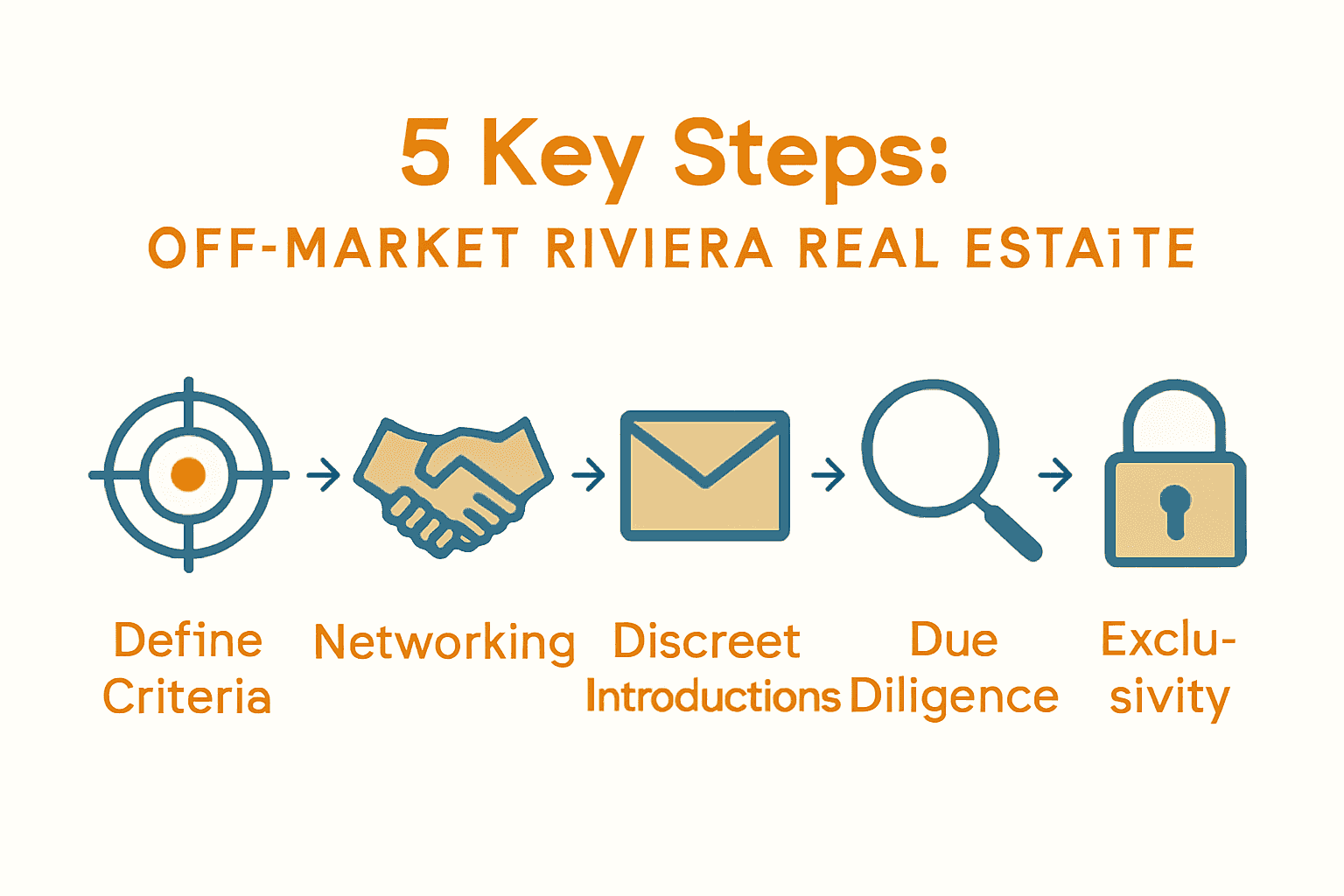
Infographic of 5 essential steps for Riviera off-market property acquisition. Consider using a Societe Civile Immobiliere structure which offers flexibility and tax advantages for international buyers. Ensure all agreements maintain the highest level of confidentiality respecting the discrete nature of off-market transactions.
By mastering the art of securing exclusivity and closing transactions you transform your Riviera property search from a dream into a reality. Your final step involves celebrating your successful acquisition and beginning the exciting journey of making this extraordinary property your own.

Unlock Your Exclusive Path to Riviera Real Estate Excellence

Navigating the hidden world of off-market luxury properties can feel like chasing shadows without the right guidance. This article clearly reveals the challenge of accessing exclusive Riviera estates and the need for a trusted strategy that balances discretion, expert due diligence, and authentic relationships. If you desire to move beyond public listings and uncover legacy properties or eco-luxury villas with exceptional appreciation potential, it is essential to define your criteria precisely and leverage local professional networks. We understand the emotional weight of securing not just a house but an heirloom for generations to come.

At Living on the Côte d’Azur, we bridge your ambitions with insider knowledge and personalized support. Our team specializes in the art of discreet introductions, confidential property evaluations, and bespoke transaction navigation tailored to the French Riviera’s unique market rhythm. Whether you are seeking a refined villa near Cap d’Antibes, a heritage estate in Èze, or a visionary new construction in Sainte-Maxime, we guide you step-by-step toward owning a seamless investment rooted in Riviera distinction.

Are you ready to transform your off-market search into a tangible legacy? Discover how our expertise can unlock access to these rare opportunities. Connect with our team today to discuss your unique vision at Living on the Côte d’Azur Contact. Begin this journey with confidence and claim your exceptional place in the sun right now.

Frequently Asked Questions

What is the first step in securing off-market real estate in the Riviera?

To secure off-market real estate in the Riviera, start by defining your specific buying criteria. Clearly outline your investment objectives, including location, property type, and financial metrics to guide your property search effectively.

How can I engage with local real estate networks for off-market opportunities?

Engage with local real estate networks by attending property events and joining professional associations relevant to the Riviera market. Build genuine relationships with local agents who can provide you access to exclusive properties that may not be listed publicly.

Riviera real estate networking

What are discreet introduction channels in the context of off-market property buying?

Discreet introduction channels are networks of professionals, such as wealth managers and real estate lawyers, who can connect you with hidden property opportunities. Cultivate these relationships to position yourself as a credible buyer and access exclusive listings.

How do I conduct due diligence on off-market properties?

Conduct due diligence by performing thorough title searches and property assessments. Hire local experts to help you navigate potential zoning issues and legal concerns, ensuring you uncover any hidden risks before proceeding with a purchase.

What should I include in my offer to secure exclusivity on an off-market property?

When making an offer, include not just the purchase price but also a detailed vision for the property and any plans for preservation or renovations. Create a compelling offer package that demonstrates your commitment and respect for the property’s unique value.

How can I effectively negotiate terms for an off-market property?

To negotiate effectively, emphasize professionalism and demonstrate a genuine appreciation for the property’s potential. Structure your offer to protect both parties’ interests, possibly by using a flexible property ownership structure, while maintaining discretion throughout the process.

Recommended

  • Ibiza is reinventing itself and has a bright future – Living on the Côte d’Azur
  • Video: Charming and authentic villa Provençal in Vence – Living on the Côte d’Azur
  • Dubai is selling the future: new real estate sales record – Living on the Côte d’Azur
  • Buying high-end luxury real estate on the French Riviera – Living on the Côte d’Azur
  • Real Estate Tips for Buyers & Sellers – Homes2MoveYou.com
by Ab Kuijer/17 November 2025/in Landingpage
https://www.livingonthecotedazur.com/wp-content/uploads/2025/11/1763342576435_image_1763342576319.jpg 768 1344 Ab Kuijer https://www.livingonthecotedazur.com/wp-content/uploads/2024/02/sitelogo150.png Ab Kuijer2025-11-17 02:24:562026-05-07 12:10:07Elite Guide to Off-Market Real Estate: Secure Riviera Gems

If you own or are planning to buy property in France and you are an overseas buyer, then understanding the Impôt sur la Fortune Immobilière (IFI),  the French real-estate wealth tax,  is essential. Many foreign investors assume French property taxes end with capital gains or income tax, but the IFI tax opens a separate set of rules triggered when your French property equity exceeds a certain threshold. This guide explains what IFI covers, how it applies to non-residents, how your property value and debts affect it, and why correct planning now can save significant tax later.

What Is the French Property Wealth Tax (IFI) and Why Does It Matter?

The IFI, introduced on 1 January 2018 to replace the former wealth tax (ISF), focuses exclusively on property-wealth instead of all assets. France taxes real estate in this way to recognise the high value of land and homes in certain regions while exempting financial and other assets. The tax matters because it applies annually if the net value of taxable real-estate assets exceeds the threshold (currently €1.3 million for most cases) as at 1 January of the tax year. Failure to declare can lead to penalties, interest charges, and difficulty in future property transactions.

Who Must Pay French Wealth Tax? Residents vs Non-Residents

Full tax liability for French residents (worldwide real estate)

Individuals who are tax-resident in France must declare and pay IFI on their worldwide real‐estate assets ,  both in France and abroad. This means a French tax resident owning property outside France is still liable for IFI.

Limited tax liability for non-residents (French property only)

If you are a non-resident for French tax purposes, you are liable for IFI only on real-estate assets located in France and on the relevant share of property rights or companies owning French property. The threshold and deductions still apply, but the base is narrower.

Mixed-residency cases: second-home owners, holiday buyers, cross-border buyers

If you split time between France and another country, or have second homes, your tax residence status must be assessed carefully under French law (e.g., centre of economic interest, habitual abode). Misjudging residency can lead to unexpected IFI liability.

Comparison: Resident vs Non-Resident IFI Obligations

CategoryTax Base CoveredThresholdAsset Scope
French ResidentWorldwide real-estate holdings€1.3 millionAll properties owned directly or via companies
French Non-ResidentFrench real-estate assets only€1.3 millionProperties or rights located in France

Which Property Types Are Taxable Under IFI?

Residential real estate (villas, apartments, holiday homes)

Any built property, houses, apartments, land to build, or second homes located in France, is included in the taxable base.  The value is assessed on 1 January of the tax year.

Rental properties, investment portfolios, and company-owned assets

Real estate used for investments (holiday rentals, buy-to-let) is taxable unless specific exemptions apply. Shares in companies owning property (SCI, etc.) may also bring property value into the IFI base.

Property held through SCI, holding companies, or trusts

Assets held via structures such as SCIs (Société Civile Immobilière) do not automatically exempt the property from IFI: value may be attributed to the beneficial owner if the structure holds French property.

What is excluded? Business-use assets, commercial property, certain family structures

Properties used for professional activity may be exempt if they meet strict criteria. Some rural land or forestry assets can also benefit from partial exclusions.

Taxable vs Non-Taxable Assets:

Taxable:

  • French villas, apartments, and land for building
  • Shares in companies holding French property
  • Rental portfolios based in France

Non-Taxable or Partially Exempt:

  • Commercial property solely used for a professional business
  • Real estate held in certain family companies with a qualifying professional activity
  • Forestry land managed under approved plans

What Deductions, Exemptions & Allowances Reduce IFI Liability?

Primary residence 30% reduction rule

Your main residence in France benefits from a 30% allowance of its market value, provided you own it directly (not via SCI). This means only 70% of that property’s value is included in the taxable base.

Debt eligibility (loans, mortgages, property improvement costs)

Outstanding loans linked to taxable real estate (purchase loan, renovation work, improvement) may be deducted from the property’s value when calculating the net taxable base.

Exemptions for professional real-estate assets

Property used for genuine professional activity by the owner (business premises, rental with hotel status) can be entirely exempt from IFI.

Limits on high-value borrowing & anti-abuse rules for large loans

Ultra-high-value estates facing borrowing or holding structures must respect rules limiting how much debt may be used to reduce the taxable base, especially above €5 million valuations.

Deductible vs Non-Deductible Debt

Debt TypeDeductible for IFINotes
Mortgage for the purchase of taxable property✅ YesIf the loan is secured by the property
Loan for major renovation work✅ YesImprovement costs count
Consumer loans not linked to property❌ NoNot linked to a taxable asset
Loan for an unrelated business❌ NoLinked to a non-taxable asset

How to Calculate IFI: Rates, Brackets & Worked Examples

Calculating French wealth tax (IFI) always starts from the same questions: what is the net value of your taxable real-estate assets on 1 January, and does it exceed the €1.3 million threshold after deducting eligible debts? The tax is progressive, which means each “slice” of value is taxed at a different rate. Current 2025 scales are widely expected to continue for 2026 unless the new “unproductive wealth” reform fully replaces them, so investors should always double-check the latest law before filing. The examples below are educational only and cannot replace personalised advice from a French tax professional.

Tax threshold: assets exceeding €1.3M net

IFI only applies if your net taxable real-estate wealth (after allowable debts) exceeds €1.3 million as at 1 January of the tax year. Net wealth means the market value of all taxable properties and rights minus qualifying loans and certain costs linked directly to those properties. If, after deducting eligible mortgages and renovation loans, your taxable base falls below €1.3 million, no IFI is due, and you do not need to pay, although in some cases a declaration may still be required depending on your income-tax position. The threshold applies to the tax household, not each person individually, so joint owners are assessed together.

Full IFI tax bracket table (2026 – based on current 2025 scale)

The current progressive IFI scale taxes your net property wealth in bands. Multiple reputable sources (French tax guides and professional firms) show the same bands and rates:

Net taxable real-estate value (after debts)IFI rate on this band
Up to €800,0000%
€800,001 – €1,300,0000.50%
€1,300,001 – €2,570,0000.70%
€2,570,001 – €5,000,0001.00%
€5,000,001 – €10,000,0001.25%
Over €10,000,0001.50%

Remember: IFI is only charged if net assets exceed €1.3 million, but the progressive scale then applies from €800,000 once you cross that point. Any future reform creating a single “unproductive wealth” rate would modify this, so always check the current official information at declaration time.

Example calculation for a non-resident owning a €3M villa

Imagine a non-resident who owns a single French villa worth €3,000,000 on 1 January with no outstanding mortgage and no other taxable French property. Their net taxable base is €3,000,000. Using the progressive bands:

  1. First €800,000 → 0% = €0
  2. Next €500,000 (800k–1.3M) → 0.5% = €2,500
  3. Next €1,270,000 (1.3M–2.57M) → 0.7% ≈ €8,889
  4. Remaining €430,000 (2.57M–3.0M) → 1.0% = €4,300

Total IFI ≈ €15,689, subject to any small adjustments or credits. This example shows how IFI grows with each band; the key driver is net value after any allowable debt, not the gross property price.

BandAmount taxedRateIFI on the band
0 → €800,000€800,0000%€0
€800,001 → €1,300,000€500,0000.5%€2,500
€1,300,001 → €2,570,000€1,270,0000.7%€8,889
€2,570,001 → €3,000,000€430,0001.0%€4,300
Total€15,689

Example calculation for €10M luxury estate with financing

Now consider a high-value estate with a market value of €10,000,000 and an eligible mortgage of €4,000,000 linked directly to its purchase. Net taxable base is €6,000,000 (10M – 4M), assuming all debt is deductible under current rules. Applying the scale:

  1. 0 → €800,000 at 0% = €0
  2. €800,001 → €1,300,000 (€500,000) at 0.5% = €2,500
  3. €1,300,001 → €2,570,000 (€1,270,000) at 0.7% ≈ €8,889
  4. €2,570,001 → €5,000,000 (€2,430,000) at 1% = €24,300
  5. €5,000,001 → €6,000,000 (€1,000,000) at 1.25% = €12,500

Total IFI ≈ €48,189. This shows how financing can significantly reduce the taxable base, especially on larger assets, but large loans are subject to specific anti-abuse limits for very high-value holdings.

BandAmount taxedRateIFI on band
0 → €800,000€800,0000%€0
€800,001 → €1,300,000€500,0000.5%€2,500
€1,300,001 → €2,570,000€1,270,0000.7%€8,889
€2,570,001 → €5,000,000€2,430,0001.0%€24,300
€5,000,001 → €6,000,000€1,000,0001.25%€12,500
Total€48,189

Special Rules for High-Value Properties (€5M+) and UHNW Buyers

High-value holdings are closely watched by French tax authorities, especially when structures or debt are used to reduce IFI. Households with net taxable real estate over €5 million must pay attention to specific limitations on deductible borrowing and to transparency rules around company ownership. Many UHNW buyers use holding companies, SCIs, or cross-border structures; while these can be legitimate, anti-avoidance measures mean that the property’s real economic value can still be taxed at the level of the beneficial owner. Careful planning with French and international tax advisers is essential.

Anti-avoidance rules for excessive debt

For very high-value portfolios, the law restricts the deduction of “excessive” debt, especially where borrowing appears artificial or mainly designed to cut IFI. For example, some rules cap the portion of debt that can be deducted when net real-estate wealth exceeds €5 million and debt exceeds a set percentage of value, or when loans are interest-free or intra-group. Certain arrangements can be re-qualified if they look like pure tax planning rather than genuine financing, which may result in recalculated IFI and penalties.

Controlled use of corporate structures (SCI, SAS, offshore holding)

SCIs and other French companies remain common structures for holding villas and apartments, especially in joint-family or cross-border situations. However, shares in a company that mostly holds real estate are themselves included in the IFI base at their property proportion. Offshore companies or trusts can be “looked through” under French law, meaning that IFI can still apply to the underlying French assets. Structures should be set up for succession, governance, and asset-protection reasons first, with tax treatment checked by qualified professionals.

Multi-property ownership across France

If you own several French properties, perhaps a main villa on the Riviera plus rental apartments in Paris, their net taxable values are aggregated to determine whether you cross the IFI threshold and which bands apply. Spreading holdings across regions does not reduce IFI; what matters is your total net French real estate at 1 January. For UHNW households, it is common to use a mix of financing, professional-use assets, and rental strategies to manage the IFI base rather than relying on geographical diversification alone.

Declaring & Paying IFI as a Foreign Property Owner

Overseas owners subject to IFI must file the tax as part of the annual French tax cycle. In most cases, IFI is declared on the same return as income tax, with deadlines typically falling in May or June, depending on online or paper filing and residence status. Non-residents usually file via the non-resident tax centre and may need to appoint a representative in complex cases. Payment is generally due shortly after the assessment is issued. Late filing or omissions can trigger penalties and interest, especially if assets have been under-reported for several years.

Filing deadlines for residents and non-residents

French residents file IFI with their annual income-tax declaration, usually by staggered online deadlines depending on their département number. Non-residents also submit through the online system or by paper to the non-resident office, using the same general calendar. Exact dates shift slightly each year, so they must be checked on impots.gouv.fr. Missing deadlines can lead to surcharges or estimated assessments, which are harder to dispute.

Documents required for accurate valuation

To complete an IFI return, you must be able to justify the values used for each property. Typical documentation includes recent property valuations, purchase contracts, notary deeds, loan statements, rental contracts, and any professional valuation reports. For complex holdings or company structures, balance sheets and breakdowns of property shares may also be needed. Storing these documents year by year helps if the tax authority later requests supporting evidence.

Reporting assets held through companies, nominees, or trusts

Where assets are held through an SCI, foreign company, nominee, or trust, you must declare the proportion of the structure’s value linked to French property. French rules include specific obligations for trustees and settlors to report trust-held French real estate or rights. Failure to report can lead to significant fixed penalties in addition to IFI itself. Understanding who is treated as the taxable “owner” in each structure is a key point where expert advice is crucial.

Working with accountants, valuers & bilingual legal advisors

Because IFI touches valuation, loans, cross-border residence, and structures, most non-resident clients benefit from working with a French tax adviser or notaire familiar with international situations. Guides from firms such as FrenchEntrée, Sassi Avocats, and other specialist tax practices give a good overview, but they also stress that detailed modelling must be handled case-by-case. Using bilingual specialists helps align IFI planning with inheritance, income tax, and long-term property strategy instead of treating it in isolation.

How French Wealth Tax Impacts Property Investment Strategy

IFI influences how overseas buyers structure and hold French property, especially at luxury levels. Investors who plan properly view IFI as one factor in a wider financial picture rather than a reason to avoid France completely. Wealth tax can affect choices such as how much to borrow, whether to buy one very large villa or several smaller units, and how much of the portfolio is used professionally or rented out. For UHNW clients, IFI is often balanced against France’s lifestyle, stability and long-term capital preservation benefits.

Buying with financing to reduce taxable base

As the examples show, using a reasonable level of mortgage can significantly reduce the net IFI base by deducting qualifying loan balances. That said, the debt must be real, linked directly to the property, and compliant with anti-abuse rules, particularly for very high-value holdings. The goal is to find a balanced loan size that supports flexibility, not to over-leverage purely for tax reasons.

Choosing location + rental structure to offset costs

Some investors accept IFI as part of owning in top locations such as the French Riviera, then offset the cost with rental income during selected periods. Combining strong seasonal rental demand with efficient financing and accurate expense tracking can help absorb part of the wealth-tax burden while preserving long-term capital growth.

Long-term holding vs resale strategy for tax efficiency

High transaction costs and capital-gains considerations mean frequent buying and selling rarely make sense purely to manage IFI. Many overseas owners instead adopt a long-term holding strategy, using well-chosen assets in prime areas that justify their costs over time. Wealth tax becomes one recurring cost within a broader, stable ownership plan rather than the main driver of decisions.

How France Compares to Other Wealth Tax Destinations (2026)

For many investors, the key question is not “does France have a wealth tax?” but “how does it compare with other countries I invest in?” France’s IFI targets real estate only, whereas Spain and Switzerland operate broader wealth-tax systems, and Portugal currently relies more on property-specific levies rather than a general wealth tax. This means that for property-focused UHNW investors, France may be more predictable than some imagine, especially when holdings in financial assets remain outside the IFI scope.

CountryWealth Tax?Who Pays?Best ForNotes
FranceYes – IFI on real estateResidents (worldwide real-estate) + non-residents (French real-estate)UHNW property buyersIFI threshold €1.3M net; progressive bands.
SpainYes (state + regions)Residents (worldwide) + non-residents (Spanish assets)Tax residents + some non-residentsStrong regional differences and evolving rules.
PortugalNo general wealth taxN/A – property IMI/AIMI applyExpats & retireesOnly high-value property is subject to AIMI, no broad wealth tax.
SwitzerlandYes (cantonal)Residents (worldwide assets at cantonal level)Tax relocation strategiesWealth tax rates vary strongly by canton.
by Jolanda Kuijer/16 November 2025/in Landingpage
https://www.livingonthecotedazur.com/wp-content/uploads/2025/07/pool-with-house-palm-trees-background.jpeg 672 1200 Jolanda Kuijer https://www.livingonthecotedazur.com/wp-content/uploads/2024/02/sitelogo150.png Jolanda Kuijer2025-11-16 21:15:422026-05-07 12:11:49French Property Wealth Tax Guide for Overseas Buyers (IFI 2026 Explained)

Over 80 percent of luxury property buyers seek out the French Riviera for its unmatched blend of elegance and investment potential. In this breathtaking stretch along the Mediterranean, every neighborhood offers something unique but few opportunities rival the enduring value found in its most coveted real estate gems. Whether you dream of panoramic sea views or crave timeless architectural charm, this guide reveals why the Riviera stands at the top of elite property investments.

Table of Contents

  • 1. Seafront Villas: The Crown Jewels of The French Riviera
  • 2. Historic Estates: Timeless Charm and Lasting Value
  • 3. Modern Eco-Villas: Sustainable Luxury for The Future
  • 4. Sky-High Penthouses: Urban Sophistication With Panoramic Views
  • 5. Private Domain Residences: Ultimate Privacy and Security
  • 6. New Constructions: Future-Proof Investments On The Riviera
  • 7. Boutique Apartment Complexes: Effortless Elegance and Amenities

Quick Summary

TakeawayExplanation
1. Seafront villas are top investmentsTheir limited supply and consistent value appreciation make them prime investment properties.
2. Historic estates combine heritage and valueThese properties not only provide traditional charm but also significant potential for appreciation and investment returns.
3. Modern eco-villas integrate sustainabilityThese properties use green technologies, enhancing their value and appeal to environmentally conscious buyers.
4. Penthouses offer elevated urban luxuryTheir strategic locations and limited availability enhance their desirability as high-end investment assets.
5. Boutique apartments provide lifestyle amenitiesThese complexes offer convenience and comprehensive services, making them attractive for discerning investors looking for effortless elegance.

1. Seafront Villas: The Crown Jewels of the French Riviera

In the world of luxury real estate, seafront villas on the French Riviera represent the ultimate investment sanctuary. These architectural masterpieces are more than properties they are statements of prestige and financial sophistication.

The allure of seafront villas lies in their unparalleled location and exceptional value appreciation. Positioned along the stunning coastline from Saint Jean Cap Ferrat to Antibes, these properties offer breathtaking Mediterranean views and instant access to azure waters. According to PRLog, exclusive properties like Villa Aulivie demonstrate the extraordinary potential of these investments.

Key Investment Characteristics:

  • Rare and limited supply of prime coastal real estate
  • Consistent value appreciation in high demand markets
  • Potential for substantial rental income during peak seasons
  • Significant tax advantages for international investors

What sets seafront villas apart is their resilience in global economic fluctuations. Even during challenging periods, these properties maintain their value. International Consortium of Investigative Journalists reports highlight the intense global interest in these remarkable properties, underscoring their status as premier investment vehicles.

For savvy investors, seafront villas represent more than real estate they are generational assets that combine lifestyle luxury with strategic financial planning. Whether seeking a personal retreat or a sophisticated investment portfolio addition, these properties offer an unmatched combination of emotional and financial returns.

When exploring living on the Côte d’Azur, understanding the unique value of seafront villas becomes paramount to making informed investment decisions.

2. Historic Estates: Timeless Charm and Lasting Value

Historic estates on the French Riviera represent more than mere real estate they are living narratives of architectural excellence and cultural heritage. These remarkable properties offer investors a unique opportunity to own a piece of history while securing a valuable long term asset.

The French Riviera boasts an extraordinary collection of historic estates that blend architectural magnificence with investment potential. Institute of Classical Architecture & Art documents highlight the profound significance of these properties in preserving cultural and architectural traditions.

Investment Potential of Historic Estates:

  • Exceptional preservation of architectural craftsmanship
  • Limited supply creating inherent value scarcity
  • Potential for significant appreciation over time
  • Unique appeal to discerning international buyers

What sets historic estates apart is their ability to transcend typical real estate markets. These properties are not just homes but cultural artifacts that tell stories of generations past. Investors find remarkable value in estates that combine historical significance with modern luxury amenities.

Careful restoration and thoughtful modernization can transform historic estates into extraordinary living spaces that honor their heritage while meeting contemporary lifestyle standards. Potential buyers should consider factors such as architectural integrity architectural significance and potential renovation costs.

The market for historic estates on the French Riviera attracts a specific segment of global investors who appreciate cultural heritage and architectural significance. These properties offer more than financial returns they provide a connection to history and a unique lifestyle experience.

When planning retirement on the French Riviera, exploring historic estates can provide an unparalleled opportunity to invest in a property with deep cultural roots and exceptional long term value potential.

3. Modern Eco-Villas: Sustainable Luxury for the Future

Modern eco-villas represent the pinnacle of luxury real estate where environmental consciousness meets unparalleled sophistication. These properties are not just homes they are statements of responsible living and forward thinking investment strategies.

Research from Susquehanna University highlights the growing trend of sustainable development in luxury real estate markets. Modern eco-villas on the French Riviera are leading this transformative movement by integrating cutting edge green technologies with stunning architectural designs.

Key Features of Eco-Villas:

  • Advanced solar energy systems
  • Integrated water recycling technologies
  • Sustainable building materials
  • Smart home energy management systems
  • Biophilic design principles

Investors are increasingly recognizing that eco-villas offer more than environmental benefits. These properties provide significant long term value through reduced operational costs and increased market desirability. American Public University research underscores the importance of sustainable practices in modern real estate investments.

The French Riviera has become a global showcase for eco-friendly luxury living. These villas seamlessly blend Mediterranean architectural traditions with innovative green technologies creating spaces that are both visually stunning and environmentally responsible.

When exploring ultra luxury real estate investments on the French Riviera sustainable properties represent the future of high end property portfolios. They offer discerning investors a unique opportunity to own a property that reflects both personal values and sophisticated investment strategies.

4. Sky-High Penthouses: Urban Sophistication with Panoramic Views

Penthouses represent the ultimate expression of urban luxury where architectural brilliance meets unparalleled lifestyle experiences. These extraordinary properties offer discerning investors a unique combination of elevated living spaces and breathtaking metropolitan perspectives.

International Consortium of Investigative Journalists reports highlight the intense global demand for high end urban properties that provide both prestige and sophisticated living environments. Sky-high penthouses on the French Riviera epitomize this trend transforming urban real estate into extraordinary investment opportunities.

Strategic Investment Characteristics:

  • Limited supply creating inherent value scarcity
  • Exceptional appreciation potential
  • Premium location in prime urban centers
  • Comprehensive security and concierge services
  • Advanced technological infrastructure

Urban development strategies increasingly recognize penthouses as critical components of luxury real estate portfolios. The Bal Harbour Village Council documents underscore the strategic importance of designing urban spaces that accommodate these high end residential experiences.

Investors are drawn to penthouses not just for their aesthetic appeal but for their potential as versatile assets. These properties serve multiple purposes from primary residences to high yield rental investments and secure storage of wealth.

When exploring ultra luxury real estate investments on the French Riviera penthouses represent a sophisticated option for those seeking urban sophistication with exceptional investment potential.

5. Private Domain Residences: Ultimate Privacy and Security

Private domain residences represent the pinnacle of exclusive real estate where security privacy and luxury converge into an unparalleled living experience. These exceptional properties offer discerning investors a sanctuary that goes far beyond traditional residential offerings.

International Consortium of Investigative Journalists reports highlight the growing significance of properties that provide comprehensive privacy protection for high profile individuals. Private domain residences on the French Riviera have become increasingly sophisticated in meeting these sophisticated security requirements.

Key Security Features:

  • Advanced perimeter surveillance systems
  • Biometric access controls
  • Private gated entrances
  • Discrete architectural designs
  • 24/7 professional security personnel

The Business and Human Rights Resource Centre documents underscore the critical importance of properties that offer comprehensive privacy protection for discerning clients.

Investors are increasingly viewing private domain residences as more than just homes they are strategic assets that provide unparalleled personal protection and lifestyle management. These properties combine architectural excellence with state of the art security technologies creating environments that are both elegant and impenetrable.

When exploring ultra luxury real estate investments on the French Riviera private domain residences represent the ultimate expression of personal security and sophisticated living.

6. New Constructions: Future-Proof Investments on the Riviera

New construction properties represent the cutting edge of luxury real estate investment on the French Riviera transforming traditional investment strategies into forward thinking opportunities. These properties offer investors a unique chance to own assets that combine contemporary design innovative technologies and exceptional potential for appreciation.

Institute of Classical Architecture & Art research highlights the remarkable evolution of architectural design in new construction projects along the Riviera showcasing properties that are not just homes but comprehensive lifestyle experiences.

Strategic Investment Advantages:

  • Modern architectural designs
  • Advanced sustainability features
  • Lower maintenance requirements
  • Potential tax incentives for new builds
  • Cutting edge technological infrastructure

Investors are increasingly recognizing new constructions as more than just physical structures. These properties represent comprehensive investment vehicles that offer superior energy efficiency reduced long term maintenance costs and alignment with contemporary lifestyle expectations.

The French Riviera has become a global showcase for innovative architectural approaches that blend traditional Mediterranean aesthetics with futuristic design principles. Buying a new construction apartment in Monaco demonstrates the exceptional potential these properties offer to discerning investors seeking both aesthetic excellence and sound financial strategies.

From the futuristic urban developments in Nice to the sophisticated new builds in Monaco these properties represent the future of luxury real estate investment providing investors with opportunities that extend far beyond traditional property acquisition.

7. Boutique Apartment Complexes: Effortless Elegance and Amenities

Boutique apartment complexes represent the pinnacle of sophisticated urban living offering investors a perfect blend of elegance convenience and exceptional lifestyle experiences. These meticulously designed residential environments go far beyond traditional housing providing comprehensive living solutions for discerning residents.

International Consortium of Investigative Journalists reports highlight the growing demand for residential properties that offer integrated lifestyle experiences. Boutique apartment complexes on the French Riviera have become synonymous with refined living that caters to sophisticated investor preferences.

Key Investment Advantages:

  • Comprehensive amenity packages
  • Professional property management
  • High end security features
  • Shared luxury facilities
  • Premium location selections

The Bal Harbour Village Council documents underscore the strategic importance of creating residential environments that offer more than just living spaces but complete lifestyle ecosystems.

Investors are increasingly viewing boutique apartment complexes as sophisticated assets that provide turnkey living experiences. These properties combine architectural excellence with comprehensive service offerings creating environments that are both elegant and highly functional.

When exploring two-bedroom apartments on the French Riviera, boutique complexes represent an ideal investment strategy for those seeking effortless luxury and strategic property ownership.

Below is a comprehensive table summarizing the key aspects of various luxury real estate properties on the French Riviera discussed in the article.

Property TypeFeaturesInvestment Benefits
Seafront VillasPrime coastal location, breathtaking viewsHigh demand, strong value appreciation
Historic EstatesArchitectural craftsmanship, cultural heritageScarcity value, significant long-term appreciation
Modern Eco-VillasSustainable technologies, environmental designReduced costs, increased market desirability
Sky-High PenthousesUrban luxury, panoramic views, premium amenitiesExceptional appreciation, versatile asset potential
Private Domain ResidencesAdvanced security, exclusive privacyPersonal protection, strategic asset
New ConstructionsContemporary design, innovative architectureTax incentives, lower maintenance costs
Boutique Apartment ComplexesComprehensive amenities, convenienceTurnkey living, refined lifestyle

Discover Your Perfect Legacy Investment on the French Riviera

Navigating the diverse luxury property options described in the article can feel overwhelming. Whether you are drawn to seafront villas with enduring value or modern eco-villas that promise sustainability and future-proof appeal, the challenge is to find a property that matches your vision and secures a lasting legacy. Understanding the key features such as limited coastal supply, potential rental yields, tax benefits, and architectural significance is essential to making a confident, smart investment decision.

At Living on the Côte d’Azur, we specialize in guiding discerning investors like you through this complex market. Our expertise connects you with exclusive estates, new constructions, and boutique properties that not only celebrate Riviera elegance but also align with your long-term financial goals. Let us help you embrace the lifestyle and investment potential waiting in places like Cap d’Antibes, Monaco, or Èze.

Ready to transform your Riviera dreams into a timeless legacy? Explore how to unlock these opportunities with the insights from our Buying Luxury Real Estate on the French Riviera – The Savvy Investor’s Compass. Take the next step today by contacting our team through Living on the Côte d’Azur and begin your journey to owning a distinguished piece of the azure paradise.

Frequently Asked Questions

What are the key characteristics of seafront villas that make them a good investment?

Seafront villas are known for their limited supply and consistent value appreciation, making them highly sought-after. To evaluate their potential, consider rental income opportunities during peak seasons and assess the long-term value projections based on location and market trends.

How can I assess the investment potential of historic estates?

Historic estates possess unique architectural features and cultural significance, contributing to their lasting value. Conduct a thorough review of restoration costs and local market demand to identify properties that align with your investment goals.

What should I look for in a modern eco-villa?

Modern eco-villas combine luxury living with sustainable features such as advanced solar systems and smart home technology. Prioritize properties that showcase energy efficiency and sustainability practices, aiming to reduce operational costs by around 20% over time.

How do penthouses differ from traditional luxury apartments?

Penthouses often provide enhanced privacy, superior views, and exclusive amenities compared to traditional luxury apartments. When evaluating these properties, focus on the unique features offered, such as advanced security and concierge services, to determine their investment value.

What are the benefits of investing in boutique apartment complexes?

Boutique apartment complexes offer amenities and refined living experiences that attract sophisticated residents. Consider properties with professional management and comprehensive service packages to ensure attractive returns on your investment.

How can new constructions be considered future-proof investments?

New constructions typically boast modern designs and lower maintenance costs, which can enhance their marketability. Evaluate the sustainability features and tax incentives associated with new builds to secure a competitive advantage in your investment portfolio.

Recommended

  • Top Locations High-Value Luxury Real Estate on the French Riviera
  • 法国里维埃拉的极致奢华理念 – Living on the Côte d’Azur
  • The concept of Ultra Luxury on the French Riviera – Living on the Côte d’Azur
  • Dubai is selling the future: new real estate sales record – Living on the Côte d’Azur
  • Yacht Brokerage Sales Guide for Power Brokers
  • 7 Conseils Pratiques pour Investir dans l’Immobilier de Luxe à Paris – LPI: La parisienne immobilière agence immobilière Paris 19
by /16 November 2025/in Landingpage
https://www.livingonthecotedazur.com/wp-content/uploads/2025/11/1763256171543_image_1763256171355.jpg 768 1344 https://www.livingonthecotedazur.com/wp-content/uploads/2024/02/sitelogo150.png 2025-11-16 02:23:472026-05-07 12:09:597 Types of Luxury Properties Savvy Investors Should Know

Dubai’s luxury real estate market shattered expectations with a staggering 19.1 percent price jump in 2024, far outpacing most global hubs. Investors around the world are rethinking old myths as Dubai redefines what high-end living means. With record-breaking sales, distinctive architectural flair, and unmatched lifestyle perks, buyers are discovering that this market offers more than just spectacular homes. Get ready for a closer look at what sets Dubai’s elite properties apart and why demand shows no sign of slowing.

Table of Contents

  • Defining Dubai Luxury Homes and Market Myths
  • Distinctive Features of Dubai’s Elite Properties
  • Prime Locations and Property Types Explained
  • Investment Drivers and Market Performance 2025
  • Legal Framework, Ownership Rights, and Taxes
  • Lifestyle, Amenities, and Global Appeal

Key Takeaways

PointDetails
Market GrowthDubai’s luxury real estate market experienced a 19.1% price increase in 2024, with total transactions reaching AED 422 billion, showcasing its global investment appeal.
Distinctive Property FeaturesContemporary luxury homes in Dubai are characterized by cutting-edge design, smart technologies, and integrated wellness features, redefining the luxury living experience.
Strategic Investment DriversA tax-free environment, political stability, and high-quality lifestyle amenities attract high-net-worth individuals seeking robust returns on investment in Dubai.
Legal and Ownership ClarityDubai offers favorable foreign ownership regulations, long-term residency options through the Golden Visa, and a transparent registration process, enhancing its attractiveness for international buyers.

Defining Dubai Luxury Homes and Market Myths

Dubai’s luxury real estate market defies conventional wisdom, emerging as a global powerhouse that challenges traditional perceptions of high-end property investment. According to Knight Frank, the residential market witnessed a remarkable 19.1% price increase in 2024, with villas dramatically outperforming apartments and total transaction values reaching an impressive AED 422 billion.

Market Dynamics transcend simple price appreciation. Dubai has systematically dismantled several persistent myths about luxury real estate, positioning itself as a premier destination for discerning international investors. The city offers more prime residential space per US$1 million compared to established markets like London and New York, effectively debunking traditional affordability constraints. Knight Frank’s research revealed an extraordinary statistic: 88 home sales above US$10 million in Q1 2023 alone, totaling over AED 6 billion.

The contemporary Dubai luxury home is not merely a property but a sophisticated lifestyle statement. Key characteristics include:

  • Cutting-edge architectural design
  • Smart home technologies
  • Panoramic views of cityscape or waterfront
  • Integrated wellness and sustainability features
  • World-class security infrastructure

Investors are discovering that Dubai’s luxury market represents more than speculation—it’s a strategic asset class with robust growth potential. The city has transformed from an emerging market to a sophisticated global real estate destination, attracting high-net-worth individuals seeking exceptional value, tax advantages, and unparalleled living experiences.

For those considering entering this dynamic market, understanding these nuanced market realities is crucial. A Comprehensive Guide to Buying Property in Dubai can provide deeper insights into navigating this complex yet rewarding investment landscape.

Distinctive Features of Dubai’s Elite Properties

Dubai’s luxury real estate landscape represents an extraordinary fusion of architectural innovation, technological sophistication, and unparalleled lifestyle design. Ultra-luxury properties in this vibrant market distinguish themselves through a combination of cutting-edge amenities, strategic locations, and unprecedented architectural creativity that redefines modern living standards.

The hallmark of Dubai’s elite properties lies in their holistic approach to luxury. These residences are not merely spaces to inhabit but comprehensive lifestyle ecosystems that integrate advanced technologies, sustainability, and extraordinary design philosophies. Key distinctive features include:

  • Intelligent Home Systems: Fully automated environments with AI-powered climate control, security, and personalized living experiences
  • Architectural Masterpieces: Designs that blend futuristic aesthetics with cultural heritage
  • Sustainable Luxury: Green technologies and energy-efficient systems integrated seamlessly into high-end designs
  • Panoramic Views: Unobstructed vistas of cityscape, waterfront, or desert landscapes
  • Wellness-Integrated Spaces: Private gyms, spa zones, meditation areas, and health-focused architectural designs

Investors seeking to understand the nuanced luxury real estate market can explore our guide on why people invest in Dubai real estate, which provides deeper insights into the strategic value of these remarkable properties. These elite residences represent more than just real estate investments—they are statements of architectural excellence, technological innovation, and a forward-thinking lifestyle that sets new global standards for luxury living.

Dubai smart penthouse interior

Prime Locations and Property Types Explained

Dubai’s luxury real estate market offers an extraordinary spectrum of property types and prime locations that cater to the most discerning global investors. From exclusive gated communities to cutting-edge high-rise developments, the city presents a diverse landscape of premium residential options that redefine urban living.

Prestigious Neighborhoods represent the cornerstone of Dubai’s luxury real estate ecosystem. Emirates Hills, often described as the ‘Beverly Hills of Dubai’, stands out as a premier gated community known for its expansive plots, proximity to world-class golf courses, and stunning lake-facing mansions. This neighborhood exemplifies the pinnacle of residential exclusivity, offering residents unparalleled privacy and sophistication.

The property types in Dubai range from opulent offerings that showcase architectural innovation to lifestyle-driven residential experiences:

  • Standalone Villas: Expansive private estates with extensive grounds
  • Luxury Apartments: High-rise living with panoramic city views
  • Penthouse Suites: Ultimate urban living with unmatched amenities
  • Waterfront Residences: Properties with direct beach or marina access
  • Gated Community Homes: Secure, meticulously planned residential enclaves

Vertical Luxury has also transformed Dubai’s real estate landscape. Elite Residence, a supertall skyscraper in Dubai Marina, represents this trend perfectly, offering 695 apartments across 87 floors and demonstrating the city’s commitment to innovative, high-altitude living. For investors seeking to understand the nuanced market dynamics, our guide on Dubai’s future real estate potential provides comprehensive insights into this dynamic market.

Investment Drivers and Market Performance 2025

The Dubai luxury real estate market in 2025 has emerged as a global powerhouse, attracting international investors with its unprecedented growth and strategic economic positioning. Cross-border investments have become the primary catalyst driving the city’s remarkable real estate performance, transforming Dubai into a premier destination for high-net-worth individuals seeking exceptional returns.

Knight Frank has documented the market’s extraordinary momentum, revealing that Dubai led the world in US$10 million-plus home sales in 2024, with an astounding 435 transactions totaling US$7.1 billion. This remarkable achievement underscores the city’s magnetic appeal to global investors looking for sophisticated and lucrative real estate opportunities.

Key investment drivers propelling Dubai’s luxury real estate market include:

  • Tax-Free Environment: Zero personal income tax and minimal property transaction costs
  • Strategic Geographic Location: Bridging East and West, offering global connectivity
  • Political Stability: Consistent governance and business-friendly regulations
  • Economic Diversification: Robust infrastructure and forward-thinking economic policies
  • High-Quality Lifestyle: World-class amenities and cutting-edge urban developments

Construction Week Online highlights that approximately 60% of foreign direct investment in 2023 originated from cross-border sources, demonstrating the market’s international credibility. For investors seeking comprehensive insights into this dynamic landscape, our guide on Dubai’s future real estate potential offers invaluable strategic perspectives on navigating this exciting investment terrain.

Legal Framework, Ownership Rights, and Taxes

Dubai’s real estate legal framework represents a meticulously designed ecosystem that provides exceptional clarity and security for international investors. Foreign ownership regulations have been strategically crafted to create an inviting, transparent environment that attracts global capital while protecting investor interests.

Markaz highlights a critical advantage for international buyers: the real estate market is open to foreign investors, with freehold ownership rights available in designated areas. This progressive approach has significantly contributed to Dubai’s appeal as a premier global real estate destination, offering unprecedented access and investment opportunities.

Key legal and ownership considerations for international investors include:

Infographic comparing freehold and leasehold property ownership in Dubai.

  • Freehold Ownership: Complete property rights in specific zones
  • Golden Visa: Long-term residency options for property investors
  • No Personal Income Tax: Attractive financial environment
  • Transparent Registration Process: Clear, standardized property transfer mechanisms
  • Foreign Investor Protections: Robust legal frameworks safeguarding international investments

Zawya emphasizes the UAE’s exceptionally favorable tax conditions, including the absence of capital gains tax, which further enhances Dubai’s attractiveness for high-net-worth individuals. For those seeking deeper insights into navigating this sophisticated market, our guide on Dubai’s real estate potential offers comprehensive strategic perspectives for discerning investors.

Lifestyle, Amenities, and Global Appeal

Dubai’s luxury real estate transcends traditional property ownership, offering a comprehensive lifestyle experience that attracts global elites seeking unparalleled sophistication and technological innovation. Luxury living in Dubai has evolved into a holistic ecosystem that seamlessly blends cutting-edge design, personalized experiences, and world-class amenities.

Forbes highlights the transformative trend of smart home technologies, revealing that luxury properties are now offering increasingly customizable living spaces tailored to the most discerning high-net-worth individuals. These residences are not just homes, but intelligent environments that adapt to residents’ precise preferences and lifestyle requirements.

Key lifestyle and amenity highlights include:

  • Wellness-Integrated Spaces: Private fitness centers, meditation zones, and holistic health facilities
  • Advanced Technology: AI-powered home management systems
  • Concierge Services: 24/7 personalized lifestyle management
  • Multicultural Community: Global networking opportunities
  • Sustainable Living: Eco-friendly design and green technologies

Khaleej Times emphasizes the rise of branded residences, reflecting a global demand for exclusive living experiences that transcend traditional real estate offerings. These developments are not just selling properties, but curating entire lifestyle narratives. Investors looking to explore Dubai’s sophisticated real estate landscape can gain deeper insights through our guide on European-style living in Dubai, which illuminates the nuanced appeal of this remarkable market.

Discover How Dubai’s Luxury Home Trends Inspire Your Next Legacy Investment on the Côte d’Azur

Dubai’s 2025 luxury real estate market is booming with visionary buyers seeking sophisticated, tech-forward villas and timeless lifestyle estates. If you are captivated by the idea of a home that transcends property and becomes an heirloom, the insights from Dubai’s rise can guide your journey on the French Riviera. Both markets value strategic growth, architectural elegance, and sustainable living that create enduring legacy investments for generations. From smart homes with panoramic views to secure gated communities, these are properties designed to elevate your lifestyle and protect your wealth.

At Living on the Côte d’Azur, we specialize in helping discerning investors translate this vision into reality. Whether you are exploring buying luxury real estate on the French Riviera, looking for eco-friendly villas with lasting appeal, or crafting a family sanctuary that outshines market fluctuations, our expert team is here to guide you. Don’t wait to secure your place in this resilient market where legacy meets lifestyle. Reach out today through our contact page and embark on the path to owning a Riviera estate that stands the test of time.

Frequently Asked Questions

What defines a luxury home in Dubai?

A luxury home in Dubai is characterized by cutting-edge architectural design, smart home technologies, panoramic views, integrated wellness features, and world-class security systems that elevate the living experience beyond mere property ownership.

What are the key investment drivers for luxury real estate in Dubai?

Key investment drivers include a tax-free environment, strategic geographic location, political stability, economic diversification, and a high-quality lifestyle, making Dubai a favored destination for high-net-worth individuals seeking robust returns.

How have property values in Dubai’s luxury market changed recently?

In 2024, Dubai’s luxury residential market saw a remarkable price increase of 19.1%, highlighting the growing demand for high-end properties, particularly villas, which significantly outperformed apartments.

What types of properties are available in Dubai’s luxury market?

The luxury market in Dubai offers a diverse range of property types, including standalone villas, luxury apartments, penthouse suites, waterfront residences, and gated community homes, catering to varying preferences and lifestyles.

Recommended

  • Dubai is selling the future: new real estate sales record – Living on the Côte d’Azur
  • The World’s Largest Visa Application Center Opens in Dubai – Living on the Côte d’Azur
  • Hire a curator for Dubai Luxury Real Estate – Living on the Côte d’Azur
  • A Dummy’s Guide to Buying Property in Dubai and Getting a Visa – Living on the Côte d’Azur
  • Luxury Properties in Barcelona 2025: Exclusive Off-Market Hidden Gems
by Anuj/15 November 2025/in Landingpage
https://www.livingonthecotedazur.com/wp-content/uploads/2025/11/1763168165825_image_1763168165717.jpg 768 1344 Anuj https://www.livingonthecotedazur.com/wp-content/uploads/2024/02/sitelogo150.png Anuj2025-11-15 01:59:082026-05-07 12:09:38Dubai Luxury Homes: Complete Guide for 2025 Buyers

Most people believe that Monaco real estate is reserved for billionaires, yet foreign buyers enjoy surprisingly open access and a variety of entry points. The truth behind these high-profile properties is often misunderstood, making it easy to overlook real possibilities and run into costly missteps. This guide breaks through popular myths and reveals what makes Monaco’s market both unique and approachable for serious investors seeking luxury, security, and lasting value.

Table of Contents

  • Monaco Real Estate Defined And Myths Explained
  • Prime Monaco Locations Versus French Riviera
  • Exclusive Lifestyle And Resident Benefits
  • Investment Rules, Taxes, And Legal Nuances
  • Risks, Costs, And Safe Alternatives Nearby

Key Takeaways

PointDetails
Investment AccessibilityMonaco’s real estate market offers properties across various price ranges, debunking the myth that only ultra-wealthy individuals can invest.
Tax AdvantagesInvestors benefit from zero personal income tax, no capital gains tax, and no annual property tax, making it an attractive location for property acquisition.
Market DynamicsThe high demand and limited inventory in Monaco result in premium property values, requiring careful evaluation of investment strategies and potential risks.
Regional OpportunitiesExploring alternatives in the French Riviera may present safer investment options with a broader range of properties and less financial exposure.

Monaco Real Estate Defined and Myths Explained

Monaco’s real estate market is a unique landscape of luxury, exclusivity, and strategic investment opportunities that often surprises international buyers. Monaco real estate represents more than just property acquisition – it’s an entry into one of the world’s most prestigious and tightly regulated property markets. According to jarniascyril.com, the market is characterized by high demand and sophisticated buyer expectations.

Common Myths About Monaco Real Estate

Contrary to popular belief, Monaco’s property market isn’t exclusively reserved for billionaires. While prices are undeniably high, strategic options exist for serious investors. jarniascyril.com reveals several persistent myths that potential buyers should understand:

  • Myth 1: Only Ultra-Wealthy Can Invest
    Fact: Properties exist across various price ranges, though they remain premium investments

  • Myth 2: Foreign Ownership is Restricted
    Fact: Monaco actually imposes minimal restrictions on international property buyers

Key Investment Considerations

Investing in Monaco requires thorough preparation and understanding of unique market dynamics. Potential buyers should be aware that additional costs can significantly impact overall investment.

Monaco property transaction As jarniascyril.com highlights, registration and notary fees can amount to approximately 9% of the purchase price – a critical factor often overlooked by international investors.

For those considering buying a new construction apartment in Monaco, understanding these nuanced market characteristics becomes paramount. The principality’s real estate market offers opportunities for those who approach it with diligence, comprehensive research, and a strategic mindset.

Ultimately, Monaco real estate represents more than a financial transaction – it’s an investment in a lifestyle defined by luxury, security, and international prestige.

Prime Monaco Locations Versus French Riviera

Monaco and the French Riviera represent two distinct yet interconnected real estate markets that attract international investors seeking luxury and lifestyle. jarniascyril.com highlights the fundamental differences between these prestigious locations, revealing nuanced investment opportunities for discerning buyers.

Market Characteristics

Monaco’s real estate market is characterized by extreme exclusivity and limited land availability, resulting in premium property values. In contrast, the French Riviera offers a more diverse property landscape with extensive options. Key distinctions include:

  • Monaco: Compact market with high-density luxury properties
  • French Riviera: Broader range of properties from luxury villas to more affordable investments

Investment Considerations

Investors must carefully evaluate the unique attributes of each location. According to jarniascyril.com, Monaco provides unparalleled stability and tax advantages, while the French Riviera presents more flexibility in property selection and pricing.

For those exploring regional opportunities, planning to retire on the French Riviera can offer additional insights into the lifestyle and investment potential of these remarkable locations.

Ultimately, choosing between Monaco and the French Riviera depends on individual investment goals, lifestyle preferences, and long-term strategic planning. Each region offers unique advantages that cater to different investor profiles and personal aspirations.

Infographic comparing Monaco and French Riviera real estate market differences

Exclusive Lifestyle and Resident Benefits

Monaco represents more than just a destination – it’s a sophisticated lifestyle that attracts global elite seeking unparalleled luxury and financial advantages. jarniascyril.com reveals that the principality offers a unique living experience defined by exceptional amenities and strategic financial benefits.

Lifestyle Highlights

Residents of Monaco enjoy a remarkable blend of cultural richness and modern convenience. Key lifestyle advantages include:

  • Tax Optimization: Zero personal income tax
  • Security: One of the world’s safest environments
  • Cultural Experiences: World-class events like Monaco Grand Prix
  • Luxury Infrastructure: High-end shopping and dining options

Financial and Personal Benefits

According to jarniascyril.com, the principality offers more than financial advantages. The vibrant arts scene, Michelin-starred restaurants, and secure environment create an unparalleled living experience for discerning residents.

For those interested in understanding the broader context of luxury living, exploring the concept of ultra luxury on the French Riviera can provide additional insights into the region’s exceptional lifestyle opportunities.

Choosing Monaco isn’t just about acquiring property – it’s about embracing a lifestyle of excellence, security, and unparalleled sophistication that sets a new standard for luxury living.

Investment Rules, Taxes, and Legal Nuances

Monaco’s real estate investment landscape represents a sophisticated legal and financial ecosystem that demands careful navigation. gordonblair.com reveals a tax regime that provides exceptional advantages for strategic investors willing to understand its intricate details.

Tax Advantages and Considerations

The principality offers remarkable financial benefits for property investors, characterized by several key tax features:

  • Zero Personal Income Tax: Complete exemption for residents
  • No Capital Gains Tax: Significant advantage for real estate transactions
  • No Annual Property Tax: Reduces ongoing ownership expenses
  • Transfer Duties: Approximately 4.5% for individual and transparent entity purchases

Legal Ownership Structures

According to jarniascyril.com, property investment in Monaco requires understanding specific legal nuances. Investors must carefully consider ownership structures, as ‘opaque’ entities face higher transfer duties and additional compliance requirements.

For those interested in exploring comprehensive luxury investment strategies, understanding the concept of ultra luxury on the French Riviera can provide complementary insights into regional investment approaches.

Successful Monaco real estate investment demands more than financial resources – it requires sophisticated legal understanding, strategic planning, and a nuanced approach to international property acquisition.

Risks, Costs, and Safe Alternatives Nearby

Monaco’s real estate investment requires a strategic approach that balances potential rewards with inherent market complexities. jarniascyril.com highlights the critical importance of understanding the nuanced risks and financial considerations associated with this exclusive market.

Market Risks and Financial Considerations

Investors must carefully evaluate several key risk factors:

  • High Entry Costs: Significant initial investment requirements
  • Market Volatility: Potential fluctuations in property values
  • Limited Inventory: Restricted property availability
  • Additional Expenses: Registration and notary fees can substantially impact overall investment

Strategic Alternatives and Risk Mitigation

According to jarniascyril.com, exploring neighboring regions can provide safer and more diverse investment opportunities. The French Riviera offers a broader range of properties with potentially lower financial exposure and greater flexibility.

For investors seeking comprehensive insights into luxury real estate strategies, exploring the concept of ultra luxury on the French Riviera can provide valuable context for making informed investment decisions.

Successful real estate investment in this region demands more than financial capital – it requires sophisticated market understanding, careful risk assessment, and a willingness to explore alternatives that align with your long-term investment goals.

Discover Your Monaco Real Estate Advantage with Living on the Côte d’Azur

Navigating Monaco’s exclusive property market requires more than just capital. The challenges include understanding unique legal frameworks, managing high entry costs, and unraveling myths about foreign ownership. You want a trustworthy partner who knows the premium landscape where luxury meets strategy. Our expertise transforms your ambition of owning a coveted Monaco estate into a seamless experience while ensuring smart investment decisions backed by market insight.

Why choose us?

  • We guide you through every step, from legal audits to financial forecasts tailored to Monaco’s niche demands.
  • We unlock opportunities in prime locations and share insider knowledge on tax benefits and market dynamics.
  • We connect you with bespoke options, including new construction projects and legacy investment properties.

Step confidently into Monaco’s world of secure luxury living and enduring wealth. Begin your journey today by connecting with the team expertly crafted for discerning buyers at Living on the Côte d’Azur. Ready to explore tailored solutions and exclusive listings? Reach out now and turn your Monaco real estate dream into a legacy.

Frequently Asked Questions

What are the common myths about Monaco real estate?

Many believe that Monaco’s real estate market is only for the ultra-wealthy or that foreign ownership is restricted. In reality, there are properties available across various price ranges, and minimal restrictions exist for international buyers.

What are the key investment considerations for buying property in Monaco?

Investors should prepare for additional costs, such as registration and notary fees, which can amount to around 9% of the purchase price. Understanding the local market dynamics is also crucial for making informed investment decisions.

What are the primary lifestyle benefits of residing in Monaco?

Residents enjoy tax optimization with zero personal income tax, a high level of security, cultural events, and luxury infrastructure including high-end shopping and dining experiences.

What tax advantages are associated with real estate investment in Monaco?

Monaco offers significant financial benefits including no personal income tax, no capital gains tax, no annual property tax, and relatively low transfer duties for property purchases. These factors can greatly enhance the overall profitability of real estate investments.

Recommended

  • Buying a new construction apartment in Monaco – Living on the Côte d’Azur
  • 7 Top Luxury Real Estate Markets to Invest In – Living on the Côte d’Azur
  • Swim Among the Stars in Monaco This Summer – Living on the Côte d’Azur
  • The Exclusive Real Estate Buying Guide – Living on the Côte d’Azur
  • Expert Buyers Agent in Barcelona for Luxury Properties
  • Where in The World is Real Estate Most Expensive? – Fanis Makrigiannis
    Realtor®
by /13 November 2025/in Landingpage
https://www.livingonthecotedazur.com/wp-content/uploads/2025/11/1762996835298_image_1762996835170.jpg 768 1344 https://www.livingonthecotedazur.com/wp-content/uploads/2024/02/sitelogo150.png 2025-11-13 02:23:122026-05-07 12:09:09Why Choose Monaco Real Estate: Complete Guide

Over thirty million visitors a year are drawn to the French Riviera, a strip of coastline where cultural heritage and modern luxury blend into one of the world’s most exclusive lifestyles. Its turquoise waters and timeless villages have long lured artists, celebrities, and investors chasing something beyond ordinary seaside escapes. Discover how this iconic region continues to redefine glamour, from legendary real estate to thriving local traditions, offering a glimpse into a world that balances both legacy and innovation.

Table of Contents

  • French Riviera Defined: Glamour, Legacy, And Lifestyle
  • Prime Real Estate Markets: Nice, Cannes, Sainte Maxime
  • Buying Process And Legal Insights For 2025
  • Legacy Investments And Sustainable Value Creation
  • Financial Considerations: Returns, Taxes, Future Outlook

Key Takeaways

PointDetails
Cultural SignificanceThe French Riviera is not just a location but a lifestyle symbol reflecting luxury, creativity, and Mediterranean charm.
Prime Real Estate MarketsNice, Cannes, and Sainte Maxime offer unique investment opportunities in luxury properties tailored for discerning buyers.
Regulatory ChangesRecent regulations, including anti-Airbnb laws, are reshaping rental strategies and necessitate adaptive investment approaches.
Sustainable Investment TrendsFocus on sustainable properties and long-term appreciation is essential for creating lasting value in the Riviera real estate market.

French Riviera Defined: Glamour, Legacy, and Lifestyle

The French Riviera, or Côte d’Azur, represents more than a geographical location—it’s a testament to refined living, where Mediterranean charm meets extraordinary legacy. According to Wikipedia, this stunning coastline in southeastern France has transformed from a historic British upper-class resort destination into a global symbol of luxury and cultural sophistication.

Beyond its picturesque landscapes, the French Riviera embodies a lifestyle of unparalleled elegance. Its evolution reflects a rich tapestry of artistic and social significance. Historically, this region attracted luminaries like writers, painters, and celebrities who were drawn to its unique Mediterranean light and cosmopolitan atmosphere. The area’s magnetic appeal stems from its ability to blend natural beauty with human creativity, offering an environment where inspiration and luxury coexist.

Modern transformation continues to shape the Riviera’s identity. As Le Monde reports, cities like Nice are experiencing significant urban shifts, with innovative platforms and tourism trends redefining the local landscape. These changes highlight the region’s dynamic nature, demonstrating that the French Riviera is not just a destination, but a living, breathing ecosystem of cultural and economic innovation.

Key characteristics that define the French Riviera include:

  • Unparalleled Mediterranean coastline
  • Rich artistic and cultural heritage
  • Blend of historic charm and modern luxury
  • Internationally recognized lifestyle destination

For those seeking to understand the true essence of the French Riviera, it’s crucial to recognize that this is not merely a location, but a sophisticated lifestyle choice that represents the pinnacle of Mediterranean living. A Legacy of Luxury: High-End investment in the French Riviera offers deeper insights into the region’s unique investment potential and cultural significance.

Prime Real Estate Markets: Nice, Cannes, Sainte Maxime

The French Riviera’s prime real estate markets represent an unparalleled opportunity for discerning investors seeking exceptional Mediterranean properties. Property in Nice, property in Cannes, and property in Sainte Maxime emerge as the most coveted property buying destinations, each offering unique characteristics that distinguish them in the luxury property landscape. These markets are not just geographical locations, but sophisticated investment ecosystems that attract international buyers looking for more than just a property—they’re seeking a lifestyle.

Nice stands out as a metropolitan jewel, blending historical architectural charm with modern urban sophistication. Its real estate market features a diverse portfolio ranging from Belle Époque apartments along the Promenade des Anglais to contemporary sea-view developments. Investors are drawn to Nice’s strategic location, robust infrastructure, and potential for significant appreciation. Buy new near Cannes. Or rather near Nice, French Riviera? provides deeper insights into the nuanced investment opportunities in this dynamic market.

Cannes, globally renowned for its international film festival, offers a more exclusive real estate landscape. Properties here command premium prices, particularly those with proximity to La Croisette or panoramic Mediterranean views. The market is characterized by luxurious villas, high-end apartments, and discrete estates that cater to an ultra-wealthy clientele. Sainte Maxime presents a different proposition—a more relaxed, family-oriented market with exceptional waterfront properties that balance investment potential with lifestyle quality.

Key investment considerations for these markets include:

  • Proximity to Mediterranean coastline
  • Historical property value appreciation
  • Diverse property types (apartments, villas, estates)
  • Strong international buyer interest
  • Potential for significant rental yields

For investors navigating these complex markets, understanding the subtle distinctions between Nice, Cannes, and Sainte Maxime is crucial. Each location offers a unique blend of architectural heritage, lifestyle opportunities, and investment potential that sets it apart in the competitive French Riviera real estate landscape.

Riviera villa interior

Buying Process and Legal Insights for 2025

Navigating the French Riviera real estate market in 2025 requires a sophisticated understanding of evolving legal landscapes and investment strategies. International buyers face a complex ecosystem of regulations, tax considerations, and market-specific nuances that demand meticulous preparation and expert guidance. The purchasing process has become increasingly refined, reflecting the region’s commitment to maintaining its prestigious real estate environment.

Significant regulatory changes are reshaping investment approaches in the region. According to Investropa, recent government regulations have dramatically transformed short-term rental strategies. The anti-Airbnb law adopted in November 2024 has substantially restricted rental income opportunities, compelling investors to recalibrate their financial models and investment expectations. This legislative shift underscores the importance of comprehensive due diligence and adaptable investment strategies.

The buying process for international investors typically involves several critical stages:

  1. Preliminary Property Research
  2. Legal Verification of Property Title
  3. Financial Pre-qualification
  4. Compromis de Vente (Initial Purchase Agreement)
  5. Mortgage Arrangement
  6. Final Deed Signing (Acte de Vente)

Key legal considerations for 2025 include:

  • Stricter foreign investment screening protocols
  • Enhanced tax transparency requirements
  • More rigorous property documentation standards
  • Increased emphasis on sustainable property certifications

Investors must also navigate complex tax implications, including potential wealth taxes, property transfer taxes, and capital gains regulations. The French real estate market demands a holistic approach that balances financial strategy with legal compliance and long-term investment potential.

Legacy Investments and Sustainable Value Creation

The French Riviera represents a pinnacle of generational wealth preservation, where real estate transcends mere property ownership to become a sophisticated strategy for long-term financial legacy. Investors are increasingly viewing these Mediterranean properties not as transient assets, but as enduring family heirlooms that appreciate in both monetary and emotional value.

According to Talvans, the French Riviera continues to attract international buyers with a pronounced emphasis on sustainable investment strategies. The market dynamics in 2025 reveal a transformative approach where luxury intersects with ecological consciousness. Cynosure further highlights this trend, reporting that prime property prices in areas like St. Tropez have risen 8.7% year-on-year, driven by innovative technologies and sustainability initiatives.

Key strategies for creating sustainable legacy investments include:

  • Selecting properties with green certification
  • Investing in energy-efficient renovations
  • Prioritizing locations with long-term appreciation potential
  • Focusing on properties with historical or architectural significance
  • Implementing comprehensive estate planning

The most forward-thinking investors recognize that true value creation extends beyond financial metrics. It encompasses environmental responsibility, cultural preservation, and the ability to create spaces that can be cherished by multiple generations.

This holistic approach transforms real estate from a mere financial instrument into a meaningful family narrative—a living testament to vision, sustainability, and enduring quality.

Financial Considerations: Returns, Taxes, Future Outlook

Navigating the financial landscape of French Riviera real estate requires a sophisticated understanding of complex investment dynamics. International investors must approach this market with a strategic mindset, balancing potential returns against a nuanced regulatory environment that continues to evolve in 2025. The region demands not just capital, but intelligent, forward-thinking investment strategies.

According to Talvans, rental yields demonstrate significant variation across key locations. Nice presents an attractive 5.2% yield, Cannes offers 4.5%, while Saint-Tropez provides a more modest 3.9% return. The capital gains tax structure remains consistent at 36.2%, with a critical taper relief mechanism that reduces taxable amounts annually after the fifth year of ownership, strategically encouraging long-term property investment.

Investropa highlights the transformative impact of recent regulatory changes, particularly the anti-Airbnb law adopted in November 2024. This legislation has fundamentally reshaped investment strategies, compelling investors to pivot from short-term rental models towards more sustainable, long-term approaches. The most successful investors will be those who can adaptively respond to these regulatory shifts while maintaining a comprehensive investment perspective.

Key financial considerations for 2025 include:

  • Detailed understanding of taper relief mechanisms
  • Comprehensive tax planning strategies
  • Diversification across different Riviera locations
  • Long-term rental potential assessment
  • Alignment with sustainability investment trends

The French Riviera real estate market remains a sophisticated arena where financial acumen meets lifestyle investment. Successful navigation requires not just capital, but a nuanced understanding of regulatory landscapes, market trends, and long-term value creation strategies.

Infographic comparing Nice, Cannes, and Sainte Maxime real estate.

Discover Your Distinctive Path to French Riviera Luxury Real Estate

Navigating the intricate 2025 French Riviera market calls for more than just ambition. Whether your goal is securing a seafront legacy in Cannes, investing sustainably in iconic Éze estates, or embracing tomorrow’s elegance through new construction in Sainte-Maxime, understanding legal complexities and market nuances is essential. You want to move beyond transactions to create heirlooms that reflect both timeless charm and forward-thinking investment. The recent regulatory shifts and evolving buyer expectations present challenges that only expert guidance can unravel.

At Living on the Côte d’Azur we specialize in turning these challenges into opportunities. From thorough legal audits ensuring title clarity to tailored financial strategies designed for international investors we craft each journey to fit your unique vision. Our deep local insight connects you with the most coveted properties across Nice, Cannes, and beyond while aligning with your goals for legacy and sustainable growth. Ready to transform your Riviera aspirations into enduring reality visit Contact Nice to Meet You to engage with our expert team who guide discerning buyers every step of the way. Act now — the 2025 luxury market is evolving quickly and your next masterpiece awaits.

Frequently Asked Questions

What is the French Riviera known for?

The French Riviera, or Côte d’Azur, is renowned for its stunning Mediterranean coastline, rich artistic and cultural heritage, and as a luxury lifestyle destination. It has attracted famous writers, artists, and celebrities, symbolizing sophistication and elegance.

What are the main real estate markets in the French Riviera?

The primary real estate markets in the French Riviera include Nice, Cannes, and Sainte Maxime. Each offers unique investment opportunities, distinguishing features, and a different blend of luxury properties, from historical villas to modern apartments.

What legal considerations should international buyers be aware of in 2025?

International buyers in 2025 should be aware of strict regulations, including enhanced foreign investment screening and tax transparency requirements. Understanding the buying process and complying with local laws is crucial for a successful property investment.

What strategies can be used for sustainable investments in the French Riviera?

Sustainable investment strategies in the French Riviera include selecting eco-friendly properties, prioritizing energy-efficient renovations, and focusing on locations with long-term appreciation potential. This approach not only preserves generational wealth but also aligns with environmental consciousness.

Recommended

  • Planning on retiring on the French Riviera? – Living on the Côte d’Azur
  • A Legacy of Luxury: High-End investment in the French Riviera – Living on the Côte d’Azur
  • Finding your Dream home on the French Riviera – Living on the Côte d’Azur
  • Living on the Cote d’Azur: Connecting Luxury Worlds
  • Eco-Luxury Safari Explained: Complete Namibia Guide – Namibia Luxury Safaris | Book Your 2025/2026 Adventure Today
by Ab Kuijer/11 November 2025/in Landingpage
https://www.livingonthecotedazur.com/wp-content/uploads/2025/11/1762823582799_image_1762823582582.jpg 768 1344 Ab Kuijer https://www.livingonthecotedazur.com/wp-content/uploads/2024/02/sitelogo150.png Ab Kuijer2025-11-11 02:13:522026-05-07 12:08:48Why Choose French Riviera: The Complete 2025 Guide

Over 60 percent of Paris property buyers cite investment potential as their top reason for entering this iconic market. Navigating Paris real estate goes far beyond simply choosing a charming apartment overlooking the Seine. With limited supply in prime neighborhoods and shifting market dynamics, every decision can have lasting financial impact. This guide breaks down each step to help investors define clear goals, pick the right location, and make informed choices for long term success in Paris real estate.

Table of Contents

  • Step 1: Define Paris Investment Goals And Criteria
  • Step 2: Research Prime Neighborhoods And Market Trends
  • Step 3: Engage Expert Advisors And Securing Financing
  • Step 4: Evaluate And Select Distinctive Properties
  • Step 5: Conduct Due Diligence And Legal Checks
  • Step 6: Finalize Your Purchase And Ensure Asset Longevity

Quick Summary

Key PointExplanation
1. Define clear investment goalsEstablish specific objectives like appreciation, rental income, or luxury residence to guide your strategy.
2. Research prime neighborhoods thoroughlyInvestigate unique district characteristics, historical price trends, and potential growth areas for informed investment decisions.
3. Engage expert advisors and secure financingAssemble a team of professionals like real estate agents and tax consultants to navigate legal and financial complexities.
4. Conduct thorough due diligenceVerifying property titles and understanding local regulations is essential to protect your investment from unexpected issues.
5. Develop a long-term asset management strategyCreate maintenance plans and establish a reserve fund to maintain and enhance your property’s value over time.

Six steps to invest in Paris real estate illustrated by icons. |

Step 1: Define Paris Investment Goals and Criteria

Defining clear investment goals and criteria is your strategic roadmap for successful Paris real estate acquisition. According to PropertNewsInt, the Paris luxury property market in 2025 features limited supply in prime locations which means strategic planning becomes paramount.

Start by evaluating your primary investment objectives. Are you seeking long term appreciation? Rental income? A personal luxury residence? Each goal demands a different approach. Talvans recommends understanding neighborhood dynamics and market trends to establish precise investment criteria. Consider factors like property type real estate appreciation potential neighborhood infrastructure and proximity to amenities.

Your investment criteria should include specific parameters such as budget range desired property type location preferences investment horizon and potential return expectations. Pro tip: Research historical price trends in different Paris arrondissements to identify areas with consistent value growth. This methodical approach transforms your Paris real estate investment from a casual transaction into a calculated strategic move.

Next you will focus on conducting comprehensive market research to validate and refine these initial investment goals and criteria.

Step 2: Research Prime Neighborhoods and Market Trends

Researching prime neighborhoods and market trends is your gateway to making an informed Paris real estate investment. This critical step will help you understand the nuanced landscape of property values neighborhood characteristics and potential growth areas across Paris.

Start by mapping out Paris arrondissements and their unique characteristics. Each district offers distinct investment potential from the historic charm of Le Marais in the 4th arrondissement to the upscale residential feel of the 16th arrondissement. Focus on factors like historical price appreciation proximity to cultural landmarks public transportation accessibility and neighborhood development plans. Look for areas showing consistent property value growth emerging neighborhood revitalization projects and strong rental market potential.

Develop a systematic research approach by utilizing multiple information sources. Consult local real estate agencies specialized market reports government urban development plans and online property platforms. Create a comparative analysis spreadsheet tracking key metrics such as average price per square meter rental yields recent infrastructure projects and demographic shifts. Pro tip: Attend local real estate investment seminars or connect with Paris property investment networks to gain insider perspectives and emerging market insights.

Your next step will involve conducting detailed financial analysis and property valuations to validate the neighborhood research and refine your investment strategy.

Step 3: Engage Expert Advisors and Securing Financing

Engaging expert advisors and securing financing are critical steps that transform your Paris real estate investment from a dream to a tangible reality. These professionals will help you navigate the complex French property landscape ensuring your investment strategy is legally sound and financially robust.

Begin by assembling a specialized team of professionals. This includes a bilingual real estate attorney experienced in French property law a certified French tax consultant a local real estate agent with international investment experience and a mortgage broker familiar with non resident financing options. Each advisor brings unique expertise critical to your investment success. Your attorney can help you understand legal structures like Societe Civile Immobiliere (SCI) which offer tax advantages for property ownership. The tax consultant will guide you through potential tax implications and optimization strategies.

For financing seek out banks and financial institutions specializing in international property investments. Prepare a comprehensive financial portfolio including proof of income international credit history and detailed investment strategy. Pro tip: French banks often require a more substantial down payment for non resident investors typically 30 to 40 percent of the property value. Consider exploring options like international mortgage providers who understand cross border real estate investments. Develop relationships with multiple financial institutions to compare terms and secure the most favorable financing package.

Your next step will involve conducting thorough due diligence and preparing for the property acquisition process.

Step 4: Evaluate and Select Distinctive Properties

Evaluating and selecting distinctive properties represents the pivotal moment where your Paris real estate investment strategy transforms from theoretical planning to tangible opportunity. PropertNewsInt highlights that the Paris luxury property market in 2025 demands careful consideration of architectural uniqueness historical significance and appreciation potential.

Develop a comprehensive property evaluation framework that goes beyond surface level aesthetics. Examine each potential property through multiple lenses including structural integrity historical provenance potential renovation requirements and alignment with your initial investment goals. Talvans recommends analyzing location condition and market demand as critical selection criteria. Look for properties with distinctive features such as original architectural elements period details exceptional views or unique spatial configurations that set them apart from standard real estate offerings.

Create a detailed scoring system to objectively assess potential properties. Assign weighted scores to factors like location quality renovation potential rental income prospects and long term appreciation likelihood. Pro tip: Schedule multiple property viewings and bring along a trusted local architect or renovation specialist to provide professional insights into each property potential. Prioritize properties that offer a combination of historical charm modern amenities and strategic investment potential.

Paris apartment evaluation

Your next step will involve conducting thorough property inspections and initiating the initial purchase negotiations.

Step 5: Conduct Due Diligence and Legal Checks

Conducting thorough due diligence and legal checks is your critical safeguard in navigating the complex Paris real estate investment landscape. Law on Solidarity and Urban Renewal highlights the importance of understanding local regulations that can significantly impact property investments in France.

Begin by assembling a comprehensive legal review package that examines multiple dimensions of the property. This includes verifying the property title examining any existing liens or encumbrances reviewing urban planning regulations and understanding potential restrictions on property modifications. RIVP provides insights into the nuanced public housing regulations that might influence property investments in Paris. Pay special attention to zoning laws historical preservation requirements and potential social housing mandates that could affect your investment strategy.

Engage a specialized French real estate attorney to perform an exhaustive legal audit of the property. Request and carefully review documents such as the diagnostic technique (technical inspection report) certificate of urban planning land registry extracts and any historical property records. Pro tip: Verify the property does not fall under any special preservation categories that might limit your renovation or development plans. Your legal review should also investigate potential future urban development projects in the surrounding area that could impact property value.

Your next step will involve negotiating the purchase terms and preparing for the official property acquisition process.

Step 6: Finalize Your Purchase and Ensure Asset Longevity

Finalizing your Paris property purchase marks the culmination of your strategic investment journey. Lodgis emphasizes the critical importance of understanding neighborhood dynamics and implementing strategies that will protect and enhance your real estate asset over time.

Prepare for the official purchase by carefully reviewing the final sales agreement known as the Acte de Vente. Ensure all negotiated terms are precisely documented including any specific conditions property condition assessments and agreed upon repairs or modifications. Investropa highlights the importance of developing a comprehensive long term asset management strategy. This involves creating a detailed maintenance plan establishing a reserve fund for potential renovations and understanding the local rental market dynamics that can impact your properties future value and income potential.

Develop a proactive asset preservation strategy that goes beyond basic maintenance. Consider professional property management services specialized in Paris luxury real estate to optimize rental potential and maintain the properties condition. Pro tip: Invest in high quality renovation and maintenance work that preserves the properties historical character while incorporating modern amenities. This approach not only protects your investment but can potentially increase its market value over time. Establish relationships with local contractors restoration specialists and property management professionals who understand the unique requirements of Paris real estate.

Your final step involves creating a comprehensive long term investment strategy that maximizes the potential of your Paris property asset.

Unlock Lasting Luxury Beyond Paris With the Côte d’Azur Experience

Investing in Paris real estate means mastering complex goals like navigating prime neighborhoods, securing expert guidance, and conducting thorough due diligence. You want your property not just to hold value but to become an heirloom that appreciates through generations. The article highlights the importance of strategic planning, legal clarity, and market insight — challenges many face when pursuing lasting value in the City of Light.

Now imagine extending that savvy investment mindset to the sun-drenched shores of the French Riviera. At Living on the Côte d’Azur, we guide discerning buyers seeking luxury villas French Riviera 2025 that blend timeless appeal with coveted lifestyle richness. Our expertise covers securing privileged access to eco-luxury estates in Cap d’Antibes and Saint-Tropez which appreciate steadily in value and offer unique legacy-building potential. Whether you crave meticulous due diligence or dream of a home infused with Mediterranean allure, our team helps transform your vision into a resilient asset.

Start your journey today by exploring our contact page to connect with advisors who specialize in legacy real estate investments. We offer tailored insights that link Paris real estate wisdom with Riviera opportunities. Learn how to navigate financing, legal reviews, and location scouting along with unforgettable lifestyle experiences. Invest now in properties that do more than shelter. Invest in memories, prestige, and a future bequeathed to generations. Discover your gateway to luxury and lasting value with Living on the Côte d’Azur.

Frequently Asked Questions

How do I define my investment goals for Paris real estate?

To define your investment goals, start by identifying what you want from the property: long-term appreciation, rental income, or a personal residence. List specific criteria like budget, property type, and desired location to guide your search effectively.

What factors should I consider when researching Paris neighborhoods?

Focus on characteristics like historical price appreciation, proximity to public transport, and neighborhood development plans. Create a comparison chart of different arrondissements to evaluate their investment potential effectively.

What kind of professionals do I need to engage for investing in Paris real estate?

You should assemble a team that includes a bilingual real estate attorney, a tax consultant, and a local real estate agent. By doing this, you ensure compliance with legal requirements and gain insights into financing options tailored to non-residents.

How should I evaluate properties in Paris?

Examine properties based on location, structural integrity, and unique features like historical significance. Create a detailed scoring system to prioritize potential properties, ensuring they align with your initial investment goals.

What are the essential legal checks to perform before purchasing property?

Conduct a comprehensive legal review, including verifying the property title and checking for any existing liens. Hire a specialized attorney to scrutinize all legal documents to avoid future complications.

How do I finalize my purchase and protect my investment?

Carefully review the final sales agreement to ensure all terms are documented accurately. Develop a long-term asset management strategy that includes a maintenance plan and potential renovation budgets to safeguard your investment’s value.

Recommended

  • Exploring Property for Sale in Paris: Your Dream Home Awaits – Living on the Côte d’Azur
  • Top Locations High-Value Luxury Real Estate on the French Riviera
  • Things to know before buying property in the South of France
  • A Legacy of Luxury: High-End investment in the French Riviera – Living on the Côte d’Azur
by /10 November 2025/in Landingpage
https://www.livingonthecotedazur.com/wp-content/uploads/2025/11/1762736227138_image_1762736226772.jpg 768 1344 https://www.livingonthecotedazur.com/wp-content/uploads/2024/02/sitelogo150.png 2025-11-10 01:57:522025-11-10 01:57:56How to Invest in Paris Real Estate for Lasting Value
Page 22 of 23«‹20212223›

Find The Best Property Deals

find best property deals french riviera

Information for buyers

  • The Buying Process
  • Legal Process 
  • Top Towns to Buy
  • Visa and residency

Popular Beaches

  • Beaches Cap Ferrat to Monaco
  • Beaches Nice
  • Beaches Antibes Juan les Pins
  • Beaches Cannes
  • Beaches Theoule sur Mer

Family Future Real Estate 3mln+

Our Full service network

  • How to use our services
  • Subscribe to our newsletter
  • Search, visit and buy
  • Full-service real estate
  • Buyer Agent service
  • Long-term rental service
  • AI Alarm and security system
  • New home, new kitchen
  • International relocation
  • Interior design and decoration
  • Landscaping and construction
  • Renovation and maintenance
  • Spa, jacuzzi, wellness
  • French mortgage loans
  • Foreign Exchange Money Saver
  • Emergency Telephone Numbers in France
  • City shirts, caps and more
  • For agencies

Online French Classes For Expats

Online French Classes For Expats in the French Riviera

A Word from our customers

More Sunny Destinations

Top 100 new on the market

Find your property by budget

  • € 0 – 300,000
  • € 300,000 – 750,000
  • € 750,000 – 1,500,000
  • € 1,500,000 – 3,000,000
  • € 3,000,000 – 6,000,000
  • € 6,000,000 – 10,000,000
  • € 10,000,000 and more

Most wanted areas

  • Nice
  • Antibes
  • Cannes
  • Mandelieu
  • Villefranche sur mer
  • Eze
  • Mougins
  • Ramatuelle
  • Saint Tropez
  • Sainte Maxime
  • Gassin
  • Grimaud
  • Paris

Dutch reviews

Discover more of us

  • French Riviera Music playlist 1
  • French Riviera Music playlist 2
  • French Riviera Music playlist 3
  • Youtube
  • Instagram
  • Instagram Interior Styling
  • Facebook Group
  • TikTok
  • Pinterest
  • City shirts, caps and more

AI powered Alarm and Security system

Take your existing alarm system to the next level. AI ​​reads all camera feeds and analyses the situation at lightning speed. In case of a serious alarm, camera recordings of the incident are shared with a local 24-hour manned alarm centre.


Accredited member of the Association of International Property Professionals (AIPP) — your guarantee of professional and ethical service for international real estate purchases.

The only real estate portal with a personal service.

The best properties from the best real estate agents.

Contact

Mail: [email protected]
WhatsApp: +33783579579

Property updates, alerts, news and events

Member of Funda Netherlands and founder of the Real Estate Legacy Network.
All information shown comes from third parties. No rights regarding price or location can be derived from this website.

© Copyright – Living on the Côte d’Azur | Home | Terms of use | Sitemap | Trusted partner of Apimo, Funda, La Boite Immo, Orisha, Twimmo

Scroll to top Scroll to top Scroll to top

This site uses cookies. By continuing to browse the site, you are agreeing to our use of cookies.

OKRead more

Cookie and Privacy Settings


How we use cookies

We may request cookies to be set on your device. We use cookies to let us know when you visit our websites, how you interact with us, to enrich your user experience, and to customize your relationship with our website.

Click on the different category headings to find out more. You can also change some of your preferences. Note that blocking some types of cookies may impact your experience on our websites and the services we are able to offer.

Essential Website Cookies

These cookies are strictly necessary to provide you with services available through our website and to use some of its features.

Because these cookies are strictly necessary to deliver the website, refusing them will have impact how our site functions. You always can block or delete cookies by changing your browser settings and force blocking all cookies on this website. But this will always prompt you to accept/refuse cookies when revisiting our site.

We fully respect if you want to refuse cookies but to avoid asking you again and again kindly allow us to store a cookie for that. You are free to opt out any time or opt in for other cookies to get a better experience. If you refuse cookies we will remove all set cookies in our domain.

We provide you with a list of stored cookies on your computer in our domain so you can check what we stored. Due to security reasons we are not able to show or modify cookies from other domains. You can check these in your browser security settings.

Other external services

We also use different external services like Google Webfonts, Google Maps, and external Video providers. Since these providers may collect personal data like your IP address we allow you to block them here. Please be aware that this might heavily reduce the functionality and appearance of our site. Changes will take effect once you reload the page.

Google Webfont Settings:

Google Map Settings:

Google reCaptcha Settings:

Vimeo and Youtube video embeds:

Privacy Policy

You can read about our cookies and privacy settings in detail on our Privacy Policy Page.

Terms of use
Accept settingsHide notification only