• English
  • German
  • Dutch
  • Italian
  • French
  • Arabic
  • Chinese
  • Polish
  • Home
  • News
  • Real estate market
  • Our services
  • FAQ
  • About us
Living on the Côte d’Azur
  • Existing properties
    • High-Value Properties
    • The Search Mandate
    • Greater Monaco area
    • Greater Nice area
    • Greater Cannes area
    • Greater Saint Raphael area
    • Greater Saint Tropez area
    • Greater Paris area
    • Use our Buyer Agent Service
    • Off market properties
    • Dubai
    • Interior design and styling
  • New constructions
    • Building a new villa
    • Monaco region
    • Nice region
    • Cannes region
    • Saint Raphael region
    • Saint Tropez region
    • Paris New Condos
    • New mountain ski chalets
    • Dubai
    • Interior design and styling
    • Capsule Tiny House
  • Budget search
    • € 0 – 300,000
    • € 300,000 – 750,000
    • € 750,000 – 1,500,000
    • € 1,500,000 – 3,000,000
    • € 3,000,000 – 6,000,000
    • € 6,000,000 – 10,000,000
    • € 10,000,000 and more
  • International
    • Ibiza real estate
    • Portugal real estate
    • United Arab Emirates
    • Mauritius Real Estate
    • Bali Real Estate
    • North Cyprus new construction
    • Crypto
  • Art
    • Tino Aiello – Ceramic Art
    • Karina Garzi – Bronze Art
  • Contact
    • Newsletter
    • Top 100 new on the market
    • Join the team!
    • Selling
    • Temporary Accommodation
    • Rent a villa for year
    • Download presentation
    • Your favorites
    • Your email alerts
  • Menu Menu


TL;DR:

  • Touring a luxury property on the French Riviera without detailed preparation risks costly surprises from hidden defects and regulatory restrictions.
  • Thorough verification of diagnostics, planning permissions, heritage status, and independent inspections is essential before making an investment.

Touring a luxury property on the French Riviera without a clear, step by step luxury property tour plan is one of the most expensive mistakes a high-net-worth investor can make. Hidden structural defects, heritage restrictions that freeze renovation ambitions, and legal pitfalls invisible to the untrained eye can transform a dream estate into a costly ordeal before the ink dries on any contract. Whether you are drawn to a sun-washed villa above Èze, a Belle Époque townhouse in Menton steps from the Lemon Festival, or an off-plan residence overlooking Sainte-Maxime’s Garonette sands, the difference between a legacy asset and a liability lies entirely in how methodically you approach the viewing process.


Table of Contents

  • Preparing for your luxury property tour on the French Riviera
  • Conducting the step by step luxury property tour
  • Legal and financial verification after your tour
  • Common pitfalls and expert tips for luxury property tours
  • The critical role of thorough property tours in securing legacy investments
  • How Living on the Côte d’Azur supports your luxury property journey
  • Frequently asked questions

Key Takeaways

PointDetails
Comprehensive preparationGather all mandatory diagnostics and legal documents before touring a luxury property to avoid surprises.
Structured touring methodUse a step-by-step inspection focusing on structure, systems, and heritage compliance during property visits.
Legal and financial diligenceUnderstand the compromis de vente, cooling-off period, and notary fees to protect your investment legally and financially.
Avoid common pitfallsCheck environmental risks and heritage restrictions early, and commission expert surveys promptly after signing contracts.
Engage expert guidanceWork with trusted local specialists and buyer agents to access exclusive properties and navigate complex regulations.

Preparing for your luxury property tour on the French Riviera

Before you set foot inside any property, the groundwork you lay will determine everything that follows. A guided luxury home tour conducted without prior documentation review is not a tour at all; it is a gamble. We recommend treating preparation as a non-negotiable phase, equal in importance to the viewing itself.
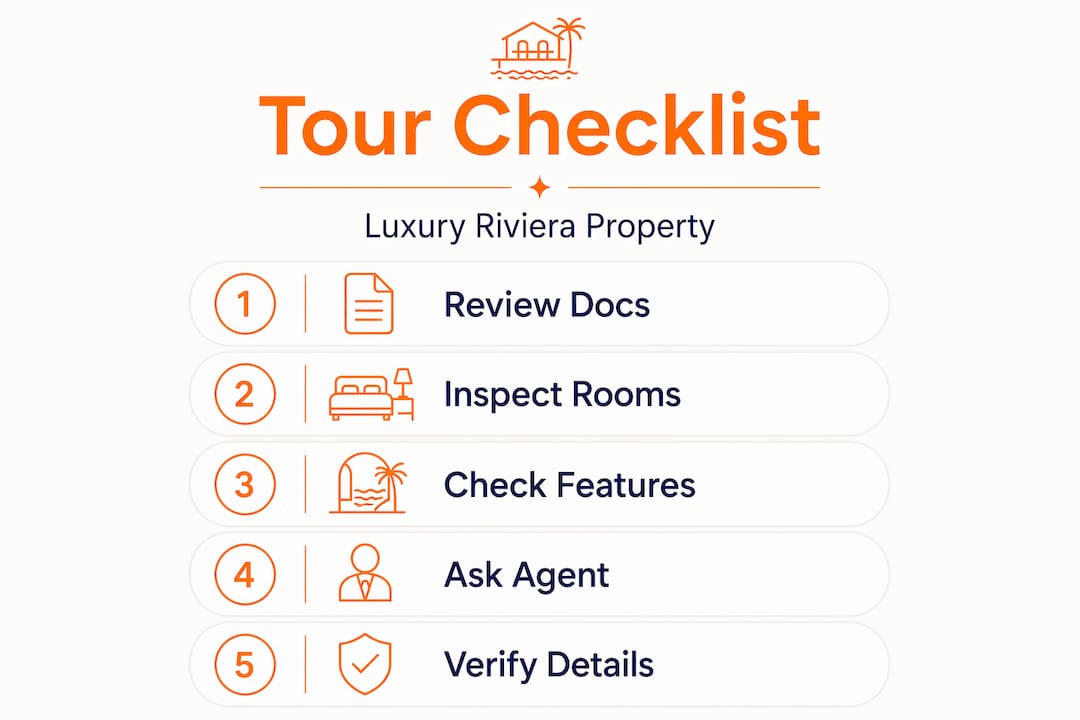
Infographic showing luxury property tour steps

The first order of business is requesting the full diagnostics dossier from the seller. French law requires vendors to provide a package of technical reports, and a thorough European luxury listing evaluation confirms you should demand every report before stepping inside: the Diagnostic de Performance Énergétique (DPE, the energy rating), asbestos survey (amiante), lead paint report (plomb), termite certificate, electrical risk assessment, gas installation report, and the État des Risques et Pollutions (ERP) covering flood and seismic exposure. Missing even one of these can leave you blindsided.

Key documents and checks to request before any viewing:

  • Full diagnostics dossier including energy ratings, asbestos, termites and electrical risks
  • Planning permission history (permis de construire) for all structures and extensions
  • Heritage protection status: is the property listed, partially listed, or situated within a protected perimeter?
  • Urban planning certificate (certificat d’urbanisme) showing permitted uses and future development constraints
  • Condominium (copropriété) accounts and minutes if applicable, covering the last three years
  • Proof of compliance for any pool, terrace, or outbuilding additions
DocumentWhat it revealsRisk if missing
DPE energy reportRunning costs, insulation qualityUnexpected energy bills, future legal non-compliance
Amiante/plomb surveyAsbestos and lead presenceHealth hazard, costly remediation
Termite certificateActive infestation or historical damageStructural integrity loss
ERP risk reportFlood, seismic and tech risk zonesUninsurable property or restricted use
Certificat d’urbanismeBuilding rights and planning constraintsRenovation blocked or fined

Our essential checklists distil years of Riviera acquisition experience into a format you can carry into every viewing. Do not tour without them.

Also verify local urban planning rules, particularly in communes such as Antibes or Cap d’Antibes where coastal protection laws (Loi Littoral) restrict extensions and new builds. Heritage perimeters around Menton’s old town or Cannes’ Boulevard de la Croisette add further layers of restriction that can prevent you from altering even a window frame.

Pro Tip: Bring a laser distance measurer, a notebook for recording room dimensions, and a smartphone with a compass app to verify which rooms actually face the sea. Sellers’ brochures are aspirational documents; your measurements are facts.

With thorough preparation in place, let’s move on to how to conduct the property tour itself effectively.
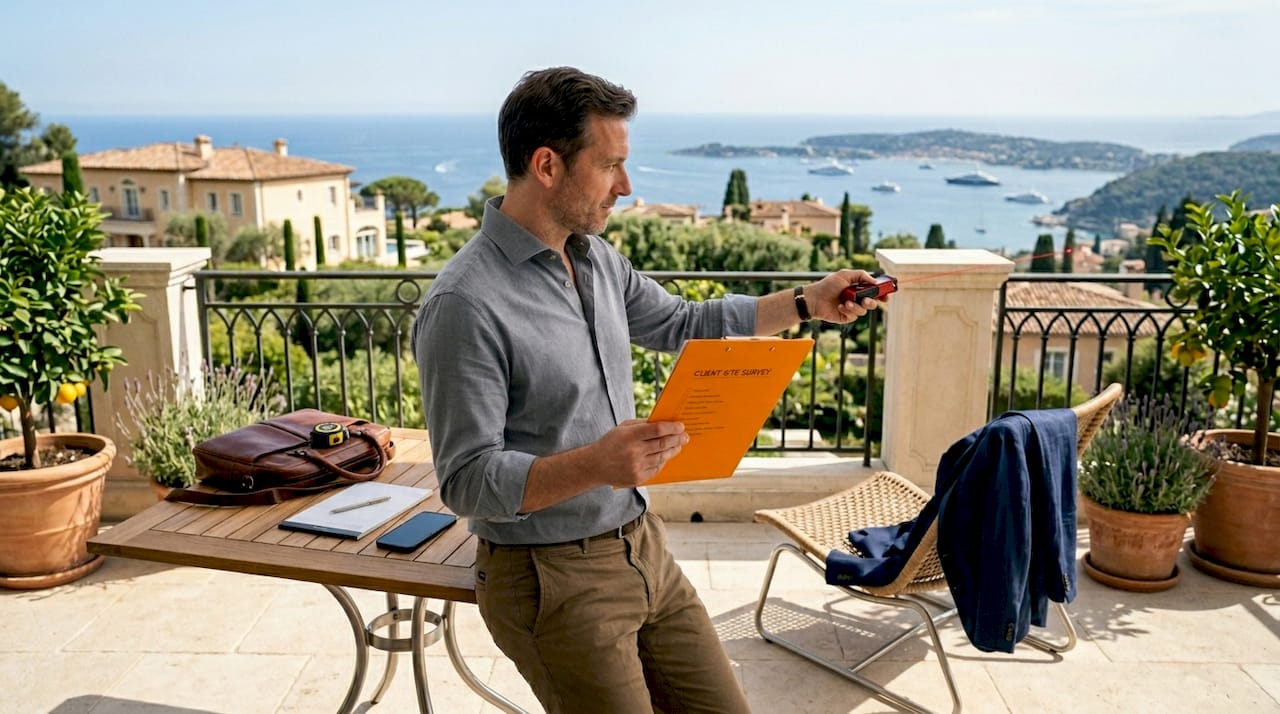
Man taking measurements during property viewing


Conducting the step by step luxury property tour

The luxury property walkthrough is where preparation meets reality. A stepwise luxury real estate tour is not a leisurely stroll through beautiful rooms; it is a structured inspection that separates emotional appeal from investment substance. We advise clients to approach each room with the detachment of a surveyor and the instincts of someone who has seen a hundred Riviera properties before.

Stepwise touring method:

  1. Begin outside. Walk the full perimeter before entering. Inspect the roof line from a distance for sagging, missing tiles, or staining that suggests water ingress. Examine retaining walls, terraces, and any poolside structures for cracking or subsidence.
  2. Assess the foundations and basement. Look for efflorescence (white salt deposits on walls), damp patches, and cracking at junctions. These are early indicators of water table issues, common in seafront properties from Nice to Saint-Tropez.
  3. Inspect timber structures in the roof space. Ask to access the loft. Darkening, bore holes, or powdery residue around beams indicates woodworm or, worse, active termite damage, a documented risk in coastal Provence.
  4. Test all MEP systems. MEP stands for Mechanical, Electrical, and Plumbing. Run every tap, flush every toilet, switch every circuit, and feel every radiator. Outdated electrical panels are one of the most common compliance failures in older Riviera villas.
  5. Evaluate heritage and planning compliance on site. Ask the agent directly: has any work been carried out without planning permission? Unauthorised additions are the seller’s liability until they are not, and once ownership transfers, they become yours.
  6. Document everything photographically. Every crack, every damp stain, every piece of outdated wiring. These photographs become your negotiation toolkit.

Independent structural surveys are strongly recommended, as 20 to 30% of Riviera properties require renovations exceeding €50,000 to achieve full legal compliance. That figure rarely appears in the listing.

Areas most frequently overlooked during a luxury property walkthrough:

  • Condition of the under-tile waterproof membrane on pool surrounds
  • Drainage and storm water management on steeply sloped plots, common in Èze and the arrière-pays above Cannes
  • Adequacy of electrical supply for contemporary home automation and EV charging infrastructure
  • Age and condition of the septic system (fosse septique) on non-mains-drainage properties
Inspection areaLuxury feature priorityCompliance/renovation priority
Sea-view terracesViews, materials, proportionsStructural fixing, waterproofing, planning authorisation
Kitchen and bathroomsFinishes, brands, layoutElectrical compliance, plumbing condition
Pool and wellnessSize, heating, automationWater treatment certification, fencing safety law
Roof and loftAesthetic characterInsulation rating, timber health, waterproofing
Heating systemSmart controls, radiant floorsAge, efficiency rating, fuel type compliance

Our luxury property tour tips go deeper on every inspection category listed above, with region-specific guidance from Cap d’Antibes to Monaco’s borders.

Pro Tip: Never tour a Riviera property for the first time at sunset. The golden light is intoxicating and deliberately so. Visit once in the morning to assess natural light objectively, and once in the afternoon to evaluate privacy from neighbouring properties.

Now that you know how to perform a detailed property tour, you need to understand the key legal and financial verification steps to secure your purchase.


Legal and financial verification after your tour

The period between a successful viewing and signed ownership is where fortunes are protected or quietly eroded. France’s property acquisition process is orderly but unforgiving of those who misread its stages.

The compromis de vente is the preliminary sale agreement, and it is far more binding than many international buyers realise. Once signed by both parties, it legally commits the seller to sell. Crucially, after signing the compromis de vente, buyers benefit from a mandatory 10-day cooling-off period during which they may withdraw completely without financial penalty. This window is precious; use it deliberately.

Post-tour legal and financial checklist:

  • Commission an independent structural and termite expert within the first 48 hours of the cooling-off period
  • Verify that the seller’s title (titre de propriété) is clear of any mortgages, charges, or rights of way not previously disclosed
  • Confirm local preemption rights: communes and the SAFER (agricultural land authority in rural zones) hold rights to purchase ahead of you in certain cases
  • Review mortgage conditions carefully; French lenders require property valuations and may impose conditions on older buildings
  • Clarify the timeline to acte authentique (the final deed signed before a notary), which typically falls 2 to 3 months after the compromis

Notary fees for resale luxury properties on the French Riviera average 7 to 8% of the purchase price, payable at the acte authentique signing. On a €3M villa near Monaco, that represents €210,000 to €240,000 in additional costs that must be budgeted from the outset.

Cost componentApproximate percentageNotes
Transfer taxes (droits de mutation)5.80%Applies to resale properties
Notary professional fees0.814 to 3.945% (sliding scale)Lower percentage on higher values
Administrative and registration fees~0.10%Fixed administrative costs
Total notary fees (resale)7 to 8%New builds attract lower fees (~2 to 3%)

Pro Tip: For new-build purchases under VEFA contracts, notary fees drop to approximately 2 to 3% of the purchase price, a saving of tens of thousands of euros on prestige developments. This is one reason our off-plan portfolio in Sainte-Maxime and Nice commands such strong interest from legacy-focused investors. Explore our successful property buying steps to navigate the full timeline with confidence.

Review our luxury real estate checklists for a stage-by-stage legal verification guide mapped to the French conveyancing process.

With legal and financial prerequisites clarified, let’s consider some advanced tips and common mistakes that can ensure your investment is sound.


Common pitfalls and expert tips for luxury property tours

Even seasoned investors make predictable errors on the French Riviera. The most costly rarely involve the obvious; they involve what is missed during the touring phase and the days immediately following.

Frequent oversights among international buyers:

  • Failing to review PPR (Plan de Prévention des Risques) maps for flood and seismic exposure before making an offer
  • Underestimating the time and cost of heritage-restricted renovations: a reclassification of works as travaux soumis à autorisation (works requiring authorisation) can add 12 to 18 months to a renovation timeline
  • Overlooking co-ownership (copropriété) debt or deferred maintenance charges that transfer with the property
  • Accepting the agent’s assurances on planning compliance without independently verifying at the local mairie (town hall)
  • Not factoring in seasonal rental licensing requirements if the investment strategy involves elite short-term lets

International buyers often miss checking PPR flood and seismic maps, and local heritage restrictions limiting renovations affect around 30% of Riviera villas. That proportion rises sharply in Belle Époque neighbourhoods of Nice and the medieval perimeters of Antibes’ Vieil Antibes.

“The most expensive square metre on the French Riviera is not the marble in the entrance hall; it is the undisclosed planning restriction that prevents you from ever changing it.” — A principle we share with every client we accompany on their first Riviera acquisition.

During the 10-day cooling-off period, commission an independent termite and structural expert immediately. Do not wait until day eight. Booking specialists on the Riviera during peak season (May through September, coinciding with Cannes Film Festival energy and summer regattas) can mean delays of several days.

Pro Tip: If diagnostics reveal issues such as active termite activity or an electrical installation requiring full rewiring, use these findings to negotiate seller credits or a price reduction before signing the acte authentique. The cooling-off period and the weeks following it are your leverage. Our luxury real estate checklists include a negotiation framework built specifically around diagnostics findings.

Having covered common pitfalls, we’ll now share our perspective on why rigorous property tours are essential for legacy investors on the French Riviera.


The critical role of thorough property tours in securing legacy investments

We have accompanied enough international buyers through the acquisition process to say something that the industry rarely articulates clearly: the tour itself is the investment decision. Everything signed afterwards merely formalises what the tour revealed, or concealed.

Many investors arrive on the Riviera with the conviction that prestige addresses, salt-kissed sea views, and trophy architecture speak for themselves. They do, but only up to a point. A villa above Èze with a Nietzsche Trail view and a crumbling fosse septique is not a legacy asset; it is a beautiful problem with a price tag attached. The emotional power of exploring high-end properties can, and frequently does, override the analytical rigour that wealth preservation demands.

What we observe consistently is that investors who treat the luxury home viewing guide process as a formality, rather than a cornerstone of due diligence, are precisely those who discover costly surprises six months into ownership. Local heritage regulations in communes from Menton to Antibes can restrict alterations to facades, shutters, and even the colour palette of exterior paintwork. Seismic zone designations affect structural reinforcement requirements that cascade directly into renovation budgets. None of this is visible at first glance, and none of it appears in a brochure photograph.

The investors who build genuine generational wealth on the Riviera are those who understand that a methodical tour, supported by independent experts and a clear verification framework, transforms risk into opportunity. A property with disclosed, negotiated defects and a clear remediation plan is frequently a stronger investment than an apparently pristine estate where nothing has been questioned. Involving local heritage architects and structural engineers before signing the compromis is not caution; it is competitive advantage.

We believe in this philosophy deeply. It is why our property investment process for legacy wealth places the tour and due diligence phase at the absolute centre of every client journey we lead.


How Living on the Côte d’Azur supports your luxury property journey

At Living on the Côte d’Azur, we do not simply list properties; we curate pathways to generational wealth along one of the world’s most coveted coastlines. Our expertise spans off-market acquisitions in Cap d’Antibes, new-build residences with sea views above Nice’s Mont Boron, and restored Provençal estates that become true family sanctuaries. Discover our invisible luxury real estate guide to access properties that never reach the open market. Our high-net-worth real estate legacy guide maps the full ROI picture for investors focused on multi-generational value. We also accept cryptocurrency payments, because the buyers reshaping the Riviera deserve a transaction process as forward-thinking as their portfolios. Contact our team to begin your curated journey today.

Pro Tip: Engage a trusted buyer’s agent before you visit a single property. Off-market opportunities on the French Riviera, the ones that appreciate 5 to 8% annually and never appear on public portals, are secured through relationships, not searches.


Frequently asked questions

What is the cooling-off period after signing the compromis de vente?

Buyers have a mandatory 10-day cooling-off period after signing the compromis de vente, during which they can withdraw from the purchase completely without incurring any financial penalty.

How much are notary fees for luxury property purchases on the French Riviera?

Notary fees for resale properties typically range from 7% to 8% of the purchase price, covering transfer taxes and professional fees, payable in full at the acte authentique signing. New-build purchases attract significantly lower fees of approximately 2 to 3%.

What essential documents should I request before touring a luxury property in the French Riviera?

Request the full diagnostics dossier including the energy rating, asbestos, termite and electrical risk reports, alongside heritage status confirmation, planning permissions for all structures, and the urban risk (ERP) certificate.

Why is it important to conduct independent inspections during a luxury property tour?

Independent structural surveys uncover hidden defects and compliance requirements that directly affect renovation budgets and future resale value, particularly on the Riviera where 20 to 30% of properties require works exceeding €50,000 for full legal compliance.

Recommended

  • Luxury Real Estate Buying Guide: Secure Your Riviera Legacy
  • How to Find Off-Market Homes for Riviera Investment Success
  • Step-by-step guide to luxury real estate investment in the French Riviera
  • Comprehensive Guide to French Riviera Investing Success
by Websols Servicedesk/17 May 2026/in Landingpage
https://www.livingonthecotedazur.com/wp-content/uploads/2026/05/1778796509064_Buyers-touring-French-Riviera-luxury-apartment.jpeg 714 1280 Websols Servicedesk https://www.livingonthecotedazur.com/wp-content/uploads/2024/02/sitelogo150.png Websols Servicedesk2026-05-17 02:00:422026-05-17 02:00:45Step by step luxury property tour for Riviera investors


TL;DR:

  • Ultra-prime French Riviera real estate offers valuable negotiation opportunities influenced by seller psychology, seasonality, and fee structures. Skilled, systematic negotiators can significantly reduce purchase costs by addressing agency fees, timing, and relationship-building strategies. Understanding emotional and legacy interests enhances success in this exclusive market where discretion and reputation are critical.

The assumption that ultra-prime real estate on the French Riviera is a take-it-or-leave-it affair is, frankly, one of the most expensive myths in high-net-worth property acquisition. From the bougainvillea-draped bastides above Èze to the palatial sea-view residences along Cap d’Antibes’ coastal sentiers, prices appear immovable at first glance. Yet beneath the polished surface of every asking price lies a negotiating landscape shaped by seller psychology, seasonal rhythms, tax architecture, and the subtle art of relationship-building. Elite buyers who understand this landscape consistently secure better terms, more favourable tax positions, and stronger long-term returns.


Table of Contents

  • Why negotiation matters for luxury real estate on the French Riviera
  • Core negotiation frameworks: What elite buyers do differently
  • Practical strategies for negotiating French Riviera property deals
  • Common pitfalls in luxury property negotiation and how to avoid them
  • What most real estate negotiation guides miss about ultra-prime markets
  • Connect with off-market French Riviera opportunities
  • Frequently asked questions

Key Takeaways

PointDetails
Negotiation saves costsEven in luxury markets, strategic negotiation cuts fees, taxes, and boosts investment value.
Elite frameworks outperformStructured approaches like stakeholder mapping and concession planning deliver better results than ad hoc tactics.
Timing mattersNegotiating in off-peak seasons or with motivated sellers increases your leverage and potential discount.
Avoid costly mistakesLowball offers and neglecting fee optimisation can ruin deals or add unnecessary costs.
Legacy and emotion countUnderstanding identity and emotional drivers unlocks unique opportunities in ultra-prime deals.

Why negotiation matters for luxury real estate on the French Riviera

The French Riviera remains one of Europe’s most coveted property markets, a constellation of prestige addresses where demand persistently outpaces supply. This reality leads many buyers, even sophisticated family offices, to assume that negotiation is futile. It is not.

Even in the tightest markets, skilled negotiation can reshape the economics of a transaction in meaningful ways. One of the most overlooked levers is how agency fees are structured. As noted in detailed market updates French Riviera analysis, negotiating agency fees separately from the purchase price can reduce the notary fee calculation base, which typically runs at 7 to 8 percent of the declared price. On a €1 million acquisition where agency fees amount to €60,000, structuring the fees outside the sale price can yield approximately €5,000 in immediate savings, before factoring in the compounding effect on annual property taxes.

The question of margin is equally nuanced. Supply constraints create slim margins of 5 to 10 percent in competitive conditions, but off-peak periods such as winter months or situations where a property has been overpriced by 10 percent or more open considerably more room. The key principle: never lowball to the point of breaking the dialogue.

Purchase priceTypical negotiation range (5-10%)Notary fee saving via agency fee separationCombined potential saving
€1,000,000€50,000 to €100,000~€4,800~€54,800 to €104,800
€3,000,000€150,000 to €300,000~€14,400~€164,400 to €314,400
€7,500,000€375,000 to €750,000~€36,000~€411,000 to €786,000

The figures above illustrate why even a modest improvement in negotiating skill translates to material wealth preservation. For family offices securing luxury property growth as a multi-generational asset, this is not a peripheral concern. It is central to the investment thesis.

“In high-demand Riviera markets, the question is never whether to negotiate, but how to negotiate with enough intelligence that you preserve the relationship while securing real value. Every percentage point retained is compounded across decades of appreciation.”


Core negotiation frameworks: What elite buyers do differently

Most buyers approach property negotiation instinctively, guided by gut feeling and whatever leverage seems obvious at the time. Elite buyers approach it as a structured process, and the results reflect that discipline.

Woman mapping negotiation steps at desk

Research into elite negotiation methodology confirms that pre-briefs, stakeholder mapping, and formal concession planning reduce negotiation cycles by 33 percent, from an average of nine rounds to six, while boosting close rates by 11 percent. These are not marginal gains. They are the difference between securing a prized Cap d’Antibes villa and watching it transfer to a better-prepared buyer.

Equally revealing is the Harvard framework for negotiation, which prioritises rational, emotional, and identity interests simultaneously. Analyses of failed transactions, including data suggesting that 70 percent of high-value M&A deals collapse due to oversight of these layered interests, apply directly to ultra-prime real estate. A seller who has lived in a Provençal mas for thirty years is not merely transacting on price. They are also transacting on legacy, on who will inherit the light that fills those stone-walled rooms each morning.

Ad hoc negotiation vs. systematised approach

FactorAd hoc approachSystematised approach
PreparationReactive, price-focusedStructured pre-brief with stakeholder map
Concession planningImprovised in the momentPredefined boundaries and approval matrix
Relationship managementVariable, often neglectedConsistent rapport-building at each stage
Number of roundsAverage 9Average 6 (33% reduction)
Close rateBaseline11% higher
Tax and fee optimisationRarely addressedBuilt into the structure from outset

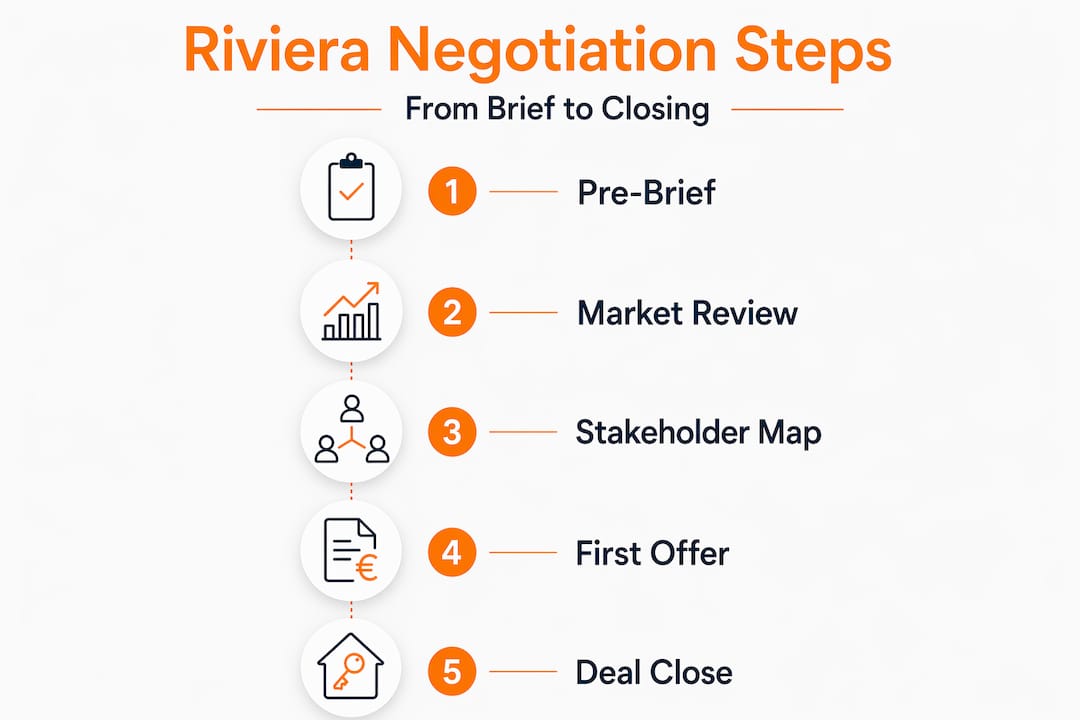
The five steps that top negotiators follow when pursuing private real estate sales tips in ultra-prime markets are as follows:

  1. Pre-brief: Establish your walk-away position, ideal outcome, and emotional priorities before any contact with the seller’s agent.
  2. Stakeholder mapping: Identify all decision-makers, including trustees, family members, or co-owners, since Riviera estates often involve complex ownership structures.
  3. Concession planning: Determine in advance which concessions you are willing to make (timing, deposit structure, furniture, crypto payment terms) and their relative value.
  4. Opening position: Place an offer that is credible and respectful, typically within 10 percent of asking unless there is a well-documented basis for a larger adjustment.
  5. Close with clarity: Confirm all agreed terms in writing immediately after any verbal agreement, ensuring no ambiguity enters the process.

Pro Tip: Always document your concession boundaries and approval matrix before your first offer. Knowing exactly what you will and will not trade prevents costly in-the-moment decisions that sellers and agents are trained to exploit. This preparation is especially critical when you are investing for lasting value as part of a broader family portfolio strategy.


Practical strategies for negotiating French Riviera property deals

The Côte d’Azur is not a monolithic market. The dynamics in Cannes, where Croisette-facing penthouses attract film-festival buyers each spring, differ meaningfully from those in Sainte-Maxime, where buyers arrive via summer ferry from Saint-Tropez and can be swayed by the romance of Nartelle beach sunsets. Timing, seller motivation, and local nuance all create leverage that a well-prepared buyer can use.

Here are the key strategies we have seen deliver consistent results:

  • Separate agency fees from the purchase price. As confirmed by French Riviera transaction specialists, structuring fees separately removes them from the notary fee calculation and from the taxable base for property taxes. On larger acquisitions this alone justifies the effort.
  • Analyse seller motivation before making any offer. A seller relocating for professional reasons, managing an estate, or facing liquidity pressures is structurally more flexible than one who is merely testing the market.
  • Time your approach deliberately. Negotiation room widens in off-peak periods, particularly between November and February when fewer competing buyers are active and sellers who listed optimistically in summer begin to recalibrate expectations.
  • Engage bilingual negotiators with verified local networks. The Riviera’s most compelling opportunities frequently never appear on public portals. A trusted local advisor with roots in the market provides access to motivated sellers before competing buyers arrive.
  • Avoid lowball offers without supporting evidence. A low offer unsupported by comparable sales data, technical survey findings, or documented remediation costs is read as disrespect and can permanently close a seller’s willingness to engage.

Pro Tip: Notary fees on the French Riviera are calculated on the declared purchase price, typically at 7 to 8 percent. If the agency commission is declared separately and paid directly by the buyer outside the deed, the notary fees apply only to the net property price. On a €3 million purchase with €150,000 in agency fees, this structure can save approximately €10,500 to €12,000 in notary costs alone. Always confirm this structure with a French notaire before signing any mandate.

We recommend choosing a local agent with a specific track record in your target area and reviewing a market value guide before forming your opening position. Understanding existing property advantages, particularly the absence of construction risk and the immediate income potential from elite seasonal letting, also strengthens your negotiating rationale.


Common pitfalls in luxury property negotiation and how to avoid them

Even buyers with genuine wealth and good intentions make errors in Riviera negotiations that cost them significant value or, worse, the property entirely. The five most consequential mistakes, and the disciplines that neutralise them, are outlined below.

  1. Lowballing without evidence. Offering 25 to 30 percent below asking on a well-priced Antibes villa, without documented justification, signals naivety or bad faith. The remedy is to ground every offer in comparable transaction data and independent valuation.

  2. Neglecting tax optimisation from the outset. Many buyers focus exclusively on price and discover the full tax cost only at the notary’s office. The remedy is to engage a French tax adviser before making any offer, mapping the complete acquisition cost including notary fees, wealth tax implications (IFI), and the impact of agency fee structuring on luxury property tax strategies.

  3. Failing to clarify agency fee arrangements early. Whether the agent represents the seller, the buyer, or both (dual mandate) has profound implications for loyalty and information flow. Clarify this before any substantive negotiation begins.

  4. Poor timing, specifically listing-season urgency. Buyers who allow themselves to be pressured during peak summer season, when Cannes is alive with yacht regattas and Menton glows through its celebrated Lemon Festival, often overpay. The remedy is to operate on a calendar that prioritises your investment logic over seasonal excitement.

  5. Neglecting the emotional dimension of the seller’s decision. Sellers of prestige Riviera properties frequently have a profound personal connection to the estate. Treating the negotiation as purely transactional, without acknowledging the history and identity embedded in the property, can destroy goodwill at a critical moment.

“In ultra-prime markets, the dialogue itself is an asset. Lose it through a reckless first offer and you may never recover access to the property, or the seller’s network of equally exceptional off-market opportunities.”

The limited supply environment on the Riviera means that sellers rarely need to entertain a buyer who has shown poor judgement. Your reputation as a credible, respectful counterpart travels through agent networks faster than any marketing campaign.


What most real estate negotiation guides miss about ultra-prime markets

Most guides on property negotiation treat it as a financial puzzle. Find the data, calculate the margin, submit the offer. In our experience advising family offices and private clients across Cap d’Antibes, Nice, and Monaco borders, the financial calculation is the easy part. The harder, more decisive work happens in the emotional and identity layers that the Harvard negotiation framework identifies as the root cause of 70 percent of high-value deal failures.

When a Niçois family has held a Belle Époque residence overlooking Baie des Anges for three generations, the seller’s core interest is not simply the highest number on the page. It is confidence that the home will be honoured, that its history will be respected, and that the new owners carry a sense of legacy into what those stone walls represent. We have witnessed negotiations where a better-funded buyer lost to a slightly lower offer from someone who communicated their vision for the estate with genuine warmth and specificity.

This is why we approach lasting legacy sales not merely as transactions but as introductions between one custodian and the next. Discretion matters enormously. The ability to conduct a negotiation entirely without public footprint, without press, without the performance of wealth, is a signal that resonates deeply with Riviera sellers who have seen every variety of high-profile buyer come and go. Rapport built quietly and consistently, over multiple conversations, across the lavender-laced months of an unhurried courtship, outperforms any aggressive financial tactic we have ever witnessed.

Infographic outlining steps for Riviera property negotiation

The practical implication: invest in the relationship as deliberately as you invest in the due diligence. Know the property’s story. Understand the family’s priorities. Arrive at the table with intelligence that goes beyond the price per square metre.


Connect with off-market French Riviera opportunities

https://www.livingonthecotedazur.com/contact-nice-to-meet-you/

If you are ready to move from strategy to acquisition, we invite you to explore the curated world of off-market luxury properties that never appear on public portals. At Living on the Côte d’Azur, our advisory team combines intimate market knowledge with a global network spanning Ibiza, Dubai, Italy, Bali, Portugal, and Mauritius, and we welcome cryptocurrency-enabled transactions for buyers who move at the pace of digital wealth. Browse our full portfolio of French Riviera villas and penthouses or deepen your understanding of what defines luxury real estate in today’s market. Your next heirloom awaits.


Frequently asked questions

How much can you typically negotiate on French Riviera luxury property?

Typical negotiation margins run 5 to 10 percent, with greater flexibility available on overpriced listings or during off-peak winter months when fewer competing buyers are active.

Why should agency fees be negotiated separately in French Riviera deals?

Separating agency fees from the purchase price reduces the declared sale price used to calculate notary fees at 7 to 8 percent, generating thousands in immediate savings on large transactions.

What is the best time of year to negotiate luxury property?

Winter and off-peak months create the most favourable conditions, as seasonal supply pressure eases and sellers who listed ambitiously during summer become more receptive to credible offers.

How do professional negotiators structure real estate deals?

They use systematic pre-briefs, full stakeholder mapping, and pre-planned concession boundaries, an approach that reduces negotiation rounds by 33 percent and raises close rates by 11 percent compared to improvised tactics.

What negotiation mistake do most luxury buyers make?

Submitting an aggressive lowball offer without documented justification risks closing the dialogue entirely, cutting off access to a coveted listing and, often, to the seller’s broader network of exceptional off-market properties.

Recommended

  • Newsletter French riviera real Estate February 2023 – Living on the Côte d’Azur
  • How legal services protect luxury property buyers on the French Riviera
  • Luxury property financing on the French Riviera: 5 key tips
  • Finding the perfect French Riviera luxury investment property
by Websols Servicedesk/15 May 2026/in Landingpage
https://www.livingonthecotedazur.com/wp-content/uploads/2026/05/1778630496023_Executive-reviewing-Riviera-property-listing-with-sea-view.jpeg 714 1280 Websols Servicedesk https://www.livingonthecotedazur.com/wp-content/uploads/2024/02/sitelogo150.png Websols Servicedesk2026-05-15 02:00:492026-05-15 02:00:53Master negotiation for French Riviera luxury property


TL;DR:

  • Reputation functions as invisible equity that enhances access and reduces risks in luxury real estate investments.
  • Building and verifying genuine reputation through thorough due diligence and credible professionals is essential for safeguarding long-term value.

There is a persistent illusion in luxury real estate: that the finest address and the highest price tag together constitute a safe, enduring investment. Sophisticated investors on the French Riviera know that this is rarely the whole story. What separates a trophy asset that appreciates gracefully across generations from one that quietly disappoints is something far subtler and far more powerful. Reputation functions as invisible equity, accelerating access to capital and counterparties in ways that price alone never can. Understanding this changes everything about how you invest.

Table of Contents

  • Why reputation is ‘invisible equity’ in luxury real estate
  • How reputation protects buyers: due diligence and credible processes
  • Can reputation signal real value? Empirical evidence and sentiment effects
  • What happens when reputation is damaged? Risks and legacy impact
  • Building and verifying reputation: a practical framework for discerning investors
  • Why reputation is the undervalued driver of Riviera legacy
  • Discover legacy investment opportunities on the Riviera
  • Frequently asked questions

Key Takeaways

PointDetails
Reputation is invisible equityA trustworthy reputation gives buyers and sellers critical leverage and access in high-stakes property deals.
Risk is reduced by credible processEngaging reputable professionals and proven due diligence minimises legacy and investment risks.
Reputation moves property valuesMarket evidence confirms that sentiment and reputation measurably affect long-term housing prices.
Damage persists across generationsNegative reputation shocks can cause lasting value loss that impacts future family wealth.
Assessment must be systematicInvestors should use a framework to check reputation alongside legal and financial fundamentals for true legacy security.

Why reputation is ‘invisible equity’ in luxury real estate

With preconceptions about value set aside, it is time to look at reputation as the true engine driving outcomes for those who invest at the highest level of the market.

“Reputation operates as ‘invisible equity’ that accelerates access to capital and counterparties; it functions as a form of relational leverage in deal execution.”

This insight reframes the entire conversation. On the Côte d’Azur, where a golden-stone villa above Èze commands eye-watering sums and a penthouse facing Cannes’ shimmering Croisette changes hands in hushed negotiations, reputation is the currency that opens doors before a price is even mentioned. A buyer known for swift, clean completions receives early calls about off-market estates. A seller whose provenance is well-documented attracts competing offers from credible investors worldwide. The deal, in short, is shaped before the formalities begin.

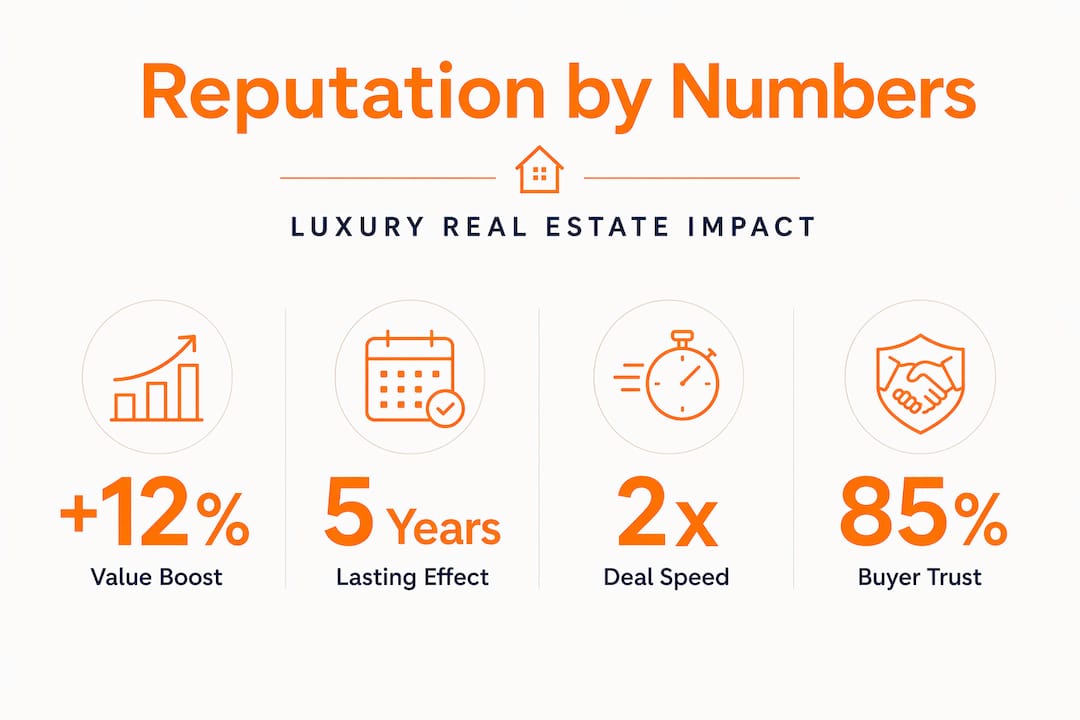
Reputation delivers several concrete advantages:

  • Access to off-market opportunities not listed on public portals, often representing the finest properties at the most competitive terms.
  • Trust that accelerates timelines, reducing the friction of negotiations in a market where speed genuinely matters.
  • Relational introductions through curated networks, connecting buyers with the most credible legal, technical, and financial professionals.
  • Protection against costly errors, because reputable counterparties have more to lose from a flawed transaction than from walking away.

We have witnessed, time and again, how lasting relationships in luxury real estate translate directly into preferential terms and privileged access. The buyers who cultivate genuine reputations, who transact with integrity and respect process, consistently outperform those who treat each deal as a purely transactional event. Working with boutique luxury agencies that carry their own impeccable standing is itself a reputational signal, one that opens further doors.

How reputation protects buyers: due diligence and credible processes

If reputation is an asset, then its most tangible expression lies in the rigour it demands from every professional involved in a high-value transaction.

When you are purchasing an estate near Cap d’Antibes or a contemporary villa above the lemon-scented lanes of Menton, the complexity of French property law is formidable. Notaires, avocats, structural engineers, and agents each carry their own professional standing, and that standing directly determines the quality of the due diligence you receive. Hidden legal and technical issues can become the buyer’s responsibility after commitment, which is precisely why the credibility of everyone around the table matters so profoundly.

Here is a practical, step-by-step approach to evaluating the reputational quality of any transaction:

  1. Verify the professional provenance of every adviser. Confirm bar registrations, notarial credentials, and agency licences. Ask for references on comparable transactions, not testimonials, but traceable completions.
  2. Demand documented process transparency. Reputable teams produce clear, sequenced due diligence reports covering title clarity, planning history, structural integrity, and any encumbrances on the land.
  3. Confirm that legal and technical reviews are coordinated, not siloed. A reputable transaction has an avocat and notaire who speak to one another and to the structural surveyor. Gaps in this coordination are warning signals.
  4. Scrutinise the property’s documented history. Planning permissions, renovation records, and any prior disputes should be fully accessible and presented proactively by a credible seller.
  5. Assess the agency’s standing in the market. Ask how long they have operated in this specific locale, who their repeat clients are, and whether they maintain the importance of experienced buyer agents as a standard of service.

Pro Tip: Do not mistake marketing polish for substantive risk protection. A beautifully produced brochure and a digitally flawless presentation are not substitutes for rigorous legal and technical review. We have seen stunning properties with elegant marketing that concealed unresolved planning disputes. The credibility of the process, and the people running it, is your real protection. High-value real estate curation must always be matched by equally rigorous process.

Can reputation signal real value? Empirical evidence and sentiment effects

Understanding the process is only half the equation. The more compelling question for the discerning investor is whether reputation can be measured in financial terms, whether it genuinely moves the price.

The answer, supported by robust research, is yes. Combining residents’ sentiment with rating scores meaningfully improves the predictive power of housing valuation models, with sentiment variables remaining statistically significant even after controlling for the physical characteristics of a property such as size, age, and amenities. This is a finding that should change how you think about any acquisition.

Reputation factorImpact on valuationDuration of effect
Positive community sentimentMeasurable price premiumMedium to long term
High professional credibilityFaster deal closure, fewer price reductionsPer transaction
Negative sentiment signalsPersistent price discountCan extend years
Verified provenance and processReduced buyer risk premiumOngoing

On the Côte d’Azur, this plays out in specific, observable ways. The villages of Èze and Saint-Jean-Cap-Ferrat consistently command premiums not solely because of their physical beauty, but because decades of curated residency and well-managed community reputation have created a self-reinforcing cycle of prestige. A property in a locale where neighbours are credible, where local governance is respected, and where the social fabric is admired by global elites, will always command a premium over a comparable property in a locale without that standing.

Statistic worth noting: Studies confirm that sentiment variables, even when extracted from text-based community reviews, contribute independently to housing price explanations after all physical variables are controlled. This is not soft data. It is measurable, persistent, and increasingly incorporated into sophisticated property valuation on the Riviera. For the investor whose horizon spans multiple generations, understanding this dynamic is not optional. It is essential.

Infographic highlighting reputation stats in real estate

What happens when reputation is damaged? Risks and legacy impact

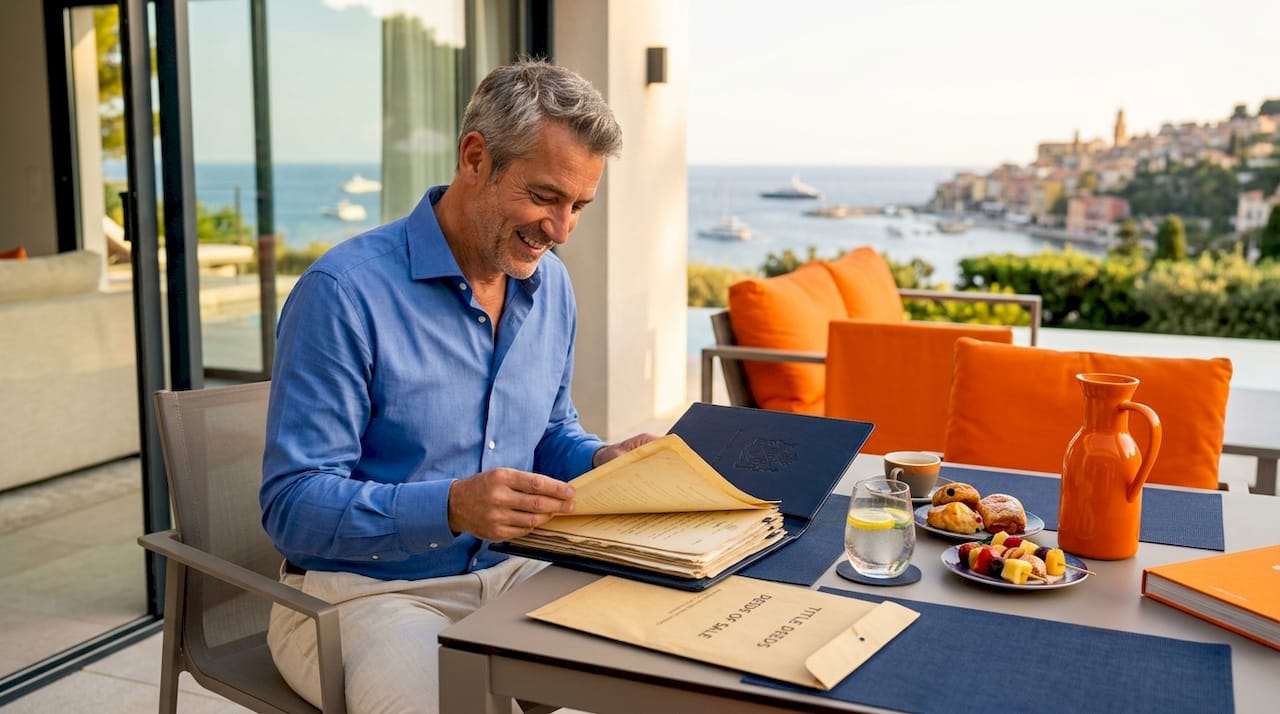
Man reviews inherited estate papers at table

Whereas positive reputation signals drive exceptional returns, negative ones carry consequences that extend far beyond a single transaction.

The academic evidence here is striking. Reputational shocks are priced into luxury real estate and, critically, these effects persist over time. This is not merely about brand association. It is about how a property’s reputation, tied to its owner, its history, or its locale, can sustain a measurable discount that proves stubbornly difficult to reverse.

“Reputation risk should be treated as a material risk factor in valuation and risk management, not a peripheral concern.”

Consider how this translates to a generational inheritance scenario. If you acquire a celebrated estate above the Pampelonne coastline of Saint-Tropez or a Provençal mas near Antibes, its value to your heirs is partly the stone, the views, and the legal title, but also the story that surrounds it. A property associated with controversy, unresolved disputes, or declining community standing carries that shadow forward.

ScenarioWithout reputation risk analysisWith reputation risk integrated
Pre-acquisitionPrice taken at face valueSentiment and provenance assessed alongside financials
Ownership periodVulnerability to unforeseen discountsActive reputation monitoring protects yield
Legacy transferRisk passed to heirsClean provenance enhances inheritance value
Distressed saleCompounded by reputational discountMitigated through documented credibility

Practical steps for managing this risk are straightforward but frequently overlooked:

  • Include a formal reputation assessment, covering community sentiment, ownership history, and any litigation history, within your due diligence framework.
  • Engage advisers who understand both the financial and the social dimensions of a property’s standing.
  • Review the luxury investment risk types relevant to Riviera acquisitions, because reputational exposure belongs alongside legal and structural risks, not beneath them.

Pro Tip: When assessing an estate, research the history of its previous owners and any public controversies attached to the property or its immediate neighbours. A single unresolved planning dispute or a well-publicised ownership scandal can create a discount that persists for years, even after the underlying issue is technically resolved. The impact of valuation after shocks is rarely immediate; it compounds quietly.

Building and verifying reputation: a practical framework for discerning investors

Given the potential for both upside and material risk, the final step is to operationalise reputation assessment in every transaction.

We recommend a three-stage evidence-based system, drawing on the most rigorous methodology for evaluating reputation available to high-net-worth investors. The framework treats reputation not as a feeling or an impression, but as a structured body of evidence assembled before commitment.

  1. Provenance of all counterparties. Verify the ownership history of the property, the professional credentials of agents and advisers, and the track record of any developer if the acquisition involves a new build. For off-market acquisitions, this is especially important, as the absence of public scrutiny means the burden of verification rests entirely with you.
  2. Documented process quality in due diligence. Insist on written records of every stage: title searches, planning audits, structural surveys, environmental assessments, and tax clearance. Reputable professionals produce these as a matter of course. Those who resist or minimise this step are communicating something important about their own standards.
  3. Measurable trust signals. Review community sentiment data for the locale, assess the property’s rental yield history if applicable, and seek references from professionals who have completed transactions in that micro-market. For an off-market reputation guide, these signals are often the most reliable indicators of genuine value.

Weaving these three elements together produces a reputation profile that is evidence-backed, not impression-led. For an investor protecting generational wealth, this rigour is not overcaution. It is the standard that separates enduring legacy from expensive regret.

Pro Tip: Weight reputation as one pillar alongside financial analysis and technical due diligence, not as a replacement for either. The most astute investors we work with treat reputation as a lens that focuses and sharpens their other investigations, not as a shortcut past them.

Why reputation is the undervalued driver of Riviera legacy

We observe, across years of working with some of the world’s most discerning buyers, a consistent blind spot: sophisticated investors who apply forensic rigour to financial projections yet treat reputation as a qualitative afterthought.

The contrarian reality is that reputation influences both pricing and access in ways that can be confounded with other fundamentals, which is precisely why it requires its own structured framework rather than a cursory glance. Surface-level reputation, a celebrated address or a well-known former owner, is not the same as deep, documented credibility. The former can disguise risk; the latter actively reduces it.

For those building real estate legacy and ROI across generations, this distinction is everything. The lavender-laced hills above Grasse, the salt-kissed corniche estates of Cap d’Antibes, the sun-drenched terraces of Nice’s Mont Boron, each of these carries a reputation that is layered, textured, and partly invisible to those who have not spent years navigating this market. We have. And what we know with conviction is this: the investors who build multi-generational fortunes on the Côte d’Azur are those who treat reputation not as a marketing narrative, but as a pillar of their investment philosophy, examined, verified, and actively managed.

Conventional due diligence checklists rarely include a reputation audit. We believe that is a systemic oversight, and one that the most prescient buyers are beginning to correct.

Discover legacy investment opportunities on the Riviera

For those who recognise the decisive role that reputation plays in every dimension of a Riviera acquisition, the next step is access. We offer precisely that: curated, reputation-assured introductions to invisible luxury real estate that never reaches the public market, guided by advisers whose own standing in this community is their most valuable asset. Whether your vision is a Provençal estate to anchor three generations or a contemporary penthouse facing the Lérins islands, our French Riviera investment guide provides the strategic foundation, while our curated portfolio of French Riviera villas and penthouses offers the finest expressions of enduring value. We accept cryptocurrency payments, and we welcome visionaries who understand that the finest properties are not bought, they are earned through the right relationships.

Frequently asked questions

What makes reputation so critical when investing in French Riviera real estate?

Reputation accelerates access to capital and counterparties, speeds up complex negotiations, and protects high-value transactions from unseen risks that price and location alone cannot guard against.

How can I verify a property’s or agency’s reputation?

Treat it as an evidence-backed system: check the provenance of all counterparties, demand fully documented due diligence, and assess measurable trust signals including local sentiment data and verifiable professional reviews.

What are the dangers of ignoring reputation in property investment?

Ignoring reputation can expose you to long-lasting value loss, because reputational shocks persist over time and create discounts that compound quietly, potentially undermining the generational legacy your investment was designed to protect.

Does a strong reputation guarantee higher property values?

A strong reputation is a proven driver of value, but reputation can be confounded with other fundamentals; always integrate reputational assessment alongside location, legal clarity, and technical quality for a complete and reliable investment picture.

Recommended

  • High-net-worth real estate: Legacy, luxury, and ROI
  • Build lasting relationships in luxury real estate 2026
  • How to Evaluate Luxury Real Estate for Smarter Investments
  • Real Estate Investment Strategies Shaping Legacy and Yield
by Websols Servicedesk/14 May 2026/in Landingpage
https://www.livingonthecotedazur.com/wp-content/uploads/2026/05/1778534455474_Advisor-meets-clients-in-Riviera-apartment.jpeg 714 1280 Websols Servicedesk https://www.livingonthecotedazur.com/wp-content/uploads/2024/02/sitelogo150.png Websols Servicedesk2026-05-14 02:00:172026-05-14 02:00:21How reputation shapes luxury real estate investment


TL;DR:

  • Luxury assets on the French Riviera serve as vital instruments for wealth preservation, income generation, and intergenerational legacy. Their value is driven by scarcity, provenance, and lifestyle integration, making them resilient across economic cycles. Successful ownership requires intentional management, expert structuring, and disciplined stewardship to maximize long-term benefits.

There is a persistent misconception that luxury assets exist purely as a theatre of wealth, gleaming trophies displayed for admiration rather than purpose. The truth, as generations of astute families along the Côte d’Azur have quietly demonstrated, is far more compelling. A cliff-top villa above Èze, bathed in the golden light that inspired Nietzsche himself, is not simply a residence. It is a living instrument of wealth preservation, an heirloom calibrated to outpace inflation, generate meaningful income, and pass seamlessly to the next generation. This guide reveals the strategic power of luxury assets and how to hold them with the intentionality they deserve.

Table of Contents

  • What defines a luxury asset: more than meets the eye
  • Core advantages: legacy, resilience, and income
  • Scarcity, provenance, and value retention
  • Risks, limitations, and the art of holding
  • Practical strategies: making luxury assets work for you
  • Why intentional, expert-driven ownership beats luck every time
  • Looking to secure your legacy on the Côte d’Azur?
  • Frequently asked questions

Key Takeaways

PointDetails
Luxury assets provide resilienceThey protect family wealth from inflation and market shocks through tangible, scarce value.
Legacy planning is vitalCareful structuring and expert advice secure luxury assets for future generations.
Illiquidity is a double-edged swordWhile it can protect against panic selling, forced sales or poor planning expose owners to risk.
Ongoing management winsExceptional results come from expert, intentional holding and not from luck or neglect.

What defines a luxury asset: more than meets the eye

To ground our discussion, we must first define what counts as a luxury asset and why it matters for your long-term goals. The term encompasses a broad and varied universe, ranging from prime coastal real estate in Antibes or Cap d’Antibes, to museum-quality art, rare vintage watches, classic automobiles, and fine wines. What unites them is not price alone. It is the combination of scarcity, provenance, and genuine desirability that endures across economic cycles.

For high-net-worth families, real estate on the French Riviera occupies a singular position within this universe. A property overlooking Cannes’ Croisette or nestled within the lemon-scented lanes of Menton offers something no equity portfolio can: tangible presence, personal use, and rental income. As research confirms, luxury real estate functions as a tangible, experience-bearing asset that also diversifies away from traditional stocks and bonds, reducing overall portfolio volatility in ways that paper assets simply cannot replicate.

Common myths deserve to be addressed directly. Many people assume that luxury assets are illiquid luxuries reserved for those who can afford to park capital indefinitely. In reality, a thoughtfully chosen villa on Mont Boron in Nice, or a newly completed sea-view apartment in Sainte-Maxime, can generate 3–5% in elite holiday lets whilst simultaneously appreciating in underlying value. Understanding the personalised luxury benefits of your chosen asset class is the first step towards building a genuinely resilient portfolio.

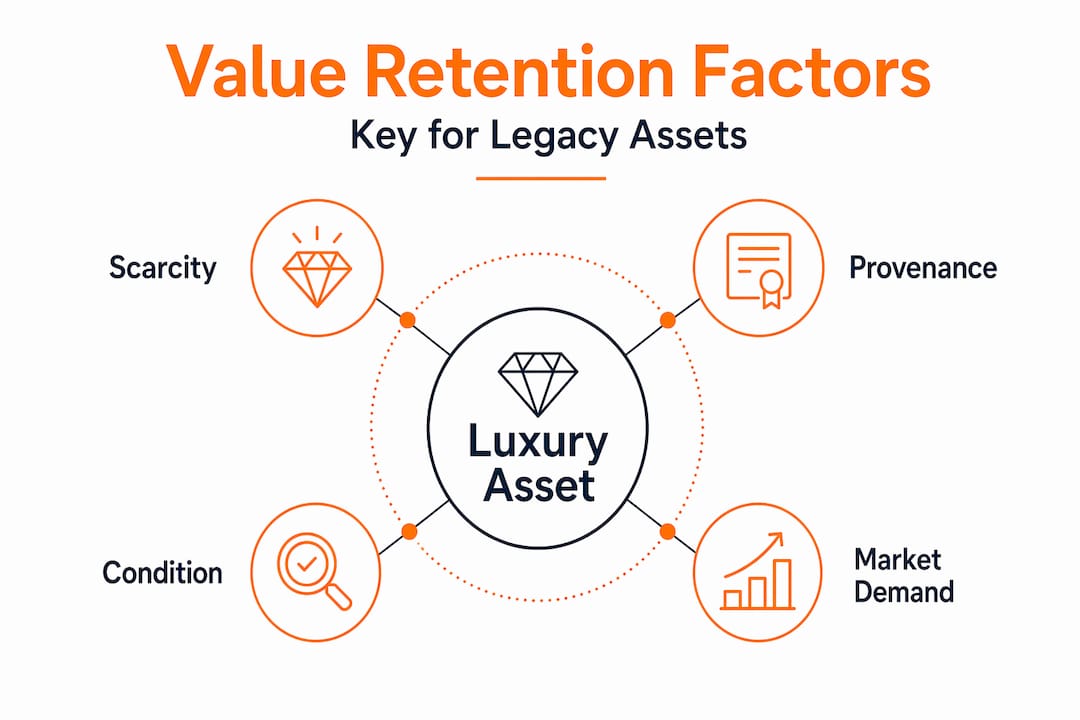
Key qualities that distinguish a true luxury asset from a mere expensive purchase include:

  • Scarcity: Limited supply in desirable locations such as Monaco-adjacent plots or Cap d’Antibes coastal sentiers
  • Provenance: A documented history of ownership, craftsmanship, or architectural significance
  • Income potential: Capacity to generate returns through seasonal or long-term letting
  • Lifestyle integration: The ability to serve as a personal sanctuary whilst functioning as an investment

Staying across evolving luxury buyer trends is equally essential, as shifting demand patterns directly influence which assets hold their value most reliably.

“The finest luxury assets are not purchased. They are curated with intention, held with patience, and ultimately passed down as the most eloquent expression of a family’s values.”

Core advantages: legacy, resilience, and income

Now that we understand what luxury assets are, let’s explore their substantial advantages for discerning investors. The Riviera’s finest properties have a compelling track record: villas in established enclaves typically appreciate at 5–8% annually, and that growth compounds powerfully over generational holding periods.

Luxury real estate preservation is widely positioned as an inflation hedge and a long-term wealth-preservation tool for legacy planning, particularly as central banks ease rates in 2026 and capital seeks tangible stores of value. When inflation erodes the purchasing power of cash and bonds, a stone-built Provençal mas in the hills above Antibes tends to hold its worth with quiet authority.

The following table compares three core luxury asset classes across the dimensions most relevant to legacy-focused investors.

Asset classDiversificationIncome potentialTangibilityLegacy transfer
Prime real estateHighHigh (3–5% rental yield)Physical and experientialExcellent via succession structures
Fine artModerateLow (unless loaned)Physical and culturalGood, though valuation complex
Rare collectiblesModerateVery lowPhysical onlyModerate, estate planning essential

What the table makes clear is that Riviera real estate leads across every dimension that matters most to families focused on wealth protection and intergenerational transfer. Holiday rentals boost returns substantially when managed professionally, transforming what might otherwise be a dormant asset into an income-generating machine that also funds its own maintenance and holding costs.

There is also an experiential dimension that no financial instrument can offer. Imagine greeting the summer season from a terrace above Sainte-Maxime, watching ferries glide towards Saint-Tropez as the evening light turns the Gulf of Saint-Tropez to hammered gold. That lived experience becomes part of the asset’s story, woven into the legacy and ROI that families discuss across generations.

Family together on Mediterranean terrace estate

Pro Tip: Engage a specialist estate planning attorney in the early stages of any luxury property acquisition. Structures such as Sociétés Civiles Immobilières (SCIs) in France can dramatically simplify succession, reduce inheritance tax exposure, and protect the asset from forced sale scenarios that could otherwise erode decades of accumulated value.

Scarcity, provenance, and value retention

Beyond the basic advantages, what makes certain luxury assets truly exceptional at retaining value? The answer lies in two intertwined forces: scarcity and provenance. These are the twin engines that have driven Riviera property values through the oil crises of the 1970s, the global financial crisis of 2008, and the pandemic disruptions of 2020 and beyond.

Research from Forbes confirms that luxury asset value retention across both real estate and collectible markets depends critically on scarcity and provenance, and on the ability to manage sale friction and illiquidity with discipline. In other words, rare locations hold value; common ones do not.

On the Côte d’Azur, specific indicators of superior value retention include:

  • Irreplaceable location: Beachfront positions in Cannes, sea-view plots in Nice’s Château Hill quarter, or private Cap d’Antibes estates where no new supply is physically possible
  • Architectural heritage: Belle Époque villas with original period features, or Picasso-era buildings in Antibes’ old town with documented cultural significance
  • Eco-credentials: Properties with solar arrays, green certifications, and biophilic design elements, which command a premium as sustainability-conscious heirs inherit wealth
  • Privacy and exclusivity: Gated estates, private beach access, or off-market properties known only within elite circles

Our value curation guide explores in detail how each of these criteria translates into measurable price resilience over time. For buyers considering off-plan projects such as the new designer apartments near Sainte-Maxime’s Nartelle beach, provenance is being built in real time through architectural distinction and the cachet of a premier Riviera address.

Fine art and rare watches behave similarly. A Basquiat acquired in 2006 and held through 2026 would have vastly outperformed a mid-tier bond portfolio. The principle is identical to holding a Belle Époque villa in Menton through the same period: scarcity, cultural significance, and sustained global demand create a floor beneath the price that broad market selloffs simply cannot reach.

Hierarchy infographic showing legacy asset value factors

Risks, limitations, and the art of holding

Understanding advantages must also include how to sidestep potential pitfalls in holding luxury assets. Even the most carefully chosen Riviera villa carries risks that, if ignored, can quietly transform an heirloom into a liability.

The primary risks, in order of severity, are:

  1. Illiquidity: Luxury real estate cannot be sold in an afternoon. In a disrupted market, finding the right qualified buyer may take months or longer.
  2. Forced sale timing: A family liquidity crisis, divorce settlement, or poorly structured estate can compel a sale at precisely the wrong moment in the market cycle.
  3. Holding costs: Property taxes, maintenance, insurance, management fees, and renovation programmes accumulate relentlessly. Left unmanaged, they consume net returns.
  4. Market cycle misreading: Even prime Riviera property moves in cycles. Buying at peak sentiment in a micro-location without broader demand can result in years of stagnation.
  5. Behavioural risk: Emotional attachment to an asset can prevent owners from making rational decisions about refinancing, letting, or eventual sale.

As Fiducient Advisors make clear, wealth protection benefits can be seriously undermined by illiquidity and behavioural or timing risk, especially when a family’s liquidity needs or tax and financing constraints force a sale during periods of stress.

“The wealthiest families we work with do not simply own magnificent properties. They maintain them with structured discipline, hold adequate liquidity buffers, and plan their exits with the same care they applied to their acquisitions.”

Understanding liquidity challenges in private real estate markets helps investors calibrate their expectations and plan their broader financial architecture accordingly. A Côte d’Azur estate should form one layer of a diversified wealth structure, not the entirety of it.

Pro Tip: Before completing any luxury property acquisition, stress-test your liquidity position. Ensure you hold sufficient accessible reserves to cover three to five years of holding costs without needing to touch the asset. This single discipline eliminates the most common source of forced, value-destroying sales.

Review your investment risk factors carefully, and consider the duration of luxury market cycles before committing capital. Professional property management for legacy assets is not an optional extra. It is a foundational part of the holding strategy.

Practical strategies: making luxury assets work for you

So, how do you ensure luxury assets deliver their full long-term advantage? Here’s how to put best practices to work for your legacy, drawing on the approaches used by the most successful families we work with on the Riviera.

As confirmed by leading advisers, full-cycle ownership costs for luxury assets must incorporate estate-structure considerations and constraints on exit timing, particularly for non-financial assets such as art, watches, and prime real estate. Ignoring these factors at acquisition leads to unpleasant surprises at disposition.

A structured approach to optimising luxury asset holdings involves the following core disciplines:

  • Engage local and international specialists: French notaires, tax advisers familiar with cross-border estate law, and experienced Riviera property managers form the essential team for any serious investor
  • Review holding periods honestly: Define at acquisition whether the asset is a 10-year, generational, or indefinite hold, and structure financing and tax arrangements accordingly
  • Map liquidity needs against asset illiquidity: Ensure liquid assets elsewhere cover all foreseeable capital requirements, so the luxury property never becomes a forced sale scenario
  • Assess estate and tax implications early: Inheritance tax rules vary significantly between France, the UK, and other jurisdictions; early structuring can preserve hundreds of thousands in value
  • Set clear legacy aims: Decide whether the asset is intended as a family holiday home, a rental yield generator, a capital appreciation play, or all three simultaneously, and manage it accordingly

Learning how to evaluate luxury investments with rigour is a skill that distinguishes successful legacy builders from those who simply own expensive properties. For those navigating the process from overseas, our guidance on international luxury property buying in 2026 covers the key legal, financial, and procedural steps in detail.

Regularly re-evaluating property values with certified independent appraisers is equally important. The Riviera market is dynamic: Antibes’ yacht-dotted marina quarter has appreciated differently from the hillside villages above Menton, and what held true three years ago may no longer reflect current demand patterns.

Why intentional, expert-driven ownership beats luck every time

We have worked with enough families along the Côte d’Azur to observe a pattern that mainstream financial media rarely discusses. The real dividing line in luxury asset performance is not which property you buy. It is whether you own it intentionally or accidentally.

Accidental ownership is more common than you might expect. A family inherits a Provençal mas near Antibes, lacks a clear plan for managing it, allows holding costs to accumulate, and eventually sells under pressure at a price far below what structured, informed management would have produced. The asset was magnificent. The stewardship was not.

Contrast this with the families who acquire a sea-view villa near Menton with a clear SCI structure in place, a professional property manager generating seasonal rental income throughout the Cannes Film Festival season and the Saint-Tropez summer, a liquidity reserve held separately, and a succession plan already registered with their notaire. These families compound quietly and powerfully, decade after decade.

As research makes plain, ‘paper’ value can diverge profoundly from true outcome if holding costs, taxes, illiquidity, and succession plans are not being actively managed. The theoretical valuation on a notaire’s balance sheet and the actual net wealth delivered to the next generation can differ by millions, depending entirely on the quality of stewardship in between.

Our philosophy at Living on the Côte d’Azur is built around this conviction. Curating high-value real estate is not simply about sourcing exceptional properties, though we do that exceptionally well. It is about accompanying clients through the entire ownership journey, from initial acquisition strategy to succession planning, so that the asset delivers its full promise across generations. Luck favours the prepared. Lasting legacy favours the intentional.

Looking to secure your legacy on the Côte d’Azur?

If you are serious about leveraging luxury assets for legacy, expert guidance on the Côte d’Azur is key to turning insight into lasting impact. At Living on the Côte d’Azur, we bring together an intimate knowledge of the Riviera’s finest locations, from Menton’s lemon-festival streets to the private coves of Cap d’Antibes, with a deeply personalised approach to legacy-focused wealth protection. Our curated portfolio spans luxury villas for sale across the French Riviera, including off-market properties unavailable to the general market. We also accept cryptocurrency payments, making us the natural partner for digital-era wealth holders. Explore your investment options on the Côte d’Azur and begin building the legacy your family deserves.

Frequently asked questions

How do luxury assets protect against inflation?

Luxury real estate and select collectibles often retain value during inflationary periods due to their scarcity and lasting demand, making them a reliable store of wealth when currency purchasing power weakens.

Are luxury assets truly liquid when you need to sell?

Luxury assets are famously less liquid than stocks or bonds; as research confirms, collectibles and prime real estate carry high entry and exit costs, meaning selling quickly during market disruptions is both difficult and potentially value-destructive.

What is the main risk of holding luxury property versus traditional investments?

The largest risk is illiquidity: as advisers warn, wealth protection benefits can be undermined by timing and behavioural risk when liquidity constraints force a sale at the wrong moment in the market cycle.

How do holding costs affect luxury assets?

Holding costs including management fees, property tax, insurance, and maintenance can significantly erode net returns if not planned for at acquisition, as full-cycle ownership costs must be factored into any honest assessment of long-term profitability.

Recommended

  • High-net-worth real estate: Legacy, luxury, and ROI
  • Real Estate Investment Strategies Shaping Legacy and Yield
  • Curating High-Value Real Estate: Legacy and ROI
  • Luxury home acquisition workflow for legacy living 2026
by Websols Servicedesk/13 May 2026/in Landingpage
https://www.livingonthecotedazur.com/wp-content/uploads/2026/05/1778420510188_Family-reviewing-deed-in-luxury-Riviera-villa.jpeg 715 1280 Websols Servicedesk https://www.livingonthecotedazur.com/wp-content/uploads/2024/02/sitelogo150.png Websols Servicedesk2026-05-13 02:00:212026-05-13 02:00:25Advantages of holding luxury assets for long-term legacy


TL;DR:

  • Property values on the Côte d’Azur are primarily driven by micro-location, sea views, and heritage. External factors like taxes, regulations, and sustainability requirements significantly influence market prospects and future appreciation. Buyers who prioritize compliance, ownership efficiency, and timing secure stronger liquidity and long-term legacy value.

The sunlit shores of the Côte d’Azur have long been synonymous with prestige, drawing visionary investors who sense that stone and sea, when combined with the right provenance, become something far greater than bricks and mortar. Yet even in this rarefied landscape, where Cap d’Antibes villas command breathtaking sea-view premiums and Monaco-adjacent addresses carry the weight of global desire, property values are not impervious to external pressures. IFI taxes of 0.5–1.5% on property above €1.3M, tightening sustainability mandates, and shifting buyer profiles are reshaping the true hierarchy of value. This guide unpacks every decisive force, equipping you to invest with precision and protect your legacy for generations to come.

Table of Contents

  • Core determinants of property value
  • Taxation, regulation and market pressures
  • Legacy, sustainability and future-proofing
  • Liquidity, demand and market timing
  • Our perspective: The overlooked forces that set true value
  • Explore investment opportunities on the Côte d’Azur
  • Frequently asked questions

Key Takeaways

PointDetails
Location nuanceMicro-location and prestige amenities shape luxury value more than broad geography.
Regulatory pressuresEvolving taxes and rules can significantly impact net returns and long-term property worth.
Sustainability premiumModern, eco-friendly features now drive both market value and future-proofing.
Liquidity mattersQuick resale opportunities and buyer demand are key to maximising investments.
Legacy thinkingPlanning for generational value secures lasting returns beyond immediate market swings.

Core determinants of property value

Having set the stage for what shapes value, we now break down the core elements and how they interplay on the Côte d’Azur. Understanding these forces is not merely academic; it is the foundation upon which every astute acquisition is built.

Micro-location remains the single most powerful driver of price on the Riviera, but it is far more nuanced than a simple postcode. Coastal frontage in Cannes, where the Croisette shimmers and superyachts line the horizon during the Festival, commands a different premium than an inland hillside villa above Èze, where Nietzsche once walked and lavender-laced breezes drift from the garrigue. Both are extraordinary. Both attract a distinct calibre of buyer. Yet the ceiling price and the pace of appreciation differ markedly.

The market value factors that seasoned investors monitor include:

  • Direct sea frontage or panoramic sea views, which can add 20–40% to a comparable inland property
  • Historic addresses and named estates, particularly those with Belle Époque or Provençal architectural heritage
  • Proximity to marinas, private beaches, and five-star hospitality, notably in Antibes and Saint-Tropez’s Vieux Port quarter
  • Privacy and discretion, the silent premium most visible in Cap d’Antibes, where walled estates offer seclusion that no apartment tower can replicate
  • Connectivity to Monaco, where the border effect elevates values even in adjacent communes such as Roquebrune-Cap-Martin

What defines luxury real estate in this context goes beyond square metres. Architecture, build quality, and the narrative attached to a property carry extraordinary weight. A Provençal mas restored with antique limestone and original beams, set above the lemon-scented citadel rambles of Menton, will attract a buyer who values legacy as much as latitude. High-profile previous ownership is another often underestimated factor; a villa once inhabited by a celebrated artist or aristocrat carries a story, and stories, on the Riviera, command premiums.

Pro Tip: Many investors focus exclusively on first-row sea views, overlooking the remarkable growth potential of second-row properties in emerging neighbourhoods such as the hills above Sainte-Maxime or the western slopes of Nice’s Mont Boron. These addresses offer compelling drivers of luxury prices with considerably more room for appreciation over a five-to-ten-year horizon.

Architect inspecting luxury villa façade

Taxation, regulation and market pressures

Yet there are external forces shaping the true market value. Taxation and regulations cannot be ignored, and on the Côte d’Azur, they are more consequential than many buyers initially anticipate.

The Impôt sur la Fortune Immobilière, universally known as the IFI, is France’s annual wealth tax applied specifically to real estate holdings. For international investors, the implications are material. IFI rates of 0.5–1.5% on net property values exceeding €1.3M translate into meaningful annual costs that must be factored into any yield calculation and exit strategy.

Tax or chargeRate or rangeThresholdImpact on investor
IFI (wealth tax)0.5% to 1.5%Net property above €1.3MAnnual ownership cost reducing net yield
Taxe foncière (property tax)Varies by communeAll property ownersRising in coastal communes, up to 30% increases in some areas
Capital gains tax (non-residents)19% plus social leviesOn sale of French propertyAffects net proceeds at exit
Rental income tax20% for non-residentsRental incomeReduces gross seasonal rental yield

Beyond IFI, local property taxes in coastal communes have risen sharply. Cannes, Nice, and Antibes have all seen taxe foncière increases of 15–30% over recent municipal cycles, driven by infrastructure investment and tourism management pressures. For investors modelling net yields from elite seasonal lets, these incremental costs can shift a 4% gross yield to a 2.5–3% net return if not anticipated from the outset.

Regulatory change is an equally pressing consideration. Short-term rental platforms face tightening oversight in French coastal communes, with registration obligations and occupancy limits being introduced progressively. Foreign buyer frameworks, while currently permissive for EU nationals, are under periodic review, and non-EU investors in particular should engage specialist advisers to navigate ownership structures. Consulting a thorough luxury real estate tax guide and staying current with the French Riviera real estate tax investor guide for 2026 is not optional; it is essential stewardship.

“The investors who thrive on the Côte d’Azur are those who treat tax structuring as part of the acquisition strategy, not an afterthought. The numbers are rarely as simple as the asking price suggests.” — Riviera property advisory specialist

Legacy, sustainability and future-proofing

Beyond today’s taxes and rules, sustainable and legacy values are shaping future price trajectories in ways that will reward those who act early and penalise those who do not.

France’s energy performance requirements are escalating steadily. By 2028, properties rated F or G on the Diagnostic de Performance Énergétique will face restrictions on new rental agreements. By 2034, these ratings will effectively render properties unlettable without significant remediation. For a luxury villa investor in Cannes or Saint-Tropez, this is not a distant concern; it is a present-day valuation issue. Buyers today must assess energy ratings as rigorously as they assess sea views.

Infographic comparing traditional and sustainable villas

FeatureTraditional Riviera villaModern sustainable villa
Energy ratingOften D to GA or B with eco finishes
Heating systemOil-fired or old gasGeothermal, heat pump or solar
InsulationStandard or periodHigh-performance triple glazing
Water managementStandard mainsRainwater harvesting, grey water recycling
Smart home technologyMinimalIntegrated automation
Resale appeal in 2030+Vulnerable to regulationStrongly positioned
Rental marketabilityDeclining for poor ratingsPremium lettable asset

The most compelling legacy investments we see on the Riviera in 2026 are those that blend heritage character with modern performance. A restored Provençal mas above Menton’s Val Rahmeh botanical garden, fitted with solar arrays and a geothermal heating system, satisfies both the aspirations of a discerning family and the demands of regulators who will inevitably tighten further.

To future-proof your property appreciation and protect value across generations, we recommend addressing the following:

  1. Commission a full energy audit before acquisition, not after
  2. Budget for solar installation and heat pump conversion as part of your purchase negotiation
  3. Integrate smart home technology to attract younger, technology-fluent buyers and tenants
  4. Assess flood and coastal erosion risk using updated 2025 PPRI mapping data
  5. Seek properties with the highest possible DPE rating or factor remediation costs into your offer
  6. Structure ownership through a Société Civile Immobilière for multi-generational transfer efficiency
  7. Confirm BREEAM or equivalent green certification for new build acquisitions

The legacy dimension extends beyond environmental compliance. Apartment value prospects are also shaped by how well the building itself is managed and maintained across decades. A well-governed co-propriété with proactive sustainability investment retains far more value than an identical building with deferred maintenance and no green strategy.

Pro Tip: Prioritising compliance with post-2030 environmental regulations during your 2026 acquisition gives you a structural advantage. Properties already meeting future standards command a growing premium today, and that premium widens considerably as the regulatory deadline approaches.

Liquidity, demand and market timing

Having covered what builds value, it is vital to understand how you can realise it through liquidity and the dynamics of buyer demand that define this market.

Liquidity on the Côte d’Azur is not uniform. A four-bedroom villa with a private pool in Cap d’Antibes will typically attract multiple credible buyers within weeks of discreet market exposure. An over-specified, awkwardly configured penthouse in an inland town without sea views may sit for eighteen months. The distinction matters profoundly when you are planning an exit, a refinancing event, or a generational transfer of wealth.

Recent market trends reveal a significant evolution in buyer profiles across the Riviera. Millennial high-net-worth individuals now represent a growing proportion of acquisitions above €3M, drawn by lifestyle flexibility, remote working infrastructure, and the Riviera’s unrivalled combination of culture, climate, and connectivity. Digital entrepreneurs in particular are attracted by the ability to pay in cryptocurrency, a facility we offer across our portfolio. Non-EU buyers from the Gulf, the United States, and East Asia continue to exert strong upward pressure on prime prices, providing a demand floor that has insulated the market through broader European economic turbulence.

Côte d’Azur market resilience is a genuine and documented characteristic of this region, yet even the most prestigious markets experience cyclical softening. To maintain liquidity and maximise your ability to transact when opportunity presents itself, consider the following strategies:

  • Position your property for the seasonal letting market to generate cash flow that offsets carrying costs during any holding period
  • Maintain impeccable presentation standards, as first impressions at the Pampelonne paddleboard lifestyle level set buyer expectations before they ever step inside a property
  • Retain flexibility on timing, and study when to invest across the calendar year, as late autumn and early spring often present acquisition opportunities before Festival season competition intensifies
  • Ensure clear title, updated diagnostics, and complete regulatory compliance to remove friction from any future sale process
  • Cultivate relationships with advisers who have access to the off-market ecosystem, where the most liquid transactions occur quietly, between trusted parties

Demand dynamics are also seasonal in character. The Cannes Film Festival, the Monaco Grand Prix, the Menton Lemon Festival, and the Antibes Jazz Festival each create distinct waves of buyer and tenant interest that a well-timed marketing campaign can harness. Understanding this rhythm is part of the investor’s craft on the Riviera.

Our perspective: The overlooked forces that set true value

Conventional wisdom on luxury property investment tends to fixate on the obvious: sea views, brand-name addresses, and headline square metreage. We have observed this pattern across hundreds of transactions, and it consistently leads sophisticated buyers to overpay for surface glamour while overlooking the forces that actually determine where value goes next.

The uncomfortable reality is that a stunning villa with a compromised energy rating in a commune facing rising taxe foncière and tightening rental regulations is not a premium asset. It is a liability dressed in beautiful stone. The properties that consistently outperform across five and ten-year horizons share a different set of qualities: regulatory compliance that anticipates future law rather than merely meeting today’s minimum, ownership structures designed for wealth transfer efficiency, and locations where international buyer demand remains structurally robust regardless of market sentiment.

We also observe that buyers who treat liquidity as an afterthought pay for that oversight at precisely the wrong moment. The Riviera is not immune to illiquid periods; it simply recovers faster than most markets. Those who position their assets correctly, with strong energy ratings, clear title, and lifestyle credentials that speak to the next generation of wealthy buyers, enjoy a materially shorter time to sale and a stronger negotiating position when the moment arrives.

The key features of value that will define the decade to come are not the marble floors or the infinity pool alone. They are the solar arrays humming quietly above them, the SCI structure protecting them for the next generation, and the energy rating that ensures they remain fully lettable when competitors’ properties cannot be offered on the rental market at all. Value for tomorrow is being created and protected today by those who are adjusting ahead of the curve.

Explore investment opportunities on the Côte d’Azur

With these insights in hand, exploring curated opportunities and tailored support will elevate your investment approach from informed to exceptional. At Living on the Côte d’Azur, we provide exclusive access to off-market luxury listings that never appear on public portals, connecting you directly to the estates and villas that define genuine legacy value. Our curated portfolio of villas and penthouses for sale spans the full arc of the Riviera, from Menton’s lemon-scented heights to Saint-Tropez’s storied Vieux Port. We accept cryptocurrency and we partner with specialist advisers to guide you through tax structuring, sustainability upgrades, and legacy-focused real estate strategies that endure across generations. Your next chapter on the Côte d’Azur begins here.

Frequently asked questions

How does the IFI wealth tax influence luxury property value?

The IFI tax at 0.5–1.5% on property above €1.3M creates meaningful annual ownership costs that reduce net yields and must be factored into acquisition price negotiations and long-term return modelling.

What sustainable features add the most value to Côte d’Azur property?

High energy performance ratings (A or B on the DPE), solar arrays, geothermal or heat pump systems, and integrated smart home technology are the features that most powerfully influence buyer appetite and future lettability.

Do market cycles affect luxury property values in this region?

The Côte d’Azur has historically proved more resilient than broader European markets, but cycle awareness still matters; strategic timing around seasonal demand peaks and regulatory milestones can meaningfully improve both acquisition pricing and exit returns.

Does international demand still drive up Côte d’Azur prices?

Sustained international interest from non-EU buyers across the Gulf region, the Americas, and Asia continues to provide a strong structural floor beneath prime prices, even as local taxation pressures increase the cost of ownership for all buyers.

Recommended

  • Luxury Home Prices: What Drives Côte d’Azur Value
  • Why Luxury Properties Appreciate on the Côte d’Azur
  • Why it is worth buying an apartment on the Cote d’Azur
  • Benefits of international property ownership: Côte d’Azur
by Websols Servicedesk/10 May 2026/in Landingpage
https://www.livingonthecotedazur.com/wp-content/uploads/2026/05/1778156561446_Agent-reviewing-properties-on-Nice-street.jpeg 714 1280 Websols Servicedesk https://www.livingonthecotedazur.com/wp-content/uploads/2024/02/sitelogo150.png Websols Servicedesk2026-05-10 02:00:212026-05-10 02:00:25Key factors influencing property value on the Côte d’Azur


TL;DR:

  • Renovating on the Côte d’Azur involves navigating heritage regulations, regional premiums, and expert craftsmanship that increase costs by 25 to 45 percent. Proper planning, including thorough surveys, experienced architects, subsidies, and a dedicated project manager, is essential to maximize investment and quality. Successful projects enhance natural views, incorporate wellness and green technology, and balance heritage integrity with bold design for long-term value.

There is something quietly extraordinary about a Côte d’Azur property that has been thoughtfully transformed. Imagine waking to salt-kissed Mediterranean light flooding a freshly opened terrace above Cap d’Antibes, the azure sea framed like a living canvas, while knowing that every franc invested in your renovation has not simply been spent but planted, growing steadily in a market where prime properties appreciate at 5 to 8 per cent annually. The Riviera rewards those who renovate with intelligence and local expertise. Yet the path from vision to finished villa is paved with regulatory nuance, heritage obligations, and regional premiums that can surprise even the most experienced international buyers.

Table of Contents

  • Understanding the Côte d’Azur renovation landscape
  • Essential steps before your renovation begins
  • Design strategies for value and personal enjoyment
  • Maximising investment returns: renovation ROI and pitfalls
  • Why conventional luxury renovation advice often fails on the Côte d’Azur
  • Start your Côte d’Azur luxury renovation journey
  • Frequently asked questions

Key Takeaways

PointDetails
Costs exceed global averagesExpect premiums on labour, regulations, and materials for Riviera renovations.
Start with local complianceThorough planning and local experts prevent delays and maximise eligibility for subsidies.
Integrate lifestyle and ROI trendsDesign for wellbeing and resale by balancing 2026 trends with classic Riviera character.
Spotlight high-ROI upgradesExterior and energy improvements lead returns; indulge in kitchens and baths for enjoyment.
Custom strategy beats generic adviceRiviera renovations succeed when tailored to local culture, climate, and property market nuances.

Understanding the Côte d’Azur renovation landscape

The French Riviera is not simply a beautiful backdrop. It is a distinct renovation ecosystem shaped by ancient stone, maritime climate, strict planning codes, and a craftsmanship culture that dates back centuries. Renovating here is genuinely different from upgrading a London townhouse or a Miami penthouse, and understanding that difference early is the foundation of every successful project.

Luxury renovation costs globally range from £80 to £480 per square foot, with bespoke kitchens running £50,000 to £200,000 and bathrooms from £24,000 to £95,000. On the Riviera, those figures carry a significant regional premium. Heritage work, specialist artisans, and local regulatory compliance routinely add 25 to 40 per cent above standard high-end renovation costs. That is not a deterrent; it is an invitation to plan with precision.

Several factors drive this premium:

  • Heritage designations. Older villas, particularly in Menton, Èze, and along the Cannes hinterland, may fall under Bâtiments de France protections, which restrict materials, colours, and structural interventions.
  • Labour scarcity. Skilled stonemasons, fresco restorers, and master tilers are a finite resource on the Riviera, and peak demand during summer months inflates scheduling and costs alike.
  • Logistics. Many coveted properties sit on steep hillsides or in gated domains, increasing the complexity and cost of delivering materials.
  • Energy regulations. France’s evolving DPE (Diagnostic de Performance Énergétique) rating system increasingly influences resale eligibility and rental licensing.
Renovation typeTypical global cost rangeEstimated Riviera premium
Luxury kitchen£50,000 to £200,00025 to 40% above baseline
Luxury bathroom£24,000 to £95,00025 to 35% above baseline
Exterior and terracing£30,000 to £150,00020 to 40% above baseline
Full villa renovation£500,000 to £3M+30 to 45% above baseline

Understanding which types of luxury properties attract the strongest post-renovation premiums is equally important. A Belle Époque villa near the Monaco border with restored original ironwork and a seamlessly extended pool terrace occupies a completely different market tier from a 1970s residence with a generic refurbishment.

Essential steps before your renovation begins

Rushing into a Riviera renovation without proper groundwork is one of the most expensive mistakes a property owner can make. The pre-project phase is where fortunes are protected.

Step one: Commission a thorough technical survey. Beyond structural integrity, assess your property’s DPE rating, existing plumbing and electrical infrastructure, and any heritage classifications. A poor DPE rating (F or G) already limits your ability to let or resell without intervention.

Inspector performing technical survey in Riviera living room

Step two: Engage an architect registered with the Ordre des Architectes. For projects exceeding 150 square metres of floor area, this is legally required in France. More importantly, a skilled local architect becomes your creative and regulatory compass, bridging your vision with what is genuinely achievable.

Step three: Investigate subsidy eligibility. This step surprises many international owners. Historic properties can qualify for up to 50 per cent state subsidies through MaPrimeRénov’ and related schemes, provided the renovation follows reversibility standards and uses certified craftspeople. For a villa with a heritage designation, this can represent hundreds of thousands of euros in recovered costs. The catch: you must apply before work commences, not after.

Step four: Appoint a dedicated project manager. This is non-negotiable for absentee owners, which describes the majority of high-net-worth buyers on the Riviera. Quality project managers co-ordinate artisans, enforce timelines, and serve as your communication bridge in both French and your own language. Budget 10 to 25 per cent of total project costs for general contractor and management fees. It is money that protects multiples of itself.

Step five: Build a realistic contingency. On the Riviera, we recommend a minimum 20 per cent contingency for older properties and 15 per cent for newer constructions. Discovering original terracotta beneath a 1980s floor, or uncovering structural concerns behind a stucco facade, is not uncommon and should be anticipated.

“The most successful Riviera renovation clients we work with share one characteristic: they budget for the unexpected before the project begins, not during it.”

Pro Tip: When exploring financing on the French Riviera, ask your adviser specifically about bridging arrangements that factor renovation phasing into drawdown schedules. This keeps your capital working efficiently across a multi-stage project.

Understanding French Riviera investment trends also informs renovation priorities. In 2026, energy efficiency upgrades are not merely ethical choices; they are fast becoming essential for maintaining rental and resale competitiveness.

Design strategies for value and personal enjoyment

Here is where the Riviera romance truly takes shape. Successful renovation design on the Côte d’Azur is a curated dialogue between the architecture’s origins, the client’s lifestyle aspirations, and the features that the market rewards most generously.

The most impactful design philosophy we have observed focuses on maximising the relationship between interior space and the Riviera’s extraordinary natural environment. Enlarging window openings, installing pivoting glass walls, and engineering seamless transitions between living rooms and terraces creates that unmistakable flow of light and landscape that makes a property feel genuinely irreplaceable. Noble materials like marble, travertine, and aged oak flooring ground the aesthetic in a timeless regional vocabulary, while resisting the dated look that can afflict trend-chasing renovations.

In 2026, several design directions are driving both personal satisfaction and measurable value uplift:

  • Wellness sanctuaries. Spa-style bathrooms featuring hydrotherapy tubs, private saunas, and steam rooms have moved from luxury to expectation at the top tier of the Riviera market. A dedicated wellness space within the property is now a significant differentiator for both personal enjoyment and elite rental yields.
  • AI climate and energy management. Integrated systems that optimise temperature, humidity, solar panel output, and security have become a standard expectation among tech-forward buyers. These systems also improve DPE ratings, directly enhancing resale and rental value.
  • Bold architectural statements. Rather than safe, neutral renovations, the most memorable properties commit to a design signature: a hand-painted ceiling in a Cannes garden room, a custom-moulded stone fireplace in a Saint-Tropez mas, or a dramatic infinity pool cantilevered above the sea near Èze. These statements command premium prices precisely because they cannot be easily replicated.
  • Biophilic integration. Living walls, interior courtyards with mature Mediterranean planting, and natural ventilation systems connect residents to the lavender-laced landscape beyond the property boundary.

Pro Tip: When selecting materials for interior design for Riviera homes, prioritise those that weather the salt air and intense UV light gracefully. Certain marble varieties, untreated teak, and high-fired terracotta actually improve with age in the Riviera climate, becoming more characterful over time rather than deteriorating.

Balancing bold design with architectural integrity is the skill that separates genuine Riviera renovation expertise from well-intentioned but misguided modernisation. A Belle Époque facade restored with original pigments and period-accurate ironwork will always outperform the same building stripped of its heritage character, regardless of how contemporary the interior becomes.

Maximising investment returns: renovation ROI and pitfalls

Every renovation decision is an investment decision. Understanding the return profile of different upgrades allows you to prioritise intelligently and avoid the traps that erode project returns.

Infographic showing key renovation ROI steps

Global benchmarking data offers a useful starting point. Upscale kitchen remodels return approximately 35 per cent on investment at resale, while bathrooms deliver around 42 per cent. Exterior improvements, including quality entrance gates, landscaping, and pool areas, can return far more. On the Riviera, we observe that sea-view terraces and infinity pools consistently outperform these global benchmarks because they are intrinsically tied to what buyers in this market pay a premium to possess.

The most common pitfalls we see are these:

  • Over-personalising interiors. A bespoke cinema room finished in a very specific aesthetic may delight the current owner but alienate future buyers. Design for enduring appeal alongside personal pleasure.
  • Neglecting energy efficiency. With France’s rental regulations tightening around DPE ratings, a beautifully renovated villa with a poor energy score faces real commercial handicaps. Pairing aesthetic upgrades with solar panels, superior insulation, and modern heating systems protects both enjoyment and income potential.
  • Ignoring the exterior approach. First impressions define perceived value. Owners who invest heavily in interiors but leave a worn entrance gate, faded shutters, or an unkempt garden often undermine tens of thousands of euros of interior investment.
  • Choosing the wrong contractor for the market. A contractor with an excellent record in a northern European climate may lack the specific knowledge of Riviera materials, planning authorities, and seasonal construction rhythms.

Pro Tip: When investing for lasting value, treat energy upgrades as a dual asset: they reduce operating costs during personal occupation and unlock higher-grade rental classifications, often translating directly into elevated nightly rates for seasonal lets.

The Riviera’s most astute renovation investors think in layers: the immediate lifestyle upgrade, the medium-term rental yield improvement, and the long-term capital appreciation story. All three layers must be served by every significant renovation decision.

Why conventional luxury renovation advice often fails on the Côte d’Azur

We hold a particular view on this, shaped by years of accompanying clients through complex Riviera projects. Generic luxury renovation guides, however polished their presentation, are built on market data from London, New York, and Sydney. That data does not transfer cleanly to a Provençal hillside above Antibes or a seafront plot between Menton and the Italian border.

The most consequential gap concerns heritage subsidies. Internationally, the assumption is that government heritage programmes create bureaucratic friction without meaningful financial reward. On the Côte d’Azur, this is dangerously wrong. The MaPrimeRénov’ framework, allied to regional preservation incentives, can recover a substantial portion of renovation costs on qualifying properties. Owners who dismiss these schemes because they “sound complicated” leave life-changing sums unclaimed.

The second gap concerns local artisans. Conventional renovation advice champions sourcing materials and skills internationally for cost efficiency. On the Riviera, this approach frequently produces inferior results. The region’s master craftspeople, from the tile workers of Vallauris to the ironworkers of the Alpes-Maritimes, hold knowledge that cannot be imported. Their waiting lists are long for good reason. Patience in engaging them is not inefficiency; it is investment in quality that the market recognises and rewards.

Finally, the sustainable property investment insights shaping the 2026 Riviera market confirm that eco-credentials are no longer a bonus feature. Properties with verified green certifications, solar autonomy, and bioclimatic design are commanding measurable premiums over comparable non-certified properties. Renovating without this lens is, in our assessment, leaving value on the table.

The Riviera rewards those who approach renovation as a relationship with place, not merely a transaction with a contractor.

Start your Côte d’Azur luxury renovation journey

Whether you are reimagining a Belle Époque residence above Nice, restoring a stone bastide near Antibes, or preparing a sea-view apartment in Cannes for elite seasonal letting, the guidance in this article only marks the beginning of your journey. At Living on the Côte d’Azur, we connect discerning owners with the expertise, network, and curated property intelligence needed to make each renovation a lasting legacy. Explore our collection of off-market Riviera properties, browse our portfolio of villas and penthouses for sale, or simply speak with our Côte d’Azur specialists to begin a conversation tailored to your vision and ambitions.

Frequently asked questions

What are the most cost-effective luxury upgrades in Côte d’Azur homes?

Exterior improvements, energy efficiency upgrades, and pool terracing typically deliver the strongest returns on the Riviera, with bathroom and kitchen remodels offering solid but secondary returns of approximately 42 per cent and 35 per cent respectively.

How can I qualify for renovation subsidies on a historic Côte d’Azur property?

Your project must follow strict reversibility standards and employ certified craftspeople; qualifying historic properties can access up to 50 per cent state funding through MaPrimeRénov’, but applications must be submitted before work commences.

Are there unique design trends for luxury properties in the Côte d’Azur in 2026?

Yes, the most sought-after features include wellness bathrooms with hydrotherapy, AI-integrated climate control, and bold statement architectural features combined with natural Mediterranean materials.

Why are luxury renovation costs higher on the Côte d’Azur than elsewhere?

Regional heritage regulations, a scarcity of specialist artisans, and the complexity of coastal and hillside logistics mean that Riviera renovation premiums consistently run 25 to 40 per cent above standard high-end renovation benchmarks.

Should I hire a project manager for my Côte d’Azur renovation?

Absolutely, particularly if you are not resident in France; experienced project managers co-ordinate local artisans, enforce quality standards, and manage all communication on your behalf, with fees typically representing 10 to 25 per cent of total project costs.

Recommended

  • How to Finance Luxury Real Estate on the Côte d’Azur
  • Luxury Home Prices: What Drives Côte d’Azur Value
  • Interior Design on the French Riviera: Crafting Legacy Homes
  • 7 Essential Real Estate Investment Tips for Côte d’Azur
by Websols Servicedesk/9 May 2026/in Landingpage
https://www.livingonthecotedazur.com/wp-content/uploads/2026/05/1778086902040_Architect-reviewing-home-renovation-plans-in-villa.jpeg 715 1280 Websols Servicedesk https://www.livingonthecotedazur.com/wp-content/uploads/2024/02/sitelogo150.png Websols Servicedesk2026-05-09 02:00:272026-05-09 02:00:31Luxury renovation tips for Côte d’Azur homes


TL;DR:

  • Luxury property buyers on the French Riviera benefit from dedicated property finders who offer exclusive off-market access, disciplined negotiation, and ongoing strategic advice beyond the transaction. These specialists prioritize buyer interests, provide discreet fieldwork, and help structure legacy investments through legal and tax guidance, ensuring privacy and long-term wealth preservation. Engaging a trusted property finder early elevates chances of securing exceptional assets while safeguarding your family’s wealth across generations.

The sun-drenched terraces of Cap d’Antibes, the scent of orange blossom drifting through Èze’s medieval lanes, a belle époque villa glimpsed behind iron gates on the Monaco border — the French Riviera seduces even the most measured of investors. Yet beneath this intoxicating surface lies a property market of extraordinary complexity, where the finest opportunities rarely appear on public portals and the most valuable deals are sealed in whispered conversations. Many high-net-worth investors underestimate one crucial ally in navigating this world: the dedicated property finder, whose role extends far beyond a simple search and whose value is measured not in listings, but in legacies.

Table of Contents

  • What is a property finder in luxury real estate?
  • Key advantages of using a property finder on the French Riviera
  • How property finders unlock unique and off-market opportunities
  • Property finders and legacy investment strategies: What elite buyers need to know
  • The real impact: Why high-net-worth buyers should demand more from their property finder
  • Secure your legacy with expert property finders
  • Frequently asked questions

Key Takeaways

PointDetails
Exclusive buyer advocacyProperty finders act solely in your interest, unlike estate agents representing sellers.
Unlock off-market assetsThey provide discreet access to unique and legacy properties not available publicly.
Holistic investment supportFinders coordinate every step from sourcing through negotiation, legal, and inheritance planning.
Essential for global investorsTrusted finders handle remote visits, paperwork, and cross-border advice for international buyers.

What is a property finder in luxury real estate?

A property finder, known in France as a chasseur immobilier, is a professional who works exclusively for the buyer. This distinction is not merely semantic. It is the foundation of an entirely different relationship, one built on undivided loyalty, confidentiality, and strategic advocacy.

Traditional estate agents represent the seller. Their incentive is to achieve the highest price and close the transaction. A property finder’s incentive is precisely the opposite: to secure the finest asset at the most advantageous terms, protecting your interests at every stage. When you are considering a choosing a real estate agent on the Côte d’Azur, understanding this fundamental difference shapes every subsequent decision you make.

Key distinctions at a glance

FeatureEstate agentProperty finder
RepresentsSellerBuyer exclusively
Fee structureSeller’s commissionBuyer’s retainer or success fee
Listings accessedPublic and agency portfolioPublic, private, and off-market
Negotiation stanceMaximise sale priceMinimise purchase cost
Discretion levelStandardElevated, client-centric
Post-sale supportRareOngoing stewardship

Infographic comparing estate agents and property finders

For international buyers navigating French property law, the property finder’s functions extend into territories that most estate agents simply do not enter. They coordinate proxy visits and discretion fieldwork for remote or international clients, provide access to off-market properties, and offer guidance on tax and inheritance structures for legacy investment buyers. This is not a peripheral service. For families placing generational wealth into Riviera stone, it is the entire point.

A skilled property finder will also:

  • Conduct rigorous due diligence on title clarity and regulatory compliance
  • Commission technical surveys that assess structural integrity and, where relevant, seismic resilience
  • Liaise with notaires, tax advisors, and inheritance specialists
  • Prepare detailed financial forecasts including rental yield projections
  • Advise on legal ownership structures such as SCI (Société Civile Immobilière) for family wealth planning

The cumulative effect is a service that transforms what could be an overwhelming process into a curated, confident acquisition.

Key advantages of using a property finder on the French Riviera

The Côte d’Azur is not a single market. It is a constellation of micro-markets, each with its own price dynamics, planning regulations, and lifestyle character. A property in Cannes, overlooking the Croisette and within strolling distance of the Lérins abbey ferry, behaves entirely differently from an estate near Menton’s lemon-festival lanes or a hillside mas above Antibes’ yacht-studded marina. Property finders carry this nuanced intelligence not as textbook knowledge, but as lived, networked expertise.

“The most exclusive properties on the French Riviera never reach the open market. They are offered quietly, peer to peer, through trusted professional networks. Without the right introduction, they simply do not exist for most buyers.”

The advantages of buying an existing property on the Riviera are considerable, and a property finder magnifies every one of them.

Here is how a dedicated finder transforms the acquisition process:

  1. Off-market access. Finders maintain curated relationships with private sellers, family offices, and notaires who control estates before they are listed. A discreet Cap d’Antibes villa or a Monaco-border apartment may be offered to you weeks before any public announcement, if at all.

  2. Conflict-free negotiation. Because finders are paid by you, they fight for your price. In a market where prestigious properties regularly command premiums exceeding €2M above comparable sales, a skilled negotiator can recover their entire fee many times over in a single transaction.

  3. Fieldwork and confidentiality. For clients who value absolute privacy, finders visit properties on your behalf, photograph and assess in person, and report back without any public trace of your interest. This is particularly valued by digital entrepreneurs, family offices, and celebrities.

  4. Remote and international buyer coordination. As documented by expat advisors in France, proxy visits, remote transaction coordination, and multilingual guidance are core to serving international buyers who cannot be present in person for every stage.

  5. Legal and tax intelligence. France’s property laws reward those who structure purchases carefully. A finder who understands SCI structures, French succession law, and non-resident tax obligations will steer you toward solutions that protect both your asset and your heirs.

Pro Tip: Always engage a property finder before you begin publicly viewing properties. Once your interest in a specific location or price bracket becomes known within the agent network, your negotiating position weakens considerably.

Browse our curated selection of luxury villa and penthouse options to understand the calibre of assets that become accessible when you work with the right partner.

How property finders unlock unique and off-market opportunities

The process by which a property finder locates and secures a truly exceptional asset is rarely linear. It is a disciplined sequence of intelligence-gathering, relationship cultivation, and precise execution. Understanding this process helps you appreciate why the finest properties on the Riviera never appear on property portals.

StageActivityOutcome for buyer
SourcingNetwork activation, private listings, notaire contactsAccess to undisclosed properties
ScreeningFieldwork, discreet vetting, preliminary due diligenceShortlist of genuine candidates
ViewingConfidential visits, proxy attendance, video reportingInformed decisions without public exposure
NegotiationMarket data analysis, buyer advocacy, legal positioningOptimal price and contract terms
ClosureContract supervision, payment coordination, transferSeamless, compliant acquisition

The invisible property market on the Côte d’Azur is larger than most buyers realise. Estimates suggest that a significant proportion of transactions above €3M are completed without any public listing whatsoever. A property finder is your key to this world.

The sourcing phase begins with the finder’s existing network. Years of relationships with private sellers, private bankers, family offices, and estate professionals mean that a trusted finder hears about properties before the market does. A restored Provençal mas near Antibes, a clifftop villa above Èze with views across the Baie des Anges, or a discreet apartment steps from Sainte-Maxime’s Nartelle beach sunsets: none of these may ever appear publicly.

Property finder surveying Riviera hillside villas

During the screening phase, the finder conducts fieldwork personally. They visit each candidate, assess the fabric of the building, verify planning permissions, identify any encumbrances, and confirm that the seller is genuinely motivated. This saves you from investing time or emotion in properties that would never survive due diligence.

The viewing stage, particularly for international buyers coordinating remotely, may involve proxy visits where the finder attends in your place, providing high-resolution video walkthroughs and detailed written assessments. Your privacy is maintained. Your intelligence is complete.

Negotiation is where great finders distinguish themselves. Armed with granular market data and unburdened by any relationship with the seller, they can pursue price reductions, secure favourable contract conditions, and identify issues that warrant renegotiation without compromising the transaction.

Pro Tip: Request that your finder provides a comparative market analysis for every property under serious consideration. On the Côte d’Azur, where micro-location differences of a few hundred metres can represent hundreds of thousands of euros in value, this precision is indispensable.

The benefits of engaging a specialist extend well beyond off-market property advantages; they encompass the entire architecture of a confident, protected acquisition.

Property finders and legacy investment strategies: What elite buyers need to know

For those investing with a generational horizon, the property finder’s role expands into territory that ordinary advisory services rarely reach. A Riviera estate is not simply a lifestyle asset. In the right hands, it is a vehicle for tax-efficient wealth transfer, a source of elite rental yield, and a tangible piece of heritage that appreciates with the decades.

The benefits of property investment on the French Riviera in 2026 are compelling on their own terms. Properties in prime locations have historically appreciated at 5 to 8% annually, and elite seasonal rentals in areas such as Saint-Tropez and Cap d’Antibes generate yields of 3 to 5% per annum. When structured correctly through an SCI or equivalent holding vehicle, the inheritance efficiency of these assets is transformative for family wealth planning.

A property finder advising legacy clients follows a structured approach:

  1. Initial wealth and succession audit. Understanding your existing estate structure, tax residency, and inheritance intentions before any property is selected ensures the acquisition fits your overall legacy plan, not just your lifestyle preference.

  2. Jurisdiction and ownership structure advice. French succession law defaults to forced heirship rules that may conflict with your intentions. A property finder with genuine legacy expertise coordinates specialist legal and tax counsel to establish the optimal ownership structure from the outset.

  3. Asset selection aligned to legacy yield. Not every beautiful property makes a sound legacy investment. The finder assesses rental demand, maintenance costs, planning constraints, and resale liquidity before any recommendation is made.

  4. Ongoing stewardship and market intelligence. As noted by expat property advisors, the needs of legacy buyers extend beyond the transaction itself to include ongoing advice on inheritance planning as laws evolve and family circumstances change.

Statistic to note: Luxury properties in prime Riviera locations, particularly those within the Monaco border belt and the Cap d’Antibes peninsula, have recorded consistent price appreciation even during periods of broader market softness, underscoring their defensive character as legacy assets.

The Riviera’s calendar reinforces this value. Properties that are positioned correctly benefit from seasonal demand spikes: the Cannes Film Festival in May, the Monaco Grand Prix, the Nice Carnaval in February, Menton’s celebrated Fête du Citron, and summer regattas that draw ultra-high-net-worth visitors from across the globe. A property finder who understands this seasonal rhythm advises you not just on what to buy, but on how to position your asset for maximum yield and minimum occupancy gaps.

The real impact: Why high-net-worth buyers should demand more from their property finder

Here is an uncomfortable truth we have observed across years of advising elite buyers on the Côte d’Azur: most property finders stop working for you the moment the contract is signed. The transaction closes, the commission is collected, and the relationship fades. For buyers acquiring lifestyle assets, this may be acceptable. For those building a generational portfolio, it represents a significant missed opportunity.

The finest property finders do not behave as transactional intermediaries. They function as long-term strategic partners, anticipating legal changes that could affect your ownership structure, monitoring market shifts that create refinancing or acquisition opportunities, and maintaining the network relationships that keep you informed of what is quietly available before it reaches anyone else.

We hold a firm conviction, born from direct experience, that the differentiator between a good property finder and an exceptional one is not their database of listings. It is the continuity and depth of their counsel after you have moved in. This is especially true when French succession law evolves, when cross-border tax treaties shift, or when a neighbouring plot suddenly becomes available and only those with local intelligence hear about it first.

The advantages of existing property are best preserved and enhanced by a partner who stays engaged. Discretion, network reach, and consistent aftercare are not add-on features. They are the measure of a property finder worth trusting with your family’s legacy.

We would encourage you to test any prospective finder on these questions directly: How do you support clients after completion? How do you stay current on French succession law changes? Who in your network would you call if a prime Cap d’Antibes property became quietly available tomorrow? The answers reveal everything.

Secure your legacy with expert property finders

At Living on the Côte d’Azur, we connect discerning global buyers with the full depth of the Riviera’s property market, including its most private and exclusive layer. Our approach is built on the same principles that define the finest property finders: undivided buyer advocacy, curated intelligence, and a commitment to legacy that extends far beyond the act of purchase. Whether you are seeking a Monaco-border retreat, a restored Provençal farmhouse above Antibes, or a contemporary eco-villa with sea views over the Baie des Anges, we bring you access to off-market luxury listings that remain invisible to the broader market. Explore our dedicated resources for legacy and luxury property investment, and speak with our team about a bespoke acquisition strategy tailored to your family’s vision.

Frequently asked questions

What is the main difference between a property finder and an estate agent in France?

A property finder exclusively supports the buyer’s interests, while an estate agent typically represents the seller and is incentivised to achieve the highest possible price. As expat property specialists confirm, this distinction fundamentally shapes who is truly advocating for your outcome.

How do property finders access off-market properties on the Côte d’Azur?

They leverage deep local networks, established relationships with notaires and private sellers, and professional reputations built over years of discreet transactions. Access to private listings of this nature simply cannot be replicated through portal searches or casual enquiry.

Why are property finders important for international investors?

They coordinate the entire process remotely, including proxy visits and remote coordination, multilingual legal guidance, and management of French administrative requirements, ensuring international buyers are never disadvantaged by distance.

Can a property finder assist with complex tax and inheritance setups?

Yes. Leading finders provide or coordinate specialist tax and inheritance advice on cross-border structures, SCI arrangements, and succession planning, making them indispensable for buyers whose acquisition is part of a broader family wealth strategy.

How do property finders ensure discretion in transactions?

They employ confidential fieldwork and private networks, manage all communications on behalf of the buyer, and ensure that your identity and interest remain protected throughout every stage of the acquisition process.

Recommended

  • Luxury real estate French Riviera: Villa or penthouse on the Côte d’Azur – Living on the Côte d’Azur
  • Finding the perfect French Riviera luxury investment property
  • 7 Key Property Buyer Agent Benefits for Luxury Investors
  • 7 Key Examples of Buyer Agent Services for Investors
by Websols Servicedesk/8 May 2026/in Landingpage
https://www.livingonthecotedazur.com/wp-content/uploads/2026/05/1777988912389_Woman-reviewing-property-listings-in-Riviera-villa.jpeg 714 1280 Websols Servicedesk https://www.livingonthecotedazur.com/wp-content/uploads/2024/02/sitelogo150.png Websols Servicedesk2026-05-08 04:00:412026-05-08 04:00:45Understand property finders for luxury French Riviera buys


TL;DR:

  • Prime real estate on the French Riviera is characterized by irreplaceable location, scarcity, and proven appreciation that sustain legacy value across market cycles. Authentic prime properties possess cultural significance, unmatched scarcity, and consistent appreciation, making them true family fortresses rather than merely desirable addresses. Accessing these hidden opportunities requires trusted, well-connected agents and thorough due diligence to preserve long-term generational wealth.

Not every villa perched above a turquoise bay qualifies as prime real estate. This is a distinction that separates the truly visionary investor from the merely aspirational buyer. On the French Riviera, where salt-kissed air mingles with the scent of mimosa and the Côte d’Azur stretches in luminous glory between Menton’s lemon-festooned hillsides and Saint-Tropez’s storied Vieux Port, the difference between a beautiful property and a genuine legacy asset is profound. For high-net-worth families seeking to protect generational wealth, understanding that distinction is not just useful — it is essential.

Table of Contents

  • Defining prime real estate for legacy investors
  • Key characteristics of prime properties on the French Riviera
  • Evaluating appreciation and legacy potential
  • Accessing and securing invisible prime opportunities
  • What most investors overlook about prime legacy real estate
  • Explore luxury legacy opportunities on the Côte d’Azur
  • Frequently asked questions

Key Takeaways

PointDetails
Prime defined by legacyTrue prime real estate on the Riviera is centred on legacy value, not just location or amenities.
Enduring characteristicsScarcity, historical prestige, and resilience underpin properties that appreciate across generations.
Access through networksElite, off-market properties require connections and trusted advisers for successful acquisition.
Ongoing stewardship neededMaintaining a property’s prime status demands care, vision, and sometimes reinvestment over the years.

Defining prime real estate for legacy investors

To begin, let us clarify what “prime real estate” truly means for those seeking legacy properties. The word “prime” is used liberally in marketing materials, yet its true meaning, in the context of generational wealth, carries far greater weight than a sea view or a freshly renovated kitchen.

Prime real estate, properly defined, is property that exhibits irreplaceable location, enduring scarcity, and demonstrable appreciation over multiple market cycles. It is real estate that your grandchildren will thank you for acquiring. On the Riviera, this means an estate in Cap Ferrat, a Belle Époque villa above the Cannes Croisette, or a Monaco-adjacent plot where supply is constitutionally constrained. These are not merely desirable addresses; they are stone-and-mortar fortifications against the erosion of wealth.

The hallmarks of genuinely prime property include:

  • Unmatched locational scarcity: The address cannot be replicated. Headlands, historic old towns, and protected coastlines are finite.
  • Cultural or historical significance: A provenance that elevates the asset beyond bricks and mortar — a Picasso-era Antibes fortress, a Belle Époque façade in Nice, a Provençal mas with centuries of story.
  • Consistent multi-cycle appreciation: Value that has risen through recessions, geopolitical shocks, and market corrections.
  • Lifestyle incomparability: Access to yachting marinas, Michelin-starred dining, international schools, and world-class healthcare that the global elite will continue to seek.

The deeper essence of luxury real estate features is not opulence for its own sake, but resilience encoded in stone. True prime property carries an emotional resonance that transcends spreadsheets — it is a family sanctuary, a gathering place for future generations, a piece of paradise held in trust.

“The most enduring estates on the Côte d’Azur were not bought as investments. They were acquired as declarations of belonging — and the returns followed naturally.”

Pro Tip: When assessing whether a property is truly prime, ask whether its location could be built again today. If the answer is no, you are looking at genuine scarcity.

Key characteristics of prime properties on the French Riviera

With a working definition in mind, we can examine the defining traits of prime properties specific to the Riviera. The Côte d’Azur is not a uniform market. Its French Riviera key features vary dramatically between a hilltop village in Èze, where Nietzsche once walked the goat paths above cobblestoned lanes, and a beachfront penthouse in Sainte-Maxime, where Nartelle’s golden sands shimmer at dusk.

The table below clarifies the line between desirable and genuinely prime:

FeatureDesirable propertyPrime legacy property
LocationPleasant neighbourhood, good accessIrreplaceable address, protected coastline or historic district
ViewsGarden or partial sea glimpseUnobstructed panoramic sea or château views
ScarcityMany comparable listingsFewer than 5 comparable assets in the market
Appreciation historyVariable, market-dependentConsistent 5–8% annual growth across cycles
Cultural prestigeModern build in sought-after areaBelle Époque heritage, noted provenance, or landmark status
Rental yield2–3% seasonal4–6% via elite seasonal or long-term lets
Buyer profileAffluent local and European buyersGlobal ultra-high-net-worth families and institutions

What separates the finest villa and penthouse options from the merely attractive is this combination of scarcity, prestige, and provable performance. Consider the difference between a new-build apartment in a Cannes suburb and a Belle Époque villa above the Croisette with direct Lérins Islands views. Both sit on the Riviera. Only one is prime.

Professional reviewing papers in penthouse

The top Riviera cities for prime legacy investment each carry their own signature. Nice rewards buyers with Baie des Anges panoramas and Cours Saleya’s vibrant cultural life. Menton, with its lemon festivals and the botanical serenity of Val Rahmeh, suits those drawn to quieter prestige. Cannes delivers Film Festival glamour and some of the most consistently priced prime inventory on the coast. Antibes, where Picasso spent formative years sketching within fortress walls, offers a rare marriage of cultural heritage and Cap d’Antibes coastal grandeur.

Prime Riviera properties in 2026 tend to share these characteristics:

  • Direct or panoramic sea views from principal living spaces
  • Private grounds of 2,000 square metres or more in sought-after communes
  • Proximity to international airports (Nice Côte d’Azur within 45 minutes)
  • Green certifications and solar infrastructure, reflecting evolving buyer preferences
  • Historic architectural distinction or contemporary signature design by recognised architects

It is worth noting that prime appreciation rates on the upper Riviera have historically outpaced both French national averages and many comparable European coastal markets, a pattern that shows no signs of reversing given constrained supply and sustained global demand.

Evaluating appreciation and legacy potential

Having established what makes property prime, let us look at the factors underpinning long-term appreciation and legacy protection. Not all prime property performs equally. Smart legacy investors move beyond the seduction of a beautiful terrace and apply a rigorous, structured assessment before committing capital.

The following table illustrates indicative appreciation patterns across key Riviera locations, drawing on historical market data and current trajectory:

LocationAverage annual appreciationScarcity ratingLegacy suitability
Cap Ferrat6–8%Extremely highOutstanding
Monaco border communes5–8%Very highOutstanding
Cannes (Croisette & La Californie)5–7%HighExcellent
Antibes (Cap d’Antibes)4–6%HighExcellent
Nice (Mont Boron & Cimiez)4–6%Moderate to highVery good
Menton historic centre3–5%ModerateGood
Sainte-Maxime beachfront3–5%ModerateGood

Infographic with Riviera property KPIs

Consulting investment trends by region before finalising any acquisition decision is something we strongly advocate for our clients, because micro-market dynamics shift subtly with infrastructure changes, planning regulations, and evolving buyer nationality profiles.

A stepwise framework for evaluating legacy potential:

  1. Verify irreplaceability. Can this specific combination of location, view, and size be found elsewhere within 5 kilometres? If yes, it is desirable. If no, it is prime.
  2. Review a minimum of two market cycles. Prime assets hold or grow value through downturns. Request transaction history for comparable properties over at least 15 years.
  3. Assess planning and regulatory environment. Protected zones (such as Natura 2000 or classified historic areas) restrict future development, preserving both exclusivity and value.
  4. Model rental income conservatively. Elite seasonal letting on the Riviera can generate 3–5% annual yields. Factor in management, maintenance, and vacancy at realistic rates.
  5. Commission a technical survey. Structural soundness, seismic resilience, and the condition of heritage features are non-negotiable for a legacy asset.
  6. Engage a notaire early. Title clarity, existing charges, and inheritance implications must be reviewed before negotiation advances.

Two pitfalls deserve particular attention. First, market sentiment can inflate prices in trophy micro-markets, creating brief windows of overvaluation. Second, changing local regulations regarding short-term rentals (as seen across France’s coastal communes in recent years) can meaningfully affect yield projections. Legacy investors plan for a 20-year horizon at minimum, and regulatory landscapes shift considerably over such periods.

Pro Tip: Always instruct an independent technical surveyor alongside your legal team. On historic Riviera properties, hidden structural costs can erode projected returns in ways that no price negotiation will fully remedy.

Accessing and securing invisible prime opportunities

Understanding what to look for is only part of the equation — actually accessing such rare opportunities is another challenge altogether. The finest prime properties on the Côte d’Azur rarely appear on public portals. They move between families, between trusted networks, between introductions made at the Cannes Film Festival or over dinner at a Menton garden party during the Lemon Festival.

This is the world of off-market or “invisible” property. It is where the most compelling legacy acquisitions occur, away from competitive bidding wars and public scrutiny. For ultra-high-net-worth buyers, access to this hidden layer of the market is not a luxury — it is a necessity.

The role of the specialist agent cannot be overstated here. A well-connected local broker does not merely facilitate a transaction; they open doors that do not appear in any catalogue. Choosing an estate agent with genuine off-market reach is, in our experience, the single most impactful decision a buyer can make before initiating their search.

A readiness checklist for accessing invisible prime assets:

  • Proof of financial capacity (typically a bank attestation or asset statement) prepared before approach
  • Legal entity or personal ownership structure decided in advance with your tax adviser
  • Clear brief prepared: preferred communes, minimum specification, budget envelope, and legacy intent
  • Power of attorney or trusted representative in place if you cannot travel quickly
  • Pre-agreed terms with a trusted notaire who can move efficiently when opportunity arises
  • Cryptocurrency readiness, where applicable, as some sellers increasingly favour digital asset transactions

“The best properties on the Riviera are never for sale to the public. They are offered, quietly, to those who have already earned the trust of the people who matter.”

Staying connected to market intelligence is equally vital. Subscribing to our property market newsletter ensures you receive curated updates on emerging opportunities, regulatory shifts, and off-plan releases before they reach the wider market.

What most investors overlook about prime legacy real estate

Beyond metrics and lists, legacy investing in the Riviera carries deeper, often invisible, layers of complexity. We have watched many sophisticated investors approach the Côte d’Azur with impressive spreadsheets and flawless due diligence protocols, and still miss what truly makes a property a generational treasure.

The most common oversight is treating a prime property as a passive asset. True legacy real estate is a living relationship — with the community, with the landscape, and with the cultural fabric of the place it inhabits. An estate in Èze that participates in the village’s artistic life, or a Menton villa whose garden opens during botanical festivals, becomes woven into the social and cultural identity of its location. This is not sentimentality. It is how heritage is created, and heritage is precisely what protects and amplifies value over generations.

We also observe that emotional resonance and cultural continuity frequently deliver better multi-decade outcomes than purely financial selection criteria. The families who have held the great Riviera estates for 40, 50, or 60 years did not always choose the highest-yielding asset on the market in their acquisition year. They chose the property that called to them, that carried a story worth adding to, and that their children would fight to inherit rather than sell.

The caution we offer through our legacy and ROI insights is this: prime status is not permanent without stewardship. An estate neglected architecturally, or disconnected from the cultural life of its commune, slowly loses the intangible qualities that justify its premium. Legacy investing requires ongoing vision, thoughtful maintenance, and a genuine sense of belonging to the place you have chosen.

Explore luxury legacy opportunities on the Côte d’Azur

If you are ready to move from insight to action, we are here to guide you with the precision and discretion that this calibre of investment demands. At Living on the Côte d’Azur, we specialise in surfacing invisible Côte d’Azur luxury properties that never reach the open market, curating opportunities aligned with your vision for generational wealth. Our high-net-worth real estate strategies are built around your family’s long-term aspirations, not short-term market noise. We accept cryptocurrency and work with clients across five continents. When you are ready to begin your legacy conversation, connect with our team for bespoke, confidential guidance.

Frequently asked questions

What makes real estate “prime” versus simply desirable on the French Riviera?

Prime real estate possesses irreplaceable location, genuine scarcity, and a demonstrable legacy investment track record, often combined with cultural or historical prestige that desirable properties simply do not carry.

How can I access off-market prime properties on the Côte d’Azur?

Working with experienced local brokers who hold deep, trusted networks is the most reliable route, as the finest prime properties are typically offered privately before any public listing occurs.

Which areas of the Riviera are considered most enduring for legacy investment?

Cap Ferrat, Monaco-adjacent communes, and central Cannes have sustained multi-generational premium status through successive market cycles, consistently delivering strong appreciation and elite buyer demand.

Is prime property always the best long-term investment?

Prime assets offer exceptional stability and prestige, but rigorous due diligence remains essential, as regulatory shifts, maintenance obligations, and micro-market changes can all influence long-term performance.

Recommended

  • Master the Property Investment Process France for Legacy Wealth
  • Securing French Riviera real estate: 5% to 8% annual growth
  • Côte d’Azur Property Lifestyle Value: 8% Legacy Wealth
  • Luxury Real Estate Buying Guide: Secure Your Riviera Legacy
  • Discover what makes French boutique wineries unique – Res Fortes
by Websols Servicedesk/7 May 2026/in Landingpage
https://www.livingonthecotedazur.com/wp-content/uploads/2026/05/1777899204174_Estate-manager-walking-near-Riviera-villa.jpeg 714 1280 Websols Servicedesk https://www.livingonthecotedazur.com/wp-content/uploads/2024/02/sitelogo150.png Websols Servicedesk2026-05-07 02:00:162026-05-07 12:56:00Prime real estate: legacy value on the French Riviera


TL;DR:

  • Europe’s luxury property markets in 2026 are highly diverse, with select hotspots offering strong appreciation, reputation, and stability. Key destinations such as the Côte d’Azur, Paris, Lake Como, Marbella, and Lisbon provide distinct opportunities for legacy, liquidity, and long-term growth. Successful investing depends on strategic market selection, patience, local expertise, and access to off-market opportunities aligned with individual family office priorities.

Europe’s luxury property markets in 2026 are simultaneously more compelling and more complex than at any previous point in a generation. For family offices and high-net-worth investors, the challenge is not a shortage of opportunity but rather the discipline to separate enduring, legacy-grade assets from beautifully packaged noise. From the salt-kissed promenades of the Côte d’Azur to the terracotta-roofed hillsides above Lake Como, the continent offers a constellation of markets where stone, sunlight, and scarcity converge. This guide cuts through the opulence to present the evidence-based framework and curated shortlist you need to invest with both confidence and intention.

Table of Contents

  • Key criteria for selecting a European real estate hotspot
  • Top five European real estate hotspots for discerning investors
  • How the hotspots compare: Investment returns, legacy appeal, and market stability
  • Tailoring your investment: Matching hotspot profiles to family office priorities
  • The truth about legacy property investing in Europe’s hotspots
  • Discover off-market opportunities and expert guidance
  • Frequently asked questions

Key Takeaways

PointDetails
Establish criteria firstA disciplined framework is vital to identify lasting real estate value in premium European markets.
Côte d’Azur and Spanish coast dominateThese regions consistently top the luxury property list for ROI, prestige, and market resilience.
Comparison sharpens decisionsA hotspot’s strengths should match your unique legacy or yield priorities—not just market hype.
Network advantageAccess to off-market and high-potential deals relies on trusted relationships and expert guidance.

Key criteria for selecting a European real estate hotspot

Before committing capital to any European market, it is essential to understand what genuinely underpins a defining luxury real estate investment rather than simply following the headlines. We have found, across decades of placing high-net-worth clients into generational assets, that six non-negotiable criteria separate the truly exceptional from the merely expensive.

The first is liquidity: can you exit the asset within a reasonable timeframe at or above market value? The second is brand positioning: does the location carry international name recognition that transcends economic cycles? Third is legacy value: will this property mean something to the next generation, not merely to a balance sheet? Fourth, rental yields must be assessed realistically, accounting for seasonal demand, management costs, and local regulation. Fifth, regulatory stability ensures that tax frameworks, ownership laws, and planning restrictions do not erode returns over time. Finally, international access by air, road, or rail underpins both personal enjoyment and sustained demand from global buyers.

Reviewing strategic investment frameworks through this lens reveals why certain markets consistently outperform. Spain’s Iberian markets including Marbella’s Golden Mile, Benahavís, Estepona, Madrid, Barcelona, Mallorca, and the Costa del Sol show strong price growth and ROI driven by tourism-fuelled rental demand, making them particularly attractive to family offices seeking EU stability alongside genuine liquidity.

Selection criteria at a glance:

  • Liquidity and exit potential in established secondary markets
  • International brand recognition and desirability
  • Legacy and heirloom appeal across generations
  • Seasonal and annual rental yield potential
  • Transparent, stable regulatory and tax environment
  • Direct international transport links

Pro Tip: Before committing to any market, request a five-year price-per-square-metre trend analysis from a local notary or independent surveyor. Markets that sustained or grew values during 2020 to 2022 are historically far more resilient during future downturns.

With a clear understanding of what underpins a true hotspot, we can now examine Europe’s most promising destinations for high-value investments.

Top five European real estate hotspots for discerning investors

The elite shortlist below represents markets that, in our experience, consistently satisfy every criterion above. Each one rewards patient, well-advised capital with both tangible returns and the intangible prestige that transforms a property into a family heirloom. Explore our curated overview of top luxury real estate locations for a broader European context, and consider each destination below on its own distinct merits.

Côte d’Azur, France

No list of European legacy property markets is complete without the French Riviera. From the lemon-scented ramparts of Menton, where the annual Fête du Citron draws admirers from across the globe, to the yacht-dotted harbour at Antibes and the golden hour glow above Cannes’ Croisette, this coastline has magnetised the world’s wealthiest families for over a century. The Côte d’Azur investment rationale is compelling: prime villas appreciate at 5 to 8% annually, and eco-luxury residences with sea views now command €2M-plus premiums. Cap d’Antibes offers extraordinary privacy, whilst Monaco-adjacent plots carry unmatched international prestige.

Key attributes:

  • 5 to 8% average annual capital appreciation on prime stock
  • World-class infrastructure and international airport access (Nice Côte d’Azur)
  • Year-round international demand from European, American, and Gulf buyers
  • Strong seasonal rental premiums during Cannes Film Festival, Grand Prix, and regattas
  • Legacy appeal reinforced by cultural icons, from Picasso’s Antibes to Nietzsche’s Èze trail

Marbella and Costa del Sol, Spain

Marbella’s Golden Mile remains one of the most liquid luxury property corridors in southern Europe. The combination of 300 days of sunshine annually, world-class golf, Michelin-starred dining, and direct international air connections creates a self-reinforcing premium. Spain’s market strength is well-documented, with strong price growth and yields from tourism-driven rentals appealing specifically to family offices prioritising EU stability.

“Marbella continues to attract multi-generational family office capital precisely because it combines exceptional liquidity with lifestyle credentials that most European markets simply cannot replicate.”

Key attributes:

  • High liquidity with active resale market in Golden Mile, Benahavís, and Estepona
  • Tourism-driven rental yields competitive across southern Europe
  • Spanish golden visa pathways available for non-EU buyers above qualifying thresholds
  • Vibrant international community providing sustained occupancy demand

Lisbon and Cascais, Portugal

Portugal’s western edge offers something rare: old-world grandeur at relative value compared to France or Switzerland. Lisbon’s Chiado and Príncipe Real neighbourhoods attract digitally mobile buyers as much as traditional HNW investors, whilst the Atlantic-facing villas of Cascais deliver privacy, prestige, and proximity to one of Europe’s most sophisticated capital cities. Explore the full case for Portugal’s property market to understand why this destination is among our most-recommended for diversification-minded family offices.

Key attributes:

  • Competitive entry pricing relative to comparable French and Italian markets
  • Non-Habitual Resident (NHR) tax regime successor attracting international wealth
  • Strong short-let yields in Lisbon’s historic neighbourhoods
  • Cascais waterfront villas offer legacy-grade privacy within 30 minutes of Lisbon airport

Paris, France

Paris requires little introduction, yet its investment credentials deserve careful attention beyond the postcard image. The 7th, 8th, and 16th arrondissements consistently rank amongst Europe’s most stable luxury property markets, with demand that barely flinched during the pandemic years. Haussmann-era apartments carry a cultural weight and architectural irreproducibility that simply cannot be manufactured elsewhere. For legacy-focused family offices, Parisian real estate is not merely an asset; it is a statement of civilisational taste.

Key attributes:

  • Unrivalled architectural heritage and cultural prestige
  • Consistent long-term capital preservation, particularly in prime arrondissements
  • Strong international rental demand underpinned by business, fashion, and cultural tourism
  • Low volatility relative to other tier-one European city markets

Lake Como, Italy

Lake Como’s northern Italian shores have attracted the world’s most discreet wealth for generations, and 2026 sees no abatement. Bellagio, Tremezzo, and Varenna present an extraordinary combination of architectural grandeur, natural spectacle, and genuine scarcity. New villas cannot realistically replicate the 18th-century lakeside estates that define this market. Legacy value here is not merely theoretical; it is geological. Properties pass through families across centuries, rarely reaching open market.

Key attributes:

  • Extreme scarcity of prime lakefront stock creating long-term price floor
  • International appeal across North American, British, and Middle Eastern buyer profiles
  • Excellent private aviation access via Milan Malpensa and Bergamo airports
  • Cultural and lifestyle prestige that transcends economic cycles

How the hotspots compare: Investment returns, legacy appeal, and market stability

This comparative summary brings the strengths and nuances of each hotspot into focus, guiding selection for different investor profiles. Reviewing the property investment benefits by region alongside this table will help you map your priorities against each market’s characteristics with greater precision.

Analyst comparing European property data

HotspotAverage annual ROILegacy valueLiquidityStability
Côte d’Azur5 to 8%ExceptionalHighVery high
Marbella / Costa del Sol4 to 7%StrongVery highHigh
Lisbon / Cascais4 to 6%GrowingModerate to highHigh
Paris3 to 5%ExceptionalHighVery high
Lake Como3 to 5%IconicLow to moderateVery high

A notable figure worth highlighting: Spain’s tourism-driven rental markets deliver some of the highest gross rental yields of any comparable European luxury destination, with family offices specifically citing liquidity and EU regulatory predictability as decisive factors. Lake Como, by contrast, offers the lowest liquidity of any market on this list precisely because of its scarcity. That scarcity is also what makes it irreplaceable as a legacy holding, not a weakness but a feature for investors with genuine long-term intent.

Understanding these nuances is what distinguishes a legacy investor from a speculative buyer. Each market serves a distinct profile, and the wisest portfolios draw from more than one column in the table above.

Tailoring your investment: Matching hotspot profiles to family office priorities

Now we have mapped the comparative landscape, let us ensure your selection is tailored to your unique priorities rather than following the crowd. In our experience, the most common misalignment between investors and markets stems from choosing a destination based on personal affection rather than strategic fit. Both emotional and financial criteria matter, but they must be weighted deliberately.

Here is how we recommend aligning priorities with markets:

  1. Capital appreciation as primary objective: The Côte d’Azur and Paris deliver the most consistent long-term appreciation trajectories, supported by genuine scarcity of prime stock and sustained international demand. Look specifically at prime property examples along the Riviera for assets with provable appreciation histories.

  2. Steady rental income and yield: Marbella and the Costa del Sol lead on gross rental yields, driven by tourism depth and year-round occupancy potential. The key features for investors in Spain’s most liquid markets include high occupancy rates during summer months and increasingly strong winter demand from northern European remote workers.

  3. Prestige and legacy status for generational transfer: Lake Como and Paris stand apart when legacy status is the dominant criterion. Properties in these markets carry a cultural and historical weight that other destinations, however glamorous, cannot match. The scarcity at Como means a carefully chosen estate can remain within a family for generations without ever reaching open market.

  4. Diversification and value-entry for risk-conscious portfolios: Lisbon and Cascais offer the most compelling entry point for family offices seeking diversification away from French and Italian price levels, whilst still accessing genuine heritage architecture and growing international demand. Portugal’s stable political environment and evolving tax frameworks make it an increasingly credible long-term choice.

  5. Lifestyle integration and seasonal use: The Côte d’Azur remains unrivalled for families who wish to use their asset personally whilst generating meaningful rental income during the Cannes Film Festival, Monaco Grand Prix, and summer season. Antibes’ Provençal markets, Saint-Tropez’s Pampelonne beach, and Menton’s botanical gardens along Val Rahmeh add layers of lifestyle value that pure investment markets simply cannot replicate.

Pro Tip: The most exceptional off-market properties rarely appear on listing portals. Building a relationship with a trusted local agent who operates within an exclusive private network is the single most effective strategy for accessing assets that will outperform the public market. Spain’s family office-focused markets in particular reward buyers who arrive with credible advisors and clear purchasing mandates, as sellers frequently prefer discretion over open competition.

The truth about legacy property investing in Europe’s hotspots

Having matched hotspot profiles to your objectives, let us challenge some assumptions that even sophisticated investors carry into these markets.

The most persistent myth is that prime automatically equals best for legacy. It does not. Some of Europe’s most celebrated addresses are, at this moment, priced at levels where genuine appreciation potential is largely exhausted. Buying on the Croisette in Cannes or in central Paris is buying prestige, which has real value, but it is not necessarily buying growth. The most compelling legacy investments we have witnessed in our years of Riviera and European market expertise have often been the quietly brilliant ones: a restored Provençal mas on the edge of a rising village, a Belle Époque villa in Menton before that market’s international recognition fully matured, or a lakeside property in Cascais before the city’s second wave of international attention arrived.

True legacy value frequently lives in the transition zone between overlooked and coveted. Recognising that transition before the broader market does is where patient capital, local expertise, and a willingness to look beyond the obvious legacy and ROI strategies separates generational wealth-builders from seasonal buyers.

Patience is not passive. It requires active cultivation of local knowledge, trusted networks, and the discipline to resist the urgency that many agents and market commentators create. The estates that become true heirlooms are seldom rushed into. They are discovered, considered carefully, and chosen with the next generation in mind as much as the current portfolio balance sheet.

Discover off-market opportunities and expert guidance

If you are ready to translate the insights above into action, we invite you to explore what we have curated beyond the public market. At Living on the Côte d’Azur, our access to off-market opportunities across the Riviera and our connected European markets means that the most discreet, highest-potential assets reach your consideration before they reach anyone else. Our legacy real estate services are designed for families and family offices who are investing not just for today but for the decades ahead. We also accept cryptocurrency payments, making us the natural partner for digital asset holders seeking to anchor wealth in enduring stone. When you are ready to take the next step, speak to a luxury property expert from our team and begin a conversation shaped entirely around your legacy ambitions.

Frequently asked questions

Which European city currently offers the highest rental yields for luxury property?

Spain’s Marbella and Costa del Sol markets are delivering some of the strongest rental yields in European luxury real estate, driven by deep tourism demand and excellent liquidity.

What are the most stable legacy property markets in Europe for family offices?

The Côte d’Azur, Paris, and Lake Como are consistently regarded as the most stable legacy markets, owing to enduring international demand, irreplaceable architectural stock, and sustained premium positioning.

How can investors access off-market luxury deals in Europe?

Building genuine, long-term relationships with elite local agents who operate within closed private networks is the most reliable route to off-market assets that outperform publicly listed properties.

What factors most impact ROI in European luxury real estate?

Tourism demand, market liquidity, and local regulatory stability are the three primary drivers of ROI, with Spain’s leading markets demonstrating how tourism-fuelled rentals can significantly enhance net returns.

Is Spain a safe choice for long-term luxury property investment?

Absolutely. Spain’s Marbella and Costa del Sol regions demonstrate strong price growth and consistent ROI, whilst EU membership provides the regulatory predictability and liquidity that family offices rightly prioritise.

Recommended

  • Europe’s top luxury real estate locations: $571B market
  • High-net-worth real estate: Legacy, luxury, and ROI
  • Curating High-Value Real Estate: Legacy and ROI
  • Real Estate Investment Strategies Shaping Legacy and Yield
  • Investitionsstrategien für Immobilien im Südosten Mallorcas
  • Top advantages of startup investing for European investors – Article | Crowdinform Investment Guides Startups
by Websols Servicedesk/5 May 2026/in Landingpage
https://www.livingonthecotedazur.com/wp-content/uploads/2026/05/1777698082858_Investor-researching-European-hotspot-map.jpeg 714 1280 Websols Servicedesk https://www.livingonthecotedazur.com/wp-content/uploads/2024/02/sitelogo150.png Websols Servicedesk2026-05-05 04:00:252026-05-05 04:00:29Top European hotspots for high-ROI legacy investments


TL;DR:

  • Côte d’Azur property serves as a lasting family legacy, embodying values, identity, and influence.
  • Luxury real estate offers control, income, philanthropy, and sustainability benefits unmatched by other assets.
  • Proper legal and family planning ensures a meaningful, flexible, and protected multi-generational inheritance.

Few assets carry the weight, warmth, and enduring prestige of a well-chosen property on the Côte d’Azur. Yet luxury real estate is persistently misunderstood as a trophy purchase rather than what it truly can be: a sophisticated, multi-generational legacy instrument that extends far beyond inheritance tax planning. For discerning families building wealth that lasts, the French Riviera offers something rare. It offers stone, sea views, and a legal and cultural framework that, when navigated with expertise, can protect fortunes, express values, and create impact for generations to come.

Table of Contents

  • What does real estate as a legacy really mean?
  • Key advantages of real estate for multi-generational stewardship
  • French succession law and cross-border complexity
  • Philanthropy, tax strategy, and sustainable legacy planning
  • The uncomfortable truth most estate planners won’t mention
  • Start building your Côte d’Azur legacy today
  • Frequently asked questions

Key Takeaways

PointDetails
Legacy goes beyond inheritanceReal estate can unify family, philanthropy, and sustainability across generations.
Unique tax and succession benefitsStrategic gifting and cross-border structuring can reduce tax burdens and enhance flexibility.
French law demands expertiseSuccession, taxation and cross-border rules require specialist guidance.
Sustainable legacies increase impactEco-friendly property choices can amplify your long-term family and societal legacy.

What does real estate as a legacy really mean?

Legacy, in the truest sense, is not simply the transfer of assets. It is the transmission of values, identity, and influence from one generation to the next. A sun-drenched villa above Èze, commanding eagle-eye vistas over pebbled coves and the shimmering Mediterranean, is not merely a property. It is a place where family stories are made, where children learn what beauty and excellence look like in tangible form.

What sets prime real estate apart from equities, bonds, or cash savings as a legacy vehicle is precisely this quality of permanence and meaning. As Wells Fargo spotlights, real estate can be deliberately used as a legacy vehicle for philanthropy and strategic tax outcomes, giving high-net-worth families a level of intentionality that liquid assets rarely afford. A share portfolio can be liquidated in a moment of crisis or impulse. A Provençal mas in the hills above Antibes, its terraces fragrant with lavender and rosemary, demands considered stewardship.

Consider what legacy real estate actually enables:

  • Control and continuity: Families retain decision-making authority over the asset, its use, and its future for decades.
  • Identity and narrative: The family home becomes part of your story, something heirs associate with belonging and shared history.
  • Philanthropic power: Appreciated property can be donated to charitable causes, generating social impact alongside tax efficiency.
  • Sustainable stewardship: Eco-renovated villas and heritage mas provide a platform for demonstrating environmental values to the next generation.
  • Stable income: Elite seasonal rental on the Riviera generates 3 to 5% annual yields, funding the estate’s upkeep while the asset appreciates.

The essentials for legacy investors are distinct from those of a conventional buyer. Where a lifestyle purchaser seeks immediate enjoyment, the legacy investor thinks in decades, designing an asset that serves multiple purposes simultaneously.

“Real estate, unlike almost any other asset class, can be simultaneously enjoyed, rented, gifted, restored, and inherited. It is the only investment that feeds the soul as readily as it feeds the balance sheet.”

This is the power that most estate planning discussions overlook entirely, and it is precisely why the Côte d’Azur remains, in 2026, the Riviera of choice for families with generational ambitions.

Key advantages of real estate for multi-generational stewardship

Now that you see the distinct power of legacy property, let us examine the strategic advantages that make Riviera real estate so compelling for sustained, cross-generational benefit.

How luxury property compares to other legacy vehicles

Legacy vehicleTangible valueFamily usePhilanthropic useSustainable angleControl retained
Côte d’Azur villaVery highYes, directYes, via donationStrong, eco-retrofitFull
Equity portfolioHigh (volatile)NoVia DAF or charityLimitedPartial
Art collectionHigh (illiquid)LimitedYes, loans/giftsMinimalFull
Cash/bondsModerateNoYes, easyNoneFull
Commercial propertyHighRarelyPossibleGrowingFull

Infographic comparing legacy investment types

The picture is clear. Prime Côte d’Azur real estate is virtually unmatched in combining all five dimensions of a great legacy vehicle. Villas in Cap d’Antibes and Monaco-adjacent estates have demonstrated appreciation of 5 to 8% annually over the past decade, even through periods of global volatility.

Here are the principal advantages for legacy-minded families:

  1. Value retention through scarcity: The Riviera’s coastal geography is finite. Demand from global ultra-high-net-worth buyers continues to outpace supply, particularly for sea-view properties above Cannes and in the hills behind Menton, where the annual Lemon Festival brings thousands of visitors and sustains the area’s enduring cultural prestige.
  2. Seasonal income that preserves the estate: A well-positioned villa near Sainte-Maxime’s Nartelle beach or above Saint-Tropez’s Pampelonne shores can command exceptional seasonal rental income, funding maintenance costs without touching the capital base.
  3. Eco-renovation as future-proofing: 2026’s green-certified properties command premiums and align with tightening European energy regulations. Solar arrays, rainwater harvesting, and biophilic landscaping transform a legacy asset into one that heirs are proud to steward.
  4. Philanthropic leverage: Donating appreciated property can allow deduction of fair market value and avoidance of realised capital gain tax, making a Riviera villa one of the most tax-efficient charitable gifts available to a high-net-worth family.
  5. Emotional and cultural capital: There is no substitute for gathering three generations under the pergola of a heritage property overlooking the Baie des Anges, Nice spreading below in golden evening light.

Pro Tip: Begin your legacy structuring well before any transfer event. The Riviera legacy buying guide outlines how to align purchase structure with succession goals from the outset, avoiding costly restructuring later. Work with your advisors on capital gains exposure, SCI (Société Civile Immobilière) structures, and generational gifting allowances while building wealth through Riviera real estate to compound your advantage over time.

French succession law and cross-border complexity

With those stewardship advantages in mind, you must also navigate the legal realities, especially in the uniquely complex Franco-European context. France is not a jurisdiction where legacy planning can be improvised.

French notary advising couple estate planning

French succession law includes forced heirship protections for children, progressive inheritance tax by beneficiary, and the option to elect the law of your country of nationality under Brussels IV. This matters enormously for international families holding Côte d’Azur property.

Key succession facts for French real estate owners

BeneficiaryForced reserve (if applicable)Tax-free allowanceProgressive tax rate
SpouseNone (exempt)Full exemption0%
ChildYes, 25 to 75% of estate€100,000 per child5 to 45% progressive
SiblingNo forced reserve€15,93235 to 45%
UnrelatedNo forced reserve€1,59455 to 60%

Several critical points deserve your attention:

  • Forced heirship: French law protects children’s rights to a reserved portion of the estate. One child receives at least 50%, two children at least 66%, and three or more children at least 75% collectively. This cannot be overridden by will for French-situated property, regardless of the testator’s nationality.
  • Brussels IV election: Non-French nationals may elect for the law of their nationality to govern their overall succession, which can provide greater testamentary freedom. This election must be made explicitly, ideally in a properly drafted will, before any succession event occurs.
  • SCI structures: Holding French property through an SCI can facilitate phased gifting, allow multiple heirs to hold shares rather than undivided co-ownership, and simplify management. It is widely used by sophisticated families across Monaco’s borders and the wider Riviera.
  • Tax-free gifting intervals: French law permits tax-free gifts to children every 15 years up to the applicable allowance, making phased transfer a powerful tool when planned with sufficient foresight.

Safeguarding your Côte d’Azur legacy requires specialist local counsel who understands both French notarial law and international private law. We strongly recommend consulting a French notaire and an international succession specialist together, before you purchase, not after. Understand the full landscape of property transfer and legacy law before making any structural decisions.

Pro Tip: If you are a non-EU national, take particular care with Brussels IV planning. The election of foreign national law may affect forced heirship protections differently across jurisdictions. An internationally connected legal team is non-negotiable for safeguarding your Côte d’Azur legacy effectively.

Philanthropy, tax strategy, and sustainable legacy planning

Equipped with a legal understanding, you can now elevate your legacy impact, both for your family and for society, through strategic philanthropy and sustainability. This is where real estate legacy planning becomes genuinely transformative.

Donating appreciated real estate directly to a qualified public charity can allow donors to deduct fair market value and skip the capital gains entirely, a combination that no other asset class replicates so cleanly. For a family holding a Riviera property acquired decades ago at a fraction of its current value, this can represent a profoundly efficient philanthropic act.

Here is a practical framework for philanthropic legacy planning through property:

  1. Identify your charitable intent: Heritage preservation, environmental restoration, arts and culture, and education are all causes with strong institutional infrastructure in the south of France. The gardens of Val Rahmeh in Menton, a botanical sanctuary of international repute, exemplify how property stewardship can itself become a philanthropic act.
  2. Assess the appreciation position: The greater the unrealised gain, the more powerful the donation strategy. Properties held for 20 or more years in prime Riviera locations typically carry substantial embedded gains.
  3. Engage a specialist charitable vehicle: Structured giving through a foundation or donor-advised fund can maximise deductibility, enable a five-year carryforward of excess deductions, and maintain family involvement in the charitable mission.
  4. Consider partial gifting or conservation easements: Donating a façade easement on a heritage property, or placing a portion of a coastal estate into conservation, can generate immediate tax relief while preserving family enjoyment of the balance.
  5. Align with sustainability: Eco-restoration of a Provençal mas, converting it into a certified sustainable property and gifting it to an environmental foundation, creates a legacy that resonates with heirs who care as much about the planet as the portfolio.

“The most powerful legacies are not those that simply transfer wealth but those that transmit values. A restored farmhouse given to an environmental charity says more about a family’s convictions than any financial bequest ever could.”

The step-by-step investment in luxury property process, when approached with legacy and philanthropic intent from the outset, becomes an entirely different exercise. It is not about finding the best price per square metre. It is about finding the property that best serves the family’s full vision, financial, personal, and social, across generations.

The uncomfortable truth most estate planners won’t mention

We have spent years working with high-net-worth families on Riviera acquisitions, and we have observed a consistent pattern. Most estate planners approach legacy real estate as a technical problem to be solved: minimise tax, maximise allowances, document the structure correctly, and close the file. The human dimension is treated as an afterthought, if it is considered at all.

That is a significant mistake. The families whose legacies endure are not those with the most sophisticated legal structures. They are the families who have thought carefully about what the property means, who will care for it, how heirs will relate to each other through shared stewardship, and what story the estate tells about who they are.

We have seen impeccably structured SCI arrangements dissolve into family conflict because no one had discussed what would happen when one heir wanted to sell and another wanted to preserve. We have watched beautifully restored heritage properties fall into neglect because the second generation felt no emotional connection to a place they were never meaningfully invited into. The technical work matters enormously. But it is not sufficient on its own.

The property investment and legacy process that truly endures integrates financial strategy with family narrative. It asks: what do we want this property to say about us in fifty years? It designs for flexibility, because heirs’ lives cannot be predicted, while simultaneously investing in shared experiences that make the estate genuinely beloved. A family that gathers on the Croisette in Cannes every summer for the Film Festival, or kayaks to the Lérins Abbey from a Cannes marina villa, builds something that no legal document can replicate: a shared desire to preserve and cherish.

The best legacy properties are not those that are most efficiently owned. They are those that are most deeply loved.

Start building your Côte d’Azur legacy today

If this article has shifted your perspective on what a Riviera property can truly accomplish for your family, the next step is a conversation with advisors who understand both the extraordinary opportunities and the genuine complexities involved. At Living on the Côte d’Azur, we specialise in connecting discerning families with exclusive Côte d’Azur properties that are positioned for multi-generational stewardship, from eco-certified villas above Antibes to Monaco-adjacent estates and new-build sea-view residences in Nice’s Mont Boron. We also accept cryptocurrency, because we understand that today’s legacy builders operate across every dimension of modern wealth. Explore our legacy luxury and ROI insights and contact our team for a curated consultation tailored to your family’s vision.

Frequently asked questions

What is the main advantage of using real estate for family legacy?

Real estate combines tangible, appreciating value with direct family use, philanthropic potential, and sustainable stewardship, offering a breadth of legacy impact that liquid assets simply cannot match across generations.

How does France’s forced heirship impact legacy plans?

Forced heirship rules guarantee children a reserved share of any French-situated estate, with progressive succession tax applied per beneficiary, meaning non-French families must plan carefully to retain flexibility and minimise exposure.

Can gifting property directly to charity reduce tax?

Yes. Donating appreciated property to a qualified charity can allow deduction of current fair market value while entirely avoiding capital gains tax, subject to applicable annual income limits and five-year carryforward provisions.

Why is sustainability relevant in real estate legacy?

Sustainable, green-certified properties align with the values of environmentally conscious heirs, comply with tightening European energy regulations, and command growing premiums in the Riviera market, making them both financially and ethically sound legacy choices.

What if heirs live outside France?

Families with non-French heirs can sometimes elect the succession law of their nationality under Brussels IV provisions, but this must be done explicitly in a valid will, with specialist legal advice to manage the intersection of French tax law and foreign succession rules.

Recommended

  • Real Estate Investment Strategies Shaping Legacy and Yield
  • Wealth Building Through Real Estate: Riviera Legacy Moves
  • Curating High-Value Real Estate: Legacy and ROI
  • High-net-worth real estate: Legacy, luxury, and ROI
  • Real Estate Low Budget Game | Beginner Real Estate Training From $0
by Websols Servicedesk/3 May 2026/in Landingpage
https://www.livingonthecotedazur.com/wp-content/uploads/2026/05/1777548860105_Family-reviewing-real-estate-documents-together.jpeg 714 1280 Websols Servicedesk https://www.livingonthecotedazur.com/wp-content/uploads/2024/02/sitelogo150.png Websols Servicedesk2026-05-03 02:00:172026-05-07 12:55:46Why real estate is your finest legacy investment
Page 4 of 24«‹23456›»

Find The Best Property Deals

find best property deals french riviera

Information for buyers

  • The Buying Process
  • Legal Process 
  • Top Towns to Buy
  • Visa and residency

Popular Beaches

  • Beaches Cap Ferrat to Monaco
  • Beaches Nice
  • Beaches Antibes Juan les Pins
  • Beaches Cannes
  • Beaches Theoule sur Mer

Family Future Real Estate 3mln+

Our Full service network

  • How to use our services
  • Subscribe to our newsletter
  • Search, visit and buy
  • Full-service real estate
  • Buyer Agent service
  • Long-term rental service
  • AI Alarm and security system
  • New home, new kitchen
  • International relocation
  • Interior design and decoration
  • Landscaping and construction
  • Renovation and maintenance
  • Spa, jacuzzi, wellness
  • French mortgage loans
  • Foreign Exchange Money Saver
  • Emergency Telephone Numbers in France
  • City shirts, caps and more
  • For agencies

Online French Classes For Expats

Online French Classes For Expats in the French Riviera

A Word from our customers

More Sunny Destinations

Top 100 new on the market

Find your property by budget

  • € 0 – 300,000
  • € 300,000 – 750,000
  • € 750,000 – 1,500,000
  • € 1,500,000 – 3,000,000
  • € 3,000,000 – 6,000,000
  • € 6,000,000 – 10,000,000
  • € 10,000,000 and more

Most wanted areas

  • Nice
  • Antibes
  • Cannes
  • Mandelieu
  • Villefranche sur mer
  • Eze
  • Mougins
  • Ramatuelle
  • Saint Tropez
  • Sainte Maxime
  • Gassin
  • Grimaud
  • Paris

Dutch reviews

Discover more of us

  • French Riviera Music playlist 1
  • French Riviera Music playlist 2
  • French Riviera Music playlist 3
  • Youtube
  • Instagram
  • Instagram Interior Styling
  • Facebook Group
  • TikTok
  • Pinterest
  • City shirts, caps and more

AI powered Alarm and Security system

Take your existing alarm system to the next level. AI ​​reads all camera feeds and analyses the situation at lightning speed. In case of a serious alarm, camera recordings of the incident are shared with a local 24-hour manned alarm centre.


Accredited member of the Association of International Property Professionals (AIPP) — your guarantee of professional and ethical service for international real estate purchases.

The only real estate portal with a personal service.

The best properties from the best real estate agents.

Contact

Mail: [email protected]
WhatsApp: +33783579579

Property updates, alerts, news and events

Member of Funda Netherlands and founder of the Real Estate Legacy Network.
All information shown comes from third parties. No rights regarding price or location can be derived from this website.

© Copyright – Living on the Côte d’Azur | Home | Terms of use | Sitemap | Trusted partner of Apimo, Funda, La Boite Immo, Orisha, Twimmo

Scroll to top Scroll to top Scroll to top

This site uses cookies. By continuing to browse the site, you are agreeing to our use of cookies.

OKRead more

Cookie and Privacy Settings


How we use cookies

We may request cookies to be set on your device. We use cookies to let us know when you visit our websites, how you interact with us, to enrich your user experience, and to customize your relationship with our website.

Click on the different category headings to find out more. You can also change some of your preferences. Note that blocking some types of cookies may impact your experience on our websites and the services we are able to offer.

Essential Website Cookies

These cookies are strictly necessary to provide you with services available through our website and to use some of its features.

Because these cookies are strictly necessary to deliver the website, refusing them will have impact how our site functions. You always can block or delete cookies by changing your browser settings and force blocking all cookies on this website. But this will always prompt you to accept/refuse cookies when revisiting our site.

We fully respect if you want to refuse cookies but to avoid asking you again and again kindly allow us to store a cookie for that. You are free to opt out any time or opt in for other cookies to get a better experience. If you refuse cookies we will remove all set cookies in our domain.

We provide you with a list of stored cookies on your computer in our domain so you can check what we stored. Due to security reasons we are not able to show or modify cookies from other domains. You can check these in your browser security settings.

Other external services

We also use different external services like Google Webfonts, Google Maps, and external Video providers. Since these providers may collect personal data like your IP address we allow you to block them here. Please be aware that this might heavily reduce the functionality and appearance of our site. Changes will take effect once you reload the page.

Google Webfont Settings:

Google Map Settings:

Google reCaptcha Settings:

Vimeo and Youtube video embeds:

Privacy Policy

You can read about our cookies and privacy settings in detail on our Privacy Policy Page.

Terms of use
Accept settingsHide notification only