• English
  • German
  • Dutch
  • Italian
  • French
  • Arabic
  • Chinese
  • Polish
  • Home
  • News
  • Real estate market
  • Our services
  • FAQ
  • About us
Living on the Côte d’Azur
  • Existing properties
    • High-Value Properties
    • The Search Mandate
    • Greater Monaco area
    • Greater Nice area
    • Greater Cannes area
    • Greater Saint Raphael area
    • Greater Saint Tropez area
    • Greater Paris area
    • Use our Buyer Agent Service
    • Off market properties
    • Dubai
    • Interior design and styling
  • New constructions
    • Building a new villa
    • Monaco region
    • Nice region
    • Cannes region
    • Saint Raphael region
    • Saint Tropez region
    • Paris New Condos
    • New mountain ski chalets
    • Dubai
    • Interior design and styling
    • Capsule Tiny House
  • Budget search
    • € 0 – 300,000
    • € 300,000 – 750,000
    • € 750,000 – 1,500,000
    • € 1,500,000 – 3,000,000
    • € 3,000,000 – 6,000,000
    • € 6,000,000 – 10,000,000
    • € 10,000,000 and more
  • International
    • Ibiza real estate
    • Portugal real estate
    • United Arab Emirates
    • Mauritius Real Estate
    • Bali Real Estate
    • North Cyprus new construction
    • Crypto
  • Art
    • Tino Aiello – Ceramic Art
    • Karina Garzi – Bronze Art
  • Contact
    • Newsletter
    • Top 100 new on the market
    • Join the team!
    • Selling
    • Temporary Accommodation
    • Rent a villa for year
    • Download presentation
    • Your favorites
    • Your email alerts
  • Menu Menu


TL;DR:

  • Portugal’s luxury property market is driven mainly by domestic demand and genuine lifestyle appeal.
  • Acquisition requires obtaining a Portuguese tax ID (NIF), legal due diligence, and engaging experienced local advisors.
  • The market offers stable, high-quality locations with strong rental yields, emphasizing long-term legacy and strategic planning.

Portugal’s luxury property market is one of Europe’s most quietly compelling stages for high-net-worth investors. Whilst other Mediterranean destinations have become saturated with speculation, Portugal endures as a market of substance, resilience, and genuine lifestyle reward. Contrary to popular narratives, foreigners represent roughly 5% of 2025 transactions, meaning the market is primarily driven by domestic demand and genuine long-term value. For those seeking properties that function as both personal sanctuaries and generational assets, Portugal offers a singular opportunity that few destinations can rival in 2026.


Table of Contents

  • Understanding the Portuguese luxury property market
  • Preparing for your purchase: requirements and strategies
  • Step-by-step buying process in Portugal
  • Maximising value: legacy and income strategies
  • A fresh perspective: what most luxury investors overlook in Portugal
  • Connect with luxury property experts for your next investment
  • Frequently asked questions

Key Takeaways

PointDetails
Market stabilityPortugal’s luxury property market remains resilient, especially in Lisbon, Algarve, and Cascais.
Clear buying stepsForeign buyers must follow legal and financial requirements for successful property acquisition.
Legacy and income focusInvestors can optimise for rental income and legacy planning through smart strategies.
Expert supportLocal professional advice streamlines the buying process and protects investments.

Understanding the Portuguese luxury property market

Portugal is no longer simply a well-priced alternative to the French Riviera or the Italian coast. It has matured into a destination of true prestige, attracting buyers who arrive not merely to diversify their portfolio, but to embed themselves in a culture of warmth, history, and extraordinary natural beauty. Lisbon’s clifftop palaces, the Algarve’s sea-kissed villas, and Cascais’s Belle Époque grandeur each offer a distinct texture of luxury living that appeals to discerning international buyers across generations.

The current landscape reflects a market that has absorbed the post-pandemic surge with admirable composure. Prime locations such as Lisbon’s Chiado and Príncipe Real neighbourhoods, the Algarve’s Golden Triangle (Quinta do Lago, Vale do Lobo, and Vilamoura), and Cascais along the Estoril Line continue to command premium pricing, with high-end properties ranging from €1.5 million to well above €10 million for architecturally significant estates. Crucially, this pricing resilience is underpinned by genuine lifestyle demand, not speculative fever.

LocationTypical luxury price rangeKey appeal
Lisbon (Príncipe Real, Chiado)€1.5M to €5M+Culture, walkability, prestige address
Algarve (Golden Triangle)€2M to €12M+Golf, beach, year-round sunshine
Cascais / Estoril€1.8M to €7M+Atlantic grandeur, proximity to Lisbon
Comporta€1.2M to €4M+Natural beauty, privacy, emerging prestige

What distinguishes property investment in Portugal from comparable European markets is the harmony of lifestyle value and investment returns. Luxury villas in the Algarve, for instance, achieve seasonal rental yields that can reach 5 to 7% annually when professionally managed, whilst simultaneously appreciating in capital value over the medium term. Comporta, Portugal’s answer to a wilder, more elemental luxury, is attracting buyers who want privacy on the scale of a nature reserve rather than a resort.

Key characteristics of the current market:

  • Stable demand in prime locations, even as broader Portuguese market volumes normalise
  • International buyers accounting for a smaller share than public perception suggests, preserving market integrity
  • Rental income potential highest in the Algarve and Lisbon during peak seasons
  • Emerging prestige in locations such as Comporta, Melides, and the Silver Coast

“The most sophisticated buyers we work with are not chasing transactions. They are choosing chapters. Portugal, for them, is the chapter that combines Atlantic light with genuine peace of mind.”

We invite you to browse new properties for sale in Portugal and discover how the country’s finest addresses translate into enduring wealth. For a broader view of curated luxury listings in Portugal, our portfolio spans the full spectrum of architectural ambition and lifestyle aspiration.

Building on the market overview, discover how to prepare for your luxury purchase in Portugal with confidence and clarity.


Preparing for your purchase: requirements and strategies

The path to owning luxury property in Portugal is more accessible than many international buyers anticipate, but it rewards preparation. Before you commit to a property search, several legal and financial prerequisites must be in place, each of which shapes the efficiency and security of your transaction.

Solicitor stamps Portugal property documents

The NIF (Número de Identificação Fiscal) is Portugal’s tax identification number, and it is the first document every buyer must secure. Non-residents can obtain a NIF at any Portuguese tax office or through a legal representative in Portugal. Without it, no property transaction can proceed. The process is straightforward, typically completed within a single visit, but engaging a local solicitor to act on your behalf adds a layer of professional oversight that we always recommend.

Fund verification and Anti-Money Laundering (AML) compliance are rigorous in Portugal’s luxury segment. Buyers should prepare to demonstrate the provenance of funds, whether through traditional banking, corporate structures, or, increasingly, cryptocurrency holdings. We accept cryptocurrency payments across our portfolio, a facility that an increasing number of digital-wealth investors find indispensable.

Purchase strategyBest suited forExpected yieldKey consideration
Primary or secondary residenceLifestyle buyers, legacy planningCapital appreciation 4 to 7%Long-term hold horizon
Short-term luxury rentalIncome-focused investorsGross yield 5 to 7%Professional management essential
Golden Visa qualifying investmentResidency and global mobilityVariableSpecific fund or business routes apply
Off-plan new buildCapital growth seekersPotential 10 to 15% on completionVEFA contract protection advised

The Golden Visa programme (Autorização de Residência para Atividade de Investimento) has evolved considerably in recent years. As of 2024 and into 2026, direct real estate purchases in high-density areas no longer qualify for the Golden Visa. However, investment funds, job creation, and certain low-density property investments remain valid pathways. For those seeking European residency as part of their investment rationale, understanding the current Golden Visa Portugal framework is essential before structuring any acquisition.

Key documents to prepare before beginning your search:

  • Portuguese NIF (tax identification number)
  • Proof of identity and residency
  • Verified source of funds documentation
  • Power of attorney if purchasing remotely
  • Bank account in Portugal or a nominated international account for fund transfers

Pro Tip: Engage a bilingual Portuguese solicitor and a local property advisor simultaneously, before you identify a specific property. This allows your legal framework to be in place the moment you wish to act on an opportunity, which in the luxury segment often means moving swiftly.

Once you know what is required, the next step is mastering the buying process itself, and doing so with the precision that a significant investment demands.


Step-by-step buying process in Portugal

Understanding the sequence of a Portuguese luxury property transaction protects your investment and removes the anxiety that often accompanies unfamiliar markets. We walk every client through this process with the same methodical care we would apply to a Riviera estate acquisition.

  1. Define your brief with precision. Articulate clearly whether you are seeking a primary residence, a seasonal retreat, an income-generating asset, or a legacy property for future generations. Each objective shapes location, property type, and legal structure differently.

  2. Engage your advisory team. Appoint a local solicitor, a trusted property consultant, and, where relevant, a tax adviser with expertise in cross-border wealth. Attempting to navigate the Portuguese market without local professional support is the single most common error we observe from international buyers.

  3. Conduct a curated property search. In the luxury segment, the most compelling properties rarely appear on public portals. Access to off-market inventory, developer relationships, and distressed estate opportunities comes through investing in Portugal real estate via established networks rather than open listings.

  4. Make a formal offer and negotiate terms. Once a property is selected, your consultant presents a formal offer in writing. Price negotiation in Portugal’s luxury market is nuanced. Vendors of prestige properties rarely discount substantially on price alone, but terms such as completion timelines, furnishings, and structural conditions are often negotiable.

  5. Execute the Promissory Contract (CPCV). The Contrato Promessa de Compra e Venda is a binding preliminary agreement signed by both parties. A deposit, typically 10 to 30% of the purchase price, is paid at this stage. Should the vendor withdraw, they must return double the deposit. Should the buyer withdraw, the deposit is forfeited.

  6. Complete legal and structural due diligence. Your solicitor conducts a title search to confirm clear ownership, verifies the property’s registration with the land registry, checks for debts or encumbrances, and confirms planning compliance. An independent structural survey is strongly advised for older properties and period estates.

  7. Sign the Escritura Pública (deed of purchase). Completion takes place before a notary. The remaining balance, property transfer tax (IMT), and stamp duty are paid. Ownership is transferred and registered in your name.

Key statistic: With foreigners representing around 5% of 2025 property transactions, Portugal’s luxury market operates with the integrity of a fundamentally domestic, demand-led economy, offering international buyers a stable foundation rather than a speculative one.

Pro Tip: Prioritise properties with both strong lifestyle credentials and demonstrable rental demand. A villa near Quinta do Lago that photographs beautifully and sits within minutes of championship golf courses will serve your income objectives and your personal enjoyment with equal generosity.

Having completed your purchase, it is important to understand how to maximise the value and legacy of your investment across both time and generations.


Maximising value: legacy and income strategies

Owning a luxury property in Portugal is only the beginning of the story. The most rewarding returns, financial and personal, come from deliberate stewardship of an asset that has the capacity to grow, generate income, and pass seamlessly to the next generation.

Rental income best practices:

  • Engage a specialist luxury property management company rather than a general letting agent. The difference in nightly rates achieved and tenant quality is significant.
  • Position your property for the premium seasonal market. The Algarve commands its highest yields from May through September, whilst Lisbon’s luxury rental market benefits from year-round corporate and cultural tourism.
  • Invest in high-quality photography, virtual tours, and professional listing management. In the luxury short-let market, presentation is pricing.
  • Ensure your property holds an Alojamento Local (local accommodation) licence if you intend to let on a short-term basis. Regulations around these licences have tightened in urban areas, making early compliance essential.

Legacy protection and succession planning:

  • Structuring ownership through a Portuguese or international holding company can offer meaningful inheritance tax efficiency, particularly for non-resident buyers. Portuguese inheritance tax between direct relatives is effectively zero, a significant advantage for wealth transfer.
  • Consider a usufruct structure, which separates the right to use and benefit from the property (usufruct) from bare ownership, allowing assets to be transferred to heirs whilst the original owner retains full enjoyment during their lifetime.
  • Establish a clear succession mandate within your estate plan that addresses the Portuguese property specifically, in parallel with your broader wealth management strategy.

Optimising for lifestyle:

  • Allocate a dedicated personal-use period each year, typically the shoulder seasons of April to May and October to November, when the Portuguese climate is at its most seductive and the properties are between peak rental periods.
  • Secure luxury growth in Portugal by focusing acquisitions on locations with proven capital appreciation and lifestyle depth, rather than emerging markets that carry greater uncertainty.
StrategyBenefitTime horizon
Professional luxury letting5 to 7% gross annual yieldImmediate to short-term
Inheritance tax optimisationZero tax between direct relativesEstate planning horizon
Capital appreciation hold4 to 7% annual growth in prime areasMedium to long-term
Off-plan acquisition10 to 15% uplift on completion2 to 4 years

Global monthly house price growth data continues to reinforce Portugal’s standing as a market where patient, well-advised investors are consistently rewarded. The country’s luxury segment, insulated from the volatility that affects mass-market property, behaves more like a curated collection than a commodity trade.
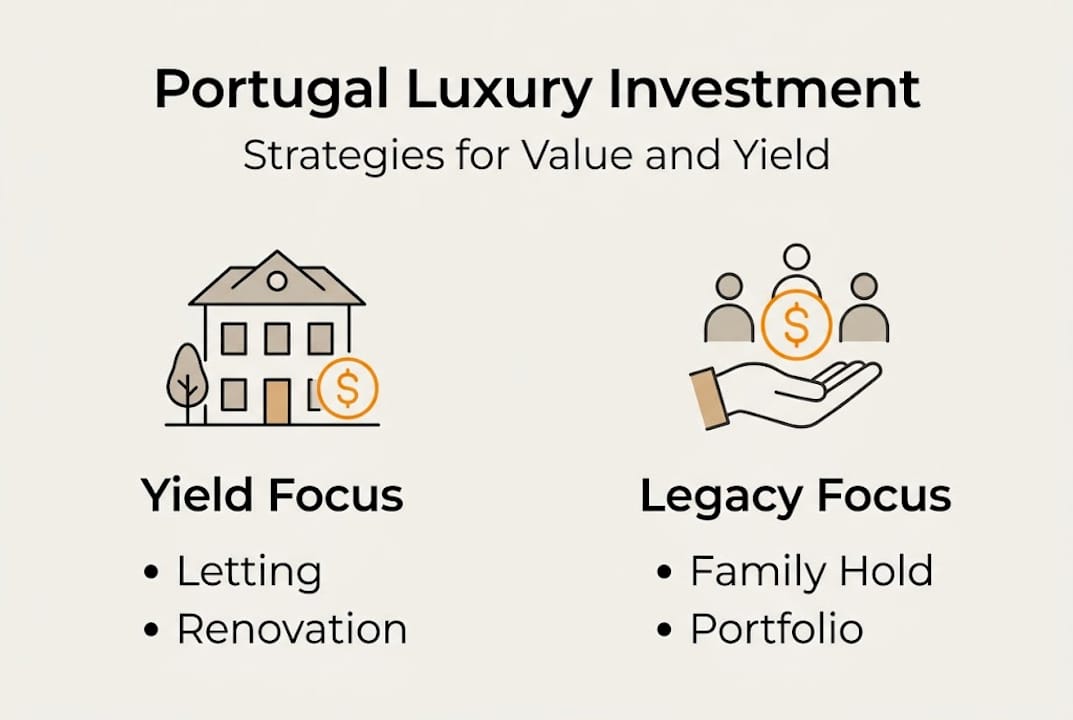
Infographic on strategies for Portugal luxury property


A fresh perspective: what most luxury investors overlook in Portugal

We have accompanied enough high-net-worth buyers through the Portuguese market to know that the most common misconception is also the most costly: the belief that market stability is uniform across regions and property types. It is not.

The resilience that analysts report for Lisbon, Algarve, and Cascais does not extend automatically to every coastal village or inland town that presents itself as “the next emerging hotspot.” We have seen investors, capable and well-resourced, purchase in locations that looked compelling on a trend report but lacked the infrastructure, international connectivity, and lifestyle ecosystem that sustain long-term value.

Our counsel is this: prestige in Portugal is hyperlocal. A villa three kilometres inland in the Algarve can yield dramatically different rental performance and capital growth compared to one within the Golden Triangle. The difference is invisible on a map and obvious only to those who know the market intimately.

Long-term legacy thinking also demands that buyers resist the temptation of short-term yield optimisation at the expense of property condition and character. The estates that hold generational meaning, and generational value, are those maintained with genuine stewardship. For those wanting to explore Portugal’s luxury homes with expert guidance, we are here to help mitigate risk and amplify reward at every stage of your journey.


Connect with luxury property experts for your next investment

For investors who understand that the finest properties are rarely listed and never rushed, we offer something beyond a portal: a curated relationship with Portugal’s most distinguished real estate landscape. Whether you are acquiring your first European estate or adding to a global portfolio that spans Ibiza, Bali, and Mauritius, our advisory team brings the local intelligence and international perspective that complex acquisitions demand. We work across the full spectrum of high-net-worth real estate, from architecturally significant residences to income-generating trophy assets. If you are new to the market, our guide to luxury real estate fundamentals is an excellent place to begin. Reach out, and let us design your Portugal chapter with the precision it deserves.


Frequently asked questions

Do foreign investors face restrictions when buying property in Portugal?

Foreign investors face very few restrictions in Portugal, but must obtain a Portuguese tax identification number (NIF) and comply with local AML regulations before any purchase can proceed.

Which regions in Portugal offer the most attractive luxury property options?

Lisbon, the Algarve, and Cascais remain the most resilient and sought-after regions for luxury buyers, combining prestige addresses with strong lifestyle credentials and proven investment performance.

Is the Portuguese luxury market still a secure investment in 2026?

Yes, the luxury segment remains notably stable, with prime locations demonstrating consistent capital appreciation and rental demand, supported by ongoing market resilience in Portugal’s most prestigious postcodes.

What are the key legal requirements for luxury property buyers in Portugal?

Buyers must hold a Portuguese NIF, provide verified source-of-funds documentation, and complete thorough legal due diligence through a qualified solicitor before signing any binding agreement.

Recommended

  • Essential steps to buying luxury real estate in Portugal
by Websols Servicedesk/27 April 2026/in Landingpage
https://www.livingonthecotedazur.com/wp-content/uploads/2026/04/1777252340444_Relaxed-couple-reviews-luxury-property-in-Lisbon.jpeg 714 1280 Websols Servicedesk https://www.livingonthecotedazur.com/wp-content/uploads/2024/02/sitelogo150.png Websols Servicedesk2026-04-27 07:11:492026-05-07 12:54:32How to buy luxury property in Portugal: your 2026 guide


TL;DR:

  • France’s investor visa requires active business investments, not passive property ownership.
  • A genuine French residency program involves creating or protecting jobs through business investments.
  • Monaco offers property-based residency with tax benefits, without job creation mandates.

Many high-net-worth buyers arrive on the Côte d’Azur, captivated by the salt-kissed air drifting over Cap d’Antibes or the bougainvillea-draped terraces above Èze, and assume that purchasing a prestigious villa will open the door to French residency. It is an understandable assumption, and one we hear often. The reality, however, is considerably more nuanced. Golden visa programmes vary dramatically across Europe, and France’s own investor pathway carries requirements that surprise even seasoned international investors. This guide cuts through the confusion, offering clear insight into your residency options, a sharp comparison of European destinations, and practical steps to position your Riviera ambitions for long-term success.

Table of Contents

  • What is a golden visa?
  • The French approach to investor visas
  • Comparing golden visas in popular European destinations
  • Practical steps for French investor visa seekers
  • Expert perspective: What most luxury investors overlook
  • Luxury real estate solutions for Riviera investors
  • Frequently asked questions

Key Takeaways

PointDetails
France requires active business investmentUnlike Portugal or Greece, France mandates substantial investment in a French company with job creation—not just property buying.
Residency via real estate is limitedBuying luxury property on the Riviera strengthens investment profiles but doesn’t automatically grant residency rights.
Monaco offers property-based residencyMonaco’s approach appeals to those seeking prestige and tax optimisation through property and financial deposits.
Investor visa process is complexApplicants must prepare a business plan, proof of funds, and navigate a two-stage French residency process over 2-6 months.
Tax and legacy planning is crucialUnderstanding the interplay of wealth tax, residency criteria, and investment strategies is essential for sustainable success.

What is a golden visa?

The term “golden visa” has become shorthand for an entire family of residency-by-investment schemes that have reshaped how the world’s wealthiest individuals think about borders, tax planning, and lifestyle. At its core, a golden visa is a formal government programme that grants residency rights in exchange for a qualifying economic contribution. Golden Visa programs are residency-by-investment schemes offered by over 100 countries, primarily requiring significant economic investments such as real estate, funds, bonds, or business ventures to obtain residency rights, often with paths to citizenship.

The qualifying investment categories vary considerably from one country to another. Most programmes accept one or more of the following:

  • Real estate acquisition above a minimum threshold
  • Government bonds or sovereign funds held for a defined period
  • Capital transfers into approved financial instruments
  • Business creation with accompanying job generation
  • Cultural or heritage fund contributions (notably in Portugal)

The appeal for globally mobile investors is self-evident. A golden visa typically extends residency rights to the primary investor’s spouse and dependent children, making it an elegant vehicle for family-wide lifestyle planning. Schengen Area access is particularly prized; holding residency in a Schengen member state allows visa-free movement across 27 European countries, from the sun-baked marinas of Antibes to the lemon-scented promenades of Menton during the famous Fête du Citron.

“A golden visa is not merely a travel document. For the discerning investor, it is a generational instrument, weaving residency rights, tax efficiency, and legacy planning into a single, elegant structure.”

Beyond mobility, golden visa holders often benefit from preferential tax treatment, access to high-quality healthcare and education systems, and the prestige of holding European residency. For those who have built wealth through digital enterprises or international business portfolios, formalising a European base through a legitimate residency programme is both a practical necessity and a statement of intent. Our international property investment guide explores how Riviera assets fit within this broader global strategy.

The French approach to investor visas

France occupies a fascinating and sometimes misunderstood position in the golden visa landscape. Unlike Portugal, Greece, or Spain, France does not offer a traditional property-based golden visa. This is the single most common misconception we encounter among buyers who fall in love with a sea-view penthouse above Nice’s Baie des Anges or a historic bastide near Cannes and assume the purchase alone confers residency privileges.

France does not offer a traditional Golden Visa; instead, high-net-worth individuals can pursue the Talent Passport ‘Business Investor’ visa requiring a minimum €300,000 investment in fixed tangible or intangible assets of a French company, at least 10 to 30% ownership, and commitment to create or protect jobs within 4 years. This is an active, commercially engaged pathway, not a passive wealth-parking mechanism.

The distinction matters enormously. Pure real estate purchases do not qualify for French investor residency; investments must be in commercial enterprises with economic impact like job creation. A magnificent villa on Cap d’Antibes, however extraordinary its architecture and however commanding its sea views, does not satisfy this criterion on its own.

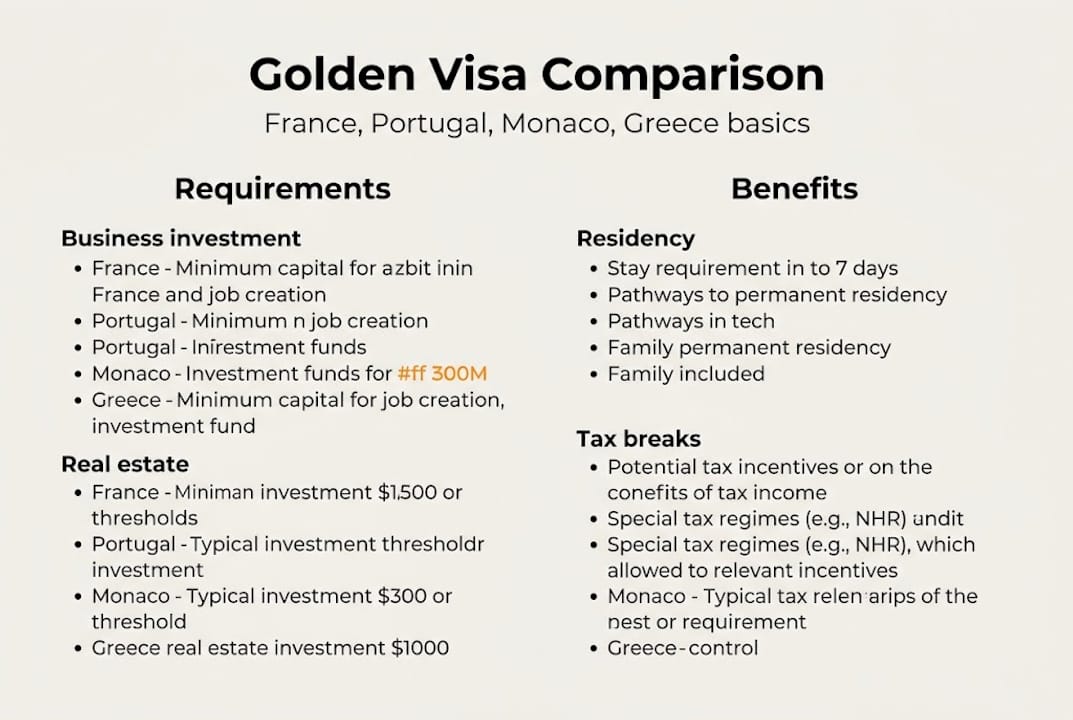
RequirementDetails
Minimum investment€300,000 in tangible or intangible assets
Ownership stake10 to 30% of a French company
Job commitmentCreate or protect employment within 4 years
Visa duration4-year renewable residence permit
Family inclusionSpouse and dependants included
Path to permanencePermanent residency eligibility after 5 years

This means that if your Riviera ambition includes French residency via the Talent Passport, you will need to pair your property acquisition with a genuine business investment. Hospitality ventures, tech enterprises, or sustainable tourism businesses operating along the Côte d’Azur are among the more natural fits for internationally mobile entrepreneurs.

Luxury investors in hotel lobby meeting

Pro Tip: Many of our clients successfully combine a Riviera property purchase with a minority stake in a local luxury hospitality or property management business, satisfying the Talent Passport’s commercial requirements whilst anchoring their family life in one of the world’s most coveted addresses. Explore our curated Côte d’Azur real estate options alongside our portfolio of legacy luxury investments to understand how these strategies work in practice.

Comparing golden visas in popular European destinations

For investors whose primary goal is property-anchored residency near the French Riviera, the European landscape offers several compelling alternatives. Over 60% of EU countries have Golden Visas; popular for French Riviera seekers include nearby Portugal (€250k in cultural funds), Greece (€250k to €800k real estate), Spain, and Italy; but France emphasises job-creating business investments over passive real estate.

Each destination carries its own distinct character, investment threshold, and lifestyle proposition. The table below distils the most relevant details for discerning investors weighing their European options.

DestinationMinimum investmentReal estate eligible?Job creation required?Schengen accessTax advantages
France€300,000 (business)NoYesYesIFI wealth tax applies
MonacoProperty + bank depositYesNoLimitedExceptional tax haven
Portugal€250,000 (cultural/funds)Limited (restricted areas)NoYesNHR tax regime
Greece€250,000 to €800,000 (real estate)YesNoYesFlat tax options
Spain€500,000 (real estate)YesNoYesBeckham Law option
Italy€250,000 (innovative startups)No (direct)ConditionalYesFlat tax €100,000/yr

The contrast between France and Monaco is particularly striking for buyers already captivated by the Riviera’s coastal grandeur. Monaco residency via property + bank deposit offers tax optimisation and prestige without job creation mandates, contrasting France’s active business investment focus. For investors who wish to enjoy the Riviera’s golden light, the Lérins Islands visible from Cannes, or the yacht-lined quays of Antibes, whilst optimising their fiscal position, Monaco’s pathway deserves serious consideration.

Portugal’s Non-Habitual Resident (NHR) tax regime remains one of Europe’s most attractive, offering flat-rate foreign income treatment for a decade. Greece has restructured its thresholds to €800,000 in prime areas, reflecting soaring international demand. Spain’s Investor Visa, requiring €500,000 in direct real estate, is accessible and efficient, though the programme’s future has been subject to political debate. Detailed golden visa comparisons across European jurisdictions are worth reviewing with your legal adviser before committing capital.

For our clients tracking Côte d’Azur luxury trends, the relationship between residency planning and property acquisition is increasingly sophisticated. We are seeing growing demand for luxury apartments in Monaco-adjacent communes such as Beausoleil and Roquebrune-Cap-Martin, precisely because they combine Riviera lifestyle with proximity to Monaco’s residency and tax benefits.

A key insight: whichever residency route you pursue, the quality of your Riviera property holding strengthens your overall wealth profile. A Pampelonne-facing estate or a Belle Époque villa above Saint-Jean-Cap-Ferrat is not merely a home. It is a cornerstone of your legacy architecture.

Infographic comparing golden visas France Monaco Portugal Greece

Practical steps for French investor visa seekers

If, having weighed your options, the Talent Passport remains your preferred route, precision and preparation are essential. France Talent Passport applications involve two-stage process: a long-stay visa from the consulate, then a residence permit at the prefecture; the process requires a business plan, proof of funds, and health insurance, with processing taking 2 to 6 months in total.

Here is how we advise approaching the process methodically:

  1. Secure your business investment first. Identify a French company in which you will hold at least 10 to 30% ownership. This must involve €300,000 in fixed tangible or intangible assets.
  2. Prepare a credible business plan. French authorities assess whether your investment is commercially viable and will genuinely support employment. Vague plans will be rejected.
  3. Gather financial documentation. Bank statements, asset declarations, and proof of the investment transfer must be presented clearly and in French or with certified translations.
  4. Obtain comprehensive health insurance. This is non-negotiable for the visa application and must cover you and all family members included in the application.
  5. Apply for your long-stay visa at the French consulate in your country of residence. Allow 8 to 12 weeks for this stage alone, and submit well in advance of your intended relocation date.
  6. Arrive in France and register at your local prefecture within the statutory timeframe to obtain your physical residence permit.
  7. Monitor your job creation obligations. You have 4 years to demonstrate that your investment has created or protected employment. Meticulous record-keeping from day one is essential.

The Talent Passport provides a 4-year renewable residence permit for the investor and family, allowing Schengen travel, work rights, and a path to permanent residency after 5 years. This is a genuinely powerful instrument for investors committed to France as a long-term base.

Pro Tip: Pairing the Talent Passport process with strategic financing for luxury real estate on the Côte d’Azur allows you to maximise capital efficiency. French banks often extend preferential mortgage terms to holders of residency permits, which can free capital for the business investment itself. Meanwhile, investing in sustainable property advantages on the Riviera positions your estate for both strong rental yields and long-term appreciation, a pairing that resonates deeply with the next generation of heirs.

Expert perspective: What most luxury investors overlook

We have guided clients from Singapore to São Paulo through the nuances of Riviera acquisition, and one pattern recurs with striking consistency: investors focus so intently on the property itself that they underestimate the fiscal architecture surrounding it. France’s IFI (Impôt sur la Fortune Immobilière) is a case in point. France’s IFI wealth tax on real estate over €1.3M applies to French real estate holdings; new residents benefit from a five-year grace period on foreign assets, whilst Monaco exempts financial assets entirely. Understanding this before you sign is not a legal technicality. It is the difference between a well-structured legacy and an inadvertent tax burden.

The deeper issue is one of strategy versus aspiration. Many buyers we speak with have conflated two distinct goals: owning a beautiful home on the Riviera and obtaining European residency. These are compatible ambitions, but they require separate instruments. A Provençal mas near Antibes or a contemporary villa above Sainte-Maxime will not, on its own, satisfy a residency application. What it will do is anchor your lifestyle, generate seasonal rental income in the 3 to 5% yield range, and build the kind of generational asset that appreciates quietly and reliably year after year. Explore our insights on luxury home pricing factors to understand precisely what drives values in each Riviera micromarket.

The investors who navigate this landscape most elegantly are those who treat the property and the residency strategy as complementary chapters of the same story, not the same sentence.

Luxury real estate solutions for Riviera investors

At Living on the Côte d’Azur, we curate what others simply cannot find. Our portfolio spans invisible luxury properties available entirely off-market, from Monaco-adjacent bastions of discretion to beachside estates in Sainte-Maxime where Nartelle sunsets become a daily ritual. Whether you are building your business investment case for the Talent Passport or securing a flagship asset for your family’s future, our team provides bespoke guidance at every stage. Browse our full collection of French Riviera villas and penthouses and discover the broader international property benefits that make the Côte d’Azur the world’s most enduring luxury address.

Frequently asked questions

Can I get French residency by buying luxury property?

No, pure real estate purchases do not qualify for French investor residency; you must invest in a business that creates or protects jobs, making the Talent Passport a commercially active, not passive, pathway.

How much do I need to invest for a French Talent Passport?

You must commit at least €300,000 in tangible or intangible assets of a French company; France does not offer a traditional Golden Visa, so this business investment must also involve at least 10 to 30% ownership and a job creation commitment within four years.

Is Monaco a better option for property-based residency?

Yes, for investors who want Riviera living without France’s business requirements; Monaco residency via property + bank deposit offers exceptional tax advantages and prestige, with no obligation to create employment.

How long does the French investor visa process take?

France Talent Passport applications involve two-stage process taking 2 to 6 months in total, covering both the consulate visa and prefecture residence permit stages.

Are financial assets like stocks eligible for French investor residency?

No, purely financial investments excluded from Talent Passport eligibility; only business investments with demonstrable economic viability and real commercial impact qualify under French law.

Recommended

  • Step-by-step guide to luxury real estate investment in the French Riviera
  • Golden Visa Programmes: Powering Global Luxury Lifestyles
  • Comprehensive Guide to French Riviera Investing Success
  • Finding the perfect French Riviera luxury investment property
by Websols Servicedesk/27 April 2026/in Landingpage
https://www.livingonthecotedazur.com/wp-content/uploads/2026/04/1777252319816_Investor-reviewing-property-portfolio-in-sunlit-Riviera-office.jpeg 715 1280 Websols Servicedesk https://www.livingonthecotedazur.com/wp-content/uploads/2024/02/sitelogo150.png Websols Servicedesk2026-04-27 07:11:232026-05-07 12:54:00Golden visa guide for luxury investors on the Riviera


TL;DR:

  • Luxury real estate terminology reflects standards of price, location, heritage, and uniqueness beyond mere expense.
  • Understanding specific terms like VEFA, bespoke, and off-market improves negotiation power and investment accuracy.
  • Clear language and verification of property features are essential for confident, strategic property investments.

When a Cannes listing describes a villa as “exclusive” and a Côte d’Azur brochure promises a “prestige residence,” most readers nod along, assuming they understand. They rarely do. The language of luxury real estate is its own dialect, one where imprecise reading can shift a negotiation, misrepresent a valuation, or cloud an otherwise brilliant investment decision. We have seen high-net-worth buyers walk away from off-market gems and overpay for ordinary stock, simply because they mistook marketing vocabulary for objective fact. This guide decodes the essential terminology shaping the French Riviera market in 2026, so you invest with precision.

Table of Contents

  • What makes a property ‘luxury’? Core definitions and distinctions
  • Critical luxury property jargon every investor must know
  • Features that define luxury: From opulence to innovation
  • Applying terminology: How language affects investment strategy
  • Perspective: Why terminology transparency is the missing luxury in property investment
  • Explore luxury French Riviera investments with expert guidance
  • Frequently asked questions

Key Takeaways

PointDetails
Luxury terms matterKnowing the language helps investors identify genuine high-end properties and avoid costly mistakes.
Jargon decodingUnderstanding legal, marketing, and regional terms gives buyers a strategic advantage in negotiations.
Feature-driven valueLuxury properties are defined by features, innovations, and experience—not just price or location.
Regional nuanceThe meaning of luxury changes across markets, so international investors should localise their understanding.
Investment impactApplying proper terminology ensures stronger portfolios and smarter investment strategies.

What makes a property ‘luxury’? Core definitions and distinctions

Let us begin where confusion thrives: the word “luxury” itself. In everyday usage, luxury suggests something expensive. In real estate, it demands far more rigour. A property commanding €900,000 in Saint-Tropez may feel luxurious to one buyer yet fall well short of the standards a seasoned investor applies. Understanding the formal taxonomy changes everything.

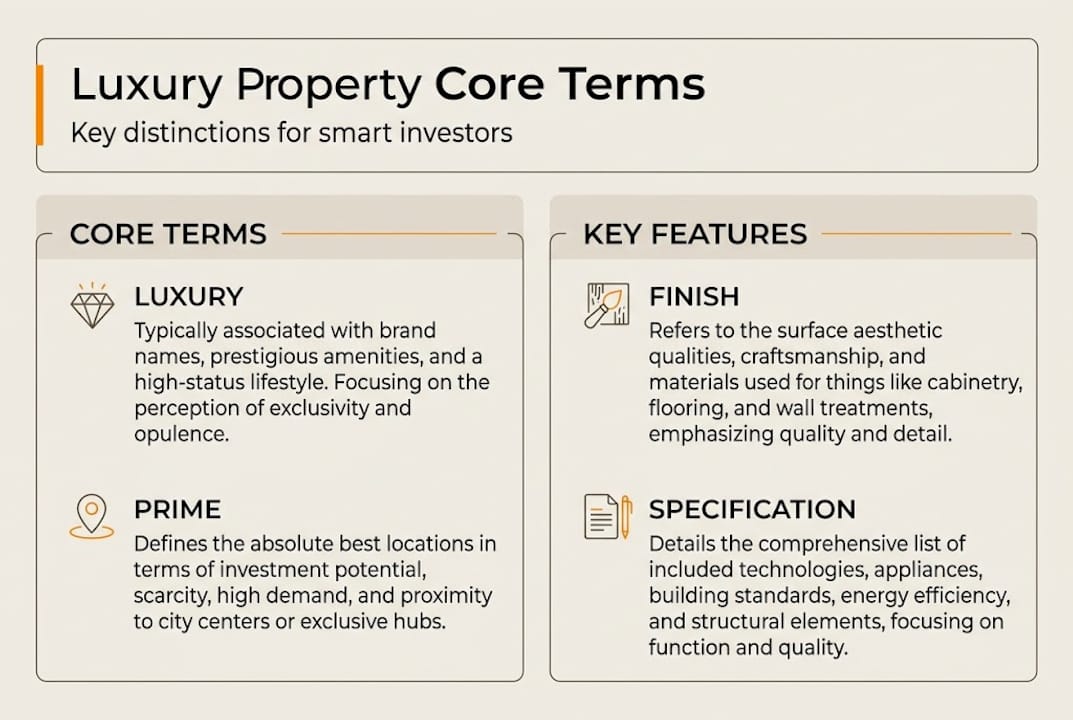
Luxury describes properties exceeding the top 10% of a given market in terms of price, specification, and finish. Prime refers to location first, where proximity to coastline, cultural anchors, or established prestige corridors such as Cap d’Antibes or Monaco’s borders defines value. Prestige adds an element of heritage or social cachet: a Belle Époque villa on the Croisette carries prestige that no newly built apartment can replicate purely through design. Bespoke means uniquely commissioned or customised, a property where the architecture, interiors, and landscaping reflect a single owner’s vision rather than a developer’s template. Exclusive, when used honestly, indicates genuine scarcity: limited units, restricted access, or a site that cannot be replicated.

Infographic of core luxury property terms and features

As luxury property terms vary significantly by region and market trends, what qualifies as prestige in Nice’s Mont Boron differs considerably from the standards applied along the Lérins Islands coastline near Cannes. Investors comparing markets across the Riviera and, say, London’s Belgravia must calibrate their definitions carefully. The same word carries different weight depending on geography, culture, and the local supply of truly exceptional stock.

Key features and value-defining terminology shape investment perceptions in ways that are both measurable and surprisingly subjective. A comparison illustrates this clearly:

TermGeneral meaningRiviera-specific nuance
LuxuryTop 10% of market by price and specOften implies sea view, concierge, high-end finishes
PrimeSuperior locationSeafront, Monaco border, Cap d’Antibes, Èze promontory
PrestigeHeritage or social standingBelle Époque, classified buildings, famous former residents
BespokeCustom-designedArchitect-led, single-commission interiors and landscape
ExclusiveGenuine scarcityLimited units, gated domain, off-market access only

Buyers who understand this table negotiate differently. They question whether “luxury” is genuinely substantiated by specification or merely aspirational branding. They ask which features create lasting value versus surface appeal.

Key distinguishing features in truly luxury stock include:

  • Panoramic sea views from principal rooms, not side angles or terraces only
  • Architectural provenance or a recognised design signature
  • Materials selected for longevity: stone, hardwood, artisan tile
  • Smart home technology integrated discreetly rather than retrofitted
  • Private outdoor space with mature landscaping or a usable pool area
  • Designer-quality finishes across every touchpoint, from fixtures to soft furnishings

“Luxury is not a price point. It is a convergence of irreplaceable elements: position, provenance, precision of craft, and the promise of an experience that no other property can offer.”

The regional dimension matters enormously. In Menton, where the Lemon Festival draws thousands each February and Val Rahmeh’s botanical gardens perfume the air, prestige attaches to hillside positions with views across the Italian border. In Antibes, where Picasso’s spirit still inhabits the old fortress, prestige is cultural and historic. Calibrating your terminology to the specific micromarket is not pedantry. It is investment intelligence.

Critical luxury property jargon every investor must know

With the foundational vocabulary established, we can move into the operational language: the abbreviations, legal terms, and marketing phrases that appear in listings, contracts, and agent conversations every single day.

VEFA stands for Vente en l’État Futur d’Achèvement, the French off-plan purchase contract under which you buy a property before construction completes. VEFA purchases benefit from a ten-year structural warranty (the garantie décennale), lower notary fees compared to resale, and staged payment plans tied to construction milestones. For new Sainte-Maxime beachside residences or Nice’s emerging Mont Boron towers, VEFA is the primary acquisition vehicle.

Woman reviewing French property contract at kitchen island

PPE or Propriété Par Étages is the Swiss equivalent of a sectional title scheme, relevant for investors operating across borders. ROI (return on investment) is expressed as a percentage of annual rental income against the purchase price, typically 3 to 5% for elite Riviera rentals. Off-market refers to properties not listed on public portals, circulated exclusively through private agent networks. These represent some of the most prized acquisitions on the Côte d’Azur precisely because competition is limited.

Dual mandate describes an arrangement where two agents hold a shared exclusive or co-exclusive instruction, occasionally creating confusion over representation. Turnkey means the property is fully furnished and operationally ready from day one, a significant advantage for buyers seeking immediate rental income during Cannes Film Festival season or the Monaco Grand Prix.

As marketing language influences buyer perceptions and property valuations directly, the words chosen in a listing are never accidental. “Curated” implies editorial taste applied to design selection. “Secure” suggests gated access, alarm systems, or 24-hour concierge. “Discreet” is code for off-market or limited disclosure, appealing to ultra-high-net-worth buyers who value privacy above all.

Understanding legacy and ROI nuances requires fluency in the language that surrounds them. Investors who cannot decode these terms rely entirely on agents to interpret, a position of vulnerability in any negotiation.

Common jargon pitfalls include:

  • Assuming “renovated” means fully refurbished. It may mean a kitchen update only.
  • Reading “sea glimpse” as “sea view.” These are not equivalent.
  • Mistaking “artist’s impression” for a finalised design in off-plan brochures.
  • Accepting “rare opportunity” without verifying actual market comparables.

A numbered checklist for approaching any luxury listing:

  1. Request the full legal designation and planning permissions.
  2. Ask for clarification on every superlative used in the description.
  3. Verify whether “exclusive” refers to the listing mandate or the property itself.
  4. Confirm the specific definition of “sea view” with compass bearings if needed.
  5. Review the property pros terminology independently before signing anything.

Pro Tip: When an agent uses “iconic,” ask them to specify exactly what makes the property irreplaceable. If they cannot answer with facts, the word is decorative, not descriptive.

Features that define luxury: From opulence to innovation

Terminology is only meaningful when it maps to tangible, verifiable features. This is where the elegance of language meets the substance of stone. On the French Riviera, where the salt-kissed air carries equal parts history and ambition, luxury features are both architectural and experiential.

Architectural language in prestige listings frequently deploys terms such as “grand,” “monumental,” “organic,” and “biophilic.” Biophilic design, which integrates natural materials, greenery, and natural light into every plane of the building, is the defining aesthetic of 2026’s most sought-after new developments. It is not merely visual preference; it reflects a measurable improvement in wellbeing and, increasingly, a premium that survives market corrections.

Features and definitions that shape how luxury hospitality and residential property are perceived include:

Feature categoryExamplesInvestment significance
WellnessSpa, hammam, indoor pool, meditation gardenCommands 15 to 20% premium in rental yield
Smart technologyHome automation, security, climate controlReduces operating cost, appeals to tech-literate buyers
Eco credentialsSolar arrays, rainwater harvesting, BREEAM ratingsFuture-proofs asset against tightening regulations
PrivacyGated domain, mature tree screening, no overlookingNon-negotiable for UHNW clients
ViewsPanoramic sea, mountain, or port viewsSingle greatest determinant of Riviera value

Ultra-luxury is defined by properties surpassing standard prestige metrics entirely, those with helicopter pads, private beach access, wine cellars curated by sommeliers, or guest pavilions designed as independent residences. These are not whims; they are value anchors that attract a global clientele willing to pay a substantial premium.

A curated list of luxury features reveals that amenities once considered rare are now expected at the higher end. A private pool is standard. A wellness spa is expected. What differentiates genuinely exceptional properties in 2026 is the calibre of feature execution: custom Italian joinery, geothermal heating, or a rooftop terrace framing the Baie des Anges panorama from Nice’s Château Hill.

Eco-luxury properties on the French Riviera represent a 15% demand spike compared to conventional luxury stock, driven by buyers who regard environmental performance as a legacy value rather than a lifestyle choice. Solar arrays, green certifications, and biophilic design are no longer optional enhancements in modern Riviera developments; they are prerequisites for long-term capital appreciation.

Much like understanding how luxury fragrance is defined by the rarity of its ingredients rather than merely its price, true luxury property value lies in the irreplaceability of its elements, not the headline figure alone.

Pro Tip: When evaluating a “wellness retreat” or “spa villa” listing, request independent evidence of spa certification or spa management contracts. Marketing language and operational reality are not always aligned.

Key features to assess beyond the brochure:

  • Construction materials: locally sourced stone versus composite panels
  • Glazing standards: double or triple glazing, UV filtration, thermal performance
  • Landscape maturity: a ten-year-old garden versus newly planted hedging
  • Certifications: HQE, BBC, or BREEAM ratings for French eco-builds
  • Service infrastructure: concierge partnerships, property management contracts

Applying terminology: How language affects investment strategy

Every term you now understand translates directly into negotiating power, portfolio clarity, and long-term returns. Language is not decoration in luxury real estate. It is architecture in its own right.

When a seller describes a Cap d’Antibes estate as “turnkey,” a terminology-literate buyer immediately verifies the inventory list, confirms the included art and furnishings, and establishes the management contracts already in place. Without that literacy, “turnkey” becomes an assumption, and assumptions are expensive on eight-figure transactions.

Proper knowledge of luxury terminology shapes portfolio and investment decisions at every stage, from initial shortlisting through to divestment planning. A luxury portfolio is not simply a collection of expensive properties. It is a strategically assembled group of assets defined by complementary attributes: one generating seasonal rental income in Sainte-Maxime, another held as a long-term legacy position near Monaco, a third providing lifestyle access during the Cannes Film Festival or Menton’s Lemon Festival in February.

A striking data point: studies of high-net-worth buyer behaviour consistently show that buyers who invest in understanding terminology before entering negotiation secure an average of 7 to 12% better pricing outcomes on premium transactions. Terminology is not academic. It is financial leverage.

A practical checklist for applying terminology to investment decisions:

  • Define your investment thesis first. Legacy holding? Rental yield? Capital growth? The terminology that matters shifts accordingly.
  • Verify all descriptors independently. Do not accept “prime” without checking location data.
  • Cross-reference legal documents. Ensure VEFA contract terms match the developer’s verbal commitments.
  • Interrogate ROI projections. Ask whether figures are gross or net, and which rental weeks are already contracted.
  • Identify the off-market pipeline. The most exceptional Riviera assets rarely appear on public portals.

A numbered investment strategy framework:

  1. Build a personal glossary before each market you enter.
  2. Engage a bilingual legal advisor to review all French-language documentation.
  3. Request disclosure of the full mandate type before any negotiation begins.
  4. Benchmark terminology against comparable transactions in the same commune.
  5. Revisit your terminology understanding each year, as the market evolves and so does its language.

Perspective: Why terminology transparency is the missing luxury in property investment

We have observed something consistently in our work across the Côte d’Azur and beyond: the investors who feel most confident are rarely the wealthiest. They are the most informed. There is a persistent myth in high-end property circles that ambiguity is elegant, that the best properties sell themselves without explanation. In reality, vague language is a tool, deployed when specifics might disappoint.

Agents occasionally benefit from buyers remaining comfortable with imprecision. “Exceptional” need not be substantiated. “Rare” requires no comparison. This is not cynicism; it is observation. The ultra-luxury market rewards those who challenge this norm, who ask their advisors to define every superlative, who insist on measured sea views rather than illustrated ones.

The French Riviera market in 2026 is genuinely exceptional, offering appreciation of 5 to 8% annually in prime locations, genuine off-market scarcity, and a lifestyle infrastructure unmatched anywhere in Europe. None of that value is accessible without the linguistic confidence to engage it precisely. True luxury, we believe, is knowing exactly what you are buying and why.

Explore luxury French Riviera investments with expert guidance

Terminology mastery is the first step; the next is finding properties that genuinely live up to the language used to describe them. At Living on the Côte d’Azur, we curate access to properties where every descriptor is earned. Whether you are building a legacy and ROI strategy across generations or seeking your first prestige acquisition on the Riviera, we bring the fluency and the access that make the difference. Our off-market luxury portfolio includes estates that never reach public listing, accessible exclusively through our private network. We also accept cryptocurrency, because the future of luxury investment is as innovative as the properties we represent.

Frequently asked questions

What does ‘bespoke’ mean in luxury property listings?

‘Bespoke’ indicates a property with customised features and design tailored uniquely for the owner or a specific market, reflecting genuine exclusivity rather than a developer’s standard specification.

How do regional differences affect luxury property terminology?

Regional variations in terminology mean that ‘prestige’, ‘prime’, or ‘exclusive’ carry different standards in Cannes versus Monaco or Saint-Tropez, requiring careful interpretation from international investors entering each micromarket.

Why is understanding property jargon so important for investment?

Clear comprehension prevents costly misunderstandings in listing details, negotiations, and legal agreements; high-net-worth real estate strategies depend directly on the buyer’s ability to decode the nuanced language surrounding every transaction.

What is an ‘off-market’ luxury property?

An off-market property is not publicly listed and is accessible only through private networks or trusted agents; invisible luxury properties on the Côte d’Azur represent some of the most exclusive and privately transacted real estate in Europe.

What is VEFA in French luxury property?

VEFA, or Vente en l’État Futur d’Achèvement, is a French off-plan purchase contract used widely in new luxury developments, offering buyers lower notary fees, staged payment plans, and a ten-year structural warranty.

Recommended

  • Luxury Property Terms: Meaning in Cannes and Beyond
  • High-net-worth real estate: Legacy, luxury, and ROI
  • How to Evaluate Luxury Real Estate for Smarter Investments
by Websols Servicedesk/27 April 2026/in Landingpage
https://www.livingonthecotedazur.com/wp-content/uploads/2026/04/1777252323096_Investor-reviewing-luxury-property-listings-at-table.jpeg 715 1280 Websols Servicedesk https://www.livingonthecotedazur.com/wp-content/uploads/2024/02/sitelogo150.png Websols Servicedesk2026-04-27 07:10:562026-05-07 12:53:52Luxury property terminology: The smart investor’s guide


TL;DR:

  • Italy offers prestigious legacy properties that require expert navigation through legal, cultural, and fiscal processes.
  • Buyers must secure a Codice Fiscale, conduct thorough due diligence, and follow a structured purchase workflow.
  • Heritage properties provide long-term value through legal protection, restoration deductions, and tax reductions.

Italy does not simply sell property. It bestows it. For high-net-worth buyers seeking a legacy investment etched in Renaissance stone or tucked within a cypress-lined Tuscan estate, the Italian market offers prestige that few places on earth can replicate. Yet the purchase workflow is layered with legal precision, cultural regulation, and fiscal nuance that demands more than enthusiasm. It demands expertise. Whether you are acquiring a lakeside villa on Como, a fortified borgo in Umbria, or a palazzo overlooking the Amalfi coast, mastering every stage of this process is what separates a sound legacy investment from a costly oversight.

Table of Contents

  • Key prerequisites for buying real estate in Italy
  • Step-by-step workflow for Italian real estate purchase
  • Costs, taxes, and closing for luxury and legacy properties
  • Legacy property purchases: State pre-emption, restoration, and due diligence
  • What legacy investments reveal about Italy’s luxury real estate market
  • Connect with legacy luxury experts and next steps
  • Frequently asked questions

Key Takeaways

PointDetails
Complete workflow clarityEvery stage from offer through notarial deed is clearly mapped for luxury and legacy purchases.
No broad buying restrictionsInternational HNWIs can buy Italian luxury property if reciprocity is verified by a notary.
Legacy-specific tax incentivesBuyers of historic assets may benefit from IMU reduction and restoration deductions.
State pre-emption and restoration rulesLegacy purchases require navigating state oversight, strict restoration compliance, and enhanced due diligence.

Key prerequisites for buying real estate in Italy

Having set the scene for Italian luxury real estate, let’s clarify what you need to begin the process. Before a single offer is submitted, a series of prerequisites must be in place. Think of these as the foundations upon which every subsequent step rests. Skipping them is not merely inconvenient — it can render a transaction legally invalid.

The Codice Fiscale: your entry pass

The Codice Fiscale is Italy’s tax identification code, and without it, no Italian real estate transaction can proceed. It functions similarly to a national insurance number in the United Kingdom, identifying you within the Italian tax system. Foreign buyers obtain this from the nearest Italian consulate abroad or directly from an Agenzia delle Entrate office in Italy. The process is relatively swift, typically completed within a day, and it must be secured before any formal offer or contract is signed.

Reciprocity rules for non-EU buyers

Italy welcomes international wealth with open arms, but not without verification. Non-EU buyers can purchase Italian property provided the reciprocity principle is confirmed by a notary, a condition already established for the United States and most other major economies. This is not a barrier — it is a formality. Your appointed notary will confirm eligibility, and the Italy real estate guide on our portal provides a detailed country-by-country breakdown of reciprocity status.

Legacy and luxury property eligibility

For buyers drawn specifically to immobili vincolati (protected heritage properties), eligibility carries an additional layer of scrutiny. These assets are governed by the Italian Cultural Heritage Code, and buyers must acknowledge the obligations tied to ownership before any purchase is formalised. Our property acquisition guide outlines these distinctions in full.

Key documents you will need at the outset:

  • Valid passport or national identification
  • Codice Fiscale (tax code)
  • Proof of source of funds (particularly relevant for high-value acquisitions)
  • Notarised translation of key documents if not in Italian
  • Banking arrangements in Italy or via an approved international transfer

Initial deposit expectations

Once eligibility is confirmed, buyers should be prepared to offer a holding deposit, often between €5,000 and €30,000, to signal serious intent. This is separate from the formal contractual deposits that follow.

Pro Tip: Engage a bilingual Italian property lawyer before submitting any offer. They work independently of the notary and protect your interests exclusively, whereas the notary serves as a neutral state officer.

RequirementEU buyersNon-EU buyers
Codice FiscaleMandatoryMandatory
Reciprocity checkNot requiredRequired by notary
Legacy property declarationIf applicableIf applicable
Proof of source of fundsRecommendedStrongly recommended

Step-by-step workflow for Italian real estate purchase

With your prerequisites ready, you’re prepared to navigate the purchase workflow. The Italian system is structured and sequential, with each stage carrying specific legal and financial weight. Understanding the chronology prevents costly errors and positions you as a well-prepared buyer, which, in a competitive market for elite properties, carries genuine negotiating power.

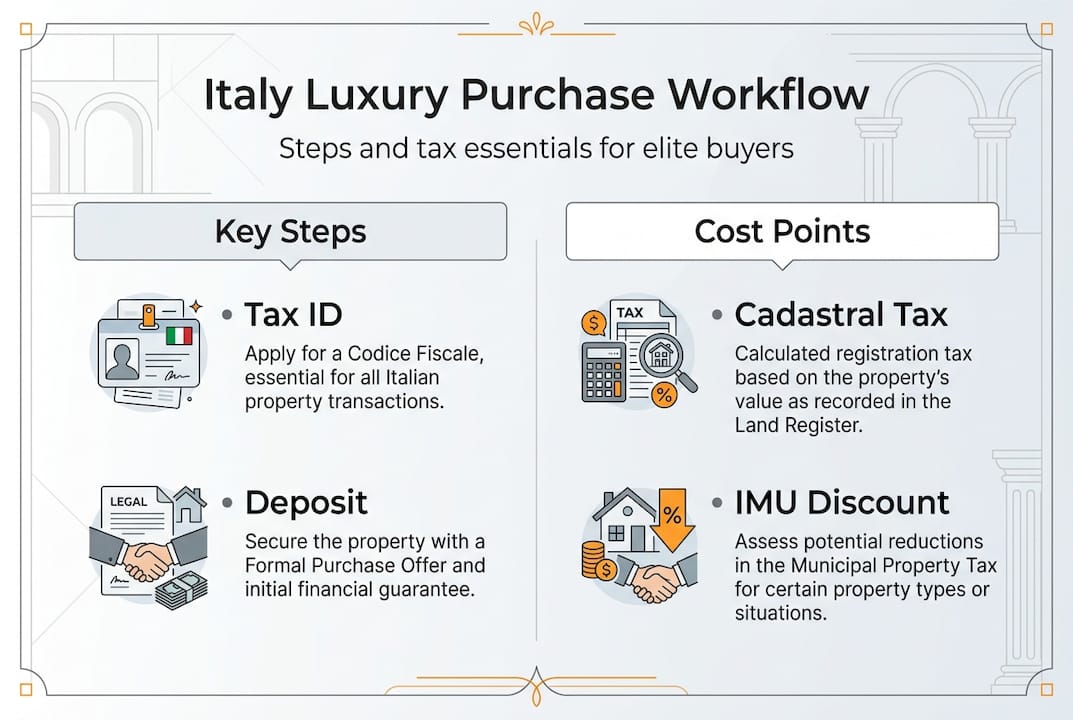
The standard Italian purchase workflow follows these stages: obtaining your Codice Fiscale, submitting a formal purchase offer known as the Proposta d’Acquisto with an initial deposit, completing cadastral and preliminary checks, conducting comprehensive due diligence across title, urban planning, and technical aspects, executing the preliminary agreement (Compromesso) with a deposit of 10 to 20 per cent, and finally completing the notarial deed (Rogito) that transfers ownership. The total timeline from Compromesso to final deed is typically one to three months.

The six stages explained:

  1. Obtain your Codice Fiscale. This is done at an Italian consulate or tax office. No purchase can proceed without it.

  2. Submit the Proposta d’Acquisto (formal offer). This written offer, accompanied by a small holding deposit, demonstrates genuine intent. If the seller accepts, the deposit becomes binding. If they decline, you receive it back in full.

  3. Conduct cadastral and preliminary checks. Your lawyer verifies the property’s cadastral category, land registry details, and any existing mortgages or encumbrances. For legacy properties, this phase also includes checking for cultural heritage listings.

  4. Complete comprehensive due diligence. This encompasses title clarity, urban planning compliance, building permits, structural surveys, and for older estates, environmental inspections. Never underestimate this stage. Irregular building work, common in older Italian properties, can create significant legal exposure.

  5. Sign the Compromesso (preliminary agreement). This bilateral contract locks both parties in. The buyer pays a deposit of 10 to 20 per cent of the agreed price. If the buyer withdraws, this deposit is forfeited. If the seller withdraws, they must return double the deposit. It is a powerful instrument of mutual commitment.

  6. Execute the Rogito (notarial deed). Signed before a state-appointed notary, this final deed transfers full ownership. Remaining funds are transferred, taxes are paid, and you receive the keys.

Consult our luxury property buying guide for detailed commentary on each stage, and explore our international property buying steps for comparisons with other elite European markets.

StageTypical timingKey action
Codice FiscaleBefore offerTax registration
Proposta d’AcquistoDay 1Offer and initial deposit
Preliminary checksDays 7 to 21Cadastral and title review
Full due diligenceWeeks 2 to 6Legal, technical, urban review
CompromessoWeeks 4 to 810 to 20% deposit, bilateral contract
RogitoMonths 2 to 4Transfer of ownership

Pro Tip: Request that the Compromesso includes penalty clauses tied to specific completion dates. For legacy assets, build in extra time for heritage compliance checks before the final deed.

Our successful buying steps resource offers further guidance on structuring these timelines to your advantage.

Costs, taxes, and closing for luxury and legacy properties

Once you’ve followed the workflow, understanding every cost and tax implication is vital. Italy’s tax structure for real estate is not punitive, but it is precise, and errors in classification can prove expensive.

Lawyer checks tax details on property documents

The breakdown is as follows: when buying from a private seller, registration tax stands at 9 per cent of the cadastral value, reduced to 2 per cent for a prima casa (primary residence). Fixed mortgage and cadastral taxes are applied at €50 each. When purchasing from a company or developer, VAT applies at either 10 or 22 per cent depending on the property’s classification. Notary fees run between 1 and 2 per cent, agent commissions around 3 per cent, and total closing costs range from 7 to 15 per cent of the purchase price.

What makes this particularly important for luxury buyers:

Cadastral value, the figure upon which many taxes are calculated, is typically well below market value for prestigious properties. This means the effective tax burden for a €5 million estate may be computed on a cadastral value of €1.2 million or less, producing a considerably more favourable tax outcome than headline rates suggest.

Infographic outlining Italian luxury property buying steps

Standard versus legacy property costs at a glance:

Cost elementStandard purchaseLegacy property
Registration tax9% (private seller)9%, with possible reductions
IMU (local property tax)Standard rate50% reduction available
Notary fees1 to 2%1 to 2% (higher for complex deeds)
Restoration costsNot applicableVariable, significant
Agent commission3%3%

Tax advantages worth noting:

  • Prima casa registration tax reduction (2%) applies when the property becomes your primary Italian residence.
  • Legacy properties carry an IMU reduction of up to 50%, which on a high-value estate represents a meaningful annual saving.
  • Restoration expenditure on heritage properties can attract deductions of up to 50%, as detailed in the section below.

Pro Tip: Always request that the notary calculate taxes based on the cadastral value where legally permissible. This is entirely standard practice in Italy and reduces your immediate fiscal outlay substantially.

Explore the key features in Italian estates to understand how property classification affects your tax profile and long-term yield potential.

Legacy property purchases: State pre-emption, restoration, and due diligence

For investors seeking legacy and historic properties, there are extra steps and more opportunity. Italy’s immobili vincolati, those protected under Legislative Decree 42 of 2004 (the Cultural Heritage Code), represent some of the most extraordinary real estate on earth. A 16th-century Venetian palace, a hillside Sicilian masseria, a fortified medieval tower in Puglia — these are not simply homes. They are cultural custodianships. The purchase workflow reflects this elevated responsibility.

State pre-emption: the 60-day window

One of the most distinctive features of legacy property acquisition in Italy is the state’s right of first refusal. After the final deed (Rogito) is executed and notified to the relevant authorities, the Italian state has 60 days to exercise its pre-emption right and purchase the property at the same price agreed between buyer and seller. In practice, the state rarely exercises this right, particularly for private residential transactions. However, buyers must understand that ownership is not fully unencumbered until this window closes.

Restoration obligations

Purchasing a protected heritage property carries an obligation to maintain and restore it in accordance with guidelines set by the Sovrintendenza, Italy’s heritage oversight authority. These rules govern materials, colours, structural interventions, and even landscaping in some instances. This is not a constraint to fear. It is, rather, a mark of distinction. Properties maintained to Sovrintendenza standards appreciate reliably and attract the highest calibre of seasonal tenants.

Enhanced due diligence requirements:

  • Confirm whether the property holds a vincolo (heritage restriction) from the Sovrintendenza
  • Review the property’s cultural interest declaration (dichiarazione di interesse culturale)
  • Verify any prior restoration works were carried out with proper authorisation
  • Assess outstanding obligations or pending restoration orders
  • Confirm there are no unresolved state interventions or notifications

“Legacy properties governed by Italy’s Cultural Heritage Code offer extraordinary prestige and genuine tax advantages, but they demand meticulous due diligence. Buyers who engage specialist heritage lawyers before the Compromesso are best positioned to navigate state pre-emption timelines and restoration obligations without disruption to their acquisition.”

Tax incentives that reward custodianship:

The Italian state compensates heritage buyers generously for assuming these obligations. A 50% IMU reduction applies to qualifying legacy properties, and restoration expenditure attracts deductions of up to 50%, providing meaningful relief against works that can run into seven figures for grand estates.

Pro Tip: Commission a specialist vincolo assessment before signing the Compromesso. This document confirms the precise scope of heritage restrictions and is essential for budgeting restoration costs accurately.

Discover the off-market property benefits that often accompany heritage and legacy assets across elite European markets, including exclusive access to unlisted immobili vincolati rarely available through public channels.

What legacy investments reveal about Italy’s luxury real estate market

We have accompanied many discerning buyers through the Italian purchase workflow, and what strikes us most consistently is this: the buyers who flourish are those who understand that a legacy property is not simply an asset. It is a relationship with the Italian state, with history, and with future generations.

The regulatory framework for protected heritage properties can appear daunting at first. State pre-emption, restoration mandates, Sovrintendenza approvals — these are real obligations. Yet they are also precisely what preserves the value of these properties over the long term. A heritage-restricted palazzo cannot be demolished, subdivided beyond recognition, or stripped of its character. That legal protection is, paradoxically, one of its greatest investment virtues.

What many international buyers overlook is the fiscal reward that accompanies responsible custodianship. When restoration deductions of up to 50% are factored against the cost of works, and annual IMU savings are compounded across a decade, the effective cost of ownership becomes considerably more attractive than a superficial reading of the workflow suggests.

Our view, refined through years of guiding elite buyers through European luxury markets as featured in our Italy real estate guide, is that Italy’s legacy properties represent a rare convergence of cultural prestige, regulatory stability, and genuine tax efficiency. The key is approaching them not with impatience, but with the same considered elegance that the properties themselves embody.

Connect with legacy luxury experts and next steps

If you’re ready to explore legacy luxury in Italy or other premier markets, here’s how to connect with experts. At Living on the Côte d’Azur, we curate opportunities that transcend the transactional. Our portfolio spans the sun-drenched excellence of the French Riviera to the storied grandeur of Italian estates, connecting visionary investors with properties that carry both financial weight and cultural soul. We understand what luxury real estate truly means at the highest level of the market — and we know that for families building intergenerational wealth, the right Italian property can become the cornerstone of a lasting legacy. Explore our curated resources on legacy luxury ROI and connect with our specialist team to begin your journey with confidence and clarity.

Frequently asked questions

How long does the Italian luxury real estate purchase workflow typically take?

The process typically takes one to three months from the preliminary agreement (Compromesso) to the final notarial deed, though legacy properties with heritage checks may require additional time.

Are there any restrictions for non-EU buyers on luxury Italian properties?

Most non-EU buyers can purchase Italian property once a notary confirms the reciprocity principle, with no broad restrictions applying to luxury or legacy assets in most cases.

What are the main tax advantages for legacy property buyers in Italy?

Eligible heritage properties may benefit from a 50% IMU reduction and restoration expenditure deductions of up to 50%, offering significant long-term fiscal advantages for qualifying buyers.

What is the state pre-emption right for historic property purchases?

The Italian state can exercise its pre-emption right within 60 days of the notarised deed for legacy properties, though in practice this right is rarely exercised for private residential acquisitions.

Recommended

  • Why Consider Italy Real Estate: Complete Guide
  • Luxury home acquisition workflow for legacy living 2026
  • Master the stages of property purchase for luxury Côte d’Azur homes
  • Essential steps to buying luxury real estate in Portugal
by Websols Servicedesk/27 April 2026/in Landingpage
https://www.livingonthecotedazur.com/wp-content/uploads/2026/04/1777252319515_Buyers-and-advisor-review-contracts-in-luxury-Milan-apartment.jpeg 715 1280 Websols Servicedesk https://www.livingonthecotedazur.com/wp-content/uploads/2024/02/sitelogo150.png Websols Servicedesk2026-04-27 07:10:322026-04-27 07:10:35Mastering Italy’s luxury real estate purchase workflow


TL;DR:

  • Regulatory changes, rising taxes, and environmental laws are reshaping luxury real estate investments in 2026.
  • Market volatility of 10-15% requires diversification and careful long-term planning.
  • Understanding local legal, environmental, and ownership complexities is essential for sustainable legacy-building.

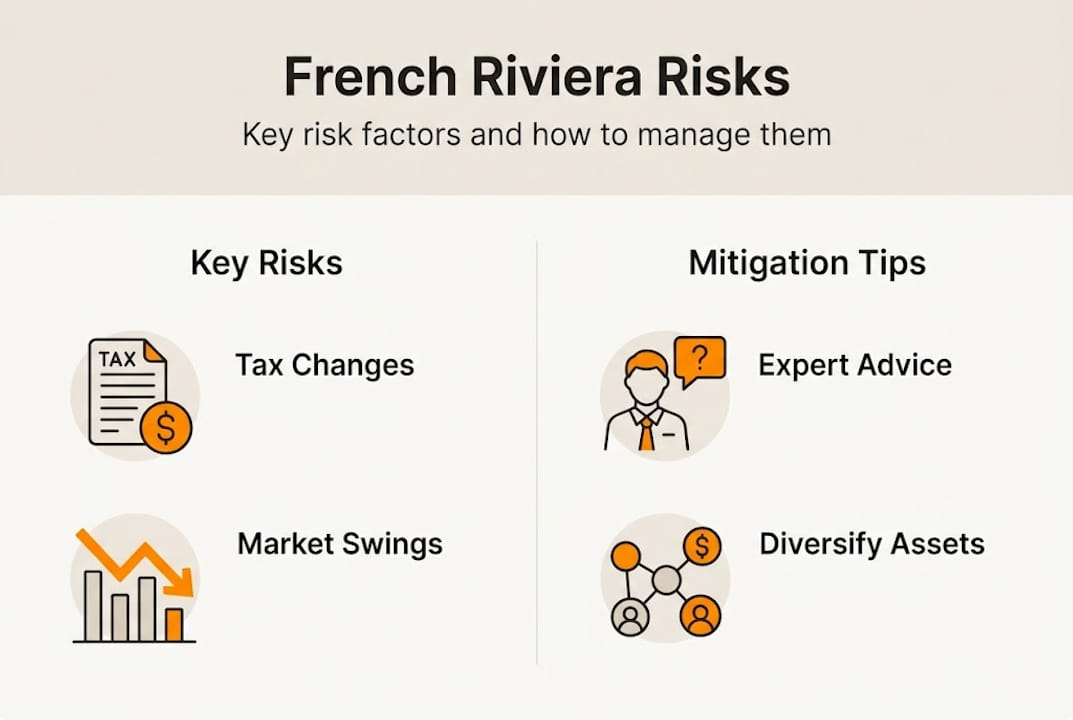
The French Riviera shimmers with a certain myth: that a villa perched above the azure Mediterranean is as close to a guaranteed investment as wealth can buy. Salt-kissed terraces, lavender-laced breezes rolling in from Provence, and the eternal glamour of Cannes and Saint-Tropez create an almost irresistible narrative. Yet even the most discerning investors occasionally allow that narrative to eclipse sober analysis. Regulatory shifts, market swings, and tightening environmental legislation are reshaping the landscape in 2026. Understanding these forces is not a reason to step back; it is precisely the intelligence that separates legacy-building from mere speculation.


Table of Contents

  • Regulatory and tax risks in French Riviera luxury real estate
  • Market volatility and economic uncertainty
  • Environmental and sustainability challenges
  • Ownership complexities for international buyers
  • What most guides miss about risk management on the French Riviera
  • Next steps for safe luxury investment on the French Riviera
  • Frequently asked questions

Key Takeaways

PointDetails
Regulation and taxes matterStringent rules and rising taxes pose real challenges for luxury property investors.
Market volatility affects returnsSignificant price swings and inflation influence confidence and legacy planning.
Sustainability is strategicEco-conscious investments future-proof your portfolio against shifting regulations.
Foreign ownership is complexInternational buyers face multilayered legal hurdles and succession planning requirements.
Expert advice reduces riskPartnering with specialists helps you anticipate and manage risks more effectively.

Regulatory and tax risks in French Riviera luxury real estate

Regulation is the invisible architecture behind every Riviera estate. It determines what you may build, how you may use your property, and how much of your return the state will reclaim. For international buyers, that architecture can feel labyrinthine, and the consequences of misreading it are measured in hundreds of thousands of euros.

The most immediate pressure point is taxation. According to France luxury real estate and villas market research, property taxes are expected to rise by 6%, with stringent zoning laws limiting development opportunities, particularly for foreign buyers navigating complex ownership regulations. A 6% uplift on taxe foncière across a portfolio of Côte d’Azur estates is not an abstraction; it is a concrete reduction in net rental yield and, over a decade, a material drag on capital appreciation.

Our Riviera property tax guide explores these mechanisms in detail, but the key regulatory hurdles every investor should map before signing include:

  • Taxe foncière increases driven by municipal budget pressures in high-demand communes such as Antibes and Beaulieu-sur-Mer
  • Plan Local d’Urbanisme (PLU) restrictions that govern height, footprint, and façade materials, often preventing the contemporary eco-luxury renovations buyers desire
  • Zones de protection du patrimoine architectural (heritage protection zones) prevalent in Menton’s citadel quarter and Èze’s medieval village, where even sympathetic restoration requires multi-agency approval
  • Non-resident ownership structures that attract wealth tax scrutiny under the Impôt sur la Fortune Immobilière (IFI), calculated on net property assets above €1.3 million
  • SCI (Société Civile Immobilière) regulations that, while useful for succession planning, carry reporting obligations that trip up investors unfamiliar with French corporate governance

The picture is complicated further by regional inconsistency. A plot in Cap d’Antibes may sit within one planning zone, while an estate fifty metres away falls under entirely different restrictions. This granularity rewards expertise and punishes assumptions.

Regulatory riskPotential impactMitigation
6% property tax riseReduced cash flowStress-test yield projections
PLU zoning limitsBlocked renovationsPre-purchase planning audit
IFI wealth taxAnnual capital chargeOptimised ownership structure
Heritage zone rulesExtended timelinesSpecialist architect briefing

Understanding luxury real estate tax risks before committing capital is not merely prudent; it is the foundation of every successful legacy investment we guide our clients through.

Infographic showing risks and mitigation steps

Pro Tip: Retain a bilingual notaire and a specialist tax adviser who works exclusively with international property investors in France. Their combined insight into local PLU nuances and cross-border IFI planning will pay for itself many times over on a single transaction.


Market volatility and economic uncertainty

Even the most beautifully curated estate on the Croisette cannot insulate its owner from macroeconomic forces. The French Riviera luxury segment is enviably resilient, but resilient is not synonymous with immune. Understanding where volatility originates, and how it manifests in pricing, is essential for investors whose horizons span generations rather than market cycles.

Man analyzing real estate market data

The French luxury real estate market is valued at EUR 30 billion, with the Côte d’Azur accounting for a commanding share. Yet within that prestige, price swings of 10 to 15% in Provence and along the broader Riviera corridor have been recorded during periods of economic stress, while inflation running at 3.8% quietly erodes real returns for investors holding assets in euros.

Consider what a 15% downswing means in practice. A villa acquired for €4.5 million near the Monaco border, bought partly as a legacy asset for the next generation, could temporarily be valued at €3.8 million on paper. That is not necessarily a crisis if the holding structure is sound and the rental income continues. But for investors who have borrowed against the asset or who need liquidity within a short window, the pressure is acute.

Economic events that have historically triggered volatility in the Riviera market include:

  • Global financial contractions (2008 and 2020 both produced sharp short-term corrections before rapid recovery)
  • Currency fluctuations affecting purchasing power for British, American, and Middle Eastern buyers, whose appetite drives significant transaction volume
  • Interest rate cycles influencing both mortgage accessibility and the opportunity cost of capital deployed into property
  • Geopolitical disruptions redirecting ultra-high-net-worth capital flows away from Europe temporarily
  • Seasonal rental market softening in years when major festivals such as the Cannes Film Festival or Monaco Grand Prix draw reduced international attendance

We track luxury market trends 2026 closely, and the current environment reflects a nuanced picture. Easing interest rates are beginning to restore confidence, while demand for sea-view properties with eco-luxury finishes continues to outpace supply in prestige locations.

Property typeTypical annual yieldVolatility exposureLegacy suitability
Cap d’Antibes villa3.5 to 4.5%ModerateExcellent
Monaco-border apartment2.5 to 3.5%LowHigh
Sainte-Maxime off-plan4.0 to 5.5%Moderate to highGood
Provence mas (farmhouse)3.0 to 4.0%LowExcellent

The annual growth in Riviera real estate of 5 to 8% in prime locations underscores why patient capital consistently rewards its custodians.

Pro Tip: Diversify your holding structure across at least two distinct micro-markets on the Riviera: pair a Monaco-adjacent prestige asset with a lifestyle property in Sainte-Maxime or Antibes. This blend balances prestige premium with higher rental yield potential, softening the impact of localised price corrections.


Environmental and sustainability challenges

The Riviera’s extraordinary natural beauty is precisely what investors are acquiring. It is also precisely what regulators are increasingly determined to protect. In 2026, environmental compliance is not a peripheral concern; it is central to both planning permission and long-term asset value.

Stringent zoning laws and regulatory requirements are tightening alongside environmental mandates, creating a landscape where even well-resourced investors can find development ambitions stalled. Coastal construction restrictions have been reinforced under France’s Loi Littoral, limiting what may be built or extended within a defined distance of the shoreline. For buyers eyeing beachside plots near Pampelonne in Saint-Tropez or Nartelle Beach in Sainte-Maxime, this legislation is not an abstraction; it is the boundary within which all creative vision must operate.

Sustainability is reshaping what it means to hold a trophy asset. The key features of French Riviera real estate that commanded premiums a decade ago, namely size and spectacle alone, are now complemented by solar arrays, energy performance certificates (DPE ratings), and biophilic design credentials. Estates that fail to meet evolving DPE thresholds face restrictions on rental income generation, a risk that strikes directly at legacy investors relying on elite lets to generate yield.

Practical steps for ensuring environmental compliance and futureproofing your investment:

  1. Commission a full DPE audit before acquisition, not after. A Grade E or below can restrict rental activity and suppress resale value significantly.
  2. Integrate solar and thermal systems during any renovation phase; these are not mere lifestyle additions but financial instruments that improve DPE ratings and reduce operating costs.
  3. Engage with a certified environmental architect familiar with Riviera coastal regulations to identify permitted works before submitting planning applications.
  4. Pursue recognised green certifications such as HQE (Haute Qualité Environnementale) or BREEAM, which add measurable premium to resale value and signal future-readiness to discerning buyers.
  5. Monitor the Schéma de Cohérence Territoriale (SCOT) for your commune, as it governs long-term land use decisions that can affect the development potential of neighbouring parcels.
  6. Budget for green retrofitting in acquisition projections; the cost of bringing a stone bastide in the hills above Èze up to contemporary environmental standards can reach 8 to 12% of acquisition price.

Sustainable property investment is no longer a values statement; it is a financial imperative. The 15% forecast demand spike for sustainable builds on the Côte d’Azur in 2026 confirms that the market is voting with its capital.

Pro Tip: Prioritise eco-certifications during the acquisition negotiation itself. A seller who holds HQE or BREEAM accreditation is offering more than a property; they are delivering a pre-validated compliance position that reduces your regulatory exposure from day one.


Ownership complexities for international buyers

Owning a Riviera estate as a foreign national is a privilege that comes wrapped in considerable legal complexity. The romance of a sun-drenched bastide above Menton’s lemon groves or a Belle Époque villa near Cannes’ Lérins Abbey does not dissolve the paperwork; it simply makes navigating it worthwhile.

The most revealing insight from France luxury real estate market research is that complex ownership regulations consistently surprise even experienced overseas investors. Common ownership challenges include:

  • Succession law under EU Regulation 650/2012, which allows non-French nationals to elect for their home country’s inheritance law to apply, but requires explicit drafting in the will and property deeds
  • SCI governance obligations, including annual accounts, registered offices, and shareholder meeting minutes, which, if neglected, can expose the structure to legal challenge
  • Mortgage accessibility limitations for non-EU nationals, with French banks applying additional due diligence and sometimes declining to lend without significant collateral held in France
  • Notaire neutrality: unlike Anglo-Saxon conveyancing solicitors, the French notaire acts for the transaction rather than either party, making independent legal counsel for the buyer essential
  • SAFER pre-emption rights on rural agricultural land, which can allow the state to requisition rural estate purchases, an issue relevant for buyers acquiring Provençal mas or vineyard estates

Reviewing regional luxury estate trends reveals how ownership complexity varies meaningfully by location. Coastal communes apply different municipal rules to inland areas; Monaco-adjacent Roquebrune-Cap-Martin operates under distinct planning frameworks compared to a hillside property in Saint-Paul-de-Vence.

“The proportion of luxury estates above €2 million that require formal succession planning through specialised cross-border legal counsel now exceeds 60% of all international transactions. The complexity is not incidental; it is structural, woven into French property and inheritance law in ways that reward preparation and punish haste.”

The French Riviera tax guide for 2026 outlines how buyers from the United Kingdom, the United States, the Gulf states, and Asia-Pacific each face subtly different regulatory entry points. Understanding selling property with legal challenges in complex regulatory environments underscores a universal truth: the exit strategy must be planned at the moment of entry.


What most guides miss about risk management on the French Riviera

Most risk management guides focus on data. They present tax tables, price indices, and regulatory checklists, and these are genuinely valuable. But in our experience, the investors who build the most enduring Riviera legacies are those who pair data literacy with something quieter: relationship capital.

Knowing which maire’s office holds influence over a particular commune’s PLU review, or which local architect has built trust with the Architectes des Bâtiments de France, is intelligence that no index captures. We have seen impeccably structured transactions falter because the buyer relied on international advisers with no genuine presence on the ground in Antibes or Nice. We have equally seen buyers investing in the Riviera with conviction and clarity because they built their team from local expertise outward.

The uncomfortable truth is this: the Riviera rewards patient, well-advised investors who treat complexity as a competitive advantage rather than a deterrent. Every regulatory hurdle that discourages an underprepared buyer is a moat protecting the value of your carefully acquired estate.


Next steps for safe luxury investment on the French Riviera

https://www.livingonthecotedazur.com/contact-nice-to-meet-you/

Understanding risk transforms it from obstacle into opportunity. At Living on the Côte d’Azur, we guide visionary investors through every dimension of Riviera acquisition: from identifying off-market luxury property that never reaches public listing, to structuring ownership for seamless intergenerational wealth transfer. Our curated portfolio spans the full spectrum of investment options on the Côte d’Azur, from Monaco-adjacent prestige apartments to biophilic eco-villas in Sainte-Maxime. Discover how our expertise converts regulatory complexity into a foundation for legacy luxury ROI that endures across generations. We accept cryptocurrency payments, reflecting our commitment to the forward-thinking investors who shape tomorrow’s Riviera.


Frequently asked questions

What are the main regulatory risks facing overseas buyers in French Riviera luxury real estate?

The main risks are rising property taxes, strict zoning laws, and complex ownership rules for foreign buyers, including IFI wealth tax obligations and SCI governance requirements.

How does price volatility impact luxury real estate investments?

Market swings of 10 to 15% reduce the predictability of returns and make long-term legacy planning considerably more demanding, particularly for investors relying on short-term liquidity.

Are sustainable or eco-focused properties less prone to risk?

Eco-certified properties may face stricter development regulations initially, but they offer superior long-term security as environmental compliance shapes future resale values, rental eligibility, and legacy asset appeal.

What is the best way to minimise ownership complexity as a foreign investor?

Engage specialised bilingual legal advisers before any offer is made and ensure your property structure addresses both French inheritance regulations and your home country’s succession requirements from the outset.

Recommended

  • Securing French Riviera real estate: 5% to 8% annual growth
  • 7 Types of Investment Risk in Real Estate for Luxury Buyers
  • Luxury property financing on the French Riviera: 5 key tips
  • Luxury Real Estate Tax Explained: Strategies and Risks – Living on the Côte d’Azur
by Websols Servicedesk/27 April 2026/in Landingpage
https://www.livingonthecotedazur.com/wp-content/uploads/2026/04/1777252356754_Woman-managing-tasks-on-luxury-terrace.jpeg 714 1280 Websols Servicedesk https://www.livingonthecotedazur.com/wp-content/uploads/2024/02/sitelogo150.png Websols Servicedesk2026-04-27 07:10:062026-04-27 07:10:11Identifying and managing risks in French Riviera luxury real estate


TL;DR:

  • Negotiating on the Côte d’Azur requires understanding micro-markets, value drivers, and off-market opportunities.
  • Successful luxury deals depend on preparation, expert team assembly, thorough due diligence, and clear objectives.
  • Legacy preservation is achieved through strategic legal structuring, post-deal verification, and articulating a compelling future vision.

Picture this: a magnificent Belle Époque villa perched above the sapphire waters of Cap d’Antibes, jasmine drifting through iron-latticed windows, a private garden sloping gently toward the sea. You have the capital. You have the appetite. Yet, without a mastery of the Riviera’s nuanced negotiation landscape, that estate slips quietly into another family’s portfolio, becoming their heirloom instead of yours. On the Côte d’Azur, where sellers are as sophisticated as the buyers, negotiation is not merely a transactional formality. It is a strategic art form that distinguishes enduring legacy from costly missed opportunity. This guide arms you with the frameworks, intelligence, and insider perspective to negotiate with precision and confidence.


Table of Contents

  • Understanding the Côte d’Azur luxury market
  • Preparing for successful negotiation
  • Executing negotiation: Strategies for luxury deals
  • Verifying success and preserving legacy
  • A seasoned negotiator’s perspective: Legacy-first approach
  • Next steps: Connect with Côte d’Azur luxury experts
  • Frequently asked questions

Key Takeaways

PointDetails
Know your marketUnderstanding the Côte d’Azur luxury real estate landscape is vital before entering negotiations.
Prepare thoroughlyProper due diligence, financial readiness, and expert advice make negotiation outcomes stronger.
Negotiate legacy-firstFocus on long-term value, generational suitability, and wealth preservation rather than just price.
Verify and safeguardAlways check contracts and plan post-acquisition stewardship to protect inheritance and legacy.

Understanding the Côte d’Azur luxury market

Before a single offer is placed, you must understand the forces shaping property value along this sun-gilded coastline. The Côte d’Azur is not a monolithic market. It is a constellation of distinct micro-markets, each with its own prestige hierarchy, buyer profile, and pricing logic. Monaco’s border communes command extraordinary premiums anchored by tax efficiency and proximity to principality status. Cap d’Antibes draws those who prize discretion and scale. Sainte-Maxime, with its Nartelle beach sunsets and easy ferry to Saint-Tropez, attracts lifestyle-driven buyers seeking both prestige and rental yield.

Market trends and value drivers on the Riviera are shaped by several converging forces:

  • Sea view premiums: Properties with unobstructed Mediterranean panoramas command between 30% and 50% more than comparable inland estates.
  • Architectural heritage: Pre-war villas with original Belle Époque or Art Deco features carry irreplaceable scarcity value.
  • Eco-luxury credentials: In 2026, green certifications and solar infrastructure are no longer optional extras. Buyers increasingly factor them into their headline offer.
  • Proximity to amenities: Walking distance to Antibes’ Provençal markets, the Cannes Croisette, or Menton’s lemon festival promenades adds tangible, quantifiable value.
  • International buyer concentration: Russian, American, British, and Gulf-state buyers continue to underpin demand, insulating prime stock from domestic economic cycles.
Micro-marketTypical price rangeKey premium driverAverage annual appreciation
Cap d’Antibes€5M to €30M+Privacy, coastal sentiers6 to 8%
Monaco border (Beausoleil, Cap Martin)€3M to €20M+Tax jurisdiction proximity7 to 9%
Cannes (Californie, Super-Cannes)€2M to €15MFestival prestige, sea views5 to 7%
Sainte-Maxime€1.2M to €8MBeach access, golf, ferry links4 to 6%
Menton€1M to €5MBotanical gardens, Italian border4 to 6%

Off-market properties deserve particular attention. A significant proportion of elite estates never appear on public portals. They circulate through a privileged network of agents, notaires, and family office advisers. These invisible deals often carry the most compelling legacy potential precisely because they attract less competitive pressure. The buying luxury estate guide we have prepared details how to position yourself for access to this rarified tier.

Understanding market cycles is equally vital. The Riviera has demonstrated remarkable resilience through global downturns, yet seasonal rhythms still create windows of opportunity. Properties listed in late autumn, after the summer season fades and before the spring regattas reignite demand, frequently offer the most negotiating room. The French Riviera investment guide breaks down these seasonal patterns with granular regional data.

Pro Tip: Commission a comparative market analysis specific to your target commune, not merely the broader Riviera. A €6M asking price in Èze village carries entirely different underpinnings from a €6M asking price in central Cannes.


Preparing for successful negotiation

Once you understand the market, preparation is the step that separates informed buyers from ordinary negotiators. The Côte d’Azur’s elite sellers and their agents are adept at reading buyer readiness. Arriving underprepared signals either naivety or lack of serious intent, and either impression can cost you leverage before the first conversation begins.

Buyer assembling negotiation documents at table

Step 1: Assemble your expert team

Secure a bilingual buyer’s agent who specialises exclusively in luxury assets and maintains genuine off-market relationships. Expert buyer agent representation is not a luxury on the Riviera. It is an absolute prerequisite. Pair this with a notaire experienced in high-value transactions and an independent legal adviser who can scrutinise title deeds, servitudes (right-of-way easements), and planning permissions.

Step 2: Conduct property and legal due diligence

French property law is layered and occasionally counter-intuitive for international buyers. Due diligence must cover:

  1. Title clarity and absence of encumbrances or unresolved servitudes.
  2. Planning history, including any unauthorised extensions or pool constructions that could complicate future sales.
  3. Cadastral survey verification to confirm stated land boundaries.
  4. Technical diagnostics: asbestos, lead, energy performance ratings, and seismic vulnerability assessments.
  5. Syndic records for co-owned properties, revealing hidden costs or deferred maintenance.

Step 3: Secure your financing before approaching sellers

Financing routeAdvantageConsideration
French mortgage (up to 70% LTV)Preserves capital, interest-deductibleSlower process, requires local bank relationship
Offshore lending against global portfolioSpeed and discretionCurrency risk management essential
Cryptocurrency-backed financeInnovative, capital-efficientVolatility of crypto assets requires robust collateral structuring
All-cash acquisitionMaximum leverage in negotiationCapital deployment opportunity cost

Sellers of trophy estates respond viscerally to proof of funds. A confirmed financial position, whether a letter of credit, a bank attestation, or a cryptocurrency wallet verification accepted by forward-thinking agencies like ours, transforms you from an interested prospect into a credible counterparty.

Step 4: Intelligence gathering

Understand why the seller is selling. A family resolving an inheritance dispute will respond differently to timelines and terms than a developer offloading a completed project. Knowing the seller’s motivation is arguably more valuable than knowing the comparable transaction data. If you are buying a second home in France for the first time, read carefully about notaire timelines and cooling-off periods under French law. For structuring the financial side elegantly, explore financing luxury property options tailored to the Riviera.

Pro Tip: Request the property’s full rental history if it has been let seasonally. A villa that achieves €25,000 per week during the Cannes Film Festival season transforms the yield conversation during negotiation.


Executing negotiation: Strategies for luxury deals

With your groundwork in place, it is time to deploy negotiation techniques that distinguish elite buyers. The most common error at this stage is treating the negotiation purely as a price conversation. On the Côte d’Azur, the finest deals are structured around an architecture of value that extends far beyond the headline figure.

Establish your full negotiation objectives

  1. Define your walk-away price with mathematical precision, not emotional approximation.
  2. Identify which chattels, artworks, or furnishings you wish to include in the sale.
  3. Clarify your preferred completion timeline, which can be a powerful non-price lever.
  4. Determine whether a phased payment structure, common in VEFA off-plan purchases, better suits your capital deployment strategy.
  5. Assess which eco or renovation commitments the seller might make as conditions of sale.

Leverage legacy, amenities, and future potential

Position yourself as the natural custodian of the property, not merely its next owner. Sellers of heritage estates, particularly those in families for generations, often respond emotionally to buyers who articulate a vision for the property’s future. A family office explaining that Cap d’Antibes coastal walks and the estate’s lemon-scented terraces will be enjoyed by three generations carries more persuasive weight than a pure price adjustment.

“The finest Riviera negotiations we have witnessed were not won on price. They were won on vision, patience, and the quiet confidence of a buyer who understood exactly what they were acquiring and why it mattered.”

Curating high-value real estate for legacy requires that you see beyond the transaction to the narrative arc of the estate itself.

Handling counteroffers and structuring for value

When a counteroffer arrives, resist the instinct to respond immediately. A measured 48 to 72-hour response window signals deliberateness, not disinterest. Use that window to revisit your due diligence, consult your legal adviser, and reassess whether the counteroffer reflects genuine seller flexibility or a negotiating position.

Structured concessions work powerfully here. Offer to move on price in exchange for inclusion of specific assets, accelerated timelines, or vendor finance on the notaire fees. The art is in assembling a package that feels generous to the seller while preserving value for you. When investing for lasting value, every euro of acquired asset must be purposeful.

Know when to walk away. The Riviera’s market depth means alternatives exist. A disciplined exit from an overpriced negotiation protects your capital for the right asset. For those securing Riviera real estate for the first time, establishing this discipline early is transformative.

Pro Tip: Never negotiate directly with the seller’s agent without your own representation present. Information asymmetry in luxury deals is significant, and an unrepresented buyer is at a structural disadvantage.


Verifying success and preserving legacy

Once the deal is struck, verifying its integrity and protecting your legacy is paramount. Many sophisticated buyers invest heavily in the negotiation phase, then underinvest in post-deal verification and long-term stewardship. This is where fortunes are quietly eroded.

Post-negotiation checks you must not skip

  • Confirm the compromis de vente (preliminary sale contract) reflects every negotiated term, including chattels, conditions precedent, and completion dates.
  • Verify that all diagnostics disclosed during due diligence are formally acknowledged in the contract.
  • Instruct your legal adviser to conduct a final title search immediately before completion, as encumbrances can emerge late in the process.
  • Confirm compliance with any local planning obligations, particularly for coastal properties subject to the Loi Littoral coastal development law.
  • Ensure that any agreed renovation or eco-upgrade commitments by the vendor are secured with financial penalties for non-completion.

Strategies for legacy preservation on the Riviera are most effective when structured from the moment of acquisition. The French legal framework offers several tools for generational transfer:

Optimising for generational wealth

Infographic with steps of luxury property negotiation

Properties held through an SCI (Société Civile Immobilière), a French civil property company, allow phased transfer of ownership shares to heirs over time, significantly reducing inheritance tax exposure. Elite seasonal rentals, generating 3 to 5% annual yields on prime Riviera assets, can fund ongoing estate costs while the underlying asset appreciates. A villa near Cannes during the Film Festival or Antibes’ sailing regattas can command exceptional short-term rental premiums that would astonish buyers accustomed to other European markets.

Common mistakes to avoid after closing

  • Failing to register the property correctly with French tax authorities.
  • Neglecting to update insurance to reflect the full replacement value of the estate.
  • Overlooking the annual taxe foncière (property tax) calendar and its implications for cash flow planning.
  • Delaying the establishment of an SCI or equivalent legal structure, thereby complicating future inheritance.

For families seeking to protect the next generation, safeguarding inheritance through proper legal structuring is as important as the negotiation itself. The Riviera legacy guide we have assembled provides a full roadmap for this critical phase.

Pro Tip: Engage a French wealth adviser (conseiller en gestion de patrimoine) within six months of completion. Their insight on SCI structuring, gift taxation, and rental yield optimisation pays dividends far exceeding their fee.

Riviera estates that appreciate 5 to 8% annually, held within a properly structured legal vehicle, compound generational wealth in ways that few other asset classes can match.


A seasoned negotiator’s perspective: Legacy-first approach

Here is a perspective that most negotiation guides will not share with you: the buyers who secure the finest Riviera estates are rarely those who fight hardest on price. They are the ones who fight most clearly on purpose.

We have observed family offices from Singapore to São Paulo approach the same Cap d’Antibes listing. The buyers who ultimately acquired it were not the highest bidders at the preliminary stage. They were the family who communicated, through their agent and through the texture of their offer, that this estate would become a place of gathering, of celebration, of continuity. The seller, an elderly widow parting with a property her father had built in 1938, chose legacy over liquidity.

This is the contrarian truth of Riviera luxury negotiation. Patience, discretion, and a clearly articulated vision consistently outperform aggressive price manoeuvring. The step-by-step luxury investment frameworks we advocate always begin with the question: what story does this estate need to tell next? When you answer that question compellingly, you become the buyer the seller has been waiting for.


Next steps: Connect with Côte d’Azur luxury experts

Transforming negotiation knowledge into a signed compromis requires more than frameworks. It requires a trusted partner who has walked these sun-warmed lanes, opened these shuttered gates, and negotiated across these candlelit dining tables. We bring exactly that intimacy to every engagement. Explore our curated portfolio of Riviera luxury villas, from Monaco border penthouses to Provençal mas that embody timeless glamour. Discover how we are curating high-value properties for discerning family offices, and explore the full spectrum of Côte d’Azur investment options tailored to your legacy ambitions. We also welcome cryptocurrency transactions for the forward-thinking investor. Reach out, and let us begin your Riviera story together.


Frequently asked questions

What is the first step in negotiating luxury property deals on the Côte d’Azur?

Begin with thorough market research and secure experienced buyer representation familiar with luxury assets and off-market deal flows; without this foundation, every subsequent step is structurally compromised.

How do you spot high-potential off-market opportunities?

Work with established local agents who maintain privileged seller relationships, and study invisible luxury properties that never reach public portals; these quiet listings carry the greatest legacy potential and the least competitive pressure.

What are common negotiation mistakes for family offices?

Failing to plan for generational transfer from day one, overlooking French tax and inheritance law, and neglecting post-deal stewardship are the three most costly errors, all of which erode the legacy wealth potential that motivated the acquisition in the first place.

How can you ensure wealth preservation through property negotiation?

Focus on rigorous contract verification, engage a French wealth adviser for SCI structuring, and align every deal clause with your long-term inheritance safeguarding strategy so that the estate serves your heirs as powerfully as it serves you today.

Recommended

  • How to Finance Luxury Real Estate on the Côte d’Azur
  • Luxury real estate French Riviera: Villa or penthouse on the Côte d’Azur – Living on the Côte d’Azur
  • High-end property explained: Côte d’Azur luxury guide 2026
  • The invisible luxury real estate properties on the Cote d’Azur – Living on the Côte d’Azur
by Websols Servicedesk/27 April 2026/in Landingpage
https://www.livingonthecotedazur.com/wp-content/uploads/2026/04/1777252284729_Luxury-property-negotiation-in-French-villa-kitchen.jpeg 715 1280 Websols Servicedesk https://www.livingonthecotedazur.com/wp-content/uploads/2024/02/sitelogo150.png Websols Servicedesk2026-04-27 07:09:412026-04-27 07:09:45Negotiate luxury property deals on the Côte d’Azur


TL;DR:

  • True value on the Côte d’Azur depends on scarcity, infrastructure, and legacy potential, not just location.
  • Rigorous due diligence, including legal, structural, and regulatory checks, is essential before purchasing.
  • Sustainable features and structural adaptability ensure estates serve multiple generations and maintain long-term worth.

The Côte d’Azur is not simply a destination. It is a declaration. With luxury villas averaging USD 12,700 to 19,100 per m² in 2025, French Riviera estates consistently outpace global luxury property benchmarks by a considerable margin. Yet even within this gilded market, not every prestige address translates into lasting wealth. Some investors secure generational treasures; others acquire expensive maintenance burdens. The difference lies not in the postcode, but in the precision of your selection criteria. This guide walks you through the overlooked, often underestimated, factors that separate a fleeting luxury purchase from a true heirloom estate.


Table of Contents

  • Understanding true value: Beyond location and aesthetics
  • Conducting comprehensive due diligence
  • Evaluating legacy and sustainability factors
  • Applying decision frameworks for investment
  • A fresh perspective: What legacy investors often overlook
  • Explore unique luxury estate opportunities
  • Frequently asked questions

Key Takeaways

PointDetails
Scarcity and infrastructureThe most valuable estates derive lasting appreciation from limited supply and quality infrastructure, not mere location.
Comprehensive due diligenceNeglecting legal, financial, and maintenance checks may threaten legacy potential and investment security.
Legacy-driven criteriaPrioritising sustainability, regulatory compliance, and adaptability ensures generational wealth transfer.
Synthesis for selectionCombining all criteria into a practical decision framework is vital to secure enduring luxury estate investments.

Understanding true value: Beyond location and aesthetics

There is a seductive simplicity to the notion that a property overlooking the Baie des Anges in Nice or perched above the lemon-scented ramparts of Menton will automatically appreciate. Location matters, of course. But on the Côte d’Azur, where every headland seems more breathtaking than the last, luxury home values are shaped by a far richer constellation of forces.

Infographic summarizing luxury estate selection criteria

Scarcity is one of the most powerful. The coastline between the Italian border and Cannes is finite. Planning restrictions, protected natural zones, and the sheer geological drama of the terrain mean that truly exceptional plots are not being created. They are only changing hands. When you acquire a Cap d’Antibes estate with direct sea access or a Monaco-adjacent villa with uninterrupted panoramas, you are not buying a product that can be replicated. That irreplaceability is a cornerstone of sustained capital growth.

Infrastructure quality is the second pillar. Proximity to Nice Côte d’Azur International Airport, the TGV rail network, and the A8 motorway corridor matters enormously to a global buyer travelling between Paris, London, or Dubai. Estates within efficient reach of these arteries command measurable premiums, particularly among families who treat the Riviera as a primary residence rather than a seasonal retreat.

Man surveys Côte d’Azur from estate balcony

Legacy potential sits above both. This is the criterion that separates transactional buyers from visionary investors. An estate with adaptable floor plans, robust structural integrity, eco-retrofit potential, and established grounds speaks to successive generations, not just the present owner.

Consider how the Côte d’Azur stacks up against comparable global luxury markets:

Value driverCôte d’AzurGlobal luxury average
Annual appreciation5 to 8%3 to 5%
Scarcity of supplyExtremely limitedModerate to high
Rental yield (elite lets)3 to 5%2 to 4%
Infrastructure accessExceptionalVariable
Legacy adaptabilityHigh (Provençal stock)Moderate
Regulatory environmentStable, EU-backedVariable

The market trends for the Côte d’Azur in 2026 reinforce this picture. Industry research projects a 5.05% CAGR for Côte d’Azur villas through to 2031, underpinned by constrained supply and intensifying global demand. Scarcity and infrastructure remain the twin engines driving appreciation well above what comparable coastal markets in Southeast Asia or the Caribbean can reliably deliver.

When evaluating French Riviera estate options, we encourage our clients to resist the magnetism of aesthetics alone. A freshly renovated Èze hillside villa with a designer kitchen will seduce you instantly. The question worth asking is whether the bones of the building, the plot’s legal clarity, and the surrounding neighbourhood’s trajectory will continue to reward your heirs in thirty years.

Key value drivers to prioritise:

  • Scarcity of the plot: Headland positions, domaine estates, and properties with agricultural or coastal protection designations
  • Structural pedigree: Belle Époque or Provençal mas construction with proven structural resilience
  • Sustainable infrastructure: Solar arrays, water recycling systems, and green certifications that future-proof the asset
  • Community prestige: Proximity to Monaco, Cannes Film Festival circuits, or established sailing regattas that maintain international visibility
  • Rental track record: Documented elite seasonal rental history that validates yield projections

Conducting comprehensive due diligence

Once you have identified an estate with genuine value credentials, the next imperative is rigorous verification. Beautiful properties can conceal complex legal histories, undeclared structural modifications, or regulatory encumbrances that erode their investment appeal entirely. We have seen discerning buyers fall in love with a Saint-Tropez mas and overlook a servitude (an easement, or a third party’s legal right of access) buried in the title deeds. That oversight cost one family months of legal dispute and a meaningful discount on a subsequent resale.

Here is the due diligence sequence we recommend for every luxury estate acquisition:

  1. Title audit: Commission a notaire (French public notary) to verify the chain of title, confirm there are no outstanding charges or mortgages, and ensure the property boundaries match cadastral records.
  2. Technical survey: Engage a qualified surveyor to assess structural integrity, seismic resilience, drainage systems, and any undeclared extensions or modifications.
  3. Regulatory compliance check: Confirm the property’s compliance with local PLU (Plan Local d’Urbanisme, or local planning regulations), particularly for any recent renovations or pool constructions.
  4. Tax liability assessment: Evaluate your exposure to the IFI (Impôt sur la Fortune Immobilière), France’s real estate wealth tax, which applies to net real estate assets above the €1.3M threshold.
  5. Financial forecasting: Model acquisition costs including notary fees (typically 7 to 8% for older properties and 2 to 3% for new builds under VEFA contracts), agency fees, and annual maintenance budgets.
  6. Off-market sourcing: Engage a chasseur d’appartement (a property hunter, a specialist advisor who sources estates not publicly listed) to access opportunities before they reach the open market.

Understanding luxury estate financing options is equally essential at this stage, particularly as easing interest rates in 2026 are opening more attractive leverage structures for high-net-worth buyers.

Due diligence checkWho conducts itApproximate cost
Title and deed auditNotaireIncluded in notary fees
Structural surveyIndependent surveyor€1,500 to €4,000
Planning complianceArchitect or legal advisor€1,000 to €2,500
IFI tax assessmentWealth tax specialist€800 to €2,000
Environmental surveySpecialist firm€500 to €1,500

A dedicated luxury real estate tax guide will clarify how to structure ownership efficiently, whether through a Société Civile Immobilière (SCI), a French civil property company, or direct personal ownership. Consulting a French property tax specialist before signing any preliminary agreement is not optional for serious investors. It is foundational.

Pro Tip: Many of the most coveted estates on the Riviera never appear on public portals. A chasseur d’appartement with a curated network across Cap d’Antibes, the Cannes hinterland, and the Monaco borders will unlock off-market estate sourcing opportunities that are entirely invisible to buyers relying on standard listings. This access alone can justify the advisor’s fee many times over.

Maintaining an estate once acquired requires equally structured thinking. Research into estate maintenance practices confirms that disciplined upkeep directly reduces vacancy rates and protects seasonal rental premiums.


Evaluating legacy and sustainability factors

With due diligence complete, the truly long-horizon investor turns attention to a set of criteria that most buyers address only superficially: legacy suitability and sustainability resilience.

A legacy estate, as we define it at Living on the Côte d’Azur, is one that serves multiple generations without requiring fundamental reinvention. It possesses structural adaptability, meaning it can be reconfigured to accommodate extended family living, private staff quarters, or even a boutique hospitality operation. It carries a maintenance history that is transparent and professionally managed. And it reflects the environmental values that today’s heirs, and tomorrow’s buyers, will demand.

The French luxury estate market is registering a 15% demand increase for eco-certified and sustainability-enhanced builds heading into 2026. Buyers who acquire estates with solar arrays, rainwater harvesting, geothermal heating, and biophilic garden design are not simply making an ethical choice. They are securing a market advantage.

True luxury is not measured in marble or sea views alone. It is measured in the estate’s capacity to endure, adapt, and reward each generation that inherits it.

Key legacy and sustainability factors to assess:

  • Green certifications: HQE (Haute Qualité Environnementale) or BBC Effinergie labels that signal energy performance
  • Renewable energy systems: Solar arrays, heat pumps, and battery storage that reduce operating costs
  • Structural adaptability: Floor plans that accommodate multi-generational living without costly reconfiguration
  • Legal structure readiness: SCI ownership structures that facilitate tax-efficient intergenerational transfer
  • Provenance and maintenance records: Documented renovation history, service contracts, and condition reports
  • Regulatory compliance trajectory: Estates that already meet 2030 energy performance standards avoid future liability

Luxury estate amenities such as private pools, tennis courts, and home automation systems contribute to rental premiums but should be assessed against their maintenance cost profiles. A Sainte-Maxime domaine with a heated infinity pool overlooking the Golfe de Saint-Tropez is a seasonal rental treasure. It also demands a disciplined upkeep budget to maintain its commanding nightly rates.

Maintenance and regulatory compliance are not administrative formalities. They are active determinants of legacy estate value. An estate that has received consistent professional care for two decades will attract a measurably different buyer profile and price upon resale than one showing deferred maintenance, regardless of its location.

Pro Tip: When reviewing an estate’s legacy potential, request at least ten years of maintenance records, any planning permissions granted or refused, and the current energy performance certificate (DPE). These three documents alone will tell you more than any estate agent’s brochure about the property’s true condition and future liability profile.

Understanding what defines a legacy property for portfolio investors is a discipline in itself, one we have refined across hundreds of client acquisitions along the Riviera.


Applying decision frameworks for investment

The final step is synthesis: taking all the criteria above and distilling them into a structured, repeatable decision framework. Without this, even informed buyers can succumb to emotional decision-making, paying a premium for an estate that excites the imagination but underdelivers on measurable investment metrics.

Here is the framework we apply with our most discerning clients:

  1. Define your investment thesis: Clarify whether the estate serves primarily as a private sanctuary, a seasonal rental asset, an intergenerational legacy vehicle, or a combination of all three. Each objective weights the criteria differently.
  2. Score the value drivers: Rate each estate against scarcity, infrastructure, sustainability, structural pedigree, and rental track record on a weighted scale you establish before viewing properties.
  3. Complete the due diligence matrix: Use the checks outlined above as non-negotiable gates. No estate advances to offer stage without passing every item.
  4. Model the financial outcomes: Calculate the price per square metre relative to comparable transactions, project the rental yield across conservative and optimistic scenarios, and stress-test the IFI implications.
  5. Assess the regulatory landscape: Confirm the estate’s position within local planning frameworks, particularly any pending infrastructure projects or environmental protection designations that could affect future development rights.
  6. Review regulatory and market comparisons: These shape investment outcomes in ways that pure property fundamentals cannot predict alone.
Decision criterionQuestions to askRed flags
ScarcityIs this plot genuinely irreplaceable?High local supply; replicated views
Due diligenceAre all checks complete and clear?Unresolved title issues; undeclared works
SustainabilityDoes it meet 2030 energy standards?Poor DPE rating; no eco features
Legacy suitabilityCan it serve multiple generations?Inflexible layout; deferred maintenance
Financial viabilityDoes the yield justify the acquisition cost?Inflated asking price; hidden charges
Regulatory clarityIs planning status unambiguous?Pending zoning changes; enforcement notices

The most common pitfalls we observe among first-time Riviera investors include an over-reliance on trend-driven amenities, such as a wine cellar or a cinema room, without investigating the estate’s regulatory standing. Another frequent error is failing to account for the cumulative tax burden across IFI, capital gains on eventual sale, and annual taxe foncière. Exploring luxury investment options on the Côte d’Azur with an experienced advisor avoids these costly oversights.


A fresh perspective: What legacy investors often overlook

We have guided buyers from Monaco to Menton, from the yacht-lined quays of Antibes to the hilltop galleries of Èze, and one pattern repeats itself with striking regularity. The investors who achieve the greatest long-term returns are not those with the largest budgets or the most sophisticated financial models. They are those who treat regulatory clarity and structural adaptability as primary criteria rather than secondary considerations.

Too many buyers arrive on the Riviera captivated by the salt-kissed light of a Cannes penthouse or the lavender-laced terraces of a Provençal mas, and they anchor their decision entirely to aesthetics and perceived prestige. The IFI implications, the DPE energy rating, the planning history: these feel like administrative details. They are, in fact, the architecture of your investment’s future value.

The estates that endure across generations are not those that impressed their era most. They are those that were built and acquired with the greatest care for what lies beneath the surface.

We also observe that the most rewarding acquisitions on the Riviera tend to come through professional networks rather than public listings. A legacy and ROI-focused approach demands access to estates that have never been publicly marketed, where motivated sellers and informed buyers meet in curated, confidential settings.

The Riviera rewards patience, precision, and the courage to look beyond the view.


Explore unique luxury estate opportunities

https://www.livingonthecotedazur.com/contact-nice-to-meet-you/

At Living on the Côte d’Azur, we connect visionary buyers with estates that transcend the ordinary, from Monaco-adjacent villas dripping with prestige to serene Sainte-Maxime retreats steps from the Nartelle sands. Whether you are ready to act or still refining your investment thesis, our advisors bring intimate knowledge of every micromarket along the coast. Discover off-market properties that never reach public portals, or explore our curated portfolio of French Riviera villas for sale across every prestige address. For families focused on protecting future generations, our high-net-worth real estate guidance delivers the strategic clarity your legacy deserves.


Frequently asked questions

What is the typical price per square metre for luxury estates on the Côte d’Azur?

In 2025, Côte d’Azur villas average between USD 12,700 and 19,100 per m², making the French Riviera one of the most consistently valued luxury markets in the world.

What legal checks are essential when acquiring luxury real estate in France?

Buyers must verify clear property title, confirm compliance with local planning regulations, and assess obligations such as the IFI wealth tax for net real estate assets exceeding €1.3M.

How can buyers access exclusive or off-market luxury estates?

Engaging a chasseur d’appartement, a specialist property hunter with curated networks along the Riviera, is the most reliable route to estates that never reach public listings.

Why is legacy potential important in luxury estate investment?

Legacy properties deliver sustained capital appreciation, facilitate tax-efficient intergenerational wealth transfer, and retain their desirability across market cycles precisely because they were selected for resilience, not simply for trend appeal.

Recommended

  • Explore the ultimate list of luxury amenities for estates
  • Top luxury real estate investment options: Côte d’Azur
  • How to Evaluate Luxury Real Estate for Smarter Investments
  • How to Finance Luxury Real Estate on the Côte d’Azur
by Websols Servicedesk/27 April 2026/in Landingpage
https://www.livingonthecotedazur.com/wp-content/uploads/2026/04/1777252192031_Woman-opens-curtains-in-luxury-Riviera-villa.jpeg 714 1280 Websols Servicedesk https://www.livingonthecotedazur.com/wp-content/uploads/2024/02/sitelogo150.png Websols Servicedesk2026-04-27 07:09:202026-04-27 07:09:23Essential criteria for selecting luxury estates on the Côte d’Azur


TL;DR:

  • Buyers on the Côte d’Azur now prioritize sustainability, legacy, and purpose alongside prestige.
  • Eco-luxury properties with renewable systems and certifications offer both environmental and financial benefits.
  • Off-market selections and strategic planning are key for building family wealth and long-term lifestyle.

The Côte d’Azur has long seduced the world’s most discerning buyers with its salt-kissed air, luminous light, and effortless glamour. Yet something profound is shifting beneath the surface of this gilded coastline. Luxury property here is no longer purely about the grandeur of a marble entrance or the gleam of a superyacht moored at Antibes. Today’s high-net-worth investors are asking deeper questions: Will this estate honour my family’s values for the next three generations? Does this villa reflect the world my children will inherit? This guide examines the forces reshaping prestige property on the Riviera, from emerging sustainability standards to the art of building a legacy etched in Provençal stone.

Table of Contents

  • What’s driving luxury property trends on the Côte d’Azur?
  • Sustainability and eco-luxury: The new standard for prestige
  • Legacy and lifestyle: Building family prestige through real estate
  • Investing smart: Practical advice for luxury property purchases
  • Our take: What legacy-driven luxury truly means in 2026
  • Discover the best luxury opportunities on the Côte d’Azur
  • Frequently asked questions

Key Takeaways

PointDetails
Sustainable luxury is essentialEco-luxury amenities and green technology are now central in prestige property investments.
Legacy drives demandFamily-focused estates and lifestyle upgrades shape buyer and investor priorities.
Off-market options expand exclusivityPrivate deals offer unique advantages for discerning luxury property buyers.
Smart investing needs expert guidanceProfessional advice and thorough due diligence remain critical for high-value acquisitions.

What’s driving luxury property trends on the Côte d’Azur?

The Côte d’Azur occupies a singular position in the European luxury real estate landscape. From the lemon-scented ramparts of Menton to the yacht-dotted marinas of Antibes, from the flower-filled Cours Saleya in Nice to the film-festival glamour of Cannes’ Croisette, this coastline is not merely a location. It is a statement of ambition, culture, and timeless refinement.

Yet the forces reshaping buyer preferences here are anything but static. We are witnessing a generational handover, as younger, globally minded investors arrive alongside established family dynasties. These newer buyers, many of them digital entrepreneurs who have built considerable wealth before their fortieth birthday, approach property with a fundamentally different calculus. Prestige still matters enormously. But prestige, for this cohort, is increasingly inseparable from purpose.

Second home trends 2025 on the Riviera confirm a marked rise in demand for properties that function as true lifestyle anchors rather than occasional retreats. The secondary home is no longer a seasonal indulgence. It is a carefully selected sanctuary that serves the family year-round, offering wellness infrastructure, private outdoor spaces, and connectivity to the cultural richness of the region.

Several converging forces explain this evolution:

  • Demographic shift: Buyers aged 35 to 55 now represent the fastest-growing segment of Riviera luxury purchasers, bringing with them priorities around family continuity, ecological responsibility, and long-term asset performance.
  • Lifestyle integration: The post-pandemic normalisation of remote work has made secondary homes into primary residences for many global families, raising expectations around space, technology, and amenity.
  • Financial sophistication: These are investors who understand luxury market insights and seek annual appreciation of 5 to 8% alongside rental yields of 3 to 5% through elite seasonal lettings.
  • Sustainability as prestige: Green credentials are no longer a niche concern. They have become a core marker of excellence, as relevant to buyers as a sea view or a private pool.

Our French Riviera real estate newsletter has tracked these currents for years, and the direction is unambiguous. The buyers arriving on the Riviera today are not chasing an address. They are curating a legacy, and they expect the properties they select to rise to meet that ambition in every dimension.

Sustainability and eco-luxury: The new standard for prestige

If there is one phrase that captures the defining shift in Côte d’Azur luxury real estate, it is this: sustainability is the new opulence. What was once considered a commendable addition to a property portfolio has become an absolute prerequisite for serious, forward-thinking buyers.

Man adjusting smart thermostat in sunny living area

Eco-luxury property investment data for 2025 reveals a 15% spike in demand for sustainably constructed or retrofitted luxury properties across the Riviera, a figure that reflects both regulatory pressure and genuine buyer conviction. France’s evolving environmental legislation is accelerating this transition, with new energy performance standards applying even to high-value estates. The smart buyer anticipates these regulations rather than reacting to them.

What does authentic eco-luxury look like in practice? Consider a Belle Époque villa near Èze, its historic stone façade preserved to honour the past while its interiors house solar arrays, a geothermal heating system, and smart water management technology that monitors irrigation across its terraced gardens. Or picture a new construction in Sainte-Maxime, steps from Nartelle beach, where biophilic design principles integrate living walls, floor-to-ceiling glazing, and passive cooling systems into an architecture of breathtaking elegance.

“The most valuable properties we encounter are those where environmental intelligence and architectural beauty are not in tension, but in perfect conversation.” — Living on the Côte d’Azur

Compare the two paradigms to understand what is genuinely at stake for investors:

FeatureTraditional luxury villaEco-luxury estate
Energy sourceGrid-dependentSolar arrays, geothermal
Water managementStandard utilitiesSmart irrigation, rainwater harvesting
Insulation and climateAir conditioning reliantPassive design, smart climate control
Regulatory future-proofingPotential retrofit costsCompliant and optimised
Buyer appeal in 2026Declining among younger HNW buyersStrong and growing
Rental premiumStandard market rateUp to 20% premium for eco-certified lets

When selecting luxury amenities for a property intended to hold and grow in value, the evidence is clear. Eco-credentials are not a cost. They are a capital investment with compounding returns.

Pro Tip: When evaluating any luxury property on the Côte d’Azur, request the property’s DPE (Diagnostic de Performance Énergétique) rating immediately. Properties rated A or B command significant premiums and face no legislative headwinds, whereas those rated E or below face mandatory upgrades before they can be legally let. Prioritise defining luxury lifestyle through sustainable choices that appreciate in both cultural and financial value.

Legacy and lifestyle: Building family prestige through real estate

There is a phrase we return to often in our conversations with the families and visionary investors we serve: stone remembers. A villa on Cap d’Antibes, its terraced gardens descending towards the Mediterranean, carries within its walls something no financial instrument can replicate. It carries story, place, and belonging. This is the essence of legacy real estate on the Côte d’Azur.

The conversation around legacy luxury and ROI is now inseparable from practical estate planning. High-net-worth families are increasingly channelling inherited capital into Riviera properties as a tax-efficient mechanism for intergenerational wealth transfer. Provençal mas, restored with architectural integrity and modern comfort, offer heirs something irreplaceable: a physical anchor for family identity across decades.

Second home demand in 2025 reveals the most sought-after property types for family legacy purposes:

Property typeKey legacy featuresAverage annual appreciation
Belle Époque villaHistoric character, large grounds6 to 8%
Provençal masAuthenticity, agricultural heritage5 to 7%
New eco-villaSustainability, low maintenance7 to 9%
Monaco-adjacent apartmentPrestige address, tax efficiency5 to 8%
Penthouse with sea viewLifestyle premium, rental appeal6 to 8%

The lifestyle dimension is equally significant. Today’s luxury family property is not merely a residence. It is a wellness ecosystem. Buyers now expect:

  • Private wellness facilities: Spas, yoga pavilions, and hydrotherapy pools are standard expectations among top-tier buyers.
  • Outdoor living infrastructure: Landscaped gardens designed for dining, entertainment, and contemplation, with views across the Baie des Anges or the Lérins islands off Cannes.
  • Cultural connectivity: Proximity to Menton’s Lemon Festival, the Cannes Film Festival, the Nice Jazz Festival, or the art galleries of Èze ensures that the property sits at the heart of a rich, year-round experience.
  • Technology integration: High-speed connectivity, smart home systems, and security infrastructure that meet the expectations of global families who divide their time across multiple continents.

The art of curating high-value real estate lies in balancing these lifestyle desires with the longer arc of legacy. A property that delights the senses today must also serve the practical needs of the family’s next generation. That means generous internal space, adaptable floor plans, and outdoor environments that can evolve as children grow and family dynamics shift.

Investing smart: Practical advice for luxury property purchases

Clarity of vision is essential, but the mechanics of securing exceptional Riviera property require both expertise and rigour. The most successful buyers we work with share a common characteristic: they approach each acquisition as a dual exercise in lifestyle curation and financial strategy.

Emerging luxury market patterns for 2025 and beyond highlight that off-market transactions account for a growing share of prestige property sales on the Riviera. Sellers of truly exceptional estates rarely advertise publicly. Exclusivity, after all, extends beyond the property itself to the manner in which it changes hands.

Here is how we recommend approaching a luxury property search on the Côte d’Azur:

  1. Define your legacy intention. Are you purchasing a family sanctuary for personal use and seasonal letting? A pure investment property for capital appreciation? Or a generational estate to pass to your heirs? Each intention shapes the property type, location, and legal structure best suited to your goals.
  2. Engage local expertise early. The Riviera market rewards those with genuine insider knowledge. Relationships with trusted notaires, architects, and estate specialists unlock opportunities that never reach the open market.
  3. Commission a full legal audit. Title clarity is non-negotiable. French property law has nuances around servitudes (rights of way), co-ownership structures, and heritage protections that require specialist legal scrutiny before any offer is made.
  4. Conduct a technical survey. A thorough structural survey, including assessment of seismic resilience, drainage, and energy performance, protects you from costly surprises and strengthens your negotiating position.
  5. Assess sustainable certifications. Verify that any eco-luxury claims are substantiated by recognised French or European certifications. HQE (Haute Qualité Environnementale) and BBC (Bâtiment Basse Consommation) labels carry genuine weight in the market.
  6. Model your financial returns. With interest rates easing across the Eurozone in 2026, the financial conditions for leveraged luxury property acquisition are becoming more attractive. Model both your capital appreciation scenario and your rental yield potential across different seasonal letting strategies.

Pro Tip: Ask your agent directly whether a property has been publicly listed in the past 24 months. If it has sat on the market, understand exactly why. Sometimes the answer reveals a hidden opportunity. More often, the finest smart investment trends emerge from properties that were never publicly listed at all.

For those new to the Riviera market, our guide to French Riviera investment advice provides a structured introduction to the due diligence process, from initial search criteria through to notarial completion.

One more consideration that distinguishes exceptional investors: the willingness to explore new constructions. Off-plan properties in locations such as Sainte-Maxime and Nice’s Mont Boron offer lower notary fees (typically 2 to 3% versus 7 to 8% for existing properties), zero-interest staged payment plans through VEFA contracts, and the reassurance of a ten-year structural warranty. These are not merely financial advantages. They represent an opportunity to create a property that embodies your sustainability vision from its very foundations.

Infographic showing classic vs eco luxury villa features

Our take: What legacy-driven luxury truly means in 2026

We have observed a tendency in the luxury property conversation to treat sustainability and prestige as parallel concerns, as if ecological responsibility and aristocratic glamour occupy separate lanes. We believe this framing is fundamentally mistaken, and it costs buyers dearly when they let it guide their decisions.

In our experience, the most enduring properties on the Côte d’Azur are those where beauty and responsibility are inseparable. A villa that harvests rainwater, generates its own energy, and breathes through passive cooling is not a compromise on luxury. It is luxury in its most mature, confident expression. It says: we build for permanence, not fashion.

The uncomfortable truth is that many buyers still prioritise surface aesthetics over structural and ecological integrity. They pay a premium for a spectacular sea view while overlooking an ageing energy infrastructure that will demand expensive retrofitting within five years. True legacy thinking, the kind we advocate through our approach to modern opulence and legacy, demands that you look beyond what dazzles at first encounter and ask what this property will mean to your grandchildren.

Real legacy is integrated. It holds together family, place, lifestyle, environment, and financial wisdom in a single, coherent vision. The Côte d’Azur, with its extraordinary landscape and cultural richness, offers the perfect setting for that vision to flourish.

Discover the best luxury opportunities on the Côte d’Azur

If the insights in this guide have sharpened your thinking about legacy, sustainability, and prestige property on the Riviera, we invite you to take the next step with us. At Living on the Côte d’Azur, we specialise in connecting visionary buyers with opportunities that rarely surface publicly. Our curated selection of invisible luxury properties includes off-market villas, historic estates, and new eco-constructions that align financial performance with family purpose. Browse our full portfolio of villas and penthouses for sale across the Riviera’s most coveted addresses. For buyers committed to ecological responsibility, our dedicated guidance on sustainable Riviera investments ensures every acquisition reflects both your values and your ambitions.

Frequently asked questions

What makes a luxury property on the Côte d’Azur sustainable?

Sustainable luxury properties feature eco-friendly construction, energy-efficient technologies, and amenities like smart water management and renewable energy systems. French certifications such as HQE and BBC provide verified benchmarks for genuine ecological performance.

Are off-market properties worth considering for high-net-worth investors?

Yes, off-market properties often offer greater exclusivity and privacy, alongside unique legacy and lifestyle amenities unavailable through standard listings. They also tend to attract less competitive bidding, which can benefit disciplined buyers.

How do I select amenities that future-proof my investment?

Prioritise sustainable, technologically advanced features like solar energy, smart automation, and wellness spaces for long-term value, as confirmed by luxury amenity research. Features that serve both lifestyle enjoyment and energy efficiency consistently outperform standard amenities in resale and rental performance.

What types of legacy properties are most in demand in 2025?

Villas, penthouses, and secondary homes equipped for intergenerational living are highly sought after, as Riviera legacy trends confirm. Buyers aiming for legacy and lifestyle increasingly favour properties that combine historic character with modern ecological standards.

Recommended

  • Sustainable luxury properties on the Côte d’Azur: 20% gains
  • Côte d’Azur real estate trends: Invest smarter in 2026
  • Luxury Home Prices: What Drives Côte d’Azur Value
  • High-end property explained: Côte d’Azur luxury guide 2026
by Websols Servicedesk/27 April 2026/in Landingpage
https://www.livingonthecotedazur.com/wp-content/uploads/2026/04/1777252292961_Woman-tending-plants-on-villa-terrace-with-sea-view.jpeg 715 1280 Websols Servicedesk https://www.livingonthecotedazur.com/wp-content/uploads/2024/02/sitelogo150.png Websols Servicedesk2026-04-27 07:09:002026-04-27 07:09:04Luxury property trends: Sustainable prestige on the Côte d’Azur


TL;DR:

  • Nearly 40% of luxury transactions on the Côte d’Azur occur off-market for privacy and exclusivity.
  • Off-market deals are faster, often premium-priced, and protect buyer and seller identities.
  • Building trusted networks and acting decisively are key to accessing these rare, high-value properties.

Nearly 40% of luxury transactions in markets like the Côte d’Azur are conducted entirely away from public listing portals, yet most investors cannot precisely define what “off-market” actually means. This distinction matters enormously. If you are seeking privacy, rarity, and the kind of generational asset that transforms a portfolio into a legacy, understanding off-market property is not optional — it is essential. We have prepared this guide to cut through the confusion, challenge a few myths, and give you the clarity and actionable strategies required to position yourself among the select few who access the Riviera’s finest hidden estates.


Table of Contents

  • What defines off-market property?
  • The advantages and risks of off-market deals
  • How off-market deals actually happen: Strategies and networks
  • The Côte d’Azur market: Off-market trends and investor outlook
  • The real truth about off-market: Why rarity is the ultimate value
  • Unlock your next legacy move with Côte d’Azur luxury experts
  • Frequently asked questions

Key Takeaways

PointDetails
Exclusive deals dominateUp to 40% of luxury property sales on the Côte d’Azur are off-market, offering rare opportunities to discerning investors.
Privacy and speed advantagesOff-market transactions offer discretion and faster closing, ideal for high-net-worth individuals seeking legacy assets.
Risks require expertiseLimited price transparency and network dependence mean investors should use trusted advisers and rigorous due diligence.
Networks matter mostBuilding relationships with brokers and advisers unlocks the best off-market opportunities in the luxury segment.
Côte d’Azur trendsThe local market follows global off-market patterns, but legacy value and rarity make these deals uniquely attractive.

What defines off-market property?

An off-market property is any asset sold without being publicly listed on aggregator portals, national Multiple Listing Services (MLS), or mainstream estate agency websites. No Rightmove listing. No SeLoger advertisement. No public price revelation. The transaction moves between trusted parties, quietly and deliberately, before the wider world even senses the opportunity exists.

This is not a grey area or a workaround. It is a deliberate, legitimate, and increasingly preferred approach among the world’s most discerning buyers and sellers. On the Côte d’Azur, where a villa in Cap d’Antibes might command €8 million and a Monaco-adjacent penthouse can exceed €20 million, the motivations for keeping a sale private are as clear as the azure water below Èze’s clifftop ramparts.

Why do sellers choose off-market?

  • Privacy: Ultra-high-net-worth individuals rarely wish to publicise their financial decisions. A sale announced on public portals can attract unwanted media attention, signal vulnerability, or simply feel undignified.
  • Speed: Off-market deals, particularly in the Swiss and French luxury segments, close approximately 60% faster than comparable on-market transactions, largely because both parties are pre-qualified and motivated.
  • Premium pricing: In the European luxury segment, sellers achieve a 3 to 8% price premium over comparable listed properties, given that buyers are competing for something genuinely rare rather than bidding against an open market.
  • Discretion for sensitive estates: Family-owned Provençal mas, inherited estates near Menton’s lemon-scented citadel, or trophy villas used seasonally by high-profile owners all benefit from quiet transitions.

How off-market differs from public listings

FeatureOn-market listingOff-market transaction
Public visibilityFull portal exposureNone
Buyer poolOpen to allPre-qualified, network-based
Transaction speedSlower, broader negotiationTypically faster
Price discoveryTransparent, competitivePrivate, often premium
Privacy levelLowHigh
Suited toStandard residentialLuxury, legacy, prestige assets

Infographic comparing off-market and public listings

There is an important counterpoint here. Some agents argue that listing publicly maximises competition and therefore price, and the data does support this in standard residential markets. For a typical three-bedroom apartment in Nice’s Carré d’Or, full exposure makes perfect sense. However, for a singular estate with its own private beach between Cannes and Antibes, mass exposure can actually commoditise the asset, diluting its perceived rarity. Our guide to off-market properties explores this distinction in depth.

In 2026, it is estimated that roughly 40% of luxury transactions across premium markets occur off-market. On the Côte d’Azur, where exclusivity is the very foundation of the lifestyle, that figure is arguably higher. Rarity is the currency here.


The advantages and risks of off-market deals

With a firm definition in place, let us examine the practical upsides and dangers investors face in the off-market space.

The advantages are compelling, particularly for buyers seeking Riviera assets that appreciate 5 to 8% annually and offer 3 to 5% seasonal rental yields. Off-market transactions protect both buyer and seller identities, allow for nuanced negotiation without public pressure, and give access to properties that simply never reach portals. Imagine discovering a restored Provençal mas near the lavender-laced hills behind Grasse before any competing buyer has even heard it exists. That is the power of a trusted network.

Couple reviews Riviera home paperwork

In Switzerland and the south of France, the data is particularly striking. Swiss luxury properties sold off-market achieve price premiums of 3 to 8% and close 60% faster than public equivalents. In markets defined by genuine scarcity, this dynamic is amplified further.

Key advantages for Côte d’Azur investors

  1. Access to irreplaceable assets: The Riviera’s finest estates, particularly those with direct sea access or proximity to Monaco, rarely appear on public platforms. They move through curated networks.
  2. Reduced competition: Without open bidding, negotiations become a dialogue rather than an auction. This typically favours a buyer with the right advisors.
  3. Price stability and privacy: Off-market pricing reflects genuine value rather than speculative frenzy, which suits long-term legacy investment.
  4. Speed and certainty: Pre-qualified buyers and motivated sellers create cleaner, faster transactions, which is critical when securing a rare opportunity.
  5. Relationship-led due diligence: Trusted networks facilitate deeper access to property history, structural surveys, and title clarity before formal contracts begin.

“For exclusive Côte d’Azur gems, public listings commoditise rarity; the off-market route preserves the very quality that makes these assets exceptional.”

However, the risks deserve equal honesty. In the United States, sellers can leave nearly $5,000 on the table per transaction by avoiding public exposure, and in some US markets, off-market properties sell for approximately 17.5% less than their listed counterparts. The risks of limited price discovery and network dependency are real. If your broker is under-connected or, worse, has a conflict of interest, you may either overpay or lose a deal to a better-placed competitor.

The solution lies in understanding how to navigate these risks intelligently. Our analysis of off-market property advantages for Riviera investors provides a practical framework, while our elite off-market strategy guide covers the safeguards sophisticated buyers rely upon.

Pro Tip: Never rely on a single agent who represents both seller and buyer. Dual agency creates an inherent conflict of interest that can cost you transparency precisely when you need it most.


How off-market deals actually happen: Strategies and networks

Understanding the strengths and weaknesses, the next step is knowing how the most successful investors actually find and secure these exclusive opportunities.

The off-market world does not have a single front door. It operates through overlapping, relationship-driven networks where trust is the entry ticket. Advisors who specialise in the Côte d’Azur luxury segment spend years cultivating relationships with notaries, family offices, wealth managers, and private banking contacts. When an estate near Saint-Jean-Cap-Ferrat becomes available, these advisors are the first to know — often before the owner has formally decided to sell.

How successful investors access off-market properties

  • Define your buy-box criteria precisely: Share exactly what you are seeking: the size, location, budget, lifestyle requirements, and investment objectives. An advisor who understands you are looking for a waterfront estate suitable for legacy transfer near the Monaco border will not waste your time with inland villas in Sainte-Maxime, no matter how charming the Nartelle beach sunsets.
  • Act decisively: Off-market sellers often test appetite with a short window. Buyers who move slowly lose deals. Having legal, financial, and structural due diligence frameworks ready in advance is a significant competitive advantage.
  • Commission truly independent due diligence: As noted in expert acquisition methodology, independent technical surveys and legal title checks should never be outsourced to the selling side of the transaction. Seismic resilience, coastal building restrictions, and historic title issues are all common on the Riviera.
  • Avoid dual agency: We reinforce this point because it genuinely matters. An agent serving both buyer and seller cannot fully advocate for either. Appoint your own independent advisor from the outset.
  • Leverage technology intelligently: Artificial intelligence platforms and curated off-market matching tools are emerging across European luxury markets. However, these tools augment rather than replace deep human networks. The Côte d’Azur’s most valuable estates will not appear in an algorithm. They move through conversations over dinner at Cannes’ Croisette or during Antibes’ Provençal market mornings.

Our off-market real estate guide outlines the precise due diligence steps we recommend, and our exclusive acquisition strategies page details how we navigate each stage with our clients.

Pro Tip: Prepare a concise one-page brief summarising your ideal property profile, acquisition timeline, and key decision criteria. Share this with your advisor in confidence. It accelerates the matching process considerably and signals that you are a serious, ready buyer rather than a casual enquirer.


The Côte d’Azur market: Off-market trends and investor outlook

Focusing specifically on the Côte d’Azur, here is how off-market trends are shaping the landscape for investors seeking enduring value and legacy.

The Riviera occupies a singular position in the global luxury property conversation. From Menton’s golden baroque facades and the botanical serenity of Val Rahmeh’s garden to Cannes’ yacht-studded bay during the Film Festival regattas, the region offers a lifestyle that simply cannot be replicated elsewhere. The financial case is equally compelling. Luxury properties in the region appreciate 5 to 8% annually, seasonal rental yields regularly reach 3 to 5%, and a growing cohort of digital-era investors are channelling wealth into tangible Riviera assets that offer both prestige and protection.

In this context, approximately 40% of luxury transactions in 2026 are occurring off-market, and the Côte d’Azur’s premium segment almost certainly exceeds this figure.

Key trends shaping the Riviera off-market landscape

  • International buyers are driving demand: British, American, Middle Eastern, and Asian investors all recognise the Riviera’s enduring appeal. Many actively prefer off-market routes to protect their privacy and avoid currency-driven bidding wars.
  • Legacy and generational wealth planning: Monaco-adjacent plots, Èze hillside estates, and restored farmhouses near Antibes are increasingly being acquired through family offices as multi-generational assets rather than short-term investments. The 2026 eco-villa trend, with solar arrays and green certifications, further supports this long-view strategy.
  • Swiss and Mediterranean parallels: Switzerland’s luxury off-market data, showing faster sales and consistent price premiums, closely mirrors what we observe along the Riviera. Scarcity, privacy, and international buyer profiles create similar dynamics.
  • Cryptocurrency and digital wealth are entering the market: Digital millionaires seeking to convert liquid crypto gains into appreciating stone assets are accelerating off-market enquiries. Discretion is paramount for this cohort.
  • Seasonal catalysts amplify demand: The Cannes Film Festival, Monaco Grand Prix, Antibes’ yachting season, and Menton’s Lemon Festival create recurring windows when motivated sellers and well-connected buyers naturally converge, making these periods rich with quiet, off-market movement.

Investors seeking to track these movements and identify top luxury real estate locations will find context in our broader European market analysis. For a deeper exploration of Riviera legacy value and forward-looking market trends for 2026, we encourage you to explore our dedicated resources.


The real truth about off-market: Why rarity is the ultimate value

We will be direct: the mainstream real estate conversation consistently overvalues exposure and undervalues exclusivity.

The conventional wisdom that every seller should maximise public reach to secure the highest price is entirely rational in a standard residential market. It is largely irrelevant when applied to a singular estate overlooking the Baie des Anges, a Monaco-border villa with its own private garden, or a clifftop retreat above Èze’s Nietzsche trail. These properties are not commodities. They are statements of heritage, privacy, and vision.

When public listings commoditise rarity, they inadvertently strip these assets of the very quality that makes them exceptional. The moment a trophy estate appears on a public portal, it becomes an object of mass curiosity rather than a curated opportunity. The sellers we work with understand this. The buyers who succeed with us understand it too.

We believe that privacy in luxury real estate is not merely a preference. It is a strategic advantage. Discretion, wielded intelligently, becomes the asset itself. The buyers who create the most enduring legacies on the Côte d’Azur are those who treat their acquisition strategy with the same deliberate restraint they bring to every other aspect of their wealth.

Pro Tip: Treat your property search criteria as confidential strategic intelligence. Share them selectively, only with advisors who have demonstrated access to the calibre of assets you are seeking.


Unlock your next legacy move with Côte d’Azur luxury experts

Having revealed the true power of discretion and rarity, here is how you can put these principles into practice with trusted experts.

At Living on the Côte d’Azur, we are the discreet gateway between exceptional properties and exceptional buyers. Our access to invisible luxury real estate — estates that never appear on public portals — is built on years of relationship cultivation across notaries, family offices, and private networks. Whether you are a seasoned investor protecting intergenerational wealth or a digital entrepreneur seeking your first Riviera legacy asset, we understand the value of international property ownership and what it truly means to own a piece of this luminous coastline. Discover precisely why the Côte d’Azur is a must for investors in Europe and speak with our team today.


Frequently asked questions

How do off-market property deals work in the luxury Côte d’Azur market?

Properties are traded privately through trusted broker networks, offering faster transactions and enhanced discretion for high-net-worth buyers. In 2026, roughly 40% of luxury transactions occur through these channels, with European luxury deals frequently closing 60% faster than public equivalents.

Is it true that sellers get less when selling off-market?

This depends heavily on market and property type. While US sellers can lose nearly $5,000 per transaction and off-market homes sell around 17.5% below listed equivalents in some markets, European luxury sellers often achieve 3 to 8% price premiums due to exclusive buyer pools and genuine scarcity.

What are the biggest risks for international buyers in off-market deals?

The primary risks are limited price transparency and reliance on the quality of your network. However, for truly rare Riviera assets, these risks are offset by access to estates that public listings would commoditise rather than celebrate.

How do I access genuine off-market luxury opportunities?

Build relationships with specialist advisors who focus exclusively on the luxury segment and have verifiable access to private networks. As expert acquisition methodology consistently shows, sharing a precise buy-box brief, committing to fast decisions, and commissioning independent due diligence are the three behaviours that separate successful off-market buyers from those who perpetually miss the finest opportunities.

Recommended

  • Off-market acquisition: secure exclusive Côte d’Azur property
  • The invisible luxury real estate properties on the Cote d’Azur – Living on the Côte d’Azur
  • Côte d’Azur real estate trends: Invest smarter in 2026
  • 7 Top Off-Market Property Advantages for Riviera Investors
by Websols Servicedesk/27 April 2026/in Landingpage
https://www.livingonthecotedazur.com/wp-content/uploads/2026/04/1777252225520_Consultant-reviewing-Cote-d-Azur-property-map.jpeg 715 1280 Websols Servicedesk https://www.livingonthecotedazur.com/wp-content/uploads/2024/02/sitelogo150.png Websols Servicedesk2026-04-27 07:08:352026-04-27 07:08:38Off-market property: Exclusive Côte d’Azur insights


TL;DR:

  • Thorough legal, financial, and market due diligence is essential before purchasing Riviera estates.
  • Property features like location, architecture, and premium amenities significantly influence estate values.
  • Verification steps, including title checks and independent surveys, prevent costly pitfalls in luxury acquisitions.

The French Riviera has long been a canvas upon which extraordinary fortunes are preserved and amplified. Yet the stakes in luxury estate evaluation have never been higher: a single misstep in due diligence can erode millions, while a well-executed acquisition can anchor generational wealth for decades to come. The 2026 Luxury Outlook Report confirms that markets remain resilient for high-net-worth buyers, with cross-border demand surging along the Côte d’Azur. This guide walks you through every essential layer of evaluation, from foundational prerequisites to sophisticated verification, so that your next acquisition becomes an heirloom rather than a liability.

Table of Contents

  • Essential prerequisites for evaluating luxury estates
  • Step-by-step process for evaluating luxury estates
  • Key features and amenities impacting estate valuation
  • Verification and common pitfalls in luxury estate evaluation
  • Beyond the numbers: What seasoned investors know about evaluating luxury estates
  • Connect with estate experts for tailored evaluation
  • Frequently asked questions

Key Takeaways

PointDetails
Preparation is crucialAssembling legal, financial, and survey requirements sets the stage for rigorous estate evaluation.
Step-by-step analysisSystematic market research and inspection underpin accurate valuation of luxury properties.
Features drive valueLocation, amenities, and premium materials directly impact estate prices and investment potential.
Verification prevents mistakesCareful review and third-party audits guard against overvaluation and overlooked risks.
Expert perspective mattersSeasoned advice and negotiation skills offer a competitive advantage in luxury estate transactions.

Essential prerequisites for evaluating luxury estates

Before a single stone is inspected or a price negotiated beneath the salt-kissed skies of Cap d’Antibes, the groundwork must be impeccably laid. Luxury estate evaluation is not simply a matter of taste; it is a structured discipline requiring legal clarity, financial readiness, and deep market literacy. Overlooking any one of these pillars can expose even the most seasoned investor to costly consequences.

Legal due diligence forms the absolute foundation. In France, title ownership is recorded through the cadastre and notarised deeds, yet complexities can arise around easements, shared access rights, and heritage protections. You should commission a bilingual French notaire and an independent legal adviser to cross-reference title deeds, verify boundary lines, and confirm that the property carries no undisclosed liens or encumbrances. For Riviera estates close to the coastline, additional environmental regulations govern construction rights and maritime access.

Financial prerequisites demand equal rigour. Proof of funds or a confirmation letter from a private bank is typically required before serious negotiations commence in this market. Equally important is understanding the full tax landscape: French droits de mutation (transfer taxes) typically sit between 5% and 6% of the purchase price for existing properties, while Riviera-specific considerations such as the taxe foncière and wealth tax implications must be factored into your return calculations. Reviewing reliable property tax guidance before proceeding is essential for international buyers in particular.

Market-specific literacy is the third prerequisite. The Riviera’s micro-markets behave quite differently from one another: a Belle Époque villa in Menton, scented with citrus from the famous Lemon Festival gardens, carries a distinct value profile compared with a contemporary glass-and-steel residence on the Monaco border. Understanding property valuation impact across these micro-markets takes time and expert guidance, but it is non-negotiable for informed decision-making.

Key prerequisites at a glance:

  • Title and cadastre verification by a qualified notaire
  • Independent legal review for easements and heritage status
  • Proof of funds and private banking confirmation
  • Full tax liability mapping including transfer taxes and ongoing holding costs
  • Micro-market comparables for the specific Riviera location
  • Currency risk assessment for international buyers
  • Understanding of VEFA contracts for off-plan purchases
PrerequisiteApplies to existing propertiesApplies to new builds
Title verificationEssentialEssential
Tax liability mappingEssentialEssential
Survey and inspectionEssentialRecommended pre-completion
VEFA contract reviewNot applicableEssential
Heritage regulation checkOften requiredSometimes required

Pro Tip: Engage an independent surveyor before any offer is tabled. In the luxury segment, surprises discovered post-offer are far more expensive to resolve than those identified during preliminary due diligence, and a qualified surveyor will flag structural concerns, drainage issues, and potential invasive species such as Japanese knotweed long before they become negotiating crises.

It is worth noting that generational wealth transfer is actively fuelling demand across luxury real estate markets globally, bringing with it a new generation of buyers who are both discerning in their lifestyle expectations and rigorous in their investment approach.

Step-by-step process for evaluating luxury estates

With the prerequisites firmly in place, the evaluation itself can unfold with confidence and precision. Think of this process as a layered investigation, moving from the broad sweep of market context down to the intimate details of a property’s bones and character.

Step 1: Location and market analysis. Begin with a thorough reading of French Riviera investment trends in the specific zone you are targeting. Each Riviera town has its own rhythm: Cannes during the Film Festival commands a different energy and price ceiling compared with Antibes during the summer regatta season, when Cap d’Antibes’ coastal walking trails draw discerning buyers who value privacy as much as prestige. Analyse recent comparable transactions, average price per square metre, and liquidity, meaning how quickly similar properties sell in that postcode.

Step 2: Physical inspection and condition assessment. Schedule a thorough inspection with both a structural engineer and an independent surveyor. Look beyond the polished surfaces: examine the roof, foundations, plumbing infrastructure, and electrical systems. For older Riviera estates, check for asbestos in pre-1997 construction materials and verify compliance with current seismic resilience standards.

Engineer inspecting luxury villa backyard

Step 3: Amenities review and lifestyle audit. Luxury buyers in 2026 expect more than marble floors and sea views. Assess the full suite of amenities: infinity pools, spa facilities, smart-home automation, EV charging infrastructure, and solar arrays that align with contemporary eco-luxury expectations. Also evaluate lifestyle proximity, such as distance to private marinas in Antibes, helipad access near Monaco, or ferry connections from Sainte-Maxime to Saint-Tropez.

Step 4: Valuation methodology. Understanding luxury home price factors is critical at this stage. The three primary valuation approaches are the comparable sales method, the income capitalisation method for rental-yield properties, and the cost replacement method for unique heritage estates. For a Provençal mas near Èze, where Nietzsche himself once walked, the heritage premium can significantly exceed what standard comparables would suggest.

Step 5: Rental yield and ROI modelling. If seasonal letting is part of the investment thesis, model realistic occupancy rates, peak-season nightly rates, and management costs. The Riviera’s peak summer season commands exceptional rates, but elite tenants expect immaculate presentation. Reviewing cleaning best practices that reduce vacancy rates by up to 15% is a practical step many investors overlook.

Evaluation stepKey focus areaTypical duration
Location and market analysisComparables, trends, liquidity1 to 2 weeks
Physical inspectionStructure, systems, compliance2 to 5 days
Amenities reviewLifestyle features, eco-compliance1 to 2 days
Valuation methodologySales, income, cost approaches1 to 2 weeks
Rental yield modellingOccupancy, rates, costs3 to 5 days

Explore the full spectrum of types of luxury properties available across the Riviera to calibrate your evaluation criteria before beginning this process.

Pro Tip: Always engage a locally based expert who has closed transactions in your specific Riviera micro-market within the last 12 months. The luxury market along the French Riviera is driven by international buyers with distinct preferences, and only an adviser who moves within those circles daily can interpret nuance accurately.

Key features and amenities impacting estate valuation

When the Riviera sunlight falls across a travertine terrace overlooking the Baie des Anges, it illuminates something that spreadsheets alone cannot capture: the irreplaceable quality of place. Yet experienced investors know that specific, quantifiable features are the true engines of value in this market. Understanding which elements command genuine premiums is both an art and a science.

Location, view, and exclusivity remain the supreme value drivers. A south-facing villa in Cap d’Antibes with unobstructed sea views will consistently outperform an inland property of comparable size by a substantial margin. Gated communities and private domains near Monaco command a prestige premium that has proven remarkably resilient across market cycles. Coastal proximity, measured precisely in metres from the shoreline, can influence price per square metre by as much as 30% to 50% in some Riviera postcodes.

Architectural quality and material excellence are the second tier of value. Properties featuring original Belle Époque architecture, sensitively restored, attract a rarified buyer who values heritage above all. For contemporary estates, material quality is paramount: understanding how marble surfaces add significant value to luxury properties is well-documented, with premium stone selections such as Calacatta marble or Noir Marquina elevating a bathroom or kitchen to gallery-level status. The specification of structural materials, joinery, and glazing systems speaks directly to discerning buyers who recognise craftsmanship.

Amenities that meet elite expectations in 2026 include an ever-expanding checklist. Reviewing premium marble design applications in comparable California and Riviera markets reveals consistent patterns: properties with bespoke kitchens, wellness suites, climate-controlled wine cellars, and automated security systems with remote monitoring achieve faster sales and stronger price retention.

Key amenity features and their valuation impact:

  • Infinity or heated indoor pool: adds 8% to 15% to assessed value in prime locations
  • Private spa with sauna and hammam: increasingly expected in the €5M-plus segment
  • Smart-home automation with integrated security: considered standard above €3M
  • Solar arrays and green energy certification: commands a 10% to 20% premium with eco-conscious buyers
  • Private garage or underground parking: valued highly in coastal Riviera towns with limited street access
  • Wine cellar with climate control: a signature feature for lifestyle-led buyers
  • Direct beach access or private mooring rights: arguably the most coveted feature of all

“The finest estates on the French Riviera are valued not simply by the sum of their features, but by the irreplaceable experience of living within them. Location, material excellence, and curated amenity form a trinity that defines lasting value in this market.”

Understanding the full scope of luxury property key features across the Riviera helps you benchmark what truly constitutes premium specification versus what merely appears premium in marketing materials.

Verification and common pitfalls in luxury estate evaluation

Even the most thorough evaluation can unravel if the verification stage is treated as an afterthought. This is precisely where many buyers, including sophisticated ones, make expensive errors. Verification is not a formality; it is the final safeguard between an inspired acquisition and a costly miscalculation.

Title and authenticity verification must be watertight. Confirm that the vendor holds clear, unencumbered title with no ongoing litigation. In France, the notaire is obliged to conduct exhaustive title searches, but supplementing this with your own independent legal review is always prudent. Check for any outstanding planning permissions, unpaid charges de copropriété (service charges in co-ownership properties), or heritage restrictions that may limit future renovation ambitions.

Infographic summarizing luxury estate verification steps

Third-party audits are particularly valuable for transactions above €5M. A specialist real estate audit firm can review the technical dossier, environmental compliance certificates, and energy performance diagnostics (DPE) to ensure they are accurate and current. For securing Riviera assets of significant value, this additional layer of scrutiny is a sound investment.

Common pitfalls to avoid:

  • Overpaying relative to recent comparables by relying on the seller’s own valuation rather than independent assessment
  • Ignoring rental-yield projections that assume unrealistic peak-season occupancy rates
  • Overlooking ongoing costs such as taxe foncière, maintenance of grounds and pools, and concierge management fees
  • Failing to conduct a turnover cleaning checklist review for rental-ready properties, which directly impacts occupancy and guest reviews
  • Underestimating renovation costs for heritage properties, particularly where listed façades or period interiors require specialist craftsmen
  • Neglecting luxury real estate tax risks that can significantly affect net returns for foreign-domiciled investors

It is also essential to understand that generational wealth transfer is reshaping buyer expectations, introducing a cohort of younger, digitally fluent inheritors who prioritise sustainability credentials, smart-home integration, and lifestyle versatility alongside traditional prestige markers.

Pro Tip: For any transaction above €3M, commission a third-party technical and legal audit before signing the compromis de vente (preliminary contract). The cost of this audit, typically a fraction of a percent of the purchase price, is negligible compared with the risk of proceeding without it.

Beyond the numbers: What seasoned investors know about evaluating luxury estates

We have guided many clients through acquisitions that appear flawless on paper yet carry subtle risks invisible to conventional analysis. The truth is, traditional valuation models were built for conventional markets. Luxury estates on the French Riviera operate by a different logic entirely.

The most sophisticated investors we work with understand that narrative drives value as powerfully as metrics. A villa where Picasso once stayed in Antibes, or an estate perched above Èze where the Mediterranean seems to pour into the sky, carries an emotional premium that rational models struggle to quantify yet the market consistently rewards.

We also observe that the buyers who fare best are those who think in decades, not years. They view the evaluation process as the opening chapter of a multi-generational story, one where the estate becomes a family sanctuary, a seasonal rental asset, and ultimately a legacy. Exploring deep luxury insights reveals how this long-horizon perspective changes every calculation. Do not just ask what a property is worth today. Ask what story it will tell in thirty years, and whether that story is one worth inheriting.

Connect with estate experts for tailored evaluation

The path from aspiration to acquisition on the French Riviera demands more than research; it requires the right relationships. At Living on the Côte d’Azur, we connect discerning buyers with a curated portfolio of exceptional estates, from Cannes’ Croisette-adjacent penthouses to secluded Cap d’Antibes villas kissed by morning sea light. Whether you are seeking visible prestige or the rarefied world of off-market luxury estates, our specialists offer tailored evaluation support at every stage. Browse our French Riviera villa listings or explore luxury explained to deepen your market understanding. We also accept cryptocurrency, making cross-border acquisition more seamless than ever. Enquire today and let us craft your Riviera legacy.

Frequently asked questions

What is the main factor influencing luxury estate valuation in the French Riviera?

Location, exclusivity, and premium amenities are the strongest drivers of estate value in the French Riviera, with international buyer demand consistently reinforcing premiums in sought-after micro-markets.

How does generational wealth transfer affect luxury real estate demand?

Generational wealth transfer is actively boosting demand, introducing younger, sustainability-focused buyers with distinct expectations around design, technology, and lifestyle credentials alongside traditional prestige.

What essential documents should investors review during estate evaluation?

Critical documents include title deeds, cadastre records, survey reports, energy performance diagnostics, and tax compliance records, all of which should be verified before signing any preliminary agreement as outlined in pre-purchase survey guidance.

Are there specific legal risks in luxury estate deals?

Legal risks include title defects, zoning restrictions, undisclosed easements, heritage protection orders, and regulatory compliance gaps, all of which require independent legal review to identify before exchange.

Should I use an independent surveyor when evaluating a luxury estate?

Yes, an independent surveyor provides unbiased structural and compliance assessment that protects your investment, as detailed in expert survey advice for high-value property acquisitions.

Recommended

  • How to Evaluate Luxury Real Estate for Smarter Investments
  • High-net-worth real estate: Legacy, luxury, and ROI
  • 7 Essential Luxury Real Estate Checklists for Elite Buyers
  • Top luxury real estate investment options: Côte d’Azur
by Websols Servicedesk/27 April 2026/in Landingpage
https://www.livingonthecotedazur.com/wp-content/uploads/2026/04/1777252124382_Advisor-reviewing-estate-documents-at-villa-table.jpeg 715 1280 Websols Servicedesk https://www.livingonthecotedazur.com/wp-content/uploads/2024/02/sitelogo150.png Websols Servicedesk2026-04-27 07:07:322026-04-27 07:07:35How to evaluate luxury estates for high-value investments
Page 6 of 23«‹45678›»

Find The Best Property Deals

find best property deals french riviera

Information for buyers

  • The Buying Process
  • Legal Process 
  • Top Towns to Buy
  • Visa and residency

Popular Beaches

  • Beaches Cap Ferrat to Monaco
  • Beaches Nice
  • Beaches Antibes Juan les Pins
  • Beaches Cannes
  • Beaches Theoule sur Mer

Family Future Real Estate 3mln+

Our Full service network

  • How to use our services
  • Subscribe to our newsletter
  • Search, visit and buy
  • Full-service real estate
  • Buyer Agent service
  • Long-term rental service
  • AI Alarm and security system
  • New home, new kitchen
  • International relocation
  • Interior design and decoration
  • Landscaping and construction
  • Renovation and maintenance
  • Spa, jacuzzi, wellness
  • French mortgage loans
  • Foreign Exchange Money Saver
  • Emergency Telephone Numbers in France
  • City shirts, caps and more
  • For agencies

Online French Classes For Expats

Online French Classes For Expats in the French Riviera

A Word from our customers

More Sunny Destinations

Top 100 new on the market

Find your property by budget

  • € 0 – 300,000
  • € 300,000 – 750,000
  • € 750,000 – 1,500,000
  • € 1,500,000 – 3,000,000
  • € 3,000,000 – 6,000,000
  • € 6,000,000 – 10,000,000
  • € 10,000,000 and more

Most wanted areas

  • Nice
  • Antibes
  • Cannes
  • Mandelieu
  • Villefranche sur mer
  • Eze
  • Mougins
  • Ramatuelle
  • Saint Tropez
  • Sainte Maxime
  • Gassin
  • Grimaud
  • Paris

Dutch reviews

Discover more of us

  • French Riviera Music playlist 1
  • French Riviera Music playlist 2
  • French Riviera Music playlist 3
  • Youtube
  • Instagram
  • Instagram Interior Styling
  • Facebook Group
  • TikTok
  • Pinterest
  • City shirts, caps and more

AI powered Alarm and Security system

Take your existing alarm system to the next level. AI ​​reads all camera feeds and analyses the situation at lightning speed. In case of a serious alarm, camera recordings of the incident are shared with a local 24-hour manned alarm centre.


Accredited member of the Association of International Property Professionals (AIPP) — your guarantee of professional and ethical service for international real estate purchases.

The only real estate portal with a personal service.

The best properties from the best real estate agents.

Contact

Mail: [email protected]
WhatsApp: +33783579579

Property updates, alerts, news and events

Member of Funda Netherlands and founder of the Real Estate Legacy Network.
All information shown comes from third parties. No rights regarding price or location can be derived from this website.

© Copyright – Living on the Côte d’Azur | Home | Terms of use | Sitemap | Trusted partner of Apimo, Funda, La Boite Immo, Orisha, Twimmo

Scroll to top Scroll to top Scroll to top

This site uses cookies. By continuing to browse the site, you are agreeing to our use of cookies.

OKRead more

Cookie and Privacy Settings


How we use cookies

We may request cookies to be set on your device. We use cookies to let us know when you visit our websites, how you interact with us, to enrich your user experience, and to customize your relationship with our website.

Click on the different category headings to find out more. You can also change some of your preferences. Note that blocking some types of cookies may impact your experience on our websites and the services we are able to offer.

Essential Website Cookies

These cookies are strictly necessary to provide you with services available through our website and to use some of its features.

Because these cookies are strictly necessary to deliver the website, refusing them will have impact how our site functions. You always can block or delete cookies by changing your browser settings and force blocking all cookies on this website. But this will always prompt you to accept/refuse cookies when revisiting our site.

We fully respect if you want to refuse cookies but to avoid asking you again and again kindly allow us to store a cookie for that. You are free to opt out any time or opt in for other cookies to get a better experience. If you refuse cookies we will remove all set cookies in our domain.

We provide you with a list of stored cookies on your computer in our domain so you can check what we stored. Due to security reasons we are not able to show or modify cookies from other domains. You can check these in your browser security settings.

Other external services

We also use different external services like Google Webfonts, Google Maps, and external Video providers. Since these providers may collect personal data like your IP address we allow you to block them here. Please be aware that this might heavily reduce the functionality and appearance of our site. Changes will take effect once you reload the page.

Google Webfont Settings:

Google Map Settings:

Google reCaptcha Settings:

Vimeo and Youtube video embeds:

Privacy Policy

You can read about our cookies and privacy settings in detail on our Privacy Policy Page.

Terms of use
Accept settingsHide notification only