• English
  • German
  • Dutch
  • Italian
  • French
  • Arabic
  • Chinese
  • Polish
  • Home
  • News
  • Real estate market
  • Our services
  • FAQ
  • About us
Living on the Côte d’Azur
  • Existing properties
    • High-Value Properties
    • The Search Mandate
    • Greater Monaco area
    • Greater Nice area
    • Greater Cannes area
    • Greater Saint Raphael area
    • Greater Saint Tropez area
    • Greater Paris area
    • Use our Buyer Agent Service
    • Off market properties
    • Dubai
    • Interior design and styling
  • New constructions
    • Building a new villa
    • Monaco region
    • Nice region
    • Cannes region
    • Saint Raphael region
    • Saint Tropez region
    • Paris New Condos
    • New mountain ski chalets
    • Dubai
    • Interior design and styling
    • Capsule Tiny House
  • Budget search
    • € 0 – 300,000
    • € 300,000 – 750,000
    • € 750,000 – 1,500,000
    • € 1,500,000 – 3,000,000
    • € 3,000,000 – 6,000,000
    • € 6,000,000 – 10,000,000
    • € 10,000,000 and more
  • International
    • Ibiza real estate
    • Portugal real estate
    • United Arab Emirates
    • Mauritius Real Estate
    • Bali Real Estate
    • North Cyprus new construction
    • Crypto
  • Art
    • Tino Aiello – Ceramic Art
    • Karina Garzi – Bronze Art
  • Contact
    • Newsletter
    • Top 100 new on the market
    • Join the team!
    • Selling
    • Temporary Accommodation
    • Rent a villa for year
    • Download presentation
    • Your favorites
    • Your email alerts
  • Menu Menu


TL;DR:

  • Thorough legal, financial, and market due diligence is essential before purchasing Riviera estates.
  • Property features like location, architecture, and premium amenities significantly influence estate values.
  • Verification steps, including title checks and independent surveys, prevent costly pitfalls in luxury acquisitions.

The French Riviera has long been a canvas upon which extraordinary fortunes are preserved and amplified. Yet the stakes in luxury estate evaluation have never been higher: a single misstep in due diligence can erode millions, while a well-executed acquisition can anchor generational wealth for decades to come. The 2026 Luxury Outlook Report confirms that markets remain resilient for high-net-worth buyers, with cross-border demand surging along the Côte d’Azur. This guide walks you through every essential layer of evaluation, from foundational prerequisites to sophisticated verification, so that your next acquisition becomes an heirloom rather than a liability.

Table of Contents

  • Essential prerequisites for evaluating luxury estates
  • Step-by-step process for evaluating luxury estates
  • Key features and amenities impacting estate valuation
  • Verification and common pitfalls in luxury estate evaluation
  • Beyond the numbers: What seasoned investors know about evaluating luxury estates
  • Connect with estate experts for tailored evaluation
  • Frequently asked questions

Key Takeaways

PointDetails
Preparation is crucialAssembling legal, financial, and survey requirements sets the stage for rigorous estate evaluation.
Step-by-step analysisSystematic market research and inspection underpin accurate valuation of luxury properties.
Features drive valueLocation, amenities, and premium materials directly impact estate prices and investment potential.
Verification prevents mistakesCareful review and third-party audits guard against overvaluation and overlooked risks.
Expert perspective mattersSeasoned advice and negotiation skills offer a competitive advantage in luxury estate transactions.

Essential prerequisites for evaluating luxury estates

Before a single stone is inspected or a price negotiated beneath the salt-kissed skies of Cap d’Antibes, the groundwork must be impeccably laid. Luxury estate evaluation is not simply a matter of taste; it is a structured discipline requiring legal clarity, financial readiness, and deep market literacy. Overlooking any one of these pillars can expose even the most seasoned investor to costly consequences.

Legal due diligence forms the absolute foundation. In France, title ownership is recorded through the cadastre and notarised deeds, yet complexities can arise around easements, shared access rights, and heritage protections. You should commission a bilingual French notaire and an independent legal adviser to cross-reference title deeds, verify boundary lines, and confirm that the property carries no undisclosed liens or encumbrances. For Riviera estates close to the coastline, additional environmental regulations govern construction rights and maritime access.

Financial prerequisites demand equal rigour. Proof of funds or a confirmation letter from a private bank is typically required before serious negotiations commence in this market. Equally important is understanding the full tax landscape: French droits de mutation (transfer taxes) typically sit between 5% and 6% of the purchase price for existing properties, while Riviera-specific considerations such as the taxe foncière and wealth tax implications must be factored into your return calculations. Reviewing reliable property tax guidance before proceeding is essential for international buyers in particular.

Market-specific literacy is the third prerequisite. The Riviera’s micro-markets behave quite differently from one another: a Belle Époque villa in Menton, scented with citrus from the famous Lemon Festival gardens, carries a distinct value profile compared with a contemporary glass-and-steel residence on the Monaco border. Understanding property valuation impact across these micro-markets takes time and expert guidance, but it is non-negotiable for informed decision-making.

Key prerequisites at a glance:

  • Title and cadastre verification by a qualified notaire
  • Independent legal review for easements and heritage status
  • Proof of funds and private banking confirmation
  • Full tax liability mapping including transfer taxes and ongoing holding costs
  • Micro-market comparables for the specific Riviera location
  • Currency risk assessment for international buyers
  • Understanding of VEFA contracts for off-plan purchases
PrerequisiteApplies to existing propertiesApplies to new builds
Title verificationEssentialEssential
Tax liability mappingEssentialEssential
Survey and inspectionEssentialRecommended pre-completion
VEFA contract reviewNot applicableEssential
Heritage regulation checkOften requiredSometimes required

Pro Tip: Engage an independent surveyor before any offer is tabled. In the luxury segment, surprises discovered post-offer are far more expensive to resolve than those identified during preliminary due diligence, and a qualified surveyor will flag structural concerns, drainage issues, and potential invasive species such as Japanese knotweed long before they become negotiating crises.

It is worth noting that generational wealth transfer is actively fuelling demand across luxury real estate markets globally, bringing with it a new generation of buyers who are both discerning in their lifestyle expectations and rigorous in their investment approach.

Step-by-step process for evaluating luxury estates

With the prerequisites firmly in place, the evaluation itself can unfold with confidence and precision. Think of this process as a layered investigation, moving from the broad sweep of market context down to the intimate details of a property’s bones and character.

Step 1: Location and market analysis. Begin with a thorough reading of French Riviera investment trends in the specific zone you are targeting. Each Riviera town has its own rhythm: Cannes during the Film Festival commands a different energy and price ceiling compared with Antibes during the summer regatta season, when Cap d’Antibes’ coastal walking trails draw discerning buyers who value privacy as much as prestige. Analyse recent comparable transactions, average price per square metre, and liquidity, meaning how quickly similar properties sell in that postcode.

Step 2: Physical inspection and condition assessment. Schedule a thorough inspection with both a structural engineer and an independent surveyor. Look beyond the polished surfaces: examine the roof, foundations, plumbing infrastructure, and electrical systems. For older Riviera estates, check for asbestos in pre-1997 construction materials and verify compliance with current seismic resilience standards.

Engineer inspecting luxury villa backyard

Step 3: Amenities review and lifestyle audit. Luxury buyers in 2026 expect more than marble floors and sea views. Assess the full suite of amenities: infinity pools, spa facilities, smart-home automation, EV charging infrastructure, and solar arrays that align with contemporary eco-luxury expectations. Also evaluate lifestyle proximity, such as distance to private marinas in Antibes, helipad access near Monaco, or ferry connections from Sainte-Maxime to Saint-Tropez.

Step 4: Valuation methodology. Understanding luxury home price factors is critical at this stage. The three primary valuation approaches are the comparable sales method, the income capitalisation method for rental-yield properties, and the cost replacement method for unique heritage estates. For a Provençal mas near Èze, where Nietzsche himself once walked, the heritage premium can significantly exceed what standard comparables would suggest.

Step 5: Rental yield and ROI modelling. If seasonal letting is part of the investment thesis, model realistic occupancy rates, peak-season nightly rates, and management costs. The Riviera’s peak summer season commands exceptional rates, but elite tenants expect immaculate presentation. Reviewing cleaning best practices that reduce vacancy rates by up to 15% is a practical step many investors overlook.

Evaluation stepKey focus areaTypical duration
Location and market analysisComparables, trends, liquidity1 to 2 weeks
Physical inspectionStructure, systems, compliance2 to 5 days
Amenities reviewLifestyle features, eco-compliance1 to 2 days
Valuation methodologySales, income, cost approaches1 to 2 weeks
Rental yield modellingOccupancy, rates, costs3 to 5 days

Explore the full spectrum of types of luxury properties available across the Riviera to calibrate your evaluation criteria before beginning this process.

Pro Tip: Always engage a locally based expert who has closed transactions in your specific Riviera micro-market within the last 12 months. The luxury market along the French Riviera is driven by international buyers with distinct preferences, and only an adviser who moves within those circles daily can interpret nuance accurately.

Key features and amenities impacting estate valuation

When the Riviera sunlight falls across a travertine terrace overlooking the Baie des Anges, it illuminates something that spreadsheets alone cannot capture: the irreplaceable quality of place. Yet experienced investors know that specific, quantifiable features are the true engines of value in this market. Understanding which elements command genuine premiums is both an art and a science.

Location, view, and exclusivity remain the supreme value drivers. A south-facing villa in Cap d’Antibes with unobstructed sea views will consistently outperform an inland property of comparable size by a substantial margin. Gated communities and private domains near Monaco command a prestige premium that has proven remarkably resilient across market cycles. Coastal proximity, measured precisely in metres from the shoreline, can influence price per square metre by as much as 30% to 50% in some Riviera postcodes.

Architectural quality and material excellence are the second tier of value. Properties featuring original Belle Époque architecture, sensitively restored, attract a rarified buyer who values heritage above all. For contemporary estates, material quality is paramount: understanding how marble surfaces add significant value to luxury properties is well-documented, with premium stone selections such as Calacatta marble or Noir Marquina elevating a bathroom or kitchen to gallery-level status. The specification of structural materials, joinery, and glazing systems speaks directly to discerning buyers who recognise craftsmanship.

Amenities that meet elite expectations in 2026 include an ever-expanding checklist. Reviewing premium marble design applications in comparable California and Riviera markets reveals consistent patterns: properties with bespoke kitchens, wellness suites, climate-controlled wine cellars, and automated security systems with remote monitoring achieve faster sales and stronger price retention.

Key amenity features and their valuation impact:

  • Infinity or heated indoor pool: adds 8% to 15% to assessed value in prime locations
  • Private spa with sauna and hammam: increasingly expected in the €5M-plus segment
  • Smart-home automation with integrated security: considered standard above €3M
  • Solar arrays and green energy certification: commands a 10% to 20% premium with eco-conscious buyers
  • Private garage or underground parking: valued highly in coastal Riviera towns with limited street access
  • Wine cellar with climate control: a signature feature for lifestyle-led buyers
  • Direct beach access or private mooring rights: arguably the most coveted feature of all

“The finest estates on the French Riviera are valued not simply by the sum of their features, but by the irreplaceable experience of living within them. Location, material excellence, and curated amenity form a trinity that defines lasting value in this market.”

Understanding the full scope of luxury property key features across the Riviera helps you benchmark what truly constitutes premium specification versus what merely appears premium in marketing materials.

Verification and common pitfalls in luxury estate evaluation

Even the most thorough evaluation can unravel if the verification stage is treated as an afterthought. This is precisely where many buyers, including sophisticated ones, make expensive errors. Verification is not a formality; it is the final safeguard between an inspired acquisition and a costly miscalculation.

Title and authenticity verification must be watertight. Confirm that the vendor holds clear, unencumbered title with no ongoing litigation. In France, the notaire is obliged to conduct exhaustive title searches, but supplementing this with your own independent legal review is always prudent. Check for any outstanding planning permissions, unpaid charges de copropriété (service charges in co-ownership properties), or heritage restrictions that may limit future renovation ambitions.
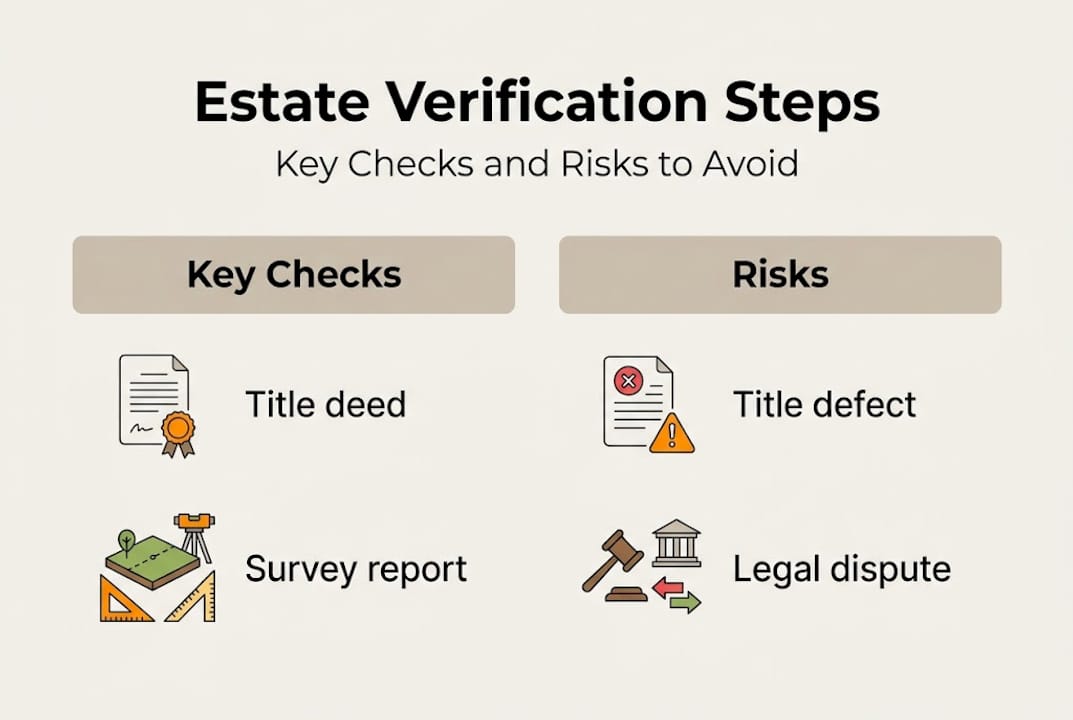
Infographic summarizing luxury estate verification steps

Third-party audits are particularly valuable for transactions above €5M. A specialist real estate audit firm can review the technical dossier, environmental compliance certificates, and energy performance diagnostics (DPE) to ensure they are accurate and current. For securing Riviera assets of significant value, this additional layer of scrutiny is a sound investment.

Common pitfalls to avoid:

  • Overpaying relative to recent comparables by relying on the seller’s own valuation rather than independent assessment
  • Ignoring rental-yield projections that assume unrealistic peak-season occupancy rates
  • Overlooking ongoing costs such as taxe foncière, maintenance of grounds and pools, and concierge management fees
  • Failing to conduct a turnover cleaning checklist review for rental-ready properties, which directly impacts occupancy and guest reviews
  • Underestimating renovation costs for heritage properties, particularly where listed façades or period interiors require specialist craftsmen
  • Neglecting luxury real estate tax risks that can significantly affect net returns for foreign-domiciled investors

It is also essential to understand that generational wealth transfer is reshaping buyer expectations, introducing a cohort of younger, digitally fluent inheritors who prioritise sustainability credentials, smart-home integration, and lifestyle versatility alongside traditional prestige markers.

Pro Tip: For any transaction above €3M, commission a third-party technical and legal audit before signing the compromis de vente (preliminary contract). The cost of this audit, typically a fraction of a percent of the purchase price, is negligible compared with the risk of proceeding without it.

Beyond the numbers: What seasoned investors know about evaluating luxury estates

We have guided many clients through acquisitions that appear flawless on paper yet carry subtle risks invisible to conventional analysis. The truth is, traditional valuation models were built for conventional markets. Luxury estates on the French Riviera operate by a different logic entirely.

The most sophisticated investors we work with understand that narrative drives value as powerfully as metrics. A villa where Picasso once stayed in Antibes, or an estate perched above Èze where the Mediterranean seems to pour into the sky, carries an emotional premium that rational models struggle to quantify yet the market consistently rewards.

We also observe that the buyers who fare best are those who think in decades, not years. They view the evaluation process as the opening chapter of a multi-generational story, one where the estate becomes a family sanctuary, a seasonal rental asset, and ultimately a legacy. Exploring deep luxury insights reveals how this long-horizon perspective changes every calculation. Do not just ask what a property is worth today. Ask what story it will tell in thirty years, and whether that story is one worth inheriting.

Connect with estate experts for tailored evaluation

The path from aspiration to acquisition on the French Riviera demands more than research; it requires the right relationships. At Living on the Côte d’Azur, we connect discerning buyers with a curated portfolio of exceptional estates, from Cannes’ Croisette-adjacent penthouses to secluded Cap d’Antibes villas kissed by morning sea light. Whether you are seeking visible prestige or the rarefied world of off-market luxury estates, our specialists offer tailored evaluation support at every stage. Browse our French Riviera villa listings or explore luxury explained to deepen your market understanding. We also accept cryptocurrency, making cross-border acquisition more seamless than ever. Enquire today and let us craft your Riviera legacy.

Frequently asked questions

What is the main factor influencing luxury estate valuation in the French Riviera?

Location, exclusivity, and premium amenities are the strongest drivers of estate value in the French Riviera, with international buyer demand consistently reinforcing premiums in sought-after micro-markets.

How does generational wealth transfer affect luxury real estate demand?

Generational wealth transfer is actively boosting demand, introducing younger, sustainability-focused buyers with distinct expectations around design, technology, and lifestyle credentials alongside traditional prestige.

What essential documents should investors review during estate evaluation?

Critical documents include title deeds, cadastre records, survey reports, energy performance diagnostics, and tax compliance records, all of which should be verified before signing any preliminary agreement as outlined in pre-purchase survey guidance.

Are there specific legal risks in luxury estate deals?

Legal risks include title defects, zoning restrictions, undisclosed easements, heritage protection orders, and regulatory compliance gaps, all of which require independent legal review to identify before exchange.

Should I use an independent surveyor when evaluating a luxury estate?

Yes, an independent surveyor provides unbiased structural and compliance assessment that protects your investment, as detailed in expert survey advice for high-value property acquisitions.

Recommended

  • How to Evaluate Luxury Real Estate for Smarter Investments
  • High-net-worth real estate: Legacy, luxury, and ROI
  • 7 Essential Luxury Real Estate Checklists for Elite Buyers
  • Top luxury real estate investment options: Côte d’Azur
by Websols Servicedesk/27 April 2026/in Landingpage
https://www.livingonthecotedazur.com/wp-content/uploads/2026/04/1777252124382_Advisor-reviewing-estate-documents-at-villa-table.jpeg 715 1280 Websols Servicedesk https://www.livingonthecotedazur.com/wp-content/uploads/2024/02/sitelogo150.png Websols Servicedesk2026-04-27 07:07:322026-04-27 07:07:35How to evaluate luxury estates for high-value investments


TL;DR:

  • The Côte d’Azur luxury market features distinct micro-markets like Nice, Cannes, Saint-Tropez, and Monaco areas.
  • Successful estate ownership relies on active maintenance, strategic legal structuring, and ongoing family governance.
  • Off-market channels and expert team assembly are crucial for securing and preserving a Riviera legacy property.

Picture this: a sun-drenched terrace above the Baie des Anges, salt-kissed air rising from the Mediterranean below, and beneath your feet, stone that has quietly appreciated for decades. A luxury villa on the Côte d’Azur is not simply a property purchase; it is a declaration of intent, a gift to the generations who will follow you. Yet without the right knowledge, even the most discerning buyers can stumble. This guide promises to walk you through every stage of securing your Riviera legacy, from reading the market with clarity to protecting your acquisition for the long term.

Table of Contents

  • Understanding the luxury real estate landscape on the Côte d’Azur
  • Pre-purchase essentials: Preparation and requirements
  • Step-by-step guide to securing your luxury villa
  • Safeguarding your legacy: Villa management and maintenance
  • The overlooked truth about generational villa investing
  • Your next step: Secure luxury and legacy on the Côte d’Azur
  • Frequently asked questions

Key Takeaways

PointDetails
Market knowledge firstUnderstanding villa categories and local trends is crucial before committing funds.
Legal and financial prepSuccessful acquisitions rely on careful preparation and a trusted professional team.
Step-by-step executionFollowing a proven process ensures you secure value and avoid costly mistakes.
Legacy safeguardingOngoing maintenance and professional management protect your investment for generations.
Expert guidance mattersPartnering with seasoned agents and advisers makes luxury villa investment stress-free and rewarding.

Understanding the luxury real estate landscape on the Côte d’Azur

The Côte d’Azur remains, without question, one of the world’s most resilient and coveted luxury property markets. Understanding its contours is the essential first step before committing capital of this magnitude.

The prime locations at a glance

The Riviera is not a single market; it is a constellation of distinct micro-markets, each with its own character and investment profile.

  • Nice offers extraordinary cultural density. Stroll the Cours Saleya flower market at dawn, then ascend Château Hill for panoramic views over the Baie des Anges. For buyers, Nice provides the broadest range of luxury properties at comparatively accessible price points.
  • Cannes commands prestige rooted in its Festival de Cannes heritage. Croisette-facing villas and penthouse residences overlooking the yacht-lined bay attract film industry luminaries and global financiers alike.
  • Saint-Tropez seduces with its mythological glamour. From Pampelonne’s paddleboard-dotted shores to the Vieux Port’s fisherman lore, the village retains an intimacy that extraordinary demand has only amplified.
  • Monaco’s borders, including Cap-d’Ail and Beausoleil, offer investors proximity to the principality’s tax advantages without Monaco’s eye-watering entry prices, making them among the most strategically astute positions on the top Riviera cities for investors.

Villa categories and investment potential

Understanding the types of luxury properties available is vital to aligning your purchase with your legacy goals.

Villa typeTypical price rangeAnnual appreciationRental yield potential
Classic Provençal mas€2M to €5M5 to 6%3 to 4%
Ultra-modern sea-view villa€5M to €20M+6 to 8%4 to 5%
Heritage estate€4M to €15M5 to 7%3 to 5%
Eco-luxury villa (certified)€3M to €12M7 to 9%4 to 6%

2026 market trends and demand dynamics

The current Côte d’Azur market trends reveal a market in confident motion. Demand for eco-luxury villas with solar arrays, green certifications, and biophilic design elements has surged by an estimated 15% year on year, driven by a new generation of wealth holders who regard environmental stewardship as inseparable from financial stewardship.

Prime sea-view properties are commanding premiums of €2M and above over comparable inland estates, a reflection of the extraordinary scarcity of Riviera coastline. The luxury home price factors most influencing values in 2026 include southern orientation, direct sea access, proximity to Monaco, and compliance with France’s latest energy efficiency standards. With interest rates easing across the eurozone, institutional and private capital is returning to the market with renewed confidence, compressing the window of opportunity for selective buyers.

Pre-purchase essentials: Preparation and requirements

With a clear view of the market, buyers must prepare the groundwork to ensure a smooth acquisition. A Riviera villa purchase is a sophisticated legal and financial undertaking, and thorough preparation separates confident acquirers from costly learners.

Legal requirements and documentation

France maintains a clear and structured property purchase process, but international buyers must be meticulous with their documentation. You will need valid identity documents, proof of address, a fiscal identification number if you are non-resident, and comprehensive proof of funds. French law requires all transactions to be finalised through a notary (notaire), a state-appointed officer who holds the legal responsibility for verifying title and registering the transfer.

Lawyer reviewing villa purchase documents

Residency rules do not restrict foreign buyers from acquiring property in France, though the structure of ownership (personal, through an SCI property company, or a foreign holding entity) carries significant tax implications. Review the luxury buying legal steps early, as structuring decisions made before the purchase can save substantial sums over generations.

Financial groundwork

Cost elementApproximate amount
Notary fees (new build)2 to 3% of purchase price
Notary fees (existing property)7 to 8% of purchase price
Agent commission3 to 6% (negotiable)
Annual property tax (taxe foncière)Varies by commune
Wealth tax (IFI)Applicable above €1.3M net property assets

Currency management is a consideration many buyers overlook. If you are purchasing in euros from a non-euro base currency, even small exchange rate movements on a €5M transaction represent tens of thousands in real value. Engage a specialist foreign exchange adviser alongside your legal team. We also accept cryptocurrency payments, offering digital-native investors a seamless route to converting blockchain wealth into enduring stone. Staying informed through resources like the French Riviera newsletter ensures you track regulatory and market shifts before they affect your strategy.

Your acquisition team

A robust buying team is non-negotiable. At minimum, you require a notary, a bilingual property lawyer experienced in cross-border transactions, a specialist luxury estate agent with genuine off-market access, and a technical surveyor capable of assessing structural integrity, seismic resilience, and energy performance. Consult a comprehensive investment property guide to understand regional variances before assembling your advisers.

Pro Tip: Build in a minimum of eight weeks for thorough due diligence. Title searches, urban planning certificates, and heritage status verifications on older estates frequently surface complexities that require resolution before contracts can proceed. Patience here protects your legacy.

Infographic showing luxury villa buying process overview

Step-by-step guide to securing your luxury villa

Once buyers are prepared, it is time to methodically follow the steps to secure the ideal villa. The acquisition journey, navigated with precision, transforms aspiration into a tangible heirloom.

  1. Define your legacy brief. Before viewing a single property, articulate your purpose with clarity. Is this an owner-occupied sanctuary, a seasonal rental asset generating 4 to 6% yield, or a wealth transfer vehicle for the next generation? Your brief shapes every subsequent decision.

  2. Engage specialist search channels. The most extraordinary Riviera properties rarely appear on public portals. Cultivate relationships with agents who maintain curated off-market networks. The finest villa and penthouse for sale opportunities reach discerning buyers through trust, not advertisement.

  3. Evaluate the property rigorously. Assess not only aesthetics but investment fundamentals: southern aspect for maximum light and rental appeal, proximity to airports (Nice Côte d’Azur is 25 minutes from Cannes), planning restrictions affecting extensions, heritage classifications, and the condition of pools, terraces, and structural fabric.

  4. Research comparable sales. Understand what similar properties have achieved in recent transactions. The top investment options on the Riviera are those where purchase price aligns with genuine scarcity, not merely aspirational vendor pricing.

  5. Submit a formal offer (offre d’achat). Once satisfied, your agent submits a written offer. In France, an accepted offer initiates the preliminary contract (compromis de vente), at which point a deposit of typically 10% becomes payable.

  6. Complete legal verification. Your notary and lawyer scrutinise the title deed, urban planning certificates (certificat d’urbanisme), diagnostics (asbestos, lead, energy performance), and any servitudes affecting the land.

  7. Sign the acte de vente. The final deed is signed before the notary, funds transfer, and the keys to your Riviera legacy are formally yours.

StageTypical duration
Property search1 to 6 months
Offer to compromis1 to 2 weeks
Compromis to acte de vente2 to 3 months
Registration and completion2 to 4 weeks post-signing

Pro Tip: Always commission an independent survey of the property’s provenance, particularly for estates in Antibes, Èze, or Menton where centuries-old ownership histories can harbour undisclosed servitudes or boundary disputes that a standard notarial search may not surface immediately.

Safeguarding your legacy: Villa management and maintenance

After acquisition, maintaining and managing the villa is essential to safeguarding its value as a generational asset. A Riviera estate that is impeccably maintained commands a premium; one left to drift loses both capital value and the emotional resonance that makes it a true legacy.

Routine maintenance priorities

  • Annual structural inspection of roofs, terraces, and external stonework, particularly after the intense Mistral winds that sweep the coast from late autumn through spring.
  • Swimming pool servicing and seasonal preparation, including equipment checks, water treatment, and safety compliance in accordance with French regulations.
  • Garden and grounds maintenance, because the sculpted olive groves, bougainvillea-laced pergolas, and maritime pine screens that define Riviera estates require professional, consistent care to retain their splendour.
  • Full review of mechanical and electrical systems, air conditioning, smart home technology, security systems, and solar installations for eco-villas with certified green credentials.

Following villa maintenance tips from Riviera specialists ensures no seasonal detail is overlooked. For those seeking best-practice standards, villa cleaning best practices demonstrate how professional housekeeping protocols can reduce vacancy periods by up to 15% for seasonal rental properties.

Management options

For owners who are not in permanent residence, the choice of management model is critical.

  • In-house staff: A resident housekeeper and property manager offer the highest level of personalised stewardship. Appropriate for estates above €5M where the complexity of maintenance warrants dedicated oversight.
  • External management agency: Specialist villa management advice is available from agencies who handle everything from tenant liaison during elite lets to emergency repairs and regulatory compliance, providing peace of mind for internationally mobile owners.
  • Concierge services: Premium concierge firms layer guest experiences atop operational management, particularly valuable for villas in Saint-Tropez or Cannes that command nightly rates of €5,000 and above during the peak summer season.

Legal structures for legacy preservation

Holding your villa within a Société Civile Immobilière (SCI) is a structure favoured by many families for its capacity to facilitate orderly inheritance. Shares in an SCI can be gifted progressively to heirs, reducing French inheritance tax exposure significantly over time. Annual review of your legal structure with a specialist adviser is a discipline that pays extraordinary dividends across generations.

A word of caution: Neglecting routine maintenance and management oversight, even for a single season, can erode both the market value and the irreplaceable character of a Riviera estate. Capital invested in stones deserves the same active stewardship as capital invested in markets.

The overlooked truth about generational villa investing

We have guided many extraordinary families through acquisitions on this coast, and the pattern we observe most consistently is this: the investors who succeed generationally are not those who buy the finest villa, but those who commit to the stewardship that follows.

The prevailing myth is that a prestige address on the legacy and ROI insights spectrum operates as a passive asset. It does not. A Riviera villa is a living entity, as responsive to care as the lavender-laced landscape surrounding it. Families who embed governance structures, from annual estate reviews to clearly documented inheritance intentions, outperform those who treat the property as a deposit made in stone.

Adaptability matters enormously. The eco-certified villa that appeals to your heir’s values in 2040 may require retrofitting today. The SCI structure that was optimal at purchase may need revision as family circumstances evolve. Community engagement, whether in Menton’s celebrated Lemon Festival or Cannes’ Film Festival social orbit, also sustains local relationships that protect property interests in quiet but meaningful ways.

Pro Tip: Convene an annual family governance review for your villa. Align ownership ambitions, maintenance budgets, and inheritance intentions in writing. This single discipline prevents the disputes that, more than any market downturn, erode generational legacies.

Your next step: Secure luxury and legacy on the Côte d’Azur

At Living on the Côte d’Azur, we connect discerning buyers with properties that transcend the transactional. Our curated portfolio spans iconic sea-view villas in Cannes and Saint-Tropez to architectural icons rising along Nice’s Mont Boron, all accessible through our bespoke off-market villa opportunities network. Browse our handpicked selection of French Riviera villas for sale, or allow our advisers to build a tailored acquisition strategy using our exclusive property investment guide. Contact us today and let us help you place your family’s future in the finest stone on the Mediterranean.

Frequently asked questions

What legal documents are required to purchase a luxury villa in France?

You need valid identity documents, proof of address, a French fiscal number if non-resident, and comprehensive proof of funds. A notary finalises all contracts and registers the transfer in accordance with French property law.

How can buyers access off-market luxury villas on the Côte d’Azur?

Off-market villas are accessed through trusted specialist agents and curated platforms with established high-net-worth networks, where the finest properties change hands quietly, long before public listings appear.

What is the typical return on investment for luxury villas in the French Riviera?

Prime Riviera villas have historically appreciated 5 to 8% annually, with elite seasonal lets generating rental yields of 3 to 6% depending on location, specification, and management quality.

How can buyers maintain a villa as a legacy asset for future generations?

Professional management and maintenance are the twin pillars of legacy preservation, ensuring the property retains both its market value and its character across ownership transitions.

Are there tax advantages or incentives for owning a luxury villa in France?

French property tax structures vary considerably by residency status, ownership vehicle, and investment type; a specialist adviser will identify the most tax-efficient structure for your family’s specific circumstances.

Recommended

  • How to Finance Luxury Real Estate on the Côte d’Azur
  • Top luxury real estate investment options: Côte d’Azur
  • Guide to International Real Estate Investment in Côte d’Azur
  • Luxury real estate French Riviera: Villa or penthouse on the Côte d’Azur – Living on the Côte d’Azur
by Websols Servicedesk/27 April 2026/in Landingpage
https://www.livingonthecotedazur.com/wp-content/uploads/2026/04/1777252143395_Couple-reading-in-sunny-Cote-d-Azur-villa.jpeg 715 1280 Websols Servicedesk https://www.livingonthecotedazur.com/wp-content/uploads/2024/02/sitelogo150.png Websols Servicedesk2026-04-27 07:06:262026-04-27 07:06:30Luxury villa buying guide: Invest on the Côte d’Azur


TL;DR:

  • Integrating smart technology and wellness amenities significantly enhances property value and appeal.
  • Heritage-preserving renovations and multi-generational layouts are key to securing long-term investment resilience.
  • Balancing tradition with discreet innovation creates timeless assets valued by discerning Côte d’Azur buyers.

Along the sun-warmed shores between Menton’s lemon-fragrant ramparts and Saint-Tropez’s storied Vieux Port, a Côte d’Azur estate is rarely just a property. It is a declaration of intent, a promise etched in Provençal stone, and, for the most discerning investors, a legacy asset designed to appreciate across generations. Selecting the right upgrades for such an estate is not simply an aesthetic exercise. It demands a careful balance of heritage respect, financial rigour, and lifestyle vision. This guide navigates that balance, covering smart technology, wellness amenities, heritage-preserving renovations, and multi-generational design.

Table of Contents

  • Smart home technology and AI integration
  • Wellness and lifestyle amenities
  • Heritage-preserving renovations
  • Guest accommodation and multi-generational design
  • Why balancing tradition and innovation shapes legacy assets
  • Explore invisible luxury, legacy assets, and expert guidance
  • Frequently asked questions

Key Takeaways

PointDetails
Smart tech boosts returnsAutomated systems and AI increase rental premiums and resale values substantially.
Wellness upgrades enhance appealSpas, gyms, and saunas align with family and investment needs, supporting legacy value.
Renovation preserves heritageBalanced upgrades protect aesthetic value and deliver price uplift, even under strict regulations.
Multi-gen layouts drive market resilienceFlexible guest accommodation helps properties sell faster and remain relevant.
Sustainable choices offer long-term ROIEnergy-efficient and eco-friendly upgrades stand up to regulatory and market pressures.

Smart home technology and AI integration

We live in an era where the salt-kissed terraces of Cap d’Antibes can be monitored, secured, and illuminated from anywhere in the world at the touch of a screen. Smart home automation is no longer a novelty reserved for tech enthusiasts. On the Côte d’Azur, it has become a fundamental pillar of luxury estate investment. The numbers are persuasive: AI management systems boost rental premiums by 15 to 25 per cent and resale values by 12 to 18 per cent, making technology integration one of the most financially sound upgrades an owner can commission.

What does a fully integrated smart estate actually offer? Consider the following features that our clients are increasingly requesting across our luxury property guide:

  • Remote security systems with biometric access, perimeter sensors, and live-stream cameras accessible via encrypted mobile applications
  • Intelligent climate control that learns occupancy patterns and adjusts automatically, reducing energy bills whilst maintaining the precise comfort expected by elite renters
  • Adaptive lighting that shifts from warm to cool tones throughout the day, enhancing both wellbeing and the visual drama of interiors designed with marble and bespoke verrières
  • AI-driven estate management platforms that coordinate maintenance schedules, rental calendars, and guest communications with minimal human intervention
  • Integrated audio-visual systems delivering cinema-grade sound and image across terraces, living areas, and pool pavilions

The challenge unique to the Côte d’Azur lies in preserving the architectural soul of these properties whilst threading modern infrastructure through walls that may date to the Belle Époque. Cable routing, concealed conduits, and wireless mesh networks must be engineered with surgical care in historic structures. Consulting architects who specialise in Riviera heritage is essential before any cabling begins.

“The most successful integrations we encounter are those where technology is truly invisible. A nineteenth-century bastide should feel timeless, not like a technology showroom. The intelligence should be felt, not seen.” — Côte d’Azur estate technology consultant

Understanding the estate market trends Côte d’Azur makes one thing abundantly clear: buyers and elite tenants in 2026 expect seamless automation as standard. Properties that lag behind are not simply less desirable; they are repositioned into an entirely different, lower-value market tier.

Pro Tip: Commission a dedicated smart-home audit before purchase. Many older Côte d’Azur estates carry outdated electrical panels that must be fully upgraded before automation layers can be safely added, and factoring this into your acquisition budget prevents costly surprises.

Wellness and lifestyle amenities

As the Cannes Film Festival crowds thin each May and the Croisette returns to its languid summer rhythm, one truth about the Riviera luxury market becomes unmistakable. The wealthiest buyers are not purchasing square metres. They are purchasing a lifestyle, and wellness is at its very heart. Wellness amenities such as spas, gyms, and saunas align directly with the priorities of today’s high-net-worth individuals, driving both rental demand and capital appreciation.

For estate owners thinking across generations, wellness spaces serve a dual purpose. They satisfy the aspirational lifestyle needs of summer tenants willing to pay premium nightly rates, and they speak to the multigenerational family buyers who intend to keep a property within the family for decades. As specialists in ultra-prime assets observe, a focus on multi-generational wellness design and tech integration protects legacy assets from market volatility by attracting cash buyers who are largely immune to fluctuating mortgage rates.

A proper wellness suite today typically encompasses:

  • Hammam or steam room connected to the pool terrace, providing a spa-grade experience without requiring external service providers
  • Dedicated fitness studio with rubber flooring, mirrored walls, and integrated air filtration
  • Cold plunge pool or ice bath set alongside a traditional Finnish sauna, increasingly popular among health-conscious European elites
  • Outdoor yoga or meditation platform positioned to capture morning sea views, preferably framed by mature cypress or olive trees
  • Professional massage room with adjustable lighting and direct access to the estate’s private garden

The luxury amenities list for a high-performing Riviera estate always includes wellness infrastructure, and the investment case is compelling. Below is a summary of typical uplift by amenity type:

Wellness amenityApproximate installation costEstimated value upliftRental premium impact
Indoor spa and hammam€60,000 to €120,0006 to 10%High
Dedicated gym studio€25,000 to €55,0003 to 5%Moderate to high
Sauna and cold plunge€18,000 to €40,0002 to 4%Moderate
Outdoor wellness terrace€15,000 to €35,0002 to 3%Moderate
Massage and treatment room€20,000 to €45,0002 to 4%High

Maintaining these spaces to the standard elite guests expect is equally important. Studies on cleaning and maintenance value confirm that rigorous upkeep practices can cut rental vacancy rates by up to 15 per cent, directly improving annual yield. Investing in sustainable luxury properties that incorporate eco-conscious heating and water systems for spas also meets growing demand from environmentally aware clients.

Pro Tip: The most overlooked wellness addition is a dedicated changing suite adjacent to the pool and spa zone. This simple investment, costing as little as €8,000, consistently receives the highest praise in guest reviews and creates the seamless hotel-grade flow that elite renters remember when rebooking.

Heritage-preserving renovations

Stand on the terrace of an Antibes bastide at dusk, the warm stone walls glowing amber, and you understand immediately why heritage matters here. The Côte d’Azur’s architectural character, its ochre pigments, handmade terracotta floors, wrought-iron balustrades, and arched doorways, is precisely what commands €2M-plus premiums. Renovations that honour this character whilst introducing modern luxury deliver the strongest returns.

The financial case for full renovation is well established. Kitchen upgrades costing €18,000 to €35,000, bathroom refurbishments at €10,000 to €18,000, air conditioning at €6,000 to €12,000, and pool or terrace enhancements at €5,000 to €15,000 collectively yield a 20 to 30 per cent price uplift. The key is ensuring these interventions speak the language of the building itself. Custom verrières and natural materials such as marble and Néolith surface the best outcomes, maintaining the Côte d’Azur aesthetic whilst dramatically elevating perceived luxury.

The renovation landscape here carries regulatory complexity that investors must understand before committing funds. Coastal build restrictions, noise regulations, and permit requirements can significantly increase project costs and timescales. Historic listing constraints apply to a meaningful proportion of the premium stock in areas such as Menton’s old town and Èze village. The wisest approach prioritises energy-efficient and sustainable upgrades, which face less regulatory resistance and carry long-term value.

“Energy performance ratings are now a material factor in Côte d’Azur valuations. A property that moves from a DPE class D to a B commands a measurably different price point and attracts a qualitatively different buyer profile.” — Senior Riviera renovation architect

Consider the relative merits of different renovation types:

Renovation typeTypical cost rangeValue uplift potentialRegulatory risk
Kitchen full refurbishment€18,000 to €35,0008 to 12%Low to moderate
Bathroom suite replacement€10,000 to €18,0004 to 7%Low
Pool and terrace upgrade€5,000 to €15,0003 to 6%Moderate to high
Air conditioning system€6,000 to €12,0002 to 4%Low
Energy efficiency package€20,000 to €50,0006 to 10%Low

Material selection carries profound importance in this market. Marble surfaces add measurable value both aesthetically and financially, signalling quality to buyers trained to distinguish genuine luxury from approximation. For flooring and wall treatments, tile renovation choices should reflect regional tradition: Salernes terracotta, handmade Provence encaustic tiles, or large-format stone that echoes the mineral palette of the landscape. Understanding the full range of drivers of luxury home value helps prioritise which renovations will yield the most meaningful return for a specific property.

Renovation programmes should always begin with a thorough structural and energy audit. On the Côte d’Azur, where sea air accelerates corrosion and older properties may carry asbestos in roof tiles or lead in plumbing, the cost of discovery mid-project dwarfs the cost of investigation before works begin.

Guest accommodation and multi-generational design

An estate at Sainte-Maxime overlooking the Golfe de Saint-Tropez is magnificent in itself. But when it also offers a self-contained guest pavilion where a grandmother can enjoy her morning coffee in private, or where adult children can host their friends independently, it becomes something rarer: a true family sanctuary. Multi-generational design is one of the most compelling value drivers in the current Côte d’Azur market.

Housekeeper preparing guest suite Côte d’Azur estate

Properties with flexible layouts and guest accommodation that supports multi-generational living sell measurably faster than comparable single-dwelling estates, and they attract cash buyers who are insulated from credit market fluctuations. This is not a peripheral feature. It is a strategic differentiator that builds resilience directly into the asset.

The most effective multi-generational layouts typically include:

  1. Independent guest pavilion or pool house with private entrance, en-suite bathroom, and small kitchen, offering complete privacy without sacrificing proximity to the main estate
  2. Secondary master suite on a different floor or wing from the primary bedroom, designed for extended family stays of several weeks or months
  3. Flexible living spaces that can serve as playrooms for children during family occupancy and be converted to cinema or entertainment rooms for rental guests
  4. Service quarters or staff accommodation ensuring that the household team operates invisibly without disrupting family or guest experience
  5. Accessible design elements including level-access showers, wider doorways, and ground-floor bedroom options, future-proofing the property for use across all life stages

For visual inspiration on how pavilion-style guest spaces can be woven organically into a Mediterranean landscape, thoughtful villa guest house design from other premium European markets demonstrates what seamless integration looks like at its finest.

When considering how these investments translate into asset performance, the property appreciation factors specific to the Côte d’Azur reward multi-generational design consistently. Properties that accommodate extended families also generate higher occupancy rates during the shoulder seasons of April, May, September, and October, when family groups travelling outside peak school holidays seek spacious, private estates rather than hotels.

Pro Tip: The single most overlooked multi-generational feature is a covered outdoor dining space large enough for twelve to sixteen people. On the Riviera, where family life and entertainment centre on long alfresco meals under the stars, an oversized pergola or loggia with outdoor kitchen often delivers the emotional connection that closes a sale faster than any interior feature. Browse our curated French Riviera villa listings to see how this principle is applied across our current portfolio.

Statistic callout: Properties offering dedicated guest accommodation and multi-generational layouts sell up to 30 per cent faster than comparable single-dwelling estates on the Côte d’Azur, whilst attracting a higher proportion of cash buyers who sustain values even during credit market contractions.

Why balancing tradition and innovation shapes legacy assets

We have observed, across many years of working with discerning investors along this coastline, that the estates which hold their value most stubbornly and appreciate most reliably are never the ones that chased a trend. They are the ones that told a coherent story.

A bastide fitted with invisible smart technology, a wellness suite that draws on the calming palette of Provence, bathrooms lined with marble quarried from Italian mountains visible on a clear day from Menton’s hilltop walks. These choices compound over time. They attract the right buyers, command the right tenants, and pass between generations without apology or embarrassment.

The contrarian insight we offer is this: in a market as emotionally charged as the Côte d’Azur, where buyers arrive primed by the romance of the Lérins islands at dawn or the scent of jasmine in Grasse, the most powerful investment move is not to innovate boldly but to curate wisely. Sustainability and heritage together create an asset that no amount of flashy renovation can replicate. To invest smarter in 2026, think less about what is fashionable and more about what is irreplaceable.

Explore invisible luxury, legacy assets, and expert guidance

https://www.livingonthecotedazur.com/contact-nice-to-meet-you/

We invite you to explore what truly lasting Côte d’Azur investment looks like through our curated portal. Our invisible luxury real estate listings bring you off-market estates that never reach the public domain, properties where every upgrade described in this guide has already been realised with precision. For those beginning their journey, our luxury real estate guide offers essential grounding, whilst our dedicated resource on legacy and ROI strategies translates aspiration into actionable financial planning. We accept cryptocurrency. We connect legacies. Reach out today.

Frequently asked questions

Which upgrades deliver the highest ROI for Côte d’Azur properties?

Smart home automation, full renovations, and wellness amenities typically yield the greatest boosts, with rental premiums rising 15 to 25% and full renovation uplifts of 20 to 30% commonly recorded across the region.

How do regulatory constraints affect luxury upgrades?

Coastal restrictions and permit requirements can add significant cost and delay to projects, making energy-efficient and sustainable upgrades the most strategically prudent first priority.

Are wellness amenities worth adding for investment properties?

Absolutely. Wellness amenities align with HNWI priorities and, combined with multi-generational design, create legacy assets that insulate against market volatility by drawing cash buyers.

Do guest houses and multi-gen layouts influence sales speed?

Properties with dedicated guest accommodation and flexible layouts sell measurably faster, attract cash buyers, and demonstrate greater resilience to credit market fluctuations, as ultra-prime market analysis consistently confirms.

What materials maximise aesthetic and investment value?

Natural materials including marble and Néolith, combined with heritage-sensitive design choices, preserve the Côte d’Azur character that justifies premium pricing whilst satisfying the evolving expectations of elite buyers and tenants in 2026.

Recommended

  • Explore the ultimate list of luxury amenities for estates
  • Luxury Home Prices: What Drives Côte d’Azur Value
  • Sustainable luxury properties on the Côte d’Azur: 20% gains
  • Luxury Penthouses: Elevating Côte d’Azur Legacy
by Websols Servicedesk/27 April 2026/in Landingpage
https://www.livingonthecotedazur.com/wp-content/uploads/2026/04/1777252239572_Gardener-tending-Cote-d-Azur-villa-garden-at-sunrise.jpeg 715 1280 Websols Servicedesk https://www.livingonthecotedazur.com/wp-content/uploads/2024/02/sitelogo150.png Websols Servicedesk2026-04-27 07:05:062026-04-27 07:05:09Luxury upgrades that enhance Côte d’Azur estate value


TL;DR:

  • Successful Côte d’Azur luxury property buying relies on thorough preparation and understanding personal luxury criteria.
  • Off-market properties offer exclusive access, lower competition, and better negotiation leverage.
  • Patience, discretion, and strong relationships with professionals are key to securing top-tier assets.

Touring luxury properties on the Côte d’Azur is nothing like browsing a property portal from the comfort of your study. The finest estates rarely surface publicly, the most coveted addresses change hands in near silence, and the difference between a productive tour and a wasted afternoon often comes down to preparation. Whether you are drawn by the lavender-laced breezes drifting through an Antibes villa garden or the salt-kissed panoramas from a Cap d’Ail clifftop terrace, this guide offers the strategic clarity to transform each viewing into a meaningful step towards a generational acquisition.

Table of Contents

  • Define your criteria for luxury
  • Access off-market and rare properties
  • Prepare for an efficient and insightful tour
  • Compare and evaluate luxury properties
  • A fresh perspective: Why discretion and patience yield generational rewards
  • Connect with trusted experts for your next luxury tour
  • Frequently asked questions

Key Takeaways

PointDetails
Clarify luxury criteriaKnow your must-haves before stepping into any property to make your tours purposeful.
Unlock off-market accessWork with buyer’s agents to see exclusive properties unavailable from public listings.
Evaluate efficientlyUse checklists and comparison tables to assess and compare each luxury asset.
Focus on legacy valuePrioritise assets that offer both personal enjoyment and generational wealth potential.

Define your criteria for luxury

Before a single gate opens or a concierge greets you on a sun-drenched threshold, you must understand precisely what luxury means to you. The word carries enormous weight on the Riviera, yet its meaning shifts dramatically from one buyer to the next. For some, luxury is a Belle Époque mansion overlooking Menton’s lemon-festival promenades, where Val Rahmeh’s botanical gardens perfume the afternoon air. For others, it is a sleek contemporary villa above Eze’s medieval citadel, with Nietzsche trails unwinding below and pebbled coves glittering far beneath the infinity pool.

Understanding what defines luxury real estate on the Côte d’Azur begins with four core pillars: location, architectural heritage, lifestyle amenities, and long-term appreciation potential. Location encompasses not only the postcode but the microclimate, the privacy of the plot, proximity to Cannes’ Croisette or Monaco’s borders, and the quality of neighbouring estates. Architectural heritage matters profoundly here, where a restored Provençal mas near Saint-Tropez carries centuries of cultural romance alongside its stone walls, while a new-build biophilic residence in Sainte-Maxime offers next-generation eco-luxury within walking distance of Nartelle beach sunsets.

You also need absolute clarity on whether your primary motivation is personal enjoyment or generational wealth creation. These goals frequently overlap, but they produce different search criteria. A family sanctuary for summers in Antibes, where children explore Cap d’Antibes coastal sentiers between Provençal market hauls, may prioritise garden space and bedroom count. An asset designed for elite seasonal lettings, generating 3 to 5% annual yields, will prioritise rental licensing, pool facilities, and proximity to international airports.

Familiarise yourself with the full spectrum of types of luxury properties available along the Riviera, from historic villas to off-plan penthouse towers on Nice’s Mont Boron. Each category carries distinct maintenance obligations, tax implications, and appreciation profiles.

Before your first tour, separate your criteria into two columns:

  • Must-haves: sea views, minimum four bedrooms, private pool, proximity to a yacht marina, planning permission for guest annexe
  • Nice-to-haves: cinema room, wine cave, helicopter landing pad, staff quarters, direct beach access

Pro Tip: Share this prioritised list with your agent before every tour. It prevents emotional decisions on the day and keeps each visit anchored to your broader investment thesis.

We strongly recommend that you engage a buyer’s agent or chasseur d’appartement for access to off-market luxury properties and expert guidance during tours. They translate your criteria into curated selections, rather than presenting you with everything on the market.

Access off-market and rare properties

Here is a truth that surprises many first-time Riviera buyers: the most extraordinary properties are almost never listed online. The owner of a storied Belle Époque villa above Cannes does not need a property portal. Neither does the Monaco-adjacent plot holder who quietly signals readiness to sell through discreet professional networks. This is the world you are entering, and it operates by different rules entirely.

Private consultation near exclusive property gate

The distinction between public listings and off-market assets is not simply one of availability. It is one of quality, exclusivity, and competitive advantage. Consider this comparison:

FeaturePublic listingsOff-market properties
VisibilityAvailable to all buyers globallyAccessible only through trusted agents
CompetitionHigh, often resulting in bidding situationsMinimal, often one-to-one negotiation
PricingFrequently inflated by demandMore nuanced, open to discreet dialogue
Property qualityMixed; full market rangeCurated; tends toward finest assets
TimingSubject to market cyclesOften available before formal market entry
Negotiation leverageLimitedSignificantly stronger for prepared buyers

Accessing off-market luxury properties on the Côte d’Azur requires building genuine relationships with professionals who hold these keys. This is not a process you can shortcut with an afternoon of online research.

The most effective strategies for gaining privileged access include:

  • Retaining an experienced buyer’s agent with a proven network across Cap d’Antibes, Saint-Jean-Cap-Ferrat, and the Monaco border communes
  • Attending curated property events tied to the Cannes Film Festival or Monaco Grand Prix season, where ownership conversations happen organically over champagne
  • Establishing relationships with notaires (French notaries), who frequently know about forthcoming sales months before any formal listing
  • Positioning yourself as a serious, financially qualified buyer early, so agents prioritise your portfolio when exceptional properties arise
  • Requesting introductions through your private bank or family office, which often carry significant reputational weight in this market

“Engaging a buyer’s agent or chasseur d’appartement provides access to off-market luxury properties and expert guidance during tours, ensuring that serious buyers are never competing on the same stage as casual browsers.” — Expats in France guidance

The seasonality of the Riviera also influences access. Owners are often more receptive to quiet introductions during the quieter months of January and February, well before the summer season ignites demand. Timing your search to coincide with Menton’s Lemon Festival in February or Cannes’ MIPIM property summit in March places you in the right company at precisely the right moment.

Prepare for an efficient and insightful tour

Privileged access to an extraordinary property is only valuable if you arrive prepared to extract maximum intelligence from each visit. A luxury tour on the Côte d’Azur is not a leisure activity. It is due diligence in one of the world’s most competitive real estate markets, conducted with the elegance that the setting demands.

We advise every client to follow a structured approach to each tour, ensuring that first impressions never overshadow practical realities. The emotional pull of a Sainte-Maxime terrace at golden hour, with the ferry to Saint-Tropez visible across the shimmering gulf, is powerful. Beautiful. But it cannot replace a methodical assessment.

Follow these steps to maximise the value of every property visit:

  1. Review ownership documentation in advance. Request title deeds and cadaster (land registry) records before you arrive, and identify any rights of way, easements, or boundary disputes.
  2. Confirm the legal status of all built structures. In France, unauthorised extensions or pools can create significant legal and financial liabilities for the incoming buyer.
  3. Examine the property’s maintenance and renovation history. Ask specifically about the roof, plumbing, electrical systems, and pool infrastructure, as high-end finishes can mask ageing systems.
  4. Prepare questions about local taxes and charges. Taxe foncière (land tax) and syndic (management company) fees vary considerably across communes and can affect net yields significantly.
  5. Assess the rental potential independently. If seasonal lettings are part of your plan, confirm that the property holds the appropriate tourism licence and that the commune permits short-term rental activity.
  6. Photograph and note every detail. Bring a checklist and complete it during the tour, not afterwards when impressions blur and emotional memory softens the edges of reality.
  7. Assess outdoor and ancillary spaces carefully. Gardens, pool houses, garages, and service quarters often reveal the true quality of a property’s management and the owner’s commitment to maintenance.

Understanding luxury property financing options in advance also positions you to ask intelligent questions about price flexibility and completion timelines. Sellers respond differently to buyers who arrive with pre-arranged financing than those who signal uncertainty.

Pro Tip: Arrange for an independent French notaire or bilingual legal adviser to review all documentation after your tour. Do not rely solely on the seller’s agent for legal interpretation, as their primary duty lies with the vendor.

Use our smart investor guide to understand which Riviera micro-markets are experiencing the strongest appreciation in 2026, so that each tour is evaluated within the correct regional context.

Compare and evaluate luxury properties

You have toured several properties. Each one has cast its own particular spell: the ancient olive grove framing a restored farmhouse above Èze, the panoramic glass walls of a new-build on Nice’s Château Hill, the private cove access of a Cap d’Antibes compound where Picasso once summered nearby. Now comes the most intellectually demanding part of the process: rational comparison.

Emotion is an asset when it signals deep personal resonance with a property that also meets your financial criteria. Emotion becomes a liability when it substitutes for rigorous analysis. The most successful Riviera buyers we work with build structured comparison frameworks, even when the process feels clinical against such an opulent backdrop.

Factors to include in your evaluation:

  • Location quality: Proximity to international transport links, prestige of the commune, sea view category (partial, lateral, or full panoramic)
  • Capital appreciation potential: Historical price growth in the specific postcode, planned infrastructure improvements, new development pipeline
  • Rental yield realism: Comparable seasonal rental rates, occupancy rates for similar properties, management cost estimates
  • Legacy value: Architectural uniqueness, historical provenance, likelihood of long-term desirability for your heirs
  • Sustainability credentials: Solar array installation, green certifications, energy efficiency ratings under 2026 French environmental standards
  • Legal clarity: Clean title, no litigation history, approved planning permissions for any desired modifications

Here is a simplified comparison table to apply across your shortlisted properties:

CriteriaProperty AProperty BProperty C
Location prestige★★★★★★★★★☆★★★★★
Sea view qualityFull panoramicLateralPartial
Estimated annual yield4.2%3.8%5.1%
Appreciation forecast6% per annum5% per annum7% per annum
Legal statusCleanMinor queryClean
Sustainability ratingACB
Legacy suitabilityHighMediumHigh

Research consistently shows that fewer than 5% of viewed properties satisfy all primary criteria for a discerning luxury buyer, which is precisely why off-market access and patient, strategic touring matter so profoundly.

Understanding market value on the Riviera requires both macro perspective and hyper-local knowledge. A villa in Antibes may command a different premium per square metre than a comparable property in Menton, not because of size, but because of demand patterns, buyer nationality mix, and seasonal rental calendars.

Familiarise yourself with the key luxury property terms used in French real estate transactions before your final evaluations, to ensure that no contractual nuance is lost in translation when the moment to decide arrives.

A fresh perspective: Why discretion and patience yield generational rewards

We have accompanied enough exceptional buyers through this market to observe a consistent truth: the clients who ultimately acquire the finest properties are rarely the fastest. They are the most patient, the most discreet, and the most strategically trusting of the professionals they have chosen to guide them.

The Côte d’Azur luxury market does not reward impatience. It rewards presence, preparation, and the kind of quiet confidence that comes from knowing your criteria, respecting the process, and building genuine relationships with the agents, notaires, and vendors who control access to truly rare assets. A buyer who rushes, who telegraphs urgency, or who relies purely on comparison tables without cultivating trust in the local ecosystem, will almost always pay more and acquire less.

Our counsel, grounded in years of curating acquisitions from Saint-Tropez to Monaco’s borders, is this: treat each tour as an investment in relationship capital, not merely a property inspection. The estate that becomes your family’s heirloom may not be the one you tour next month. It may be the one whose owner remembers you as the buyer who asked the right questions, demonstrated genuine cultural appreciation for the Riviera’s heritage, and waited gracefully for the right moment.

Follow our luxury real estate investment guide to understand every stage of this journey, from initial search criteria through to completion day.

Connect with trusted experts for your next luxury tour

At Living on the Côte d’Azur, we curate privileged access to the Riviera’s most extraordinary properties, from sun-gilded Cap d’Antibes compounds to glass-fronted penthouses above Nice’s Baie des Anges. Our portfolio of French Riviera luxury properties spans every prestige address, with a specialist focus on the estates that never reach public markets. We also accept cryptocurrency payments, reflecting the preferences of the digital wealth generation redefining luxury acquisition in 2026.

Explore our curated selection of exclusive off-market properties and stay ahead of shifting demand with our in-depth analysis of Côte d’Azur market trends. Your heirloom awaits. Let us open the gate.

Frequently asked questions

How do I access off-market luxury properties on the Côte d’Azur?

Engaging a buyer’s agent or chasseur d’appartement provides insider access to exclusive listings not publicly advertised, placing you in private conversations that never reach open portals.

What should I prepare before a luxury property tour?

Prepare a detailed checklist of your luxury criteria, legal considerations, and key questions about market value, applicable taxes, and seasonal rental potential to ensure each visit delivers actionable intelligence.

How can expert agents maximise my tour experience?

Expert agents guide you through hidden opportunities, facilitate access to properties reserved for qualified buyers, and safeguard your interests at every stage, as confirmed by specialist Riviera advisers.

What is most often overlooked during luxury property tours?

Many buyers overlook the importance of legacy planning and independent legal checks after each tour, both of which can significantly affect the long-term value and transferability of the asset to future generations.

Recommended

  • Guide to International Real Estate Investment in Côte d’Azur
  • How to Finance Luxury Real Estate on the Côte d’Azur
  • 7 Essential Real Estate Investment Tips for Côte d’Azur
  • Master the stages of property purchase for luxury Côte d’Azur homes
by Websols Servicedesk/27 April 2026/in Landingpage
https://www.livingonthecotedazur.com/wp-content/uploads/2026/04/1777252278294_Couple-touring-Cote-d-Azur-luxury-villa.jpeg 715 1280 Websols Servicedesk https://www.livingonthecotedazur.com/wp-content/uploads/2024/02/sitelogo150.png Websols Servicedesk2026-04-27 07:04:002026-04-27 07:04:04Essential tips for luxury property tours on the Côte d’Azur


TL;DR:

  • Dubai offers zero income tax, strong rental yields, and prime locations attracting high-net-worth buyers.
  • The property acquisition process requires thorough preparation, legal documentation, and professional guidance.
  • Successful investors view Dubai real estate as part of a diversified global portfolio with careful long-term planning.

Dubai has quietly become one of the world’s most compelling arenas for luxury real estate investment, where gleaming towers rise from the desert and waterfront villas command extraordinary premiums. For the discerning global investor, the emirate offers zero income tax, freehold ownership rights, and rental yields that regularly outpace those of London, Paris, or Geneva. Yet the process of acquiring property here is nuanced, layered with specific legal frameworks, developer protocols, and administrative procedures that reward the well-prepared. This guide walks you through every critical step, from market orientation to title deed registration, so that your Dubai acquisition becomes not merely a transaction but a cornerstone of lasting wealth.


Table of Contents

  • Understanding the Dubai property market
  • Preparation: Requirements and documentation
  • Step-by-step process to buy in Dubai
  • Verification and post-purchase essentials
  • A seasoned investor’s perspective on buying in Dubai
  • Explore more legacy luxury real estate opportunities
  • Frequently asked questions

Key Takeaways

PointDetails
Prime locations matterChoosing the right Dubai area significantly impacts your investment performance and ownership experience.
Preparation is vitalAdvance document gathering and compliance ensure a smooth and efficient buying process.
Follow the legal stepsAdhering to each stage from offer to transfer protects your investment and ensures clear ownership.
Post-purchase diligencePost-closing checks and management are key to preserving and growing your property’s value.

Understanding the Dubai property market

Dubai’s luxury real estate landscape is as diverse as it is dazzling. Understanding where to focus your attention, and why, is the foundation of a sound acquisition strategy. The emirate’s prime locations each carry a distinct character and investor profile, and knowing the differences between them shapes everything from your negotiation position to your long-term rental yield.

Prime locations worth knowing

  • Palm Jumeirah: The iconic palm-shaped island remains the gold standard for waterfront opulence, with signature villas and penthouses attracting ultra-high-net-worth buyers from Europe, Asia, and the Gulf. Signature beachfront villas frequently command between AED 15 million and AED 80 million.
  • Downtown Dubai: Home to the Burj Khalifa and Dubai Mall, this district draws investors seeking prestige address, strong capital appreciation, and a sophisticated rental audience of executives and long-stay visitors.
  • Dubai Marina: A cosmopolitan waterfront hub with some of the market’s most reliably performing rental properties, particularly appealing to younger affluent professionals and digital nomads.
  • Emirates Hills and Al Barari: These verdant, gated enclaves offer large-plot private villas in landscaped settings, attracting families who prize tranquillity and space above proximity to the urban core.
  • Jumeirah Bay Island and Bluewaters Island: Emerging ultra-premium addresses where exclusivity is engineered into the very planning of the development.

As current market conditions indicate, luxury properties in Dubai are achieving gross rental yields of between 5% and 9% annually, figures that compare very favourably with mature European markets. Capital appreciation in prime districts has averaged between 7% and 12% year-on-year in recent cycles, driven by sustained international demand, a growing population of high-earning expatriates, and an increasingly sophisticated regulatory environment.

DistrictAvg. gross rental yieldCapital appreciation (2023–2025)Typical entry price
Palm Jumeirah5–7%10–14%AED 8M+
Downtown Dubai5–8%8–12%AED 2.5M+
Dubai Marina6–9%7–10%AED 1.5M+
Emirates Hills4–6%9–13%AED 15M+
Bluewaters Island5–7%11–15%AED 3M+

Ownership structures for foreign investors

Foreign nationals can purchase freehold property in designated freehold zones, owning the property and the land outright with no Emirati sponsor required. Leasehold arrangements (typically 99-year terms) exist in certain areas but are far less common for luxury acquisitions. Crucially, a property purchase of AED 2 million or above qualifies the buyer for a UAE Golden Visa, granting a 10-year renewable residency for the investor and immediate family. The appeal for global investors is therefore not only financial but deeply lifestyle-oriented, offering a genuine base in one of the world’s most connected cities.

Pro Tip: Always verify that your chosen property sits within an officially designated freehold zone before signing anything. Your agent or lawyer should provide written confirmation of this status as a matter of course.

Our Dubai luxury home guide offers a curated breakdown of the finest properties across these prime districts, which we recommend reviewing alongside your own research.


Preparation: Requirements and documentation

Once you understand the market and your target areas, the next step is meticulous preparation. Dubai’s property acquisition process is well-structured, but it rewards investors who arrive with their paperwork in order and their finances clearly documented. Attempting to shortcut this phase is one of the most common mistakes we see, and it invariably causes delays.

Woman preparing Dubai property documents

Who can buy?

Dubai imposes remarkably few restrictions on foreign ownership. There is no minimum age threshold beyond the standard legal capacity to contract (typically 18), no nationality exclusions in freehold zones, and no residency requirement to purchase. Whether you are based in Paris, London, Singapore, or São Paulo, you may acquire property in your personal name, through a corporate structure, or via a trust arrangement.

Documentation checklist

The following documents are typically required by the seller, developer, or conveyancing lawyer:

  1. Valid passport (all pages, clearly legible)
  2. UAE residence visa, if applicable (non-residents may still purchase)
  3. Proof of residential address (utility bill or bank statement, issued within three months)
  4. Source of funds documentation (bank statements covering at least six months)
  5. Proof of income or net worth (audited accounts, investment portfolio statements, or equivalent)
  6. Know Your Customer (KYC) form completed with the developer or agent
  7. A completed Anti-Money Laundering (AML) declaration where required by the developer

Comparison: Resident vs. non-resident buyer requirements

RequirementUAE resident buyerNon-resident buyer
PassportRequiredRequired
UAE visa copyRequiredNot applicable
Local bank accountStrongly recommendedStrongly recommended
Source of funds evidenceRequiredRequired
KYC verificationRequiredRequired
Mortgage eligibilityUp to 80% LTVUp to 50% LTV

As outlined in this step-by-step buying guide, non-resident buyers face slightly more restricted mortgage terms, with lenders typically offering up to 50% loan-to-value. In practice, many of our high-net-worth clients purchase in cash, which accelerates the process considerably and strengthens their negotiating position with sellers.

Financial preparation extends beyond documentation. You will need to hold sufficient liquid funds to cover the purchase price, the 4% Dubai Land Department (DLD) transfer fee, a 2% agency commission, and miscellaneous registration and legal costs totalling approximately 1–2% of the purchase price. Understanding these Dubai property laws in advance prevents unwelcome surprises at the closing table.


Step-by-step process to buy in Dubai

With your dossier assembled, you are ready for the transaction phase itself. Dubai’s buying process is more streamlined than many European jurisdictions, but it follows a precise sequence that must be respected.

  1. Property search and shortlisting: Work with a RERA-registered (Real Estate Regulatory Agency) agent whose mandate clearly covers the properties you are evaluating. Insist on viewing title deed copies and confirming freehold status before investing serious time in negotiation.

  2. Negotiation and agreed terms: Once you identify your chosen property, negotiate price, payment schedule, and any inclusions (furniture, parking, service fee credits) directly. Verbal agreements carry no legal weight in Dubai; everything must be committed to writing.

  3. Sign the Memorandum of Understanding (MoU): The MoU (also known as Form F) is the binding preliminary contract that records the agreed price, payment terms, and completion timeline. You will typically pay a deposit of 10% of the purchase price at this stage, held in trust by the agent or a conveyancing firm. This is the moment commitment becomes formal.

  4. Obtain the No Objection Certificate (NOC): The seller applies to the developer for a No Objection Certificate confirming there are no outstanding service charges or developer restrictions on the transfer. Processing time is typically five to ten working days, though premium developers often expedite this for known clients.

  5. Payment and funds transfer: Funds should be transferred in cleared form before the DLD appointment. Dubai mandates payment by manager’s cheque (a guaranteed bank draft) or bank transfer, both of which must be evidenced at the transfer. We increasingly see clients acquire Dubai property using cryptocurrency converted into dirhams ahead of the DLD appointment, a process we facilitate through our platform.

  6. Title deed transfer at the Dubai Land Department: Both buyer and seller (or their authorised representatives via Power of Attorney) attend the DLD office or a registered trustee office. The 4% transfer fee is paid, and the new title deed is issued in the buyer’s name, typically on the same day.

“In Dubai, the transaction moves at the speed of preparation. The investors who complete smoothly are those who arrive with clean funds, clear documentation, and a trusted team around them. Speed is a luxury earned by those who plan.” — Living on the Côte d’Azur advisory team

Your property acquisition process benefits enormously from engaging an independent lawyer alongside your agent. The agent represents the deal; the lawyer represents you. Before listing your property for rental after acquisition, consider professional staging and presentation standards that consistently reduce vacancy periods by measurable margins.

Pro Tip: Request a Power of Attorney be prepared by your Dubai lawyer before you travel. If unforeseen circumstances prevent you from attending the DLD transfer in person, your representative can complete the process without delay.


Verification and post-purchase essentials

With the keys almost in hand, a final round of checks ensures your legacy investment is precisely as represented and positioned for maximum performance from day one.

Pre-transfer inspection checklist

Before attending the DLD for the title deed transfer, conduct a thorough snagging inspection of the property. For new builds and off-plan completions, this is especially critical.

  • Inspect all fixtures, fittings, and appliances for damage or defects
  • Test all electrical sockets, lighting circuits, and air conditioning systems (crucial in Dubai’s climate)
  • Check water pressure and plumbing throughout
  • Examine flooring, tiling, and paintwork for imperfections
  • Confirm that all parking spaces, storage units, and amenity access rights are as specified in the contract
  • Verify that service charge accounts are up to date and zero-balance before transfer

For resale properties, commission an independent structural survey from a UAE-certified engineer. This step, often bypassed in the excitement of acquisition, can reveal hidden maintenance liabilities that affect both your running costs and eventual resale value.

Title deed and registration

Once the DLD transfer is complete, you will receive a physical title deed bearing your name and property details. This document is the definitive proof of ownership under UAE law. Store it securely, and ensure your lawyer retains a certified copy. The title deed is also the instrument you will present when applying for your Golden Visa, if eligible.

Post-purchase actionTimelinePriority
Register for utility connections (DEWA)Within 7 days of transferHigh
Appoint property management companyWithin 30 daysHigh
Apply for Golden Visa (if eligible)Within 60 daysMedium
Register with RERA for rental activityBefore first tenancyHigh
Arrange landlord insuranceBefore occupationMedium

Infographic showing steps for Dubai property buying

As detailed in the buying process guidelines, property management in Dubai is a regulated activity. Choose a firm registered with RERA to handle tenancies, ensuring your rental income is collected and your obligations under the Tenancy Law (Law No. 26 of 2007) are fully met. For ongoing upkeep between tenancies, a rigorous post-purchase maintenance protocol protects both your asset value and your tenant satisfaction scores. Verify that your property complies with current legal requirements for rental registration, as non-compliance can void your insurance and expose you to regulatory penalties.


A seasoned investor’s perspective on buying in Dubai

We have watched many high-net-worth buyers arrive in Dubai seduced by the glossy renderings of a developer’s show apartment, only to overlook two factors that matter far more in the long run: the quality of the developer’s track record and the reality of annual service fees.

Service charges in premium Dubai developments range from AED 15 to AED 45 per square foot per year. On a 5,000 square foot villa, that is between AED 75,000 and AED 225,000 annually before you account for any special levies. This figure dramatically affects your net yield calculations, yet it rarely features prominently in a developer’s marketing materials.

Equally, we urge every client to treat their Dubai acquisition as part of a broader global portfolio rather than an isolated play. The investors we admire most are those who calibrate their Dubai holding alongside positions in the French Riviera, Portugal, or Bali, creating a constellation of assets that balances seasonal demand, currency exposure, and legacy transfer efficiency. Consider reading about steps to successful property buying across markets for a broader strategic perspective.

Dubai is exceptional. But exceptional rewards flow to those who approach it with rigour, patience, and a long horizon.


Explore more legacy luxury real estate opportunities

For those who view property not as a possession but as a promise to future generations, our portfolio at Living on the Côte d’Azur extends far beyond any single market. We curate opportunities across Dubai, the French Riviera, Ibiza, Bali, Italy, Portugal, and Mauritius, connecting discerning investors to off-market acquisitions that never appear on public platforms. Whether you are seeking a salt-kissed villa above the Mediterranean or a trophy penthouse above Dubai’s skyline, our team is positioned to guide you with the intimacy of a trusted adviser and the reach of a global network. Explore our dedicated section on real estate for high-net-worth buyers or discover the discreet world of invisible luxury real estate that we make accessible to our most valued clients.


Frequently asked questions

Can foreigners buy and own property outright in Dubai?

Yes, foreigners can buy freehold property in designated areas of Dubai, with full ownership rights and no age restrictions, meaning you hold the title to both the property and the land beneath it.

What are the main fees and taxes when buying property in Dubai?

Typical fees include the 4% Dubai Land Department transfer fee, a registration fee, a 2% agent commission, and 5% VAT on new properties, with total acquisition costs generally sitting between 6% and 8% of the purchase price.

How long does the property buying process take in Dubai?

The process generally takes between two and eight weeks from agreed terms to title deed, though having clean funds and complete documentation in place can allow experienced buyers to complete in under three weeks.

Is it necessary to hire a lawyer to buy in Dubai?

While not required by law, hiring an independent lawyer is highly recommended to review the MoU, verify title clarity, and protect your interests throughout the transfer process, particularly for non-resident buyers unfamiliar with UAE legal conventions.

Recommended

  • How to Buy Property in Dubai: A Step-by-Step Guide – Living on the Côte d’Azur
  • How to Acquire Dubai Property: A Step-by-Step Guide – Living on the Côte d’Azur
  • Key steps in international luxury property buying 2026
by Websols Servicedesk/27 April 2026/in Landingpage
https://www.livingonthecotedazur.com/wp-content/uploads/2026/04/1777250319447_image.jpeg 720 1260 Websols Servicedesk https://www.livingonthecotedazur.com/wp-content/uploads/2024/02/sitelogo150.png Websols Servicedesk2026-04-27 07:02:572026-04-27 07:03:00Essential steps to buying luxury property in Dubai


TL;DR:

  • Portugal attracts high-net-worth individuals with its lifestyle, safety, and sustainable infrastructure.
  • Tax advantages include no wealth tax, low inheritance tax, and favorable NHR regimes.
  • Sustainable luxury properties in Portugal offer higher appreciation, rental yields, and generational value.

Portugal has quietly become one of Europe’s most coveted arenas for legacy-focused luxury real estate, and those in the know are moving decisively. With €3.9B in foreign investment recorded in 2025 alone, a figure that rose 10% year on year, this sun-drenched Atlantic nation is drawing the world’s most discerning family offices and high-net-worth individuals for reasons that go far deeper than golden light and ocean breezes. Sustainability, tax efficiency, architectural beauty, and multi-generational wealth preservation converge here in a way no other European market currently replicates. This guide reveals precisely why, and how you can act with confidence.

Table of Contents

  • Why Portugal’s luxury property market attracts global wealth
  • Financial and tax advantages for legacy wealth
  • Sustainability and future-proofing your luxury portfolio
  • Navigating Portugal’s luxury property acquisition journey
  • The real value overlooked: Portugal’s legacy returns go beyond numbers
  • Start building your sustainable luxury legacy
  • Frequently asked questions

Key Takeaways

PointDetails
Tax-efficient legacyPortugal’s tax structure supports cross-generational wealth without heavy burdens.
Sustainable luxury demandGreen-certified properties command higher demand and future investment value.
Global investor hotspotPortugal is now a top draw for affluent international buyers with over €3.9B invested annually.
Clear acquisition stepsA transparent, step-by-step buying process makes entry smooth for HNWIs and family offices.

Why Portugal’s luxury property market attracts global wealth

The moment you understand what Portugal truly offers, the question shifts from whether to invest to where to begin. This is not a market driven by speculation or short-term sentiment. It is a market underpinned by structural demand, lifestyle excellence, and an investor profile that is growing both in number and sophistication.

91% of wealthy expats rate Portugal’s real estate market as highly attractive, a figure that reflects lived experience rather than marketing. These are individuals who have compared Paris, Milan, Marbella, and Lisbon before planting their flag on Portuguese soil. The consensus is consistent: value, quality, and future potential align here like nowhere else.

What specifically draws global wealth to Portugal’s shores? Consider these converging advantages:

  • Lifestyle excellence: 300 days of sunshine annually, Atlantic-cooled summers, world-class cuisine, and a cultural richness that rewards curiosity. Lisbon’s Alfama district and the Douro Valley wine estates offer contrasting luxury experiences, both deeply Portuguese.
  • Low crime rates: Consistently ranked among Europe’s safest countries, Portugal provides the security that families with young heirs prioritise above almost everything else.
  • Stunning coastal and inland locations: From the Algarve’s dramatic limestone cliffs to Comporta’s reed-fringed lagoons and Cascais’s yacht-dotted marina, the variety of settings is exceptional.
  • Progressive, open culture: Portugal welcomes international residents with genuine warmth, and its legal system is stable, transparent, and EU-aligned.
  • Sustainable living infrastructure: Cities like Porto and Lisbon are investing significantly in green transport, renewable energy grids, and ecological urban planning.

“Portugal is no longer a hidden gem. It is a deliberate choice made by the world’s most informed investors, who see both present enjoyment and future returns in a single, elegant decision.”

Exploring luxury homes in Portugal reveals a portfolio that spans restored quintas (traditional manor houses), contemporary ocean-front villas, and eco-certified urban penthouses. Each property type carries a distinct investment thesis, and each appeals to a different chapter of the family legacy story. Those who research Portugal property investment consistently find that the country outperforms comparable EU destinations on investor confidence indices, capital appreciation forecasts, and quality-of-life metrics simultaneously. That rare trifecta is precisely why we regard Portugal as a cornerstone of any globally diversified luxury portfolio.

Financial and tax advantages for legacy wealth

Beyond appeal, Portugal’s fiscal framework strengthens its case for prudent investors with multi-generational ambitions.

Portugal’s tax architecture is, quite simply, designed as though legacy planning were a national priority. No general wealth tax and low inheritance tax on transfers to direct family members make the country exceptional for those structuring cross-generational asset protection. Compare this with France’s inheritance levies reaching 45% on certain estates, or the UK’s 40% threshold, and Portugal’s proposition becomes unmistakably compelling.

The NHR 2.0 (Non-Habitual Resident) regime, updated and refined, now offers qualifying residents a 20% flat income tax rate on Portuguese-source income from high-value activities, alongside 0% tax on foreign dividends and capital gains in many circumstances. This is a direct advantage for family offices managing wealth across multiple jurisdictions.

Here is how Portugal’s tax framework compares to key European rivals for legacy investors:

FeaturePortugalFranceSpainUK
General wealth taxNoneNone (ISF abolished)Yes (varies by region)None
Inheritance tax (direct heirs)Very low (0.8% stamp duty)Up to 45%Up to 34%Up to 40%
NHR flat income tax20%Not availableNot availableNot available
Foreign income tax (NHR)0% in many casesStandard rates applyStandard rates applyRemittance basis available
Capital gains tax28% (residents)30% (flat)19–26%24–28%

To benefit most fully from Portugal’s framework, consider these steps before committing capital:

  1. Obtain your NIF (Número de Identificação Fiscal): Your Portuguese tax identification number, essential for any property transaction.
  2. Engage a specialist tax adviser: One who operates at the intersection of Portuguese fiscal law and international wealth structuring.
  3. Apply for NHR 2.0 status early: The application must be submitted by 31 March of the year following your relocation.
  4. Structure ownership correctly: Whether through direct personal ownership, a Portuguese holding company, or a family trust, the structure shapes your tax exposure for decades.
  5. Review succession plans annually: Portugal’s regulations evolve, and proactive planning preserves the advantages you have built.

Pro Tip: Structuring your Portuguese property within a family holding company can streamline inheritance procedures significantly, reducing both the administrative burden and fiscal exposure for your heirs. Seek specialist legal counsel for structures involving properties valued above €2M.

For those committed to safeguarding legacy inheritance, Portugal offers a clarity and generosity in its fiscal treatment of family wealth that is genuinely rare in the current European landscape. The combination of low tax burden, NHR advantages, and stable legal infrastructure creates a foundation that is as durable as the stone of a Lisbon townhouse.

Sustainability and future-proofing your luxury portfolio

Legacy value depends not just on financials but on future-ready, sustainable assets that the next generation will be proud to inherit rather than compelled to sell.

Portugal’s luxury development sector has embraced sustainability not as a marketing gesture but as a structural commitment. Green building certifications such as LEED (Leadership in Energy and Environmental Design) and BREEAM (Building Research Establishment Environmental Assessment Method) are increasingly standard in premium new developments across Lisbon, the Algarve, and the Silver Coast. Solar arrays, rainwater harvesting systems, geothermal heating, and passive cooling architecture are now features that top-tier buyers expect rather than simply appreciate.

Checking eco-luxury home sustainability details

How do sustainable luxury properties in Portugal compare to conventional premium properties on key investment metrics?

MetricSustainable luxury propertyConventional luxury property
Annual appreciation rate7–10%4–6%
Rental yield premium15–20% higherBaseline
Tenant/buyer demand growthAcceleratingStable
Energy cost savings (annual)€8,000–€20,000Minimal
Resale price premium12–18% above comparableStandard market
Generational desirabilityVery highModerate

Infographic comparing Portugal luxury investments

The data is persuasive, and the direction of travel is clear. 91% of wealthy expats already rate Portugal highly, and a significant portion of that approval is driven by the country’s commitment to ecological responsibility. Portugal generated over 60% of its electricity from renewables in recent years, creating an infrastructure that aligns perfectly with eco-conscious luxury living.

Key sustainability features worth prioritising when selecting Portuguese luxury assets include:

  • LEED Gold or Platinum certification: The internationally recognised benchmark for sustainable construction quality.
  • Photovoltaic solar integration: Reducing operating costs and carbon footprint simultaneously, while adding tangible asset value.
  • Smart home energy management systems: Appealing to both present-day residents and technologically fluent future heirs.
  • Biophilic design principles: Living walls, natural materials, and landscape integration that honour both aesthetics and ecology.
  • Proximity to protected natural areas: Properties near Arrábida Natural Park or the Ria Formosa preserve value through scarcity and scenic protection.

Exploring the finest Portugal luxury listings reveals how dramatically interior design has evolved alongside sustainability principles. Finishes now reflect conscious sourcing, with sustainable marble trends reshaping the aesthetics of high-end kitchens and bathrooms in ways that are simultaneously opulent and responsible.

Pro Tip: When evaluating a Portuguese luxury property’s sustainability credentials, request an EPC (Energy Performance Certificate) at scale A or A+. This rating directly affects rental premiums and future resale values, particularly as EU energy efficiency regulations tighten through 2030.

Navigating Portugal’s luxury property acquisition journey

Once convinced of Portugal’s appeal, executing the investment effectively and securely requires a structured approach. The process is elegant when managed well, and notably straightforward compared to other Southern European markets.

The acquisition journey for luxury property in Portugal typically follows these stages:

  1. Initial property selection and shortlisting: Define your acquisition criteria clearly: coastal versus city, off-plan versus established, pure investment versus primary residence. The more precisely you articulate your legacy goals, the more effectively we can align properties to your ambitions.
  2. Obtain your NIF: This Portuguese tax number is the essential gateway to any legal transaction in Portugal and can be obtained through a Portuguese embassy abroad or a local tax office.
  3. Engage a Portuguese property lawyer: Independent of the selling agent, your lawyer conducts the critical legal audit of title deeds, planning permissions, and any encumbrances attached to the property.
  4. Conduct technical and sustainability due diligence: Commission a structural survey and an independent energy audit. For sustainable properties, verify all certification claims through the issuing bodies.
  5. Sign the Promissory Contract (CPCV): This legally binding agreement secures the property and typically involves a deposit of 10–30% of the agreed purchase price.
  6. Complete final deed (Escritura) at the notary: The transfer of title is formalised before a Portuguese notary, with all taxes and fees settled at this point.
  7. Register with the Land Registry: The final step that legally records your ownership and protects your investment in perpetuity.

Key pitfalls to navigate with confidence include:

  • Unverified sustainability claims: Always verify green certifications directly with accrediting bodies rather than relying solely on developer marketing materials.
  • Overlooking municipal planning restrictions: Some of Portugal’s most scenic locations carry strict planning limitations that affect renovation or development potential.
  • Currency risk on staged payments: For off-plan purchases with phased payment schedules, work with a currency specialist to protect against exchange rate movement.
  • Undisclosed condominium charges: In managed luxury developments, annual service charges can be significant. Request three years of accounts before committing.

91% of wealthy expats confirm Portugal’s strong appeal, and those who navigate the process with experienced advisers consistently report smoother transactions and stronger long-term results. We guide our clients through every stage of buying luxury real estate in Portugal with the precision and discretion that significant wealth requires. For those seeking a complete overview of the financial and procedural landscape, our step-by-step Portugal investment resource offers an invaluable framework.

Pro Tip: Consider visiting Portugal during the Estoril Open in April or the Lisbon Architecture Triennale to combine property viewings with cultural immersion. Context shapes conviction, and experiencing Portugal’s lifestyle first-hand accelerates decision-making for even the most analytical investor.

The real value overlooked: Portugal’s legacy returns go beyond numbers

With a clear framework in mind, consider what many experts miss when viewing Portugal purely through a financial lens.

Numbers matter enormously, of course. But the investors we work with at the highest levels consistently tell us the same thing: the most meaningful returns from Portuguese luxury property are not visible on a spreadsheet. They are felt in the moment a grandchild swims in an Atlantic-facing pool for the first time, or in the quiet pride of a family gathering in a restored quinta whose stones carry centuries of history.

Portugal enables a form of legacy investment that is simultaneously emotional and financial, personal and structural. The country’s scale is intimate enough to feel known, yet its reach and connectivity are thoroughly international. This is a place where sustainable values and refined living are not in tension. They reinforce each other beautifully.

We believe the investors who thrive in Portugal are those who recognise that true legacy is not merely transferred wealth. It is transferred experience, identity, and belonging. Portugal offers all three, in exceptional measure.

Start building your sustainable luxury legacy

If you are inspired to secure your family’s lasting future in sustainable luxury, begin with the curated resources and exclusive market access we have assembled specifically for discerning investors. Our guides on HNW luxury real estate offer deep insight into return profiles, legacy structures, and the sustainability metrics that matter most to generational wealth. For those who prefer the quiet confidence of invisible off-market properties, we provide access to acquisitions that never reach public portals. We accept cryptocurrency payments and work with family offices across multiple jurisdictions to ensure every transaction reflects your values as precisely as it does your financial ambitions. Reach out to our team for a bespoke conversation about your Portugal legacy strategy.

Frequently asked questions

What makes Portugal unique for luxury real estate investors?

Portugal offers rare tax incentives, including the NHR 2.0 regime with a 20% flat tax and 0% on certain foreign income, alongside stable market growth and an unmatched European lifestyle proposition.

Does Portugal have inheritance or wealth taxes for international investors?

Portugal has no general wealth tax and applies only a low stamp duty on direct family inheritance transfers, making it significantly more advantageous than France, Spain, or the United Kingdom for legacy planning.

Are sustainable properties really in demand among luxury buyers in Portugal?

Absolutely. With 91% of wealthy expats rating Portugal’s market as highly attractive, demand for eco-certified luxury assets is growing rapidly, commanding both rental premiums and stronger resale values.

What’s the typical process for acquiring luxury property in Portugal?

The process moves from property selection and NIF registration through independent legal audit, promissory contract, and final notary deed, ideally supported by a specialist lawyer and independent sustainability surveyor throughout.

How does Portugal compare to France or Spain for luxury investment?

Portugal stands apart through its combination of NHR tax relief, near-zero inheritance tax for direct heirs, and rapidly growing market appeal that currently outpaces comparable Southern European destinations on both demand growth and sustainable development activity.

Recommended

  • Essential steps to buying luxury real estate in Portugal
  • Sustainable luxury properties on the Côte d’Azur: 20% gains
by Websols Servicedesk/27 April 2026/in Landingpage
https://www.livingonthecotedazur.com/wp-content/uploads/2026/04/1777250152771_Couple-viewing-Portugal-property-living-room.jpeg 715 1280 Websols Servicedesk https://www.livingonthecotedazur.com/wp-content/uploads/2024/02/sitelogo150.png Websols Servicedesk2026-04-27 07:01:542026-05-07 12:53:13Why invest in Portugal luxury: sustainable legacy wealth


TL;DR:

  • A buyer’s agent in France works exclusively for the buyer, ensuring better market access and negotiation.
  • They unlock off-market luxury properties, providing access to discreet, high-value listings hidden from public view.
  • Due diligence and expert negotiation by a buyer’s agent significantly reduce risks and increase property value.

The French Riviera whispers a promise of sun-drenched terraces, salt-kissed sea views, and stone-built prestige that endures across generations. Yet for every discerning buyer who arrives on the Côte d’Azur with vision and capital, the property market conceals more than it reveals. Traditional estate agents represent sellers, not you. The most coveted villas between Cap d’Antibes and the Monaco border rarely appear on public portals. Without the right advocate in your corner, you risk overpaying, missing generational opportunities, and navigating France’s complex legal framework unguided. A buyer’s agent changes every one of those variables.


Table of Contents

  • What is a buyer’s agent and how do they work in France?
  • Uncovering off-market and exclusive luxury listings
  • Due diligence and smarter buying decisions
  • Negotiation power, value, and risk mitigation
  • What most luxury buyers get wrong about the French Riviera property hunt
  • Ready to secure the best luxury property on the Riviera?
  • Frequently asked questions

Key Takeaways

PointDetails
Buyer-focused representationA buyer’s agent in France acts solely for your interests, not the seller’s.
Access to exclusive listingsAgents connect you to hidden, off-market luxury properties you’d otherwise miss.
In-depth due diligenceThorough checks protect you from costly mistakes and ensure smooth legal transactions.
Negotiation and cost savingsOn average, agents secure 6% price reductions, offsetting their fees and delivering ROI.
Lower risk, higher successAvoid dual agency pitfalls, overpayment, and legal minefields with specialist guidance.

What is a buyer’s agent and how do they work in France?

In France, the distinction between a buyer’s agent and a traditional estate agent is not merely semantic. It is structural, legal, and financial. As buyer’s agents work exclusively for the buyer, unlike traditional estate agents who are contractually bound to sellers, their entire professional obligation sits on your side of the transaction. That alignment matters enormously when millions of euros are at stake.

Infographic comparing buyer’s agent and estate agent roles

The formal relationship begins with a document called the Mandat de Recherche. This signed agreement defines the scope of your search, the agent’s mandate, and their fee structure before a single property is visited. It is your guarantee that the agent’s energy, network, and expertise are directed entirely at serving your acquisition goals.

From that point, the service is genuinely end-to-end. A skilled buyer’s agent will:

  • Scout the full market, including off-market and privately traded properties
  • Preview and filter dozens of options on your behalf, saving you weeks of wasted viewings
  • Commission technical and legal checks before you commit to an offer
  • Negotiate price and terms with full knowledge of comparable sales and market conditions
  • Coordinate notaires, surveyors, and legal advisers through to completion

The role of an estate agent in France is publicly well-documented, yet the buyer’s agent’s complementary role remains underused by international clients. Fees typically sit between 3% and 5% of the purchase price, which sounds significant until you consider that skilled negotiation routinely delivers savings that exceed this cost entirely.

FeatureTraditional estate agentBuyer’s agent
RepresentsSellerBuyer only
MandateMandat de VenteMandat de Recherche
Market accessPublic listingsPublic and off-market
Fee paid bySeller (built into price)Buyer (3–5%)
Negotiation loyaltySeller’s best priceBuyer’s best price
Due diligenceNot providedFull legal, technical, financial

Our buyer agents luxury guide walks through this distinction in greater detail, while our team specialising in choosing a real estate agent can help you identify the right professional for your specific acquisition goals along the Riviera.

Pro Tip: Engage a buyer’s agent before you begin visiting properties. Arriving at the market without a mandate already signed means you may inadvertently alert sellers’ agents to your interest and lose negotiation leverage before the conversation has even begun.


Uncovering off-market and exclusive luxury listings

One of the most startling realities of the French Riviera property market is how little of it is actually visible to the public. Estimates from specialist brokers suggest that between 30% and 50% of premium transactions above €3 million never appear on any public portal. These properties change hands quietly, through private networks, personal introductions, and professional relationships cultivated over years. For a buyer without access to these channels, they simply do not exist.

This is where a buyer’s agent becomes, quite literally, irreplaceable. Off-market and private listing access on the French Riviera is crucial for luxury properties that are never publicly advertised, and it is the buyer’s agent’s most coveted asset. Their black book of contacts includes notaires, family offices, private banks, and fellow specialists who quietly circulate opportunities among trusted networks.

Consider what this means in practice. The stone-clad villa on a private lane above Èze with panoramic views over the Mediterranean. The heritage bastide tucked behind ancient walls near Antibes, whose owners wish to sell with absolute discretion. The Monaco-adjacent penthouse whose family prefer a discreet introduction over a public listing. These are not hypothetical. They are the kinds of acquisitions that our off-market Côte d’Azur portfolio consistently surfaces for clients who would otherwise never have known they were available.

Property typePublicly listedOff-market estimated share
Villas above €5M55%45%
Historic estates40%60%
Monaco-border penthouses50%50%
Provençal mas and farmhouses65%35%

The reasons sellers choose private channels are compelling. Privacy from competitors or press. Speed of transaction with fewer parties. The ability to control who owns their family home next. For buyers, the advantages are equally clear:

  • No competitive bidding war inflating the price artificially
  • Ability to negotiate from a position of exclusivity rather than urgency
  • Access to properties that may suit legacy and family objectives more precisely
  • Greater discretion throughout the transaction

Our buyer agent services and property buyer benefits pages offer a detailed view of how we unlock this hidden market for you. Whether you are drawn to Cannes with its Croisette yacht-gazing and Lérins Island escapes, or to Sainte-Maxime’s glorious Nartelle beach sunsets with ferry rides to Saint-Tropez, the finest addresses are rarely found without the right key.


Due diligence and smarter buying decisions

Securing the right luxury address is only half the battle. Before you sign a compromis de vente, you need absolute certainty that the property you are acquiring is sound in law, structure, and financial logic. This is where buyer’s agents earn their fees most quietly and most profoundly.

Advisor and buyer reviewing property dossier

Pre-purchase due diligence conducted by buyer’s agents covers legal, technical, and financial dimensions, filtering out problematic properties before they consume your time, emotion, and capital. The risks concealed within French luxury property can be substantial. Undeclared extensions that breach planning permissions. Title encumbrances dating back to Napoleonic-era succession laws. Coastal development restrictions that limit renovation ambitions. Technical deficiencies in older mas or Belle Époque villas that surveys must uncover before exchange.

A thorough buyer’s agent manages this process in a structured sequence:

  1. Legal title review to confirm clear ownership, identify any charges or liens, and verify planning compliance
  2. Technical survey assessing structural integrity, seismic resilience, drainage, electrical and plumbing systems
  3. Planning and zoning verification to confirm future development rights and restrictions, particularly relevant in coastal zones
  4. Tax and succession analysis relevant to your nationality, residency, and long-term estate planning objectives
  5. Financial modelling including rental yield projections if the property is intended for elite seasonal letting

“The most expensive mistakes in French luxury property are not made at negotiation. They are made in the weeks before, when buyers fall in love with a property and stop asking the difficult questions.”

Getting a survey before buying is broadly recognised as essential protection across the European property market, and the French Riviera is no exception. The difference a buyer’s agent provides is not merely commissioning the survey. It is knowing which questions to ask, which specialists to appoint, and how to interpret findings in the context of a complex French legal framework.

We also encourage clients to review the advantages of buying existing property on the Riviera, where heritage buildings carry particular character but equally particular risks that only experienced due diligence can properly assess.

Pro Tip: Insist that your buyer’s agent provides a complete documentation dossier before any offer is submitted. This should include the full diagnostics pack, planning history, notaire correspondence, and a written summary of any risks identified. This level of preparation is standard for elite acquisitions and non-negotiable.


Negotiation power, value, and risk mitigation

With the groundwork protected, the next imperative is maximising value. This is where the financial case for a buyer’s agent becomes mathematically compelling.

Average negotiation savings of 6% off the listed price in France regularly exceed the buyer’s agent fee of 2–5%. On a €4 million villa overlooking the Baie des Anges from Nice’s Mont Boron, a 6% reduction equates to €240,000 returned to your portfolio. Against an agent fee of 4%, your net saving is a clean €80,000. The arithmetic is persuasive.

But the negotiation advantage runs deeper than headline price. Skilled buyer’s agents consistently secure:

  • Deferred payment structures that optimise cash flow across the transaction timeline
  • Inclusion of furnishings, fittings, and equipment that would otherwise require separate negotiation
  • Extended completion timelines that align with your tax planning or residency requirements
  • Contractual contingencies protecting your deposit should surveys or financing reveal complications
  • Post-sale service commitments including property management introductions and rental preparation

The system itself creates a structural imbalance that buyer’s agents directly counter. Without expert representation, buyers face dual agency conflicts, risk overpaying significantly, miss off-market opportunities entirely, and can stumble into legal complexities within the French notaire system. The notaire in France is a neutral public officer, not an adviser working in your interest. Their role is to ensure a legally valid transaction, not to protect your financial position.

For international buyers, this risk is amplified. Language barriers, unfamiliarity with French property law, and the absence of local professional relationships create significant vulnerabilities. A British investor acquiring a villa above Antibes’ coastal sentiers without an advocate, or a digital entrepreneur purchasing a Menton property steps from the Val Rahmeh botanical gardens and the annual Lemon Festival, faces a market stacked against their interests without expert representation.

Our team working with international buyer agents on the Riviera has navigated precisely these scenarios for clients from across the globe, from London and Geneva to Singapore and Dubai.

A 6% negotiation saving on a €3 million property delivers €180,000 in recovered value. Your buyer’s agent fee, at 4%, costs €120,000. The net position is clearly in your favour.

The Riviera’s most prestigious addresses, those quiet lanes behind Cap d’Antibes’ coastal sentiers, the Belle Époque facades on the Cannes Croisette, the lavender-laced hillside estates above Èze on the Nietzsche trail, do not yield their best terms to buyers who arrive without professional advocacy. They reward preparation, access, and expertise.


What most luxury buyers get wrong about the French Riviera property hunt

We have guided acquisitions across every postcode of the Riviera, and the single most persistent misconception we encounter is this: that hiring a reputable traditional estate agent gives you equal access to the market. It does not. Not even close.

Traditional estate agents curate their offer around publicly listed stock. Their incentive is to close a transaction at the highest achievable price for their seller client. The very architecture of their professional relationship works against your interests as a buyer. Yet we still see sophisticated investors, people who would never accept conflicted advice in their financial or legal affairs, walking into major property acquisitions without a dedicated advocate.

The stakes on the Riviera in 2026 are simply too high for this approach. Properties that appreciate 5–8% annually, that serve as family sanctuaries, generational wealth vessels, and platforms for elite seasonal rental income, deserve the same rigour you would apply to any major investment decision.

Our experienced buyer agents are not simply intermediaries. They are force multipliers for your vision, your privacy, and your legacy. The difference between a good purchase and a generational acquisition often comes down to one professional relationship: the one where someone is fighting, exclusively and completely, for you.


Ready to secure the best luxury property on the Riviera?

At Living on the Côte d’Azur, we believe every acquisition should be a legacy in the making. Our curated portfolio of French Riviera villas and penthouses spans the most sought-after addresses from Monaco’s borders to the sun-warmed coves of Saint-Tropez. For clients seeking true exclusivity, our invisible luxury property deals offer access to acquisitions that never reach the public market. Whether your ambition is a private family sanctuary, a prestige high-net-worth legacy investment with compelling rental returns, or both, we are ready to guide you. We also accept cryptocurrency payments. Contact us to begin your personalised search.


Frequently asked questions

What does a buyer’s agent charge and are their fees worth it?

Fees typically range from 3–5% of the purchase price, but negotiation savings of 6% off the listed price in France frequently exceed the total agent cost, delivering a clear net financial gain.

How do buyer’s agents find off-market properties?

They leverage professional networks, notaire relationships, and private contacts that are entirely inaccessible to the public, giving clients access to private listings never publicly advertised.

Are there risks to buying without a buyer’s agent?

Yes. Without expert representation you face dual agency conflicts, significant risk of overpaying, exclusion from off-market deals, and exposure to legal complexity within the French notaire system.

What is the process when working with a buyer’s agent on the Riviera?

You begin by signing a Mandat de Recherche, after which the agent manages the entire process including property sourcing, previewing, due diligence, and negotiation through to completion.

Recommended

  • Role of Buyer Agents in Luxury Real Estate: Complete Guide
  • International Buyer Agents: Shaping Riviera Luxury Deals
  • French Riviera luxury: why experienced buyer agents matter
  • The Essential Guide to Using a Buyers Agent – Living on the Côte d’Azur
by Websols Servicedesk/27 April 2026/in Landingpage
https://www.livingonthecotedazur.com/wp-content/uploads/2026/04/1777250136493_Client-and-agent-reviewing-luxury-Riviera-property.jpeg 715 1280 Websols Servicedesk https://www.livingonthecotedazur.com/wp-content/uploads/2024/02/sitelogo150.png Websols Servicedesk2026-04-27 07:01:312026-04-27 07:01:34Why use a buyer’s agent for luxury Riviera property?


TL;DR:

  • Prioritize year-round usable amenities like heated pools and wellness spaces for better investment returns.
  • Key luxury features such as private pools, concierge services, and smart technology significantly increase property value and rental income.
  • Thoughtful curation and restraint in amenities are more valuable than an excess of personalized or niche features.

On the Côte d’Azur, where salt-kissed air mingles with the scent of sun-warmed stone and every terrace commands a theatre of cerulean sea, the question of which property amenities to prioritise is never merely aesthetic. It is financial. It is generational. The right features transform a beautiful villa into a legacy asset, one that rewards you with sublime daily living whilst appreciating reliably in a market where prime properties gain 5 to 8 per cent annually. This guide brings clarity to that decision, helping you choose with both heart and strategic intelligence.

Table of Contents

  • How to evaluate luxury amenities: Beyond the wow factor
  • Top 7 amenities that truly elevate luxury living
  • Amenity value matrix: How top features stack up
  • Matching amenities to lifestyle and legacy goals
  • Why true luxury is about thoughtful curation, not excess
  • Discover Côte d’Azur properties with the finest amenities
  • Frequently asked questions

Key Takeaways

PointDetails
Year-round amenities matterFeatures usable in all seasons, like heated pools and spas, boost both enjoyment and investment value.
Private pools increase ROIA private pool can raise rental rates by up to 35% in Côte d’Azur luxury homes.
Balance lifestyle and legacyPrioritise amenities that fit both your daily preferences and long-term resale or rental demand.
Choose quality over quantityA thoughtfully selected set of top-tier amenities adds more value than a checklist of features.
Materials influence valuePremium finishes such as marble support lasting appeal and resale strength.

How to evaluate luxury amenities: Beyond the wow factor

The moment you step into a Riviera estate and encounter a rooftop infinity pool gazing towards the Lérins Islands, or a subterranean spa carved from Provençal limestone, the instinct is pure desire. We understand that feeling entirely. Yet the most astute buyers we work with always pause and ask a different set of questions before signing. The discipline of selecting luxury amenities with rigour, rather than impulse, is what separates a trophy purchase from a true investment.

The essential questions worth asking before committing to any feature are:

  • Can this amenity be enjoyed year-round? The Côte d’Azur is gloriously sunny, yet winters in Menton or the hills above Antibes can be cool enough to render an unheated outdoor pool dormant for months. Heated pools and indoor wellness spaces retain their utility and their earning power throughout all twelve months.
  • What are the realistic maintenance costs? A cinema room or a private tennis court carries ongoing upkeep expenses. Calculate annual maintenance as a percentage of the property’s value and weigh this honestly.
  • Does this feature have broad market appeal? Hyper-personalised additions, a recording studio built to one owner’s specification, or an ultra-niche collection room, may alienate future buyers during resale. The goal is to evaluate luxury real estate through the lens of universal desirability.
  • How does it perform in the rental market? If the property will generate seasonal income during the Cannes Film Festival, the Monaco Grand Prix, or the lavender season in the Var hinterland, certain amenities become direct revenue amplifiers.

Year-round usable features like heated pools and spas provide measurably better long-term return on investment than purely seasonal ones. This is not opinion; it is drawn from rental benchmarks across the premium Mediterranean market.

Be wary, too, of over-personalisation. Premium marble finishes in a timeless Carrara white read as universally opulent. A bespoke mosaic depicting a personal crest in the entrance hall reads as someone else’s story. One adds value. The other must be negotiated away at sale.

Pro Tip: When visiting a property, mentally remove every piece of furniture and decoration. Ask yourself whether the fixed amenities, the pool, the kitchen architecture, the integrated technology, would still impress a discerning stranger. If yes, they hold lasting value.

Top 7 amenities that truly elevate luxury living

With the key criteria established, let us examine the specific amenities that consistently deliver both experience and financial return on the Côte d’Azur. These are the features that appear again and again across our most sought-after portfolios, from a clifftop villa above Èze with its Nietzsche trail views to a Belle Époque mansion on the Cap d’Antibes peninsula.

  1. Private heated pool and spa. Nothing defines Riviera living quite so vividly. A heated infinity pool extending over a sea view is both an icon of lifestyle and a proven revenue driver. Private pools and concierge services add 10 to 35 per cent to rental rates, making this the single most powerful amenity investment available to property owners on the coast.

  2. Concierge and property management services. Whether built into a development or arranged through a trusted local operator, concierge access transforms a property into a seamless experience. For rental guests arriving for the Cannes Yacht Show or the Monaco Formula One weekend, the ability to pre-arrange everything from restaurant reservations to private yacht charters is invaluable. Explore the breadth of luxury amenities for estates to understand how service infrastructure elevates perceived value.

  3. Smart home technology. Integrated systems managing climate control, security, lighting, and entertainment from a single interface are now considered standard at the top tier. They reduce energy waste, enhance security, and appeal strongly to the digital millionaires and tech entrepreneurs who form a growing segment of Riviera buyers. Inspiration can also be drawn from luxury yacht amenities, where integrated automation has long been the norm.

  4. Wellness and fitness facilities. A private gym, yoga studio, hammam, or dedicated treatment room speaks directly to the priorities of today’s global elite. Wellness is not a trend on the Riviera; it is an expectation. Properties in Sainte-Maxime with gym facilities and direct access to the Nartelle beach coastal path command significant premiums over comparable homes without them.

  5. Chef-standard kitchen. Sub-Zero refrigeration, La Cornue ranges, or Gaggenau appliances signal seriousness to buyers who entertain. These kitchens also photograph magnificently, which matters considerably in the era of international property marketing and digital listing platforms.

  6. Outdoor entertainment and dining spaces. The Riviera was built for al fresco living. A landscaped terrace with an outdoor kitchen, fire pit, and shaded pergola over hand-cut stone extends the liveable footprint of any property. For a family estate near Menton, where lemon-scented evenings carry that particular magic during the Fête du Citron season, outdoor space is not optional; it is the heart of the home.

  7. Secure automated access and perimeter systems. Privacy is the ultimate luxury on the Côte d’Azur. High-profile buyers, whether from Monaco’s financial world or international creative industries, require certainty. Biometric entry, CCTV integration, and automated gate systems add both genuine security and powerful marketing appeal. Review the full range of luxury property features that high-net-worth buyers prioritise across our portfolio.

“The properties that command the strongest premiums, both in rental yield and resale price, are those where private outdoor leisure and seamless service are not afterthoughts. They are the architectural soul of the estate.”

Amenity value matrix: How top features stack up

After individually assessing the top amenities, a systematic comparison helps clarify their overall contribution to both lifestyle quality and financial performance. The table below summarises how each amenity performs across four dimensions critical to any Riviera investment decision.

AmenityLifestyle impactMaintenance levelEstimated value increase
Heated pool and spaVery highMedium to high20 to 35%
Concierge servicesVery highLow10 to 25%
Smart home technologyHighLow8 to 15%
Wellness and gym facilitiesHighMedium10 to 18%
Chef-standard kitchenHighLow to medium8 to 12%
Outdoor entertainment spaceVery highLow to medium10 to 20%
Secure automated accessMedium to highLow5 to 10%

The figures for private pools and concierge are particularly compelling. Rental rate premiums of 20 to 35% for private pools and 10 to 25% for concierge services represent empirical benchmarks that translate directly into yield calculations for any investor modelling their seasonal rental income from a Cap d’Antibes villa or a Cannes Croisette-facing apartment.

Concierge welcomes guests at luxury foyer

What this matrix also reveals is the relationship between maintenance burden and return. Smart home technology and concierge services sit at an enviable intersection: low ongoing cost paired with meaningful value uplift. By contrast, a heated pool delivers the greatest premium but demands the most active management. Neither is inherently superior. The right choice depends entirely on how you plan to use and hold the asset.

For buyers focused on real estate ROI and generational wealth transfer, understanding this matrix is as important as reading the notarial deed. A property in Nice’s Mont Boron neighbourhood with a heated pool, smart systems, and concierge access can realistically achieve both exceptional seasonal rental returns and strong capital appreciation over a five to ten year horizon.

The statistic worth remembering: combining a private pool with concierge services can lift total rental revenue by up to 45 per cent compared to a comparable property offering neither. That figure transforms the conversation from indulgence to strategy.

Matching amenities to lifestyle and legacy goals

Understanding the differences in value and practicality, it is essential to match amenities to your real-world goals. Not every buyer arrives at the Riviera with the same vision. Some seek a sun-drenched holiday sanctuary for family summers in Saint-Tropez. Others are building a portfolio of discreet assets, properties that will pass to the next generation, perhaps positioned along the Monaco border for maximum prestige and tax efficiency.

Consider which scenario resonates most with your position:

  • Holiday home for seasonal enjoyment: Prioritise outdoor spaces, heated pool, and chef-standard kitchen. Aesthetic finishes matter enormously here because this property is your personal stage for life’s best moments, from aperitifs on a Sainte-Maxime terrace to early morning swims with the scent of lavender drifting down from the Maures hills.
  • Multi-generational family estate: Focus on adaptability. Wellness facilities that serve multiple age groups, smart systems that a teenage grandchild and a grandparent can both navigate intuitively, and security infrastructure that offers genuine peace of mind. These features ensure the property serves the family across decades, not just seasons.
  • High-ROI rental investment: Year-round amenities like heated pools and spas deliver materially better returns than those that sit idle in January. Pair these with professional concierge infrastructure and you create a property that earns actively during the Monaco Grand Prix, the Antibes Jazz à Juan festival, and the Menton Lemon Festival alike.
  • Legacy asset for wealth transfer: Invest in timeless finishes, particularly natural stone and marble, which consistently adds value to high-end properties at resale. Avoid trend-led personalisation that dates quickly.

The list of must-have luxury features that retain universal appeal is shorter than many buyers assume. Restraint and quality consistently outperform volume and novelty.

Pro Tip: The most overlooked amenity for resale value is storage. Generous, beautifully finished storage spaces, wine cellars, bespoke wardrobes, and secure garaging for multiple vehicles are rarely the headline feature of a listing but they are consistently cited by buyers and agents as decisive factors at the point of negotiation.

Why true luxury is about thoughtful curation, not excess

We have walked through hundreds of exceptional properties across the Côte d’Azur, from perfumed gardens in Èze where bougainvillaea spills over ancient stone walls to modernist villas cantilevered above Saint-Tropez’s Pampelonne bay. One pattern stands out with remarkable consistency: the estates that endure in desirability and appreciate most reliably are never the ones with the longest amenity list.

They are the ones where every feature feels inevitable. Where the pool is positioned to catch the last light of a Riviera evening. Where the kitchen layout anticipates the rhythms of real family life. Where the security system is invisible precisely because it is so well integrated.

The risk of excess is real. Over-customised properties, those where a previous owner installed a home cinema, a bowling alley, a panic room, and a specialist humidity-controlled orchid house, often sit on the market longer and sell at greater discounts. Each unusual feature narrows the buyer pool.

What defines luxury real estate at its most enduring is the quality of decisions made before the walls were built, not the count of features listed in the brochure. Curation is the discipline. Restraint is the sophistication.

Discover Côte d’Azur properties with the finest amenities

If these insights have sharpened your sense of what you are truly seeking, we invite you to explore our curated portfolio. At Living on the Côte d’Azur, we specialise in connecting discerning buyers with properties where every amenity has been chosen with both lifestyle and legacy in mind. Browse our full range of luxury investment options across the Riviera, or explore the defining luxury real estate features that shape our most prized listings. For those who prefer a more private approach, our access to exclusive off-market properties ensures that the finest estates rarely need to announce themselves publicly.

Frequently asked questions

Which amenities provide the highest rental returns on the Côte d’Azur?

Private pools and concierge services typically boost rental rates by 10 to 35 per cent based on recent premium rental market benchmarks, making them the most financially impactful additions to any Riviera property.

How do I balance lifestyle needs with future resale value?

Select amenities with broad, year-round appeal and proven demand, such as heated pools and integrated smart systems, because year-round usable features deliver stronger long-term returns and attract the widest pool of future buyers.

Are there low-maintenance luxury amenities worth considering?

Yes, smart home systems, premium kitchen appliances, and concierge infrastructure all boost perceived value and rental performance whilst keeping ongoing maintenance costs relatively modest compared to features like pools or tennis courts.

What is the biggest mistake buyers make in choosing luxury amenities?

Over-customising to highly personal taste, from bespoke themed rooms to unusual specialist installations, narrows future resale appeal and can significantly increase both initial costs and the eventual negotiation discount at sale.

Which materials add long-term value to luxury homes?

Natural stone and marble finishes are consistently associated with value retention in high-end properties, and marble enhances renovation value in ways that more trend-led materials rarely sustain over time.

Recommended

  • Luxury Home Prices: What Drives Côte d’Azur Value
  • Why Luxury Properties Appreciate on the Côte d’Azur
  • Sustainable luxury properties on the Côte d’Azur: 20% gains
by Websols Servicedesk/27 April 2026/in Landingpage
https://www.livingonthecotedazur.com/wp-content/uploads/2026/04/1777250157971_Cote-d-Azur-luxury-villa-terrace-with-pool.jpeg 715 1280 Websols Servicedesk https://www.livingonthecotedazur.com/wp-content/uploads/2024/02/sitelogo150.png Websols Servicedesk2026-04-27 07:00:572026-05-07 12:52:53Top luxury amenities for lasting value on the Côte d’Azur


TL;DR:

  • France dominates Europe’s luxury real estate market with a focus on personalized advisory services.
  • Personal service integrates lifestyle, legal, tax, and estate planning for multi-generational legacy building.
  • Holistic advisory models provide ongoing, relationship-based support beyond property transactions.

France commands 22.7% of Europe’s luxury real estate market in 2025, a dominance built not merely on sun-soaked coastlines and stone-clad villas, but on something far more quietly powerful: personalised service. For high-net-worth individuals and family office executives, the French Riviera is not simply a place to purchase property. It is a landscape in which to forge lasting legacies, where the quality of guidance received shapes whether an investment becomes an heirloom or a regret. Location and price are the opening notes of this symphony. Personal service is the rest of the score.

Table of Contents

  • Why personal service matters in luxury property
  • Comparing traditional agents and holistic service models
  • Integrating personal service: tax, legacy and lifestyle
  • Getting practical: Choosing advisors and structuring your investment
  • Why the typical luxury real estate experience is not enough
  • Discover bespoke legacy solutions for luxury property
  • Frequently asked questions

Key Takeaways

PointDetails
Personal service drives valueLuxury real estate success relies on bespoke, holistic service that integrates tax, legacy, and lifestyle concerns.
Choose service model wiselyTraditional agents and family office approaches offer vastly different results—understand which suits your investment needs.
Integration secures legacyCombining personal oversight with robust tax and estate planning is essential for safeguarding your Riviera legacy.
Demand transparency and expertiseSelect advisors who provide independent, comprehensive service for enduring success.

Why personal service matters in luxury property

The prevailing assumption in luxury real estate is that the property itself carries all the value. Find the right villa above Cap d’Antibes, secure the right sea view, and the investment will perform. This logic is seductive, but incomplete. For legacy-oriented buyers and family offices, the depth of personal service surrounding a transaction determines whether a property becomes a generational anchor or simply another line on a balance sheet.

“France holds 22.7% of Europe’s luxury real estate market in 2025, driven by French Riviera demand from ultra-high-net-worth individuals for villas in Saint-Tropez, Antibes and beyond. This concentration of demand is not accidental. It reflects the trust placed in markets that deliver exceptional, bespoke experiences at every level.”

Personal service in this context is not a concierge calling a restaurant. It is the capacity to hold an entire family’s vision, financial architecture, and lifestyle ambitions within a single advisory relationship. It means knowing that the buyer who is drawn to Menton’s Val Rahmeh botanical gardens and the Lemon Festival’s gilded floats also needs to understand French forced heirship laws before signing anything. It means recognising that the family whose children will one day kayak to the Lérins Abbey from a Cannes waterfront estate need an inheritance structure built today to make that future possible.

Family office services for real estate illustrate exactly how far this integration can reach: oversight of property management, tax and estate planning coordination, and lifestyle preferences all folded into a single, ongoing relationship. This is the standard that the most discerning buyers on the Riviera have come to expect, and rightly so.

What separates experienced buyer agents from standard transactional agents is precisely this breadth of vision. A standard agent opens doors and presents figures. A truly personal service model opens futures. It considers which Antibes coastal sentier your grandchildren might walk, which Èze gallery might hold a piece commissioned during a stay, and how the property fits into a tax-efficient transfer decades from now.

The research into personalisation in luxury brands is unambiguous: ultra-high-net-worth clients remain loyal to advisors who demonstrate genuine knowledge of their personal and financial lives. They do not return to transactional relationships. They return to partners.

Key reasons personal service drives disproportionate value for legacy buyers:

  • It aligns property selection with multi-generational lifestyle goals
  • It integrates legal, tax, and estate considerations from day one
  • It creates advisory relationships that evolve alongside the family’s wealth
  • It surfaces off-market opportunities inaccessible through conventional channels
  • It provides continuity of care through ownership, rental management, and eventual transfer

Pro Tip: Before engaging any advisor or agent for a Riviera acquisition, ask how they have supported clients beyond the moment of purchase. A compelling answer will reach across decades, not just the completion date. Explore tailored real estate services that place your legacy at the centre of every decision.

Comparing traditional agents and holistic service models

With personal service established as the foundation of genuine luxury real estate value, the natural question becomes: which service model actually delivers it? The spectrum runs from traditional estate agents at one end to single-family offices at the other, with multi-family offices and boutique concierge models occupying the considerable space between.

Understanding the multi-family office model reveals the stark contrast. Traditional agents operate transactionally: they match buyers to properties, negotiate, and conclude sales. Their incentive is completion. A holistic service model, whether delivered through a family office or a boutique advisory, operates relationally: its incentive is the long-term success of the client’s entire wealth picture, of which the property is one part.

Service modelApproachNet worth thresholdCore strengthsLimitations
Traditional estate agentTransactionalNo thresholdMarket access, speedNo ongoing relationship, limited tax/legal scope
Boutique conciergeRelational€2M+ assetsPersonalised, lifestyle-focusedSmaller network than family offices
Multi-family officeHolistic, shared$10–25MBroad services, cost-efficientLess customisation than single-family offices
Single-family officeFully bespoke$100M+Maximum customisation, dedicated teamSignificant operating cost

The boutique real estate advantages of operating outside the large-agency model are real and material. Boutique advisors on the Riviera hold relationships with private sellers in Sainte-Maxime whose properties never reach open listings, with architects in Nice’s Mont Boron neighbourhood who design before planning permission is sought, and with legal specialists who understand the particular pressures of cross-border estate planning for international clients.

The buyer journey differs fundamentally depending on which model you engage:

  1. Discovery: Traditional agents present listed inventory. Holistic models begin with a values and legacy conversation, then identify property categories that serve those goals.
  2. Shortlisting: Traditional agents filter by price and specification. Holistic models filter by lifestyle fit, tax efficiency, and generational suitability.
  3. Due diligence: Traditional agents coordinate surveys. Holistic models commission legal audits for title clarity, seismic resilience reports, and forward financial modelling.
  4. Negotiation: Traditional agents negotiate price. Holistic models negotiate price, terms, notarial conditions, and post-sale service agreements simultaneously.
  5. Post-completion: Traditional agents conclude their engagement. Holistic models begin the ongoing chapter: rental management, property maintenance, tax reporting, and legacy planning.

Pro Tip: Determine your financial profile before approaching any advisor. If your investable assets sit between $10M and $25M, a reputable multi-family office will likely serve you with both breadth and efficiency. Above $100M, the bespoke customisation of a single-family office structure becomes genuinely justifiable.

Integrating personal service: tax, legacy and lifestyle

The brilliance of integrated personal service is that it refuses to treat tax, legacy, and lifestyle as separate conversations. For families acquiring estates on the Côte d’Azur, these three dimensions are inseparable. The villa in Èze that frames Nietzsche’s own walking trail is not merely a home. It is a tax position, an inheritance structure, and a lifestyle statement all at once.

Estate planner and client review strategy

Family office services consistently demonstrate that the most financially successful luxury property acquisitions are those in which tax and estate planning are embedded from the outset, not retrofitted after completion. French property law, particularly around forced heirship and the interaction with EU Succession Regulation 650/2012, creates specific obligations that international buyers frequently underestimate.

Consider the components that integrated personal service must hold together:

  • Tax planning: French capital gains treatment, wealth tax (IFI) thresholds, and the impact of holding structures such as SCI (Société Civile Immobilière) on future transfers
  • Estate and inheritance: Alignment with forced heirship regulations and structuring that protects all intended beneficiaries
  • Lifestyle preferences: Selection of locations that match the family’s actual rhythms, from Saint-Tropez’s Pampelonne mornings to Menton’s lemon-scented winter festivals
  • Rental yield strategy: Properties generating 3–5% annual yields through elite seasonal lets, particularly relevant along the Cannes Croisette and the Cap d’Antibes coastal path
  • Sustainability: 2026’s eco-villas with solar arrays and green certifications appeal both to heirs who prioritise environmental responsibility and to the rental market willing to pay premiums for them

The table below illustrates how each dimension of personal service maps to practical outcomes:

DimensionPersonal service roleOutcome for legacy buyer
Tax planningStructures ownership vehicles for IFI efficiencyLower annual tax burden, higher net yield
Estate planningDesigns inheritance architecture from acquisitionSmooth, compliant wealth transfer to heirs
Lifestyle coordinationMatches property to genuine family preferencesHigher usage rates, deeper emotional connection
Rental managementMaximises seasonal yield through elite networks3–5% annual income supporting portfolio returns
SustainabilitySources eco-certified properties with green credentialsFuture-proofed asset values, appeal to next generation

Infographic on personal service and real estate value

Understanding luxury real estate tax strategies relevant to French property is non-negotiable for any serious legacy investor. Similarly, safeguarding real estate legacy through proper estate planning is not an afterthought but the very architecture upon which the investment’s longevity rests.

Smart tax planning strategies align the year of acquisition, the holding vehicle chosen, and the eventual succession plan into a coherent sequence. For those considering retirement in France, the tax residency implications interact with property ownership in ways that require specialist, personalised guidance from day one.

Getting practical: Choosing advisors and structuring your investment

Understanding the theory of integrated personal service is valuable. Applying it through the right advisors and investment structures is where that understanding becomes wealth. The Riviera is home to many who claim bespoke expertise. Distinguishing genuine capability from polished presentation requires a clear process.

Family office real estate advisors who genuinely deliver integrated service share several consistent characteristics: they ask about your family’s values before your budget, they introduce tax and legal specialists during early conversations rather than after offer acceptance, and they maintain relationships with clients measured in decades rather than transactions.

The advisor selection process we recommend follows these steps:

  1. Define your legacy goals first. What do you want this property to represent for your family in 30 years? An estate in the hills above Antibes that hosts summer gatherings? A Sainte-Maxime apartment generating rental income that funds your grandchildren’s education? Clarity here dictates everything that follows.
  2. Assess the advisor’s network depth. A genuinely capable advisor on the Riviera holds active relationships with notaires, tax specialists, architects, and rental management teams. Ask for specific names and recent examples of cross-disciplinary collaboration.
  3. Probe their independence. An advisor compensated through sales commissions alone faces structural conflicts of interest. Ask directly: how do you charge, and are you independent of the sellers whose properties you present?
  4. Review their legacy credentials. Have they structured SCIs? Navigated forced heirship challenges for international clients? Managed properties through generational transfers? Evidence of this experience is non-negotiable.
  5. Test their lifestyle knowledge. The finest advisors on the Côte d’Azur know that a family who thrives at Nice’s Cours Saleya flower market on Saturday mornings will not be well-served by a remote hillside property with no community life. Personal alignment matters as much as financial alignment.

Common pitfalls to avoid when selecting advisors:

  • Engaging agents who do not proactively introduce legal and tax specialists
  • Accepting vague answers about advisor compensation structures
  • Prioritising agents with the largest marketing presence over those with the deepest client relationships
  • Failing to confirm the advisor’s experience with your specific nationality’s cross-border tax obligations
  • Overlooking the importance of post-completion property management capability

Understanding international real estate investment frameworks helps establish the right questions. Clarity on financing luxury real estate options, including the currency considerations relevant to cryptocurrency holders purchasing Riviera property, further sharpens your position. Staying informed on market trends for 2026 ensures your timing aligns with the most favourable conditions.

Pro Tip: Demand a written declaration of independence from any advisor before sharing your full financial picture. The finest advisors welcome this request. It is the ones who hesitate that warrant caution.

Why the typical luxury real estate experience is not enough

We have guided many discerning buyers through the Riviera’s finest estates, and we hold a firm view: the standard luxury property transaction, however elegantly executed, is insufficient for those with genuine legacy intentions. It is a beautiful beginning that leads nowhere.

Most luxury purchases conclude at the notaire’s table. A bottle of Provence rosé is opened, keys are exchanged, and the agent moves to the next transaction. The buyer is left with a magnificent asset and no ongoing architecture to protect, grow, or ultimately transfer it. This is the comfortable industry norm. We believe it is a disservice to clients who deserve more.

“The contrast between traditional and holistic approaches is not one of preference but of outcomes. Transactional relationships produce properties. Holistic relationships produce legacies.”

The boutique real estate perspective we champion holds that bespoke service is not a luxury addition to the luxury property experience. It is the foundation of it. You would not purchase a Picasso without provenance documentation and conservation advice. An estate above the salt-kissed waters of Antibes deserves equivalent stewardship. Expect more. Demand it. The finest advisors on the Côte d’Azur are ready to deliver it.

Discover bespoke legacy solutions for luxury property

At Living on the Côte d’Azur, we believe that every acquisition on the French Riviera should carry the weight and the warmth of a true legacy decision. Our curated portfolio of invisible luxury properties surfaces estates that never reach public listings, reserved for buyers whose vision extends beyond the immediate transaction. Whether you are clarifying what luxury real estate truly represents at this level, or you are ready to explore structured high-net-worth legacy investments with full tax and estate integration, we are here as your trusted partner. We accept cryptocurrency payments and connect Riviera expertise with a global network spanning Ibiza, Dubai, Bali, and beyond.

Frequently asked questions

What distinguishes personal service in French Riviera luxury real estate?

Personal service means holistic integration of lifestyle, legacy, tax, and estate planning, delivered through an ongoing advisory relationship that extends far beyond the point of purchase and completion.

How do family offices manage luxury property investments?

Family offices oversee transactions, coordinate tax and estate planning, and manage lifestyle preferences for legacy-focused investments, functioning as a single point of trusted authority across all dimensions of the client’s wealth.

What is the minimum net worth for multi-family office luxury property services?

Multi-family office services typically require $10–25 million net worth, while single family offices generally begin at $100 million, reflecting the bespoke infrastructure required to serve at that level.

Can personal service help with inheritance and legacy planning in French Riviera property?

Yes, expert advisors ensure inheritance compliance, forced heirship navigation, and long-term legacy strategies through personalised service structured from the very first conversation about a property acquisition.

Recommended

  • Why tailored real estate services elevate your success
  • French Riviera luxury: why experienced buyer agents matter
  • High-net-worth real estate: Legacy, luxury, and ROI
  • Build lasting relationships in luxury real estate 2026
by Websols Servicedesk/26 April 2026/in Landingpage
https://www.livingonthecotedazur.com/wp-content/uploads/2026/04/1777172496098_Advisor-and-clients-review-luxury-home-plans.jpeg 715 1280 Websols Servicedesk https://www.livingonthecotedazur.com/wp-content/uploads/2024/02/sitelogo150.png Websols Servicedesk2026-04-26 07:02:192026-04-26 07:02:24How personal service shapes luxury real estate value


TL;DR:

  • Owning a second home on the Côte d’Azur involves complex tax, legal, and inheritance considerations.
  • Rental activity and commune location significantly influence tax obligations and legacy planning strategies.
  • Viewing secondary residences as legacy assets, not just vacation homes, maximizes long-term wealth benefits.

Owning a second property on the Côte d’Azur conjures images of cerulean seas, the scent of lavender drifting over Cap d’Antibes, and mornings spent watching yachts glide past Cannes’ Croisette. Yet beneath that salt-kissed allure lies a legal and fiscal architecture that surprises even seasoned global investors. A secondary residence in France is not simply a holiday address. It carries specific tax obligations, commune-level rules, and legacy implications that shape the true cost and opportunity of ownership. Understanding these nuances is not optional; it is the foundation of every intelligent Riviera acquisition.

Table of Contents

  • Defining secondary residence: More than a second home
  • Personal use, rental, and tax categorisation: Navigating dual roles
  • French Riviera commune taxes: Local nuances every investor should know
  • Acquisition strategies for secondary residences: Personal enjoyment and legacy investment
  • A fresh perspective: Redefining secondary residence for legacy investors
  • Explore luxury Riviera real estate opportunities
  • Frequently asked questions

Key Takeaways

PointDetails
Beyond holiday useSecondary residences require more than personal enjoyment—they carry legal and tax consequences that affect legacy planning.
Tax categorisation mattersHow you use and declare your property determines its tax treatment and influences future returns.
Local rules impactFrench Riviera commune taxes and local surcharges must be understood for effective investment.
Strategic acquisitionSuccessful investors balance lifestyle goals with tax and legacy outcomes when acquiring a secondary residence.
Legacy-first mindsetReframing secondary residence decisions with generational wealth and compliance in mind yields superior long-term results.

Defining secondary residence: More than a second home

The term “secondary residence” sounds straightforward. In practice, it is one of the most consequential legal classifications a property owner on the French Riviera will encounter. French law defines a secondary residence as any property that is not your principal habitation, meaning the dwelling where you reside for the majority of the calendar year. Everything else, whether a sun-drenched villa above Èze or a sleek penthouse near the Monaco border, falls into the secondary category.

This distinction matters enormously because second home taxes in France operate within a domestic tax and occupancy categorisation framework, not an immigration status framework. Many international buyers arrive believing their Riviera property qualifies them for residency benefits. It does not, at least not by virtue of ownership alone. What it does confer is a set of local commune tax obligations and national reporting requirements that demand careful attention.

The difference between a secondary residence and an investment property, whilst subtle, is pivotal. A property purchased purely for rental income with no personal use may attract a different fiscal treatment than one used partly by the owner and partly let to seasonal guests. French tax authorities observe the reality of occupancy, not merely the stated intent. Exploring the full spectrum of second home locations across the Var and Côte d’Azur reveals just how varied these classifications can become across communes.

Investors typically acquire secondary residences on the Riviera for a blend of the following purposes:

  • Personal enjoyment and lifestyle enrichment, from Menton’s lemon-scented promenades during the Fête du Citron to Antibes’ Provençal market hauls at dawn
  • Legacy and generational wealth transfer, structuring estates so that heirs inherit tangible, appreciating assets
  • Retirement planning, securing a Riviera address well in advance of making it a primary residence
  • Portfolio diversification, balancing financial instruments with bricks-and-mortar assets that historically appreciate 5 to 8 per cent annually on the Riviera
  • Seasonal rental income, generating 3 to 5 per cent annual yields from elite short-term lets during the Cannes Film Festival, regattas, or Monaco Grand Prix season

Classification is not merely administrative. How your Riviera property is categorised by the local commune determines your taxe d’habitation liability, your eligibility for certain fiscal exemptions, and even the inheritance tax treatment your heirs will face. Treat this decision with the same rigour you apply to any blue-chip investment.

For those new to this landscape, consulting our buying a second home guide provides an authoritative starting point. Those with experience in UK real estate guidance will recognise parallels, though the French system carries its own distinct character.

Personal use, rental, and tax categorisation: Navigating dual roles

Now, let us move from definitions to the practical mechanics of how your choices affect both your investment and your tax bill. The moment you introduce rental activity to a secondary residence, you alter its fiscal identity. This is not a theoretical concern; it is a lived reality for hundreds of Riviera property owners each season.

Shifting classification toward rental treatment can occur even when a property is used personally at certain times of the year. The French tax system, much like its Anglo-Saxon counterparts, is alert to properties that generate rental income while also functioning as personal retreats. The critical variable is proportionality: how many days is the property occupied by the owner, and how many days is it let commercially?

The practical consequences unfold as follows:

CategoryOccupancy criteriaTax reporting requirementKey risk
Personal use onlyOwner-occupied throughout the yearTaxe d’habitation, taxe foncière declared annuallySurcharge risk in high-demand communes
Partial rental useMixed personal and rental daysMust declare rental income under BIC or micro-BIC regimeMisclassification triggers back tax
Predominantly rentalMinimal personal useFull investment property treatment, TVA may applyLoss of personal-use exemptions
Long-term leaseProperty rarely personally usedRevenus fonciers regime, specific deductions applyExcludes from certain capital gains reliefs

When personal and rental days are tracked meticulously, investors can often preserve favourable tax treatment whilst still generating meaningful seasonal rental income. This dual role, personal sanctuary by spring and elite holiday let during the summer season when Pampelonne beach draws its glamorous crowds, is the model that most Riviera investors favour.

Pro Tip: Maintain a dedicated occupancy log from day one of ownership. Record every night the property is personally used and every rental period with its corresponding income. This log becomes your primary defence in any tax audit and your clearest evidence of legitimate personal use.

Legacy planning adds another layer of complexity. If a secondary residence is eventually intended for inheritance, the structure of ownership at the time of transfer determines the succession tax exposure. French inheritance law, governed by the Code Civil, applies forced heirship rules that can surprise international investors unfamiliar with the French system. Structuring ownership through an SCI (Société Civile Immobilière), a form of French property holding company, is one strategy that can facilitate smoother generational transfer whilst preserving the property’s status.

Reviewing our Riviera property tax guide and luxury real estate tax strategies will equip you with the detailed knowledge to navigate these obligations confidently. For additional visual context on the properties these strategies apply to, residential property visuals offer an evocative sense of scale.

French Riviera commune taxes: Local nuances every investor should know

With the importance of occupancy and rental categorisation clear, let us tackle the local tax rules that truly define your financial landscape on the Côte d’Azur. Three principal taxes apply to secondary residences in France, and all three have features that are particularly acute on the Riviera.

Lawyer reviewing French local tax paperwork

The taxe d’habitation on second homes is the most immediately relevant. Unlike primary residences, which were progressively relieved of this tax, secondary residences remain fully liable. Moreover, communes in high-demand zones, which describes virtually the entire coastline from Menton to Saint-Tropez, are legally permitted to apply a surcharge of up to 60 per cent on the base taxe d’habitation rate. The taxe foncière (property ownership tax) applies regardless of whether the property is occupied. Capital gains tax applies upon sale and diminishes progressively over time.

TaxWho paysRate rangeRiviera surcharge risk
Taxe d’habitationOwner of secondary residenceVaries by communeUp to 60% surcharge in tension zones
Taxe foncièreProperty ownerVaries, typically 0.5% to 1.5% of cadastral valueModerate; less variable than habitation
Capital gains tax (plus-value)Seller19% flat rate plus social levies (up to 36.2% total)Reduced by exoneration after 22 or 30 years
IFI (Impôt sur la Fortune Immobilière)Owners with net property assets above €1.3M0.5% to 1.5% progressiveHighly relevant for Riviera HNWI portfolios

Several considerations shape how local tax rules influence investor decision-making:

  • Location within the commune matters. A villa in Nice’s Mont Boron neighbourhood and one in a quieter inland village near Sainte-Maxime may carry very different taxe d’habitation liabilities, even if their market values are comparable
  • Declared use is scrutinised. Communes have become increasingly rigorous in verifying that properties classified as primary residences genuinely meet the criteria, protecting secondary residence tax revenues
  • IFI (Impôt sur la Fortune Immobilière) thresholds are particularly relevant on the Riviera, where a single sea-view villa can push an investor’s net property wealth above the €1.3 million trigger point
  • Capital gains exoneration rewards long-term holding. After 22 years, income tax on capital gains is eliminated; full social levy relief arrives after 30 years, making patience a genuine strategy

Strategies for minimising tax liability across legacy properties include holding through an SCI, staggering sales across tax years, and timing disposals to maximise exoneration relief. Our Riviera real estate investor tax guide provides current 2026 guidance on each of these approaches, and our capital gains taxes overview clarifies the sale-stage implications. For comparative context, property tax in the UK illustrates how different fiscal architectures can be across jurisdictions.

Acquisition strategies for secondary residences: Personal enjoyment and legacy investment

Now let us put these principles into action and explore how investors approach acquisition for both pleasure and legacy. The French Riviera in 2026 presents three primary acquisition pathways: direct purchase of existing properties, investment in new off-plan developments, and access to curated off-market opportunities.

Each pathway carries its own blend of lifestyle appeal and fiscal consequence. A restored Provençal mas near Antibes, with shuttered windows opening onto terraced gardens heavy with bougainvillea, brings immediate character and a fully known tax history. A new development at Sainte-Maxime, steps from Nartelle beach with views across to Saint-Tropez, offers a ten-year structural warranty, lower notary fees typically around 2 to 3 per cent versus 7 to 8 per cent for existing properties, and often a staged payment plan that preserves capital liquidity during construction.

The sequential process for acquiring a secondary residence on the Riviera typically unfolds as follows:

  1. Define your dual mandate. Clarify the balance between personal enjoyment (seasonal presence, lifestyle access to Cannes regattas, Menton’s Lemon Festival) and investment objectives (rental yield targets, capital appreciation horizon, legacy structuring)
  2. Engage a specialist adviser. Appoint both a French notaire and an independent tax adviser familiar with international clients before viewing a single property
  3. Conduct legal and technical due diligence. Commission a titre de propriété audit, a structural survey, and where applicable a seismic resilience assessment
  4. Assess commune-level tax exposure. Request a detailed breakdown of current taxe d’habitation, taxe foncière, and any applicable surcharges for the specific property address
  5. Structure ownership correctly from the outset. Decide whether individual ownership, joint ownership, SCI, or an international holding structure best serves your legacy and tax goals before signing the compromis de vente
  6. Plan for generational transfer. Incorporate succession provisions into the ownership structure at the point of acquisition, not as an afterthought years later

The advantages of buying existing property on the French Riviera are considerable, particularly for investors who prize immediate occupancy and established rental track records. Equally, the benefits of buying a new home in the south of France are compelling for those who prize modern energy performance, biophilic design, and the clean slate of a property whose entire fiscal history you control from day one.

Pro Tip: Integrate your property selection with your long-term legacy and tax strategy from the first viewing. A villa that suits your lifestyle perfectly but sits in a commune with a 60 per cent taxe d’habitation surcharge may erode the net legacy value you intend to pass to your heirs. Profitability and pleasure must align. Drone property views can help you appreciate scale and position before committing to travel.

Second home locations across the Var and Côte d’Azur each carry their own micro-climate of tax risk, lifestyle reward, and legacy potential. The investor who treats location as a tax decision, not merely an aesthetic one, invariably makes the stronger acquisition.

Infographic summarizing Riviera residence tax and use

A fresh perspective: Redefining secondary residence for legacy investors

We observe, across many years of working with global high-net-worth clients on the Côte d’Azur, a persistent and costly misconception. Investors arrive thinking of their Riviera property as a maison de vacances, a beautiful indulgence sitting apart from their serious portfolio. This framing is, we believe, the single greatest missed opportunity in Riviera real estate.

The secondary residence, when conceived as a legacy instrument from the very moment of acquisition, transforms entirely. Tax optimisation through occupancy management, carefully structured SCI ownership, and commune-level fiscal planning are not bureaucratic burdens. They are the levers that convert a holiday address into a generational asset. We have guided clients whose French Riviera investment strategy began with a single sea-view apartment and grew, through disciplined repositioning, into portfolios yielding both income and enduring family wealth.

The investors who thrive here are those who ask, from the first day of ownership: “How will this stone serve my heirs?” That question changes everything.

Explore luxury Riviera real estate opportunities

https://www.livingonthecotedazur.com/contact-nice-to-meet-you/

Having challenged traditional definitions and explored actionable strategies, here is how to make your next move on the Riviera with confidence. At Living on the Côte d’Azur, we curate an exclusive portfolio of Riviera villas and penthouses tailored precisely for investors who seek both personal opulence and enduring legacy value. Our team specialises in aligning lifestyle aspiration with fiscal intelligence, ensuring every acquisition serves your generational vision. From legacy real estate strategies to the art of curating high-value property in the most coveted communes, we are your trusted partner from first enquiry to final deed. We also accept cryptocurrency payments, because your wealth moves at the speed of the modern world.

Frequently asked questions

What legally defines a secondary residence in France?

A secondary residence is any property you own or occupy that is not your principal habitation, making it subject to distinct tax and commune rules including taxe d’habitation and specific reporting obligations.

How does rental use affect secondary residence tax treatment?

Rental use can shift classification towards an investment asset treatment, altering income reporting requirements and potentially reducing access to personal-use capital gains reliefs.

What is taxe d’habitation and who pays it?

Taxe d’habitation is a local property tax that remains fully applicable to secondary residences, with commune-level surcharges of up to 60 per cent possible in high-demand Riviera zones; the property owner bears this liability.

How do you optimise legacy planning with a secondary residence?

Optimising legacy planning requires structuring ownership correctly at the point of acquisition, whether through an SCI or another vehicle, tracking occupancy diligently, and aligning the property’s fiscal profile with your intended generational wealth transfer strategy.

Recommended

  • Step-by-step guide to luxury real estate investment in the French Riviera
  • French property tax: guide for luxury Riviera investors 2026
  • Comprehensive Guide to French Riviera Investing Success
  • How to Invest in French Riviera Real Estate for Lasting Value
by Websols Servicedesk/25 April 2026/in Landingpage
https://www.livingonthecotedazur.com/wp-content/uploads/2026/04/1777082466789_Investor-reviewing-paperwork-on-Riviera-villa-balcony-1.jpeg 715 1280 Websols Servicedesk https://www.livingonthecotedazur.com/wp-content/uploads/2024/02/sitelogo150.png Websols Servicedesk2026-04-25 07:02:372026-04-28 02:00:23Secondary residence on the French Riviera: investor’s guide
Page 7 of 24«‹56789›»

Find The Best Property Deals

find best property deals french riviera

Information for buyers

  • The Buying Process
  • Legal Process 
  • Top Towns to Buy
  • Visa and residency

Popular Beaches

  • Beaches Cap Ferrat to Monaco
  • Beaches Nice
  • Beaches Antibes Juan les Pins
  • Beaches Cannes
  • Beaches Theoule sur Mer

Family Future Real Estate 3mln+

Our Full service network

  • How to use our services
  • Subscribe to our newsletter
  • Search, visit and buy
  • Full-service real estate
  • Buyer Agent service
  • Long-term rental service
  • AI Alarm and security system
  • New home, new kitchen
  • International relocation
  • Interior design and decoration
  • Landscaping and construction
  • Renovation and maintenance
  • Spa, jacuzzi, wellness
  • French mortgage loans
  • Foreign Exchange Money Saver
  • Emergency Telephone Numbers in France
  • City shirts, caps and more
  • For agencies

Online French Classes For Expats

Online French Classes For Expats in the French Riviera

A Word from our customers

More Sunny Destinations

Top 100 new on the market

Find your property by budget

  • € 0 – 300,000
  • € 300,000 – 750,000
  • € 750,000 – 1,500,000
  • € 1,500,000 – 3,000,000
  • € 3,000,000 – 6,000,000
  • € 6,000,000 – 10,000,000
  • € 10,000,000 and more

Most wanted areas

  • Nice
  • Antibes
  • Cannes
  • Mandelieu
  • Villefranche sur mer
  • Eze
  • Mougins
  • Ramatuelle
  • Saint Tropez
  • Sainte Maxime
  • Gassin
  • Grimaud
  • Paris

Dutch reviews

Discover more of us

  • French Riviera Music playlist 1
  • French Riviera Music playlist 2
  • French Riviera Music playlist 3
  • Youtube
  • Instagram
  • Instagram Interior Styling
  • Facebook Group
  • TikTok
  • Pinterest
  • City shirts, caps and more

AI powered Alarm and Security system

Take your existing alarm system to the next level. AI ​​reads all camera feeds and analyses the situation at lightning speed. In case of a serious alarm, camera recordings of the incident are shared with a local 24-hour manned alarm centre.


Accredited member of the Association of International Property Professionals (AIPP) — your guarantee of professional and ethical service for international real estate purchases.

The only real estate portal with a personal service.

The best properties from the best real estate agents.

Contact

Mail: [email protected]
WhatsApp: +33783579579

Property updates, alerts, news and events

Member of Funda Netherlands and founder of the Real Estate Legacy Network.
All information shown comes from third parties. No rights regarding price or location can be derived from this website.

© Copyright – Living on the Côte d’Azur | Home | Terms of use | Sitemap | Trusted partner of Apimo, Funda, La Boite Immo, Orisha, Twimmo

Scroll to top Scroll to top Scroll to top

This site uses cookies. By continuing to browse the site, you are agreeing to our use of cookies.

OKRead more

Cookie and Privacy Settings


How we use cookies

We may request cookies to be set on your device. We use cookies to let us know when you visit our websites, how you interact with us, to enrich your user experience, and to customize your relationship with our website.

Click on the different category headings to find out more. You can also change some of your preferences. Note that blocking some types of cookies may impact your experience on our websites and the services we are able to offer.

Essential Website Cookies

These cookies are strictly necessary to provide you with services available through our website and to use some of its features.

Because these cookies are strictly necessary to deliver the website, refusing them will have impact how our site functions. You always can block or delete cookies by changing your browser settings and force blocking all cookies on this website. But this will always prompt you to accept/refuse cookies when revisiting our site.

We fully respect if you want to refuse cookies but to avoid asking you again and again kindly allow us to store a cookie for that. You are free to opt out any time or opt in for other cookies to get a better experience. If you refuse cookies we will remove all set cookies in our domain.

We provide you with a list of stored cookies on your computer in our domain so you can check what we stored. Due to security reasons we are not able to show or modify cookies from other domains. You can check these in your browser security settings.

Other external services

We also use different external services like Google Webfonts, Google Maps, and external Video providers. Since these providers may collect personal data like your IP address we allow you to block them here. Please be aware that this might heavily reduce the functionality and appearance of our site. Changes will take effect once you reload the page.

Google Webfont Settings:

Google Map Settings:

Google reCaptcha Settings:

Vimeo and Youtube video embeds:

Privacy Policy

You can read about our cookies and privacy settings in detail on our Privacy Policy Page.

Terms of use
Accept settingsHide notification only