
In this guide, “chamonix immobilier” refers to luxury Côte d’Azur real estate — the sun-drenched villas, prestige apartments and trophy estates of Nice, Cannes, Saint-Tropez and the Monaco corridor. For a UK buyer, the immediate priority is a legally structured purchase plan, certified proof of funds, and a trusted local advisor before any offer is made. Commission a legal and market audit first, choose your ownership vehicle, and appoint a notaire who specialises in non-resident transactions.
- Decide ownership structure: personal name, SCI, or company holding
- Prepare certified proof of funds and traceable bank-to-bank transfer records
- Appoint a notaire with non-resident experience before signing anything
- Engage a specialist advisor for legal audit, tax planning and financing introductions
Key takeaways
The Côte d’Azur remains one of Europe’s most resilient luxury property markets, and UK buyers who structure their purchase correctly — legally, fiscally and financially — are positioned to acquire assets that deliver both lifestyle and long-term value.
| Point | Details |
|---|---|
| Structure before you search | Choose personal name, SCI or company holding before signing — it changes tax, succession and rental outcomes. |
| Budget 7–8% in acquisition costs | Notaire fees and transfer taxes on resale property typically reach 7–8% of the purchase price. |
| Non-resident deposit: 20–40% | French banks commonly require a larger deposit from non-resident buyers; prepare documentation early. |
| Capital gains at 19% | Non-residents pay a 19% base rate on French property gains, with abatements for longer holding periods. |
| Living On The Cote d’Azur | Provides off-market access, legal audits, tax structuring and financing introductions for UK HNW buyers. |
Table of Contents
- Why the Côte d’Azur remains a compelling market for UK HNWIs
- What do different budgets buy across the Riviera?
- What legal and tax steps must UK buyers take in France?
- How do you finance a Riviera purchase from the UK?
- What does the buying timeline look like, and what are the costs?
- Advantages and disadvantages of buying on the Riviera
- How do you choose the right advisor for a luxury Riviera purchase?
- Current market trends on the Côte d’Azur in 2026
- Legal and tax considerations specific to the Riviera versus other French markets
- Seasonality and rental yields on the Riviera
- Property types on the Riviera and their investment characteristics
- Visa and residency considerations for UK buyers
- Key local regulations affecting property purchase and usage
- Living On The Cote d’Azur: end-to-end support for UK buyers
- A considered view on timing and approach
- Sources
- FAQ
Why the Côte d’Azur remains a compelling market for UK HNWIs
The Riviera is not simply a lifestyle choice — it is one of Europe’s most resilient luxury property markets. Regional market data for 2025–2026 shows a rebound in luxury transactions, with foreign buyers comprising a majority of the market and rising average transaction values in coastal hotspots. Post-2022 contraction acted as a filter: the recovery concentrates on scarcity, energy performance and turnkey quality — precisely the attributes that preserve long-term value.
For UK buyers, sterling volatility adds a layer of timing sensitivity. The Riviera’s luxury market trends for 2026 confirm that prime coastal inventory remains constrained, which underpins pricing even when broader European markets soften.
Pro Tip: Book viewings in late September or October. Sellers are more receptive after the summer season, and your negotiating position is measurably stronger than in July.
What do different budgets buy across the Riviera?
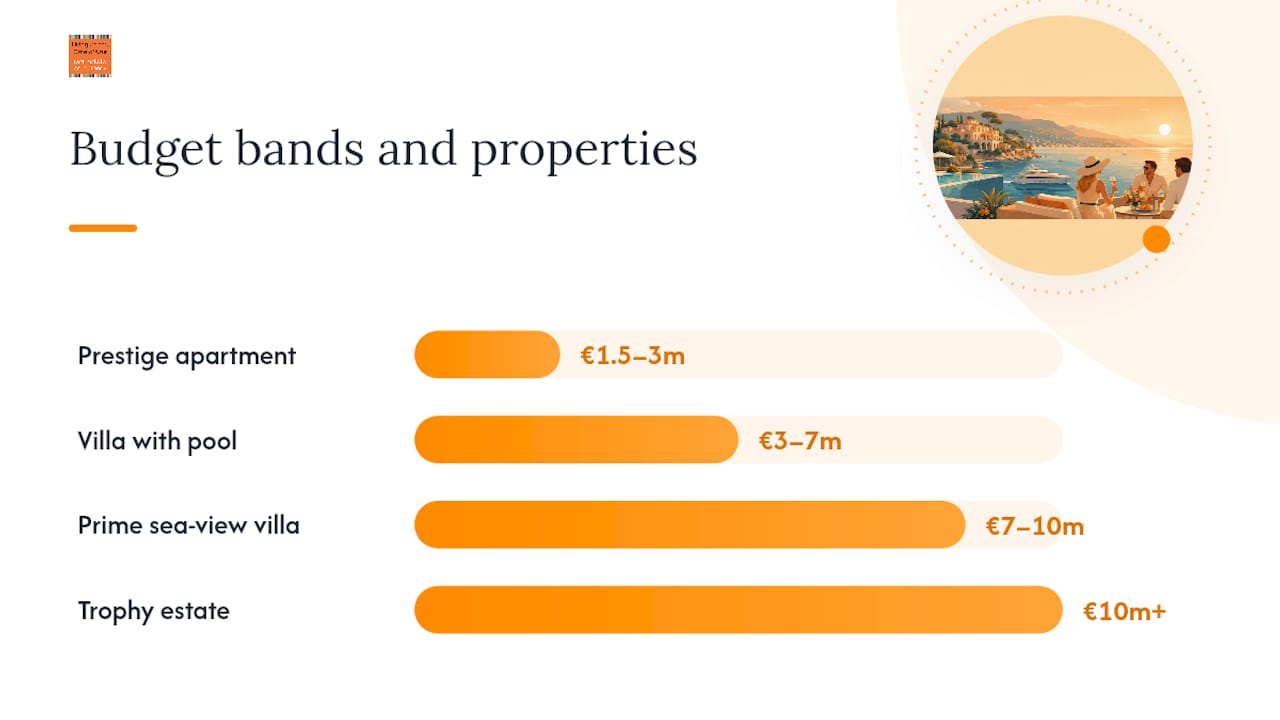
Price bands vary sharply by location, but the entry point for genuine luxury on the Côte d’Azur starts around €1.5m. Below is an indicative guide; ranges reflect current market conditions and should be treated as directional.
| Budget (indicative) | Typical property | Priority towns |
|---|---|---|
| €1.5m–€3m | Prestige apartment, 3–4 beds, sea views | Nice, Antibes, Menton |
| €3m–€7m | Villa with pool, private garden | Cannes, Mougins, Valbonne |
| €7m–€10m | Prime villa, panoramic sea views | Saint-Tropez, Théoule-sur-Mer, Èze |
| €10m+ | Trophy estate, beachfront or Monaco corridor | Monaco corridor, Cap d’Ail, Roquebrune-Cap-Martin |
The ultra-prime segment above €10m remains more volatile and less liquid than the €3m–€10m band, where international demand is most active.
Top towns and their investor profiles:
- Nice — gateway city, strong rental demand, excellent airport access, broad price range
- Cannes — festival prestige, high seasonal rental yields, strong resale liquidity
- Antibes — family-friendly, marina lifestyle, more accessible entry price than Cannes
- Saint-Tropez — trophy cachet, ultra-seasonal, best suited to legacy buyers not reliant on yield
- Monaco corridor (Cap d’Ail, Roquebrune-Cap-Martin) — proximity to Monaco tax benefits without Monaco prices
- Mougins / Valbonne — inland prestige, privacy, strong expat community and international schools
- Èze / Villefranche-sur-Mer — dramatic coastal scenery, boutique inventory, strong appreciation history
- Sainte-Maxime — Gulf of Saint-Tropez access at a lower price point, growing family demand
Pro Tip: Proximity to Nice Côte d’Azur Airport or Monaco Heliport materially affects both lifestyle convenience and resale values. A 20-minute drive to either hub commands a measurable premium.
What legal and tax steps must UK buyers take in France?
French law governs all property situated in France, regardless of the buyer’s nationality. Structuring the purchase correctly — personal name versus SCI — materially alters tax liability, succession outcomes and rental flexibility. Notaires advises every foreign buyer to consult a professional before proceeding, noting that the notaire has a statutory duty to explain all fiscal consequences.
As Quanteos explains, the ownership vehicle — personal name, SCI or company — has tangible consequences for taxation, succession and administrative obligations. An SCI can be essential for multi-owner legacy planning but carries corporate formalities and its own VAT and rental-regime implications.
Legal checklist:
- Appoint a notaire experienced with non-resident buyers
- Conduct a title search and verify planning permissions
- Check coastal protection rules (loi Littoral) and any heritage restrictions
- Confirm the matrimonial or civil partnership regime applicable to your purchase
- Decide ownership vehicle with your tax adviser before signing the preliminary contract
Key taxes to budget for:
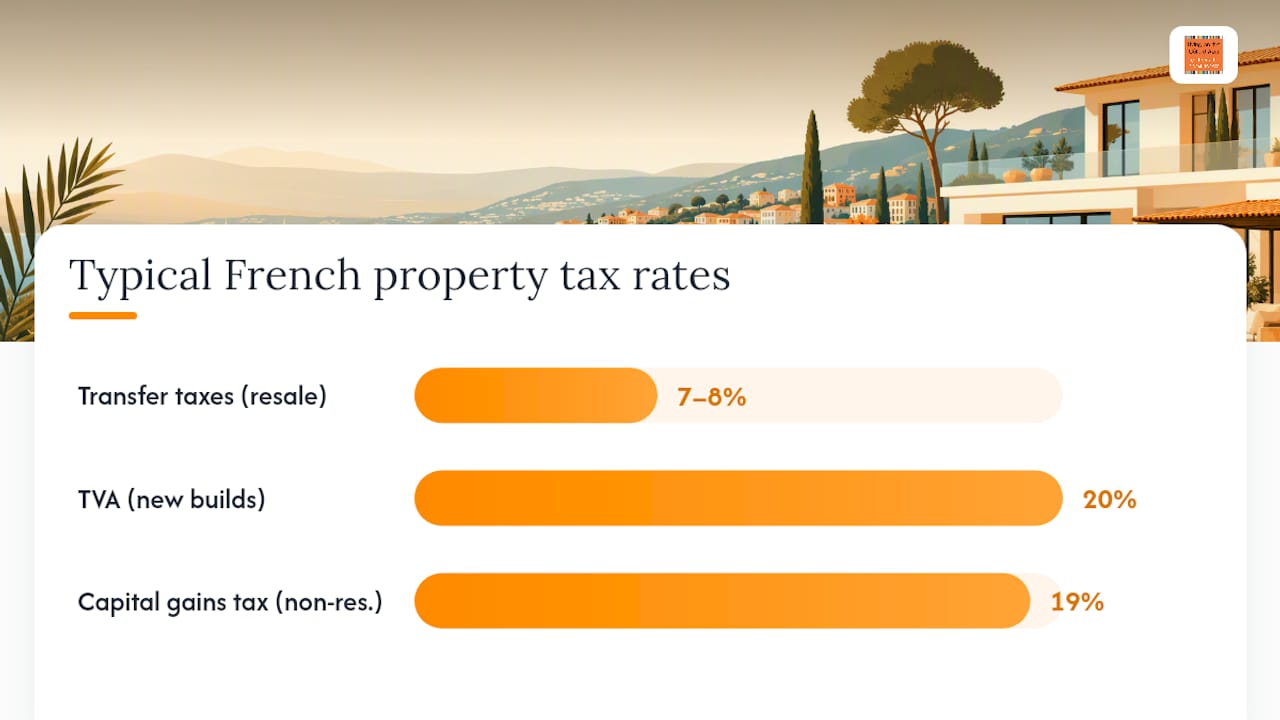
- Transfer taxes and notaire fees: typically 7–8% of purchase price on resale property (lower on new builds)
- Taxe foncière: annual land tax, varies by commune and property size
- Taxe d’habitation: largely abolished for primary residences; may apply to secondary homes
- TVA (20%): applies to new-build purchases instead of transfer taxes
- Capital gains tax: non-residents pay a 19% base rate on French property gains, with duration abatements reducing the taxable base over time
- Rental income: taxable in France; LMNP status can neutralise income tax through amortisation for furnished lettings
Pro Tip: UK buyers with children should address inheritance planning before completion. French succession law applies to French property, and without an SCI or a specific EU Succession Regulation election, forced heirship rules may override your wishes. See our guide on inheritance tax in France for the full picture.
How do you finance a Riviera purchase from the UK?
Non-resident financing is available from French banks, but the documentation bar is higher and deposits are larger than for residents. MyExpat confirms that banks commonly expect a personal deposit of 20–40% of the purchase price, with lending conditions depending on residency status and income currency.
Mortgage documentation checklist:
- Last 2–3 years of certified accounts or tax returns
- Proof of income in sterling with currency conversion statements
- French tax identification number (numéro fiscal)
- Certified proof of funds for the deposit
- Fully traceable bank-to-bank transfer records
Efficience Notaires warns that TRACFIN and AML checks are rigorous: failure to present certified proof of funds can delay or derail a transaction, particularly on competitive listings where the seller has multiple offers.
Pro Tip: Use a specialist FX service rather than a high-street bank for the transfer. The spread on a €3m transaction can cost tens of thousands of pounds at retail rates. Fix the rate forward once your offer is accepted to remove currency risk entirely.
What does the buying timeline look like, and what are the costs?
A typical Riviera purchase from initial search to notarial completion runs 3–6 months. Administrative checks and financing approval are where delays concentrate.
- Mandate and search (weeks 1–4): define criteria, access on-market and off-market listings
- Offer and negotiation (weeks 4–6): submit written offer; seller counters or accepts
- Compromis de vente (preliminary contract): signed within days of acceptance; 10% deposit held in escrow
- Due diligence period (weeks 6–14): title checks, surveys, planning verification, financing approval
- Acte authentique (notarial completion): balance transferred, keys released
| Cost item | Typical range |
|---|---|
| Deposit (held in escrow) | 10% of purchase price |
| Notaire fees and transfer taxes | 7–8% (resale); ~2–3% (new build) |
| Agency fees (where applicable) | 3–6% (often included in listed price) |
| Renovation contingency | 5–10% depending on condition |
| Annual taxe foncière | Varies by commune |
Pro Tip: Always budget a renovation contingency, even on turnkey properties. Coastal humidity, pool systems and period features routinely reveal costs that surveys miss. Ten per cent of the purchase price is a prudent reserve.
Advantages and disadvantages of buying on the Riviera
The Côte d’Azur offers genuine lifestyle and portfolio benefits, but the administrative and financial complexity is real.
Advantages:
- Portfolio diversification into a hard asset denominated in euros
- Strong rental demand in prime coastal locations, particularly Cannes and Nice
- Lifestyle value: climate, culture, gastronomy and international connectivity
- Scarcity of prime coastal inventory supports long-term price resilience
- Potential for LMNP tax efficiency on furnished rental income
Disadvantages:
- Running costs are substantial: maintenance, management fees, insurance, taxe foncière
- Tax complexity for UK non-residents requires ongoing professional advice
- Seasonal management demands for rental properties, especially in Saint-Tropez
- Ultra-prime segment (above €10m) carries liquidity risk in softer markets
- Post-Brexit visa rules limit stays to 90 days in any 180-day period without a visa
Pro Tip: Appoint a local property manager before completion, not after. The best managers in Cannes and Nice have waiting lists; securing one early removes the single largest operational headache for non-resident owners.
How do you choose the right advisor for a luxury Riviera purchase?
Choosing the right advisor is the single most consequential decision in a cross-border luxury transaction. A weak team costs far more in tax inefficiency, missed off-market opportunities and legal exposure than their fee ever saves.
Selection checklist:
- Confirmed experience with UK non-resident buyers on the Côte d’Azur
- In-house or closely partnered legal audit capability
- Tax planning and SCI structuring expertise
- Established bank introductions for non-resident mortgage applications
- Documented local agent relationships and off-market access
- Transparent fee structure with a written engagement letter
Essential services your advisor should provide:
- Full market audit and property shortlisting, including off-market inventory
- Negotiation support and offer strategy
- Legal and tax structuring (personal name, SCI, or company)
- Financing introductions and mortgage application support
- Concierge coordination for viewings, surveys and notarial appointments
Pro Tip: Request at least two client references from completed transactions in the past 18 months, and ask specifically about their experience managing TRACFIN documentation and AML compliance. Advisors who have navigated this smoothly are worth their weight.
Current market trends on the Côte d’Azur in 2026
The 2025–2026 rebound on the Riviera is selective rather than broad. Liquidity and price recovery concentrate in the most international and coastal hotspots, while the ultra-prime segment above €10m remains more volatile. Buyers now prioritise energy performance ratings, turnkey condition and scarcity of location — attributes that align with the prime real estate locations where Living On The Cote d’Azur operates. Demand from UK and American buyers has returned with conviction, and off-market transactions are increasingly the route through which the best assets change hands.
Legal and tax considerations specific to the Riviera versus other French markets
The Côte d’Azur carries specific regulatory overlays that inland French markets do not. The loi Littoral restricts development within 100 metres of the coastline, which affects renovation permissions and new-build viability. Coastal communes also apply stricter rules on short-term rental licences, and some municipalities now cap the number of nights a property may be let on platforms such as Airbnb. The secondary residence tax guide covers these distinctions in detail.
Seasonality and rental yields on the Riviera
Rental demand on the Côte d’Azur is intensely seasonal. Cannes and Nice sustain year-round occupancy through business travel, film festival periods and conference trade; Saint-Tropez is almost entirely summer-driven, with peak weeks commanding extraordinary nightly rates but long void periods in winter. Saint-Tropez yields are lower on an annualised basis but the capital appreciation argument remains strong for trophy assets.
Property types on the Riviera and their investment characteristics
Three asset classes dominate the Côte d’Azur market. Prestige apartments in Nice and Cannes offer the strongest rental liquidity and the lowest management burden — ideal for buyers who want income alongside capital growth. Villas with pools and sea views in Mougins, Valbonne or Théoule-sur-Mer suit families seeking privacy and lifestyle, with strong resale demand from the international community. Trophy estates and beachfront properties in the Saint-Tropez peninsula or the Monaco corridor are legacy assets: held for decades, rarely traded, and valued as much for exclusivity as for yield.
Visa and residency considerations for UK buyers
Post-Brexit, UK nationals are third-country citizens in France. You may visit and use a property for up to 90 days in any 180-day rolling period without a visa. Stays beyond that threshold require a long-stay visa or residency permit, applied for through the French consulate in the UK before travel. Owning property in France does not confer residency rights. If you intend to spend more than 90 days per year at your Riviera property, begin the visa application process well in advance of completion — processing times can extend to several months.
Key local regulations affecting property purchase and usage
Beyond the loi Littoral, Riviera buyers should be aware of several regulatory layers. Historic building classifications (monuments historiques and secteurs sauvegardés) restrict exterior modifications in towns such as Èze and Saint-Paul-de-Vence. Short-term rental registration is now mandatory in most coastal communes, and some have introduced quotas. Planning permissions for pool installation, terracing or extensions require prior authorisation from the local mairie, and coastal communes apply additional environmental impact assessments. The French property tax guide covers the fiscal side of these obligations in full.
Living On The Cote d’Azur: end-to-end support for UK buyers
For UK buyers who want the Riviera’s finest assets without the administrative weight of navigating French law alone, Living On The Cote d’Azur provides a genuinely differentiated service. Access to over 100,000 properties — including off-market and invisible listings that never reach public portals — means the search begins where most buyers cannot go. The team coordinates legal audits conducted by local specialists, tax optimisation and inheritance planning, financing introductions to French banks experienced with non-resident buyers, and longstanding relationships with local agents across Nice, Cannes, Antibes, Saint-Tropez, Monaco and beyond.
The practical next step: contact Living On The Cote d’Azur to commission a private market audit and receive a curated shortlist matched to your budget, structure and legacy objectives.
A considered view on timing and approach
The buyers who secure the finest Riviera properties are rarely the fastest — they are the best prepared. The current market rewards those who arrive with a clear ownership structure, pre-approved financing and a trusted local network already in place. Shoulder-season visits, particularly in October and early November, consistently reveal motivated sellers and properties that have sat quietly through summer without finding the right buyer. That is where the most interesting negotiations happen.
Sources
- Luxe immobilier 2026 : rebond record sur la Côte d’Azur — Anaxago
- Notaires
- Impots
- Myexpat
- Investir dans l’immobilier français depuis le Royaume Uni — Quanteos
This article is general information, not a substitute for advice from a qualified financial advisor. Consult a qualified financial professional about your own circumstances before acting on anything here.
FAQ
What does “chamonix immobilier” mean for a UK buyer?
In the context of this guide, it refers to luxury Côte d’Azur real estate — prestige villas, apartments and estates in locations such as Nice, Cannes, Saint-Tropez and the Monaco corridor, available through specialist advisors such as Living On The Cote d’Azur.
What capital gains tax rate applies when a UK buyer sells French property?
Non-residents pay a 19% base rate on capital gains from French property sales, as confirmed by Impots, with duration abatements reducing the taxable base over time.
How much deposit do French banks require from non-resident buyers?
What is an SCI and should UK buyers use one?
An SCI (Société Civile Immobilière) is a French property-holding company that can simplify multi-owner succession and offer tax advantages, but it carries corporate formalities and changes VAT and rental-regime obligations — professional advice is essential before choosing this structure.
How long does a Riviera property purchase take from offer to completion?
A typical transaction runs 3–6 months from accepted offer to notarial completion, with due diligence, financing approval and administrative checks accounting for most of that period.
Recommended
 //
//