
TL;DR:
- Serviced residences are fully furnished apartments offering hotel-style services for stays of one week to six months. They combine the comfort of home with professional management and all-inclusive pricing, serving corporate, relocating, and elderly guests. Regulatory requirements and market growth make these properties a flexible, cost-effective alternative to hotels and traditional rentals.
Serviced residences are defined as fully furnished apartments or houses that provide hotel-style services within a self-contained living space, designed for stays typically ranging from one week to six months. The industry term most widely used is “serviced apartment,” though “serviced residence” has gained currency particularly in the luxury and senior living segments. These properties combine the privacy and comfort of a home with the professional services of a hotel, making them a distinct category within the broader accommodation spectrum. For corporate travellers, relocating professionals, and discerning individuals seeking a curated living experience, understanding the definition of serviced residences is the first step towards choosing the right arrangement.
What features and services define serviced residences?
Serviced residences operate as a hybrid accommodation model, offering more living space than a standard hotel room at a lower nightly rate. The defining characteristic is the combination of fully equipped domestic facilities with professionally delivered services. This is not simply a furnished flat with a cleaner; it is a managed living environment with consistent standards.
The core features found across serviced residences include:
- Fully equipped kitchen: A complete kitchen with hob, oven, refrigerator, and utensils, allowing guests to prepare their own meals.
- Separate living and sleeping areas: Distinct zones that replicate a home environment rather than a single hotel room.
- Regular housekeeping: Linen changes and cleaning services delivered on a scheduled basis, typically weekly or more frequently on request.
- Concierge and reception services: On-site or remote support for bookings, deliveries, and local guidance.
- High-speed internet and utilities included: All-inclusive pricing covers utilities, broadband, and sometimes local taxes, removing the administrative burden of setting up individual accounts.
Beyond these essentials, the range of additional services varies considerably by property tier. Purpose-built serviced residence blocks in major cities often include gyms, business centres, and 24/7 reception. At the upper end of the market, residents may access private dining, valet parking, and dedicated lifestyle management.
Cost is a significant advantage. The all-inclusive pricing structure means guests know their total outlay from the outset. There are no surprise utility bills, no broadband contracts to arrange, and no furniture deposits to negotiate. For a corporate traveller on a three-month assignment, this predictability is worth a great deal.

Pro Tip: When comparing serviced residences, ask for a full breakdown of what the weekly or monthly rate includes. Properties vary widely on whether gym access, parking, and weekly cleaning are bundled or charged separately.
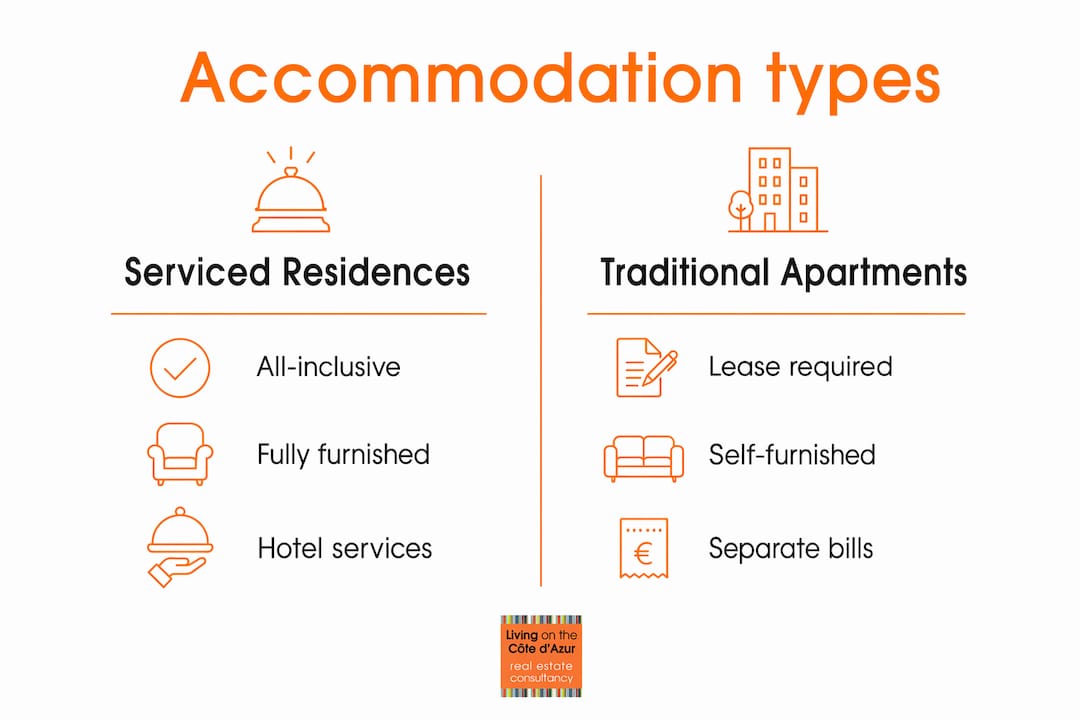
Professional management is the operational backbone of any quality serviced residence. Management firms enforce uniform cleaning standards, furniture quality, and service delivery across all units. This consistency is what separates a well-run serviced residence from an ordinary furnished let.
How do serviced residences differ from hotels, vacation rentals, and traditional apartments?
The distinction matters because each accommodation type carries different expectations, legal frameworks, and cost structures. Placing serviced residences correctly within this spectrum helps guests and investors make informed decisions.
| Feature | Serviced residence | Hotel | Vacation rental | Traditional apartment |
|---|---|---|---|---|
| Space | Full apartment layout | Single room | Variable | Full apartment layout |
| Kitchen | Fully equipped | Kitchenette or none | Usually equipped | Fully equipped |
| Housekeeping | Weekly or more | Daily | Rarely included | Not included |
| Minimum stay | One week to one month | One night | Two nights to one week | Six to twelve months |
| Pricing structure | All-inclusive monthly | Per night, itemised | Per night or week | Monthly, utilities separate |
| Management | Professional firm | Hotel operator | Owner or platform | Landlord |
| Consistency | Standardised | Standardised | Variable | Variable |
Hotels deliver daily housekeeping and on-demand room service, but the space is limited and the cost per night is substantially higher for stays beyond a fortnight. A serviced residence provides comparable service standards with the added benefit of a full kitchen, a living room, and the privacy of a self-contained home.
Vacation rentals, listed through peer-to-peer platforms, offer domestic space but rarely deliver consistent quality across bookings. The property may be immaculate one stay and poorly maintained the next, depending on the individual owner. Serviced residences, by contrast, are operated by professional management companies that enforce uniform standards across every unit.
Traditional apartment leases require tenants to set up utility accounts, source their own furniture, and commit to a minimum term of six to twelve months. Serviced residences remove all of that friction. They are ready to occupy on arrival, with no administrative setup required.
The legal distinctions are equally significant. Local governments impose regulations on serviced accommodation to protect housing availability and neighbourhood character. Zoning rules, licensing requirements, and short-term let restrictions vary by jurisdiction. In France, for example, specific legal definitions govern what qualifies as a serviced residence, particularly in the senior living segment.
Pro Tip: If you are considering a serviced residence for a stay of more than one month, always request a copy of the management company’s service level agreement. This document confirms exactly what is included and what recourse you have if standards slip.
Who benefits most from staying in serviced residences?
Corporate travellers and relocating employees represent the largest and most consistent guest segment for serviced residences. A professional on a three-month project assignment needs a space that functions as both a home and a working environment. A hotel room becomes oppressive after a fortnight; a traditional lease requires too much commitment and administrative effort.
The guest profiles that benefit most from serviced living spaces include:
- Corporate assignees: Professionals on medium-term project postings who need a stable, well-managed base without the complexity of a full tenancy agreement.
- Relocating families: Households in transition between properties who need furnished, serviced accommodation while their permanent home is being prepared or purchased.
- High-net-worth individuals: Discerning guests who value privacy, curated interiors, and consistent service standards, particularly in prestige locations such as Monaco, Saint-Tropez, or Cannes.
- Elderly residents seeking autonomy: Serviced residences designed for older adults provide private accommodation alongside communal services, including dining programmes and social activities, balancing independence with security.
- Professionals between contracts: Consultants, lawyers, and finance professionals who move between cities and require flexible leases without the penalties of breaking a fixed-term tenancy.
The financial logic is compelling for medium-term stays. A serviced residence typically costs less per month than a comparable hotel, and the all-inclusive pricing eliminates the hidden costs that accumulate in a traditional rental. There are no furniture purchases, no utility deposits, and no broadband installation fees.
For the luxury segment, the benefits extend beyond cost. A well-managed serviced residence in a prime location offers the kind of curated, consistent experience that a private rental rarely delivers. The real estate investment potential of such properties also attracts owners who wish to generate yield from a premium asset while maintaining the option to occupy it personally.
Elderly-focused serviced residences deserve particular attention. This niche has grown considerably as an ageing population seeks living arrangements that preserve independence without sacrificing security. Communal dining, social programmes, and on-site care coordination are features that standard apartments simply cannot replicate.
What are the current market trends and regulatory considerations for serviced residences?
The serviced residence sector has diversified significantly over the past decade. What began as a corporate travel product has expanded into senior living, luxury lifestyle, and extended family accommodation. This growth has attracted both opportunity and scrutiny.
The key regulatory and market developments shaping the sector in 2026 are:
Zoning and licensing requirements: Many municipalities now require operators to obtain specific licences before offering serviced accommodation. These rules exist to prevent residential housing stock from being permanently converted to short-term lets.
Tax obligations: Operators face varying tax treatments depending on jurisdiction. In some countries, serviced residences are taxed as commercial hospitality businesses rather than residential lettings, which affects both pricing and profitability.
Housing availability concerns: Local governments impose regulations to mitigate the impact of serviced accommodation on housing availability and community character. Cities including Paris, Barcelona, and Amsterdam have introduced caps on short-term let licences.
Legal definitions in France: French law, specifically Article L631-13 of the Building and Housing Code, defines serviced residences for the elderly by specifying that services must be communal and non-individualised. This legal precision distinguishes them from standard apartments and from other senior living formats.
Professional management as a compliance tool: Operators who use professional management firms are better positioned to meet regulatory requirements. Standardised record-keeping, licensing compliance, and guest vetting are far easier to maintain under a professional management structure.
The real estate trends of 2025 and 2026 show that demand for flexible, serviced living spaces continues to outpace supply in prime urban and coastal markets. This supply gap creates genuine opportunity for investors willing to navigate the regulatory environment carefully.
The luxury end of the market is particularly resilient. Prestige locations on the Côte d’Azur, for example, attract guests who are largely insulated from economic cycles. A well-positioned serviced residence in Cannes or Cap d’Antibes commands premium rates year-round, not merely during the summer season.
Regulatory note: The property management landscape on the Côte d’Azur reflects these broader trends. Professional management is no longer optional for operators seeking to maintain both compliance and asset value.
Key takeaways
Serviced residences are the most practical and cost-effective accommodation choice for medium-term stays, combining home comfort, professional management, and all-inclusive pricing in a single arrangement.
| Point | Details |
|---|---|
| Core definition | Serviced residences are fully furnished units with hotel-style services for stays of one week to six months. |
| All-inclusive pricing | Utilities, internet, and housekeeping are bundled into one predictable monthly cost. |
| Professional management | Management firms enforce consistent quality standards, which is the primary advantage over vacation rentals. |
| Regulatory complexity | Zoning, licensing, and tax rules vary by jurisdiction and require careful compliance from operators. |
| Diverse guest profiles | Corporate assignees, relocating families, elderly residents, and luxury travellers all benefit from serviced living. |
Why I think serviced residences are misunderstood by most property buyers
Most people encounter the term “serviced apartment” and assume it means a hotel room with a kitchenette. That assumption undersells the category considerably. Having worked with clients across the Côte d’Azur for many years, I have seen how a well-chosen serviced residence can function as a genuinely superior living arrangement, not merely a stopgap between leases.
The misconception I encounter most often is that serviced residences are expensive. They are not, when you account for the full cost of the alternative. A traditional rental in Monaco or Saint-Tropez requires a furniture budget, utility deposits, broadband contracts, and a minimum twelve-month commitment. A serviced residence eliminates every one of those costs and obligations. For a client relocating from London to the Riviera, the financial case for a serviced residence during the first six months is almost always compelling.
The second misconception is that quality is inconsistent. This was true a decade ago, when the sector was dominated by individual operators with no standardised approach. Today, professionally managed properties deliver uniform standards that rival the best hotels. The key is selecting a property operated by a firm with a verifiable track record, not simply the cheapest option available.
The niche I find most underappreciated is the elderly-focused serviced residence. The combination of private living space, communal dining, and social programming addresses a genuine gap in the market. Clients who have placed ageing parents in these environments consistently report that the balance of autonomy and community support is far superior to either a care home or an isolated private flat.
My honest view is that the serviced residence sector will continue to grow, particularly at the luxury end. The demand for flexible, curated living arrangements is not a temporary trend. It reflects a permanent shift in how affluent, mobile professionals and families think about where and how they live. If you are considering owning multiple residences across different locations, a serviced residence in a prime market is often the most elegant entry point.
— Ab Kuijer
Luxury serviced residences on the Côte d’Azur with Livingonthecotedazur
Livingonthecotedazur connects discerning clients with over 100,000 properties across the most prestigious addresses on the French Riviera, from Monaco to Saint-Tropez. For those seeking a serviced residence that combines curated interiors with professional management and genuine investment potential, the Côte d’Azur remains one of the world’s most compelling markets. Our team provides personalised guidance, legal audit support, and tax optimisation advice at every stage of the process. Whether you are seeking a flexible base for extended stays or a prestige asset that generates yield, we invite you to explore our off-market luxury properties on the Riviera. The finest residences rarely appear on public listings.
FAQ
What is the definition of serviced residences?
Serviced residences are fully furnished apartments or houses that provide hotel-style services, including housekeeping, concierge, and all-inclusive utilities, for stays typically ranging from one week to six months.
How do serviced residences differ from standard apartments?
Standard apartments require tenants to arrange their own furniture, utilities, and services under a fixed-term lease. Serviced residences arrive fully equipped and managed, with all costs bundled into a single monthly payment.
Are serviced residences suitable for long-term stays?
Yes. Many serviced residences cater specifically to stays of one to six months, making them well-suited to corporate assignees, relocating professionals, and individuals in property transitions.
What regulations apply to serviced residences in France?
French law, under Article L631-13 of the Building and Housing Code, defines specific service requirements for serviced residences, particularly those serving elderly residents. Operators must also comply with local zoning and licensing rules that govern short-term accommodation.
What types of guests use serviced residences most often?
Corporate travellers, relocating employees, high-net-worth individuals, and elderly residents seeking independent living with communal support are the primary guest profiles for serviced residences.
Recommended
 //
//