
TL;DR:
- Super-prime real estate represents the top 1% of properties characterized by irreplaceable land, bespoke architecture, and scarcity. These assets prioritize legacy and long-term wealth preservation over liquidity, often exchanged in private, off-market transactions. Genuine super-prime properties are defined by their unique location, architectural significance, and the ability to exist nowhere else.
Super-prime real estate is defined as the top 1% of residential properties by market value, characterised by irreplaceable location, bespoke architecture, and a level of scarcity that places these assets beyond the reach of conventional luxury. In London, the threshold typically begins at £10 million or £4,000 per square foot. On the Côte d’Azur, the benchmark shifts to prestige of a different order: a Belle Époque villa on Saint-Jean-Cap-Ferrat or a cliff-top estate above Èze, where the Mediterranean light itself becomes part of the asset. These properties do not simply appreciate. They endure, generation after generation, as tangible expressions of legacy and discernment.
What characteristics define super-prime real estate?
Super-prime property is distinguished not by price alone, but by a constellation of attributes that, together, create genuine irreplaceability. Understanding these features is the first step towards evaluating whether a property truly belongs in this category or merely carries the label.
The defining hallmarks include:
- Irreplaceable land value. Waterfront positions in Beaulieu-sur-Mer, historic plots within the ramparts of Saint-Paul-de-Vence, or Cap d’Antibes headland parcels cannot be replicated. The land itself is the primary asset, and its scarcity underpins long-term value resilience.
- Architectural significance. Landmark architecture and master craftsmanship are non-negotiable. Whether a Provençal bastide restored by a celebrated atelier or a contemporary villa designed by a Pritzker-recognised architect, the construction standard must be genuinely bespoke, not merely expensive.
- Exceptional private amenities. Private wellness suites, cinemas, and underground parking are standard expectations, not aspirational extras. Pools, private bars, and dedicated staff quarters complete the picture.
- Advanced security infrastructure. 24/7 surveillance, biometric access, and integrated panic rooms reflect the privacy expectations of ultra-high-net-worth buyers. Discretion is engineered into the property itself.
- Soft infrastructure. Concierge services, proprietary security teams, and professional estate management are critical components of super-prime value. These ongoing operational layers add both cost and distinction to ownership.
- Micro-location precision. On the Côte d’Azur, the difference between a property in Roquebrune-Cap-Martin with a direct Monaco border view and one set back by 200 metres can represent a price differential of 30% or more. Micro-location is everything.
Pro Tip: When evaluating a property marketed as super-prime, verify authentic scarcity beyond the brochure. Request independent architectural assessments, land registry records, and comparable off-market transactions. The label is applied loosely; the genuine article is rare.
How does super-prime real estate differ from prime properties?
The distinction between prime and super-prime is not merely a matter of adding zeros to the price. The two segments operate by fundamentally different rules, attract different buyers, and serve different financial objectives.

Prime real estate occupies the top 5 to 10% of the residential market by value. It offers relatively transparent pricing, reasonable liquidity, and a buyer pool large enough to support competitive bidding. A prime villa in Cannes or a premium apartment in Nice’s Mont Boron district can be listed publicly, attract multiple qualified buyers, and transact within a predictable timeframe.
Super-prime operates in a different register entirely. Supply is structurally constrained. Pricing is opaque, negotiated privately, and rarely disclosed. The buyer pool is global but thin, comprising sovereign wealth, inherited dynasties, and a new generation of digital wealth seeking to convert liquid assets into stone that endures.
| Point | Prime real estate | Super-prime real estate |
|---|---|---|
| Market position | Top 5 to 10% by value | Top 1% by value |
| Pricing transparency | Publicly listed, comparable data available | Opaque, off-market, privately negotiated |
| Liquidity | Moderate to good | Low, by design |
| Primary buyer motivation | Investment return and lifestyle | Capital preservation and legacy |
| Transaction method | Standard agency process | Private networks and boutique brokers |
| Côte d’Azur example | Premium apartment, Nice or Cannes | Waterfront estate, Saint-Jean-Cap-Ferrat or Cap d’Antibes |
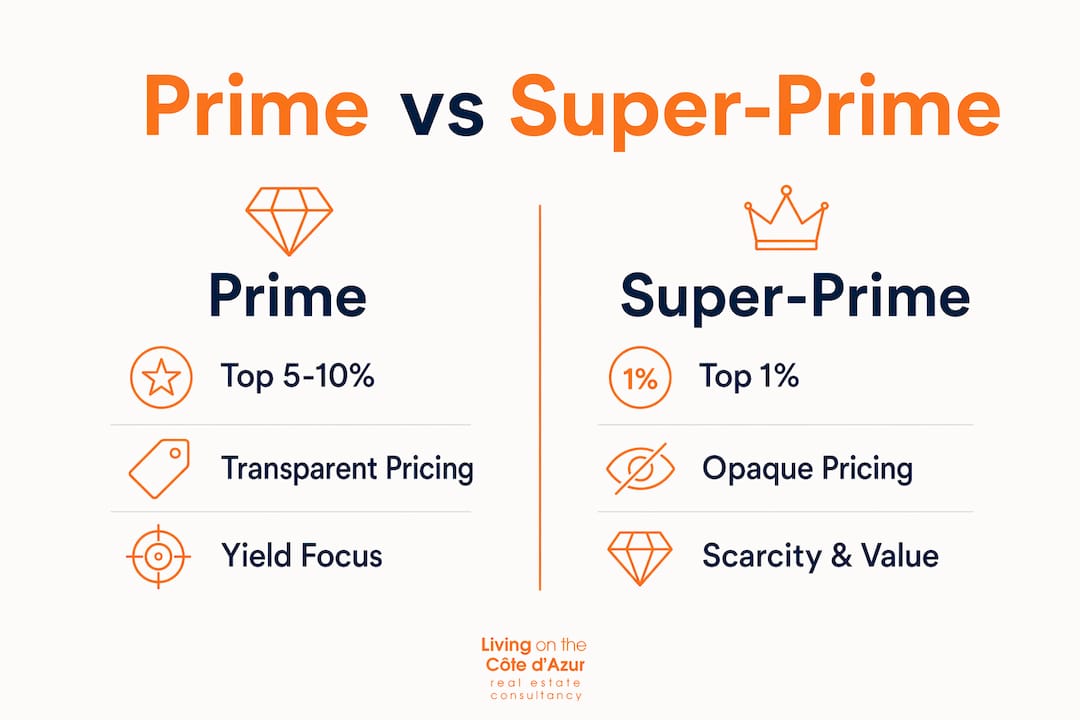
The investment logic also diverges sharply. Prime buyers weigh yield, rental income, and resale timelines. Super-prime buyers prioritise legacy and long-term wealth preservation over short-term gains or liquidity. This distinction shapes every aspect of how these assets are acquired, held, and eventually transferred.
Why do investors and luxury buyers prioritise super-prime real estate?
The motivations behind super-prime acquisition are strategic as much as they are emotional. For high-net-worth families and global investors, these properties serve a purpose that transcends lifestyle.
- Capital preservation in volatile markets. Super-prime assets behave like alternative investments, insulated from interest rate cycles because transactions are predominantly cash-based. When equity markets contract and bond yields fluctuate, a clifftop estate above Èze or a walled domain in Mougins holds its value with a composure that financial instruments rarely match.
- Safe-haven status. Prestigious villages on the Côte d’Azur, from Théoule-sur-Mer to Roquefort-les-Pins, carry a heritage premium that global buyers recognise and seek. The legacy and ROI of high-net-worth real estate on the Riviera is well-documented, with select properties appreciating 5 to 8% annually over the long term.
- Supply constraints as a value driver. There will never be another Belle Époque villa on the Cap Ferrat peninsula. There will never be another plot overlooking the Lérins islands from the heights of Le Cannet. Finite supply, combined with growing global demand from wealth concentrated in Asia, the Gulf, and the Americas, creates structural upward pressure on values.
- Lifestyle and privacy. The Côte d’Azur calendar adds a dimension that pure financial analysis cannot capture. The Cannes Film Festival in May, the Monaco Grand Prix, the Menton Lemon Festival each February, and the regattas that animate Antibes’ harbour through summer create a backdrop of cultural richness that enhances the ownership experience and the property’s desirability.
- Intergenerational wealth transfer. The advantages of holding luxury assets for long-term legacy are particularly pronounced in France, where carefully structured ownership can facilitate tax-efficient succession planning.
Pro Tip: Do not treat super-prime as a single asset class. The most resilient portfolios we see at Livingonthecotedazur combine a primary Riviera estate with a portfolio of curated income-generating luxury properties in villages like Valbonne, Mouans-Sartoux, or Saint-Laurent-du-Var, balancing capital preservation with seasonal rental yield.
How is the super-prime property market accessed?
The mechanics of acquiring a super-prime property bear little resemblance to a standard real estate transaction. Understanding the process is as important as understanding the asset itself.
- Cultivate specialist relationships first. Most super-prime listings never reach public portals. They circulate within private networks of boutique brokers, family offices, and trusted intermediaries. Your first investment is in relationships, not searches.
- Engage a boutique specialist with genuine local knowledge. A broker who understands the difference between a Grasse hinterland domain and a Châteauneuf-Grasse estate, or who can explain why a Beausoleil address commands a Monaco-adjacent premium, is worth considerably more than a generalist agency with a glossy website.
- Prepare for cash-based transactions. Super-prime deals are predominantly cash purchases, which accelerates timelines and simplifies negotiations but requires buyers to have liquidity structures in place before approaching sellers. Livingonthecotedazur also accepts cryptocurrency payments, reflecting the reality that digital wealth is now a primary source of capital for this buyer profile.
- Commission independent legal and technical due diligence. French property law requires careful attention to title clarity, notarial audits, and in coastal zones, compliance with the Loi Littoral. A step-by-step luxury transaction guide is an indispensable resource before any offer is made.
- Respect discretion throughout. Sellers of super-prime properties are often as concerned with privacy as buyers. Approaching a transaction with the appropriate level of confidentiality signals seriousness and builds the trust that unlocks the best opportunities.
The Côte d’Azur market adds a further nuance: the most coveted properties in villages like Cap-d’Ail, Biot, or Tourrettes-sur-Loup are held by families who have owned them for generations and sell only when the right buyer presents the right terms. Patience and reputation are as valuable as capital.
Key takeaways
Super-prime real estate is the top 1% of residential properties, defined by irreplaceable location, bespoke construction, and a market structure built on privacy, scarcity, and long-term capital preservation.
| Point | Details |
|---|---|
| Core definition | Super-prime is the top 1% of residential real estate by value, not merely the most expensive listing. |
| Distinguishing features | Irreplaceable land, landmark architecture, biometric security, and professional estate management set it apart. |
| Prime vs super-prime | Prime offers liquidity and transparency; super-prime prioritises capital preservation and operates off-market. |
| Investment rationale | Safe-haven status, supply constraints, and legacy wealth transfer drive super-prime acquisition decisions. |
| Market access | Most opportunities require specialist broker relationships and readiness for cash-based, off-market transactions. |
Why the label matters less than the land
After years of working with discerning buyers across the Côte d’Azur, from the lavender-scented hills above Grasse to the salt-kissed corniches of Roquebrune-Cap-Martin, the single observation I return to most often is this: the word “super-prime” is applied far more liberally than it is deserved.
I have seen properties marketed with that designation that lacked any genuine claim to irreplaceability. The price was high. The finishes were expensive. But the land could be replicated, the architecture was competent rather than significant, and the location, while pleasant, was not the kind that makes a buyer’s breath catch. That is not super-prime. That is expensive.
The properties that genuinely qualify share one quality above all others: you cannot imagine them existing anywhere else. A Belle Époque villa on Saint-Jean-Cap-Ferrat does not merely occupy a prestigious address. It is the address. The same is true of a walled domain above Èze, where Nietzsche once walked and the Mediterranean stretches to the horizon without interruption.
My advice to first-time buyers in this segment is to resist the marketing and focus on the land. Ask whether the location is genuinely irreplaceable. Ask whether the architecture would be considered significant in fifty years. Ask whether the property could be sold discreetly to a qualified buyer within twelve months if circumstances required it. If the answers are yes, you are looking at a true super-prime asset. If there is hesitation, you are looking at something else, however beautifully it is presented.
— ab
Discover exclusive off-market properties on the Côte d’Azur
At Livingonthecotedazur, we specialise in connecting discerning buyers with properties that never appear on public portals. Our invisible luxury properties on the Côte d’Azur represent the most coveted estates in villages from Beaulieu-sur-Mer to Mougins, curated for buyers who understand that true value is rarely advertised. Whether you are seeking a legacy estate for your family, a capital-preservation asset in a supply-constrained market, or a prestige property that generates elite seasonal rental income, our private network gives you access that no search engine can replicate. We accept cryptocurrency payments and work with buyers across Europe, the Gulf, Asia, and the Americas. Speak with us to begin your search in confidence.
FAQ
What is the definition of super-prime real estate?
Super-prime real estate is the top 1% of residential properties by market value, characterised by irreplaceable location, bespoke architecture, and advanced private amenities. In London, the threshold begins at approximately £10 million; on the Côte d’Azur, it is defined by prestige villages and genuine scarcity rather than price alone.
What is ultra-prime real estate and how does it differ?
Ultra-prime is a term used interchangeably with super-prime in many markets, though some analysts reserve it for the very apex of the super-prime segment, typically trophy assets with global cultural significance. The distinction is not legally defined and relies on expert judgement rather than binding thresholds.
Why do super-prime properties hold their value better than other luxury assets?
Super-prime assets maintain value independently of interest rate fluctuations because they are acquired predominantly through cash purchases focused on capital legacy rather than leveraged investment. Supply constraints and irreplaceable location create structural resilience that mainstream property cannot match.
How do buyers access super-prime properties on the Côte d’Azur?
Most super-prime opportunities on the Côte d’Azur are transacted off-market through private broker networks. Villages such as Saint-Jean-Cap-Ferrat, Cap d’Antibes, and Èze rarely see their finest estates listed publicly. Specialist relationships and a reputation for discretion are the primary keys to access.
What soft infrastructure should I expect from a genuine super-prime property?
Genuine super-prime ownership includes professional estate management, concierge services, and proprietary security as standard operational layers. These services add significant ongoing cost but are integral to maintaining the property’s condition, privacy, and long-term value.
Recommended
 //
//